
****

****
Lisätiedot: Soundtools
Kitarablogi.com – Finland's premier Guitar and Bass blog
Juttuja kitaroista ja bassoista

****

Orange Amplification have a long and illustrious tradition in the building of guitar and bass amplifiers, a fact that shows in many of the company’s current products.
But that doesn’t mean that Orange are a backward-facing company – far from it. The brand-new Terror Bass combo, for example, is very much a contemporary product – a compact, yet powerful valve-hybrid amp.
****

The Orange Terror Bass TB500C-212 (current RRP in Finland: 994 €) melds the company’s 500-Watt BT-500H-head with their 2 x 12″ SP-212-cabinet.
The Orange TB500C is a valve-hybrid amplifier, which in this case means that its preamp section is powered by two 12AX7 valves. The tubes imbue the combo with a warm basic tonality, nicely seasoned with mild and organic compression. I’d also wager that a bit of overdrive will be on the menu at some point.
The power amp, on the other hand, uses modern technology to its best advantage: A Class D amplifier manages to produce lots of volume in a very energy efficient way. Because this technology cuts down drastically on heat dissipation as a byproduct of amplification, manufacturers are now able to build smaller and lighter amps.

Orange’s Smart Power bass cabinets are built according to the isobaric principle.
An isobaric speaker cabinet basically uses two identical speakers – in the TB500C’s case two 12-inch neodymium speakers – mounted one behind the other in a straight line, resulting in fatter tones and more sound pressure than you’d expect from a relatively compact design.
Take a look at Orange’s own video to get more of an insight into their Smart Power cabinets:

But we bassists needn’t trouble ourselves with too much theory, we only have to use the combo.
The front panel is typical of Orange-amps: There are the famous pictograms above the clearly labelled controls for gain and master volume, as well as the three-band EQ section, which make it even easier to know your way around the amp.

The amplifier section is connected to the combo’s speaker using the provided Speakon-lead.
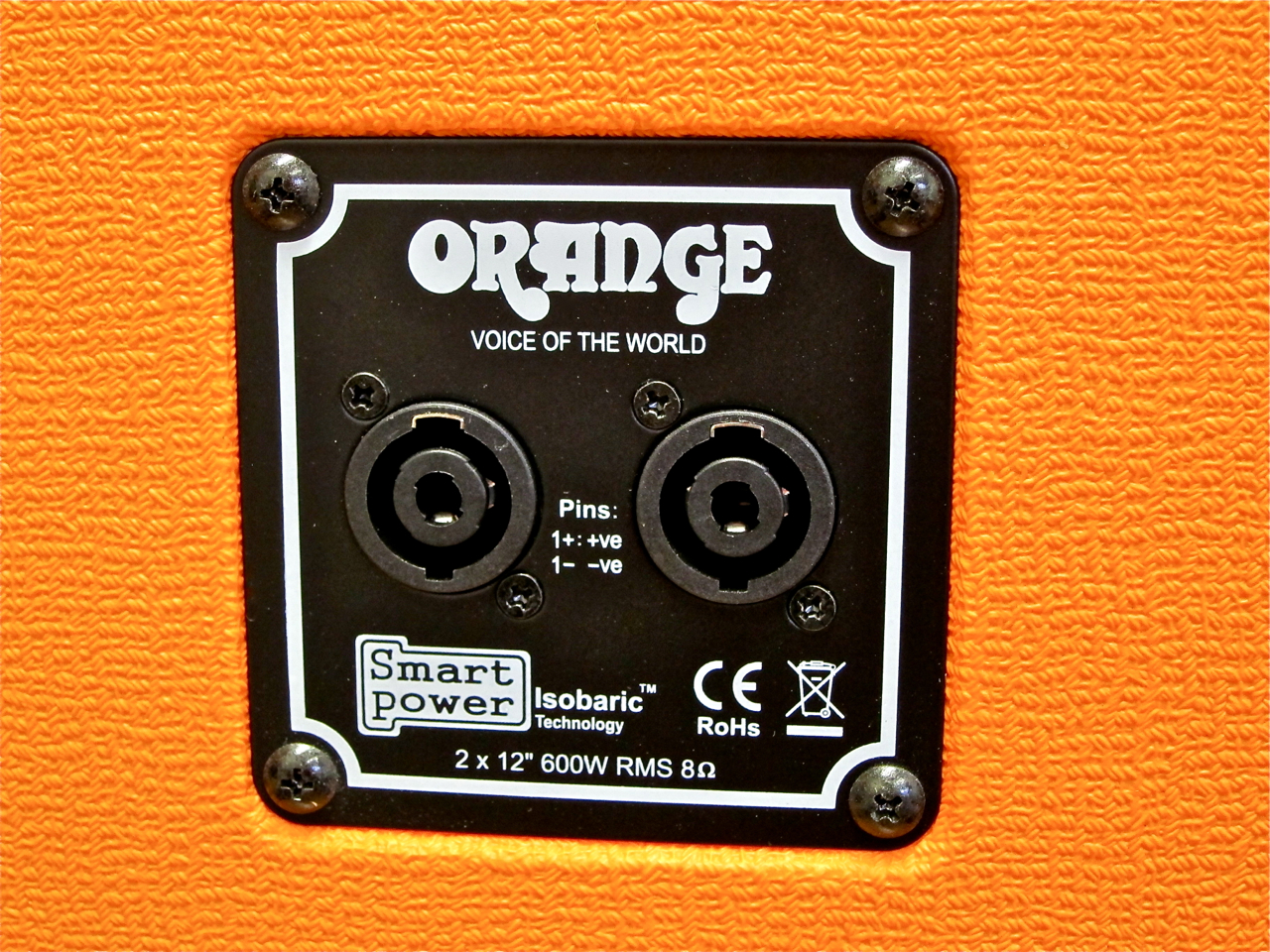
Because the amplifier allows you to daisy-chain two cabinets…
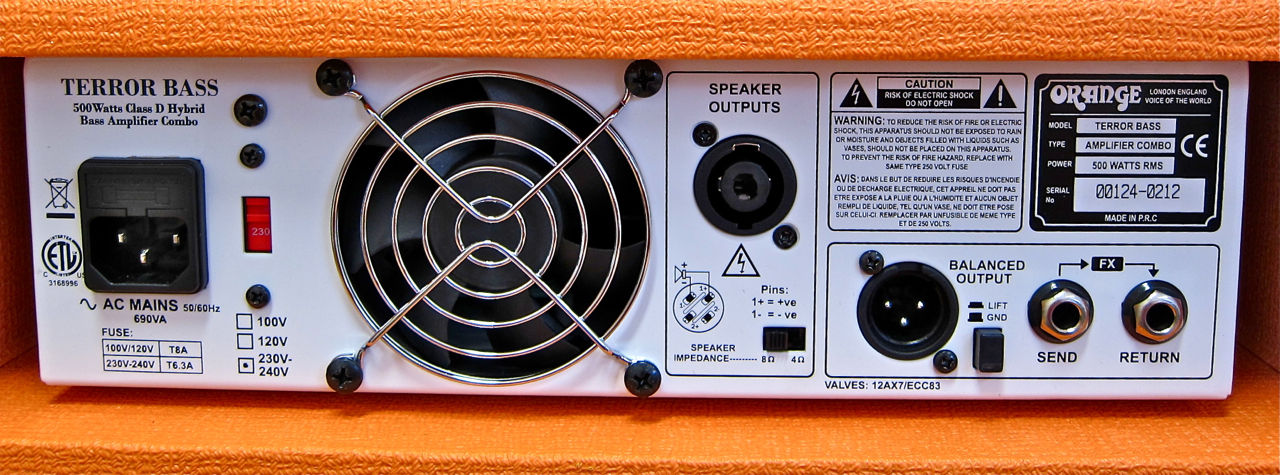
…you will find the necessary impedance switch on the back panel underneath the Speakon-jack.
The other connectors on the back panel are for the effects chain and the balanced DI-output.
****

Whoa, watch out – this combo is a real shouter!
I’ve got to admit right away that I tend to dislike the use of single 12-inch speakers in bass amps. More often than not I find these designs to lack real bottom end and transparency in their tonal delivery.
But this isn’t a thing that you could accuse the Orange Terror Bass of, by any stretch of the imagination! The isobaric Smart Power cabinet is quite a different beast, sounding large and muscular, with more than enough clarity and punch for most applications.
In terms of its basic sound the Orange TB500C is clearly a dyed-in-the-wool, card-carrying member of the Orange-family: If you’re looking for extreme clarity and hi-fi-style response, this isn’t really the right amp for you. We’re talking about earthy and muscular bass tones here. Dialling in more gain gradually adds delicious grit and graininess to proceedings. Above 3 o’clock on the gain control any bass will drive the Orange well into classic, glorious overdrive.
Even though the Terror Bass combo is part of Orange’s cost-conscious Terror-range, I am rather sure this powerful and compact bass amp will find its way into many professional backlines.
I recorded the audio clips using my trusty Japanese 1985 Squier Jazz Bass and my own P-Man bitser equipped with a MM-humbucker and passive controls:
****
Orange Terror Bass TB500C-212
current RRP in Finland: 994 €
Finnish distributor: Musamaailma
Pros:
+ size
+ power
+ valve preamp
+ sound
+ weight
****

****
Orange Amplificationilla on hyvin pitkä perinne kitara- ja bassovahvistimien valmistuksessa, ja se näkyy monissa firman nykyisissä tuotteissakin.
Se ei kuitenkaan tarkoita, ettei Orange olisi avoin myös uudelle teknologialle. Esimerkkinä kelpaa hyvin upouusi Terror Bass -kombo, joka on kompakti, mutta silti tehokas nykyaikainen putkihybridivahvistin.
****
Orange Terror Bass TB500C-212 (994 €) yhdistää firman 500-wattisen BT-500H-nupin ja kahdella 12-tuumaisella varustetun SP-212-kaapin yhdeksi kombovahvistimeksi.
Orange TB500C on putkihybridivahvistin, mikä tarkoittaa Bass Terrorin tapauksessa, että sen etuvahvistin on rakennettu käyttäen kahta 12AX7-putkea. Putkilla saa aikaiseksi lämpimän perussoundin, joka on valmiiksi höystetty miedolla ja orgaanisella kompressiolla, ja myös aitoa putkisäröä voi odottaa tästä kombosta.
Päätevahvistin taas käyttää huipputehokasta, mutta kevyttä nykyteknologiaa: D-luokan päätevahvistin pystyy tuottamaan paljon ääntä – tässä tapauksessa 500 wattia (rms) – hyvin kompakteilla komponenteilla ja energiatehokkaasti vähällä hukkalämmöllä.
Orangen Smart Power -bassokaapit rakennetaan isobaarisen toimintaperiaatteen mukaisesti.
Isobaarisessa kaapissa käytetään kahta samanmallista kaiutinta – TB500C:n tapauksessa kaksi 12-tuumaista, kevyttä neodyymi-kaiutinta – asennettuna peräkkäin samassa linjassa. Lopputulos on syvempi bassotoisto ja isompi äänenpaine verrattuna samankokoiseen perinteiseen bassokaappiin.
Tässä on Orangen oma video, jossa Smart Power -kaappien isobaarista teknologiaa esitellään tarkemmin:
Mutta Orange Terror Bass -kombo ei vaivaa basistia lainkaan sen sisäisellä teknologialla.
Ulospäin näkyy vain varsin perinteinen Orange-etupaneeli, joka tarjoaa gain- ja master-säätimien lisäksi kolmialueisen EQ-osaston.
Vahvistimen- ja kaappipuolien liittäminen tapahtuu mukaantulevalla Speakon-johdolla.
Koska kaksi Orange-kaappia pystyy ketjuttaa…
…löytyy vahvistimen takapaneelista kaiutinlähdön alla myös impedanssikytkin.
Muut liittimet ovat efektilenkin lähtö- ja tulojakki, sekä balansoitu DI-lähtö mikseriin.
****
Whoa, watch out – tästä paketista lähtee rutkasti ääntä!
Täytyy myöntää, etten ole yksittäisellä 12-tuumaisella varustettujen bassokombojen suurin ystävä. Usein niiden soundi on melko honottava ja vähän puuroinen alhaisessa keskialueessa.
Orangen Terror Bass -kombo on kuitenkin ihan oma tapauksensa! Isobaarinen Smart Power -kaappi kuulostaa ilahduttavan isolta ja lihaksikkaalta, ja myös potkua löyttyy mielin määrin.
Soundillisesti Orangen TB500C kuuluu selvästi samaan perheeseen kuin muut Orangen bassovahvistimet: täällä ei hifistellä, vaan tarjolla on reilu annos maanläheistä bassottelua. Gain-namikan avaaminen lisää menoon aluksi vain hieman lämpöä ja särmikästä rosoisuutta, mutta liikeradan loppupuoliskolla astuu kuvaan myös herkullista putkisäröä.
Vaikka Terror Bass -kombo on osaa Orangen edullisemmasta Terror-sarjasta, olen melko varma, että tämä voimapesä löytää tiensä myös monen ammattibasistin backlineen.
Äänitin seuraavat esimerkipätkät japanilaisella Squier Jazz -bassolla, sekä passivisella MM-humbuckerilla varustetulla P-Man-bassollani:
****
Orange Terror Bass TB500C-212
994 €
Maahantuoja: Musamaailma
Plussat:
+ koko
+ teho
+ putkietuaste
+ soundi
+ paino
****

****
At NAMM 2012 Ampeg introduced their second micro stack to the public – the Ampeg Micro-CL.
The company’s first foray into this market segment came in the guise of the very successful Micro-VR (currently still available), which is a 200 Watt miniature version of Ampeg’s classic 1970s SVT. The brand-new Micro-CL takes its starting point from the Eighties version of the venerable Ampeg bass stack (the SVT-CL), offering 100 Watts of bass tone.

Ampeg’s Micro-CL -stack (current RRP in Finland: 505 €) brings the company’s classic look down to an easily manageable size.
The solid-state head weighs in at only about six kilos, with the cabinet clocking in at a very moderate 15 kg. The whole miniature stack is only about 80 cm tall – making it a very easy fit with almost any car boot.
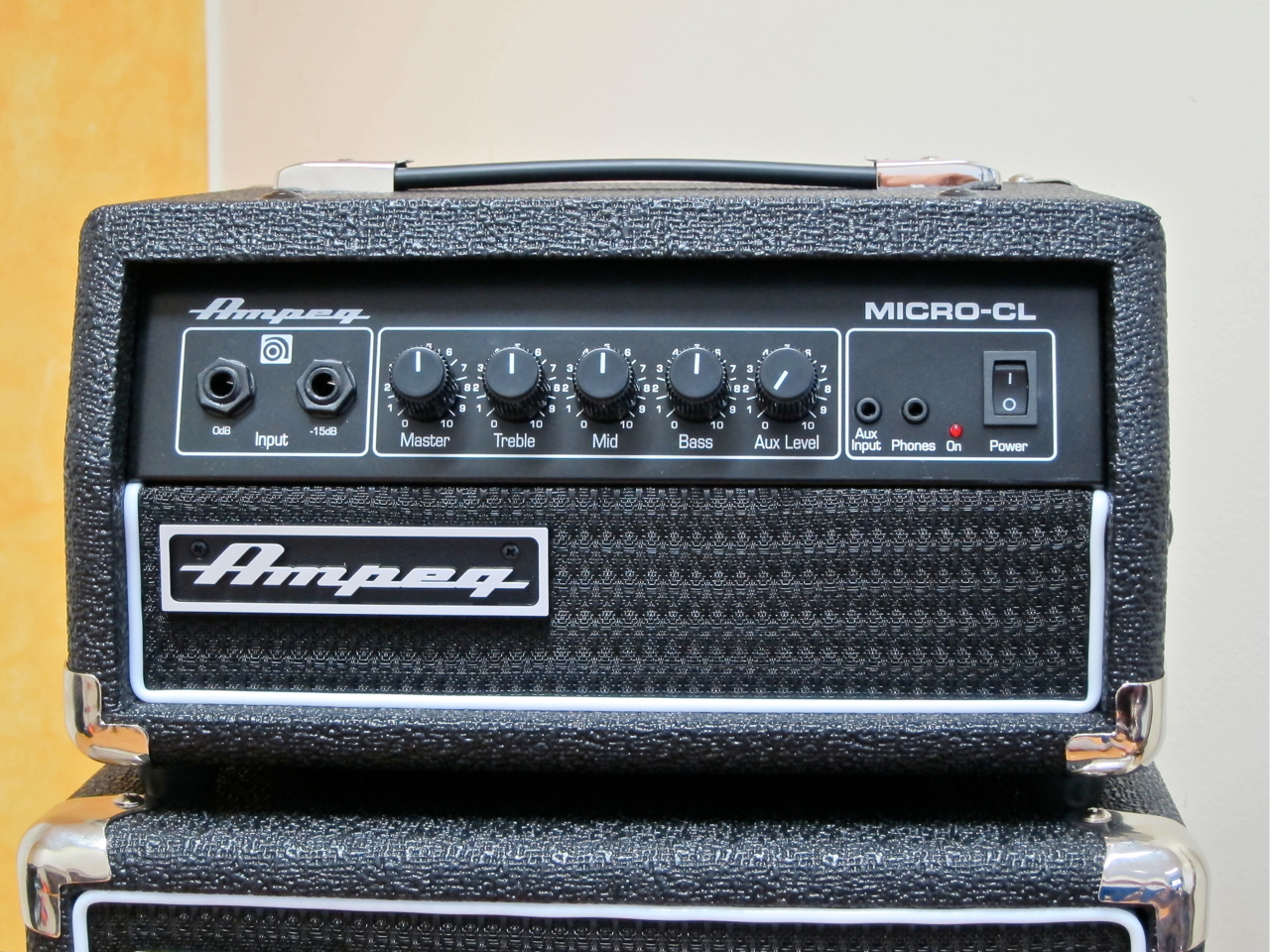
The Micro-CL-head comes equipped with two inputs – one for passive and the other for active bass guitars – as well as a three-band EQ-section.
Because this amp is also very handy as a practice amp at home, Ampeg have added an Aux-input (with its own volume control) and a headphones output to the front panel.
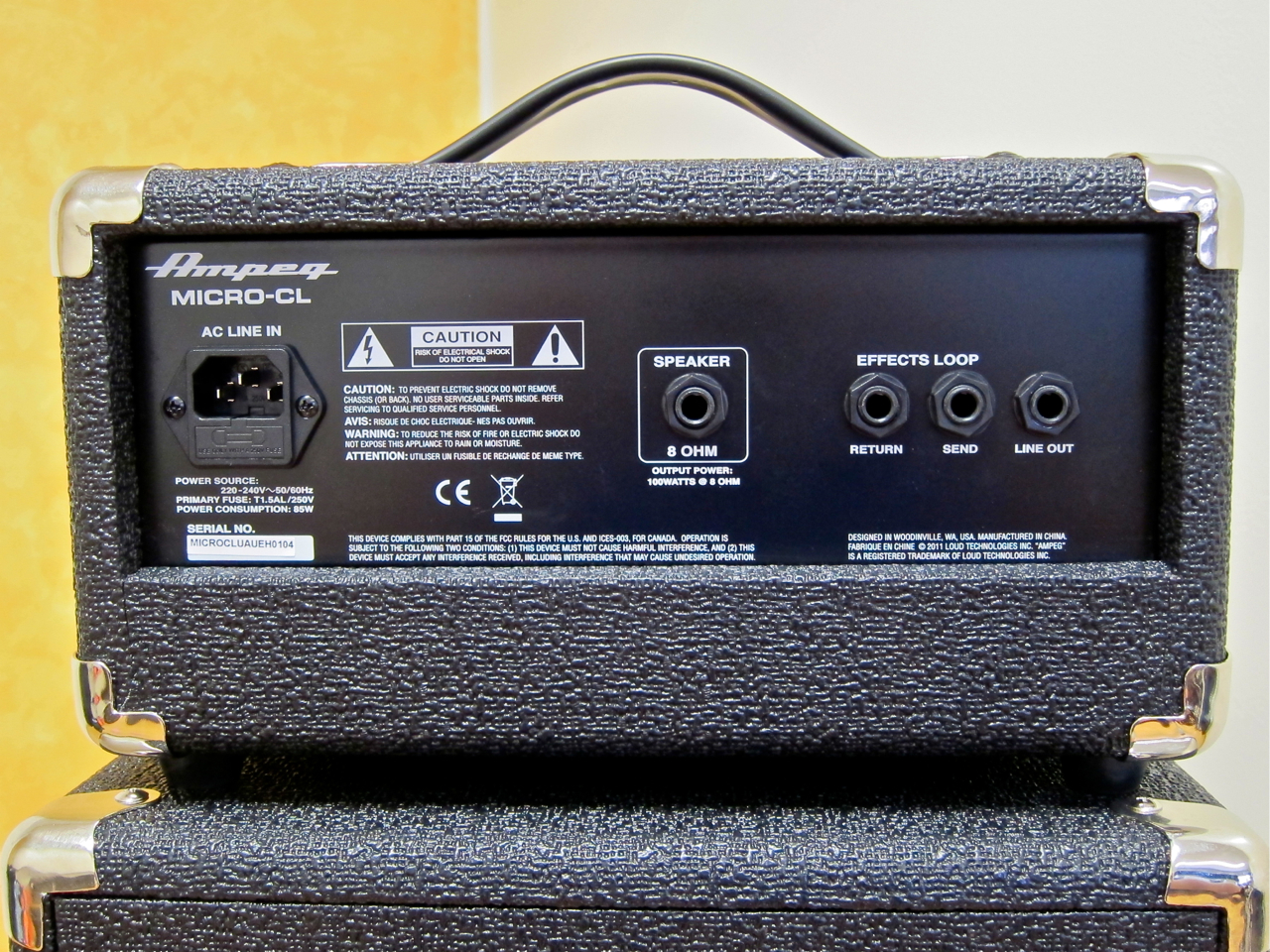
On the head’s flip side you’ll find the speaker output, as well as phone jacks for the effects loop and the line-level output.

The stack’s cabinet – called the Ampeg MC-210E – is built using the same Infinite Baffle -principle also applied to the company’s famous (and huge) 8 x 10″ cabinets.

The completely enclosed cab comes loaded with two 10-inch speakers. The front grille is attached in the traditional way using velcro.
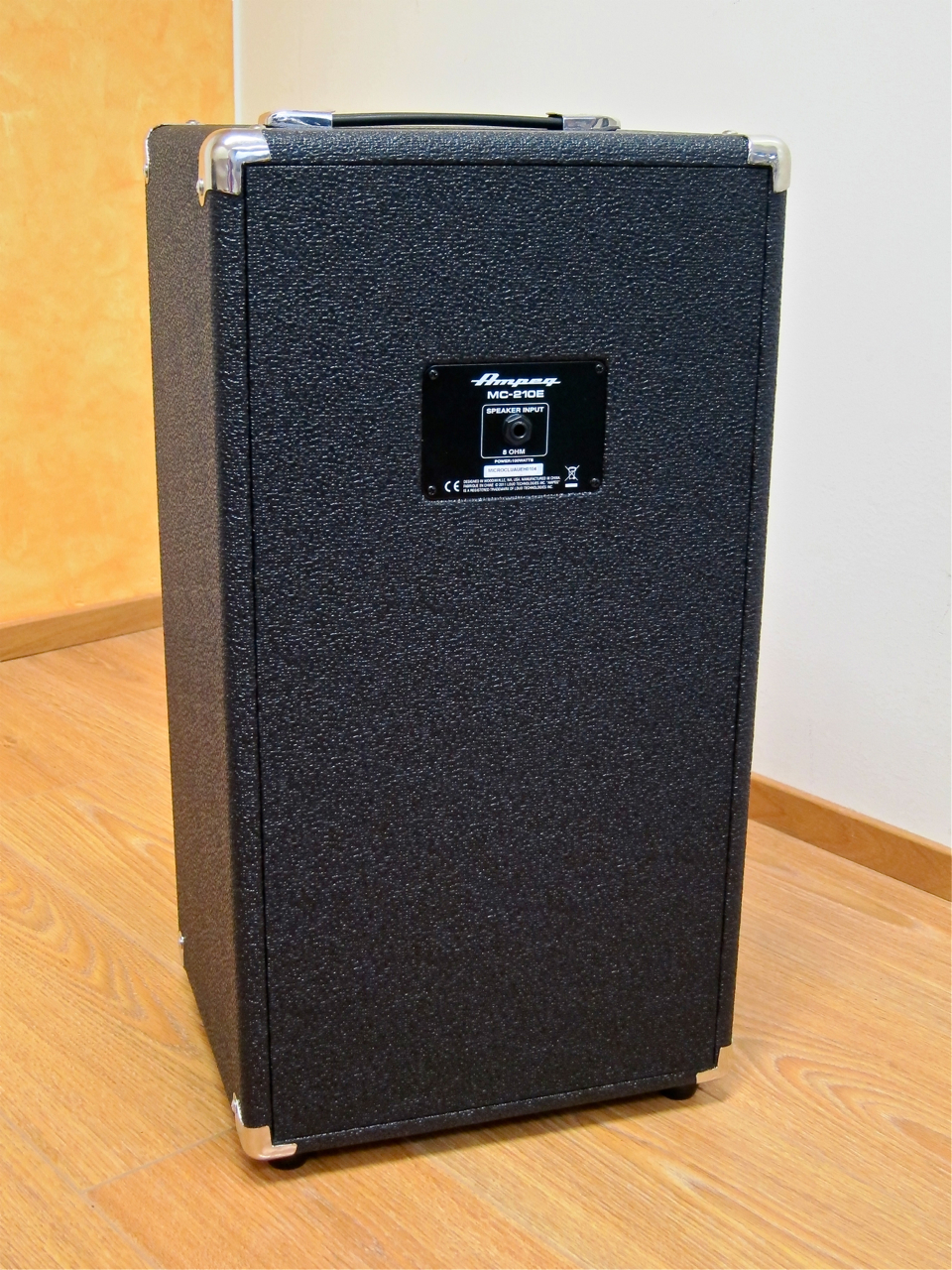
The workmanship seems spot on, with the miniature cabinet exuding the same air of rugged roadworthiness that its big brothers are known for.

The speaker input sits on its own metal plate.

Just to put things into perspective for you: Here’s the stack and a regular bass guitar case – yup, this stack really is small…
****

The amp may be small and cuddly, but don’t forget we have a genuine 100 W Ampeg system here!
I was positively surprised by the sound levels this small bass amp dishes out. Using it at home I wouldn’t recommend turning the master volume anywhere above number three, if you want to stay on good terms with your neighbours.
In the rehearsal studio – where I also recorded the audio clips for this review – the Micro-CL left me in no doubt that it would be fully up to its task at rehearsals and even smaller gigs.
With regard to its sound the tiny stack proved to be a thoroughbred Ampeg: The tones on offer are fat and juicy, with the raunchy midrange growl this company’s bass amps are famous for.
With the master volume approaching 10 you will also be able to coax some tasty, tube-like overdrive from the Micro-CL – but I’d suggest using earplugs then.
Granted, the Ampeg Micro-CL -stack is something of a cutie, but this isn’t a fancy toy, it’s a real bass amp with a lot of Ampeg-tone to boot.
The audio clips have been recorded using my ’87 Rickenbacker 4003 (starting with the neck pickup):
****
Ampeg Micro-CL -stack
current price in Finland 505 €
Finnish distributor: Soundtools
****
Pros:
+ size
+ weight
+ sound
+ output levels
+ workmanship
+ authentic looks
****

****
The new Boss JS-10 eBand (current RRP in Finland: 422 €) is the perfect companion for all of a guitarist’s entertainment, practicing and teaching needs.

The Boss JS-10 combines a wave-/mp3-player with a high-quality multi-effects unit – chock full with amp models and effects taken from the GT-100 – two guitar inputs, special features for practicing, as well as a full-toned 2.1 loudspeaker system.
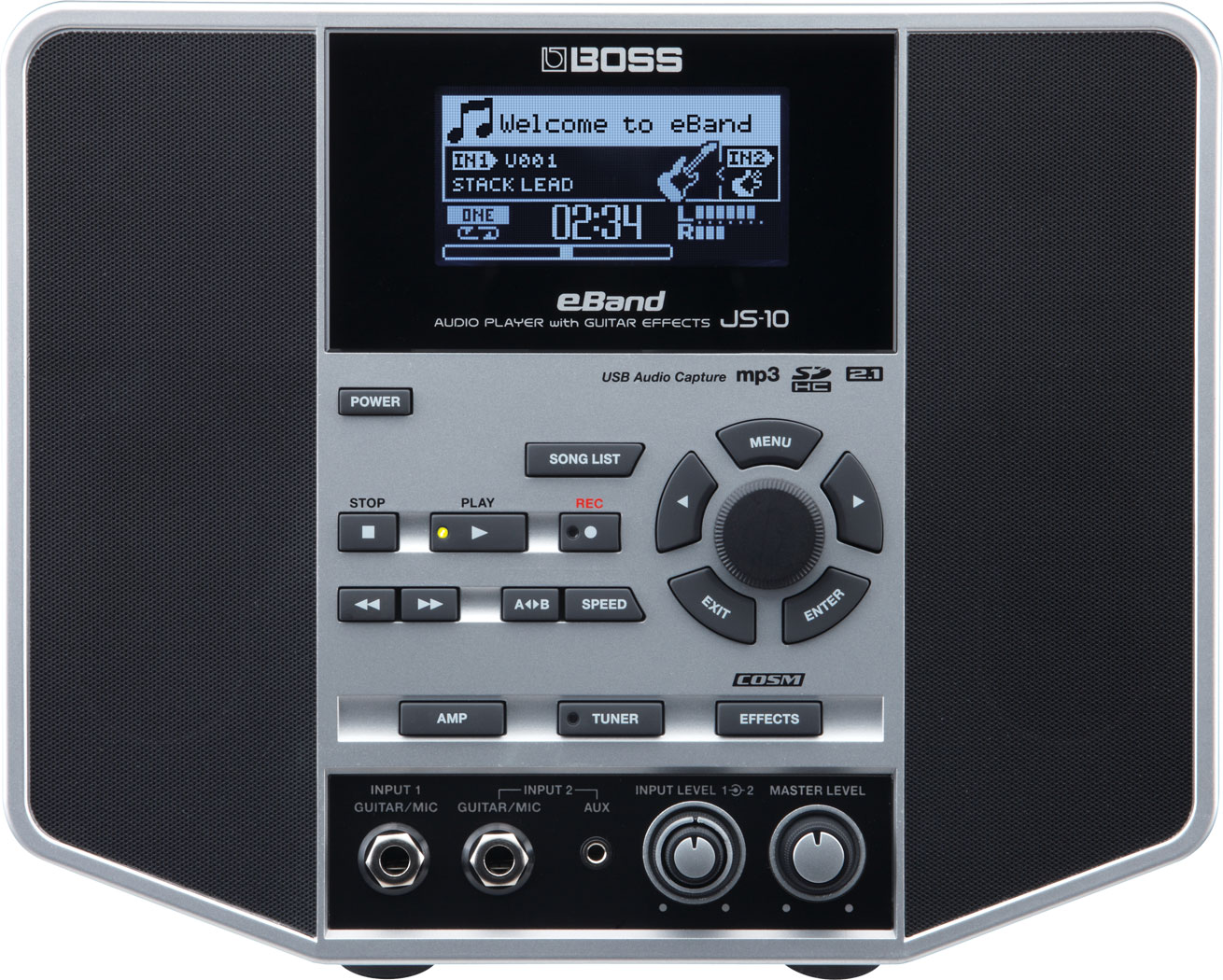
The front panel is the eBand’s command central with a very clear and concise layout.
The playback and recording functions are catered for by the usual transport buttons we all know so well. Backing tracks (the eBand calls them songs), effects and menus can be accessed via their own buttons, and then changed using the navigation buttons and the large data wheel.
The lowest row of buttons gives you quick access to the current amp model and effect chain, as well as the digital tuner.
The lowermost, black section is home to the two instrument (or microphone) inputs. You can even plug in an outboard stereo signal source into channel two’s mini-jack if your keyboarder turns up for a little jam.

You can find all other connectors on the unit’s back:
There are two usb-port – one for connection to your computer, one for a usb-stick. You can connect a footswitch or an expression pedal to the JS-10, to switch effects on-the-fly, start or stop songs, or for wah-wah or volume pedal duties.
There is also a slot for a SD/SDHC-card. The SD-card included in the package also includes the eBand Song List Editor software, which enables you to sort and swap eBand-songs using your computer, as well as for ripping CD-tracks directly into eBand-mode (PC and MAC supported). The necessary drivers for using the JS-10 as an external sound card are also included on the SD-card.
Two analogue outputs are provided in the form of a pair of RCA-connectors and one mini-jack.

Thanks to its large woofer – installed into the unit’s base, firing down – the Boss JS-10’s sound is considerably fatter and punchier than what you’d expect from such a compact piece of gear.
****
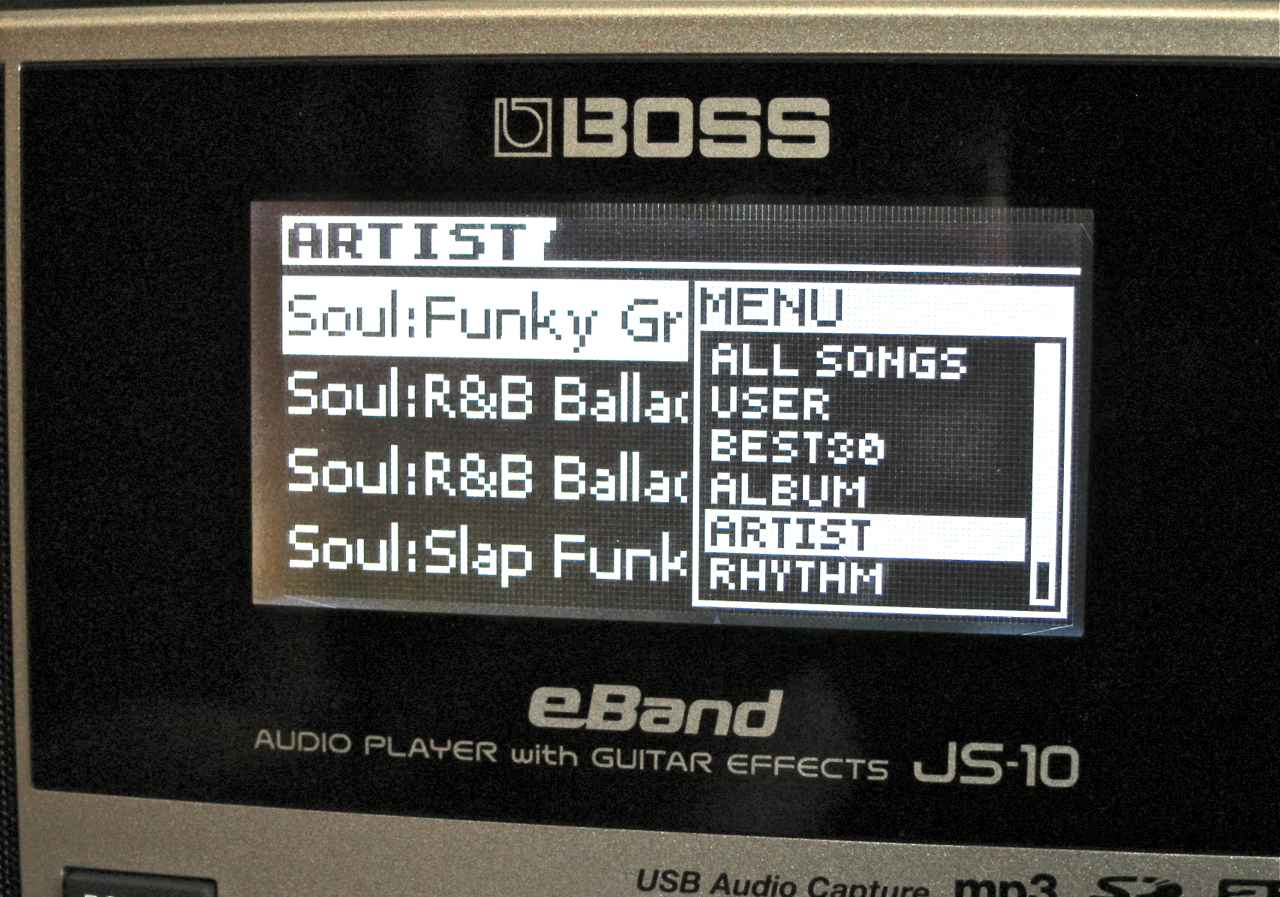
The Boss comes preloaded with a large number of eBand-songs.
eBand-songs are basically very long audio loops, sorted according to their musical genre and BPM. The library includes drums only -songs, as well as eBand-songs with full arrangements for you to solo over.
The preloaded eBand-songs are all of a very high quality and musicianship. The tracks groove thanks to the fact that they’ve been recorded using real musicians, and not just programmed midi-patterns!
Still, you are free to use whatever you choose as your backing track in the JS-10 – regardless of whether the tracks are imported using the Song List Editor or whether you’re playing them directly off a usb-stick as wave- (44,1 kHz/16 Bit) or mp3-files (64-320 kbps).
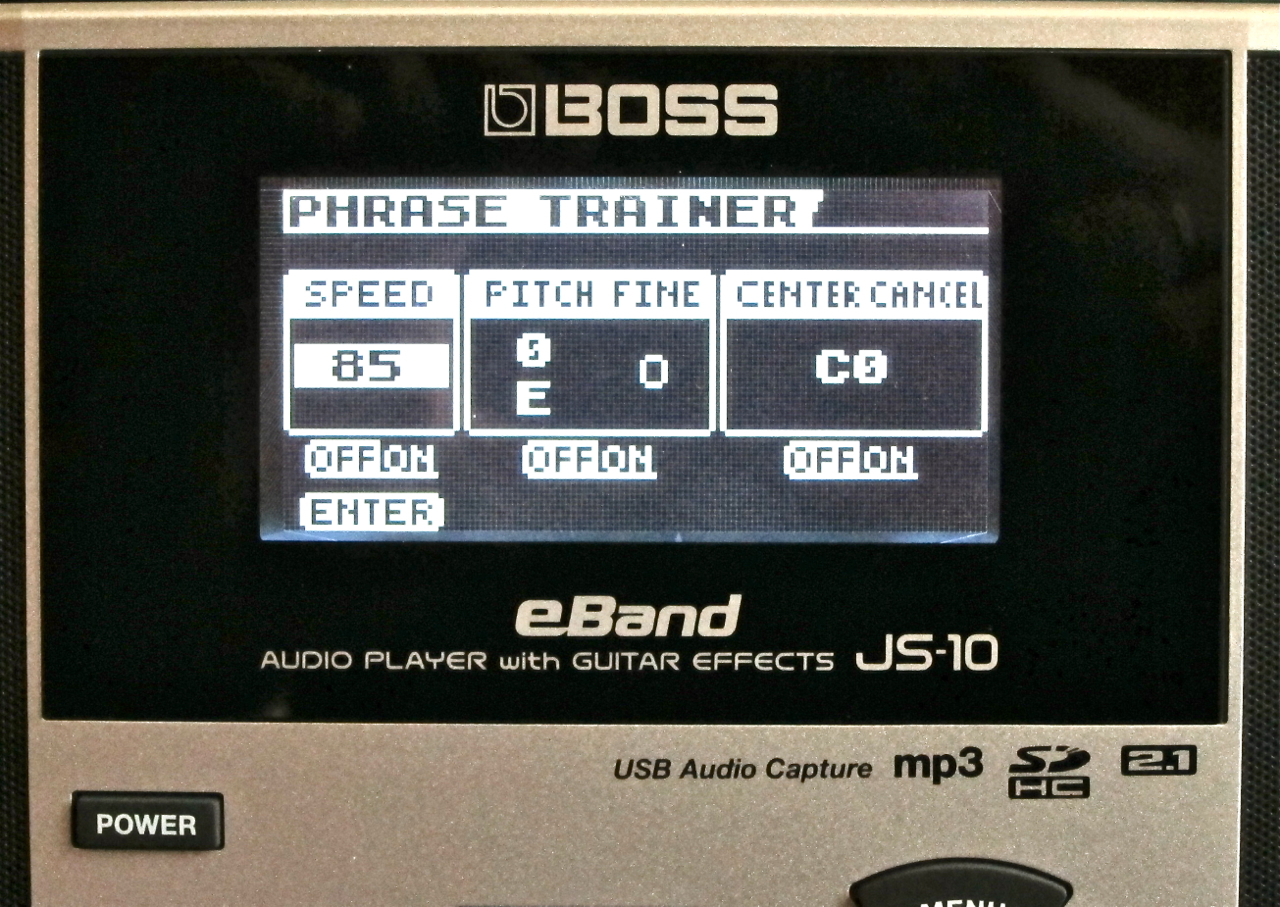
To access Boss’ Phrase Trainer -section you have to push the Speed-button:
As their names give away, Speed is used for slowing down and speeding up the playback of the current song, while Pitch is responsible for changing the pitch.
Center Cancel will be familiar to most from many Karaoke DVD-players, using phase cancellation to mute parts of the stereo image. The effect can be assigned to work only on the stereo picture’s middle…

…but one of the JS-10’s specialities is its ability to cancel out signals from elsewhere in the panorama as well (say, for example, the lead guitar in a 1960s, ping-pong-stereo recording).
How well the Phrase Trainer -section’s features work is tied directly to the technical quality and resolution of the chosen eBand-song. This means that a wave-file or a higher quality mp3 (256 or 320 kbps) will sound more natural even with larger changes, than a lower resolution mp3.

This is what the built-in tuner looks like.
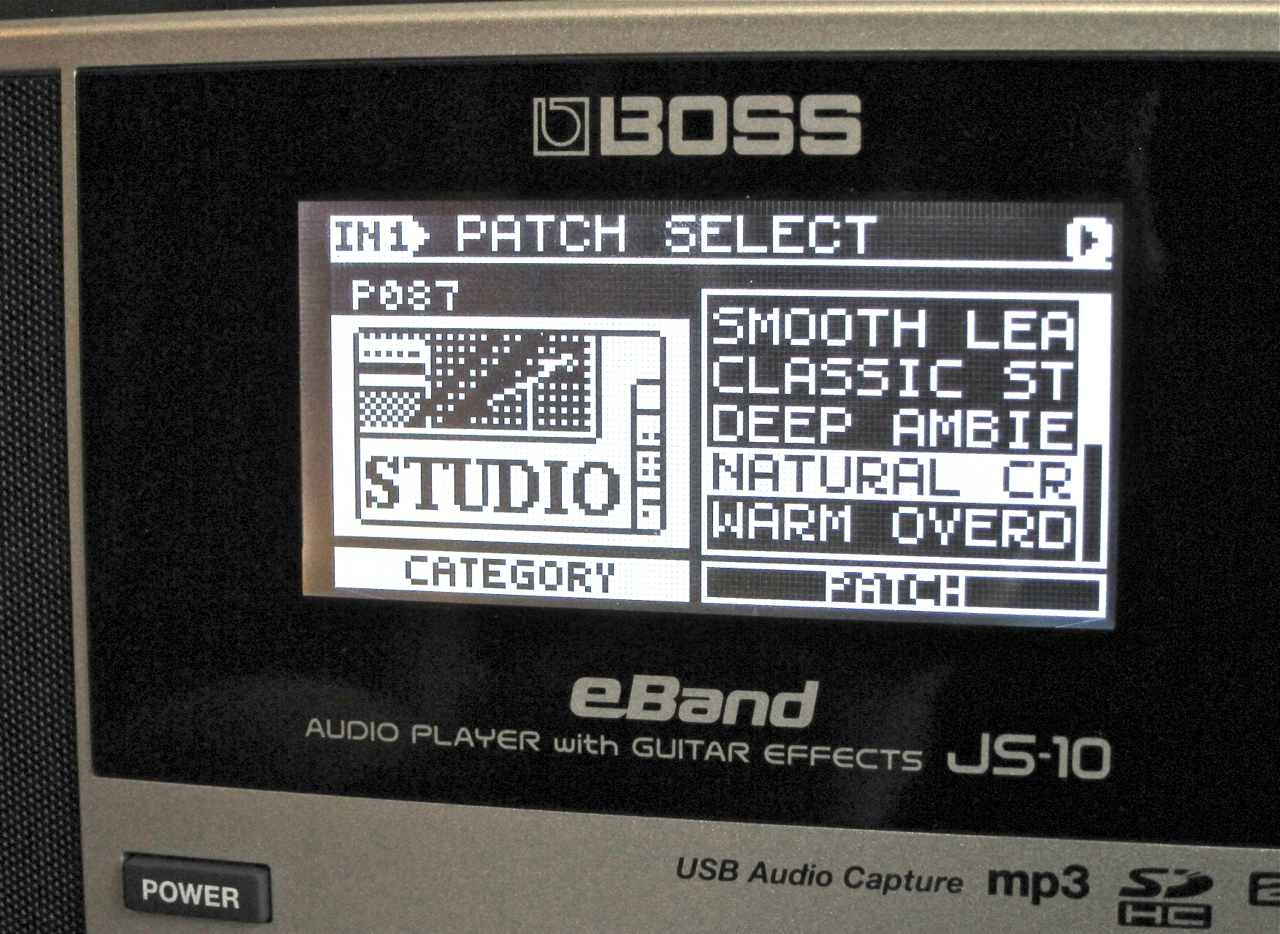
The eBand contains a long list of factory effect patches, which can be sorted according to genre. There are even a few patches for vocals and bass.
Additionally, you can also programme your own effect patches and store them in the effect section’s user library.
Each guitar input is assigned their own effect patch.

The eBand-songs already factory-loaded into the JS-10 are all tied to predetermined effect patches.
For quick editing Boss’ EZ Edit -function is most convenient. No need to fiddle with many different parameters – you simply move the cursor in the desired direction on the Solo/Backing- and Soft/Hard-axes and change the amount of ambience in the sound, and you’re set.

The Patch Edit -menu, on the other hand, gives you detailed access to all effect parameters in the signal chain.
****

There aren’t really many direct competitors to the Boss JS-10, which is kind of strange: Using the eBandin really is a faster and smoother ride than having to deal with a bunch of different devices, as well as their power supply units and connecting leads.
The Boss JS-10 is a great piece of gear, both for getting your own chops up, as well as for guitar teaching. It is straightforward in use, the effects sound great, the Phrase Trainer allows you to get to grips with devilish details, and you can check on your progress by recording your playing.
Here are three short pieces I recorded to demonstrate the quality of the eBand-songs and effects on offer:
****
Boss JS-10 eBand
Current RRP in Finland: 422 €
Finnish distributor: Roland Scandinavia
Pros:
+ sound
+ COSM-effects
+ Phrase Trainer -functions
+ recording capability
+ SDHC-card slot
+ USB-audio
****
****
Yksi Ampegin tämänvuotisista NAMM-uutuuksista on firman toinen pikkustäkki – Ampeg Micro-CL.
Suuren suosion saanut edeltäjä – Micro-VR (yhä saatavilla) – on pienennetty versio 1970-luvun Ampeg SVT -vahvistimesta, jolla on 200:n watin teho. Upouusi Micro-CL taas on satawattinen miniatyyri 80-luvun Ampegista (nykyinen SVT-CL).
Ampeg Micro-CL -stäkki (ovh: 505 €) tuo firman tyylikkyyttä helposti kannettavaan muotoon.
Transistorinuppi painaa vain kuusi kiloa, ja siihen kuuluva kaappi ainoastaan 15 kiloa. Koko ministäkki jää korkeudeltaan juuri ja juuri alle 80 cm – se mahtuu siis helposti tavallisen henkilöauton takakontiin.
Micro-CL-nuppi tarjoaa kaksi tuloa – yksi passiivi- ja toinen aktiivibassolle – ja kolmikaistaisen EQ-osaston.
Koska kyse on tässä myös harjoitusvahvistimesta, nuppiin on lisätty Aux-tulo (minijakki, omalla volyymisäätimellään) mp3-soittimelle. Myös kuulokelähtö löytyy etupaneelista.
Takapaneeliin on sijoitettu Micro-CL:n linjatasoinen lähtö, sekä efektilenkin liittimet.
Stäkin kaappi – Ampeg MC-210E – on rakennettu samalla Infinite Baffle -periaatteella kuin firman perinteiset, valtavankokoiset 8 x 10″ -kaapit.
Täysin suljetussa kaapissa on miniversiossa kaksi kymppituumaista kaiutinta. Etukangas on kiinnitetty autenttisesti tarranauhoilla.
Ampeg-kaappi vaikuttaa erittäin kestävältä, ja työnjälki on yhtä laadukas kuin Ampegin täysikokoisissa tuotteissa.
Takalevyltä löytyy MC-210E:n tulo.
Tässä näkyy Ampeg Micro-CL ja tavallinen bassokeissi – kyllä, stäkki on todella pieni…
****
Vaikka vahvistin onkin pienikokoinen, on syytä muistaa, että kyseessä on kuitenkin aito, satawattinen Ampeg!
Yllätyin kuinka paljon ääntä tästä pikkujärjestelmästä lähti. Olohuonekäytössä master-säädin pysyy varmasti jossain alkumetreillä (kolmosen tienoilla), muuten naapurisopu on vaarassa jäädä innokkaan bassosoiton jalkoihin.
Treenikämpässä – jossa äänitin myös tämän jutun esimerkkipätkät – kävi hyvinkin selväksi, että Micro-CL:n voimavarat riittävät mainiosti tavalliseen harjoituskäyttöön, ja jopa monille pienille keikoille.
Soundiltaankin Ampegin pienokainen on täysiverinen Ampeg: soundissa on mukana aimo annos lämpöä, ja firman vahvistimille tyyppillinen rouhea ja murea keskialue on tässäkin hyvin esillä.
Kun master-säädin on lähes täysillä, mukaan kuvaan astuu myös hyvin putki-tyylinen särö, mutta silloin korvatulppien käyttö on jo suositeltavaa.
Vaikka Ampeg Micro-CL -stäkki onkin ulkomitoiltaan erittäin söpö, se ei ole lelu vaan oikea bassovahvistin, joka tarjoaa aidon Ampeg-soundin kätevässä pakkauksessa.
Seuraavat esimerkkipätkät on soitettu Rickenbacker 4003 -bassolla (vuosimalli 1987, aina kaulamikki ensin):
****
Ampeg Micro-CL -stäkki
505 €
Maahantuoja: Soundtools
****
Plussat:
+ koko
+ paino
+ soundi
+ teho
+ työnjälki
+ autenttinen ulkonäkö
****
****
Kitarablogi-testi ilmestyy huomenna…
****
Uusi Boss JS-10 eBand (suositushinta: 422 €) on kitaristin viihde-, harjoitus- ja opetuskeskus yhdessä kätevässä paketissa.
Boss JS-10:ssä yhdistyvät wav- ja mp3-soitin, efektilaite laadukkailla multiefekteillä ja vahvistinmallinnuksilla (lainattuja suoraan GT-100-pedaalista), kaksi tulokanavaa, erilaiset harjoitukseen sopivat apuvälineet, sekä laadukas 2.1-äänijärjestelmä (kokonaisteho 12 W).
eBandin etupaneeli on laitteen komentokeskus, ja sen rakenne on ilahduttavan selkeä.
Taustaraitojen toistoon – ja oman soiton äänitykseen – löytyy tutut transportti-näppäimet. Biisien ja efektien valintaan, sekä muihin menuvalintoihin ja parametrisäätöihin löytyy selkeät navigointinapit ja iso datapyörä.
Viimeiset kolme nappia tarjoavat meille kitaristeille suoran pääsyn vahvistimallinnukseen, efektiketjuun sekä viritysmittariin.
Mustataustaiseen master-osioon on sijoitettu laitteen kaksi analogista tuloa, joihin voi liittää joko sähkökitaran (tai -basson) tai laulumikrofonin. Kakkostulon mini-jakkiin (stereo) voi myös kytkeä ulkoisen mp3-soittimen tai bändikaverin synan yhteistä harjoittelua varten.
Kotelon kääntöpuolelta löytyy kaksi usb-porttia – yksi tietokonetta varten, toinen usb-tikulle.
Pedaali-jakkiin voi kytkeä joko jalkakytkimen (tai tuplapedaalin) tai ekspressiopolkimen. Kytkimellä saa potkaistua biisit käyntiin tai vaihdettua efektipatcheja ilman käsiä. Ekspressiopedaali taas toimii Boss JS-10:ssa joko wah-pedaalina tai volumesäätimenä.
Oikeassa laidassa on paikka SD/SDHC-kortille (1-32 GB). Boss eBandin mukaan tulevalla SD-kortilla on eBand Song List Editor -softa, jolla pystyy kätevästi järjestellä eBand-biisejä, siirtää niitä tietokoneen ja JS-10:n välillä sekä ripata biisejä suoraan CD:ltä eBand-muotoon usb-johdon kautta (PC ja Mac). Myös eBandin ajurit on pakattu mukaan, minkä ansiosta JS-10:tä voi käyttää ulkoisena usb-äänikorttina, ja hyödyntää eBandin laadukkaita efektejä sekvensseriäänityksissä.
Analogiset lähdöt on sijoitettu laitteen kylkeen – rca-pari sekä mini-jakki.
Ison subbarinsa ansiosta kätevän kokoisen JS-10:n soundi on huomattavasti muhkeampi ja isompi kuin luulisi näin kompaktista laitteista irtoavan.
****
Bossin mukana tulee erittäin tuhti paketti erilaisia eBand-biisejä.
Valmiit eBand-biisit ovat periaatteessa pitkiä audiolooppeja eri tyylilajeissa ja nopeuksissa. Biisikirjastosta löytyy sekä sellaisia kappaleita, jotka ovat pelkkiä rumpukomppeja, että kokonaisia bänditaustoja, joiden päälle voi sooloilla.
Valmiiden eBand-biisien laatu on erittäin korkea ja taustat groovaavat ja svengaavat kuin hirvi. Taustat on nimittäin äänitetty oikeilla soittajilla, sen sijaan että ne olisi luotu ohjelmoimalla midi-soittimia!
Taustoina voi kuitenkin käyttää myös Song List Editorilla ripattuja biisejä tai suoraan usb-tikulta soitettuja wav- (44,1 kHz/16 Bit) tai mp3-tiedostoja (64-320 kbps).
Speed-näppäimen takaa löytyy Bossin Phrase Trainer -osasto:
Speed-toiminto muuttaa soivan biisin nopeutta sekä ylös että alaspäin, ja Pitch käytetään audion transponointiin ja/tai hienovirittämiseen.
Center Cancel taas on monille tuttu karaoke-laitteista, ja se poistaa vaihemanipuloinnilla tehokkasti osan stereokuvan signaalista. Efekti voidaan kohdistaa perinteisesti stereon keskelle…
…mutta JS-10:n ässä hihassa on vapaasti kohdistettava poistaja, jolla pyyhkäistään tehokkaasti myös muualla stereo-kuvassa esiintyviä soittimia (esim. 1960-luvun ping-pong-stereossa).
Phrase Trainerin toiminta ja lopputuloksen soundi on suoraan sidoksissa audion tekniseen laatuun – siis: wav-tiedosto tai iso mp3-audio (256 tai 320 kbps) kestää isompiakin muutoksia paremmin kuin matalalla resoluutiolla pyörivä mp3.
Tältä näyttää Bossin viritysmittari.
eBandistä löytyy pitkä lista valmiita efektipatcheja, joita voi valita myös tyylilajin mukaan. Jopa muutama valmis laulu- ja bassoohjelma on mahdutettu mukaan.
Valmiiden efektien lisäksi voi luonnollisesti ohjelmoida myös omia efektipatcheja, joita pystyy kirjoittamaan muistin user-osioon.
Kummallekin tulolle on tarjolla oma efektiohjelmansa.
Laite valitsee omatoimisesti jokaiselle eBand-biisille siihen sopivan efektiohjelman.
Soundin nopeaan hienosäätimiseen voi käyttää Boss-multiefekteistä tuttua EZ Edit -toimintoa, jossa kursoria liikkumalla ristikossa saadaan nopeasti ja helposti soundi halutunlaiseksi. Ei tarvitse siis ruuvailla montaa parametriä peräkkäin, vaan tässä toimitaan pehmeä-aggressiivinen, komppi-soolo ja kuiva-kaikuisa akseleilla.
Patch Edit -ikkunoissa pääsee sitten yksityiskohtaisesti jokaisen efektiparametriin kiinni.
****
Boss JS-10:n kaltaiset laiteet ovat erittäin harvinaisia, mikä on tavallaan ihmeellistä: eBandin käyttö on nimittäin paljon sujuvampaa, nopeampaa ja siistimpää kuin kamppailu erillislaitteiden johto- ja adapteriviidakossa.
Boss JS-10 on loistava vehje, sekä harjoitteluun kotioloissa, että kitaraopetukseen. Se on erittäin mutkaton laite, jossa on hyvä soundi, toimvat Phrase Trainer -ominaisuudet, loistavat efektit, sekä mahdollisuus oman soiton äänittämiseen.
Tässä on kolme lyhyttä pätkää, joissa soitan soolo-osuudet JS-10:n omien eBand-biisien päälle:
****
Boss JS-10 eBand
suositushinta: 422 €
Maahantuoja: Roland Scandinavia
Plussat:
+ soundi
+ COSM-efektejä
+ Phrase Trainer -osasto
+ äänitysmahdollisuus
+ SDHC-kortti
+ USB-audio
****



 Kitarablogi.com – Finland's premier Guitar and Bass blog