The body is crafted from three pieces of maple, with its frontside spruced up with a very pretty quilted maple veneer.
The bass’ bolt-on neck is put together using three long strips of hard rock maple.
The neck joint features rounded edges for added comfort, while five screws with separate, countersunk washers make for a very precise and sturdy fit.
The pearl SSD-logo has been cleanly inlaid into the back-angled headstock.
A self-lubricating top nut makes tuning a smooth experience. The nut’s corners have been rounded – a nice upmarket touch in this price bracket.
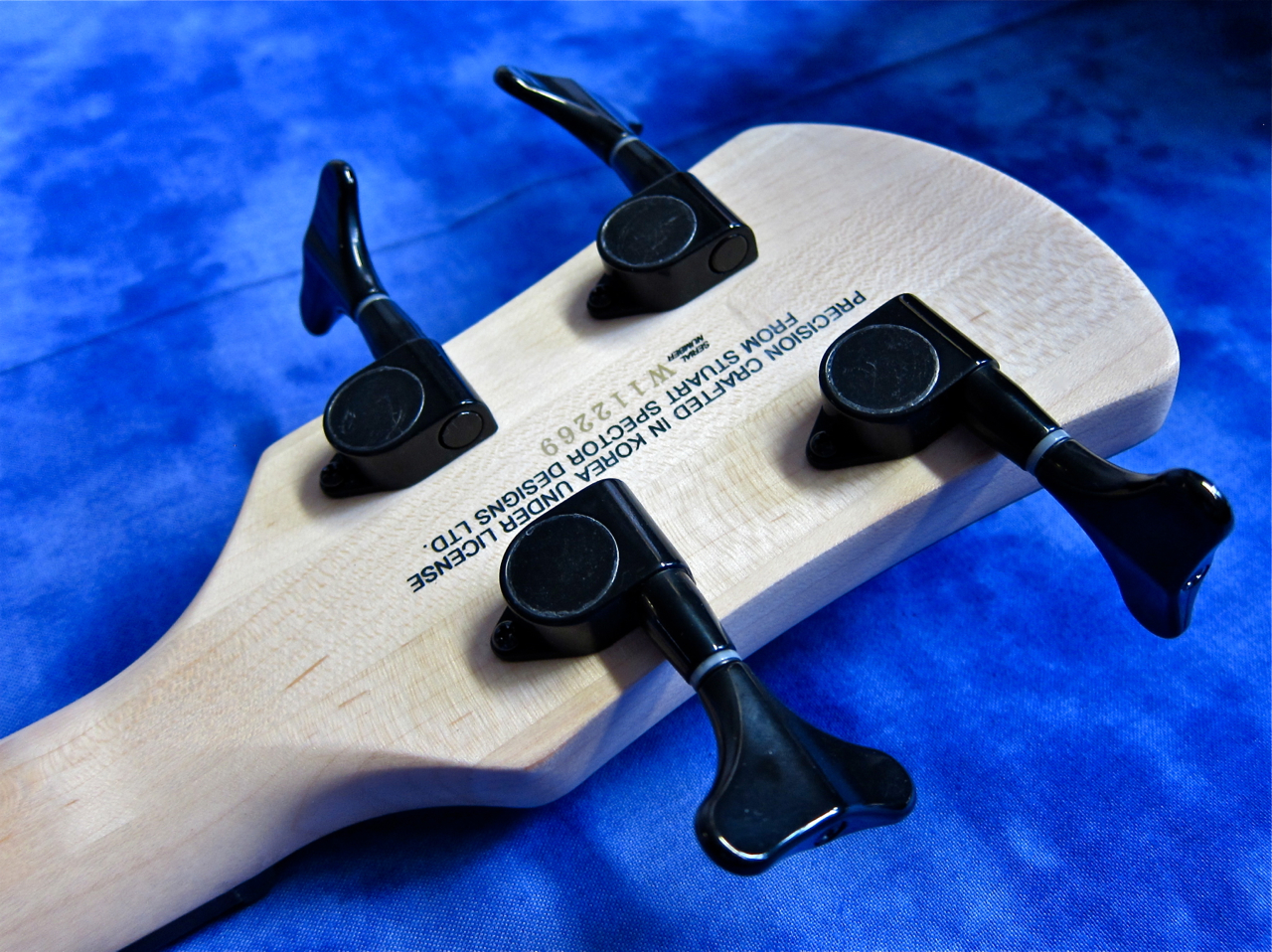
Black is the colour of choice for all of the Legend 4 Classic’s hardware. The modern, sealed tuners keep the tuning rock steady.
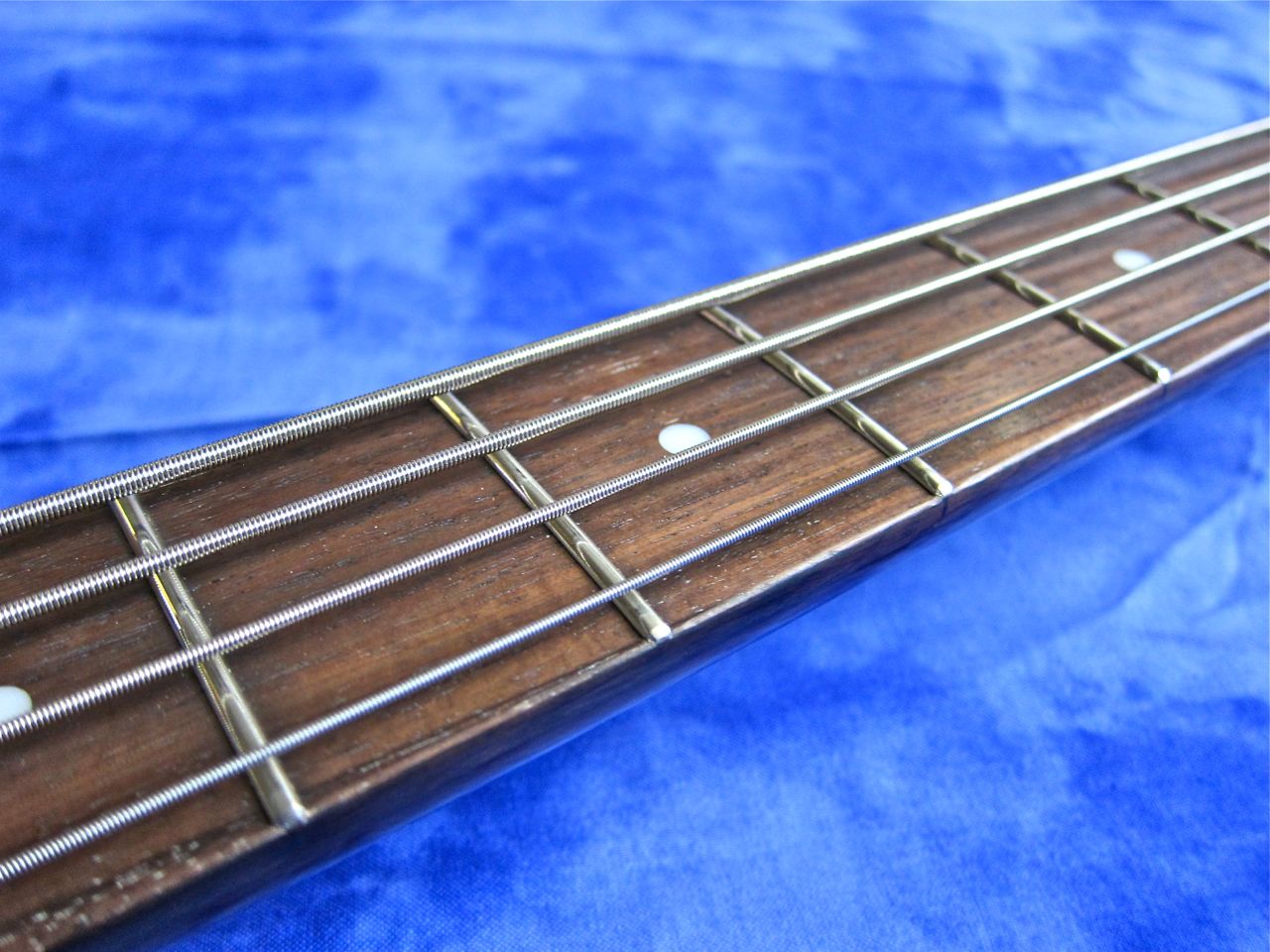
The rosewood fingerboard sports 24 jumbo frets, which are well seated and nicely polished, making for a smooth playing surface.
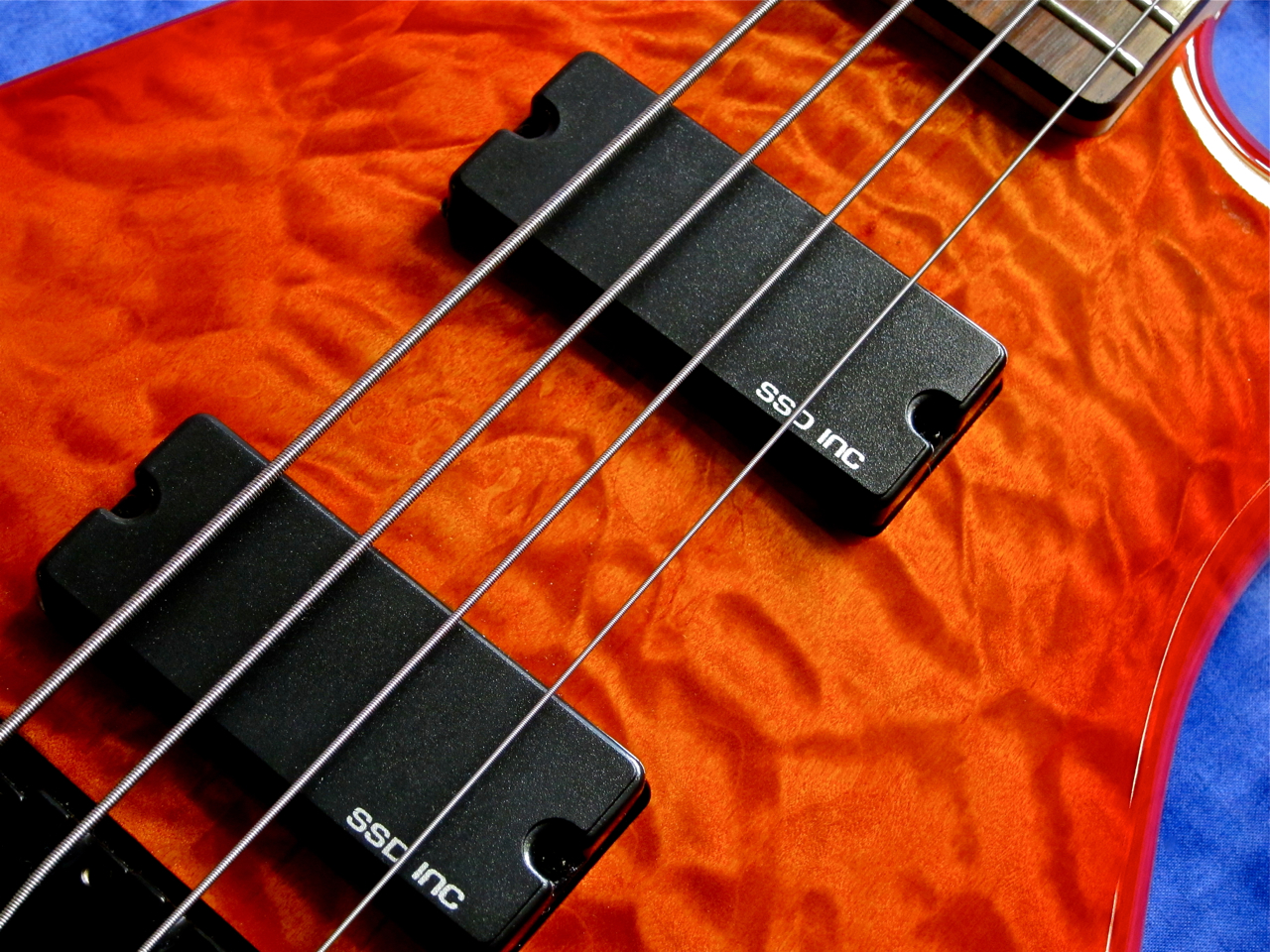
The Classic-model’s passive SSD-humbuckers are manufactured by EMG. These units – designed specifically for this bass – use the EMG-HZ-pickups as a starting point, but add a good helping of mid-range for a meatier tone.
This Spector’s controls comprise two separate volume knobs (one for each pickup), as well as active boost controls for bass and treble, respectively.
The preamp – which is boost-only – is Spector’s own Tone Pump Jr -circuit, which has been glued to the control cavity’s side wall.
To minimise interference buzz the whole cavity has been covered in conductive paint, and the lid lined with aluminium foil. The lid is fixed to the body using machine screws and threaded inlets – a much better choice on an active bass than plain wood screws.
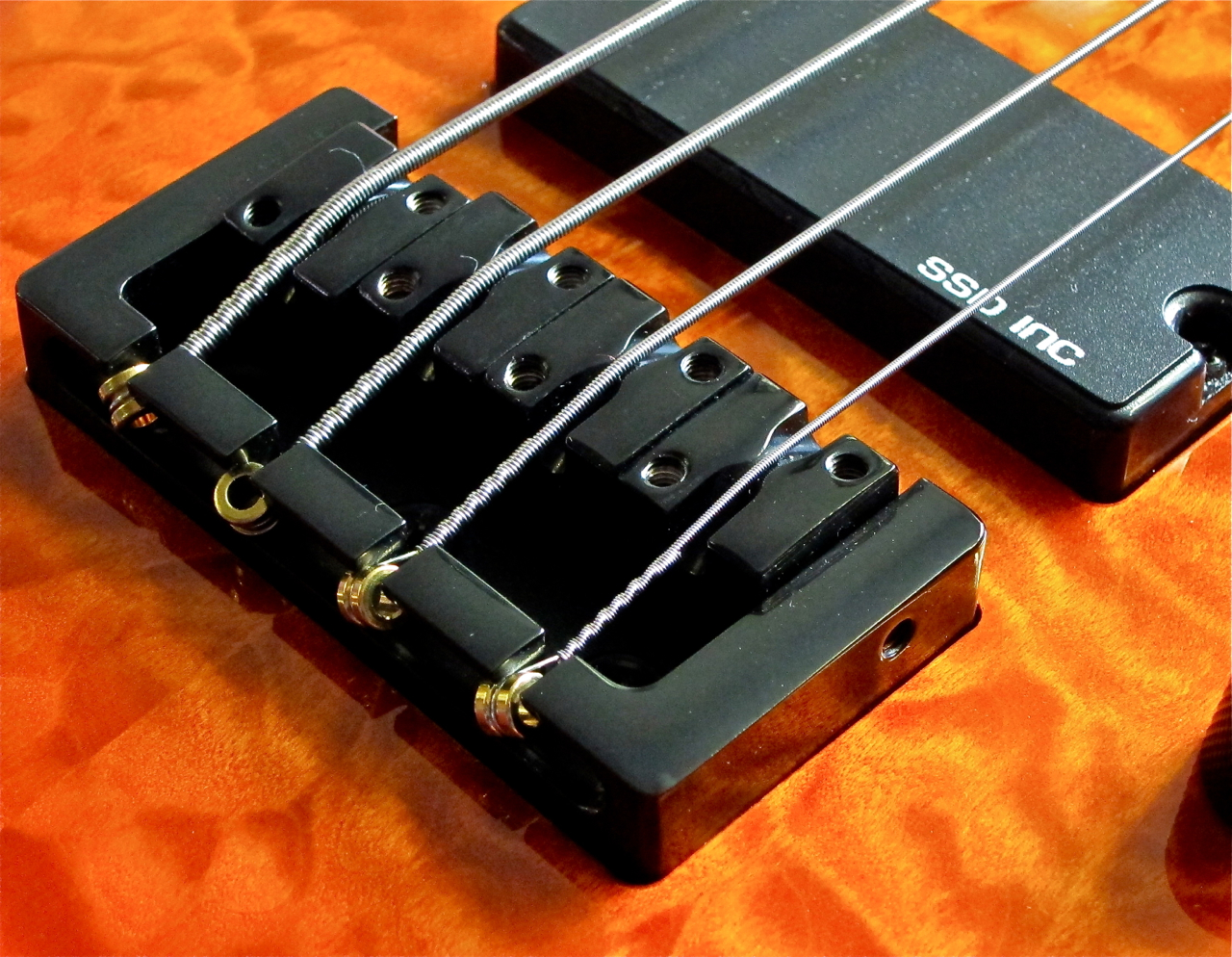
The Legend 4 Classic’s bridge is a hefty design. The saddles are locked in place with grub screws to prevent any rattling, thus enhancing the instrument’s sustain.
****
The Spector Legend 4 Custom (current RRP in Finland: 855 €) is the Classic’s higher-spec’d sibling.
Here the body uses two, centre-joined pieces of basswood with a quilted maple veneer on top.
The Custom’s neck is glued into the body, and features graphite rods reinforcing the neck.
Just like the NS-2, both basses reviewed here feature curved bodies, even though the arch is much less pronounced in these more affordable instruments.
The beer-belly chamfer adds to the bass’ strapped-on comfort.
The Custom features the same graceful headstock as the classic…
…but here the back of the neck is finished in gloss lacquer, and all the hardware is gold-coloured.
The fretwork on the Legend 4 Custom is of an even higher standard than on the Classic – you can clearly spot the well-rounded fret ends in the photo.
EMG’s HZ bass humbuckers are known for their excellent, wide-range tone.
The preamp is an EMG B30, which offers you a full three-band EQ-section in addition to the separate pickup volume knobs. The mid-range has it’s own full-sized control, while the stack knob deals with treble (tip) and bass (ring).
Here’s a peek into the Custom’s control cavity – everything’s clean, neat and tidy.
And here we have the excellent Spector-bridge in a golden finish.
****
The neck profile on the Spector Legend 4 Classic is a very comfortable D-shape. The neck is a close cousin to a Jazz Bass neck, but offers a slightly more contemporary, flatter slant on the theme.
The large fretboard radius combined with the jumbo frets lends this bass a slick and fast action and feel.
Our test sample’s considerable weight is really the only point that I can criticise – get yourselves a wide, comfortable strap, and everything will work out fine.
The Legend 4 Classic’s SSD-pickups have quite a high output, with the signal being rich in deliciously growling mids. I also enjoyed the Classic’s clear, yet warm high-mid presence, which keeps the sound nicely organic.
This bass’ basic tone is really good, so I didn’t particularly miss the ability to cut any frequencies – the Tone Pump Jr’s bass and treble boosts work fine in this context.
I recorded the audio clips via a Focusrite Saffirer 6 USB -soundcard straight into the audiosequencer, without any kind of amplifier modelling. Each clip starts with the neck pickup:
The Spector Legend 4 Custom’s neck profile is a tiny bit meatier and rounder, when compared to the Classic. Together with the gloss finish this results in a slightly more grown-up and steadier feel. Somehow the Custom feels like a more expensive bass to this reviewer.
Due to the set neck and the stiffening graphite rods inside the neck the Custom’s acoustic tone is clearly punchier and fatter, with a nice bit of ”wire” in its attack.
The neutral-sounding – in the best sense of the word – EMG-HZs, combined with the bass’ nice preamp, lend the Custom an air that is distinctly ”active”, with a healthy dose of presence, clarity and a fresh top end.
The three-band EQ – offering boost as well as cut – naturally is a more versatile tone-shaping tool than the Classic’s more concise Tone Pump Jr.
Here are the same bass lines as above, this time played on the Legend 4 Custom:
I think it is great that Spector is offering us bassists more affordable versions of its US- and Euro-models. Both the Legend 4 Classic as well as the Legend 4 Custom are quality instruments and a pleasure to play.
The Spector Legend 4 Classic is your key to Stuart Spector’s world, offering you a straightforward, streamlined and easy-to-use active bass for a very reasonable price.
The Legend 4 Custom, for its part, clearly is a large step towards the full-blown Spector-experience, in both playability and sound. This beautiful quality instrument could easily become a professional’s main squeeze.
Runko on veistetty kolmesta vaahterapalasta, ja etupuoleen on liimattu näyttävä loimuvaahteraviilu.
Ruuvikaula taas on koottu kolmesta vierekkäisistä vaahterapalasta.
Liitoskohta on veistetty hyvin sulavaksi, ja viidellä ruuvilla toteutettu kiinnitys on hyvin luja.
Taakse kalistuvassa viritinlavassa komeilee siististi upotettu helmiäisupotus.
Itsevoitelevan satulan reunat on muotoiltu mukavan sulavaksi.
Legend 4 Classic -mallissa käytetään mustia metalliosia. Nykyaikaiset virityskoneistot toimivat tarkasti ja pitävät basson hyvässä vireessä.
Palisanteriotelautaan on asennettu huolellisesti 24 jumbokokoista nauhaa.
Classic-basson passiiviset SSD-humbuckerit tulevat EMG:ltä, ja niitä on kehitelty EMG-HZ-mikrofonien pohjalta juuri tätä mallia varten.
Spectorin neljästä säätimestä kaksi ovat volume-säätimet kummallekin mikrofonille, kun taas toinen pari tarjoaa aktiivista korostusta basso- ja diskanttitaajuuksille.
Etuvahvistin – joka siis tarjoaa ainoastaan boostin – on Spector Bassin oma Tone Pump Jr -piiri, joka on liimattu elektroniikkalokeron reunaan.
Ulkoisten häiriöiden minimointia varten lokero on penslattu grafiittimaalilla ja muovikansi taas on vuorattu alumiinifoliolla. Kannen kiinnitys hoidetaan mallikkaasti koneruuveilla ja runkopuuhun upotetuilla vastakappaleilla.
Legend 4 Classic -mallin talla on varsin jämäkkää sorttia. Tallapalat voi lukita säätämisen jälkeen paikoilleen kuusiokoloruuveilla, mikä parantaa basson sustainea.
Basson runko on tässä mallissa valmistettu kahdesta lehmuspalasta. Etupuoli on tässäkin tapauksessa loimuvaahteralla koristeltu.
Customissa on runkoon liimattu vaahterakaula, jota on vahvistettu kaulapuuhun upotetuilla grafiittitangoilla.
Molempien bassojen rungot ovat (NS-2:n tavoin) hieman kaarevat, vaikka niiden kaari on selvästi loivempi kuin amerikkalaisessa alkuperäisversiossa.
Yläreunan viisteen ansiosta molemmat mallit istuvat mukavasti soittajan kehoa vasten.
Customissa on sama tuttu lapa kuin Classic-bassossa…
…mutta sen kaula on viimeistelty kiiltävällä lakalla, ja sen metalliosat ovat kullanväriset.
Legend 4 Custom -basson nauhatyön laatu on vielä huolellisempi kuin Classicissa – kuvassa näkyy hyvin nauhojen sulavaksi pyöristetyt päät.
EMG-HZ-humbuckereille luvataan hieman neutraalimpaa sointia, kuin mikä Classic-basson SSD-mikeistä lähtee.
EMG B30 -etuvahvistin tarjoaa kahden erillisten volumesäätimien lisäksi sekä vaimennusta että vahvistusta keskialueelle, bassolle ja diskantille.
Tältä näyttää Legend 4 Customin siististi toteutettu elektroniikka.
Customissa vankalla Spector-tallalla on kullanvärinen viimeistely.
****
Spector Legend 4 Classicin kaulaprofiili on erittäin mukavantuntuinen D. Mitoiltaan kaula on läheistä sukua Jazz-bassolle, mutta nykyaikaistetulla, aavistuksen verran matalammalla läpileikkauksella.
Otelaudan loiva kaarevuus ja jumbokokoiset nauhat antavat bassolle hyvin nopean ja modernin tuntuman.
Testisoittimen ainoa miinuspiste menee basson painon tilille – hyvin vuorattu, leveä hihna on tässä käytännössä pakollinen lisävaruste.
Legend 4 Classic -basson SDD-humbuckereistä lähtee hyvin voimakas signaali, jolla on herkullisesti muriseva keskialue. Pidin myös Classicin selkeästä, mutta lämpimästä preesensalueesta, jonka ansiosta tämän basson soundi pysyy aina mukavan maanläheisenä.
Perusääni on mielestäni niin hyvä, etten kaivannut lainkaan vaimennusta aktiivielektroniikasta – tulin mainiosti toimeen pelkällä boostilla.
Ääniesimerkit on äänitetty suoraan Focusrite Saffire 6 USB -äänikortin kautta audiosekvensseriin, ilman mitään vahvistinmallinnusta. Jokainen pätkä lähtee liikkeelle kaulamikrofonista:
Spector Legend 4 Customin kaulaprofiili on hivenen verran paksumpi ja pyöreämpi kuin Classicin kaula. Sen kiiltävän lakkauksen seurauksena Customin soittotuntuma on jotenkin ”aikuisempi” ja tasaisempi. Ainakin minun mielestä tämä Spector tuntuu kalliimmalta, kuin mitä se on.
Liimaliitoksen ja kaulan grafiitivahvistuksien ansiosta Legend Customin akustisessa soinnissa on enemmän alakertaa ja potkua, sekä aavistuksen verran purevampi atakki.
Positiivisella tavalla värjäämättömät EMG-HZ-humbuckerit ja saman firman etuvahvistin antavat Custom-bassolle selkeästi ”aktiivisemman” soundin, jossa on aina läsnä tietty annos preesensalueen selkeys ja diskantin tuore pirteys.
Kolmialueinen EQ, jossa on sekä vaimennus että korostus, on luonnollisesti selvästi monipuolisempi työkalu kuin Classicin yksinkertaisempi Tone Pump Jr -etunen.
Tässä ovat samanlaiset esimerkkipätkät Spector Legend 4 Custom -bassolla soitettuna:
Mielestäni on loistava asia, että Spector tarjoaa basistille US- tai Euro-malliensa edullisempia vaihtoehtoja. Sekä Legend 4 Classic, että Legend 4 Custom ovat laadukkaita soittimia, joilla on ilo soittaa.
Spector Legend 4 Classic toimii avaimena Stuart Spectorin maailmaan, ja basso on mukavan suoraviiveinen aktiivibasso erittäin reilulla hinnalla.
Legend 4 Custom taas on soundiltaan ja soittotuntemukseltaan selvästi muutaman askeleen lähempänä Spectorin USA-soittimia. Tämän kauniin laatubasson rahkeet riittävät mielestäni mainiosti myös ammattikäyttöön.
The new Boss JS-10 eBand (current RRP in Finland: 422 €) is the perfect companion for all of a guitarist’s entertainment, practicing and teaching needs.
The Boss JS-10 combines a wave-/mp3-player with a high-quality multi-effects unit – chock full with amp models and effects taken from the GT-100 – two guitar inputs, special features for practicing, as well as a full-toned 2.1 loudspeaker system.
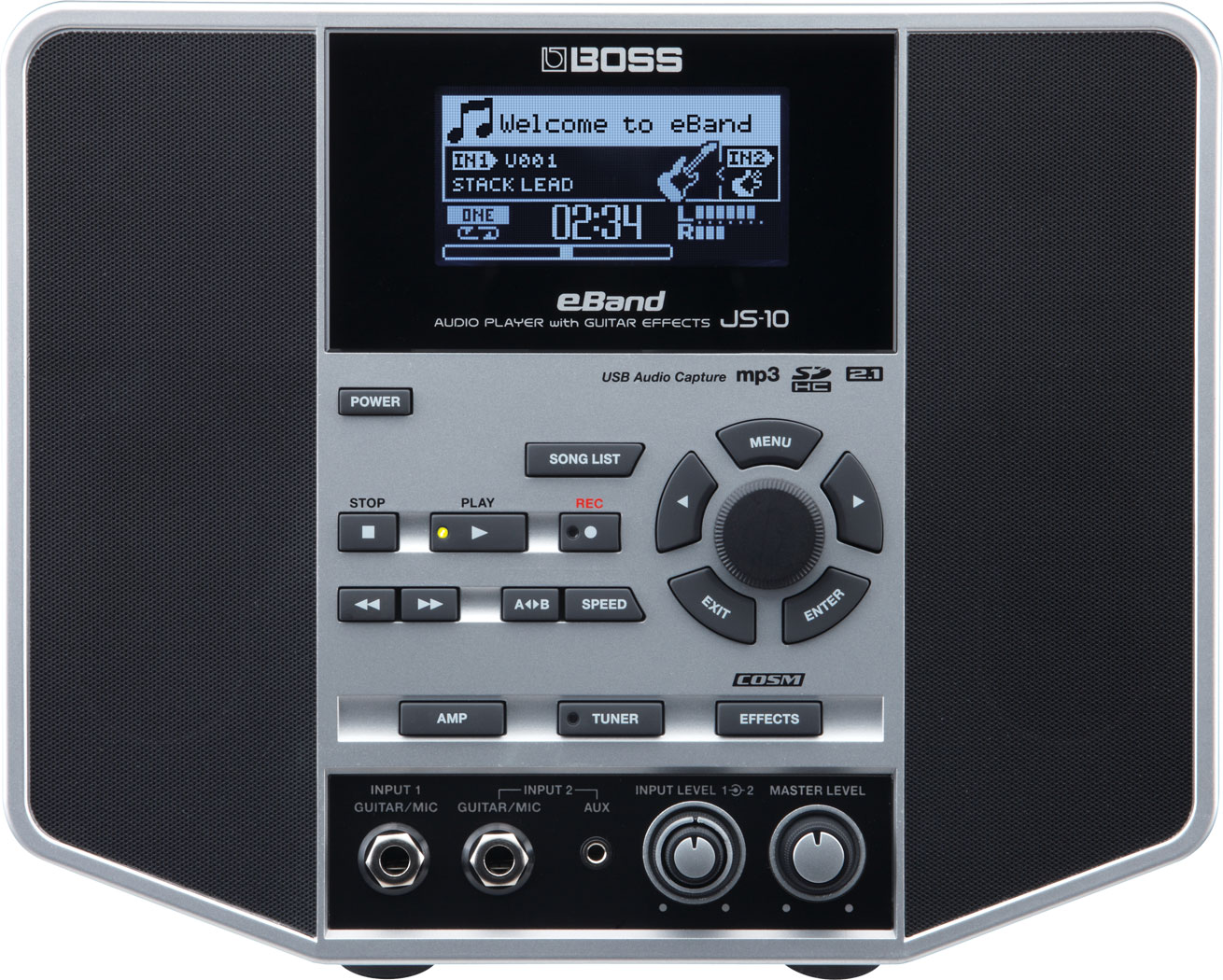
The front panel is the eBand’s command central with a very clear and concise layout.
The playback and recording functions are catered for by the usual transport buttons we all know so well. Backing tracks (the eBand calls them songs), effects and menus can be accessed via their own buttons, and then changed using the navigation buttons and the large data wheel.
The lowest row of buttons gives you quick access to the current amp model and effect chain, as well as the digital tuner.
The lowermost, black section is home to the two instrument (or microphone) inputs. You can even plug in an outboard stereo signal source into channel two’s mini-jack if your keyboarder turns up for a little jam.
You can find all other connectors on the unit’s back:
There are two usb-port – one for connection to your computer, one for a usb-stick. You can connect a footswitch or an expression pedal to the JS-10, to switch effects on-the-fly, start or stop songs, or for wah-wah or volume pedal duties.
There is also a slot for a SD/SDHC-card. The SD-card included in the package also includes the eBand Song List Editor software, which enables you to sort and swap eBand-songs using your computer, as well as for ripping CD-tracks directly into eBand-mode (PC and MAC supported). The necessary drivers for using the JS-10 as an external sound card are also included on the SD-card.
Two analogue outputs are provided in the form of a pair of RCA-connectors and one mini-jack.
Thanks to its large woofer – installed into the unit’s base, firing down – the Boss JS-10’s sound is considerably fatter and punchier than what you’d expect from such a compact piece of gear.
****
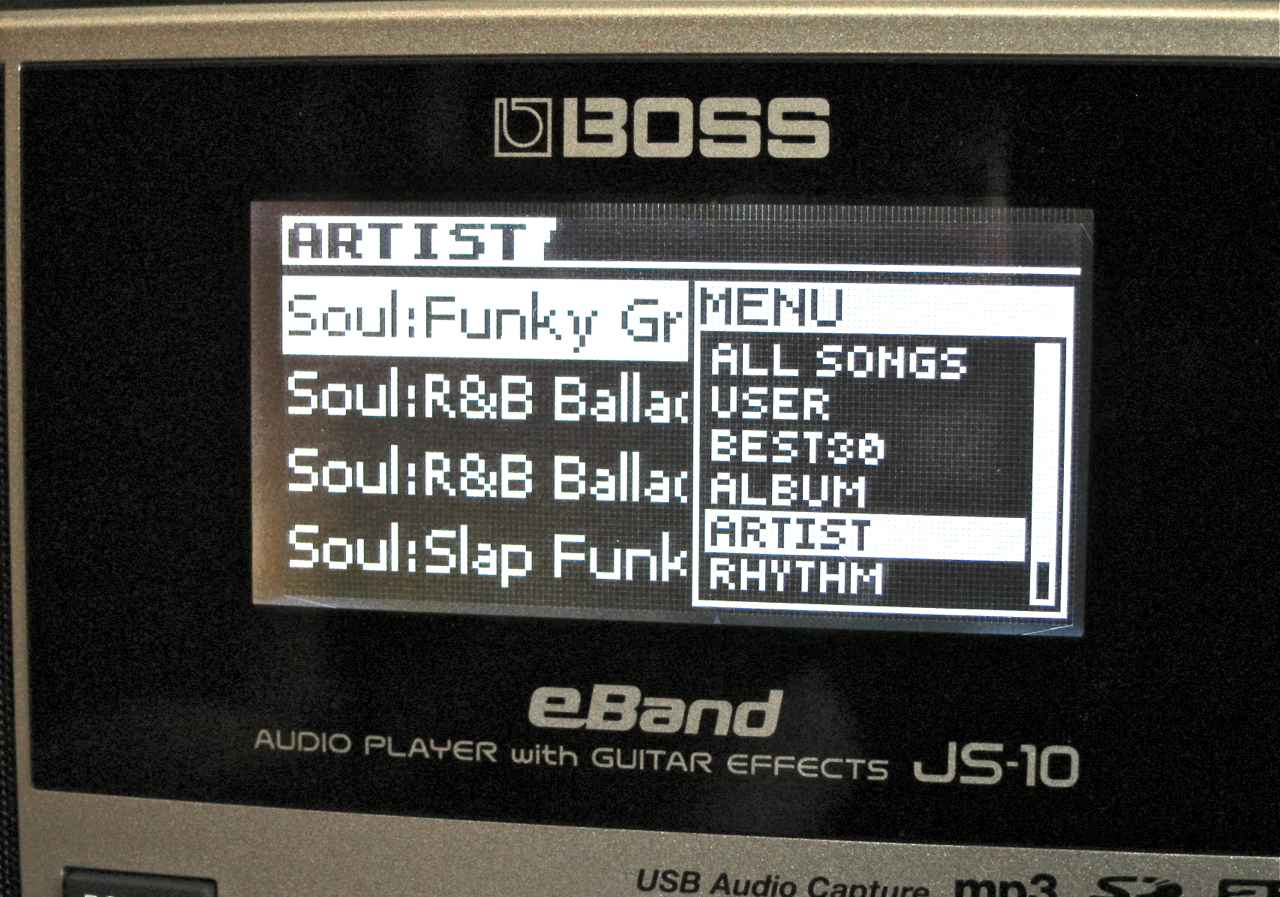
The Boss comes preloaded with a large number of eBand-songs.
eBand-songs are basically very long audio loops, sorted according to their musical genre and BPM. The library includes drums only -songs, as well as eBand-songs with full arrangements for you to solo over.
The preloaded eBand-songs are all of a very high quality and musicianship. The tracks groove thanks to the fact that they’ve been recorded using real musicians, and not just programmed midi-patterns!
Still, you are free to use whatever you choose as your backing track in the JS-10 – regardless of whether the tracks are imported using the Song List Editor or whether you’re playing them directly off a usb-stick as wave- (44,1 kHz/16 Bit) or mp3-files (64-320 kbps).
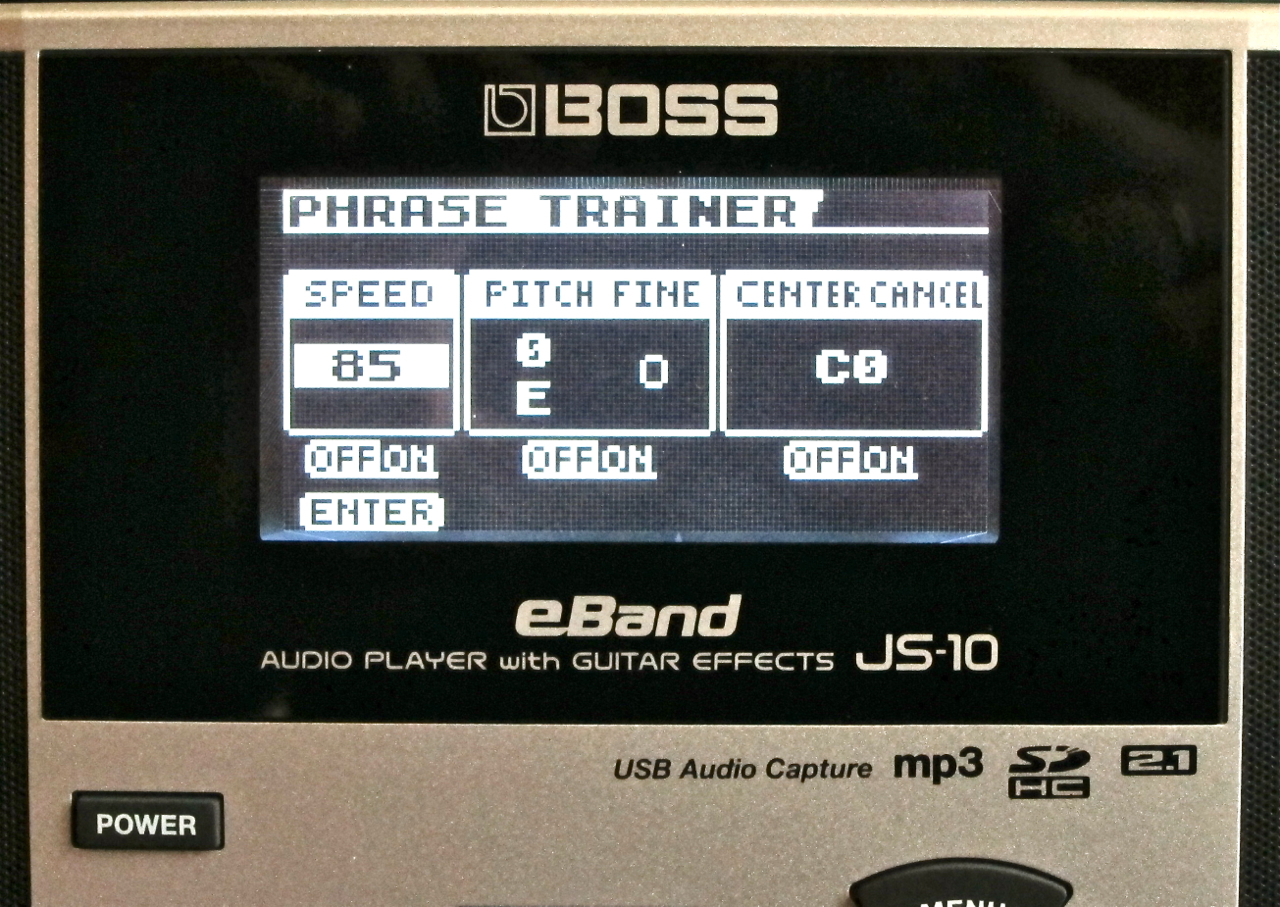
To access Boss’ Phrase Trainer -section you have to push the Speed-button:
As their names give away, Speed is used for slowing down and speeding up the playback of the current song, while Pitch is responsible for changing the pitch.
Center Cancel will be familiar to most from many Karaoke DVD-players, using phase cancellation to mute parts of the stereo image. The effect can be assigned to work only on the stereo picture’s middle…
…but one of the JS-10’s specialities is its ability to cancel out signals from elsewhere in the panorama as well (say, for example, the lead guitar in a 1960s, ping-pong-stereo recording).
How well the Phrase Trainer -section’s features work is tied directly to the technical quality and resolution of the chosen eBand-song. This means that a wave-file or a higher quality mp3 (256 or 320 kbps) will sound more natural even with larger changes, than a lower resolution mp3.
This is what the built-in tuner looks like.
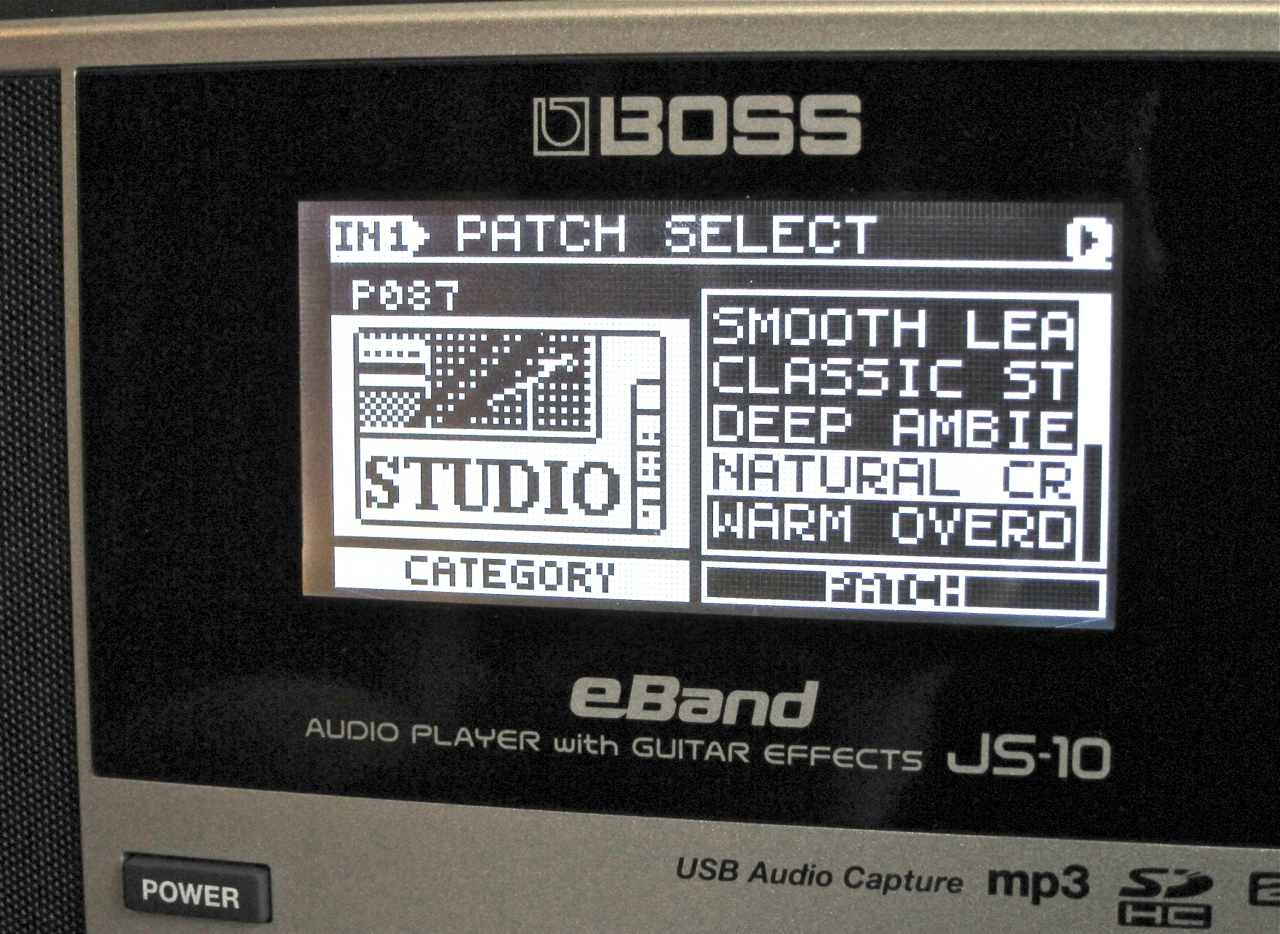
The eBand contains a long list of factory effect patches, which can be sorted according to genre. There are even a few patches for vocals and bass.
Additionally, you can also programme your own effect patches and store them in the effect section’s user library.
Each guitar input is assigned their own effect patch.
The eBand-songs already factory-loaded into the JS-10 are all tied to predetermined effect patches.
For quick editing Boss’ EZ Edit -function is most convenient. No need to fiddle with many different parameters – you simply move the cursor in the desired direction on the Solo/Backing- and Soft/Hard-axes and change the amount of ambience in the sound, and you’re set.
The Patch Edit -menu, on the other hand, gives you detailed access to all effect parameters in the signal chain.
****
There aren’t really many direct competitors to the Boss JS-10, which is kind of strange: Using the eBandin really is a faster and smoother ride than having to deal with a bunch of different devices, as well as their power supply units and connecting leads.
The Boss JS-10 is a great piece of gear, both for getting your own chops up, as well as for guitar teaching. It is straightforward in use, the effects sound great, the Phrase Trainer allows you to get to grips with devilish details, and you can check on your progress by recording your playing.
Here are three short pieces I recorded to demonstrate the quality of the eBand-songs and effects on offer:
Uusi Boss JS-10 eBand (suositushinta: 422 €) on kitaristin viihde-, harjoitus- ja opetuskeskus yhdessä kätevässä paketissa.
Boss JS-10:ssä yhdistyvät wav- ja mp3-soitin, efektilaite laadukkailla multiefekteillä ja vahvistinmallinnuksilla (lainattuja suoraan GT-100-pedaalista), kaksi tulokanavaa, erilaiset harjoitukseen sopivat apuvälineet, sekä laadukas 2.1-äänijärjestelmä (kokonaisteho 12 W).
eBandin etupaneeli on laitteen komentokeskus, ja sen rakenne on ilahduttavan selkeä.
Taustaraitojen toistoon – ja oman soiton äänitykseen – löytyy tutut transportti-näppäimet. Biisien ja efektien valintaan, sekä muihin menuvalintoihin ja parametrisäätöihin löytyy selkeät navigointinapit ja iso datapyörä.
Viimeiset kolme nappia tarjoavat meille kitaristeille suoran pääsyn vahvistimallinnukseen, efektiketjuun sekä viritysmittariin.
Mustataustaiseen master-osioon on sijoitettu laitteen kaksi analogista tuloa, joihin voi liittää joko sähkökitaran (tai -basson) tai laulumikrofonin. Kakkostulon mini-jakkiin (stereo) voi myös kytkeä ulkoisen mp3-soittimen tai bändikaverin synan yhteistä harjoittelua varten.
Kotelon kääntöpuolelta löytyy kaksi usb-porttia – yksi tietokonetta varten, toinen usb-tikulle.
Pedaali-jakkiin voi kytkeä joko jalkakytkimen (tai tuplapedaalin) tai ekspressiopolkimen. Kytkimellä saa potkaistua biisit käyntiin tai vaihdettua efektipatcheja ilman käsiä. Ekspressiopedaali taas toimii Boss JS-10:ssa joko wah-pedaalina tai volumesäätimenä.
Oikeassa laidassa on paikka SD/SDHC-kortille (1-32 GB). Boss eBandin mukaan tulevalla SD-kortilla on eBand Song List Editor -softa, jolla pystyy kätevästi järjestellä eBand-biisejä, siirtää niitä tietokoneen ja JS-10:n välillä sekä ripata biisejä suoraan CD:ltä eBand-muotoon usb-johdon kautta (PC ja Mac). Myös eBandin ajurit on pakattu mukaan, minkä ansiosta JS-10:tä voi käyttää ulkoisena usb-äänikorttina, ja hyödyntää eBandin laadukkaita efektejä sekvensseriäänityksissä.
Analogiset lähdöt on sijoitettu laitteen kylkeen – rca-pari sekä mini-jakki.
Ison subbarinsa ansiosta kätevän kokoisen JS-10:n soundi on huomattavasti muhkeampi ja isompi kuin luulisi näin kompaktista laitteista irtoavan.
****
Bossin mukana tulee erittäin tuhti paketti erilaisia eBand-biisejä.
Valmiit eBand-biisit ovat periaatteessa pitkiä audiolooppeja eri tyylilajeissa ja nopeuksissa. Biisikirjastosta löytyy sekä sellaisia kappaleita, jotka ovat pelkkiä rumpukomppeja, että kokonaisia bänditaustoja, joiden päälle voi sooloilla.
Valmiiden eBand-biisien laatu on erittäin korkea ja taustat groovaavat ja svengaavat kuin hirvi. Taustat on nimittäin äänitetty oikeilla soittajilla, sen sijaan että ne olisi luotu ohjelmoimalla midi-soittimia!
Taustoina voi kuitenkin käyttää myös Song List Editorilla ripattuja biisejä tai suoraan usb-tikulta soitettuja wav- (44,1 kHz/16 Bit) tai mp3-tiedostoja (64-320 kbps).
Speed-näppäimen takaa löytyy Bossin Phrase Trainer -osasto:
Speed-toiminto muuttaa soivan biisin nopeutta sekä ylös että alaspäin, ja Pitch käytetään audion transponointiin ja/tai hienovirittämiseen.
Center Cancel taas on monille tuttu karaoke-laitteista, ja se poistaa vaihemanipuloinnilla tehokkasti osan stereokuvan signaalista. Efekti voidaan kohdistaa perinteisesti stereon keskelle…
…mutta JS-10:n ässä hihassa on vapaasti kohdistettava poistaja, jolla pyyhkäistään tehokkaasti myös muualla stereo-kuvassa esiintyviä soittimia (esim. 1960-luvun ping-pong-stereossa).
Phrase Trainerin toiminta ja lopputuloksen soundi on suoraan sidoksissa audion tekniseen laatuun – siis: wav-tiedosto tai iso mp3-audio (256 tai 320 kbps) kestää isompiakin muutoksia paremmin kuin matalalla resoluutiolla pyörivä mp3.
Tältä näyttää Bossin viritysmittari.
eBandistä löytyy pitkä lista valmiita efektipatcheja, joita voi valita myös tyylilajin mukaan. Jopa muutama valmis laulu- ja bassoohjelma on mahdutettu mukaan.
Valmiiden efektien lisäksi voi luonnollisesti ohjelmoida myös omia efektipatcheja, joita pystyy kirjoittamaan muistin user-osioon.
Kummallekin tulolle on tarjolla oma efektiohjelmansa.
Laite valitsee omatoimisesti jokaiselle eBand-biisille siihen sopivan efektiohjelman.
Soundin nopeaan hienosäätimiseen voi käyttää Boss-multiefekteistä tuttua EZ Edit -toimintoa, jossa kursoria liikkumalla ristikossa saadaan nopeasti ja helposti soundi halutunlaiseksi. Ei tarvitse siis ruuvailla montaa parametriä peräkkäin, vaan tässä toimitaan pehmeä-aggressiivinen, komppi-soolo ja kuiva-kaikuisa akseleilla.
Patch Edit -ikkunoissa pääsee sitten yksityiskohtaisesti jokaisen efektiparametriin kiinni.
****
Boss JS-10:n kaltaiset laiteet ovat erittäin harvinaisia, mikä on tavallaan ihmeellistä: eBandin käyttö on nimittäin paljon sujuvampaa, nopeampaa ja siistimpää kuin kamppailu erillislaitteiden johto- ja adapteriviidakossa.
Boss JS-10 on loistava vehje, sekä harjoitteluun kotioloissa, että kitaraopetukseen. Se on erittäin mutkaton laite, jossa on hyvä soundi, toimvat Phrase Trainer -ominaisuudet, loistavat efektit, sekä mahdollisuus oman soiton äänittämiseen.
Tässä on kolme lyhyttä pätkää, joissa soitan soolo-osuudet JS-10:n omien eBand-biisien päälle:























 Kitarablogi.com – Finland's premier Guitar and Bass blog