Review: Boss JS-10 eBand

****

The new Boss JS-10 eBand (current RRP in Finland: 422 €) is the perfect companion for all of a guitarist’s entertainment, practicing and teaching needs.

The Boss JS-10 combines a wave-/mp3-player with a high-quality multi-effects unit – chock full with amp models and effects taken from the GT-100 – two guitar inputs, special features for practicing, as well as a full-toned 2.1 loudspeaker system.
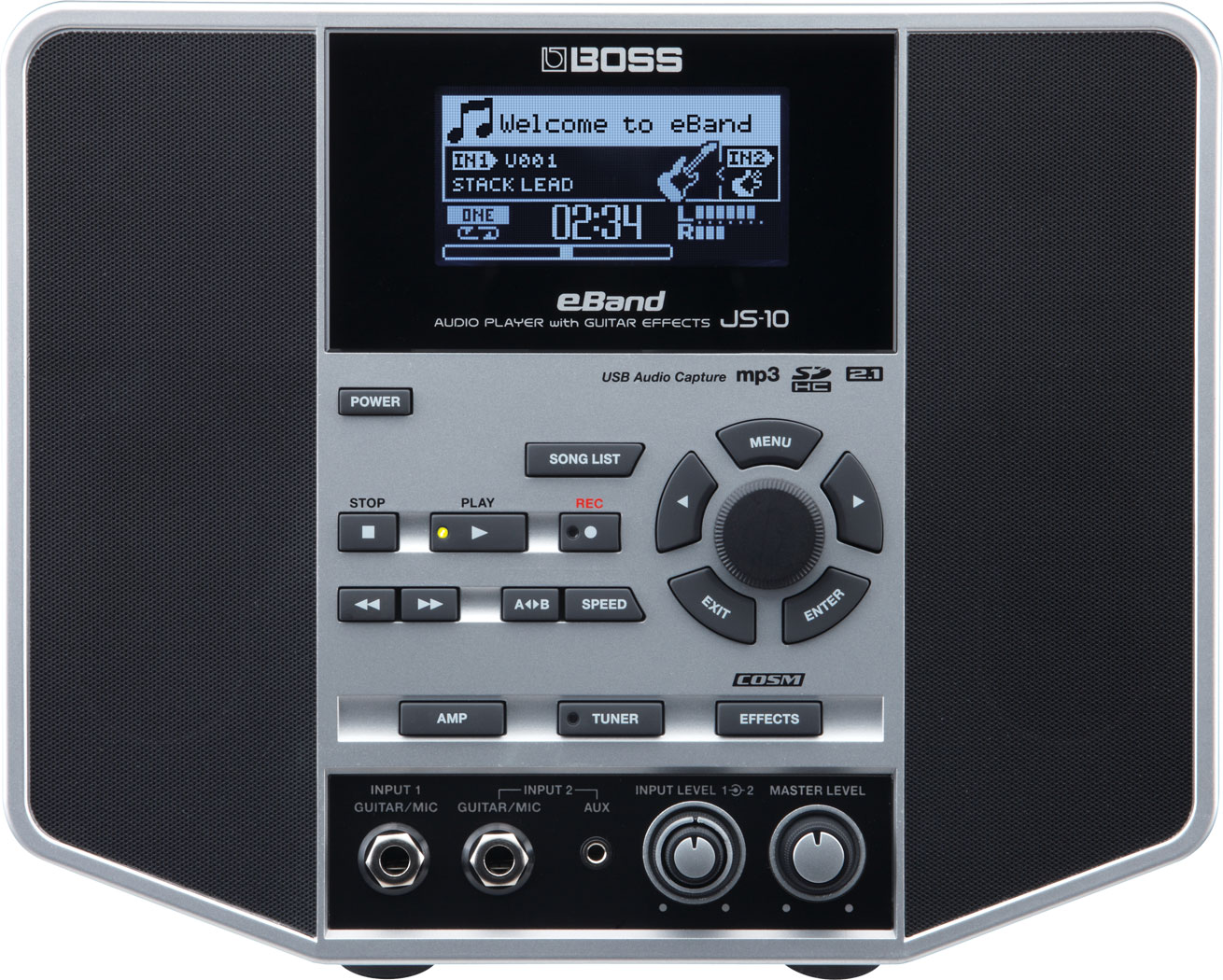
The front panel is the eBand’s command central with a very clear and concise layout.

The playback and recording functions are catered for by the usual transport buttons we all know so well. Backing tracks (the eBand calls them songs), effects and menus can be accessed via their own buttons, and then changed using the navigation buttons and the large data wheel.

The lowest row of buttons gives you quick access to the current amp model and effect chain, as well as the digital tuner.

The lowermost, black section is home to the two instrument (or microphone) inputs. You can even plug in an outboard stereo signal source into channel two’s mini-jack if your keyboarder turns up for a little jam.

You can find all other connectors on the unit’s back:

There are two usb-port – one for connection to your computer, one for a usb-stick. You can connect a footswitch or an expression pedal to the JS-10, to switch effects on-the-fly, start or stop songs, or for wah-wah or volume pedal duties.

There is also a slot for a SD/SDHC-card. The SD-card included in the package also includes the eBand Song List Editor software, which enables you to sort and swap eBand-songs using your computer, as well as for ripping CD-tracks directly into eBand-mode (PC and MAC supported). The necessary drivers for using the JS-10 as an external sound card are also included on the SD-card.

Two analogue outputs are provided in the form of a pair of RCA-connectors and one mini-jack.

Thanks to its large woofer – installed into the unit’s base, firing down – the Boss JS-10’s sound is considerably fatter and punchier than what you’d expect from such a compact piece of gear.

****
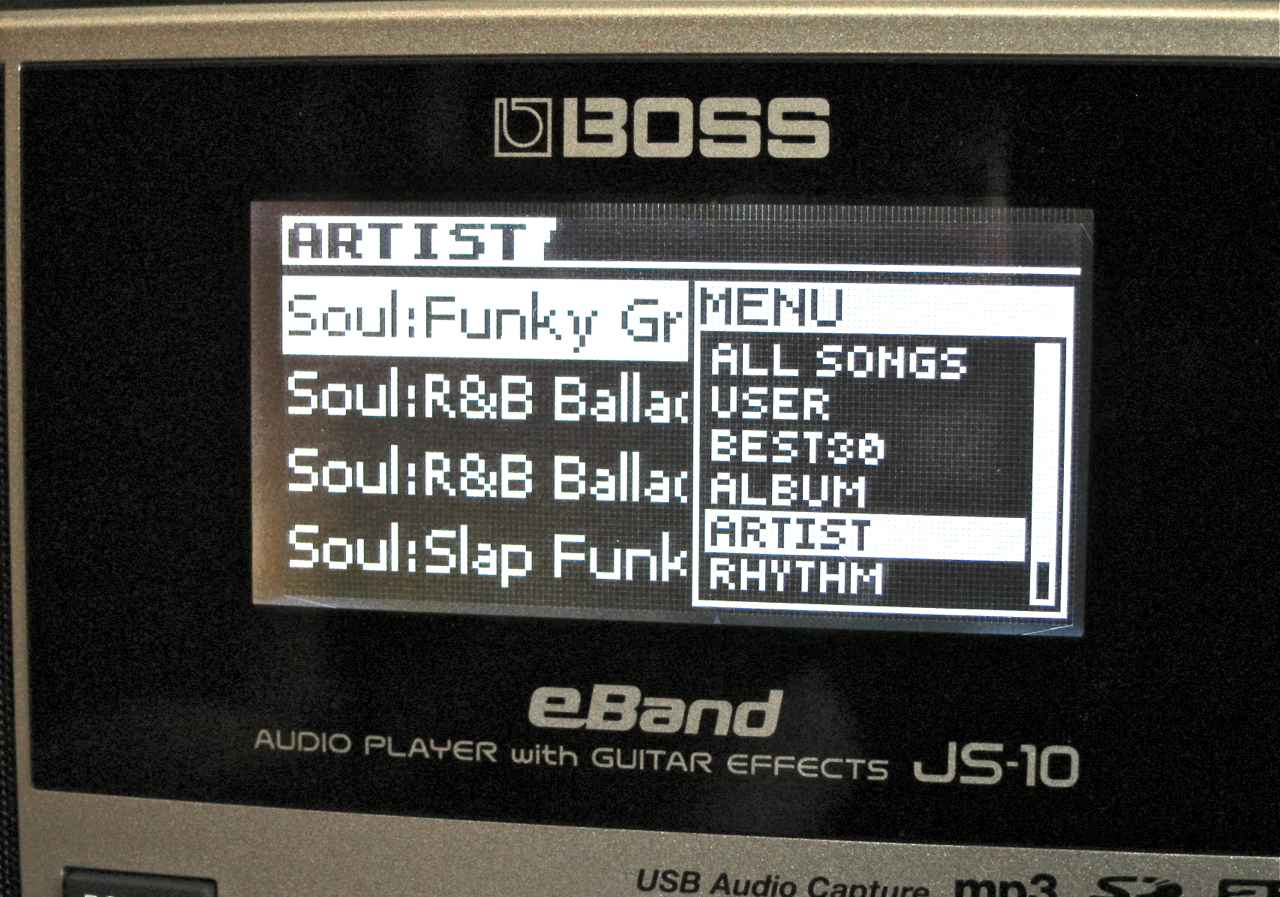
The Boss comes preloaded with a large number of eBand-songs.

eBand-songs are basically very long audio loops, sorted according to their musical genre and BPM. The library includes drums only -songs, as well as eBand-songs with full arrangements for you to solo over.

The preloaded eBand-songs are all of a very high quality and musicianship. The tracks groove thanks to the fact that they’ve been recorded using real musicians, and not just programmed midi-patterns!

Still, you are free to use whatever you choose as your backing track in the JS-10 – regardless of whether the tracks are imported using the Song List Editor or whether you’re playing them directly off a usb-stick as wave- (44,1 kHz/16 Bit) or mp3-files (64-320 kbps).
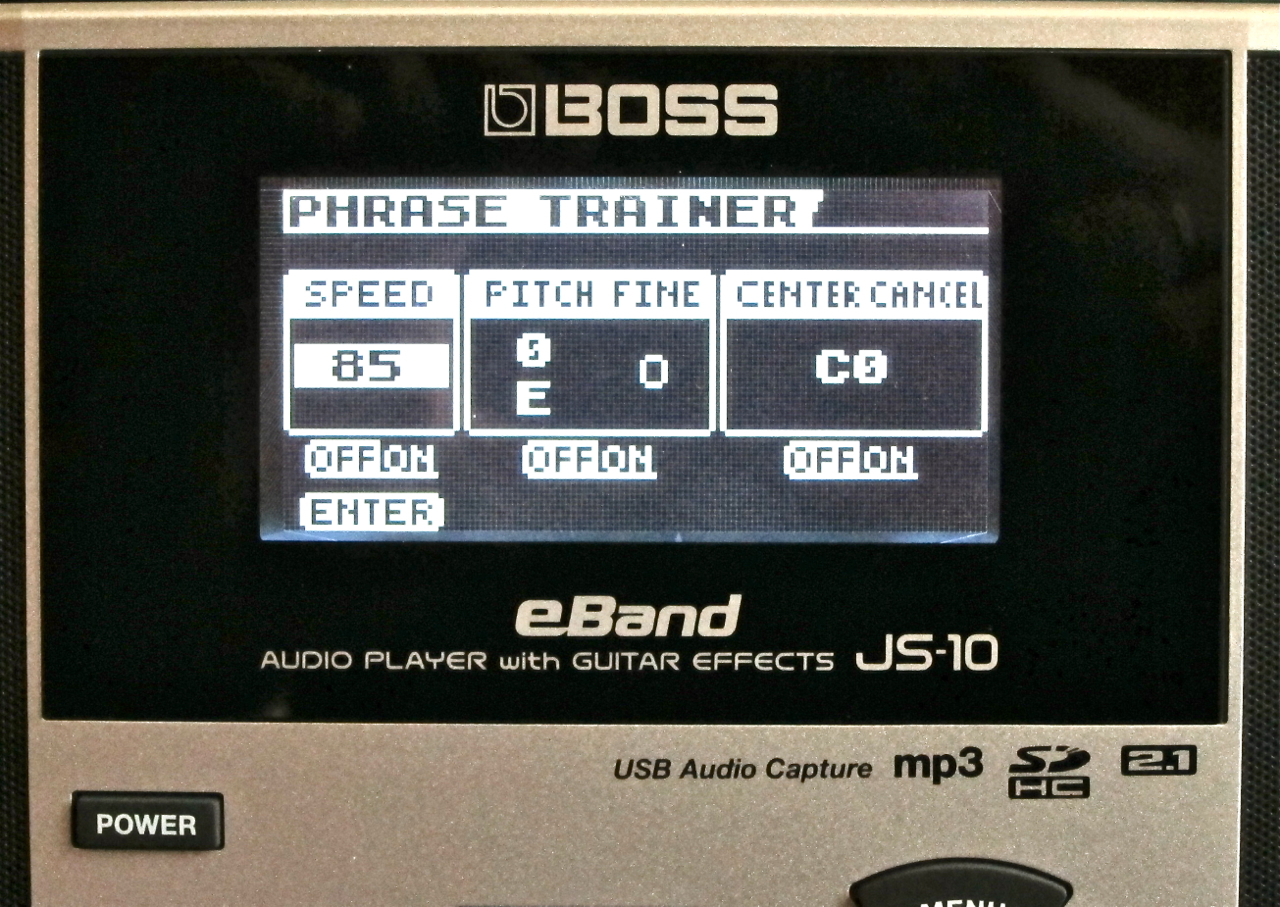
To access Boss’ Phrase Trainer -section you have to push the Speed-button:

As their names give away, Speed is used for slowing down and speeding up the playback of the current song, while Pitch is responsible for changing the pitch.

Center Cancel will be familiar to most from many Karaoke DVD-players, using phase cancellation to mute parts of the stereo image. The effect can be assigned to work only on the stereo picture’s middle…

…but one of the JS-10’s specialities is its ability to cancel out signals from elsewhere in the panorama as well (say, for example, the lead guitar in a 1960s, ping-pong-stereo recording).

How well the Phrase Trainer -section’s features work is tied directly to the technical quality and resolution of the chosen eBand-song. This means that a wave-file or a higher quality mp3 (256 or 320 kbps) will sound more natural even with larger changes, than a lower resolution mp3.

This is what the built-in tuner looks like.
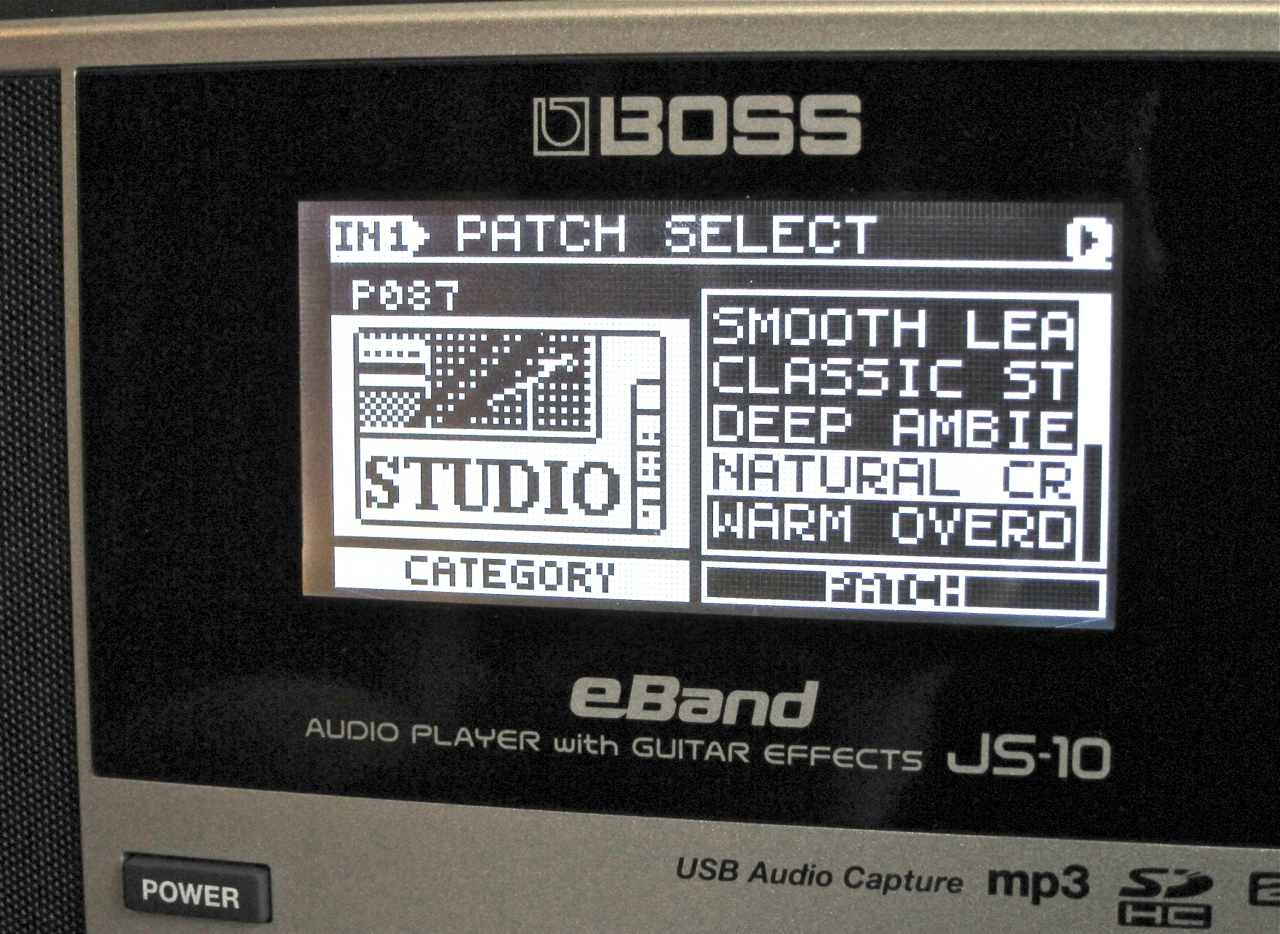
The eBand contains a long list of factory effect patches, which can be sorted according to genre. There are even a few patches for vocals and bass.

Additionally, you can also programme your own effect patches and store them in the effect section’s user library.

Each guitar input is assigned their own effect patch.

The eBand-songs already factory-loaded into the JS-10 are all tied to predetermined effect patches.

For quick editing Boss’ EZ Edit -function is most convenient. No need to fiddle with many different parameters – you simply move the cursor in the desired direction on the Solo/Backing- and Soft/Hard-axes and change the amount of ambience in the sound, and you’re set.

The Patch Edit -menu, on the other hand, gives you detailed access to all effect parameters in the signal chain.

****

There aren’t really many direct competitors to the Boss JS-10, which is kind of strange: Using the eBandin really is a faster and smoother ride than having to deal with a bunch of different devices, as well as their power supply units and connecting leads.

The Boss JS-10 is a great piece of gear, both for getting your own chops up, as well as for guitar teaching. It is straightforward in use, the effects sound great, the Phrase Trainer allows you to get to grips with devilish details, and you can check on your progress by recording your playing.

Here are three short pieces I recorded to demonstrate the quality of the eBand-songs and effects on offer:

Boss JS-10 – Funky Groove

Boss JS-10 – Gothic Metal

Boss JS-10 – Country Train

****

Boss JS-10 eBand

Current RRP in Finland: 422 €

Finnish distributor: Roland Scandinavia

Pros:

+ sound

+ COSM-effects

+ Phrase Trainer -functions

+ recording capability

+ SDHC-card slot

+ USB-audio

****

Testipenkissä: Boss JS-10 eBand

****

Uusi Boss JS-10 eBand (suositushinta: 422 €) on kitaristin viihde-, harjoitus- ja opetuskeskus yhdessä kätevässä paketissa.

Boss JS-10:ssä yhdistyvät wav- ja mp3-soitin, efektilaite laadukkailla multiefekteillä ja vahvistinmallinnuksilla (lainattuja suoraan GT-100-pedaalista), kaksi tulokanavaa, erilaiset harjoitukseen sopivat apuvälineet, sekä laadukas 2.1-äänijärjestelmä (kokonaisteho 12 W).

eBandin etupaneeli on laitteen komentokeskus, ja sen rakenne on ilahduttavan selkeä.

Taustaraitojen toistoon – ja oman soiton äänitykseen – löytyy tutut transportti-näppäimet. Biisien ja efektien valintaan, sekä muihin menuvalintoihin ja parametrisäätöihin löytyy selkeät navigointinapit ja iso datapyörä.

Viimeiset kolme nappia tarjoavat meille kitaristeille suoran pääsyn vahvistimallinnukseen, efektiketjuun sekä viritysmittariin.

Mustataustaiseen master-osioon on sijoitettu laitteen kaksi analogista tuloa, joihin voi liittää joko sähkökitaran (tai -basson) tai laulumikrofonin. Kakkostulon mini-jakkiin (stereo) voi myös kytkeä ulkoisen mp3-soittimen tai bändikaverin synan yhteistä harjoittelua varten.

Kotelon kääntöpuolelta löytyy kaksi usb-porttia – yksi tietokonetta varten, toinen usb-tikulle.

Pedaali-jakkiin voi kytkeä joko jalkakytkimen (tai tuplapedaalin) tai ekspressiopolkimen. Kytkimellä saa potkaistua biisit käyntiin tai vaihdettua efektipatcheja ilman käsiä. Ekspressiopedaali taas toimii Boss JS-10:ssa joko wah-pedaalina tai volumesäätimenä.

Oikeassa laidassa on paikka SD/SDHC-kortille (1-32 GB). Boss eBandin mukaan tulevalla SD-kortilla on eBand Song List Editor -softa, jolla pystyy kätevästi järjestellä eBand-biisejä, siirtää niitä tietokoneen ja JS-10:n välillä sekä ripata biisejä suoraan CD:ltä eBand-muotoon usb-johdon kautta (PC ja Mac). Myös eBandin ajurit on pakattu mukaan, minkä ansiosta JS-10:tä voi käyttää ulkoisena usb-äänikorttina, ja hyödyntää eBandin laadukkaita efektejä sekvensseriäänityksissä.

Analogiset lähdöt on sijoitettu laitteen kylkeen – rca-pari sekä mini-jakki.

Ison subbarinsa ansiosta kätevän kokoisen JS-10:n soundi on huomattavasti muhkeampi ja isompi kuin luulisi näin kompaktista laitteista irtoavan.

****

Bossin mukana tulee erittäin tuhti paketti erilaisia eBand-biisejä.

Valmiit eBand-biisit ovat periaatteessa pitkiä audiolooppeja eri tyylilajeissa ja nopeuksissa. Biisikirjastosta löytyy sekä sellaisia kappaleita, jotka ovat pelkkiä rumpukomppeja, että kokonaisia bänditaustoja, joiden päälle voi sooloilla.

Valmiiden eBand-biisien laatu on erittäin korkea ja taustat groovaavat ja svengaavat kuin hirvi. Taustat on nimittäin äänitetty oikeilla soittajilla, sen sijaan että ne olisi luotu ohjelmoimalla midi-soittimia!

Taustoina voi kuitenkin käyttää myös Song List Editorilla ripattuja biisejä tai suoraan usb-tikulta soitettuja wav- (44,1 kHz/16 Bit) tai mp3-tiedostoja (64-320 kbps).

Speed-näppäimen takaa löytyy Bossin Phrase Trainer -osasto:

Speed-toiminto muuttaa soivan biisin nopeutta sekä ylös että alaspäin, ja Pitch käytetään audion transponointiin ja/tai hienovirittämiseen.

Center Cancel taas on monille tuttu karaoke-laitteista, ja se poistaa vaihemanipuloinnilla tehokkasti osan stereokuvan signaalista. Efekti voidaan kohdistaa perinteisesti stereon keskelle…

…mutta JS-10:n ässä hihassa on vapaasti kohdistettava poistaja, jolla pyyhkäistään tehokkaasti myös muualla stereo-kuvassa esiintyviä soittimia (esim. 1960-luvun ping-pong-stereossa).

Phrase Trainerin toiminta ja lopputuloksen soundi on suoraan sidoksissa audion tekniseen laatuun – siis: wav-tiedosto tai iso mp3-audio (256 tai 320 kbps) kestää isompiakin muutoksia paremmin kuin matalalla resoluutiolla pyörivä mp3.

Tältä näyttää Bossin viritysmittari.

eBandistä löytyy pitkä lista valmiita efektipatcheja, joita voi valita myös tyylilajin mukaan. Jopa muutama valmis laulu- ja bassoohjelma on mahdutettu mukaan.

Valmiiden efektien lisäksi voi luonnollisesti ohjelmoida myös omia efektipatcheja, joita pystyy kirjoittamaan muistin user-osioon.

Kummallekin tulolle on tarjolla oma efektiohjelmansa.

Laite valitsee omatoimisesti jokaiselle eBand-biisille siihen sopivan efektiohjelman.

Soundin nopeaan hienosäätimiseen voi käyttää Boss-multiefekteistä tuttua EZ Edit -toimintoa, jossa kursoria liikkumalla ristikossa saadaan nopeasti ja helposti soundi halutunlaiseksi. Ei tarvitse siis ruuvailla montaa parametriä peräkkäin, vaan tässä toimitaan pehmeä-aggressiivinen, komppi-soolo ja kuiva-kaikuisa akseleilla.

Patch Edit -ikkunoissa pääsee sitten yksityiskohtaisesti jokaisen efektiparametriin kiinni.

****

Boss JS-10:n kaltaiset laiteet ovat erittäin harvinaisia, mikä on tavallaan ihmeellistä: eBandin käyttö on nimittäin paljon sujuvampaa, nopeampaa ja siistimpää kuin kamppailu erillislaitteiden johto- ja adapteriviidakossa.

Boss JS-10 on loistava vehje, sekä harjoitteluun kotioloissa, että kitaraopetukseen. Se on erittäin mutkaton laite, jossa on hyvä soundi, toimvat Phrase Trainer -ominaisuudet, loistavat efektit, sekä mahdollisuus oman soiton äänittämiseen.

Tässä on kolme lyhyttä pätkää, joissa soitan soolo-osuudet JS-10:n omien eBand-biisien päälle:

Boss JS-10 – Funky Groove

Boss JS-10 – Gothic Metal

Boss JS-10 – Country Train

****

Boss JS-10 eBand

suositushinta: 422 €

Maahantuoja: Roland Scandinavia

Plussat:

+ soundi

+ COSM-efektejä

+ Phrase Trainer -osasto

+ äänitysmahdollisuus

+ SDHC-kortti

+ USB-audio

****

Kaksi uutta bassoa Squierilta – Telecaster Bass ja Telecaster Bass Special

Squier Vintage Modified Telecaster Bass on mielenkiintoinen sekoitus 1950-luvun Presarista ja Telecaster-kitarasta.

Bassossa on keskipitkä mensuuri (32 tuumaa/81,3 cm) ja yksi yksikelainen Duncan Designed -mikrofoni. Kolmiasentoinen kytkin mahdollistaa tavallisen sähköbassosoundin lisäksi myös erittäin tummia vaihtoehtoja tai nasaaleja baritoni-soundeja.

****

Squier Vintage Modified Telecaster Bass Special taas tarjoaa kaksi hyvin erilaista mikkiä samassa paketissa. Kaulan läheltä löytyy Fender Wide Range -humbuckeri ja tallan viereen on asennettu Duncan Designed -merkkinen Jazz-basson yksikelainen.

Review: Kataja Guitars – three basses

****
Ari Kataja’s Kataja Custom Shop is a small builder from Tampere (Finland), who has concentrated on one-offs for his clients up to now (alongside repair work).

Kataja Guitars have recently come out with their line of Fender-inspired basses, produced in small runs; the new models were also on display at this year’s Bassopäivä (the annual Bass Day at the Pop-Jazz-Academy in Helsinki).

Kitarablogi.com jumped at the opportunity to get three models for a review:

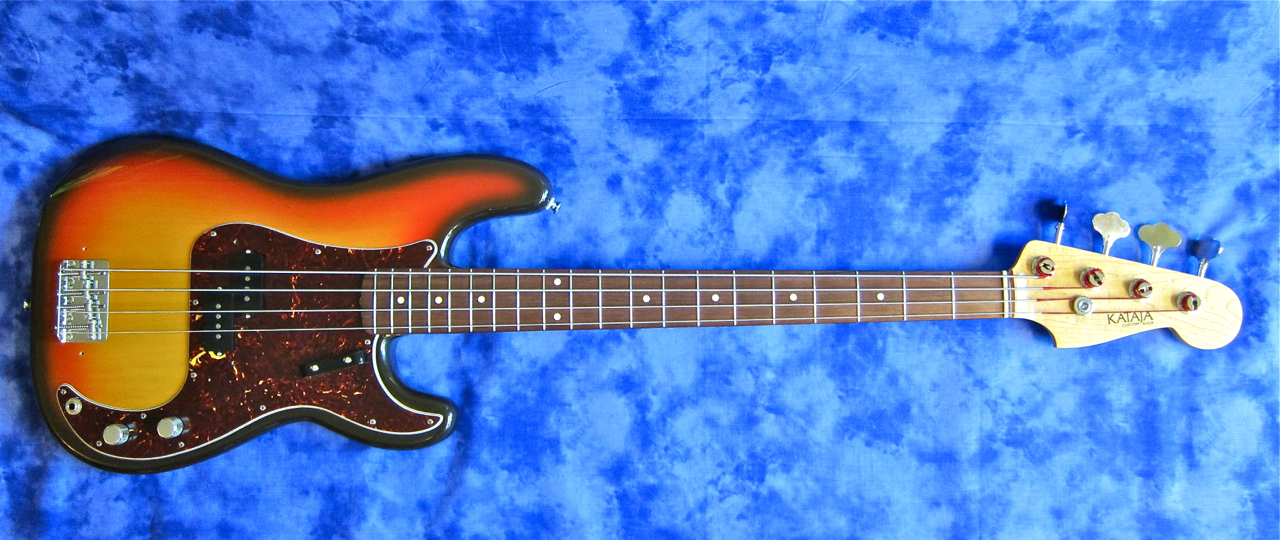
Ari Kataja’s version of a P-bass…

…a model based on a 1960 Jazz…

…as well as a ca 1962/63 Jazz Bass -based bass (current prices in Finland start from 1,920 €, incl gigbag).

****
Kataja Custom basses are crafted in Finland – start to finish. Even though there is quite a number of so-called custom builders, who use pre-fabricated bodies and necks as their basic ingredients, this is not the way for Mr Kataja. His instruments start life as wood blanks, carefully dried to a correct moisture content.

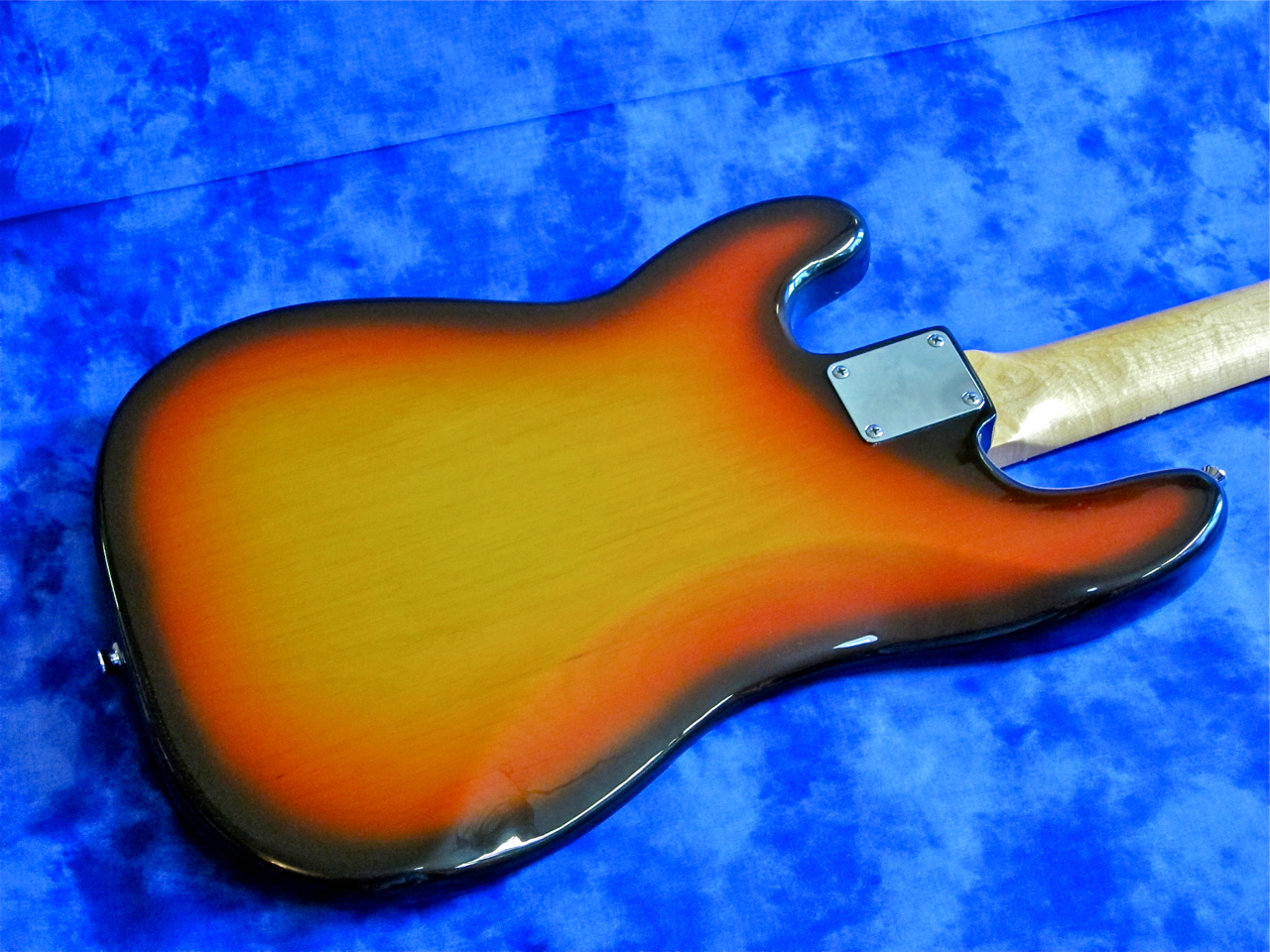
Shared features among the three review basses are bodies crafted from alder and maple necks sporting rosewood fingerboards.

Ari Kataja is also a stickler for period-correct parts and hardware. Take the tortie ’guard on the white 1960 J-model, for example, which is a special item using vintage-style celluloid for its top layer.

All three models have been finished using a modern type of nitrocellulose lacquer. The resulting finish is very thin and hard, protecting the wood, but not inhibiting the instruments’ vibrations.

The P-model’s headstock comes finished in clear lacquer…

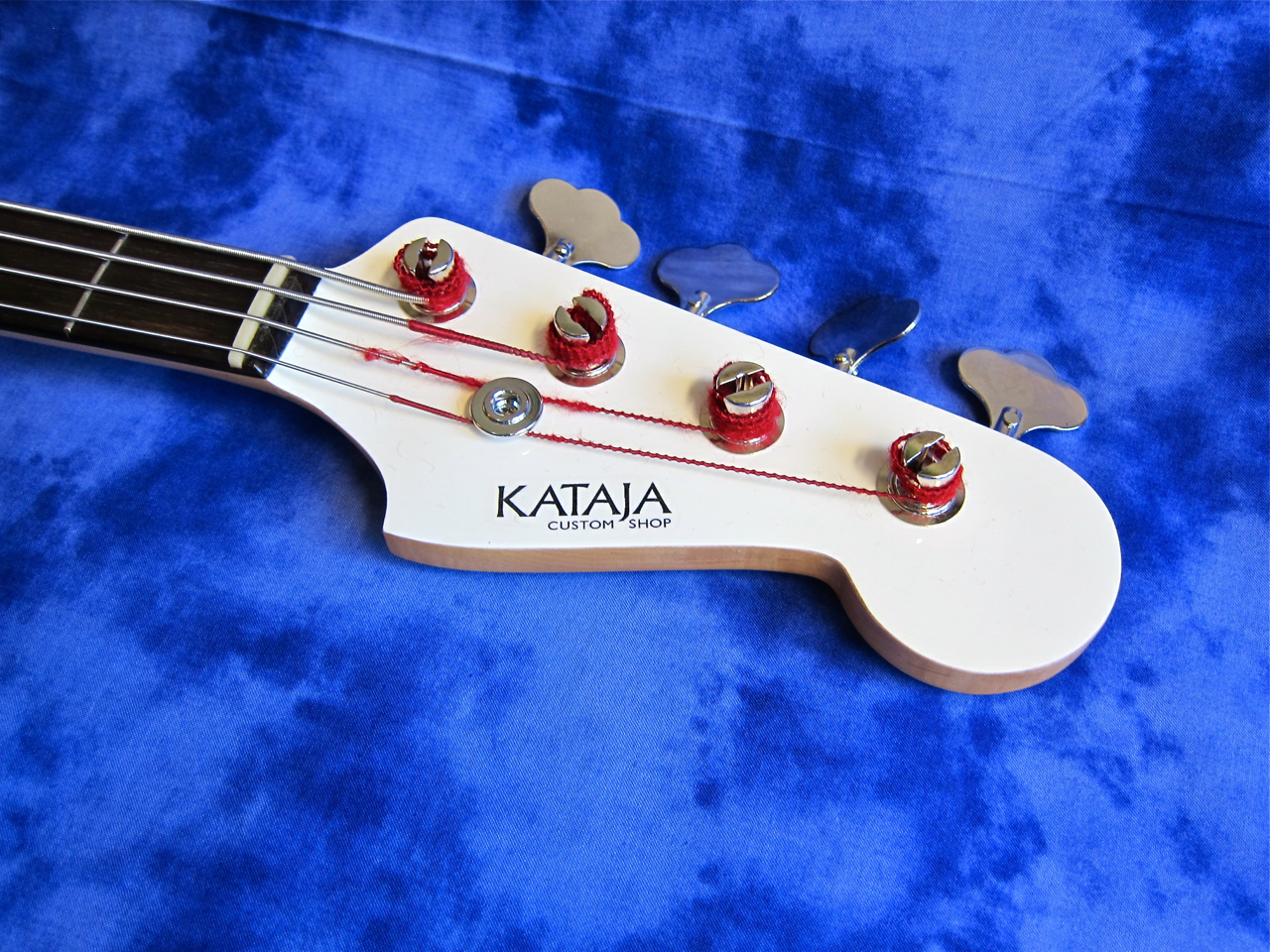
…while both of the J-models on review here…

…sport colour finishes, matching their bodies.

The tuning machines are modern reproduction of the reverse-action Klusons from the 1950’s and 60s. The keys still have to be turned the ”wrong” way around, compared to modern machine heads, but the tuning ratio is finer on these improved vintage reissues.

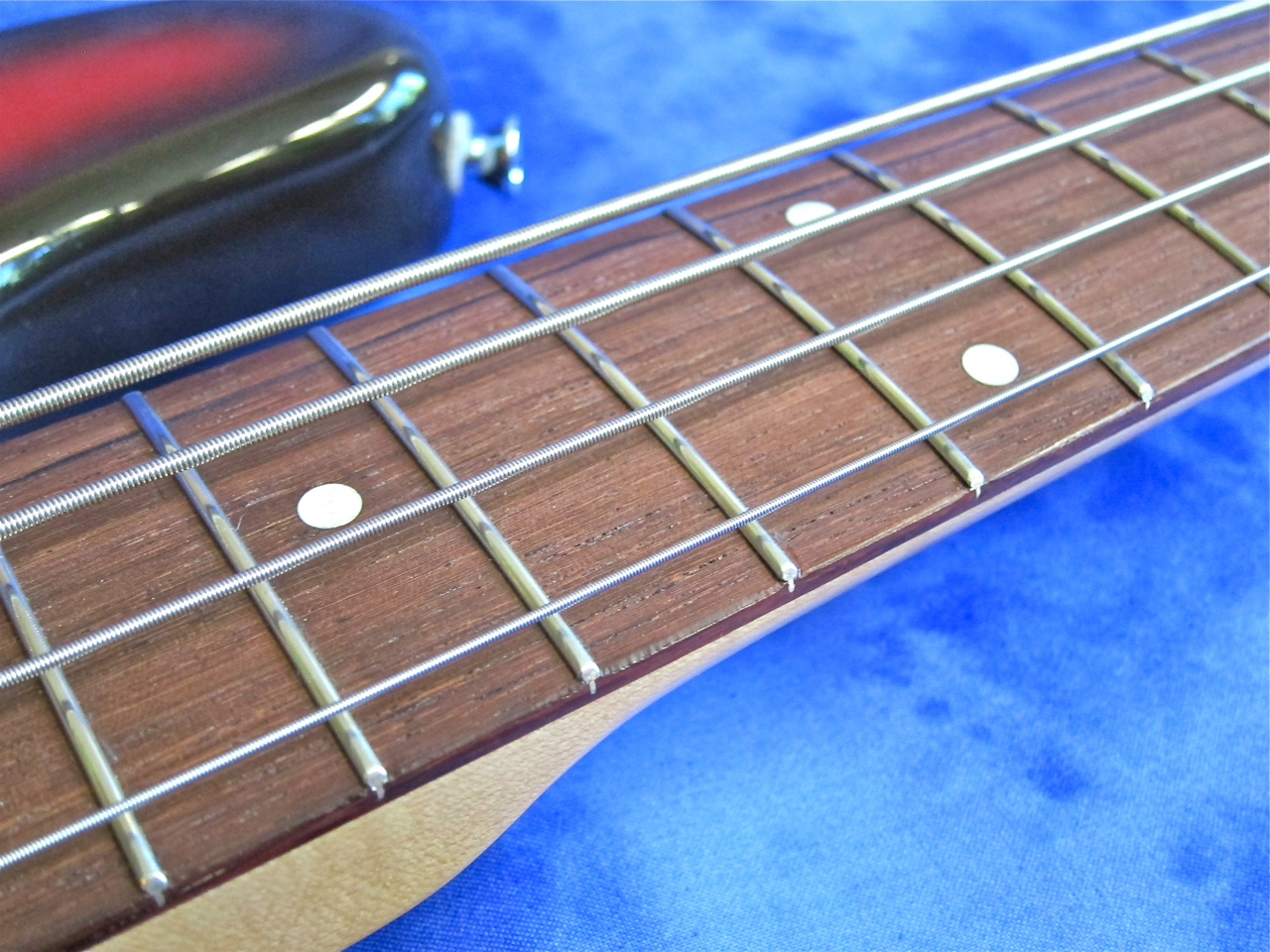
The review basses sport gorgeous Madagascar rosewood fingerboards.

The white 60 J comes with small vintage-sized frets…

…while the P-model and the 62 J both come equipped with medium-sized frets.

The neck joints are traditional. Following a late-50s/early-60s pattern, all basses have deep contouring for added comfort.

All three instruments come with a period-correct vintage bridge with threaded bridge saddles. This makes it possible to set the distance between the strings simply by lifting each string from one ”groove” to another.

****
The Kataja 60 P and 60 J have pickups loaded with 0,195″-diameter (4,95 mm) alnico magnets with bevelled tips.

The bevelling was used to prevent the magnets from chipping the vulcanised fibreboard coil formers, when the magnets were tapped through their holes.

The guitar boom of the 1960s made it paramount to increase production numbers and production efficiency. One step was bringing down the diameter of the pickup magnets marginally to 0,187″ (4,75 mm). The slightly slimmer magnets were easier to get through the fibreboard coil formers, which made the bevelling unnecessary. Thrue to style, Kataja’s 62 J model uses this type of magnet in its pickups.

There are also other differences between the pickups that aren’t easy to spot: The P and  60 J models’ pickups are wound with the period-correct Heavy Formvar -wire, while the blue Kataja’s pickups use the Plain Enamel -variety. Also, the fibreboard coil formers are coloured differently, according to the bass’ respective ”vintage”.

The white J-type features two stacked, concentric controls, with the silver top being each pickup’s volume control, and the lower ”ring” being the pickup’s own tone roll-off.

This set-up was changed in 1962 to the control lay-out we all know and love so well – separate volumes, one per pickup, with a shared master tone control.

****

These three basses by the Kataja Custom Shop are amazing, top-drawer instruments, designed for the vintage fanatic. The workmanship on display is first-rate, and the way with which Ari Kataja is able to zone in on each minute detail says a lot about this craftsman’s dedication and passion.

As is implied in the name, a Custom Shop’s forte is the flexibility with which it can accommodate a customer’s special wishes into the finished instrument. In the case of these three basses, Mr Kataja fattend up the neck profiles a little bit to his own preference.

The Kataja basses play like a dream and sound fantastic.

I recorded the following soundbites direct, using a Sans Amp Bass Driver DI plugged into a Focusrite Saffire 6 USB -soundcard. Each style has been recorded with one set of Sans Amp settings, taking care to keep the differences between each bass in terms of output level and sound intact. With the J-types each bass line is first played using only the neck pickup, then repeated with both pickups on full, and lastly recorded via the bridge unit on its own.

Kataja 60 P – fingerstyle

Kataja 60 J – fingerstyle

Kataja 62 J – fingerstyle

……

Kataja 60 P – pleck

Kataja 60 J – pleck

Kataja 62 J – pleck

……

Kataja 60 P – slap

Kataja 60 J – slap

Kataja 62 J – slap

****

As you can clearly hear, the Kataja-basses deliver great, vintage tones. The pickups vintage-style medium output only helps in achieving the clear and dynamic tones the originals of yore are so famous for.

In light of the offered build quality and the tasty tones on tap, Kataja’s pricing can only be seen as truly affordable.

If you’re on the lookout for an investment-grade, vintage-style bass, you should definitely try one of Kataja Custom Shop’s creations!

****

Kataja Custom Shop – vintage-style basses

current prices in Finland start from 1,920 €, incl gigbag

Contact: Kataja Guitars

Pros:

+ Made in Finland

+ workmanship

+ playability

+ sound

+ Kataja-pickups

+ satin finishes necks on review samples

+ fair price

****

Epiphone esittelee kolme uutta Pro-versiota

Epiphonen kolme uutta Pro-versiota vievät firman klassikkomalleja entisestäkin lähempää alkuperäisiä Gibson-soittimia:

Epiphone Thunderbird Classic-IV Pro -bassossa on kaula-läpi-rungon rakenne mahongista ja pähkinäpuusta. Mikrofonit tulevat Gibson USA:lta – ne ovat aidot Gibson TB-Plus -humbuckerit keraamisilla magneeteilla.

****

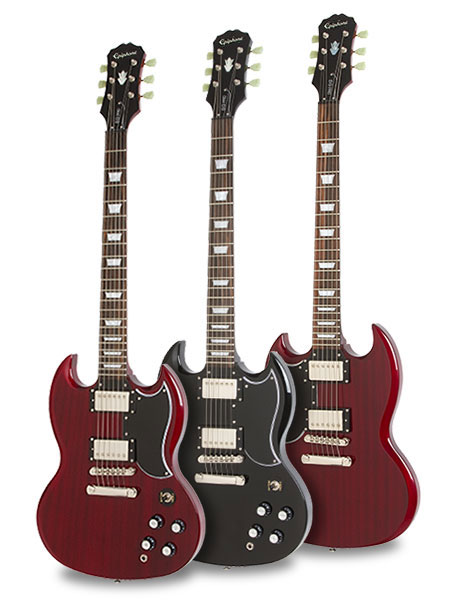
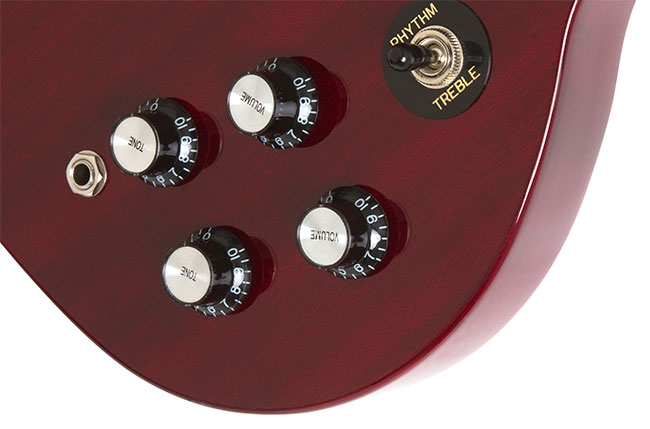
Epiphone G-400 Pro -malli komeilee Epiphone Alnico Classic Pro -humbuckereilla, joita voi volume-potikoihin piilotetuilla nostokytkimillä puolittaa. Kirsikanpunainen G-400 Pro on saatavilla myös vasenkätisenä.

****

Näyttävillä loimuvaahteraviilulla koristeltu Epiphone Les Paul Standard Plustop Pro taas on varustettu puolitettavilla Epiphone ProBucker-2 ja ProBucker-3 -humbuckereilla. Oikeankätisille kitaristeille on tarjolla viisi värivaihtoehtoa, kun taas vasenkätisen soittajan on tyydyttävä Heritage Cherry Sunburst -väritykseen.

****

Pidä blogia WordPress.comissa.

Ylös ↑