Lisätiedot: Musamaailma
Kitarablogi.com – Finland's premier Guitar and Bass blog
Juttuja kitaroista ja bassoista


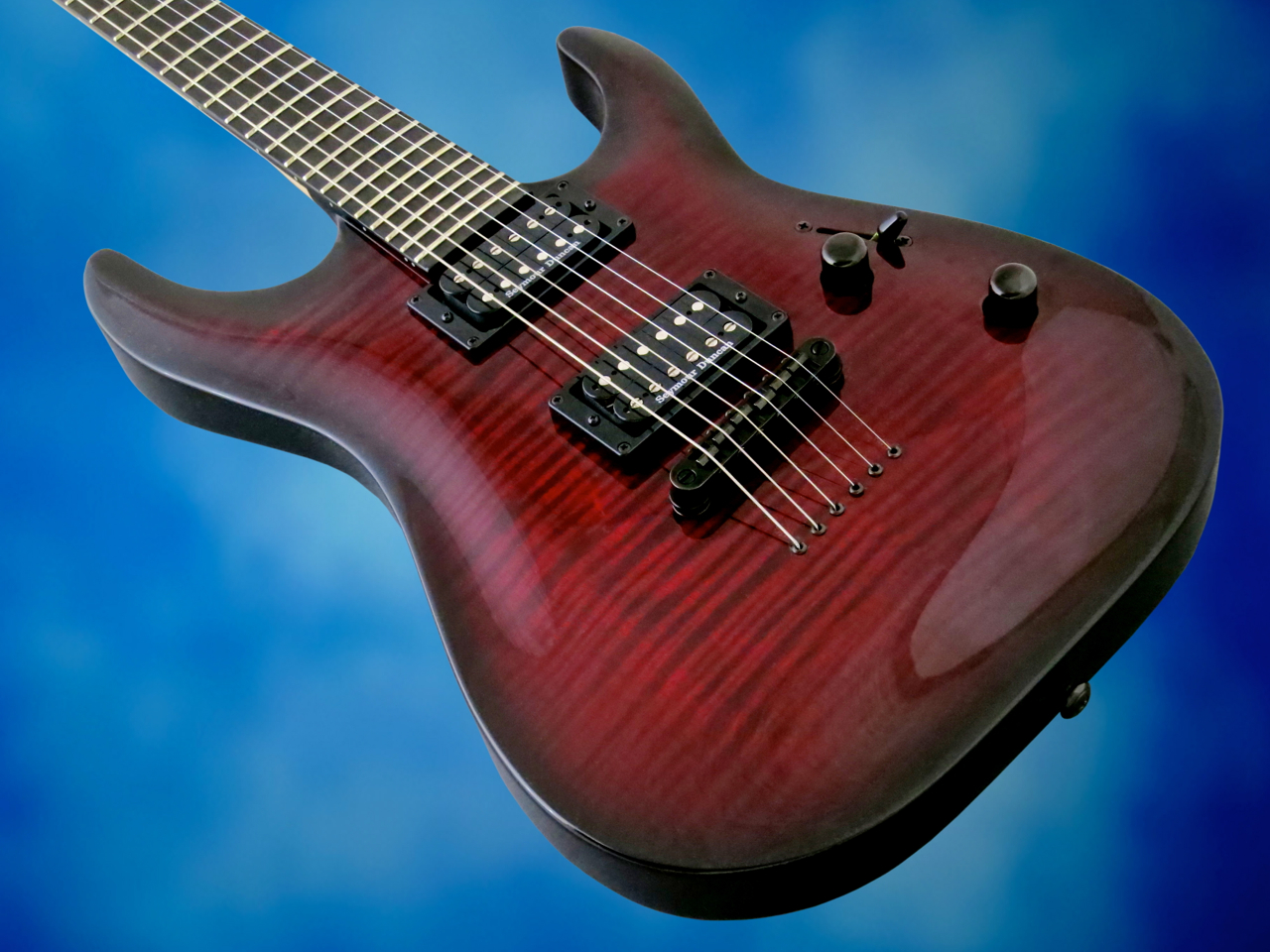
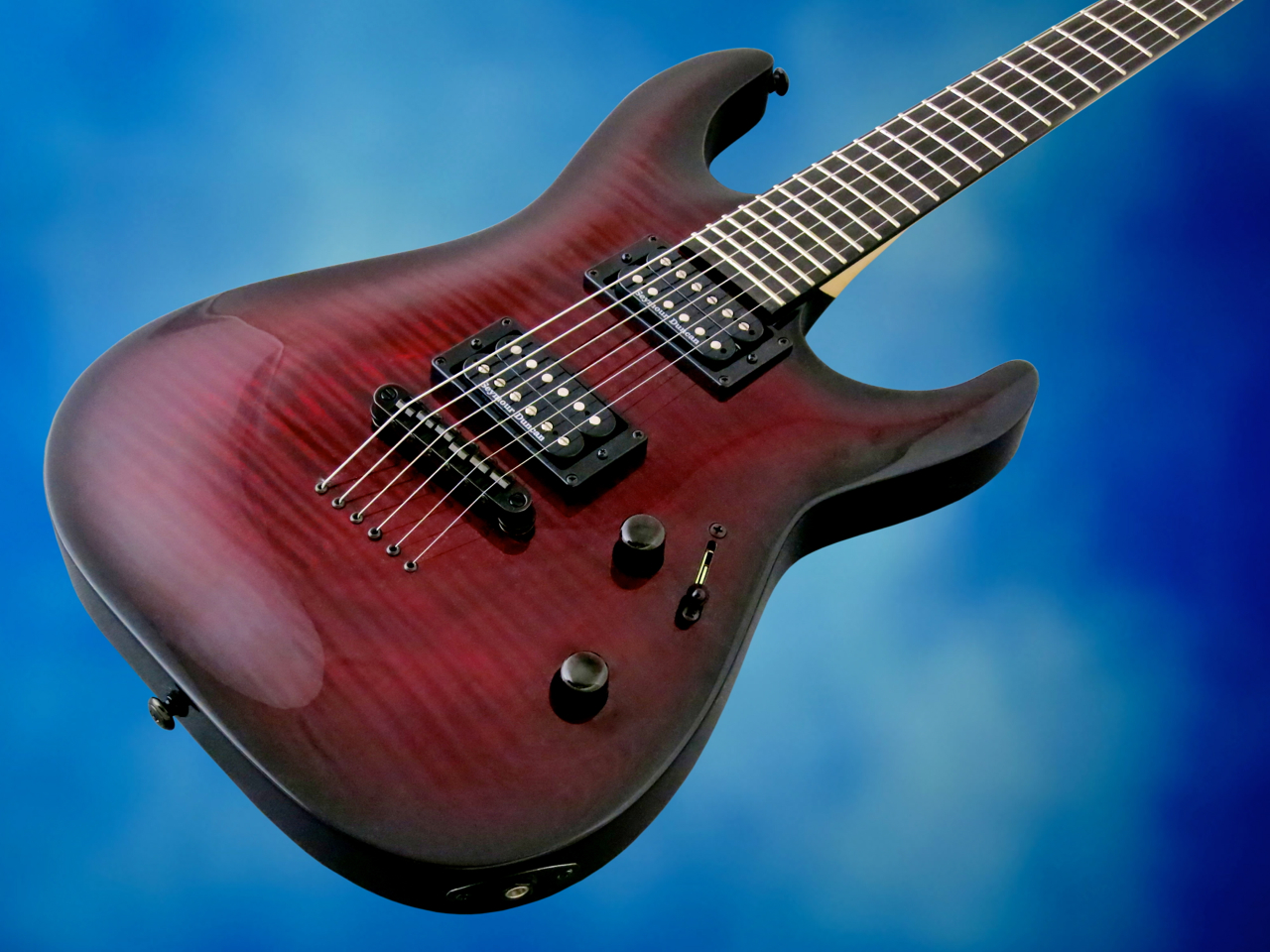
ESP LTD MM-30 on Musamaailman 30-vuotis juhlamalli.


Soitinliikkeenä ja maahantuojana tunnettu Musamaailma juhlii tänä vuonna 30-vuotissynttäriään.
Juhlan kunniaksi ESP Guitars on valmistanut 30 kappaletta LTD MM-30 -juhlamallista. Synttärimallin Kitarablogi-testi on juuri työn alla.
ESP- ja LTD-soittimien lisäksi Musamaailma tuo kitara- ja bassopuolella maahan mm. myös seuraavat merkit: Admira, Blackstar, Bogner, DV Mark, EMG, GJ2 Guitars, Markbass, Mooer, Seymour Duncan, Spector, Tanglewood, Tech 21 NYC, Tokai, Rockbag ja Warwick.

Kitarablogin testipenkissä kävi tällä kertaa kaksi eri Markbass bassokomboa – toisesta niistä on jo tullut varsinainen klassikko firman mallistossa, kun taas toinen on upouusi nimikkomalli erittäin soittajaystävällisellä hinnalla.
****

Markbass Mini CMD 121P (799 €) on yksi firman myydyimmistä kombovahvistimista, koska se tarjoaa hyvin kompaktissa, ja erittäin houkuttavassa paketissa kaikkia Markbassolle ominaisia tunnusmerkkejä ja ominaisuuksia.
Mini CMD 121P -komboon on asennettu tehokas, mutta kevyt neodyymikaiutin Markbassin keltaisella kartiolla, sekä diskanttitorvi (edestä katsottuna oikeassa yläkulmassa).

Kotelon takaseinässä on refleksiaukko. Kombo on päällystetty kestävällä mustalla mattomaisella materiaalilla, ja tuhdit kulmasuojat on tehty muovista.

Kombon ulkomitat ovat vain 38 x 43 x 36 cm (l x k x s) ja koko komeus painaa hiukan yli 13 kiloa, mikä tekee tästä Markbass-vahvistimesta helppoa roudata.
Vaikka Markbass Mini CMD 121P onkin kompakti, se ei missään nimessä ole hentoääninen, vaan se tarjoaa 300 wattia kahdeksan ohmin tai 500 wattia neljän ohmin impedanssilla.
Markbass rakentaa kombojaan upottamalla olemassa olevia vahvistin-nuppeja ylhäältä päin kaiutinkoteloon. Tässä tapauksessa käytössä on Combo Head II -niminen vahvistinyksikkö.

Vahvistimessa on aktiivijäähdytys pienellä ja hiljaisella tuulettimella. Reilunkokoinen tuuletusaukko kombon sivussa takaa tuloilman riittävyyden.

Markbass-vahvistimien erinomainen soundi on italialaisvalmistajan tärkein valttikortti ja ominaisuus:
Combo Head II:n kolme volume-säädintä on helppoa erottaa EQ:sta ja muista nupeista niiden keltaisen värin ansiosta. Tulopuolella on tarjolla gain-säädin (sinisellä ledillä), kun taas lähtöpuolelta löytyy master volumen lisäksi myös tasosäädin kombon DI-lähtöä varten.
EQ-osastolta löytyy nelikaistaiset taajuuskorjaimet, sekä Markbasson omat VLE- ja VPF-säätimet.
VLE tarkoittaa Vintage Loudspeaker Emulator, ja säätimen avulla voi siirtyä portaattomasti nykyaikaisesta, tuoreesta soundista vintage-maisesti kumisevaan soundiin.
Variable Pre-Shape Filter -nupilla (VPF) taas muokataan signaalia hieman Hi-fi-tyylisemmäksi.
Kombossa on myös sisäinen kaksikaistainen limitteri, joka suojaa Mini CMD 121P:n kaiuttimia ylikuormittumiselta, silloin kun vahvistin toimii täydellä volyymillä.

Koska nupin etupaneeli katsoo ylöspäin, suuntavat takapaneelin liittimet luonnollisesti lattiaa kohti. Ei ehkä paras mahdollinen ratkaisu pimeällä lavalla, mutta ajan kanssa käyttäjä varmasti oppii ulkomuistista liittimien järjestyksen ja sijainnin.
Tässä Markbassossa on balansoitu DI-lähtö omalla pre-/post-EQ ja ground lift kytkimillä. Lisäksi löytyy yksi efektilenkki, yksi lähtö viritysmittarille, sekä Speakon-liitin lisäkaiuttimelle.
****

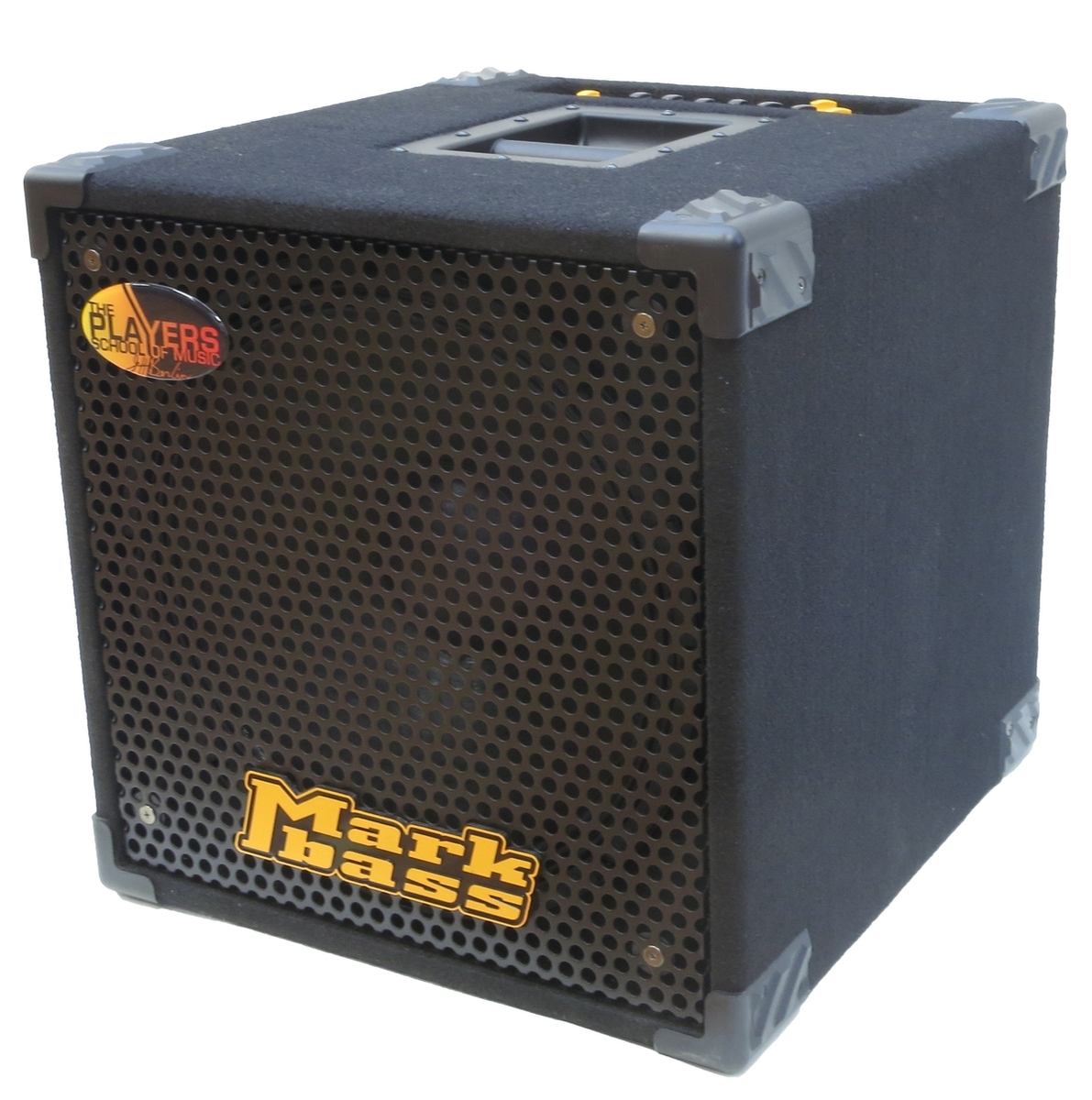
Legendaarinen basisti Jeff Berlin on jo pitkään ollut Markbass-tuotteiden fani. Berlinistä on hiljattain tullut myös oman musiikkiopiston – The Players School of Music – johtaja, ja hän sai idean kehittää yhdessä Markbass-suunnittelijoiden kanssa edullisempaa, juuri opiskelijoille tarkoitettua Markbass-komboa.
Tämän yhteistyön hedelmä, Markbass CMD Jeff Berlin Players School (499 €), on suunniteltu kunnianhimoista aloittelijaa varten, mutta sopii varmaan myös kaikille sellaisille basisteille, jotka etsivät edullista, mutta hyväsoundista komboa. CMD JB Players School -kombon tarkoitus on antaa käyttäjälle aito Markbass-kokemus mutta muutamalla, Jeff Berlinin pyytämällä, muutoksella höystettynä.
Jeff Berlinin ihannesoundi on lämmin, iso ja orgaaninen. Mies myös vihaa tunnetusti diskanttitorvien käyttöä kaikissa bassokaapeissa. Näistä syystä Players School -malliin on suunniteltu erikoissyvä kaiutinkaappi, ja siksi kombo on myös varustettu ainoastaan yhdellä 15-tuumaisella ämyrillä.

Basistilegendan toivelistalla oli myös kestävä, komboon upotettu metallikahva. Vaikka Players School -mallin ulkomitat ovat selvästi Mini CMD -komboa isommat (46 x 46 x 48 cm), painaa vahvistin silti vain 16 kiloa.

Myös tässä kombossa on refleksiaukot takana…
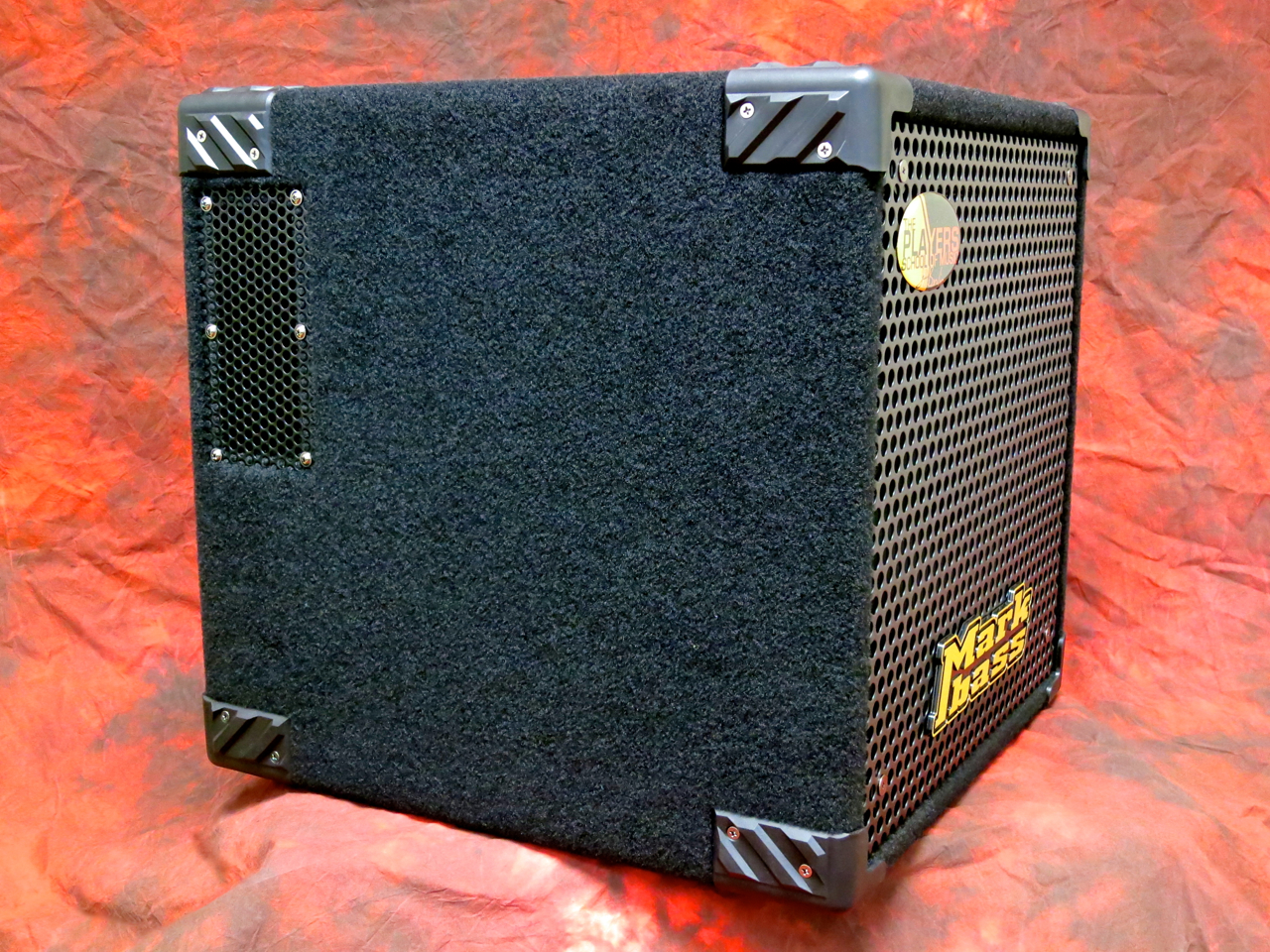
…sekä tuuletusritilä vahvistinyksikön tuloilmaa varten.

Players School -mallissa käytetään Markbassin Little Mark 250 nuppia, josta lähtee 150 wattia kahdeksalle ohmille (tai 250 wattia neljän ohmin impedanssille).
Vahvistimen ominaisuudet ovat miltei samoja kuin Mini CMD -kombossa – tarjolla on nelikaistainen EQ, ja sen lisäksi VLE- ja VPF-filtterit.

CMD JB Players School -vahvistimen takapaneeli on toiseen komboon nähden käytännössä täysin identtinen, ja sieltä löytyy DI-lähtö, efektilenkki, lähtö viritysmittarille, sekä Speakon-kaiutinlähtö.
****

On helppo nähdä miksi Markbass Mini CMD 121P -mallista on tullut näin valtava myyntimenestys italialaisvalmistajalle: On hyvin hankalaa löytää näin kompaktia ammattitason bassovahvistinta, josta lähtee samaa volyymiä, voimaa, potkua, monipuolisuutta, sekä näin laadukasta ääntä.
Mini CMD 121P:n ääni on hyvin täyteläinen ja tasapainoinen (vaikka kyseessä onkin ”vain” 12-tuumainen kaiutin), ja sen äänessä on herkullisen mehukas ja kärjekäs ylämiddle, sekä hyvin luonteikas ala-middle. Erittäin musikaalisesti toimivalla EQ-osastolla, sekä Markbasson VLE- ja VPF-säätimillä on helppoa löytää juuri se ”oma ja oikea” soundi.
Mini CMD:n omat tehot tulevat varmasti riittämään hyvin moneen keikkatilanteeseen. Tosi isoissa paikoissa taas voi käyttää komboa yksinkertaisesti sopivalla lisäkaapilla.
Ei tarvitse olla mikään selvännäkijä ennustamaan myös Markbasson CMD Jeff Berlin Players School -kombolle suurta menestystä. Tässä kun on tarjolla täysikokoinen Markbass-kombo 500:lla eurolla!
En tiedä miten he ovat tehneet sen mutta, itse asiassa, pienemmästä nimellistehostaan huolimatta Players School -kombo vaikuttaa lähes niin äänekkäältä kuin nyt testattu Mini CMD. Jeff Berlin Players School:n potku riittää varmasti hyvin moneen ravintola- ja hääkeikkaan, sekä pienille klubeille. Ja lisätehon tarpeessa voi aina käyttää lisäkaappia ja/tai kombon erinomaista DI-lähtöä kytkettynä PA:han.
CMD JB Players School -kombolla on todella herkullinen ääni, jossa riittää syvyyttä ja lämpöä, ja myös vahvistimen dynaaminen skaala on vaikuttava. Tulen itsekin yleensä erinomaisesti toimeen ilman erillisen diskanttielementin tuomia naksahduksia, ja ihastuin täydellisesti Jeff Berlin CMD -kombon nykyaikaiseen soundiin ja silkkiseen trebleen.
Olen äänittänyt molempia komboja samankaltaisilla säädöillä yhdellä single Shure SM57 -mikrofonilla. Näissä demoissa on aina sama järjestys: Jazz Bass (sormisoitto)/Mini CMD –> Rickenbacker (plektralla)/Mini CMD –> Jazz Bass/CMD JBPS –> Rickenbacker/CMD JBPS.
Tässä ovat pelkästään basso-osuudet:
Rummut lisätty:
Koko sovitus, mutta bassot miksattu eteen:
Ja viimeiseksi hieman ”tavallisempi” miksaus:
****
Markbass Mini CMD 121P & CMD Jeff Berlin Players School -kombot
Mini CMD 121P – 799 €
CMD JB Players School – 499 €
Maahantuoja: Musamaailma
****
Plussat (molemmat mallit):
+ koko
+ paino
+ monipuolisuus
+ teho
+ soundi
Miinukset (molemmat mallit):
– takapaneeli hieman hankalassa paikassa
This time Kitarablogi.com takes a look at two different Markbass bass combos – one is already a bona fide classic, while the other is a brand new, affordably-priced signature model.
****
The Markbass Mini CMD 121P (current price in Finland: 799 €) is one of the company’s best-selling combos, as it manages to put all of Markbass’ trademark features into a compact, hard-to-beat package.
The Mini CMD 121P comes loaded with a lightweight, but powerful 12-inch neodymium speaker with Markbass’ cool yellow cone, as well as a piezo tweeter in the top right corner.
The back-ported cabinet is covered in a hard-wearing carpet style exterior, and comes equipped with sturdy plastic corner protectors.
The whole combo measures only 38 x 43 x 36 centimetres (w x h x d) and weighs in at just above 13 kilos, which makes it easy to carry around by its single top handle.
Despite its diminutive dimensions the Markbass Mini CMD 121P packs a very hefty punch, delivering 300 watts at 8 ohms or 500 watts at 4 ohms.
Markbass tend to use existing amp head models in their combos by simply sinking the amp units into the cabinet from the top. This combo uses the Markbass Combo Head II amp, for example.
Ample ventilation is provided thanks to a side vent, as well as a (quiet-running) ventilator next to the bass-reflex port.
Markbass’ excellent preamp is definitely one of the features that originally put the Italian brand on the map:
The Combo Head II makes all the volume knobs stand out from the EQ-section by using yellow controls. We have an input gain control (with its corresponding blue indicator LED), a level control for the balanced DI output, and the master volume control.
The EQ-section comprises a four-band EQ, and Markbass’ special VLE and VPF controls.
VLE stands for Vintage Loudspeaker Emulator, and it allows you to take your tone from modern, fresh and wiry to vintage-style thuddy – and all points in-between – by the simple turn of a knob.
The Variable Pre-Shape Filter, or VPF, lets you dial in a pre-EQ curve with a dip in the lower mids, should you prefer a more Hi-Fi-type sound.
A built-in, automatic two-band limiter protects the Mini CMD 121P’s speakers from damage, even when you run the combo flat out.
As the amp head has been sunk into the cabinet with its controls facing up, the back panel faces floor ward. This isn’t the most practical of solutions on a dimly lit stage, but over time you will learn which connector is which.
The Markbass features a balanced DI output with pre/post-switching and a secure ground lift feature, an effects loop, a tuner output, and a Speakon connector for hooking up an expansion cabinet.
****
Bassist extraordinaire Jeff Berlin has long been a vocal supporter of Markbass amps. Now Mr Berlin and Markbass have come up with an affordably-priced, but fully-spec’d bass combo to go along with Jeff’s position as the director of The Players School of Music.
The new Markbass CMD Jeff Berlin Players School combo (current price in Finland: 499 €) is aimed directly at the ambitious beginner/intermediate bass player (or anyone on a tight budget), who wants maximum tone from a gig-worthy combo. The CMD JB Players School combo gives you the genuine Markbass experience with a couple of twists specifically requested by Jeff Berlin.
Mr Berlin likes to hear a fat, organic bass sound, and he simply hates all types of tweeters in bass amplifiers, which is why he requested a special, deep cabinet for the Players School –model, loaded with an all-black 15-inch speaker, but no treble horn.
Jeff Berlin also requested a chunky metal handle for the 46 x 46 x 48 centimetres cabinet. Despite its larger cabinet and speaker the CMD JB Players School model still only weighs just under 16 kilos.
This combo is also rear-ported…
…and features an air vent for the fan-cooled amplifier.
The Players School model comes equipped with a Little Mark 250 amp, which dishes out 150 watts to 8 ohms, or 250 watts at 4 ohms impedance.
The amp’s features are virtually identical to the Mini CMD’s, offering a four-band EQ-section with additional VLE and VPF knobs.
The CMD JB Players School offers the same array of outputs on its back panels, namely balanced DI, effects loop, tuner output, and Speakon speaker output.
****
It’s easy to see why the Markbass Mini CMD 121P has become such a mega seller for the Italian maker: There aren’t that many professional bass combos around that manage successfully to glean such an amount of volume, punch, versatility and sheer quality of tone from such a compact 12-plus-one setup.
The Mini CMD 121P’s basic tone is surprisingly full (for a 12-inch speaker) and balanced with a nice, juicy upper midrange nose, as well as lots of lower-mid character. The extremely musical EQ-, VLE- and VPF-controls make it very easy to dial in the sounds you hear in your head.
You will be able to do most of your gigs just by running the Mini CMD by its own. For larger venues, simply add one of Markbass’ bass cabs for additional girth and volume.
You don’t need to be a prophet to predict a huge success for Markbass’ CMD Jeff Berlin Players School combo, too. A genuine, full-blown Markbass bass combo for 500 euros, you’ve gotta be kidding me!
I’m not sure how they’ve managed to do this, but actually, despite its lower wattage, the Players School amp doesn’t seem that much quieter. I’m sure you can play most restaurant gigs, functions, and small clubs with this combo. And should you need more power, there’s always the option to use the excellent built-in DI output to connect to the PA-system.
The CMD JB Players School combo has a gorgeously round, deep and warm basic tone with a wide dynamic range. I’m not a huge fan of the additional click and trebly scratch that many tweeters seem to add to your bass sound, which made me feel right at home with the Jeff Berlin CMD, and its modern tone and silky top end.
I’ve recorded both combos with similar settings using a single Shure SM57. These demo tracks all follow the same sequence: Jazz Bass (fingerstyle)/Mini CMD –> Rickenbacker (plectrum)/Mini CMD –> Jazz Bass/CMD JBPS –> Rickenbacker/CMD JBPS.
Here are the combos on their own:
The same track with the drums added:
The full arrangement with the bass tracks mixed high:
And, lastly, a more balanced mix of the above:
****
Markbass Mini CMD 121P & CMD Jeff Berlin Players School combos
Mini CMD 121P – 799 €
CMD JB Players School – 499 €
Distributor: Musamaailma
****
Pros (both combos):
+ size
+ weight
+ versatility
+ power
+ sound
Cons (both combos):
– back panel access

Bass parts on demo song:
1. Squier (Japan) Jazz Bass/Mini CMD 121P – fingerstyle
2. Rickenbacker 4003/Mini CMD 121P – plectrum
3. Squier (Japan) Jazz Bass/CMD JB Players School – fingerstyle
4. Rickenbacker 4003/CMD JB Players School – plectrum
All bass tracks recorded using a Shure SM57.
****
Distributor: Musamaailma

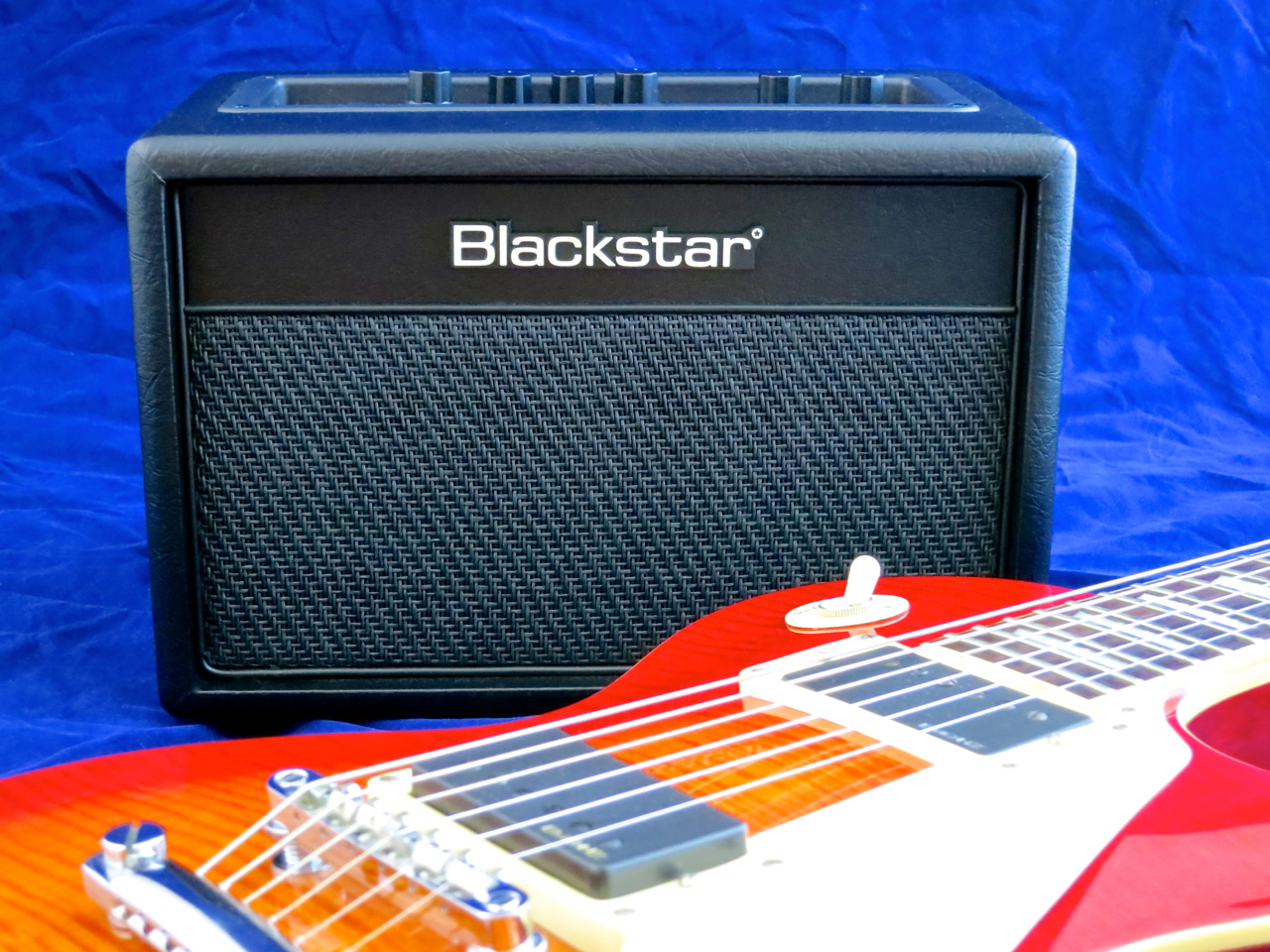
Blackstar’s ID:Core BEAM (current price in Finland: 299 €), which was introduced at this year’s NAMM Show, is one of a new breed of amplifiers:
The BEAM is a so-called ”lifestyle amp” that combines a practical solution for living room practising with a Bluetooth stereo system with a suitable Rock look.
****

The Blackstar ID:Core BEAM is a genuine ID:Core-combo, which means that all its parameters are accessible via Blackstar’s Insider software.
The newcomer is a stereophonic amp with its 20 watts of power running into a pair of three-inch speakers. Blackstar’s Super Wide Stereo-effect – a feature taken from the company’s larger ID:Core combos – can also be applied to the BEAM’s music player, with its own, separate width adjustment.

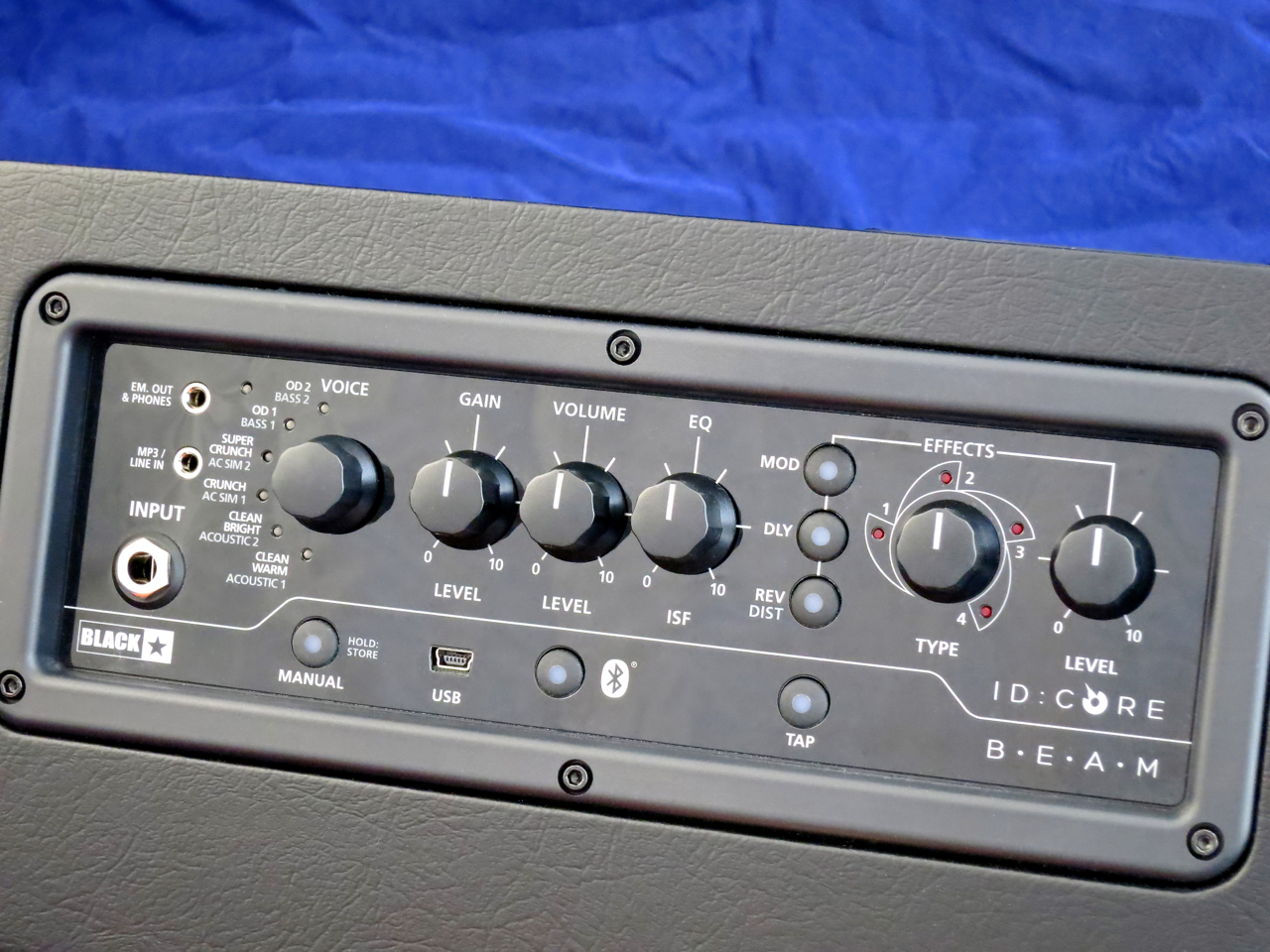
Apart from the power switch, the ID:Core BEAM’s back panel features the input jack for the (optional) footswitch. The rest of the combo’s controls and connectors can be found on the top-mounted control panel.
The larger ID:Core combos are well-equipped practice amps, but the BEAM has a couple of additional aces up its sleeve:
The ID:Core BEAM offers you 12 amp models (Voices). The first set (the Voices LED glows red) deals with six amp models for electric guitar, while the second set (green LED) gives you two Voices each for acoustic guitar, electric bass, and acoustic guitar simulation.
The amp section has three physical knobs for adjustment – gain, volume, and Blackstar’s patented ISF-control, which control’s the amp’s overall tonal character. Using the Insider-software you will be able to access additional parameters for deep editing, like a three-band EQ-section or a noise gate.
The effects department features four different modulation effects, four delay types, and four reverbs. The two Voices for bass swap the reverbs for bass distortion. You can choose one effect from each effect section for a Voice (meaning up to three simultaneous effects).
The small combo also features a built-in tuner.
The music signal, sent to the BEAM from your mobile device via Bluetooth, naturally isn’t sent through the combo’s amp modelling circuits. It is fed into the signal chain just before the power amp section. The ID:Core BEAM allows you to play along to the Bluetooth signal, of course!
The USB-port isn’t only used to remote control the amp’s parameters via Insider – this lifestyle combo doubles as a full-blown USB sound card. The BEAM can be run in three different USB-modes, which allows you to either send a stereo signal of the amp sound to your sequencer, or send two discrete mono signals (with one channel completely dry, and the second channel with all the amp modelling and effects) to your recording software. The third USB-mode is called Reamping, and it’s used to feed a dry guitar signal off your audio sequencer into the ID:Core BEAM and record the effected signal onto a separate recording track simultaneously.
The signal level of the USB-audio can be controlled directly (and independently of the amp’s master volume settings), making it very easy to set the correct recording levels for your personal studio setup.
****
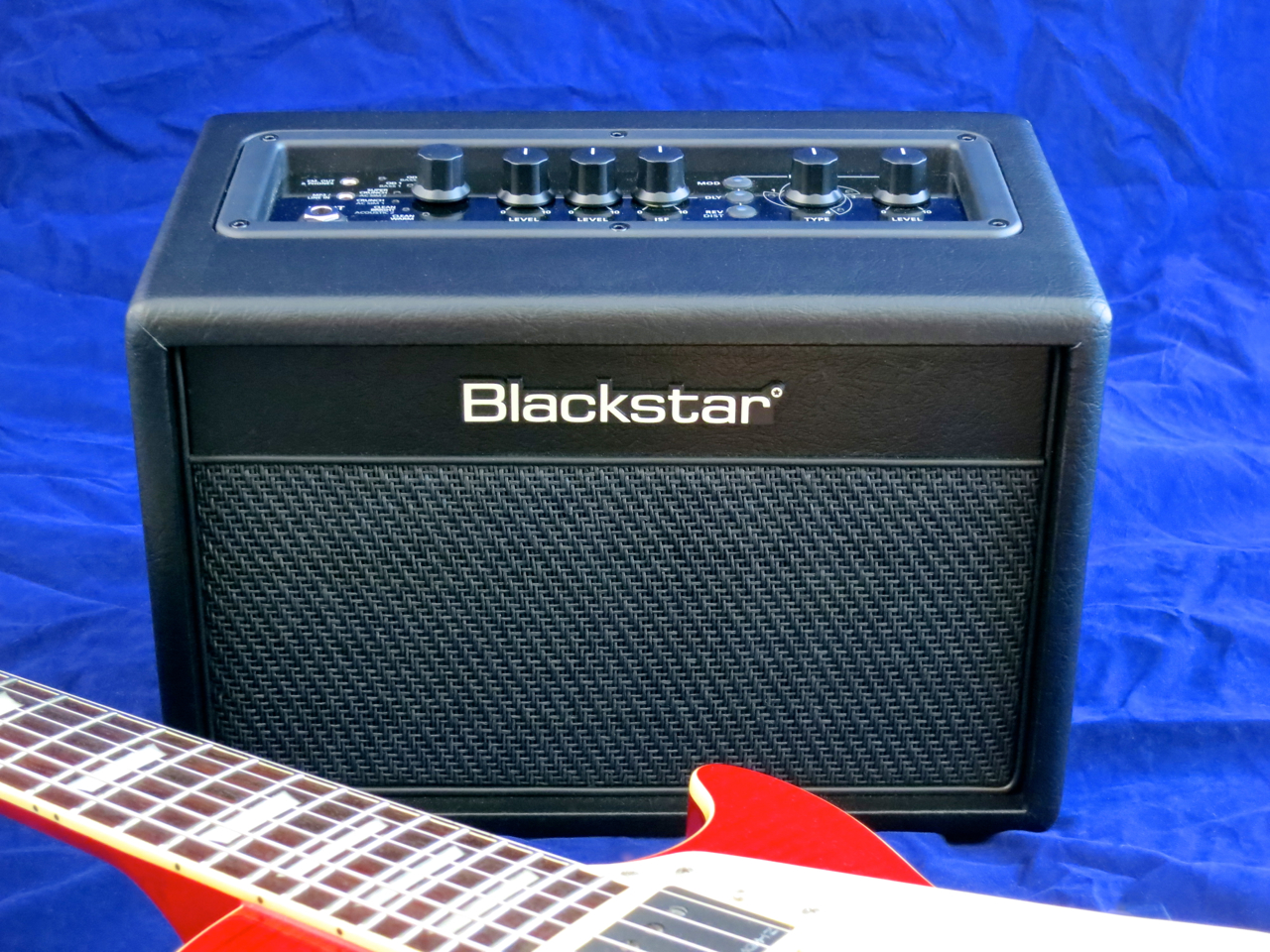
Blackstar have really hit the bull’s eye with their new lifestyle combo!
Listening to music with a very critical ear you can hear a little bit of hiss, but it isn’t loud enough to spoil the fun. Remember, the ID:Core BEAM isn’t meant to be a studio monitor, but rather a nifty, compact music player for your bookcase – something this little combo handles with much aplomb. You wouldn’t necessarily expect such a full and strong delivery from such a compact unit.
The ID:Core BEAM also sounds great as a guitar and bass amp, which isn’t quite as surprising, considering this combo’s pedigree.
The guitar amp voices have plenty of character, and the effects have more than ample depth and width:
The high quality of the acoustic simulator was something of a positive surprise:
Despite its diminutive size, the BEAM also delivers when it comes to electric bass tones:
****

The Blackstar ID:Core BEAM succeeds to combine a programmable practice combo for guitar and bass, a Bluetooth-player, and a USB sound card into a very enticing package. In addition to being a great living room amp, the BEAM could also prove a handy little amp for guitar instructors.
****
Blackstar ID:Core BEAM
299 €
Finnish distributor: Musamaailma
****
Pros:
+ well thought-out concept
+ value for money
+ feature-packed guitar and bass amp
+ adjustable Super Wide Stereo-function
+ USB sound card
+ full sound
Cons:
– high noise gate setting on default bass distortion