
Yamaha FG700S Gearwire-videossa

Kitarablogi.com – Finland's premier Guitar and Bass blog
Juttuja kitaroista ja bassoista

****
The Legend 4 Classic and Legend 4 Custom basses are Spector Bass’ affordable, Korean versions of the company’s NS-2-bass, the famous model that Stuart Spector designed in co-operation with Ned Steinberger.
****

The Spector Legend 4 Classic (current RRP in Finland: 672 €) is a long-scale active bass.
The body is crafted from three pieces of maple, with its frontside spruced up with a very pretty quilted maple veneer.

The bass’ bolt-on neck is put together using three long strips of hard rock maple.

The neck joint features rounded edges for added comfort, while five screws with separate, countersunk washers make for a very precise and sturdy fit.

The pearl SSD-logo has been cleanly inlaid into the back-angled headstock.
A self-lubricating top nut makes tuning a smooth experience. The nut’s corners have been rounded – a nice upmarket touch in this price bracket.
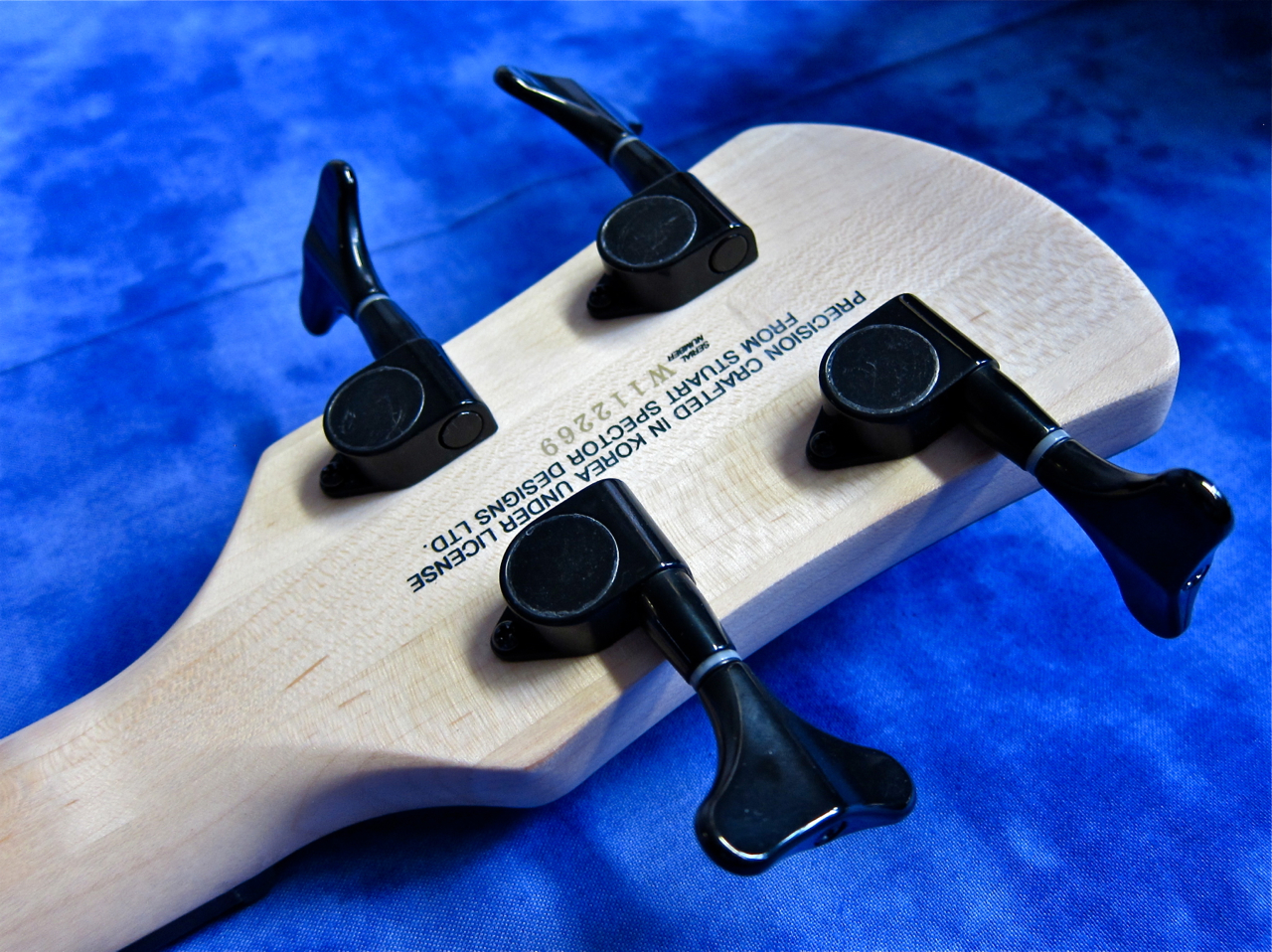
Black is the colour of choice for all of the Legend 4 Classic’s hardware. The modern, sealed tuners keep the tuning rock steady.

The rosewood fingerboard sports 24 jumbo frets, which are well seated and nicely polished, making for a smooth playing surface.
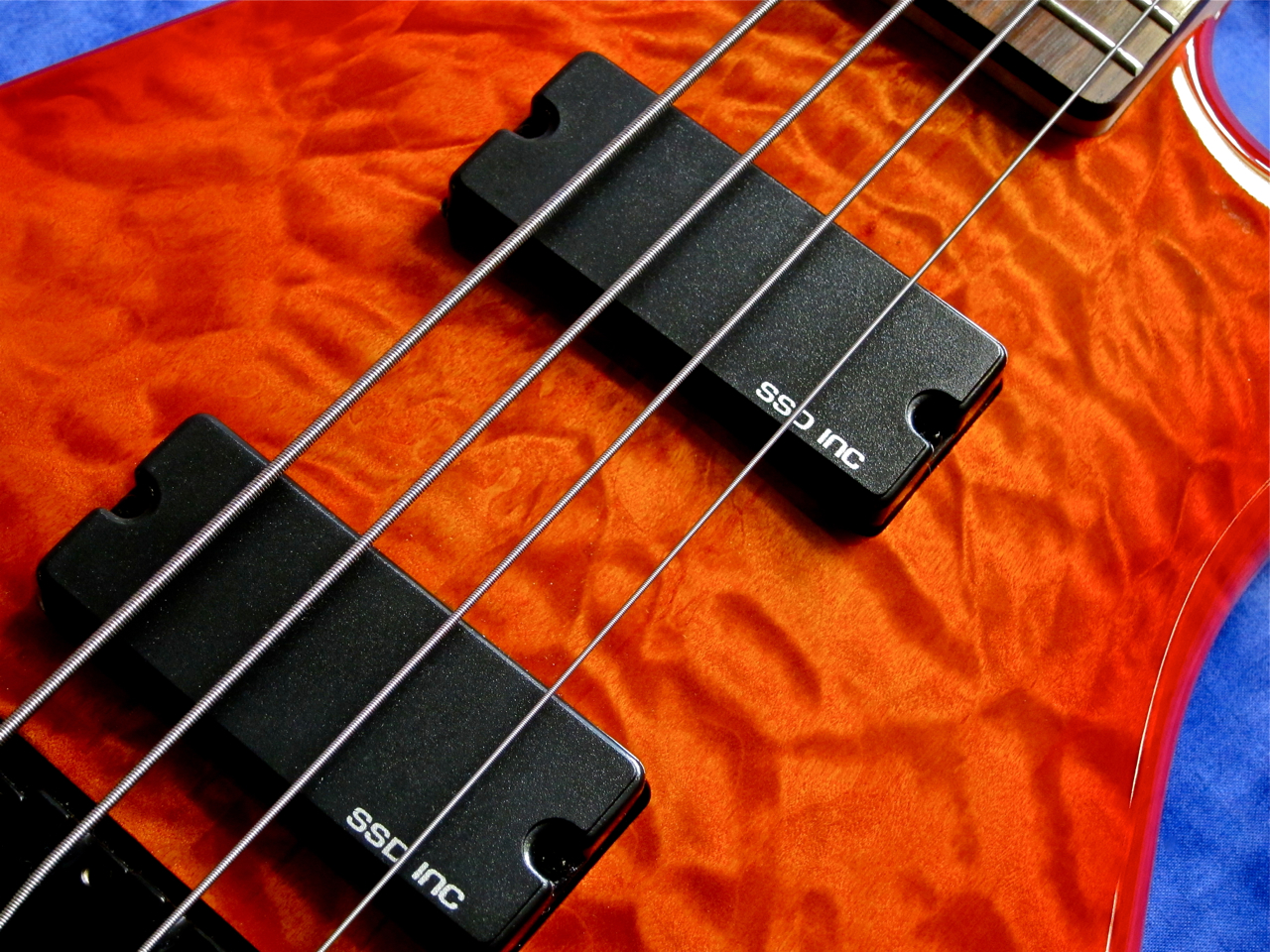
The Classic-model’s passive SSD-humbuckers are manufactured by EMG. These units – designed specifically for this bass – use the EMG-HZ-pickups as a starting point, but add a good helping of mid-range for a meatier tone.

This Spector’s controls comprise two separate volume knobs (one for each pickup), as well as active boost controls for bass and treble, respectively.

The preamp – which is boost-only – is Spector’s own Tone Pump Jr -circuit, which has been glued to the control cavity’s side wall.
To minimise interference buzz the whole cavity has been covered in conductive paint, and the lid lined with aluminium foil. The lid is fixed to the body using machine screws and threaded inlets – a much better choice on an active bass than plain wood screws.
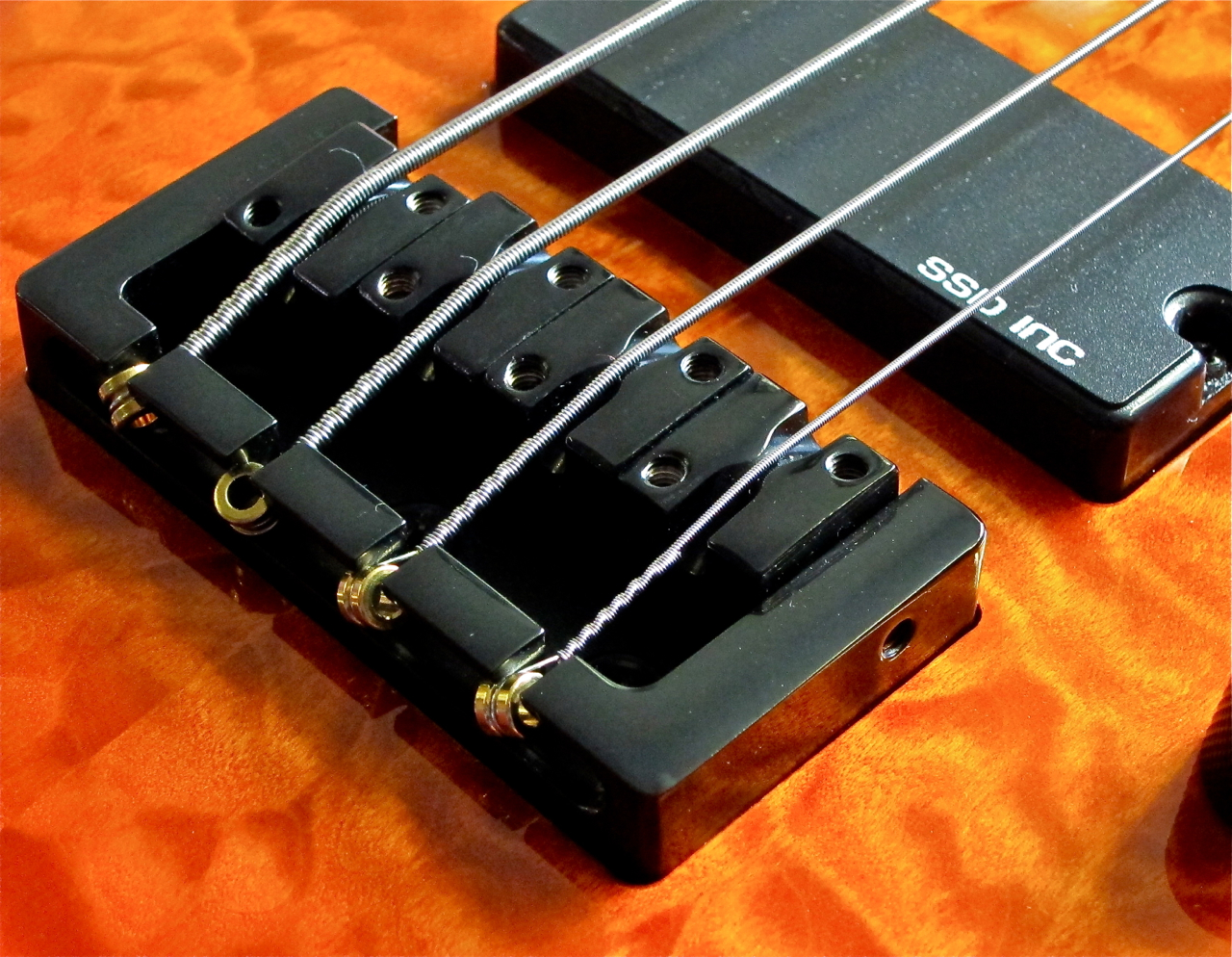
The Legend 4 Classic’s bridge is a hefty design. The saddles are locked in place with grub screws to prevent any rattling, thus enhancing the instrument’s sustain.
****

The Spector Legend 4 Custom (current RRP in Finland: 855 €) is the Classic’s higher-spec’d sibling.
Here the body uses two, centre-joined pieces of basswood with a quilted maple veneer on top.

The Custom’s neck is glued into the body, and features graphite rods reinforcing the neck.

Just like the NS-2, both basses reviewed here feature curved bodies, even though the arch is much less pronounced in these more affordable instruments.
The beer-belly chamfer adds to the bass’ strapped-on comfort.

The Custom features the same graceful headstock as the classic…

…but here the back of the neck is finished in gloss lacquer, and all the hardware is gold-coloured.
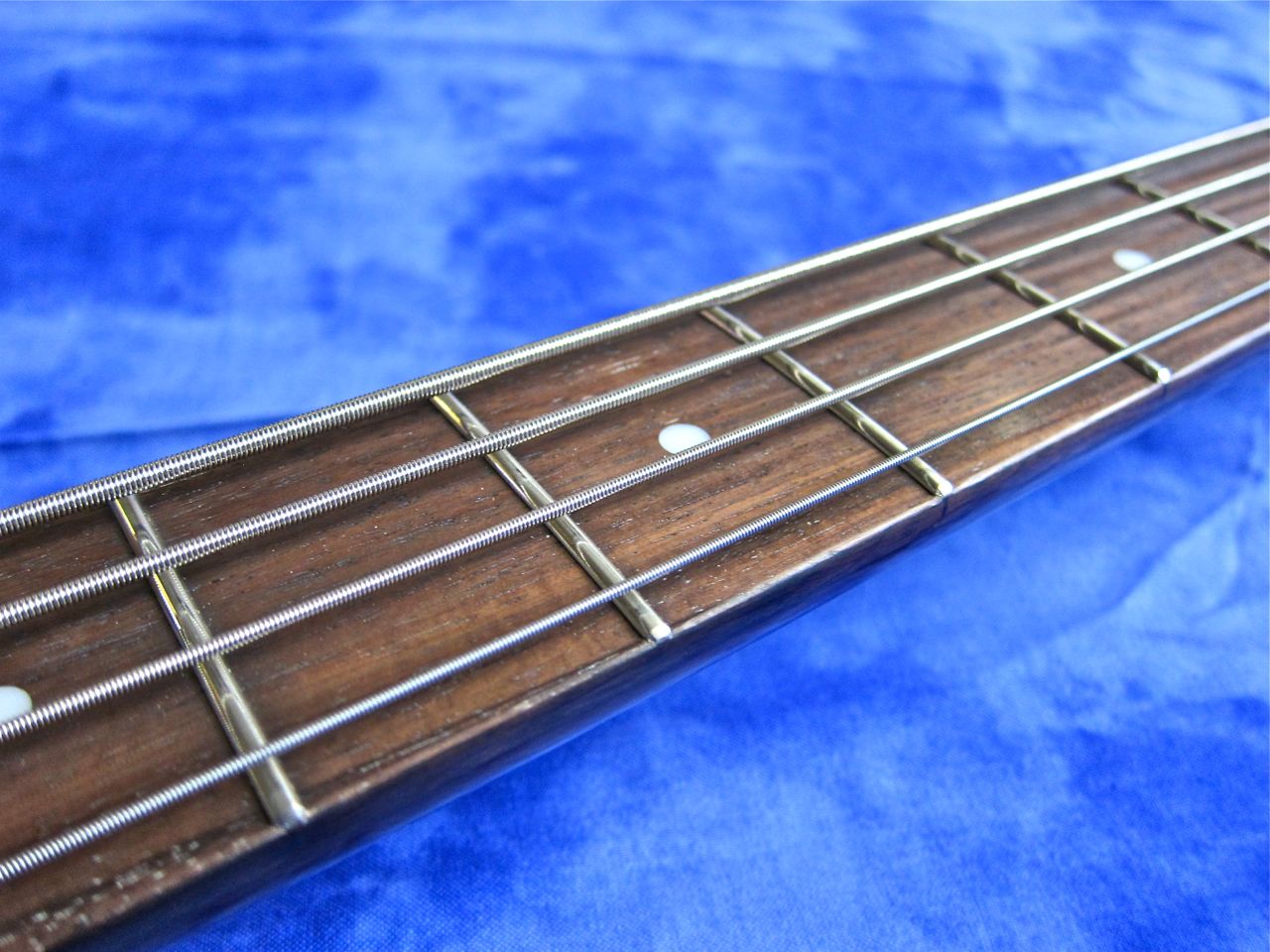
The fretwork on the Legend 4 Custom is of an even higher standard than on the Classic – you can clearly spot the well-rounded fret ends in the photo.

EMG’s HZ bass humbuckers are known for their excellent, wide-range tone.

The preamp is an EMG B30, which offers you a full three-band EQ-section in addition to the separate pickup volume knobs. The mid-range has it’s own full-sized control, while the stack knob deals with treble (tip) and bass (ring).

Here’s a peek into the Custom’s control cavity – everything’s clean, neat and tidy.

And here we have the excellent Spector-bridge in a golden finish.
****

The neck profile on the Spector Legend 4 Classic is a very comfortable D-shape. The neck is a close cousin to a Jazz Bass neck, but offers a slightly more contemporary, flatter slant on the theme.
The large fretboard radius combined with the jumbo frets lends this bass a slick and fast action and feel.
Our test sample’s considerable weight is really the only point that I can criticise – get yourselves a wide, comfortable strap, and everything will work out fine.
The Legend 4 Classic’s SSD-pickups have quite a high output, with the signal being rich in deliciously growling mids. I also enjoyed the Classic’s clear, yet warm high-mid presence, which keeps the sound nicely organic.
This bass’ basic tone is really good, so I didn’t particularly miss the ability to cut any frequencies – the Tone Pump Jr’s bass and treble boosts work fine in this context.
I recorded the audio clips via a Focusrite Saffirer 6 USB -soundcard straight into the audiosequencer, without any kind of amplifier modelling. Each clip starts with the neck pickup:
Spector Legend 4 Classic – fingerstyle
Spector Legend 4 Classic – Reggae
Spector Legend 4 Classic – slap
Spector Legend 4 Classic – pleck
****

The Spector Legend 4 Custom’s neck profile is a tiny bit meatier and rounder, when compared to the Classic. Together with the gloss finish this results in a slightly more grown-up and steadier feel. Somehow the Custom feels like a more expensive bass to this reviewer.
Due to the set neck and the stiffening graphite rods inside the neck the Custom’s acoustic tone is clearly punchier and fatter, with a nice bit of ”wire” in its attack.
The neutral-sounding – in the best sense of the word – EMG-HZs, combined with the bass’ nice preamp, lend the Custom an air that is distinctly ”active”, with a healthy dose of presence, clarity and a fresh top end.
The three-band EQ – offering boost as well as cut – naturally is a more versatile tone-shaping tool than the Classic’s more concise Tone Pump Jr.
Here are the same bass lines as above, this time played on the Legend 4 Custom:
Spector Legend 4 Custom – fingerstyle
Spector Legend 4 Custom – Reggae
Spector Legend 4 Custom – slap
Spector Legend 4 Custom – pleck
****
I think it is great that Spector is offering us bassists more affordable versions of its US- and Euro-models. Both the Legend 4 Classic as well as the Legend 4 Custom are quality instruments and a pleasure to play.
The Spector Legend 4 Classic is your key to Stuart Spector’s world, offering you a straightforward, streamlined and easy-to-use active bass for a very reasonable price.
The Legend 4 Custom, for its part, clearly is a large step towards the full-blown Spector-experience, in both playability and sound. This beautiful quality instrument could easily become a professional’s main squeeze.
****
Spector-basses
Finnish distributor: Musamaailma
****
Spector Legend 4 Classic
Current price in Finland: 672 €
Pros:
+ price
+ finish
+ workmanship
+ playability
+ high-output SSD-pickups
+ easy-to-use preamp
+ sound
Cons:
– review sample’s weight
****
Spector Legend 4 Custom
Current price in Finland: 855 €
Pros:
+ price
+ finish
+ workmanship
+ playability
+ graphite-reinforced neck
+ versatile preamp
+ sound
****
****
Legend 4 Classic ja Legend 4 Custom ovat Spector Bassin edulliset, korealaiset versiot Spectorin kuuluisasta NS-2-bassosta, jonka Stuart Spector aikoinaan suunnitteli yhteistyössä Ned Steinbergerin kanssa.
****
Spector Legend 4 Classic (672 €) on pitkällä mensuurilla varustettu aktiivibasso.
Runko on veistetty kolmesta vaahterapalasta, ja etupuoleen on liimattu näyttävä loimuvaahteraviilu.
Ruuvikaula taas on koottu kolmesta vierekkäisistä vaahterapalasta.
Liitoskohta on veistetty hyvin sulavaksi, ja viidellä ruuvilla toteutettu kiinnitys on hyvin luja.
Taakse kalistuvassa viritinlavassa komeilee siististi upotettu helmiäisupotus.
Itsevoitelevan satulan reunat on muotoiltu mukavan sulavaksi.
Legend 4 Classic -mallissa käytetään mustia metalliosia. Nykyaikaiset virityskoneistot toimivat tarkasti ja pitävät basson hyvässä vireessä.
Palisanteriotelautaan on asennettu huolellisesti 24 jumbokokoista nauhaa.
Classic-basson passiiviset SSD-humbuckerit tulevat EMG:ltä, ja niitä on kehitelty EMG-HZ-mikrofonien pohjalta juuri tätä mallia varten.
Spectorin neljästä säätimestä kaksi ovat volume-säätimet kummallekin mikrofonille, kun taas toinen pari tarjoaa aktiivista korostusta basso- ja diskanttitaajuuksille.
Etuvahvistin – joka siis tarjoaa ainoastaan boostin – on Spector Bassin oma Tone Pump Jr -piiri, joka on liimattu elektroniikkalokeron reunaan.
Ulkoisten häiriöiden minimointia varten lokero on penslattu grafiittimaalilla ja muovikansi taas on vuorattu alumiinifoliolla. Kannen kiinnitys hoidetaan mallikkaasti koneruuveilla ja runkopuuhun upotetuilla vastakappaleilla.
Legend 4 Classic -mallin talla on varsin jämäkkää sorttia. Tallapalat voi lukita säätämisen jälkeen paikoilleen kuusiokoloruuveilla, mikä parantaa basson sustainea.
****
Spector Legend 4 Custom (855 €) on Classic-mallin isoveli.
Basson runko on tässä mallissa valmistettu kahdesta lehmuspalasta. Etupuoli on tässäkin tapauksessa loimuvaahteralla koristeltu.
Customissa on runkoon liimattu vaahterakaula, jota on vahvistettu kaulapuuhun upotetuilla grafiittitangoilla.
Molempien bassojen rungot ovat (NS-2:n tavoin) hieman kaarevat, vaikka niiden kaari on selvästi loivempi kuin amerikkalaisessa alkuperäisversiossa.
Yläreunan viisteen ansiosta molemmat mallit istuvat mukavasti soittajan kehoa vasten.
Customissa on sama tuttu lapa kuin Classic-bassossa…
…mutta sen kaula on viimeistelty kiiltävällä lakalla, ja sen metalliosat ovat kullanväriset.
Legend 4 Custom -basson nauhatyön laatu on vielä huolellisempi kuin Classicissa – kuvassa näkyy hyvin nauhojen sulavaksi pyöristetyt päät.
EMG-HZ-humbuckereille luvataan hieman neutraalimpaa sointia, kuin mikä Classic-basson SSD-mikeistä lähtee.
EMG B30 -etuvahvistin tarjoaa kahden erillisten volumesäätimien lisäksi sekä vaimennusta että vahvistusta keskialueelle, bassolle ja diskantille.
Tältä näyttää Legend 4 Customin siististi toteutettu elektroniikka.
Customissa vankalla Spector-tallalla on kullanvärinen viimeistely.
****
Spector Legend 4 Classicin kaulaprofiili on erittäin mukavantuntuinen D. Mitoiltaan kaula on läheistä sukua Jazz-bassolle, mutta nykyaikaistetulla, aavistuksen verran matalammalla läpileikkauksella.
Otelaudan loiva kaarevuus ja jumbokokoiset nauhat antavat bassolle hyvin nopean ja modernin tuntuman.
Testisoittimen ainoa miinuspiste menee basson painon tilille – hyvin vuorattu, leveä hihna on tässä käytännössä pakollinen lisävaruste.
Legend 4 Classic -basson SDD-humbuckereistä lähtee hyvin voimakas signaali, jolla on herkullisesti muriseva keskialue. Pidin myös Classicin selkeästä, mutta lämpimästä preesensalueesta, jonka ansiosta tämän basson soundi pysyy aina mukavan maanläheisenä.
Perusääni on mielestäni niin hyvä, etten kaivannut lainkaan vaimennusta aktiivielektroniikasta – tulin mainiosti toimeen pelkällä boostilla.
Ääniesimerkit on äänitetty suoraan Focusrite Saffire 6 USB -äänikortin kautta audiosekvensseriin, ilman mitään vahvistinmallinnusta. Jokainen pätkä lähtee liikkeelle kaulamikrofonista:
Spector Legend 4 Classic – sormisoitto
Spector Legend 4 Classic – Reggae
Spector Legend 4 Classic – slap
Spector Legend 4 Classic – plektralla
****
Spector Legend 4 Customin kaulaprofiili on hivenen verran paksumpi ja pyöreämpi kuin Classicin kaula. Sen kiiltävän lakkauksen seurauksena Customin soittotuntuma on jotenkin ”aikuisempi” ja tasaisempi. Ainakin minun mielestä tämä Spector tuntuu kalliimmalta, kuin mitä se on.
Liimaliitoksen ja kaulan grafiitivahvistuksien ansiosta Legend Customin akustisessa soinnissa on enemmän alakertaa ja potkua, sekä aavistuksen verran purevampi atakki.
Positiivisella tavalla värjäämättömät EMG-HZ-humbuckerit ja saman firman etuvahvistin antavat Custom-bassolle selkeästi ”aktiivisemman” soundin, jossa on aina läsnä tietty annos preesensalueen selkeys ja diskantin tuore pirteys.
Kolmialueinen EQ, jossa on sekä vaimennus että korostus, on luonnollisesti selvästi monipuolisempi työkalu kuin Classicin yksinkertaisempi Tone Pump Jr -etunen.
Tässä ovat samanlaiset esimerkkipätkät Spector Legend 4 Custom -bassolla soitettuna:
Spector Legend 4 Custom – sormisoitto
Spector Legend 4 Custom – Reggae
Spector Legend 4 Custom – slap
Spector Legend 4 Custom – plektralla
****
Mielestäni on loistava asia, että Spector tarjoaa basistille US- tai Euro-malliensa edullisempia vaihtoehtoja. Sekä Legend 4 Classic, että Legend 4 Custom ovat laadukkaita soittimia, joilla on ilo soittaa.
Spector Legend 4 Classic toimii avaimena Stuart Spectorin maailmaan, ja basso on mukavan suoraviiveinen aktiivibasso erittäin reilulla hinnalla.
Legend 4 Custom taas on soundiltaan ja soittotuntemukseltaan selvästi muutaman askeleen lähempänä Spectorin USA-soittimia. Tämän kauniin laatubasson rahkeet riittävät mielestäni mainiosti myös ammattikäyttöön.
****
Spector-bassoja
Maahantuoja: Musamaailma
****
Spector Legend 4 Classic
672 €
Plussat:
+ hinta
+ viimeistely
+ työnjälki
+ soittotuntuma
+ voimakkaat SDD-mikrofonit
+ helppokäyttöinen etuvahvistin
+ soundi
Miinukset:
– testiyksilön paino
****
Spector Legend 4 Custom
855 €
Plussat:
+ hinta
+ viimeistely
+ työnjälki
+ soittotuntuma
+ grafiittivahvisteinen kaula
+ monipuolinen etuvahvistin
+ soundi
****

****
At NAMM 2012 Ampeg introduced their second micro stack to the public – the Ampeg Micro-CL.
The company’s first foray into this market segment came in the guise of the very successful Micro-VR (currently still available), which is a 200 Watt miniature version of Ampeg’s classic 1970s SVT. The brand-new Micro-CL takes its starting point from the Eighties version of the venerable Ampeg bass stack (the SVT-CL), offering 100 Watts of bass tone.

Ampeg’s Micro-CL -stack (current RRP in Finland: 505 €) brings the company’s classic look down to an easily manageable size.
The solid-state head weighs in at only about six kilos, with the cabinet clocking in at a very moderate 15 kg. The whole miniature stack is only about 80 cm tall – making it a very easy fit with almost any car boot.
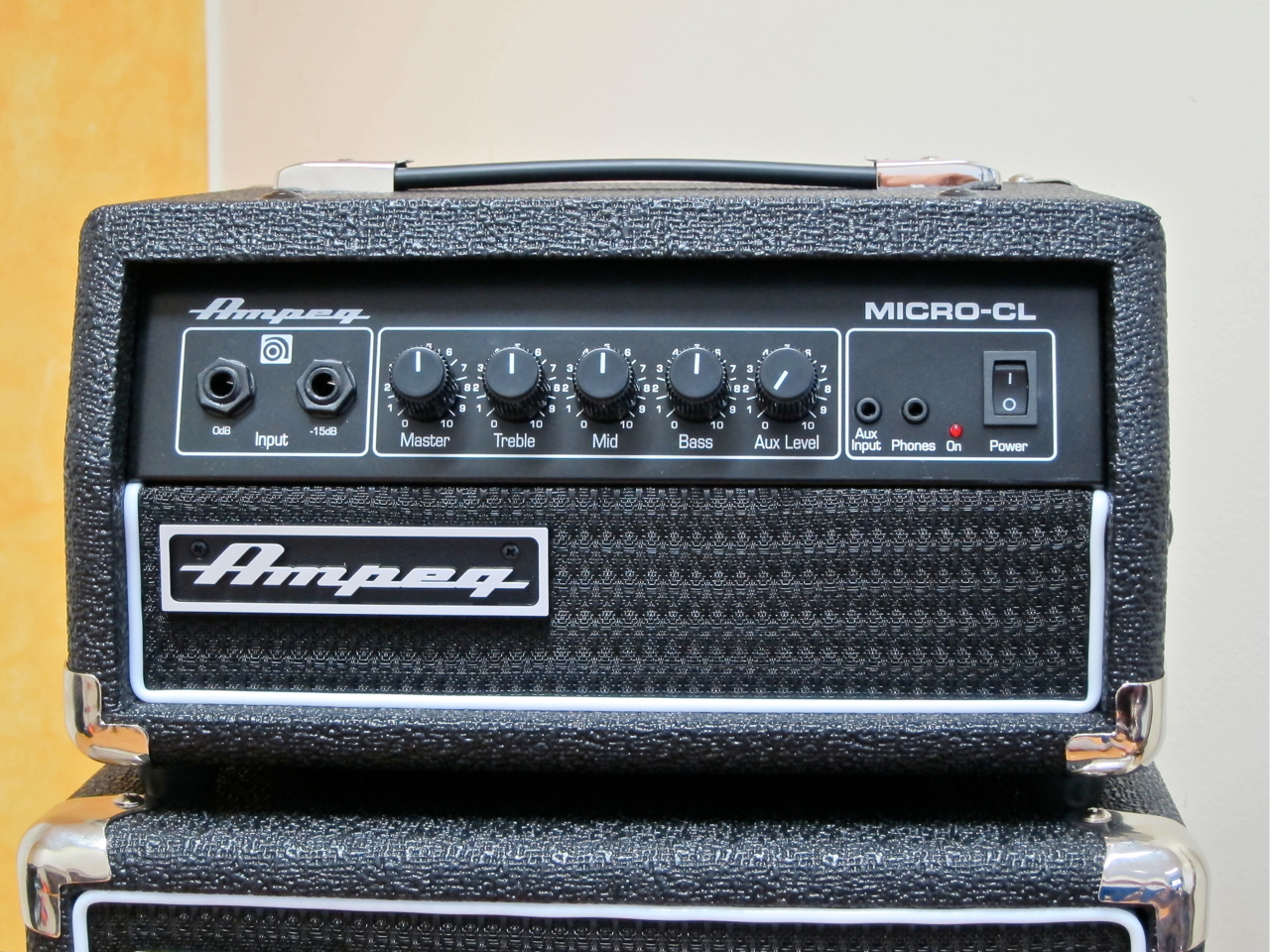
The Micro-CL-head comes equipped with two inputs – one for passive and the other for active bass guitars – as well as a three-band EQ-section.
Because this amp is also very handy as a practice amp at home, Ampeg have added an Aux-input (with its own volume control) and a headphones output to the front panel.
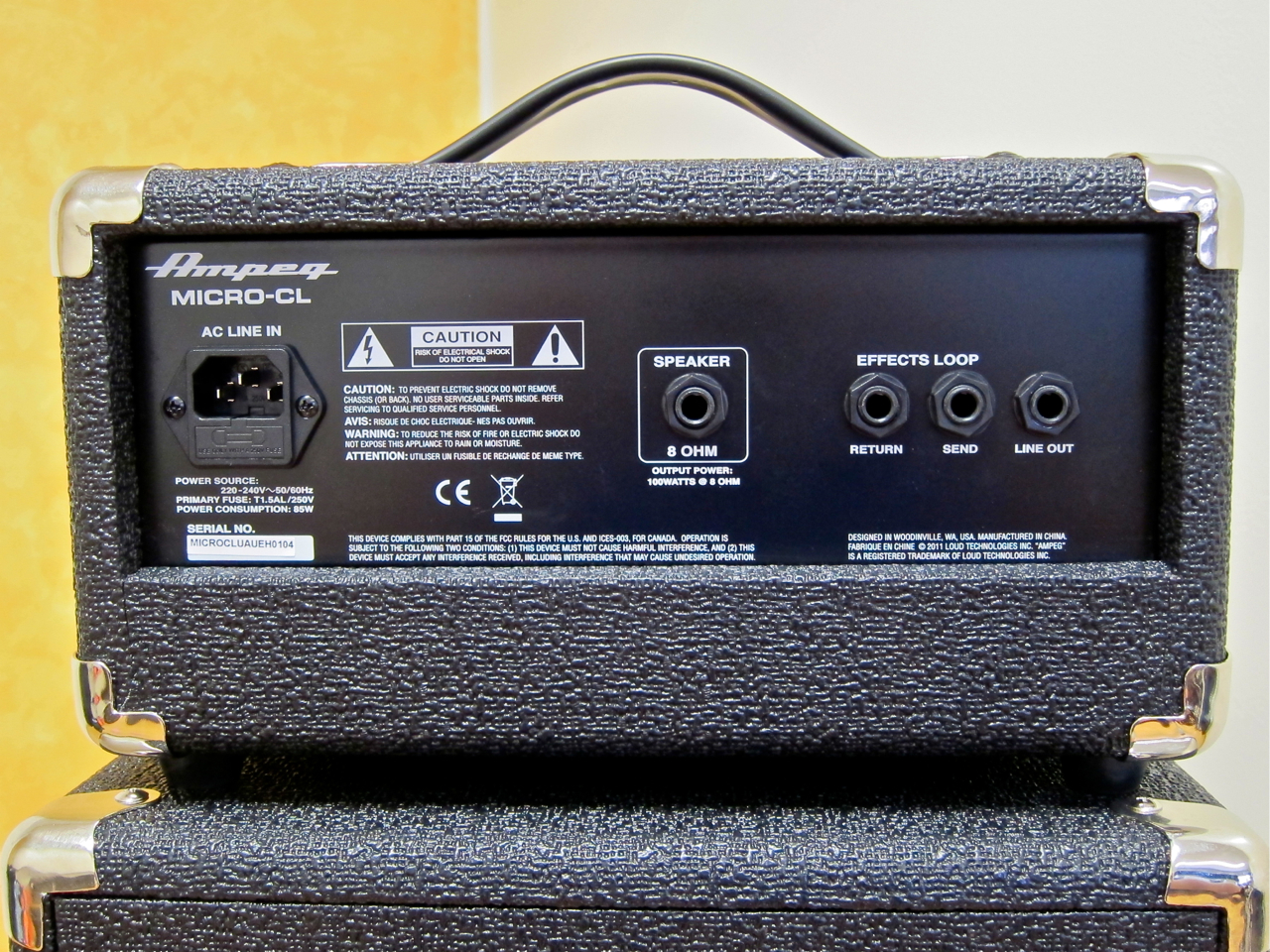
On the head’s flip side you’ll find the speaker output, as well as phone jacks for the effects loop and the line-level output.

The stack’s cabinet – called the Ampeg MC-210E – is built using the same Infinite Baffle -principle also applied to the company’s famous (and huge) 8 x 10″ cabinets.

The completely enclosed cab comes loaded with two 10-inch speakers. The front grille is attached in the traditional way using velcro.
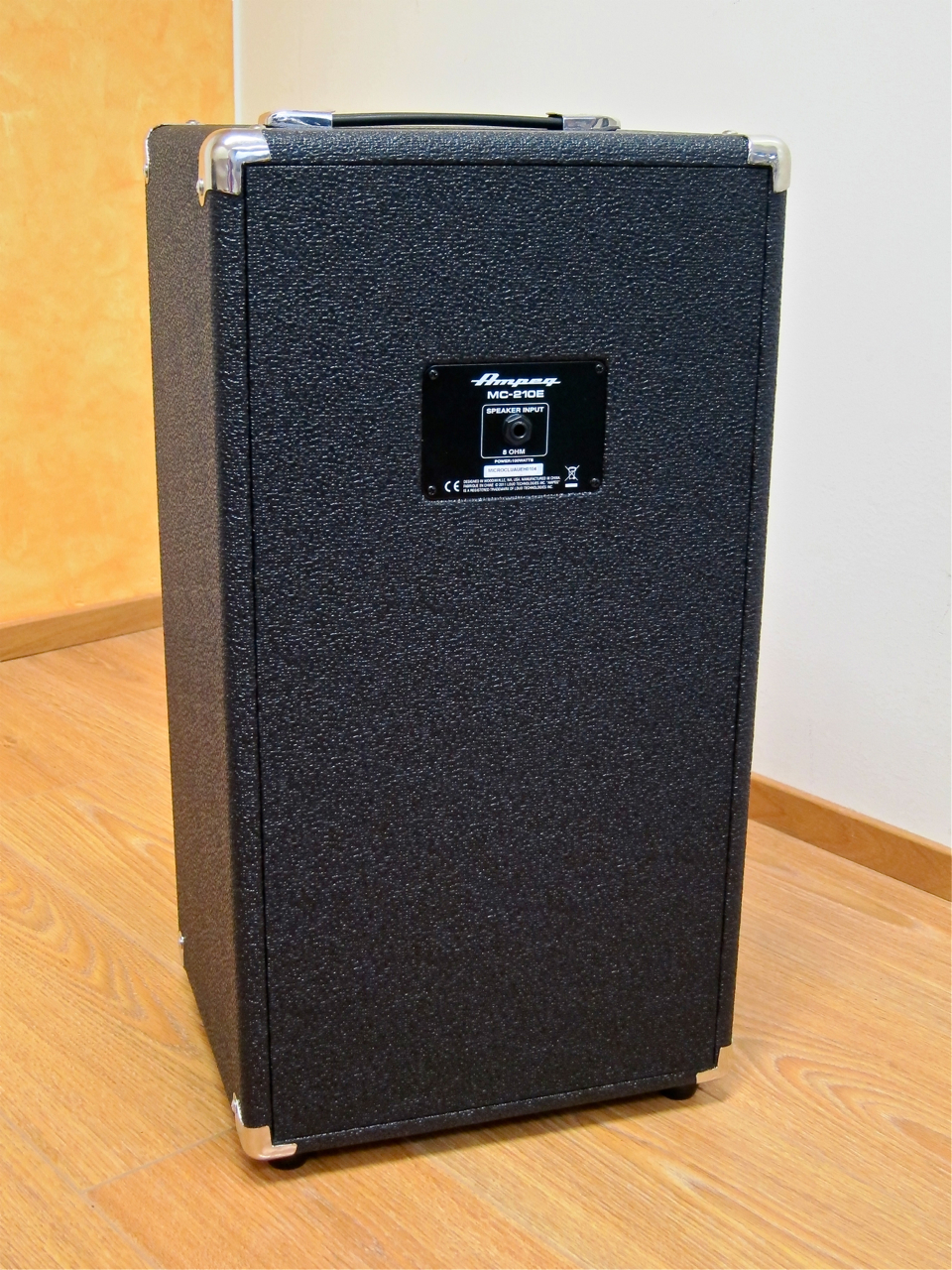
The workmanship seems spot on, with the miniature cabinet exuding the same air of rugged roadworthiness that its big brothers are known for.

The speaker input sits on its own metal plate.

Just to put things into perspective for you: Here’s the stack and a regular bass guitar case – yup, this stack really is small…
****

The amp may be small and cuddly, but don’t forget we have a genuine 100 W Ampeg system here!
I was positively surprised by the sound levels this small bass amp dishes out. Using it at home I wouldn’t recommend turning the master volume anywhere above number three, if you want to stay on good terms with your neighbours.
In the rehearsal studio – where I also recorded the audio clips for this review – the Micro-CL left me in no doubt that it would be fully up to its task at rehearsals and even smaller gigs.
With regard to its sound the tiny stack proved to be a thoroughbred Ampeg: The tones on offer are fat and juicy, with the raunchy midrange growl this company’s bass amps are famous for.
With the master volume approaching 10 you will also be able to coax some tasty, tube-like overdrive from the Micro-CL – but I’d suggest using earplugs then.
Granted, the Ampeg Micro-CL -stack is something of a cutie, but this isn’t a fancy toy, it’s a real bass amp with a lot of Ampeg-tone to boot.
The audio clips have been recorded using my ’87 Rickenbacker 4003 (starting with the neck pickup):
****
Ampeg Micro-CL -stack
current price in Finland 505 €
Finnish distributor: Soundtools
****
Pros:
+ size
+ weight
+ sound
+ output levels
+ workmanship
+ authentic looks
****

There’s surprisingly little information available on the net when it comes to classical/nylon-string guitars.
Now Kitarablogi.com comes to the rescue:
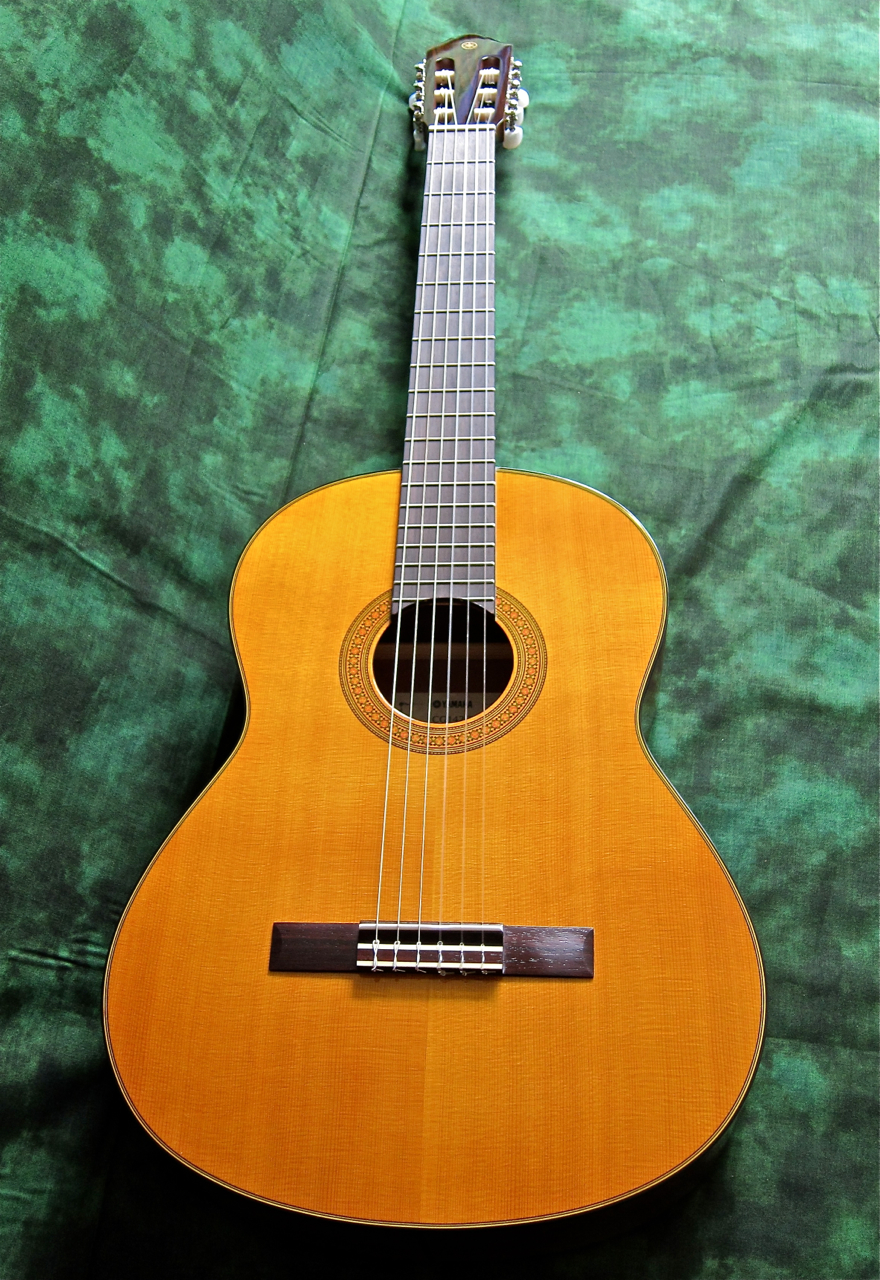
Yamaha’s C- and CG-series instruments are the best-selling classical guitars in Finland. We selected a solid cedar -topped Yamaha CG142C for this review.
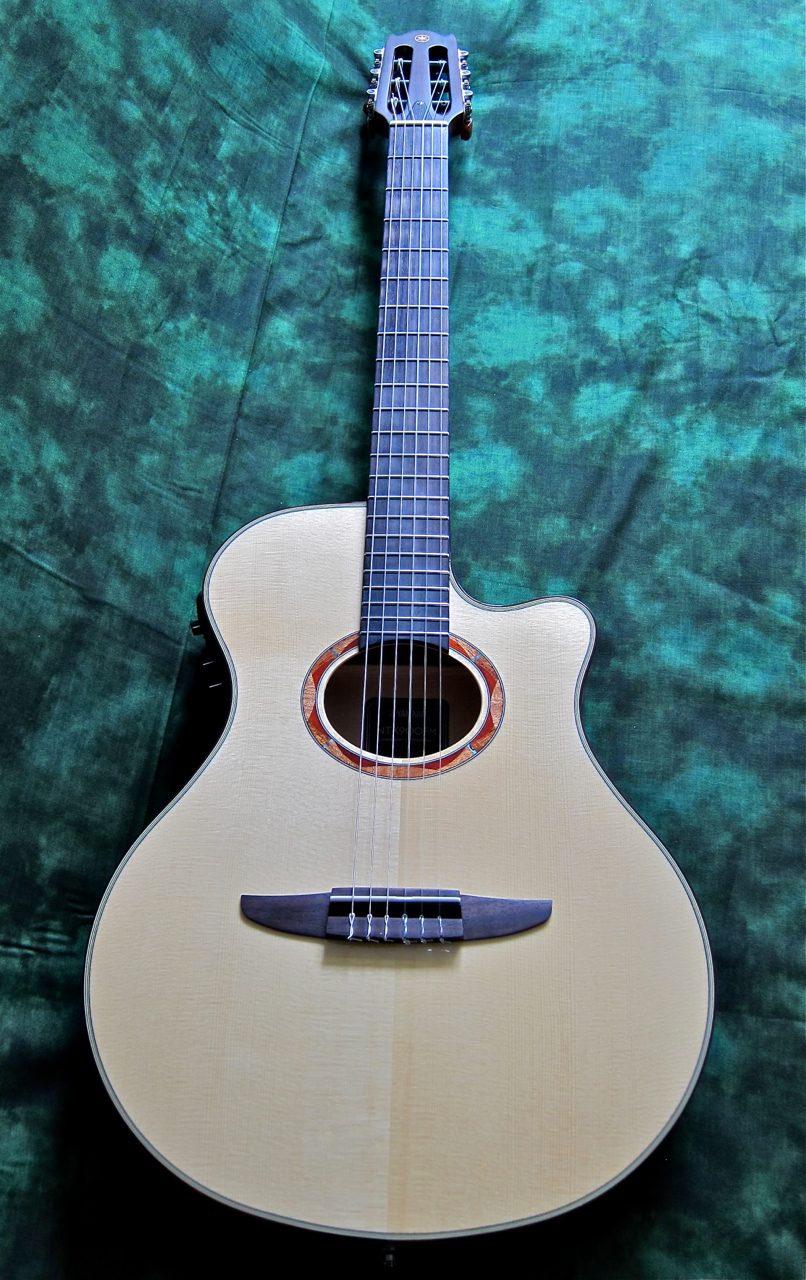
The Yamaha NTX900FM is a very interesting hybrid model – a nylon-string with a pickup and preamp system, as well as a narrower-than-classical nut width.
****

Typical of the company’s output, Yamaha’s CG142C (current street price in Finland approx. 300 €) is an extremely clean piece of work with the understated charm of a classical guitar. All CG-series guitars are build with solid tops – spruce-topped models have an ”S” suffix to their name, while cedar models are denoted with a ”C” at the end of their model name.

The neck, as well as the body’s back and rims, has been crafted from nato-wood. Nato is a South-East Asian tree species (lat. Palaquium) which looks and sounds similar to mahogany. The neck is solid wood, while the body (apart from the top) uses nato-plywood.
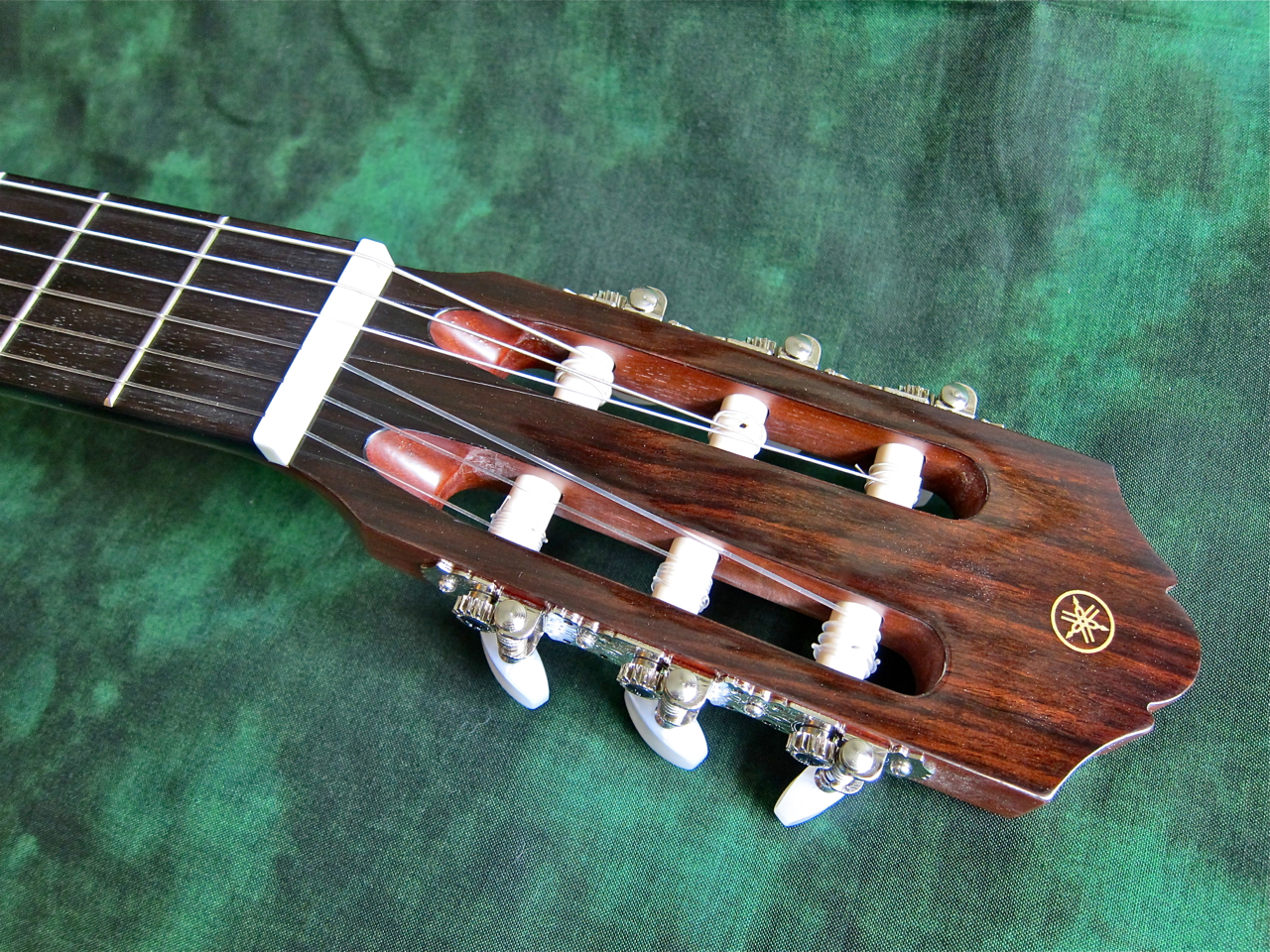
The headstock sports a beautiful rosewood veneer.
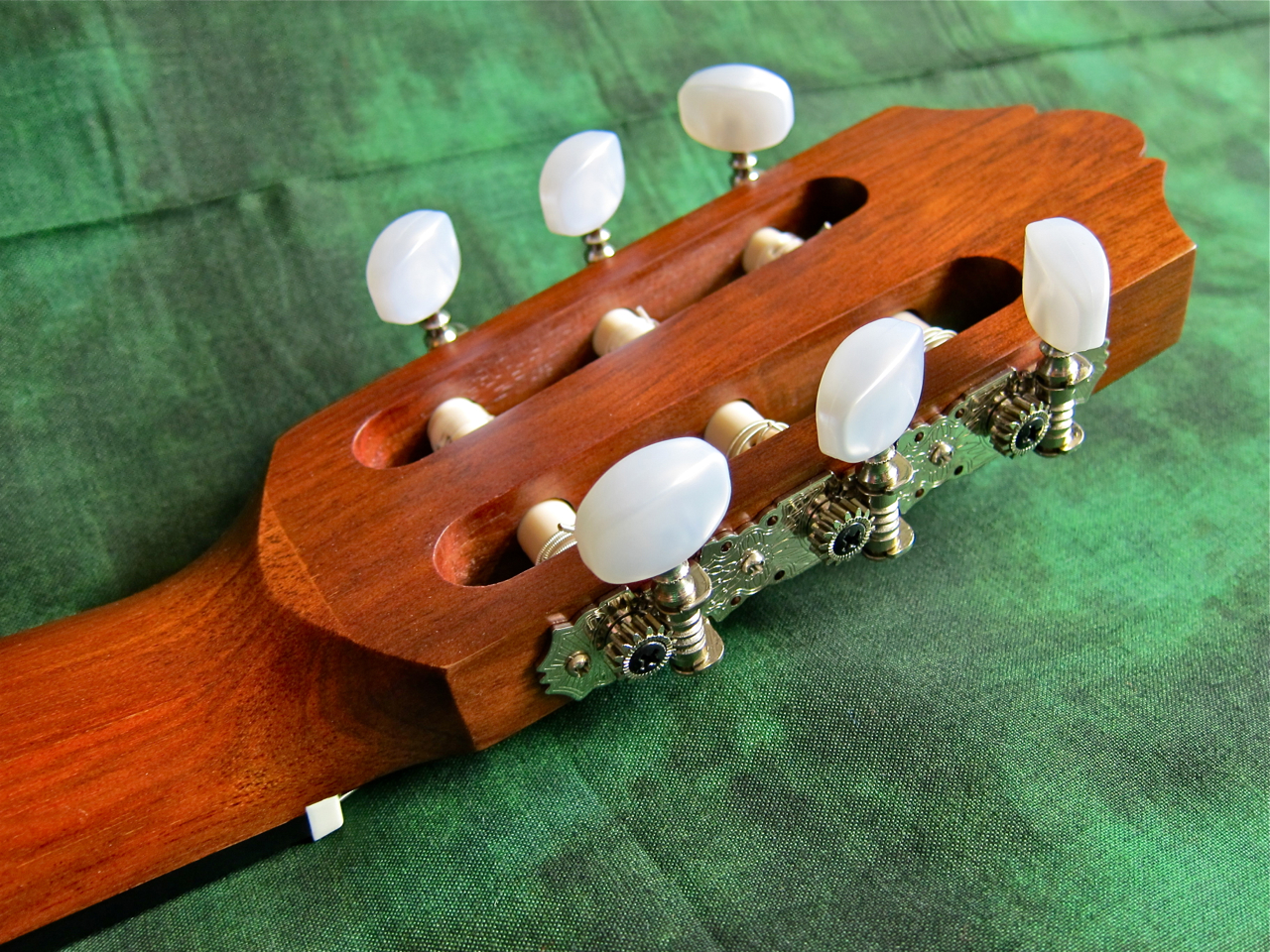
The CG142C comes equipped with traditional, open tuners. The headstock has been glued to the main part of the neck right above the neck wrist.

The satin-finished neck has been made by gluing together three strips of nato side-by-side. Added onto this main part is the neck heel, built up from several pieces of nato. Using small cut-offs in this way not only keeps costs sufficiently low, but also helps to save natural resources.

The bound rosewood fretboard sports traditional small and narrow frets.
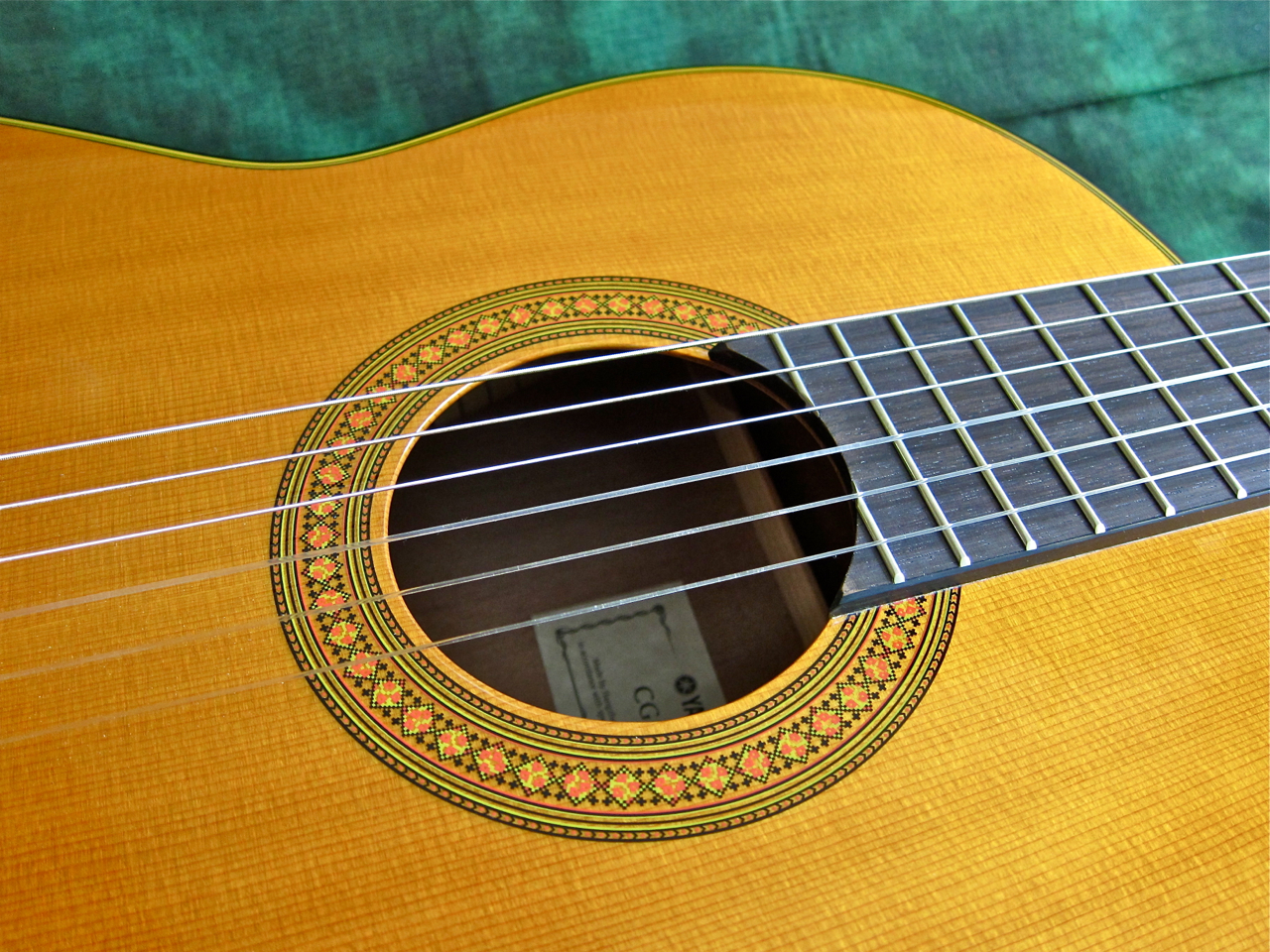
The CG142C’s beautiful rosette is actually a decal, stuck onto the top prior to lacquering, which is common practice on many budget classicals. Higher-priced models feature rosettes crafted from many small pieces of wood and other materials.

Here’s a close-up look at the top’s five-ply binding.
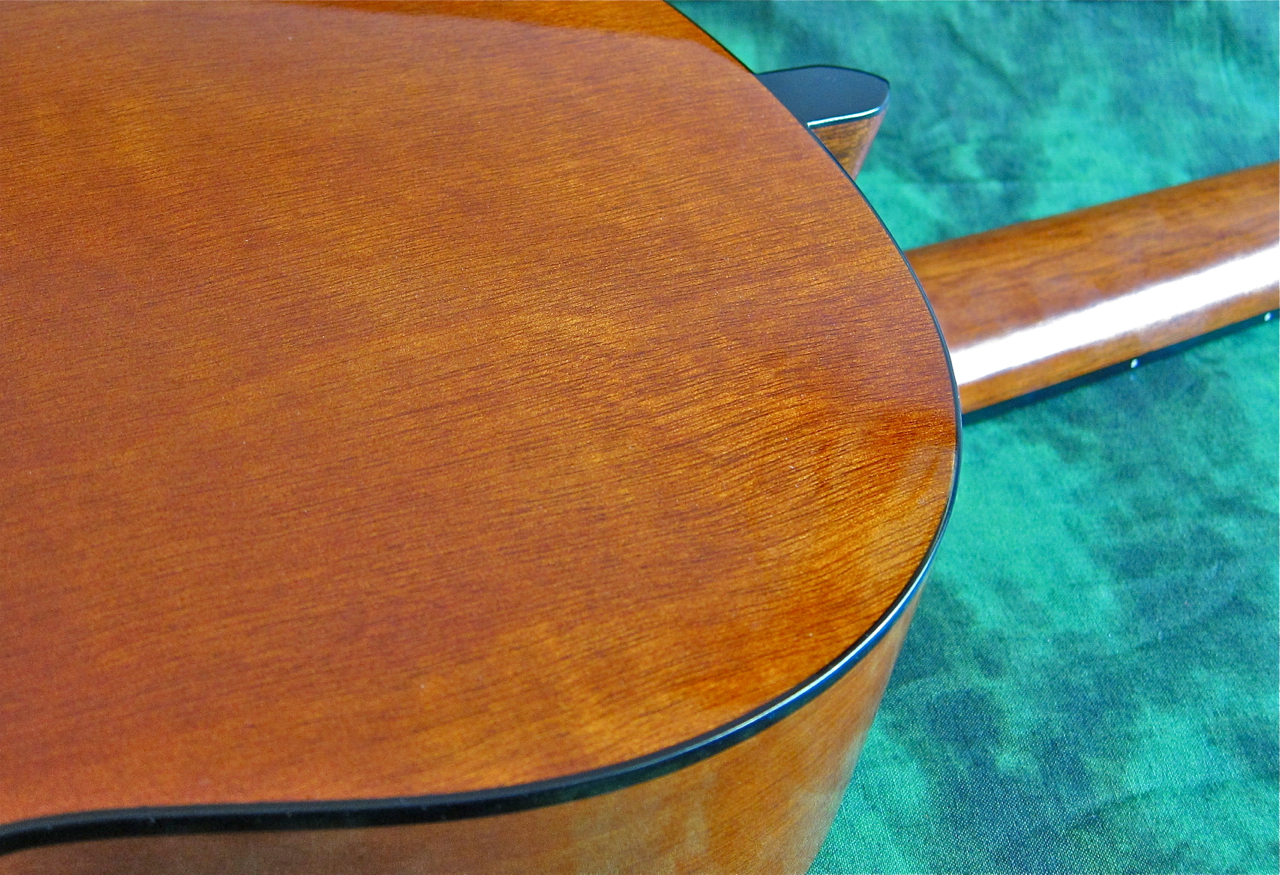
The back’s black binding is carried across to the heel cap.
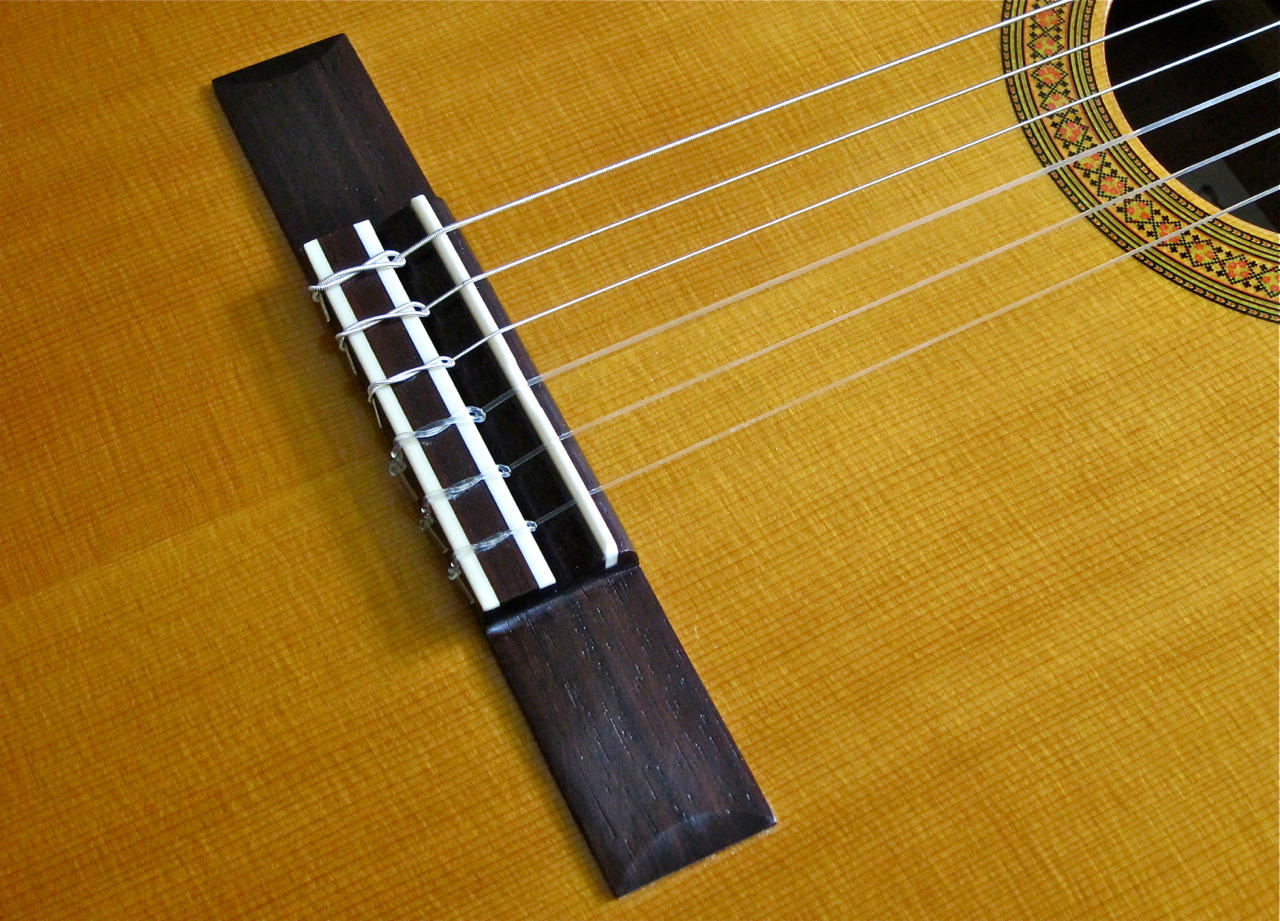
The Yamaha CG142C’s rosewood bridge is quite fetching in its poised simplicity.

Yamaha’s classical guitars tend to display clean workmanship on the inside also.
****

The Yamaha NTX900FM (current street price in Finland approx. 800 €) is the nylon-string cousin of the company’s APX-guitars. It has been designed for the guitarist who needs a quality pickup system, but doesn’t necessarily like the traditional wide and flat classical neck profile.
The NTX900FM’s top has been crafted from solid Engelmann-spruce.
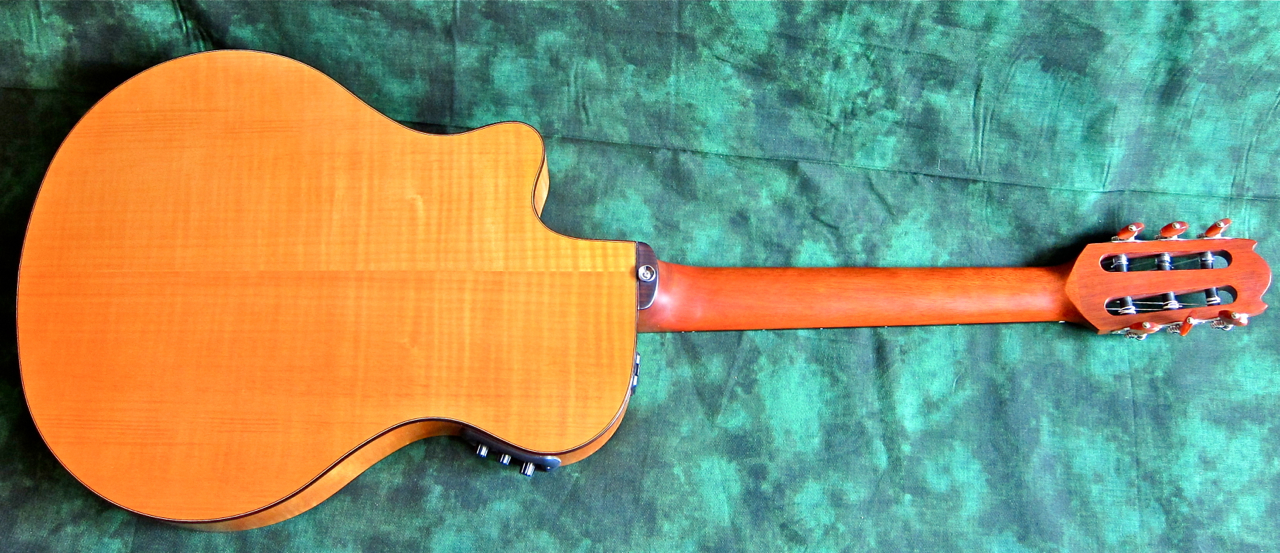
The nato neck has been glued to the maple body.
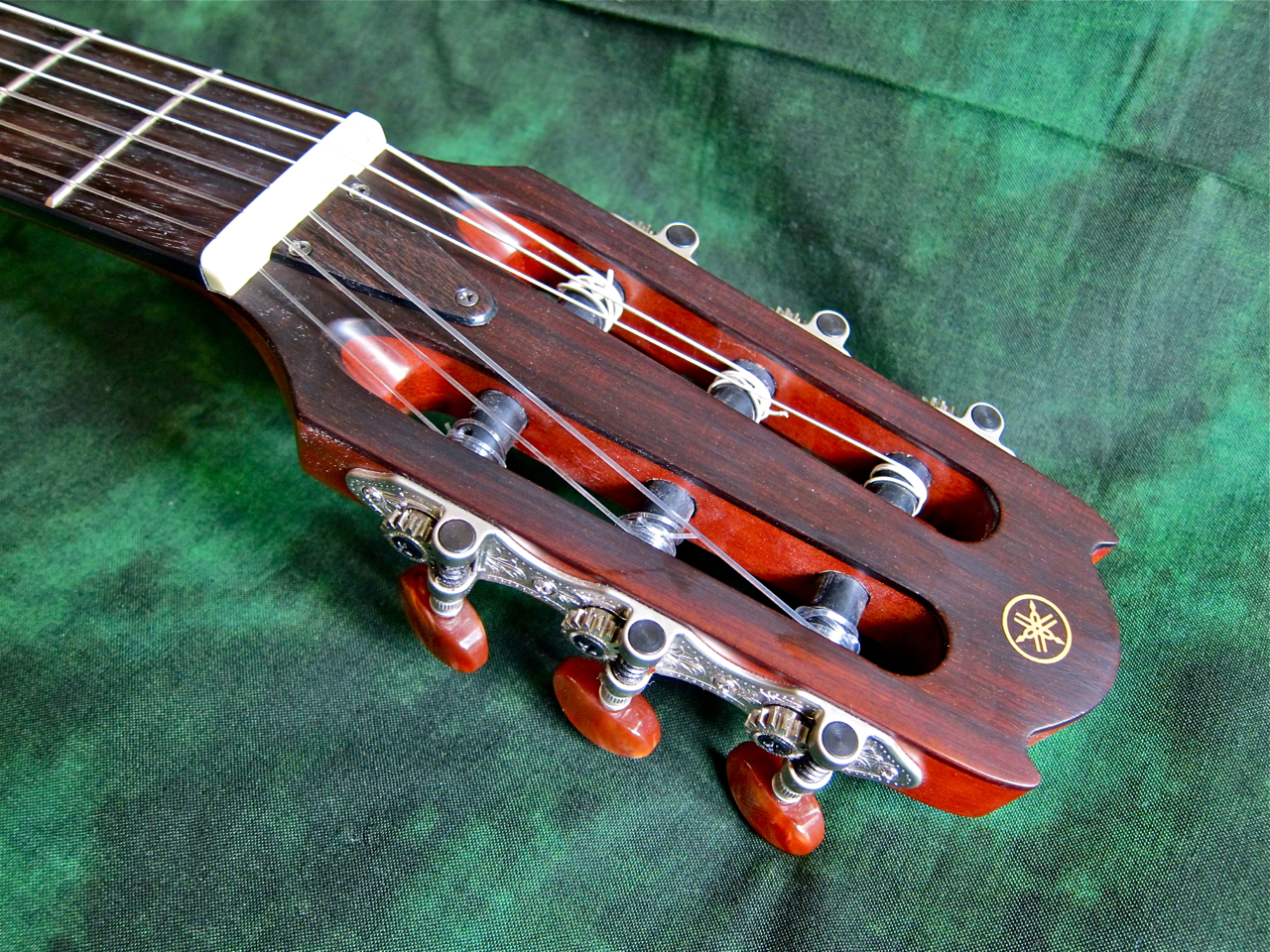
The headstock displays a cool and contemporary look…
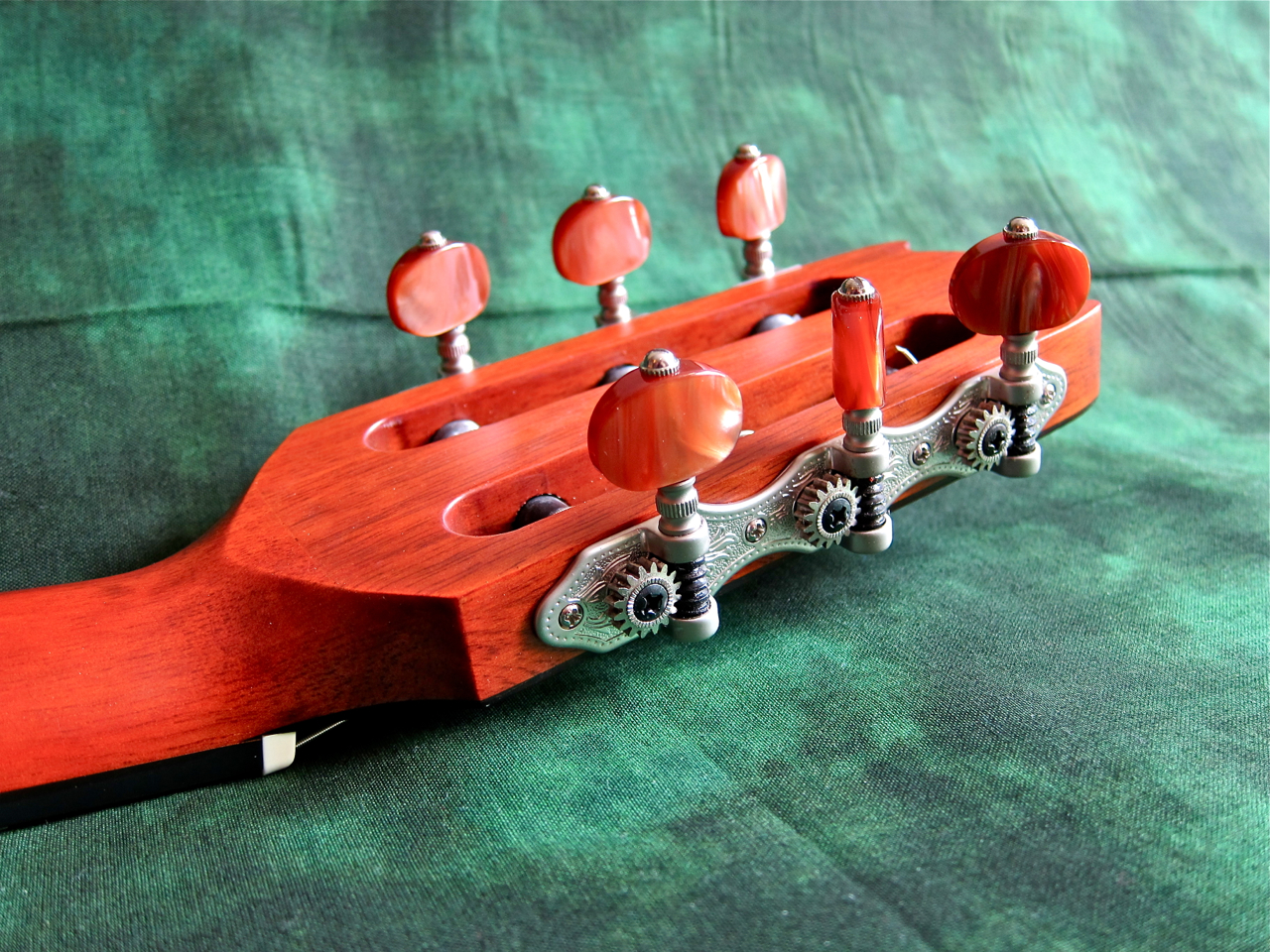
…which is complemented by the nice tuners.
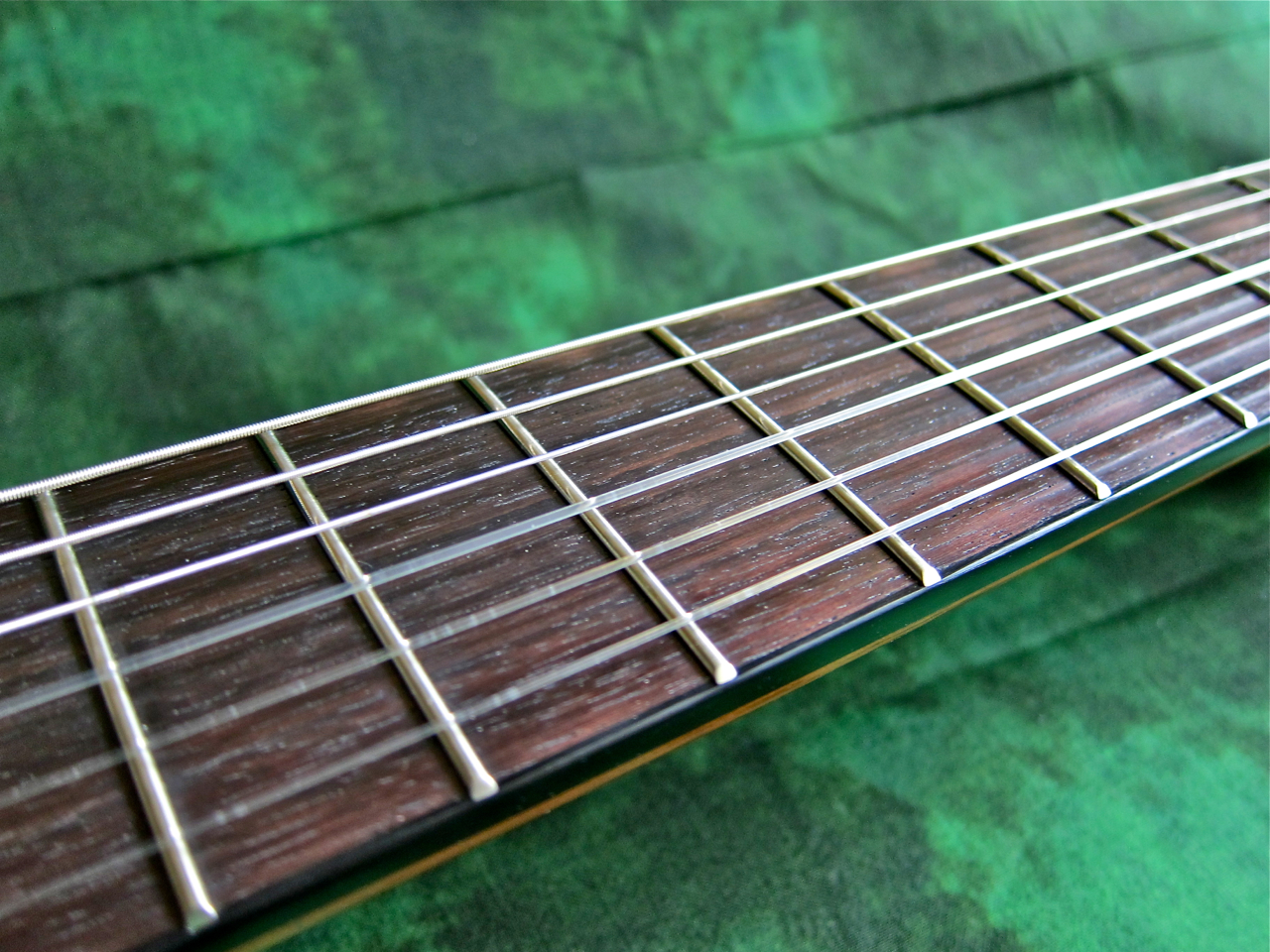
The NTX’ bound fingerboard is rosewood and comes with traditional frets.

NTX-guitars have the same type of body shape as their APX-brethren, and, just like the APX-guitars, the NTX-body is also shallower than what you’d expect from a classical guitar (with a depth of about 75 %).
The NTX900FM’s rosette has been beautifully crafted from various pieces of wood, as well as small bits of abalone.
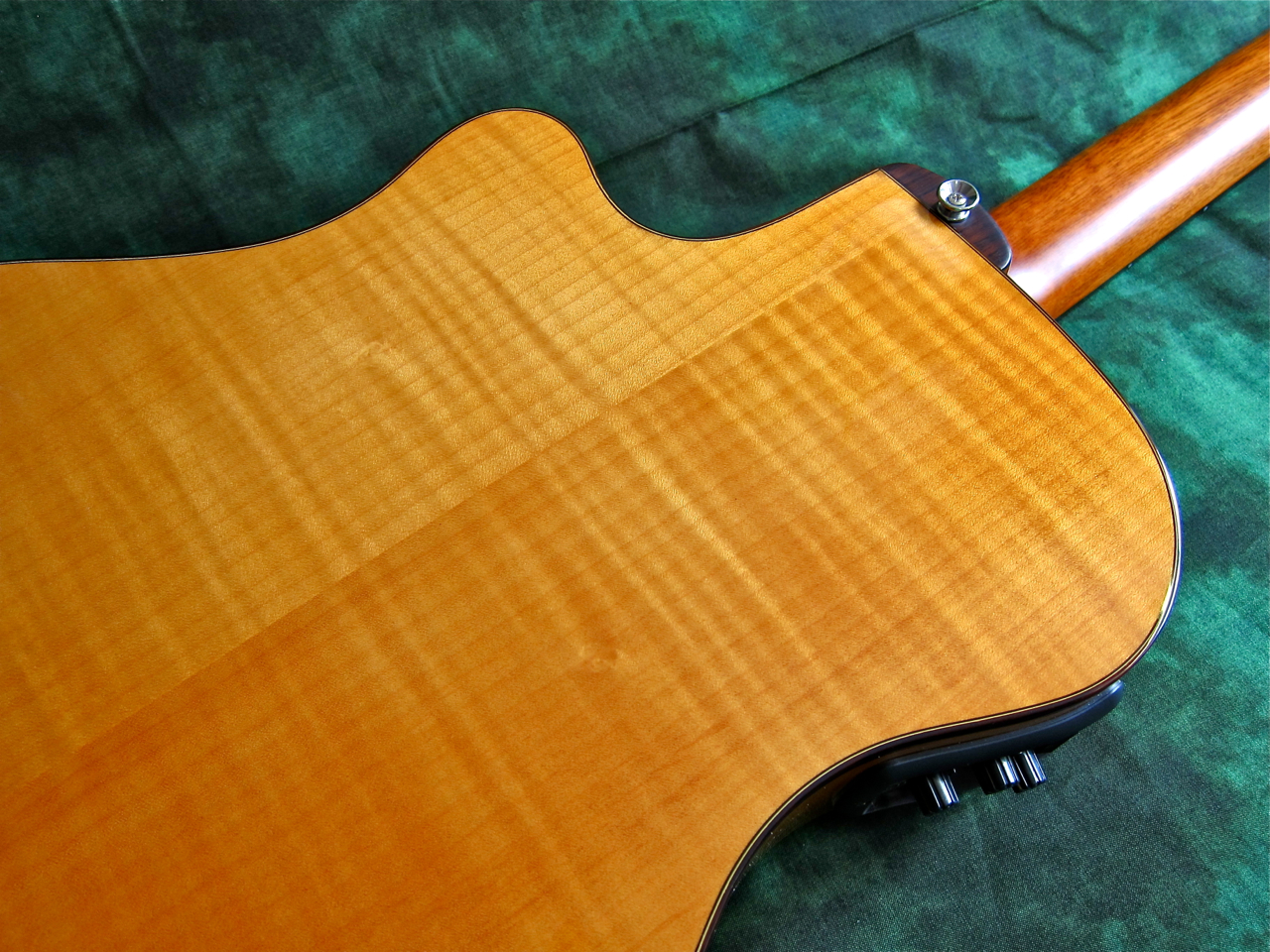
The honey-coloured finish of the flame maple soundbox looks good enough to eat.

Thes NTX900’s rosewood bridge also breaks with classical tradition in a stylish way.

This guitar’s preamp is Yamaha’s ART System 61, which is a two-band preamp with separate piezo transducers for the bass and treble string triplets. This enables you to adjust signal levels independently for the bottom and top halves. The ART System 61 preamp is equipped with a three-band EQ and a digital tuner.
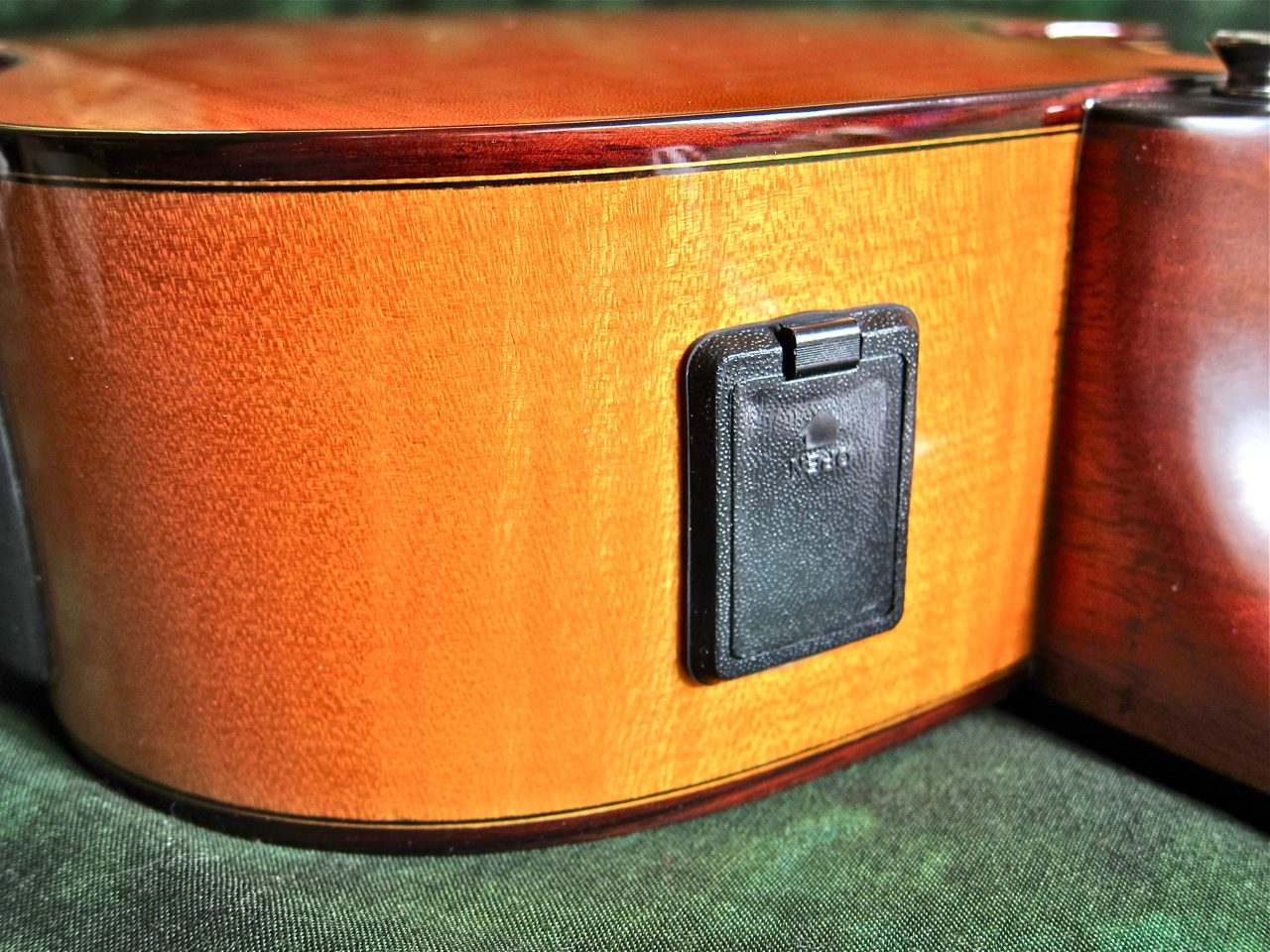
The battery compartment has been placed next to the neck heel.
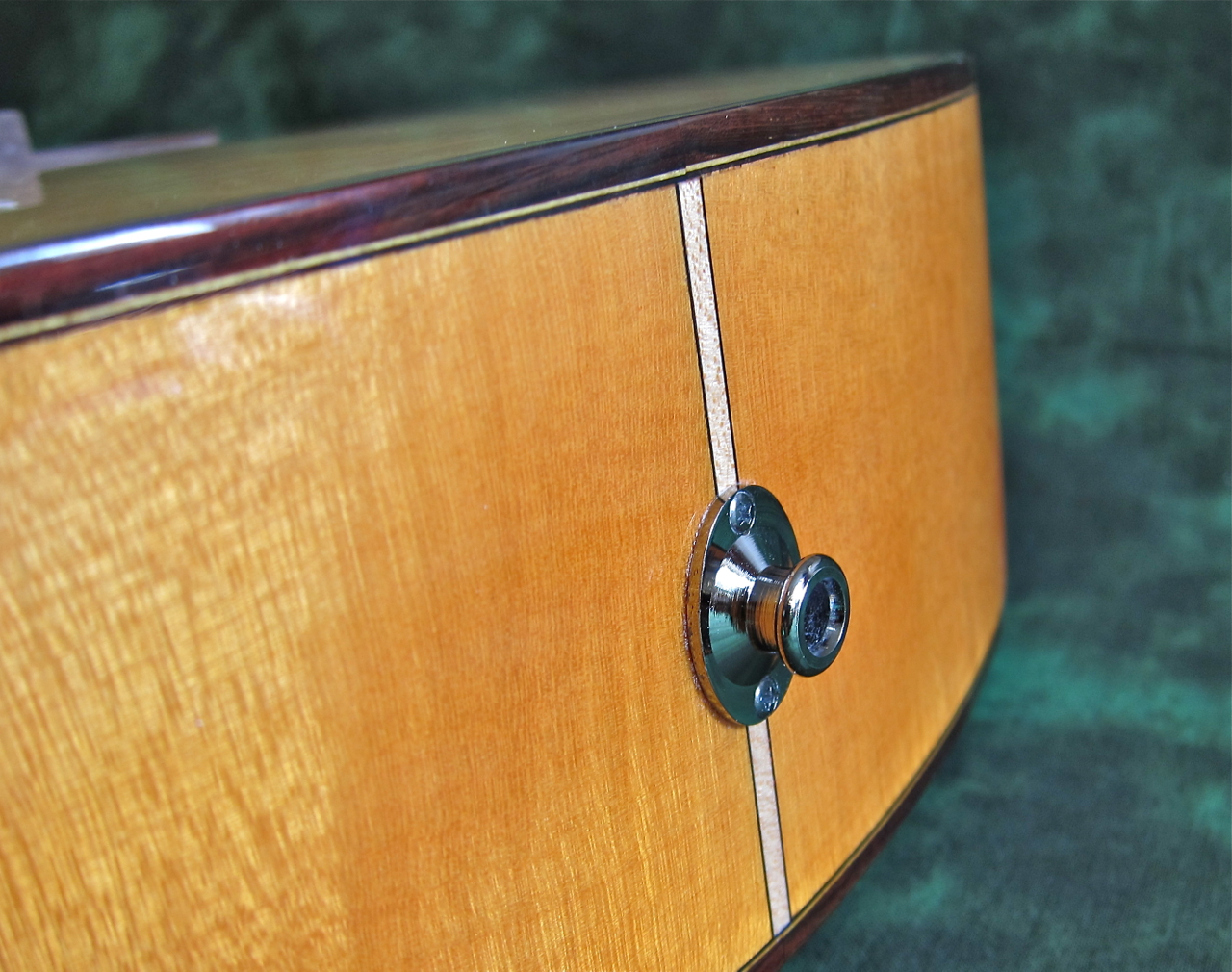
NTX900FM carries two strap buttons, with the bottom one doubling as the piezo system’s output jack.
The workmanship is clean and neat all around – inside and out.
****
****

Yamaha’s CG412C feels like a typical classical guitar: The nut width is a whopping two inches (52 mm) and the neck profile is true to style, namely flat and broad-shouldered. Such a traditional neck gives your left hand plenty of breathing room for complex fingerings, but barre chords require more attention and strength compared to a steel-string.
From an electric player’s standpoint a traditional classical set-up looks impossible, with the action at the 12th fret typically somewhere around 3.5 mm, but this is standard, comfortable fare on a nylon-string. Nylon strings are much softer than steel strings, and they also require a higher action to allow for their larger excursion.
Yamaha’s CG412C sings with a nice, full-bodied voice and an open tonal character. The guitar doesn’t project as well as an expensive classical does, but in its own price bracket the Yamaha CG142C clearly is a winner.
****

The nut width of the Yamaha NTX900FM’s neck lies halfway between a standard steel-string and a classical guitar, measuring 48 mm. The neck’s more tapered, slimmer and rounder D-profile makes for a much friendlier feel for the non-classical guitarist.
The NTX also comes with a lower string action (bottom-E: 3,1 mm/high-e: 2,6 mm at the 12th fret). This clearly narrows the guitar’s dynamic range, but also makes it easier to play for most of us.
Due to its shallower body and the use of maple for the soundbox, the NTX900FM isn’t particularly loud or full-bodied acoustically. The available volume is enough for practicing or song-writing, but this guitar doesn’t project in the way a traditional nylon-string does.
Yamaha NTX900FM – acoustically
Using the on-board pickup system changes things dramatically, turning the Yamaha NTX900FM into an interesting addition to your guitar arsenal. Yamaha’s ART-system works extremely well, and the separate volume controls for the bass and treble sides come in handy for fine-tuning your tone. The under-saddle transducers are also quite immune against handling noises, and the whole system is refreshingly low on hiss.
In my opinion the Yamaha NTX900FM is a good choice if you’re looking for nylon-string tones with a steel-string feel – or if you’re into juicing up your nylon with effects.
Yamaha NTX900FM – ART System 61
****
Yamaha CG142C + NTX900FM – nylon-string guitars
Finnish distributor: F-Musiikki
****
Yamaha CG142C
current street price in Finland around 300 €
Pros:
+ value-for-money
+ workmanship
+ traditional neck and action
+ sound
Cons:
– traditional neck requires different technique
****
Yamaha NTX900FM
current street price in Finland around 800 €
Pros:
+ value-for-money
+ workmanship
+ rounder and narrower neck profile
+ tone/pickup system
Cons:
– acoustically rather quiet
****


This time Kitarablogi.com takes a closer look at two Hagström models: The Viking Deluxe Baritone is a Far-Eastern-made baritone-guitar, made to please the friends of low riffage, while the brand-new Northen Swede is part of the company’s new high-end line, which is handmade in the Czech Republic.
****

The Hagström Viking Baritone (current street price in Finland approx. 600 €) is the newest addition to the Viking-line. This long-necked beauty features the same stylish curves and semi-acoustic body as the rest of the Vikings.
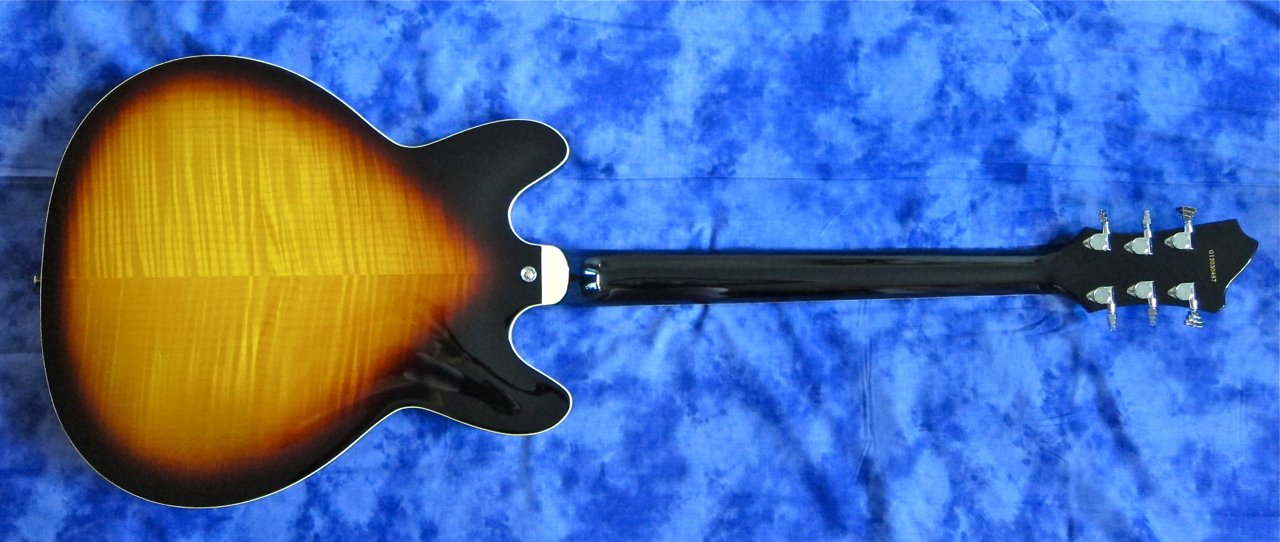
The Canadian hard rock maple neck is glued into the body, which is made from flame maple plywood.

Hagström’s headstock simply oozes 1950’s glitzy panache, with its ultraclean binding and inlay work.
The top nut, on the other hand, is up to date, using self-lubricating, man-made Black Tusq.
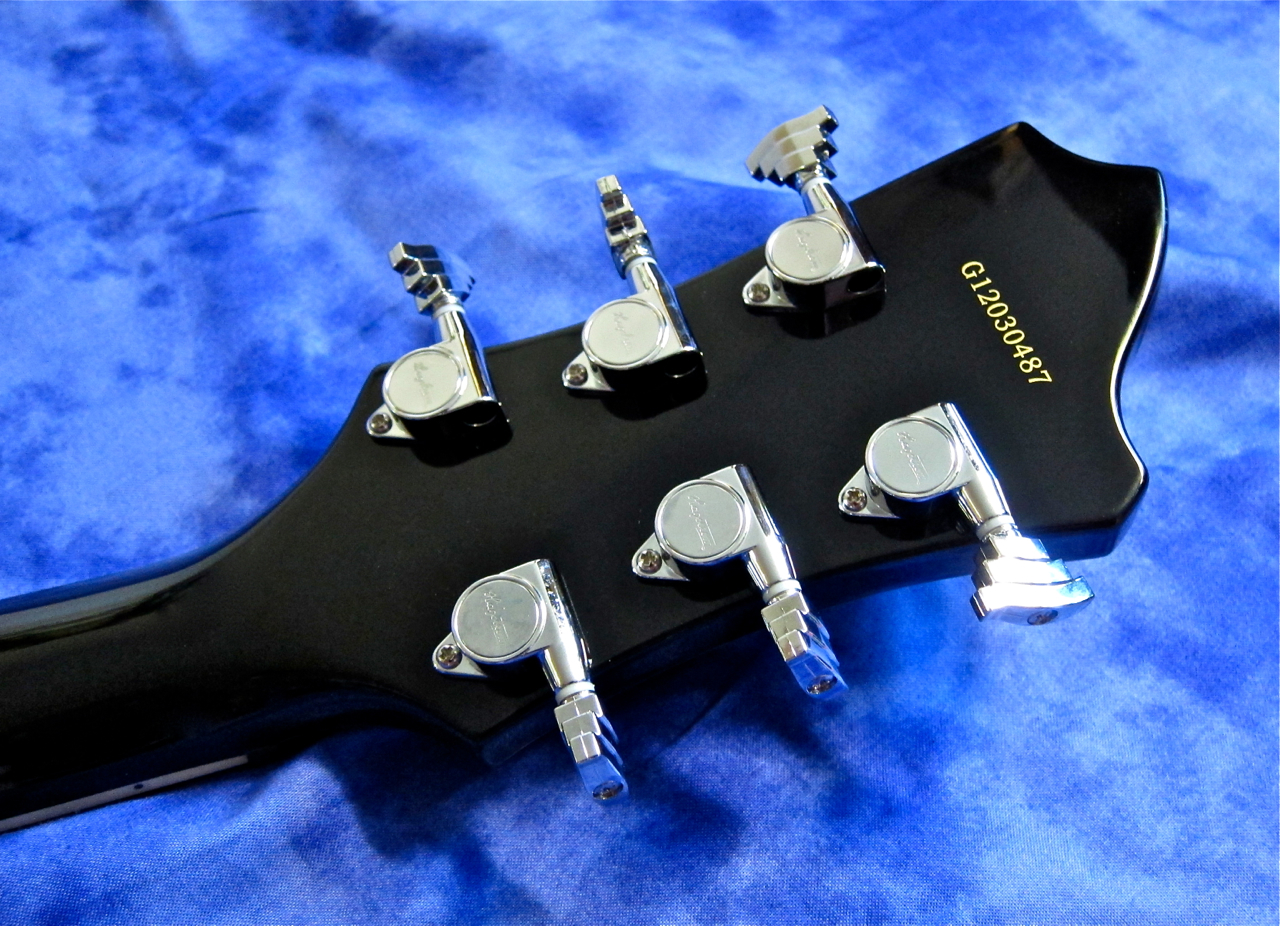
Modern sealed Hagström-tuners keep things steady.

One of Hagström’s special features is their Resinator-fingerboard. Resinator is a man-made alternative to ebony – in both looks and sound – and is made using wood fibres and resin.
The fretwork is rather good on our test sample, apart from a few fret ends, which felt a tiny bit sharpish in places.

Inside the plywood soundbox you can see the Viking Baritone’s full-length mahogany centre block.
The centre block is what turns a fully acoustic guitar into a semi. It improves attack and sustain, as well as greatly reducing the danger of howling feedback at higher volume levels.
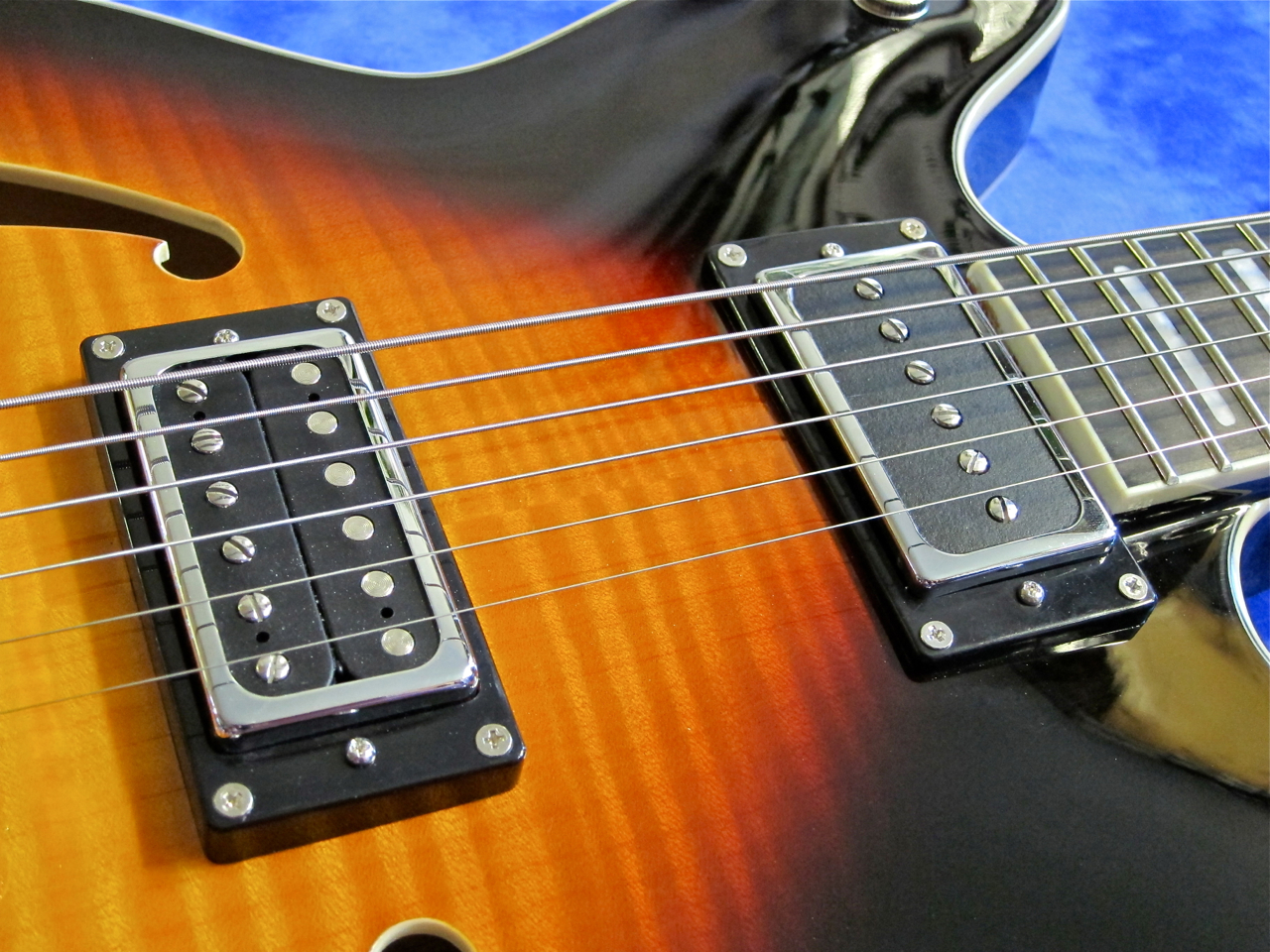
Hagström have optimised this Viking’s choice of pickups for use in a baritone-guitar:
The neck pickup is Hagström’s new P-Urified unit, which is a P-90-type singlecoil in humbucker-size. Employing a singlecoil in the neck position makes great sense, as it improves tonal clarity, while steering clear of any potential mushiness.
The bridge unit is Hagström’s great Custom 58 -humbucker, whose moderate output and nice dynamic range fit the P-Urified perfectly.
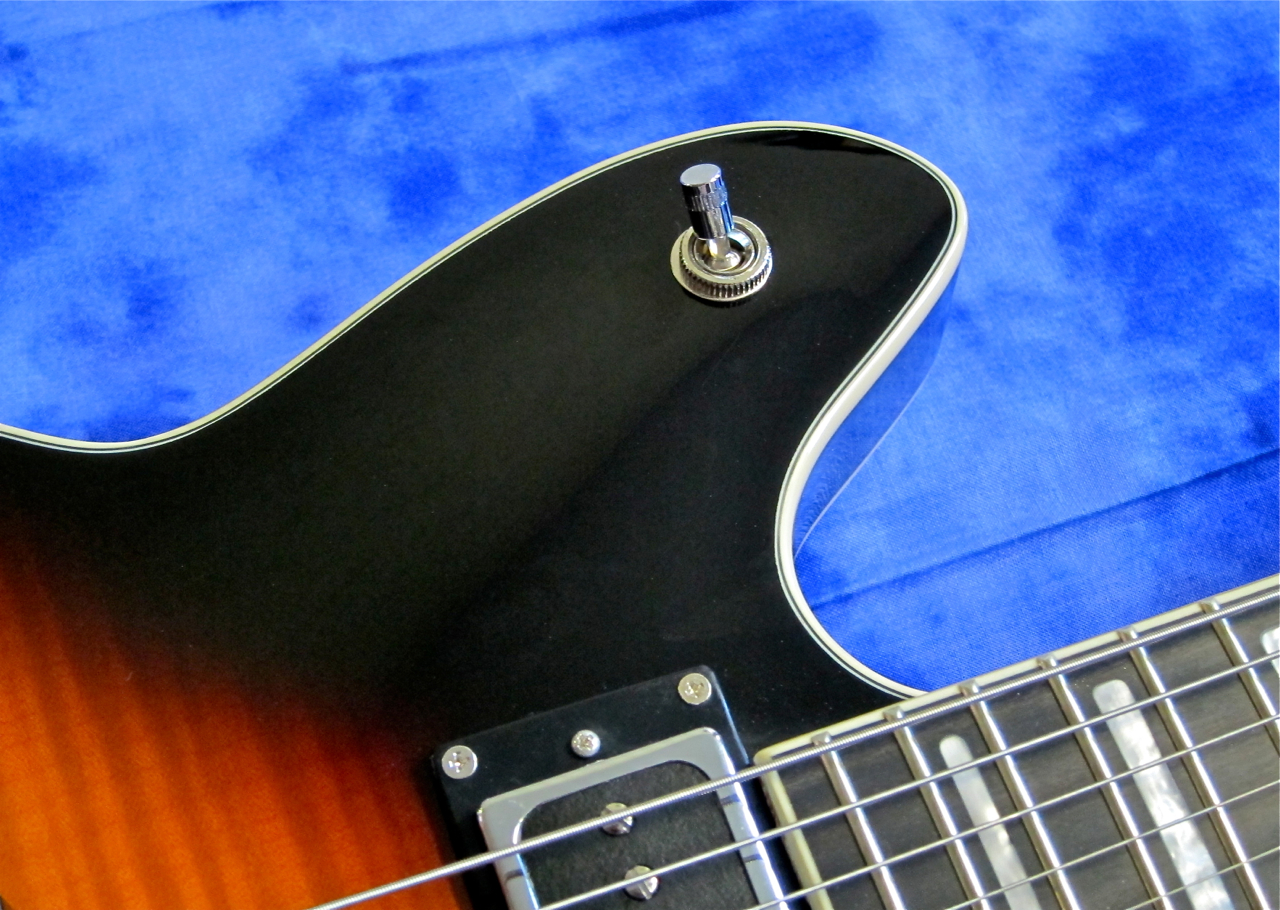
The three-way toggle sits on the Viking Baritone’s top horn.

It’s nice to see quality long-throw pots and clean workmanship inside the Viking.

The classic Gibson-type bridge and stopbar combination works fine on a semi like this.
****
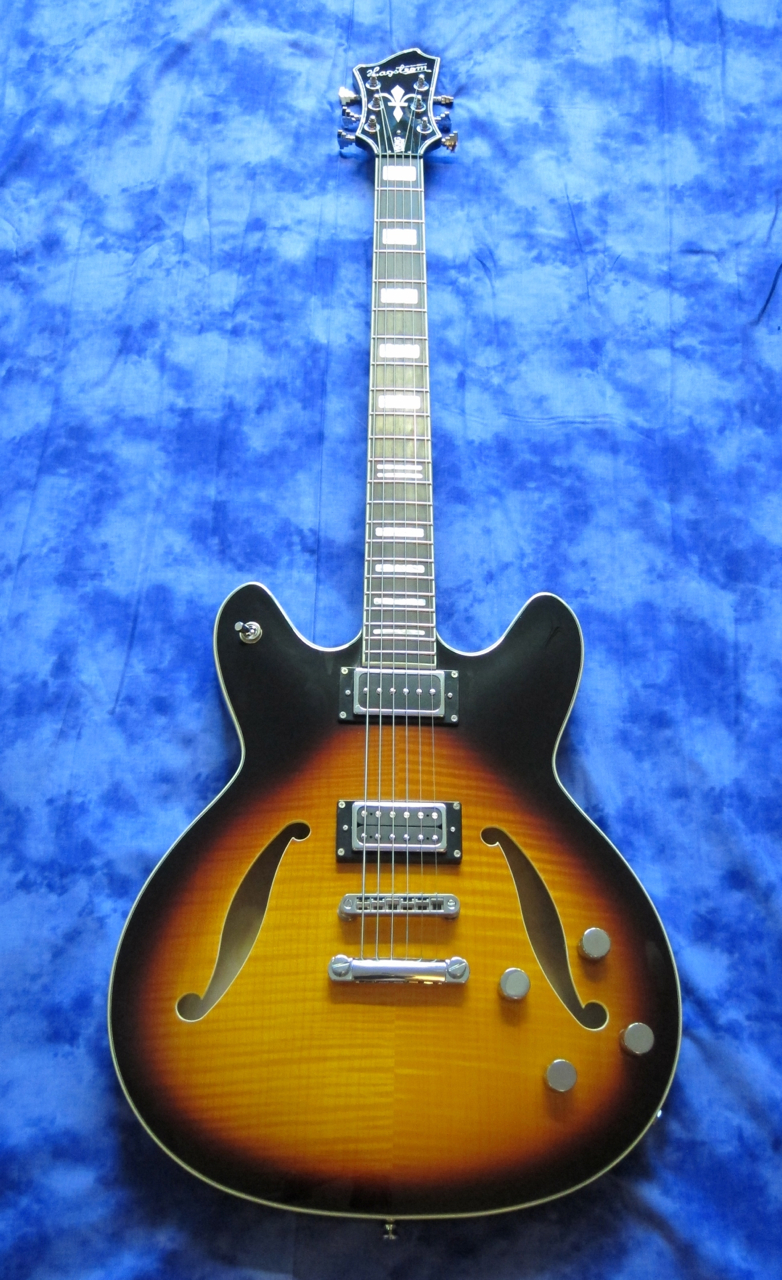
Thanks to its nice, moderate weight the Hagström Viking Baritone sits comfortably in your lap, with good strapped-on balance, too, regardless of a whiff of neck-heaviness due to its long neck.
The neck profile is a fleshy, but not too fat ”D”. Due to a baritone-guitar’s longer scale length (28″/71,1 cm) a newbie will need a little time to adjust his (or her) technique, but after a few minutes or so muscle memory will take the reigns without any problems.
The Viking Baritone’s choice of pickups really does it for me, fitting this guitar’s acoustic tone to a tee. The freshness of the neck pickup, together with its deliciously woody response, will keep even the lowest runs clear and punchy. And the moderately-powered bridge humbucker adds just the right amount of bite and grit to proceedings.
I feel that Hagström’s Viking Baritone is a fine baritone for all occasions and all styles of music (well, probably apart from the most massive of high-gain applications).
Listen to these two audio clips (the pickup order is: neck – both – bridge):
Hagström Viking Deluxe Baritone – clean
Hagström Viking Deluxe Baritone – crunchy
****
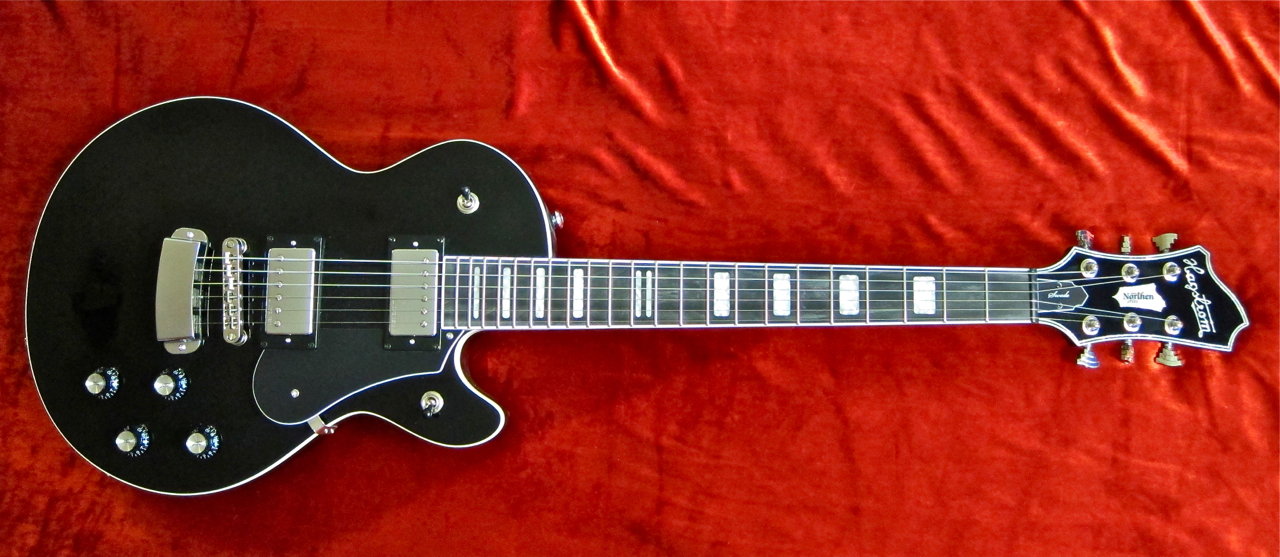
The Hagström Northen Swede (current street price in Finland approx. 1.200 €) is a high-quality, EU-made reissue of the classic Swedish model of yore.
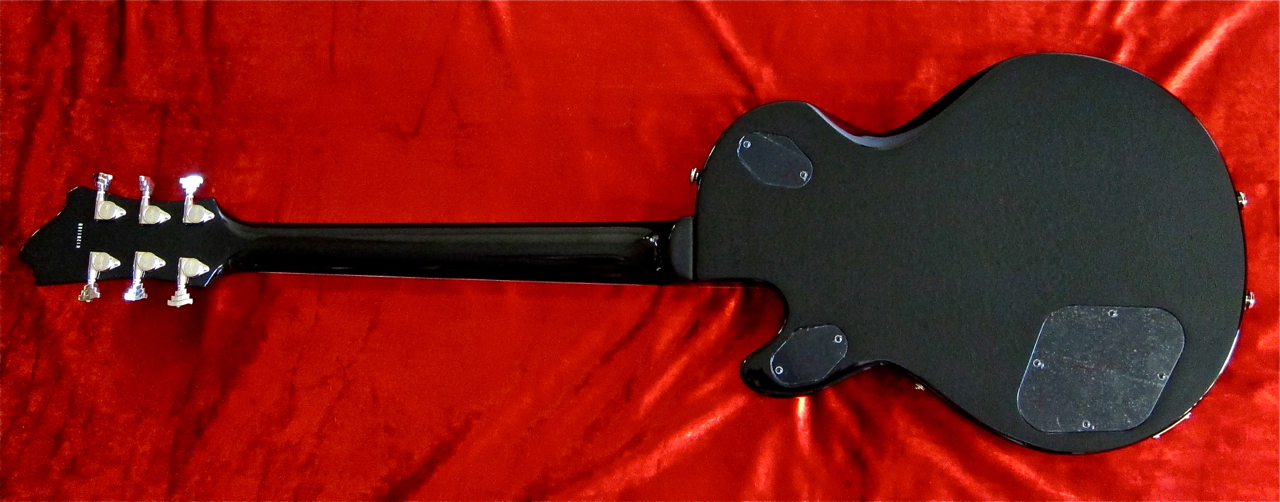
We’re talking about a set-neck solidbody, made almost completely from African mahogany (note: the cover plates look strange in this pic, because they still have their protective foils stuck on top).
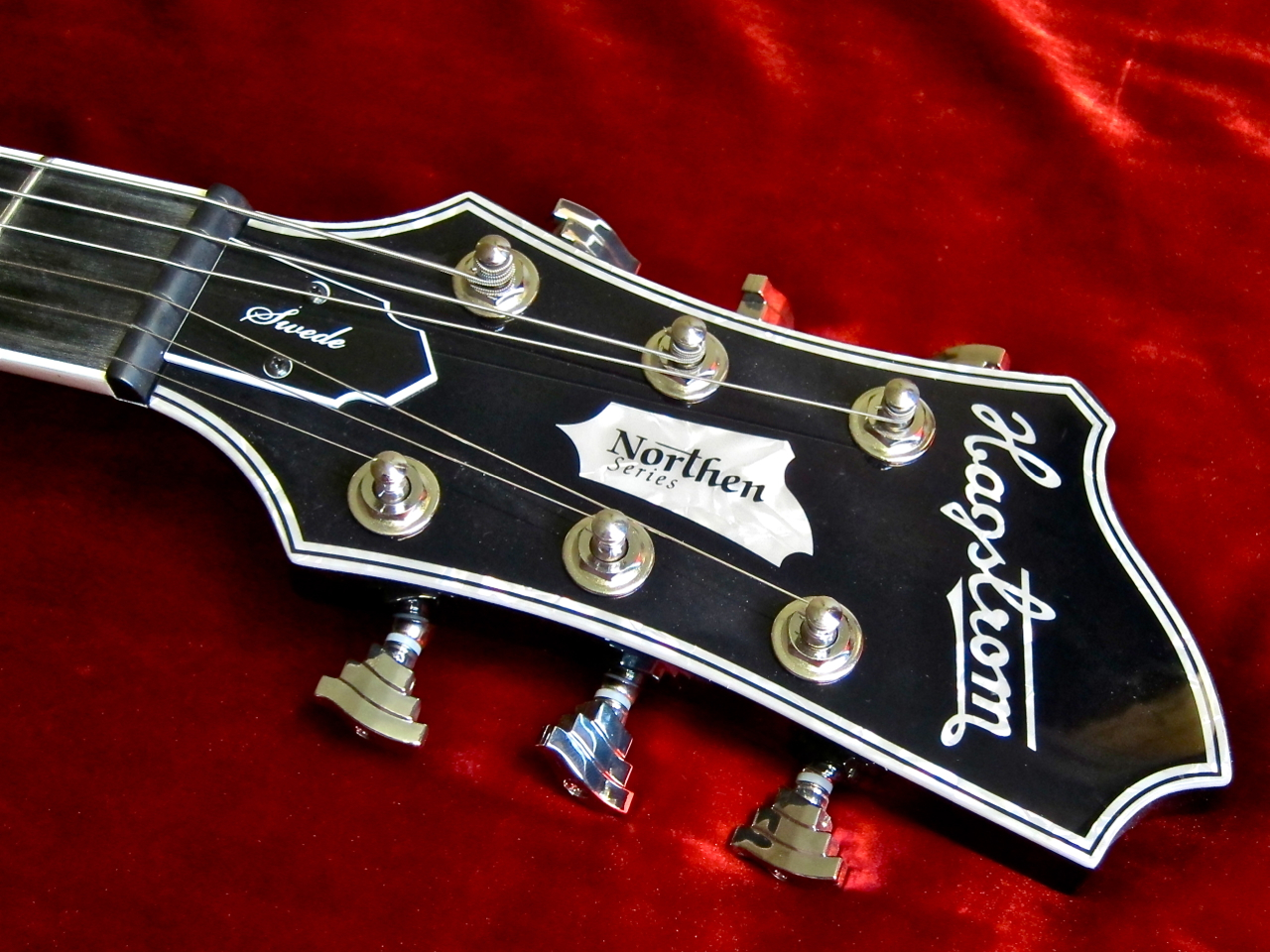
The large pearloid inlay proudly displays the Northen-series’ logo.

The Hagström-tuners have an 18:1 gear ratio and a smooth and precise feel.
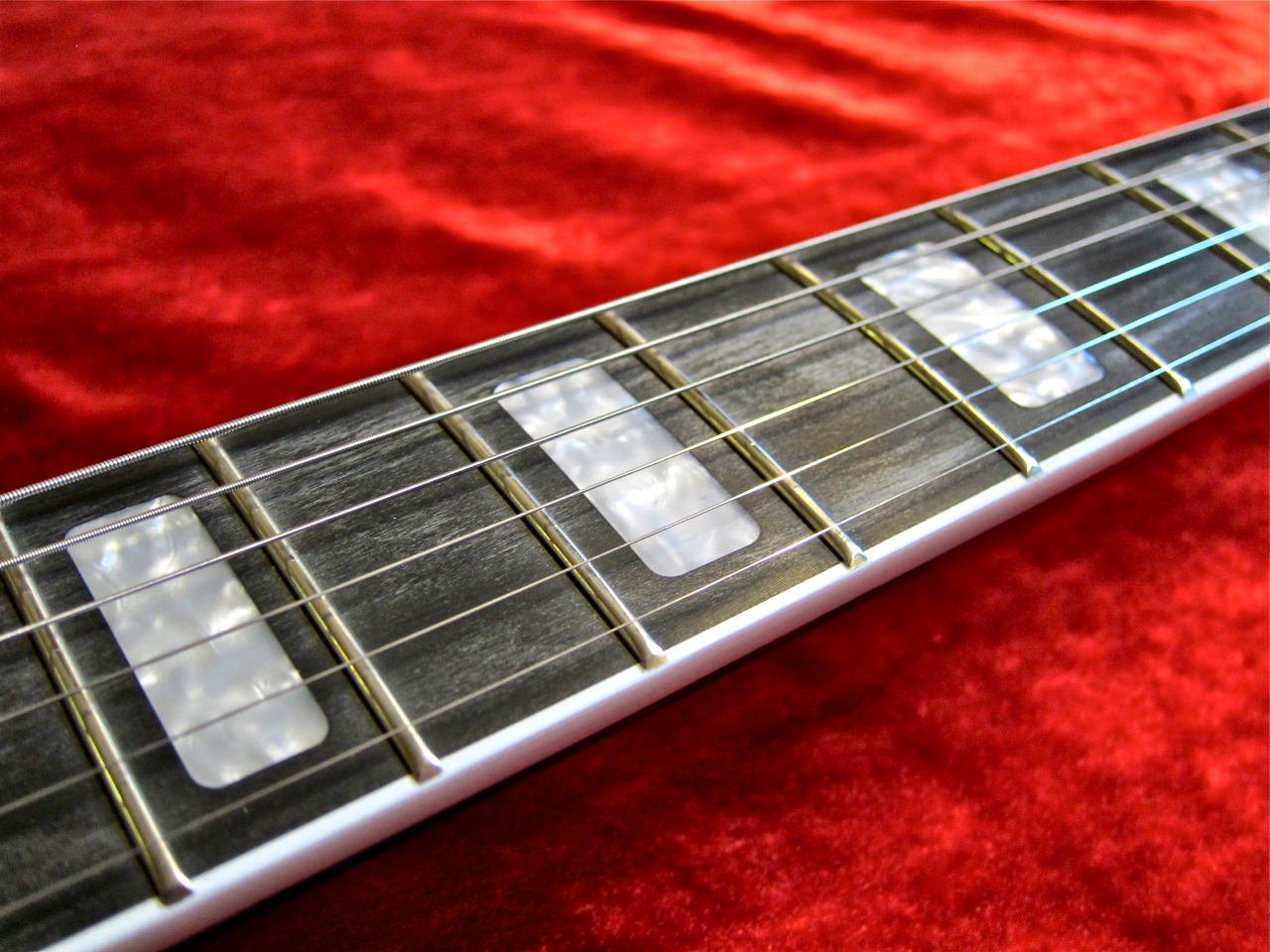
The Northen Swede’s Resinator-board looks more lively than its counterpart on the Viking Baritone. The fretwork is very good.
One special, time-tested feature of all Hagström necks is the H-Expander truss rod system. The H-Expander truss rod sits in a rigid aluminium bar with an H-shaped cross-section. The whole system is then mounted into a tight-fitting, profiled slot inside the the neck, resulting in greater rigidity and thus a better vibrational transfer than most other truss rod systems provide.
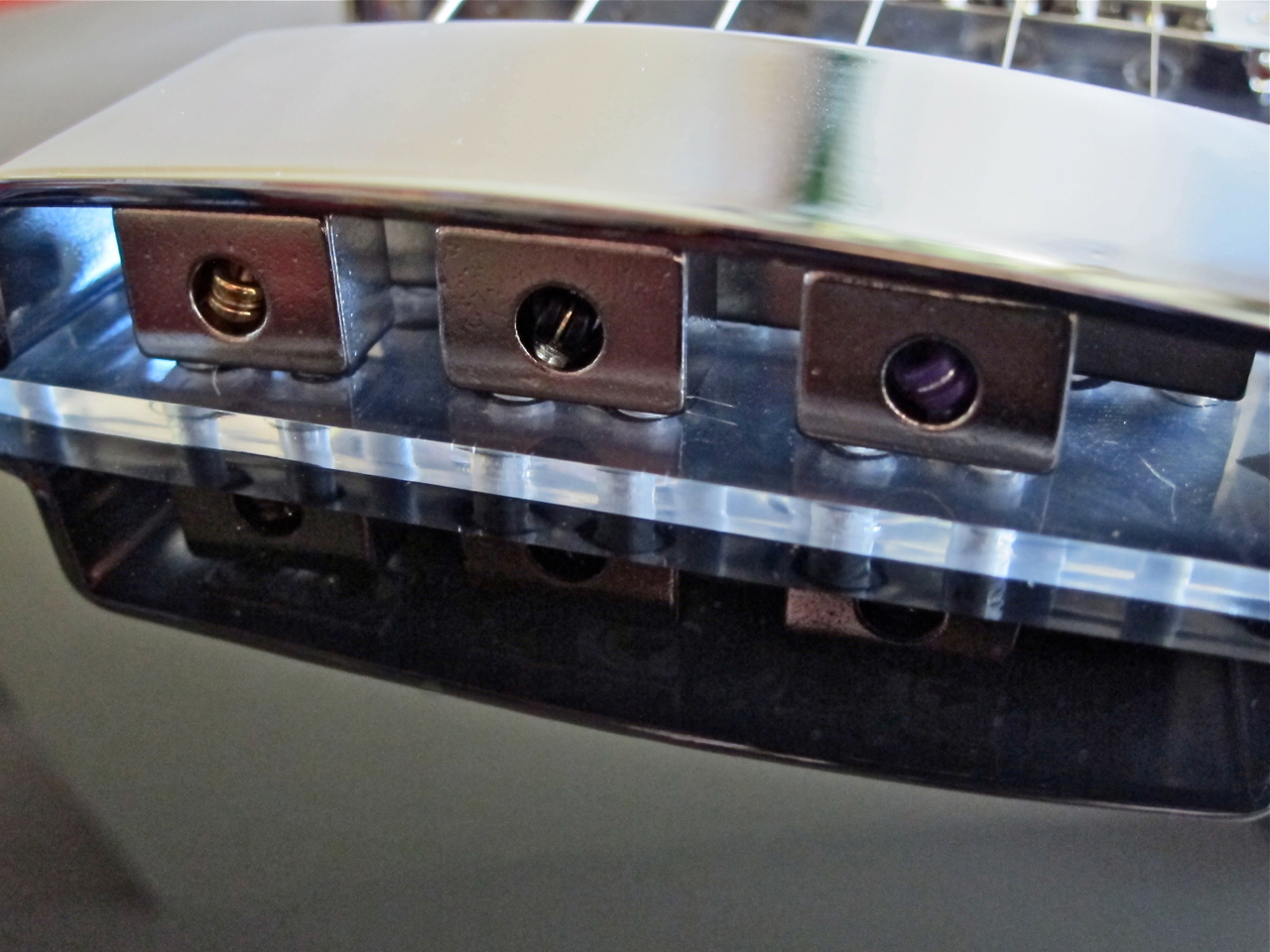
The Swede features Hagström’s idiosyncratic tailpiece, using individual string retainers mounted onto a perspex plate.

Swedish pickup-guru Johan Lundgren is the force behind the Northen Swede’s classy pickups. The guitar is equipped with a pair of No. 2 -humbuckers, which are powered by Alnico 2 magnets.
The Hagström Swede sports two three-way toggle switches: The switch on the guitar’s shoulder is your usual pickup selector, while the one on the treble-side horn is a tone filter -switch.
The tone filter’s middle position is off, with the ”up” selection giving you a mild presence roll-off, while the ”down” position results in a noticeably greater treble and high-mid cut.
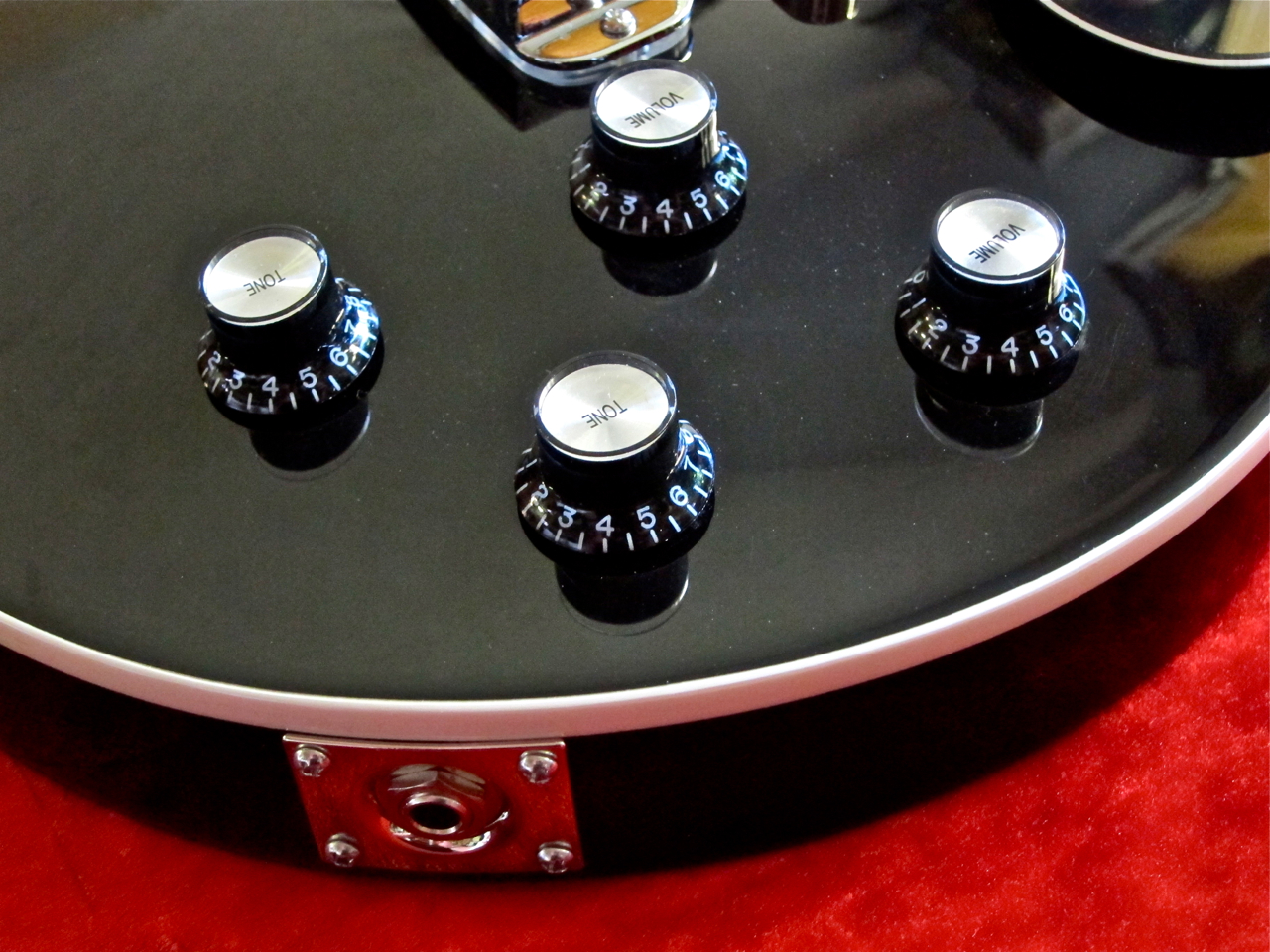
The control knobs work in the standard Les Paul -fashion, with each pickup being provided with its own set of volume and tone controls.
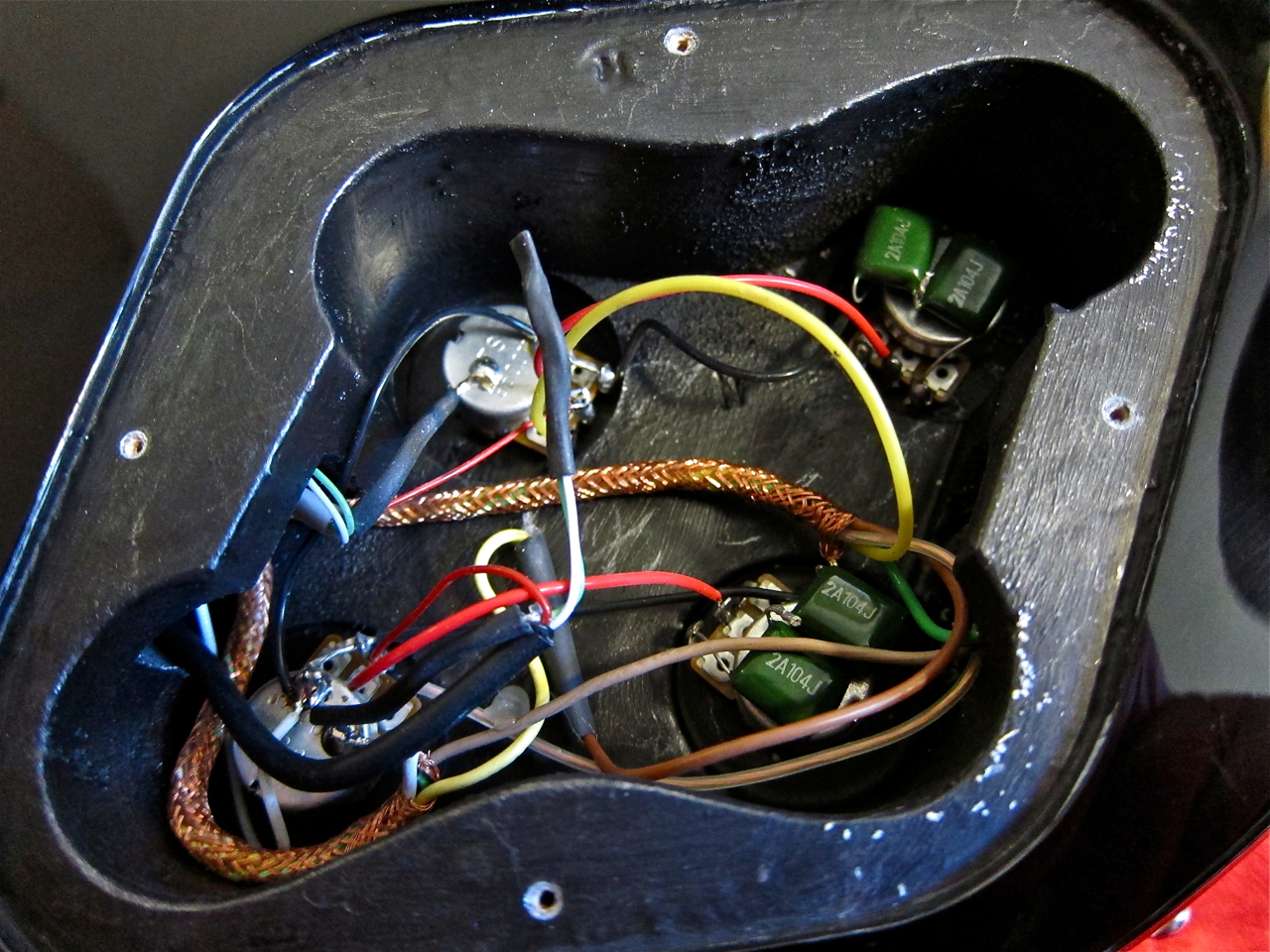
Quality components, clean soldering and thorough screening, using conductive paint and an aluminium-lined lid, get the thumbs up from this here reviewer.
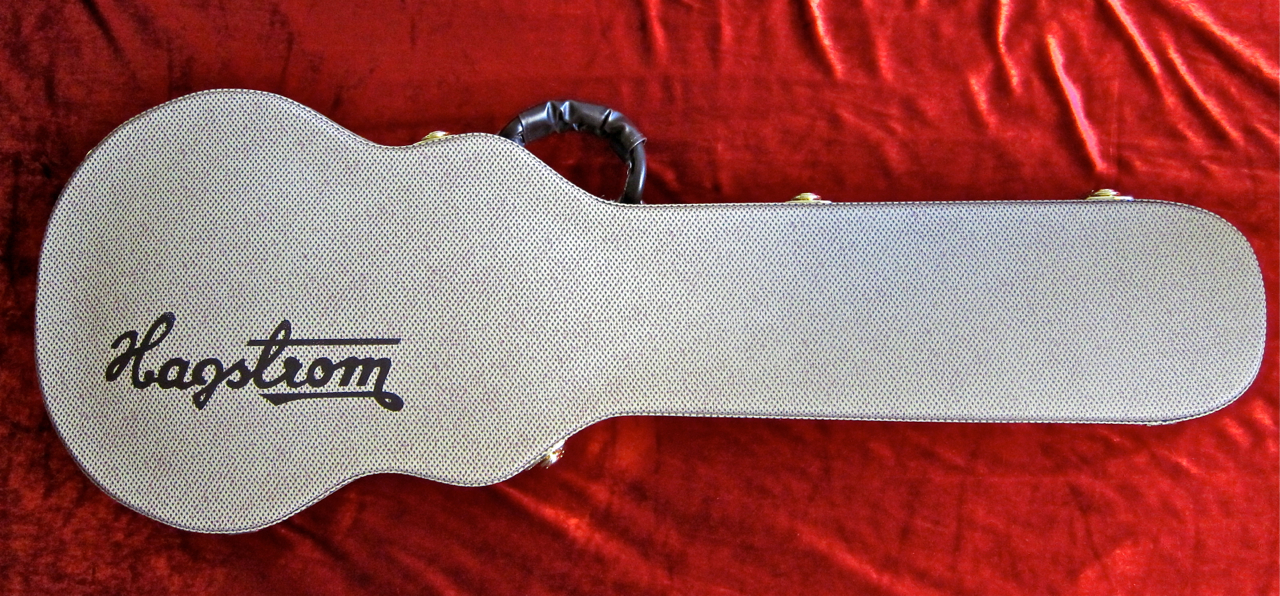
A sturdy and beautiful Hagström-case is included in the Northen Swede’s price.
****

The Hagström Northen Swede’s well-rounded neck profile feels great to me. The nicely polished frets and the ’board’s 12-inch camber make for a fast and effortless playing experience.
Thanks to the fantastic interplay between the tone filter -switch and the guitar’s controls, the tonal options afforded by this Swede are virtually limitless. The Lundgren-designed pickups have a very clear and clean basic tonal character, which enables you to make the most of the Northen Swede’s passive electronics.
In my opinion Hagström’s Northen Swede is a top-quality guitar offering a great deal of tonal variation to the discerning guitar connoisseur. In light of its Czech origin, I must say that the Northen Swede truly represents quality European workmanship at a very moderate price.
All the following audio clips have been recorded with the tone filter -switch starting at off, then going to moderate roll-off, with the last phrase using the full treble cut selection:
Hagström Northen Swede – neck pickup/clean
Hagström Northen Swede – both/clean
Hagström Northen Swede – bridge pickup/clean
Hagström Northen Swede – neck pickup/crunchy
Hagström Northen Swede – both/crunchy
Hagström Northen Swede – bridge pickup/crunchy
****
…and here we have both Hagströms in action:
Hagström Viking Baritone + Northen Swede – the video’s audio
****
Hagström-guitars
Finnish distributor: EM Nordic
A big thank you to DLX Music Helsinki for the loan of the review instruments!
****
Hagström Viking Deluxe Baritone
Current street price in Finland about 600 €
Pros:
+ sound
+ playability
+ workmanship
+ weight
+ pickups
Cons:
– fingerboard binding felt a tad angular on test sample
****
Hagström Northen Swede
current street price in Finland about 1.200 €
Pros:
+ made in the EU
+ sound
+ versatility
+ Lundgren-pickups
+ workmanship
+ playability
+ weight
****


 Kitarablogi.com – Finland's premier Guitar and Bass blog