

****
Kitarablogi.com – Finland's premier Guitar and Bass blog
Juttuja kitaroista ja bassoista

****
Marshall Amplification celebrate their 50th anniversary this year. To honour the occasion the company is releasing five small anniversary models, produced in limited numbers. Each model of these one-Watt all-valve heads and combos has been designed to represent one era in Marshall-history, both in looks and in sound.

Kitarablogi.com had the pleasure to review the Sixties and Seventies combos – the JTM1C and JMP1C.
****

The JTM1C-combo (current street price in Finland approximately 700 €) nails the look of early JTM-models perfectly. Just like the famous Bluesbreaker-combo, the JTM1C sports a golden nameplate with the old-style block lettering and the famous salt-and-pepper grille cloth of yore.

Valve purists will be delighted at the sight of just one volume- and one tone-control – nothing stands in the way of pure tone.

Even though the anniversary models aren’t wired point-to-point in the vintage style, the electronic lay-out and PCB-build look very sturdy and clean. Two ECC83/12AX7-valves run in the preamp section, while the power amp employs one ECC82/12AU7.
The Marshall JTM1C is equipped with the same, fine Celestion speaker, which had been developed for the Class 5 combo – the ten-inch G10F-15.

The combo’s half-open back looks as clean as the front.

The Power-button next to the two external speaker jacks drops the maximum output of the amp from one Watt to 0.1 Watts.
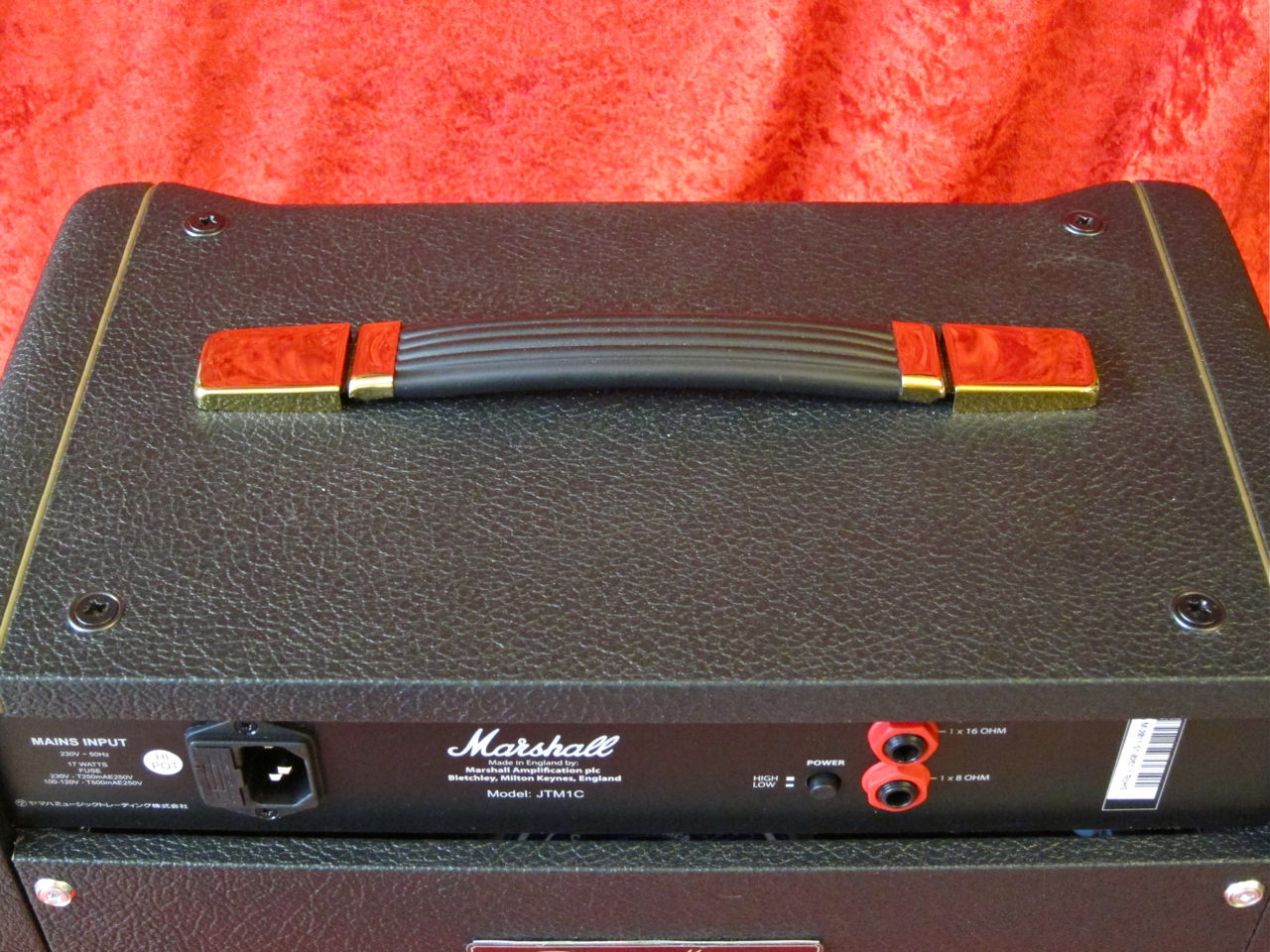
The same Marshall-handle is used on all of the anniversary amps.
****
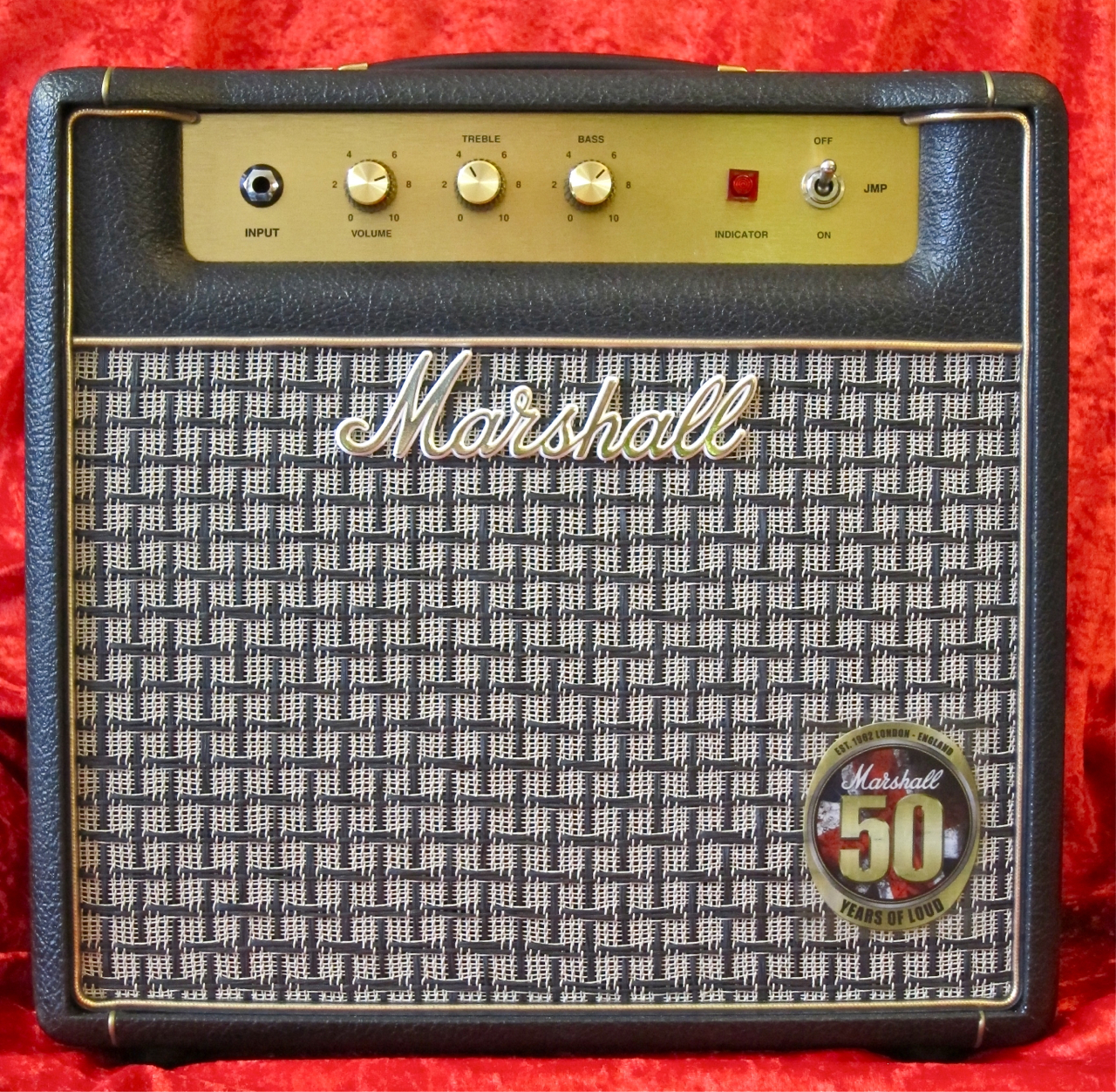
The Seventies are represented by the JMP1C (current street price in Finland approximately 700 €), which displays the famous Marshall script logo, as well as the light grey grille cloth with the dark weave that’s typical of many amps from that era.
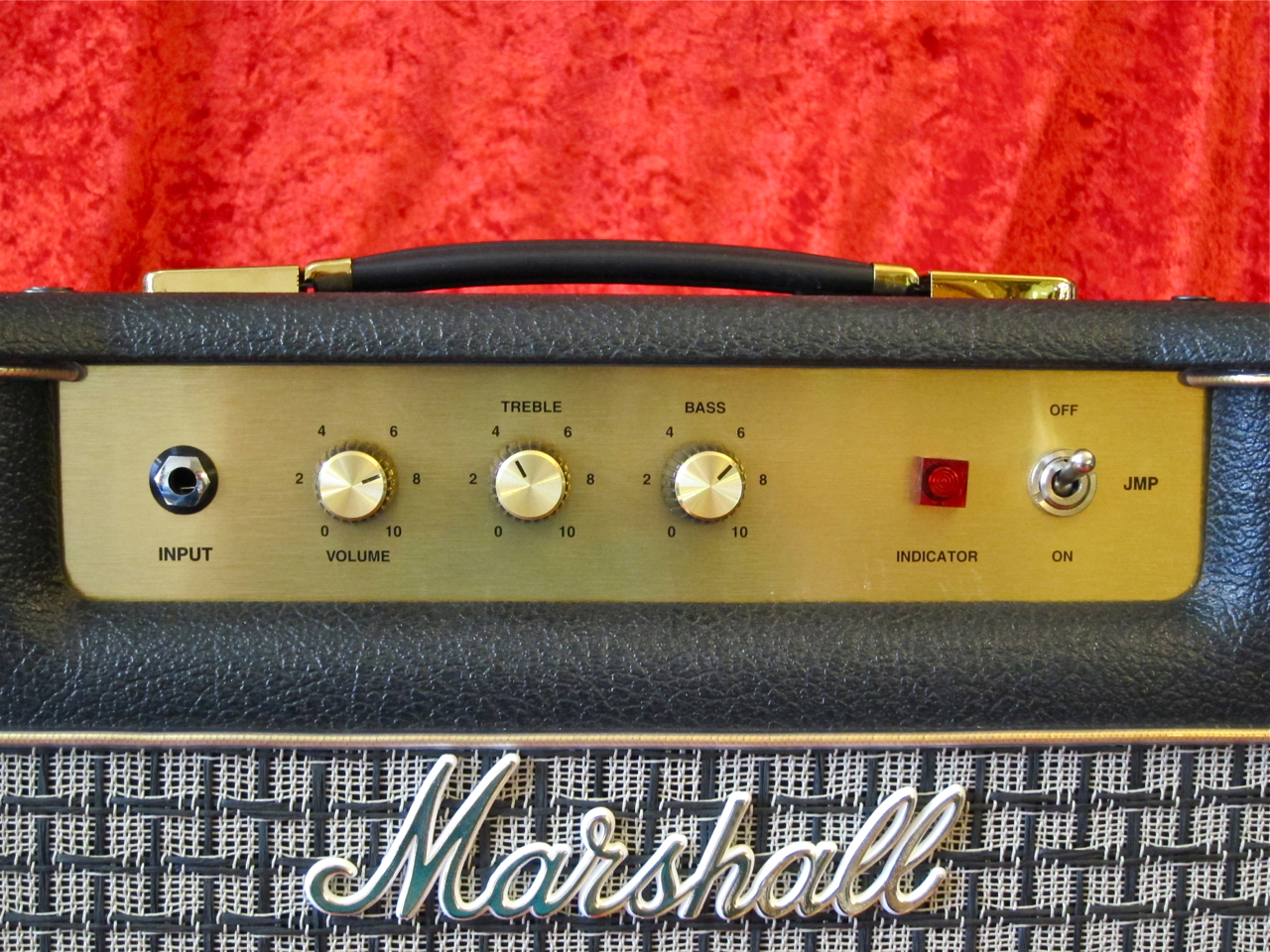
This anniversary model features three controls – volume, treble and bass.
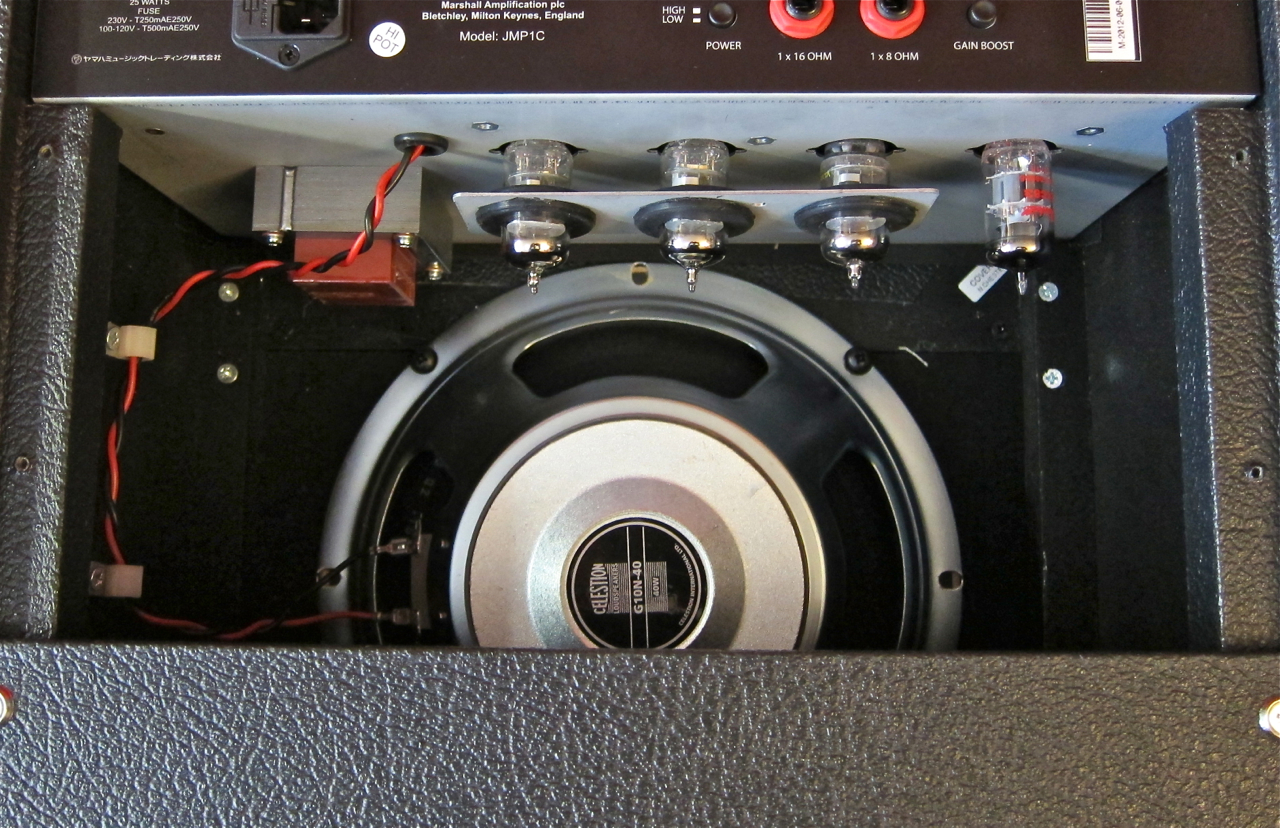
The JMP1C’s design uses four valves: two ECC83/12AX7’s in the preamp section, and two ECC81/12AT7-models for the power stage. The speaker, too, is different here – it’s a ten-inch Celestion G10N-40.
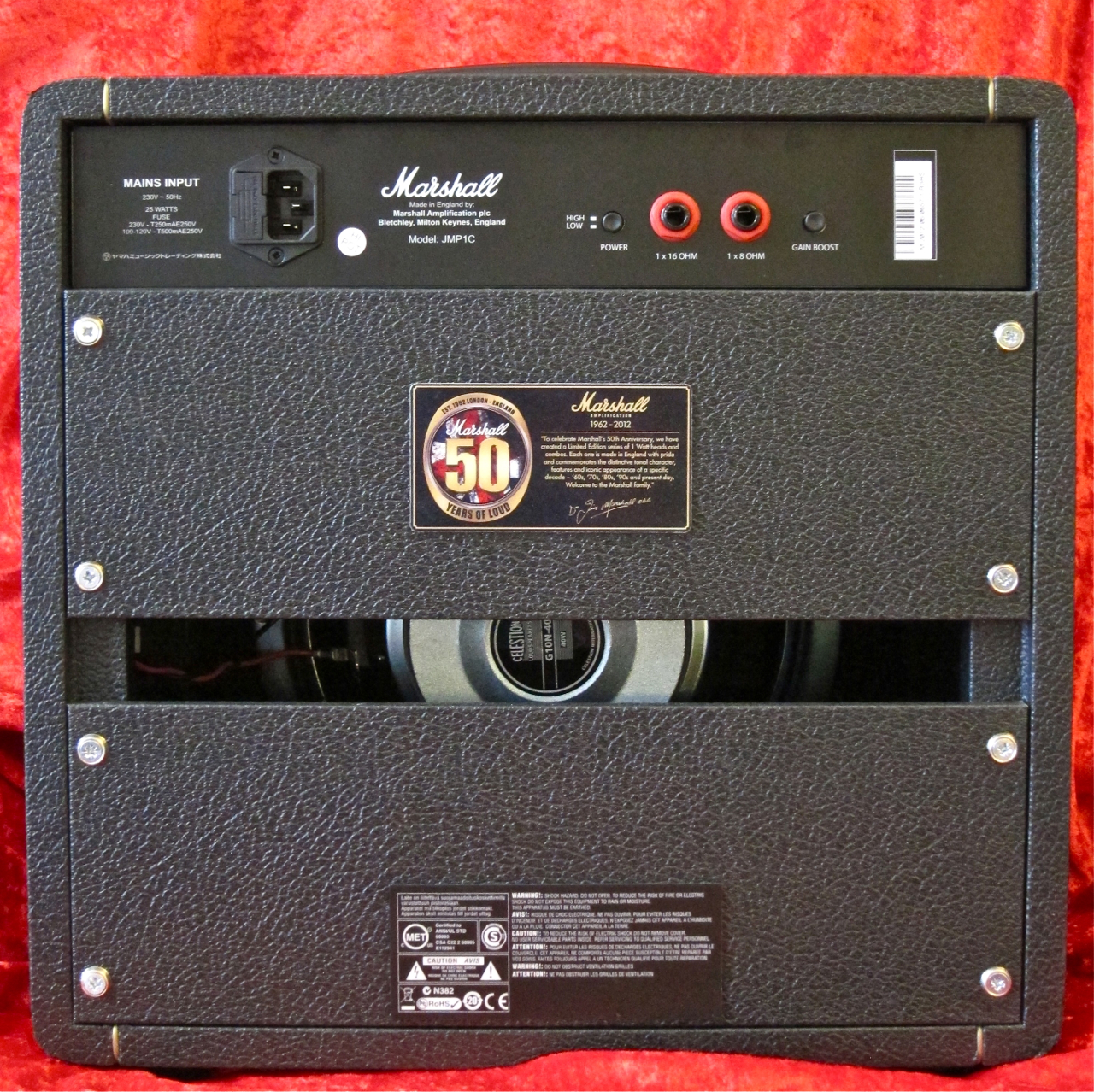
Looking from the back the JMP1C seems to look almost exactly like the JTM1C; but wait…
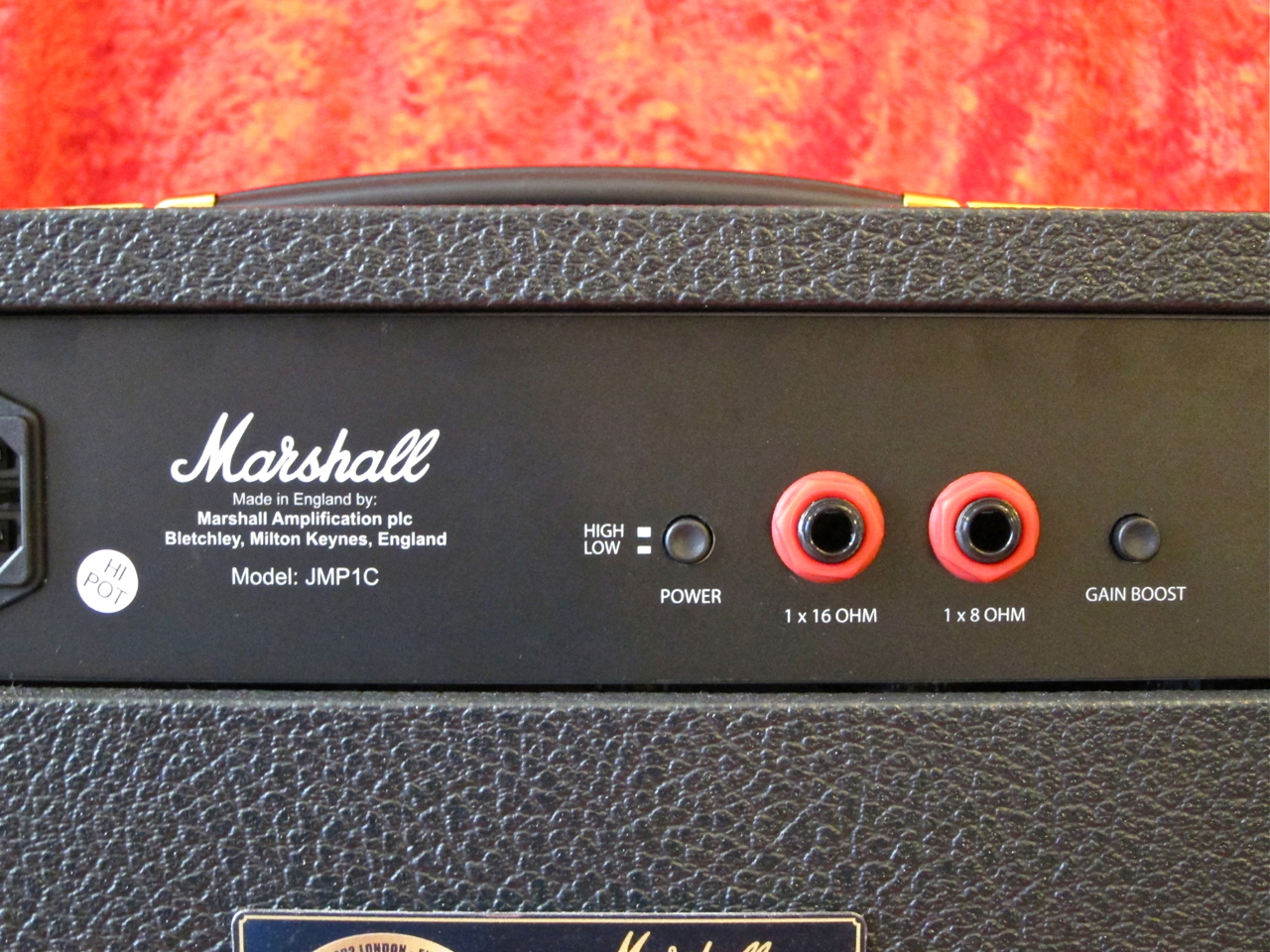
…there’s a second pushbutton next to the speaker outputs, labelled Gain Boost.
****
It’s interesting to note the sonic differences between these two combos.
Set clean the Marshall JTM1C has a fine, open and bright ring to its voice, while the JMP1C is noticeably fatter and more mid-centric. Neither of the combos is endowed with a lot of clean headroom, but I found the Sixties version to be somewhat better suited for clean playing:
Marshall JTM1C – Telecaster/clean
Marshall JMP1C – Telecaster/clean
****
Regardless of what guitar is used, once the volume control reaches about 12 o’clock both amps are definitely in overdriven territory. The JTM’s drive tones are warmer and smoother than those of the JMP. The JMP1C’s overdriven sounds are fresher and crunchier, with a distinct stack-like tonality, in contrast to the JTM1C’s Bluesbreaker-inspired delivery:
Marshall JTM1C – Les Paul Junior/overdrive
Marshall JMP1C – Les Paul Junior/overdrive
****
At full throttle – and with the JMP’s Gain Boost activated – the differences are clearer still: The JTM1C is really creamy and warm, while the JMP1C has a far more aggressive and snarling take on things. You could say the JTM1C is the bluesier alternative, while the JMP1C caters for the classic rock fans:
Marshall JTM1C – Hamer Studio Custom/full gain
Marshall JMP1C – Hamer Studio Custom/full gain
Both combos are rather loud for one-watters. Turned up full the volume is not quite loud enough to annoy your neighbours during the day, but almost, which is where the handy Power-button on the back panel comes in and saves the day.
****
700 Euros for such small combos may sound like a lot of money to some, but you shouldn’t forget two things: Firstly, all anniversary models are built in the UK, and not in China, and secondly, these are limited edition runs, making them interesting for collectors. If Marshall had chosen to release 50- or 100-Watt stacks to commemorate their five decades in business, the price of such models would have been above most of our budgets. With these cool one-Watt amps most Marshall fans are getting the opportunity to acquire their own piece of Marshall-history, without going bankrupt.
I feel the reviewed combos are great little amps that are a fitting tribute to both Marshall the company, as well as to their founder, the late Jim Marshall!
****
Marshall 50th Anniversary -combos
Finnish Distributor: EM Nordic
A big thanks to DLX Music for the loan of the review samples!
****
Marshall JTM1C
Pros:
+ workmanship
+ sound
+ output power can be curtailed
+ small size
+ collectability
****
Marshall JMP1C
Pros:
+ workmanship
+ sound
+ gain booster
+ output power can be curtailed
+ small size
+ collectability
****

****
Marshall Amplification juhlii tänä vuonna 50-vuotis syntymäpäiviään. Juhlan kunniaksi firma julkaisi viisi pientä juhlavahvistinta, joita rakennetaan rajoitetuissa erissä. Yksiwattiset täysputkinupit ja -kombot on suunniteltu niin, että ne edustavat soundiltaan ja ulkonäöltään aina tiettyä aikakautta Marshallin historiassa.
Kitarablogi.com sai testiin 1960- ja 1970-lukua edustavat kombot – JTM1C ja JMP1C.
****
JTM1C-kombon (katuhinta noin 700 €) ulkonäkö on varhaisten JTM-mallien, kuten esimerkiksi Bluesbreaker-kombon, mukainen: kultainen, vanhalla logolla varustettu laatta ja kuuluisa, harmahtava etukangas.
Soundipuristi ilahtuu spartaanisesta säädintarjonnasta – volyymi/vahvistus-säädin sekä yksi tone-potikka, siinä kaikki.
Vaikka juhlamallit eivät ole vintage-tyylisesti point-to-point käsinjuotettuja, elektroniikan toteutus piirilevyineen on hyvin laadukas. Etuasteputkina toimii kaksi ECC83/12AX7-putkea ja pääteputki on ECC82/12AU7.
Marshall JTM1C:hen on asennettu jo Class 5 -kombosta tuttu erikois-Celestion: kymppituumainen G10F-15.
Kuten kombon etupuoli, myös takapuoli komeilee erittäin siistillä työnjäljellään.
Kahden kaapilähdön lisäksi takapaneeliin on sijoitettu ”Power”-nappi, jolla kombon tehot saa laskettua yhdestä watista 0,1:een wattiin.
Kaikissa juhlamalleissa on sama Marshall-kantokahva.
****
1970-lukua edustavassa JMP1C:ssä (katuhinta noin 700 €) on käytössä meille kaikille niin tuttu ”käsin kirjoitettu” Marshall-logo, sekä harmaa, ruudullinen etukangas.
Tässä juhlamallissa on aikakauden mukaisesti ”kunnon” taajuuskorjaimet – erilliset säätimet diskantille ja bassolle.
JMP1C:ssä käytetään peräti neljää putkea: kaksi ECC83/12AX7-etuasteputkea, sekä päätevahvistimessa kaksi ECC81/12AT7-mallia. Myös kaiutin on tässä toinen, nimittäin kymmenentuumainen Celestion G10N-40.
Takaa katsottuna JMP1C näyttää lähes samanlaiselta kuin JTM1C; mutta – hetkinen…
…kaiutinlähtöjen toisella puolella on toinen nappi. Gain Boost -nimityksen perusteella voi varmaan odottaa, että tästä kombosta varmasti löytyy tarpeeksi säröä.
****
On todella mielenkiintoista huomata minkälaisia soinnillisia eroja kahdesta hyvin samankaltaisista komboista löytyy.
Puhtaissa soundeissa Marshall JTM1C soi avoimella ja kirkkaamalla äänellä, kun taas JMP1C:n ääni on keskialuevoittoisempi ja lämpimämpi. Molemmissa vahvistimissa ei ole erityisen paljon puhdasta headroomia, mutta 1960-luvun uusintapainos vetää mielestäni puhtaissa soundeissa pidemmän korren:
Marshall JTM1C – Telecaster/puhdas
Marshall JMP1C – Telecaster/puhdas
****
Viimeistään volume-säätimen puolessavälissä kummankin kombon soundi on selvästi säröllä. JTM:n särösoundit ovat miedompia ja lämpimämpiä kuin JMP:n. JMP1C on säröllä runsaasti tuoreempi ja rapeampi ja se kuulostaa enemmän vahvistinstäkiltä kuin JTM, jonka sointi on hyvin Bluesbreaker-tyylinen:
Marshall JTM1C – Les Paul Junior/särö
Marshall JMP1C – Les Paul Junior/särö
****
Kun gain on täysillä ja JMP:n boosti on aktivoituna, särösoundien selvä ero vielä korostuu. JTM1C on hyvin kermainen ja lämmin, kun taas JMP:llä on tarjolla selkeästi enemmän säröä ja soundi on rouheampi. Sanoisin, että JTM1C on bluesimpi, kun taas JMP1C rokkimpi:
Marshall JTM1C – Hamer Studio Custom/gain täysillä
Marshall JMP1C – Hamer Studio Custom/gain täysillä
Kummatkin vahvistimet ovat melko kovaäänisiä yksiwattisiksi komboiksi. Täysillä niillä voi juuri ja juuri soittaa päiväsaikaan kerrostaloasunnossa, joten on erittäin hyvä, että molemmista löytyy myös tehonpudotuskytkin.
****
Noin 700 euroa yksiwattisesta kombosta voi kuulostaa melko kalliilta, mutta ei sovi unohtaa, että juhlamallit valmistetaan kokonaan Englannissa (eikä Kiinassa), ja että kyse on myös keräilykohteesta. Jos Marshall olisi päättänyt valmistaa 50- tai 100-wattisia vahvistimia juhlan kunniaksi, niiden hinta olisi ollut liian korkea tavalliselle kitaristille. JTM1C:n ja JMP1C:n (ja muiden juhlasarjan pikkuvahvistimien) ansiosta lähes jokainen halukas voi ostaa itselleen palan Marshall-historiaa, omaa taloudellista tilannetta vaarantamatta.
Molemmat kombot ovat mielestäni erittäin onnistuneita kunnianosoituksia sekä Marshall-vahvistinfirmalle että juuri edesmenneelle perustajalle Jim Marshallille!
****
Marshall 50th Anniversary -kombot
Maahantuoja: EM Nordic
Kiitos DLX Musicille testiyksilöiden lainasta!
****
Marshall JTM1C
Plussat:
+ työnjälki
+ soundi
+ kaksi päätetehoa
+ pieni koko
+ keräilyarvo
****
Marshall JMP1C
Plussat:
+ työnjälki
+ soundi
+ kaksi päätetehoa
+ gain-boosteri
+ pieni koko
+ keräilyarvo
****

This review could have carried the title ”Elegant Twins”, as both models from Yamaha’s brand-new A-series look very much alike.
The A-series looks like Yamaha’s answer to Taylor Guitars – it encompasses eight guitars in all, half of them Dreadnoughts and the other half in Grand Concert -size. All models feature a cutaway and a pickup system, as well as a new, organic-feeling type of matte finish rather reminiscent of some Taylors.


****

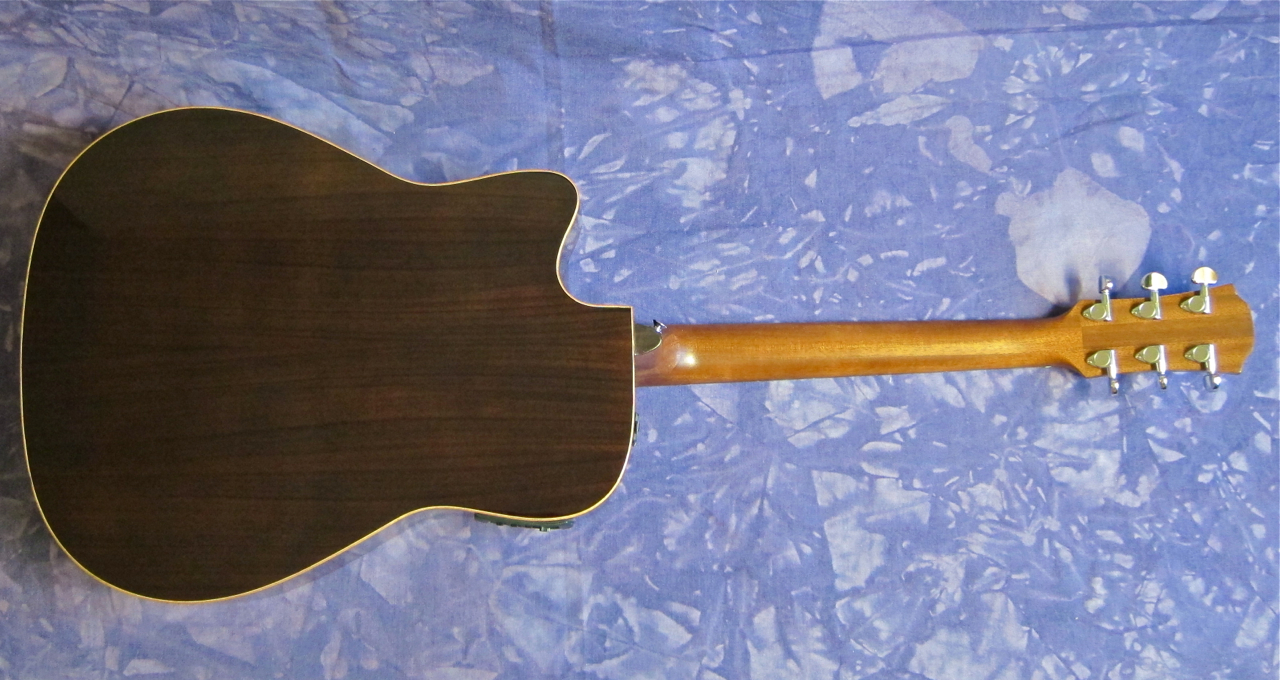
The Yamaha A1R (current recommended price in Finland: 639 €) is the less expensive guitar of the two on review here. The model’s nicely grained sitka spruce top is solid wood, with the rosewood sides and back being made of veneer.

The A1R’s headstock has received a rosewood facing.
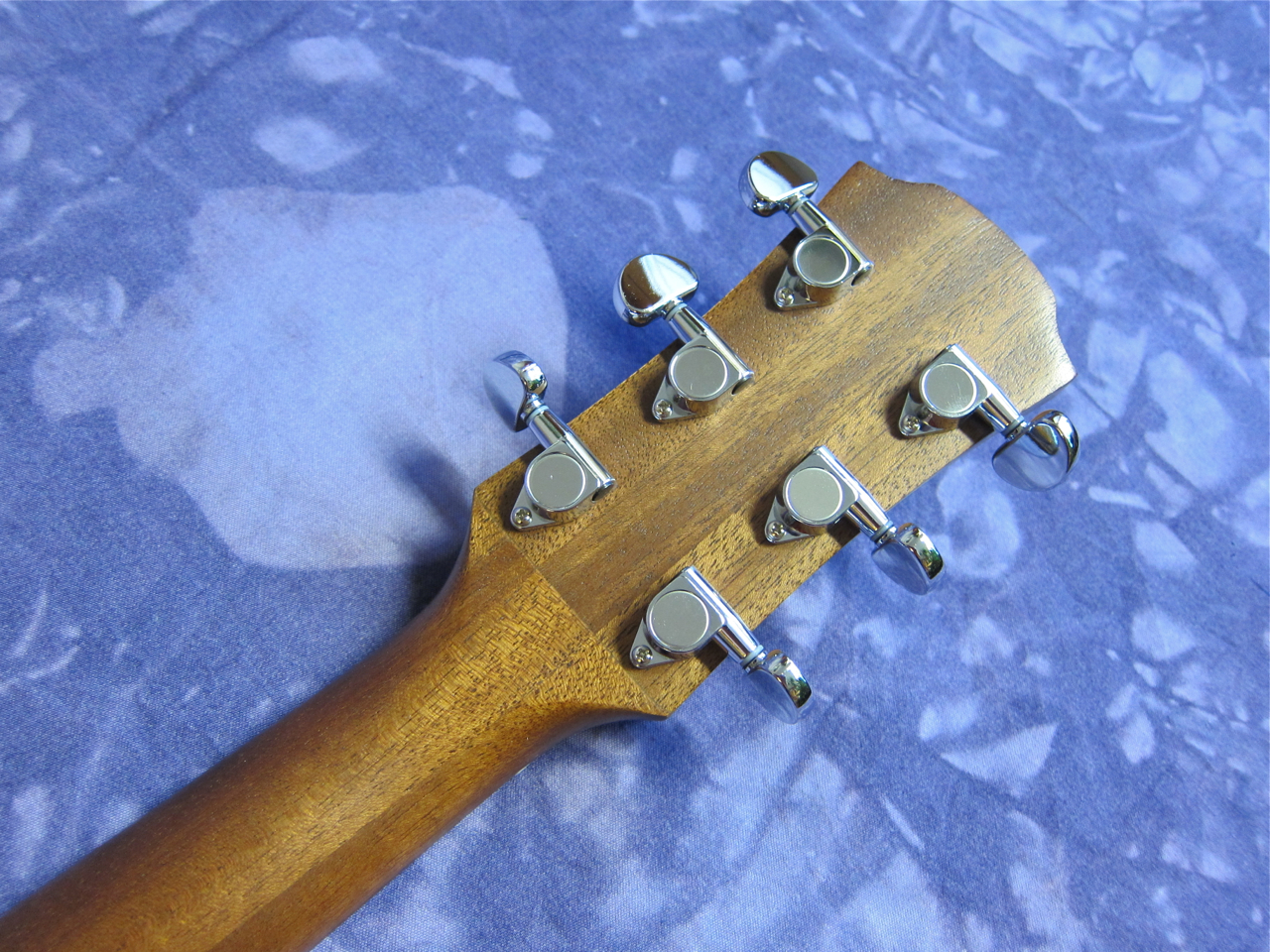
Yamaha uses the same type of sealed tuners on the bulk of their steelstring acoustics. The lower A-series models sport necks made from three long and narrow pieces of mahogany. The separate headstock has also been put together from several pieces, and it has been glued on next to the E-tuners.

Our test sample displayed some nice fret work, as well as stylishly understated tiny dots in its rosewood fingerboard.

The heel of the neck has been built up using smaller pieces of mahogany. This saves cost, as well as natural resources, as the company are able to use smaller neck blanks and wood cut-offs.
The quick access battery compartment can be found next to the heel. Yamaha uses two AA-batteries in all of their A-series preamps.

The A1R’s body is of typical Dreadnought size.

The rosette consists of black and white rings around the soundhole. The faux-tortie scratchplate is similar to plates used on the Gibson Country & Western -model and on many Taylor guitars.

The binding looks very nice with its outer ply of mahogany.

The rosewood bridge is one of Yamaha’s own designs, and feels smooth to the touch. The piezo pickup is situated beneath the compensated saddle.

All A1- ja AC1-guitars come equipped with Yamaha’s analogue System 66 -preamp, which sports a three-band EQ with adjustable midrange frequency, as well as an on-board tuner.

The A-series range features stylish end pins with an integrated output jack.
****


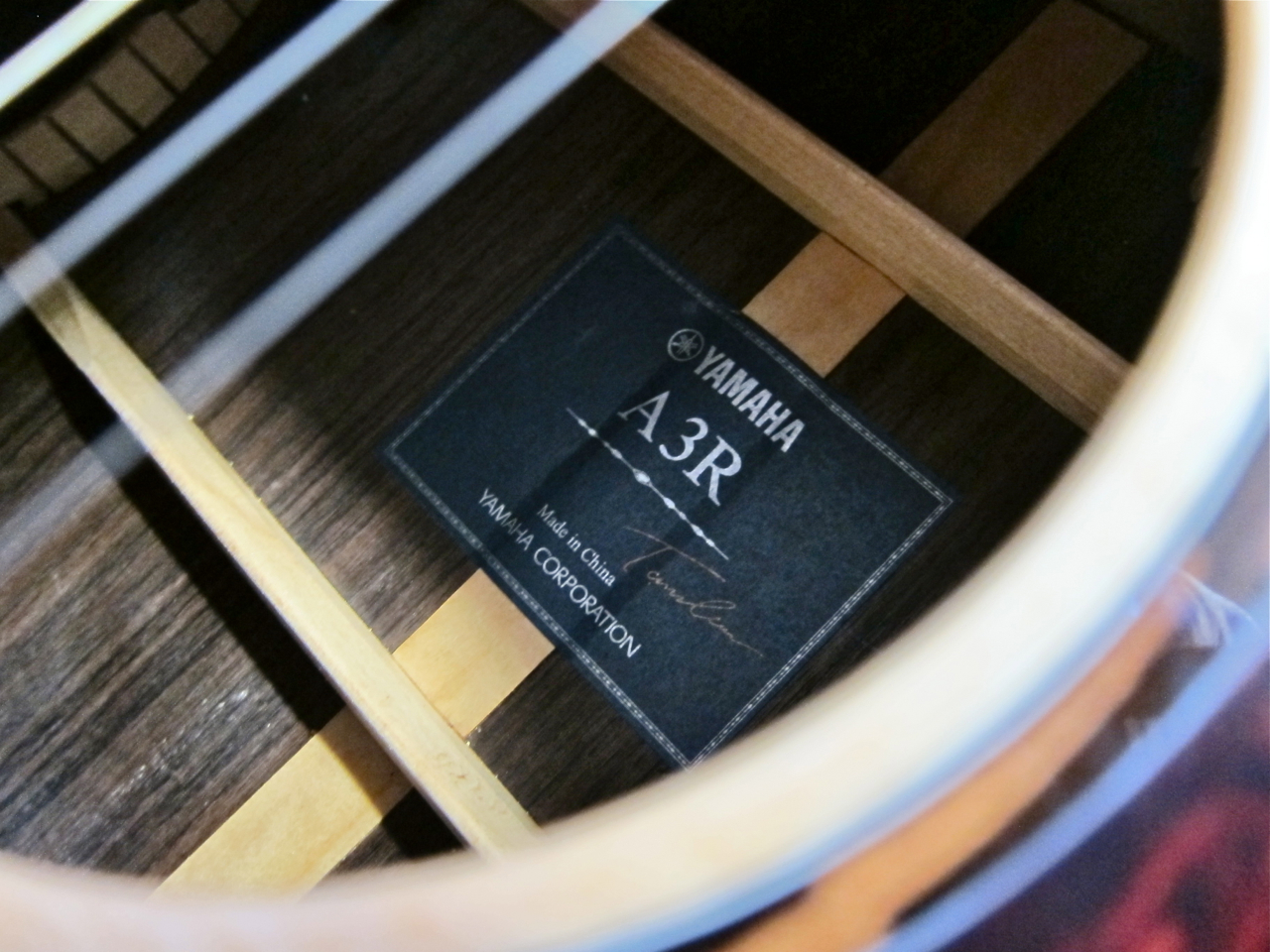
The A1R’s bigger sister, called Yamaha A3R (current recommended price in Finland: 849 €), is somewhat better endowed, as it is an all-solid-wood acoustic guitar. The top is – again – sitka spruce, with solid Indian rosewood used for the rims and the back.
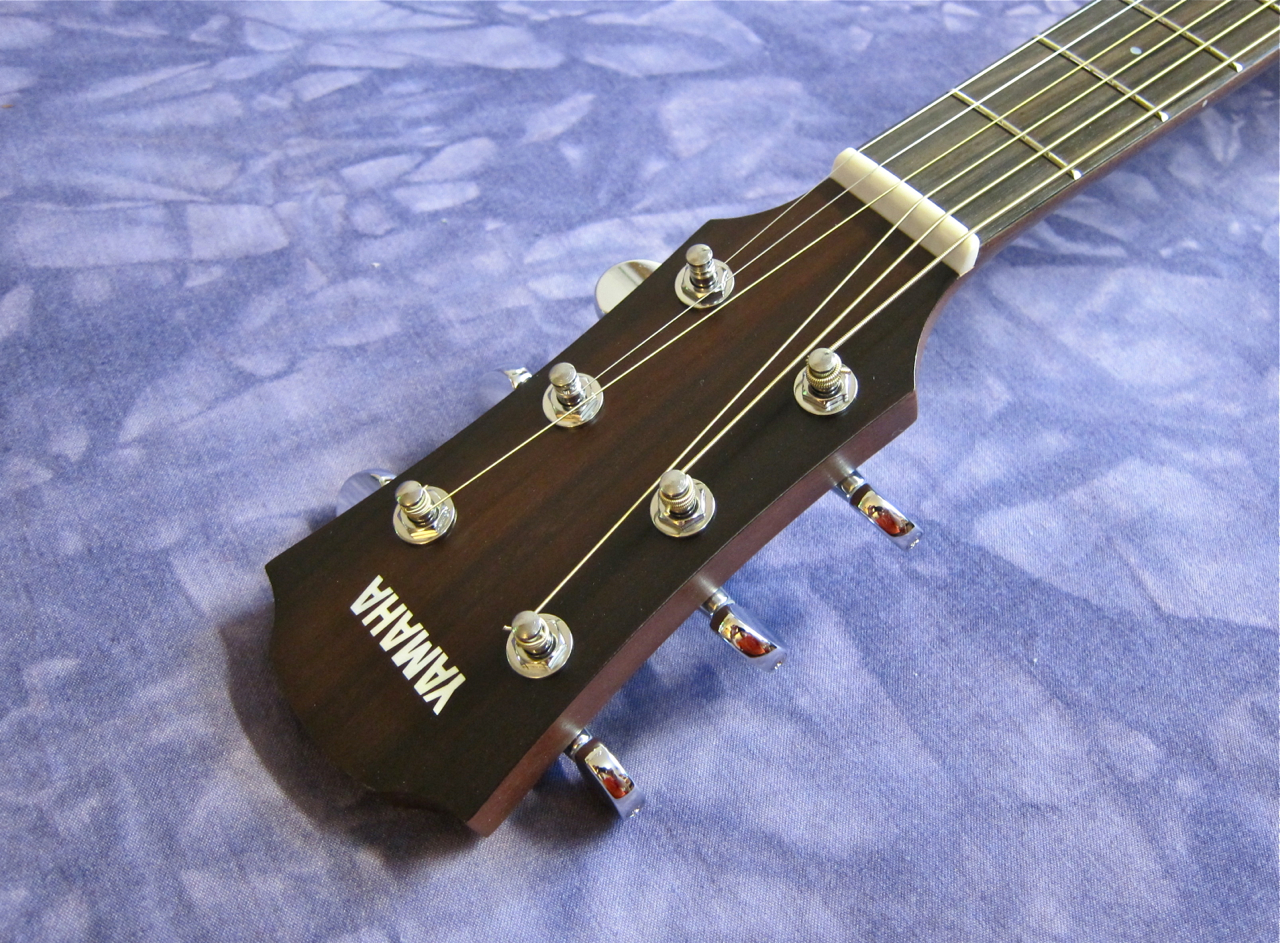
From the front both headstocks look virtually identical…

…but a look at the back reveals a neck made from one piece of mahogany (plus a separate one-piece headstock) on the A3R.
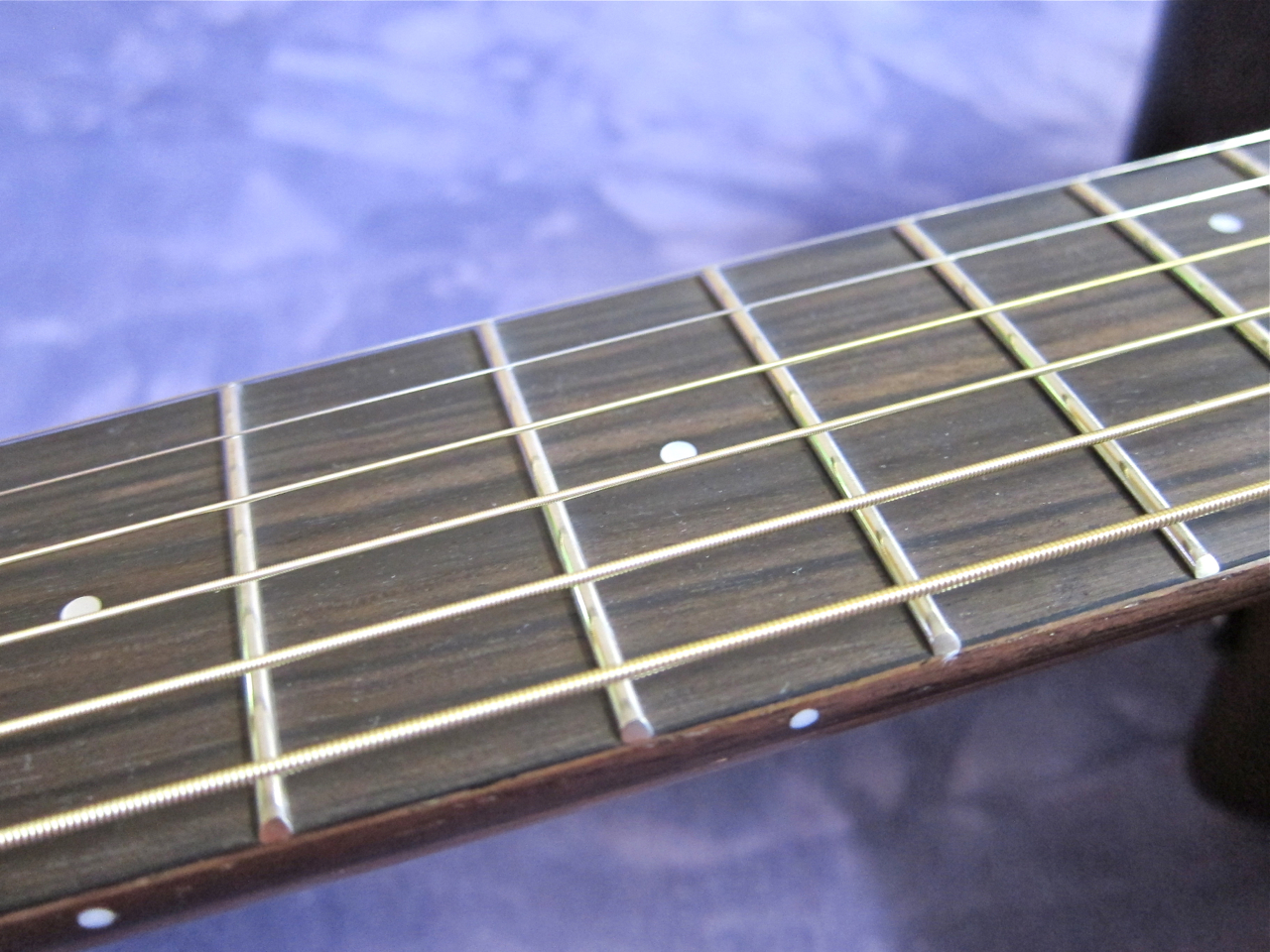
Again, we found fine fretwork on the A3R – this time on a light-coloured ebony board.

Our test sample displayed a heel, which was more carefully matched in colour and grain to the rest of the neck’s mahogany.
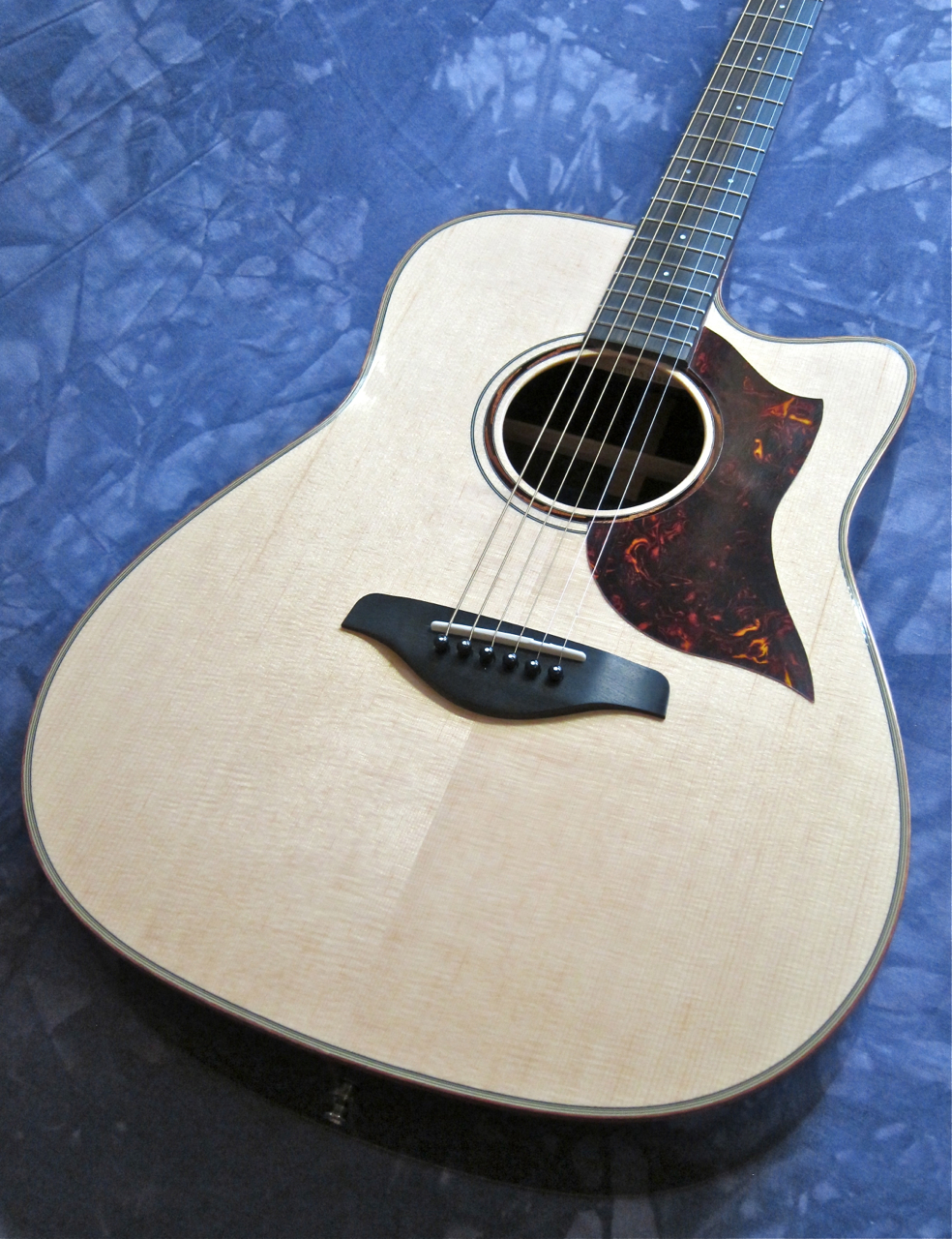
Look at that beautiful top with rich cross-silking…

An inner ring put together using mahogany and ebony gives the A3R an touch of added class.
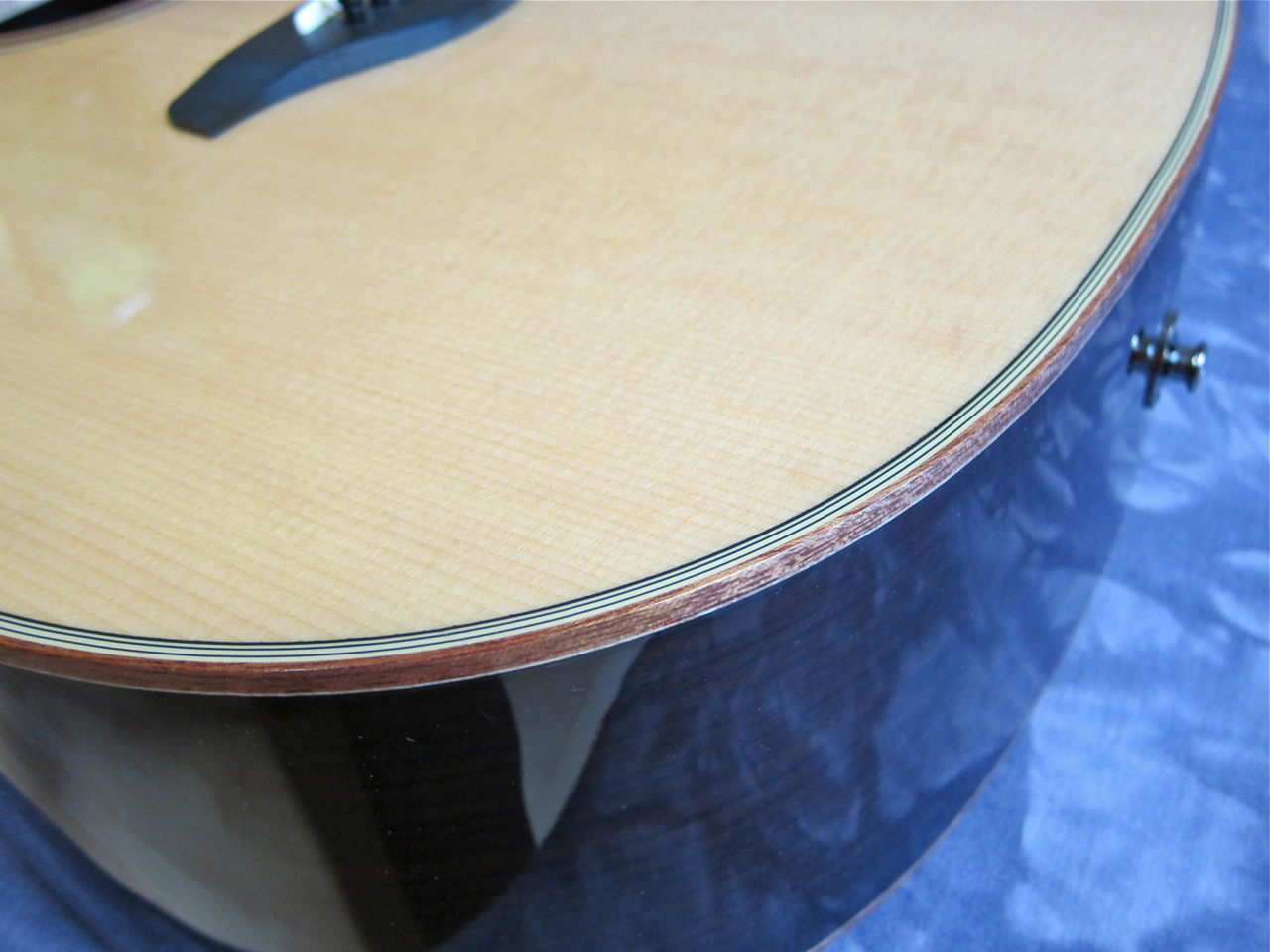
The binding follows the same pattern as on the less expensive model.

The bridge features the same design, but in the A3R’s case it has been crafted from ebony.

The Yamaha A3R is equipped with a System 63 SRT -preamp offering both the analogue pickup signal, as well as three digitally modelled virtual microphones to pick from. SRT-modelling takes the piezo’s signal and digitally morphs it to sound like this particular guitar model being miked up (either close-up or from a little bit further away). You can choose between a virtual large-diaphragm condenser microphone (Type 1), a small-diaphragm condenser (Type 2) or a ribbon microphone (Type 3). You can also adjust the amount of virtual body resonance picked up.
Adding to all this the System 63 SRT features a three-band EQ, an on-board tuner, as well as automatic feedback reduction (A.F.R.).
****
Both Yamahas feel virtually the same, with identical medium-sized D-shape neck profiles and a comfortable medium-low action. The best bit is the new open-grained matte finish that really let’s you feel the neck wood.
Played acoustically both models display a dense, piano-like ring, with plenty of attack and sparkle.
The all-solid construction of the A3R results in a warmer low end and a little more volume. The A1R sounds a tad drier and more upfront.
The A1R’s System 66 gives you a nice, middle-of-the-road piezo tone, with the typical quacking attack and direct dryness of a piezo.
The A3R’s System 63 SRT -preamp offers more scope for adjustment.
The SRT-modelling sounds quite realistic, and goes a very long way in removing all piezo-ness in the guitar’s amplified tone – regardless of the chosen virtual mic. The sound is realistic enough for many live and studio applications, even though I’m quite sure a solo guitar-virtuoso will still insist on having his (or her) guitar miked up in the real world.
****
Yamaha A-series
Finnish distributor: F-Musiikki
****
Yamaha A1R
639 €
Pros:
+ value for money
+ neck profile
+ neck finish
+ workmanship
+ acoustic tone
+ good piezo sound
Cons:
– typical piezo artifacts
****
Yamaha A3R
849 €
Pros:
+ value for money
+ neck profile
+ neck finish
+ workmanship
+ acoustic tone
+ SRT-modelling
****
****

****
Tämän jutun otsikko voisi hyvinkin olla ”Kaksoset”, koska Yamahan uuden A-sarjan jäsenet A1R ja A3R muistuttavat toisiaan erehdyttävästi.
Uusi A-sarja on selkeästi Yamahan vastaus Taylor Guitarsille – tarjolla on kahdeksan Dreadnought- ja Folk-kokoista kitaraa, joissa kaikissa on soololovi ja mikkisysteemi, sekä kauloissa Taylor-tyylinen mattaviimeistely, jonka läpi voi tuntea puun struktuurin.
****
Yamaha A1R (suositushinta: 639 €) on nyt testatusta kaksikosta se edullisempi. Soittimen kaunis sitkakuusikansi on kokopuinen, kun taas sivut ja pohja ovat palisanterivaneria.
A1R:n viritinlapa on päällystetty palisanteriviilulla.
Yamaha käyttää lähes kaikissa teräskielisissä akustisissa samoja laadukkaita virittimiä. A-sarjan edullisimmissa malleissa kaula koostuu kolmesta vierekkäisestä mahonkipalasta. Lapa on liitetty kaulaan E-virittimien kohdalla.
Palisanteriotelautaan asennetut pienet nauhat on viimeistelty huolellisesti. Pienet pyöreät otemerkit antavat otelaudalle hyvin hillityn ja asiallisen ulkonäön.
Kaulan korko on rakennettu eri paloista, mikä säästää sekä luontoa että kustannuksia. Kaula-aihioksi kelpaa näin paljon ohuempi mahonkilankku, ja kaulakoron valmistuksessa voi hyödyntää myös sellaisia pikkupaloja, jotka ovat jääneet muualla yli.
Helppokäyttöinen paristolokero sijaitsee kaulaliitoksen vieressä. Yamaha käyttää kaikissa A-sarjan etuvahvistimissa kahta AA-paristoa.
Rungolla on tyypillisen Dreadnoughtin ulkomitat.
Kaikuaukon koristelu – niin kutsuttu rosetti – koostuu A1R:ssä useasta mustasta ja valkoisesta renkaasta. Pleksin muotoilu muistuttaa Gibson Country & Western -mallia tai Taylorin soittimia.
Reunalistoituksessa käytetty mahonkinen ulkoreuna on mielestäni erittäin tyylikäs ratkaisu.
Palisanterista veistetty talla on yksi Yamahan vakiomalleista, ja sen muotoilu tuntuu hyvin sulavalta. Kompensoidun tallan alla sijaitsee Yamahan pietsomikrofoni.
A1- ja AC1-malleissa käytetään Yamahan perinteistä analogista System 66 -etuvahvistinta, joka tarjoaa kolmikaistaisen taajuuskorjaimen säädettävällä keskialueella sekä sisäisen viritysmittarin.
Jakkilähtö on molemmissa testikitaroissa yhdistetty hihnatappiin – kaunis ja siisti ratkaisu.
****
A1R:n iso sisar Yamaha A3R (suositushinta: 849 €) on kaksikon prameampi malli, jossa rungon kaikki puut ovat kokopuuta. Kansi on sitkakuusta ja sivut ja pohja palisanteria.
Edestä A3R:n lapa näyttää täysin samanlaiselta kuin A1R:ssä…
…vilkaisu taakse kuitenkin paljastaa, että kaulan pitkä osa on A3R:ssä yhdestä mahonkipalasta tehty, niin kuin myös kitaran lapa.
Yamahan huolellinen nauhatyö – tällä kertaa A3R:n vaaleassa eebenpuuotelaudassa.
Testisoittimen kaulakoron yksittäiset palat on sovitettu väriltään ja syykuvioiltaan yhteen sopiviksi.
Myös A3R:n kuusikannen syykuviot paljastavat puun korkean laadun.
Tämän mallin rosetissa on varsin näyttävä rengas mahongista ja eebenpuusta.
A3R:ssä on sama kaunis reunalistoitus kuin sisarmallissaan.
Kalliimman kitaran talla on samanmuotoinen, mutta se on veistetty eebenpuusta.
Yamaha A3R:ssä käytetty System 63 SRT -etuvahvistin yhdistää analogisen pietsosignaalin (P.U.) ja digitaalisen SRT-mikrofonimallinnuksen (Mic). SRT-mallinnus muokkaa tallan alla olevan kontaktimikrofonin signaalia niin, että lopputulos kuulostaa studiomikrofonilla äänitetyltä. Tarjolla on kolme virtuaalimikkiä – isokalvoinen kondensaattorimikki, pienikalvoinen kondensaattori sekä nauhamikrofoni – lähimikkitettynä (Focus) tai hieman kauemmalta (Wide) äänitettynä. Myös kopan resonanssin määrää/syvyyttä pystyy säätämään.
SRT:n lisäksi System 63:ssa on kolmikaistainen EQ, viritysmittari, sekä automaattinen feedback-poistaja (A.F.R.).
****
Kahden A-sarjan Yamahojen soittotuntuma on käytännössä täysin identtinen. Soittimien D-profiilliset kaulat istuvat hyvin käteen ja tatsi on säädetty oikein mukavaksi ja kevyeksi. Parasta on mielestäni kuitenkin kaulojen viimeistely, joka tuntuu erittäin orgaaniselta.
Akustisesti molemmat Yamahat soivat komeasti. Hyvän pianon lailla soundissa on tarkka atakki, täyteläinen keskialue sekä helisevä diskantti.
Kokopuisen palisanteripohjansa ansiosta A3R:stä löytyy hieman enemmän volyymiä ja aavistuksen verran lämpimämpi basso. A1R taas on kaksikosta se hieman kuivempi ja tarkempi vaihtoehto.
A1R:n System 66 on perushyvä analogi mikkisysteemi, jossa kuulee selvästi pietsosysteemille tyypillisen maiskuvan atakin ja kuivan suorasukaisuuden.
A3R:n System 63 SRT -etunen antaa runsaasti säätömahdollisuuksia, jotka kaikki vaikuttavat lähtösignaaliin.
SRT-mallinuksen toiminta on aika vaikuttavaa, ja se poistaa signaalista kaikki pietsoon liityvät negatiiviset seikat. Ääni on selkeästi avoimempi ja luonnollisempi – SRT-virtuaalimikrofonivalinnasta riippuumatta. Soundi on niin lähellä studiossa mikitettyä kitaraa, että linjasoitto kelpaa erittäin hyvin monissa live- tai studiotilanteissa, vaikka akustinen soolovirtuoosi varmasti äänittää soittonsa jatkossakin oikeilla mikrofoneilla.
****
Yamaha A-sarjan teräskielisiä
Maahantuoja: F-Musiikki
****
Yamaha A1R
639 €
Plussat:
+ hinta-laatu-suhde
+ kaulaprofiili
+ kaulan viimeistely
+ työnjälki
+ akustinen ääni
+ perushyvä pietsosoundi
Miinukset:
– tyypilliset pietsosoundin lieveilmiöt
****
Yamaha A3R
849 €
Plussat:
+ hinta-laatu-suhde
+ kaulaprofiili
+ kaulan viimeistely
+ työnjälki
+ akustinen ääni
+ SRT-mallinnus
****
****
****

****
Musamaailma tarjoaa Suomessa hyvin harvinaisen kustomointipalvelun, jossa asiakas voi tilata – kohtuullista lisämaksua vastaan – kitaraansa haluamansa EMG- tai Seymour Duncan -mikit valmiiksi asennettuina. Firmalla on omat kitaranrakentajat töissä paikan päällä varastossa, jotka hoitavat kitaran säätämisen ja kustomoinnin vankalla ammattitaidolla.


Kitarablogi sai kokeilua varten uuden Tokai TST-50 -mallin (699 €), joka edustaa brändin laadukasta japanilaista mallistoa.

Tokai TST-50:een on talla-asemaan vaihdettu perinteisen yksikelaisen mikrofonin sijaan Seymour Duncanin Little ’59 -humbuckeri (84,60 €), joka lupaa PAF-tyylisiä soundeja Strato-kokoisesta mikrofonista.
****

Tokai TST-50 on perinteitä kunnioittava S-tyylinen sähkökitara varhaisen 1960-luvun speksien mukaan:
Leppärungon muotoilu on hyvin sulava, ja runko on saanut ylleen kolmivärisen sunburst-lakkauksen. Ruuvattu vaahterakaula pienellä viritinlavalla, tumma otelauta palisanterista sekä valkoinen, kolmikerroksinen pleksi täydentävät kuvan.
****


Testiyksilön vaahterakaula on kaunista kanadalaista linnunsilmävaahteraa. Vintage-speksejä kunnioittaen tässä mallissa käytetään Gotohin laadukkaita Kluson-kopioita.

Vintagesta poiketen kaula on viimeistelty erittäin ohuella satiinipintaisella lakalla. Lopputulos tuntuu erittäin mukavalta ja ”nopealta”.
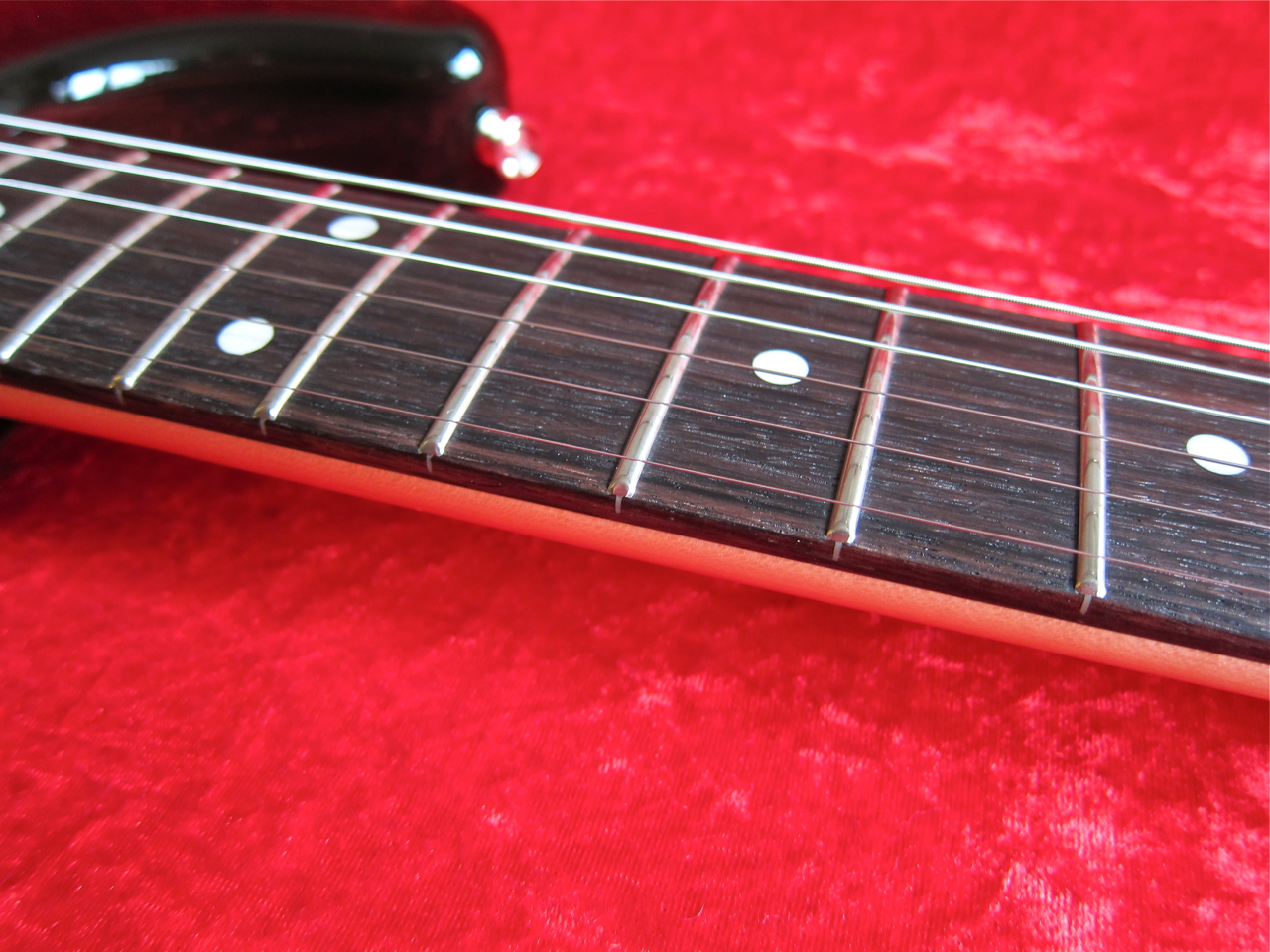
Alkuperäistä korkeammat ja leveämmät nauhat ovat nekin nykyaikaisen maun mukaan, koska ne helpottavat ratkaisevasti kielten venymistä.

Kitaran alkuperäiset mikrofonit tulevat Gotohin Japan Vintage -mallistosta – japanilaista laatutyötä siis. Myös TST-50:n vintagevibra on peräisin saman valmistajan kalliimmasta, japanilaisesta hardware-sarjasta.
Seymour Duncan Little ’59 on nykyään jo itsekin klassikko. Kun tämä mikrofoni esiteltiin yli 20 vuotta sitten, se oli yksi ensimmäisistä Strato-kokoisista humbuckereista, jossa kelat olivat vierekkäin.
Testisoittimen elektroniikkaan ei muuten koskettu — säätimet toimivat perinteisesti siten, että ensimmäinen tone-säädin vaikuttaa vain kaulamikrofoniin ja toinen tone vain keskimikkiin.
****
Ei ole ihme, että Fenderin Stratocaster (ja sen kaikki sen kopiot ja mukaelmat) on myydyin kitara maailmassa – malli istuu esimerkillisesti kehoon soittajan koosta ja ruumiinrakenteesta riippumatta.
Tokai TST-50 on erittäin onnistunut versio samasta teemasta, ja työnjälki on kauttaaltaan ensiluokkainen.
Kaulaprofiiliksi on valittu mukavan ovaali C-poikkileikkaus, josta kaula saa hyvin autenttisen varhaisen kuuskytluvun karakteerin.
Tokain akustinen sointi on tämän lajityypin malliesimerkki – selkeä, naksahtava atakki sekoittuu sopusuhteessa leppärungon ja palisanteriotelaudan tuomaan lämpöön, sekä vintagevibran tuoreuteen.
Monelle kitaristille suoraan lähtöjakkiin kytketty Strato-tyylinen yksikelainen on liian ohut, pureva ja terävä vaihtoehto, etenkin särösoundeissa. Tässä kohtaa Little ’59 astuu kuvioihin. Soundi saa keskiväkevästä humbuckerista selvästi enemmän ryhtiä, potkua ja paksuutta. Puhtaaseen kanavaan syötettynä Little ’59:n aiheuttama hyppy volyymitasossa voi olla joidenkin mielestä liian korostunut, mutta särökäytössä Strato-tyylinen kitara saa pikkuhumbuckerista erittäin maukkaan boostin kermaisia sooloja tai rankkoja riffejä varten.
Äänipätkissä soi aina ensin Tokain kaula- ja keskimikrofoni yhdessä, minkä jälkeen siirrytään Seymour Duncaniin:
****
Tokai-kitarat ja Seymour Duncan -tuotteet
Maahantuoja: Musamaailma
****
Tokai TST-50
699 €
Plussat:
+ erinomainen hinta-laatu–suhde
+ soundi
+ työnjälki
+ laadukas vibrato
****
Seymour Duncan Little ’59 for Strat
84,60 €
Plussat:
+ sopii suoraan S-tyyliseen kitaraan
+ soundi
+ PAF-tyylinen signaalitaso
+ neljä johtoa mahdollistavat erilaisia kytkentöjä
****
****
Finnish importer and retailer Musamaailma offer an in-house customising service, which is still a rather rare thing over here. For a fair price you can order your guitar with your choice of EMG- or Seymour Duncan -pickups. Musamaailma employ their own luthiers, so all this work is done professionally and in-house.
Kitarablogi got to try out the brand-new Tokai TST-50 -model (current price in Finland: 699 €), which is an addition to the brand’s high-quality Japanese line-up.
In our case the Tokai TST-50’s stock, singlecoil bridge pickup has been swapped for a humbucking Seymour Duncan Little ’59 (current price in Finland: 84,60 €), which promises authentic PAF-type tones from a Strat-sized unit.
****
Tokai’s TST-50 gives more than a passing nod to traditional S-style guitars in an early Sixties vein:
The alder body has all the characteristic flowing curves and deep body chamfers, and it has been finished in beautiful three-colour sunburst. The bolt-on maple neck with a small headstock, the rosewood fretboard and the three-ply white scratchplate complete the picture.
****
Gorgeous Canadian hard rock maple has been used for the test sample’s neck – there are even some bird’s eyes sprinkled across the neck. In keeping with the vintage-look the Tokai sports a set of high-end Gotoh Kluson-copies.
For the TST-50 Tokai have nonetheless made the sensible decision to stray from the vintage path by employing a thin satin finish on the neck. The result feels extremely comfortable and ”fast”.
The medium-sized frets are another welcome upgrade, giving you more purchase for precise string-bending action.
This model’s stock pickups come from Gotoh’s Japan Vintage series – pro-quality singlecoils. The TST-50 also sports a vintage-correct, Japanese Gotoh-vibrato.
Seymour Duncan’s Little ’59 has become a classic itself by now. When this model was introduced over two decades ago, it was one of the first Strat-sized humbuckers with side-by-side coils.
The rest of our test sample’s electronics has been left untouched – the controls work in the traditional way, with one tone control for the neck pickup and one for the middle pickup. The bridge pickup is left without a tone control, its signal going only through the master volume.
****
A Strat-style guitar’s great ergonomics are well documented by now, so there’s really no need to reiterate common knowledge. No wonder the Fender Stratocaster (and all its copies) is the best-selling electric guitar of all times – this model sits comfortably in you lap, regardless of the player’s size and physique.
Tokai’s TST-50 is an outstanding variation on this theme, delivered with crisp and clean workmanship.
We find a comfortable, oval C-shaped neck profile, resulting in a quite authentic early Sixties feel.
Acoustically this Tokai displays all of the classic traits of a guitar of this type – a well-defined, clucking attack in fine balance with the warmth and character an alder body and rosewood fingerboard bring, seasoned with a sprinkle of vibrato-induced sparkle.
Many guitarists find the cutting tone of a bridge singlecoil too much to bear with this type of guitar, especially in an overdriven or distorted musical context. This is just where Duncan’s Little ’59 comes to the rescue. This humbucker with its moderate, PAF-type output level lends proceedings a healthy kick up the proverbial. There’s more beef and mid-range in the tone, as well as the dynamics and fat-ness you’d associate with a full-sized humbucker. Staying in clean territory the resulting jump in the guitar’s output might be a bit too much for some purists, but for overdriven Blues, Rock and high-gain tones the Little ’59 is a great way to fly.
The soundbites all feature the stock neck/middle-combination for starters, moving on to the Duncan Little ’59 about halfway through:
****
Tokai-instruments and Seymour Duncan -products
Finnish distributor: Musamaailma
****
Tokai TST-50
Current price in Finland: 699 €
Pros:
+ outstanding value-for-money
+ sound
+ workmanship
+ quality vibrato
****
Seymour Duncan Little ’59 for Strat
Current price in Finland: 84,60 €
Pros:
+ fits most Strat-type guitars directly
+ tone
+ PAF-type output
+ four conductors for different wiring options
****
****
One of the new products at the EBS-stand in Frankfurt this year was a compact-yet-powerful bass amp called Reidmar. Kitarablogi.com managed to get hold of a Reidmar RD250, as well as a Classic Line -series CL112-cabinet for this review.
****
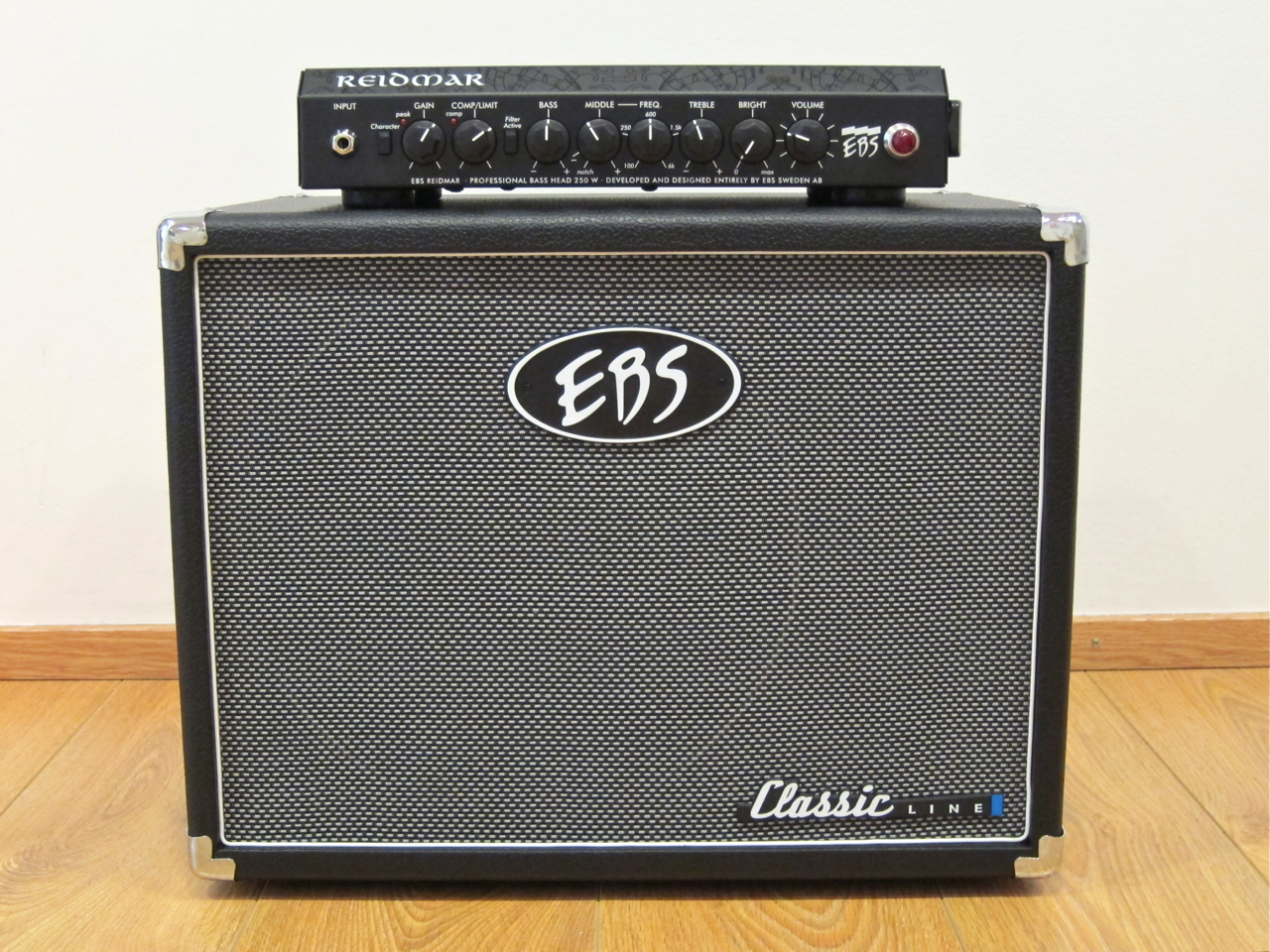
Both the Reidmar-head, as well as the Classic Line -series of cabinets have been designed and engineered in Sweden, but are being produced cost-effectively in China.
The EBS Reidmar (current street price in Finland: 469 €) runs a Class D power amp with 250 Watts of output at 4 Ohms. Because Class D amps run extremely energy-efficiently, there’s no need for large and heavy cooling ribs, which is why such amps can be much more compact than a traditional amplifier of the same power rating. EBS’s Reidmar weighs in at a mere 3.2 kilos, and fits easily into a compact backpack.
The good guys at EBS were quick to stress that the 250 W (RMS) rating is rather conservative, with the head reaching more than 400 Watts peak power with minimal distortion.
The new Classic Line CL112 -cabinet (current street price in Finland: 299 €) fits the Reidmar like a glove, as it, too, has been designed to pack a massive punch into a handy-sized piece of gear. The cab’s impedance is eight Ohms, and beneath the vintage-style exterior you can find one 12-inch speaker paired with a two-inch tweeter.
****
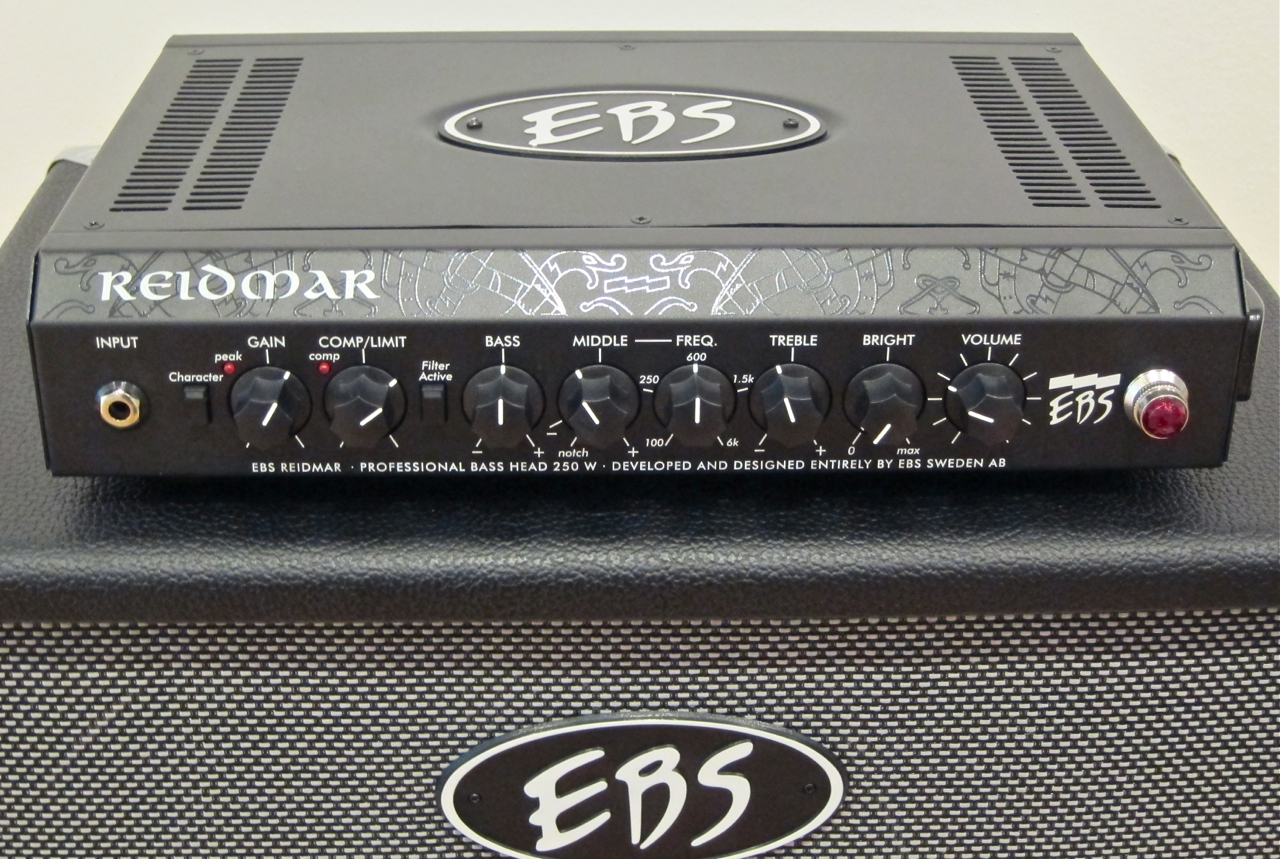
Regardless of its diminutive size, the Reidmar’s front panel dishes up all the goodies we’ve come to expect from an EBS-amp:
Next to the Gain-control you find the Character-button which lets you choose between a linear frequency curve and a loudness-type counterpart, with more bottom end and treble. EBS’ on-board compressor is known for its organic and musical behaviour, as well as its easy one-knob functionality. The EQ-section uses a four-band set-up with semiparametric mids – meaning the user can adjust the mid-range-filter’s centre frequency (in this case between 100 and 6,000 Hz). One EBS-speciality is the notch filter built into the mid-band. A notch filter is a very steep (=exact) filter that can be used to defeat an acoustic bass’ feedback howl or to reign in strong room/stage resonances, without interfering with the rest of your tone.
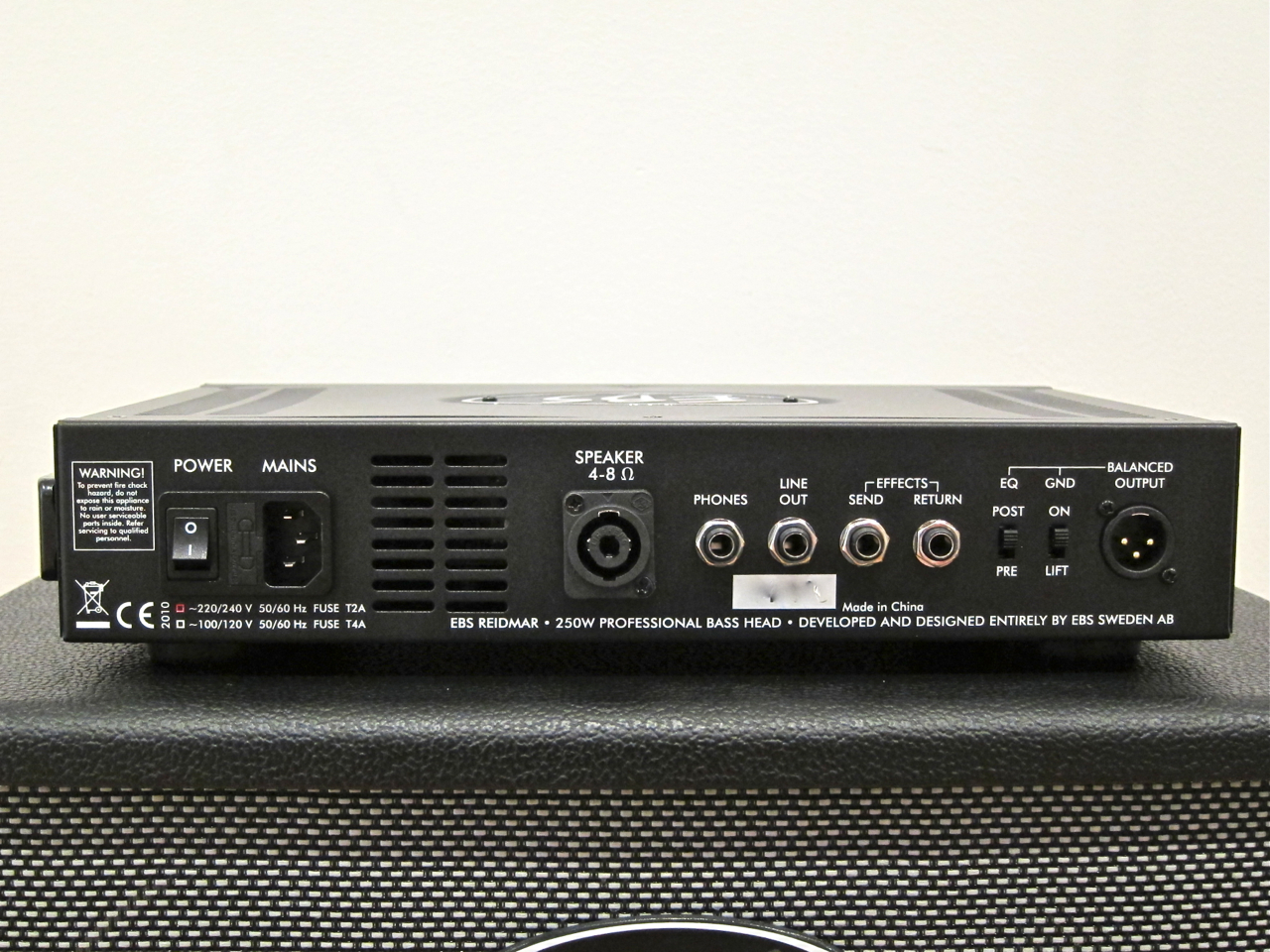
The back panel holds all your connections to the outside world – from the excellent DI-output to the effects loop.
****
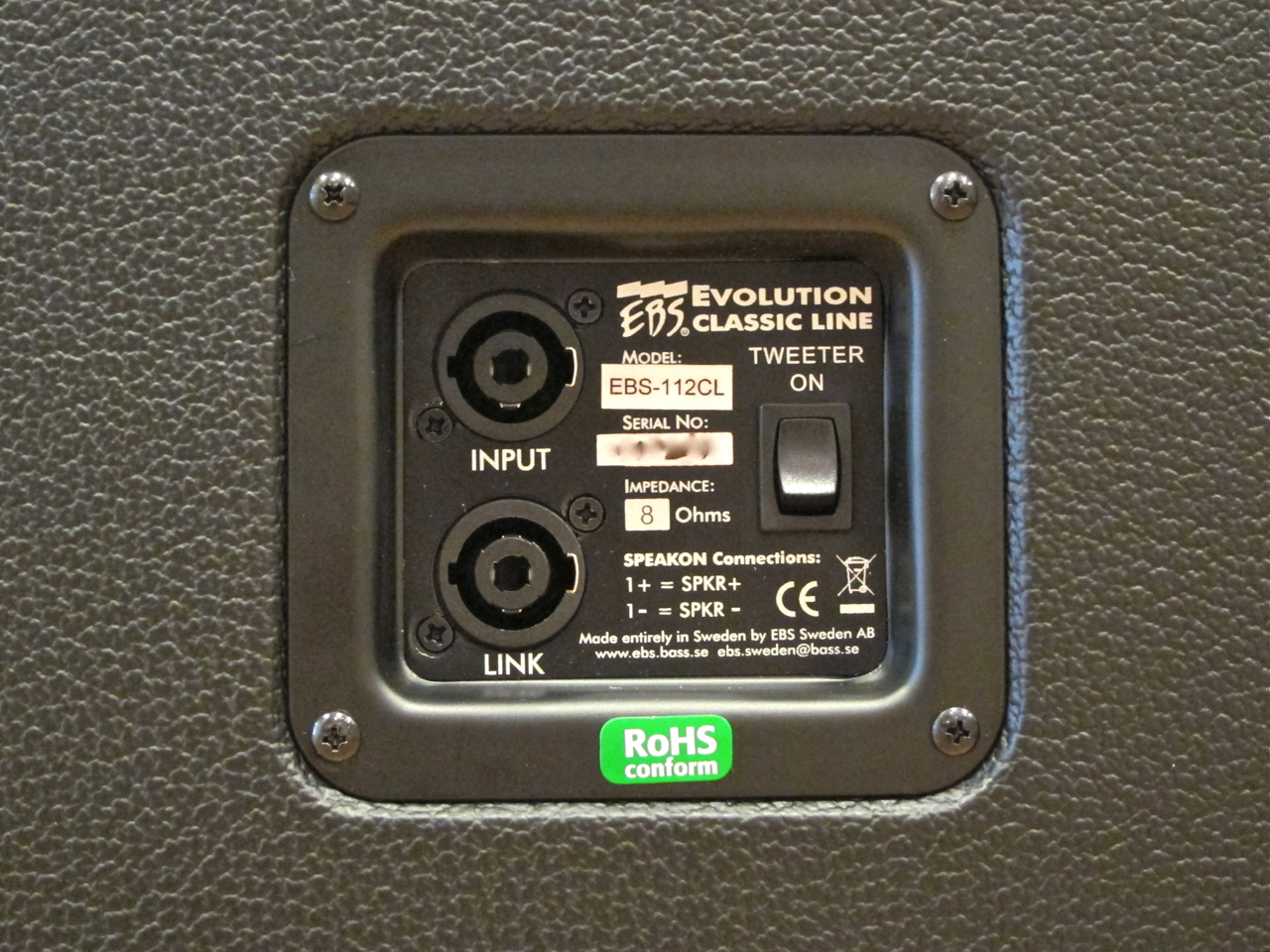
The EBS CL112 -cab sports two Speakon-connectors on its back panel – one for the input signal, and one to link another cabinet to the head. The small Tweeter-switch lets you switch off the cab’s tweeter for authentic vintage-style tones.

Even though the CL112 weighs in at only 17.5 kilos, EBS have sunk a sturdy metal grip into the cabinet’s left side.
****
A good bass amp should sound well balanced and full before you even touch the EQ-controls. The EBS Reidmar/CL112 -stack passes this test with full points. My old Jazz Bass sounds nice and chewy, with all of its ”wood” and tone intact:
Engaging Character noticeably pumps up the bass and adds muscle to the proceedings:
The EQ-section makes it possible to achieve virtually any tone you want. Let’s start with a nice and clean Pop tone:
Boosting the bottom end, as well as adding bite, results in a classic slap tone:
Adding bass while cutting treble takes you straight to Reggae’s swampy realms:
A punkish bit of plectrum-driven anger can be dialled in just as quickly on the EBS-stack:
…and if you fire up a chorus pedal the Reidmar and the CL112 can take you straight to Jaco-land:
Pictures of Blogi – Homage to Jaco P.
****
With its Reidmar-head and CL112-cabinet EBS have managed to shrink a bassist’s core equipment without depriving him (or her) of his (or her) tone. True, if a five-string is your weapon of choice, you should probably consider a different cabinet – like the EBS NeoLine 115, for example – to keep the punch in the lowermost notes intact, but in most situations this little gem of a stack will hold its own more than adequately. If you splash out on two CL112-cabs you’d get a very powerful and flexible modular system, which would enable you to take along the second cab to larger gigs, leaving it at home when it’s not needed.
The Reidmar gives you genuine EBS-tone in a compact and very affordable package. The EBS CL112 dissipated all my reservations concerning single 12-inch cabs: Its tone is open and strong, without being the least bit boxy or nasal. The silky-sounding tweeter adds just the right amount of brilliance to the tone. Jättebra!
****
EBS Reidmar RD250 & Classic Line CL112
Finnish distributor: F-Musiikki
****
EBS Reidmar RD250
Street price: 469 €
Pros:
+ price
+ sound
+ flexibility
+ power
+ size
+ weight
****
EBS CL112
Street price: 299 €
Pros:
+ price
+ sound
+ power handling
+ size
+ weight
****
****
Yksi uutuuksista EBS-ständillä Frankfurtissa oli kompakti voimanpesä nimeltään Reidmar. Kitarablogi.com sai Reidmar-nupin, sekä Classic Line -sarjaan kuuluvan CL112-kaapin testiin.
****
Sekä Reidmar-nuppi että Classic Linen kaapit on suunniteltu Ruotsissa, mutta valmistus on siirretty Kiinaan, mikä selittää molempien edullisen hinnan.
EBS Reidmar (katuhinta: 469 €) on D-luokan päätevahvistimella varustettu 250-wattinen (4 ohmia) bassonuppi. Koska D-luokan vahvistimet toimivat hyvin energiatehokkaasti, ne eivät tarvitse suuria jäähdytyselementtejä. Tämän ansiosta D-luokan vahvistimet ovat yleensä huomattavasti pienempiä ja kevyempiä kuin teholtaan vastaava perinteinen vahvistin. EBS:n Reidmar painaa vain 3,2 kiloa, ja koko nuppi mahtuu helposti esimerkiksi olkalaukkuun tai selkäreppuun.
EBS:n edustajat muuten korostivat messuilla, että nupin 250:n watin RMS-teho on ilmoitettu hyvin konservatiivisesti, ja että vahvistimen peak-teho voi nousta yli 400 wattiin ilman säröä.
Uusi Classic Line CL112 -kaappi (katuhinta: 299 €) sopii Reidmarin pariksi kuin nakutettu, koska sekin on suunniteltu mahdollisimman kompaktiksi. Kaapin impedanssi on kahdeksan ohmia, ja sen vintage-tyylisen ulkokuoren alle on sijoitettu yksi 12-tuumainen kaiutin, sekä 2-tuumainen diskanttipilli.
****
Pienestä koostaan huolimatta Reidmarin etupaneeli tarjoaa kaikki EBS-vahvistimista tutut ominaisuudet:
Gain-säätimen vieressä olevalla Character-napilla voi lisätä tulosignaaliin jo heiman loudness-maista taajuuskäyrää, ilman että taajuuskorjaimiin tarvitsisi koskea lainkaan. EBS:n kompressori on tuttu hyvin musikaalisesta toiminnastaan, ja sen säätäminen on todella helppoa. EQ-osasto on nelikaistainen parametrisella keskialueella, mikä tarkoittaa että keskialueen filtterin keskitaajuutta voi säätää (tässä tapauksessa 100:n ja 6.000:n hertsin välillä). EBS-taajuuskorjainten erikoisuus on Middle-säätimeen sisäänrakennettu notch filter -ominaisuus. Notch-filtteri (kaistanestosuodatin) on erittäin kapeaa erikoissuodatin, jolla voi poistaa tehokkaasti esimerkiksi akustisen basson feedback-ulinan tai pahan lava-/huoneresonanssin, vaikuttamatta lähes olenkaan muihin taajuuksiin.
Takapaneeliin on sijoitettu kuulokelähtö (hiljaista harjoittelua varten), linjatasoinen lähtö, efektilenkin liittimet, sekä EBS:n ensiluokkainen DI-lähtö.
****
EBS CL112 -kaapin takapaneelissa on kaksi Speakon-liitintä, joista yksi on tulosignaalia ja toinen useampien kaappien ketjuttamista varten. Oikeanpuoleisella kytkimellä voi halutessa mykistää diskanttipillin autenttisia vintage-soundeja varten.
Vaikka CL112:n paino on vain 17,5 kg EBS on upottanut kaapin vasempaan kylkeen ammattitason metallikahvan. Kuljettaminen on siis yhtä turvallista kuin vaivatontakin.
****
Hyvän bassovahvistimen pitäisi soida tasapainoisen hyvin jo ilman EQ:ta tai muita apuvälineitä. EBS Reidmar/CL112-stäkillä tämä erikoiskoe hoidetaan mallikkaasti. Vanha Jazz-bassoni soi jäntevästi, ja soittimen oma karakteeri pysyy täysin ehjänä:
Character-käyrä lisää touhuun sopivasti potkua ja fundamenttia:
Taajuuskorjainten käyttö avaa tien mahdollisuudet mihin soundiin tai tyylilajiin vaan. Aloitetaan siistillä Pop-bassolla:
Lisäämällä hieman botnea ja preesenssiä saa kädenkäänteessä loistavan peukkubasso-soinnin aikaiseksi:
Kun taas leikataan diskanttia reilusti pois ja lisätään vielä enemmän bassoa saadaan Reidmarista mainio Reggae-kone:
Eikä nahsahtava plektra-Rock ole mikään haaste EBS-stäkille:
…ja kun lisätään hieman chorus-efektiä Reidmar ja CL112 vievät meidät Jacon ihmeelliseen maailmaan:
Pictures of Blogi – Homage to Jaco P.
****
EBS on Reidmarin ja CL112-kaapin myötä onnistunut kutistamaan ja keventämään huomattavasti basistin työkaluja, ilman että pääasia – soundi nimittäin – kärsisi tämän seuraksena. Totta, viisikieliselle bassolle tarvitaan ehkä toisenlainen kaappi – esimerkiksi EBS NeoLine 115 – jotta alhaisimmat sävelet soisivat kunnolla, mutta useimmissa tilanteissa tällaisella pikku-stäkillä pärjää mainiosti. Kahdella CL112-kaapilla voi sitten jo rakentaa modulaarisen järjestelmän, jolloin toinen kaappi otetaan vain silloin mukaan, kun sitä oikeastaan tarvitaan.
Reidmar tarjoaa ehtaa EBS-soundia pienessä, kevyessä ja hyvin edullisessa pakkauksessa. EBS CL112 -kaappi taas pyyhki pois kaikki ennakkoluuloni 12-tuumaisia kohtaan – ei mitään nasaalisuutta tai tukkoisuutta, vaan loistava bassosoundi, jolle kaapin silkkisen pehmeä diskanttipilli antaa viimeisen silauksen. Jättebra!
****
EBS Reidmar RD250 & Classic Line CL112
Maahantuoja: F-Musiikki
****
EBS Reidmar RD250
katuhinta: 469 €
Plussat:
+ hinta
+ soundi
+ monipuolisuus
+ teho
+ koko
+ paino
****
EBS CL112
katuhinta: 299 €
Plussat:
+ hinta
+ soundi
+ tehonkesto
+ koko
+ paino
****

****
A dedicated amplifier for acoustic guitar opens up plenty of interesting possibilities: most small pub gigs won’t require a PA-system anymore, because the majority of acoustic combos are equipped with a second input channel for a microphone. For larger gigs you can assign the acoustic combo to monitoring duties, putting yourself in full control over your stage sound, and then feeding your signal on to the FOH mixer.

The Tanglewood T6 (current price in Finland: 396 €) is a very compact, two-channel combo, pumping out 60 Watts of power through an 8-inch speaker. The T6 weighs a mere 11 kilos, and is very easy to transport thanks to the nice gigbag that comes with the amp.
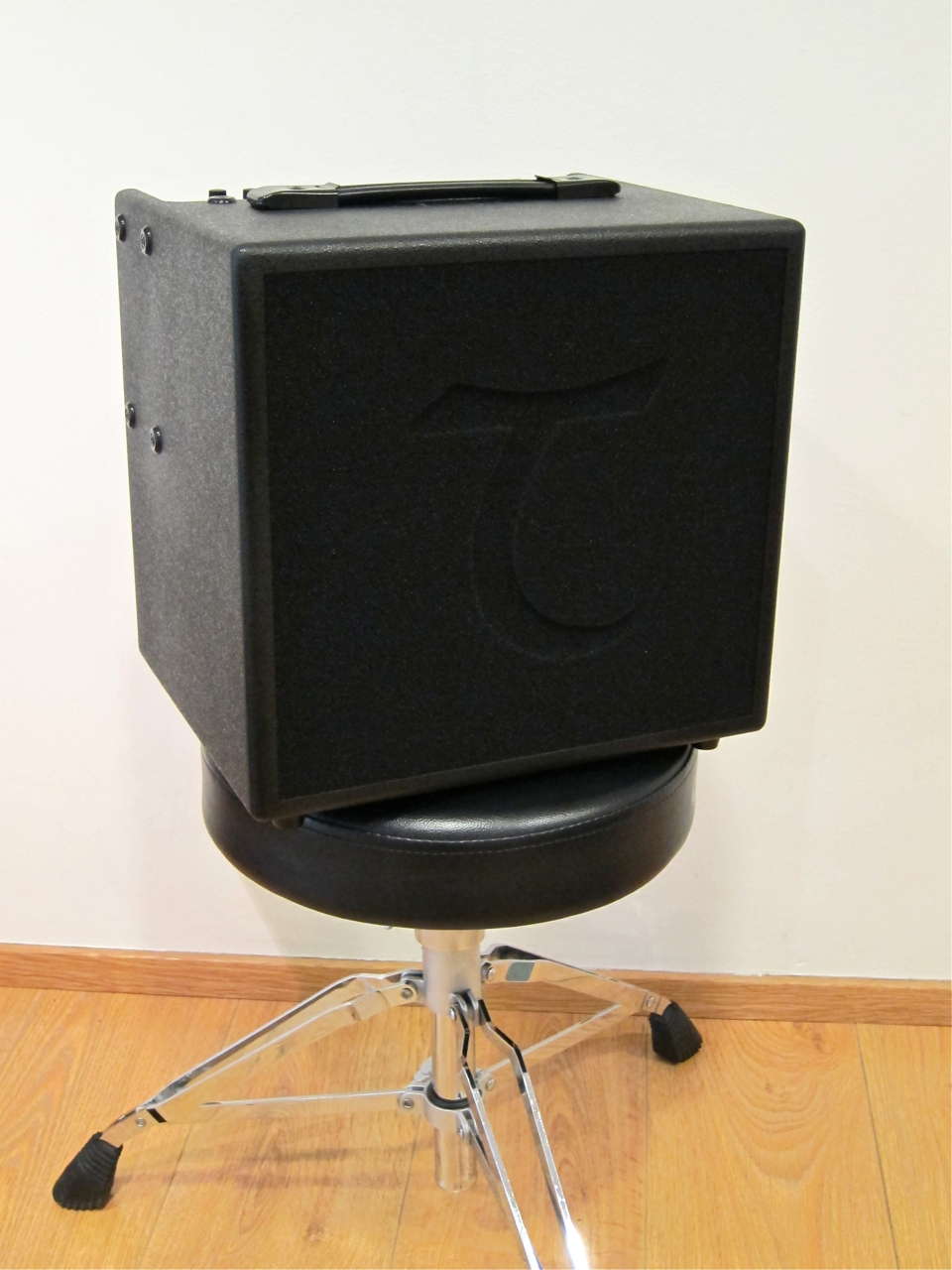
The Tanglewood feels rugged enough for regular gigging, with its cabinet covered in textured nylon. A fat foam grille protects the speaker.

The T6’s first channel is meant for use with an acoustic guitar (or similar instrument), offering controls for gain and the 3-band EQ. The High/Low-selector lets you tame hot guitar preamps, while Contour adds brilliance to a dull signal.
Channel number two is the right place to connect a microphone or a line level signal source. It sports an XLR/jack-combo connector, a Mic/Line-selector, as well as controls for gain and 2-band EQ.
Tanglewood’s effects section lets you choose between four different effects – two different reverbs (Hall and Plate), one combination effect (Chorus/Room) and one delay. The Effect Pan -knob lets you assign the signals from both channels to the effect section’s input. Going all the way counterclockwise will feed only the signal off channel one to the effect, while going all the way clockwise only sends channel two’s signal to the effect processor. The Level control adjusts the amount of wet signal in the output mix.

The back panel holds all the connectors necessary for the T6 to communicate with an auxiliary signal, an mp3-player, your tuner, a mixer or soundcard (XLR or line out), a pair of headphones, as well as a footswitch (for muting the effects on the fly).

If need be you can even hoist the Tanglewood T6 up onto a speaker stand.
****
I must admit that the quality of the T6’s basic sound came as a surprise to me. Even without resorting to the EQ controls this combo rings out clear and true, with a fresh and punchy tone that’s never brittle or abrasive (all soundbites have been recorded using a Taylor 110CE -guitar):
The Tanglewood’s Hall-reverb sounds lush and dense, with just the right amount of presence:
Switching to Plate-reverb I found a good amount freshness and a nice, unobtrusive charcter:
For my taste I would have preferred for the Chorus/Room-combination to contain a larger amount of chorus with added depth – still, the effect is more than useable in its present form, too:
The Delay-effect feels a little half-hearted; not because of its sound, but because the delay time is factory-set to a medium value, which will only fit some songs. A better solution would have been to have offered either a selector – slapback/medium – giving you two different time presets, or a full-blown tap tempo function, which would allow you to set song-specific delay times.
****
If you’re on the lookout for an easy-to-use, good-sounding acoustic combo that won’t cost you an arm and a leg, I suggest you rush out to your Tanglewood dealer. With the T6 you only have to set your gain levels and the master volume, adjust the effect section to your liking, and you’re ready to roll. The amount of amplification is ample for most small pub gigs, and the T6 works well as a backline stage monitor, as long as you don’t play in a raucous Hard Rock band.
The Tanglewood’s only real drawback is the complete absence of dedicated feedback-prevention tools, like a notch-filter or an automatic feedback defeater. Nevertheless, you can well work your way around this by positioning the T6 sensibly, and maybe closing you guitar’s soundhole, should you require high sound levels.
****
Tanglewood T6
Current price in Finland: 396 €
Finnish Distributor: Musamaailma
****
Pros:
+ lightweight
+ compact
+ basic sound
+ quality effects
+ stand adapter built in
+ affordable
Cons:
– delay-time fixed
– no anti-feedback tools
****
 Kitarablogi.com – Finland's premier Guitar and Bass blog