Review: PRS SE Custom 24 30th Anniversary

PRS SE Custom 24 30th Ann – body beauty 1

Thirty years ago a young, bespectacled man introduced the guitar-playing world to the first guitar model from his new company at the NAMM Show. The company from Maryland was only a small start-up, but their beautiful new electric guitar already started to attract a good deal of attention.

This young man was none other than Paul Reed Smith, the company PRS Guitars, and their first model the now-legendary Custom 24.

Before founding PRS Guitars, Smith had already managed to sell several of his handmade guitars to well-known guitarists, such as Howard Leese and Carlos Santana. Smith’s early guitars were clearly grounded in Gibson-tradition, successfully blending classic Les Paul Standard visuals with the more practical double-cut design of late 1950s Les Paul Specials. Carlos Santana’s signature PRS is based on these early (pre-PRS) guitars.

Nonetheless, Paul Reed Smith wasn’t content with high-class ”copying”. He wanted to come up with the ultimate electric guitar, both in terms of playability and sounds. What he came up with was a guitar that successfully bridges the gap between Fender and Gibson electrics, without copying any of their classic models.

The first step on Paul Reed Smith’s ongoing quest for excellence was the PRS Custom 24, introduced at NAMM in 1985.

This guitar set PRS’ wheels a-rollin’, and the company has come a long way from its humble beginnings. These days people talk about the ”Big Three” manufacturers of electric guitars – meaning Fender, Gibson and PRS.

To celebrate their anniversary PRS have released four limited edition models. Kitarablogi.com managed to get hold of the Made-in-Korea SE Custom 24 30th Anniversary for this review.

****

PRS SE Custom 24 30th Ann – full front

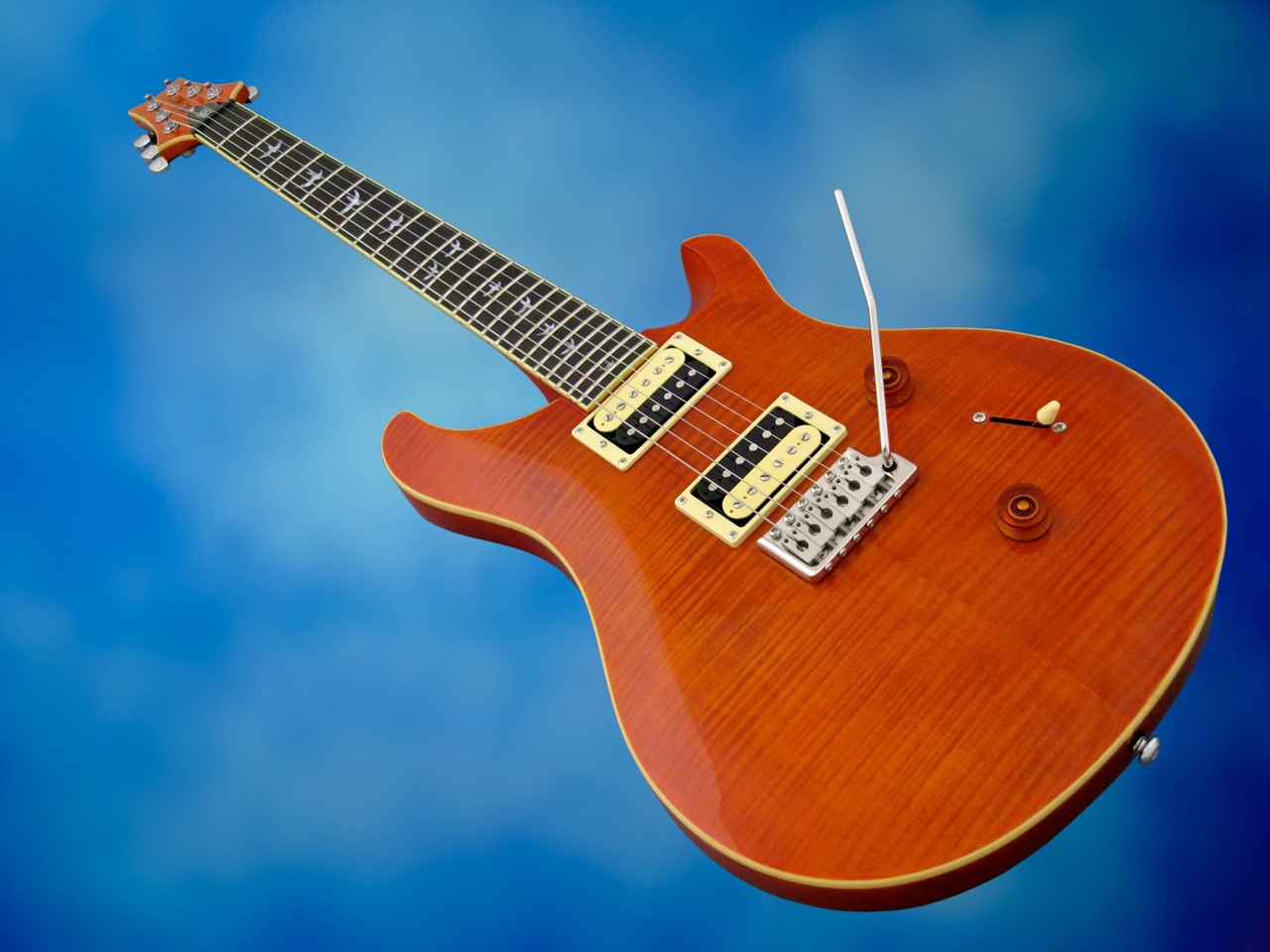
The PRS SE 30th Anniversary Custom 24 (current price in Finland approx. 1,000 €) is the most-affordable of the anniversary models, but it still is a great-looking guitar.

It has PRS Guitars’ typical scale length of 25-inches (63.5 cm), which is longer than Gibson’s, but shorter than Fender’s typically used scale lengths.

The back of the body is made from mahogany, while the curved top is crafted from maple. To spruce up the looks of the SE 30th Anniversary, a thin flame maple veneer is glued onto the (plain) maple top. The top is bound with cream-coloured plastic.

PRS SE Custom 24 30th Ann – full back

On current SE Custom 24 guitars the neck is made from maple – in contrast to the mahogany necks on US-produced Customs. The change was made recently for both tonal and ecological reasons. The SE’s set neck is glued together from three long strips of maple, with two small pieces added to get the headstock to its full width.

PRS SE Custom 24 30th Ann – headstock

The nut is made from PRS’ special graphite-impregnated, hard plastic.
PRS SE Custom 24 30th Ann – tuners

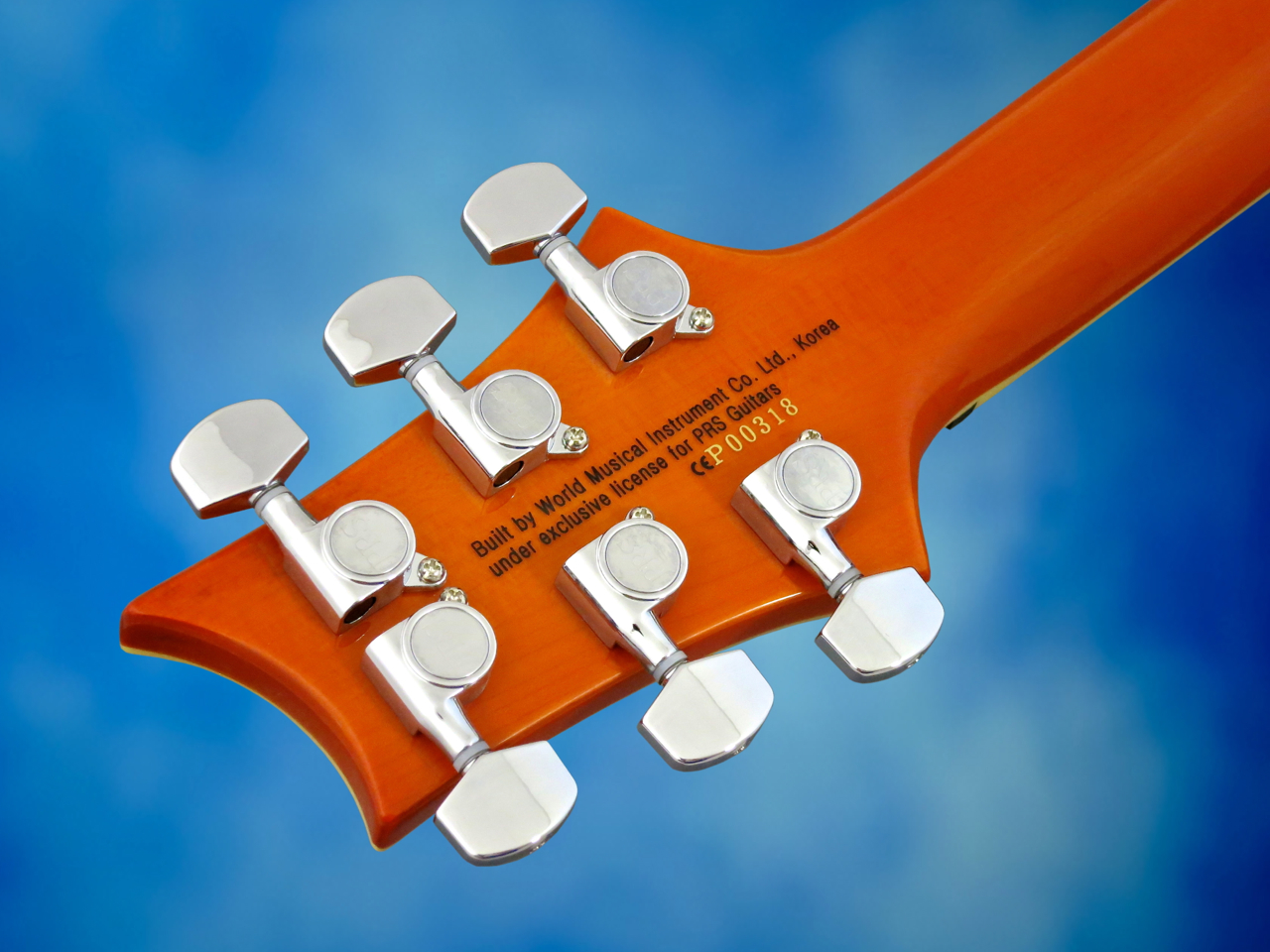
The 30th Anniversary SE Custom 24 sports a set of very decent, non-locking Schaller-copies.

PRS SE Custom 24 30th Ann – bird inlays

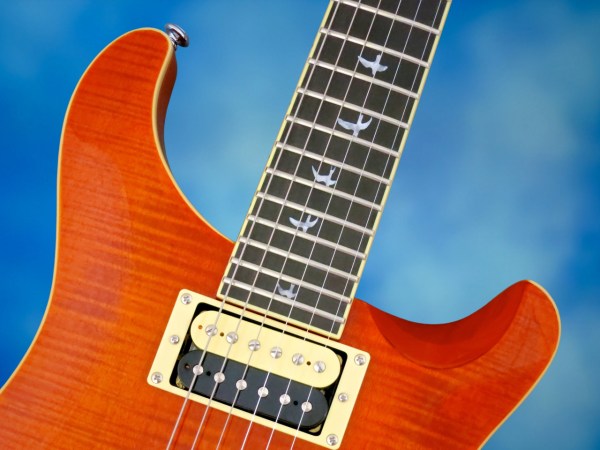
PRS have come up with a variation of their bird-inlays for the anniversary models, which sees the birds flying in a gracefully curved line across the fingerboard.

The bound rosewood fingerboard is home to 24 medium-jumbo frets. The fretjob is excellent.

PRS SE Custom 24 30th Ann – cutaways

The bevelled treble side cutaway has become something of a trademark for PRS guitars.

If you click on the picture for a better view, you will be able to see clearly the demarcation lines between the mahogany back, the maple top, and the flame maple veneer.

PRS SE Custom 24 30th Ann – vibrato

Thirty years ago locking vibratos (Floyd Rose, Kahler, Rockinger) were highly fashionable, but Paul Reed Smith wasn’t too keen on them. In his view locking systems changed a guitar’s sound in a negative way, and he felt they were too cumbersome when it came to changing strings.

Smith came up with a highly-improved take on the classic Stratocaster vibrato – a chunky piece of beauty, milled from solid brass.

The SE 30th Anniversary Custom uses a high-quality version of the original design.

PRS SE Custom 24 30th Ann – pickups

In the Eighties guitarists favoured hot bridge humbuckers, because they made achieving a creamy distortion sound much easier.

This Anniversary-Custom brings this concept back by combining a medium-output neck humbucker – the Vintage Bass – with the SE-version of the high-output HFS Treble (HFS = hot fat screams).

PRS SE Custom 24 30th Ann – controls

In the beginning, original PRS Custom 24 models came with two ”controls” and a mini-toggle switch. Actually, the second ”control” was a five-way rotary switch that served as the guitar’s pickup selector. The tiny switch was PRS’ Sweet Switch, a preset treble roll-off.

Over the years, the rotary switch fell out of favour, and the control setup on US-made guitars changed to master volume, master tone, and a five-way blade switch.

On the SE Custom 24 the blade switch is a three-way model, while a push/pull switch in the tone control allows you to split both humbuckers.

PRS SE Custom 24 30th Ann – gig bag

A well-made gig bag is included with the SE Custom 24 30th Anniversary model.

****

PRS SE Custom 24 30th Ann – beauty shot 1

PRS guitars are known for their well though-out ergonomics and their great playability, and the SE Custom 24 30th Anniversary proves to be a genuine PRS in this respect, too. It has a comfortable medium weight, and feel nice both in your lap and strapped on.

In keeping with the 1980s theme, the SE comes with a Wide Thin neck profile. Despite its name, though, you needn’t be afraid that this Custom 24 comes with an insubstantial Ibanez Wizard. I’d describe the Wide Thin profile as distinctly oval with a medium thickness, so there’s still more than enough wood left for good tone and sustain.

The review guitar came with a comfortably low setup (low-E: 1.9 mm/high-e: 1.6 mm) without any buzzes, thanks to the great fret job.

I know that it’s a thing of personal preference, but I’d like to see a PRS strung up with a set of 010-gauge strings, instead of the factory set of 009s. The factory set feels almost too ”slinky”and effortless, making it hard to really dig into the strings.

The PRS-vibrato is one of the best updates of the vintage vibrato you’re likely to encouter, and it works like a dream on the SE Custom 24, too. The feel is smooth, creamy and precise, but isn’t as sensitive to heavy-handed playing or string bending as a Floyd Rose, despite the floating setup.

Paul Reed Smith has also proven he know’s how to voice pickups. Naturally, these Korean pickups aren’t quite in the same league as their American counterparts, but these are still very decent pickups.

On paper, pairing a Vintage Bass with a HFS Treble humbucker sounds like a recipe for a slightly schizophrenic sound, when, actually, these pickups work very well together. The jump in output levels isn’t as acute as you might think. The difference between the Vintage Bass and the HFS Treble comes over clearest in the way the latter focusses heavily on the mid-range frequencies.

The sound clips both start with the coil-split on, before moving on to the full humbucker sound. The sequence is always neck pickup –> both pickups –> bridge pickup:

The rhythm guitars on the demo track use the coil-split (left channel: neck PU; right channel: both PUs), while the lead guitar starts with the full neck humbucker, before switching to the full bridge humbucker at 0’49”:

PRS SE Custom 24 30th Ann – back beauty

****

PRS SE Custom 24 30th Ann – body beauty 2

No wonder that PRS Guitars’ SE-range is so popular:

The SE Custom 24 30th Anniversary gives you the genuine ”PRS experience” at a truly fair price. This is a pro-level electric guitar that plays very well and offers you a wide variety oif different sounds.
PRS SE Custom 24 30th Ann – beauty shot 2

****

PRS SE Custom 24 30th Anniversary

approximately 1,000 € (including gig bag)

Finnish distributor: EM Nordic

A big thank you to DLX Music Helsinki for the loan of the review instrument!

****

Pros:

+ workmanship

+ playability

+ vibrato action

+ versatile sound

+ anniversary model
Testipenkissä: PRS SE Custom 24 30th Anniversary

PRS SE Custom 24 30th Ann – body beauty 1

Kolmekymmentä vuotta sitten nuori, rillipäinen mies esitteli hänen pikkufirmansa ensimmäisen kitaramallin yhdysvaltalaisilla NAMM-messuilla. Marylandilaisessa yrityksessä työskenteli silloin vain puoli tusina kitaranrakentajaa, mutta firman tyylikäs kitara, jossa oli selvästi klassikon ainekset, kyllä huomioitiin jo silloin.

Tämä nuori mies oli tietysti Paul Reed Smith, hänen firmansa PRS Guitars, ja se ensimmäinen kitaramalli firman legendaarinen Custom 24.

Ennen PRS Guitarsin perustamista, Smith oli jo onnistunut myymään muutamia varhaisia, pikkuverstaassa rakennettuja, kitaroitaan nimekkäille kitaristeille, kuten Howard Leeselle ja Carlos Santanalle. Nämä kitarat olivat pitkälti Gibson-tyylisiä kitaroita, joissa yhdistettiin Les Paul Standardin prameutta kahdella soololovella varustetun Les Paul Specialin käytännöllisyyteen. Carlos Santanan nimikkomalli on yhä samalla tavalla rakennettu.

Paul Reed Smithissä oli kuitenkin selvästi keksijän ja kehittäjän ”vika”, koska korkean tason ”kopiointi” ei riittänyt hänelle. Smith halusi kehittää ultimatiivisen sähkökitaran, joka kulkisi sekä soitettavuuden että soundin ja ulkonäön kannoilta kultaista keskitietä Fender- ja Gibson-maailmojen välissä.

Kehitystyön ensimmäinen tulos oli PRS Guitarsin ensimmäinen kitaramalli – juuri se 1985:n NAMMissa esitelty Custom 24.

Tästä kitarasta alkoi PRS:n voittokulku ja kasvutarina. Nykyään puhutaan USA:ssa ”kahden ison” sijasta ”kolmesta isosta” sähkökitaroiden valmistajista – Fender, Gibson ja PRS.

Vuosipäivän kunniaksi PRS on julkaissut neljä juhlamallia, joista saimme Koreassa tehdyn SE Custom 24 30th Anniversary -kitaran tähän testiin.

****

PRS SE Custom 24 30th Ann – full front

PRS SE 30th Anniversary Custom 24 (katuhinta noin 1.000 €) on juhlamalleista edullisin, mutta sitä huolimatta erittäin kaunis soitin.

PRS Guitarsille tyypillinen on kitaran 25-tuumainen (63,5 cm) mensuuri, joka on pidempi kuin Gibsonin, mutta lyhyempi kuin Fenderin yleensä käyttämä mensuuri.

Rungon takaosa on tehty mahongista, kun taas sen kaareva kansi on vaahteraa. Vaahterakannen koristeeksi on lisätty ohut loimuvaahteraviilu, ja koko komeus on reunalistoitettu kermanvaalealla muovilla.

PRS SE Custom 24 30th Ann – full back

Nykyisissä SE Custom 24 -malleissa on – USA-tuotannosta poiketen – kolmesta pitkästä vaahterapalasta veistetty liimakaula mahongin sijaan. Muutos tehtiin sekä soinnillisista että ekologisista syistä muutama vuosi sitten.

PRS SE Custom 24 30th Ann – headstock

SE-juhlamallissa käytetään PRS Guitarsin erittäin kovasta materiaalista tehty, itsevoitelevaa yläsatulaa.

PRS SE Custom 24 30th Ann – tuners

Virittimet ovat laadukkaita, korealaisia Schaller-kopioita. Kyseessä on perinteiset, ei-lukittavat mallit.

PRS SE Custom 24 30th Ann – bird inlays

30-vuotis juhlamalleissa käytetään uusia lintukuvioisia otemerkkejä, jossa lintujen lentoreitti otelaudassa on hienosti kaareva.

Reunalistoitetuun, ruusupuiseen otelautaan on asennettu 24 medium jumbo -kokoista nauhaa. Nauhatyö oli testisoittimessa erittäin hyvä.

PRS SE Custom 24 30th Ann – cutaways

Viistoitetusta diskanttipuolen soololovesta on tullut yksi PRS:n tunnusmerkeistä.

Kun klikkaat tätä kuvaa suuremmaksi, näet selvästi rungon rakenteen – mahongin, vaahteran, sekä loimuvaahteraviilun.

PRS SE Custom 24 30th Ann – vibrato

Kolmekymmentä vuotta sitten lukittavat vibratallat (Floyd Rose, Kahler, Rockinger) olivat erittäin suosittuja. Paul Reed Smithin mielestä ne olivat kuitenkin pahoja soundisyöppöjä, eikä hän myöskään pitänyt siitä, että ne tekivät kieltenvaihdosta niin hankalan.

Smith kehitti oman vibratonsa alkuperäisen Stratocaster-tallan perusteella, mutta käytti Fenderistä poiketen selvästi massiivisempia osia messingistä.

SE 30th Anniversary Customissa käytetään erittäin laadukasta versiota alkuperäisestä.

PRS SE Custom 24 30th Ann – pickups

1980-luvulla kitaristit halusivat tuhteja tallamikrofoneja kermaisen särösoundin perusteeksi.

Juhla-Custom palaa takaisin siihen aikaan yhdistämällä vintage-tyylistä SE Vintage Bass -kaulamikrofonia kuumaan SE HFS Treble -tallaumbuckeriin (HFS on muuten lyhenne sanoista ”hot fat screams”, siis: ”kuumia paksuja kirkaisuja”).

PRS SE Custom 24 30th Ann – controls

Alkuperäisissä Custom 24 –malleissa on kaksi ”säädintä”, sekä yksi pikkukytkin. Toinen säädin oli todellisuudessa kiertokytkin, joka toimi mikrofonivalitsimena. Tone-säätimen sijaan näissä kitaroissa käytettiin sitä minikokoista vipukytkintä, PRS:n ns. Sweet Switch, jolla saatiin diskantit vaimennettua.

Kiertokytkin kuitenkin osoittautui ajan myötä epäsuosituksi, minkä takia säädinosastoa muutettiin perinteisemmäksi – master volume, master tone, sekä kolmiasentoinen vipukytkin. Tone-potikassa on nostokytkin, jolla voi puolittaa kitaran humbuckereita.

PRS SE Custom 24 30th Ann – gig bag

Laadukas topattu pussi kuuluu SE Custom 24:n hintaan.

****

PRS SE Custom 24 30th Ann – beauty shot 1

PRS-kitarat ovat tunnettuja niiden hyvästä ergonomiasta ja soitettavuudesta, ja SE 30th Anniversary Custom 24 on myös tässä suhteessa aito PRS. Kitara ei ole liialla painolla pilattu, ja se istuu erittäin mukavasti sylissä, sekä roikkuu rauhallisesti hihnassa.

80-luvun henkisesti kaulaprofiiliksi on valittu firman Wide Thin -profiili. Nimestä huolimatta kyse ei ole olemattoman ohuesta Ibanez Wizard -kaulasta, vaan tässä on vielä mukavasti puuta jäljellä. Itse kuvailisin Wide Thin -profiilia leveäksi ovaaliksi, joka on todella hyvä kompromissi pyöreän vintage-kaulan ja laakean ”vauhtikaulan” välillä.

Testisoittimen nauhatyö oli erinomainen ja soittotatsi oli säädetty mukavan matalaksi (ala-E: 1,9 mm/ylä-e: 1,6 mm) ilman ylimääräistä kielten räminää.

Tämä on tietysti täysin subjektiivista, mutta itse toivoisin tällaisessa kitarassa 010-paksuista kielisatsia. Tehdaskielten (009-satsi) kanssa soitettavuus oli jo lähes liian vaivatonta ja kevyttä.

PRS:n vibratalla on mielestäni yksi parhaimmista vintage-vibraton päivityksistä, ja systeemi toimii moitteettomasti myös Custom 24 -juhlamallissa. PRS SE:n vibra toimii pehmeästi ja tarkasti, mutta se ei ole läheskään niin herkkä raskaalle plektrakädelle tai kielten venytyksille kuin esimerkiksi Floyd Rose talla.

Paul Reed Smithillä on aina ollut myös todella tarkka korva mikrofonien suhteen. Vaikka SE-juhlamallin mikrofonit ei luonnollisesti yllä ihan samalle huipputasolle kuin PRS:n USA-mikrofonit, on niiden soundi kuitenkin erittäin kiitettävällä tasolla.

Vaikka Vintage Bass- ja HFS Treble -mikrofonien yhdistelmä näyttää paperilla hieman kaksijakoiselta, toimi mikkien yhteistyö käytännössä loistavasti. Ero näiden humbuckereiden luonteissa huomaa vähemmän signaalitasosta kuin siitä, että tallahumbuckerin soundi fokusoituu selvästi keskitajuuksille.

Näissä esimerkkipätkissä aloitetaan ensin puolitetuista vaihtoehdoista, ennen kun mennään täysille humbuckereille. Järjestys on aina kaulamikki –> molemmat –> tallamikki:

Demobiisin komppikitarat käyttävät puolitettuja mikrofoneja (vasen kanava: kaulamikki; oikea kanava: molemmat mikit yhdessä), kun taas soolokitara aloittaa täydellä kaulahumbuckerilla, ennen kun se vaihtuu täyteen tallamikkiin (noin 0:49 kohdalla):

PRS SE Custom 24 30th Ann – back beauty

****

PRS SE Custom 24 30th Ann – body beauty 2

Ei ole ihme, että PRS Guitarsin SE-mallisto on näin suosittu:

Tästä SE Custom 24 30-vuotis juhlamallista saa täydellisen ”PRS-kokemuksen” todella reiluun hintaan. Kyseessä on ammattitason sähkökitara loistavalla soitettavuudella ja monipuolisella soundilla.

PRS SE Custom 24 30th Ann – beauty shot 2

****

PRS SE Custom 24 30th Anniversary

katuhinta noin 1.000 € (topattu pussi kuuluu hintaan)

Lisätiedot: EM Nordic

Suuri kiitos DLX Musiikille testikitaran lainaamisesta!

****

Plussat:

+ työnjälki

+ soitettavuus

+ vibratallan toimivuus

+ monipuolinen soundi

+ juhlamalli

Review: Boss DD-500

dd_500_angle_3_gal

The brand-new Boss DD-500 will quite likely prove to be a definite milestone in the effect company’s history. Boss’ newest creation isn’t just another run-of-the-mill delay pedal; instead, the company’s R&D-department has set out to create a genuine ”mother of all delay pedals”, aiming to take the user all the way, from the illustrious past of echoes and delays right into the here-and-now of top notch audio processing.

****

dd_500_top_gal

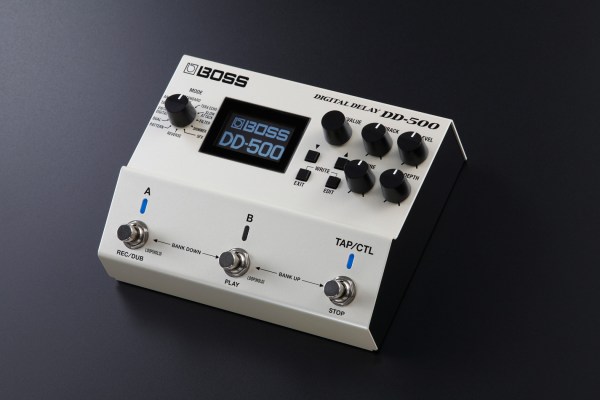
The Boss DD-500 (current street price in Finland approx. 370 €) comes over as a very matter-of-fact, businesslike pedal with a very clean and uncluttered look.

Despite the fact that each effect patch contains quite a number of different adjustable parameters, Boss have provided the user with physical knobs and buttons to access the most important features directly. In addition to the all-important Delay Mode selector, you’ll find controls for Time, Feedback, Effect Level, Tone, and Modulation Depth. This makes tweaking any patch very fast and easy.

The Model-selector goes right to the heart of what the DD-500 does, offering you access to the different delay types on offer. The DD-500’s twelve Modes really run the whole gamut of all delay types known to mankind, starting with a state-of-the-art, contemporary delay (Standard) and leading you all the way to some of the best digital models of tape- and bucket brigade-delays you’re likely to hear. Let’s not forget about the more special delay types on offer here, such as Boss’ own Tera Echo Mode, Shimmer, Slow Attack, or Reverse. The outlandishly bit-crunching SFX setting, as well as the fat and chewy Filter Mode will take your playing closer to the realms of synthesizers and Electronica. Depending on the chosen mode, the maximum delay time on offer stretches to a whopping ten seconds!

Naturally, the DD-500 also comes with a phrase looper, which can loop up to two minutes of audio.

dd_500_back_gal

The Boss DD-500 will work equally well in mono or stereo setups.

The Control/Expression-jack lets you hook up an additional (double) footswitch unit or an expression pedal (not included) to the delay unit, allowing for real-time control of almost any parameter(s) you choose.

You can use MIDI to synchronise your delays to an outside source (such as an audio sequencer), as well as for remote effect patch switching.

The DD-500’s USB-port can handle both MIDI data, as well as digital audio, making it easy to record your effected guitar signal straight into your sequencer.

The Boss DD-500 offers plenty of memory space for effect patches:

Set to factory specifications, the delay unit will give you access to 99 banks of two patches each (A & B), that you can turn on and off using the switches of the same name. In this configuration the third switch is set aside for tap tempo and parameter control duties. You can change the factory configuration, though, which makes it possible to use 99 banks of three patches each (A, B & C). And if you’re really adventurous, you can also choose a setting that lets you use two delay patches simultaneously.

The Boss DD-500 can be run as a true bypass-effect, meaning that the input signal goes straight to the unit’s output, whenever the delay is turned off. If you have a long effect chain, or if you’re forced to run long cables to your backline, you will appreciate the delay’s buffered output option, too, which will keep all your precious trebles and dynamic content intact.

****

dd_500_angle_1_gal

Boss’ internal digital signal processing, with a sample rate of 98 kHz and a 32-bit resolution, lays the perfect groundwork for the DD-500’s excellent audio quality and amazing versatility. This isn’t your daddy’s delay box, where you can only set the delay time, feedback, and effect level; the DD-500 allows you to delve very deep to hone your tone in exactly the way you want. For example, all Delay Modes come with their dedicated semiparametric EQ, a comprehensive modulation section, and a ducking compressor.

Adding the possibilities offered by the CTL-switch – or additional switches, or an expression pedal – into the mix, further multiplies the tonal options on tap in the DD-500. If you don’t need the tap tempo function, you can use the built-in CTL-switch for special effects, such as – among others – Hold (the repeats don’t fade away, while the footswitch is pressed), Warp (basically a modern version of tape-spin; your delay running wild) or different types of Roll (changing the note value of your delay).

Yes, there is a long list of different parameters that you can tweak, but the DD-500 is still surprisingly easy to use. Despite the fact that this unit is much more versatile than a simple analogue delay, making your own delay patches is still relatively simple.

In my opinion, the new Boss DD-500 is the best and most versatile delay pedal available today.

Even used ”straight” – that is without further modulation or filtering – the basic Delay Modes sound great, offering you the widest possible scope to take you on a sonic journey par excellence. Here’s a short clip introducing all twelve Modes, using the same knob settings (with Modulation Depth set to zero). I start with Standard and work my way forward in a clockwise direction:

The factory patches in the DD-500 offer so many different types of delays that a review, such as this, can’t cover them all. The demo track features 12 different factory patches on the lead guitar, plus an additional patch, used to simulate a violin sound.

Here’s a mix of just the lead guitar parts:

And here’s the full track:

****

dd_500_angle_4_gal

I’m pretty sure that the Boss DD-500 will put an end to many a guitarist’s epic search for the ”perfect delay pedal”.

This delay unit offers you such a wealth of different sounds, delay types, and tonal options, that I probably could have spent weeks on end with the DD-500, without bumping into the outer walls of this universe of inspiration. The Boss DD-500 is an equally excellent choice for the traditional guitarist, looking for authentic versions of legendary delay sounds, as it is for the fearless sound traveller, who will draw a sheer never-ending wealth of inspiration from this device.

dd_500_angle_5_gal

****

Boss DD-500

street price ca. 370 €

Contact: Roland

****

Pros:

+ value-for-money

+ 12 delay types

+ broad scope for adjustment

+ large patch memory

+ sound

Testipenkissä: Boss DD-500

dd_500_angle_3_gal

Upouusi Boss DD-500 on melkoinen merkkipaalu firman kitaraefektien keskellä. DD-500 ei ole nimittäin ”vain” Bossin tuorein delay-pedaali, vaan idea on ollut kehittää ”kaikkien viive-efektien äiti”. Sellainen pedaali, joka tarjoaa soittajalle koko delay-efektin historian yhdessä rasiassa.

****

dd_500_top_gal

Boss DD-500 (katuhinta noin 370 €) ulkoinen olemus on hyvin selkeä ja asiallinen, mikä helpottaa työskentelyä laitteen kanssa.

Vaikka jokainen efektipatchi sisältää runsaan määrän eri ohjelmoitavia parametrejä, pääsee käyttäjä kuitenkin käsiksi kaikkiin tärkeisiin kohtiin suoraan etupaneelin säätimillä. Tarjolla on viivemoodin lisäksi viiveaika, feedback, efektin volyymitaso, efektin master tone, sekä modulaation syvyys. Kevyt presetin editointi lennossa sujuu säätimien ansiosta erittäin helposti.

Mode-kytkin on DD-500:n toiminnan kannalta keskeisessä asemassa – sillä valitaan efektipatchille se delaytyyppi, joka halutaan käyttää. Tarjolla on peräti 12 vaihtoehtoa, jotka ulottuvat nykyaikaisesta ”state of the art -viiveestä” (Standard) nauhakaiku- ja analogidelay-mallinnukseen (Tape ja Analog), unohtamatta erikoisempia viiveitä kuin Tera Echo, Shimmer, Slow Attack tai Reverse. Erikoisefektien ystävät voivat kehitellä hyvin mielenkiintoisia delay-vaihtoehtoja käyttämällä Filter-moodia tai bittisyvyytä rajoittavaa SFX-viivettä. Pisin mahdollinen viive (moodista riippuen) on peräti kymmenen sekuntia!

Luonnollisesti DD-500 voi käyttää myös audioloopperina, ja pisin looppi voi olla jopa kahden minuuttin pituinen.

dd_500_back_gal

Boss DD-500 toimii sekä monofonisessa että stereofonisessa efektiketjussa yhtä hyvin.

Control/Expression-jakkiin voi liittää (tupla-) jalkakytkimen tai ekspressiopedaalin (eivät kuulu hintaan), jolla voi vaikuttaa soiton aikana (itse valittuun) parametriin (tai parametreihin).

MIDIn kautta voi esimerkiksi kauko-ohjata DD-500:n ohjelmavaihtoja ja tahdistaa viiveaikoja.

Myös USB-portti pystyy lähettämään ja vastaanottamaan MIDI-käskyjä, mutta sen lisäksi Bossissa on myös sisäinen äänikortti, jolla efektipedaalin signaalin voi lähettää digitaalisessa muodossa esimerkiksi sekvensserille.

Boss DD-500 tarjoaa myös erittäin runsaasti tilaa omille efektipatcheille:

Tehdasasetuksilla laite on konfiguroitu näin, että muistissa on 99 pankkia, joissa on kaksi patchia (A ja B), jotka laitetaan päälle ja pois pedaalin samannimisillä jalkakytkimillä. Kolmas kytkin on silloin varattu Tap Tempo- (tai Control) -toiminnolle. DD-500 voi kuitenkin käyttää myös niin, että TAP/CTL-jalkakytkin muutetaan kolmanneksi patchikytkimeksi, jolloin muistiin mahtuu 99 pankkia, joissa on kolme patchia (A, B ja C) per pankki. Tosi monisävyisien delay-soundien ystäville Boss tarjoaa myös sellaisen konfiguraation, jossa voi ketjuttaa kaksi patchia samanaikaisesti.

Boss DD-500 voi toimia true bypass -pedaalina, mikä tarkoittaa että signaali menee suoraan tulosta lähtöön, silloin kun pedaali on pois päältä. Jos oma efektiketju on kuitenkin hieman pidempi, voi laittaa tässä pedaalissa myös bufferin päälle, jotta signaalin diskantti ja dynamiikka pysyisivät ehjinä.

****

dd_500_angle_1_gal

Bossin digitaalinen prosessointi 98 kilohertsisenä ja 32-bittisenä luo vankan perustan DD-500:n huikean äänenlaatuun, sekä sen erittäin vaikuttavaan vääntöön signaalin muokkauksessa. Tämä ei nimittäin ole mikään tavallinen viiverasia, jossa asetetaan vain aika, toistojen määrä, toistojen kirkautta ja efektin volyymiä kohdallaan, vaan DD-500:ssa on paljon enemmän mahdollisuuksia signaalin muokkaukseen. Jokaisessa delay-tyypissä on mukana myös esimerkiksi puoliparametrinen EQ (jolla saadaan viivesoundin just sellaiseksi kuin mitä haluaa), modulaatio-osasto (esimerkiksi huojunta- tai chorusefektejä varten), ja ducking-kompressori (joka nostaa viiveet esiin soittotauoissa).

CTL-kytkimen – tai lisäpedaalien – käyttö laajentaa DD-500:n tarjoamia ominaisuuksia vielä entisestään. Jos Tap Tempoa ei tarvita CTL-kytkimellä voi ohjata sellaisia toimintoja kuin esimerkiksi Hold (viivet jäävät ikäänkuin seisomaan), Warp (viive ”villiintyy” ja kasvaa) tai erilaiset Roll-tyypit (jossa aikajako muutetaan painalluksen ajaksi).

Vaikka parametrimäärä on DD-500:ssa hyvin runsas, on onnistettu kuitenkin tehdä käyttökokemuksesta helppo ja suoraviivainen. Vaikka tässä on kyse perus-delaytä paljon monipuolisemmasta lattiaefektistä, efektipatchien ohjelmointi on tehty suhteellisen simppeliksi.

Mielestäni Boss DD-500 on paras delay-efekti, johon olen tähän mennessä törmännyt.

Perus delay-moodit kuulostavat jo erittäin terveiltä, ja ne tarjoavat erittäin monipuolisen lähtökohdan erilaisille perinteisille, sekä ei-niin-perinteisille ja hyvin erikoisille viiveille. Tässä kaikki 12 viivemoodia, soitettu samoilla asetuksilla (ja ilman lisämodulaatiota). Aloitetaan Standardista ja mennään sitten kytkimen asentoja läpi myötäpäivässä:

DD-500 tarjoaa jo tehdaspatcheissa niin monta eri soundivaihtoehtoa, että niiden läpikäymiseen menee jo melkoinen tovi. Käytin demobiisissä 12 eri patchia soolokitaran kanssa, sekä yhtä patchia, jolla matkin viulusoundia.

Ensin vain ne soolo-osuudet:

Ja tässä koko biisi:

****

dd_500_angle_4_gal

Mielestäni näyttää hyvin paljon siltä, että monien kitaristin ”ultimatiivisen delay-pedaalin” etsintä voisi päätyä Boss DD-500:n hankinnalla.

Olen melko varma, että olisin itse voinut tutustua tähän pedaaliin vielä paljon pitempään ja perusteellisemmin, ilman että olisin törmännyt DD-500:n tarjoaman luovuuden rajaan. Bossin DD-500 sopii yhtä hyvin sellaiselle kitaristille, joka tarvitsee suuren määrän erilaisia ”autenttisia” viive-efektejä, kuin myös kokeilunhaluiselle soittajalle, jolle tämä pedaali tarjoaa lähes ehtymättömän lähteen inspiraatiolle.

dd_500_angle_5_gal

****

Boss DD-500

katuhinta noin 370 €

Lisätiedot: Roland

****

Plussat:

+ hinta-laatu-suhde

+ 12 delay-tyyppiä

+ erittäin laajat muokkausmahdollisuudet

+ iso patch-muisti

+ soundi

Review: Tokai Classic Series

Tokai Classic TE – headstock

Tokai Guitars has built its reputation on very well-crafted and vintage-correct copies of classic models. The original Japanese Tokai instruments from the Seventies and Eighties gave most US manufacturers a good run for their money, and in some respects Tokai’s – ahem – ”versions” were even better than some of the originals from that era.

Tokai’s top-of-the-line instruments are still made in Japan. The company’s Chinese output, though, makes it possible to own a genuine Tokai guitar (or bass), even on a tighter budget.

The idea behind the brand-new Tokai Classic series is to offer very reasonably priced guitars and basses, which combine a classic look with a few modern tweaks for easier playability.

****

Tokai Classic TE – full front

Tokai Classic TE – full back

Kitarablogi received these three Tokai Classics for review:

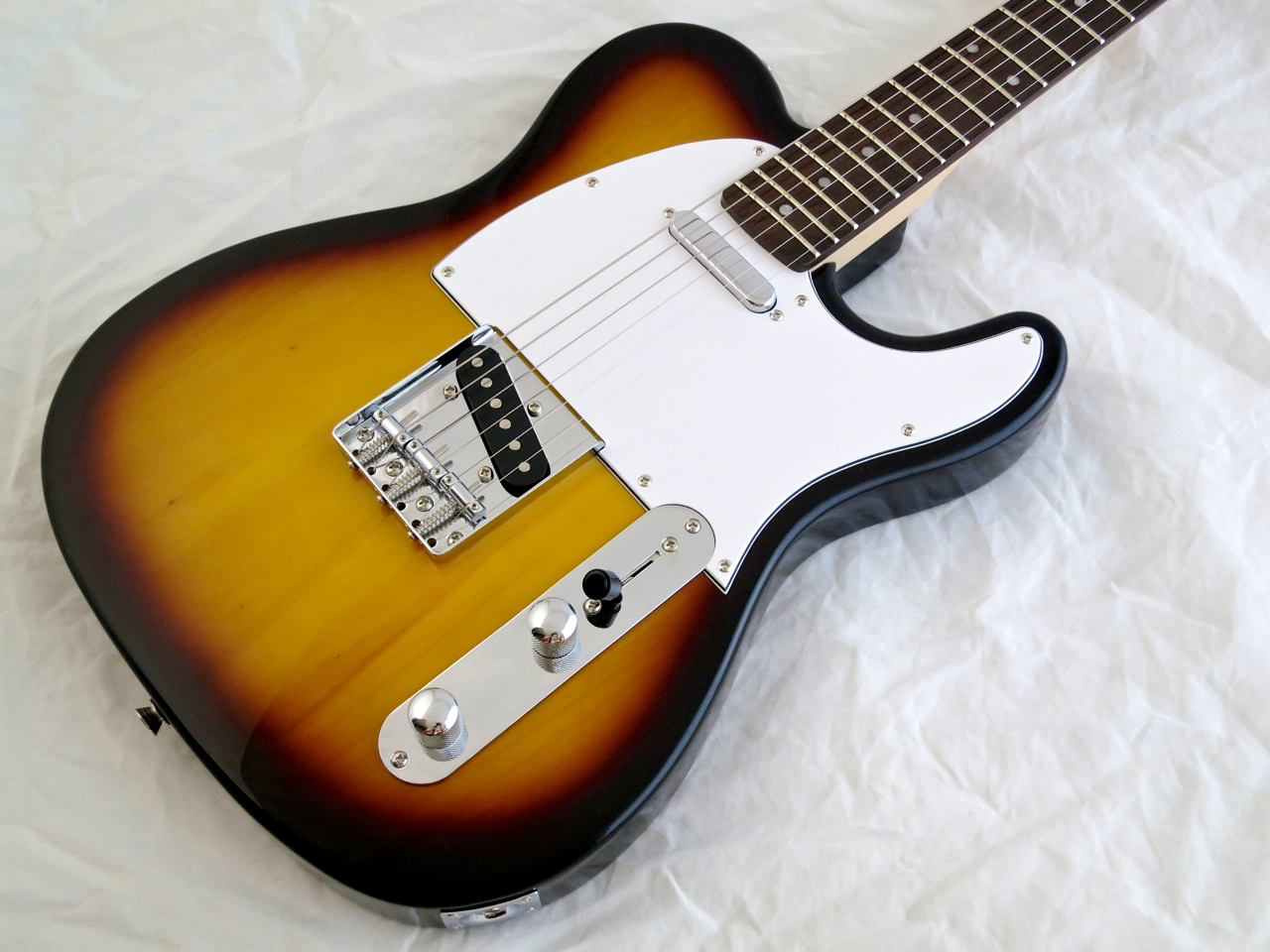
A Tokai Classic TE (current price in Finland: 249 €) in a 50s-style two-tone sunburst finish…

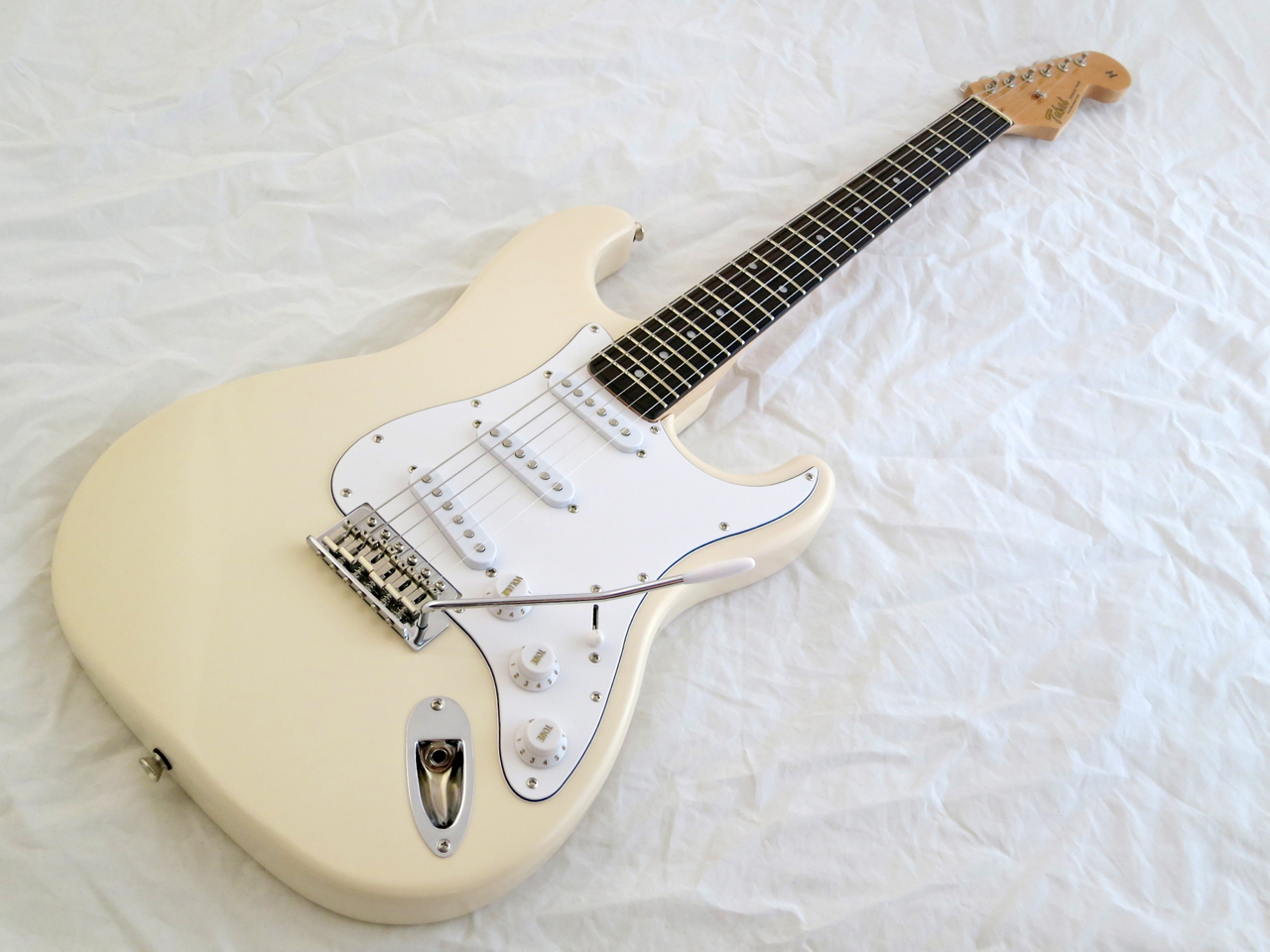
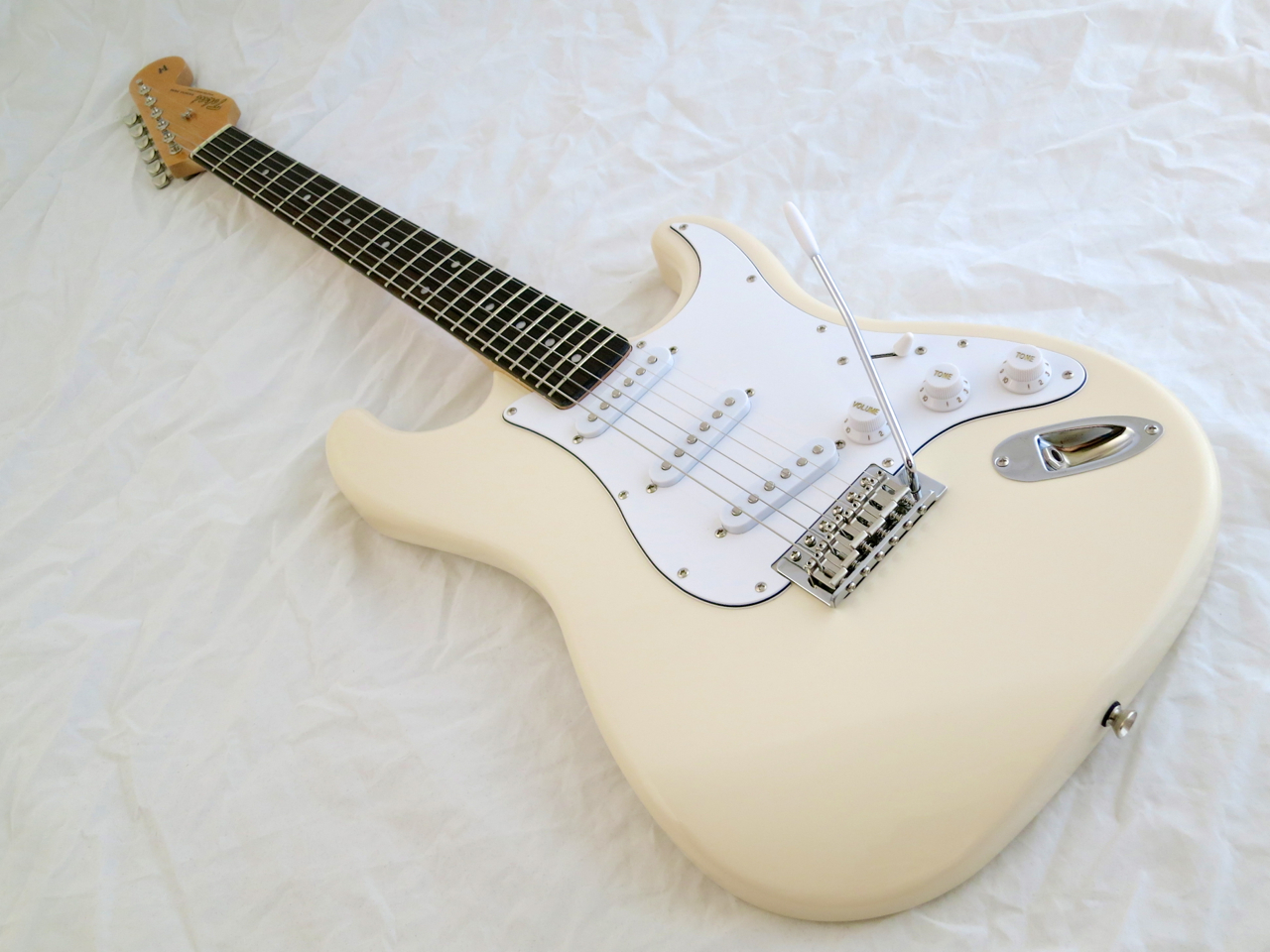
Tokai Classic ST – full front

Tokai Classic ST – full back

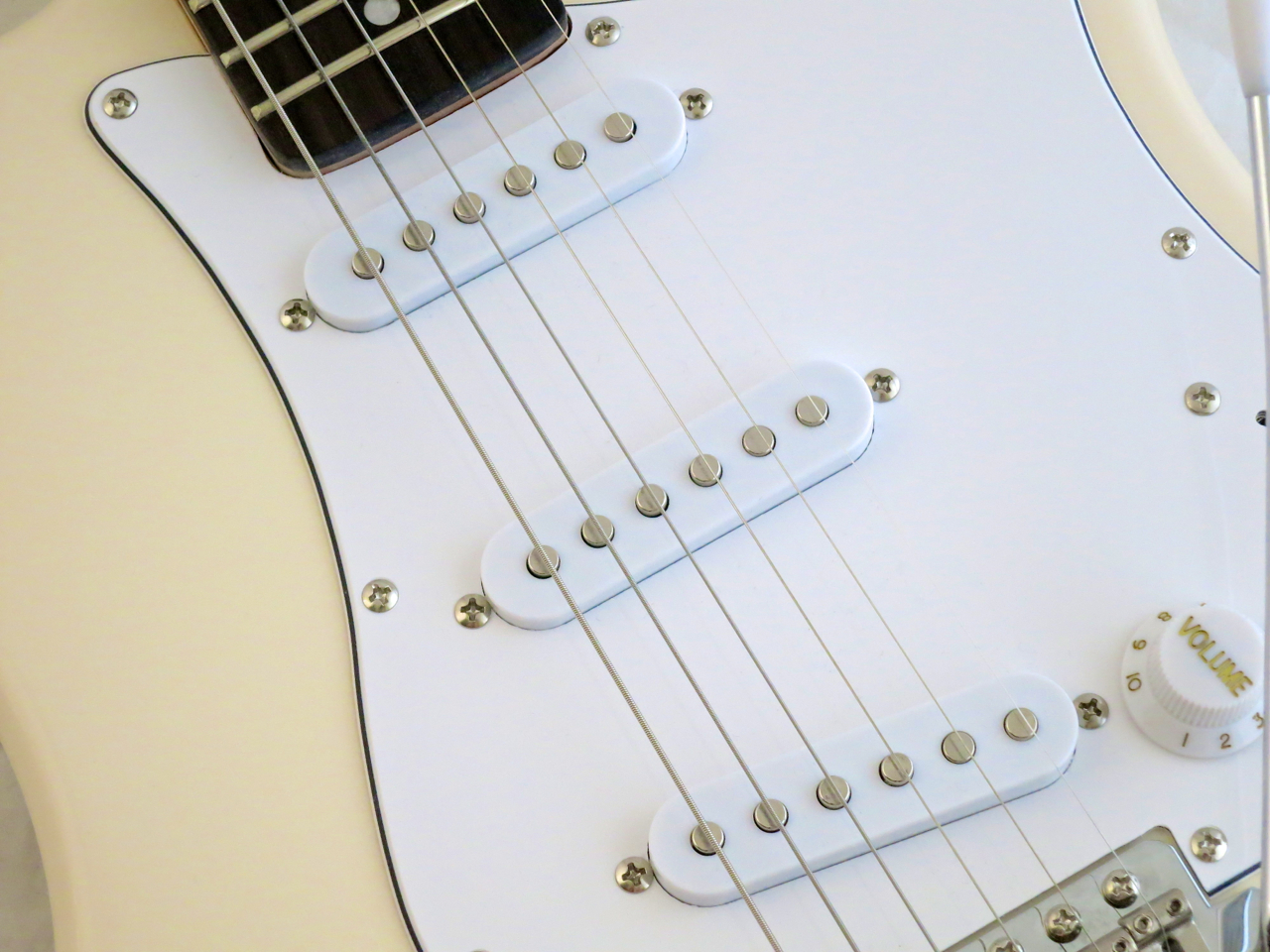
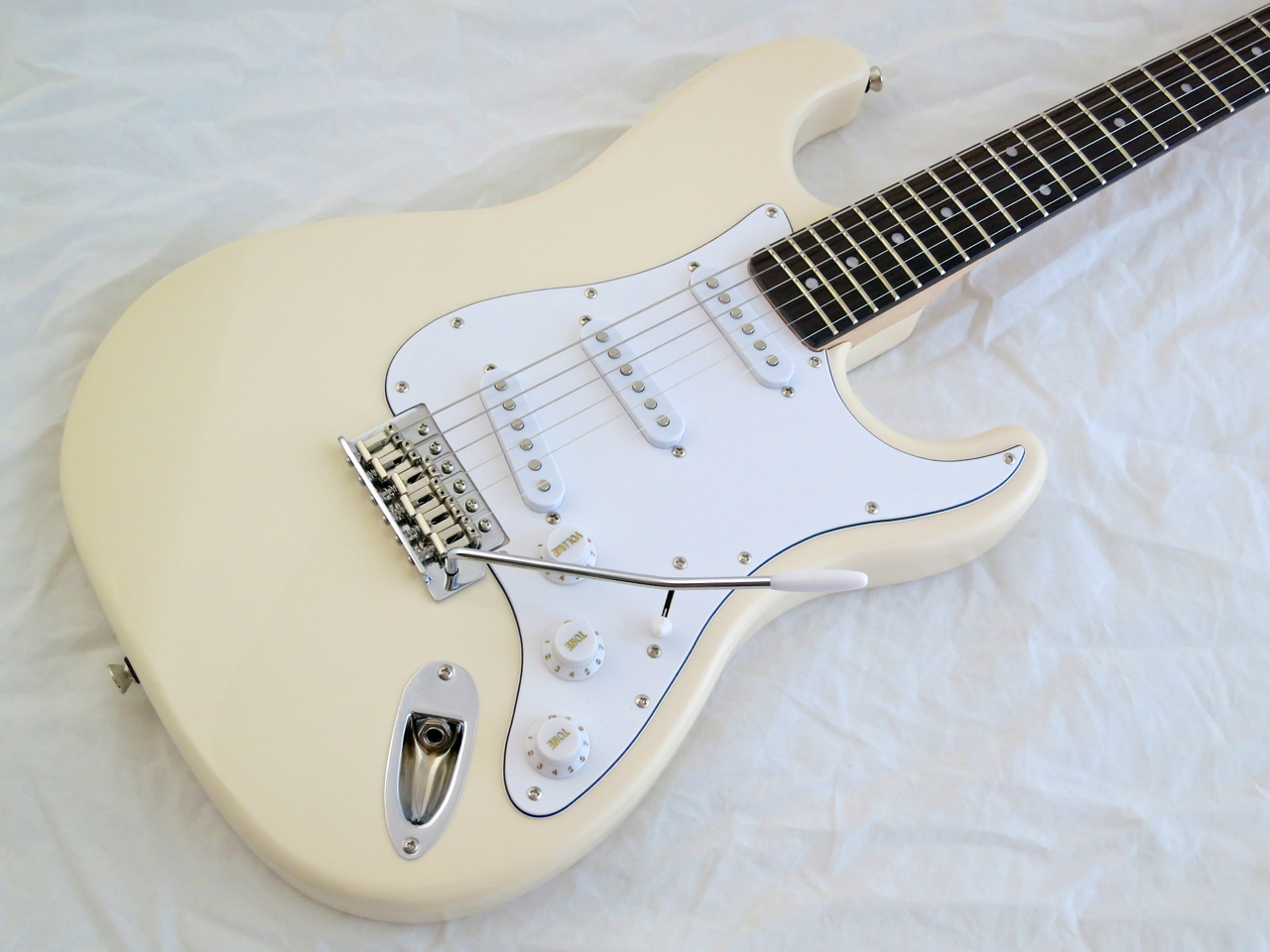
…a creamy white Tokai Classic ST (249 €)…

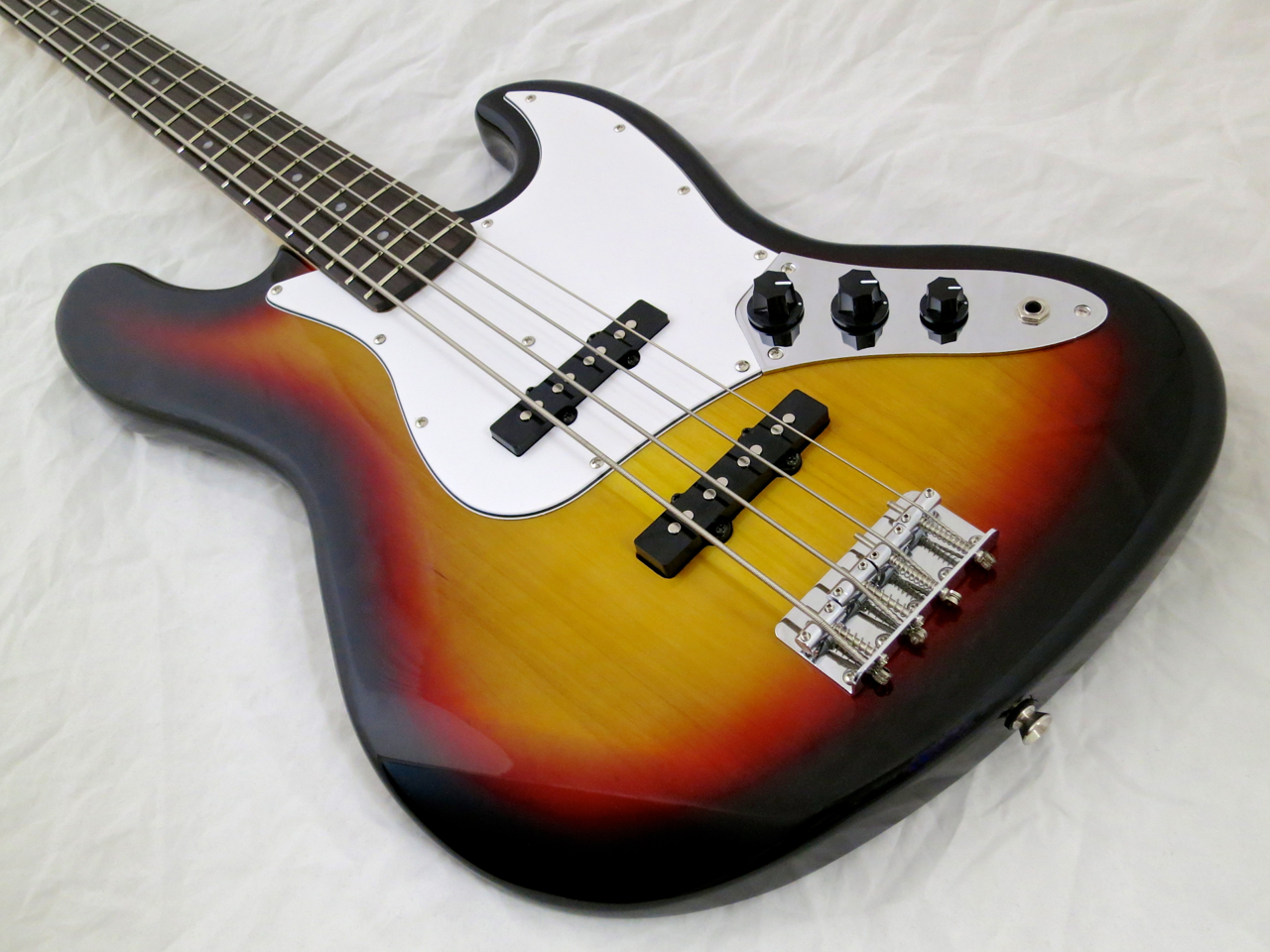
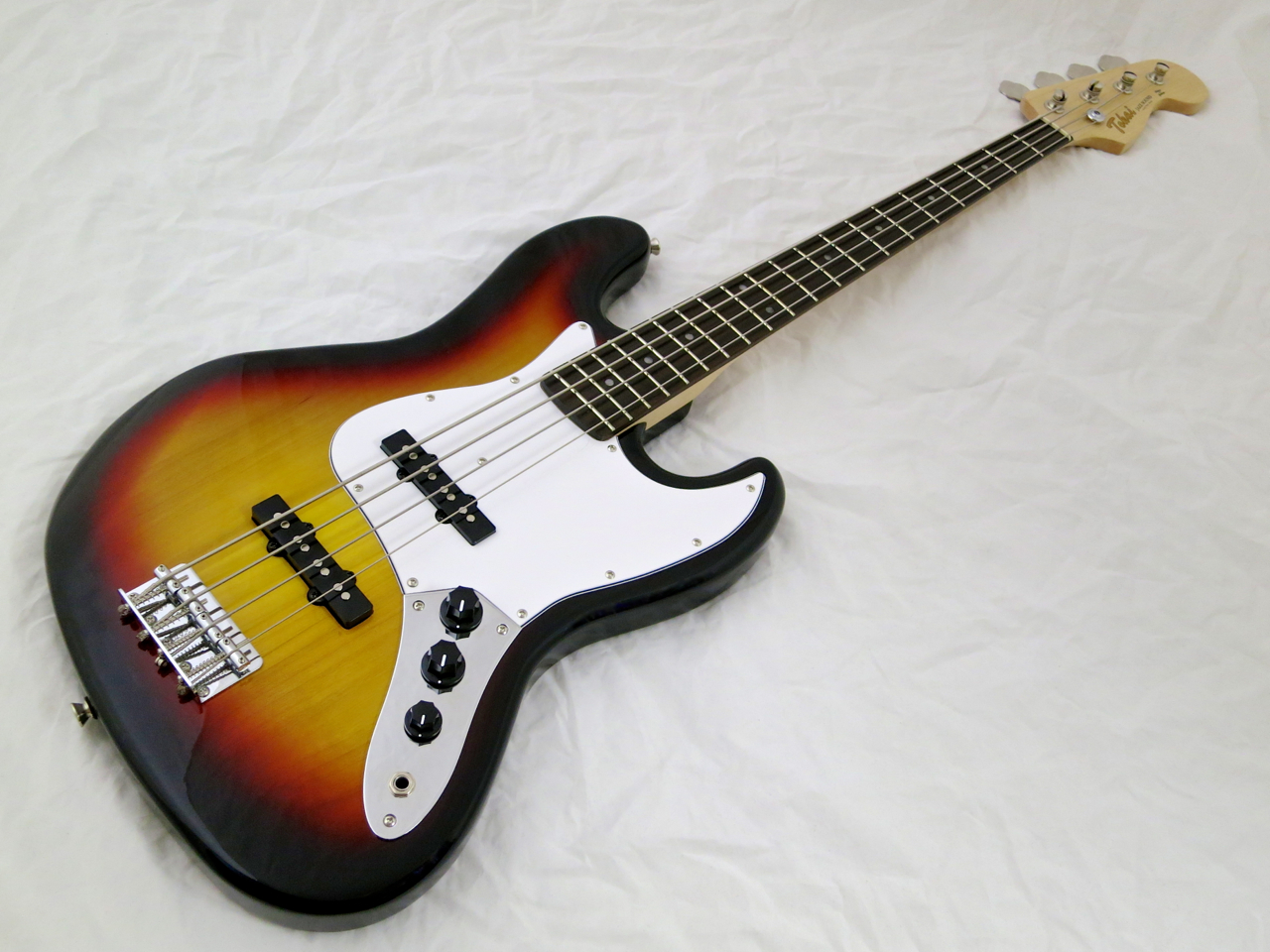
Tokai Classic JB – full front

Tokai Classic JB – full back

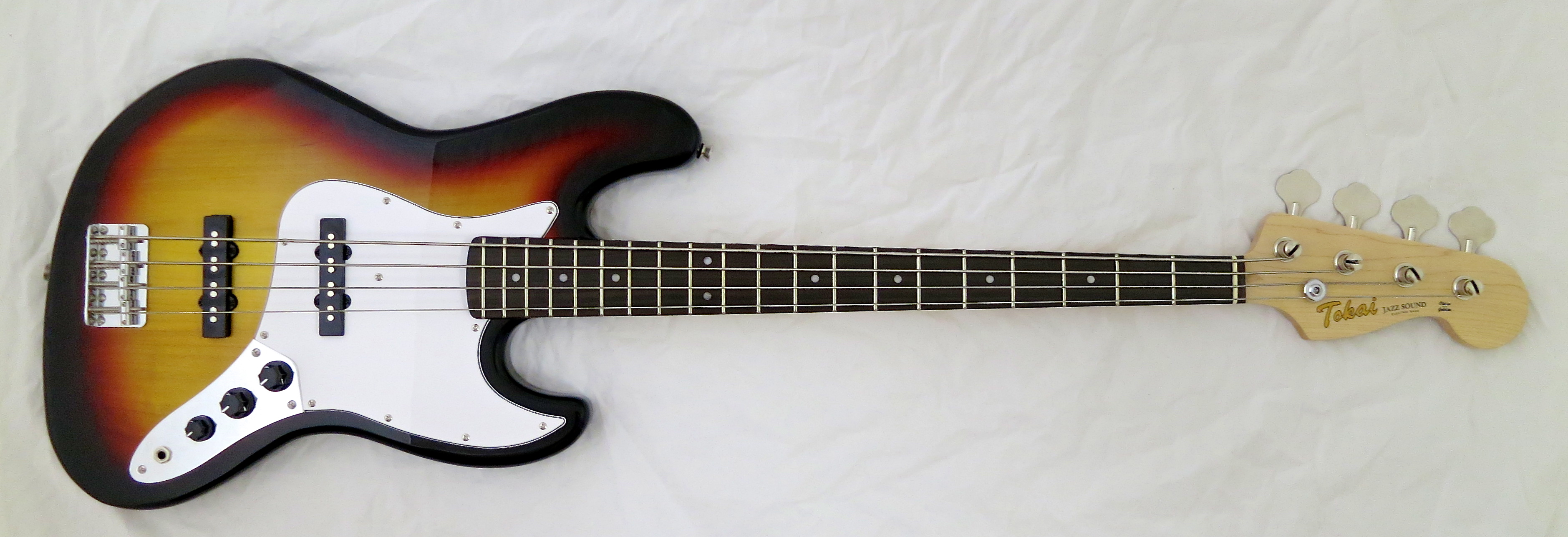
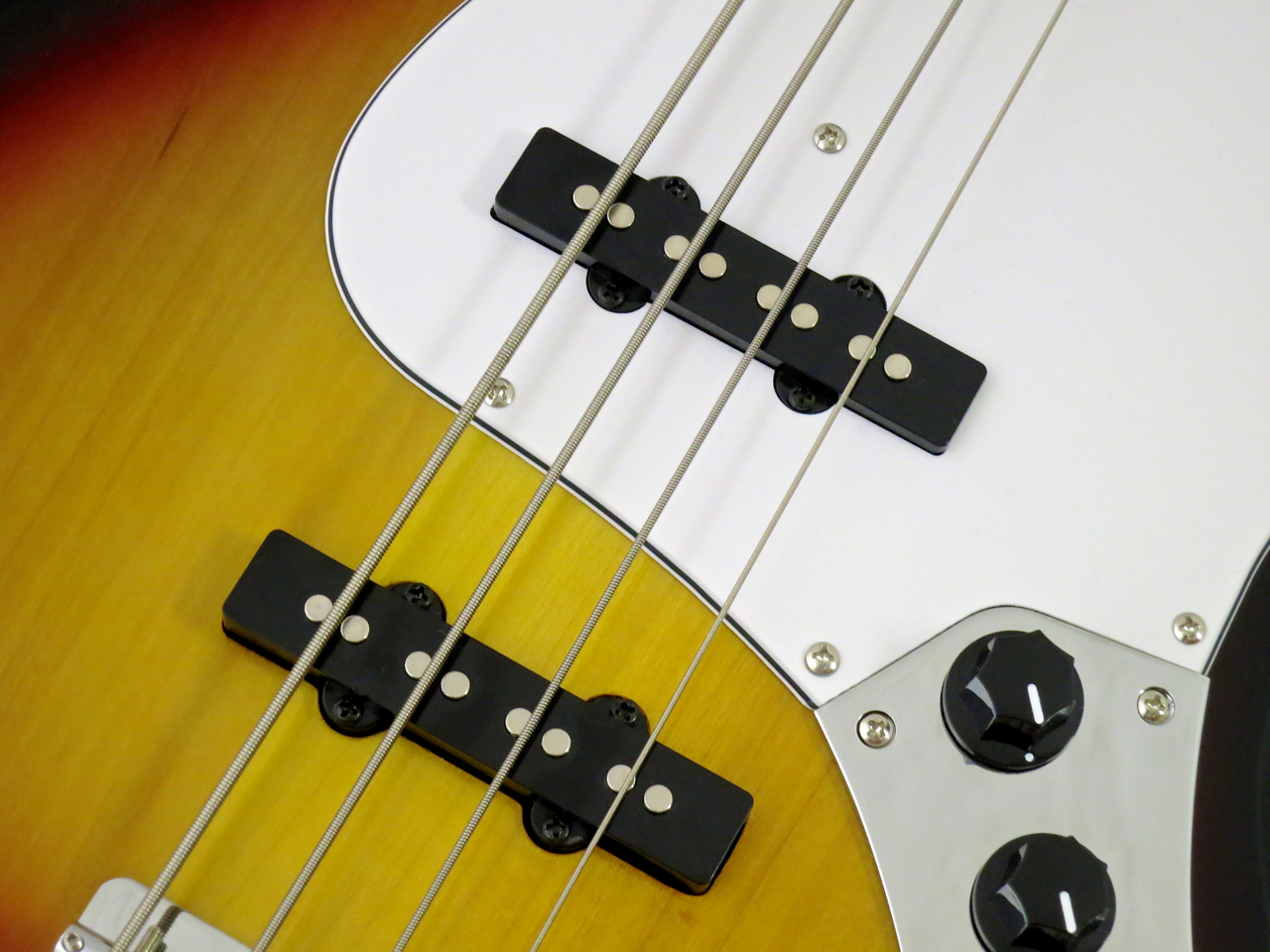
…as well as a Classic JB bass (299 €) in a fetching three-tone sunburst.

Tokai Classic ST – headstock

Tokai’s Classic series features bolt-on maple necks.

On the TE and ST models the face of the headstock sports a gloss finish.

Tokai Classic JB – headstock

The JB bass’ headstock front has received the same thin satin finish as the neck.

All Classic instruments offer easy access to the truss rod at the headstock, so you won’t have to take off the neck to make adjustments.

Tokai Classic TE – tuners

There’s a set of very decent Kluson-copies installed on the guitars.

Tokai Classic JB – tuners

The Classic JB comes with a set of Schaller-copies, which are less massive than vintage-style Klusons.

Tokai Classic guitars – fretboard

The Classic TE and ST come with a flatter-than-vintage fingerboard radius and chunkier frets, which makes the playing feel much more modern and bend-friendly.

Tokai Classic JB – fretboard

The same goes for the Tokai Classic bass.

Tokai Classic TE – back beauty 2

All Classic series bodies are made of basswood, a proven tonewood with a sound similar to alder.

Tokai Classic TE – neck plate

The black plastic cushion beneath the neck plate protects the finish.

Tokai Classic TE – bridge

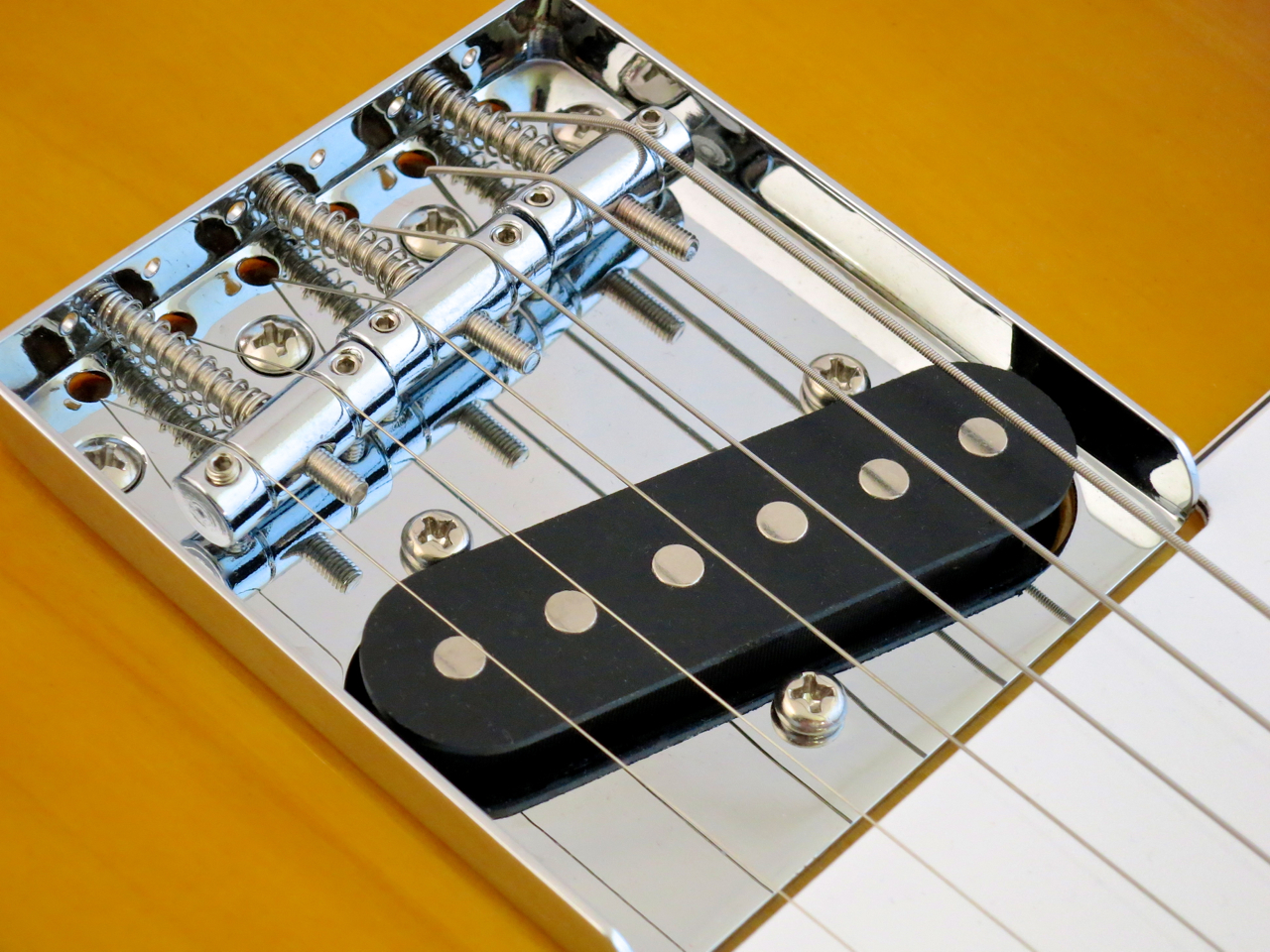
There are different versions of the three-saddle Tele-style bridge in circulation:

The Classic TE goes for the late-Sixties variety sporting three saddles with pre-set grooves for the strings.

Tokai Classic TE – back ferrules

The TE came strung the regular way, though the body, with the strings’ ball-ends anchored in ferrules. This setup is favoured by most Tele players.

Tokai Classic TE – additional bridge holes

Tokai’s Classic TE nevertheless offers an additional interesting feature:

It’s possible to string this guitar through the back of the bridge, too. This was a rare feature on original Fender Telecasters in 1958/59 that noticeably alters the feel and sound of the guitar.

Tokai Classic ST – bridge

At first glance, the bridge on Tokai’s Classic ST looks like a dead-on copy of a vintage Strat vibrato.

Tokai Classic ST – vibrato block

The vibrato block, though, isn’t as chunky as on the original. It’s about the same size as the block on a Floyd Rose vibrato.

Vintage-anoraks will sniff disapprovingly at the sight of such a block, claiming that it’s bad for the tone of the guitar. Let me tell you that the review guitar’s acoustic ring and sustain were actually quite healthy. So much for preconceptions…

Tokai Classic JB – bridge

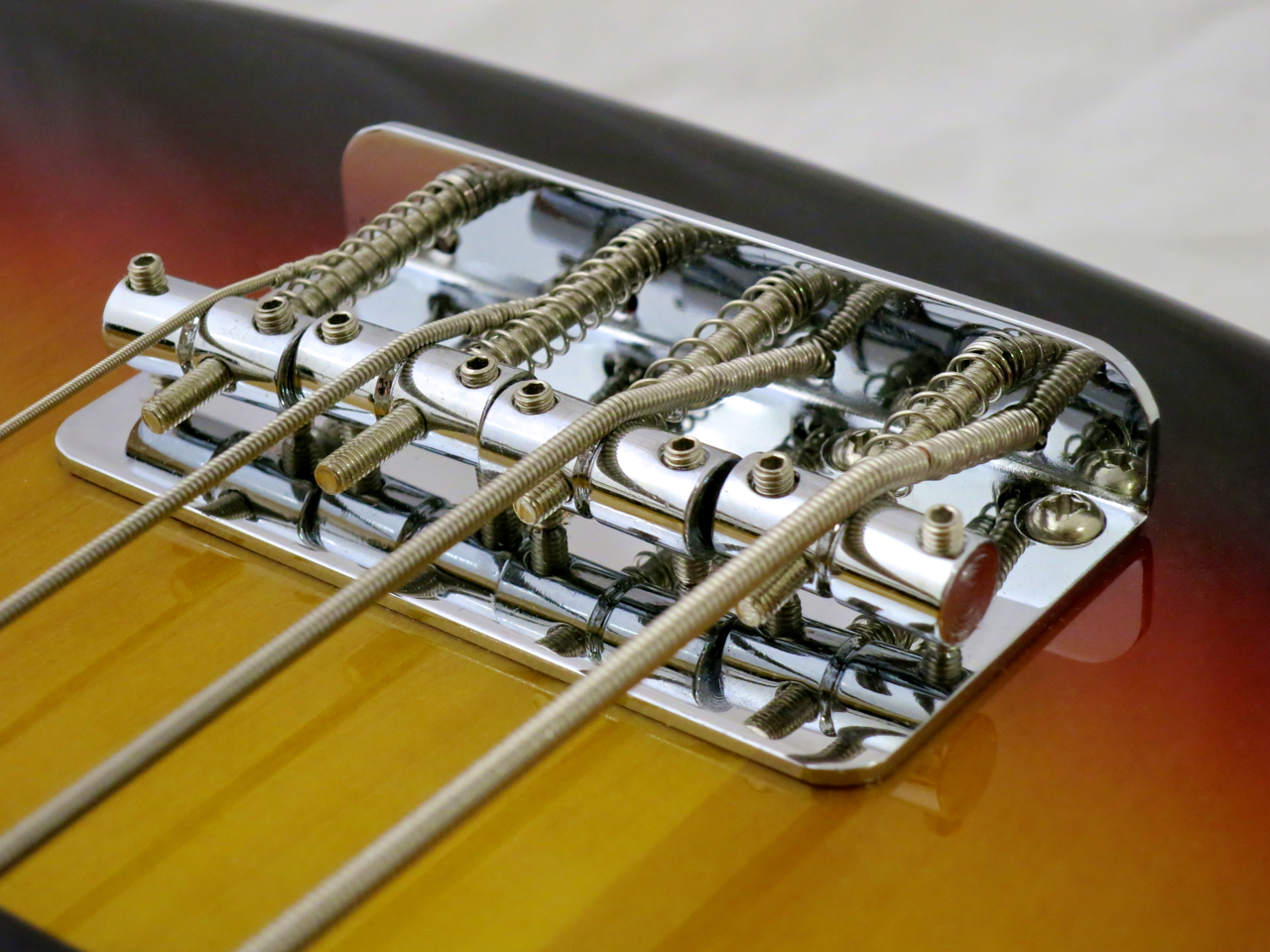
The Classic JB sports a nice copy of a 1970s Fender bass bridge.

Tokai Classic TE – pickups

Most self-appointed ”vintage-gurus” will tell you to steer clear at all times of ceramic Fender-style singlecoils.

Traditionally, a Fender-type singlecoil is constructed from six small, cylindrical magnets, which are tapped into vulcanised fibre plates. Around this magnet core a coil of thin copper wire is wound to complete the pickup. In traditional pickups the polepieces you see are actually the top ends of the alnico magnets.

Tokai Classic ST – pickups

Tokai’s Classic series uses ceramic pickups, which are made a little differently. The polepieces aren’t magnets, but rather soft steel rods, which are in physical contact to a ceramic bar magnet (or sometimes two magnets) stuck to the bottom of each pickup.

Tokai Classic JB – pickups 2

When ceramic pickups first appeared on budget guitars in the Nineties, their sound was admittedly often very spiky, brittle and sharp. This gave ceramic singlecoils a bad name, which wasn’t all that undeserved.

But that was then, and ceramic pickups have been improved drastically since. Despite this, there’s still quite a lot of prejudice against this type of guitar pickup.

In the case of these Tokai Classic instruments, I’d suggest you approach their pickups with an open heart and open ears – you might be in for a positive surprise!

Tokai Classic TE – control cavity

The Classic series features electronic parts of inexpensive, but very decent quality. All the switches and controls work fine, and without any hiccups.

As you can easily see from this picture, the workmanship is very clean in the Classic TE.

Tokai Classic JB – control cavity

The rout for the Classic JB’s component cavity wasn’t quite as clean on our review sample. Luckily, this has no bearing whatsoever on the functionality of this bass guitar.

****

Tokai Classic TE – body beauty 1

Tokai’s Classic TE is a very nice, well-playing Tele-style electric guitar.

Quite often, you will find uninspiring, flat and generic neck profiles on instruments in this price bracket.

The Classic TE is quite an exception, as it sports a comfortable, well-rounded and chunky neck, that still manages to stay on the right side of ”fat”. The fretwork is really great on our review sample. Combined with the bigger frets and flatter fretboard radius, this results in a slinky and bend-friendly playing feel.

Tokai’s Classic TE is no slouch in the sound department, either:

The neck pickup is warm and round, but never sounds boring or one-dimensional. The middle position of the switch will give you a cool, funky rhythm tone. The bridge pickup on its own offers enough twang for Country playing, and enough whack for the Classic Rock crowd.

Tokai Classic TE – body beauty 2

****

Tokai Classic ST – body beauty 1

I’d never have thought an electric guitar costing only 249 € could be as utterly inspiring as this Tokai Classic ST!

The neck feels great with its oval C-profile. The fretwork and setup make this a real player’s guitar. The vibrato works well in a vintage-style way, and the ST’s acoustic tone is woody and dynamic.

The ceramic pickups on the Tokai Classic ST are a bit hotter than the alnicos on my 50s-style Fender Stratocaster reissue. They also have a bit more sizzle and bite, but in a good way, making this more of a ”Jimi Hendrix” than a ”Buddy Holly” guitar.

Tokai Classic ST – body beauty 2

****

Tokai Classic JB – body beauty 1

Tokai’s Classic JB truly offers a lot of bass in a very pocket-friendly package.

The Classic JB will give you all the features you’d look for in a Jazz Bass-type instrument:

There’s the slender, distinctly tapered neck profile, the comfortable balance, and the wide variety (for a passive bass) of different sounds.

Tokai Classic JB – body beauty 2

This last clip lets you listen to the video’s bass and guitar tracks in isolation. During the first half all guitar tracks are played on the Classic TE, in the second half the Classic ST takes over:

****

Tokai Classic TE – beauty shot 1

Tokai Classic ST – beauty shot 1

Tokai Classic JB – beauty shot 1

Tokai’s Classic Series may well prove to set a new standard for vintage-style instruments in this price range. The three reviewed guitars were well-made, well-playing instruments, and their sound was inspiring.

While the Classic series is aimed mainly at beginners, I wouldn’t be surprised if some of the instruments crept up on pub or club stages!

****

Tokai Classic Series

Tokai Classic TE – 249 €

Tokai Classic ST – 249 €

Tokai Classic JB – 299 €

Finnish distributor: Musamaailma

****

Pros:

+ value-for-money

+ playability

+ workmanship

+ sound

Tokai Classic ST – beauty shot 2

Review: Ogre Guitars Magnox-M1

MM 2015 – Ogre all-magnesium guitars

There was this strange booth at Frankfurt Musikmesse 2015 that had everybody stop and take notice:

A company called Ogre displayed a variety of very goth effect pedals, but the real show-stopper was a medieval-looking electric guitar made completely out of magnesium alloy, called the Magnox-M1.

Thanks to Finnish distributor R-Jam Group we were able to take a closer look at this intriguing new concept.

****

Ogre Magnox-M1 – S – full front LRG

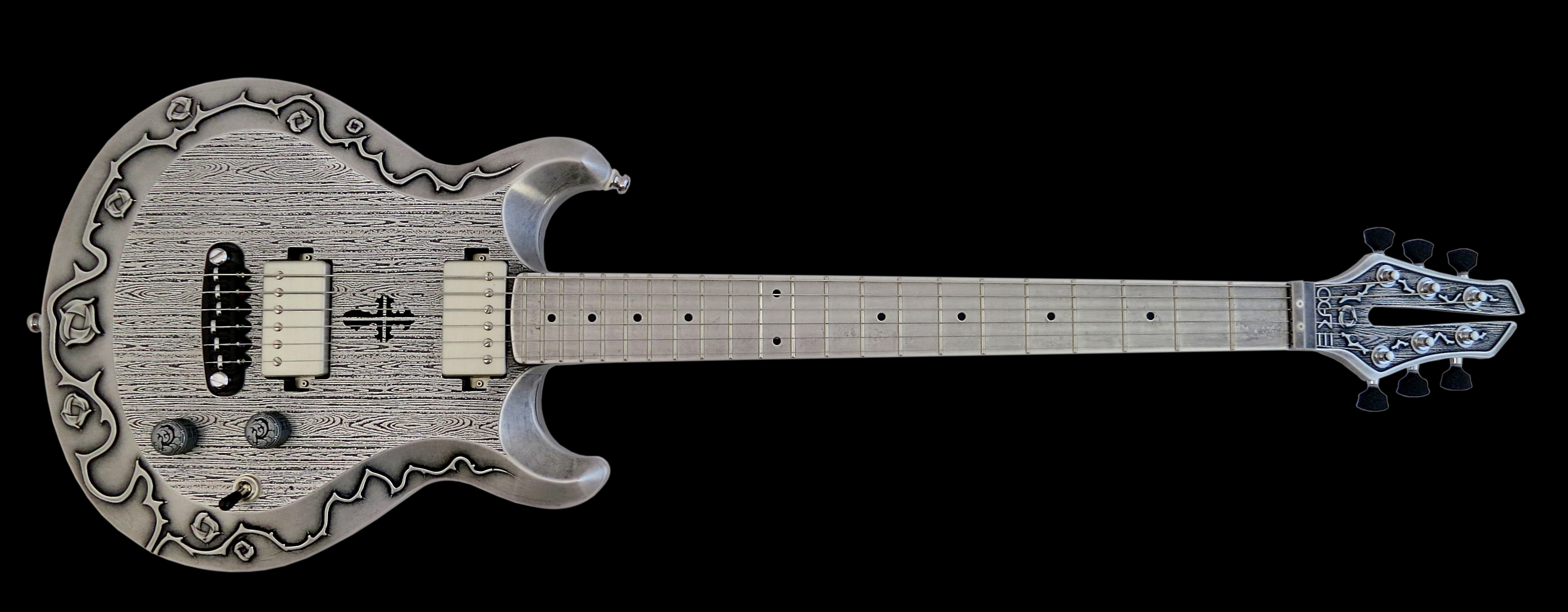
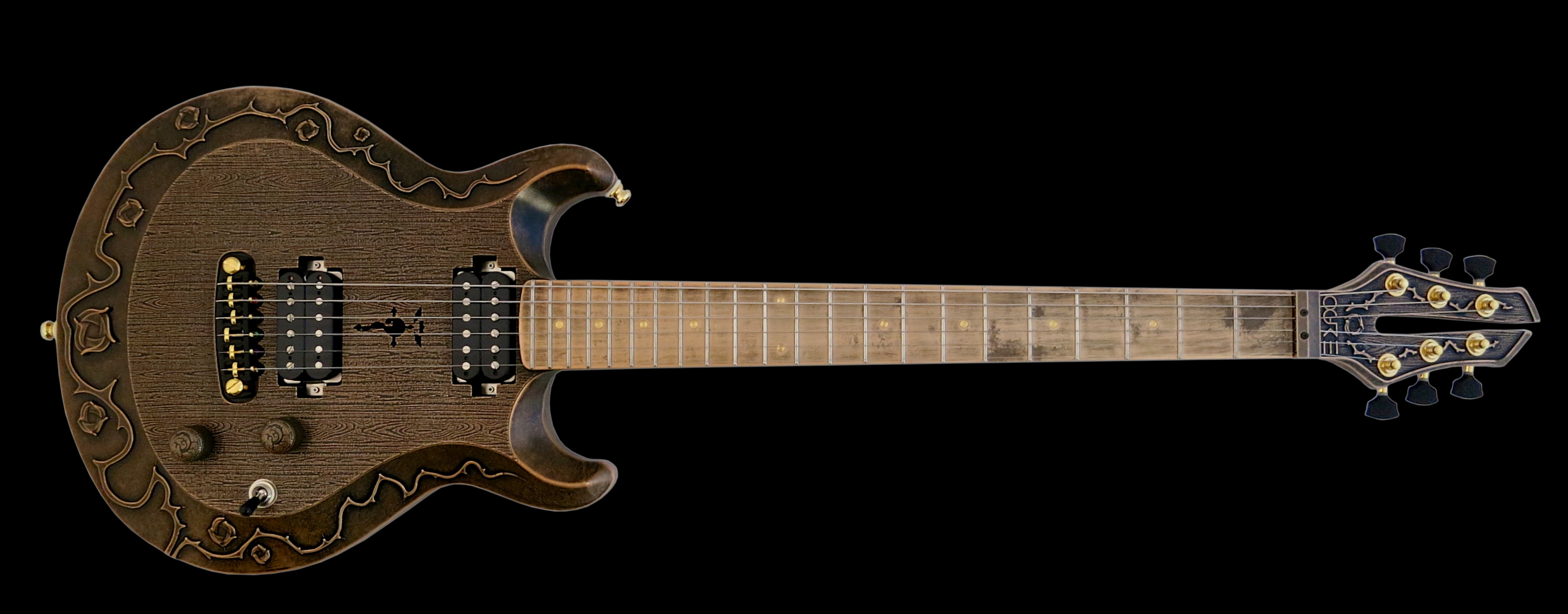
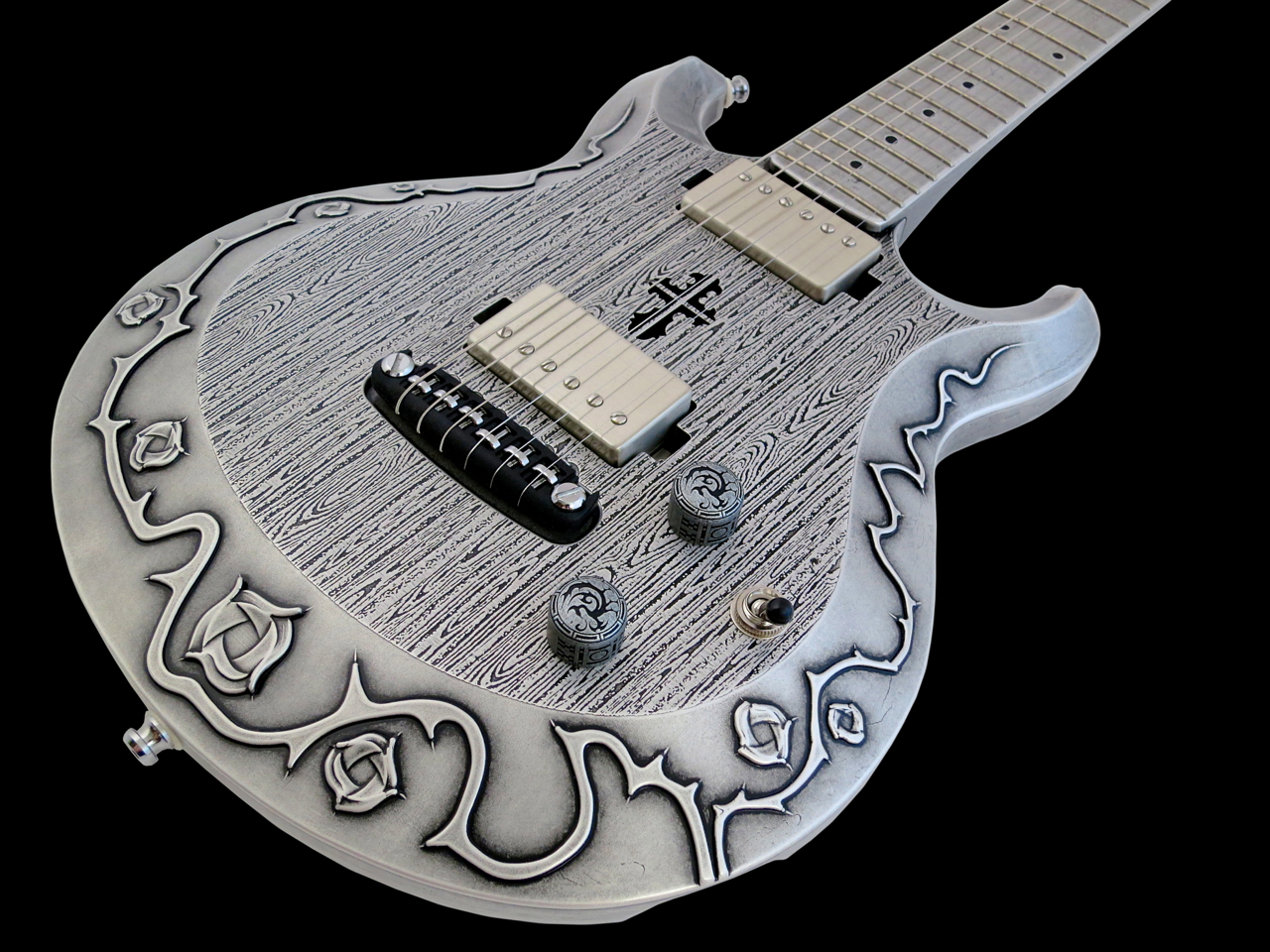
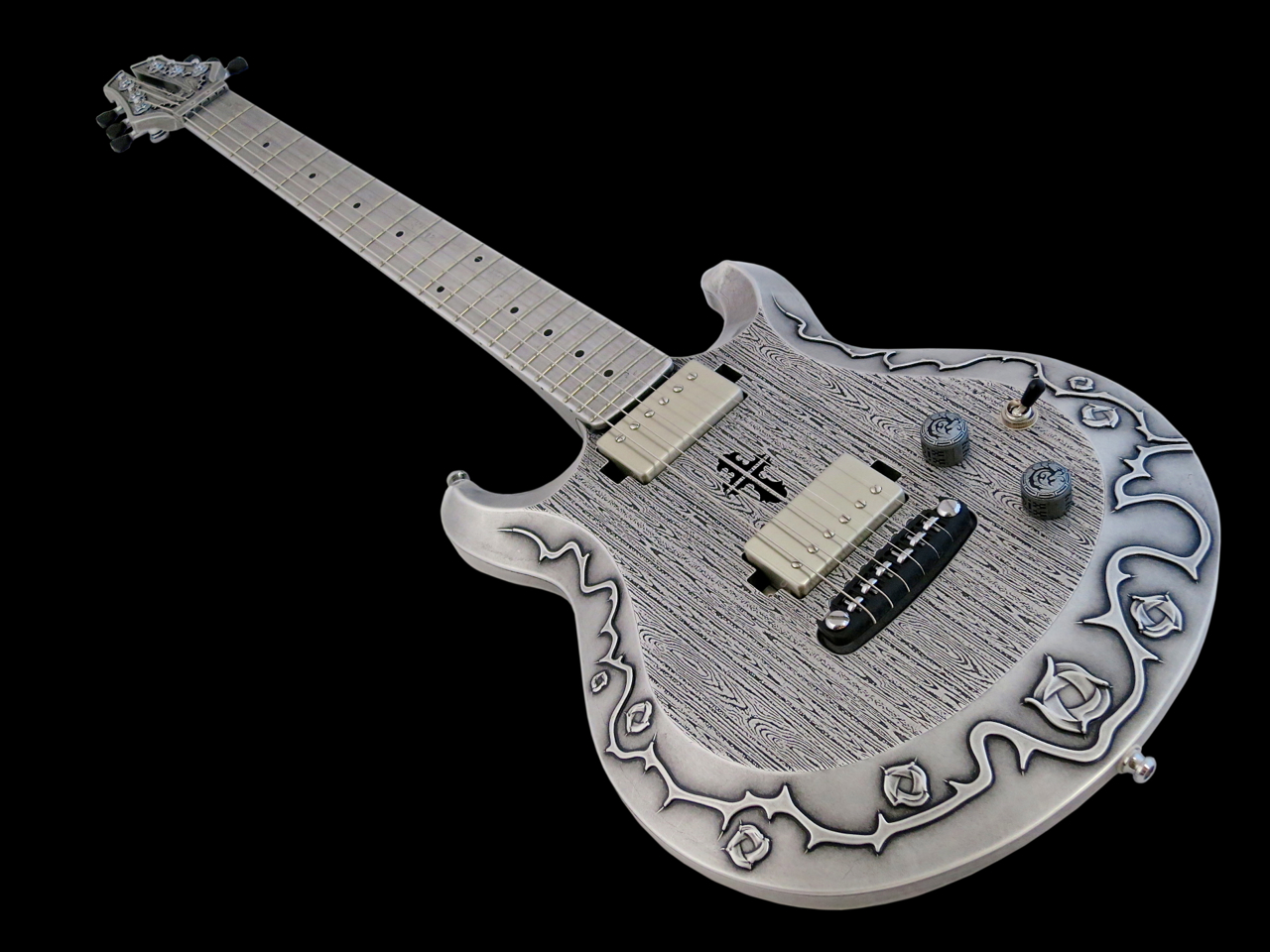
The all-metal Ogre Magnox-M1 (current price in Finland: 1,399 €) truly is a sight to behold. It isn’t often you get to see an instrument that looks like old metal, and which features beautiful rose-and-thorns reliefs on its body.

Ogre Magnox-M1 – B – full front LRG

The twin-cutaway Ogre Magnox-M1 has a scale of 25.5 inches (64.8 cm), and its thin body is partly hollow.

Our two review instruments both come with a pair of humbuckers, but there’s also an HSS-loaded Magnox-M1 available.

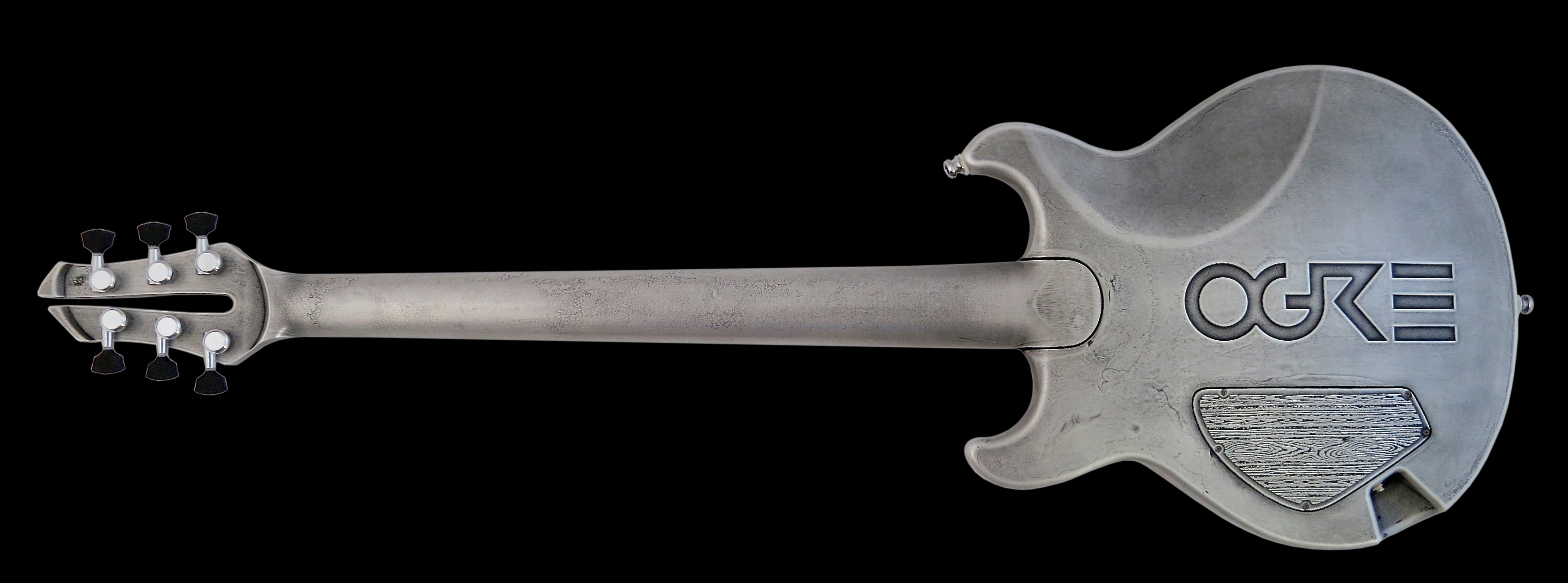
Ogre Magnox-M1 – S – full back LRG

The back of the body sports a deep ribcage bevel.

Ogre Magnox-M1 – B – full back LRG

The output jack sits in its own recess.

Ogre Magnox-M1 – S – headstock

The top nut is also made from magnesium alloy. Even though it looks a bit like a locking nut, the strings aren’t locked.

Ogre Magnox-M1 – B – tuners

Ogre go for top-drawer quality in the tuner department by using Sperzel locking tuners equipped with Ogre’s own metal tuner buttons.

Ogre Magnox-M1 – S – fretboard

The pewter-coloured Magnox-M1 sports black dot markers.

Ogre Magnox-M1 – B – fretboard

The position markers on the bronze-coloured Ogre are golden.

The Magnox comes with 22 medium jumbo frets.

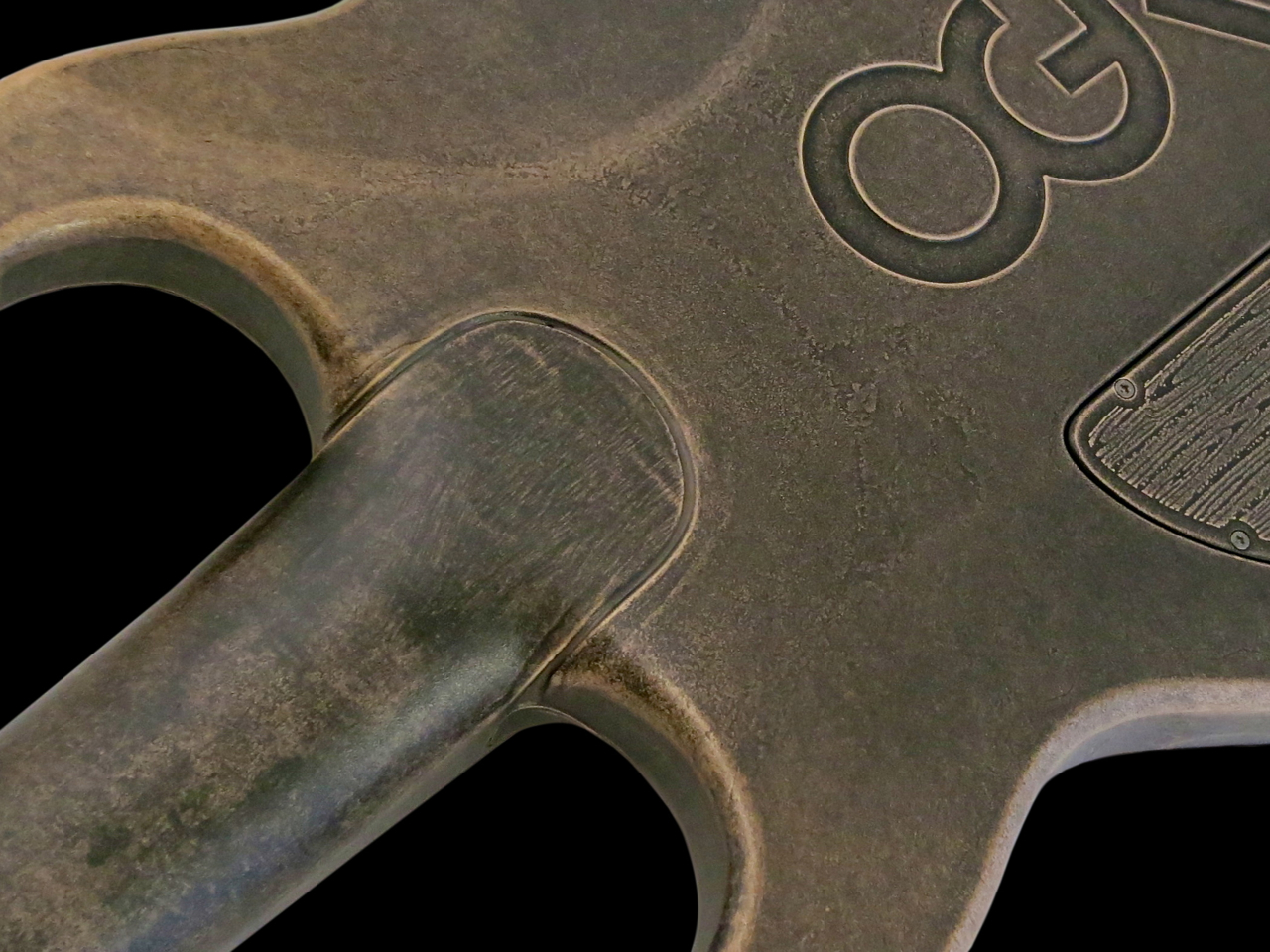
Ogre Magnox-M1 – B – neck joint

Ogre’s neck joint is very smooth, so you can widdle your way up to the dusty end with ease.

Ogre Magnox-M1 – S – bridge

The wraparound bridge is Ogre’s own design, its base cast from the same metal alloy as the rest of the guitar.

Ogre Magnox-M1 – S – pickups

Twin-humbucker equipped Magnox-M1 models are available with two different sets of pickups:

In our case, the pewter Ogre sports a pair of the company’s own PAF-style ’buckers.

Ogre Magnox-M1 – B – pickups

The bronze-coloured Magnox comes with a Seymour Duncan ’59 at the neck, and a JB model at the bridge.
Ogre Magnox-M1 – S – controls

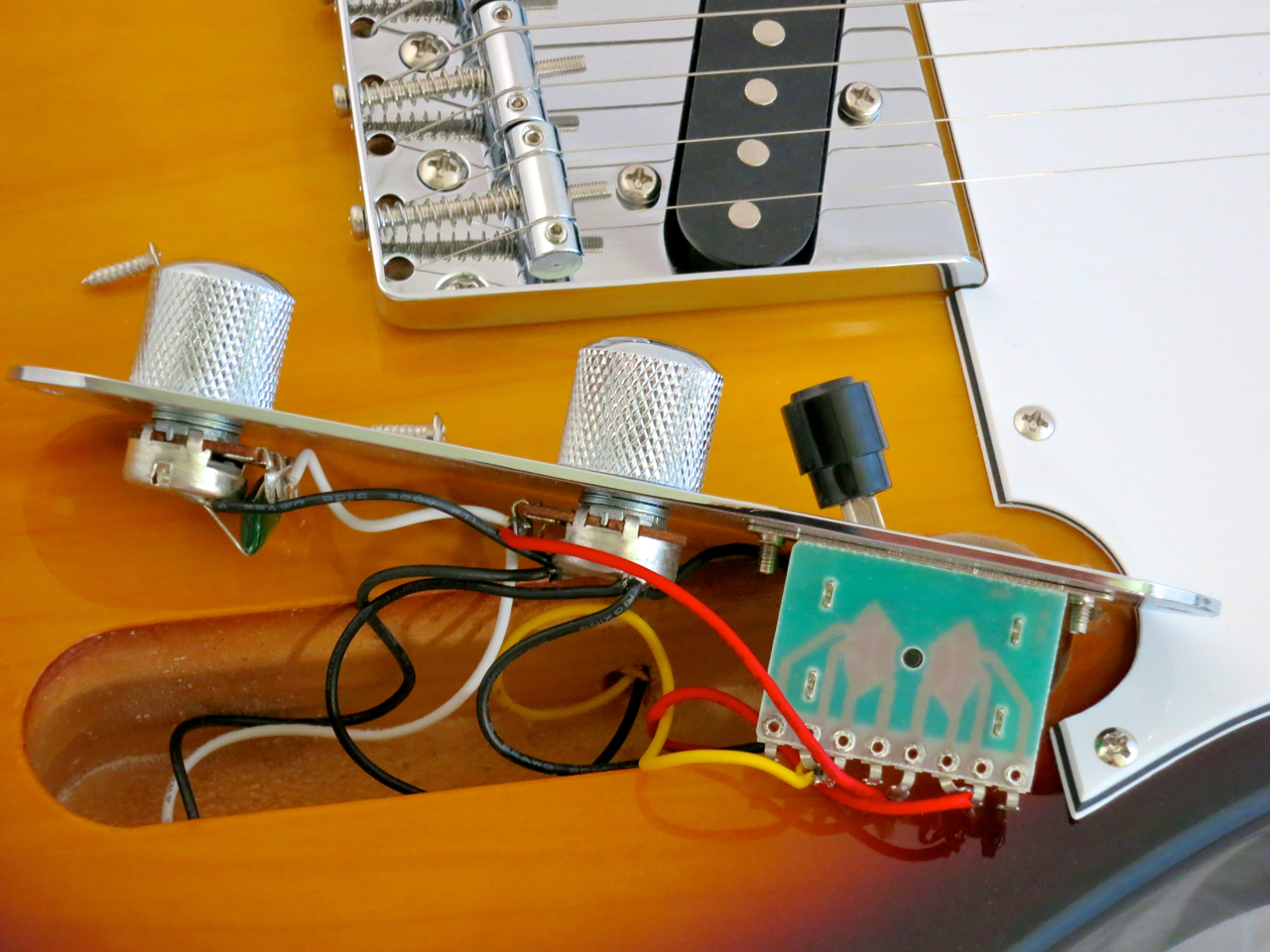
These Ogres are equipped with a three-way toggle switch, as well as master volume and tone controls. There’s a push/pull-switch hidden in the master tone control, which allows you to split the humbuckers for singlecoil tones.

Ogre Magnox-M1 – S – control cavity

A close look under the hood reveals quality parts and clean workmanship.

Ogre Magnox-M1 – cases

A fancy carbon fibre hard case is included in the price.

****

Ogre Magnox-M1 – S – back beauty

Thanks to its semi-hollow body the Ogre Magnox-M1 only weighs a very comfortable 3.8 kg. Despite the fact that the neck and fingerboard are not hollowed out, the M1 stays perfectly balanced .

Ogre’s expertise in the finishing department is really something else:

Both guitars look old, rusty, and oxidised, and some parts even look coarse and scratched, but this is all a very cool illusion conjured up by the excellent finishing job. In reality the Magnox-M1 feels very smooth and friendly, even if it’s a tad cool when pulled out of its case. The only things that are real are the beautiful reliefs on the front and back of the body (as well as on the control cavity lid), all other dings and scratches are an optical effect.

In my opinion Ogre’s not-too-chunky C-profiled neck feels really great. The fretwork is excellent, and the fretboard’s edges are comfortably smooth.

Ogre Magnox-M1 – S – body beauty 1

Ogre’s own PAF-style humbuckers have a very dynamic, crisp and open sound, thanks to their moderate output levels. The split-coil settings sound remarkably Fender-like.

The sound clips both feature the split humbuckers first, followed by the full humbucker settings, both starting with the neck pickup:

Ogre Magnox-M1 – S – body beauty 2 from PS

Ogre Magnox-M1 – B – body beauty 1

The Seymour Duncan set is higher in output, and the sounds have a fatter mid-range character. Played into a clean channel, the bridge humbucker can sound a bit honky at times, but using crunchy settings will make the JB model rock even harder than the Ogre bridge humbucker.

The sound clips both feature the split humbuckers first, followed by the full humbucker settings, both starting with the neck pickup:
Ogre Magnox-M1 – B – body beauty 2

Ogre Magnox-M1 – S – beauty shot 1

The demo track features the pewter-hued Magnox-M1 exclusively for the first half, while all the guitar tracks in the second half have been played on the bronze Ogre model.

• rhythm guitars (split pickups) – left channel: both pickups, right channel: bridge pickup

• lead guitar – full neck humbucker

Ogre Magnox-M1 – B – beauty shot 2

****

Ogre Magnox-M1 – S – beauty shot 2

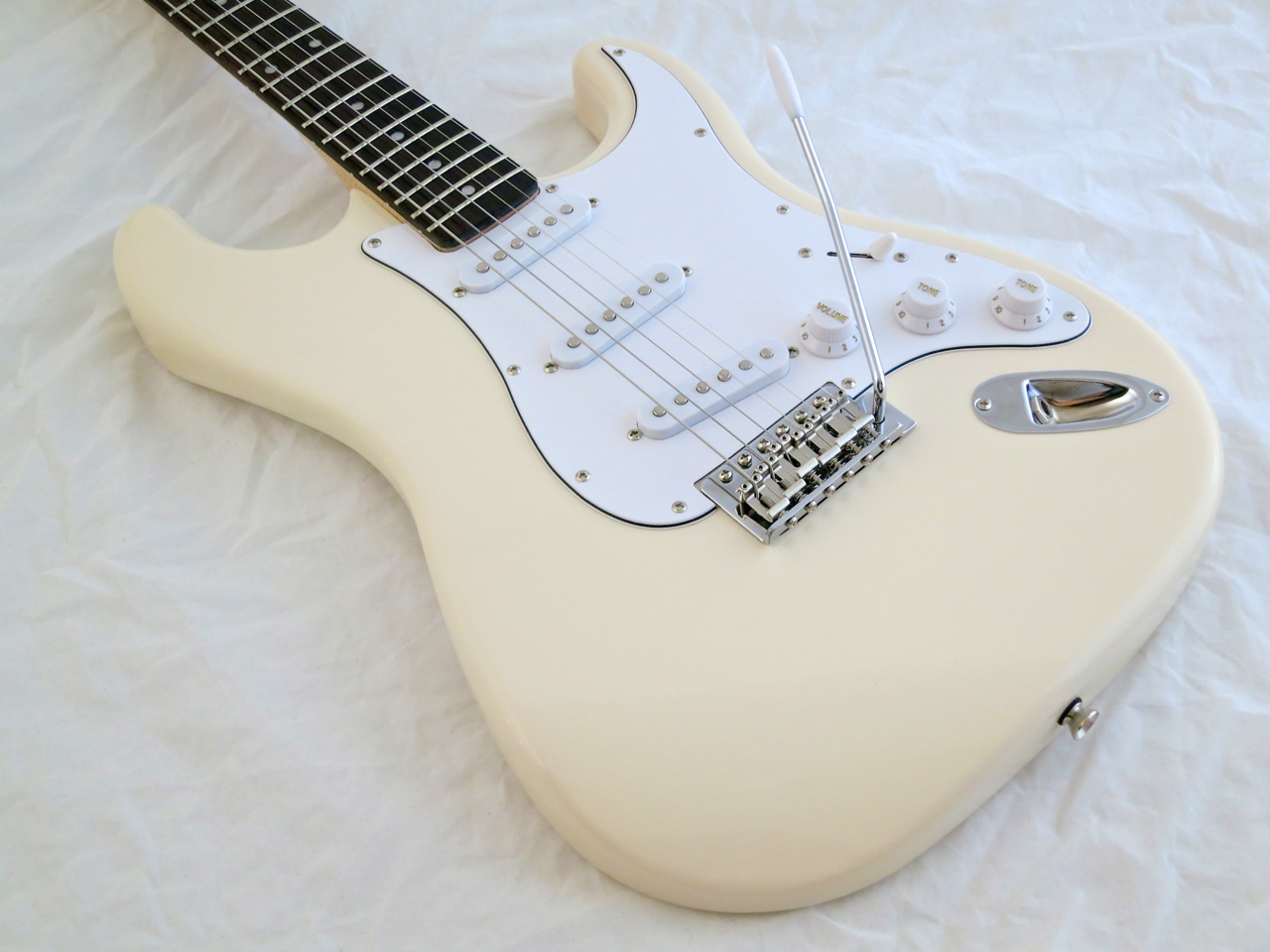
The Ogre Magnox-M1 is a very fine electric guitar, which offers a viable alternative to traditional wooden instruments. I really like the visual design of these guitars, too, but some might disagree. The best thing about the Magnox-M1 guitars, though, is the great sound they make. These are very inspiring instruments, indeed!

Ogre Magnox-M1 – B – beauty shot 1

****

Ogre Magnox-M1

1.399 €

Finnish distributor: R-JAM Group

****

Pros:

+ cool design

+ workmanship

+ playability

+ different pickup options available

+ sound

Testipenkissä: Tokai Classic Series

Tokai Classic TE – headstock

Tokai Guitarsin maine perustuu firman erittäin laadukkaisiin ja tarkkoihin kopiosoittimiin. Japanilaisen Tokain ”versiot” klassikkosoittimista olivat 1970- ja 80-luvulla monessa suhteessa jopa parempia kuin saman aikakauden kitarat USA:sta.

Tokain parhaimpia sarjoja valmistetaan yhä Japanissa, pitkälti käsityönä. Firman kiinalaiset sarjat tarjoavat kuitenkin oivan mahdollisuuden omistaa aidon Tokai-kitaran tai -basson myös pienemmällä budjetilla.

Upouuden Tokai Classic -sarjan idea on tarjota edullisia soittimia, joissa vintage ulkonäköön on yhdistetty nykyaikainen soitettavuus.

****

Tokai Classic TE – full front

Tokai Classic TE – full back

Kitarablogi sai kolme Tokai Classic -sarjalaista testiin:

Tokai Classic TE:n (249 €) Two Tone Sunburst -viimeistelyllä…

Tokai Classic ST – full front

Tokai Classic ST – full back

…kermanvalkoisen Tokai Classic ST:n (249 €)…

Tokai Classic JB – full front

Tokai Classic JB – full back

…sekä Classic JB -basson (299 €) kolmivärisellä sunburst-värityksellä.

Tokai Classic ST – headstock

Tokai Classic -sarjan kaulat veistetään vaahterasta.

TE- ja ST-mallissa viritinlavan etupuoli on viimeistelty kiiltävällä lakalla.

Tokai Classic JB – headstock

Bassomallissa koko kaulassa on ohut mattaviimeistely.

Kaularaudan säätäminen tapahtuu Classic-soittimissa lavan puolelta, ilman kaulan irrottamisen tarvetta.

Tokai Classic TE – tuners

Kitaroissa käytetään hyviltä tuntuvia Kluson-kopioita.

Tokai Classic JB – tuners

Classic JB:n lapaan on asennettu pienempiä Schaller-tyylisiä vintage virittimiä.

Tokai Classic guitars – fretboard

Classic TE:n ja ST:n otelautojen vintagea loivempi radius, sekä kitaroiden nykyaikaiset medium jumbo -nauhat, tekevät soittotuntumasta hyvin mukavan, etenkin kielten venytyksissä.

Tokai Classic JB – fretboard

Myös Tokai Classic -bassossa on sopivasti nykyaikainen soittotuntuma.

Tokai Classic TE – back beauty 2

Classic-sarjojen kokopuiset rungot valmistetaan lehmuksesta.

Tokai Classic TE – neck plate

Kaulalevyn alta löytyvä musta muovityyni suojaa soittimen viimeistelyä.

Tokai Classic TE – bridge

Tele-tyylisestä tallasta löytyy erilaisia versioita:

Classic TE:n tallassa on kolme tallapalaa, joissa on valmiiksi kieliuria.

Tokai Classic TE – back ferrules

TE:n kielet voi pujottaa rungon läpi, mikä on juuri se tapa, jota Tele-soittajat tavallisesti suosivat.

Tokai Classic TE – additional bridge holes

Tokai Classic TE:ssä on kuitenkin myös mahdollisuus kiinnittää kielet tallan takaseinään.

Se oli harvinainen ominaisuus vuoden 1958/59 Fender Teleissä, ja tämä kiinnitystapa muuttaa tuntuvasti kitaran soundia ja tatsia.

Tokai Classic ST – bridge

Tokai Classic ST:n talla näyttää edestä täydelliseltä vintage-vibran kopiolta.

Tokai Classic ST – vibrato block

Tallan metalliblokki on kuitenkin jonkin verran ohuempi kuin alkuperäisessä – se on hyvin samankaltainen kuin Floyd Rose -vibran blokki.

Vintage-hipsterit aloittaisivat blokin takia heti valittelun sen tuomasta ”huonosta” soundista, mutta ainakin testisoitimessa akustinen soundi ja kitaran sustain olivat hyvinkin kohdillaan.

Tokai Classic JB – bridge

Classic JB:n talla on hyvä kopio 1970-luvun Fender-tallasta.

Tokai Classic TE – pickups

Monet ”vintage-gurut” eivät koskaan koskisi sellaiseen Fender-tyyliseen soittimeen, jonka mikrofoneissa on alkuperäisestä poikkeava rakenne:

Perinteinen tapa rakentaa Fender-tyylinen mikrofoni on kiinnittää lieriömäisiä magneettipätkiä kahteen kuitulevyyn. Magneettirivin ympärille käämitään sitten mikin kela. Näissä perinteisissä mikrofoneissa näkyvät navat ovat mikrofonin magneetit.

Tokai Classic ST – pickups

Tokai Classic -sarjan soittimissa käytetään hieman edullisempia mikrofoneja, joissa on teräksisiä napapaloja, sekä mikkirungon alle liimattu keraaminen tankomagneetti (tai kaksi).

Tokai Classic JB – pickups 2

Kun nämä keraamiset mikrofonit ilmestyivät 1990-luvulla edullisissa soittimissa, niiden soundi oli eittämättä hirveän piikikäs ja korvia raastava. Mikkityyppi sai tästä (osittain oikeutetusti) huonon maineen.

Alkuajoista kehitys on kuitenkin mennyt hurjaa vauhtia eteenpäin, ja nykyisten edullisten keraamisten mikrofonien laatua on parannettu hyvin tuntuvasti.

Ainakin Tokai Classic -soittimien tapauksissa kannattaa lähestyä niiden mikrofoneja ennakkoluulottomasti.

Tokai Classic TE – control cavity

Classic-sarjan elektroniikka on laadultaan mukavasti asiallinen – kaikki säätimet ja kytkimet toimivat moitteettomasti.

Tokai Classic JB – control cavity

Testibasson elektroniikkakolossa työnjälki ei ollut ihan niin siisti kuin testikitaroissa. Tämä ei kuitenkaan vaikuta millään lailla soittimen toimivuuteen.

****

Tokai Classic TE – body beauty 1

Tokai Classic TE on erittäin mukavan tuntuinen Tele-tyylinen sähkökitara.

Tämän hintaluokan soittimissa törmää melko usein sellaisiin kaulaprofiileihin, jotka tuntuvat kulmikkailta tai liian ohuilta.

Classic TE on tässä ilahduttava poikkeus, kitaran mukavan pyöreän ja lihaksikkaan kaulan ansiosta, joka ei kuitenkaan ole liian paksu. Myös TE:n nauhatyö on kiitettävällä tasolla.

Testisoittimen paino ja soitettavuus olivat siis kohdillaan, samoin kuin TE:n soundi:

Etumikrofoni on lämmin ja pyöreä, mutta kuitenkin eloisa, kytkimen keskiasennosta taas saadaan loistava Funk-soundi, ja tallamikrofonissa sekä Country-twäng että Rock-asenne ovat kohdallaan.

Tokai Classic TE – body beauty 2

****

Tokai Classic ST – body beauty 1

Miten vain 249 euroa maksava sähkökitara voi ollakin niin inspiroiva kuin tämä Classic ST?

Kaula tuntuu erittäin mukavalta (C-profiili), soittotuntuma on kevyt ja vaivaton, vibratalla toimii hyvin (vintage-tyylisissä raameissa), ja akustisessa soinnissa on kiitettävästi dynamiikkaa ja ”puuta”.

Tokai Classic ST:n keraamisissa mikit ovat hieman kuumemmat kuin esimerkiksi vertailussa käytetyssä, vintage-tyylisessa Stratossa. Mikkien soundissa on myös hiukan enemmän preesensalueen purevuutta – soundi on siis enemmän ”Jimi Hendrix” kuin ”Buddy Holly”.

Tokai Classic ST – body beauty 2

****

Tokai Classic JB – body beauty 1

Classic JB -bassokin tarjoaa paljon soundia hyvin kohtuuhintaisessa paketissa.

Tokai Classic JB tarjoaa kaikki ne ominaisuudet, joita vanha Jazz-basso fani soittimeltaan kaipaa:

Kaulaprofiili on mukavan solakka, soittimen balanssi on kohdallaan, ja basson tarjoama soundikirjo on passiivibassoksi laaja.

Tokai Classic JB – body beauty 2

Viimeisessä klipissä soi videon biisin kitara- ja bassoraidat ilman muuta taustaa (ensimmäinen puolisko: TE; toinen: ST):

****

Tokai Classic TE – beauty shot 1

Tokai Classic ST – beauty shot 1

Tokai Classic JB – beauty shot 1

Tokai Classic -sarjasta voisi mielestäni helposti tulla uusi laatustandardi tämän hintaluokan soittimissa. Testisoittimissa laatu, soitettavuus ja soundi olivat enemmän kuin kohdillaan.

Vaikka Classic-soittimien kohderyhmä on selvästi aloittelijat, voi vanha kettukin saada paljon iloa näistä kitaroista ja bassoista!

****

Tokai Classic Series

Tokai Classic TE – 249 €

Tokai Classic ST – 249 €

Tokai Classic JB – 299 €

Maahantuoja: Musamaailma

****

Plussat:

+ hinta-laatu-suhde

+ soitettavuus

+ työnjälki

+ soundi

Tokai Classic ST – beauty shot 2

Testipenkissä: Ogre Guitars Magnox-M1

MM 2015 – Ogre all-magnesium guitars

Ogre-nimisen firman ständi Frankfurt Musikmesse 2015 -messuilla oli oikea katseenvangitsija. Siellä nähtiin monta goottityylistä kitaraefektiä, sekä täysin magnesiumseoksesta valettuja Magnox-M1-sähkökitaroita, jotka muistuttavat keskiaikaisia koriste-esineitä.

Suomalainen maahantuoja R-Jam Group tuo tätä mielenkiintoista kitaramallia nyt myös meidän ulottuville.

****

Ogre Magnox-M1 – S – full front LRG

Täysin metallista valmistettu Ogre Magnox-M1 (promootiohinta 1.399 €) on kyllä erikoinen näky, etenkin sen reliefeillä koristetun rungon (ja lavan), sekä kitaran relikoidun viimeistelyn ansiosta.

Ogre Magnox-M1 – B – full front LRG

Kahdella soololovella varustetun Ogre Magnox-M1:n mensuuri on täyspitkä 25,5 tuumaa (64,8 cm), ja sen runko on osittain ontto.

Testillä käyneillä kitaroilla on kaksi humbucker-mikrofonia, mutta Magnox-M1-mallia saa myös HSS-varustuksella.

Ogre Magnox-M1 – S – full back LRG

Rungon takapuolella on reilunkokoinen mukavuusviiste.

Ogre Magnox-M1 – B – full back LRG

Lähtöjakki on upotettu omaan syvennykseen kitaran alareunaan.

Ogre Magnox-M1 – S – headstock

Kitaran (ei-lukittava) satula on – samoin kuin koko muu soitin – tehty magnesiumista.

Ogre Magnox-M1 – B – tuners

Virittimet ovat laadukkaat Sperzel-lukkokoneistot, jotka on varustettu Ogren omilla mustilla metallinupeilla.

Ogre Magnox-M1 – S – fretboard

Vaalealla – tinaa tai vanhaa hopeaa muistuttavalla – kitaralla on otelautaan upotettuja mustia otemerkkejä.

Ogre Magnox-M1 – B – fretboard

Pronssinvärisessä mallissa taas on kullanväriset otemerkit.

Magnoxeissa on 22 medium jumbo -kokoista nauhaa.

Ogre Magnox-M1 – B – neck joint

Ogren kaulaliitos on erittäin sulava, mikä mahdollistaa esteettömän pääsyn myös ylimmille nauhoille.

Ogre Magnox-M1 – S – bridge

Wraparound-tallan runko on valettu samasta magnesiumseoksesta, jota käytetään myös kitaran muita osia varten.

Ogre Magnox-M1 – S – pickups

Kahdella humbuckerilla varustetut Magnox-M1-kitarat saa kahdenlaisilla mikrofoneilla:

Tinanväriseen testisoittimeen on asennettu kaksi Ogren valmistamaa, PAF-tyylistä humbuckeria.

Ogre Magnox-M1 – B – pickups

Pronssi-Magnoxissa taas löytyy Seymour Duncanin ’59-kaulamikrofoni, sekä JB-malli tallahumbuckerina.

Ogre Magnox-M1 – S – controls

Ogressa käytetään kolmiasentoisen mikkikytkimen lisäksi master volume- ja master tone -säätimiä. Tonessa on lisäksi vielä nostokytkin, jolla puolitetaan humbuckerit.

Ogre Magnox-M1 – S – control cavity

Elektroniikkalokerossa näkyy laadukkaita osia ja siistiä työnjälkeä.

Ogre Magnox-M1 – cases

Kitaran hintaan kuuluu myös laadukas ja modernistinen hiilikuidusta valmistettu kova laukku.

****

Ogre Magnox-M1 – S – back beauty

Ohuen ja osittain onton runkonsa ansiosta Ogre Magnox-M1:n paino jää 3,3 kilolla jopa alle monen Stratocasterin painon. Koska kaula ja otelauaa on jätetty soundin ja sustainin maksimoinnin vuoksi massiivisemmaksi, malli on kuitenkin hivenen verran kaulapainoinen. Laadukkaalla nahkahihnalla tämä lievä taipumus saadaan kuitenkin hoidettua tehokkaasti.

UPDATE (15.09.2015): Testissä käyneet kitarat tulivat varhaisesta tuotantoerästä. Uusissa Ogre Magnox-M1 -erissä balanssiongelma on korjattu lisäämällä rungolle noin 500 grammaa painoa.

Ogren viimeistely on kyllä ihan omaa laatuaan:

Vaikka molemmat kitarat näyttävät vanhalta, hieman hapetetulta metallilta, ja niiden pinta näyttää karhealta ja osittain jopa naarmuuntuneelta, Magnoxit tuntuvat todellisuudessa hyvin sileiltä ja aluksi myös aavistuksen verran kylmiltä. Ainoastaan rungon ja lavan etupuolella (sekä elektroniikkalokeron kannessa) näkyvät reliefit ja kohokuvat ovat siis aitoja, kaikki muu karheus on vain illuusio.

Minun mielestäni Ogren valitsema keskipaksu ja pyöreähkö C-profiili tuntuu erittäin mukavalta. Nauhatyö on ensiluokkaista, ja myös otelaudan reunat on pyöristetty mukavan sileiksi.

Ogre Magnox-M1 – S – body beauty 1

Ogren omilla PAF-tyylisillä humbuckereilla on maltillinen teho ja hyvin avoin soundi. Puolitettu tallamikki kuulostaa yllättävän Fender-tyylisen kirkkaalta.

Audiopätkissä soitetaan aina ensin puolitetut vaihtoehdot ja sen jälkeen täysillä humbuckereilla. Järjestys on kaulamikki –> molemmat yhdessä –> tallamikki:

Ogre Magnox-M1 – S – body beauty 2 from PS

Ogre Magnox-M1 – B – body beauty 1

Seymour Duncan -mikrofoneilla on vähän enemmän tehoa, ja niiden keskialue on selvästi pyöreämpi. Puhtaissa soundeissa täysi tallahumbuckeri voi jopa kuulostaa hieman honottavalta, kun taas särösoundeissa JB-mallilla on ehkä hieman enemmän potkua kuin Ogre-tallamikissä.

Audiopätkissä soitetaan aina ensin puolitetut vaihtoehdot ja sen jälkeen täysillä humbuckereilla. Järjestys on kaulamikki –> molemmat yhdessä –> tallamikki:

Ogre Magnox-M1 – B – body beauty 2

Ogre Magnox-M1 – S – beauty shot 1

Demobiisissä ensimmäisen puoliskon kaikki kitararaidat on soitettu hopeanvärisellä Magnox-M1-kitaralla, ja toisessa puoliskossa kuullaan vain pronssivärisellä Ogrella soitettuja soundeja.

• komppikitarat (puolitetut mikit) – vasen kanava: molemmat mikit, oikea kanava: tallamikki

• soolokitara – täysi kaulahumbucker

Ogre Magnox-M1 – B – beauty shot 2

****

Ogre Magnox-M1 – S – beauty shot 2

Ogre Magnox-M1 on erittäin laadukas, hyväntuntuinen ja hyvältä kuulostava vaihtoehto puusta tehdylle sähkökitaralle. Minusta myös kitaroiden visuaalinen puoli on erittäin hyvin onnistunut, vaikka tämä on varmaan makukysymys. Olin kuitenkin positiivisesti yllättänyt, kuinka hyviltä nämä kitarat tuntuivat ja kuulostivat. Inspiroivia soittimia molemmat!

Ogre Magnox-M1 – B – beauty shot 1

****

Ogre Magnox-M1

1.399 € (promootiohinta)

Maahantuoja: R-JAM Group

****

Plussat:

+ massasta erottuva ulkonäkö

+ työnjälki

+ soittotuntuma

+ eri mikrofonivaihtoehdot

+ soundi

Miinukset:

– lievä kaulanpainoisuus (nyt korjattu – kts. teksti)

Testipenkissä: Digitech Trio

Digitech-Trio

Tämä kuvio on varmasti kaikille tuttu:

On keskiviikkoilta – nyt olisi nastaa jammailla tunti tai pari, mutta rumpalilla on biljarditurnaus ja basistin täytyy vahtia lapsiaan.

Lopputulos on jälleen kerran ilta yksin telkkarin edessä ja kitara sylissä…

Onneksi nyt on olemassa paljon luovempi ratkaisu jammailuun ja treenaamiseen – Digitechin uusi Trio Band Creator -pedaali tarjoaa väsymättömän rytmisektion hyvin kompaktissa muodossa.

****

Digitech Trio full front

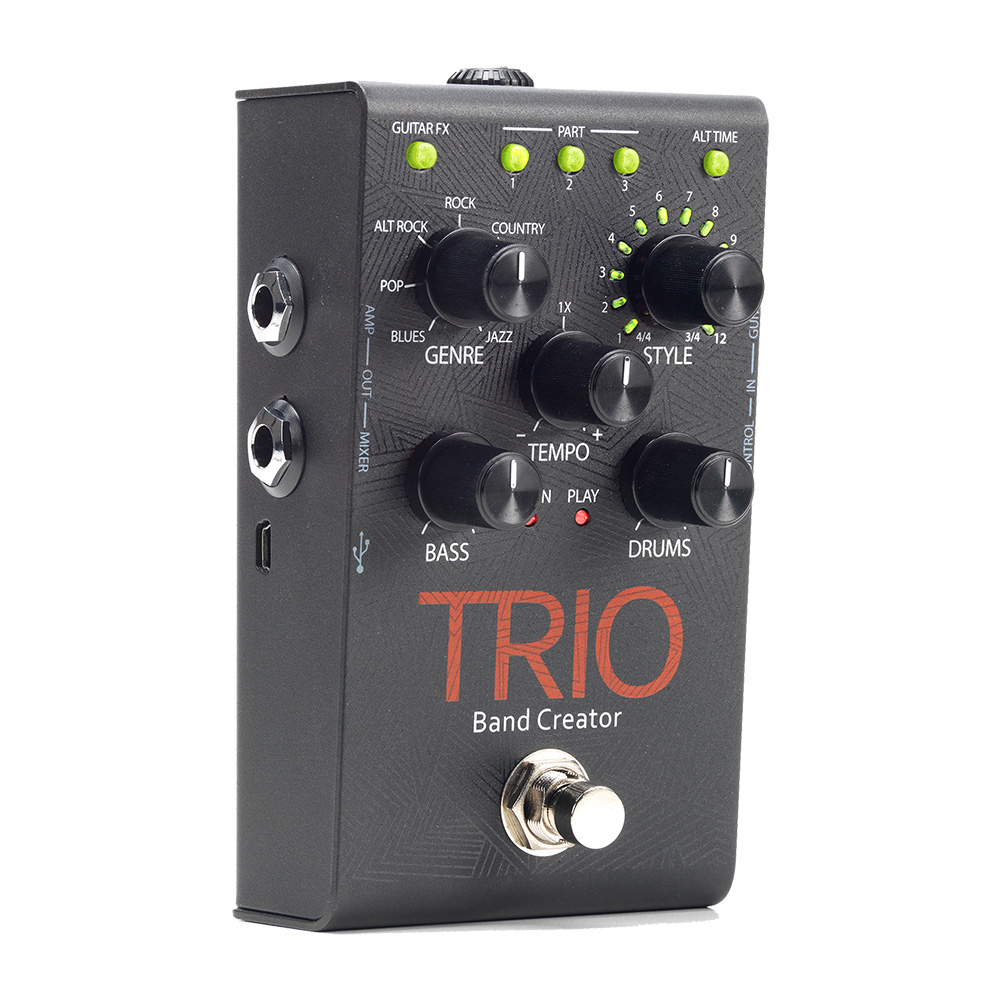
Digitech Trio -pedaali (katuhinta noin 240 €) oppii Learn-moodissa biisin (tai biisiosan) soinnut ja rakenteen suoraan kitarasignaalista. Trioon kytketään ihan tavallinen kitarajohto – käyttöön ei siis tarvita kallista MIDI-mikrofonia tai kömpelöä ohjelmointia käsin.

Trio osaa soittaa komppikuvioita seitsemästä eri musiikkigenrestä (Genre). Jokaisessa genressä on 12 eri tyylivaihtoehtoa (Styles), siis eri tavalla soitettuja rumpupatterneja ja bassokuvioita. Kaikki tyylit on kehitetty yhteistyössä Band In A Box -softan valmistajan kanssa.

Digitechin uusi ihmerasia tunnistaa biisin tempon automaattisesti analysoimalla sisään tulevaa audiosignaalia Learn-moodissa, mutta sitä voi hienosäätää jälkikäteen Trion Tempo-säätimellä. Alt Time -kytkimellä voi myös valita tavallisen tempon ja half-timen välillä.

Digitech Triosta löytyy lisäksi alkeellinen efekti- ja kaiutinsimulaatio-osasto, jos haluat jammailla ilman erillistä vahvistinta.

Kompakti Trio Band Creator -pedaali vaikuttaa hyvin kestävältä.

Digitech Trio right

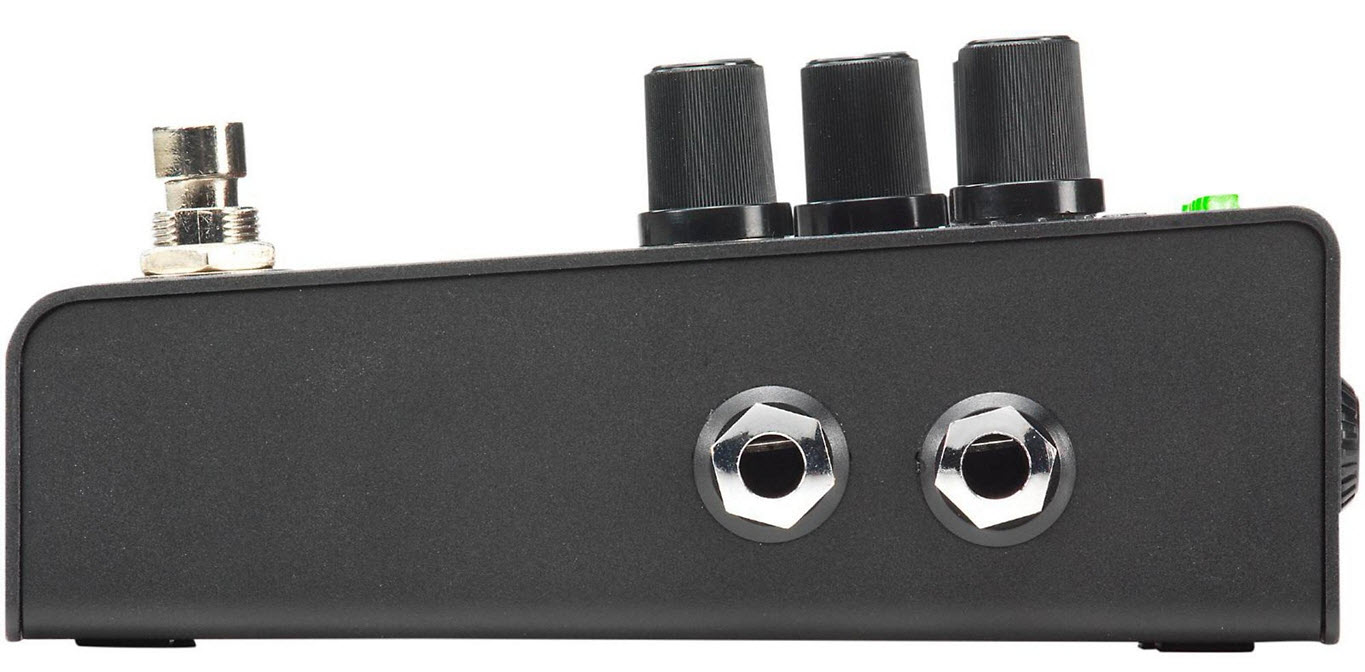
Laitteen oikeaan kylkeen on sijoitettu kaksi tuloa, joista toinen on kitarasignaalille ja toinen (lisävarusteena saatavalle) Digitech FS3X -jalkapedaalille, jolla Trioa voi ohjailla ilman käsiä.

Digitech Trio phones out

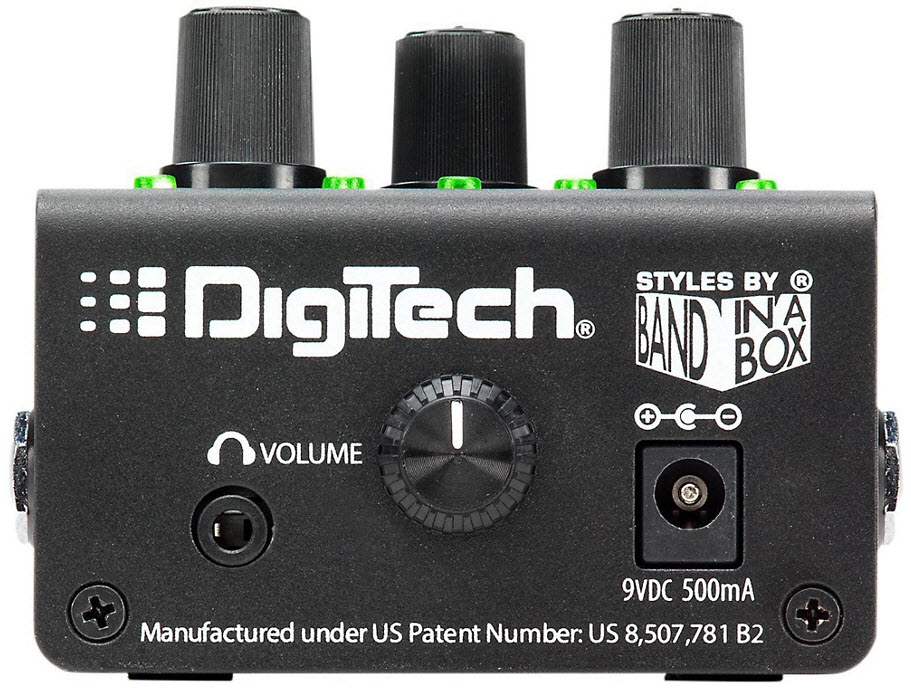
Pedaalin edessä on tulo pakettiin kuuluvalle virtalähteelle, sekä kuulokelähtö omalla volume-säätimellään.

Digitech Trio left

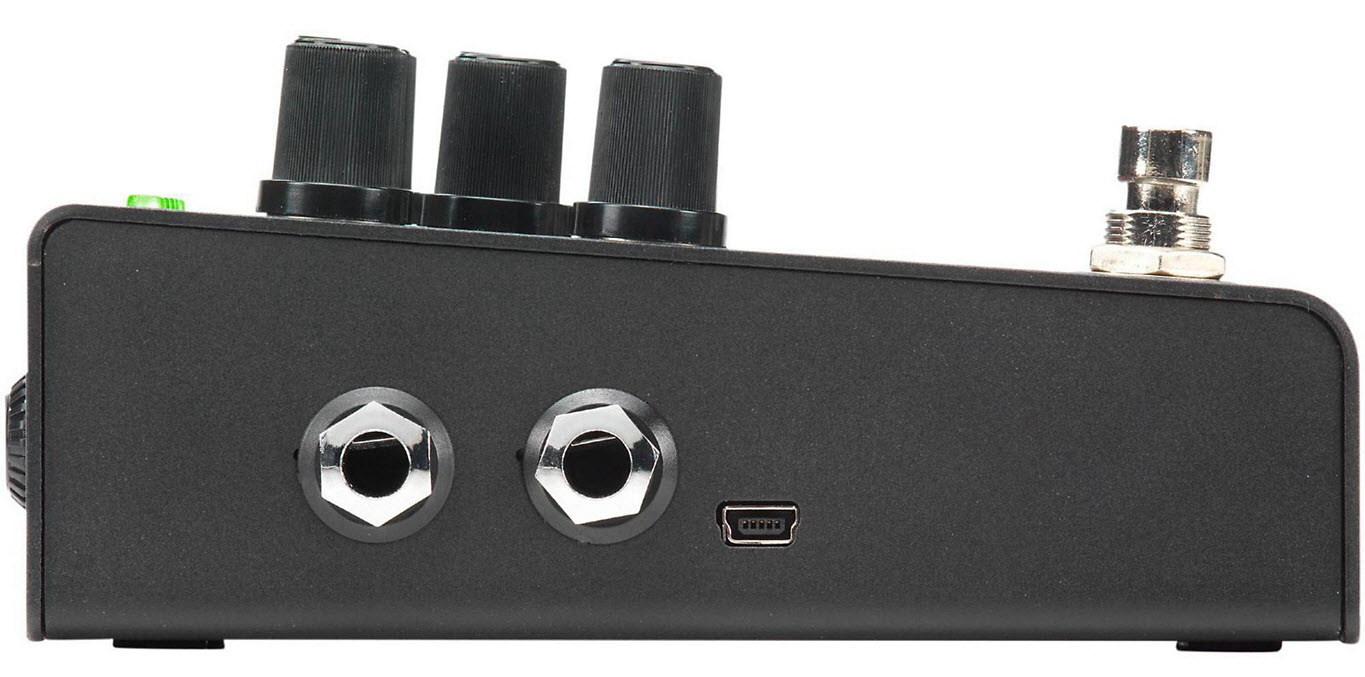
USB-portti on firmware-päivityksiä varten, kun taas vasemman kyljen jakit ovat audiolähdöt kitaravahvistimelle ja mikserille/äänikortille.

Digitechin Trio tunnistaa automaattisesti mikä lähtö on käytössä:

Kun vain vahvistinlähtöön on kytketty plugi, rumpu- ja bassosignaali säädetään vahvistinkanavalle sopivaksi. Kun vain mikserilähtö on käytössä, kitarasignaaliin lisätään kaiutinsimulaatiota. Kun taas molempia lähtöjä käytetään samanaikaisesti, kitarasignaalia ohjataan vain vahvistinlähtöön, ja rumpu- ja bassokuviot tulevat vain mikserilähdöstä. Kuulokkeen kytkeminen Trioon mykistää automaattisesti sekä vahvistin- että mikserilähdön.

****

Tässä Kitarablogi-videossa näytetään miten Digitech Trio -pedaalia käytetään:

****

Toisen videon musiikkia on äänitetty käyttämällä Digitech Trio -pedaalia, soittamalla kolme Alt Rock -genren Styles-tyyliä:

****

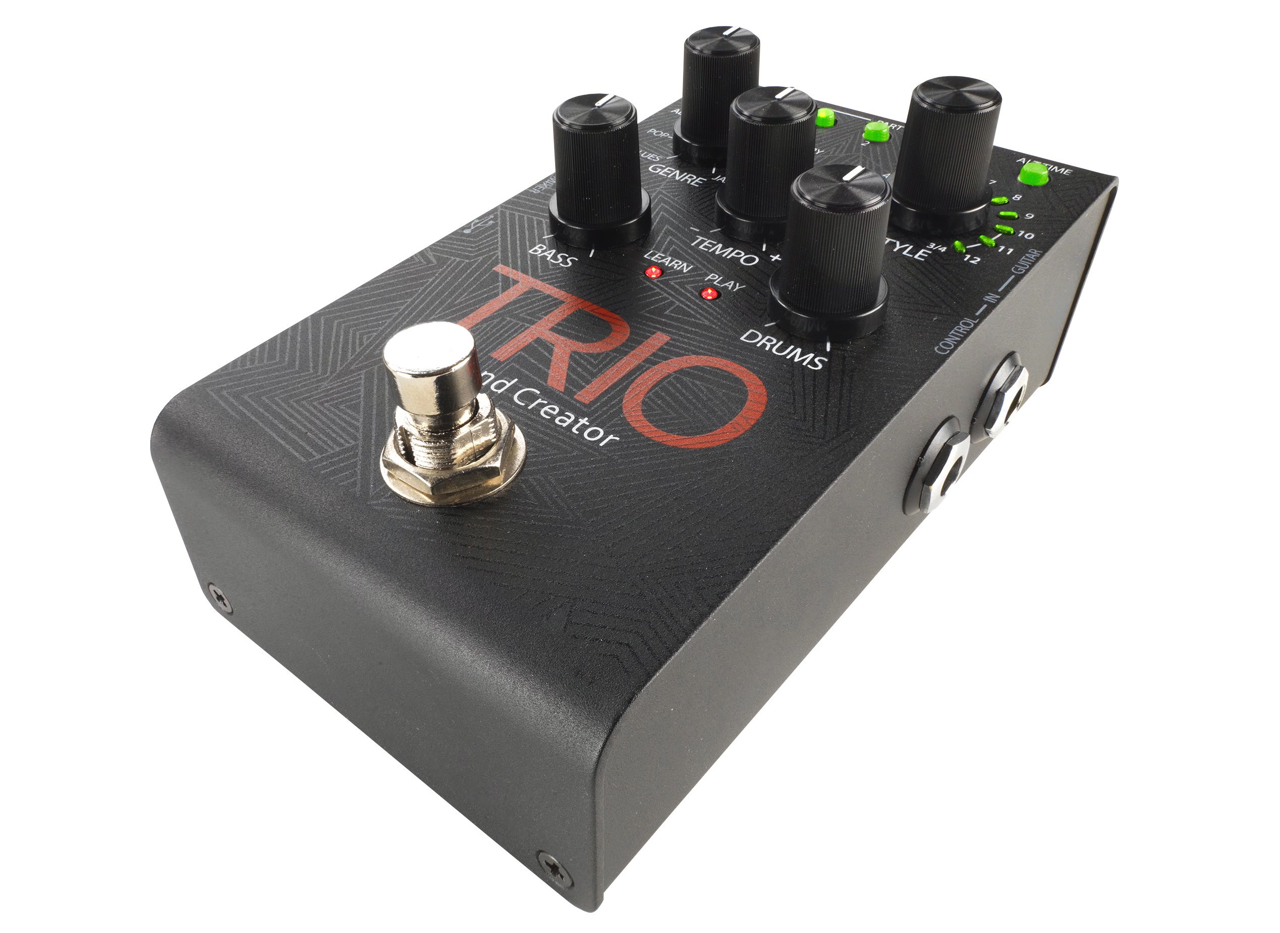
Digitech Trio angled

Testin perusteella voin todeta, että Digitech Trio on hyvin helppo ja intuitiivinen käyttää. Minun mielestäni se on fantastinen laite olohuone-jammailuun, sekä uusien biisien työstämiseen.

Trio Band Creator -pedaali onnistuu tunnistamaan biisinpätkän tempon ja sointukierron yllättävän hyvin edellyttäen, että a) Learn-vaiheessa ei esiinny kitaransoitossa liikkaa synkopaatiota, ja että b) opetusvaiheessa käytetään selkeästi tunnistettavia duuri, molli- ja seiskasointuja.

Trion rumpu- ja bassosoundit ovat hyvin kelvollisia, ja Style-kuvioissa esiintyy riittävästi automaattista live-tyylistä vaihtelua, ettei lopputuloksesta tulee turhauttavan robottimaista.

Metal-genren puuttuminen on valitettavaa, mutta riffien tunnustaminen suoraan audiosignaalista (ja riffien tarkka toistaminen) olisi varmaan ollut niin monimutkaista, että laitteesta olisi tullut yksinkertaisesti liian kallis ja liian hankalaa käyttää.

Ei-metallimiehille (ja -naisille) Trio Band Creator on kuitenkin todella mahtava työkalu harjoitteluun, jammailuun, sekä biisien kirjoitteluun. ylös sohvalta, siis!

****

Digitech Trio Band Creator

katuhinta noin 240 €

Maahantuoja: EM Nordic

Suuri kiitos DLX Musiikille testilaitteen lainaamisesta!

****

Plussat:

+ vankka tekoa

+ kompakti

+ interaktiivinen

+ monipuolinen Genre- ja Styles-tarjonta

+ hyvät rumpu- ja bassosoundit

Miinukset:

– Metal-genre ei edustettu

– laite ei pysty oppimaan riffejä

Review: Digitech Trio

Digitech-Trio

We’ve all been there, haven’t we? It’s a Wednesday evening, and you want to jam; but the drummer’s at the hairdresser’s and the bassist has to babysit all evening long.

So what do you do? You get bored to tears sitting on the sofa with your fingers widdling away idly on your favourite couch guitar…

Actually, now there’s a better, much more creative way to spend your spare time – Digitech’s brand-new Trio Band Creator pedal lets you jam and work on new song ideas by supplying an indefatigable rhythm-section-in-a-box.

****

Digitech Trio full front

The Digitech Trio (current street price in Finland approx. 240 €) uses a learn function that detects the chord changes (and tempo) of a part straight off your guitar’s audio signal. There’s no need for complicated step-by-step programming or an expensive (and fiddly) MIDI-pickup – just plug in your guitar lead, and you’re ready to go.

The Trio offers you seven musical Genres to choose from, each offering a whopping 12 Styles (meaning: different pattern templates for the drum rhythm and bass pattern). The patterns have all been developed for the best-selling Band In A Box computer software.

Digitech’s new wonder box picks up the tempo directly from your playing, but you can fine-tune the speed after the fact using the Tempo control. You can also switch between a normal and a half-time feel.

Digitech’s Trio also includes a very rudimentary guitar effects section, should you want to jam without using your guitar amp.

The Trio Band Creator comes in a very compact, yet very sturdy pedal format.

Digitech Trio right

There are two jacks on the right side of the pedal – one is the guitar input, while the second one allows you to connect Digitech’s own FS3X footswitch unit for hands-free Part-switching.

Digitech Trio phones out

The pedal’s front sports the input for the power supply unit (included), as well as a headphones output with its own volume control.

Digitech Trio left

The USB-port on the unit’s left side is for firmware updates, while the two output jacks are the guitar amp and mixer outputs.

The Digitech Trio automatically detects which of the outputs are in use:

If only the amp output is used the drum and bass parts are pre-EQ’d to work well with a clean guitar amp. When using only the mixer out the guitar signal will run through the pedal’s cabinet emulation. Using both outputs simultaneously sends the guitar signal to the amp output and the rhythm section to the mixer. Plugging in headphones into the pedal’s headphone output automatically mutes both the mixer and amp outputs.

****

Here’s Kitarablogi’s video clip showing you how to use the Digitech Trio:

****

And here’s the Digitech Trio used in context, playing a three-part song (using Alt Rock styles):

****

Digitech Trio angled

I found Digitech’s Trio very easy and intuitive to use. In my view it’s a fantastic little unit in a living room jamming and song developing context.

The Trio Band Creator does a surprisingly good job of learning the tempo and chord changes of a part straight off your guitar playing, provided you a) don’t syncopate too wildly, and b) stick to major, minor and 7th chords for the most part.

The drum and bass sounds are very decent, and an ample amount of automatic Style variation keeps enough semblance of the ”human” element in the accompaniment, to keep it from sounding robotic.

I would have liked to have seen a Metal Genre included in the Digitech Trio. On the other hand, this would have meant the inclusion of a riff-learning function of some sort, which probably would have made the pedal too complicated and expensive.

For non-Metal guitarists, though, the Trio Band Creator is a fantastic tool to keep your playing chops up, as well as for jamming and coming up with new songs. No need to noodle aimlessly on the sofa, anymore!

****

Digitech Trio Band Creator

Current street price approximately 240 €

Finnish Distributor: EM Nordic

A big thank you to DLX Music Helsinki for the loan of the review unit!

****

Pros:

+ build quality

+ compact

+ interactive

+ large variety of Genres and Styles

+ quality of drum and bass sounds

Cons:

– no Metal genre available

– cannot learn riffs

Pidä blogia WordPress.comissa.

Ylös ↑