Review: Squier Sonic Mustang SS

From the late 1970s on, Fender’s student-oriented models began to find their way into the hands of musicians from the Punk, New Wave, Grunge and Alternative Rock genres.

The reasons for this can be found both in the musicians’ budgets, as well as in the guitars’ image. The average guitarist wanted to play with ”familiar and safe” models, and in Fender’s case, these were the Telecaster and Stratocaster.

At the end of the 1970s, Fender’s so-called student instruments, that were very popular in the 1950s and 60s, could be found very inexpensively second-hand. With the Mustang, Duo-Sonic or Musicmaster, the young New Wave musician got genuine Fender quality at a very affordable price, and since these instruments were not – at least at the time – collector’s items, modifying the guitars to suit the needs of the ”new music” was no problem.

Many guitarists of the new genres – e.g. the Talking Heads’ David Byrne, Sonic Youth’s Thurston Moore and Nirvana’s Kurt Cobain – added more powerful pickups to their Duo-Sonic or Mustang to better suit their sound. This resulted in distinctive guitars that certainly weren’t ”your dad’s Country guitar”.

Last year, Fender’s subsidiary Squier Guitars changed the name of its most affordable line from Affinity to Sonic, and at the same time expanded the range of instruments in the series.

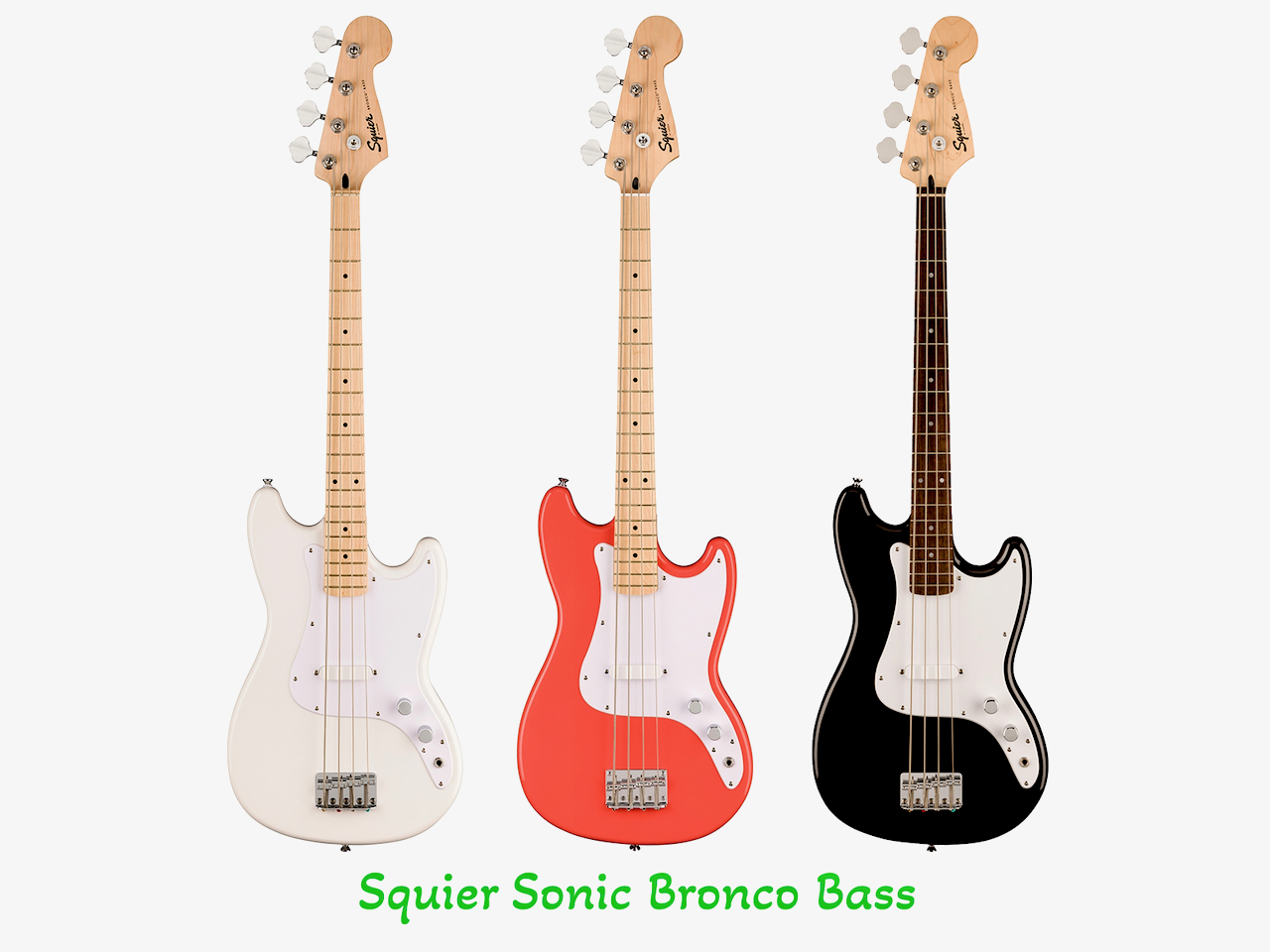
There are now two different Mustang guitars in the Sonic series, of which the Mustang HH offers two humbucker pickups, while the Mustang SS, like the original Fender, comes equipped with two single coils. Both models are offered in two different colour options as standard, which in the case of the Mustang SS model are sunburst and Torino Red. The Mustang HH comes in light blue and pink. The Sonic Bronco bass is now available in three different colors – white, red and black.

A vintage enthusiast would be the first to point out that, according to Fender’s original terminology, the Squier Sonic Mustang SS (street price approx. 180-200 €) is not a Mustang, but a Duo-Sonic, as the model has a fixed bridge and a three-position pickup selector. I would bet that Fender and Squier have decided that the name Mustang is simply cooler and better known than Duo-Sonic, which is why all their short-scale models with the same body shape are currently called Mustangs, despite the streamlined electronics and bridge.

However, the familiar basic recipe still applies:

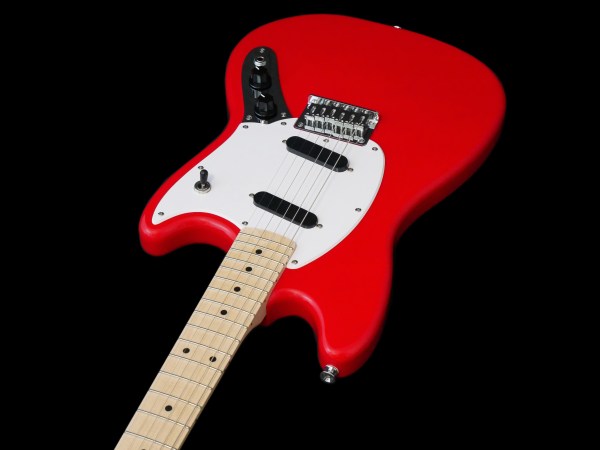
The Squier Mustang SS is an electric guitar with a 24-inch scale. The bolt-on maple neck has a maple fingerboard and well-installed 22 vintage-style frets.
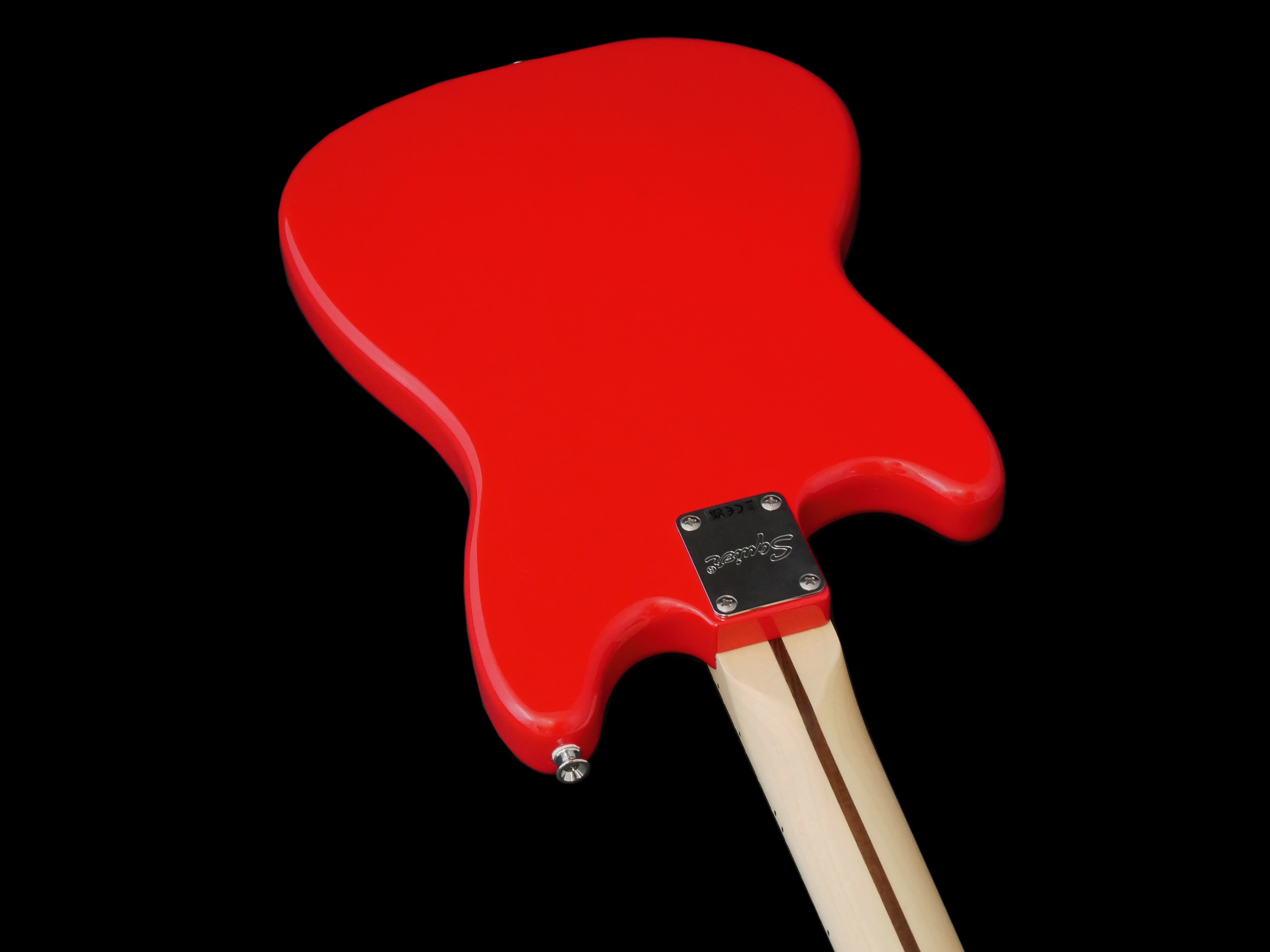
The offset body of the Mustang SS is a slab number with rounded edges, but without any chamfers.

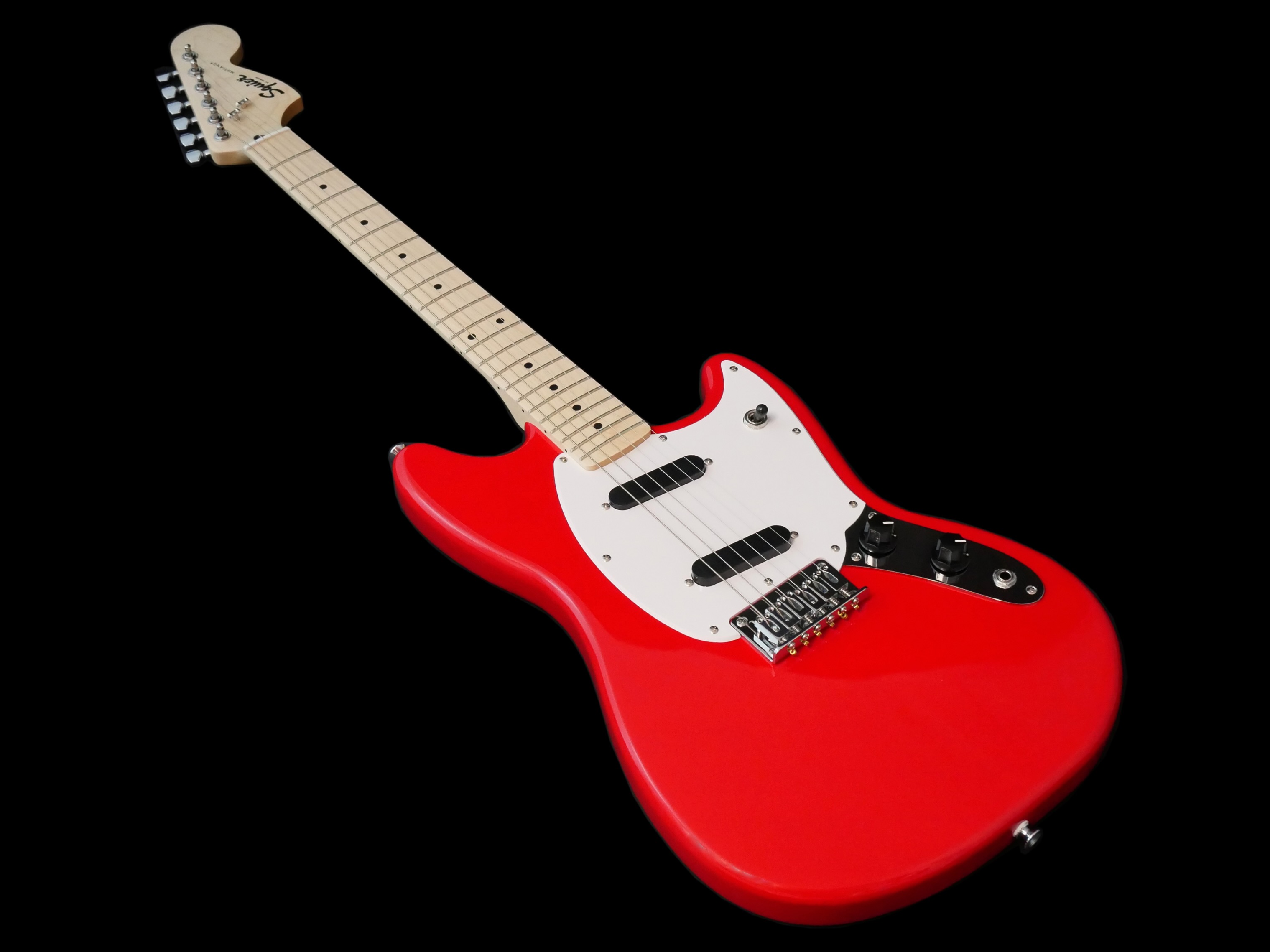
The thick single-layer plastic pickguard is typical for Sonic series instruments. Mustang’s two single-coil pickups – with closed black plastic covers – and a three-position mic selector are installed onto the pickguard.

The Squier guitar’s volume and tone controls, as well as the output jack, are placed on a chrome-plated metal plate.
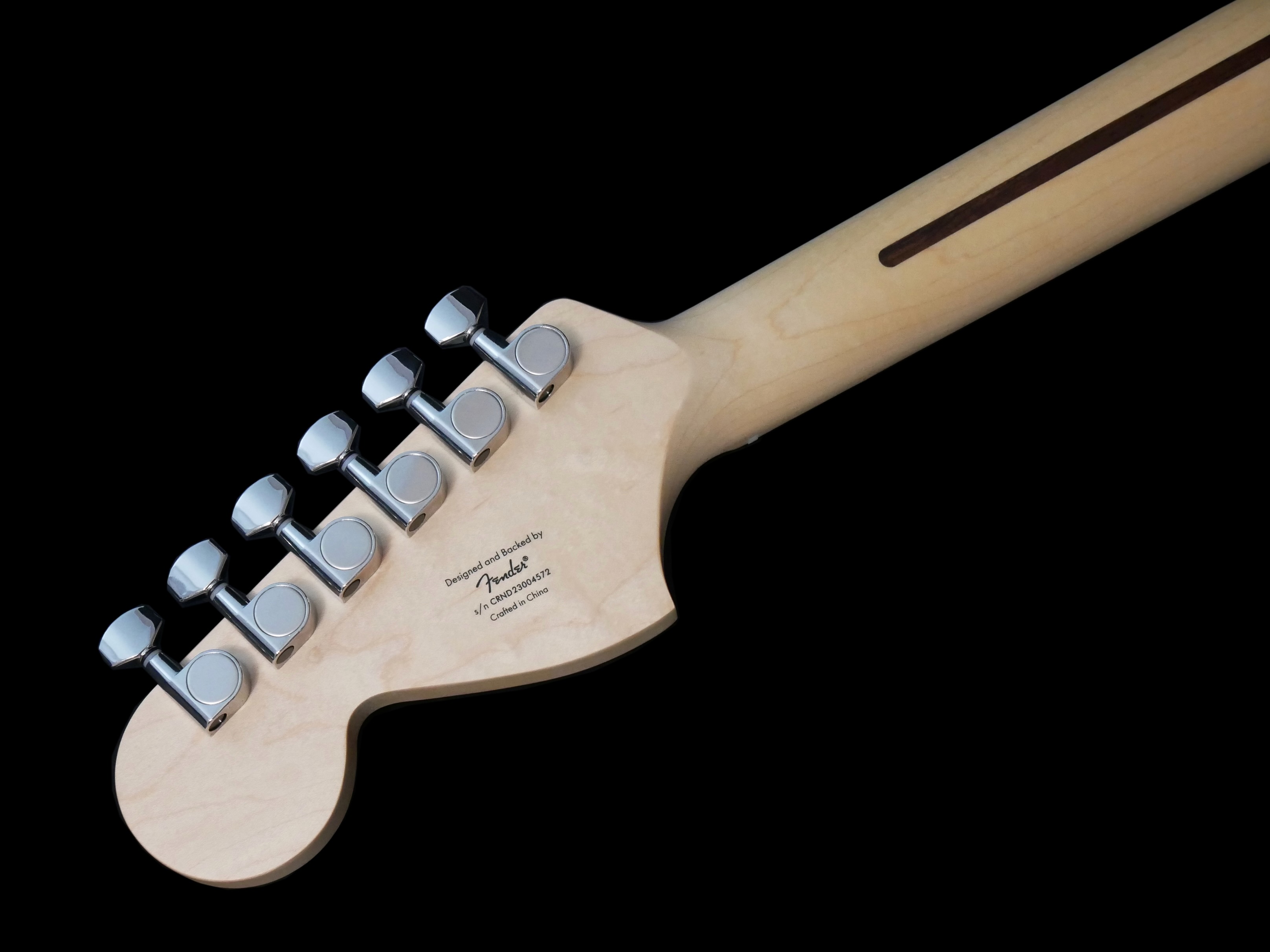
The Mustang’s modern sealed tuners work well, as does the Sonic model’s fixed bridge with six separate saddles.
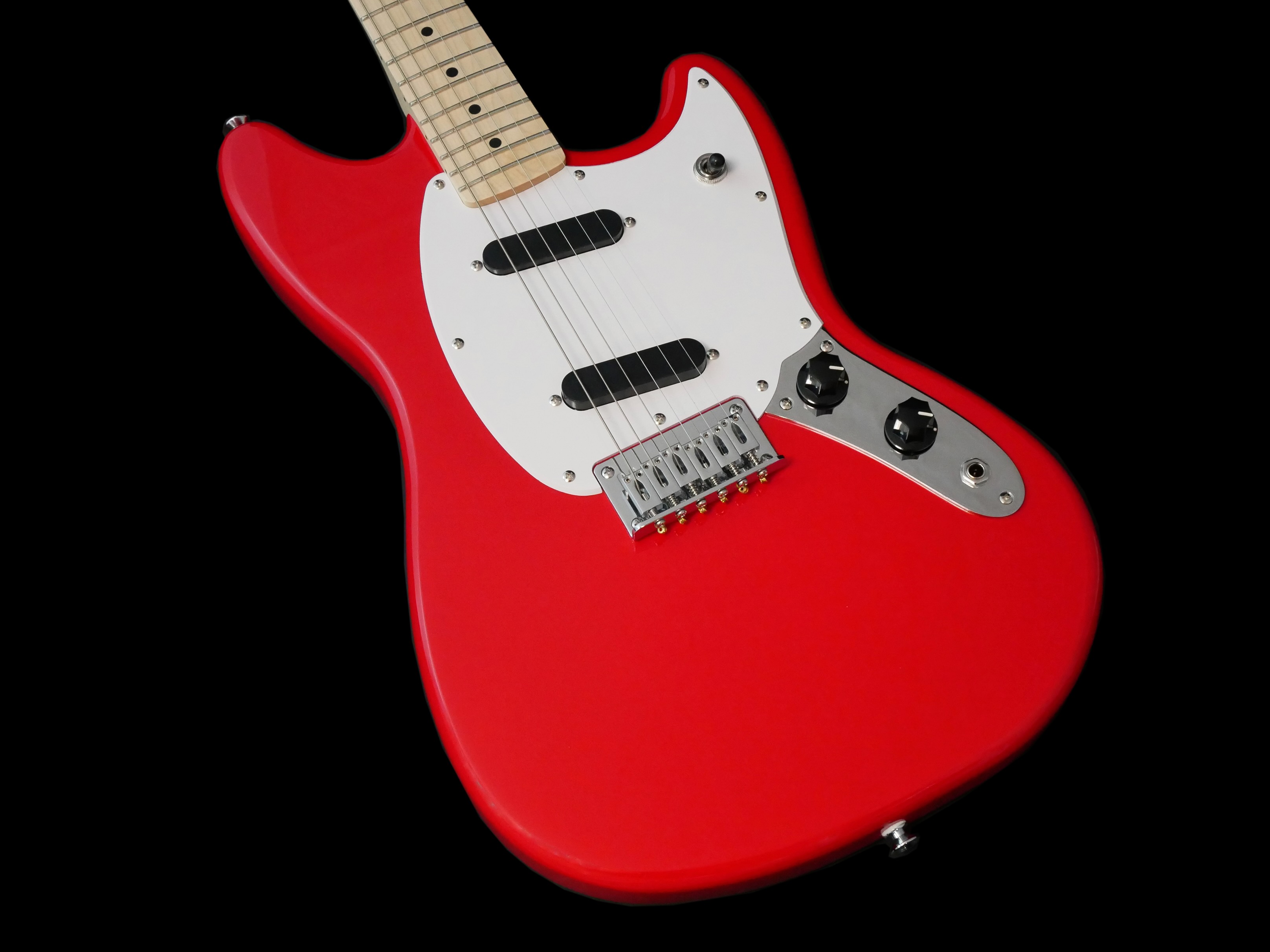
Straight out of the shipping carton, the test guitar is almost ready to play – only the action and intonation had to be fine-tuned. The guitar doesn’t suffer from sharp fret ends sticking, or other ”cheap guitar” problems. The workmanship seems fine.

The new Squier Sonic Mustang SS weighs a bit more than the original edition from the 1960s, but in light of the Mustang’s very affordable price, this is to be expected and perfectly okay.

The Squier Sonic Mustang SS model has a decent 009 set of strings installed at the factory, which is probably a good choice for the guitar’s target group (children and young people). The playing feel is very effortless and light, and the Mustang chimes very nicely. I played all the guitar tracks in the demo video with Squier’s factory-installed strings.
However, the feel of the 009 string set on a guitar with a 61 cm scale is too loose for me, which is why I changed over to the same 010-052 strings that I use in all my electric guitars. With these strings, the Sonic Mustang SS immediately has a firmer playing feel, which is not very different from, for example, a Gibson SG.

Although the scale of the Sonic Mustang is much shorter than that of Telecasters or Strats, there is a definite dose of ”Fender-ism” in the sound of the guitar, thanks to the single-coil pickups. Because the Mustang’s pickups are placed in somewhat different places relative to the scale than, for example, in the Telecaster, the model always displays its own recognisable sound. The Mustang’s tone rings like a bell, but is never as biting as, for example, the output of a Stratocaster.
Review: Squier Affinity Bronco Bass & Höfner Ignition Violin Bass SE

This is a slightly shorter version of an article in Finnish published at Rockway.fi.

****

In 2021 short-scale basses are often seen as less desirable, as instruments purely for beginners, but not for ”serious” use.

Back in the Fifties, Sixties and much of the Seventies, a wealth of great music has been recorded by bassists playing short-scale basses. To some degree this was out of pure necessity, as many guitar manufacturers didn’t regard the electric bass guitar as a serious instrument in the early days. Those companies simply used slight redesigns of their guitar models with longer necks and different pickups, in order to have something to sell to the public. Gibson, for example, only released its first long-scale basses – the Thunderbird II and IV models – in 1963, while Gretsch and Guild stuck to their ”modified guitars” well into the 1970s.

Other companies designed their short-scale basses from the ground up:

In 1956 a German luthier called Walter Höfner developed a comfortably light and compact semi-acoustic bass with a violin-shaped body. In keeping with the Höfner Company’s nomenclature this new bass received the rather uninspiring name Höfner 500/1.

This bass might have become a mere footnote in history, had it not been for a young British musician, who ordered a left-handed 500/1, while working in a nightclub in Hamburg (West Germany) with his band. This young bass player was, of course, none other than Paul McCartney, and the Beatles’ global fame from 1963 onwards catapulted the Höfner 500/1 right into the limelight.

Embed from Getty Images
Paul McCartney still uses his iconic Höfner bass.
Embed from Getty Images
Tina Weymouth (Talking Heads; Tom Tom Club) is regularly seen with her Höfner 500/1, as well as with Höfner 500/2 Club Basses (as in this picture).

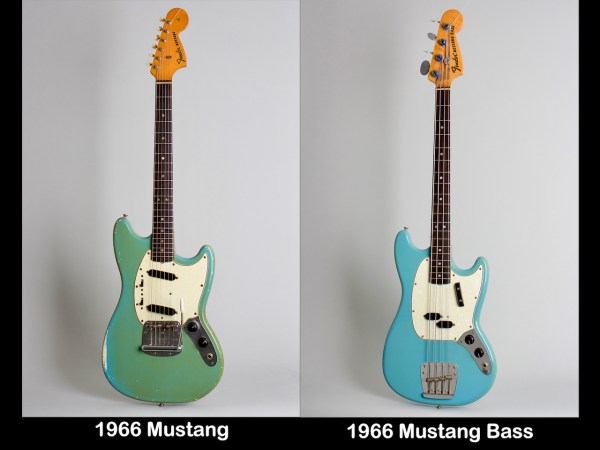
The Fender Company, whose founder Leo Fender was the father of the electric bass, introduced its first short-scale bass in 1966. The Fender Mustang was based on their legendary Precision Bass, and was meant as a companion to the company’s Mustang Guitar.

Embed from Getty Images
Most classic Status Quo hits were recorded by Alan Lancaster playing his Mustang Bass.
Embed from Getty Images
The Rolling Stones’ original bass player Bill Wyman used his Mustang Bass on stage between 1968 and 1971.

Regardless of their affordable price tags, the models in this review are straight descendants of the Höfner 500/1 and Fender Mustang models.

****

When the Fender Musicmaster Bass was released in 1971 it was Fender’s most affordable electric bass, making it an ideal choice for beginners, music classes, and – in the late 70s and early 80s – for Punk or New Wave bands. The original Musicmaster Bass used the same body as the Mustang, but sported a redesigned scratchplate and bridge, cheaper machine heads, and a covered guitar (!) pickup.

The Squier Affinity Bronco Bass (current price in Finland around 200 €) has been the brand’s most-affordable bass for many years, until the very recent arrival of the Mini-P Bass, which is a few euros cheaper.

The Indonesian Bronco Bass is clearly based on the Musicmaster Bass from the Seventies:

The Bronco Bass sports the same Mustang-style body, and shares its predecessor’s simple, two-saddle bridge, as well as the 19-fret bolt-on neck. The new scratchplate design, which is clearly Strat/Precision-inspired is much prettier, though.

The satin finished maple neck is a one-piece affair, with the frets directly installed into its curved front, and it offers easy truss rod access next to the top nut. The tuning machines are improved versions of the originals.

Squier’s websites aren’t especially clear on the body material; some places state it is made from agathis, while others mention poplar. Be this as it may, our review sample comes finished in a beautiful Torino Red gloss finish. The bass is also very light in weight.

The single-ply scratchplate holds a powerful ceramic Stratocaster pickup, and the master volume and tone controls.

The quality of workmanship on the reviewed Squier Bronco Bass is simply amazing. I’m old enough to remember affordable instruments from the late Seventies, and this little bass is simply in a completely different league. Everything is clean and crisp. The neck profile is a very comfortable ”C” and the fretwork is very good. The playability of the bass is buttery and there are no annoying mechanical buzzes or rattles. You could basically grab this bass and do a gig.

Due to the very spartan bridge the Bronco’s intonation is never completely spot-on in the higher reaches of the fretboard, but I feel I can live with the small compromises required.

What the Squier Bronco offers is great playability, a healthy acoustic tone, and a surprisingly balanced and full-bodied performance from its single-coil guitar pickup. The Bronco Bass sounds like a ”real” bass played through a quality bass amp.

****

A German Höfner 500/1 ”Mersey”.

Höfner’s Violin Basses are currently produced in three model ranges:

The Made-in-Germany range comprises several vintage reissues, reliced basses, and an ecologically-conscious Green Line-version.

Höfner’s mid-price range is called the Contemporary Series (HCT), and it is produced in China. The Contemporary Violin Bass models come equipped with genuine German pickups, but differ slightly in construction by adding a feedback-reducing centre block inside the body.

The most affordable instruments are the Höfner Ignition models (HI). These instruments are also made in China, but offer less painstakingly exact recreations of Höfner’s most famous models.

The Höfner Ignition Violin Bass SE (current price in Finland approx. 350 €) is the newest update of the McCartney-inspired Ignition-version of the Höfner, which adds a few features that have been requested by many fans:

The body’s bass-side shoulder is now adorned with a vintage-style Höfner-decal, while the previous Jazz Bass-style control knobs have been replaced with Höfner’s famous teacup knobs. Additionally, the bass now also comes with a replica of the famous BASSMAN-sticker in the box. During the making of the Beatles’ Get Back/Let It Be film and LP, Paul McCartney had peeled off the sticker from his new Fender Bassman amplifier stack and stuck it to the top of his bass. For some Beatles fans this sticker has since become a legendary piece of memorabilia, which has now been made available to buyers of the Ignition Violin Bass SE.

The Höfner Ignition is a beautifully made instrument that closely follows the most crucial aspects of the German original’s build:

The hollow body of the Violin Bass is made from an arched plywood spruce top and plywood flame maple for the rims and the arched back. The set neck is carved from rock maple, while the rosewood bridge is held in place on top of the body by the downward force of the strings in Jazz-guitar style.

The most obvious difference between German (and HCT) basses and the Ignition is the exact build of the neck. The original features a freestanding, so-called cantilever fingerboard between the neck joint and the neck pickup. The Ignition’s neck continues as a solid block of maple for the whole way, which actually even makes the neck joint a tiny bit stronger. Additionally, while German 500/1s come with (depending on the model) necks made from either two long strips of maple, or a central piece of beech sandwiched between two outer strips of maple, the Ignition’s neck is one-piece maple with a separate piece glued on for the headstock.

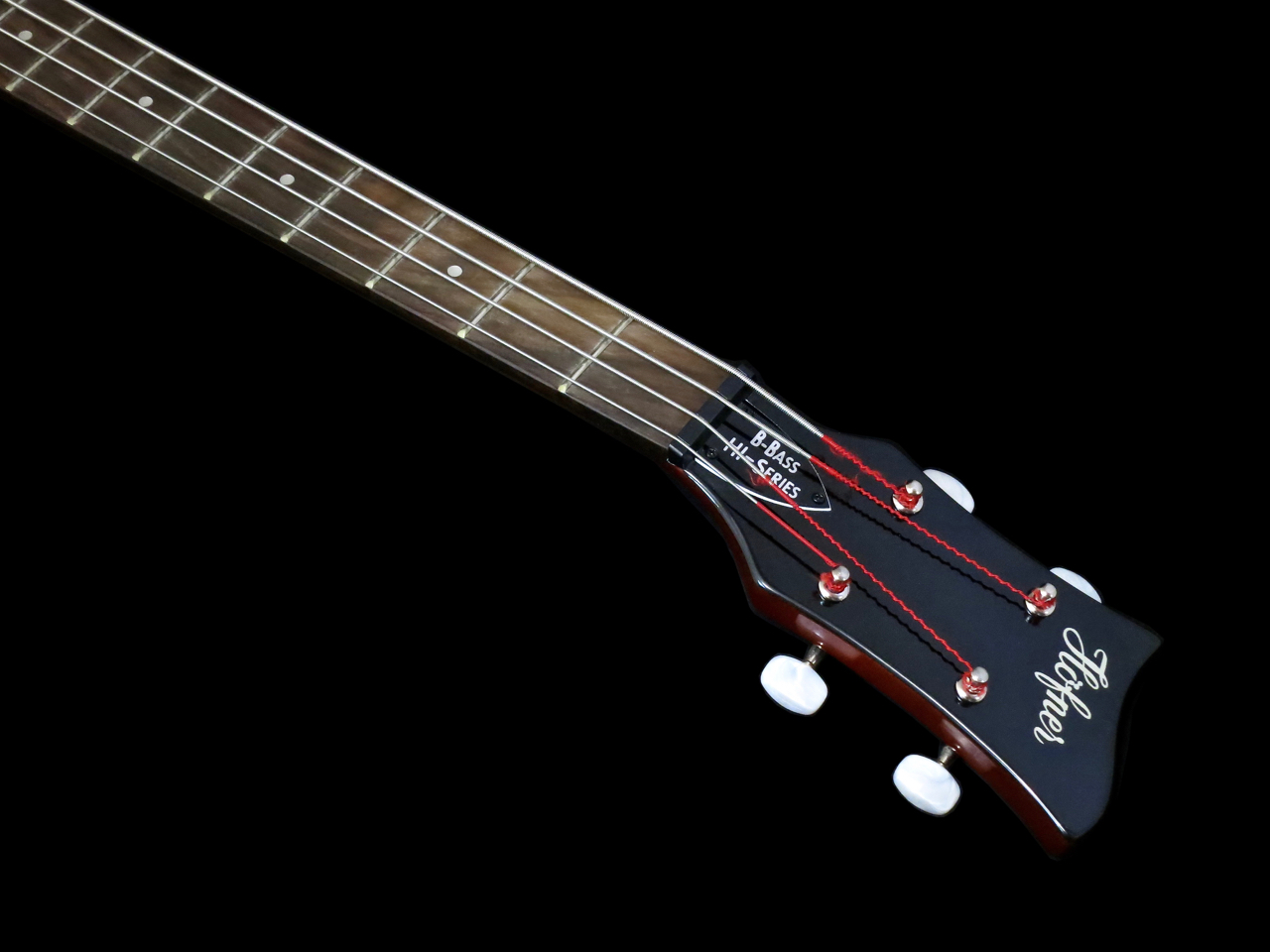
For environmental reasons Höfner now uses thermo-treated jatoba wood for the fingerboards on Ignition Violin Basses. The string trapeze is chromed, while the tuning heads are four separate units with pearloid knobs.

The Ignition pickups are actually reissues of rare Japanese Staple pickups, which were used on some ”New Special” models for the Japanese market back in the Eighties. They look similar to the classic Staple pickups on Paul McCartney’s 500/1, but are slightly wider, and – what’s more important – easier to adjust for height than the German originals.

* Click/tap the picture for a larger view *

Many players who are new to Höfner-basses have trouble with Walter Höfner’s classic ”Aggregat” control console that also comes installed on the Ignition Violin Bass SE. I hope the above picture will do its bit to clear up which component does what.

It looks like a Höfner, it’s built like a Höfner, and – surprise, surprise – the Ignition Violin Bass SE sounds like the genuine Höfner it is! This is a quality instrument, and very compact and light to wear on a strap. The set-up and playability of our review sample was spot on, making the Ignition SE a fast and comfortable player. The neck’s depth may be a bit chunkier than on many modern basses, but the relatively narrow U-profile means that a Höfner neck sits very nicely in the palm of your hand.

It is true that the Höfner 500/1 (aka Violin Bass aka Beatle Bass) will forever be associated with Paul McCartney and the Beatles, but that shouldn’t lead to the instrument being pidgeonholed as a ”Sixties music” bass. I know what I’m talking about, as I have been a very satisfied 500/1-owner since 1990, and I regularly use the Violin Bass in many different contexts. As long as you don’t need to play slap bass or high-gain Metal, a Höfner will handle anything you throw at it.

Pidä blogia WordPress.comissa.

Ylös ↑