Testipenkissä: TC Electronic Röttweiler + The Dreamscape

****

TC Electronicin Röttweiler-särö (katuhinta 129 €) on erikoistunut rankkoihin soundeihin, eikä haaskaa aikaa turhalle hienostelulle.
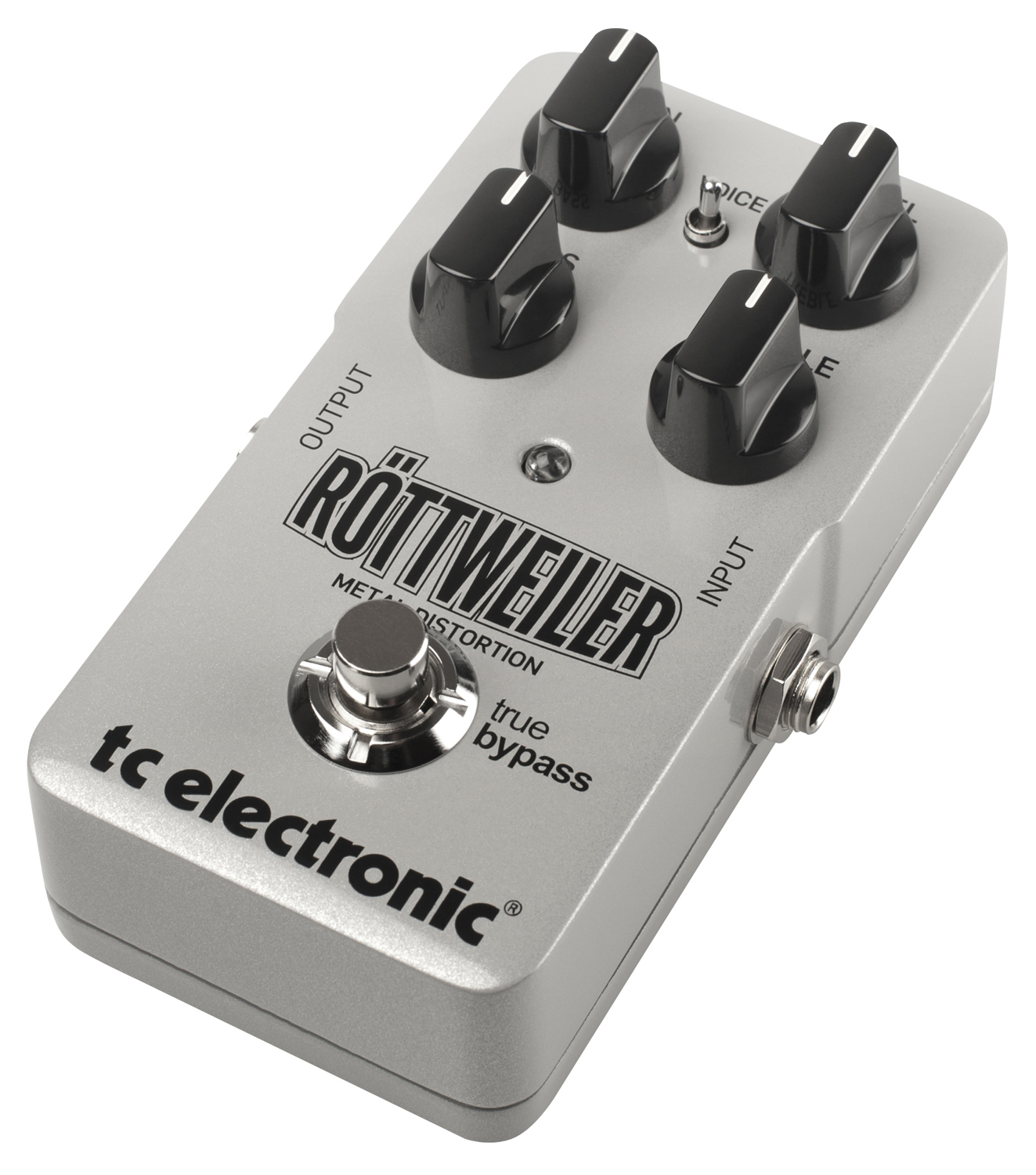
Gain-säätimen vaikutusalue ulottuu kovasta säröstä vielä kovempaan — Blues-tyylisiä pikkusärösoundeja on Röttweilerilta siis turha etsiä. Kaksiasentoinen Voice-kytkin tarjoaa kaksi eri perussoundia: off-asennossa keskialue on tuhdimpi klassisia Hard Rock- ja Metal-soundeja varten, kun taas on-asennossa Röttweilerista lähtevät purevammat Thrash-soundit, joissa on selvästi vähemmän matalaa keskialuetta (engl. scooped mids). Soundien hienosäätöön pedaali tarjoaa vielä sävynsäätimet bassolle ja diskantille.

TC Electronic Röttweiler on loistava erikoistyökalu metallimusiikin ystäville, joka saa jokaisen vahvistimen kuulostamaan tulikuumalta high gain -stäkiltä.

Tässä kolme esimerkkisoundia, joita Miloš Berka soitti seitsenkielisillä Schecterillä puhtaan vahvistimeen:

Röttweiler off

Röttweiler on, voice off

Röttweiler on, voice on

****

TC Electronic The Dreamscape (katuhinta 245 €) on John Petruccin nimikkopedaali, joka sisältää kuusi modulaatioefektiä sekä yhden Tone Print -muistipaikan.

Dreamscape-pedaalia voi käyttää sekä mono- että stereofonisissä ympäristöissä. Pohjalevyn alla löytyy muista Tone Print -efekteistä tutut kaksi minikytkintä, jolla voi valita suoran tai bufferoidun bypass-tilan välillä, sekä kytkeä efektoimattoman signalin kokonaan pois pedaalin lähtöistä, kun käyttää rinnakaiskytkennöllä olevaa efektilenkkiä.
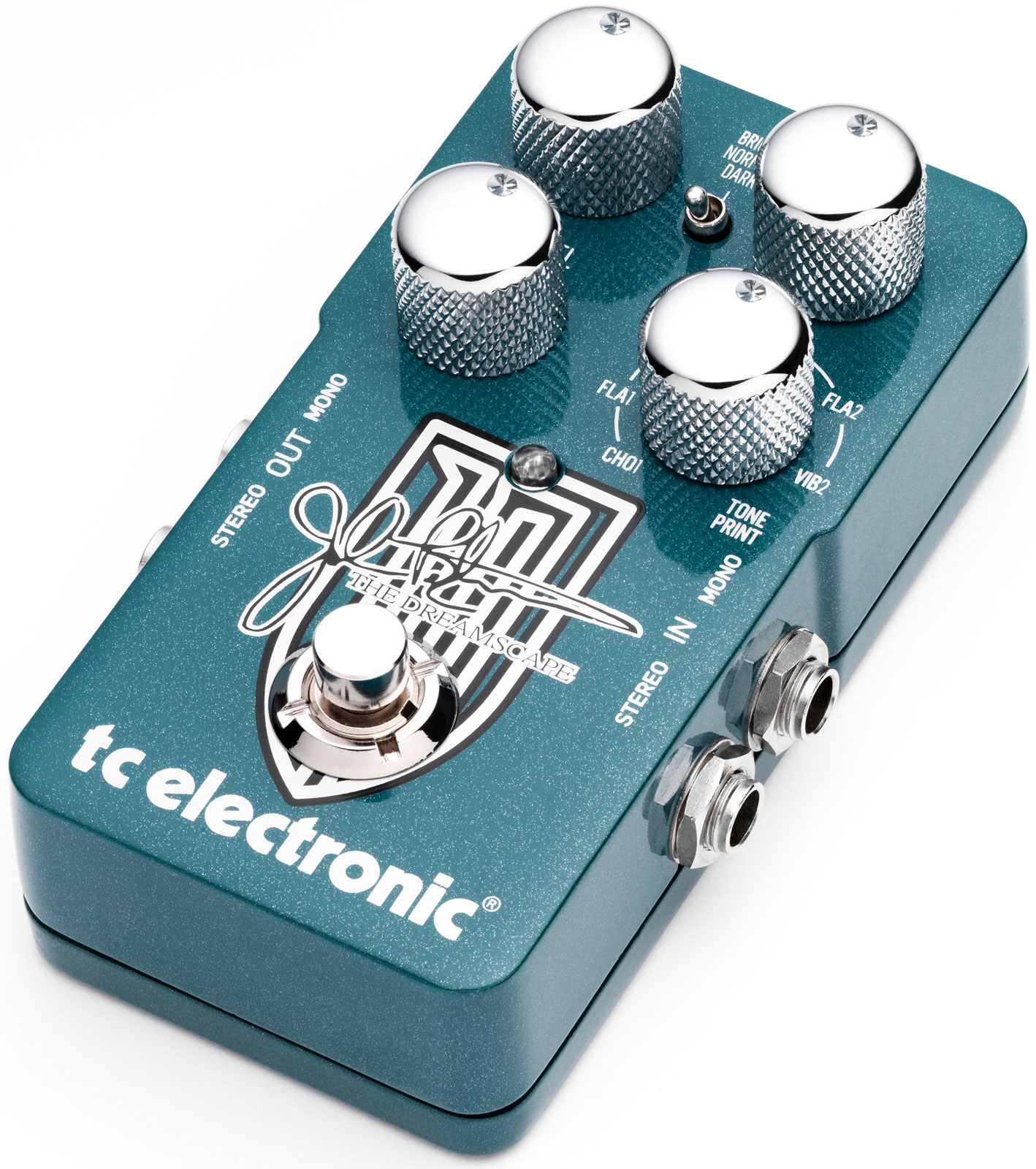
Dreamscapen säätimillä voi vaikuttaa valitun efektin syvyteen (depth), vatkauksen nopeuteen (speed), sekä pedaalin lähtötasoon. Kolmiasentoinen minikytkin tarjoaa efektoidun signaalin kolmella eri kirkkaudella – tummasta ja miedosta Dark-vaihtoehdosta kirkkaan ja selkeään Bright-valintaan.

John Petruccin valitsemat efektit on ryhmitetty kitarasankarin omien tarpeiden mukaan niin, että kolmen efektin ykkösvaihtoehto on sellainen, jonka Petrucci käyttää puhtaissa soundeissa, ja kakkonen on tarkoitettu särösoundeille. Itse en vetäisi rajan ollenkaan niin tiukasti, sillä sain kaikilla kuudella efektillä hyviä soundeja aikaiseksi. Pedaalin juju on mielestäni juuri siinä, että jokaisesta efektityypistä on olemassa kaksi erilaisia versiota, joilla on hieman erilainen soundi, ja jotka reagoivat eri tavalla säätöihin.

Olen äänittänyt tällaiset pätkät Fender Stratocasterilla:

Chorus 1

Flanger 1

Vibrato 1

Chorus 2

Flanger 2

Vibrato 2

TC Electronic The Dreamscape on 245:llä eurolla kallein Tone Print -pedaali. Osa hinnasta on luultavasti nimikkomallin lisäys, mutta toisaalta tarjoaa tämä pedaali samassa paketissa peräti kuusi erilaista, laadukasta modulaatioefektiä sekä yhden Tone Print -muistipaikan. Pedaalin monipuolisuuden valossa hinta ei kuulostaa enää kovin pahalta.

****

TC Electronic -kitarapedaaleja

Maahantuoja: Soundtools

****

Röttweiler Distortion

katuhinta 129 €

Plussat:

+ kompakti

+ erikoistunut Metal-musiikkiin

+ hyvä soundi

+ omassa genressään monipuolinen

Miinukset:

– Voice-kytkin ahtaassa paikassa

****

The Dreamscape

katuhinta 245 €

Plussat:

+ kompakti

+ kuusi modulaatioefektiä

+ Tone Print -muistipaikka

+ monipuolinen

+ stereofoninen

Miinukset:

– muita Tone Print -pedaaleja korkeampi hinta

– Bright-kytkin ahtaassa paikassa

****

Kolme uutta Fender Pawn Shop -mallia!

Fender on lisännyt Pawn Shop -sarjaansa kaksi uutta kitaraa, sekä yksi bassomalli:

Jaguarillo on kolmella mikrofonilla varustettu kitara, joka perustuu Jaguar-malliin.

****

Offset Special on hyvin erikoinen ristisiitos Stratolta, Jazzmasterilta ja Telecatser Thinlinestä.

****

Reverse Jaguar Bass on vasenkielinen basso keskipitkällä mensuurilla (32″/81,2 cm), jossa kielet ja elektroniikka ovat kuitenkin oikeanpäin – aika Fender-Bird-kaltainen meininki…

****

Uutuus: Pawn Shop Amps (by Fender) – mummon radio tuli takaisin!

Uusista Fender-vahvistimista on jätetty tahallaan Fenkun logo pois, sillä Fender haluaa luoda tietoisesti sellaista vaikutelmaa, että malliston kitarakombot ovat peräisin 1950-luvulta, ”unohdettuja helmiä”.

****

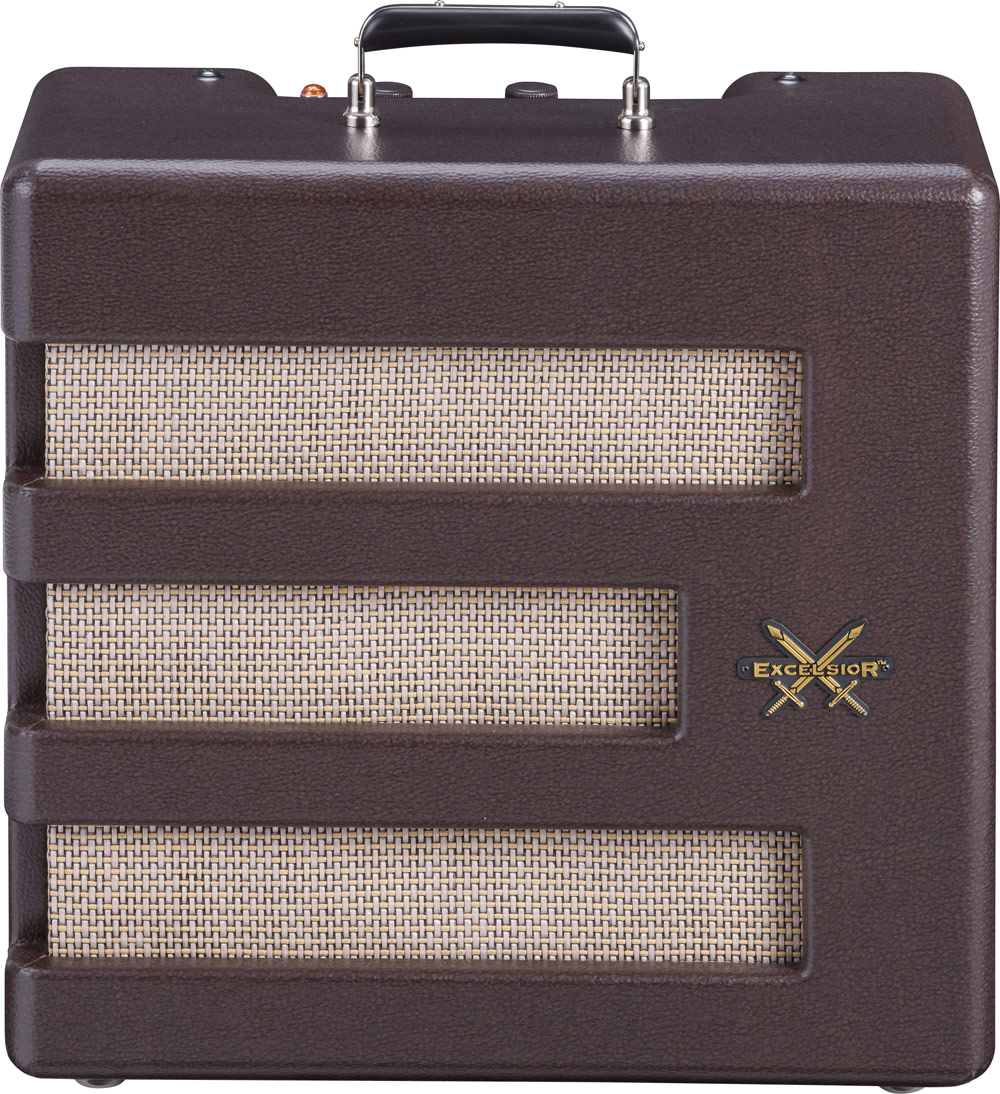
Pawn Shop Excelsior on 15-tuumaisella kaiuttimella varustettu, 13-wattinen kitarakombo, joka muistuttaa hieman vanhoja Gretsch- tai Gibson-malleja.

Putkivarustus koostuu kahdesta 12AX7-etuasteputkesta sekä kahdesta 6V6-mallista.

Pawn Shop Excelsior tarjoaa kolme tuloa – kitaralle, mikrofonille sekä hanurille (!) – sekä tremolon.

****

Pawn Shop Greta taas muistuttaa ikivanhaa putkiradiota. Pikkuvahvistimella on kaksi wattia tehoa, ja toimii yhdella 12AX7-etuasteputkella sekä yhdellä 12AT7-pääteputkella. Gretalla on 4-tuumainen kaiutin.

Takapaneelista löytyy kitaratulon lisäksi vielä minijakki mp3-soitinta varten, linjalähtö sekä kaappilähtö.

Classic Guitars, part 9: Fender Jazzmaster and Jaguar

The Fender Jazzmaster was introduced in 1958 as a conscious effort to broaden Fender’s user base and appeal.

The company’s first efforts – the now legendary Telecaster and Stratocaster models – had already proven to be successful, but were then still widely perceived as bright-sounding guitars for Country & Western, as well as early Rock ’n’ Roll. Now Leo Fender and his team were aiming for the more ”serious” guitarists of the Jazz and Easy Listening genres.

Fender kept the standard long Fender-scale (25.5″), but – for the first time – added a rosewood fingerboard. The reasons for the rosewood board were both cosmetic – it looked classier than the lacquered maple of previous models – as well for tonal reasons, with rosewood imbuing the sound with a warmer timbre. The Jazzmaster was also the company’s first guitar with an enlarged version of the Strat-headstock, which was meant to combat dead spots and wolf-tones.

The body was a brand-new design premiering the company’s patented offset waist feature, meant to improve balance, especially when playing seated.

A new, front-mounted vibrato with a softer, spongier action (meant as a direct competitor to Bigsby’s models) was also devised. The vibrato – which worked with a separate, rocking bridge – was easy to adjust from the front, and also featured a locking mechanism for disabling the system (and keeping the guitar in tune even after a string breakage).

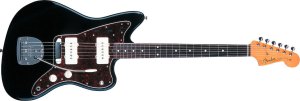
The most important changes took place in the electronics of the Jazzmaster: The pickups were clearly Fender’s attempt at getting a Gibson P-90 -type tonality, with the wide and flat coils. The controls featured two different circuits, with the normal circuit offering a 3-way toggle switch, as well as a master volume and tone control. A slide switch on the scratchplate’s upper shoulder engaged the so-called Rhythm Circuit, which switched on only the neck pickup going through its own set of volume and tone controls (above the neck pickup).

After a first wave of enthusiasm over Fender’s new top-of-the-line guitar, the Jazzmaster’s success sadly waned. Most conservative Jazz guitarists wouldn’t touch Fender’s ”plank” with a barge pole, and still considered the sound as too bright, while the company’s usual customers were perfectly happy with their more straightforward Strats and Teles.

The biggest genuine problem with Jazzmasters lies in their singlecoil pickups, which take in a lot of extraneous hum and interference (just like P-90’s do).

Modern players also tend to complain about the vibrato system’s flimsy bridge saddles, although, in fairness, one should note that this is mostly due to our modern light string gauges. The Jazzmaster-vibrato had been designed at a time when ”light gauge” meant an 012-set with a wound g-string.

Today the Jazzmaster’s appeal lies mostly in the alternative field, and not too many name players spring to mind:

Thurston Moore and Lee Ranaldo (Sonic Youth), J Mascis (Dinosaur Jr.), as well as British songwriter Elvis Costello are the most well-known Jazzmaster players.

****

In 1962 Fender took the Jazzmaster as the basis for a brand-new model, geared towards Surf and Pop guitarists – called the Fender Jaguar.

The Jaguar was Fender’s first guitar with 22 frets, and it featured a relatively short scale of 24″ (even shorter than Gibson’s usual 24.75″). The general look stayed in place, but the Jaguar was adorned with glitzy chrome control plates.

Fender took the criticisms over the Jazzmaster-pickups to heart and designed new pickups for the Jaguar. The new units are reminiscent of Strat-pickups, but feature slightly higher coils, as well as metal shielding plates that enclose most of the pickups’ bottom and sides.

The normal/Rhythm-circuit set-up stayed in place, but the normal circuit now featured three slide switches – an on/off-switch for each pickup, plus a ”strangle” switch that cuts all bottom end from the output signal.

The Jaguar originally also came equipped with a detachable mechanical string mute, which wasn’t well-received by guitar players.

Sadly, the Jaguar’s fate followed along the Jazzmaster’s lines – after a first wave of success sales dwindled in the wake of the British Invasion.

The most famous names associated with the Fender Jaguar are Carl Wilson (The Beach Boys), Kurt Cobain (Nirvana) and Johnny Marr (The Smiths, Modest Mouse).

As with the Jazzmaster, the Jaguar has seen a resurgence of sorts over the past few years, with many new and modified versions springing up, such as the Fender Blacktop Jaguar HH.

Review: Zoom R24 -multitracker

****

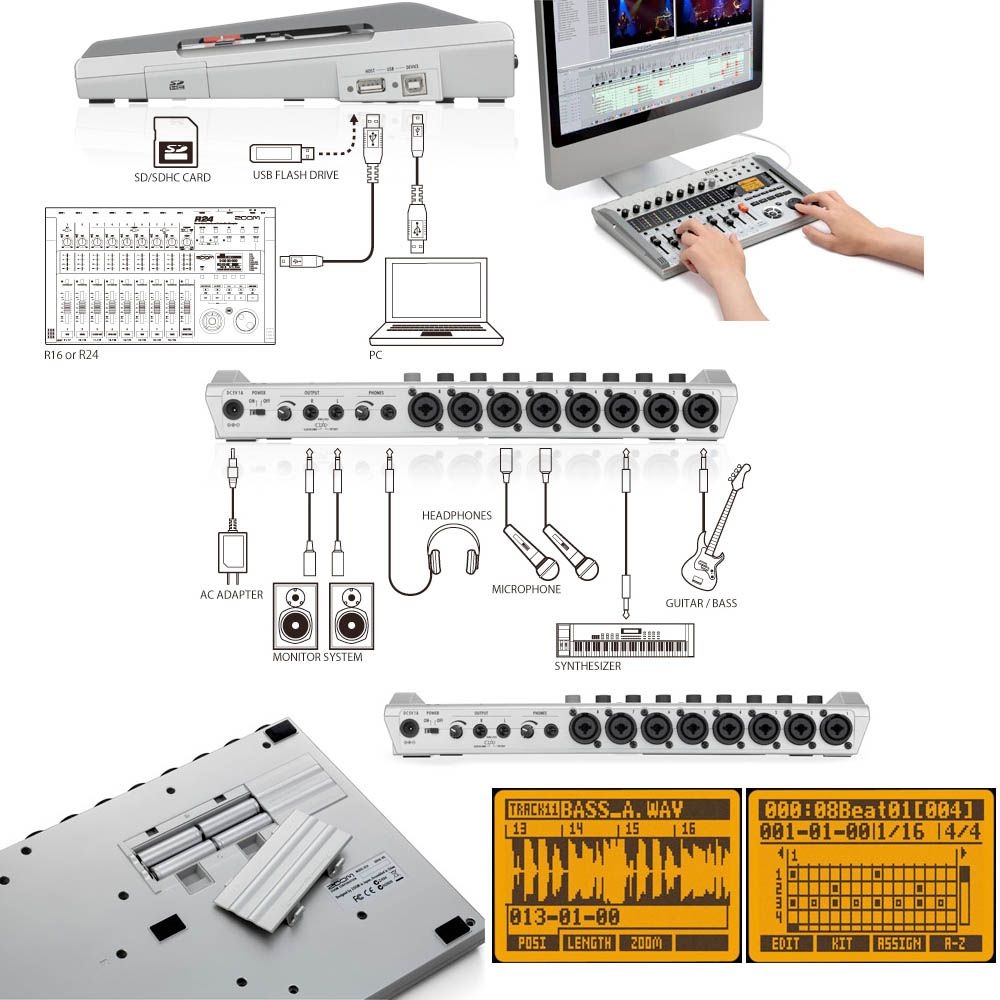
The Zoom R24 (current street price in Finland: 479 €) is a compact and very lightweight, but still quite nifty and versatile unit: The Zoom’s main purpose is to serve as a stand-alone digital multitracker (24 tracks, recording to SD-cards), but it can also be used with a computer as an external soundcard and/or a control surface for an audio sequencer (Cubase LE 5 comes included in the box).

The R24 is ready to go wherever you want to use it, thanks to its ability to run on six AA-batteries, as well as with the included, compact power supply.

This Zoom offers eight XLR/phone-combo inputs, which equals the maximum number of simultaneous recording tracks.

****

Zoom have kept the R24’s signal routing deliberately spartan and easy-to-use. Each of the inputs is hardwired to its corresponding channel fader and from there on to the corresponding recording track. It’s what-you-see-is-what-you get, basically, but with one important twist. As the R24’s mixer deals with 24 tracks, but offers only eight faders, the unit uses the same type of channel bank system, which larger digital consoles also tend to employ.

There are three fader banks (or fader planes) available for use: 1–8, 9–16 and 17–24. In the context of recording this means that each input signal can be assigned to one of the three tracks corresponding to its fader: Input 1, for example can thus be recorded either on Track 1, Track 9 or Track 17.

The R24’s inputs have been equipped ith slightly different features: Input 1 is ready to take direct signals coming froma high impedance instruments, such as an electric guitar, in addition to line level signals. Inputs 3–8 offers switchable phantom power (48 or 24 Volts), while the signal off the built-in stereo condenser mics can only be routed to Inputs 7 and 8.

But what happens if you want to record more than, say, three tracks of direct-injected guitar? No problem! The very handy Swap-button lets you swap the just-recorded track’s content with any other track you want. This means that while you have to record certain signals to certain tracks, you can then easily free up these tracks for new recordings.

****

The Zoom R24 is filled to the brim with useful features: Each mixer channel has its own 3-Band EQ section, as well as two sends to the internal send/return-effect units (Chorus and Reverb). An extremely versatile insert-effect section holds a plethora of fine guitar and bass amp models (lifted from Zoom’s own G2Nu– and B2  effects pedals), as well as algorithms tailored to vocals, drums and keyboards, plus the very useful mastering section.

The sound quality on offer is remarkable for a unit in this price bracket. It would be unrealistic to expect high-end pro-quality effects from what is basically a lower mid-price home recording device. But still, it is quite remarkable what quality you get in return for a modest outlay these days!

As the heart of your own studio, the Zoom also makes it possible to build up loop- and sample-based backings. It is also equipped with a decent built-in programmeable drum machine.

Editing, sampling and looping naturally feels a bit clumsy, when you’re used to grafic interfaces and a large computer display. But with a little persistence and some elbow grease you can achieve astonishing results on a unit such as the R24.

And as if the features so far hadn’t been enough already to make the R24 seem like a real bargain, Zoom is supplying Steinberg’s Cubase LE 5 -sequencer in the box, along with a usb-stick filled with great drum loops by Peter Erskine and Big Fish Audio.

The Zoom R24 is a handily-sized and advantageously-priced little 24-tracker, that will be perfect as you personal demo-machine, or for cutting decent recordings of your band’s rehearsals or gigs in a jiffy. The recording can the be mixed and mastered either internally in the R24 or using and audio sequencer (like Cubase).

And if one of your bandmates happens to own his/her own Zoom R24, you can even slave one machine to the other, and record a whopping 16 tracks simultaneously!

****

Zoom R24 – internal stereo mics – Taylor 110CE

****

Zoom R24

Finnish distributor: Studiotec

Street price: 479 €

Pros:

price

weight and size

ease of use

can be run on batteries

internal stereo microphones

versatile effects

• basic sound

Cons:

all-plastic build

small display

Pidä blogia WordPress.comissa.

Ylös ↑