Contact: J. Leachim Music


Review: Tokai AJG-88

****

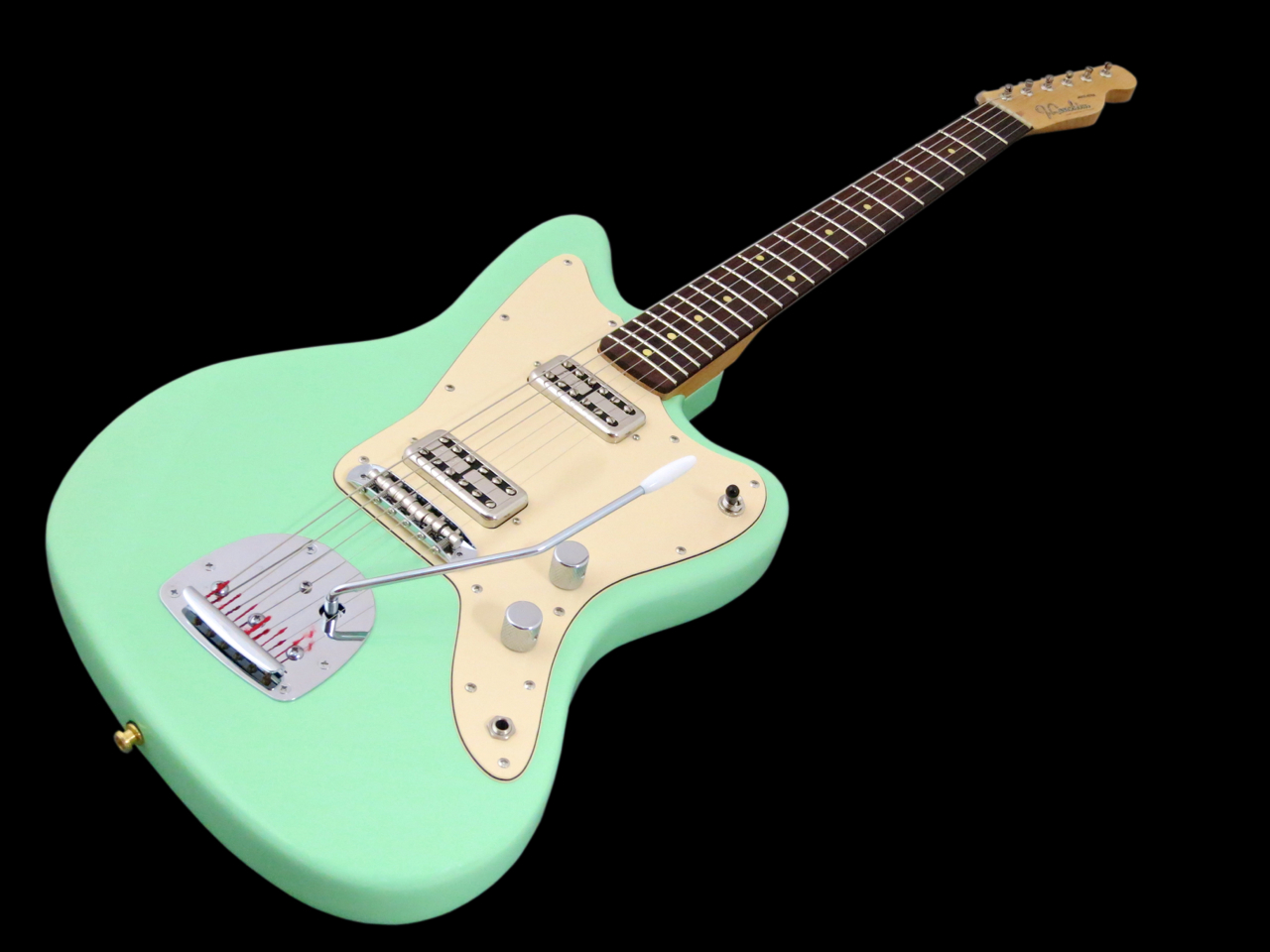
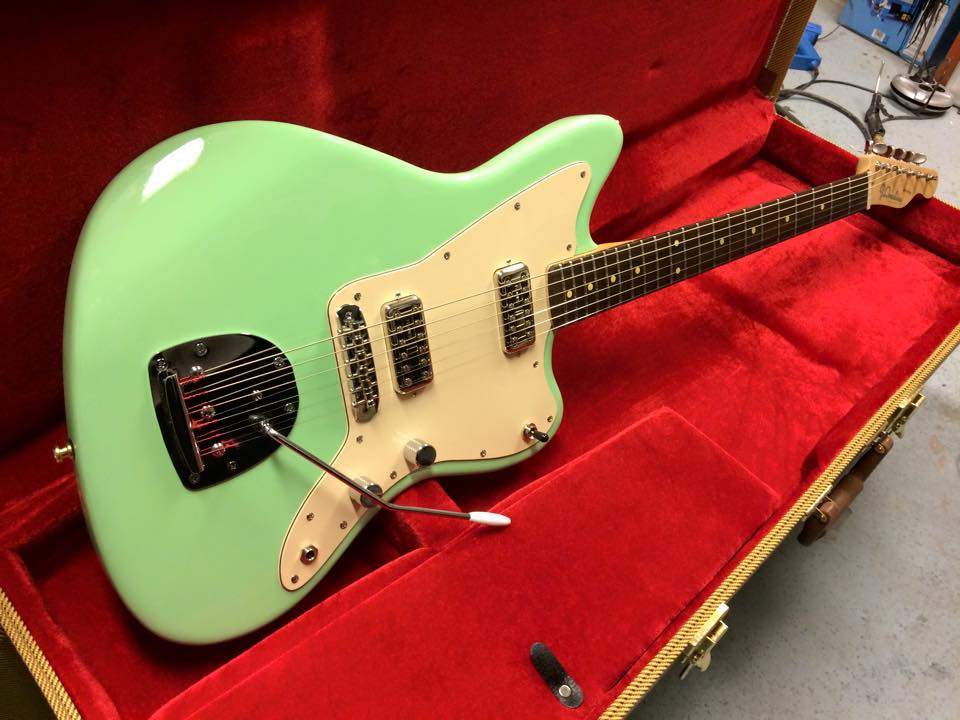
Are you looking for something off the beaten path of Strat- and Les Paul-clones? One interesting guitar might be the Tokai AJG-88 – an homage to the Fender Jazzmaster, factory-modded for the modern player.
****

The Tokai AJG-88 (current price in Finland: 1,099 €) is a bolt-on-neck instrument with a long scale.

We find a one-piece maple neck fastened to a streamlined alder body, crafted from three side-by-side pieces.
The Tokai comes in an all-gloss finish: The neck has been sprayed with clear lacquer, with the body showing off a sumptuous three-tone sunburst.

One welcome nod to the 21st century is the AJG-88’s truss rod access, which has been moved from the traditional body-facing end of the neck up to the headstock for easy accessibility.

The AJG-88 comes equipped with a nice set of sealed Gotoh tuners.

The chocolate-coloured rosewood fingerboard sports 22 medium-jumbo frets, which have been expertly seated and well polished. That’s full full marks for Tokai’s fretwork!

The classic screw-on neck joint coupled with Japanese workmanship…

Up to this point Tokai’s AJG-88 may have looked like a full-on Jazzmaster-copy, but the pickups, wiring and the choice of bridge make quite clear that this Tokai has its own, more contemporary, thing going.

Original Jazzmasters feature a front-mounted vibrato paired with a rocking bridge, designed to work correctly with the fat string gauges of yore (.012 or bigger). Putting a .009-set on a vintage-type Jazzmaster will lead to all sorts of problems, from rattling bridge saddles to strings not staying in their respective grooves – not good for sustain or tone.
On the Tokai AJG-88 these problems won’t occur, because this model is equipped with a tune-o-matic and stopbar combination (made by Gotoh). As a result the tuning is rock solid regardless of string gauges or tuning preferences. Tuning down for Metal isn’t a problem for the Tokai.

Both the original Jazzmaster, as well as its younger sister the Jaguar, were equipped with singlecoil pickups and rather complicated electronics with a separate rhythm-circuit for their neck pickup.
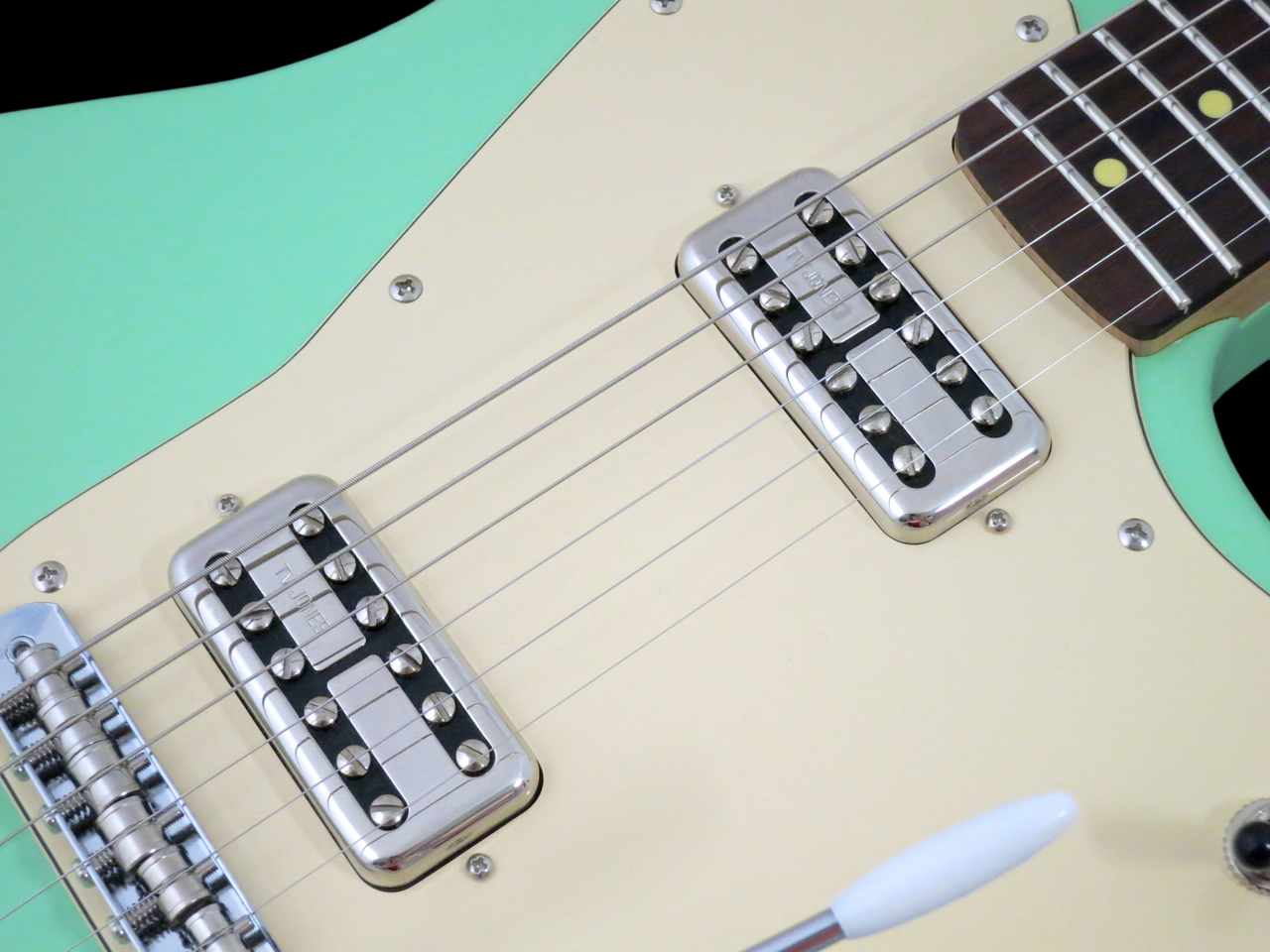
Instead of a dizzying array of knobs and switches, Tokai offer you two genuine Seymour Duncan humbuckers. The neck pickup is their famous Jazz-model (SH-2N), with the slightly chunkier-than-vintage Jeff Beck-model (SH-4) placed next to the bridge.

A three-way toggle switch and master volume and tone controls – nice and easy does it…
****

I can only recommed giving the Tokai AJG-88 a spin. If you haven’t tried a Jazzmaster-style guitar before, you’ll be surprised at the well-balanced ergonomics that this large-bodied classic holds in store. The feel is different – in a very good way – and the AJG-88 is easy to hold, both standing up and sitting down.
The neck profile is a nice, medium-thickness vintage-style ”D”. Thanks to the excellent fretwork our test sample came with a really low action (low E: 1.6 mm, high e: 1.0 mm), yet was free from fret buzz.
Acoustically Tokai’s AJG-88 sounds open with a tight bottom end, as well as a charming, slightly hollow mid-range.
Played with a clean amp the Tokai’s neck pickup gives you warm and full tones with a nicely rounded top end. As is the case with most two-humbucker guitars, putting the AJG-88’s toggle in the centre position will result in the most useable clean rhythm tones. The sound is open and airy, with a nice helping of plectrum attack. The bridge pickup on its own displays a chunky mid-range colour – quite useable for clean tones, but, naturally, not as biting and wiry as a Fender-type singlecoil.
This Tokai really loves overdriven sounds, with the excellent-sounding humbuckers dishing out the goods aplenty for all your Blues-, Rock- and Metal-needs. This isn’t your granddad’s Jazzmaster – this Tokai really knows how to rock:
Tokai’s AJG-88 is a classy quality-guitar from Japan. I found it to be a very intriguing and well-executed mix of Fenderish looks and playability, coupled with Gibson-style tones, and offered at a fair price.
****
Tokai AJG-88
1,099 €
Finnish distributor: Musamaailma
****
Pros:
+ Made in Japan
+ value for money
+ workmanship
+ playability
+ Seymour Duncan pickups
+ sound
****

Testipenkissä: Tokai AJG-88
****
Etsitkö mielenkiintoista vaihtoehtoa ainaisille Stratocaster- ja Les Paul -johdannaisille? Ratkaisu pulmaasi voisi hyvinkin olla Tokai AJG-88 – firman valmiiksi modattu kunnianosoitus Fender Jazzmasterille.
****
Tokai AJG-88 (1.099 €) on pitkällä mensuurilla varustettu ruuvikaulainen sähkökitara.
Soitin on rakennettu vaahterakaulasta, sekä sulavanlinjaisesta, kolmesta vierekkäisestä palasta kootusta rungosta.
Sekä kaulaa että runkoa on viimeistelty vintage-tyylisesti kiiltävällä lakalla: kaulaan käytetään kirkaslakkaa, kun taas runko on saanut ylleen erittäin kauniin kolmivärisen liukuvärityksen.
Yksi selvä parannus esikuvaansa nähden on Tokain nykyaikainen kaularauta, jota voi mukavasti säätää suoraan lavan puolelta.
AJG-88 on varustettu Gotohin laatuosilla – virittimet ovat nykyaikaisia suljettuja malleja.
Palisanteriotelautaan on asennettu 22 medium jumbo -nauhaa. Tokain nauhatyö on ensiluokkaista.
AJG-88:ssa on käytössä perinteinen ruuviliitos, joka on toteutettu japanilaisella tarkkuudella.
Tähän asti Tokai AJG-88 olisi voinut kuvailla suoraksi Jazzmaster-kopioksi, mutta soittimen elektroniikka, mikrofonivarustus, sekä tallaratkaisu tekevät selväksi, että testikitara menee paljon nykyaikaisempaan suuntaan.
Alkuperäisessä Jazzmasterissa on edestä asennettu vibrato sekä keinuva talla, joka toimii oikeastaan vain vintage-tyylisellä kielisatsilla (012 tai isompi) tyydyttävästi. Nykysetillä Jazzmaster-tallan tallapalat usein liikkuvat ja sirisevät, kielet tahtovat hypätä ulos uristaan, ja seurauksena sustain kärsii.
Tokai AJG-88 -kitaralla sellaiset ongelmat eivät pääse edes syntymään, koska soitin on varustettu vankalla Gotoh-tallalla ja -kieltenpitimellä. Viritys pitää ja sustainea riittää tämän ansiosta, riippumatta musiikkigenrestä tai soittotyylistä. Gotohin laadukas parivaljakko kestää mukisematta myös matalat Metal-viritykset.
Jazzmasterilla oli P90-tyylisiä, häiriöherkkiä mikrofoneja, ja sen Jaguar-sisarmallilla parannettuja kapeita yksikelaisia. Molemmissa malleissa oli monimutkainen kytkentä erillisine säädinosastoineen vain kaulamikrofonille.
Epäsuosittujen alkuperäisten ratkaisujen sijaan, Tokai tarjoaa kaksi aitoa Seymour Duncan -humbuckeria – kaulassa Jazz-malli (SH-2N) ja tallan vieressä vintagea tuhdimpaa Jeff Beck -mikrofoni (SH-4).
Elektroniikka on virtaviivaistettu niin, että AJG-88:ssä on tarjolla kolmiasentoinen vipukytkin, sekä master volume ja tone -säätimet.
****
Jos et ole koskaan kokeillut Jazzmaster-tyylistä kitaraa, voin vain suositella Tokai AJG-88:n kokeilemista. Isokokoisen rungon ja erilaisen geometriansa ansiosta soittokokemus on positiivisella tavalla hieman erilainen. Virtaviivaista, 1950-luvun autoista vaikutteita saanutta soitinta on joka tapauksessa erittäin mukava soittaa sekä istuen että seisten.
Kaulaprofiiliksi on valittu mukava, vintage-tyylinen ja keskipaksu ”D”. Erinomaisen nauhatyön ansiosta kielet on voitu säätää erittäin matalaksi (matala E: 1,6 mm, korkea e: 1,0 mm), ilman että kielet rämisisivät häiritsevästi akustisessa soitossa.
Tokai AJG-88:n akustinen ääni on avoin, ja sillä on tiukka bassorekisteri, sekä hyvin viehättävä, hieman ontto keskirekisteri.
Puhtaaseen vahvstinkanavaan soitettuna saa Tokain kaulamikrofonilta kauniita täyteläisiä soundeja, joissa on kuitenkin myös riittävästi diskantin tuomaa hohtoa. Kuten monissa kahdella kaksikelaisilla varustetuissa kitaroissa, myös AJG-88:ssa vipukytkimen keskiasennosta saa soittimen parhaita puhtaita. Keskiasennossa sointi on avoin, ja sillä on kauniisti selkeyttä lisäävää atakkia. Vintagea hieman vahvempi tallahumbuckeri tarjoaa tehonsa lisäksi myös selvästi tiheämpää keskirekisteriä – enemmän kuin käyttökelpoinen clean-soundi, siis, vaikka se ei tarjoakaan F-tyylistä twängiä tai purevuutta.
Tämä Tokai todella tykkää säröstä, ja soittimen humbuckerit tarjoavat erittäin maukkaita Blues-, Rock- ja Metal-soundeja. Tällaista voimaa ja sustainea on tavallisesti turha hakea perinne-Jazzmasterista, mutta AJG-88 on heti valmis kovaan menoon.
Tokai AJG-88 on todella hieno laatukitara Japanista. Se on mielestäni erittäin toimiva sekoitus Fender-tyylisestä ulkonäöstä (ja soitettavuudesta) ja Gibson-tyylisestä soundista, ja se tarjoaa roimasti vastinetta rahelle.
****
Tokai AJG-88
1.099 €
Maahantuoja: Musamaailma
****
Plussat:
+ japanilainen laatusoitin
+ hinta
+ työnjälki
+ soitettavuus
+ Seymour Duncan -mikrofonit
+ soundi
****
Classic Guitars, part 9: Fender Jazzmaster and Jaguar

The Fender Jazzmaster was introduced in 1958 as a conscious effort to broaden Fender’s user base and appeal.
The company’s first efforts – the now legendary Telecaster and Stratocaster models – had already proven to be successful, but were then still widely perceived as bright-sounding guitars for Country & Western, as well as early Rock ’n’ Roll. Now Leo Fender and his team were aiming for the more ”serious” guitarists of the Jazz and Easy Listening genres.
Fender kept the standard long Fender-scale (25.5″), but – for the first time – added a rosewood fingerboard. The reasons for the rosewood board were both cosmetic – it looked classier than the lacquered maple of previous models – as well for tonal reasons, with rosewood imbuing the sound with a warmer timbre. The Jazzmaster was also the company’s first guitar with an enlarged version of the Strat-headstock, which was meant to combat dead spots and wolf-tones.
The body was a brand-new design premiering the company’s patented offset waist feature, meant to improve balance, especially when playing seated.
A new, front-mounted vibrato with a softer, spongier action (meant as a direct competitor to Bigsby’s models) was also devised. The vibrato – which worked with a separate, rocking bridge – was easy to adjust from the front, and also featured a locking mechanism for disabling the system (and keeping the guitar in tune even after a string breakage).
The most important changes took place in the electronics of the Jazzmaster: The pickups were clearly Fender’s attempt at getting a Gibson P-90 -type tonality, with the wide and flat coils. The controls featured two different circuits, with the normal circuit offering a 3-way toggle switch, as well as a master volume and tone control. A slide switch on the scratchplate’s upper shoulder engaged the so-called Rhythm Circuit, which switched on only the neck pickup going through its own set of volume and tone controls (above the neck pickup).
After a first wave of enthusiasm over Fender’s new top-of-the-line guitar, the Jazzmaster’s success sadly waned. Most conservative Jazz guitarists wouldn’t touch Fender’s ”plank” with a barge pole, and still considered the sound as too bright, while the company’s usual customers were perfectly happy with their more straightforward Strats and Teles.
The biggest genuine problem with Jazzmasters lies in their singlecoil pickups, which take in a lot of extraneous hum and interference (just like P-90’s do).
Modern players also tend to complain about the vibrato system’s flimsy bridge saddles, although, in fairness, one should note that this is mostly due to our modern light string gauges. The Jazzmaster-vibrato had been designed at a time when ”light gauge” meant an 012-set with a wound g-string.
Today the Jazzmaster’s appeal lies mostly in the alternative field, and not too many name players spring to mind:
Thurston Moore and Lee Ranaldo (Sonic Youth), J Mascis (Dinosaur Jr.), as well as British songwriter Elvis Costello are the most well-known Jazzmaster players.

****

In 1962 Fender took the Jazzmaster as the basis for a brand-new model, geared towards Surf and Pop guitarists – called the Fender Jaguar.
The Jaguar was Fender’s first guitar with 22 frets, and it featured a relatively short scale of 24″ (even shorter than Gibson’s usual 24.75″). The general look stayed in place, but the Jaguar was adorned with glitzy chrome control plates.
Fender took the criticisms over the Jazzmaster-pickups to heart and designed new pickups for the Jaguar. The new units are reminiscent of Strat-pickups, but feature slightly higher coils, as well as metal shielding plates that enclose most of the pickups’ bottom and sides.
The normal/Rhythm-circuit set-up stayed in place, but the normal circuit now featured three slide switches – an on/off-switch for each pickup, plus a ”strangle” switch that cuts all bottom end from the output signal.
The Jaguar originally also came equipped with a detachable mechanical string mute, which wasn’t well-received by guitar players.
Sadly, the Jaguar’s fate followed along the Jazzmaster’s lines – after a first wave of success sales dwindled in the wake of the British Invasion.
The most famous names associated with the Fender Jaguar are Carl Wilson (The Beach Boys), Kurt Cobain (Nirvana) and Johnny Marr (The Smiths, Modest Mouse).
As with the Jazzmaster, the Jaguar has seen a resurgence of sorts over the past few years, with many new and modified versions springing up, such as the Fender Blacktop Jaguar HH.

Squierilta herkullisia versioita Jaguarista ja Jazzmasterista

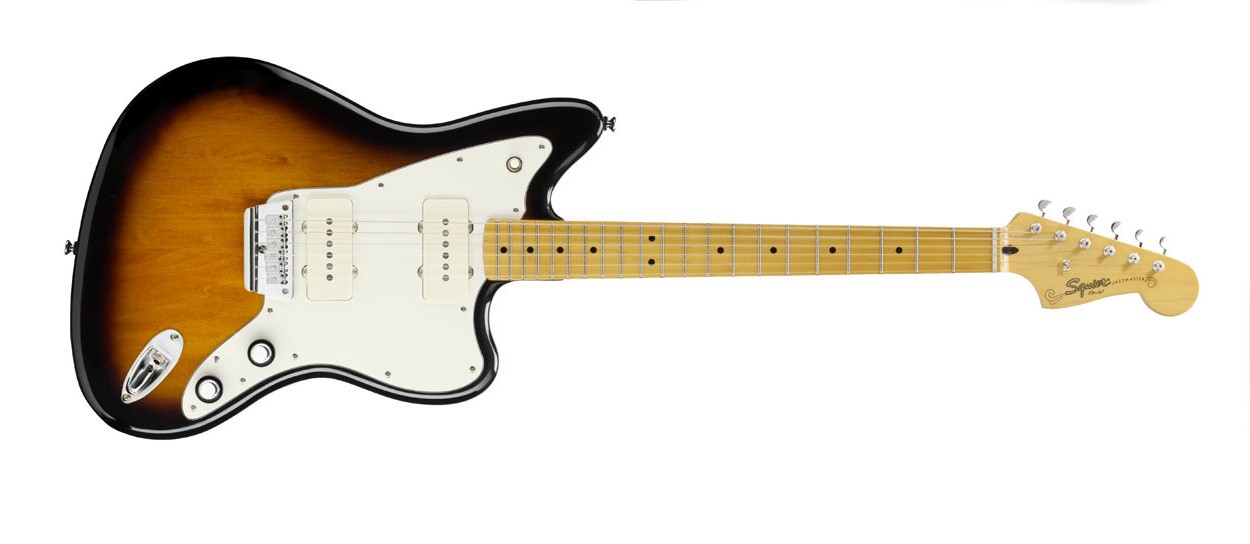
Squier tarjoaa nyt virtaviivaistettuja päivityksiä Jaguar– ja Jazzmaster-malleista.
Elektroniikka ja mikkejä on uudistettu ja vibratallatkin on jätetty pois.

 Kitarablogi.com – Finland's premier Guitar and Bass blog