Review: Bluetone Black King Reverb

Finnish boutique amplifier company Bluetone Custom Amplifiers offers a wide range of different all-valve guitar amplifiers, from gnarly tweed-style combos to the full-on assault of modern high-gain Metal machines.

Over the last few years Bluetone’s dynamic duo of Harry Kneckt and Lauri Vuojolahti seem to have hit on a winning concept with their range of amplifiers with the word ”Black” as the first word in their name.

It all started in 2021, when Bluetone introduced a thoroughly updated version of the Black Prince Reverb. That particular model – which is basically a handmade cross between a Fender Blackface Princeton and a Deluxe, coupled with a very versatile power amp section – has very quickly become the company’s top selling model. This success has spawned several smaller Black Prince models, which have also become very popular. I own a Black Prince Reverb myself, and it has become my go-to guitar amplifier.

When Harry told me that Bluetone was about to introduce a new model – called the Black King Reverb – that would combine a Fender Vibro-King’s preamp section with Bluetone’s Black Prince-power amp, I was very eager to test drive one.

Embed from Getty Images
I’m a huge admirer of Pete Townshend’s (The Who) oeuvre, and he has been using Fender Vibro-Kings as his live amps, ever since they were introduced in the mid-1990s.

The first couple of Bluetone Black King combos were sold as quickly as the guys could make them, but now I’ve finally managed to grab one for a couple of days.

****
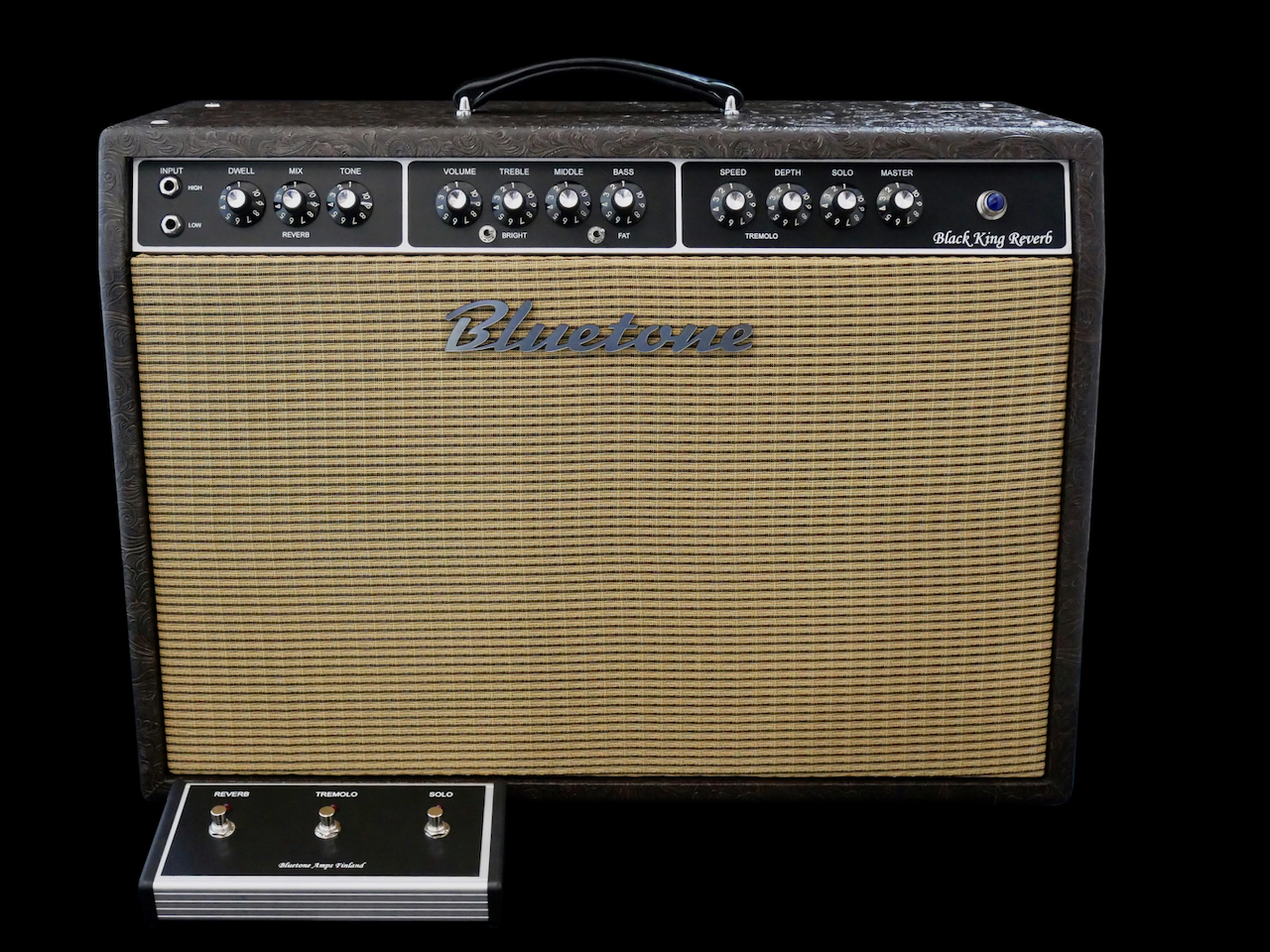
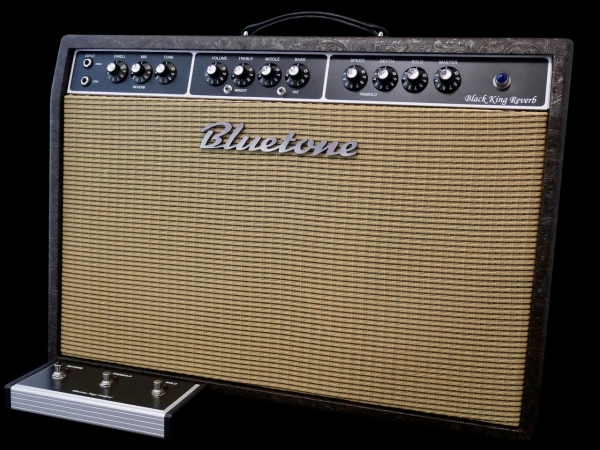
The Bluetone Black King Reverb (current price: 1,900 €) is twin-speaker all-tube combo, loaded with a pair of 10-inch speakers, but it still weighs in at less than 14 kilos. Most of the musician-friendly weight reduction is down to Bluetone using solid paulownia wood for its cabinets. Paulownia is an ecologically viable species that offers a superior strength-to-weight ratio for amplifier and speaker cabinets.

As mentioned before, the Black King lifts its extremely flexible power amp section from Bluetone’s Black Prince combo. The power amp runs off a pair of valves – virtually all available octal power tubes can be dropped in without the need for rebiasing. A pair of 6L6GCs or EL34s will give you approximately 28 to 30 watts of output power, while a pair of 6V6GTs will drop the output down to about 14 watts. Refer to the manual for details.

The Black King’s preamp is built around three 12AX7, but will also take other valves from the 12A_7-range, if you want to experiment with different gain structures (again, refer to the manual).

The toroidal power transformer (the black doughnut in the far left) is another long-standing hallmark of Bluetone amplifiers, which cuts down on the amp’s weight, as well as reducing hum interference noticeably.

The Black King Reverb normally leaves Bluetone’s workshop with a pair of 10-inch Warehouse Guitar Speakers Veterans, but – Bluetone being a custom builder – you can also request different speakers, should you so desire.

The long reverb tank is installed to the bottom of the combo’s cabinet.

Despite making all-valve amplifiers, Harry and Lauri are all about hard technical facts, leaving all the snake oil and tube voodoo for others. In the Black King’s case this means – among other things – that the reverb’s signal path is using their unique op-amp-powered circuit, for a cleaner, more dynamic and hiss-free tone.
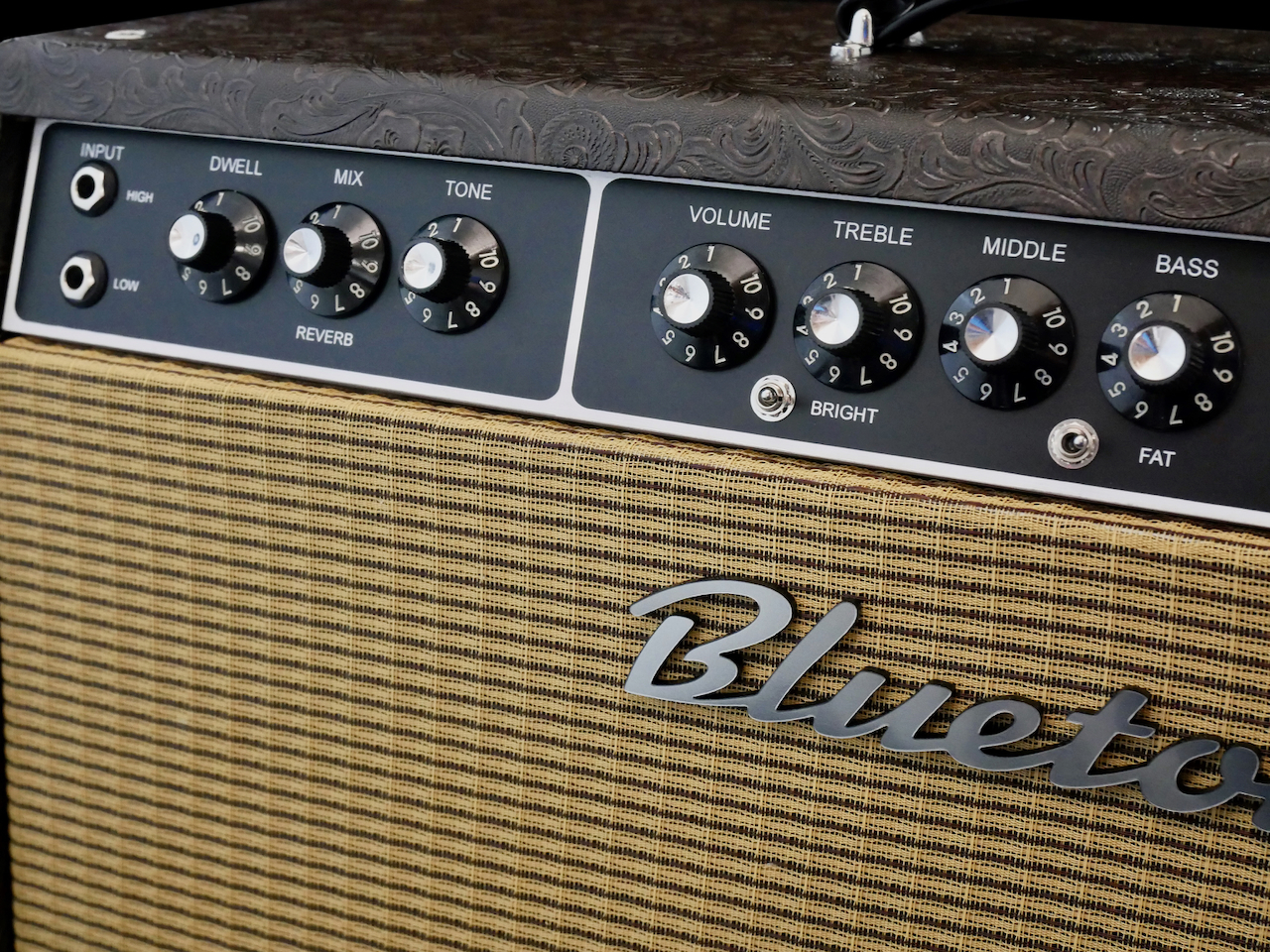
For a single-channel combo Bluetone’s Black King Reverb offers plenty of scope for adjustment:

The preamp section sports controls for volume and 3-band EQ with an additional two mini-switches for Bright- and Fat-boosts. Everything does what it says on the tin, offering a wide variety of fantastic guitar tones that keep the core character of each guitar intact.

The Black King is a reverb connoisseur’s nirvana, not only offering a top-quality full-length spring tank, but also a full set of three controls for maximum tonal range. Dwell adjusts how hard you drive the spring reverb’s input – higher Dwell-settings will result in longer reverb times, as well as more saturation. Tone controls the tone of the reverb’s output, from dark to bright, while Mix lets you choose how much of the Black King’s super lush reverb will be used to bolster your guitar signal.

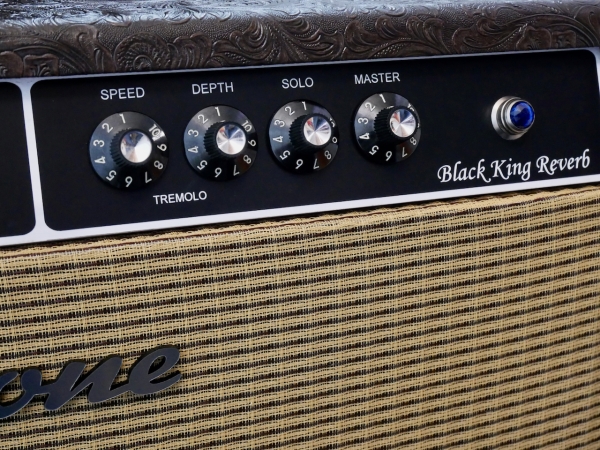
The output section offers you controls for the Band King’s scrumptious bias-modulated tremolo, the level of the solo-boost, and the master volume control. As the master volume is placed after the phase inverter stage, setting the master control to full will remove it completely from the power amp’s circuit.

All three amp effects – tremolo, soolo-boost, and reverb – are switched on or off with the supplied three-switch foot-switching unit.

There’s a lot going on on the Bluetone Black King Reverb’s back panel:

There’s an unbalanced line level output with its dedicated signal level control, so you can plug the combo straight into a speaker modeller. If you need to go completely silent, for example in the studio, the Black King includes a built-in switchable dummy load.

Next to the three speaker outputs we can find a mini-switch labelled ”NFB On/Off”. This allows you to choose whether or not you want to run so-called negative feedback in the combo’s power amp section.

A negative feedback loop will normally ”clean up” the power amp’s sonic footprint, giving you less power amp distortion and more clarity and articulation, while turning it off will give you a gnarlier and more distorted character. A wide generalisation would be that negative feedback takes the amp closer to Blackface territory, while no negative feedback gives it more of a Tweed- or Vox-style accent. Of course, your choice of power amp valves also has an important bearing on the overall character of the Black King.
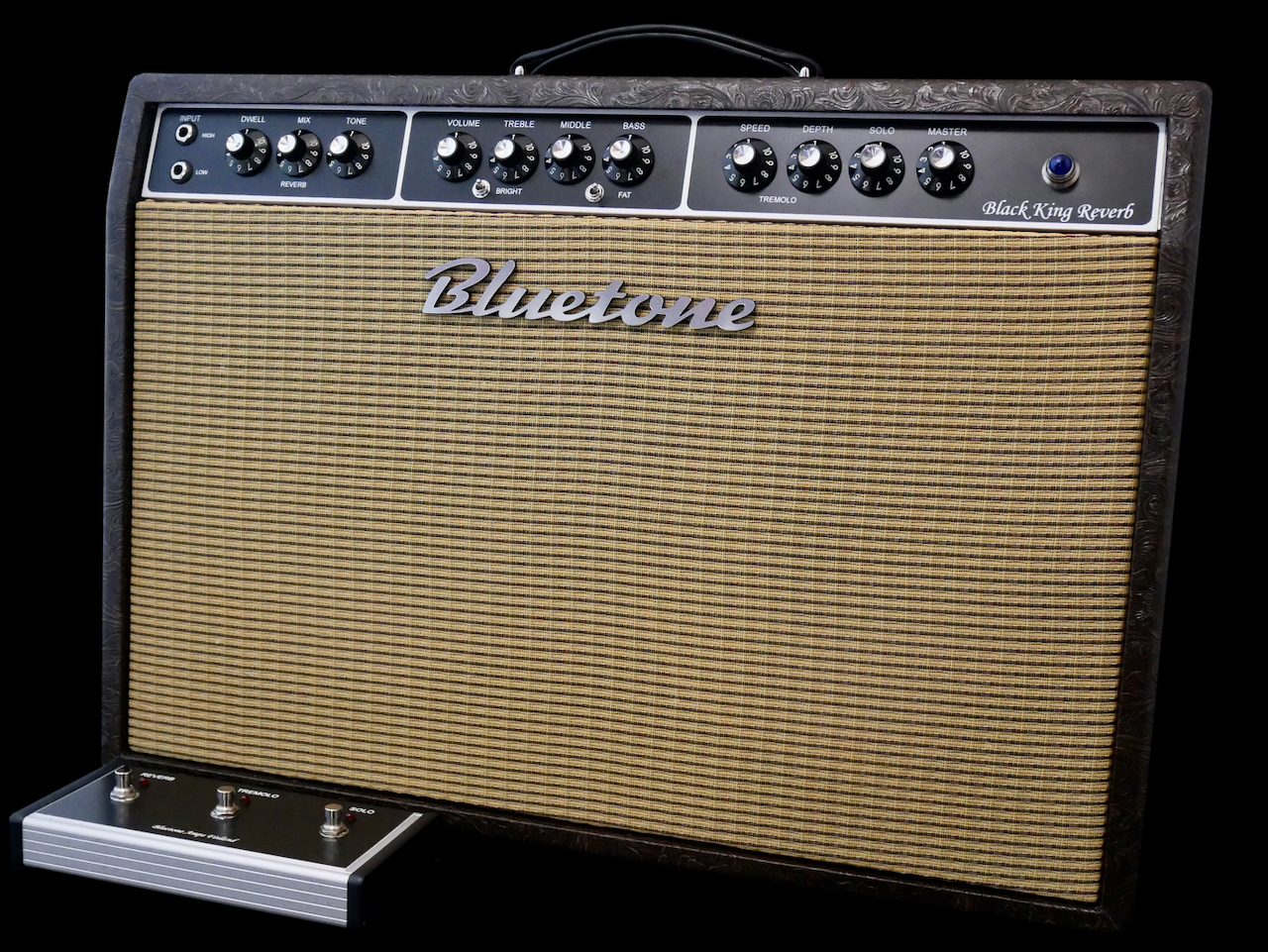
The Bluetone Black King Reverb ticks all the right boxes in my book.

The Black King offers some of the best clean sounds you are likely to experience, regardless of the type of guitar or pickup you throw at it. The genuine spring reverb is simply fantastic, and may even prove to be a dealbreaker in comparison to many other combos. The tremolo effect is luscious, with plenty of scope for adjustment of both speed and depth.

The overdriven/distorted tones you can glean from the Bluetone Black King Reverb are pleasantly gritty, but if you don’t like them, no problem – the Black King also loves pedal effects.

In my view, the Black King Reverb’s clean tones are this combo’s biggest forte. There’s plenty of headroom on offer, and the character is definitely in the Blackface-vein. There’s plenty of dynamic range on offer and the amp’s basic voice is big and open, seasoned with a crystal-clear top end. The three-band EQ offers more than enough scope for tone-shaping, and the Bright- and Fat-boosts work like a dream. What’s not to like?

For less than two grand you can get yourself a hand-made boutique valve combo that’s very versatile and great sounding. This is hands down one of the best amps you will find in its class, and it’s offered at a very fair price.

Here’s a demo song featuring the brand-new Bluetone Black King Reverb combo. The track is a short cover of the Who’s classic medley ”See Me, Feel Me/Listening To You”.
All guitar tracks recorded with the Bluetone Black King Reverb, without any additional pedals. The amp was miked with a Shure SM7B running into a Cranborne Audio Camden EC2.
****
”See Me, Feel Me” – Guitars
• rhythm guitar (stereo left): Fender Japan 50s Stratocaster Reissue
• rhythm guitar (stereo right): Epiphone G-400 (SG Standard)
• lead guitar: Fender Japan 50s Stratocaster Reissue
”Listening To You” – Guitars
• rhythm guitar (stereo left): Fender Japan 50s Stratocaster Reissue
• rhythm guitar (stereo right): Epiphone G-400 (SG Standard)
• lead and harmony guitars: Gibson Melody Maker SG
****
• bass guitar: Rickenbacker 4003 plugged straight into the Cranborne preamp
Bluetone Black King Reverb ++ Testi tulossa ++ Working on a review

Here’s a demo song featuring the brand-new Bluetone Black King Reverb combo. The track is a short cover of the Who’s classic medley ”See Me, Feel Me/Listening To You”.
All guitar tracks recorded with the Bluetone Black King Reverb, without any additional pedals. The amp was miked with a Shure SM7B running into a Cranborne Audio Camden EC2.
****
”See Me, Feel Me” – Guitars
• rhythm guitar (stereo left): Fender Japan 50s Stratocaster Reissue
• rhythm guitar (stereo right): Epiphone G-400 (SG Standard)
• lead guitar: Fender Japan 50s Stratocaster Reissue
”Listening To You” – Guitars
• rhythm guitar (stereo left): Fender Japan 50s Stratocaster Reissue
• rhythm guitar (stereo right): Epiphone G-400 (SG Standard)
• lead and harmony guitars: Gibson Melody Maker SG
****
• bass guitar: Rickenbacker 4003 plugged straight into the Cranborne preamp

Höfner 500/1 (Beatle Bass) vs Rickenbacker 4003

Here’s a demo based on the Beatles’ classic song ”Taxman”, using my 1989 Höfner 500/1 and my 1987 Rickenbacker 4003. Both basses were strung with roundwounds and both pickups were on. The bass tracks were recorded with a Bluetone Bass 200 and a Shure SM7B microphone.
****
The guitar tracks were recorded using a Tech 21 Mop Top Liverpool effect pedal.
• rhythm guitar left (Fender Stratocaster): Channel B with Boost
• rhythm guitar right (Gibson Melody Maker SG): Channel A with Boost
• lead guitar (Epiphone Casino): Channel B with Boost
• reverb added during mixdown

Review: Vox VX15-GT

****

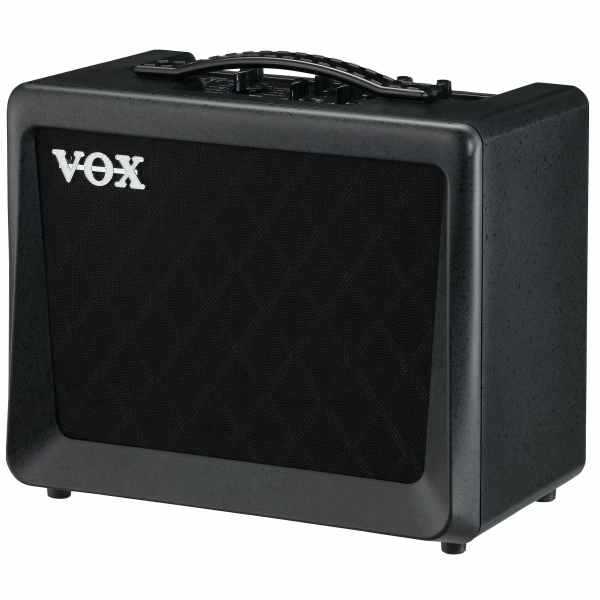
The new Vox VX15-GT (street price in Finland approx. 155 €) is an ultra-light, modelling practice amp with a 15-watt power amp.

The VX15-GT shares the control panel and signal-processing blocks with its larger brother, the VX50-GTV, but with one crucial difference. While the larger combo’s preamp section utilises Vox’ proprietary Nutube – a modern, low voltage tube – the VX15-GT uses Vox’ patented VET (Virtual Element Technology) digital modelling architecture.

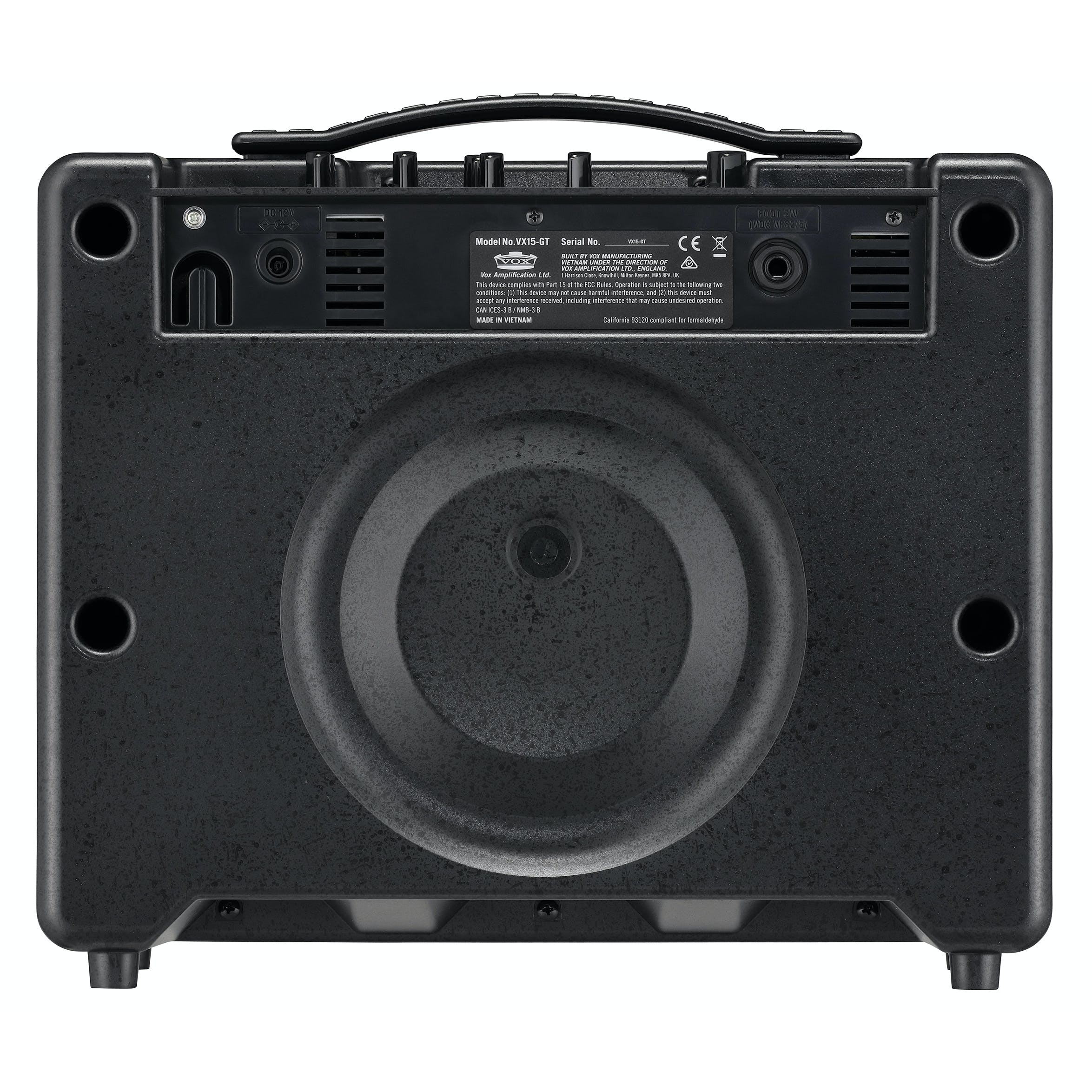
The Vox VX15-GT’s astonishingly low weight (of just under four kilos) is achieved by using a special cabinet that is molded completely from ABS-plastic, as well as the use of a modern, lightweight power amplifier.

The single speaker is a 6.5-inch Vox unit.

The combo is powered by 12 volts DC from an external, laptop style AC adapter.

The internal preset memory holds 11 slots for factory presets (one per amp model) plus two storable user presets. By connecting an optional Vox VFS5 footswitch the number of user presets can be increased to eight.

****

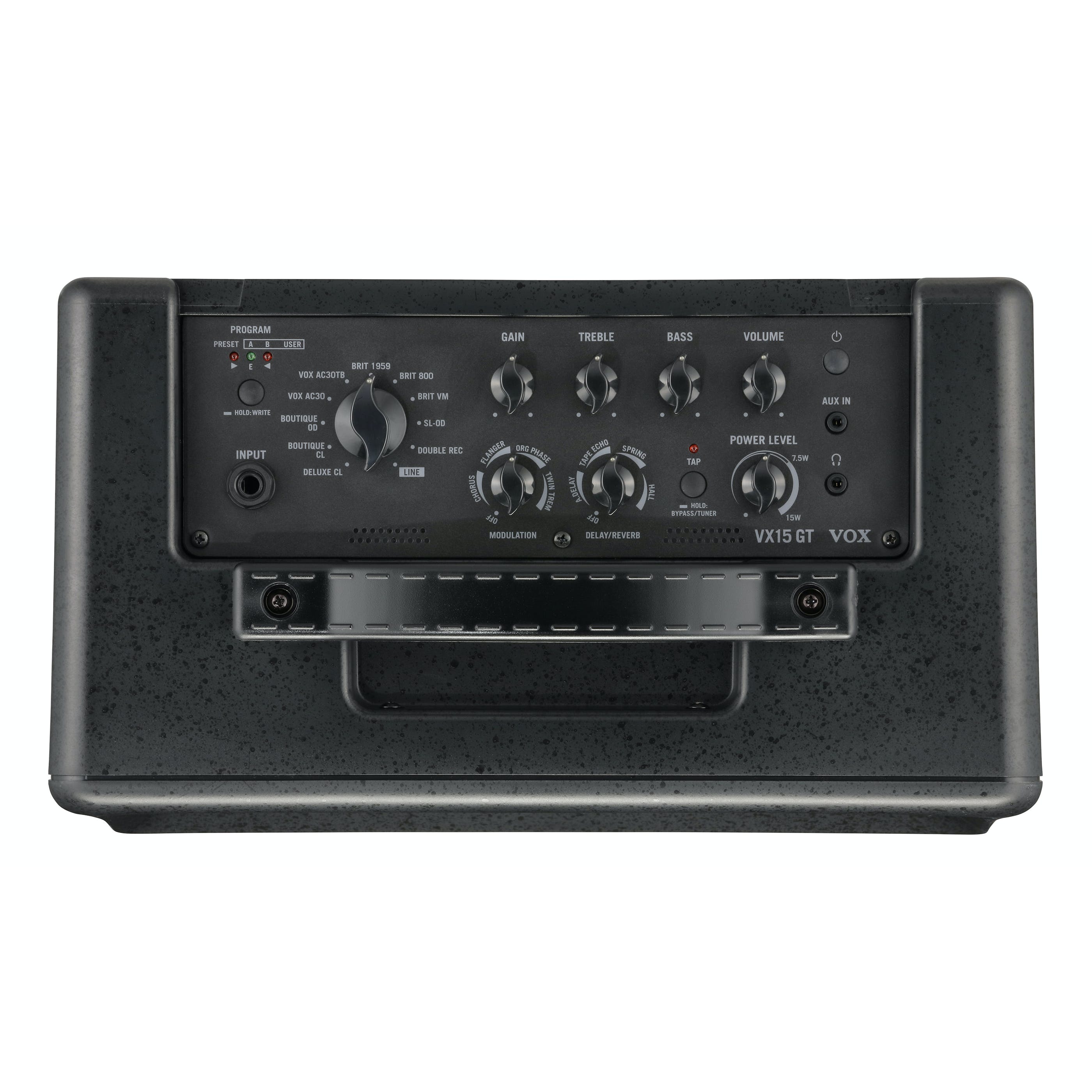
The Vox VX15-GT’s top-facing control panel sports the typical control layout of most modelling practice amps:

Starting from the left we find an E-tuner above the guitar input. The tuner LEDs double as preset programme indicators – when all LEDS are off the combo is in manual mode, with all parameters corresponding to the current knob positions. The amp selector offers you ten different amplifier models – one Fender, two Dumbles, two Voxes, three Marshalls, one Soldano and one Mesa/Boogie. The Line setting disconnects the amp modelling section, so you can use the VX15-GT to amplify a line level signal, such as a synthesiser.

The four smaller knobs in the top row control the usual amplifier functions, namely gain, two-band EQ and programme volume.

The Modulation control lets you choose and adjust one of four different modulation effects – chorus, flanger, phaser (the abbreviation ”ORG” stands for the colour orange) and tremolo. The Modulation knob sweeps each effect’s speed from very slow to very fast. Here’s an audio clip running through the four modulation types, starting with the modulation section off:

The Delay/Reverb control lets you select one out of two delays or two reverbs. This control adjusts the chosen effect’s intensity (its volume in the mix), while the delay speed and the reverb length is set using the Tap Tempo button. For this clip I have set the delay time to almost full. I start off with a dry example and then play two examples of each effect, one with low and the other with high intensity:

As a demo song I recorded short cover version of the Weeknd’s song ”Blinding Lights”. All guitar tracks were played on a Gibson Melody Maker SG and recorded with a Shure SM57. I used only the Vox VX15-GT’s own effects:

****

Once I got over the unusual, all-plastic construction of the new Vox combo, I was really taken with the range of different sounds and the decent amounts of volume the VX15-GT has to offer.

This is a very inspiring and lightweight package, which, in my view, will work best as a practice (or teaching) guitar combo or in a small home studio setting.

One ”hidden”, but very nifty, feature that I haven’t mentioned is the very efficient, built-in noise suppressor. I was able to use single-coil pickups in the highest gain settings, without any 50-cycle hum!

You cannot compare the 15 watts of solid state power output to the full-on blast of an all-valve Vox AC15, but stick a decent microphone in front of it and you could even use the VX15-GT for the occasional pub gig.

****

Vox VX15-GT

Street price around 155 €

Finnish distributor: EM Nordic

Pros:

+ lightweight, ABS cabinet

+ decent presets

+ wide variety of amps

+ decent effects

+ sound

Cons:

– lightweight, ABS cabinetOSave

Save

Save

Save

Save

Save

Save

Save

Vox VX15 GT – The Kitarablogi-video

DEMO SONG

A short cover version of the Weeknd’s song ”Blinding Lights”.

• All guitar tracks played on a Gibson Melody Maker SG and recorded with a Shure SM57.

• Only the Vox VX15-GT’s effects were used.

****

Vox VX15 GT

• 15 Watts RMS @ 4 Ohms

• 1 x 6.5″ speaker

• Inputs: 1 x guitar; 1 x aux in; 1 x footswitch

• Outputs: 1 x headphones

• Controls: Amp Selector, Volume, Gain, Treble, Bass, Power Level, Modulation, Delay/Reverb, Program Selector

• 11 (10 + Line) amp models (VET: Virtual Element Technology)

• Effects: Modulation (Chorus, Flanger, Phaser, Tremolo), Delay/Reverb (Analogue Delay, Tape Echo, Spring, Hall)

• Programmes: 11 x Preset; 2 x User (using the VFS5 footswitch increases the number of user programmes to 8)

Save

Save

Testipenkissä: Nux Mini Core -pedaalit + Cerberus-multiefekti

Kiinalainen valmistaja Nux tarjoaa laajan valikoiman elektronisia musiikkituotteita – sähkörummuista langattomiin järjestelmiin – jotka kaikki lupaavat muusikoille mahdollisimman paljon vastinetta rahalle.

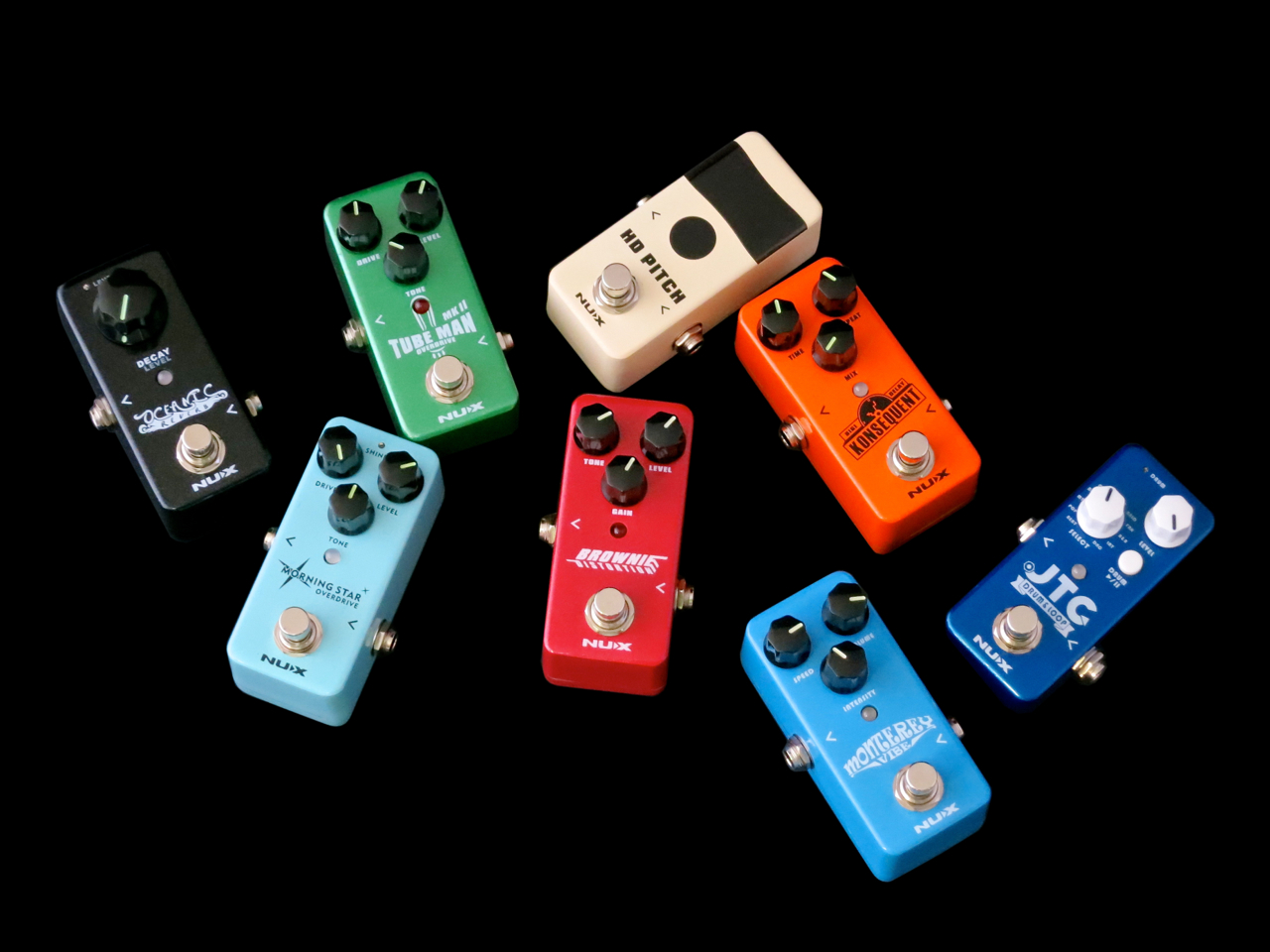
Uusi Nux Mini Core -sarja minikokoisia kitarapedaaleja on hyvä esimerkki firman filosofiasta, sillä useimmissa Mini Core -pedaaleissa piilee hyödyllisiä lisäominaisuuksia.

Saimme kahdeksan sarjan pedaaleista Nuxin maahantuojalta testiin.

Kaikki Mini Core -pedaalit toimivat Boss-standardin mukaisella virtalähteellä.

Säätimien asennot näkyvät hyvin myös pimeällä lavalla, sillä nuppien merkkiviivat fluoresoivat (= loistavat pimeässä).

Malliston digitaalisten efektien (modulaatiot, loopperi jne.) käyttöjärjestelmät voi päivittää mini-USB-portin kautta.

****

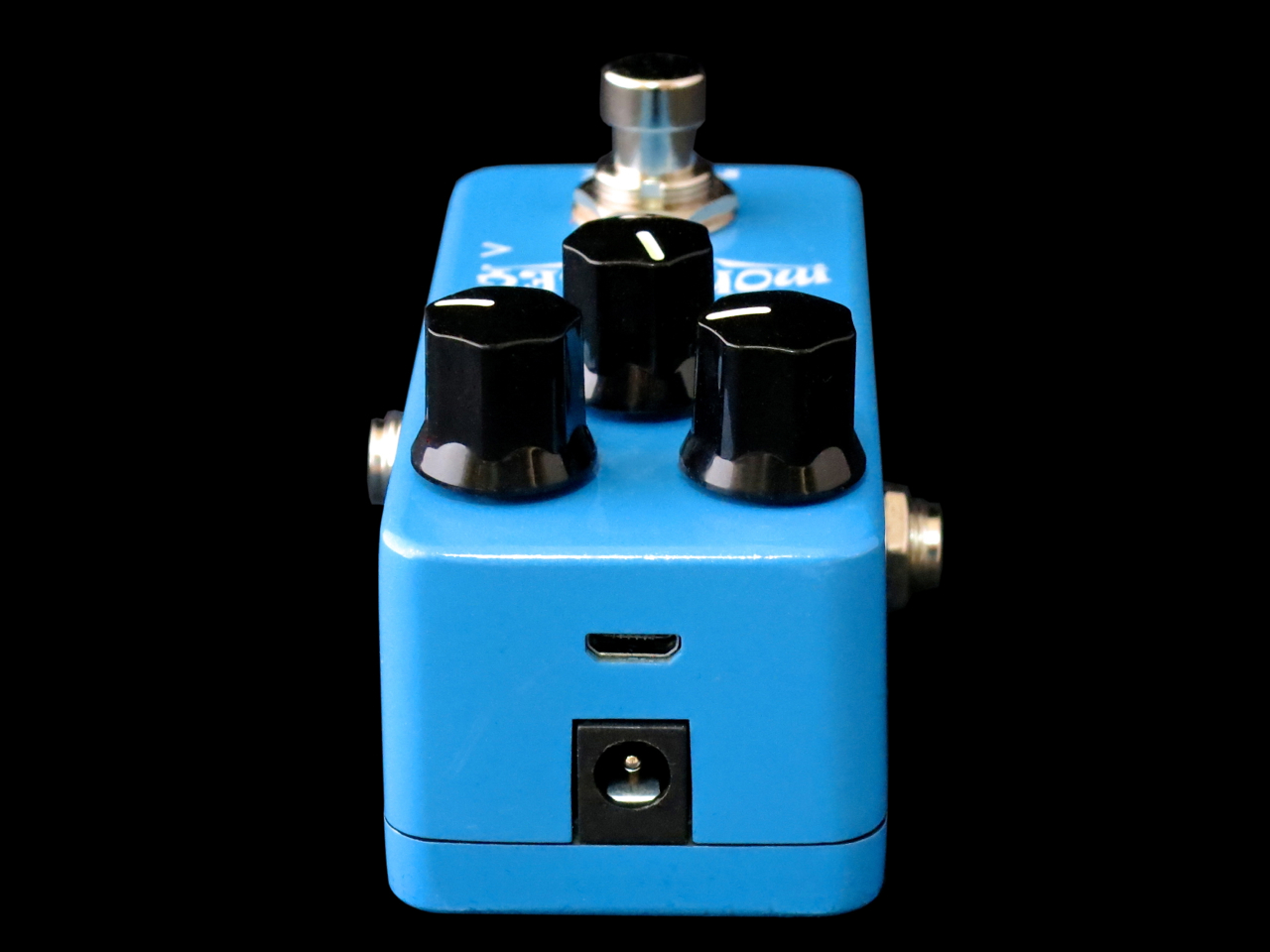
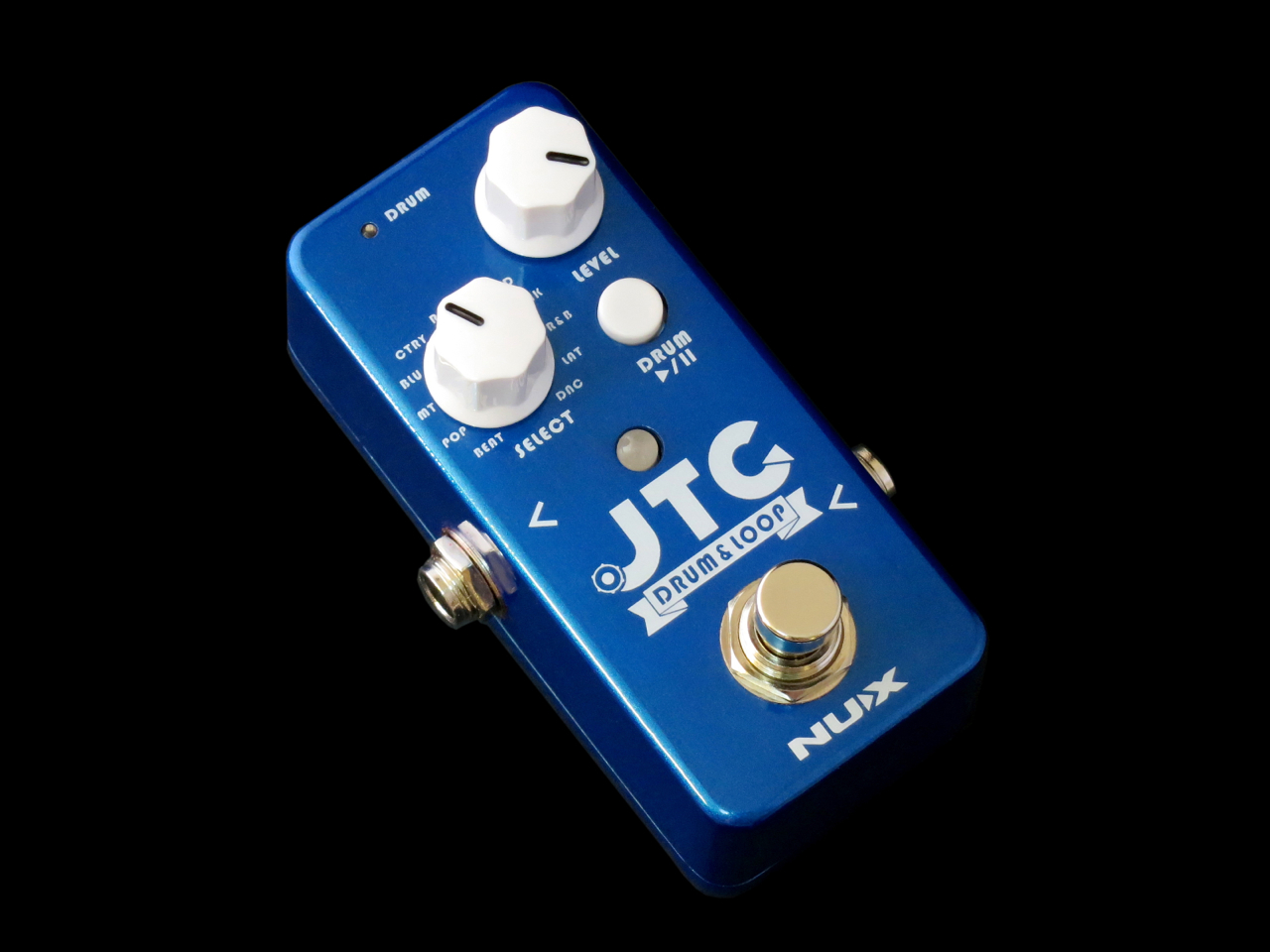
Mini Core -malliston viritysmittarin nimi on HD Pitch (74 €). Nux JTC Drum & Loop -pedaali (99 €) yhdistää helppokäyttöisen rumpukoneen laadukkaaseen loopperiin.

HD Pitch on erittäin hyvin speksattu viritysmittari, joka tarjoaa kaksi erilaista viritystilaa – Arrow Mode ja Strobe Mode – hyvin onnistuneella graafisella käyttöliittymällä.

Lisäksi HD Pitch tarjoaa mahdollisuuden valita kahden bypass-tyypin välillä. True Bypass on paras valinta, jos käytössä on vain pari-kolme efektiä tai jos pedaalilaudalla pyörii jo toinen bufferoitu efekti. Bufferoitu bypass taas on oiva apuväline silloin, kun käytössä on monta true bypass -pedaalia ja/tai matka pedaalilaudasta vahvistimeen on pitkä. Bufferi muuttaa kitarasignaalin impedanssia korkeasta matalaksi, jonka ansiosta signaalin dynamiikka ja diskantti ei kärsi pitkästä signaalitiestä.

Nuxin JTC on tietääkseni tällä hetkellä maailman ainoa minikokoinen rumpukoneen ja audioloopperin yhdistelmä.

JTC Drum & Loopin rumpukone ei luonnollisesti pysty korvaamaan oikeata rumpalia, sillä pedaalin rumpuosastoa ei pysty ohjelmoimaan. Mutta rumpupatternien laatu ja soundi toimivat tällaisen pedaalin yhteydessä enemmän kuin tyydyttävästi.

JTC:n looperiosasto taas edustaa aitoa pro-laatua. Tarjolla on 24-bittinen audiolaatu ja peräti kuuden minuutin äänitysaikaa (ilman päällesoiton rajoituksia). Niin kuin kaikissa yhden kytkimen looppereissa on aluksi opittava Nux JTC:n loopperin käyttölogiikka. Pedaalin loogisen käyttöliittymän ansiosta looperin kanssa pääsee kuitenkin todella nopeasti sinuksi.

****

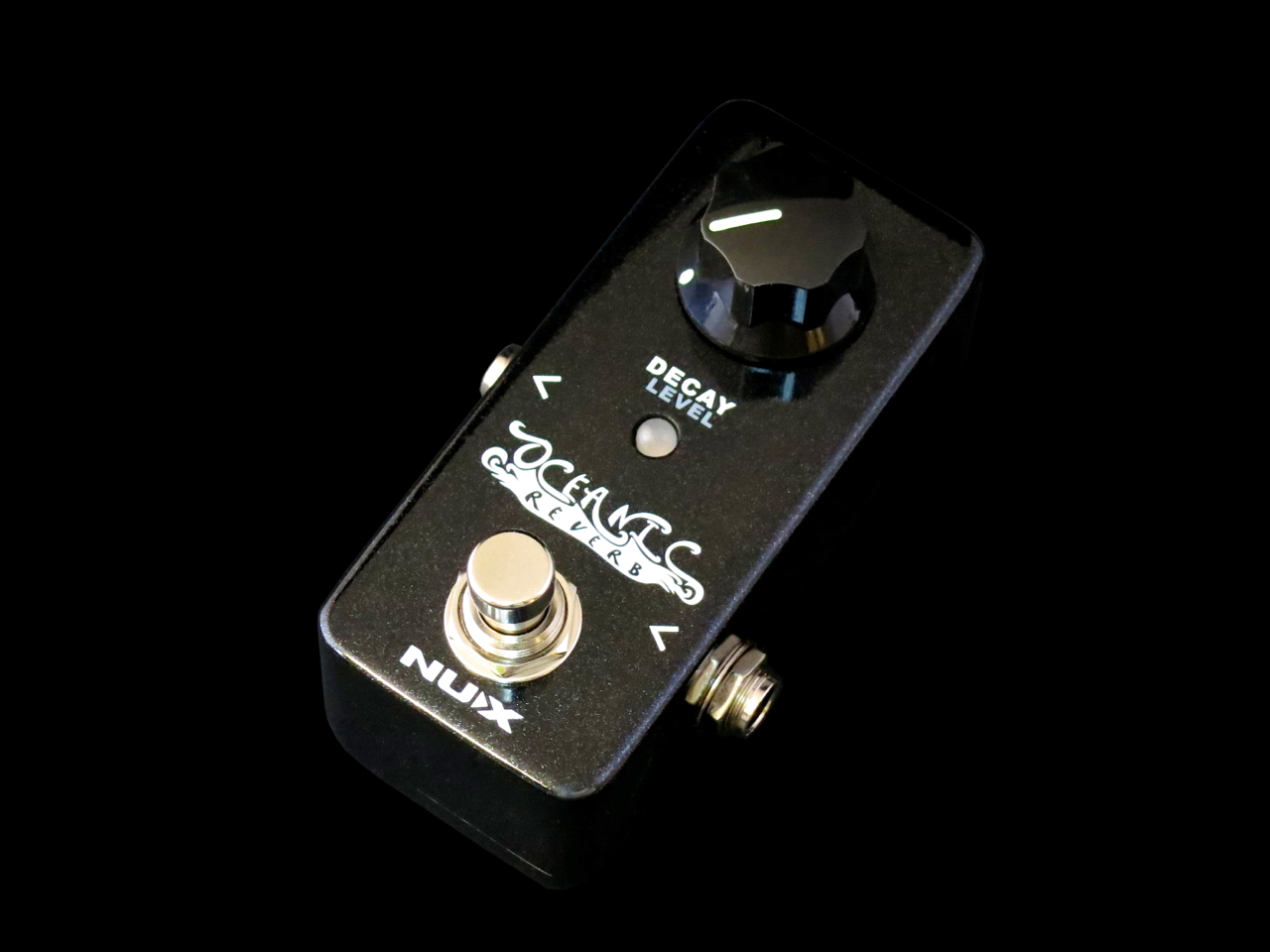
Saimme testiin kolme Nux Mini Core -sarjan modulaatiopedaalia – Oceanic Reverbin (76 €), Konsequent Delayn (76 €), sekä Monterey Viben (76 €).

Vaikka Ocean Reverb -kaiku on äärimmäisen helppo käyttää, tarjoaa pedaali kuitenkin hyvin laajan skaalan kaikutiloja.

Ocean Reverbin prosessointi perustuu nimittäin digitaalisten kaikualgoritmien morfaukseen, jossa Decay-säätimen käyttö ei ainoastaan muuta kaiun pituutta, vaan kaiun luonne muuttuu pituudesta riippuen kaakeloidusta pikkuhuoneesta plate reverbin kautta suureksi halliksi. Morfauksen ansiosta kaikutyyppien väliset vaihdot tapahtuvat täysin portaattomasti ja ikään kuin huomaamattomasti.

Myös Konsequent Delayssä löytyy konepellin alta mielenkiintoisia ominaisuuksia:

Konsequent tarjoaa kaksi eri viivemoodia – Regular Pattern ja Groove Pattern. Regular-moodissa toistot ovat tasaisia (neljäsosasia, kahdeksasosasia jne.), kun taas Groove-moodissa pisteelliset kahdeksasosaset astuvat mukaan kuvaan, The Edge -tyyliseen menoon.

Konsequentiin lisätty saturaatiopiiri lämmittää laitteen toistojen soundia juuri sopivasti.

Yksi Jimi Hendrixin lempiefekteistä oli japanilainen Uni-Vibe, joka oli ensimmäinen yritys pakata Leslie-urkukaapin soundi suhteellisen kompaktiin laitteeseen. Uni-Vibe tarjosi runsaasti säätövaraa, ja sen soundit ulottivat pehmeästä choruksesta phaserin kautta väkevään vibratovatkaukseen.

Nuxin Monterey Vibe on onnistunut pakkaamaan Uni-Viben tärkeimmät soundit hyvin kompaktiin muotoon. Lisäksi pedaalin nykyaikainen digitaalinen signaaliprosessointi tuottaa nämä soundit luotettavasti ilman alkuperäisefektin kohinaa.

Uni-Viben tavoin myös Monterey Vibe tarjoaa kaksi käyttötilaa – miedompi Chorus, sekä rajumpi Vibrato.

****

Saimme testiin myös Mini Core -malliston analogisia säröpedaaleja – punainen Brownie Distortion (51 €), vihreä Tube Man (51 €), sekä vaaleansininen Morning Star Overdrive (59 €).

Vaikka Nuxin Tube Man on Tube Screamerin tavoin vihreä, se ei ole legendaarisen säröpedaalin kopio.

Tube Man -pedaalin kytkentä perustuu nimittäin FET-vahvistinpiiriin, joka käyttäytyy jo luonnostaan enemmänkin yliohjatun vahvistimen lailla, kuin Tube Screamerin alkuperäinen operaatiovahvistin (op-amp).

Mini Core Tube Manin soundi on hyvin dynaaminen ja luonnollinen.

Nux on yhdistänyt eri distortion-pedaalien parhaimmat ominaisuudet yhteen pedaaliin – Brownie Distortioniin.

Brownie Distortion -pedaalin uumenissa toimii kolme peräkkäistä säröpiiriä. Ketjun alussa signaaliin lisätään mietoa asymmetristä säröä BJT-transistorilla, mikä jälkeen alipäästösuodatin mallintaa Variac-laitteen soundia. Lopuksi signaali ajetaan sekä yhden op-amp- että yhden LED-piirin läpi, jotka lisäävät päätevahvistimen säröä muistuttavaa klippausta soundiin.

Brownie Distortion särö on erittäin kermainen ja muhkeasti kompressoiva.

Nuxin Morning Star ei ole Tube Screamer -tyypinen overdrive-pedaali, vaan selvästi nykyaikaisempi efekti.

Morning Starin Drive-säädin tarjoaa laajemman skaalan eri gain-asetuksia – miedosta reunasäröstä suhteellisen rankkaan menoon. Kytkettävällä Shine-ominaisuudella saa lisättyä särösignaalin diskantiin lisää hohtoa.

****

Kitaristipiireissä harrastetaan (valitettavasti) usein kilpavarustelua ja efektivoodoota. Muotivirtauksien mukaan tiettyjen ”boutique-efektien” maine joko kasvaa tai laskee, ja jotkut kitaristit kilpailevat suorastaan efektilautansa varustuksella.

Käytännöllisesti ajatteleva soittaja taas osaa arvostaa uusimman teknologian tuomat edut ja massatuotannon tuomat säästöt. Nux Mini Core -pedaalit eivät ole statussymboleja, vaan erittäin kompakteja, käteviä ja käytännöllisiä lattiaefektejä. Mini Core -pedaaleilla saa jokainen kasattua itselleen helposti ja edullisesti erittäin toimivan ja hyvältä kuulostavan kokonaisuuden.

Demobiisin rumpuraita tulee JTC:n rumpuosastolta. Sähköpianoraita, sekä kaikki kitararaidat käyttävät Mini Core -sarjan pedaaleja. Kitarat on äänitetty linjasoitolla Blackstar HT-1R -kombon kautta.

****

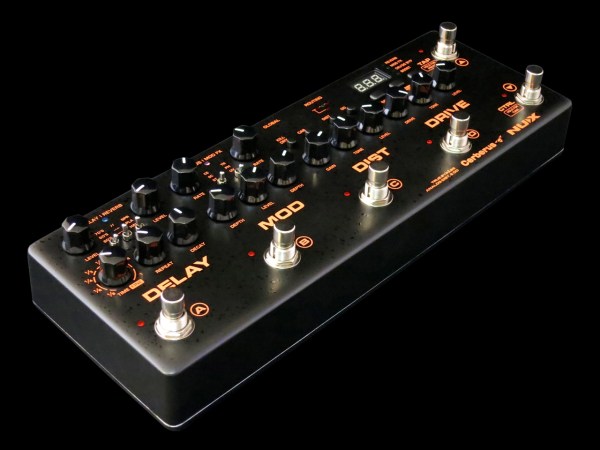
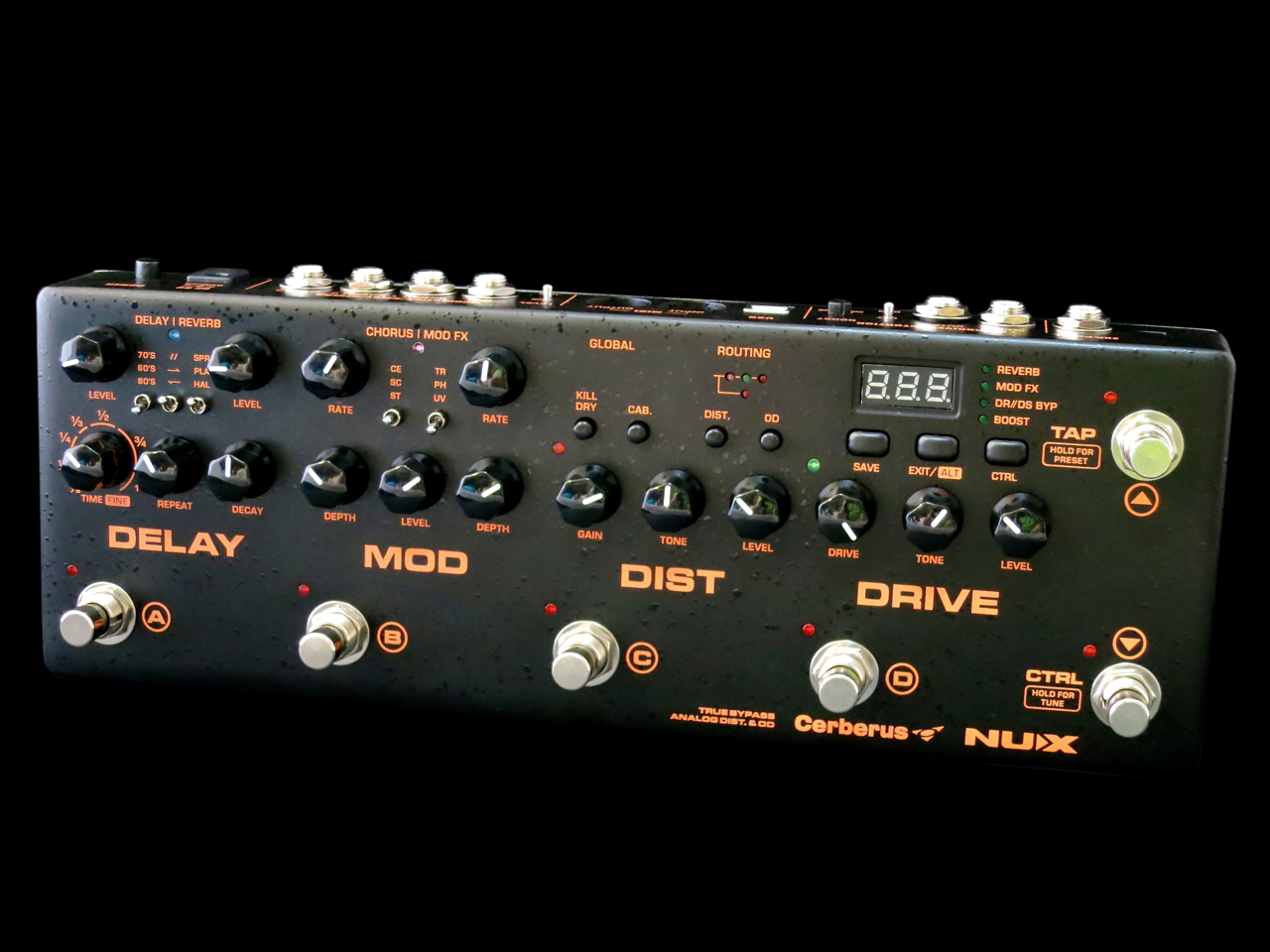
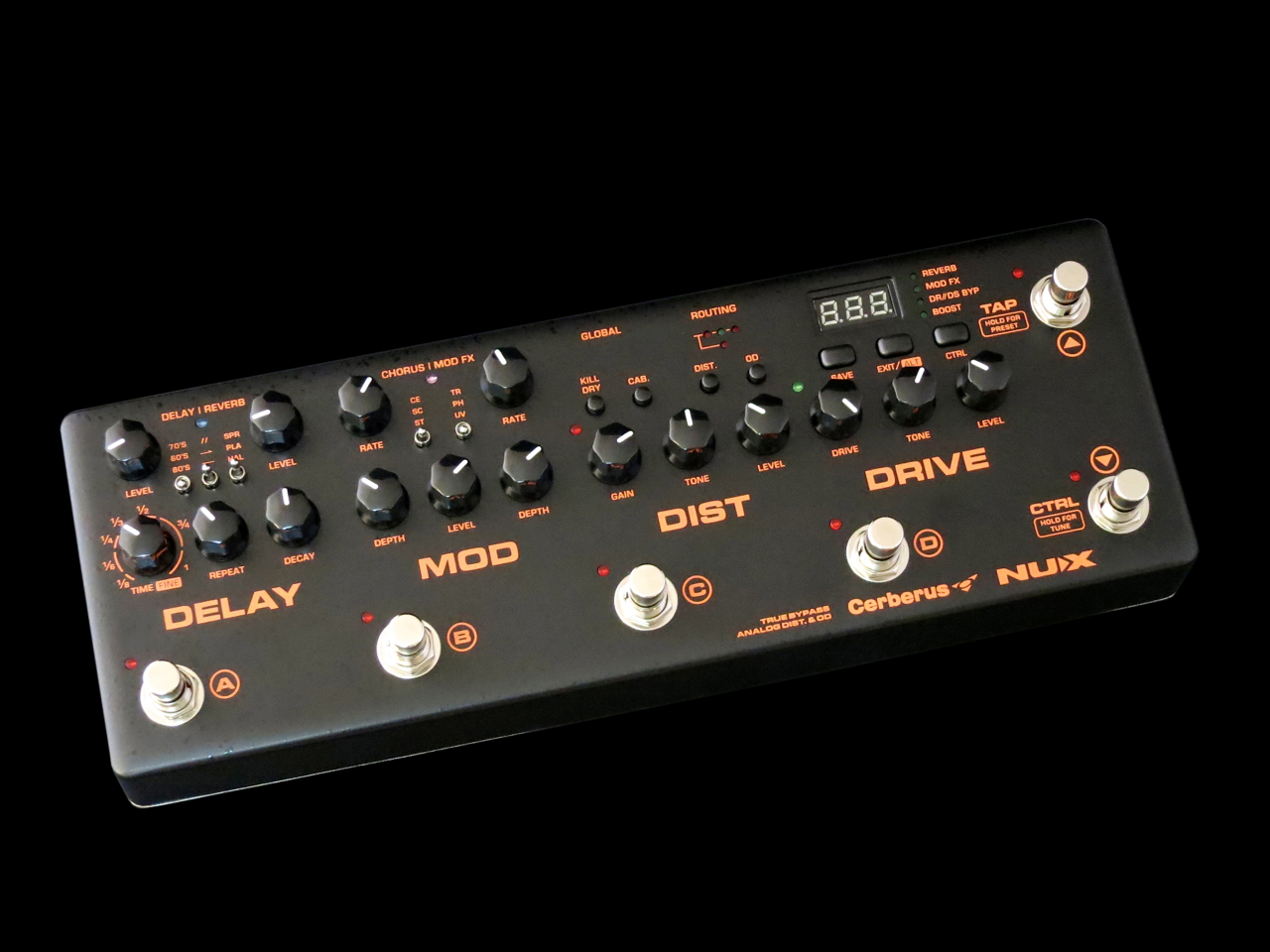
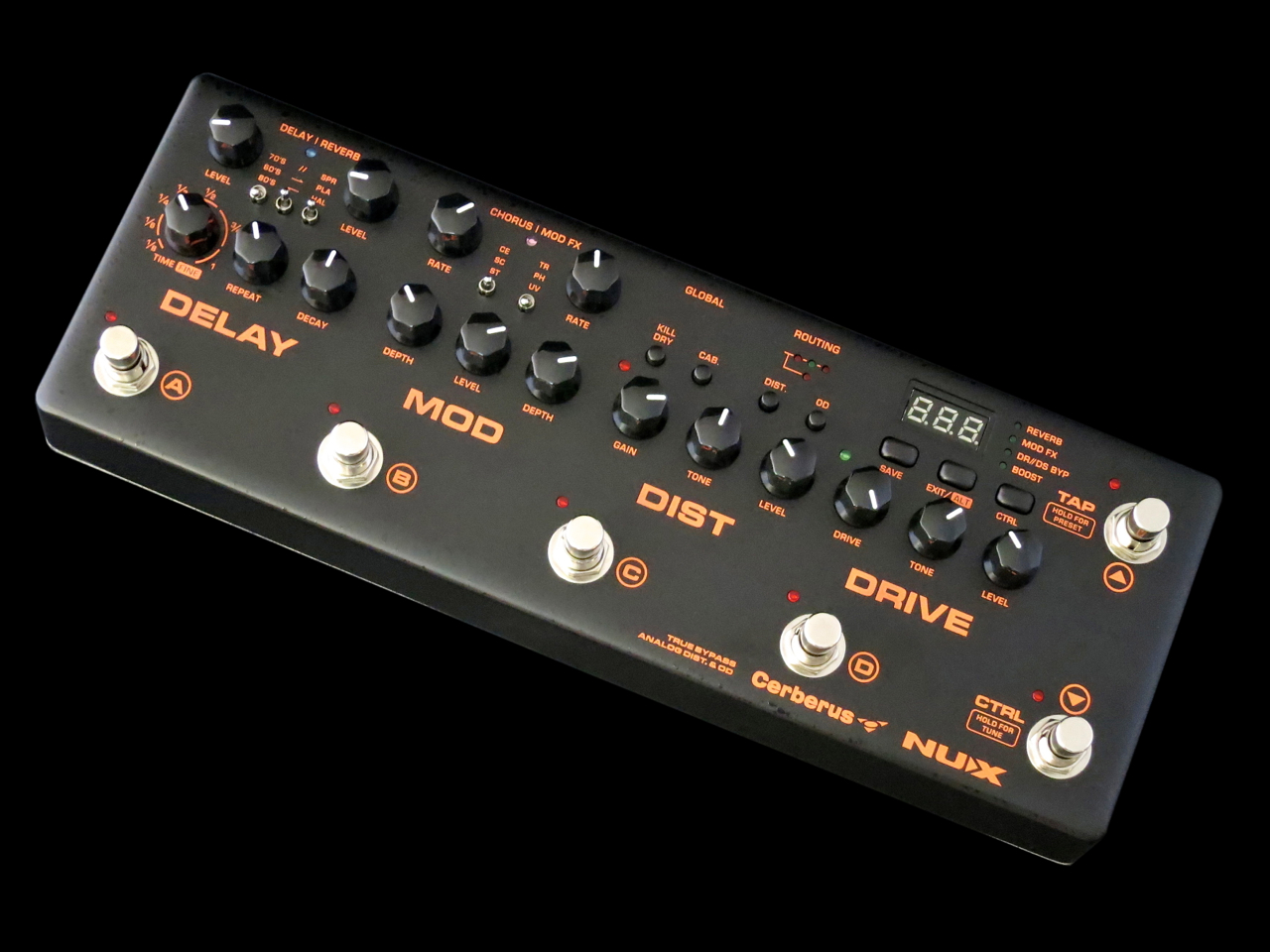
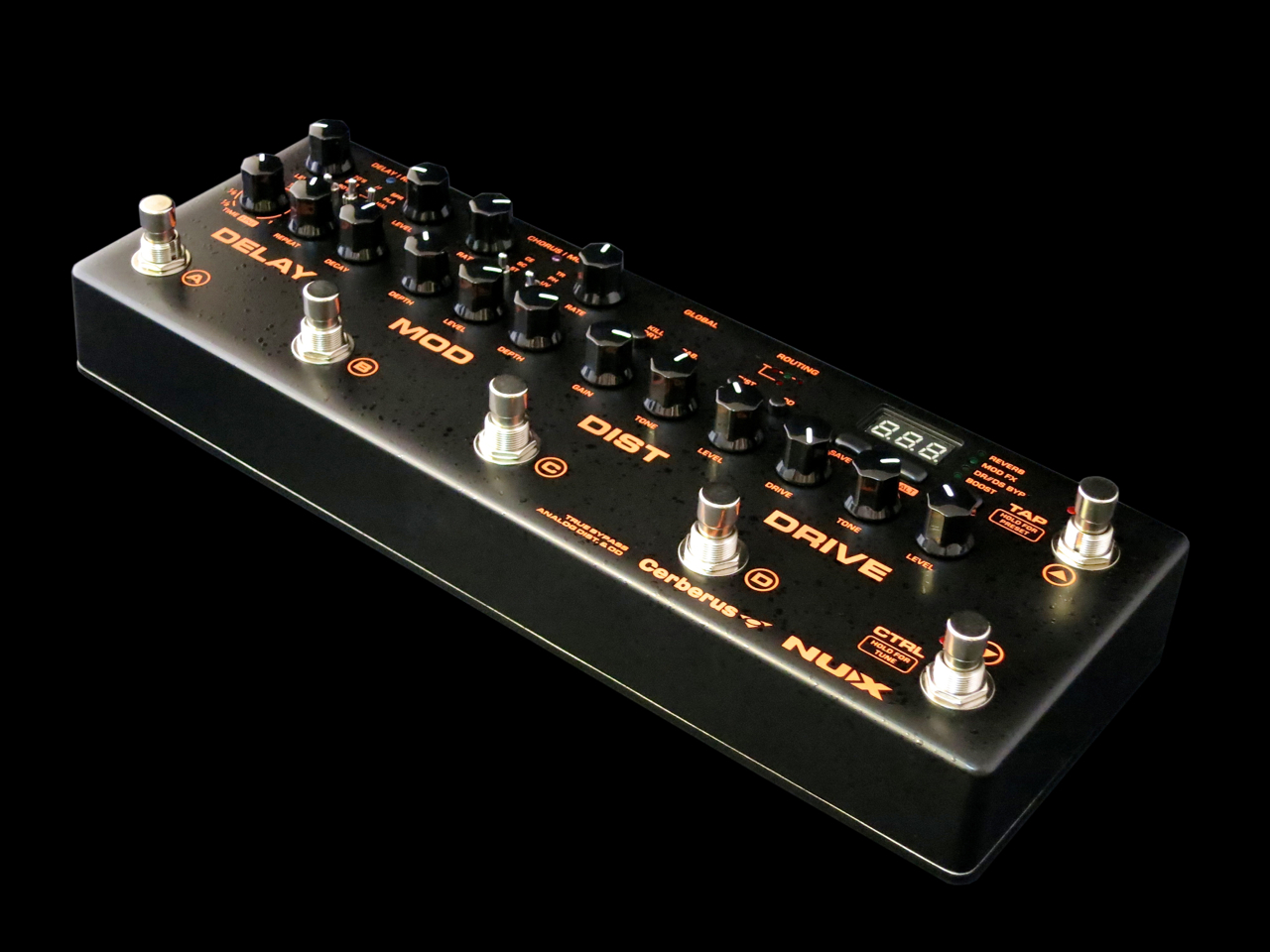
Nux Cerberus (299 ) on firman upouusi multiefektien lippulaiva.

Cerberus on erittäin kompakti ja hyvin varusteltu ohjelmoitava multiefekti, joka tarjoaa runsaasti efektejä ja muistitilaa, sekä monta pro-tason lisäominaisuutta.

****

Nux Cerberus tarjoaa 16 eri efektiä neljässä pääryhmässä – Drive, Distortion, Modulation ja Delay/Reverb.

Cerberuksen muistissa on tilaa 128 presetille 32 pankissa.

Useampiin samankaltaisiin laitteisiin nähden yksi Cerberuksen suurimmista valteista on signaalitien muokattavuus, joka alkaa jo kahden säröpalikoittensa kytkennässä:

Kahdella painonapilla pystyy valitsemaan Driven ja Distortionin järjestyksen signaalitiellä nopeasti ja vaivattomasti. Overdrive-särö voi olla ennen distortionia tai sen jälkeen, tai molemmat säröt voivat myös toimia rinnakkaiskytkennässä.

Säröosastot toimivat muuten Cerberuksessa täysin analogisesti ja True Bypass -periaatteella. Vasta niiden jälkeen signaali muunnetaan laadukkaasti digitaaliseksi (88,2 kHz/32-bit).

Vaikka Nux Cerberuksessa on neljä efektiryhmää, voidaan käyttää jopa kuutta efektiä jokaisessa presetissä, koska sekä Modulation- että Delay-ryhmä tarjoavat kumpikin kaksi samanaikaista efektiä käytettäväksi. Ryhmän toisen efektin saa päälle ja pois Control/Down-jalkakytkimellä.

Modulation-ryhmän ”pääefekti” on chorus, josta saa valittua yhden kolmesta vaihtoehdosta. Lohkon toiseen puoliskoon voi valita yhden kolmesta efektistä. Tarjolla on tremolo, phaser, sekä Uni-Vibe.

Delay/Reverb-osastossa pystyy valita kolmesta kytkentävaihtoehdosta – viive ensin, kaiku ensin tai molemmat rinnakkaiskytkennällä.

Viivepuoli tarjoaa kolme efektityypiä, jotka ovat 1960-luvun nauhakaiku, 70-luvun analogiviive, sekä nykyaikainen digidelay. Viiveaika säädetään joko manuaalisesti tai Tap Tempo -toiminnolla (Tap/Up-jalkakytkimellä), jolloin viiveen jako voidaan asettaa vaivattomasti Time-nupilla.

Reverb-puoliskosta taas löytyy jousikaiku, plate-kaiku ja halli.

Suoraa linjasoittoa (ja kuulokekäyttöä) varten Nux-laudassa on oma digitaalinen kaiutinmallinnus (on/off-kytkimellä). Mallinnus toimii impulssivaste-periaatteella (Impulse Response). Cerberukseen pystyy lataamaan sekä omia että myös muiden valmistajien impulssivasteita.

Takapaneelin liitintarjonta ei todellakaan jätä toivomiseen varaa, ja se antaa enemmän kuin pienen vihjeen Cerberuksen monipuolisuudesta.

Cerberusta voi käyttää sekä itsenäisenä stand-alone-laitteena että integroida järjestelmään ulkoisia efektejä ja laitteita, Drive- ja Distortion-osastojen suoran lähdön ja modulaatio- ja kaikuosastojen oman tulon ansiosta. Näillä lisätuloilla ja -lähdöillä pystyy kytkemään myös Cerberuksen säröt suoraan vahvistimen tuloon, samalla kun modulaatio- ja kaiku-/viive-efektit toimivat vahvistimen omassa efektilenkissä. Jos styrkkarin efektilenkki on rinnakkaislenkki, pystyy myös poistaa kuivan signaalin Cerberuksen digiosastosta yhdellä napinpainalluksella (Kill Dry).

Tässä vielä Nuxin grafiikat Cerberuksen signaalitiestä ja mahdollisista kytkennöistä (kaikki jutun kuvat voi klikata isommiksi):

****

Vau, mikä laite! Jos kompakti, mutta monipuolinen multiefekti on hakusessa, kannattaa minun mielestäni ehdottomasti tutustua Nux Cerberukseen.

Firman päätös rakentaa multiefektillä analogisia säröpiirejä kannatti, sillä Cerberuksen säröosastot ovat todella maukkaita ja luonnollisia. Mutta myös Nuxin digitaaliset efektit kuulostavat erittäin hyviltä. Uni-Vibe-tyylinen vatkaus on multiefekteissä melko harvinainen herkku.

Nux Cerberus -multiefektiä on erittäin helppo käyttää, laite vaikuttaa kestävältä, ja se on erittäin helppo integroida monenlaisiin rigeihin. Cerberus toimii yhtä suvereenisti suoraan vahvistimen (tai äänikortin) edessä kuin osana isompaa järjestelmää.

****

NUX Mini Core -pedaalit & Cerberus-multiefekti

Maahantuoja: Musiikki Silfverberg

Kiitos Vantaan Musiikille testilaitteiden lainaamisesta!Save

Save

Save

Save

Save

Save

Save

Save

Save

Save

Save

Save

Nux Cerberus – the Kitarablogi-video

Nux Cerberus

• Multi-function effect pedal for electric guitar
• 16 different effect types in 4 effect groups (delay/reverb, mod, distortion, drive)
• 128 presets in 32 banks
• Analog overdrive and distortion circuits
• True bypass (overdrive/distortion)
• Realistic speaker simulation with impulse response loader
• MIDI compatible
• USB port for upgrading the software editor
• Converter: 88.2 kHz/32-bit AD/DA
• Kill-dry switch
• Integrated chromatic tuner
• Tap function
• Multiple inputs and outputs
• Dimensions: 320 x 100 x 65 mm
• Weight: 1.26 kg
• Power supply not included

Info: Musiikki Silfverberg

Nux Cerberus – Now on SoundCloud

Nux Cerberus

• Multi-function effect pedal for electric guitar
• 16 different effect types in 4 effect groups (delay/reverb, mod, distortion, drive)
• 128 presets in 32 banks
• Analog overdrive and distortion circuits
• True bypass (overdrive/distortion)
• Realistic speaker simulation with impulse response loader
• MIDI compatible
• USB port for upgrading the software editor
• Converter: 88.2 kHz/32-bit AD/DA
• Kill-dry switch
• Integrated chromatic tuner
• Tap function
• Multiple inputs and outputs
• Dimensions: 320 x 100 x 65 mm
• Weight: 1.26 kg
• Power supply not included

Info: Musiikki Silfverberg

First Look: Valeton Dapper Dark

Valeton Dapper Dark

Five-in-one effects strip

• TUNER module with fast, accurate tuning
• Powerful BOOST module
• HIGH-GAIN DISTORTION module with built-in noise suppressor
• CHORUS module
• Analog-voiced DELAY module with tap tempo
• CAB SIM selector for recording or direct-to-PA
• FX LOOP for extending the effects chain
• Power supply included

****
All guitar parts played on a Gibson Melody Maker SG. Reverb added during mixdown.

Contact: R-JAM GroupSave

Save

Pidä blogia WordPress.comissa.

Ylös ↑