Löydät Mooer GE150 -testin TÄÄLTÄ.
Nyt Rockway-blogissa: Mooer GE150
Kitarablogi.com – Finland's premier Guitar and Bass blog
Juttuja kitaroista ja bassoista
Löydät Mooer GE150 -testin TÄÄLTÄ.

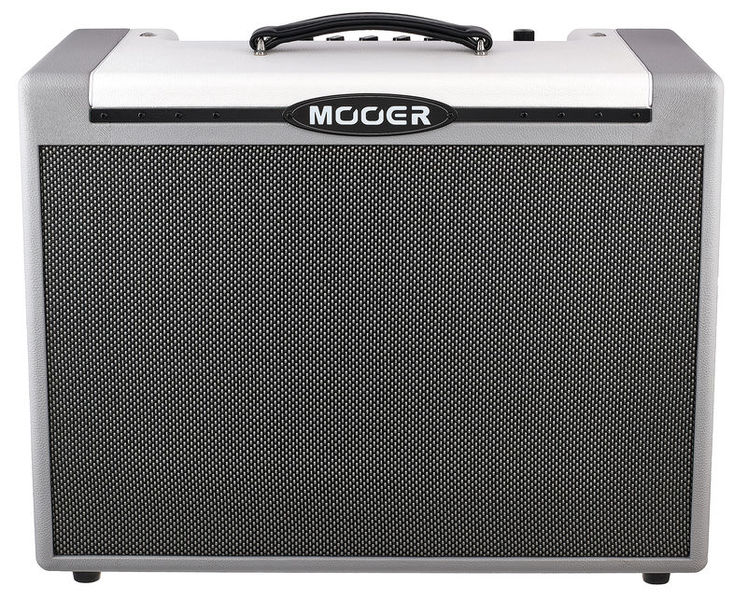
Viime vuosina Mooer on onnistunut saamaan vankan jalansijan edullisien, mutta silti laadukkaiden kitaraefektien valmistajana. Brändinä firma tuli aluksi tunnetuksi mikrokokoisista pedaaleistaan, mutta Mooer valmistaa myös isompia multiefektejä.
Vuoden 2018 Hornet-mallisto antoi jo vihjeen siitä, että Mooerilta oli tulossa uusia tuotteita, ja nyt firman ensimmäiset ”täysikasvuiset” mallintavat kitarakombot ovat ilmestyneet – Mooer SD30 ja SD75.
****

Upouusi Mooer SD75 (378 €) on hybridikombo digitaalisella etuasteella ja transistoripohjaisella päätevahvistimella (75 W; A/B-luokka).

Kauniista kaksivärisestä kaiutinkotelosta löytyy 12-tuumainen Mooer-kaiutin 100 watin tehonkestolla (8 Ω).
SD75 painaa vain 18 kiloa.
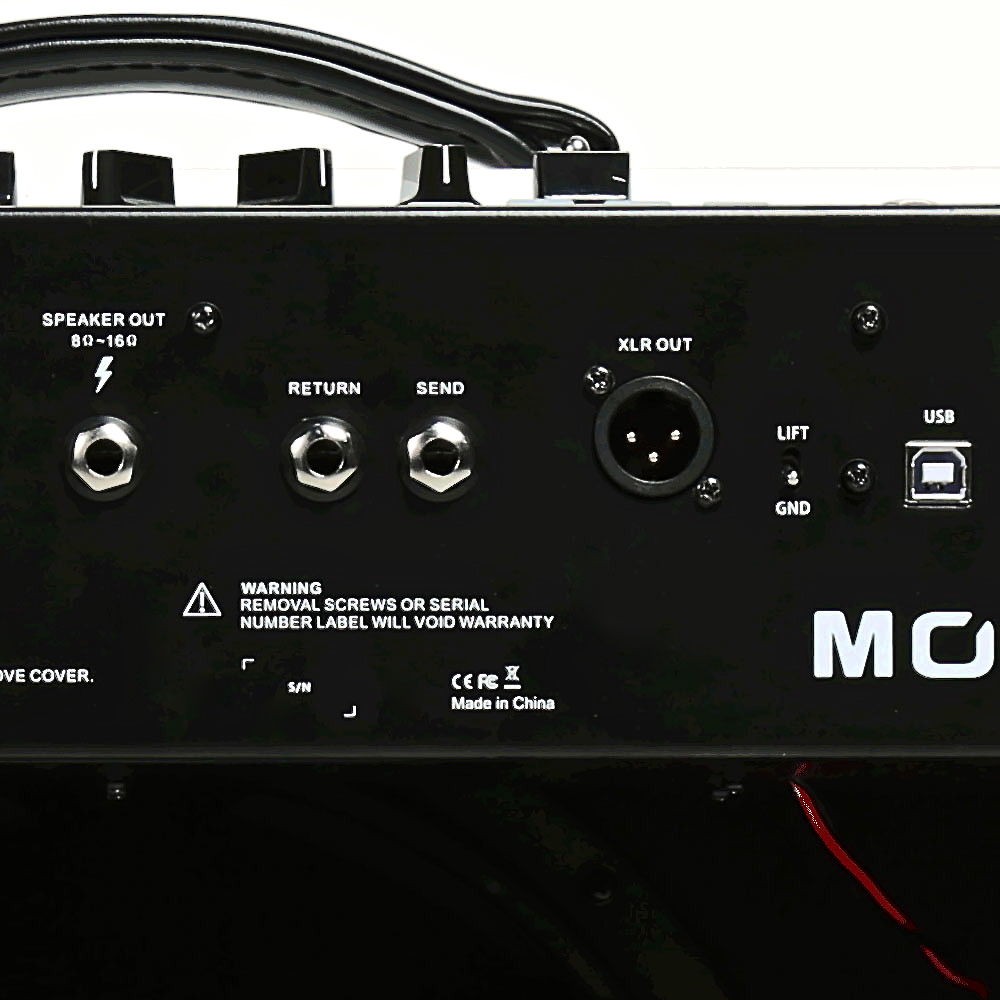
Kombon takapaneeli tarjoaa liittimet lisäkaiuttimelle, efektilenkille, balansoidulle DI-lähdölle (kytkettävällä kaiutinsimulaatiolla), sekä USB-portti firmware-päivitykseen.

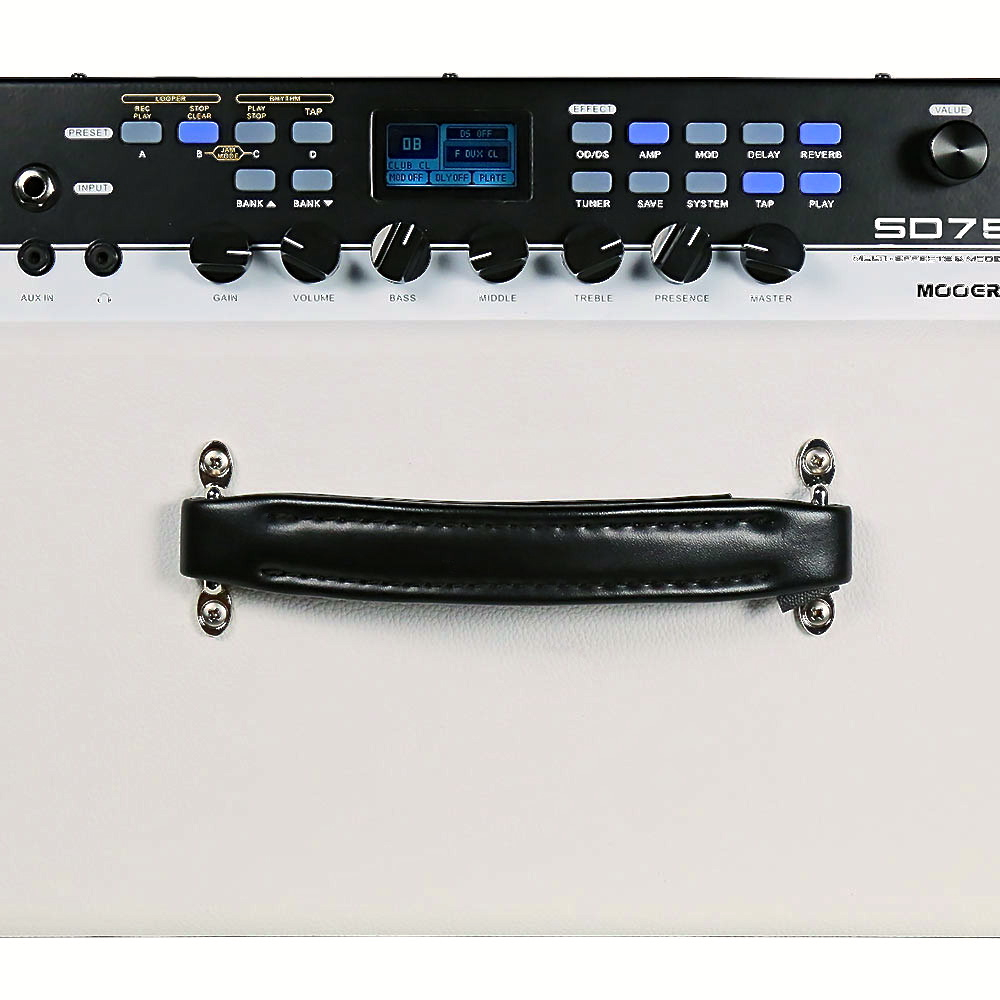
Mooerin säädinpaneeliin pääsee ylhäältä:
Mustaan osaan on aseteltu vahvistimen näyttö, Value-pyörä, sekä taustavalaistut painonapit, joilla pääsee käsiksi kombon ohjelmamuistiin, sekä etuvahvistimen kaikkiin vahvistin- ja efektiosioihin. Napinpainaluksilla pääsee myös Mooerin Jam Mode -tilaan, jossa voi käyttää vahvistimen sisäistä audioloopperia (150 sekuntia äänitysaikaa) ja SD75:n rumpukonetta/metronomia (40 rumpupatternia; 10 eri metronomivaihtoehtoa). Uutuuskombossa on myös sisäinen kromaattinen viritysmittari.
Vahvistimen pääsäädöt tehdään tässäkin perinteisillä säätimillä – tarjolla on Gain, Volume, Bass, Middle, Treble, Presence ja Master. Kaikkien säätimien asetukset – paitsi Masteria – voi tallentaa efektiasetuksien lisäksi SD75:n presetmuistiin, joka tarjoaa 40 muistipaikkaa.

Mooer SD75 -kombossa on myös Bluetooth-valmius:
Kombon mukaan tulee Mooerin Airswitch jalkakytkin neljällä kytkimellä, jolla pystyy vaihtamaan presettejä ja ohjata loopperia. Bluetoothin kautta pystyy myös striimaamaan audiota älylaitteista.
****

Veikkaisin, että käytännössä jokainen kitaristi kokeilee ensin tällaisen vahvistimen tehtaalla ladatut preset-ohjelmat läpi, ennen kuin kokeilee itse mallintavan vahvistimen ohjelmointia. Kyllä tehdasohjelmista saa jonkinlaisen käsitteen Mooer SD75 -kombon tarjoamista mahdollisuuksista, vaikka mielestäni lähes kaikki presetit ovat tässä liian bombastisia minun makuun.
Minusta tutustumista varten kannattaa valita yksi presetti ja painaa kaikki efektiosiot pois päältä. Tämän jälkeen voi ensin valita yhden vahvistinmalleista ja ruuvata sen parametreja rauhassa kuntoon. Seuraavaksi voi sitten mennä kaikki efektiosiot läpi ja kokeilla mitä kaikkea kivaa sieltä löytyy.
Mooerin vahvistinkokoelmaan kuuluu 25 eri mallinnusta. Pedaalivalikoima taas koostuu OD/DS-osiosta (yksi puhdas boosti, sekä seitsemän eri säröä), yhdeksän modulaatioefektiä (choruksesta kehämodulaattoriin), viisi viivettä (nauhakaiusta ducking delayhin), sekä kuusi eri kaikua. Jokaisesta efektiosiosta voi valita yhden efektin.
Parametrien säätäminen on hyvin helppoa taustavalaistujen nappien ja kätevän Value-pyörän ansiosta. Jokaisessa vahvistinmallissa pystyy vaikuttamaan seitsemään parametriin, joihin sisältyvät SD75:n kuusi fyysistä säädintä, sekä sen lisäksi kohinasalpa. Pedaaliefektit on jätetty tahallaan helppokäyttöisiksi, ja ne tarjoavat ainoastaan kolme parametria, niin kuin monet fyysiset pedaalitkin.
Myös muutoksien tallentaminen ja presetin nimeäminen on nopeaa ja helppoa, minkä ansiosta esimerkiksi asetuksien hiominen treeneissä on vaivatonta, ja muutokset voi tallentaa keikkoja varten kahdella painalluksella. Ohjelmamuistossa on tilaa 40 presetille – kymmenen pankkia neljällä presetillä – mikä tarkoittaa, että komboon pystyy ohjelmoimaan etukäteen vaikkapa koko bändisetin verran eri kitarasoundeja.
Mooer SD75:n Jam Mode -tila on kätevä lisä jammailuun, harjoitteluun tai uusien ideoiden kehittämiseen. Kombon sisäinen loopperi toimii todella hyvin. Rumpukoneen soundi ei ehkä ole parasta studiolaatua, mutta se toimii kokonaisuutta (ja hintaa) nähden hyvin.
Johdoton Mooerin Airswitch -kytkin on tässä hintaluokassa harvinainen herkku, jonka ansiosta kitaristin jalkoihin jää yksi johto vähemmän.

Mooerin SD75 kuulostaa todella hyvältä. Kombo tarjoaa mielestäni loistavaa vastinetta rahallesi. Kaksitoistatuumaisen kaiuttimensa ja tuhdin päätevahvistimensa ansiosta SD75 olisi fantastinen valinta coverbändin kitaristille tai bändiluokalle tai vaikkapa (vuokraus-) harjoituskämpälle.
Kuulen jo kysymyksen: ”Onko uusi Mooer parempi kuin kallis vahvistin ja muutama boutique-luokan pedaali?” Vastaukseni on – tietysti – ei ole! Hei, hieman realismia kehiin, tämä on todella edullinen peli.
Mutta:
Näillä spekseillä, tällä hinnalla, ja näillä soundeilla Mooer SD75 on erittäin hyvä valinta viikonlopun kitarasankareille, jolla on tiukka budjetti.
• Komppikitarat: Fender Telecaster (vasen kanava) & Arvo 2-P90 (oikea kanava)
• Soolokitara: Epiphone G-400 Bigsby-vibratolla
• Kitararaidoissa käytetään ainoastaa Mooer SD75 -kombon omia efektejä
• Äänitetty Shure SM57 -mikrofonilla
****
• Komppikitarat: Epiphone SG (G-400; vasen kanava) & Fender Stratocaster (oikea kanava)
• Likkikitarat: Arvo Guitars 2-P90
• Soolokitara: Arvo 2-P90
• Kitararaidoissa käytetään ainoastaa Mooer SD75 -kombon omia efektejä
• Äänitetty Shure SM57 -mikrofonilla
****
Mooer SD75
378 €
Maahantuoja: Musamaailma
****
Plussat:
+ laaja soundivalikoima
+ helppo käyttää
+ sisärakennettu loopperi ja rumpukone
+ DI-lähtö kaiutinmallinnuksella
+ soundi
+ hinta
Minukset:
– rumpusoundien laatu
Over the past decade Mooer has built a brand reputation for making cost-effective guitar effects of very decent quality. The company made considerable inroads into the market with its micro-sized pedals, but has since also introduced several successful multi-effect units.
Mooer’s Hornet-range of small practice amps – launched in 2018 – already hinted at things to come, and now the company has widened its product range by introducing two ”grown-up” modelling guitar combos – the SD30 and SD75.
****
The Mooer SD75 (current price in Finland: 378 €) is a hybrid combo that combines a digital preamp section with a solid-state power amp (75 W; Class A/B).
The stylish two-tone, open back cabinet is loaded with a 12-inch Mooer speaker rated at 100 watts (8 Ω).
The SD75 weighs 18 kilos.
The SD75’s back panel sports connectors for an optional external speaker, a serial effects loop, a balanced DI output (speaker emulated) with a ground lift switch, and a USB-port for firmware updates.
The Mooer’s control panel is top-facing, with its black portion offering access to the combo’s patch memory, as well as all of the preamp’s effect blocks. The backlit buttons on the left of the display also let you activate the SD75’s Jam Mode section, which comprises a 150 second audio looper and a simple drum pattern player/metronome, featuring 40 drum patterns and 10 different metronome styles. The built-in chromatic tuner, on the other hand, is accessed by a button just above the Treble knob.
The combo sports seven control knobs – Gain, Volume, Bass, Middle, Treble, Presence, and Master. All knob settings, save for the Master control, can be saved in one of the SD75’s 40 patch memory slots, along with all the other preamp parameters.
The Mooer SD75 also runs a Bluetooth section, which allows you to use a four-switch Mooer Airswitch unit for bank and patch preset switching, as well as for streaming audio from an external device, such as a smartphone.
****
The first thing virtually all of us will do, when first trying out a programmable amp, is to make a quick journey through the factory-installed presets. The Mooer SD75’s presets will give you an idea of the combo’s scope of different sounds, even if they seem to have been concocted to wow teenage guitarists.
I would strongly suggest you try out the Mooer by selecting any of the patches and turning off all the preamp blocks. I would then start exploring all the effect blocks by choosing an amp model first, adjusting its settings to your own taste, and then experiment with the effects in the other blocks.
In addition to its 25 different amp models the Mooer offers eight gain effects in the OD/DS-section (a clean boost plus seven drives/distortions), nine modulation effects (including ring modulation and pitch shifting), five delays (from tape all the way to ducking), and six different reverbs. You are limited to one effect per block.
Editing is very easy using the backlit buttons and the black Value-knob. The amp models offer seven parameters each, namely the six storable physical knobs plus a noise gate. The pedal effect sections have been kept deliberately easy to programme by offering only three parameters each, just like on many physical effect pedals.
Saving (and naming) your own presets is fast and easy, too, which means that you can store your settings during rehearsals with minimal fuss, and then recall them on stage. The patch memory of 40 presets – arranged as ten banks of four patches each – means that you should probably be able to store all your amp settings for your band’s set list in advance.
The Mooer SD75’s Jam Mode is a cool add-on for getting your creative juices flowing. The looper works really great, while the drum machine serves its purpose in the context of this amp, even if the drum sounds are quite bassy.
Mooer’s Airswitch Bluetooth switch unit is a very classy addition reducing the number of cables at the player’s feet.
Mooer’s new SD75 guitar combo sounds great and really offers amazing value for the money. With a 12-inch speaker and a healthy 75 watts power section, the SD75 would be a fantastic choice for any covers band guitarist on a tight budget, or as the resident combo in a band school.
Will the Mooer trump a top-class guitar amp along with some boutique effect pedals? No, of course not! Look at the price tag and be realistic. But as an all-in-one solution for weekend warriors and guitar heroes on a budget, the Mooer SD75 is hard to beat.
• Rhythm guitars: Fender Telecaster (left channel) & Arvo 2-P90 (right channel)
• Lead guitar: Epiphone G-400 with Bigsby vibrato
• All guitar tracks use only the Mooer SD75’s internal effects
• Recorded with a Shure SM57
****
• Rhythm guitars: Epiphone SG (G-400; left channel) & Fender Stratocaster (right channel)
• Lick guitars: Arvo Guitars 2-P90 (handmade Finnish guitar)
• Lead guitar: Arvo 2-P90
• All guitar tracks use only the Mooer SD75’s internal effects
• Microphone used: Shure SM57
****
Mooer SD75
378 €
Finnish distributor: Musamaailma
****
Pros:
+ wide variety of available sounds
+ easy to use
+ built-in looper and drum section
+ built-in DI-output
+ sound
+ price
Cons:
– mediocre drum sounds

DEMO TRACK
• Rhythm guitars: Epiphone SG (G-400; left channel) & Fender Stratocaster (right channel)
• Lick guitars: Arvo Guitars 2-P90 (handmade Finnish guitar)
• Lead guitar: Arvo 2-P90
• All effects on the guitar tracks come from the Mooer SD75
• Microphone used: Shure SM57
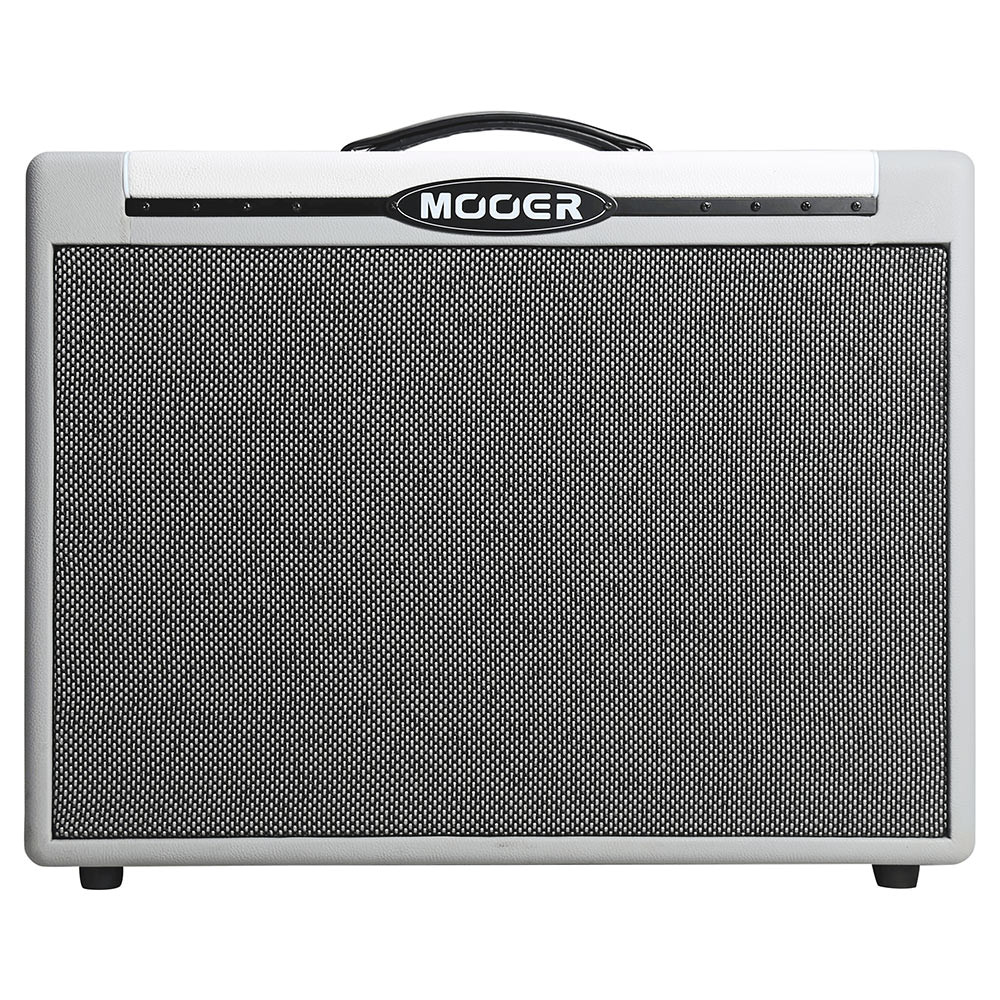
• Modelling guitar combo
• Power: 75W Class A/B
• Speaker Element: 1x 12” Custom 100W 8 Ohm Driver
• Controls: Gain, Volume, Bass, Middle, Treble, Presence, Master, 4 Preset Buttons, 2 Bank Buttons, 5 Effects Buttons, 5 Function Buttons, Value Multi Function Knob, Power On/Off, Ground Lift
• Amp Models: 25
• Effects: 28 (DS/OD: 8, Mod: 9, Delay: 5, Reverb: 6)
• Presets: 40
• Looper: 150 Seconds
• Drum Patterns: 40
• Metronome Styles: 10
• Inputs: 1x 6.3mm Instrument In, 1x 3.5mm Stereo Aux In, 1x 6.3mm FX Loop Return, USB-B
• Outputs: 1x 6.3mm FX Loop Send, 1x Balanced XLR Out, 1x 3.5mm Stereo Headphones Out
• Speaker Out: 1x 8-16 Ohm 75W 6.3mm Jack (Unbalanced Speaker Cable)
• Power: 220V-240V AC /100V-120V AC
• Includes Mooer Airswitch Footswitch with 4 Switches
DEMO TRACK
• Rhythm guitars: Fender Telecaster (left channel) & Arvo 2-P90 (right channel)
• Lead guitar: Epiphone G-400 with Bigsby vibrato
• All guitar tracks use only the Mooer SD75’s internal effects
• Recorded with a Shure SM57
• Modelling guitar combo
• Power: 75W Class A/B
• Speaker Element: 1x 12” Custom 100W 8 Ohm Driver
• Controls: Gain, Volume, Bass, Middle, Treble, Presence, Master, 4 Preset Buttons, 2 Bank Buttons, 5 Effects Buttons, 5 Function Buttons, Value Multi Function Knob, Power On/Off, Ground Lift
• Amp Models: 25
• Effects: 28 (DS/OD: 8, Mod: 9, Delay: 5, Reverb: 6)
• Presets: 40
• Looper: 150 Seconds
• Drum Patterns: 40
• Metronome Styles: 10
• Inputs: 1x 6.3mm Instrument In, 1x 3.5mm Stereo Aux In, 1x 6.3mm FX Loop Return, USB-B
• Outputs: 1x 6.3mm FX Loop Send, 1x Balanced XLR Out, 1x 3.5mm Stereo Headphones Out
• Speaker Out: 1x 8-16 Ohm 75W 6.3mm Jack (Unbalanced Speaker Cable)
• Power: 220V-240V AC /100V-120V AC
• Includes Mooer Airswitch Footswitch with 4 Switches

Löydät testin TÄÄLTÄ.


Säröpedaalien katsaus on nyt luettavissa Rockwayn blogissa.


Jimi Hendrix’ simply doesn’t seem to wane, even though the genial guitar hero himself died in London in 1970 at 27 years of age. There’s still so much interest in Hendrix’ music that he continues to rank among the top ten of best-earning dead celebrities in Forbes magazine.
The Fender Stratocaster was the master’s favourite instrument, so it’s not really surprising that the man has been honoured with a signature model by Fender last year. This guitar is now also available in Finland.
The new Made-in-Mexico Fender Jimi Hendrix Stratocaster isn’t the first Hendrix model that Fender has released:
In 1980 a small, semiofficial run of Hendrix Strats was made, sporting a white body and a left-handed neck with a large headstock. Fender’s Custom Shop came out with 100 Monterey Stratocasters, which where close copies of the guitar instrument played and burned at the 1967 festival. It was a right-handed Stratocaster with a small headstock and a hand-painted body, set up for left-handed playing. Along with the guitar the Monterey Set also included a flight case and a leather gig bag. In the same year (1997) Fender USA started to produce the Jimi Hendrix Voodoo Strat. The Voodoo Strat was in fact a a left-handed (!) copy of Hendrix’ (right-handed) Woodstock Stratocaster, with the headstock decals turned into mirror images, so that you would look (a bit) like Hendrix, whenever you stepped in front of a mirror. 😀
****

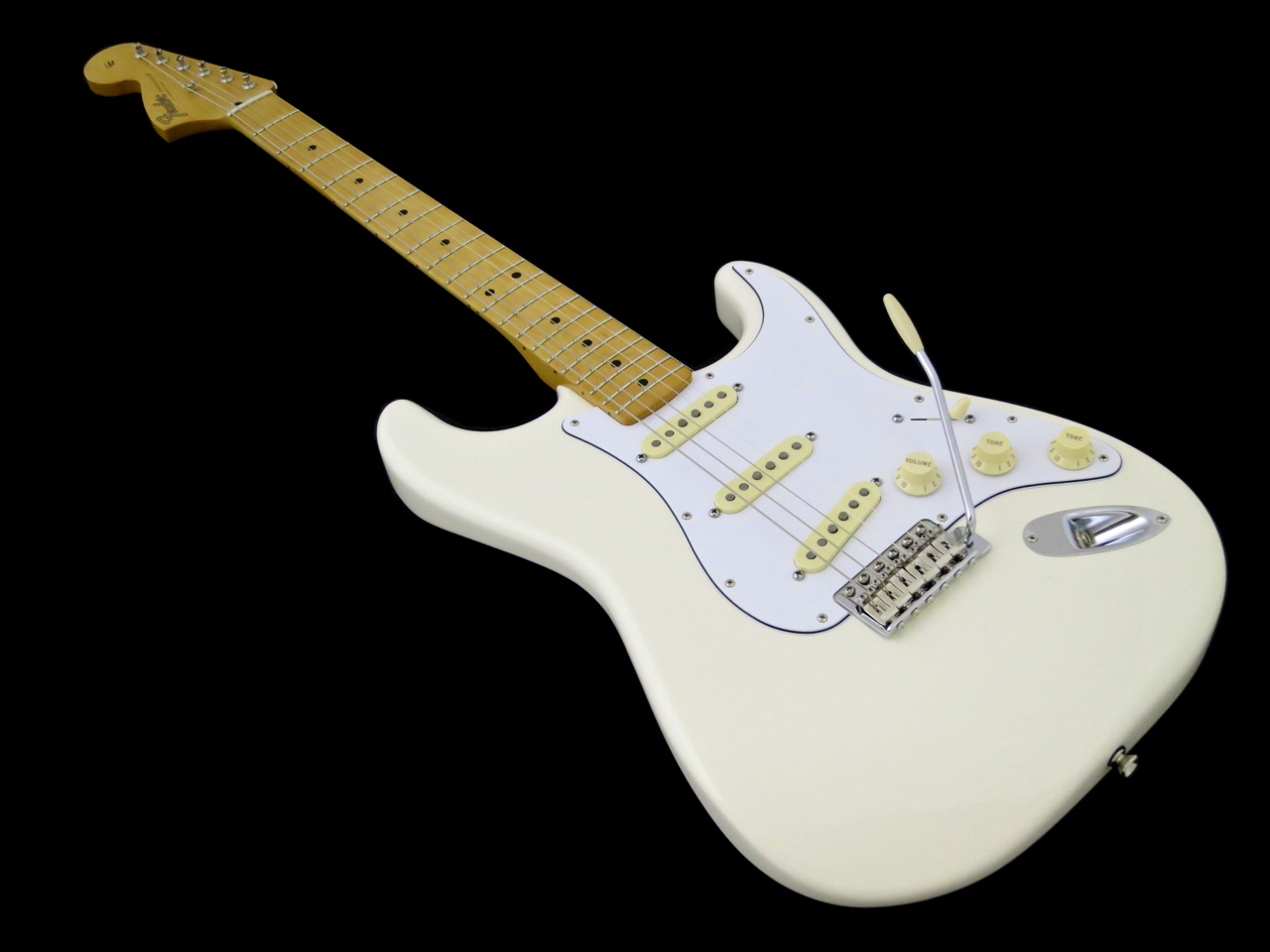
The brand-new Fender Jimi Hendrix Stratocaster (approx. 950 € in Finland) also has some features resembling the guitar Hendrix used at the Woodstock festival:
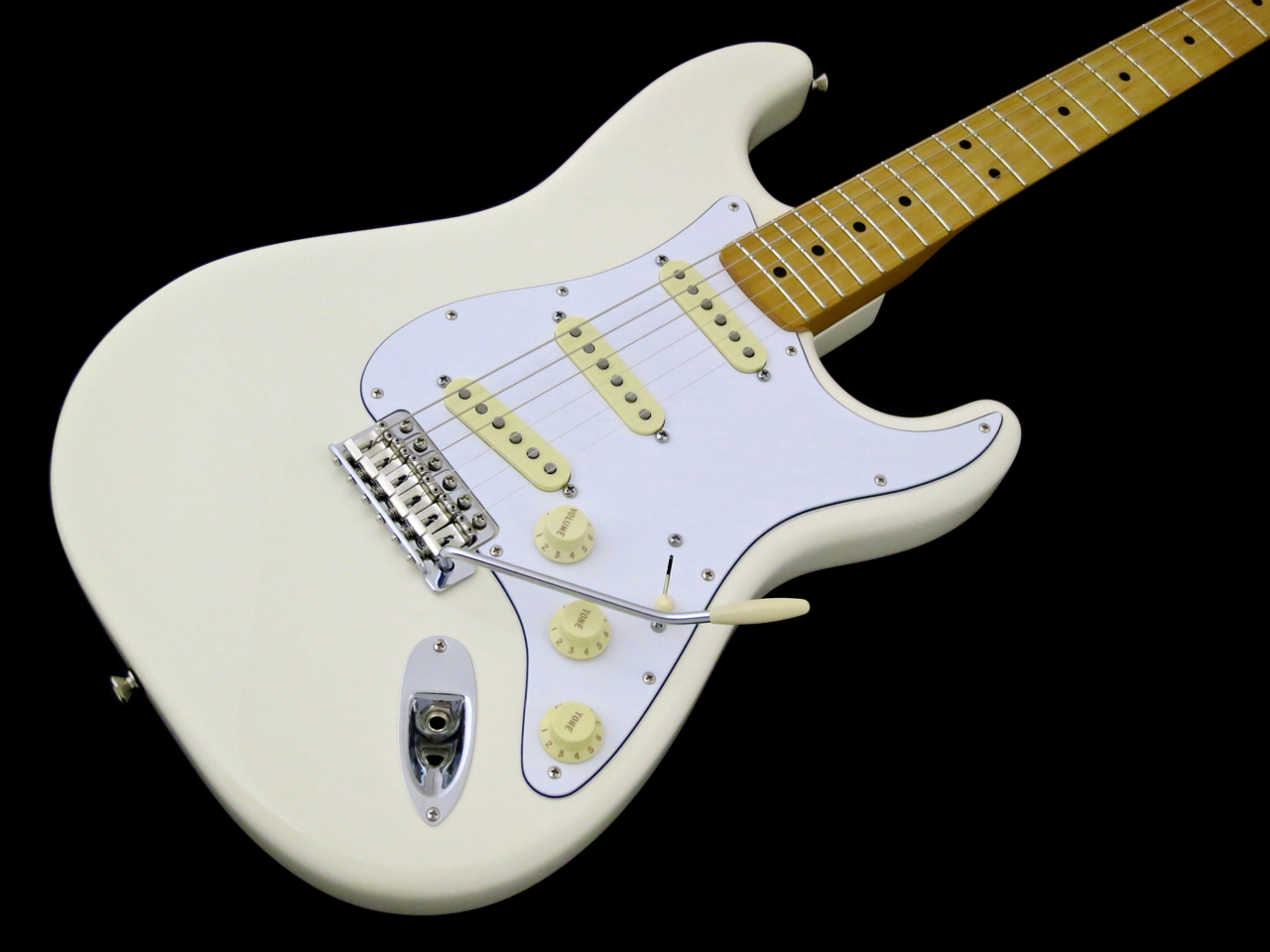
The right-handed alder body is finished either in black or in white, while the neck is a large headstock-carrying, left-handed, all-maple affair.
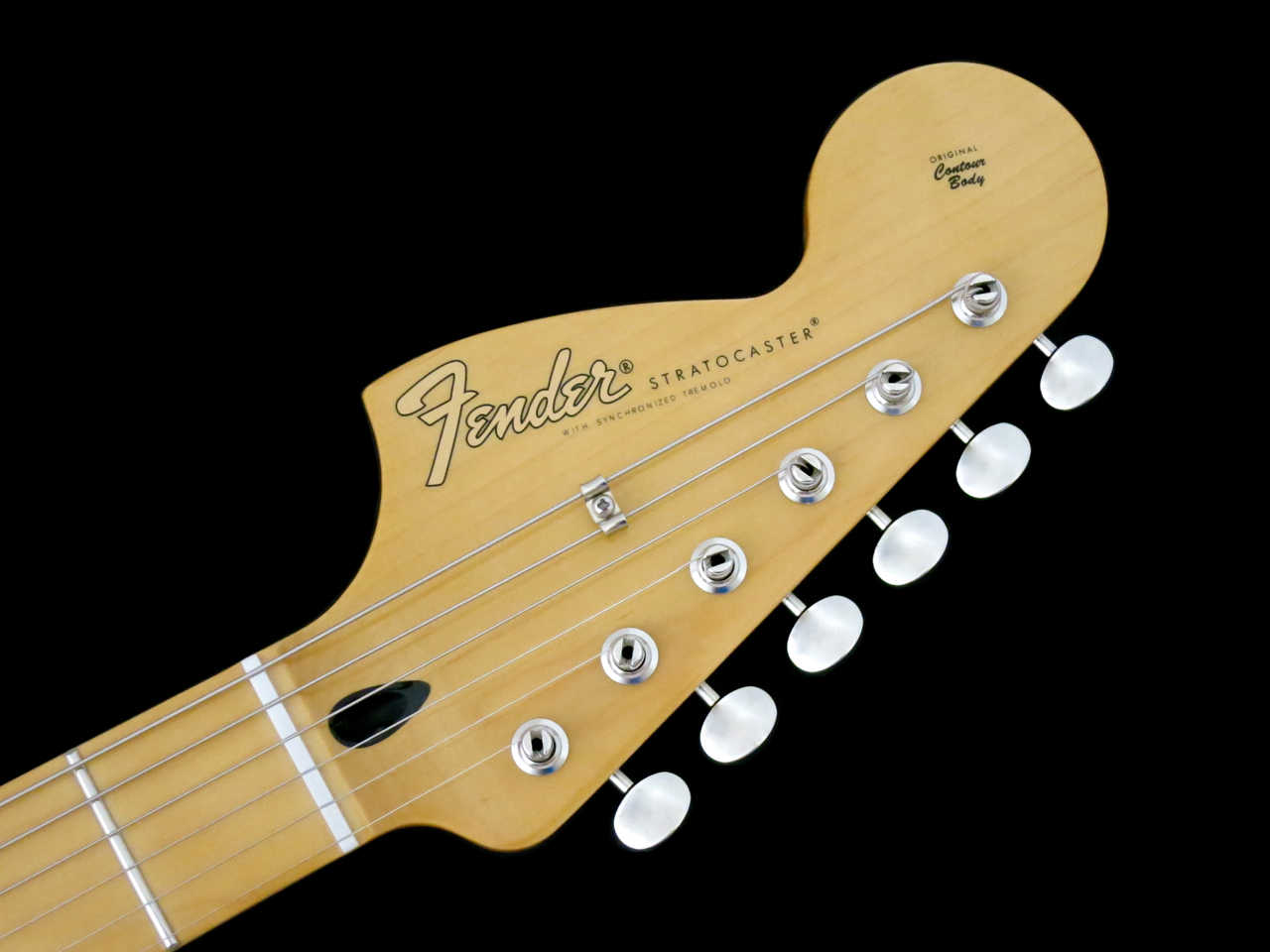
The headstock carries the so-called transition logo from the mid-Sixties, which was much larger than the Fifties’ spaghetti logo, but still gold coloured. By the end of the Sixties the logo was changed to black and the model name was written in large, bold lettering – that would be called the the CBS logo.
Modern improvements on the Hendrix Strat include truss rod access from the headstock side, as well as a flatter, more bend-friendly fretboard radius of 9.5 inches.

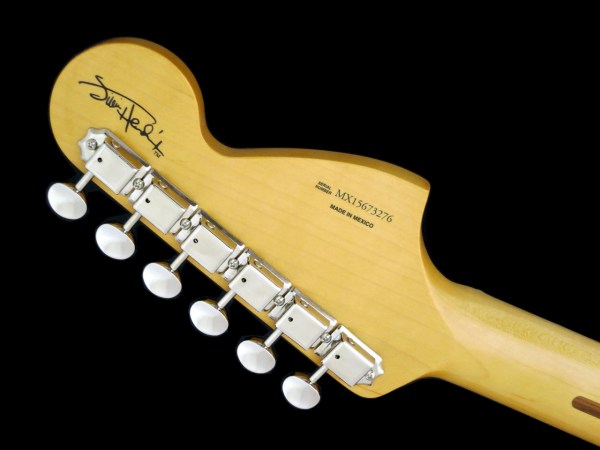
The headstock’s flip side displays Hendrix’ signature, and a very decent set of Kluson copies.

The neck joint has been kept very traditional, but for the Authentic Hendrix-logo on the neck plate.

The most important differences between the Hendrix model and a bog standard Strat can be found in the pickup department:
The Mexican signature guitar comes equipped with a pukka set of American Vintage ’65 Gray-Bottom Fender-pickups, which have been installed into this guitar, as if this were a left-handed model turned over. Both the neck and middle pickup have been flipped over by 180 degrees, while the bridge pickup has been flipped over first, before being installed at a reverse angle. Usually the bridge pickup is placed so that its bass side is closer to the neck with the treble side being closer to the bridge. On the Hendrix Strat the bridge pickup’s bass side is closer to the bridge and the treble side closer to the neck.
This reverse installation means that the magnet stagger is ”wrong”, changing slightly the balance between the strings in terms of output. Furthermore, the bridge pickup will give you a slightly changed range of overtones, due to its reverse angle.
We’ll find out in the listening test, whether these changes really make any discernible difference.

The controls follow the vintage recipe – master volume, neck tone, middle tone – while the pickup selector on the Hendrix model is a modern five-way unit.
The American Vintage ’65 pickup set is true to the original specs and does not feature a reverse-wound/reverse-polarity middle pickup for hum-cancelling in positions two and four, like many updated Strats!

Fender’s vintage vibrato bridge (the ”Sychronized Tremolo”) sports bent steel saddles.
****

Fender Strats are well-known for their excellent ergonomic properties and the Hendrix signature model stays true to this heritage.
Our review instrument was of comfortable moderate weight. The neck’s mid-Sixties C-profile feels great, thanks to not being overly chunky.
The guitar arrived strung with a set of 010s and tuned to E-flat, but the setup wasn’t quite spot-on. The vibrato bridge was tipped a little too steeply, and the intonation was a bit off on the bass strings. But it only took me a couple of minutes (and the correct pair of screwdrivers) to get this Strat shipshape. The result was a great-playing and great-sounding guitar (string height at 12th fret: bottom-E: 2.2 mm/high-e: 1.7 mm).
The flatter-than-vintage fretboard radius really helps to make the Hendrix Strat a very bend-friendly guitar, while also minimising the possibility of fret choke during large-interval bends.
I must admit that I’m not quite sure, whether I really hear much of a difference in the amplified sound of the reversed pickups, though.
Jimi’s guitar tech and effects guru, Roger Mayer, has often stated that Hendrix was satisfied with the sound of his (right-handed) Strats right off the peg. According to Mayer, the only ”customisation” the pair ever did on newly bought guitars, was to take off the neck and remove all possible finish residue inside the neck pockets to improve the stability of the neck joints. Hendrix’ effects, on the other hand, were a regular target for fine-adjustment and electronic customisation.
Anyway, the new Fender Jimi Hendrix signature guitar sounds just like a great Strat should. Here’s a clean clip first:
Here’s an example of the Hendrix Strat’s distorted tone:
I was eager to start recording with the Fender Hendrix model. The first demo track puts the signature Strat into a slightly more contemporary context. The signal chain for this track was: Fender Hendrix Stratocaster –> Electro-Harmonix Germanium 4 Big Muff Pi –> Morley M2 Wah/Volume –> Blackstar HT-1R:
Next I recorded a demo track with a more Hendrix-like arrangement. The signal path was: Hendrix Stratocaster –> Morley M2 Wah/Volume –> Electro-Harmonix Nano Big Muff Pi –> Blackstar HT-1R. The Uni-Vibe style sound at the end of the track was achieved with a phaser plug-in during mixdown:

****

Even though Jimi Hendrix was known for his avant-garde use of effects in the studio – buoyed by the creativity of his sound engineer Eddie Kramer – his signal chain on stage was surprisingly straightforward. Here’s a short and basic rundown of Hendrix’ live rig.
1. Marshall Model 1959 ”Plexi” stack
Jimi Hendrix used what we now call a vintage-type, non-master volume amplifier stack, which wasn’t especially high-gain by today’s standards. Usually Hendrix had two 100 Watt Marshall-stacks running in parallel, which meant things got very loud. His Strats would cause his amp to break up, but the type of distortion was closer to what we’d now call a 60s Blues sound than to 70s Metal, and far removed from the high-gain saturation of our time.
I simulated this type of amp response by turning my Blackstar HT-1R’s gain control up to get the clean channel to overdrive.
2. Dallas-Arbiter Fuzz Face
In my view, the fuzz pedal is the most important ingredient in Jimi’s sound, because it adds a lot of oomph, creamy compression, and aggression to proceedings.
A British importer of musical equipment, a man called Ivor Arbiter, came up with the Fuzz Face in 1966, because he wanted to have a fuzz pedal in his product range. He came up with a chunky package by having the Fuzz Face circuit built into the base of a 60s microphone stand. The round enclosure, coupled with the unit’s two controls and single footswitch, looked like a smiley face, which is where the pedal got its name from.
Fuzz Faces are built by the Jim Dunlop company these days. There are also cheap alternatives available, from companies such as Mooer or Rowin. I’m using an Electro-Harmonix Nano Big Muff Pi for the demo tracks:
3. Vox Wah-Wah
Hendrix generally used his Vox Wah in front of his Fuzz Face, but keeping it behind the fuzz will also result in some cool tones. Great wah-pedals can also be head from Boss, Mission Engineering or Jim Dunlop.
I’ve used my Morley M2 Wah/Volume pedal in front of the Big Muff Pi:
4. Octavia +Uni-Vibe
Roger Mayer’s Octavia-pedal was sometimes used as an additional ingredient in Jimi’s live sound. This strange-sounding effect combines distortion with an artificial upper octave and some slight ring-modulation. Hendrix also used a Uni-Vibe effect, which was one of the first pedals that tried to create a Leslie-like sound in a compact format.
A genuine Octavia-pedal is only made by Roger Mayer, but Joyo’s inexpensive JF-12 Voodoo Octave stomp box sets you off in a very similar direction.
Korg has introduced the NuVibe, which is a pukka re-imagination of the original Uni-Vibe-pedal. Voodoo Lab’s Micro Vibe is a high-quality proposition at a fair price.
You can also simulate Uni-Vibe-style tones by using a suitable phaser. The Boss PH-3 is a modern and versatile phaser. If you want something even more affordable, you could check out Mooer’s range of effects.
This clip uses a combination of two phaser plug-ins in my audio sequencer:
****
If you want to go all the way to ”become Hendrix”, you will need to buy a left-handed Stratocaster and turn it into a right-handed instrument. The result will be authentic, but also much less comfortable than a regular Strat, because the controls are all in the wrong place.
Fender’s new Jimi Hendrix Stratocaster will give you the (very slight) difference a reversed headstock brings to the playing feel, as well as the (very slight) tonal differences of the reversed pickups, while keeping all of the Stratocaster’s great ergonomics intact.
Fender’s Hendrix model is a fine Strat, which you can use for all types of music. Still, it’s the ”Hendrix-thing” this guitar does the best!
If I could only have the maestro’s long fingers and musical imagination…
****
Fender Jimi Hendrix Stratocaster
Price approx. 950 €
Contact: Fender
A big ”thank you” goes to DLX Music Helsinki for the kind loan of the review guitar!
Pros:
+ musician-friendly price tag
+ workmanship
+ American Vintage pickups
+ playability
+ sound
Cons:
– factory setup


 Kitarablogi.com – Finland's premier Guitar and Bass blog