Finnish company Uraltone ran a DIY pedal workshop at this year’s Tonefest Helsinki, where you could assemble this overdrive/distortion pedal kit. The three-way mini-switch gives you regular distortion, slightly overdriven boost, and distortion with asymmetrical clipping. All guitar tracks recorded using the Uraltone Tonefest Overdrive Plus pedal: • main rhythm guitar (centre): Harley Benton DC-60 Junior; Juketone Trueblood • rhythm guitar (left): Harley Benton DC-60 Junior; Bluetone Black Prince Reverb • rhythm guitar (right): Squier Sonic Mustang SS; Bluetone Black Prince Reverb • lead guitar: Jackson JS32 Dinky; Vox V845 wah; Bluetone Black Prince Reverb • microphone: Shure SM7B
From the late 1970s on, Fender’s student-oriented models began to find their way into the hands of musicians from the Punk, New Wave, Grunge and Alternative Rock genres.
The reasons for this can be found both in the musicians’ budgets, as well as in the guitars’ image. The average guitarist wanted to play with ”familiar and safe” models, and in Fender’s case, these were the Telecaster and Stratocaster.
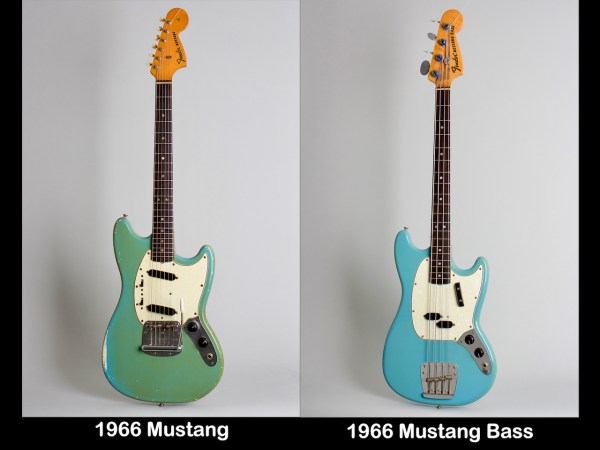
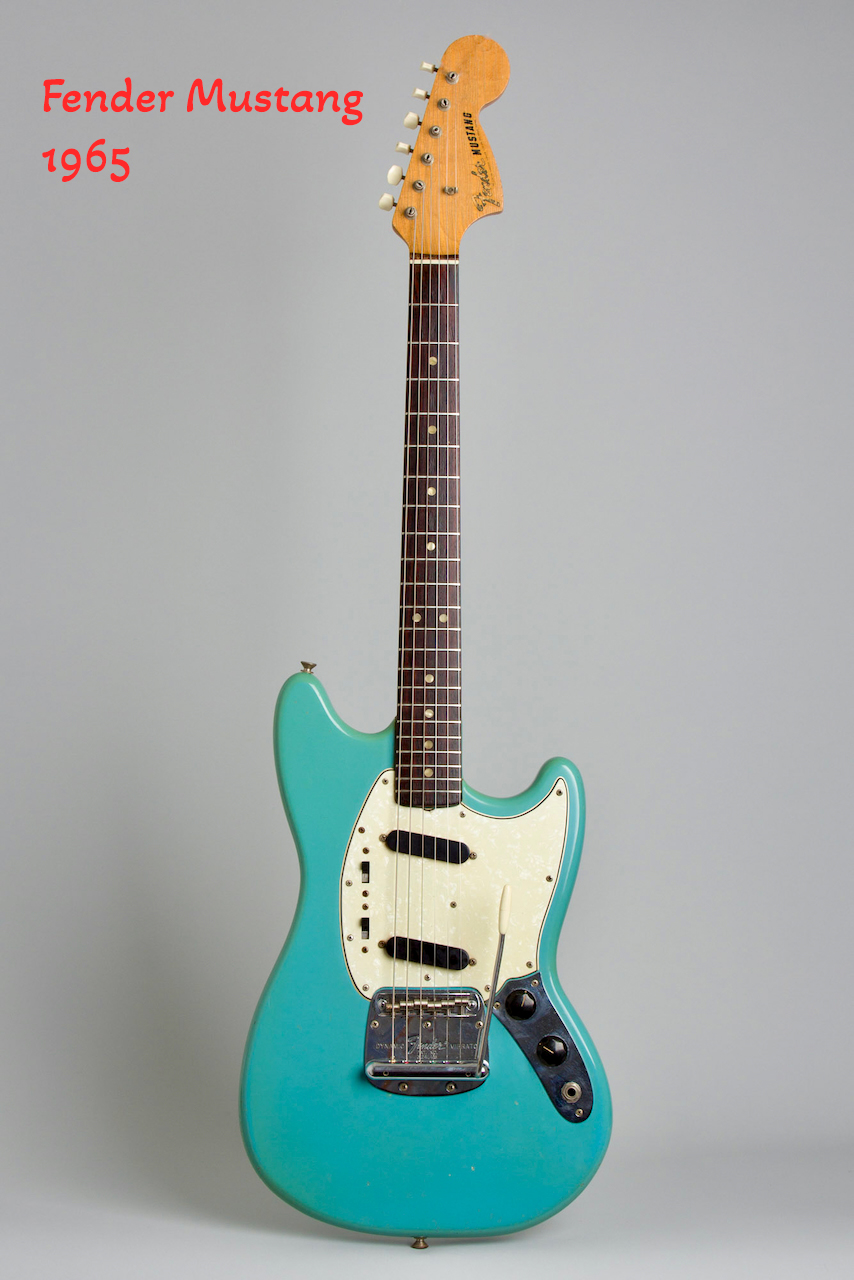
At the end of the 1970s, Fender’s so-called student instruments, that were very popular in the 1950s and 60s, could be found very inexpensively second-hand. With the Mustang, Duo-Sonic or Musicmaster, the young New Wave musician got genuine Fender quality at a very affordable price, and since these instruments were not – at least at the time – collector’s items, modifying the guitars to suit the needs of the ”new music” was no problem.
Many guitarists of the new genres – e.g. the Talking Heads’ David Byrne, Sonic Youth’s Thurston Moore and Nirvana’s Kurt Cobain – added more powerful pickups to their Duo-Sonic or Mustang to better suit their sound. This resulted in distinctive guitars that certainly weren’t ”your dad’s Country guitar”.
Last year, Fender’s subsidiary Squier Guitars changed the name of its most affordable line from Affinity to Sonic, and at the same time expanded the range of instruments in the series.
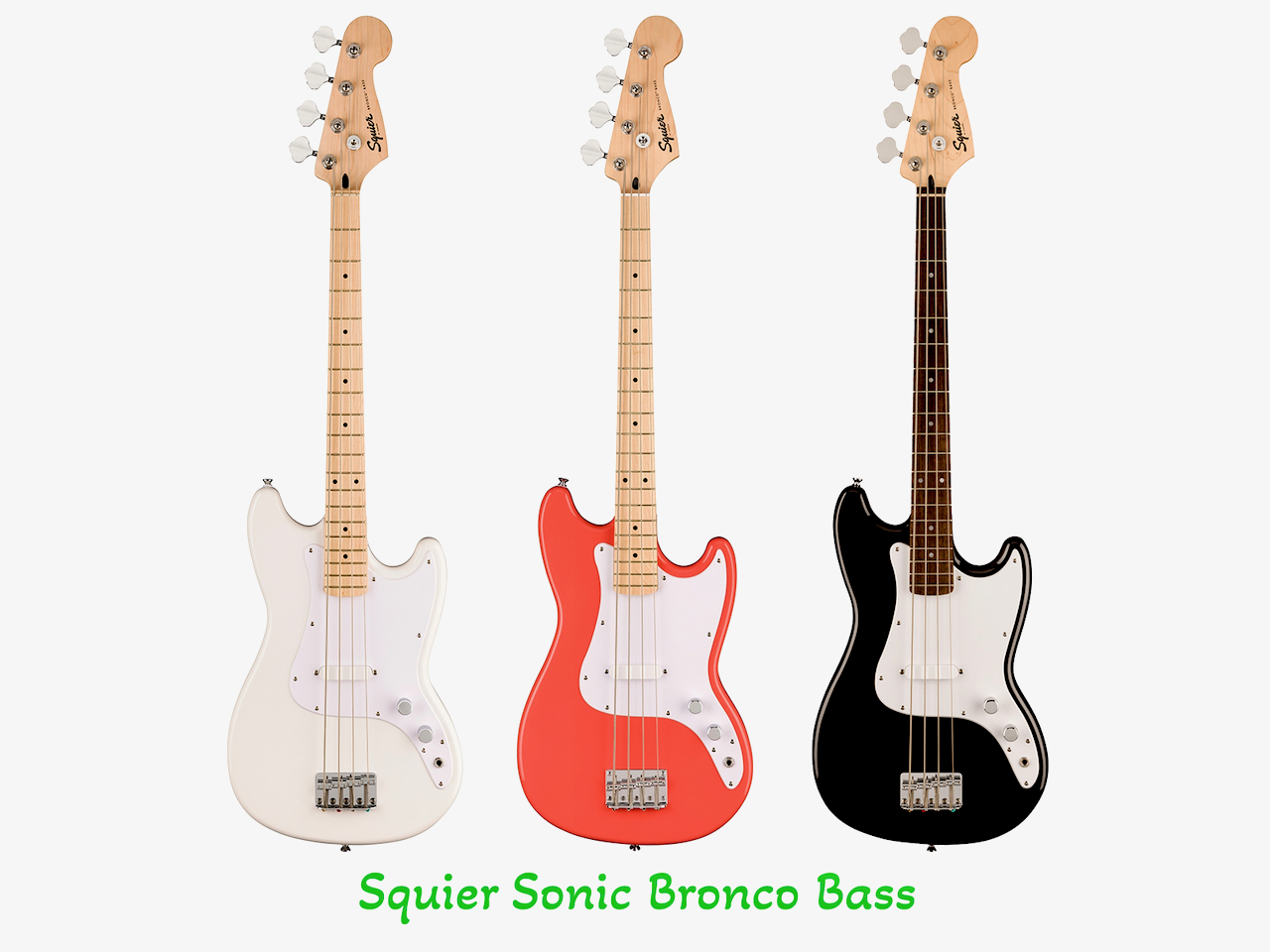
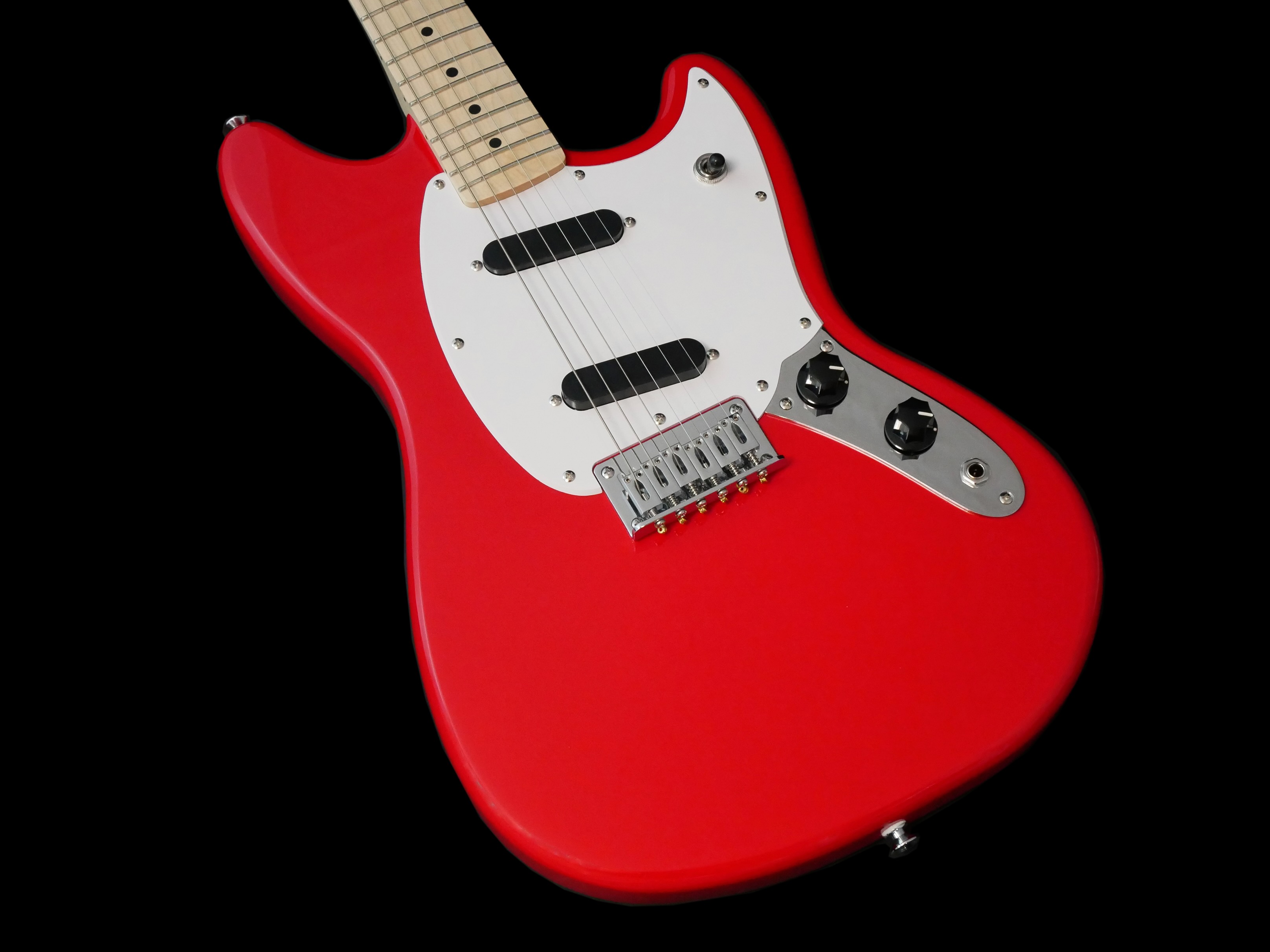
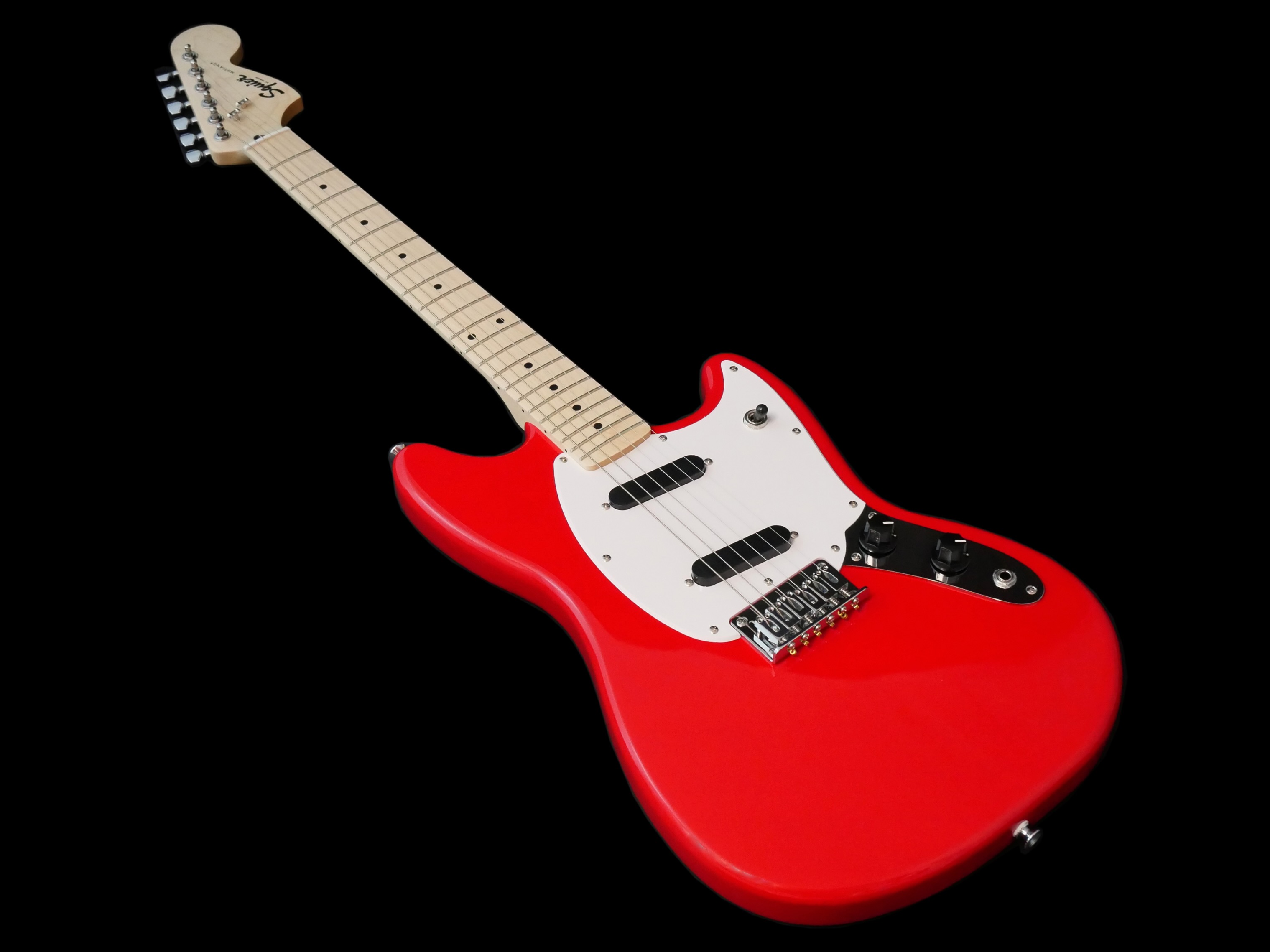
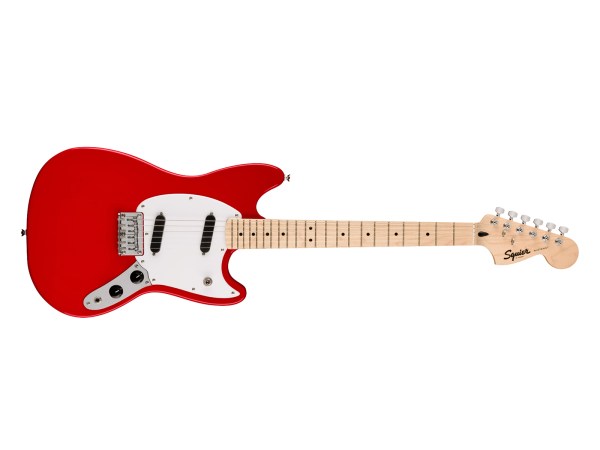
There are now two different Mustang guitars in the Sonic series, of which the Mustang HH offers two humbucker pickups, while the Mustang SS, like the original Fender, comes equipped with two single coils. Both models are offered in two different colour options as standard, which in the case of the Mustang SS model are sunburst and Torino Red. The Mustang HH comes in light blue and pink. The Sonic Bronco bass is now available in three different colors – white, red and black.
A vintage enthusiast would be the first to point out that, according to Fender’s original terminology, the Squier Sonic Mustang SS (street price approx. 180-200 €) is not a Mustang, but a Duo-Sonic, as the model has a fixed bridge and a three-position pickup selector. I would bet that Fender and Squier have decided that the name Mustang is simply cooler and better known than Duo-Sonic, which is why all their short-scale models with the same body shape are currently called Mustangs, despite the streamlined electronics and bridge.
However, the familiar basic recipe still applies:
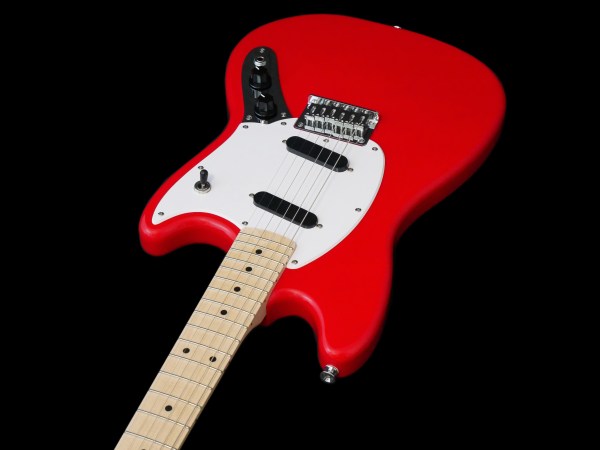
The Squier Mustang SS is an electric guitar with a 24-inch scale. The bolt-on maple neck has a maple fingerboard and well-installed 22 vintage-style frets.
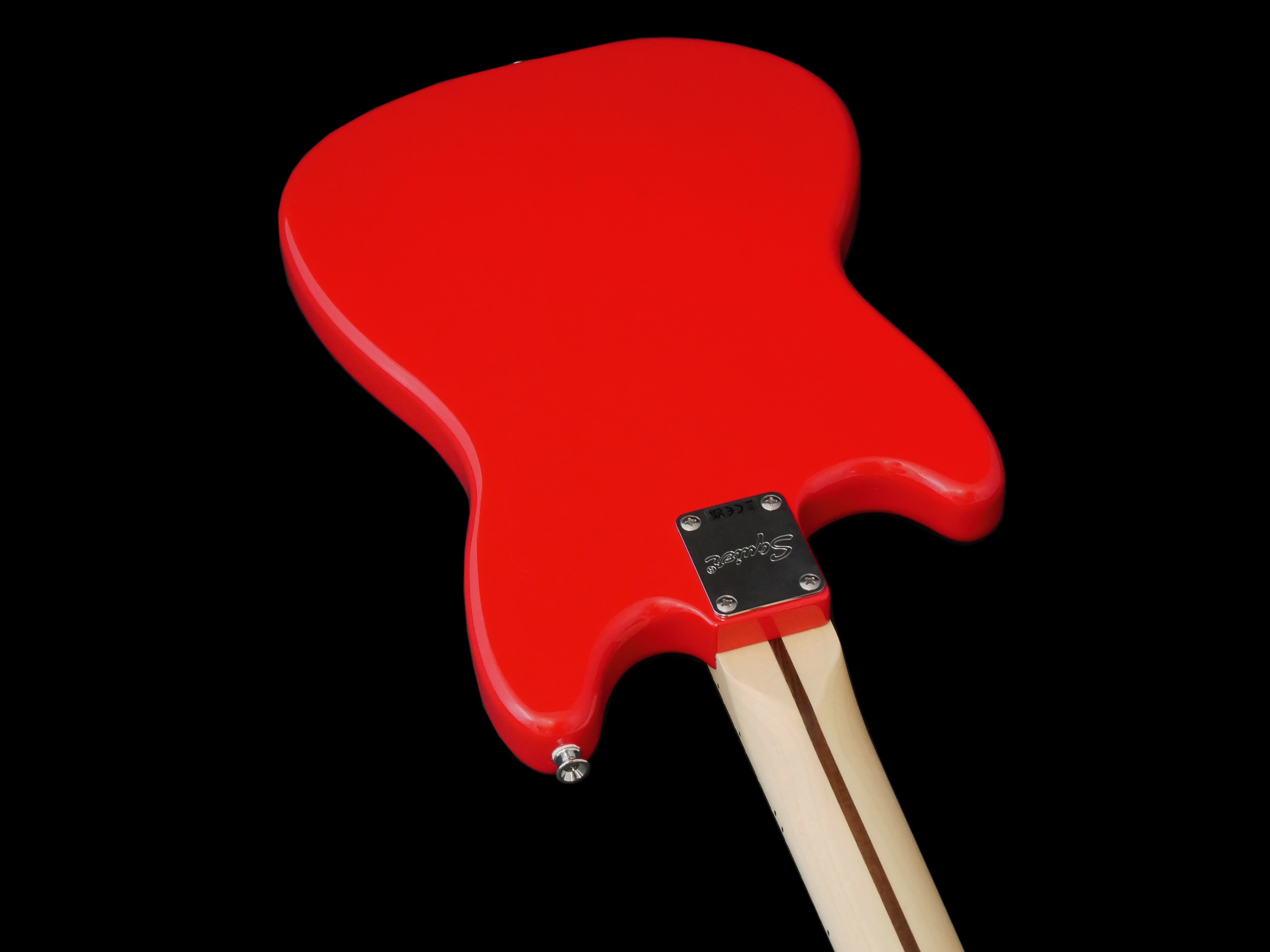
The offset body of the Mustang SS is a slab number with rounded edges, but without any chamfers.
The thick single-layer plastic pickguard is typical for Sonic series instruments. Mustang’s two single-coil pickups – with closed black plastic covers – and a three-position mic selector are installed onto the pickguard.
The Squier guitar’s volume and tone controls, as well as the output jack, are placed on a chrome-plated metal plate.
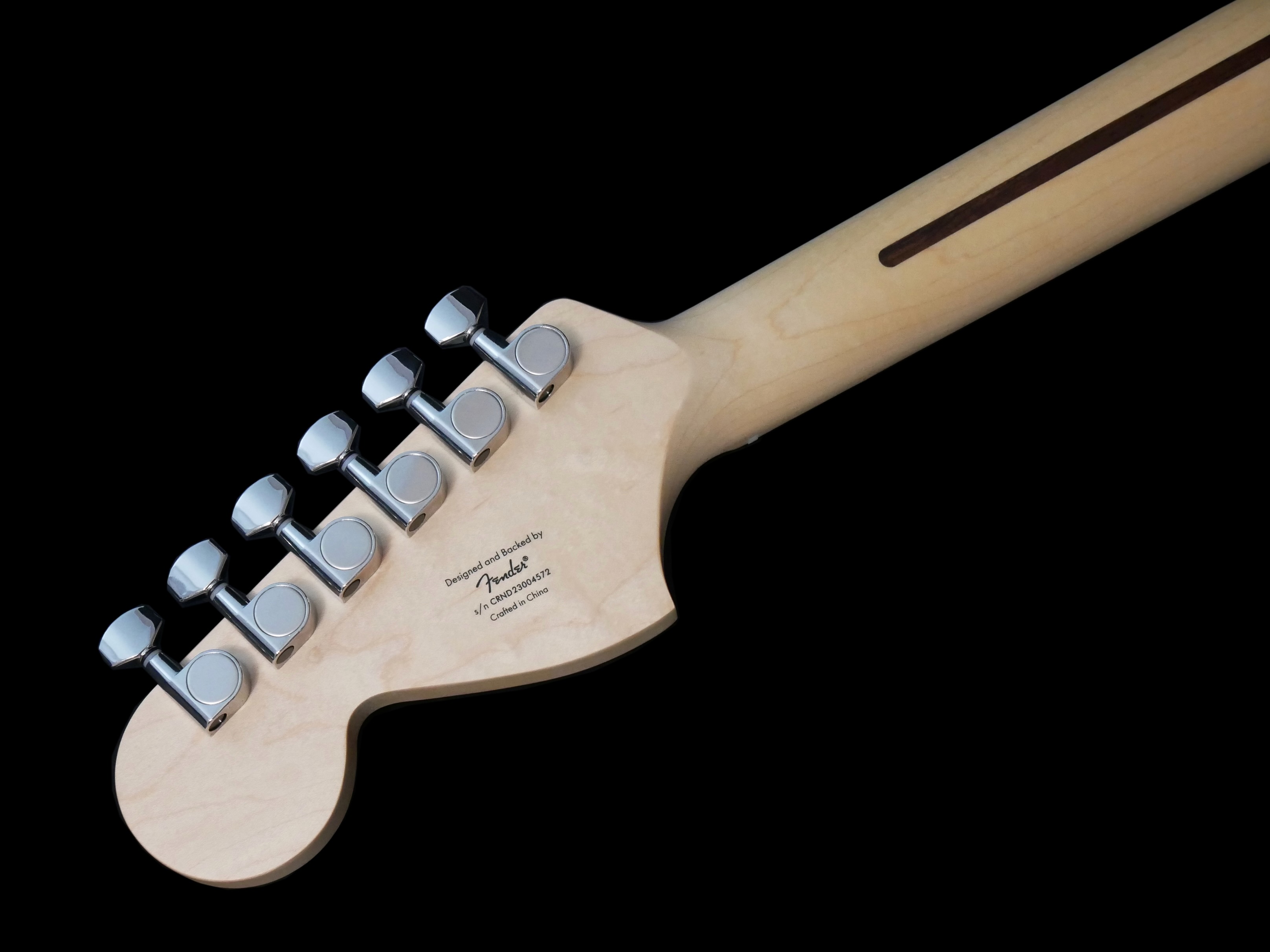
The Mustang’s modern sealed tuners work well, as does the Sonic model’s fixed bridge with six separate saddles.
Straight out of the shipping carton, the test guitar is almost ready to play – only the action and intonation had to be fine-tuned. The guitar doesn’t suffer from sharp fret ends sticking, or other ”cheap guitar” problems. The workmanship seems fine.
The new Squier Sonic Mustang SS weighs a bit more than the original edition from the 1960s, but in light of the Mustang’s very affordable price, this is to be expected and perfectly okay.
The Squier Sonic Mustang SS model has a decent 009 set of strings installed at the factory, which is probably a good choice for the guitar’s target group (children and young people). The playing feel is very effortless and light, and the Mustang chimes very nicely. I played all the guitar tracks in the demo video with Squier’s factory-installed strings.
However, the feel of the 009 string set on a guitar with a 61 cm scale is too loose for me, which is why I changed over to the same 010-052 strings that I use in all my electric guitars. With these strings, the Sonic Mustang SS immediately has a firmer playing feel, which is not very different from, for example, a Gibson SG.
Although the scale of the Sonic Mustang is much shorter than that of Telecasters or Strats, there is a definite dose of ”Fender-ism” in the sound of the guitar, thanks to the single-coil pickups. Because the Mustang’s pickups are placed in somewhat different places relative to the scale than, for example, in the Telecaster, the model always displays its own recognisable sound. The Mustang’s tone rings like a bell, but is never as biting as, for example, the output of a Stratocaster.
Vuonna 1965 Gibson Guitars etsi tapaa, jolla se voisi tehdä vielä Melody Makeria edullisempaa kitaraa aloittelijoille. Yhdellä mikrofonilla varustettu Gibson Melody Maker maksoi vuonna 1961 109,50 dollaria, mikä vastasi silloin noin tuhannen euron nykyistä ostovoimaa.
Rock’n’Roll -buumin ansiosta Yhdysvaltoihin tuotiin silloin runsaasti halpoja japanilaisia kitaroita.
Firman pomot päättivät kopioida Fenderiä, mutta ruuvikaulaisen sähkökitaramallin runkomateriaaliksi valittiin MDF-kuitulevyä kokopuun sijaan.
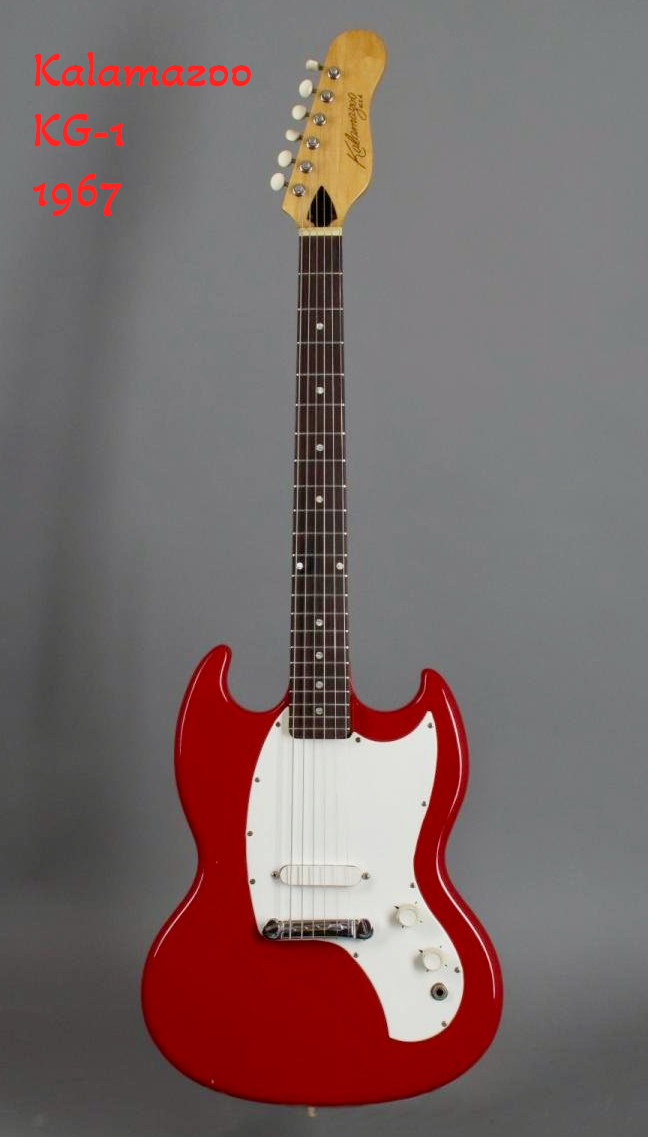
Koska Gibsonilla pelättiin, että uudet halpakitarat voisivat himmentää oman brändin loistoa, herätettiin 1930-luvun Kalamazoo-brändi uudelleen henkiin. Vuodesta 1933 vuoteen 1942 Kalamazoo-soittimet olivat edullisempia versioita Gibsonin akustisista kitaroista, mandoliineista ja banjoista. Näiden soittimien peruslaatu oli samankaltainen kuin Gibson-soittimissa, mutta Kalamazoot olivat kosmeettisesti vaatimattomampia, ja soittimissa ei myöskään ollut säädettävä kaularauta.
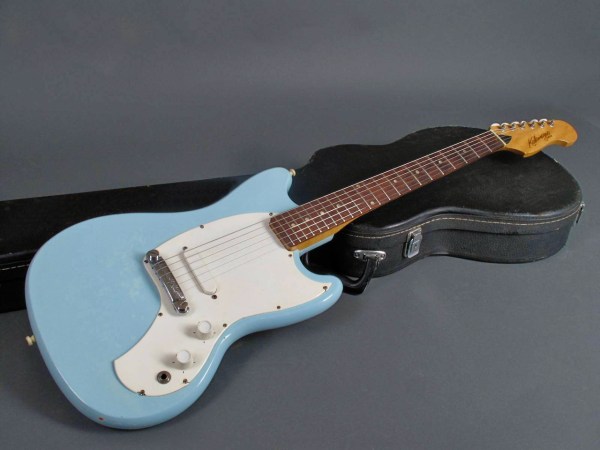
Koska uudet Kalamazoo-sähkikset olivat suunnattuja aloittelijoille, Gibson meni ja kopioi lähes yksi yhteen Fender ”oppilassoittimien” – Musicmaster, Duo-Sonic, sekä Mustang – ulkonäköä.
Uudet Kalamazoot saatiin neljänä mallina:
Kalamazoo KG-1 (yksi mikrofoni), KG-1A (yksi mikrofoni ja yksinkertainen vibrato), KG-2 (kaksi mikkiä), sekä KG-2A (kaksi mikkiä ja yksinkertainen vibrato). Värivaihtoehtoja oli tasan kolme – valkoinen, sininen ja punainen.
Vaikka Fender ei tietääkseni reagoinut tähän kopiointiin, muutettiin kuitenkin vuonna 1967 kaikkien neljä mallien rungot Gibson SG:n kaltaiseksi.
Vuoden 1969 lopussa Gibson kuitenkin lopetti koko Kalamazoo-brändin (ja myös Epiphonen US-tuotannon), koska oli päätetty teettää tästä eteenpäin edullisia soittimia Japanissa Epiphone-brändin alla.
Here’s a short cover version of the Fine Young Cannibals classic ”She Drives Me Crazy” featuring a Squier Sonic Mustang SS. • Guitar used – Squier Sonic Mustang SS • Amps used – Bluetone Black Prince Reverb (all guitar parts, except the distorted chords in the chorus), Vox Pathfinder 10 (distorted chords in the chorus) • Mic used – Shure SM7B
• Digital practice and recording amp
• 40 W power (2x 20 W)
• Speakers: 2x 6.5″
• 21 Amp models
• 47 Effects
• Controls for Gain, Volume, Treble, Bass & Master
• Three layer buttons
• Tap button
• USB recording output
• Aux input
• Headphone output
• Digital chromatic tuner
• Bluetooth audio streaming
• Easy WIFI firmware and feature updates
• Editing and sharing via Fender Tone app (iOS & Android)
****
Demo tracks recorded with a pair of Shure SM57s.
Guitars used – Fender (Japan) ’62 Telecaster Custom reissue & Hamer USA Studio Custom
• Digital practice and recording amp
• 40 W power (2x 20 W)
• Speakers: 2x 6.5″
• 21 Amp models
• 47 Effects
• Controls for Gain, Volume, Treble, Bass & Master
• Three layer buttons
• Tap button
• USB recording output
• Aux input
• Headphone output
• Digital chromatic tuner
• Bluetooth audio streaming
• Easy WIFI firmware and feature updates
• Editing and sharing via Fender Tone app (iOS & Android)
****
Demo track recorded with a Shure SM57.
Guitar used – Fender (Japan) ’62 Telecaster Custom reissue
Fender Guitars tuo nyt firman vanhat ”oppilasmallit” 1950-luvulta ja 60-luvulta takaisin päivitettyinä versioina. Uutuussarjan nimi on Offset Series.
Offset-sarjassa on tällä hetkellä neljä kitaramallia, sekä yksi basso. Kaikissa soittimissa on lyhyemmät mensuurit kuin Fender-soittimissa yleensä. Kitaroissa mensuuri on 24 tuumaa (58,8 cm) ja bassossa luku on 30 tuumaa (76,2 cm). Kaikissa Offseteissä on nykyaikaiset medium-jumbo nauhat, sekä helppokäyttöinen, virtaviivaistettu elektroniikka.
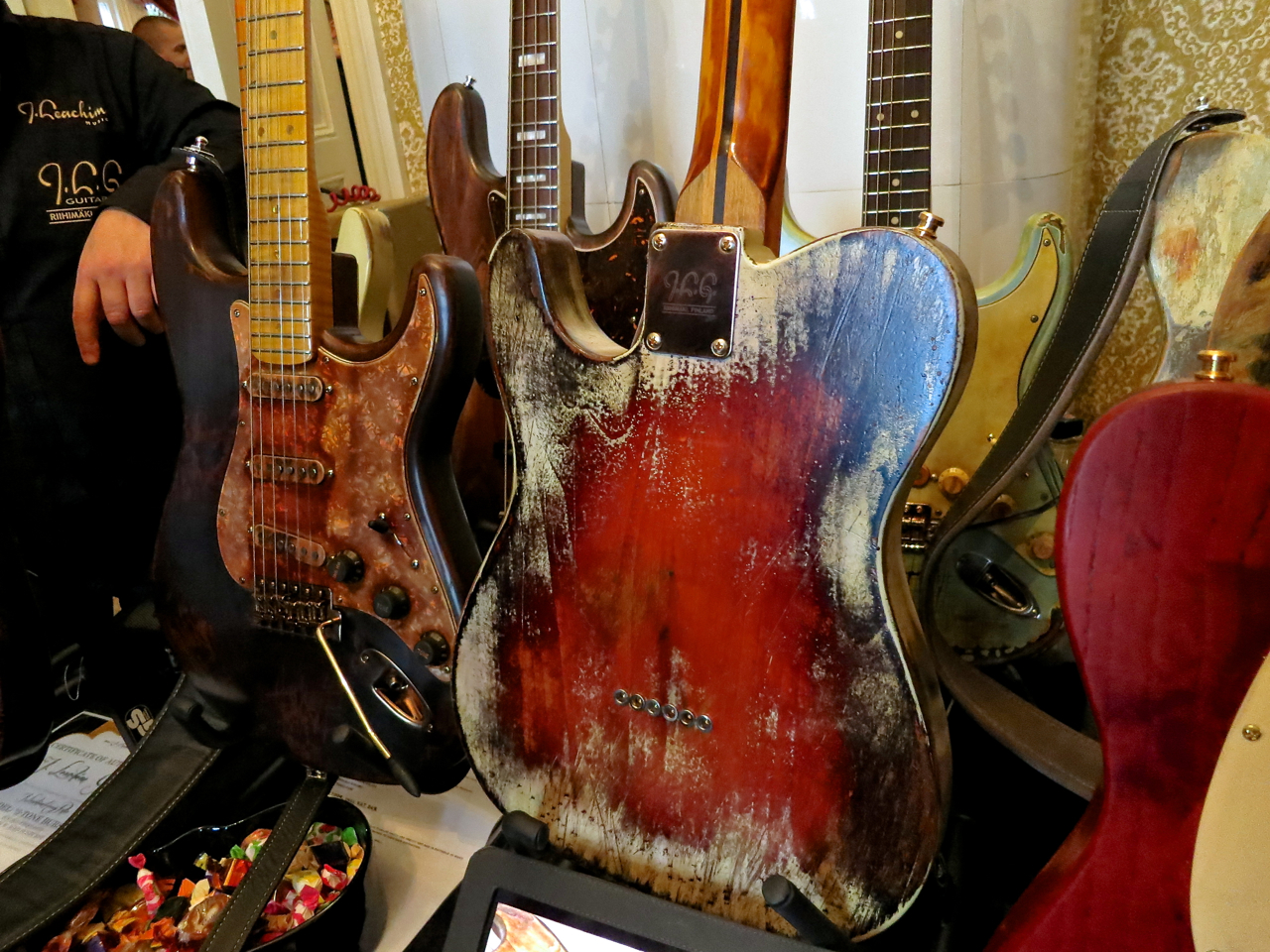
You could call J. Leachim Guitars Finland’s answer to Nash Guitars. Just like the American maker, JLG, too, don’t make their guitars from scratch, from the raw wood. Instead, J. Leachim assembles guitars from bought in unfinished necks and bodies, as well as parts and hardware sourced from a number of reputable sources. J. Leachim Guitars’ forte lies in their finish work, and the relicing of guitars.
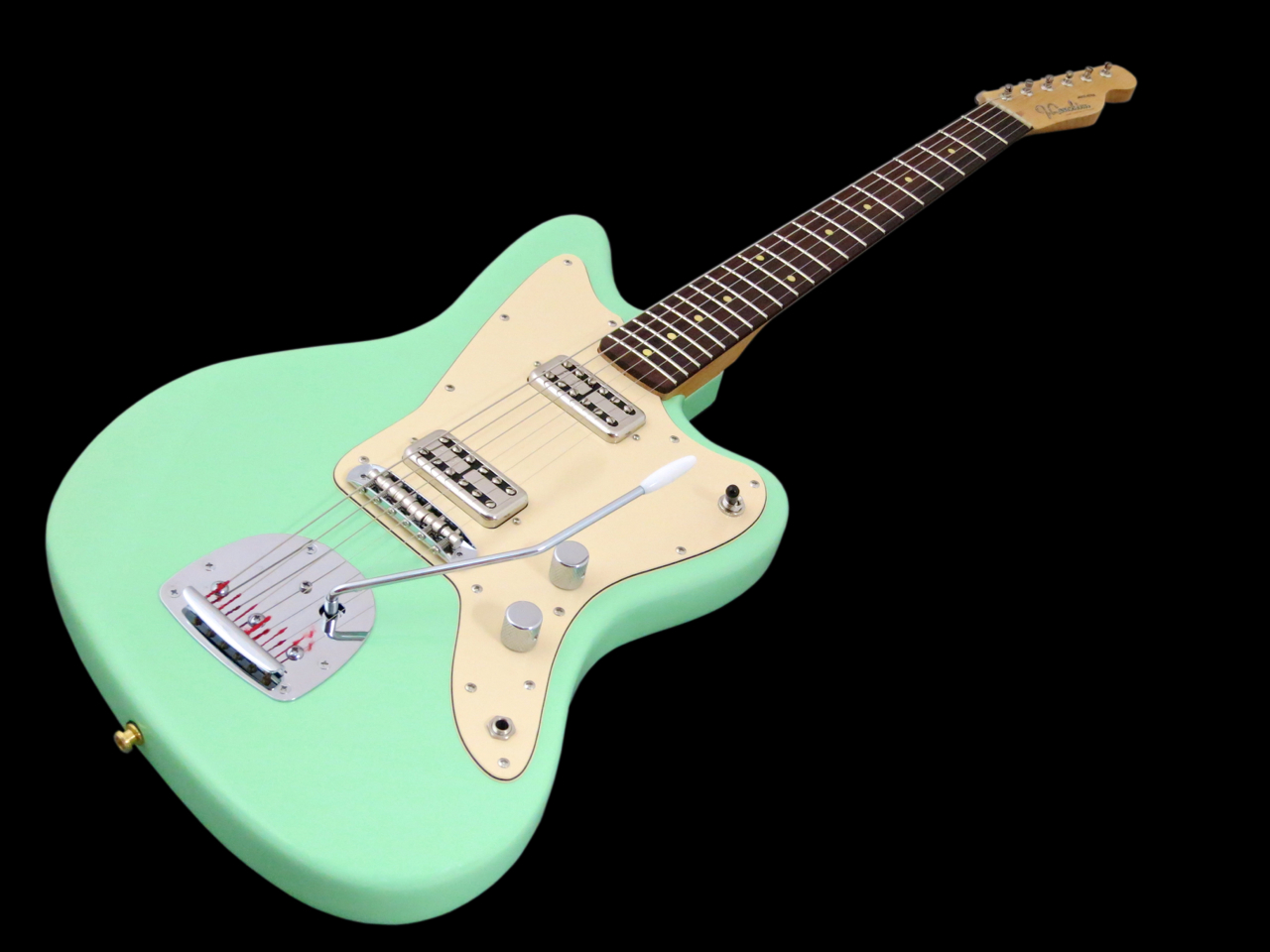
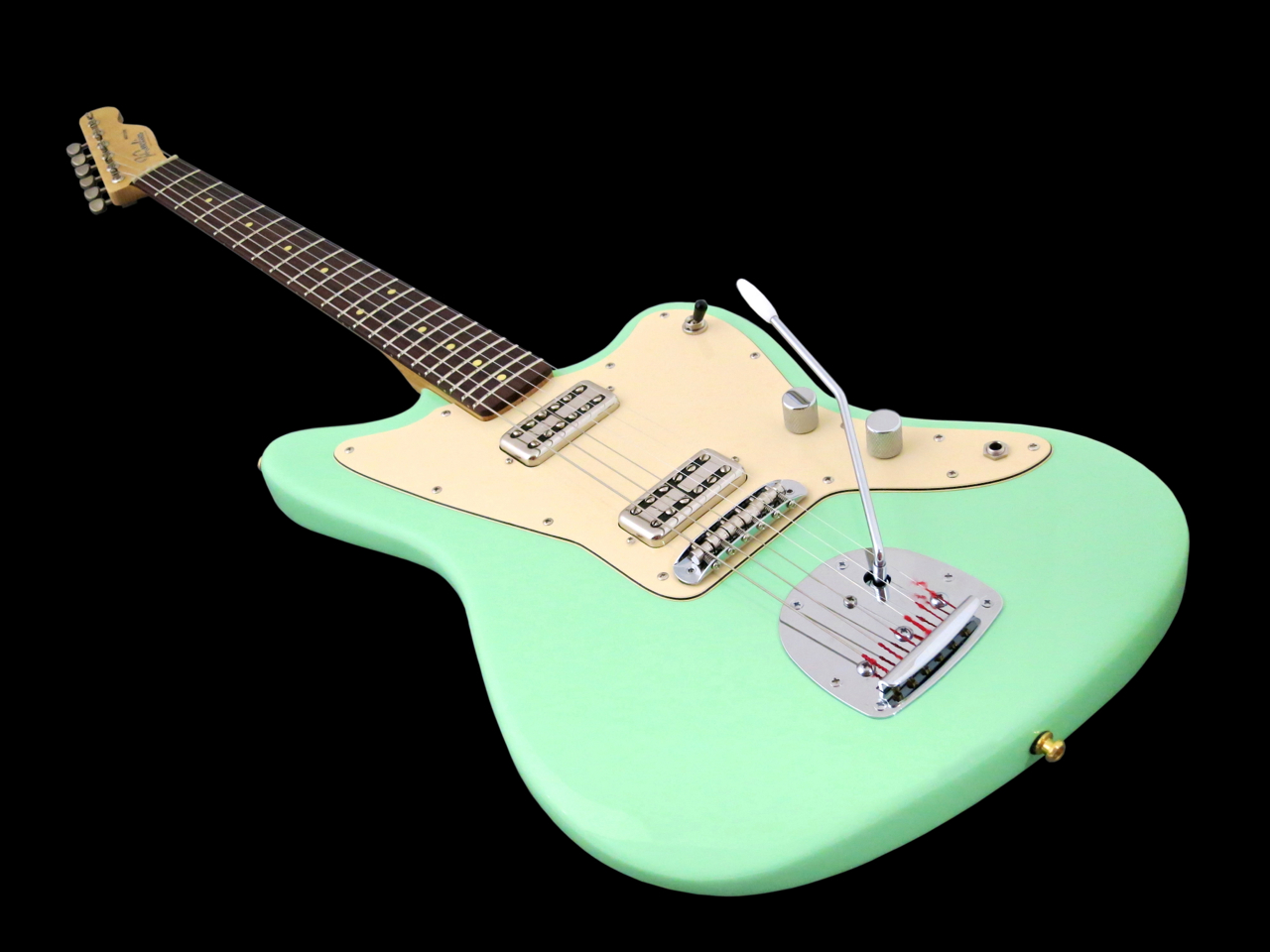
J. Leachim’s main man, Jan Merivirta, supplied Kitarablogi.com with an example of his Jazzcaster model, which sports a pristine, “NOS” nitro finish.
****
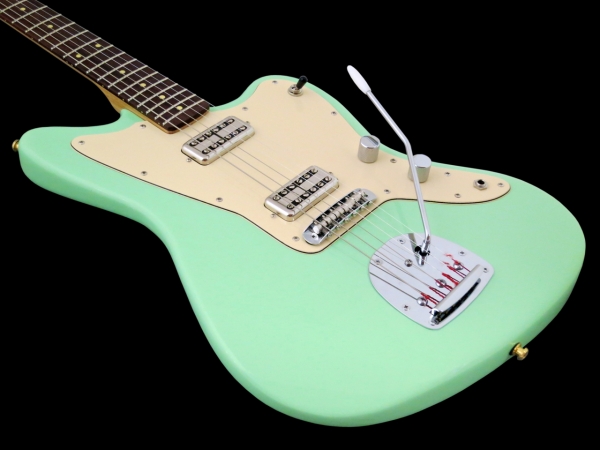
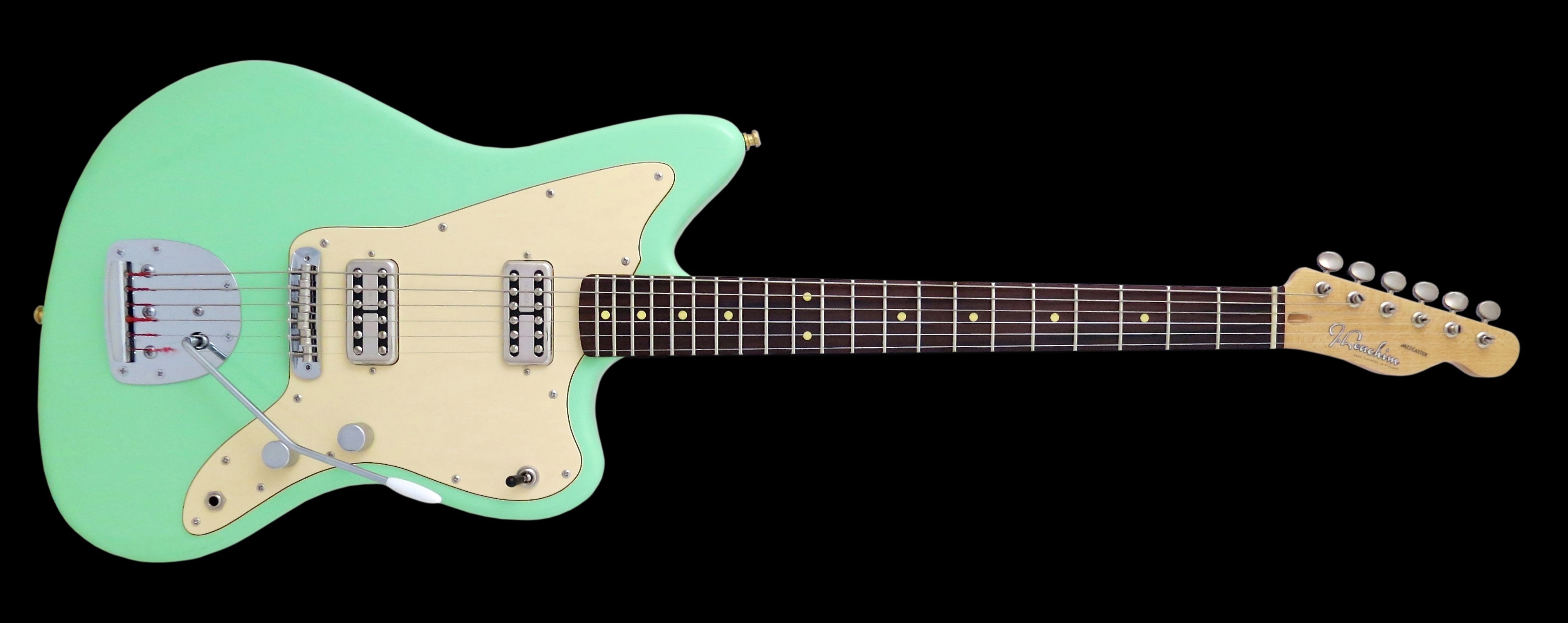
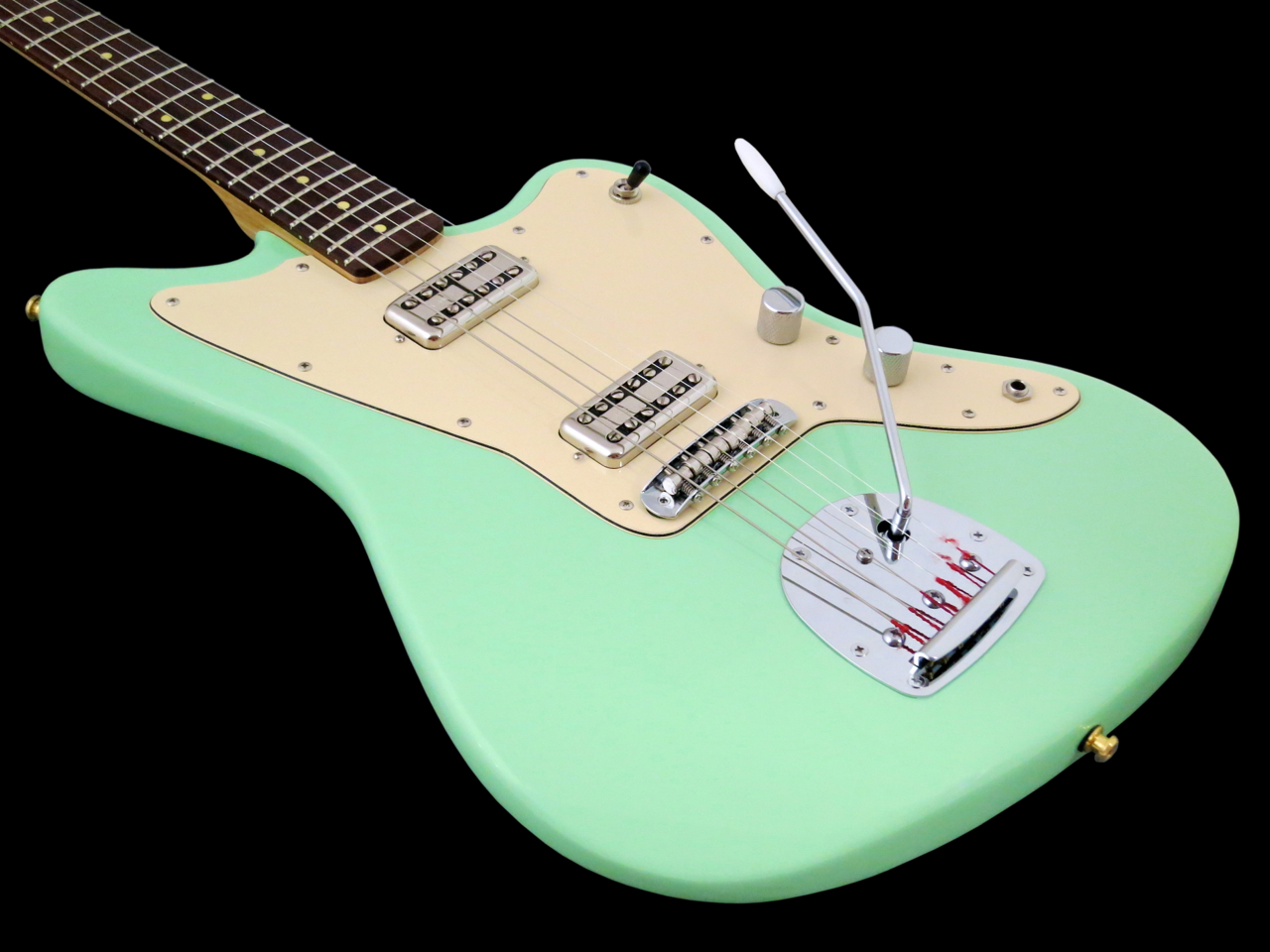
The J. Leachim Guitars Jazzcaster (prices start from approx. 1,300 €; hard case incl.) is a very enticing mix of different classic guitars:
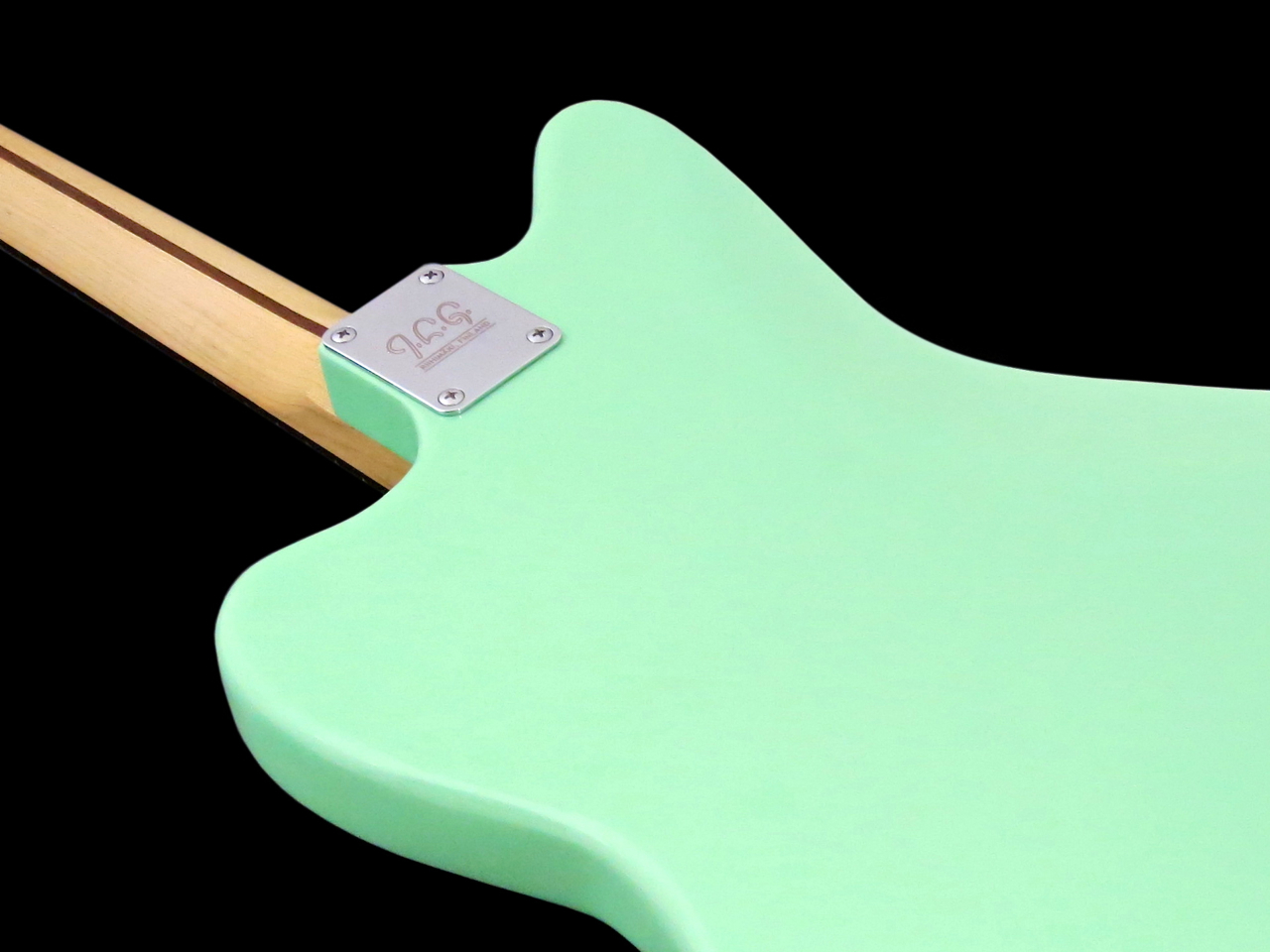
The Jazzcaster’s maple neck has been sourced from Northwest Guitars. It’s a Tele-style neck sporting jumbo frets, as well as a modern fretboard radius of 9.5 inches.
The Guitarbuild body has been crafted from very lightweight swamp ash. Filtertron-sized pickup routs have been added at the J. Leachim workshop.
J. Leachim Guitars clearly know how to use nitro lacquer properly:
The body has received an exquisite, thinly applied gloss finish in Surf Green, while the neck has been finished with a thin satin clear coat.
The fretwork on the Jazzcaster is great. The rosewood fingerboard comes with 21 jumbo-sized frets.
The top nut has been carved from a piece of genuine bovine bone. Some may find the nut’s shaping a tad angular, but I don’t mind; it’s only cosmetics, after all.
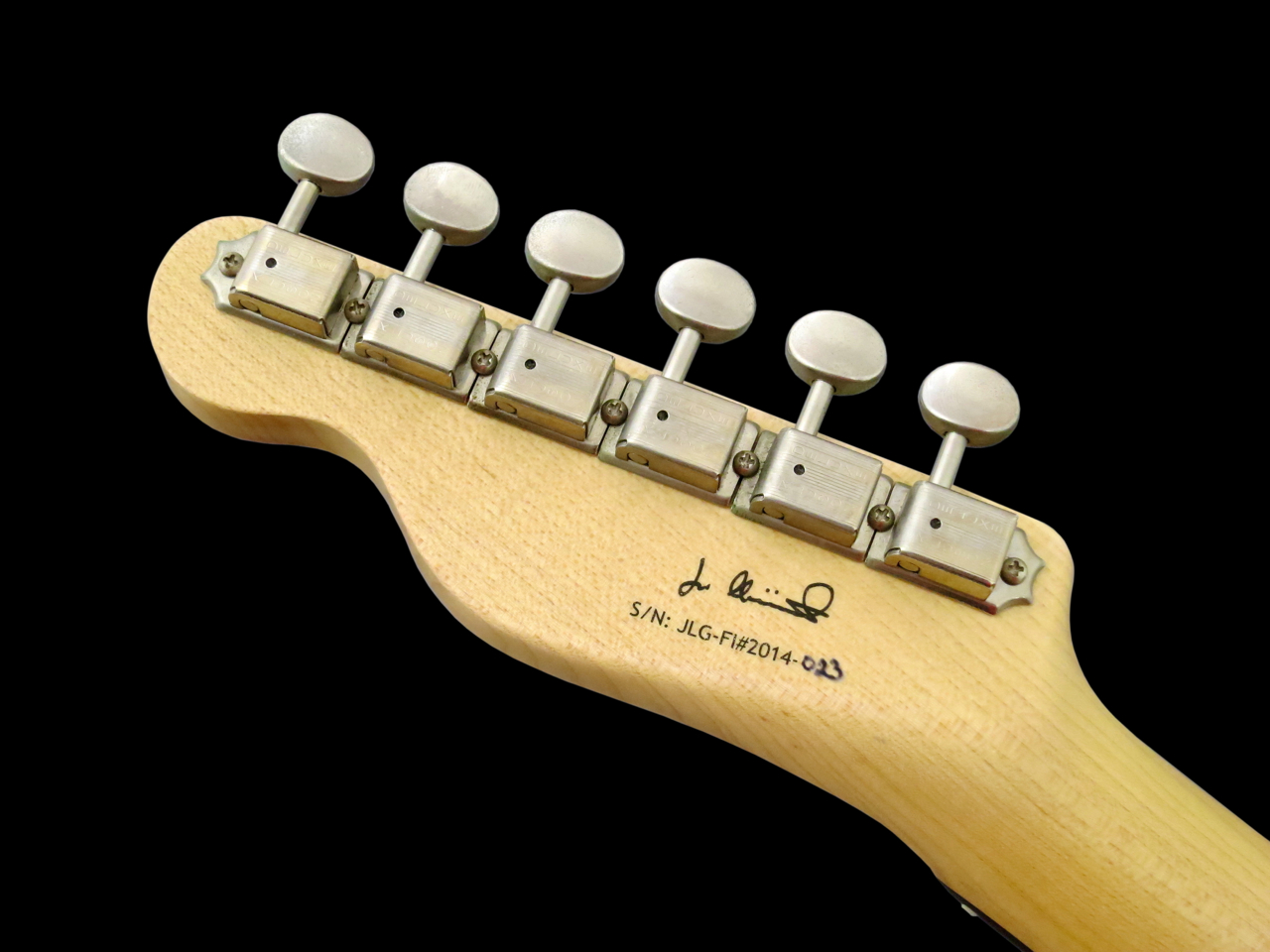
A nice set of lightly-aged Klusons takes care of tuning duties on this J. Leachim model.
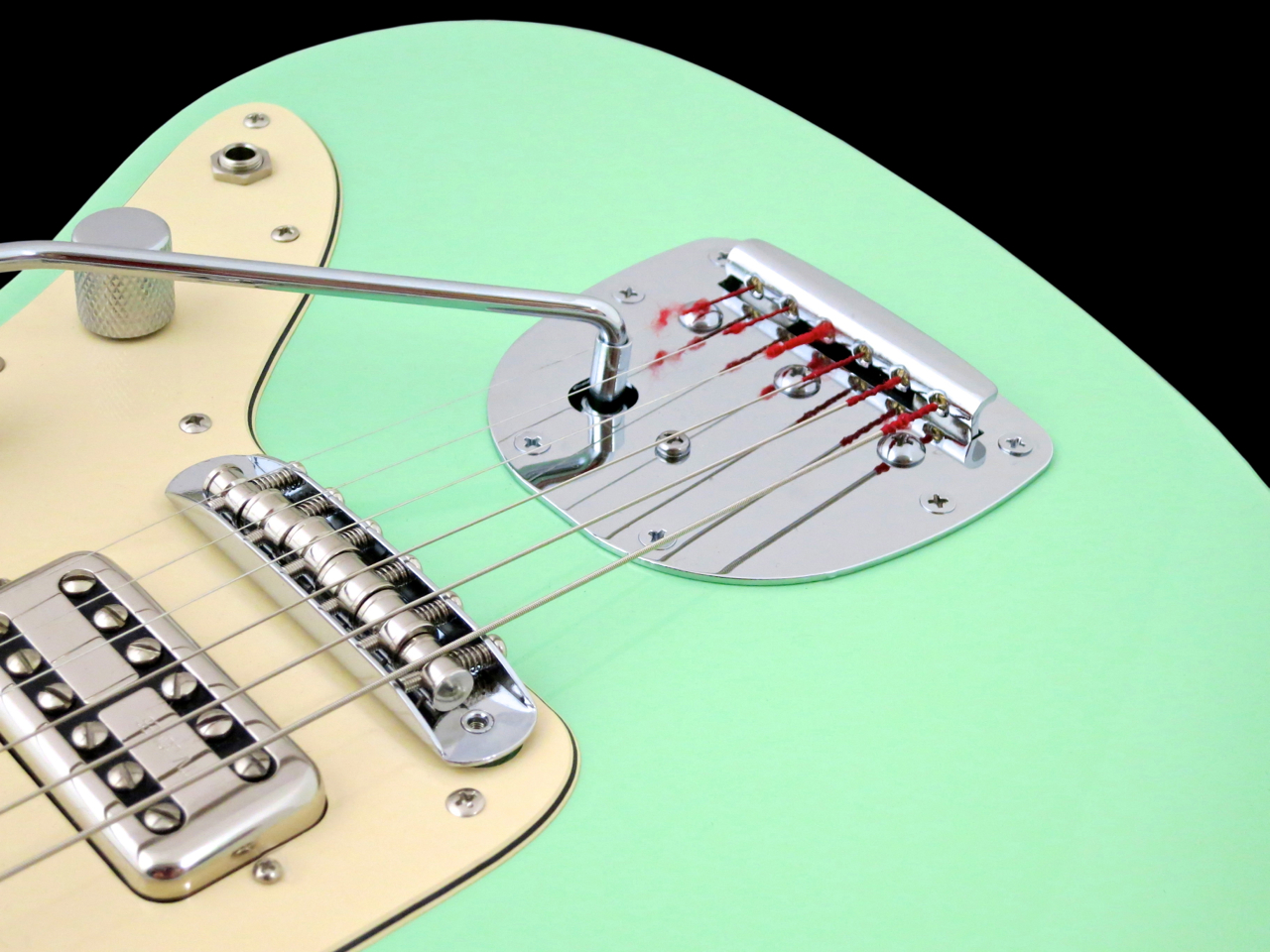
The Jazzcaster’s bridge and vibrato tailpiece have both been sourced from WD Music:
The vibrato is a version of the Fender Jazzmaster/Jaguar-vibrato, albeit without the original’s lock-off mechanism. The original locking mechanism is notoriously difficult to set up properly, so leaving it off is actually a good thing (in the view of most guitarists).
Many guitarists today dislike the original Jazzmaster-bridge, too, because the individual height-adjustment screws on the bridge saddles tend to work themselves loose with modern (light gauge) strings. Originally, this bridge – as well as the vibrato – has been designed to work with the stiffer string sets of the late 1950s (mostly 012 or 013 sets). With a set of 010s or 009s the Jazzmaster-bridge’s adjustment screws tend to rattle a lot.
Many modern makers – like J. Leachim Guitars – substitute the Jazzmaster-bridge with a Fender Mustang-bridge for this very reason. The Mustang-bridge is a direct replacement, and it uses differently sized bridge saddles to preset the fretboard radius permanently, so nothing can work itself loose and rattle.
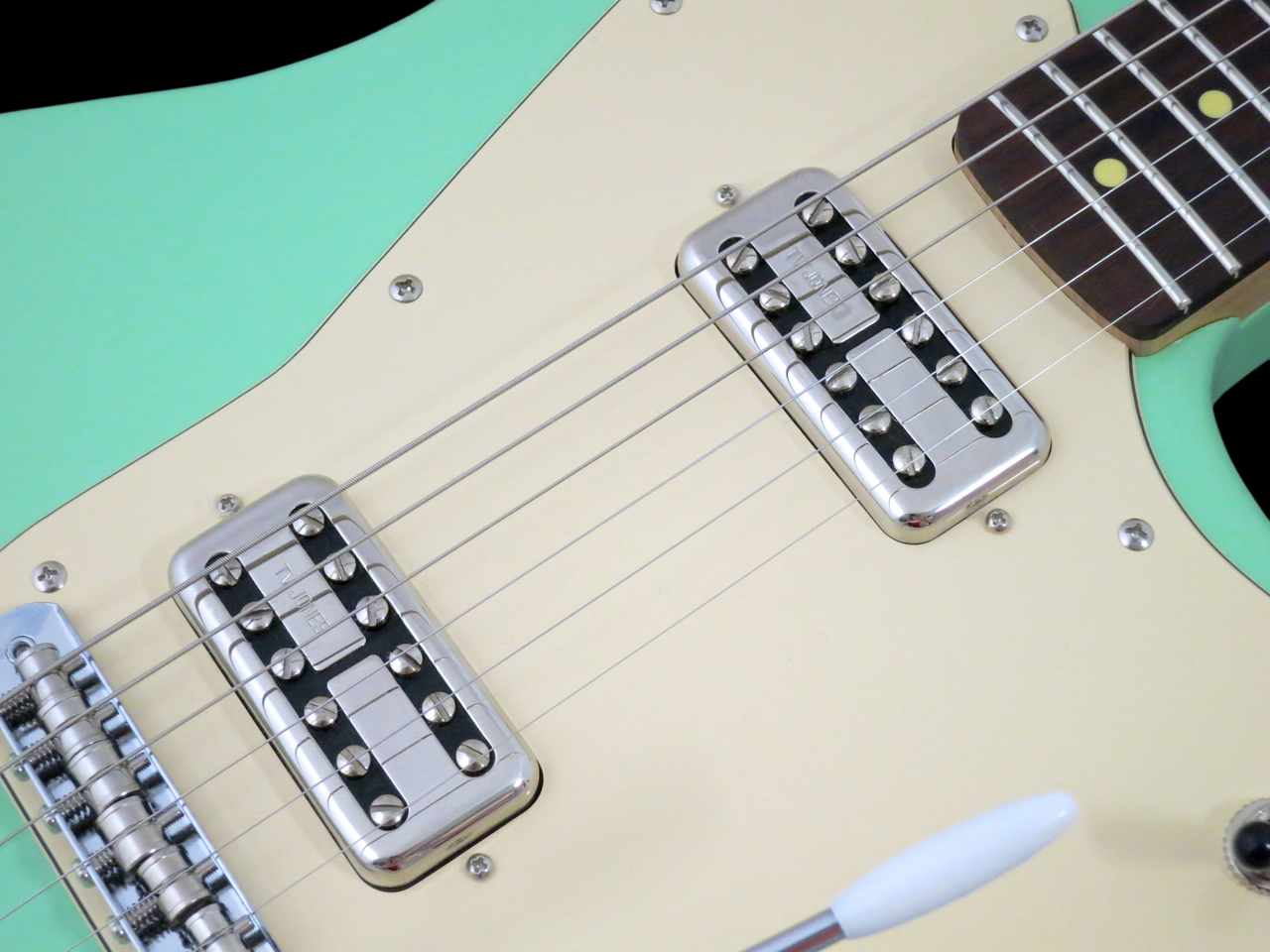
Gretsch Filtertron-style pickups are the ”in” thing at the moment.
J. Leachim’s Jazzcaster comes with a pair of TV Jones-pickups – there’s a vintage-type TV Classic in the neck position, and a more powerful Powertron model placed near the bridge.
The customer who ordered this particular Jazzcaster specified a reverse tone control (working clockwise), so this is what can be found on this instrument.
J. Leachim Guitars use a stereo phone jack, which keeps a firmer grip on the guitar lead’s plug, as well as making sure you always have a good connection to ground.
****
In my view, the J. Leachim Jazzcaster very successfully blends the ergonomics of the Jazzmaster body with a Gretschy tone. Thanks to its very smooth Jazzmaster-vibrato, the JLG Jazzcaster has a more open sound than, for example, a Cabronita Telecaster.
The Jazzcaster plays like a dream, as long as you’re willing to live with the typical, well-known compromises of the Jazzmaster/Jaguar-vibrato.
With modern, slinky strings, big bends – especially, when played higher up the neck – can quite easily make the high e-string jump out of its bridge groove. In a way this isn’t so much a fault, but more of a feature of this vibrato system, because the strings cross the bridge at a relatively shallow angle. With the stiff string sets of the late Fifties the system works fine, but for huge Blues bends with a contemporary 010-gauge set you should maybe invest in an additional bridge roller.
I would like to see a smoother taper on the tone control, though. On the review instrument the treble roll-off was more a matter of on or off, with everything happening right at the end of of the knob’s travel.
The Jazzcaster has a beautiful acoustic tone, with a bell-like ring and an open, yet firm body.
TV Jones’ acclaimed Filtertron-style pickups seem like a perfect fit for this model, adding a good deal of chime and twang, without sounding too bright or biting. Being humbuckers, the TV Jones pickups are also immune against hum and buzz, unlike a traditional Jazzmaster’s singlecoil units, which are not a million miles removed from a Gibson P-90.
This clip gives you an idea of the J. Leachim Jazzcaster’s clean sounds (starting with the neck pickup):
When plugged into an overdriven channel, the Jazzcaster wins you over with a chunky, aggressive and compact voice, which is just the ticket for Seventies-style Rock or Punk. Famous Filtertron-users in the Rock genre include AC/DC’s original rhythm guitarist Malcom Young, and the Who’s Pete Townshend, who frequently used Gretsch guitars as his ”secret weapon” in the studio.
Here’s the track from the Youtube-video – ”Seabird Flavour (Homage to Peter Green)”:
There are three rhythm parts – left channel (neck pickup), centre (neck pickup), and right channel (both pickups) – as well as the lead part, which uses both pickups (and the vibrato tailpiece).
****
In my view, J. Leachim’s Jazzcaster is a beautiful, and very well-made, Fender-inspired guitar, with a sound that’s all its own. You could think the Jazzcaster was only for Jazz or Country, but in reality this fine guitar covers a much wider area of musical styles.
In any case, J. Leachim Guitars is yet another Finnish guitar brand worth keeping on your radar.











 Kitarablogi.com – Finland's premier Guitar and Bass blog