Leo Fender’s and George Fullerton’s Precision Bass was the world’s first electric bass guitar. It was introduced to the puzzled public in 1951.
Tony Bacon and Barry Moorehouse quote Fender’s old production chief from the 50s and 60s, Forrest White, on the initial impact the new-fangled instrument had (in their well-written ”The Bass Book”):
”Those who were not sure if Leo was crazy when he brought out the solidbody guitar were darn sure he was crazy now, since he came up with an electric bass. They were convinced a person had to be out of their mind to play that thing.”
Leo and George took the Telecaster-concept and adapted it for a bass instrument. At the same time they hit upon some standards – almost by mistake – that are still valid these days. The most important ones are the body’s additional long upper horn, which helped in balancing such a long-necked instrument, as well as the scale length of 34 inches (84,6 cm).
Initial problems in the project were the total lack of appropriate strings, which had to be custom-ordered from V.C. Squier, as well as tuning machines. At first they used sawed off double bass tuners, before they were able to order Kluson-machines, manufactured to Fender’s own specifications.
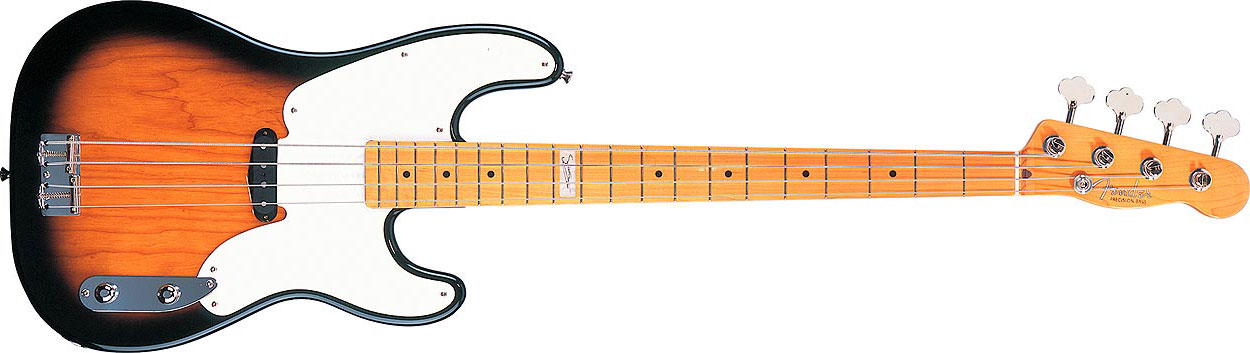
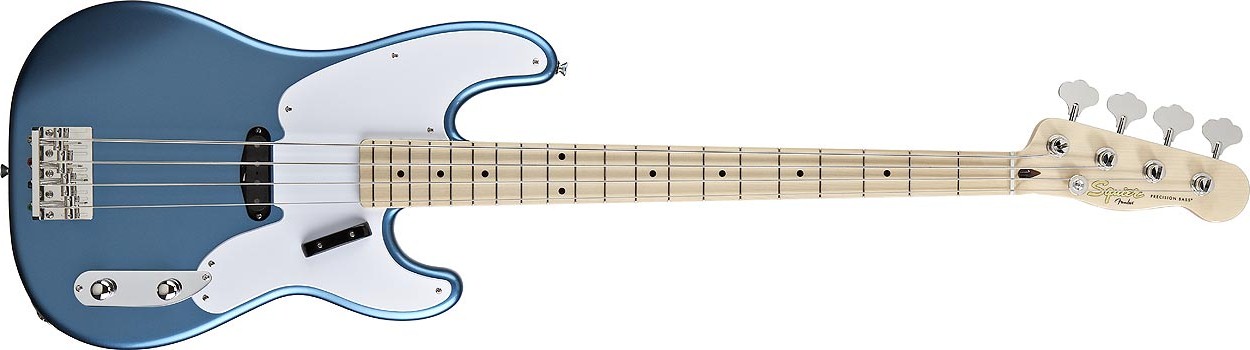
The first edition of the Precision Bass, made between 1951 and 1954, had a yellowish, semi-opaque-finished (blonde) slab ash body, a black Bakelite scratchplate, a Telecaster-style single coil pickup and a one-piece maple neck with a Telecaster-headstock. The simple bridge had only two saddles, which were first made from plastic and later from metal.
When the Stratocaster was introduced in 1954 the P-Bass received a slight make-over: the body gained Fender’s comfort contours, the scratchplate changed to single-ply white plastic and the standard finish became two-tone sunburst.
The Sting Signature Precision is based on a ’54-’56 P-Bass:
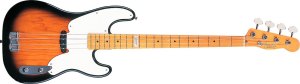
But Leo Fender still wasn’t quite satisfied with his creation: the pickup was picking up too much buzz, and its spiky signal tended to trash a lot of Bassman-amp speakers. Adding to this the Precision’s intonation wasn’t really very precise, because of the spartan bridge. And lastly it seemed that the small headstock had something to do with some dead notes on the g-string around the 5th fret.

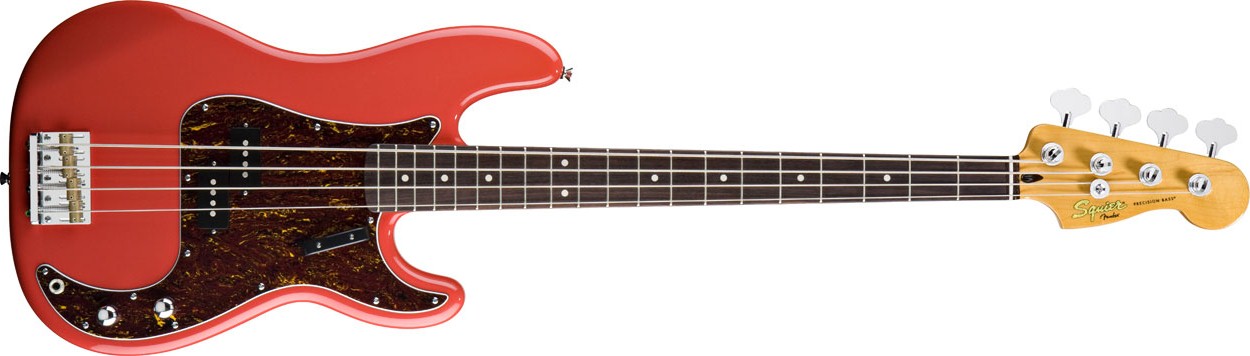
All these problems were addressed in the major overhaul (in 1957), which turned the Precision into the classic we all know today: with a large Strat-style headstock, a bridge with four individual saddles and a brand-new split-coil pickup.
This new pickup consisted of two halves, one each for the E- and A-string as well as the D- and g-string, wound reverse and with opposing magnetic polarities. Once hooked up in series the split-coil pickup produces a humbucking signal with a singlecoil sound. Placing each string between its own pair of magnets (in contrast to the single magnet below each string in the old design) also smoothed out the attack phase of each note, which in turn resulted in a signal that was much easier on a bass amp’s speakers.
The very first ”new and improved” Precisions also featured a gold-coloured aluminium scratchplate.
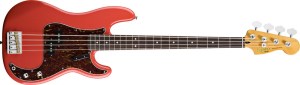
In 1959 Fender switched to rosewood fingerboards on all of their string instruments. Since the end of the 60s the P-Bass has been available both with a one-piece maple neck as well as with a rosewood fretboard.
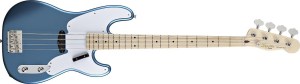
Nowadays Squier and Fender offer a Precision-model for all seasons and budgets, from vintage replicas to modern updates.
___________________________________________________________
You can listen to the sound of a 1976 fretless Fender Precision here.
The song was written by my late friend Pauli Rissanen, who also sings on the recording.



 Kitarablogi.com – Finland's premier Guitar and Bass blog