
****
Lisätiedot: Amfisound
Kitarablogi.com – Finland's premier Guitar and Bass blog
Juttuja kitaroista ja bassoista

****

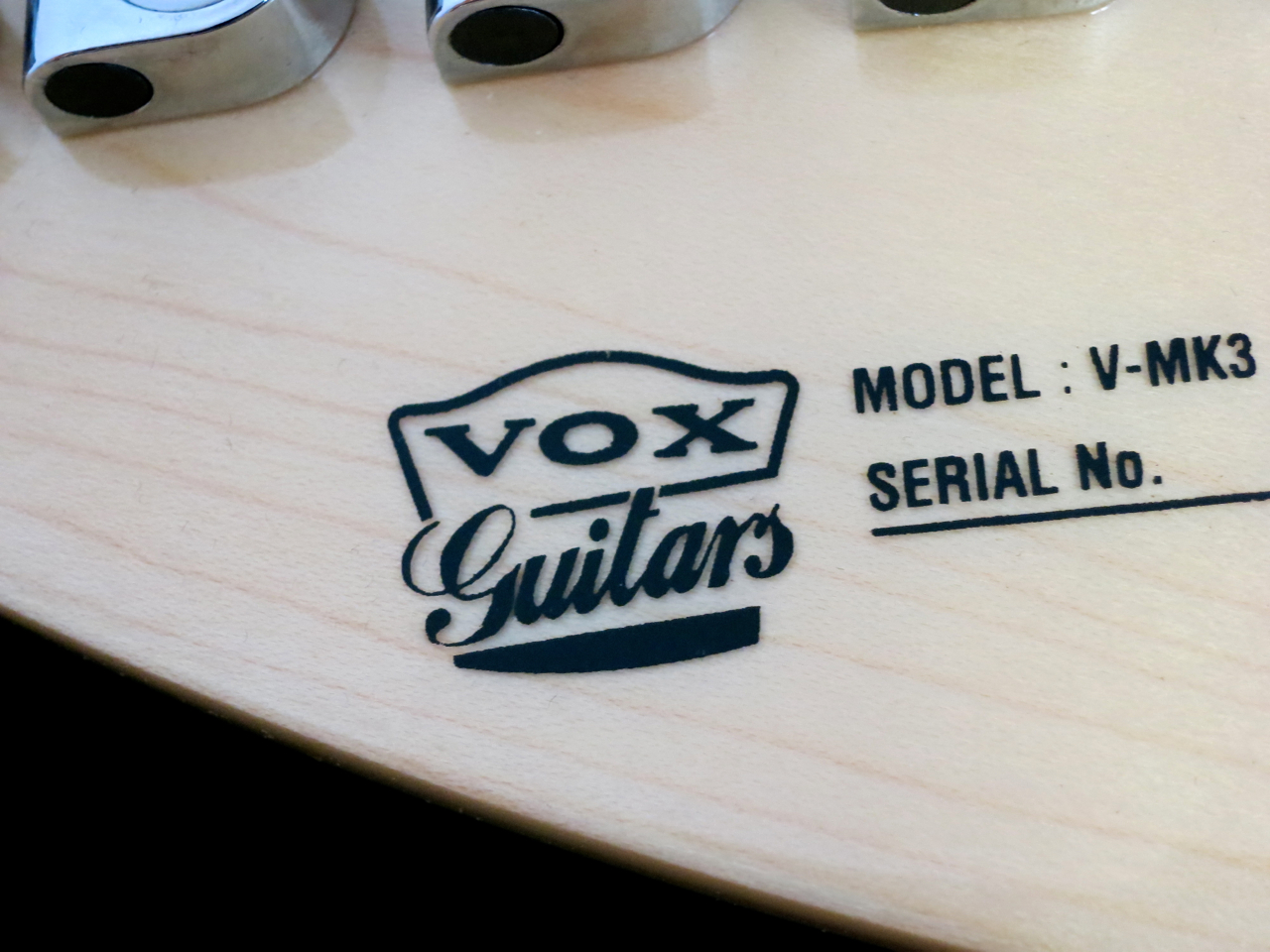
Vox’ legendary Sixties guitars, the Mark III and the Mark V – aka the Vox Teardrop (Mark III) and the Vox Phantom (Mark V) – have made a comeback! These Brit Boom-guitars have claimed their place in history as the chosen axes of the Rolling Stones’ original lead guitarist Brian Jones (Mark III) and Tony Hicks (Mark V) of the Hollies.
But the best news is that these new versions come at quite affordable prices!
****

The Vox Mark III (current price in Finland approx. 355 €) sports a symmetrical body, which calls to mind old lutes or the Greek bouzouki.
This reissue comes with a short 22-inch scale (610 mm), making it an ideal beginner’s instrument.

The Teardrop is build from a basswood body and a bolt on maple neck. The fretboard is crafted from rosewood.

The new, smaller version of the legendary Vox-headstock cuts down on neck weight and thus improves the guitar’s balance.

The Mark III is equipped with a set of modern sealed tuning machines that sport off-white buttons.
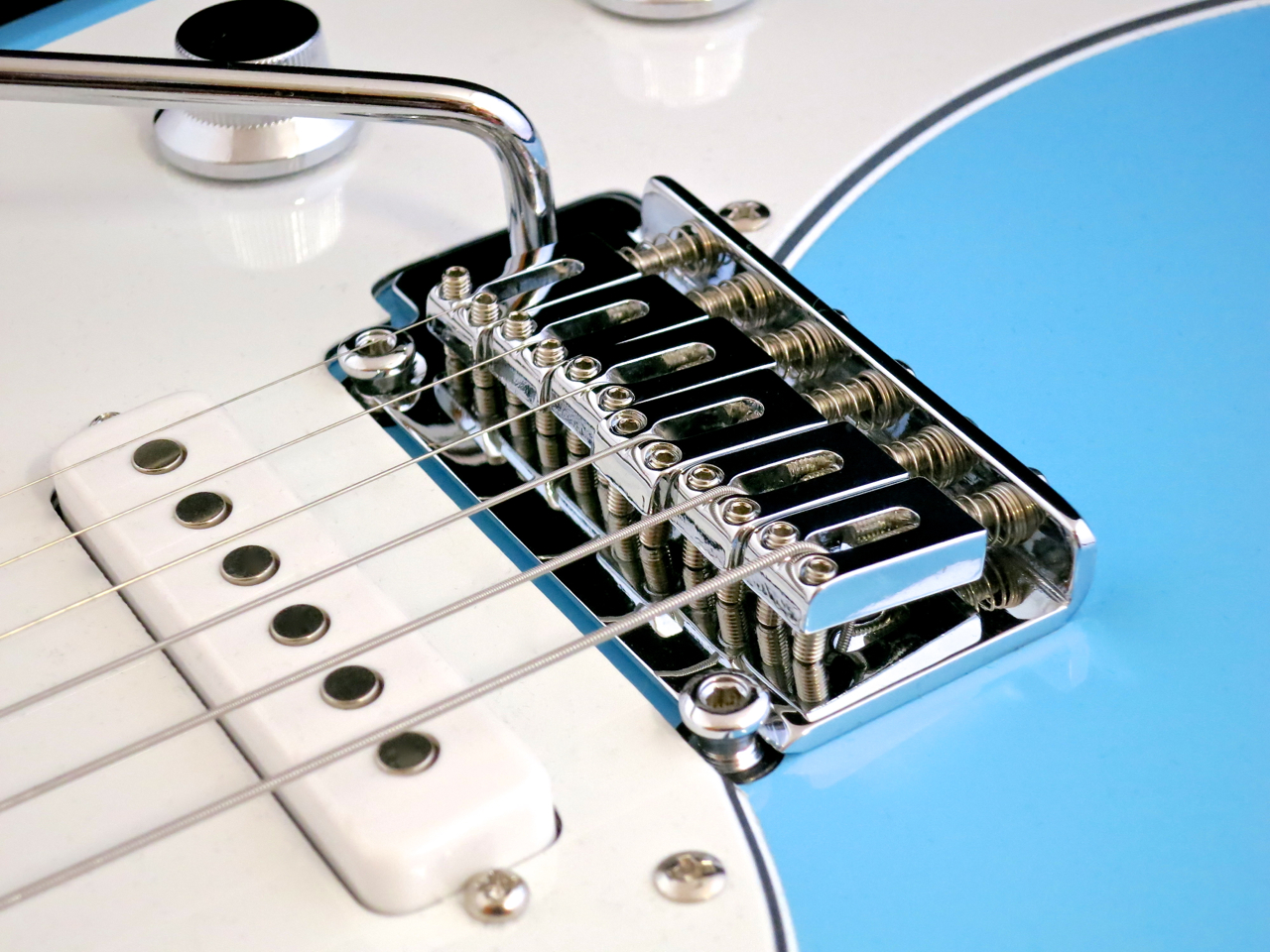
Both Voxes comes with a modern two-post vibrato bridge.

Three springs are factory-installed, but you can find a fourth spring in the gig bag, should you desire a firmer feel.
Vintage-snobs probably will scoff at the narrow tremolo block used in this vibrato. There are claims that this type of block diminishes sustain, but on the other hand Floyd Rose systems also use narrow blocks and nobody’s complaining.

There are three singlecoil pickups mounted to the three-ply scratchplate, meaning we’re in for a nice, sprightly vintage tone in all likelihood.
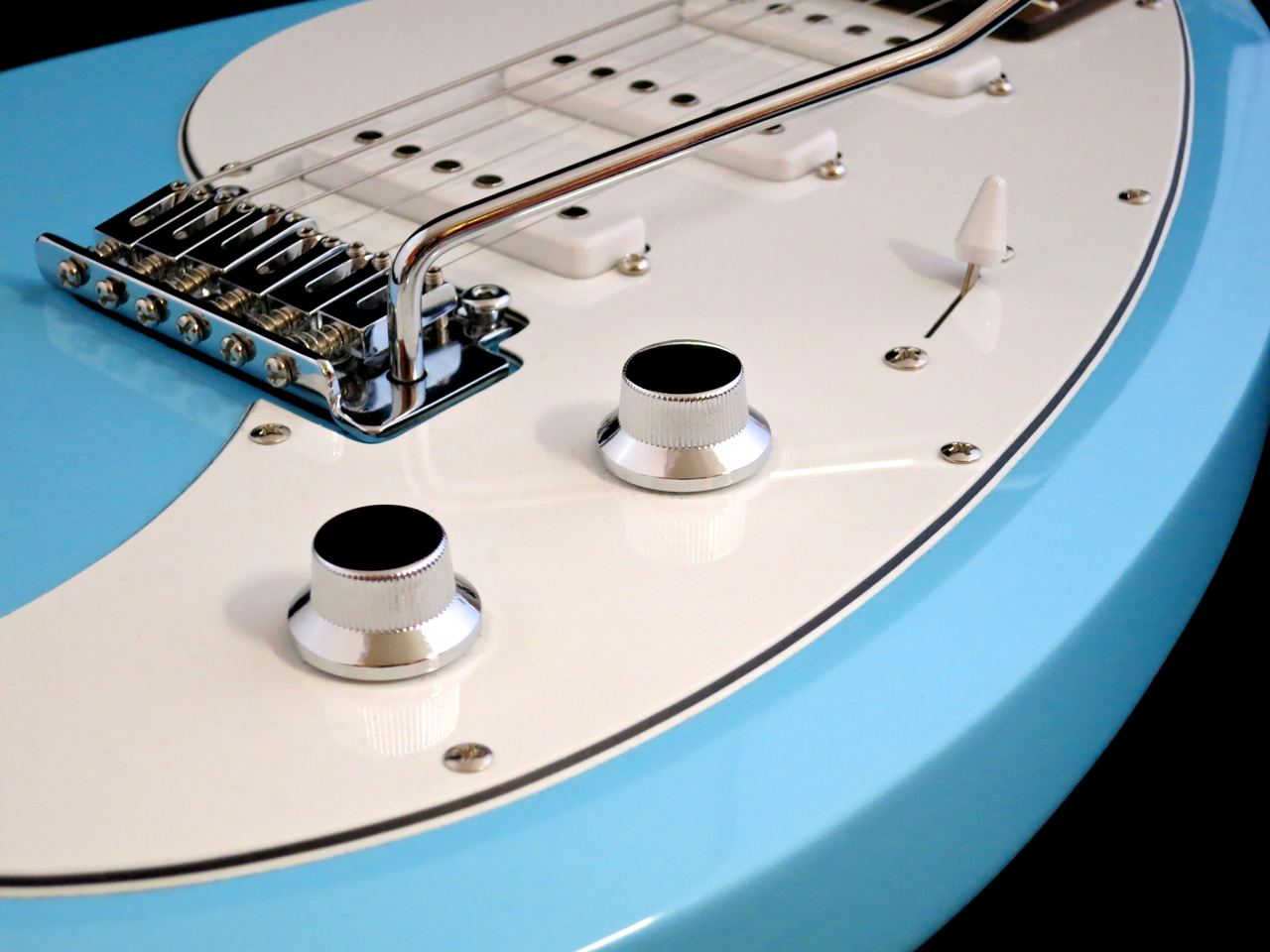
The traditional passive electronics comprise a five-way switch, as well as a master volume and a tone control.
****

The basic ingredients for the angular Vox Mark V (current price in Finland approx. 355 €) are virtually the same as in the Mark III.

There’s a rib cage contour in the Phantom’s basswood body, too.
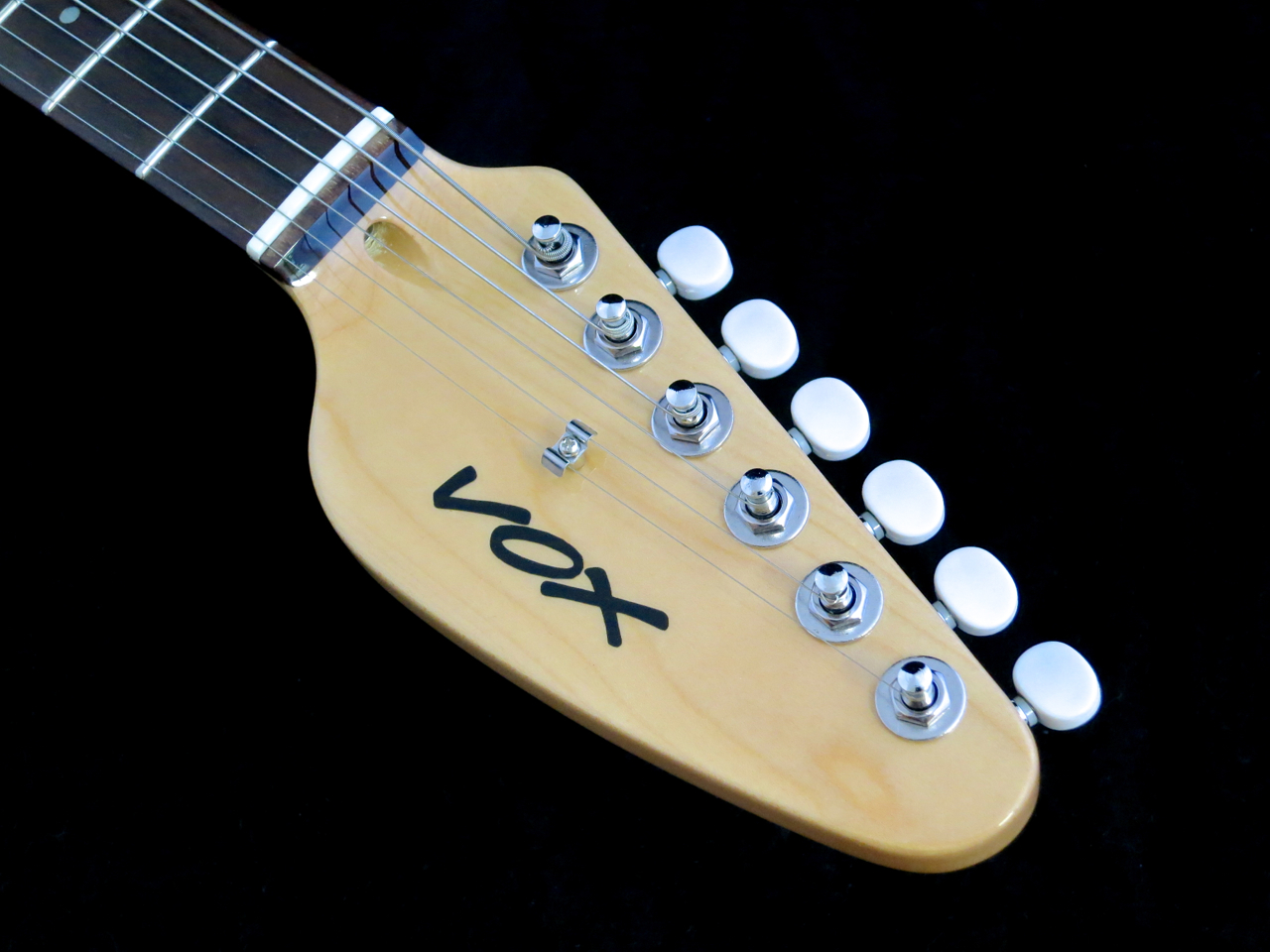
Both Mark-models feature gloss-finished maple necks with truss rod access at the headstock.

The vibrato bridge is surrounded the large pickguard of the Mark V.
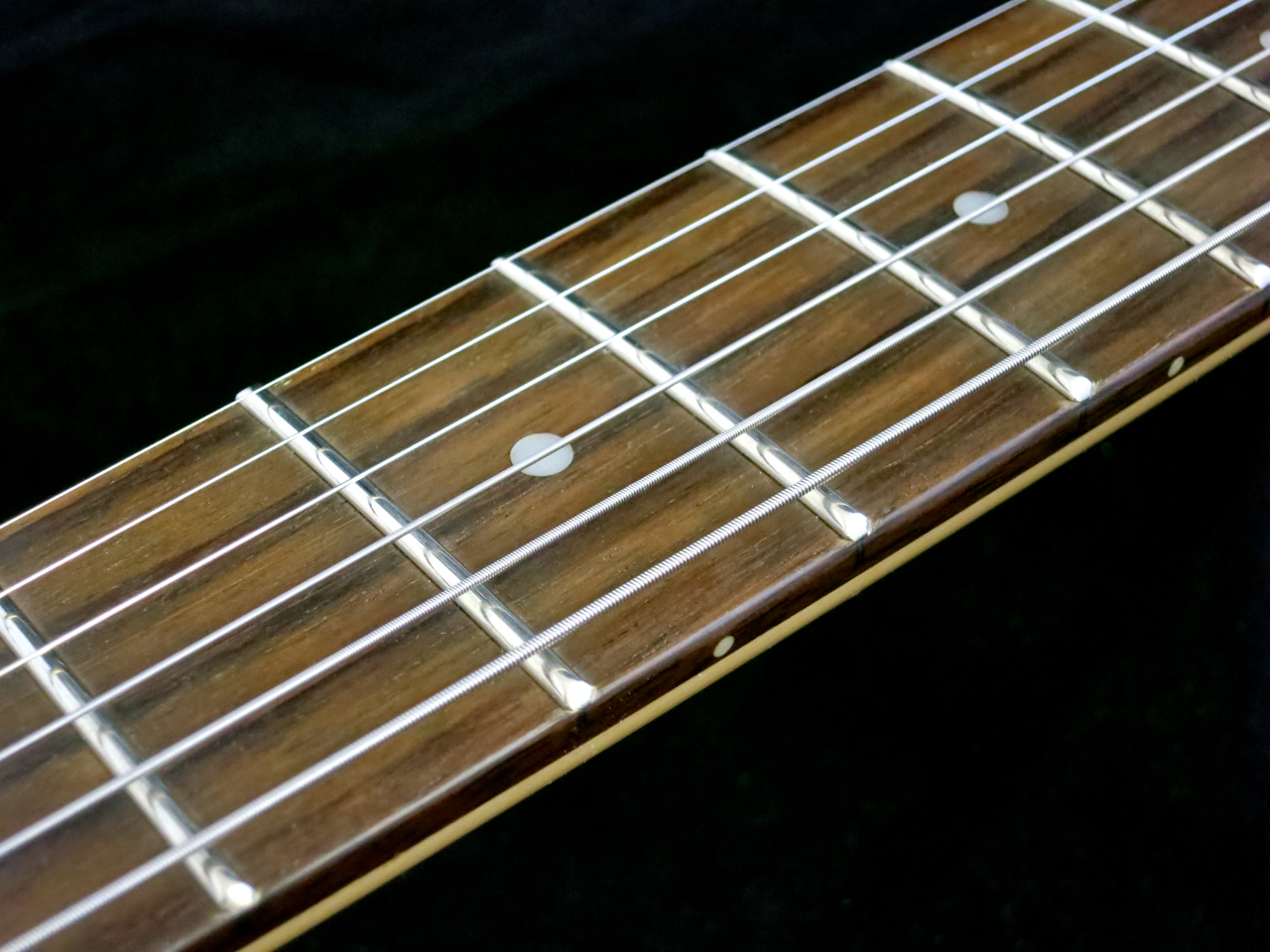
Both Voxes display very decent fretwork, which isn’t always a given in this affordable price bracket. The frets have been polished to a gleam and all ends have been rounded off carefully.
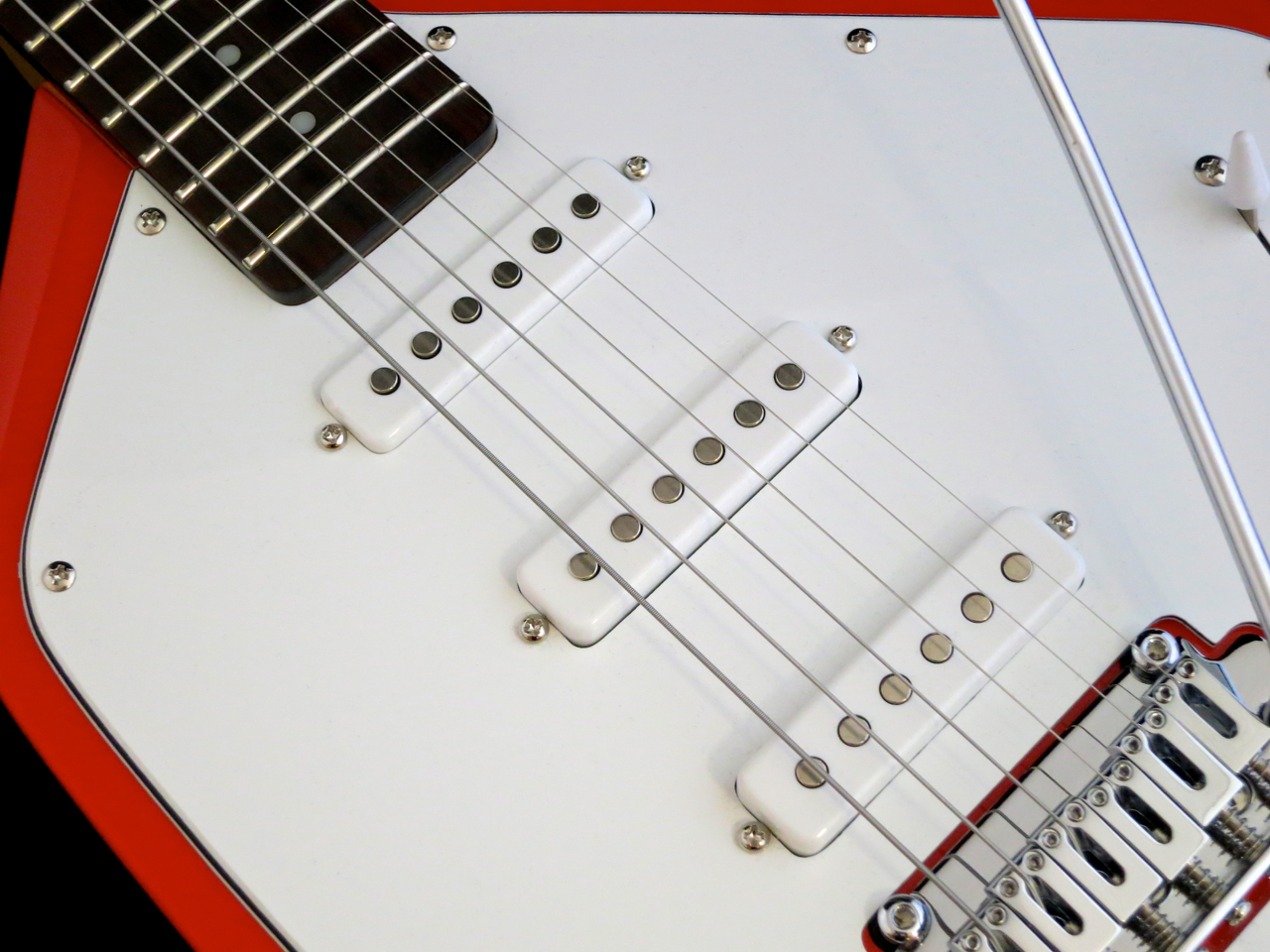
Vox Mark V Phantom is equipped with the same pickups…

…and the same controls as the Mark III Teardrop.
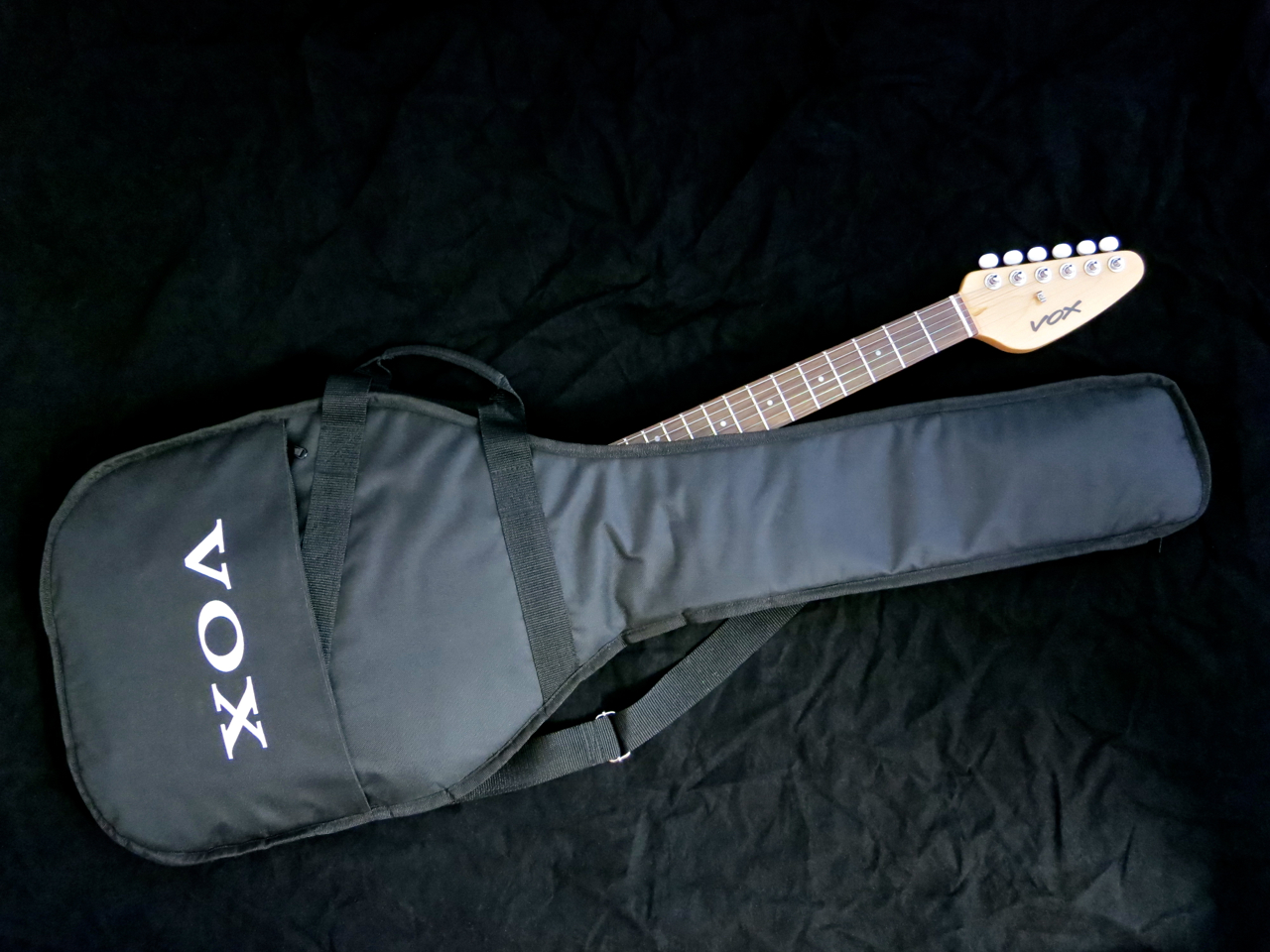
Both Vox Marks are sold with a nice gig bag!
****
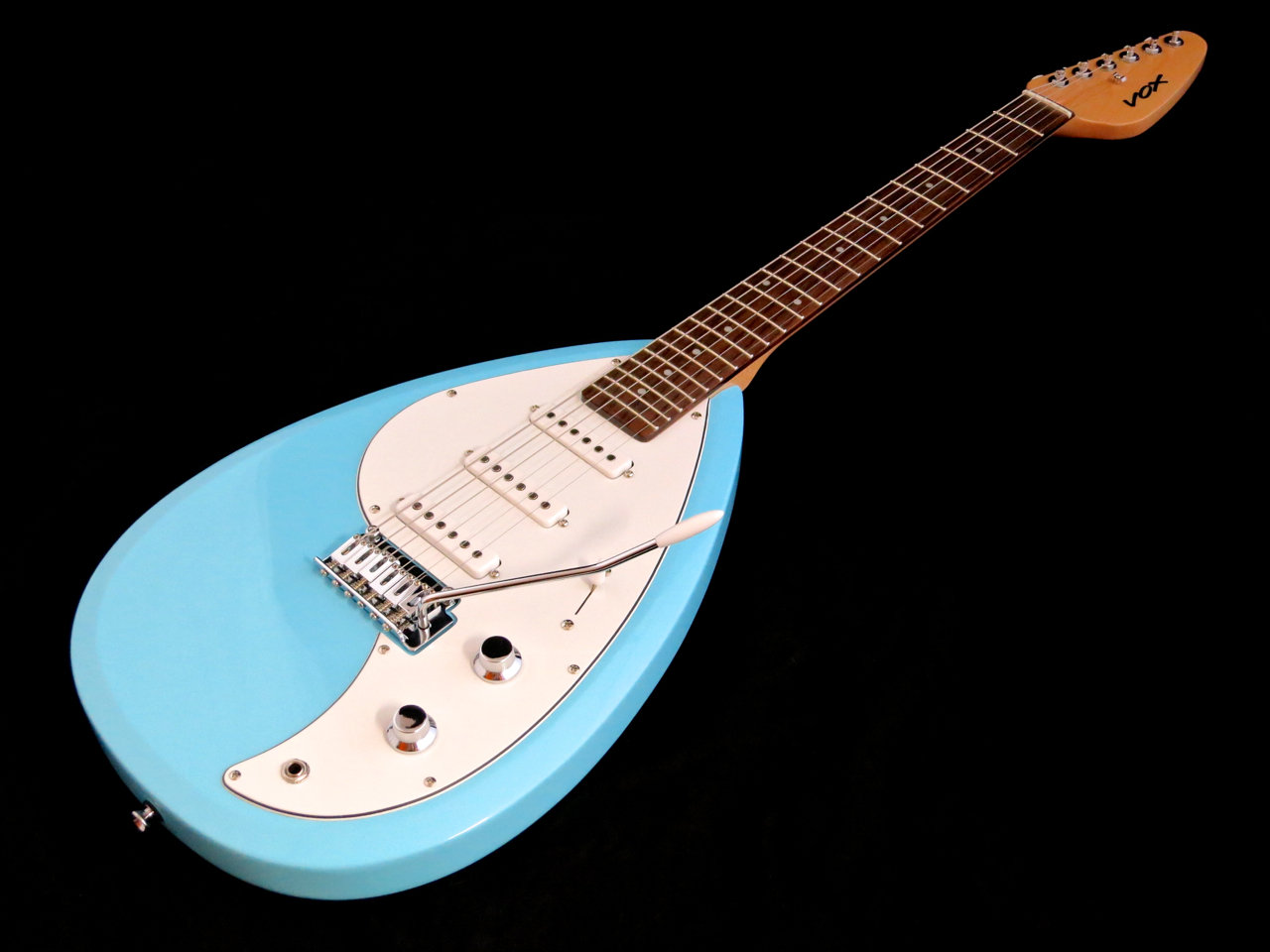
The Vox Mark III is a very compact electric guitar, with our test sample also being nicely light in weight. Due to its very rounded body the Terdrop probably isn’t the most comfortable ”sofa guitar”, but on a strap everything feels hunky dory.
The whole vibe is quite reminiscent of, say a Fender Mustang, no doubt because of the Mark III’s short-scale, gloss-finished neck with its round D-profile. With the factory set of 010-gauge strings bending is very effortless. Our test sample’s very low – but buzz free – action (E: 1,6 mm/e: 1,3 mm) pays testament to Vox’ workmanship. Used in moderation the vibrato works decently, but don’t expect Floyd Rose-style return to pitch.
The Vox Mark III rings very nicely with a fresh and firm acoustic voice.
The clean tones of the Vox Teardrop works great in a Sixties-style poppy, jangly context or for funky workouts:
Add some overdrive for some nice, sinewy vintage Rock-sounds:

****

The Vox Mark V doesn’t seem to want to fit in you lap – it takes a while to get comfortable, when playing sitting down. Our lightweight test samples’ strapped-on balance proved to be excellent, though.
In most respects the Phantom feels very similar to the Mark III, with its comfortable, vintage-style neck. Straight out of the gig bag our test sample’s intonation was a bit fruity on a couple of strings, but this was corrected in no time with the correct screwdriver. The action was set quite low (E: 1,6 mm/e: 1,1 mm) on the Mark V, too. And again, as with the Teardrop, the Phantom still rang nice and true without any rattling. Well done, Vox! Should you prefer a slightly firmer feel, I’d suggest moving up to a 011-gauge string set.
Both Voxes sound almost indentical – acoustically, as well as amped up.
This is the Mark V Phantom’s clean delivery, played through a small Marshall combo:
I really like the gritty and slightly rude Rock-sounds you can get from the Mark V:

****

Due to their unconvetionally-shaped bodies, Vox’ Mark range always runs the slight risk of being regarded as mere ”poser guitars”, better suited to music videos that to actually making music.
This is far from the truth, though, because these new versions of the Mark III and Mark V really deliver nicely vintage-tinged sounds for the Pop, Beat, Blues, and Classic Rock genres. In view of their pocket-friendly prices, quality workmanship, quirky looks and great sounds, I can only applaud Vox for bringing back the classic Teardrop and Phantom models. Try one!

****
Vox Mark-series guitars
Vox Mark III Teardrop – 355 €
Vox Mark V Phantom – 355 €
Finnish distributor: EM Nordic
A big thank you goes to DLX Music Helsinki for the loan of the review guitars!
****
Pros (both models):
+ classic looks
+ workmanship
+ playability
+ sound
+ gig bag included in price
Cons (both models):
– not the most natural ”sofa guitars”

****

German maker Duesenberg is known for its high-quality guitars and basses, that combine seamlessly Art Deco-chic and ingenious improvements in many details, such as the hardware and electronics departments.
The Duesenberg D-Bass is a good example of this, promising both P- and J-style tones from a passive, one-pickup instrument.
****

The Duesenberg D-Bass (current price in Finland: 1.729,90 €) proves that you can build a bass from classic tonewoods without having to resort to copying others.
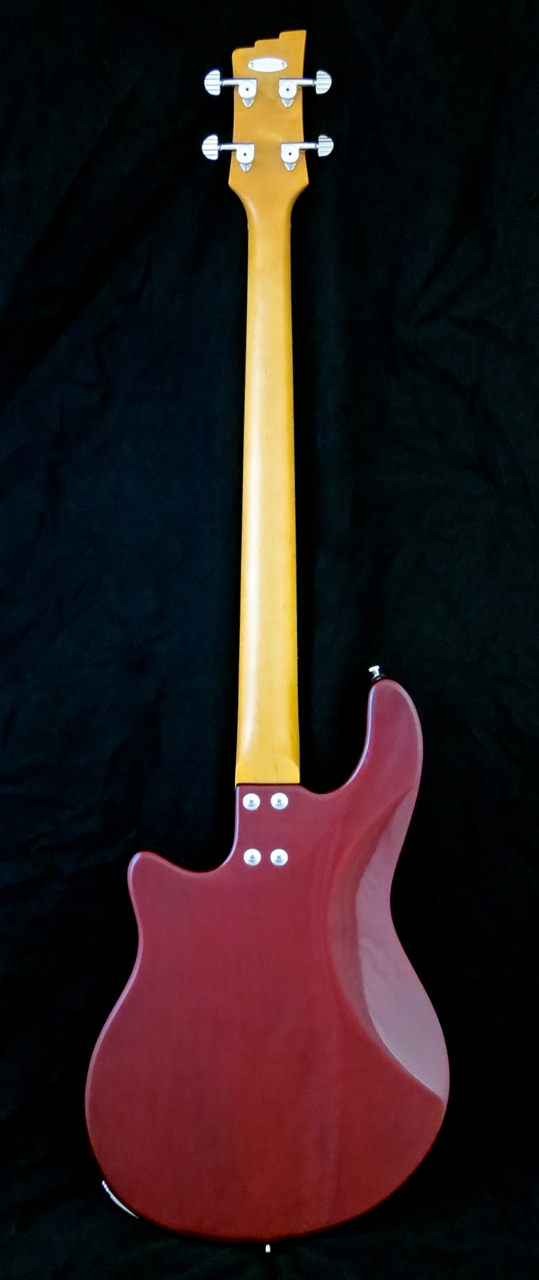
This is a four-string, passive bass, built using a bolt-on maple neck with a rosewood fretboard mated to a bound alder body. The top of the body sports elegant carving.

The generous rib cage bevel adds a great deal of comfort to the D-Bass.
The body comes in a fetching gloss finish, while the neck has received a thin, vintage-tinted satin finish.

I feel that Duesenberg’s three step headstock looks even better in its bass guise than the smaller guitar version.
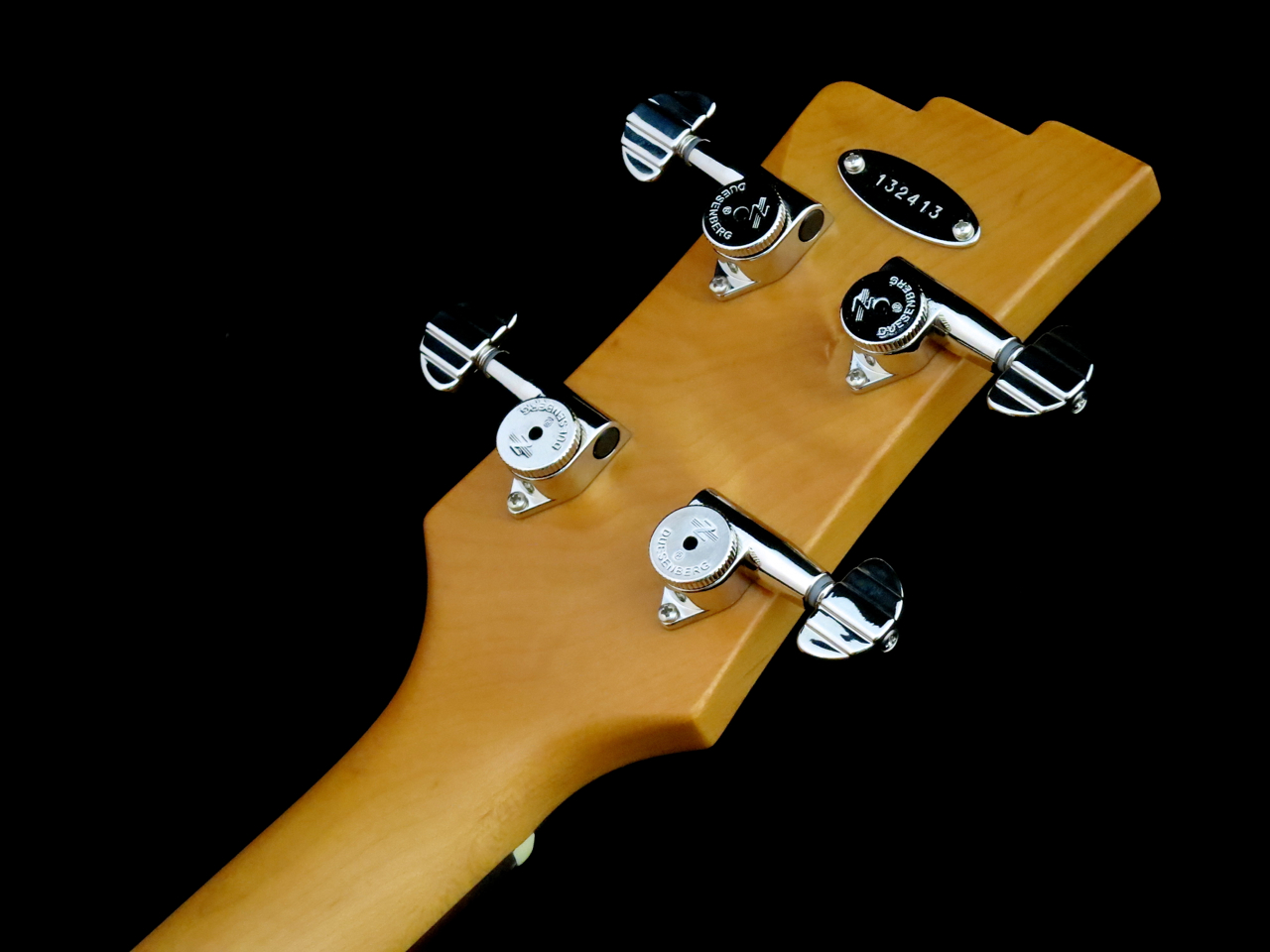
Duesenberg use their own locking Z-Tuners on the D-Bass. The string is first fed into a well in the tuning post until it comes out of a small hole in the tuning machine’s back. You cut off the surplus length of string, pull back the string by a couple of millimetres, lock it in place and tune up. Voila, a clean and uncluttered solution that leaves no sharp string ends.

Duesenberg employ a PLEK-robot to give all their instruments a perfect fret job and set-up.

Thanks to the angled neck joint an excursion to the dusty end of the fretboard is fast and easy on the D-Bass.

Duesenberg’s bridge and tailpiece combo are made of chunky bits of milled brass.
In addition to action and intonation the bridge also offers the adjustment of string-to-string distance. After adjustment you can lock everything in place with allen grub screws.

The D-Bass’ two-part pickup is situated on its own, oval pickguard.
Duesenberg’s Toaster-pickup may resemble a Fender Precision-pickup, but it really has its own thing going on in terms of construction. While the venerable P-Bass is equipped with two singlecoil pickups (one for each pair of strings), which are hooked up to form a humbucking unit, Duesenberg’s design uses two small humbuckers with open covers.

The passive controls are found on the bass’ larger pickguard and comprise a master volume, the Mid-Shift control and a master tone.

The Mid-Shift control uses a nifty bit of wiring voodoo:
When Mid-Shift is fully turned up, both coils of each pickup are used fully, but some of the top end signal is filtered by a capacitor. This is how the D-Bass achieves a P-style sound.
Turning the potentiometer counterclockwise fades out the signal of one of each humbucker’s coils, while lessening the capacitor’s effect on the signal. Fully counterclockwise, this gives you a brighter and more focussed, J-type tone.
You can find a similar wiring trick on Seymour Duncan’s web page, showing you how to wire up a humbucker in such a way that you can use a control pot for going from humbucking to singlecoil by feeding one of the pickup coils to earth.


The Duesenberg D-Bass comes in its own quality hard case.
****

Duesenberg’s bass is a beautiful instrument with a nice, medium weight and a great balance, both in you lap or hanging on a strap.
The neck profile is a Precision-style wide ”D”, but combined with the D-Bass’ larger fingerboard radius and its jumbo frets the playing feel is decidedly more modern and slinky than vintage.
My only small gripe is a strictly cosmetic one: I would like to see one or two screws added to the larger control scratchplate, as the current layout doesn’t make the plate fit snugly on top of the body’s top contour, leaving a few edges standing proud of the body surface.
This Duesenberg has a very healthy acoustic ring, completely devoid of any of the quirks often associated with vintage basses (like an over-enthusiastic low G or a dead spot around the high c).
Amped up you’re in for a real treat, as long as you’re not after that type of extreme EQ, only achievable with active preamps. Duesenberg’s Mid-Shift control is a really ingenious addition to the D-Bass, resulting in a much more organic palette of sounds than a mere coil-split could provide. The volume drop going from the P- to the J-variant is negligible, which is another positive effect of not using a straight coil-split.
I always play the same motif twice in each sound clip – first with Mid-Shift full on (P), then with Mid-Shift turned down fully (J).

****

I must say, I liked the Duesenberg D-Bass very much. It is a great instrument for connoisseurs of passive bass tones. The Mid-Shift control isn’t ”in your face”, but still manages to provide you with an ingenious way of tailoring the bass’ sound to your needs.
****
Duesenberg D-Bass
1.729,90 €
Finnish distributor: F-Musiikki
****
Pros:
+ workmanship
+ Mid-Shift control
+ playability
+ design
+ sound
Cons:
– pickguard fit (read the review)
****

****
Voxin 1960-luvun Mark III- ja Mark V -kitarat – jotka tunnetaan myös nimillä Teardrop (Mark III) ja Phantom (Mark V) – ovat jälleen saatavissa musiikkikaupoista. Brittiboomi-mallien tunnetuimmat käyttäjät olivat 1960-luvulla Rolling Stonesien Brian Jones (Mark III) ja Hollies-yhtiön Tony Hicks (Mark V).
Todella ilahduttavaa on, että uusi Vox-kaksikko on saatavilla erittäin maltillisella hinnalla.
****
Vox Mark III (355 €) muistuttaa symmetrisellä rungollaan hieman kreikkalaista busukia.
Uusintapainos valmistetaan lyhyellä 22-tuuman (610 mm) mensuurilla, minkä ansiosta se sopii hyvin myös nuorten soittimeksi.
Lehmusrunkoon ruuvattu kaula on veistetty vaahterasta, ja Teardropin otelauta on palisanteria.
Legendaarinen Vox-lavan uusi versio on hieman pienempi kuin alkuperäinen ja mielestäni paljon alkuperäistä kätevämpi.
Nykyaikaisissa suljetuissa virittimissä on valkoisia muovinuppeja.
Vox Mark III on varustettu nykyaikaisella vibratallalla.
Tehtaalta Mark III ja Mark V lähtevät kolmella jousella varustettuina, mutta topatussa pussissa on pakattu vielä yksi jousi mukaan.
Vintage-snobit eivät luultavasti tykkää tämän vibran ohuesta blokista, koska sanotaan, että sustainin kannalta massiivisempi on parempi. Toisaalta myös Floyd Rose -vibroissa käytetään vintagea ohuempaa blokkia.
Vox-mallin kolmesta yksikelaisista voi varmasti odottaa raikasta soundia kuuskytluvun hengessä.
Elektroniikka koostuu yhdestä viisipykäläisestä kytkimestä, sekä master tone- ja master volume -säätimistä.
****
Kulmikkaan Vox Mark V:n (355 €) perusresepti on periaatteessa sama kuin Mark kolmosessa.
Myös Fantomin lehmusrunkoon on lisätty mukavuusviiste soittajan kylkiluita/vatsaa varten.
Mark-mallien kaulat ovat samanlaisia, aina kiiltävää viimeistelyä myöten.
Mark V:ssa kolmikerroksinen pleksi ympäröi kitaran vibratallaa.
Vox-soittimien nauhatyö on yllättävän laadukasta, kun katsoo Mark-mallien hintalappuja. Nauhat on kiillotettu ja niidet päät on pyöristetty huolellisesti.
Vox Mark V Phantom -kitarassa käytetään samoja mikrofoneja…
…sekä samaa elektroniikkaa kuin Mark III Teardropissa.
Topattu pussi kuuluu Mark-malleissa hintaan!
****
Vox Mark III on erittäin kompakti kitara, ja testissä käynyt yksilö mukavan kevyt. Rungon pyöreän muotoilun takia Teardrop ei ole ehkä maailman luontevin ”sohvakitara”, mutta hihnan varressa kitaraa on hyvin mukava kantaa.
Lyhyen skaalan ja kiiltäväksi lakatun, pyöreällä D-profiililla varustetun kaulan ansiosta tällä Voxilla on samantyyppiset vibat kuin esimerkiksi Fenderin Mustang-mallissa, ja tehdaskieliä (010-satsi) on erittäin helppoa venyttää. Vaikka kielet oli säädetty hyvin lähelle otelautaa (E: 1,6 mm/e: 1,3 mm), Mark III Teardrop soi puhtaasti ja rämisemättä. Vibratalla toimii maltillisesti käytettynä hyvin, mutta Floyd Rosen haastajaksi sitä ei tietenkään ole.
Vox Mark III:n akustinen ääni on hyvin Fender-mainen, mutta samalla kauniin lämmin.
Vox Teardrop -mallin puhdas soundi sopii vaikkapa rautalankaan tai funk-musiikkiin:
Säröpuolella homman nimi on Vintage Rock:
****
Vox Mark V on sylissä hieman vastahakoinen tapaus, ja hyvän soittoasennon löytämiseen menee tovi. Kevyt testiyksilö roikkuu kuitenkin hihnassa todella hyvässä tasapainossa.
Phantomin soittotuntuma on erittäin lähellä Teardrop-mallia, nimittäin vintage-tyylinen ja mukava. Testiyksilössä intonaatio oli säädetty kahdelle kielelle hieman nuotin vierestä, mutta homma hoitui nopeasti ristiruuvarilla. Kitaran tatsi oli säädetty myös Vox Mark V:ssa hyvin kevyeksi (E: 1,6 mm/e: 1,1 mm). Jos haluaa soittotuntumasta vielä kiinteämmän, suosittelisin pykälän paksumman 011-satsin käyttämistä.
Molemmat Vox-kitarat kuulostavat miltei samalta, sekä akustisesti että vahvistimen kautta soitettuina.
Tällainen on Mark V Phantomin puhdas soundi pienen Marshall-kombon kautta soitettuna:
Mark V:n Rock-soundista löytyy mukavasti karkeutta ja asennetta:
****
Vox Mark -mallien erikoisten runkomuotojen takia voisi helposti erehtyä lokeroimaan Teardrop- ja Phantom-kitarat pelkiksi ”musiikkivideo-kitaroiksi”.
Totuus on kuitenkin, että sekä Mark III että Mark V toimivat ilahduttavan hyvin Pop-, Beat-, Blues- ja Classic Rock -genreissä. Uudet Voxit tarjoavat roimasti vastinetta rahalle, koska niiden soitettavuus ja soundi ovat enemmän kuin kohdillaan. Suosittelen!
****
Vox Mark -sarjan kitarat
Vox Mark III Teardrop – 355 €
Vox Mark V Phantom – 355 €
Maahantuoja: EM Nordic
Suuri kiitos DLX Musiikille testisoittimien lainaamisesta!
****
Plussat (molemmat mallit):
+ ulkonäkö
+ työnjälki
+ soitettavuus
+ soundi
+ topattu pussi kuuluu hintaan
Miinukset (molemmat mallit):
– eivät istu kovin luontevasti sylissä
****

Tokai Guitars are known for their well-made copies of classic guitar and bass models.
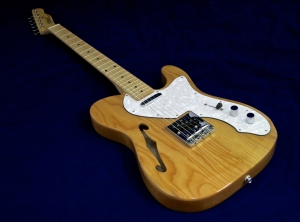
The brand-new Tokai ATE-33N Thinline is part of Tokai’s more affordable Chinese-made range, and represents their version of a Thinline Tele-type guitar.
****
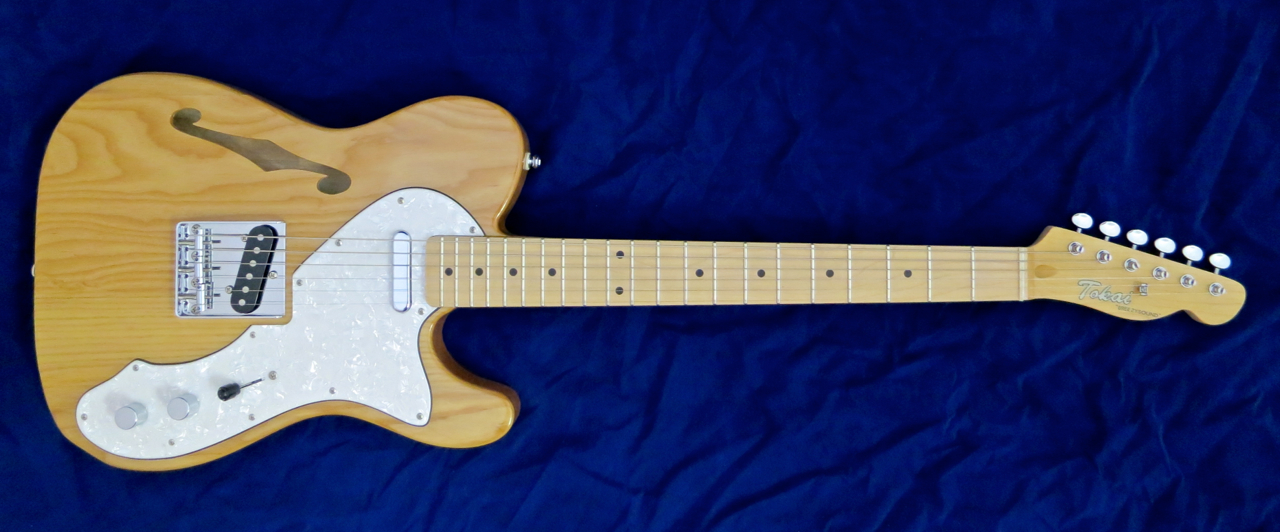
The Tokai ATE-33N Thinline (current price in Finland 437 €) is a real looker and will delight fans of the natural look, despite its moderate price tag.
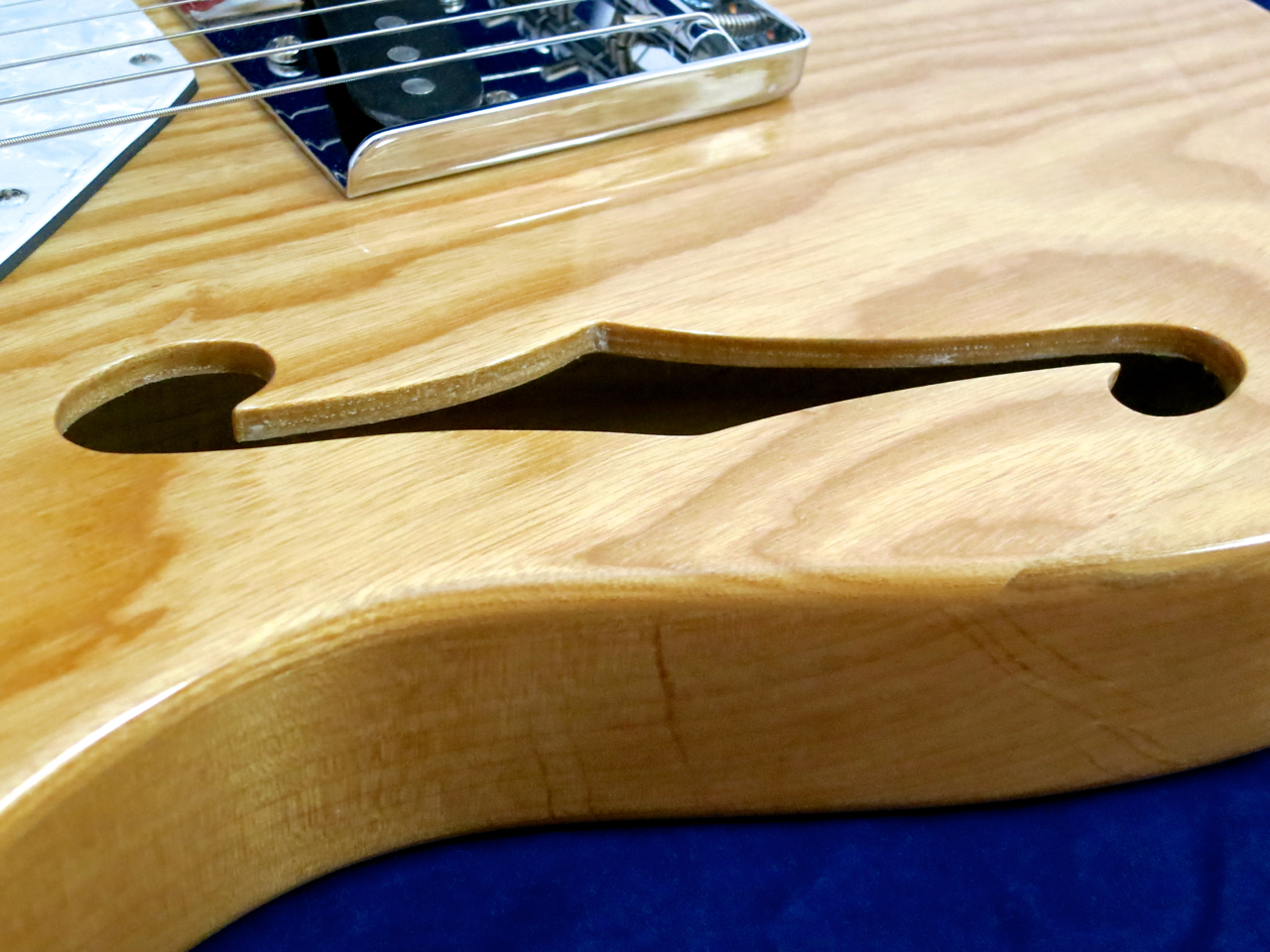
Roger Rossmeisl – known for his classic Rickenbacker designs – hit upon the concept of the Thinline Telecaster in the late 1960s when working for Fender. The original version was made with a body which featured three large pockets routed out from the back. A separate, glued-on solid piece of wood served as the body’s back.
Tokai approaches the construction of the ATE-33N Thinline the other way around: the pockets are routed into the front of the alder body, which then receives a beautiful, five millimetre thick swamp ash top. This solid ash top was made from three side-by-side pieces on our test sample, with the nicely matched grain efficiently disguising the glue lines.

The body of Tokai’s ATE-33N Thinline sports a gloss finish, while the neck has received a thin satin finish.
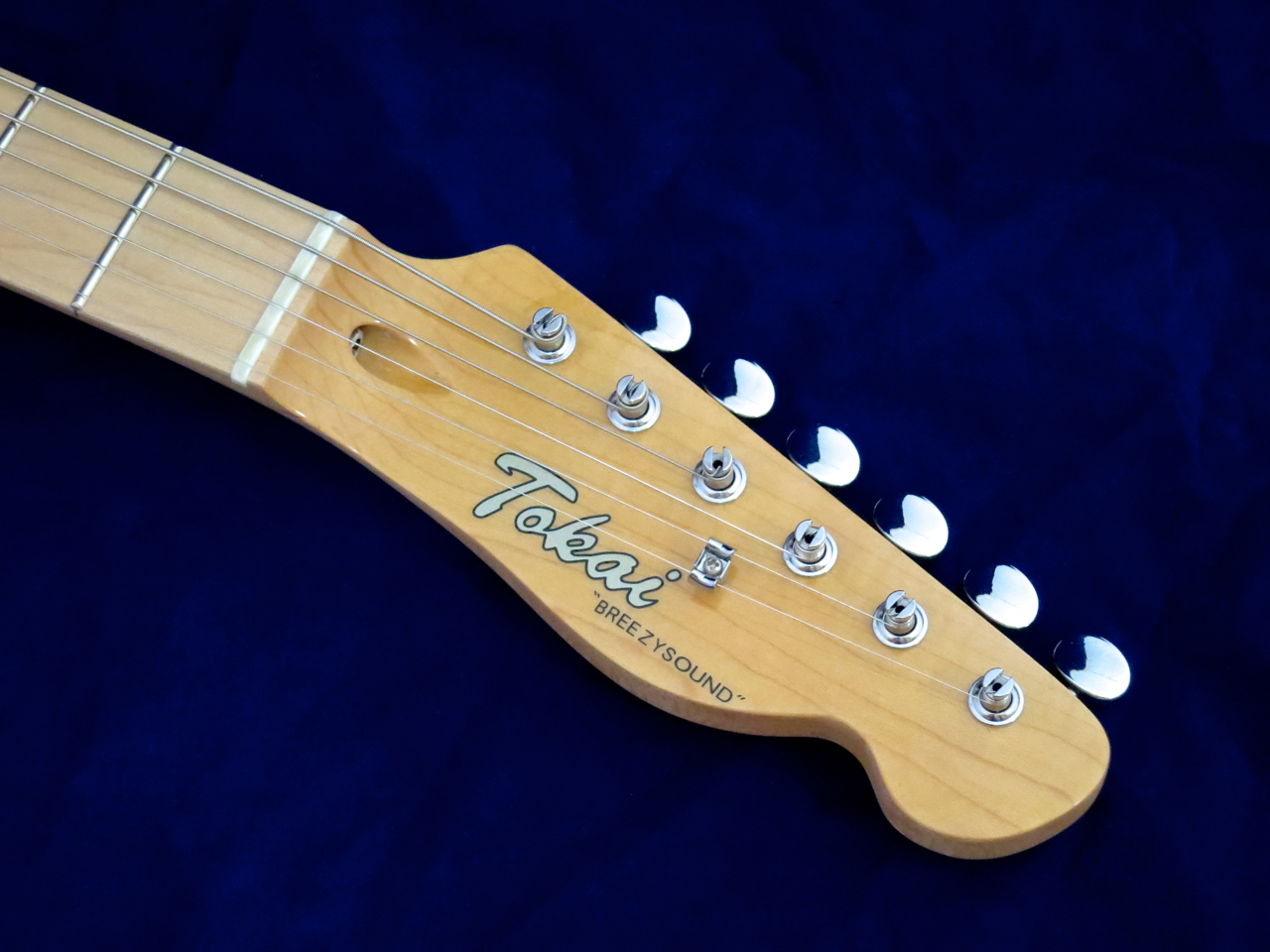
This Tokai is no slave to vintage fashion – truss rod adjustment is at the headstock end of the neck, which is a far more practical solution.

These nice Kluson-copies work fine.

The maple fingerboard has a larger radius (meaning it’s flatter) and fatter frets than its Sixties counterpart, making the ATE-33N easier to play. Especially string bending is far more comfortable with this type of neck.

The neck joint is a traditional four screw affair.

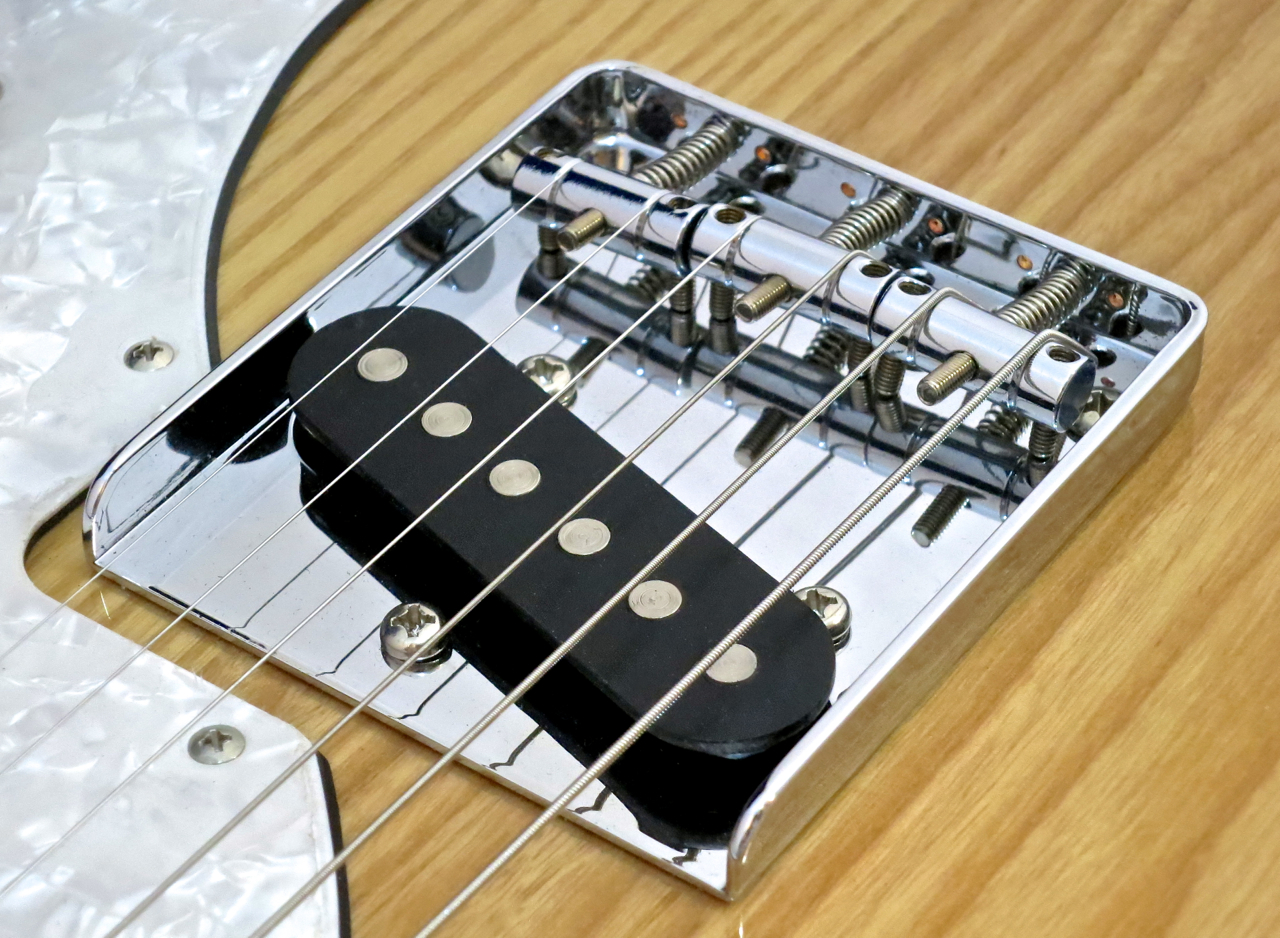
From a sonic standpoint, the traditional three-saddle, bent sheet-metal bridge that doubles as a pickup frame is probably a Tele-style guitar’s most important ingredient.
With these bridges octave compensation is always a matter of compromise, but most guitarists learn to live with the design’s limitations.

The ATE-33N Thinline is equipped with two singlecoil pickups that use soft steel slugs as polepieces and bar magnets stuck to the bottom of the bobbin.

Here’s a look at Tokai’s three-position switch and the guitar’s master volume and tone controls.
****

Now seems to be the perfect time to buy an electric guitar, judging by the sheer quality displayed by the very favourably priced Tokai ATE-33N Thinline.
The ATE-33N Thinline seems to tick all the right boxes with ease:
The satin-finished maple neck feels great. It’s rounded D-profile provides a sturdy fundament for tone and sustain, and it is comfortable to play, too. This model’s well-dressed frets and the fretboard’s flatter radius make a slinky set-up possible. Our test sample measured 1.4 mm for the low E and 1.2 mm for the high e (at the 12th fret), and it played well and without string rattles all across the neck.
Played acoustically you can clearly hear the open character of the hollowed out thinline body. Naturally, a T-style thinline won’t win a shouting match over a ES-335, but the hollowed out pockets do still make a discernible difference in this Tokai.
There’s lots of talk on guitar forums about the nastiness of many budget Tele-pickups, but I can only state that Tokai’s set of Mk3-pickups perform rather well. The neck pickup is war and round, but never muddy or one-dimensional. The bridge unit dishes out the Country twang with the right amount of bite and conviction. And the Tokai also nails my favourite Tele tone – the chimey middle setting with both pickups on. This means that changing the Tokai pickups for some aftermarket brand wouldn’t be my first priority, at least…
Here’s a taste of the ATE-33N Thinline’s clean tones, starting with the neck pickup and moving on from there:
And here’s a bit of Rock riffing:
****

In my opinion the Tokai ATE-33N Thinline scores high in the value-for-money stakes. It is a beautiful-looking instrument that plays very well indeed.
I have to admit having some reservations about the pickups before plugging in, but the sound of the Mk3-units has really won me over. This Tokai dishes out all the T-style tones we’ve come to expect from a traditionally styled and built example.
And should you decide to upgrade the pickups, regardless, the ATE-33N Thinline will prove to be a great starting point for any such ventures.
****
Tokai ATE-33N Thinline
437 €
Finnish distributor: Musamaailma
****
Pros:
+ outstanding value for money
+ workmanship and finishing
+ playability
+ sound
****


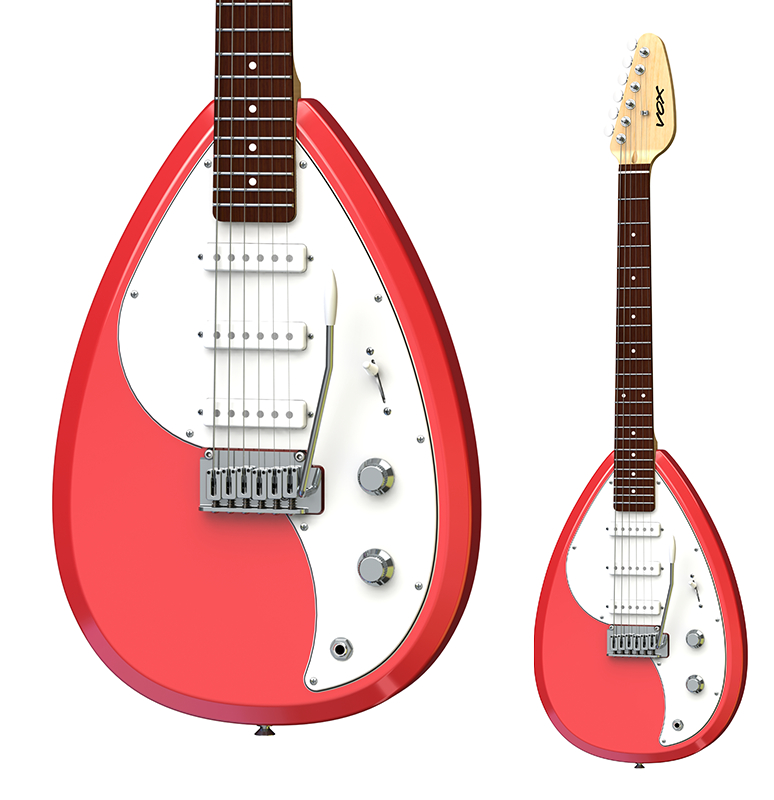

1960-luvun legendaariset Vox III– (aka Teardrop) ja Mark V -mallit (aka Phantom) ovat tulleet takaisin, uusina edullisina versioina.
Kitaroissa on ruuvikaula vaahterasta palisanteriotelaudalla, sekä lehmusrunko. Molemmat mallit ovat lyhytskaalaisia (61 cm), ja niissä on kolme yksikelaista mikrofonia ja moderni Strato-tyylinen vibratalla.
Kitaroiden lisäksi Vox tarjoaa nyt myös lyhytskaalaisia Mark III ja Mark V -bassoja.


****
Maahantuoja: EM Nordic
****
Saksalainen Duesenberg on valmistaja, joka on tunnettu laadukkaista kielisoittimista, joissa vintage-mainen tyylikkyys yhdistyy saumattomasti uusiin, kekseliäisiin ratkaisuihin yksityiskohdissa.
Duesenberg D-Bass on juuri tällainen soitin, sillä valmistajan mukaan bassosta saa irti sekä Presari- että Jazz-maisia soundeja firman passiivisella Mid-Shift-säätimellä.
****
Duesenberg D-Bass (1.729,90 €) on hyvä osoitus siitä, että hyväksi havaittuja perusaineksia voi yhdistellä tyylikkäästi kopioimatta muita soittimia.
Soitin on passiivinen nelikielinen basso, jolla on ruuvikaula vaahterasta ruusupuisella otelaudalla, sekä reunalistoitettu leppärunko kaarevalla etupuolella.
Rungon syvä viiste lisää D-Basson mukavuutta.
Soittimen runko viimeistellään kiiltävällä lakkauksella, kun taas kaulassa on ohut mattapintainen viimeistely.
Minun mielestäni Duesenbergin kolmiaskelmainen viritinlapa näyttää isona bassoversiona vielä paremmalta kuin firman kitaroissa.
D-Bassossa käytetään Duesenbergin omia, lukittavia Z-Tuner-virittimiä, joissa kieli ensin pujotetaan virittimen akselissa olevaan käytävään, ennen kuin kieli lukitaan paikoilleen.
Duesenbergin erittäin siisti nauhatyö viimeistellään PLEK-robotilla.
D-Basson 22. nauhaan pääsee vaivattomasti sulavan kaulaliitoksen ansiosta.
Duesenbergin messinkinen talla on erittäin lujaa tekoa.
Kielten korkeuden ja intonaation lisäksi voi säätää vapaasti myös kielten väliset etäisyydet. Säätämisen jälkeen tallapalat lukitaan paikoilleen kuusiokoloruuveilla.
D-Basson kaksiosainen mikrofoni on asennettu omaa ovaaliin pleksiin.
Duesenbergin Toaster-bassomikrofonin juju piilee siinä, että jokaisessa puoliskossa on kaksi kelaa. Tässä mallissa kytketään siis kaksi humbuckeria yhteen, kun taas vanhassa Presarissa käytetään kaksi yksikelaista puoliskoa, jotka vasta yhdessä muodostavat häiriöitä torjuvan yhdistelmän.
Duesenbergin passiivinen elektroniikka löytyy basson isommasta plektrasuojasta – master volume, Mid-Shift-säädin ja master tone.
Tässä Mid-Shiftin toimintaperiaate paljastuu:
Silloin kun Mid-Shift-säädin on täysin avattu, kummankin puoliskon molempia keloja käytetään soundin tuottamisessa, mutta signaalin diskanttia suodatetaan hieman kondesaattorilla. Tästä syntyy D-Basson Presari-tyylinen soundi.
Mitä enemmän säädintä käännetään vastapäivään, sitä enemmän kummankin mikrofonipuoliskon toisen kelan signaalista vaimennetaan potentiometrin omalla vastuksella, mutta samalla kondensaattorin vaikutus vähenee. Säätimen toisessa ääripäässä syntyy siis hieman kirkkaampi ja ohuempi J-tyylinen soundi.
Seymour Duncanin sivuilla löytyy samankaltainen kytkentä, jolla kitaran humbuckeria muutetaan portaattomasti humbuckerista yksikelaiseen kytkemällä toinen kela säätimen kautta maahan.
Duesenberg D-Bassoa myydään omassa kovassa laukussaan.
****
Duesenberg-basso on kaunis soitin mukavalla keskivertopainolla ja erinomaisella tasapainolla, sekä sylissä että hihnasta roikkuen.
Kaulaprofiiliksi on valittu hyvin Presari-mainen matala, mutta leveä ”D”. Soittotuntuma on kuitenkin hyvin nopea ja nykyaikainen, koska D-Basson palisanteriotelaudan kaarevuus on melko loiva, ja myös koska käytössä ovat jumbo-kokoiset nauhat.
Ainoa huomautukseni on kosmeettisesta seikasta: Näkisin kernaasti yksi tai kaksi ruuvia lisää säätimiä kantavassa pleksissä, jotta kolmikerroksinen muovi istuisi tiukemmin D-Basson kaarevaa runkoa vasten.
Duesenbergin akustinen soundi on erinomainen, eikä soittimesta löydy lainkaan monista vintage-bassoista tuttuja soundillisia ongelmakohtia (esimerkiksi ”yli-innokas” matala G tai nopeasti ”kuoleva” korkea c).
Vahvistettu soundi on loistava, jos ei haeta aktiivisoittimista tuttua äärimmäistä muokattavuutta. Mid-Shift-säädin toimii kiitettävästi, ja sen vaikutus on paljon orgaanisempi kuin raju päälle/pois-tyypistä kelojen kytkemistä. Koska kytkentä ainoastaan filtteroi ja vaimentaa osan signaalista, Mid-Shift-säätimen ääriasentojen välillä ei myöskään synny huomattavia eroja signaalitasossa, vaan ainoastaan äänen karakteri muuttuu hieman savuisemmasta P-basson soundista vähän kirkkaampaan J-tyyliseen sointiin.
Esimerkkipätkissä soitan aina saman kuvion kahdesti – ensin Mid-Shiftiä täysin avattuna (P) ja sen jälkeen säätimellä toisessa ääriasennossa (J).
****
Duesenberg D-Bass on mielestäni upea sähköbasso laadukasta passivisoundia etsiville. Soittimen Mid-Shift-toiminto on hienovarainen, mutta silti erittäin toimiva tapa räätälöidä Duesenbergin soundia itselleen sopivaksi.
****
Duesenberg D-Bass
1.729,90 €
Maahantuoja: F-Musiikki
****
Plussat:
+ työnjälki
+ Mid-Shift-säädin
+ soitettavuus
+ ulkonäkö
+ soundi
Miinukset:
– plektrasuojan kiinnitys (katso teksti)
****






 Kitarablogi.com – Finland's premier Guitar and Bass blog