In all clips the first half is recorded without the Spin X Cable, while the second half uses the Spin X in front of the sound card or amp.
++++
Mic + DI track (to check the delay between mic and DI):
• left channel – AKG C3000 close miking a Stratocaster
• right channel – Stratocaster DI’d via Focusrite Saffire 6 USB
++++
The signal chain used was:
Guitar –> 6 m Whirlwind Leader –> (Spin X Cable) –> Blackstar HT-1R –> 5 m Planet Waves Classic –> Focusrite Saffire 6 USB
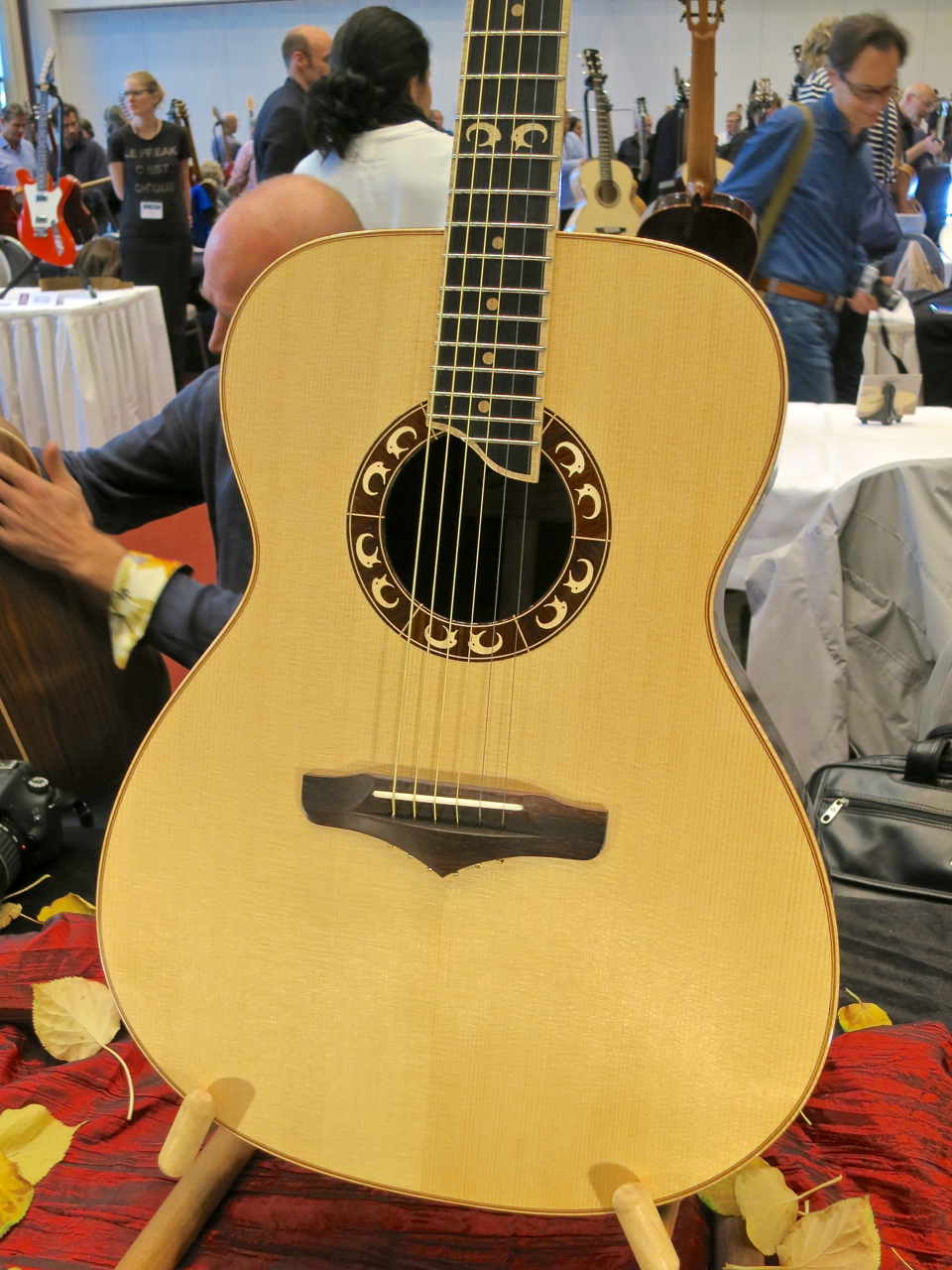
Parlour-kokoiset Lottoset löytyy nykyään jo monen soittajan arsenaalissa.
You should really try Lottonen’s parlour-sized acoustic guitars!
****
Juha Ruokankaan Ruokangas Guitars on nykyään jo käsite myös muualla maailmassa. Tämän Mojo-mallin kannessa on Juhan tyttären maalaus.
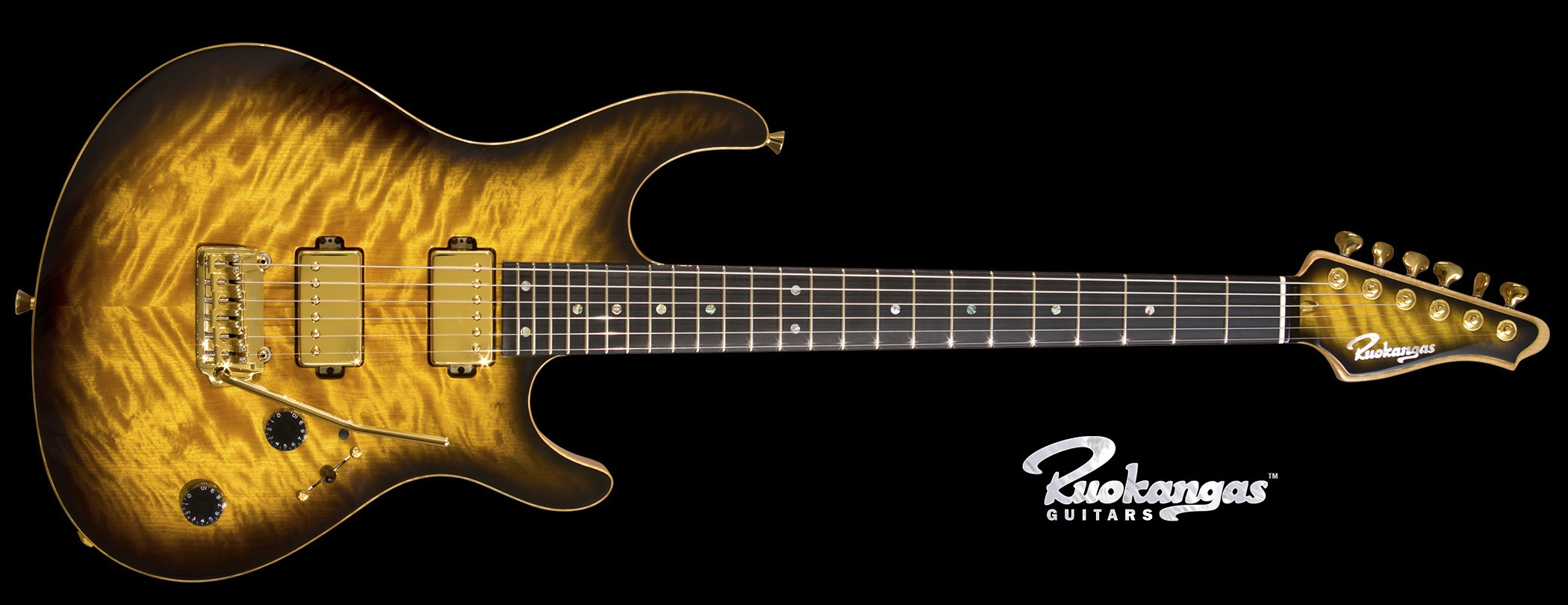
Juha Ruokangas’ company, Ruokangas Guitars, is already well-established in the field of boutique guitars. This Mojo-model comes with a top that was hand-painted by Juha’s daughter.
Uudessa Unicorn Supersonic-kitarassa on erikoisviimeistelty loimukoivukansi.
The brand-new Unicorn Supersonic comes with Ruokangas’ special Bare Bones finish.
Mr Fastfingerin luoja Mika Tyyskä saapuu Ruokangas-ständille.
Mika Tyyskä, Mr Fastfinger’s human alter ego, arrives at the Ruokangas stand.
• Handmade in Finland
• Chambered alder body
• Bolt-on maple neck
• Bound rosewood fingerboard
• 22 medium frets
• 24.75″/62.8 cm scale
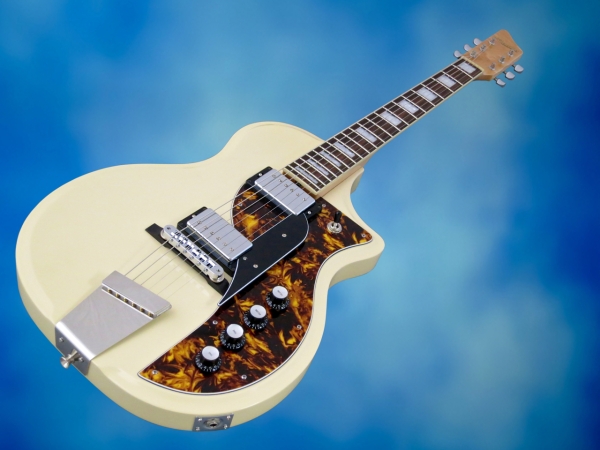
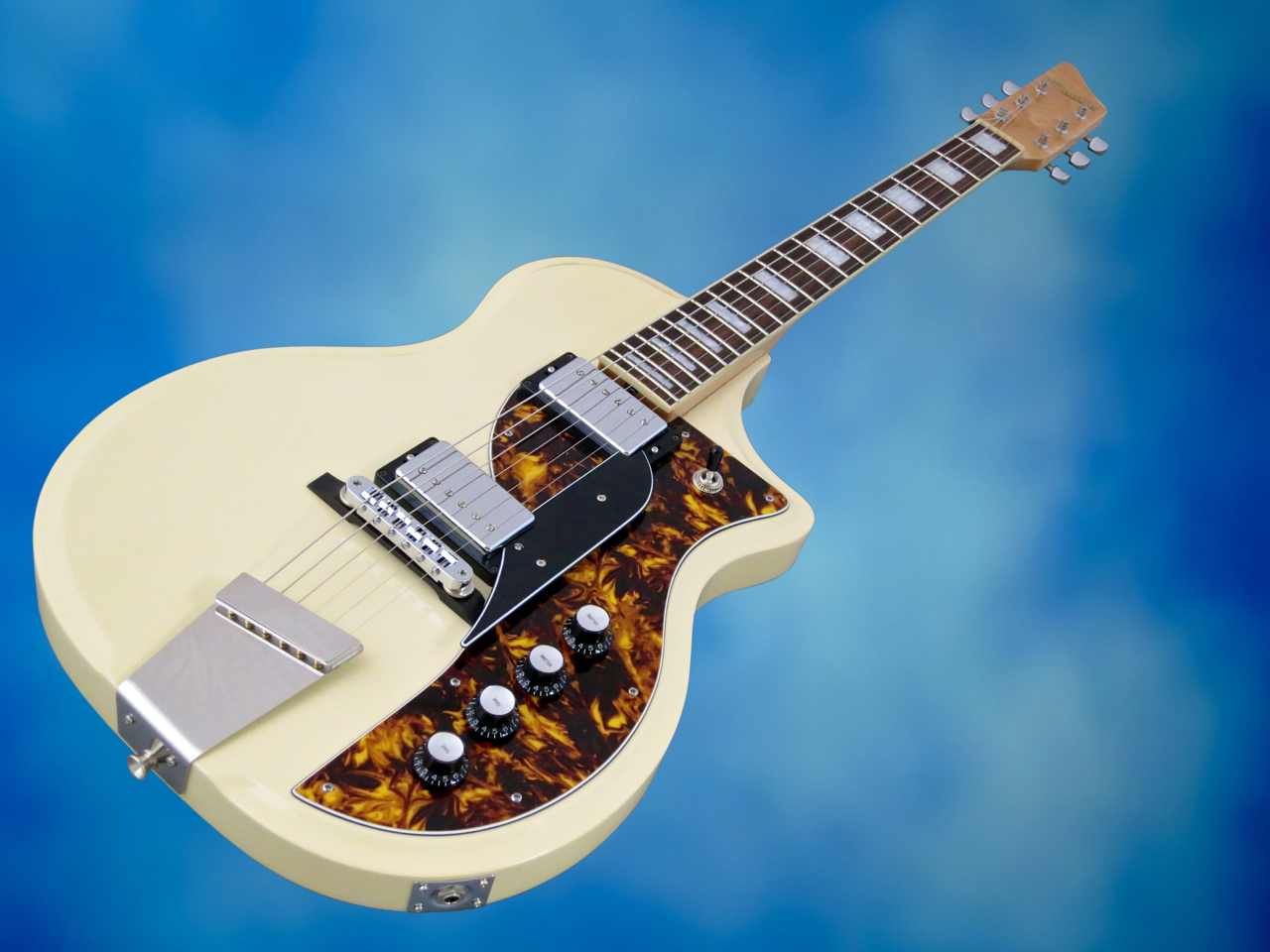
• Two Rautia Valco Style singlecoil pickups
• Two volume, two tone controls
• Push/pull switch in neck tone reverses neck PU’s phase
• Schaller Tune-o-matic with ebony base
• Gotoh Stealth tuners
• Guitarkits USA tailpiece
Ruokangas Guitars celebrate their 20th Anniversary by releasing two new models:
Unicorn Supersonic™
The Supersonic features a new unique Bare Bone™ finish by Ruokangas. Another new original feature are the Lock-Thru-Body™ bridge bushings, that make the guitar stronger (the wraparound bridge will not bend forward over time), and guarantee unparalleled energy transfer from the bridge into the body of the guitar.
Selling Price starting from: 3 700 €
Supersonic as pictured: 3 950 € (varies depending on options)
****
Aeon™ Classic/Deluxe/Artist
The Aeon comes in three versions – the Classic with a thermo-treated alder body and bolt-on neck – the Deluxe with a spanish cedar body, an arctic birch top and a bolt-on neck – and the Artist with a spanish cedar body, an arctic birch top and neck-thru-construction. As always with Ruokangas, you have a truckload of options for customizing the guitar to fit your style. The word ‘Aeon’ is latin, and means ‘infinity’.
Selling Price starting from: 3 200 €
Aeon Artist as pictured: 8 000 € (varies depending on options)
Thirty years ago a young, bespectacled man introduced the guitar-playing world to the first guitar model from his new company at the NAMM Show. The company from Maryland was only a small start-up, but their beautiful new electric guitar already started to attract a good deal of attention.
This young man was none other than Paul Reed Smith, the company PRS Guitars, and their first model the now-legendary Custom 24.
Before founding PRS Guitars, Smith had already managed to sell several of his handmade guitars to well-known guitarists, such as Howard Leese and Carlos Santana. Smith’s early guitars were clearly grounded in Gibson-tradition, successfully blending classic Les Paul Standard visuals with the more practical double-cut design of late 1950s Les Paul Specials. Carlos Santana’s signature PRS is based on these early (pre-PRS) guitars.
Nonetheless, Paul Reed Smith wasn’t content with high-class ”copying”. He wanted to come up with the ultimate electric guitar, both in terms of playability and sounds. What he came up with was a guitar that successfully bridges the gap between Fender and Gibson electrics, without copying any of their classic models.
The first step on Paul Reed Smith’s ongoing quest for excellence was the PRS Custom 24, introduced at NAMM in 1985.
This guitar set PRS’ wheels a-rollin’, and the company has come a long way from its humble beginnings. These days people talk about the ”Big Three” manufacturers of electric guitars – meaning Fender, Gibson and PRS.
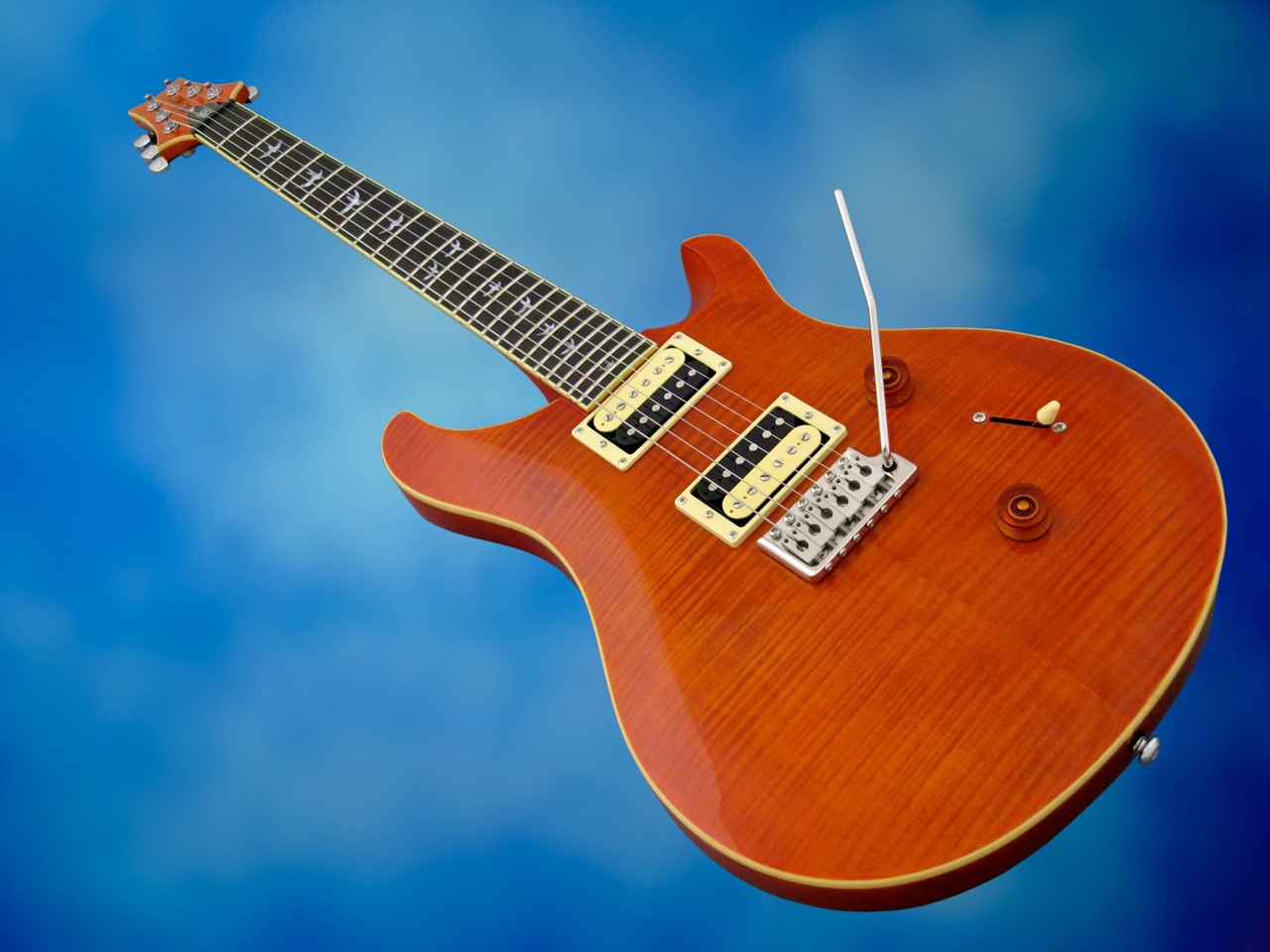
The PRS SE 30th Anniversary Custom 24 (current price in Finland approx. 1,000 €) is the most-affordable of the anniversary models, but it still is a great-looking guitar.
It has PRS Guitars’ typical scale length of 25-inches (63.5 cm), which is longer than Gibson’s, but shorter than Fender’s typically used scale lengths.
The back of the body is made from mahogany, while the curved top is crafted from maple. To spruce up the looks of the SE 30th Anniversary, a thin flame maple veneer is glued onto the (plain) maple top. The top is bound with cream-coloured plastic.
On current SE Custom 24 guitars the neck is made from maple – in contrast to the mahogany necks on US-produced Customs. The change was made recently for both tonal and ecological reasons. The SE’s set neck is glued together from three long strips of maple, with two small pieces added to get the headstock to its full width.
The nut is made from PRS’ special graphite-impregnated, hard plastic.
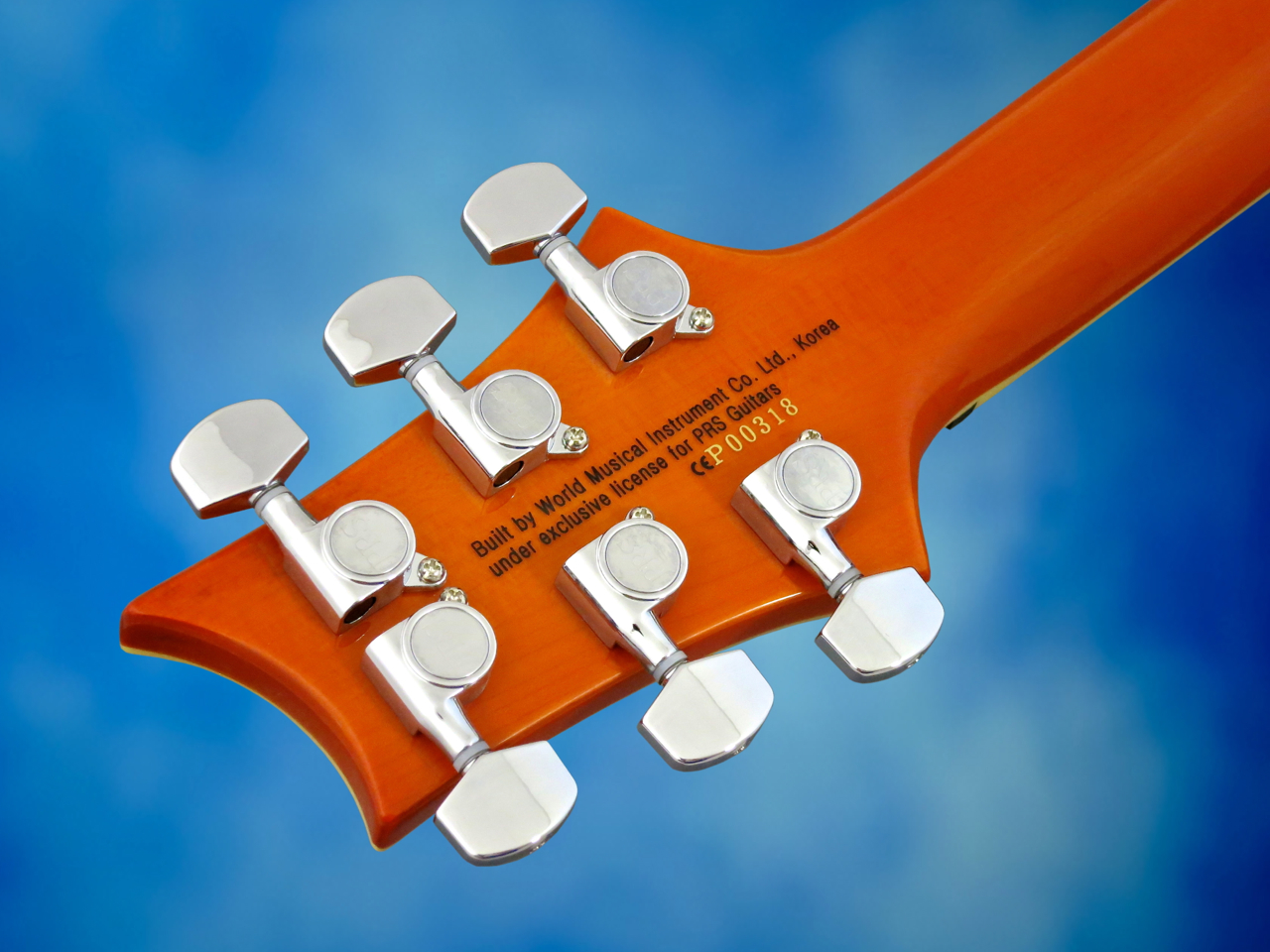
The 30th Anniversary SE Custom 24 sports a set of very decent, non-locking Schaller-copies.
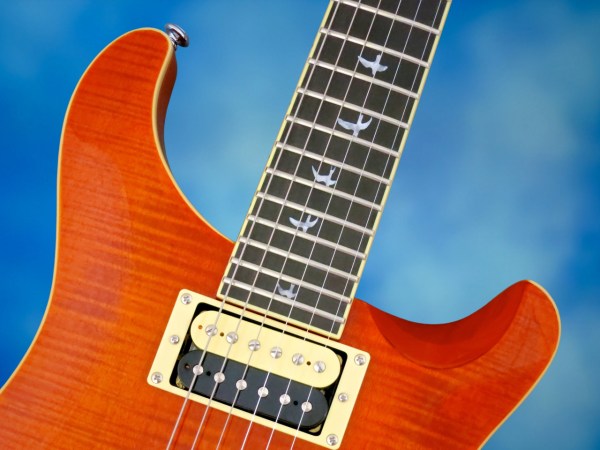
PRS have come up with a variation of their bird-inlays for the anniversary models, which sees the birds flying in a gracefully curved line across the fingerboard.
The bound rosewood fingerboard is home to 24 medium-jumbo frets. The fretjob is excellent.
The bevelled treble side cutaway has become something of a trademark for PRS guitars.
If you click on the picture for a better view, you will be able to see clearly the demarcation lines between the mahogany back, the maple top, and the flame maple veneer.
Thirty years ago locking vibratos (Floyd Rose, Kahler, Rockinger) were highly fashionable, but Paul Reed Smith wasn’t too keen on them. In his view locking systems changed a guitar’s sound in a negative way, and he felt they were too cumbersome when it came to changing strings.
Smith came up with a highly-improved take on the classic Stratocaster vibrato – a chunky piece of beauty, milled from solid brass.
The SE 30th Anniversary Custom uses a high-quality version of the original design.
In the Eighties guitarists favoured hot bridge humbuckers, because they made achieving a creamy distortion sound much easier.
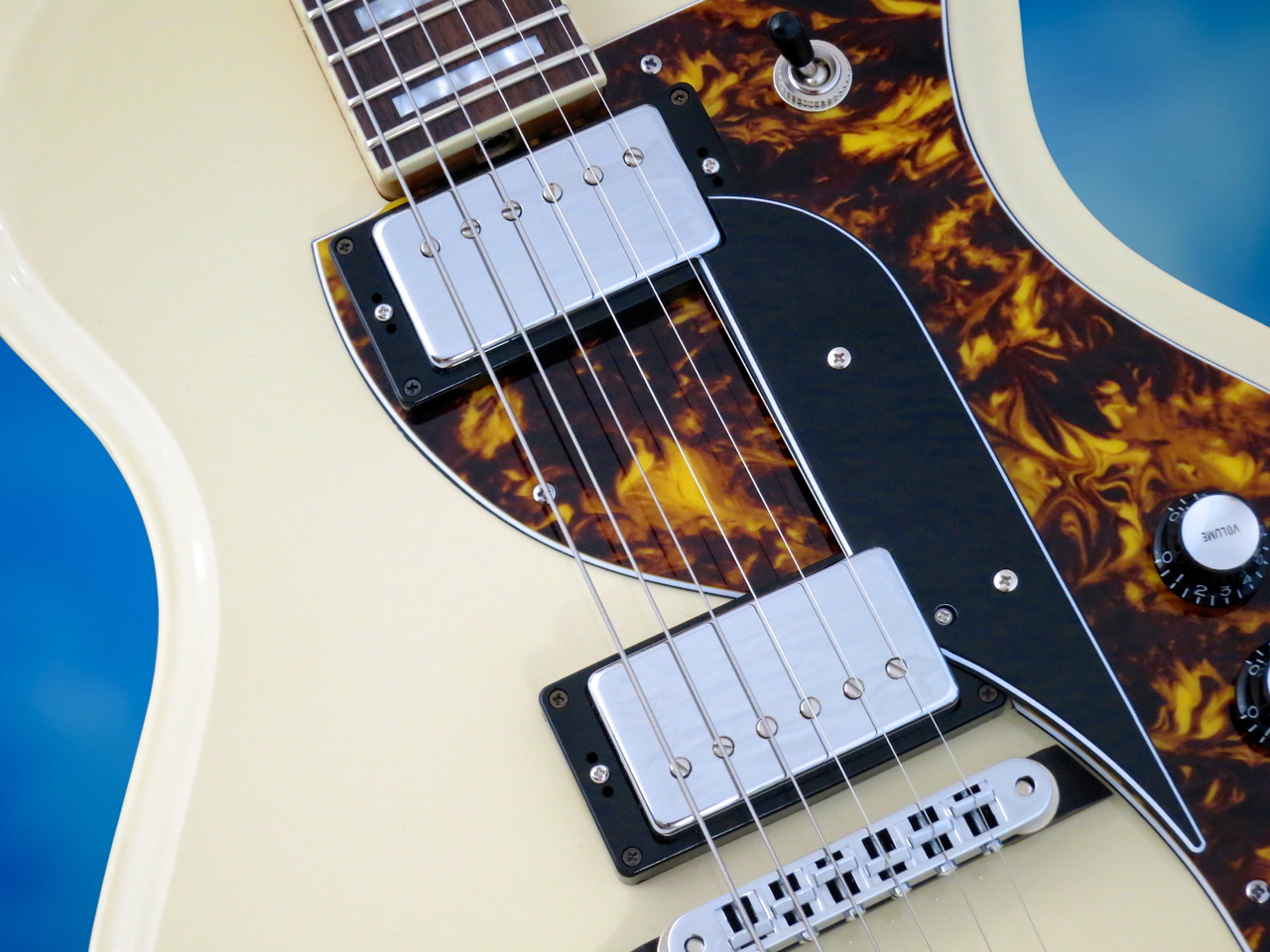
This Anniversary-Custom brings this concept back by combining a medium-output neck humbucker – the Vintage Bass – with the SE-version of the high-output HFS Treble (HFS = hot fat screams).
In the beginning, original PRS Custom 24 models came with two ”controls” and a mini-toggle switch. Actually, the second ”control” was a five-way rotary switch that served as the guitar’s pickup selector. The tiny switch was PRS’ Sweet Switch, a preset treble roll-off.
Over the years, the rotary switch fell out of favour, and the control setup on US-made guitars changed to master volume, master tone, and a five-way blade switch.
On the SE Custom 24 the blade switch is a three-way model, while a push/pull switch in the tone control allows you to split both humbuckers.
A well-made gig bag is included with the SE Custom 24 30th Anniversary model.
****
PRS guitars are known for their well though-out ergonomics and their great playability, and the SE Custom 24 30th Anniversary proves to be a genuine PRS in this respect, too. It has a comfortable medium weight, and feel nice both in your lap and strapped on.
In keeping with the 1980s theme, the SE comes with a Wide Thin neck profile. Despite its name, though, you needn’t be afraid that this Custom 24 comes with an insubstantial Ibanez Wizard. I’d describe the Wide Thin profile as distinctly oval with a medium thickness, so there’s still more than enough wood left for good tone and sustain.
The review guitar came with a comfortably low setup (low-E: 1.9 mm/high-e: 1.6 mm) without any buzzes, thanks to the great fret job.
I know that it’s a thing of personal preference, but I’d like to see a PRS strung up with a set of 010-gauge strings, instead of the factory set of 009s. The factory set feels almost too ”slinky”and effortless, making it hard to really dig into the strings.
The PRS-vibrato is one of the best updates of the vintage vibrato you’re likely to encouter, and it works like a dream on the SE Custom 24, too. The feel is smooth, creamy and precise, but isn’t as sensitive to heavy-handed playing or string bending as a Floyd Rose, despite the floating setup.
Paul Reed Smith has also proven he know’s how to voice pickups. Naturally, these Korean pickups aren’t quite in the same league as their American counterparts, but these are still very decent pickups.
On paper, pairing a Vintage Bass with a HFS Treble humbucker sounds like a recipe for a slightly schizophrenic sound, when, actually, these pickups work very well together. The jump in output levels isn’t as acute as you might think. The difference between the Vintage Bass and the HFS Treble comes over clearest in the way the latter focusses heavily on the mid-range frequencies.
The sound clips both start with the coil-split on, before moving on to the full humbucker sound. The sequence is always neck pickup –> both pickups –> bridge pickup:
The rhythm guitars on the demo track use the coil-split (left channel: neck PU; right channel: both PUs), while the lead guitar starts with the full neck humbucker, before switching to the full bridge humbucker at 0’49”:
****
No wonder that PRS Guitars’ SE-range is so popular:
The SE Custom 24 30th Anniversary gives you the genuine ”PRS experience” at a truly fair price. This is a pro-level electric guitar that plays very well and offers you a wide variety oif different sounds.
Kolmekymmentä vuotta sitten nuori, rillipäinen mies esitteli hänen pikkufirmansa ensimmäisen kitaramallin yhdysvaltalaisilla NAMM-messuilla. Marylandilaisessa yrityksessä työskenteli silloin vain puoli tusina kitaranrakentajaa, mutta firman tyylikäs kitara, jossa oli selvästi klassikon ainekset, kyllä huomioitiin jo silloin.
Tämä nuori mies oli tietysti Paul Reed Smith, hänen firmansa PRS Guitars, ja se ensimmäinen kitaramalli firman legendaarinen Custom 24.
Ennen PRS Guitarsin perustamista, Smith oli jo onnistunut myymään muutamia varhaisia, pikkuverstaassa rakennettuja, kitaroitaan nimekkäille kitaristeille, kuten Howard Leeselle ja Carlos Santanalle. Nämä kitarat olivat pitkälti Gibson-tyylisiä kitaroita, joissa yhdistettiin Les Paul Standardin prameutta kahdella soololovella varustetun Les Paul Specialin käytännöllisyyteen. Carlos Santanan nimikkomalli on yhä samalla tavalla rakennettu.
Paul Reed Smithissä oli kuitenkin selvästi keksijän ja kehittäjän ”vika”, koska korkean tason ”kopiointi” ei riittänyt hänelle. Smith halusi kehittää ultimatiivisen sähkökitaran, joka kulkisi sekä soitettavuuden että soundin ja ulkonäön kannoilta kultaista keskitietä Fender- ja Gibson-maailmojen välissä.
Kehitystyön ensimmäinen tulos oli PRS Guitarsin ensimmäinen kitaramalli – juuri se 1985:n NAMMissa esitelty Custom 24.
Tästä kitarasta alkoi PRS:n voittokulku ja kasvutarina. Nykyään puhutaan USA:ssa ”kahden ison” sijasta ”kolmesta isosta” sähkökitaroiden valmistajista – Fender, Gibson ja PRS.
PRS SE 30th Anniversary Custom 24 (katuhinta noin 1.000 €) on juhlamalleista edullisin, mutta sitä huolimatta erittäin kaunis soitin.
PRS Guitarsille tyypillinen on kitaran 25-tuumainen (63,5 cm) mensuuri, joka on pidempi kuin Gibsonin, mutta lyhyempi kuin Fenderin yleensä käyttämä mensuuri.
Rungon takaosa on tehty mahongista, kun taas sen kaareva kansi on vaahteraa. Vaahterakannen koristeeksi on lisätty ohut loimuvaahteraviilu, ja koko komeus on reunalistoitettu kermanvaalealla muovilla.
Nykyisissä SE Custom 24 -malleissa on – USA-tuotannosta poiketen – kolmesta pitkästä vaahterapalasta veistetty liimakaula mahongin sijaan. Muutos tehtiin sekä soinnillisista että ekologisista syistä muutama vuosi sitten.
SE-juhlamallissa käytetään PRS Guitarsin erittäin kovasta materiaalista tehty, itsevoitelevaa yläsatulaa.
Virittimet ovat laadukkaita, korealaisia Schaller-kopioita. Kyseessä on perinteiset, ei-lukittavat mallit.
30-vuotis juhlamalleissa käytetään uusia lintukuvioisia otemerkkejä, jossa lintujen lentoreitti otelaudassa on hienosti kaareva.
Reunalistoitetuun, ruusupuiseen otelautaan on asennettu 24 medium jumbo -kokoista nauhaa. Nauhatyö oli testisoittimessa erittäin hyvä.
Viistoitetusta diskanttipuolen soololovesta on tullut yksi PRS:n tunnusmerkeistä.
Kun klikkaat tätä kuvaa suuremmaksi, näet selvästi rungon rakenteen – mahongin, vaahteran, sekä loimuvaahteraviilun.
Kolmekymmentä vuotta sitten lukittavat vibratallat (Floyd Rose, Kahler, Rockinger) olivat erittäin suosittuja. Paul Reed Smithin mielestä ne olivat kuitenkin pahoja soundisyöppöjä, eikä hän myöskään pitänyt siitä, että ne tekivät kieltenvaihdosta niin hankalan.
Smith kehitti oman vibratonsa alkuperäisen Stratocaster-tallan perusteella, mutta käytti Fenderistä poiketen selvästi massiivisempia osia messingistä.
SE 30th Anniversary Customissa käytetään erittäin laadukasta versiota alkuperäisestä.
1980-luvulla kitaristit halusivat tuhteja tallamikrofoneja kermaisen särösoundin perusteeksi.
Juhla-Custom palaa takaisin siihen aikaan yhdistämällä vintage-tyylistä SE Vintage Bass -kaulamikrofonia kuumaan SE HFS Treble -tallaumbuckeriin (HFS on muuten lyhenne sanoista ”hot fat screams”, siis: ”kuumia paksuja kirkaisuja”).
Alkuperäisissä Custom 24 –malleissa on kaksi ”säädintä”, sekä yksi pikkukytkin. Toinen säädin oli todellisuudessa kiertokytkin, joka toimi mikrofonivalitsimena. Tone-säätimen sijaan näissä kitaroissa käytettiin sitä minikokoista vipukytkintä, PRS:n ns. Sweet Switch, jolla saatiin diskantit vaimennettua.
Kiertokytkin kuitenkin osoittautui ajan myötä epäsuosituksi, minkä takia säädinosastoa muutettiin perinteisemmäksi – master volume, master tone, sekä kolmiasentoinen vipukytkin. Tone-potikassa on nostokytkin, jolla voi puolittaa kitaran humbuckereita.
Laadukas topattu pussi kuuluu SE Custom 24:n hintaan.
****
PRS-kitarat ovat tunnettuja niiden hyvästä ergonomiasta ja soitettavuudesta, ja SE 30th Anniversary Custom 24 on myös tässä suhteessa aito PRS. Kitara ei ole liialla painolla pilattu, ja se istuu erittäin mukavasti sylissä, sekä roikkuu rauhallisesti hihnassa.
80-luvun henkisesti kaulaprofiiliksi on valittu firman Wide Thin -profiili. Nimestä huolimatta kyse ei ole olemattoman ohuesta Ibanez Wizard -kaulasta, vaan tässä on vielä mukavasti puuta jäljellä. Itse kuvailisin Wide Thin -profiilia leveäksi ovaaliksi, joka on todella hyvä kompromissi pyöreän vintage-kaulan ja laakean ”vauhtikaulan” välillä.
Testisoittimen nauhatyö oli erinomainen ja soittotatsi oli säädetty mukavan matalaksi (ala-E: 1,9 mm/ylä-e: 1,6 mm) ilman ylimääräistä kielten räminää.
Tämä on tietysti täysin subjektiivista, mutta itse toivoisin tällaisessa kitarassa 010-paksuista kielisatsia. Tehdaskielten (009-satsi) kanssa soitettavuus oli jo lähes liian vaivatonta ja kevyttä.
PRS:n vibratalla on mielestäni yksi parhaimmista vintage-vibraton päivityksistä, ja systeemi toimii moitteettomasti myös Custom 24 -juhlamallissa. PRS SE:n vibra toimii pehmeästi ja tarkasti, mutta se ei ole läheskään niin herkkä raskaalle plektrakädelle tai kielten venytyksille kuin esimerkiksi Floyd Rose talla.
Paul Reed Smithillä on aina ollut myös todella tarkka korva mikrofonien suhteen. Vaikka SE-juhlamallin mikrofonit ei luonnollisesti yllä ihan samalle huipputasolle kuin PRS:n USA-mikrofonit, on niiden soundi kuitenkin erittäin kiitettävällä tasolla.
Vaikka Vintage Bass- ja HFS Treble -mikrofonien yhdistelmä näyttää paperilla hieman kaksijakoiselta, toimi mikkien yhteistyö käytännössä loistavasti. Ero näiden humbuckereiden luonteissa huomaa vähemmän signaalitasosta kuin siitä, että tallahumbuckerin soundi fokusoituu selvästi keskitajuuksille.
Näissä esimerkkipätkissä aloitetaan ensin puolitetuista vaihtoehdoista, ennen kun mennään täysille humbuckereille. Järjestys on aina kaulamikki –> molemmat –> tallamikki:
Demobiisin komppikitarat käyttävät puolitettuja mikrofoneja (vasen kanava: kaulamikki; oikea kanava: molemmat mikit yhdessä), kun taas soolokitara aloittaa täydellä kaulahumbuckerilla, ennen kun se vaihtuu täyteen tallamikkiin (noin 0:49 kohdalla):
****
Ei ole ihme, että PRS Guitarsin SE-mallisto on näin suosittu:
Tästä SE Custom 24 30-vuotis juhlamallista saa täydellisen ”PRS-kokemuksen” todella reiluun hintaan. Kyseessä on ammattitason sähkökitara loistavalla soitettavuudella ja monipuolisella soundilla.
****
PRS SE Custom 24 30th Anniversary
katuhinta noin 1.000 € (topattu pussi kuuluu hintaan)

















 Kitarablogi.com – Finland's premier Guitar and Bass blog