
Testi tulossa…
A review is in the works…
Kitarablogi.com – Finland's premier Guitar and Bass blog
Juttuja kitaroista ja bassoista

Testi tulossa…
A review is in the works…


The Holy Grail Guitar Show 2015 pidettiin Berliinissä 31.10. ja 01.11.2015.
The Holy Grail Guitar Show 2015 was held on the 31st of October and the 1st of November 2015 in Berlin (Germany).
****
Suomi oli – jälleen kerran – todella hyvin edustettu:
Finland was – once again – very well represented:

Ari-Jukka Luomuranta (AJL-Guitars) ja hänen erikoismallinsa, Model Gypsy Fire, jolla on iso soikea ääniaukko ja tummanpunainen viimeistely.
Gypsy Jazz specialist Ari-Jukka Luomuranta (AJL-Guitars) with his special large-holed Favino-type Model Gypsy Fire in burgundy red.
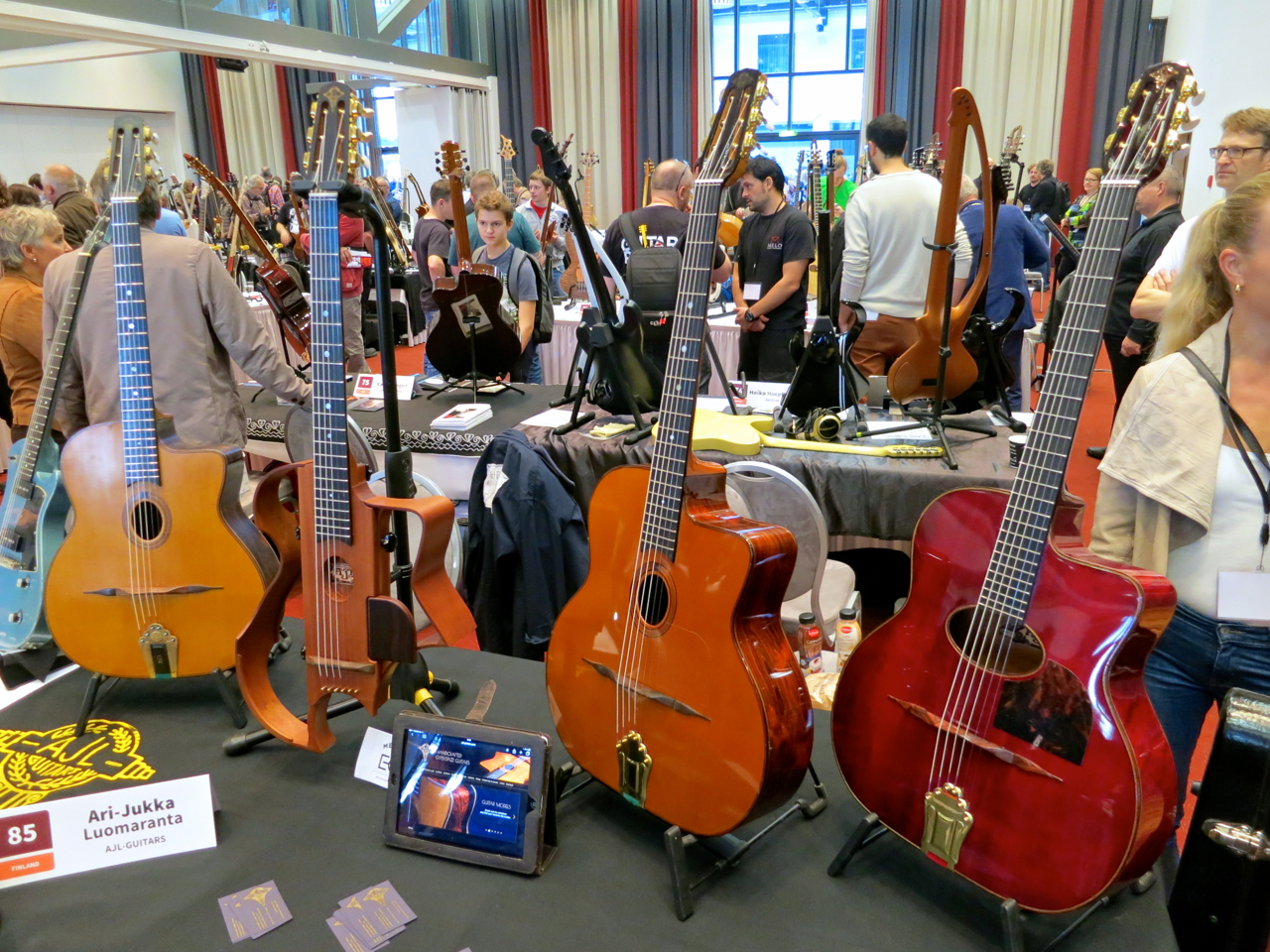
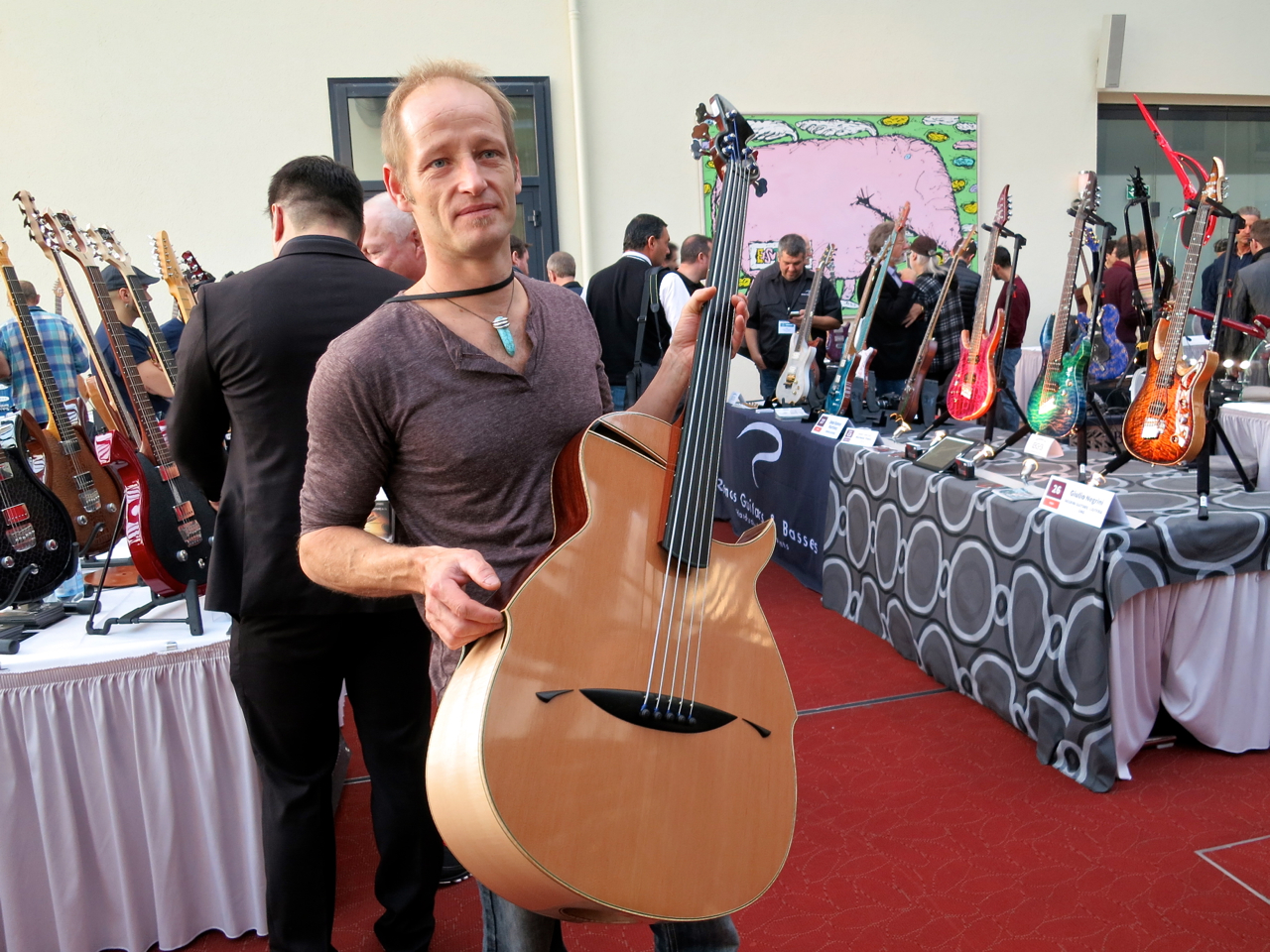
AJL-Guitarsista saa nyt myös firman ainutlaatuista Quiet & Portable -matkakitaraa.
To our knowledge, AJL-Guitars’ Quiet & Portable travel Gypsy guitar is a world first.
****
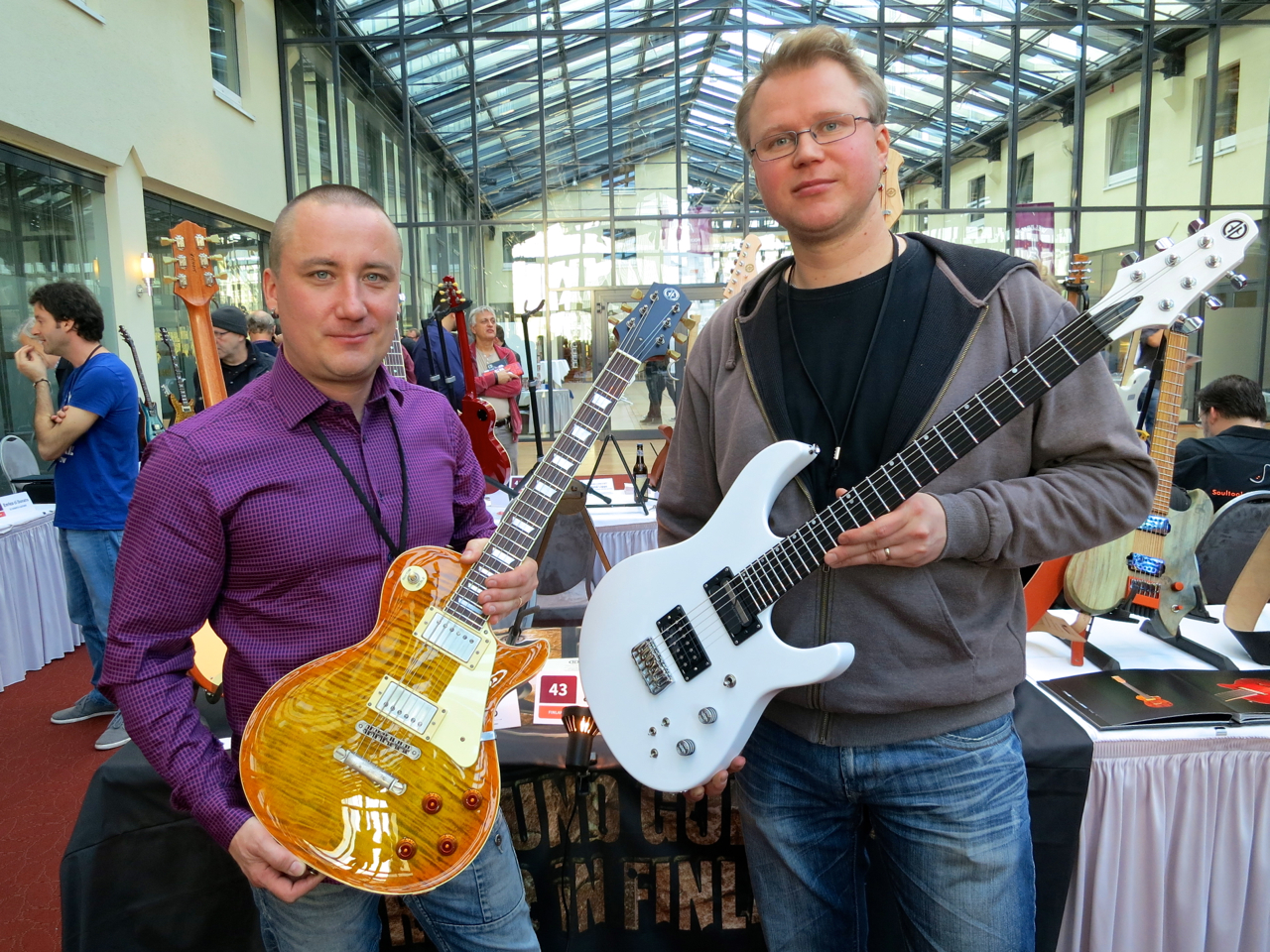
Amfisoundin Sampo Leppävuori (vas) ja Tomi Korkalainen (oik).
Sampo Leppävuori (l) and Tomi Korkalainen (r) from Amfisound Guitars.

Amfisoundin uudistettut Halti-mallit saa nyt uudenlaisella Set-Lock-kaulaliitoksella, joka helpottaa huomattavasti pääsyn ylimmille nauhoille.
Their updated Halti-models are now made with Amfisound’s Set-Lock neck joint, which makes it easy to reach the neck’s dusty end.
****

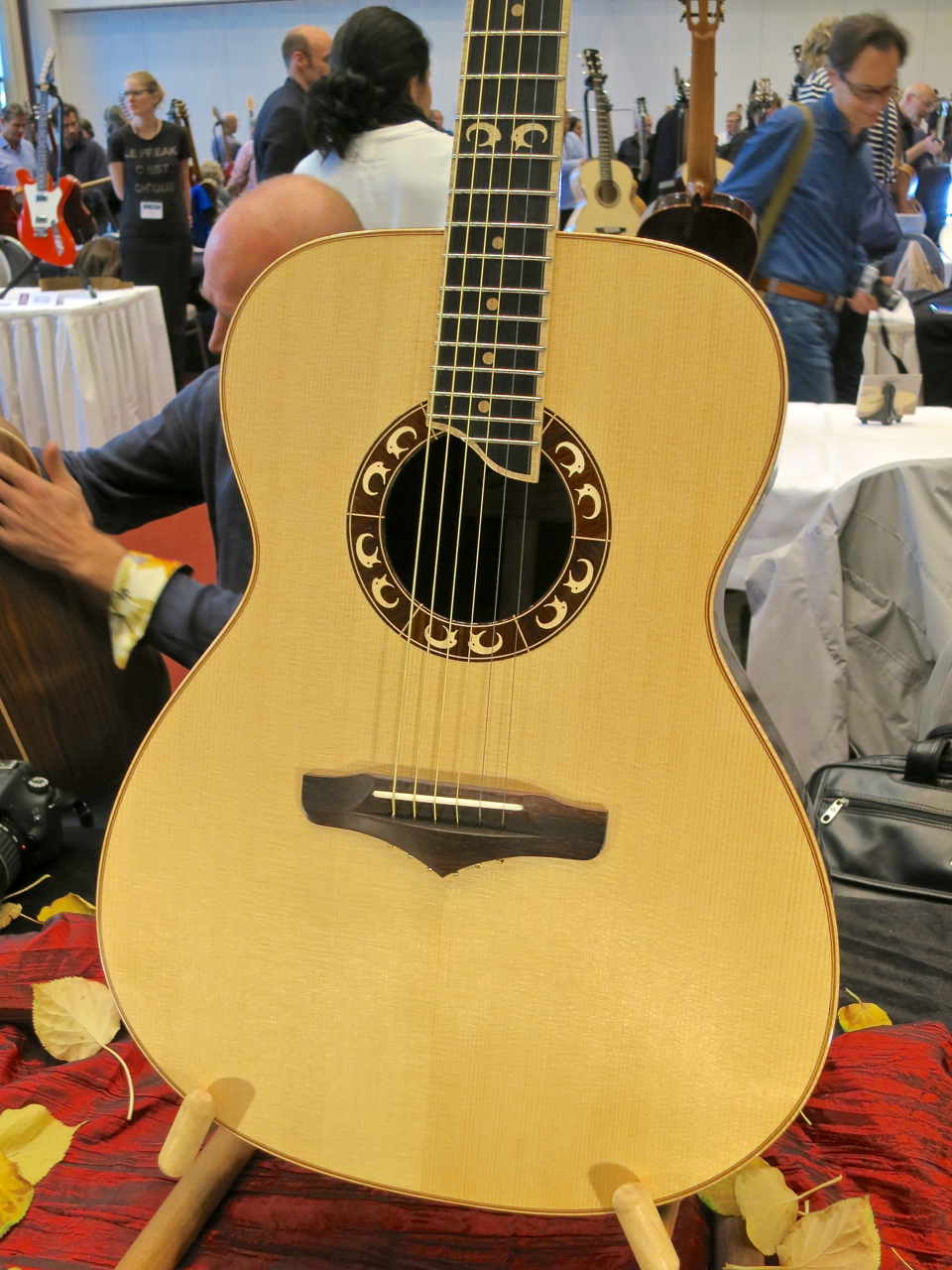
A-P Paasosen Soitinpaja Jasesoi esitteli Holy Grail -messuilla uudet akustiset mallinsa, jossa kaulaliitos on 13. nauhan (!) kohdalla.
A-P Paasonen’s company Jasesoi introduced their new steel-string model with a neck joint at the 13th (!) fret.

Kuvankaunis!
What a beauty!
****

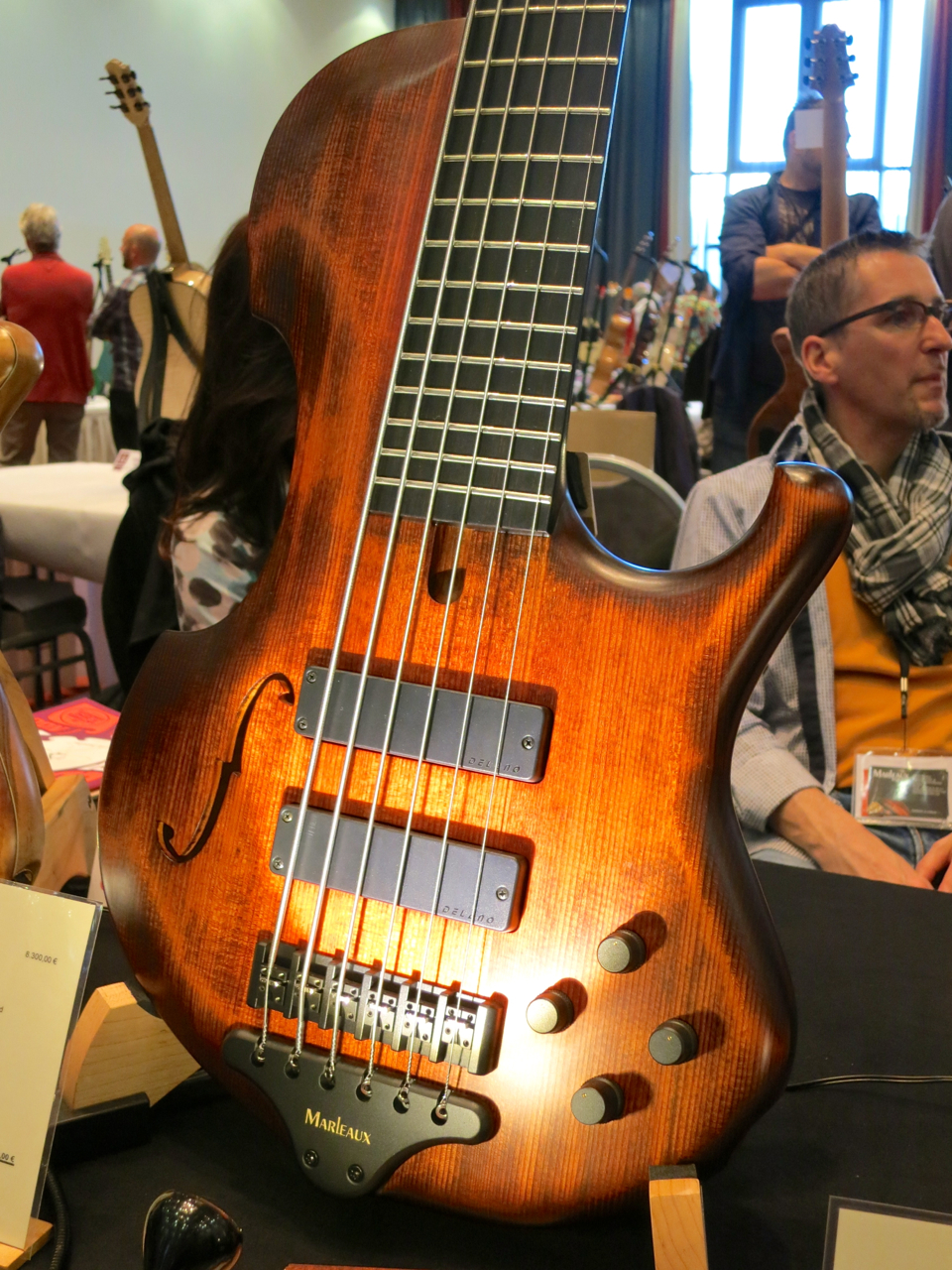
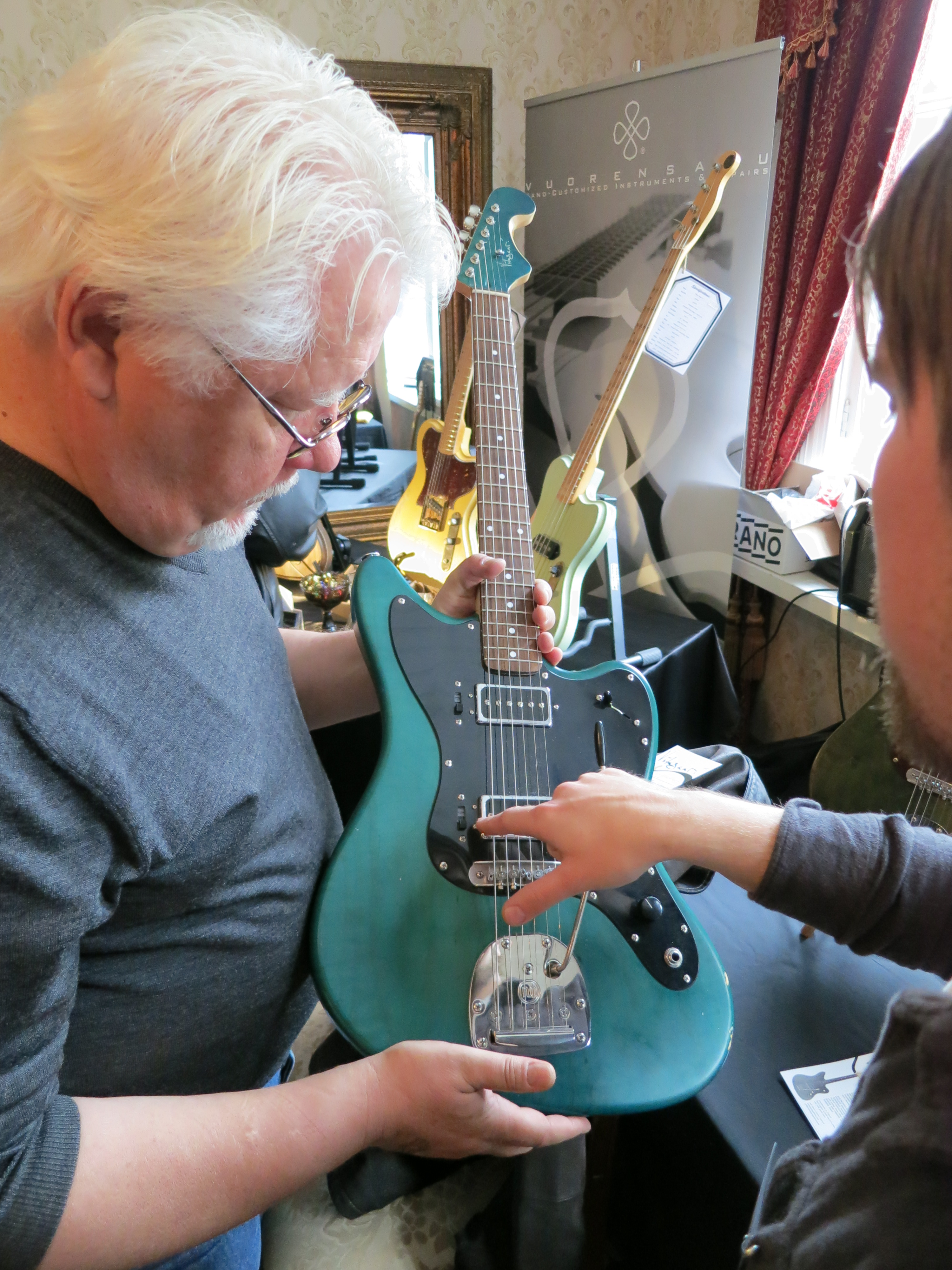
Anders Liljeströmin (vas) uusi, kevyesti vanhennettu malli kiinnosti sekä messuvieraat että muut soitinrakentajat.
Anders Liljeström’s (l) new aged-look guitar was met with a lot of interest, both from players as well as colleagues.

Tässä Anders on kokeilemassa uutta Jasesoi-mallia.
Anders even found time to check out Jasesoi’s new model.
****

Lottonen Guitarsin Juha Rinne (vas) ja Juha Lottonen (oik).
Juha Rinne (l) and Juha Lottonen (r) of Lottonen Guitars.

Parlour-kokoiset Lottoset löytyy nykyään jo monen soittajan arsenaalissa.
You should really try Lottonen’s parlour-sized acoustic guitars!
****

Juha Ruokankaan Ruokangas Guitars on nykyään jo käsite myös muualla maailmassa. Tämän Mojo-mallin kannessa on Juhan tyttären maalaus.
Juha Ruokangas’ company, Ruokangas Guitars, is already well-established in the field of boutique guitars. This Mojo-model comes with a top that was hand-painted by Juha’s daughter.

Uudessa Unicorn Supersonic-kitarassa on erikoisviimeistelty loimukoivukansi.
The brand-new Unicorn Supersonic comes with Ruokangas’ special Bare Bones finish.

Mr Fastfingerin luoja Mika Tyyskä saapuu Ruokangas-ständille.
Mika Tyyskä, Mr Fastfinger’s human alter ego, arrives at the Ruokangas stand.
****
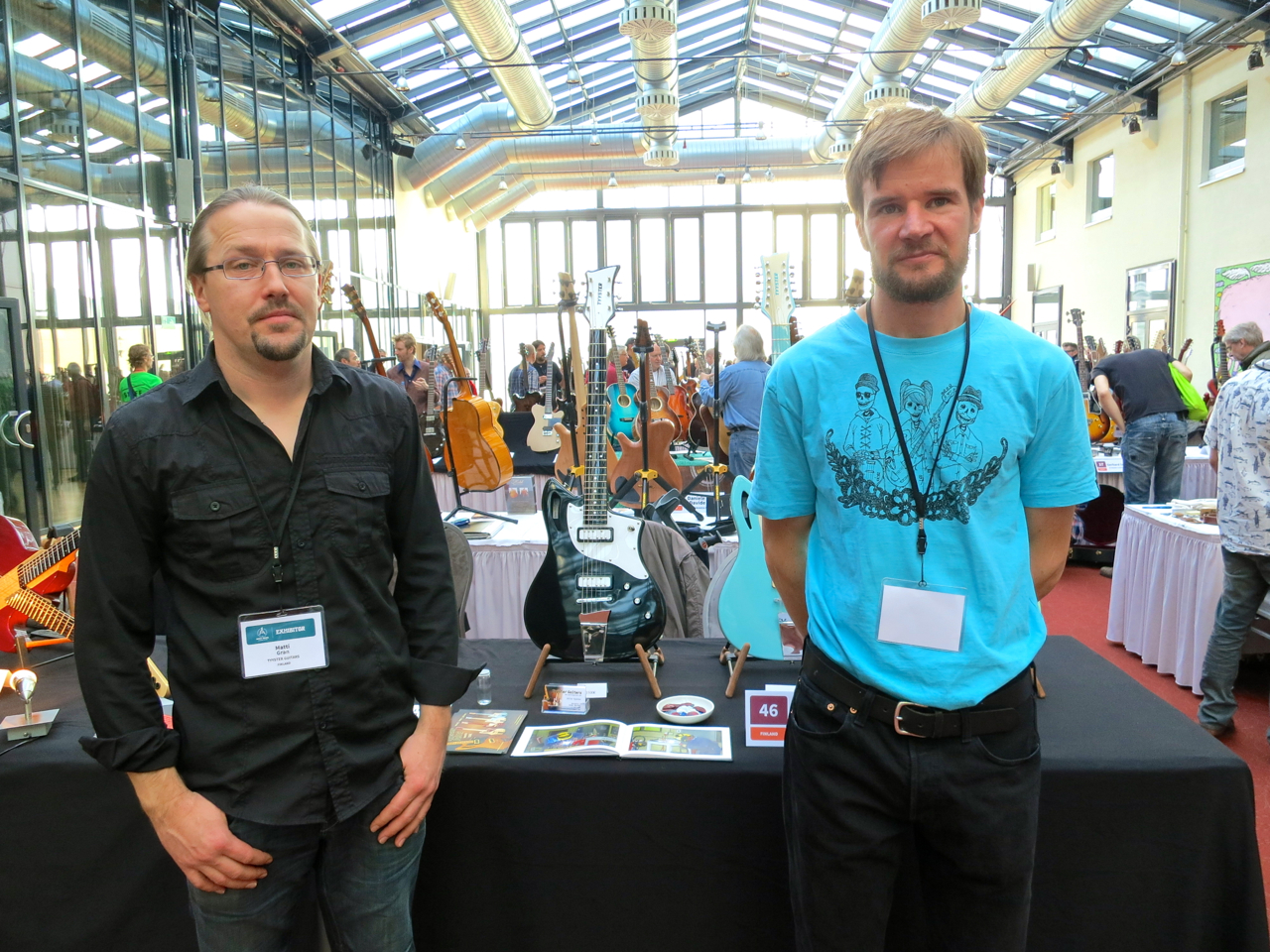
Tyyster Guitarsin Matti Gran (vas) and Ville Tyyster (oik).
Matti Gran (l) and Ville Tyyster (r) from Tyyster Guitars.

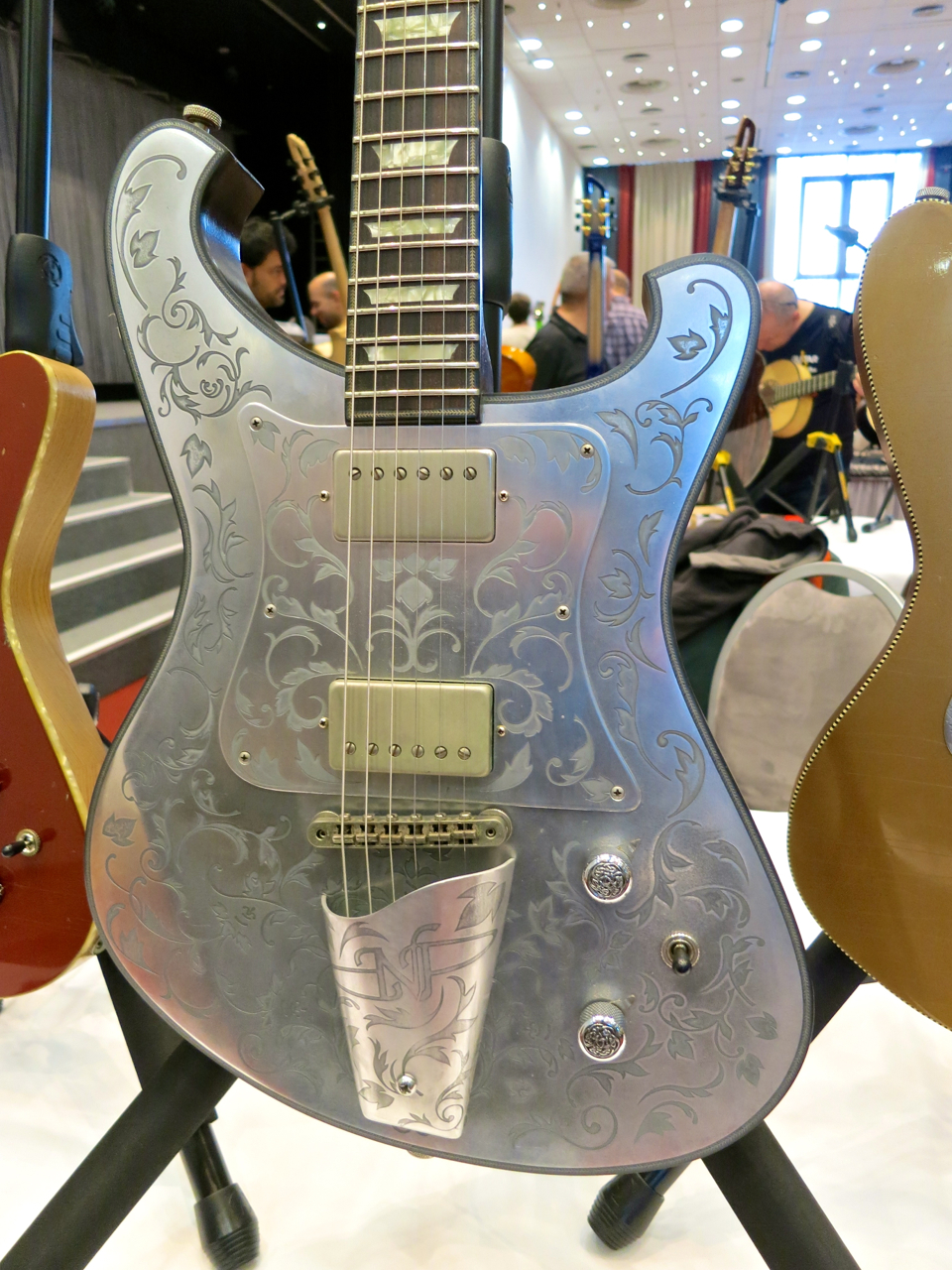
Tyysterin Pelti-malli on erinomainen Blues- ja Roots-kitara.
Blues- and Roots-players will surely enjoy the Tyyster Pelti with its metal thinline body.
****





Lisää kuvia The Holy Grail Guitar Showsta löydät TÄÄLTÄ.
For more pictures from The Holy Grail Guitar Show click HERE.

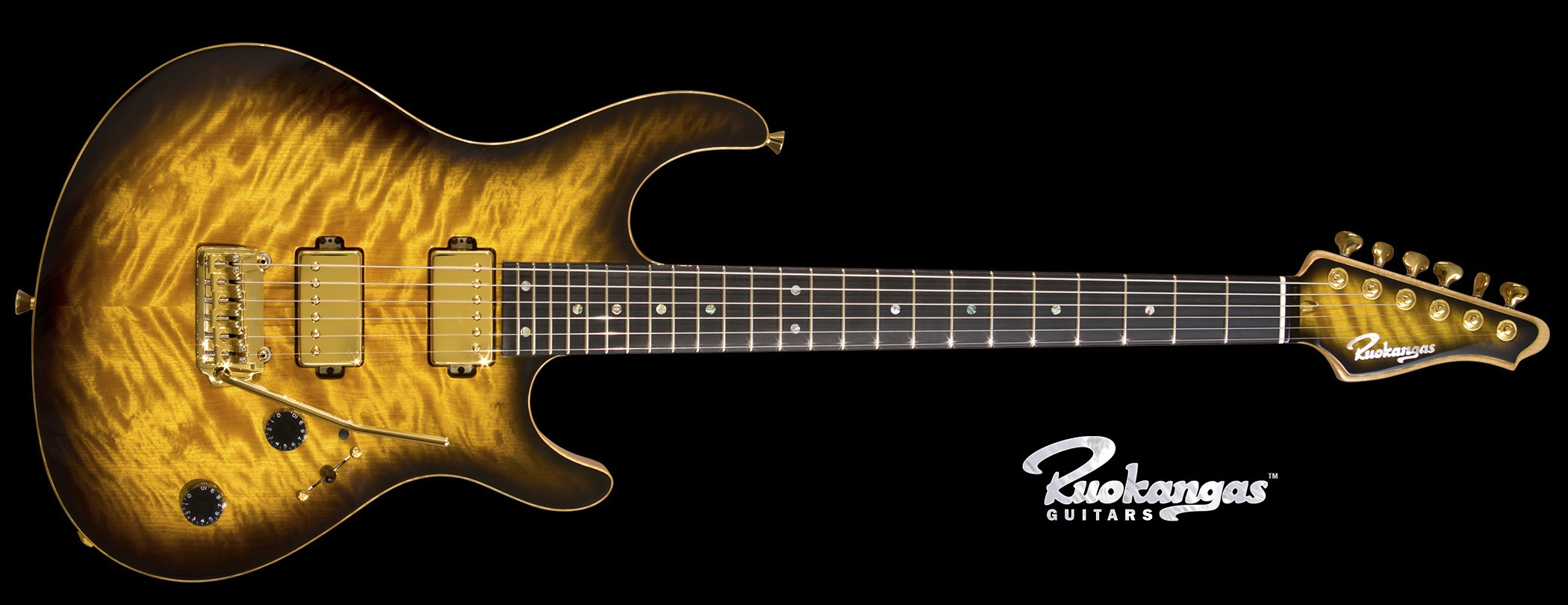
Ruokangas Guitars celebrate their 20th Anniversary by releasing two new models:
The Supersonic features a new unique Bare Bone™ finish by Ruokangas. Another new original feature are the Lock-Thru-Body™ bridge bushings, that make the guitar stronger (the wraparound bridge will not bend forward over time), and guarantee unparalleled energy transfer from the bridge into the body of the guitar.
Selling Price starting from: 3 700 €
Supersonic as pictured: 3 950 € (varies depending on options)

****
The Aeon comes in three versions – the Classic with a thermo-treated alder body and bolt-on neck – the Deluxe with a spanish cedar body, an arctic birch top and a bolt-on neck – and the Artist with a spanish cedar body, an arctic birch top and neck-thru-construction. As always with Ruokangas, you have a truckload of options for customizing the guitar to fit your style. The word ‘Aeon’ is latin, and means ‘infinity’.
Selling Price starting from: 3 200 €
Aeon Artist as pictured: 8 000 € (varies depending on options)
****
Contact: Ruokangas Guitars
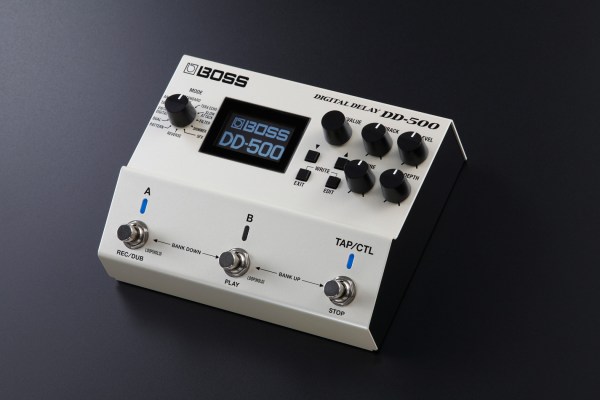

The brand-new Boss DD-500 will quite likely prove to be a definite milestone in the effect company’s history. Boss’ newest creation isn’t just another run-of-the-mill delay pedal; instead, the company’s R&D-department has set out to create a genuine ”mother of all delay pedals”, aiming to take the user all the way, from the illustrious past of echoes and delays right into the here-and-now of top notch audio processing.
****

The Boss DD-500 (current street price in Finland approx. 370 €) comes over as a very matter-of-fact, businesslike pedal with a very clean and uncluttered look.
Despite the fact that each effect patch contains quite a number of different adjustable parameters, Boss have provided the user with physical knobs and buttons to access the most important features directly. In addition to the all-important Delay Mode selector, you’ll find controls for Time, Feedback, Effect Level, Tone, and Modulation Depth. This makes tweaking any patch very fast and easy.
The Model-selector goes right to the heart of what the DD-500 does, offering you access to the different delay types on offer. The DD-500’s twelve Modes really run the whole gamut of all delay types known to mankind, starting with a state-of-the-art, contemporary delay (Standard) and leading you all the way to some of the best digital models of tape- and bucket brigade-delays you’re likely to hear. Let’s not forget about the more special delay types on offer here, such as Boss’ own Tera Echo Mode, Shimmer, Slow Attack, or Reverse. The outlandishly bit-crunching SFX setting, as well as the fat and chewy Filter Mode will take your playing closer to the realms of synthesizers and Electronica. Depending on the chosen mode, the maximum delay time on offer stretches to a whopping ten seconds!
Naturally, the DD-500 also comes with a phrase looper, which can loop up to two minutes of audio.

The Boss DD-500 will work equally well in mono or stereo setups.
The Control/Expression-jack lets you hook up an additional (double) footswitch unit or an expression pedal (not included) to the delay unit, allowing for real-time control of almost any parameter(s) you choose.
You can use MIDI to synchronise your delays to an outside source (such as an audio sequencer), as well as for remote effect patch switching.
The DD-500’s USB-port can handle both MIDI data, as well as digital audio, making it easy to record your effected guitar signal straight into your sequencer.
The Boss DD-500 offers plenty of memory space for effect patches:
Set to factory specifications, the delay unit will give you access to 99 banks of two patches each (A & B), that you can turn on and off using the switches of the same name. In this configuration the third switch is set aside for tap tempo and parameter control duties. You can change the factory configuration, though, which makes it possible to use 99 banks of three patches each (A, B & C). And if you’re really adventurous, you can also choose a setting that lets you use two delay patches simultaneously.
The Boss DD-500 can be run as a true bypass-effect, meaning that the input signal goes straight to the unit’s output, whenever the delay is turned off. If you have a long effect chain, or if you’re forced to run long cables to your backline, you will appreciate the delay’s buffered output option, too, which will keep all your precious trebles and dynamic content intact.
****

Boss’ internal digital signal processing, with a sample rate of 98 kHz and a 32-bit resolution, lays the perfect groundwork for the DD-500’s excellent audio quality and amazing versatility. This isn’t your daddy’s delay box, where you can only set the delay time, feedback, and effect level; the DD-500 allows you to delve very deep to hone your tone in exactly the way you want. For example, all Delay Modes come with their dedicated semiparametric EQ, a comprehensive modulation section, and a ducking compressor.
Adding the possibilities offered by the CTL-switch – or additional switches, or an expression pedal – into the mix, further multiplies the tonal options on tap in the DD-500. If you don’t need the tap tempo function, you can use the built-in CTL-switch for special effects, such as – among others – Hold (the repeats don’t fade away, while the footswitch is pressed), Warp (basically a modern version of tape-spin; your delay running wild) or different types of Roll (changing the note value of your delay).
Yes, there is a long list of different parameters that you can tweak, but the DD-500 is still surprisingly easy to use. Despite the fact that this unit is much more versatile than a simple analogue delay, making your own delay patches is still relatively simple.
In my opinion, the new Boss DD-500 is the best and most versatile delay pedal available today.
Even used ”straight” – that is without further modulation or filtering – the basic Delay Modes sound great, offering you the widest possible scope to take you on a sonic journey par excellence. Here’s a short clip introducing all twelve Modes, using the same knob settings (with Modulation Depth set to zero). I start with Standard and work my way forward in a clockwise direction:
The factory patches in the DD-500 offer so many different types of delays that a review, such as this, can’t cover them all. The demo track features 12 different factory patches on the lead guitar, plus an additional patch, used to simulate a violin sound.
Here’s a mix of just the lead guitar parts:
And here’s the full track:
****

I’m pretty sure that the Boss DD-500 will put an end to many a guitarist’s epic search for the ”perfect delay pedal”.
This delay unit offers you such a wealth of different sounds, delay types, and tonal options, that I probably could have spent weeks on end with the DD-500, without bumping into the outer walls of this universe of inspiration. The Boss DD-500 is an equally excellent choice for the traditional guitarist, looking for authentic versions of legendary delay sounds, as it is for the fearless sound traveller, who will draw a sheer never-ending wealth of inspiration from this device.

****
Boss DD-500
street price ca. 370 €
Contact: Roland
****
Pros:
+ value-for-money
+ 12 delay types
+ broad scope for adjustment
+ large patch memory
+ sound
Upouusi Boss DD-500 on melkoinen merkkipaalu firman kitaraefektien keskellä. DD-500 ei ole nimittäin ”vain” Bossin tuorein delay-pedaali, vaan idea on ollut kehittää ”kaikkien viive-efektien äiti”. Sellainen pedaali, joka tarjoaa soittajalle koko delay-efektin historian yhdessä rasiassa.
****
Boss DD-500 (katuhinta noin 370 €) ulkoinen olemus on hyvin selkeä ja asiallinen, mikä helpottaa työskentelyä laitteen kanssa.
Vaikka jokainen efektipatchi sisältää runsaan määrän eri ohjelmoitavia parametrejä, pääsee käyttäjä kuitenkin käsiksi kaikkiin tärkeisiin kohtiin suoraan etupaneelin säätimillä. Tarjolla on viivemoodin lisäksi viiveaika, feedback, efektin volyymitaso, efektin master tone, sekä modulaation syvyys. Kevyt presetin editointi lennossa sujuu säätimien ansiosta erittäin helposti.
Mode-kytkin on DD-500:n toiminnan kannalta keskeisessä asemassa – sillä valitaan efektipatchille se delaytyyppi, joka halutaan käyttää. Tarjolla on peräti 12 vaihtoehtoa, jotka ulottuvat nykyaikaisesta ”state of the art -viiveestä” (Standard) nauhakaiku- ja analogidelay-mallinnukseen (Tape ja Analog), unohtamatta erikoisempia viiveitä kuin Tera Echo, Shimmer, Slow Attack tai Reverse. Erikoisefektien ystävät voivat kehitellä hyvin mielenkiintoisia delay-vaihtoehtoja käyttämällä Filter-moodia tai bittisyvyytä rajoittavaa SFX-viivettä. Pisin mahdollinen viive (moodista riippuen) on peräti kymmenen sekuntia!
Luonnollisesti DD-500 voi käyttää myös audioloopperina, ja pisin looppi voi olla jopa kahden minuuttin pituinen.
Boss DD-500 toimii sekä monofonisessa että stereofonisessa efektiketjussa yhtä hyvin.
Control/Expression-jakkiin voi liittää (tupla-) jalkakytkimen tai ekspressiopedaalin (eivät kuulu hintaan), jolla voi vaikuttaa soiton aikana (itse valittuun) parametriin (tai parametreihin).
MIDIn kautta voi esimerkiksi kauko-ohjata DD-500:n ohjelmavaihtoja ja tahdistaa viiveaikoja.
Myös USB-portti pystyy lähettämään ja vastaanottamaan MIDI-käskyjä, mutta sen lisäksi Bossissa on myös sisäinen äänikortti, jolla efektipedaalin signaalin voi lähettää digitaalisessa muodossa esimerkiksi sekvensserille.
Boss DD-500 tarjoaa myös erittäin runsaasti tilaa omille efektipatcheille:
Tehdasasetuksilla laite on konfiguroitu näin, että muistissa on 99 pankkia, joissa on kaksi patchia (A ja B), jotka laitetaan päälle ja pois pedaalin samannimisillä jalkakytkimillä. Kolmas kytkin on silloin varattu Tap Tempo- (tai Control) -toiminnolle. DD-500 voi kuitenkin käyttää myös niin, että TAP/CTL-jalkakytkin muutetaan kolmanneksi patchikytkimeksi, jolloin muistiin mahtuu 99 pankkia, joissa on kolme patchia (A, B ja C) per pankki. Tosi monisävyisien delay-soundien ystäville Boss tarjoaa myös sellaisen konfiguraation, jossa voi ketjuttaa kaksi patchia samanaikaisesti.
Boss DD-500 voi toimia true bypass -pedaalina, mikä tarkoittaa että signaali menee suoraan tulosta lähtöön, silloin kun pedaali on pois päältä. Jos oma efektiketju on kuitenkin hieman pidempi, voi laittaa tässä pedaalissa myös bufferin päälle, jotta signaalin diskantti ja dynamiikka pysyisivät ehjinä.
****
Bossin digitaalinen prosessointi 98 kilohertsisenä ja 32-bittisenä luo vankan perustan DD-500:n huikean äänenlaatuun, sekä sen erittäin vaikuttavaan vääntöön signaalin muokkauksessa. Tämä ei nimittäin ole mikään tavallinen viiverasia, jossa asetetaan vain aika, toistojen määrä, toistojen kirkautta ja efektin volyymiä kohdallaan, vaan DD-500:ssa on paljon enemmän mahdollisuuksia signaalin muokkaukseen. Jokaisessa delay-tyypissä on mukana myös esimerkiksi puoliparametrinen EQ (jolla saadaan viivesoundin just sellaiseksi kuin mitä haluaa), modulaatio-osasto (esimerkiksi huojunta- tai chorusefektejä varten), ja ducking-kompressori (joka nostaa viiveet esiin soittotauoissa).
CTL-kytkimen – tai lisäpedaalien – käyttö laajentaa DD-500:n tarjoamia ominaisuuksia vielä entisestään. Jos Tap Tempoa ei tarvita CTL-kytkimellä voi ohjata sellaisia toimintoja kuin esimerkiksi Hold (viivet jäävät ikäänkuin seisomaan), Warp (viive ”villiintyy” ja kasvaa) tai erilaiset Roll-tyypit (jossa aikajako muutetaan painalluksen ajaksi).
Vaikka parametrimäärä on DD-500:ssa hyvin runsas, on onnistettu kuitenkin tehdä käyttökokemuksesta helppo ja suoraviivainen. Vaikka tässä on kyse perus-delaytä paljon monipuolisemmasta lattiaefektistä, efektipatchien ohjelmointi on tehty suhteellisen simppeliksi.
Mielestäni Boss DD-500 on paras delay-efekti, johon olen tähän mennessä törmännyt.
Perus delay-moodit kuulostavat jo erittäin terveiltä, ja ne tarjoavat erittäin monipuolisen lähtökohdan erilaisille perinteisille, sekä ei-niin-perinteisille ja hyvin erikoisille viiveille. Tässä kaikki 12 viivemoodia, soitettu samoilla asetuksilla (ja ilman lisämodulaatiota). Aloitetaan Standardista ja mennään sitten kytkimen asentoja läpi myötäpäivässä:
DD-500 tarjoaa jo tehdaspatcheissa niin monta eri soundivaihtoehtoa, että niiden läpikäymiseen menee jo melkoinen tovi. Käytin demobiisissä 12 eri patchia soolokitaran kanssa, sekä yhtä patchia, jolla matkin viulusoundia.
Ensin vain ne soolo-osuudet:
Ja tässä koko biisi:
****
Mielestäni näyttää hyvin paljon siltä, että monien kitaristin ”ultimatiivisen delay-pedaalin” etsintä voisi päätyä Boss DD-500:n hankinnalla.
Olen melko varma, että olisin itse voinut tutustua tähän pedaaliin vielä paljon pitempään ja perusteellisemmin, ilman että olisin törmännyt DD-500:n tarjoaman luovuuden rajaan. Bossin DD-500 sopii yhtä hyvin sellaiselle kitaristille, joka tarvitsee suuren määrän erilaisia ”autenttisia” viive-efektejä, kuin myös kokeilunhaluiselle soittajalle, jolle tämä pedaali tarjoaa lähes ehtymättömän lähteen inspiraatiolle.
****
Boss DD-500
katuhinta noin 370 €
Lisätiedot: Roland
****
Plussat:
+ hinta-laatu-suhde
+ 12 delay-tyyppiä
+ erittäin laajat muokkausmahdollisuudet
+ iso patch-muisti
+ soundi





 Kitarablogi.com – Finland's premier Guitar and Bass blog