
Contact: Tokai Guitars Nordic

Kitarablogi.com – Finland's premier Guitar and Bass blog
Juttuja kitaroista ja bassoista


TOKAI LS-200F-5A
• Very limited edition
• Handcrafted in Japan
• AAAAA flame maple top
• Seymour Duncan Antiquity Humbucker set
• Push/push switches in tone controls for coil-splitting
****
Demo Track
• Rhythm guitar – both pickups in split mode
• Lead guitar – starts with split neck pickup; second pass with full neck pickup
• Amp used – Juketone True Blood (handwired 5F1 Champ-clone)
• Recorded with a Shure SM57
****
Contact: Tokai Guitars Nordic


”Suuri USA-kiertue” – se kuulostaa monen muusikon korviin todella houkuttelevalta. Yksityiskoneita, limusiineja, glamouria, kauniita naisia, helppoa elämää, paljon rahaa…
Väärin meni!
Vaikka olisitkin maailmankuulun bändin kitaristi, silloin kun olet sivuprojektisi kanssa liikenteessä, tulet Yhdysvalloissa aloittamaan (lähes) nollasta, nimittäin pelkkänä lämmittelybändinä.
Kimmo Aroluoman uutuuskirja ”Jenkkirundi – seitsemän viikkoa kiertue-elämää” seuraa aitiopaikalta Mikko ”Linde” Lindstömin (HIM) ”soolobändin”, Daniel Lioneyen, ensimmäistä USA-kiertuetta, jolla Aroluoma toimi bändin teknikkona.
Aroluoman kirjasta selviää millaista se on, kun suomalainen bändi lähtee Jenkkeihin support-bändinä äärimmäisen tiukalla budjetilla. Glamour on joka tapauksessa todellisuudesta hyvin kaukana.
”Jenkkirundi – seitsemän viikkoa kiertue-elämää” ei ole opas kiertueelle lähteville bändeille, vaikka kirjasta selviää esimerkiksi miten kiertuebudjetti laaditaan, vaan se on rehellinen katselmus USA-kiertueella vastaan tulevista koettelemuksista.
Toisena juonena tässä erinomaisessa kirjassa toimii kirjoittajan oma henkinen (ja fyysinenkin) kärsimys- ja kasvutarina täydellisen burnoutin ja avioeron partaalla.
Tästä syntyy lukemisen arvoinen kokonaisuus, joka kertoo siitä miten bändi ja heidän taustavoimat saivat käännettyä rundin ulkoisista paineista, teknisistä vaikeuksista ja henkilökohtaisista ongelmista huolimatta tärkeäksi menestykseksi.
”Jenkkirundi – seitsemän viikkoa kiertue-elämää” (130 sivua; 16,90 €) ilmestyy 01.09.2016. Kirjan voi tilata ennakkoon TÄÄLTÄ.

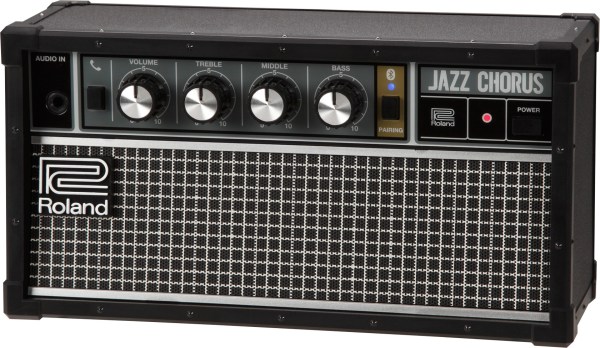
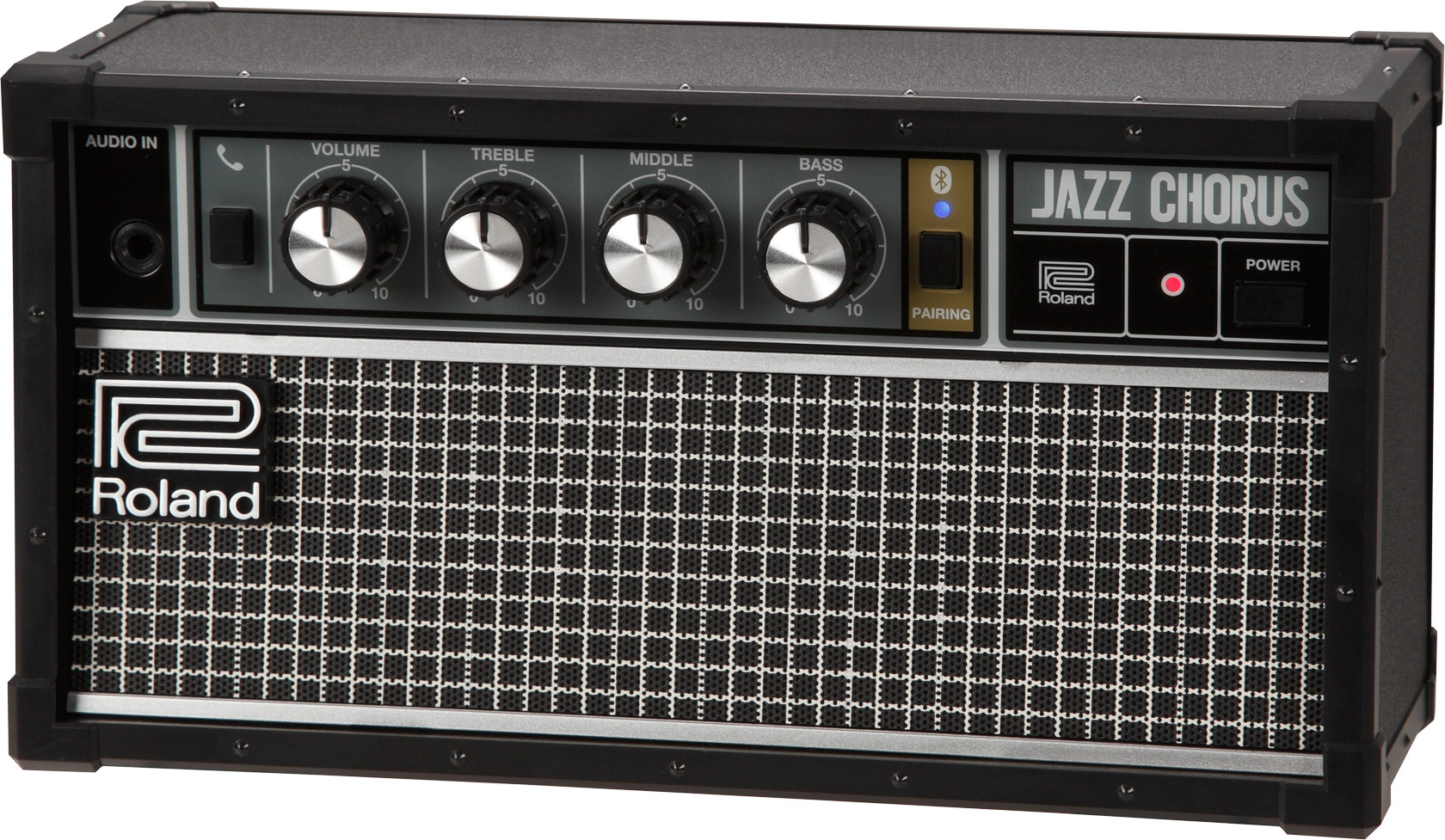
Lisätiedot: Roland

Jimi Hendrix’ simply doesn’t seem to wane, even though the genial guitar hero himself died in London in 1970 at 27 years of age. There’s still so much interest in Hendrix’ music that he continues to rank among the top ten of best-earning dead celebrities in Forbes magazine.
The Fender Stratocaster was the master’s favourite instrument, so it’s not really surprising that the man has been honoured with a signature model by Fender last year. This guitar is now also available in Finland.
The new Made-in-Mexico Fender Jimi Hendrix Stratocaster isn’t the first Hendrix model that Fender has released:
In 1980 a small, semiofficial run of Hendrix Strats was made, sporting a white body and a left-handed neck with a large headstock. Fender’s Custom Shop came out with 100 Monterey Stratocasters, which where close copies of the guitar instrument played and burned at the 1967 festival. It was a right-handed Stratocaster with a small headstock and a hand-painted body, set up for left-handed playing. Along with the guitar the Monterey Set also included a flight case and a leather gig bag. In the same year (1997) Fender USA started to produce the Jimi Hendrix Voodoo Strat. The Voodoo Strat was in fact a a left-handed (!) copy of Hendrix’ (right-handed) Woodstock Stratocaster, with the headstock decals turned into mirror images, so that you would look (a bit) like Hendrix, whenever you stepped in front of a mirror. 😀
****

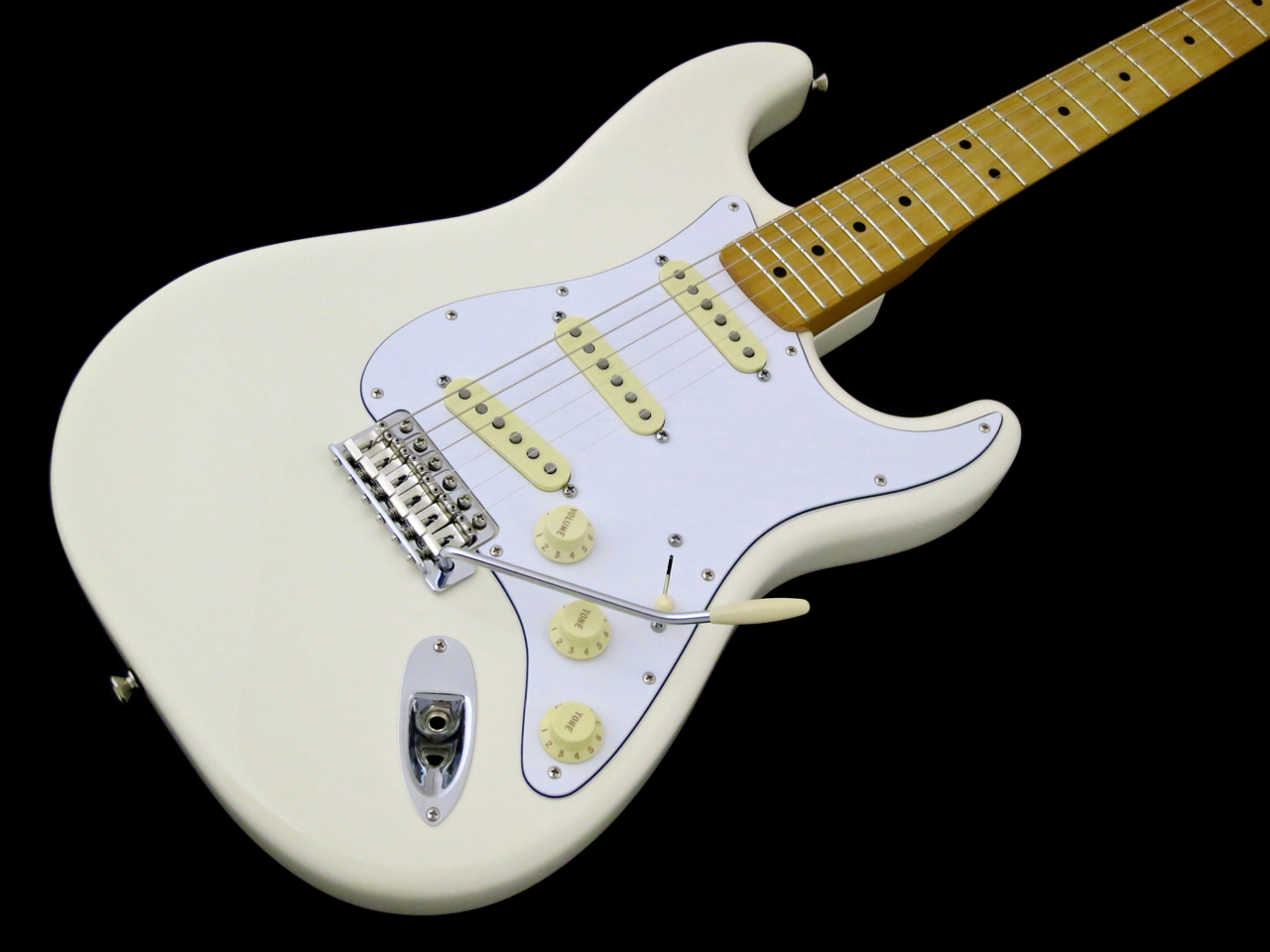
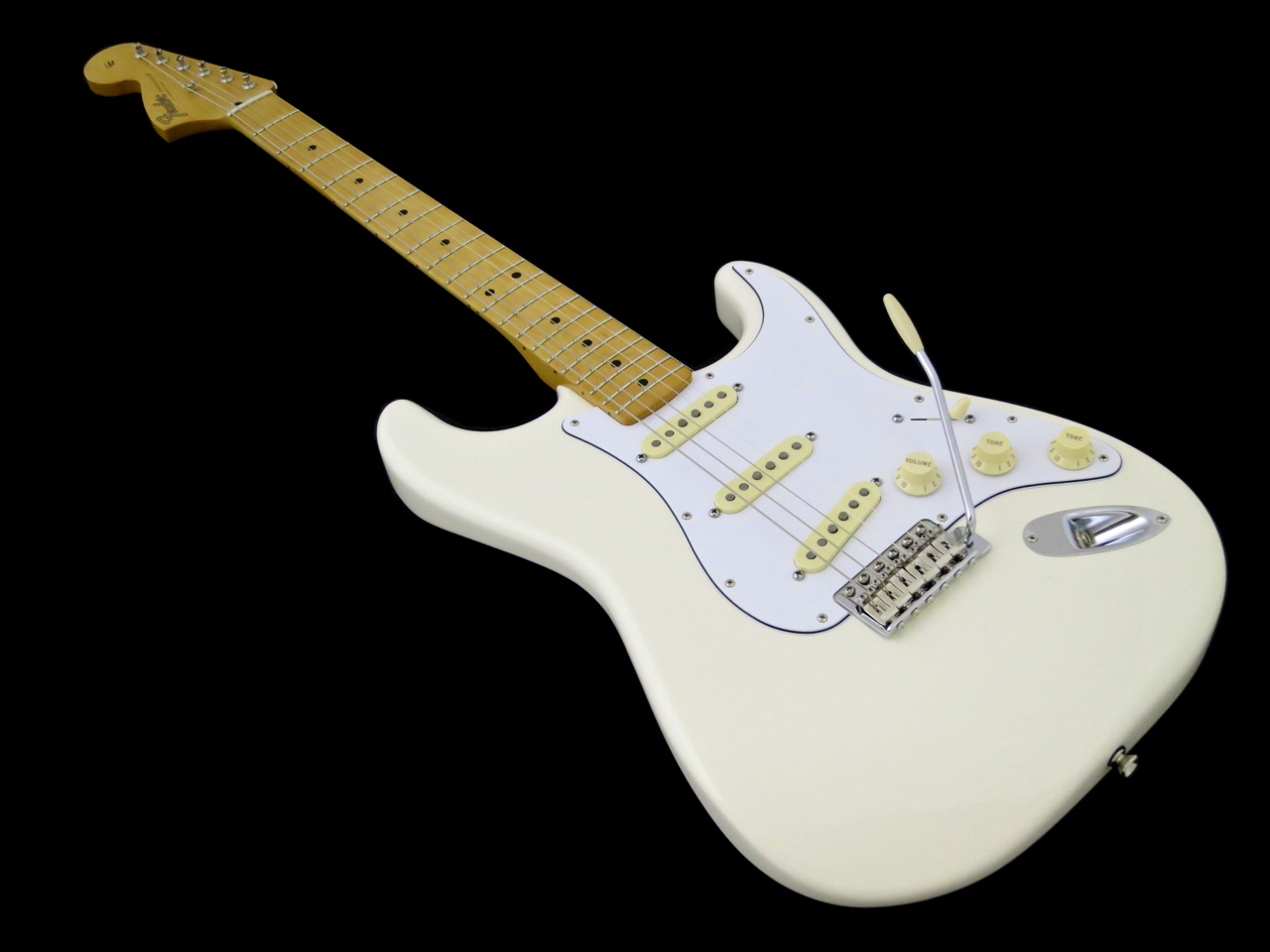
The brand-new Fender Jimi Hendrix Stratocaster (approx. 950 € in Finland) also has some features resembling the guitar Hendrix used at the Woodstock festival:
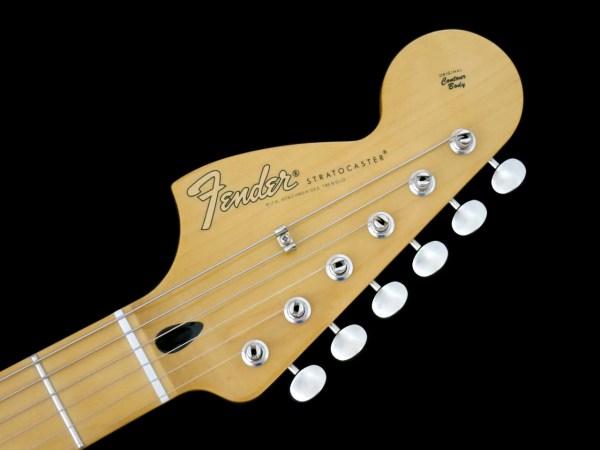
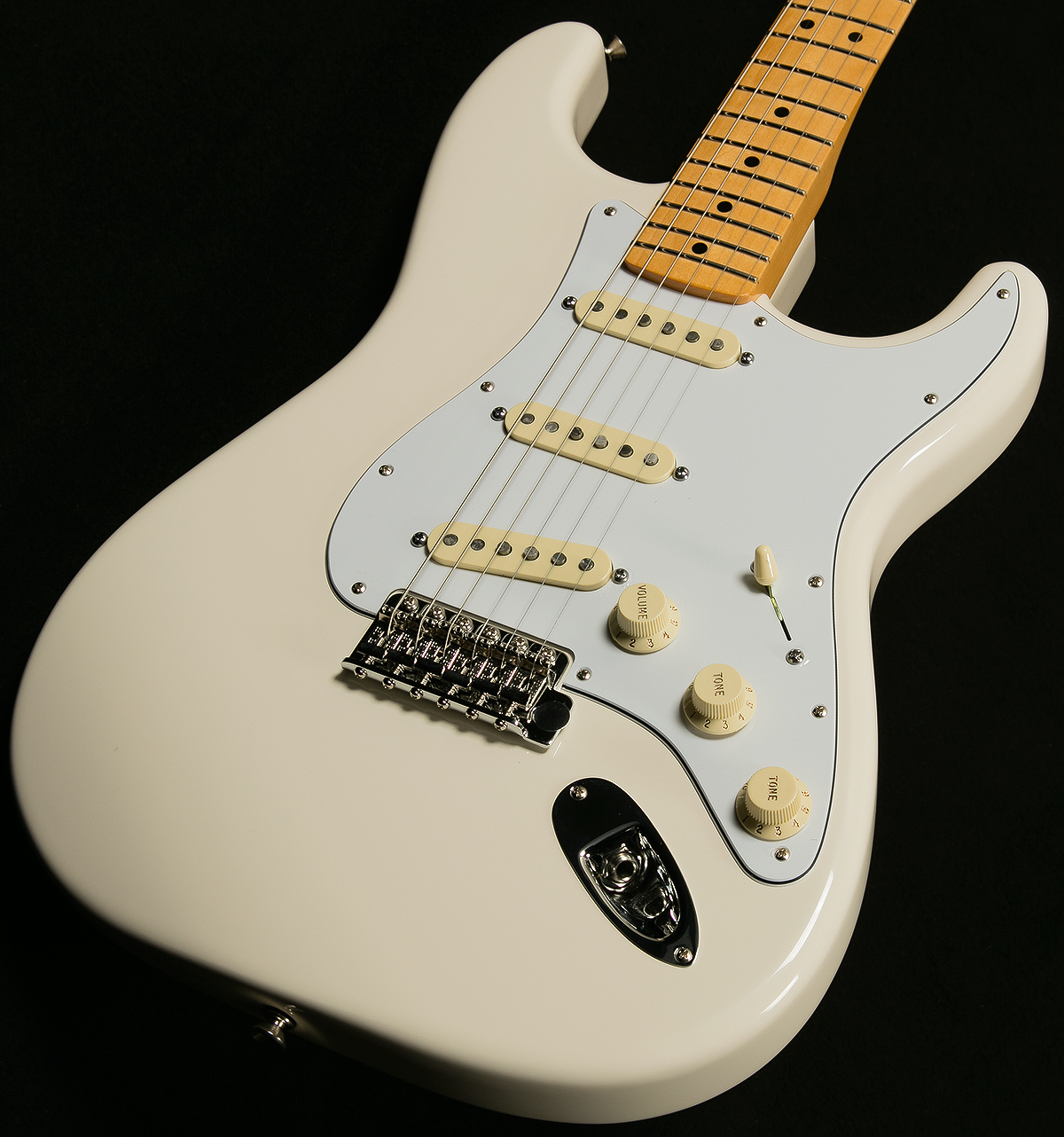
The right-handed alder body is finished either in black or in white, while the neck is a large headstock-carrying, left-handed, all-maple affair.
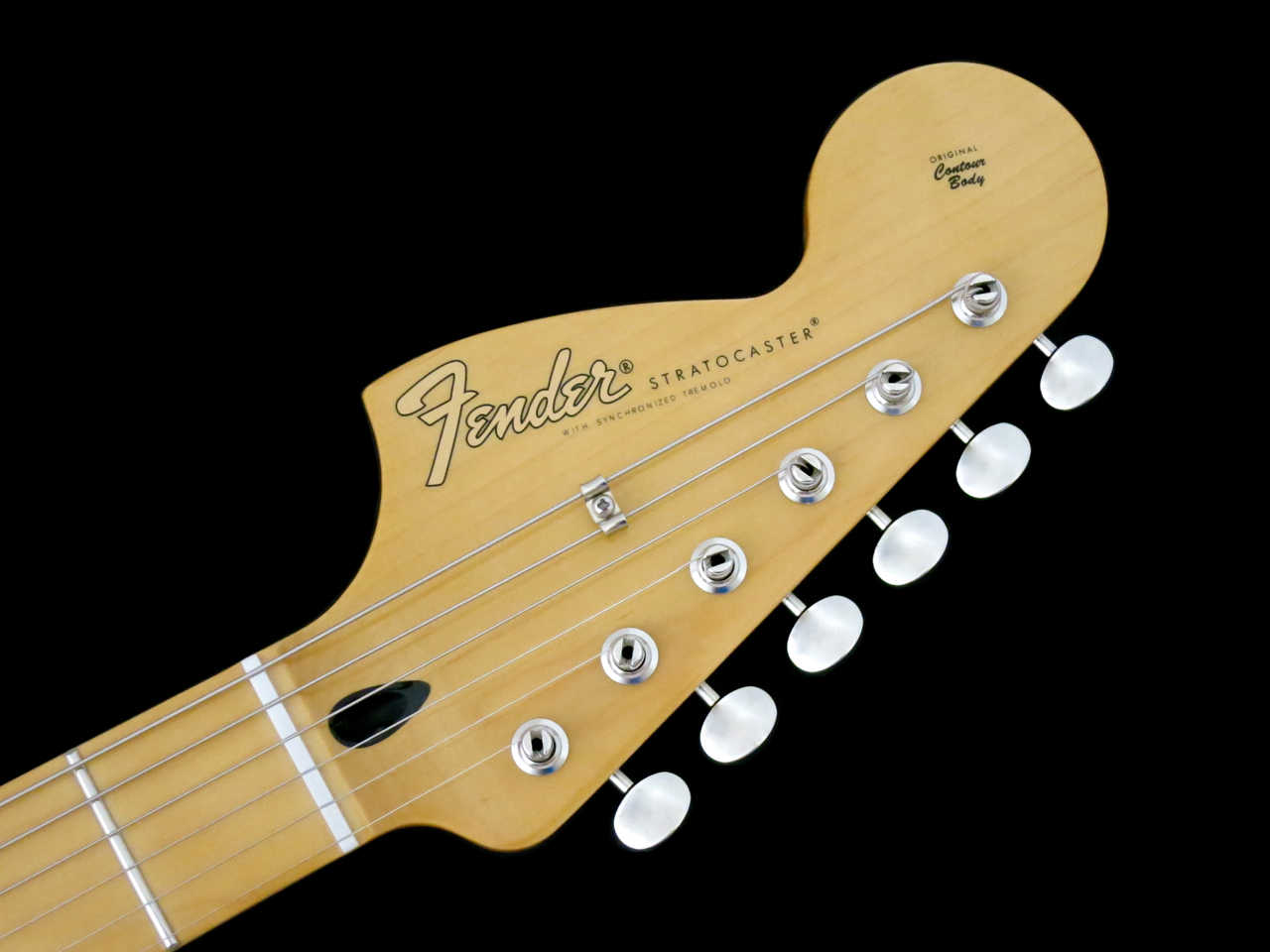
The headstock carries the so-called transition logo from the mid-Sixties, which was much larger than the Fifties’ spaghetti logo, but still gold coloured. By the end of the Sixties the logo was changed to black and the model name was written in large, bold lettering – that would be called the the CBS logo.
Modern improvements on the Hendrix Strat include truss rod access from the headstock side, as well as a flatter, more bend-friendly fretboard radius of 9.5 inches.

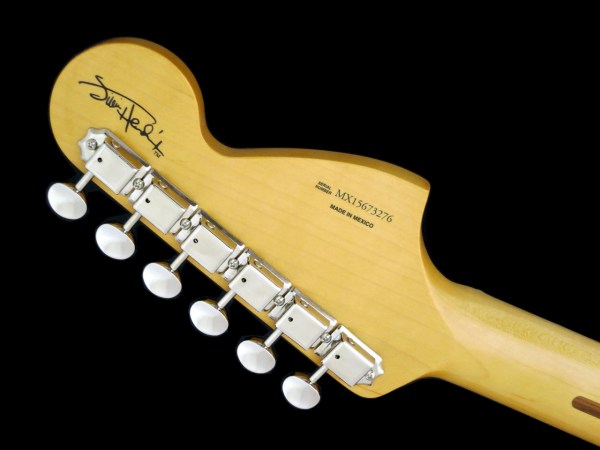
The headstock’s flip side displays Hendrix’ signature, and a very decent set of Kluson copies.

The neck joint has been kept very traditional, but for the Authentic Hendrix-logo on the neck plate.

The most important differences between the Hendrix model and a bog standard Strat can be found in the pickup department:
The Mexican signature guitar comes equipped with a pukka set of American Vintage ’65 Gray-Bottom Fender-pickups, which have been installed into this guitar, as if this were a left-handed model turned over. Both the neck and middle pickup have been flipped over by 180 degrees, while the bridge pickup has been flipped over first, before being installed at a reverse angle. Usually the bridge pickup is placed so that its bass side is closer to the neck with the treble side being closer to the bridge. On the Hendrix Strat the bridge pickup’s bass side is closer to the bridge and the treble side closer to the neck.
This reverse installation means that the magnet stagger is ”wrong”, changing slightly the balance between the strings in terms of output. Furthermore, the bridge pickup will give you a slightly changed range of overtones, due to its reverse angle.
We’ll find out in the listening test, whether these changes really make any discernible difference.

The controls follow the vintage recipe – master volume, neck tone, middle tone – while the pickup selector on the Hendrix model is a modern five-way unit.
The American Vintage ’65 pickup set is true to the original specs and does not feature a reverse-wound/reverse-polarity middle pickup for hum-cancelling in positions two and four, like many updated Strats!

Fender’s vintage vibrato bridge (the ”Sychronized Tremolo”) sports bent steel saddles.
****

Fender Strats are well-known for their excellent ergonomic properties and the Hendrix signature model stays true to this heritage.
Our review instrument was of comfortable moderate weight. The neck’s mid-Sixties C-profile feels great, thanks to not being overly chunky.
The guitar arrived strung with a set of 010s and tuned to E-flat, but the setup wasn’t quite spot-on. The vibrato bridge was tipped a little too steeply, and the intonation was a bit off on the bass strings. But it only took me a couple of minutes (and the correct pair of screwdrivers) to get this Strat shipshape. The result was a great-playing and great-sounding guitar (string height at 12th fret: bottom-E: 2.2 mm/high-e: 1.7 mm).
The flatter-than-vintage fretboard radius really helps to make the Hendrix Strat a very bend-friendly guitar, while also minimising the possibility of fret choke during large-interval bends.
I must admit that I’m not quite sure, whether I really hear much of a difference in the amplified sound of the reversed pickups, though.
Jimi’s guitar tech and effects guru, Roger Mayer, has often stated that Hendrix was satisfied with the sound of his (right-handed) Strats right off the peg. According to Mayer, the only ”customisation” the pair ever did on newly bought guitars, was to take off the neck and remove all possible finish residue inside the neck pockets to improve the stability of the neck joints. Hendrix’ effects, on the other hand, were a regular target for fine-adjustment and electronic customisation.
Anyway, the new Fender Jimi Hendrix signature guitar sounds just like a great Strat should. Here’s a clean clip first:
Here’s an example of the Hendrix Strat’s distorted tone:
I was eager to start recording with the Fender Hendrix model. The first demo track puts the signature Strat into a slightly more contemporary context. The signal chain for this track was: Fender Hendrix Stratocaster –> Electro-Harmonix Germanium 4 Big Muff Pi –> Morley M2 Wah/Volume –> Blackstar HT-1R:
Next I recorded a demo track with a more Hendrix-like arrangement. The signal path was: Hendrix Stratocaster –> Morley M2 Wah/Volume –> Electro-Harmonix Nano Big Muff Pi –> Blackstar HT-1R. The Uni-Vibe style sound at the end of the track was achieved with a phaser plug-in during mixdown:

****

Even though Jimi Hendrix was known for his avant-garde use of effects in the studio – buoyed by the creativity of his sound engineer Eddie Kramer – his signal chain on stage was surprisingly straightforward. Here’s a short and basic rundown of Hendrix’ live rig.
1. Marshall Model 1959 ”Plexi” stack
Jimi Hendrix used what we now call a vintage-type, non-master volume amplifier stack, which wasn’t especially high-gain by today’s standards. Usually Hendrix had two 100 Watt Marshall-stacks running in parallel, which meant things got very loud. His Strats would cause his amp to break up, but the type of distortion was closer to what we’d now call a 60s Blues sound than to 70s Metal, and far removed from the high-gain saturation of our time.
I simulated this type of amp response by turning my Blackstar HT-1R’s gain control up to get the clean channel to overdrive.
2. Dallas-Arbiter Fuzz Face
In my view, the fuzz pedal is the most important ingredient in Jimi’s sound, because it adds a lot of oomph, creamy compression, and aggression to proceedings.
A British importer of musical equipment, a man called Ivor Arbiter, came up with the Fuzz Face in 1966, because he wanted to have a fuzz pedal in his product range. He came up with a chunky package by having the Fuzz Face circuit built into the base of a 60s microphone stand. The round enclosure, coupled with the unit’s two controls and single footswitch, looked like a smiley face, which is where the pedal got its name from.
Fuzz Faces are built by the Jim Dunlop company these days. There are also cheap alternatives available, from companies such as Mooer or Rowin. I’m using an Electro-Harmonix Nano Big Muff Pi for the demo tracks:
3. Vox Wah-Wah
Hendrix generally used his Vox Wah in front of his Fuzz Face, but keeping it behind the fuzz will also result in some cool tones. Great wah-pedals can also be head from Boss, Mission Engineering or Jim Dunlop.
I’ve used my Morley M2 Wah/Volume pedal in front of the Big Muff Pi:
4. Octavia +Uni-Vibe
Roger Mayer’s Octavia-pedal was sometimes used as an additional ingredient in Jimi’s live sound. This strange-sounding effect combines distortion with an artificial upper octave and some slight ring-modulation. Hendrix also used a Uni-Vibe effect, which was one of the first pedals that tried to create a Leslie-like sound in a compact format.
A genuine Octavia-pedal is only made by Roger Mayer, but Joyo’s inexpensive JF-12 Voodoo Octave stomp box sets you off in a very similar direction.
Korg has introduced the NuVibe, which is a pukka re-imagination of the original Uni-Vibe-pedal. Voodoo Lab’s Micro Vibe is a high-quality proposition at a fair price.
You can also simulate Uni-Vibe-style tones by using a suitable phaser. The Boss PH-3 is a modern and versatile phaser. If you want something even more affordable, you could check out Mooer’s range of effects.
This clip uses a combination of two phaser plug-ins in my audio sequencer:
****
If you want to go all the way to ”become Hendrix”, you will need to buy a left-handed Stratocaster and turn it into a right-handed instrument. The result will be authentic, but also much less comfortable than a regular Strat, because the controls are all in the wrong place.
Fender’s new Jimi Hendrix Stratocaster will give you the (very slight) difference a reversed headstock brings to the playing feel, as well as the (very slight) tonal differences of the reversed pickups, while keeping all of the Stratocaster’s great ergonomics intact.
Fender’s Hendrix model is a fine Strat, which you can use for all types of music. Still, it’s the ”Hendrix-thing” this guitar does the best!
If I could only have the maestro’s long fingers and musical imagination…
****
Fender Jimi Hendrix Stratocaster
Price approx. 950 €
Contact: Fender
A big ”thank you” goes to DLX Music Helsinki for the kind loan of the review guitar!
Pros:
+ musician-friendly price tag
+ workmanship
+ American Vintage pickups
+ playability
+ sound
Cons:
– factory setup

Jimi Hendrixin suosio ei näytä hiipumisen merkkejä, vaikka tämä valovoimainen kitarasankari itse kuoli jo vuonna 1970 27-vuotiaana Lontoossa. Kiinnostus Hendrixin musiikkia kohti on yhä niin suuri, että hän on sijalla yhdeksän Forbes-lehden listalla parhaiten tienaavista kuolleista henkilöistä.
Fenderin Stratocaster oli mestarin suosikkisoitin, eikä ole siis ihme, että Fender hiljattain esitteli uuden Jimi Hendrix -nimikkomallin, joka on nyt myös saatavilla Suomessakin.
Uusi meksikolainen Fender Jimi Hendrix Stratocaster ei ole kuitenkaan firman ensimmäinen kunniaosoitus legendaariselle kitaristille:
Vuonna 1980 tehtiin pieni ”epävirallinen” erä Hendrix-Stratoja (tuotantoerä vain muutama tusina) valkoisella rungolla ja vasenkätisellä, isolla viritinlavalla varustetulla kaulalla. Vuonna 1997 ilmestyi Custom Shopin 100 kitaran erä Hendrixin Monterey-Stratosta, joka oli tarkka kopio soittimesta, jota Hendrix käytti Monterey-festivaalilla 1967. Se oli käsin maalattu vasenkätiselle sopivaksi muutettu oikeankätinen Strato pienellä lavalla. Monterey Strat -settiin kuului myös flight case -laukku, nahkahihna, sekä nahasta tehty topattu pussi. Vuonna 1997 ilmestyi myös Fender USA:n Jimi Hendrix Voodoo -Strato, joka oli oikeakätiselle tarkoitettu kopio Hendrixin legendaarisesta Woodstock-kitarasta. Voodoo-Straton juju oli, että kitaran logo oli alkuperäisen peilikuva, minkä ansiosta nimikkomallin käyttäjä näytti peilin edessä enemmän Hendrixiltä. 😀
****
Upouudessa Fender Jimi Hendrix Stratocasterissa (hinta-arvio noin 950 €) on myös vahvoja vivahteita mestarin Woodstock-kitarasta:
Tässä tapauksessa kitaran leppärunko on saatavilla joko valkoisena tai mustana, ja siihen on liitetty yksiosainen vaahterakaula isolla, vasenkätisellä lavalla.
Viritinlavalta löytyy ns. transition logo 60-luvun keskiväliltä, joka on isompi kuin 50-luvun spaghetti logo, mutta vielä kultainen. Logo muuttui 60-luvun lopulla mustaksi CBS logoksi.
Nykyaikaisia parannuksia Hendrix Stratocasterissa ovat lavanpuoleinen kaularaudan säätöruuvi, sekä otelaudan loivempi kaarevuus (9,5 tuumaa), joka helpottaa kielten venytyksiä.
Lavan kääntöpuolelta löytyy Jimi Hendrixin nimikirjoitus, kitaran sarjanumero, sekä sulavasti toimivat Kluson-kopiot.
Kaulaliitos on hyvin perinteistä sorttia, mutta kaulalevyyn on kaiverrettu Authentic Hendrix -tuotteiden logo.
Tärkein ja ratkaisevin ero rivi-Stratoon piilee Fender Jimi Hendrix -mallin mikrofoneissa:
Meksikolaisessa nimikkomallissa käytetään laadukkaita American Vintage ’65 Gray-Bottom Fender-mikrofoneja, jotka on asennettu niin kuin tämä kitara olisi vasenkätinen. Kaula- ja keskimikrofoni on siis käännetty 180 asteella. Myös tallamikrofoni on ensin käännetty, mutta tämän lisäksi se on myös asennettu käänteisen kulmaan. Tavallisesti tallamikin bassopuoli on lähempänä kaulaa, Hendrix-Stratossa taas mikin diskanttipuoli on lähempänä soittimen kaulaa.
Tämä toimenpide kääntää mikrofonien erikorkoisten magneettien järjestystä, ja se myös muuttaa tallamikin tapauksessa mitkä ylä-äänet mikki poimii kielistä.
Vasta käyttötestissä selviää onko ero kuultavissa.
Säädinosasto on vintage-reseptin mukainen – master volume, kaulamikin tone ja keskimikin tone – mutta Hendrix-mallissa on nykyaikainen viisiasentoinen kytkin.
American Vintage ’65 -mikkisetissä kaikki mikrofonit on käämitty samaan suuntaan, niin kuin aidoissa 60-luvun Stratoissa. Tämän takia yksikelaisten hurina ei poistu mikkiasennoissa kaksi ja neljä, niin kuin monissa nykyaikaisissa Stratocastereissa!
Vibratalla on Fenderin vintage vibrato (”Sychronized Tremolo”) teräksisillä tallapaloilla.
****
Fender Stratot tunnetaan niiden hyvästä ergonomiasta, eikä Fender Jimi Hendrix -malli poikkea tästä linjasta.
Testiyksilö on mukavasti keskipainoinen ja sen runko hyvin sulavalinjainen. Fender on valinnut 1960-luvun C-profiilin tähän Hendrix-Stratoon, joka tuntuu todella hyvältä kädessä myös hyvin maltillisen paksuutensa ansiosta.
Testikitara saapui Es-vireessä 010-satsilla, mutta sen säädöt eivät olleet täysin kohdallaan suoraan laatikosta. Vibratallan kulma oli hieman liian jyrkkä ja myös soittimen intonaatio oli bassokielillä vähän pielessä. Oikean kokoisilla ristipääruuvareilla ongelmat hoidettiin nopeasti ja helposti pois päiväjärjestykseltä. Lopputulos oli erittäin hyvin soiva sähkökitara mukavalla tatsilla (kieltenkorkeus 12. nauhalla: matala-E: 2,2 mm/diskantti-e: 1,7 mm).
Loivasta otelautaradiuksesta (9,5 tuumaa) on todellakin paljon hyötyä bendaamisessa. Kielten venyttäminen on helpompaa, eivätkä kielet rämise isoissa intervalleissa ylimpiä nauhoja vastaan kuin usein kuperammalla vintage-radiuksella (7,25 tuumaa).
En ole ihan varma kuuluuko käänteisten mikrofonien soundillisia vaikutuksia ratkaisevasti Hendrix-Stratocasterin sähköisessä soundissa.
Hendrixin tekniikon ja soundigurun, Roger Mayerin, mukaan muusikko itse oli tyytyväinen tuotantolinjan Stratoihin. Mayer on sanonut useissa haastatteluissa, että ainoat toimenpiteet, joita tehtiin juuri ostettuihin soittimiin, olivat kaulataskujen siivoaminen lakkausjäämiltä. Sen sijaan Hendrixin efekteihin tehtiin kaikenlaista kustomointia.
Oli niin tai näin, uusi Fender Jimi Hendrix -malli soi kuin laadukas Strato. Tässä ensin puhdas pätkä:
Ja tässä esimerkki Hendrix-kitaran särösoundista:
Halusin ensin kokeilla Jimi Hendrix -Stratoa nykyaikaisessa soundiympäristössä, ja äänitin tämän pienen demon. Signaaliketju on Hendrix Stratocaster –> Electro-Harmonix Germanium 4 Big Muff Pi –> Morley M2 Wah/Volume –> Blackstar HT-1R:
Äänitin sitten vielä toisen, Hendrix-tyylisen demokappaleen. Signaaliketju on tässä Hendrix Stratocaster –> Morley M2 Wah/Volume –> Electro-Harmonix Nano Big Muff Pi –> Blackstar HT-1R. Kappaleen lopussa simuloin Uni-Vibe-efektin soundia nopealla phaser-efektillä miksausvaiheessa:
****
Vaikka Jimi Hendrix oli – ääniteknikko Eddie Kramerin avulla – melkoinen edelläkävijä efektien käytössä studiossa, perustui hänen live-soundinsa yllättävän pieneen efektiarsenaaliin. Tässä todella lyhyt johdanto Hendrixin signaaliketjuun lavalla.
1. Marshall Model 1959 ”Plexi” -stäkki
Jimi Hendrix käytti mitä tänään kutsutaan vintage-tyylisiksi stäkeiksi, joiden vahvistimissa ei ollut high-gain säröpiirejä, eikä master volume säätimiä. Hänellä oli tavallisesti käytössä jopa kaksi 100-watista Marshall-stäkkiä, mikä tarkoitti että äänenpaine oli melkoinen. Stratollakin nämä vahvistimet menevät särölle, mutta soundi on enemmän Blues-tyylinen, kuin mitä saadaan nykyaikaisista high-gain stäkeistä.
Simuloin tätä soundia kääntämällä Blackstar HT-1R -kombon clean-kanavalla gain-säätimen reilusti auki.
2. Dallas-Arbiter Fuzz Face -säröpedaali
Fuzz-tyypinen säröpedaali on mielestäni Hendrix-soundin kannalta ratkaisevassa asemassa, koska se lisää soundiin sekä lihaksia ja kermaista sustainea että runsaasti rosoisuutta.
Englantilainen musiikkilaitteiden maahantuoja Ivor Arbiter halusi saada firmalleen 1966 oman säröpedaalin. Hän keksi Fuzz Facen rakentamalla fuzz-piirin mikrofoniständin jalkaan. Pyöreä jalka näytti kahdella säätimellään ja yhdellä jalkakytkimellään naamalta, josta pedaalin nimi tulee.
Fuzz Faceja valmistaa nykyään Jim Dunlop. Edullisia vaihtoehtoja saa myös Mooerilta tai Rowinilta. Itse käytin tässä Electro-Harmonix Nano Big Muff Pi -pedaalia:
3. Vox Wah-Wah
Hendrix käytti Vox Wahiaan tavallisesti kytkettynä Fuzz Face -särön tuloon, mutta myös fuzzin jälkeen saadaan monta käyttökelpoista soundia. Hyviä wah-pedaaleja on saatavilla esimerkiksi Bossilta, Mission Engineeringiltä tai Jim Dunlopilta.
Itse käytin tässä omaa Morley M2 Wah/Volume -pedaalia (ennen fuzzia):
4. Octavia +Uni-Vibe
Lisämausteina Hendrix käytti vielä Roger Mayerin rakentamaa Octavia-efektiä, jossa säröefekti ja yläoktaaveri tuottavat hyvin erikoisia soundeja, sekä alun perin Leslie-simulaatioksi tarkoitettua Uni-Vibe-pedaalia.
Oikean Octavia-efektin saa vain Roger Mayerilta, mutta Joyo JF-12 Voodoo Octave -tuplapedaali tarjoaa hyvin edullisen vaihtoehdon.
Korgilta saa nykyään NuVibe-nimeä kantavan Uni-Vibe-uusintapainoksen, mutta pedaali on melko kallis hankinta. Voodoo Labin Micro Vibe on jo hieman edullisempi, mutta silti laadukas ratkaisu.
Uni-Vibe-tyylisiä soundeja voi simuloida myös phaser-efektillä. Bossin PH-3 on nykyaikainen phaser-pedaali monipuolisilla ominaisuuksilla, kun taas Mooerilta saa hyvin edullisen phaserin.
Esimerkkipätkässä ketjutin miksausvaiheessa kaksi phaser-plugaria audiosekvensserissä:
Tässä vielä LINKKI Kimmo Aroluoman erinomaiselle jutulle Hendrixin signaaliketjusta, sekä toinen LINKKI pro-luokan Hendrix-pedaalilaudan testille.
****
Jos haluaa soittaa kitaraa täysin autenttisesti Hendrixin hengessä, pitää hankkia itselleen vasenkätisten Strato, vaihtaa (tai kääntää) kitaran satula oikeankätiseksi ja soittaa sitä kitaraa sitten väärinpäin. Lopputulos on autenttinen, mutta samalla ergonomialta ongelmallinen, koska esimerkiksi säätimet ovat huonolla paikalla.
Uudelta Fender Jimi Hendrix Stratocasterilla saa vasenkätisen viritinlavan tuomaa (hieman) erilaista soittotuntumaa, sekä käännettyjen mikrofonien tuomaa (hieman) erilaista perussoundia oikeankätisen kitaran ergonomialla.
Fenderin Hendrix-malli on todella hyvä Strato, jolla voi soittaa myös muuta musiikkia kuin vain Hendrixiä, mutta Hendrix onnistuu kyllä erityisen hyvin.
Nyt pitäisi ”vain” olla mestarin pitkät sormet ja Hendrixin idearikkautta…
****
Fender Jimi Hendrix Stratocaster
hinta-arvio noin 950 €
Lisätiedot: Fender
Kiitos DLX Musiikille testikitaran lainaamisesta!
Plussat:
+ muusikkoystävällinen hinta
+ työnjälki
+ American Vintage -mikkisetti
+ soitettavuus
+ soundi
Miinukset:
– tehtaan säädöt

When guitar synthesisers first came into being (at the beginning of the 1970s) they all were fully analogue and used the actual guitar signal as the raw material of their output. The guitar’s output was fed into a chain of different effects, including distortion, octaving, filters and modulation, to make the sound resemble that of an analogue synth.
Many old guitar synths sound great, but they require a very clean playing technique to track cleanly, and almost all of the devices were purely monophonic (meaning: no chords).
Roland’s GK-pickup – as well as the MIDI standard – changed all that drastically:
Thanks to the GK-pickup it was (and still is) possible to make use of chords, bends and double stops, and incorporate them all in your synth performance. The GK system also makes it easy to trigger rack synths, software synths or samplers using your guitar, turning the instrument into a full-blown orchestra.
The brand-new Boss SY-300 (street price in Finland approx. 720 €) returns to the original idea of the guitar synth, but takes advantage of the huge advances that have been made in digital technology recently. Boss say the SY-300 tracks quickly and accurately, while delivering huge and fat sounds with lots of scope for editing. But the best thing about it is: The synth is polyphonic and works straight off the regular guitar signal.
****
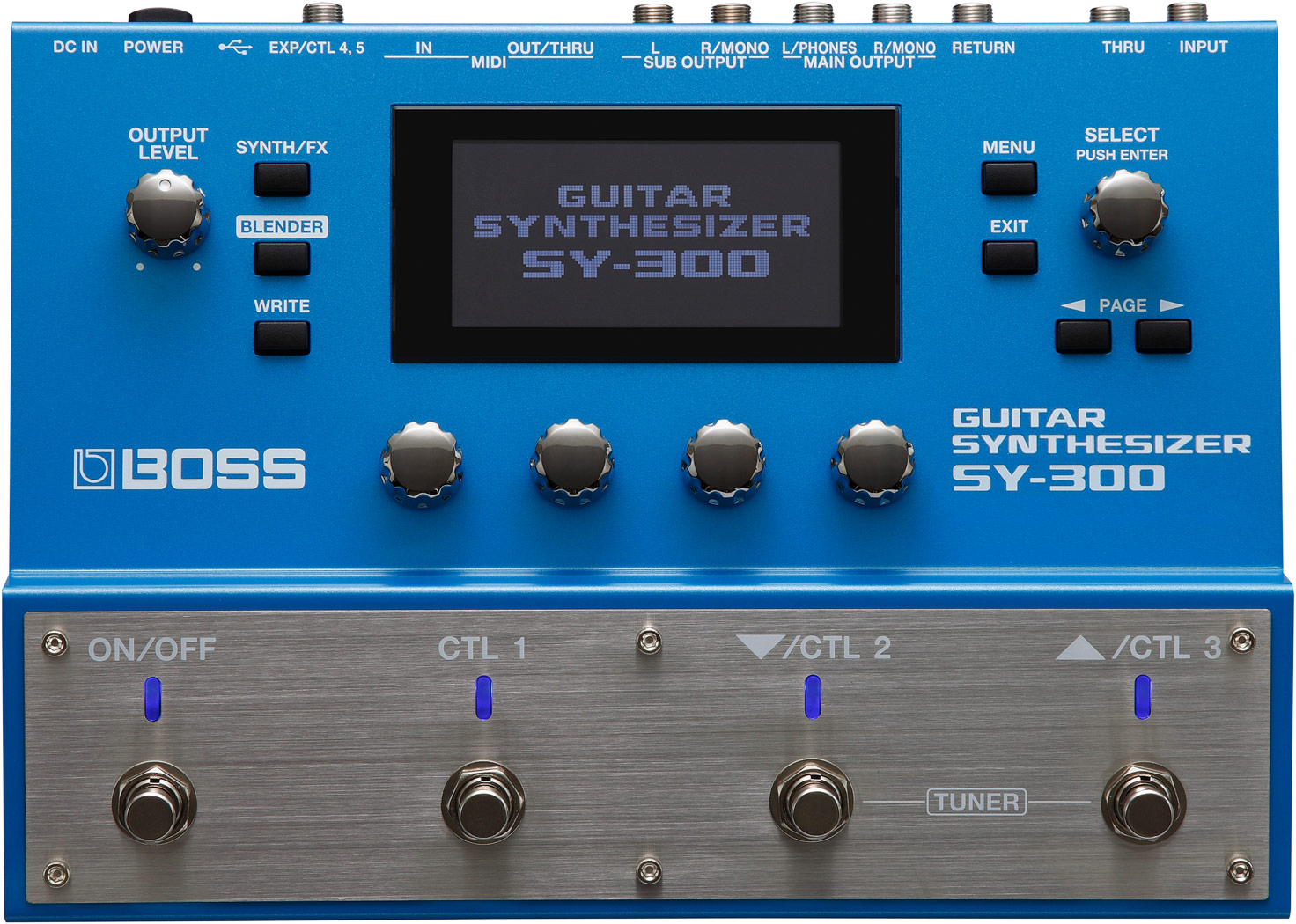
The Boss SY-300 is a chunky piece of gear and looks like a compact multi-effects unit. The external power supply unit is included in the price.
You can assign the synth’s four footswitches to different functions, but in the factory default they work as follows:
The switch on the far left is the On/Off-switch (well, actually the bypass). CTL 1 is used to change a predetermined parameter in the chosen patch (like vibrato or modulation). The last two switches (CTL 2 and CTL 3) take over patch changing duties; step on them both, and you’ll switch on the built-in digital tuner.
As we are talking about a fully featured digital piece of equipment, the amount of editable parameters is quite staggering. Luckily, the graphics-based user interface in the Boss SY-300 is well-designed, making it fairly easy to programme the synthesiser using the controller knobs beneath the display, and the navigation buttons to the right of it.
****

The SY-300’s well-spec’ed back panel will not leave you wanting:
Placed next to the guitar input are the phone jacks for the guitar synth’s external effects loop. The Ground/Lift-switch makes it safe and easy to break any hum-inducing earth loop. Boss even included two sets of stereo outputs in their synth. The Main Output could be sent to your onstage amplifiers, for example, while the Sub Output feed could be connected to the FOH console. The Main Output’s left output also doubles as a headphones jack.
It’s also easy to integrate the Boss guitar synth into any MIDI-setup, thanks to its two MIDI-ports. The jack labelled EXP/CTL 4,5 is for use with additional (optional) footswitches and/or expression pedals. The SY-300 is compatible with EV-5- and FS-7-pedals, as well as the FS-5U- and FS-6-footswitch units.
The Boss SY-300 can also be utilised as a versatile external soundcard, with the synth offer four different USB Audio-modes for just this purpose, like the nifty Re-Synth-mode, which works in the same way as reamping. The unit also sends and receives MIDI-data using USB. You can also edit patches, load new ones or share your settings with other SY-300 users with the free Boss Tone Studio software (Win/Mac OS).
****
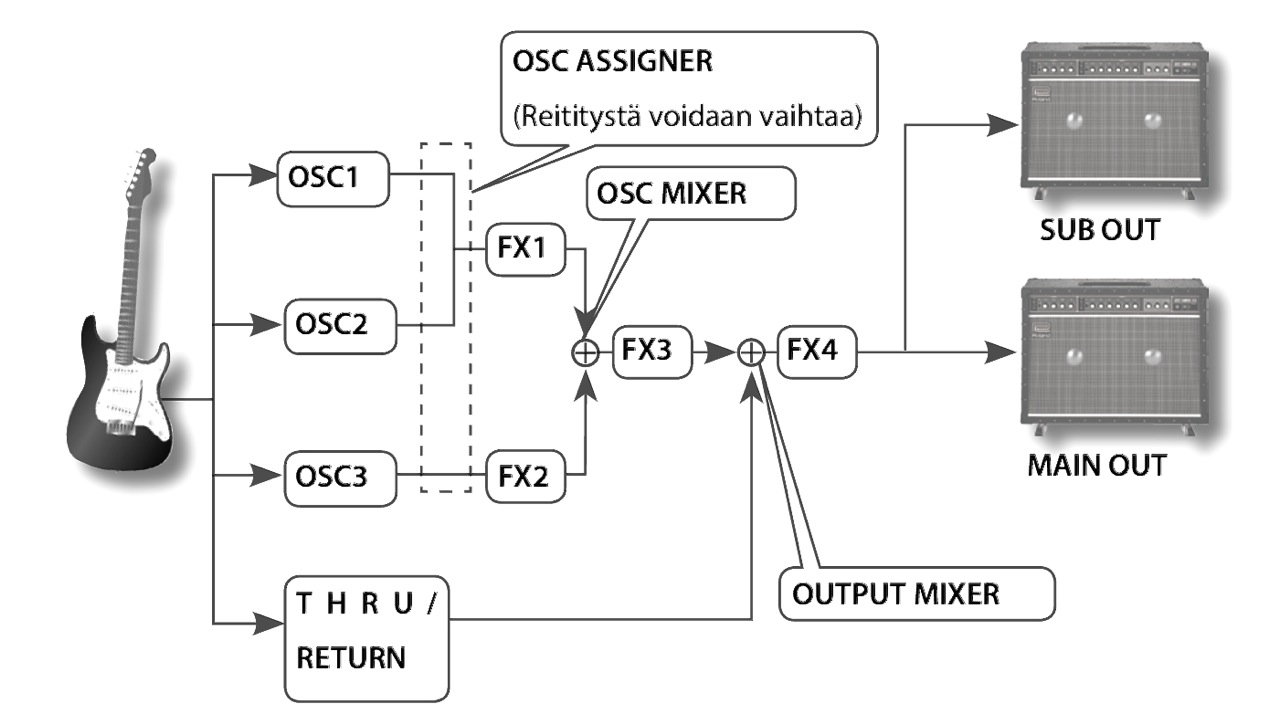
The above graphics show you the internal architecture and the signal path of the Boss SY-300. Each patch (Preset: 70; User: 99) can use up to three oscillators as sound sources (OSC1-OSC3). Each oscillator comes with a number of different waveforms to choose from (from saw to PWM, and beyond), as well as its own set of dedicated filters, LFOs and ADSR-envelope modules. A good indication of the SY-300’s versatility lies in the fact that exact placement of the oscillators in the signal path can be changed. You could have two oscillators running in parallel, with the third one placed behind the pair in series. Furthermore, the Sequencer feature makes it possible to use each oscillator as a 16-step sequencer, turning each note you play into a rhythmic and melodic pattern.
But there’s still more to come:
Boss’ new guitar synth also comes with four FX modules, each offering a very wide selection of different pro-quality effects. Depending on the chosen oscillator routing, the signal routing of the FX modules can also be changed by the user.
****

The new Boss SY-300 is a very user-friendly device, but due to its versatility – as well as the huge amount of editable parameters – you should take some time to read the user manual, before trying to programme your own patches. Especially if you’re new to the subject of synthesis, you shouldn’t be disappointed if it takes a little time, before your creations sound the way you intended.
I’m old enough to have learned synthesiser programming in the age of polyphonic analogue synths and the Yamaha DX7, which meant I felt right at home with the SY-300.
A good test of any user interface is trying to create something completely from scratch. I chose to use the Boss synth to come up with a slightly Eastern-influenced patch, that uses two oscillators in series to produce a sitar-style twangy tone, with the third oscillator assigned to produce shimmering overtones.
The resulting patch sounds like this (a single guitar synth track, plus three tracks of Roland HandSonic-percussion):
This clip gives you some idea of the types of patches included in the factory settings:
I also recorded a demo track that uses the Boss SY-300 for everything, except for the drum tracks:
****

Boss’ new guitar synth is a fantastic piece of gear, if you’re a fan of real synthesiser sounds.
The SY-300 locks on to your guitar signal very well and it tracks like a dream, staying true to both the dynamic, as well as the melodic and harmonic content of your playing.
The SY-300 isn’t meant to replace Roland’s GK-/GR-products – if you’re after realistic-sounding, multitimbral sounds, using a GK-pickup is still the easiest and best option. The Boss SY-300 is meant as a fantastic choice if you’re looking for a genuine guitar synth – in the original sense of the term. You will get huge and fat synthesiser sounds, seasoned with great effects, from the SY-300, not pianos, violins or trumpets.
****
Boss SY-300
Street price in Finland approximately 720 €
Contact: Roland
****
Pros:
+ graphic user interface
+ polyphonic
+ three OSC-modules
+ four FX-modules
+ external effects loop
+ sound
+ USB-soundcard

 Kitarablogi.com – Finland's premier Guitar and Bass blog