Changing strings – vintage-style Stratocaster

Photos: Miloš Berka

****

Here’s what you need:

A pack of strings, a wire cutter, a tuner and a guitar lead. A cheap plastic crank speeds up the whole process of string winding.

A metal ruler comes in handy for measuring the vibrato’s tip-up (the distance between the back of the baseplate and the face of the guitar), as well as the action at the 12th fret before you start. If you take down these measurements it will be easy to readjust your guitar’s vibrato and action, should the need arise, due to the new string set differing in gauge compared to the old set.

****

It’s easiest, in my opinion, to take off all of a Strat’s strings once.

****

The old strings are much easier to pull out of the vibrato block, once you’ve snipped off the coiled end that was formed by the tuner post.

****

And out the string comes…

****

On vintage-style Stratocasters the tuners are copies of old Kluson-machines, which feature a well inside the tuner post for the string to go in.

****

It’s a good idea to check the tuners for loose fixing screws, and tighten them carefully, if necessary. Slightly stiff tuners benefit from a drop of oil, applied via the small hole in the tuner’s back cover.

****
I recommend starting with the low E-string, working your way up. This way offers you slightly more manoeuvering space on the headstock than doing it the other way around.

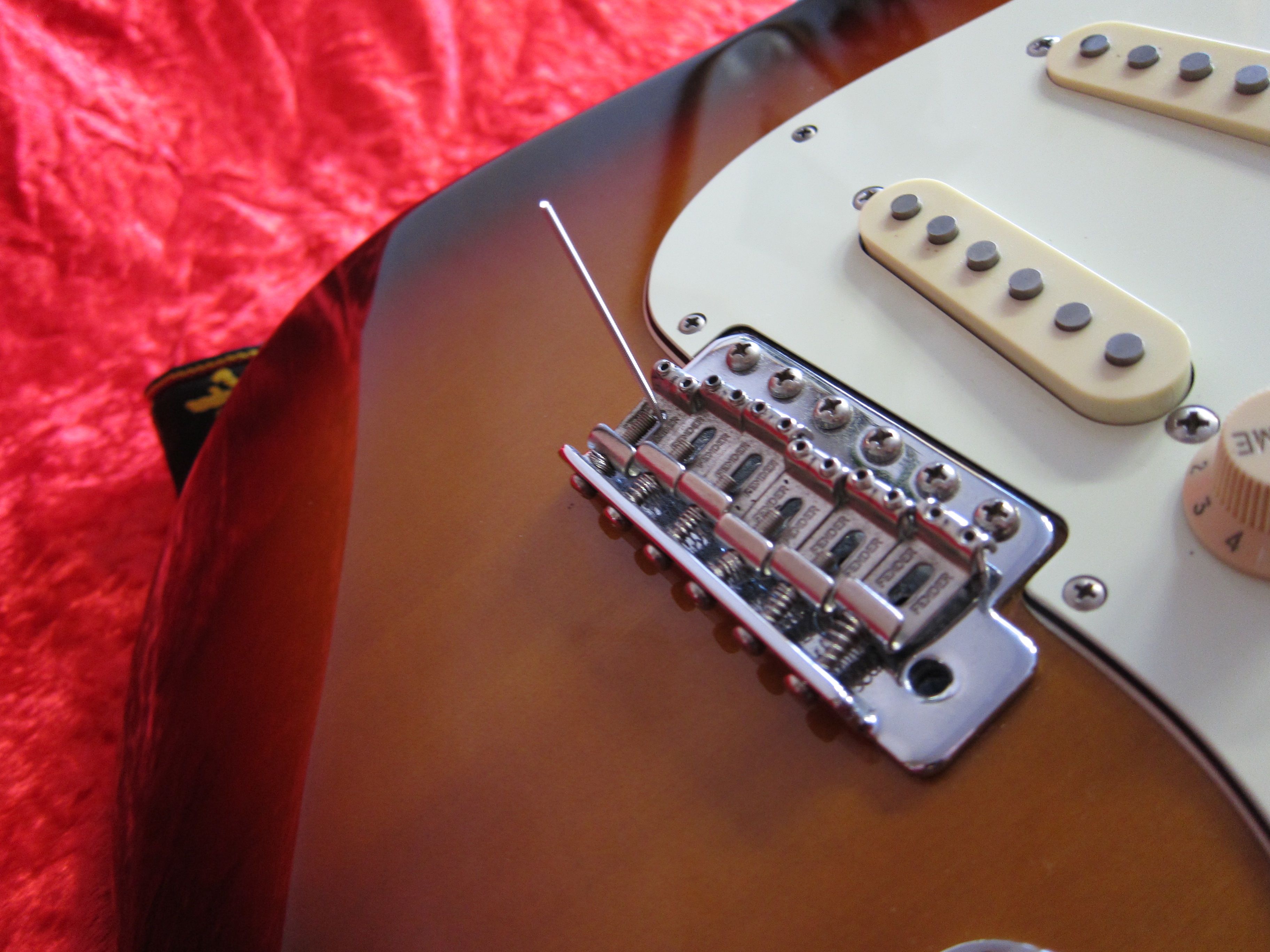
The new string is fed into the vibrato block and through the vibrato’s base plate. Pull the string up first in a straight line away from the body, until you feel the ball-end hitting the top of the vibrato block, before pulling the string towards its tuner.

If you pull the string carelessly through the vibrato block, pulling it towards the tuner before the ball-end has travelled fully through the block, you can easily end up with a kink in the brand-new string, which may well cause breakage, possibly already during the first tune-up.

****

Because of the handy hole in the tuner post, you won’t need the full length of string. Shorten it, by cutting it off at about the second next tuner post (in this case at the D-string’s tuner). Be careful, cutting through a string may cause it to jump at you. The cut-off point is very sharp, so mind your eyes!

****
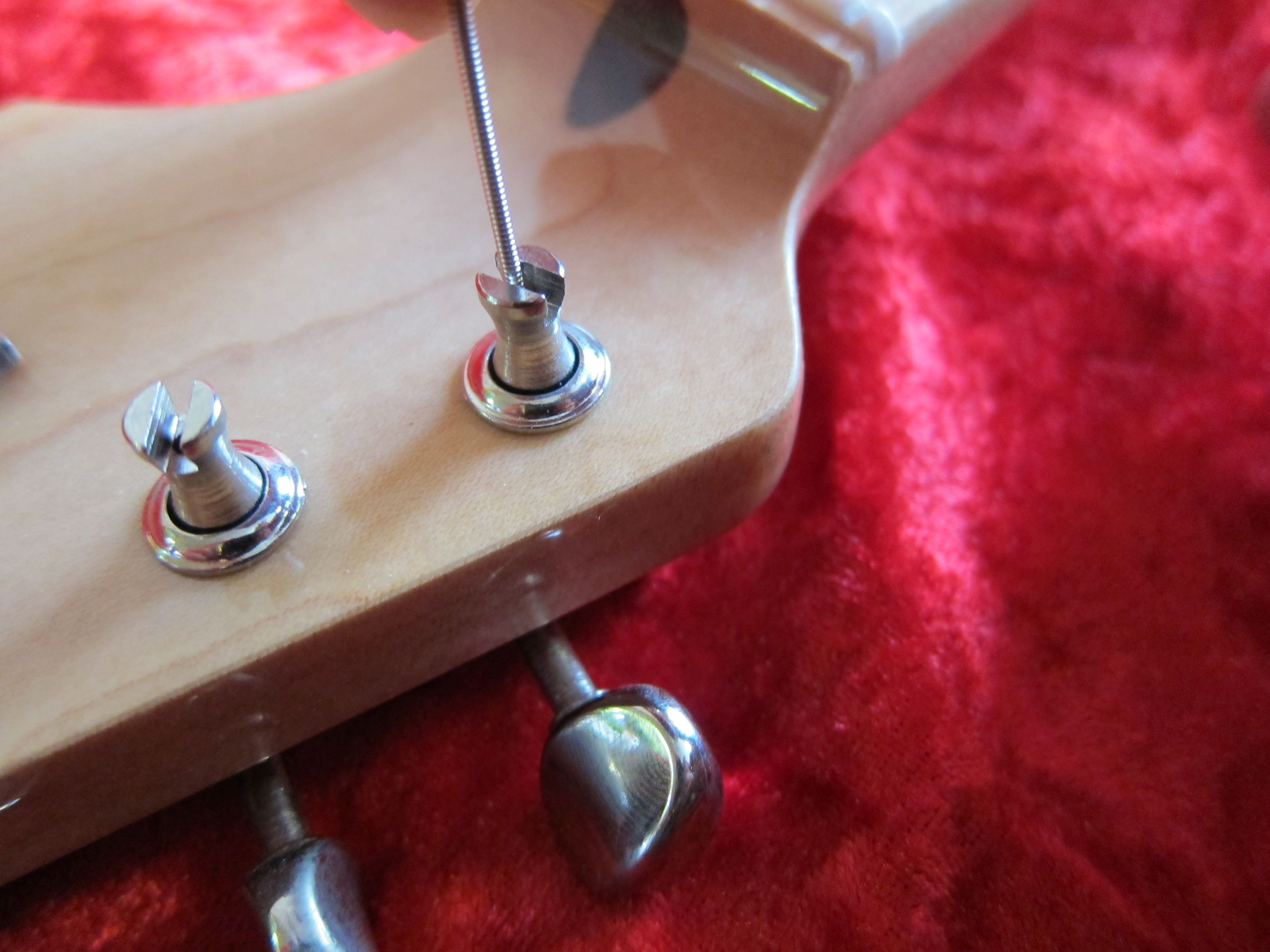
Feed the start of the new string all the way into the tuner post…
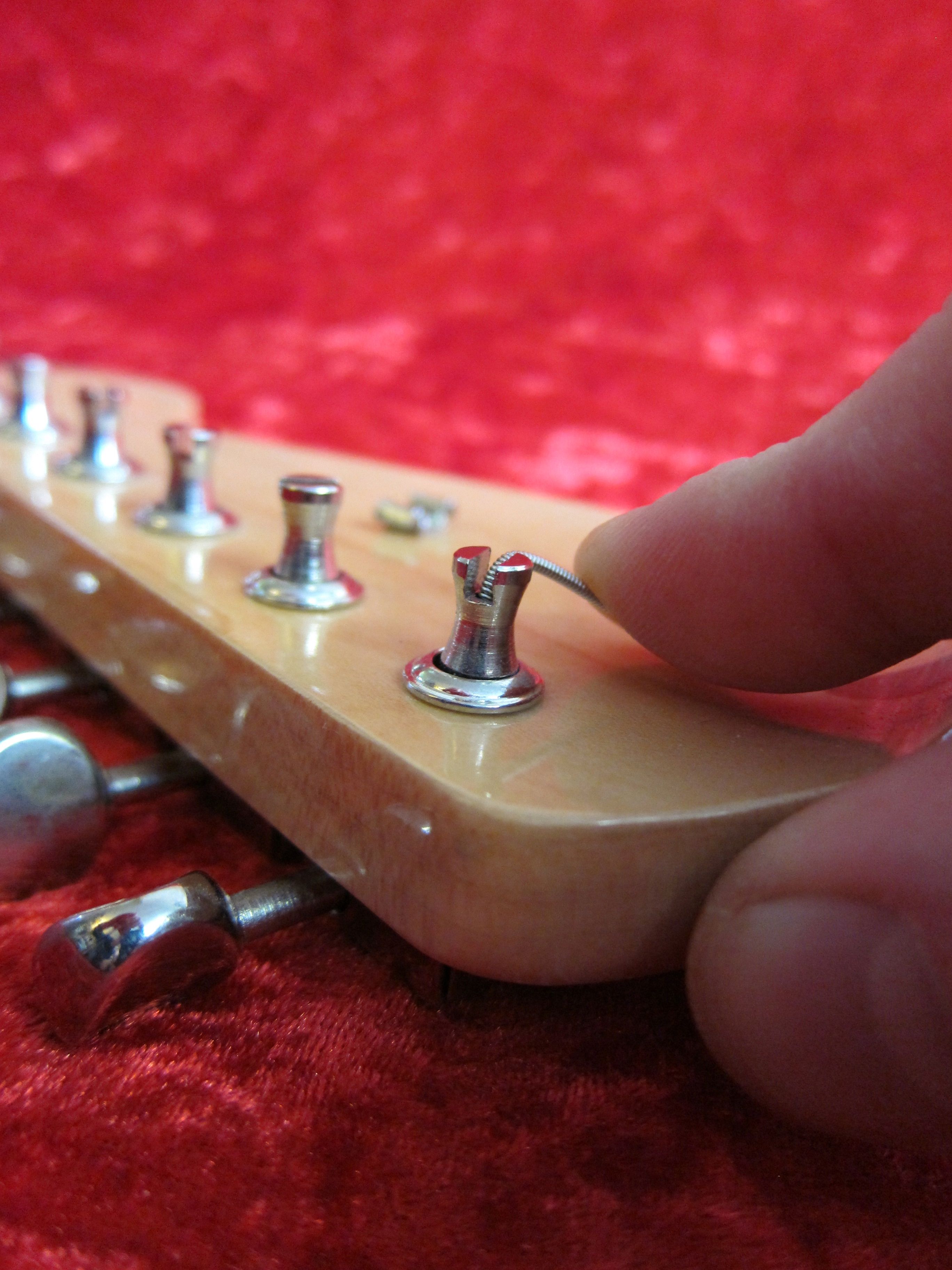
…then bend it towards the headstock, once it’s in.

****
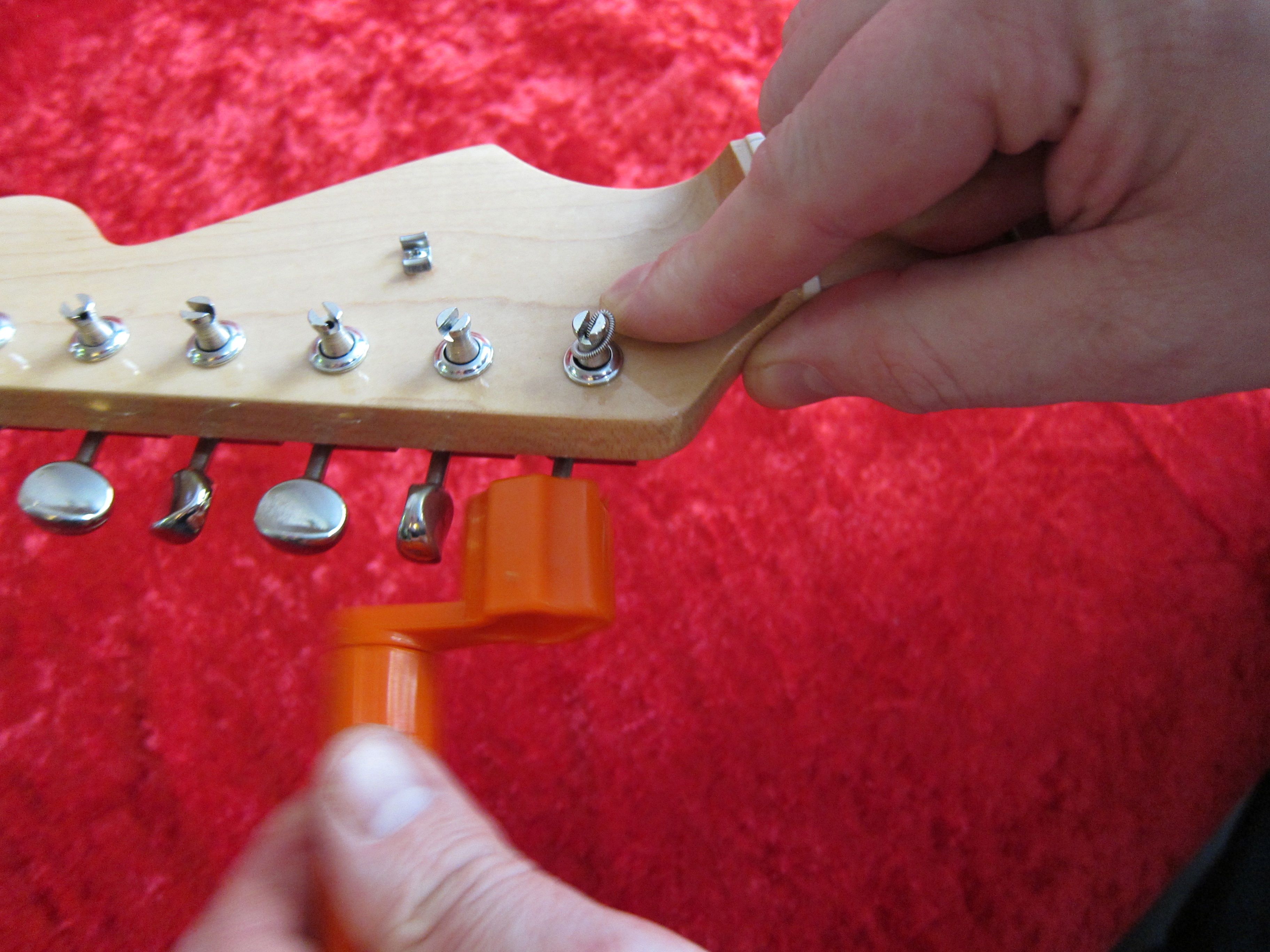
Keep the string pressed downwards, while you’re turning the crank. Each new winding should pass under the one before it.

****

Note that the bridge saddles on a vintage-type Strat feature no groove for string alignment. You can check the correct alignment by looking at the middle pickup. Each string should pass over its magnet approximately through the middle.

Realigning a string is much easier, if you remember to tune down a few turns before pushing the string over the saddle’s surface.

****

Getting new strings to stay in tune is a much faster process, if you stretch each string carefully. It works like this: First you tune to pitch, then you stretch each string, and retune again. Once you’ve repeated this process four to five times, you should be ready to go (a floating vibrato may need a few tugs and retunings more).

Your fretting hand should hold down the string you’re stretching at the first or second fret to avoid damage to the top nut.

Once the guitar is in tune you should check the tip-up of the bridge and the string action at the 12th fret and compare it with the values measured with the old string set. Adjust the tip-up first by changing the position of the spring claw inside the back compartment, before adjusting the action via the bridge saddles’ adjustment screws.

****

The last stage should be checking and resetting the guitar’s intonation. Always check your intonation with the guitar in playing position, by comparing the correctly tuned open string (or its 12th fret harmonic) to the fretted pitch at the 12th fret.

If the fretted note is flat (its pitch too low), you need to adjust the bridge saddle closer to the bridge pickup. Give the screw a few turns, then retune and check again. Repeat if necessary.

If the fretted note is sharp (its pitch too high), you need to adjust the bridge saddle further away from the bridge pickup. Give the screw a few turns, then retune and check again. Repeat if necessary.

***

Kielten vaihtaminen – vintage-tyylinen Stratocaster

Kuvat: Miloš Berka

****

Kielten vaihtamiseen tarvitaan vintage-tyylisessä Stratocasterissa kielisatsin lisäksi terävän leikkurin, viritysmittarin ja kitarajohdon. Halpa muovikamppi nopeuttaa virityskoneiston kääntämistä.

Metalliviivoittimella taas mitataan ennen kuin aloittaa vibraton aluslevyn takareunan etäisyyttä runkoon sekä kielten korkeus 12:n nauhan kohdalla. Mittaamisen ansiosta kitaran säätäminen soittokuntoon helpoittuu huomattavasti, silloin kun on vaihdettu kielten paksuutta.

****

Mielestäni Stratossa on helpointa ottaa ensin kaikki kielet pois.

****

Kun poistaa ensin virittimen aiheuttama kierre, kielen voi vetää vibrablokin läpi ilman turhaa kitkaa.

****

Vanha kieli vedetään rungon takaosasta ulos.

****

Vintage-tyylisissä Stratoissa käytetään vanhojen Kluson-virittimien kopiot, joissa on tapin keskellä kanava terävälle kielipäälle.

****

Nyt on hyvä hetki kiristää varovaisesti virittimien kiinnitysruuveja. Jos virittimet ovat hieman jäykistineet voi kotelon reiän läpi lisätä tilkkua öljyä koneistoon.

****

Aloitan aina ala-E-kielestä ja jatkan sitten ylöspäin.

Uusi kieli pujotetaan vibrablokin läpi ja vedetään ensin suoraan poispäin rungon etupuolesta. Vasta kun ball-end-niminen metallirengas on saavuttanut kanavan loppupään, vedetään kieli viritinlavalle.

Jos ball-end-rengas ei ole vielä oikeassa kohdassa uusi kieli taipuu ensin väärästä kohdasta, mikä voi aiheuttaa sen katkeamista viritettäessä.

****

Uusi kieli lyhennetään sopivasti – noin kaksi virittimiä oikean tapin ohi. Varo silmiäsi, kieli voi tulla yllättävästi vastaan! Kielipää on aika terävä!

****

Kielipää upotetaan huolellisesti tapin kanavaan…

…ja kieli taivutetaan lapaa kohti.

****

Yksi käsi painaa kielen alas, kun toinen kiertää sen kireäksi. Kielen pitää kiertää tapin ympäri ylhäältä yhä alemmas.

****

Vintage Straton tallapaloissa ei ole kieltä kohdistava ura. Kun kaikki kielet ovat paikoillaan tasaisen etäisyyden voi tarkistaa keskimikistä. Jokaisen kielen pitäisi mennä kutakuinkin keskimikrofonin magneetin keskikohtaa läpi.

Kun virittää kielen ensin hieman alas, on helpompi työntää sen oikeaan paikkaan.

****

Kielet pitävät virettä nopeammin, jos niitä venytetään ensimmäisten viritysten yhteydessä: ensin viritetään, sitten venytetään…neljän-viiden kerran jälkeen viritys pitäisi alkaa asettua (jos vibra on säädetty kelluvaksi, se voi kestää kauemminkin).

Otekäsi pitää kielen alhaalla venymisen yhteydessä, jottei satulaan kohdistaisi liikkaa rasitusta.

Kun kitara on viritetty voidaan mitata uusien kielten korkeus 12:n nauhan yllä sekä tarkistaa onko tallan asento sama kuin vanhoilla kielillä. Tarvittaessa säädetään ensin vibran aluslevyn korkeutta (kiristimällä tai löystämällä jouset rungon takapuolella). Tämän jälkeen viritetään uudestaan ja säädetään tarvittaessa kielten korkeus uudestaan tallapalojen ruuveilla.

****

Viimeinen vaihe on intonaation tarkistus ja (jos on tarve) säätäminen. Intonaatiota tarkistetaan kitara sylissä soittamalla ensin avoimen kielen (tai kielen huiluääntä 12:n nauhan kohdalla) ja sen jälkeen kieli painettua alas 12:n nauhalla.

Jos alaspainetun kielen sävel on matalampi kuin tavoitettu sävel, tallapalan täyttyy säättää lähemmäksi tallamikrofonia. Tämän jälkeen viritetään uudestaan ja tarkistetaan intonaatiota uudestaan.

Jos alaspainetun kielen sävel on korkeampi kuin tavoitettu sävel, tallapalan täyttyy säättää tallamikrofonista poispäin. Tämän jälkeen viritetään uudestaan ja tarkistetaan intonaatiota uudestaan.

***

Näin poistetaan Rickenbacker-bassosta tallamikrofonin suoja

Nykyään lähes kaikki soittajat poistavat Rickenbacker 4003 -bassosta tallamikrofonin suojan, koska se on yksinkertaisesti tiellä.

Tässä Gear Wiren mainio video-opas aiheeseen:

HUOM: Videossa ei mainita, että vanhoissa 4001-malleissa (sekä niiden uusintapainoksissa) tallamikrofonin suoja ei ole pelkästään suoja, vaan se on mikrofonin magneetti. Näistä malleista suojan/magneetin luonnollisesti ei saa poistaa!

Lataa Rickenbackerin pdf-tiedosto tallamikrofoneista tästä:

Rickenbacker 4003/4001 bridge pickup assemblies

Putting a new jack plate on a Les Paul

pictures: Béla Berka

Les Paul jack plates are traditionally made of plastic on most models. Plastic is a great flexible material – until it gets brittle through ageing, that is. The jack plate on my Junior lost one of its corners recently, so it was time for a new one.

I decided to switch to a chromed metal jack plate this time, which should last considerably longer than plastic. A genuine Gibson-plate should (at least theoretically) guarantee the new plate will be a straight swap without complications.

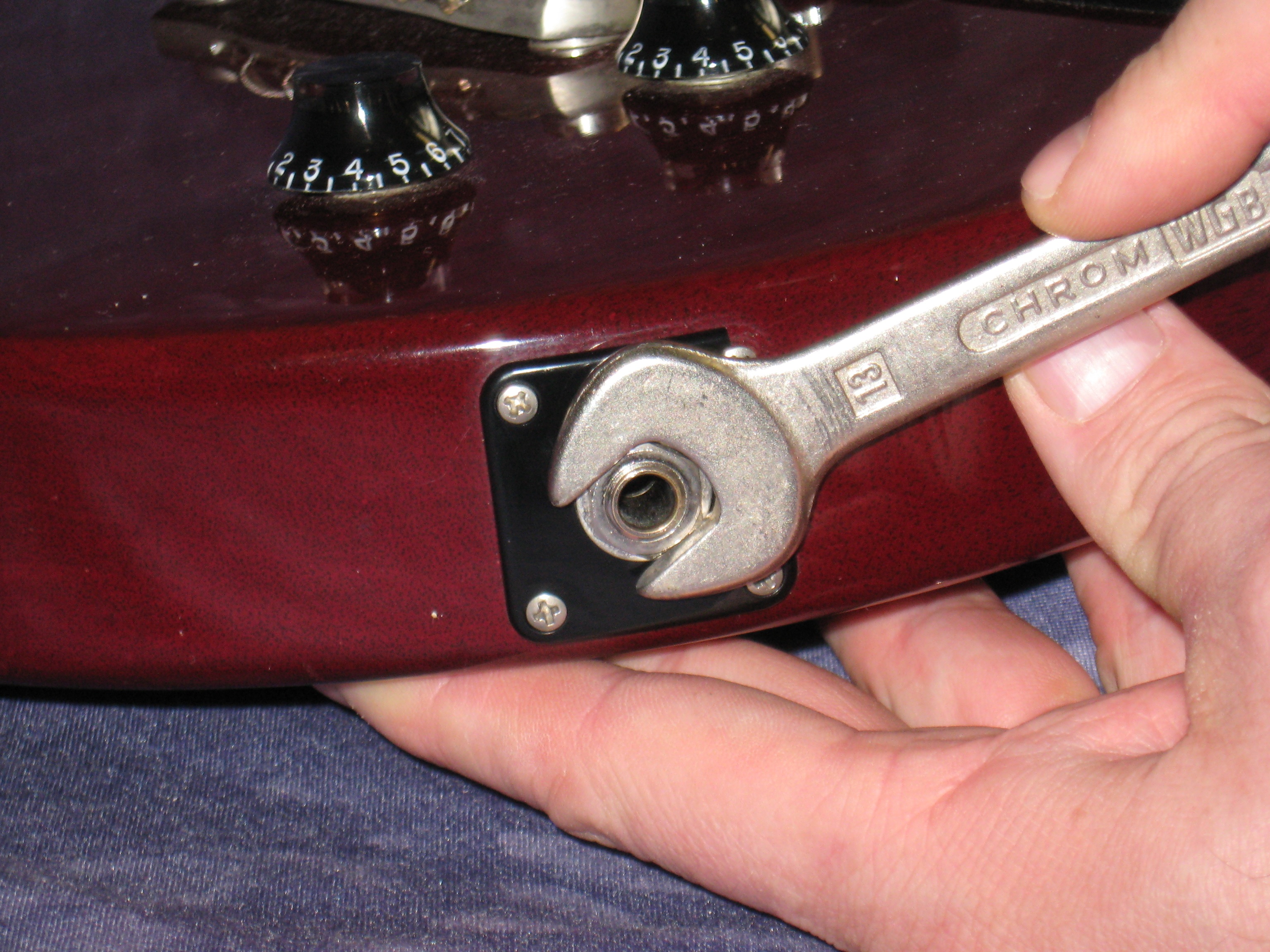
I’d recommend you loosen the nut before taking off the plate.

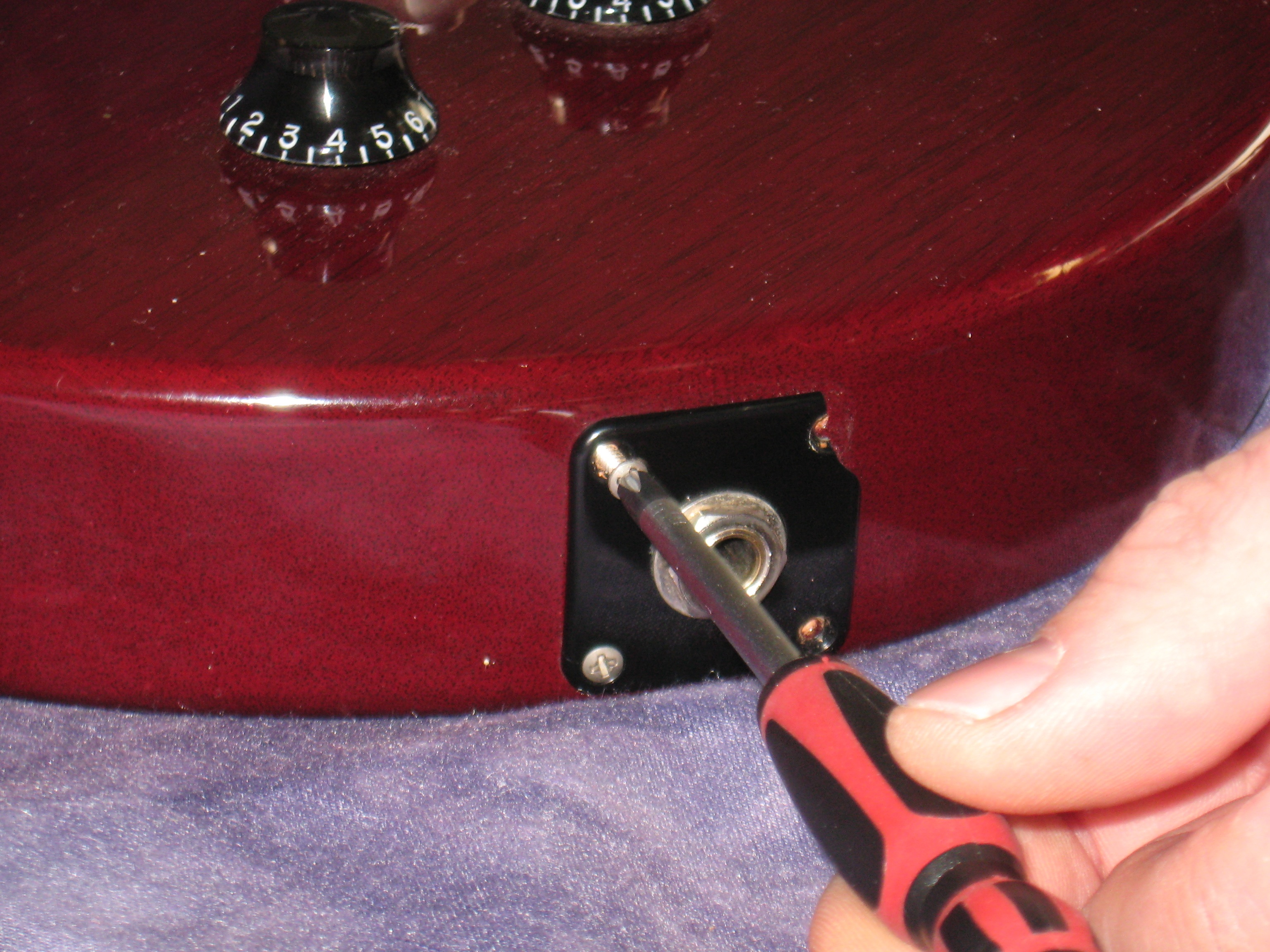
A screwdriver with the correct tip will keep the screw heads in working order.

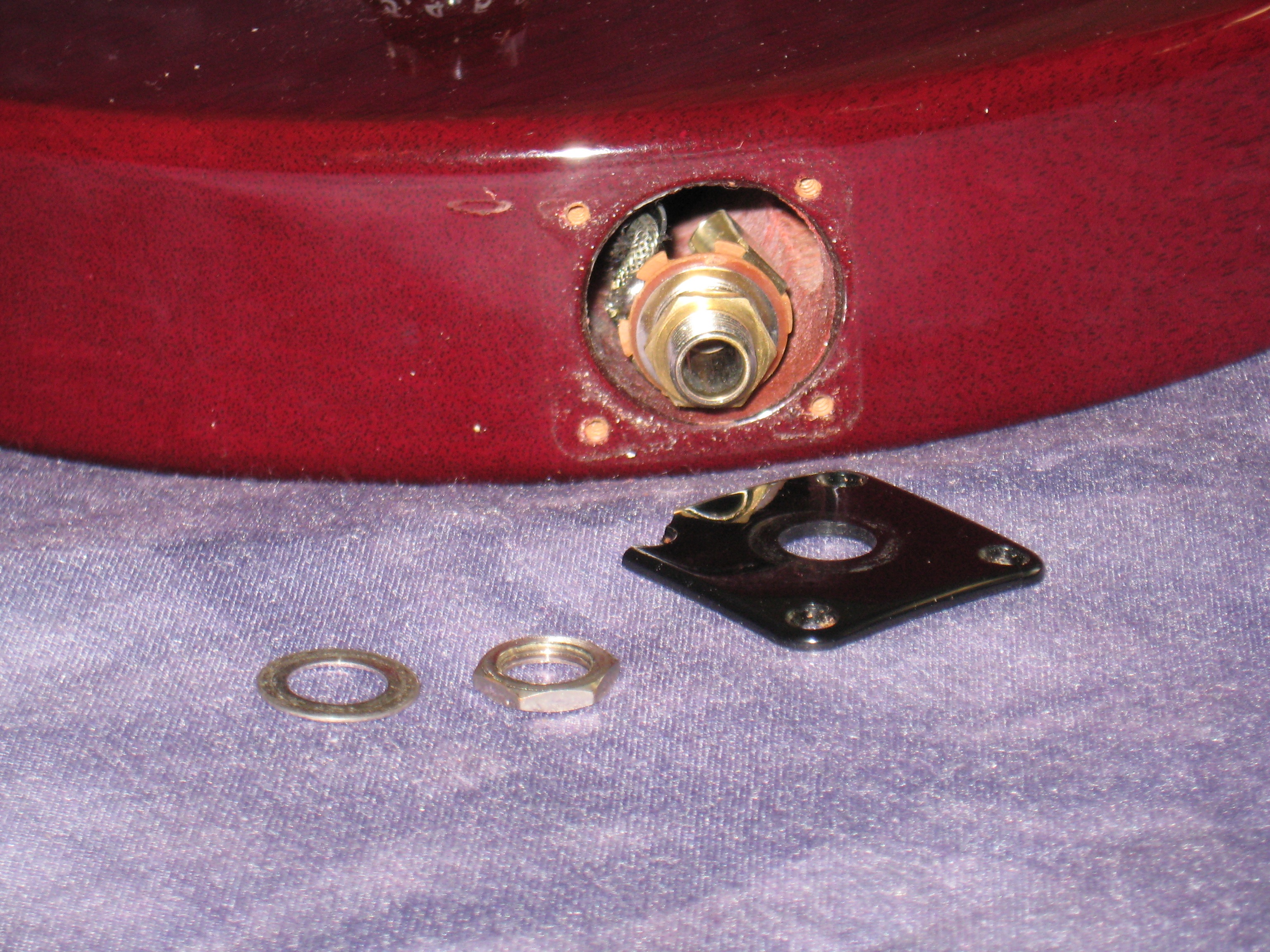
The nut is easy to unscrew with your fingers, if you’ve remembered to loosen it at the start of our little operation.

Fix the jack to the plate using only very moderate force – if you overdo it the jack might bend. It’s important to hold the jack in place to keep it from turning along with the nut. If you allow the jack to spin chances are you’ll rip off the leads in no time.

In some cases a jack will only fit into the cavity in one particular position. If the jack doesn’t fit in snugly and easily, loosen the nut a little bit and try to find the correct position.

The Gibson-plate fits like a glove, so all that’s left to do is screw it back in place.

Mission accomplished – shiny new plate on cherished old guitar!  😀

Jakkilevyn vaihto Les Paulissa

kuvat: Béla Berka

Lähes kaikissa Gibson Les Paul -malleissa jakkilevy on muovista. Muovin hyvä puoli on, että se on joustava materiaali – mutta vain tietyn ajan. Minun Juniorin noin kymmenen vuotta vanhasta jakkilevystä on hiljattain murtunut yksi kulmista. Oli siis uuden aika…

Tällä kertaa päätin hankkia kromatun metallilevyn, jonka pitäisi kestää muovia kauemmin. Aidon Gibson-varaosan pitäisi sopia vanhan jakkilevyn tilalle ilman ongelmia.

Ennen kuin poistaa ruuvit on suositeltavaa löysätä jakin mutteria hieman sopivalla avaimella.

Oikean kokoinen ruuvimeisseli pitää ruuvien päät ehjinä.

Jakin mutteri lähtee nätisti käsivoimilla, kun on muistettu löysätä sitä operaation alussa.

Jakin mutteri kiristetään hyvin maltillisella voimalla, muuten jakki voi vääntyä. On tärkeää pitää jakkia sormilla paikoillaan, jottei se pyörii kiristäessä mukana – johdot voisivat irtoa.

Joissakin tapauksissa jakki sopii vain yhdessä tietyssä asennossa takaisin kitaraan. Jos näin on, täytyy avata mutterin vielä kerran ja asemoida jakkia uudestaan.

Uusi levy sopii kuin nakutettu, joten ruuvit huolellisesti takaisin puuhun.

…ja tältä näyttää valmis asetelma.

Pidä blogia WordPress.comissa.

Ylös ↑