Marco de Virgiliis’ company Markbass has made its mark spearheading the use of Class D power amps, which have made it possible to pack an amazing amount of output power into very small and lightweight bass amp heads. Markbass’ sister brand, DV Mark, concentrates on guitar amps, for the most part.
Markbass and DV Mark have recently changed their distributor in Finland. Their products are now distributed by Musamaailma, which celebrates its 30th year in business in 2015.
The combos in DV Mark’s Jazz series – the DV Little Jazz (current price in Finland:393 €) and the DV Jazz 12 (462 €) – are very lightweight guitar amps, meant for professional use, and designed to concentrate solely on one thing – a top grade clean tone.
****
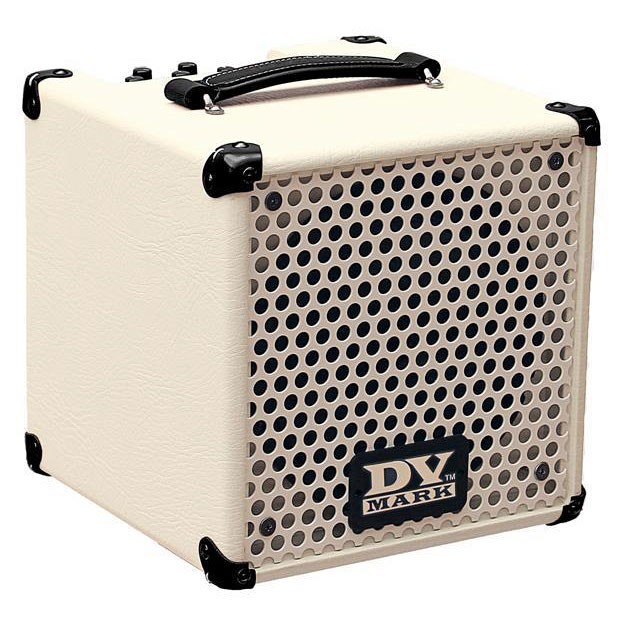
The DV Little Jazz is a surprisingly small combo in the shape of a cube (27 x 27 x 26 cm). Thanks to its diminutive size and small weight (just under seven kilos), you can easily take it on a bus or tram on the way to your next gig or rehearsal.
The cream white cabinet is home to an eight-inch speaker that was specially designed for this amp.
The corner protectors and the Little Jazz’ sturdy metal grille give this small combo a suitably chunky look.
The DV Jazz 12 is a good deal larger in size (43 x 42 x 30 cm), with a more traditional guitar combo look and a stylish cloth grille.
Thanks to its special-design, neodymium 12-inch speaker, the Jazz 12 weighs in at just under nine kilos.
Both combos have a partially open back, and they share an identical, fan-cooled amplifier module dishing out 45 watts of power.
The back panel offers a speaker output, a balanced DI output (XLR), as well as a headphones output and an on/off-switch for the internal speaker.
In addition to the Master volume, the control panel sports a three-band EQ section, a level control for the built-in digital reverb, as well as an auxiliary input for your phone, tablet or mp3-player.
****
The sound of both DV Mark Jazz-combos is really clean, warm and beautiful, but never lifeless or one-dimensional. The inherent character of your chosen guitar is kept intact, and the same holds true for all the intricacies of your playing technique.
You can then fine-tune the tone to your liking by using the musical EQ section.
A fantastically realistic spring reverb simulation works as the basis for the reverb sound in these DV Mark combos. To add even more character and depth to the overall tone, DV Mark’s designers have chosen to add some pitch modulation to the reverb. Adding reverb in moderate amounts, the modulation adds a chorus-like breadth to proceedings. At full-on Surf-style settings, though, the pitch modulation could prove to be a tad distracting to some guitarists.
My only real criticism regarding the Little Jazz and Jazz 12 combos has to do with their continuous fan-cooling. On stage the – relatively quiet – whoosh of the PC-type fan won’t be a problem, but in intimate recording studio settings some fan noise may end up on ”tape”.
I would really like to stress that, despite looking like a small practice amp, the DV Mark Little Jazz really is meant for active onstage use – it’s not a toy! The combo’s 45 W will be enough in many situations, and if you need more power, you can simply stick a mic in front of it or use the excellent built-in DI-output.
For such a small amp the Little Jazz sounds surprisingly big and warm, even though there’s a small trace of boxiness to the tone, when compared directly with the Jazz 12. DV’s Little Jazz sounds like the grown up guitar combo it really is.
Here’s a short clip using a Fender Telecaster and recorded with a Shure SM57:
This is what a double humbucker Hamer sounds like through the Little Jazz:
Here’s a short clip of the built-in reverb:
The DV Jazz 12 could be called the Little Jazz’ deluxe edition, thanks to its bigger and slightly more open sound. The larger speaker combined with a larger cabinet gives the brilliant clean tone more space to breathe. The end result is one of the best clean sounds I’ve ever heard.
The first clip has been played on a Telecaster:
Here’s a similar clip with my Hamer USA Studio Custom:
I’ve used an Epiphone Casino (equipped with Göldo pickups) for the demo track. The first pass is the Little Jazz, the second pass has been recorded with the Jazz 12:
****
The DV Mark Little Jazz and Jazz 12 are two great combos for the gigging guitarist. And I don’t just mean Jazzers.
These DV Mark combos are also fantastic choices for players who like to get their sounds from pedals or multi-effect boards. By combining a pair of Little Jazzes or Jazz 12s you’ll end up with a great-sounding stereo rig, which will still be easy to transport.
Marco de Virgiliisin perustama Markbass on tunnettu edelläkävijänä D-luokan päätevahvistimien käytössä, mikä on mahdollistanut tehokkaiden bassovahvistimien tarjoamista erittäin kompaktissa ja kevyessä muodossa. Markbassin sisarbrändi DV Mark taas keskittyy kitaravahvistimiin.
Markbassin ja DV Markin edustus Suomessa on muuttunut hiljattain – uusi maahantuoja on Musamaailma.
DV Markin Jazz-sarjan kombot – DV Little Jazz (393 €) ja DV Jazz 12 (462 €) – ovat ammattikäyttöön tarkoitettuja, hyvin kevyitä kitaravahvistimia, jotka keskittyvät täysin yhteen asiaan – erittäin laadukkaaseen puhtaaseen soundiin.
****
DV Little Jazz on todella pienikokoinen, kuutiomainen (27 x 27 x 26 cm) kitarakombo, joka kulkee erittäin helposti soittajan mukana. Paino pysyy jopa seitsemän kilon alapuolella.
Kermanvaalean kotelonsa uumeniin on asennettu 8-tuumainen, juuri tätä vahvistinta varten suunniteltu kaiutin.
Kestävä metallinen eturitilä antaa kombolle sopivasti tukevan ulkonäön.
Selvästi isomman (43 x 42 x 30 cm) DV Jazz 12 -kitarakombon ulkonäkö on perinteisempi, ja sen tumma etukangas kenties myös tyylikkäämpi.
Erikoisvalmisteisen, 12 -tuumaisen neodyymikaiuttimensa ansiosta Jazz 12:n paino pysyy jopa alle 9 kiloa.
Molemmissa komboissa on identtinen, tuulettimella jäähdytetty 45-wattinen vahvistinmoduuli, sekä puoliavoin takaseinä.
Takapaneelista löytyy lähtö lisäkaiuttimelle, balansoitu DI-lähtö, päälle/pois-kytkin sisäiselle kaiuttimelle, sekä kuulokelähtö hiljaista harjoittelua varten.
Etupaneeli taas tarjoaa master-volumen lisäksi kolmikaistaisen EQ-osaston, digitaalisen kaiun, sekä aux-tulon mp3-soittimelle.
****
DV Markin Jazz-sarjan kombojen soundi on todella puhdas, lämmin ja kaunis, muttei koskaan tylsä tai yksiulotteinen. Käytetyn soittimen luonne säilyy täysin ehjänä, ja myös kitaristin soittotekniikan jokaista yksityiskohtaa vahvistetaan uskollisesti.
Erittäin tervettä perussoundia voi sitten maustella itselleen sopivaksi kombon oivilla Bass-, Mid- ja Treble-säätimillä.
Kaiun perustana toimii DV Mark -kaksikossa erittäin luonnollisen kuuloinen jousikaiun mallinnus. Kaikuun on kuitenkin lisätty pikkuannos sävelkorkeuden huojuntaa, joka syventää kaiun maltillisilla asetuksilla (chorus-efektin lailla) sopivasti vahvistimen soundia. Surf-tyylisillä asetuksilla (= kaiku täysille) kaiun modulaatio voi kuitenkin mahdollisesti häiritä huojunnalle herkkää kultakorvaa.
Ainoa kritiikkikohta koskee Little Jazzin ja Jazz 12:n tuuletinta – lavalla tuulettimen (sinänsä hiljainen) käyntiääni ei varmasti koidu ongelmaksi, mutta erittäin intiimeissä studiotilanteissa pieni annos aktiivituuletuksen suhinaa voi joskus päätyä ”nauhaan”.
Haluaisin korostaa sitä, että vaikkapa DV Little Jazz näyttääkin pieneltä harjoituskombolta, se on todellakin live-käyttöön tarkoitettu kitaravahvistin, eikä lelu! Kombon 45 wattia riittävät mainiosti moniin tilanteisiin, ja lisätehoa saa helposti joko mikittämällä tai mainion sisäänrakennetun DI-lähdön kautta.
Soundiltaan Little Jazz on yllättävän iso ja lämmin, vaikka suorassa vertailussa Jazz 12:een pikkuinen annos soinnillista ahtautta on toki havaittavissa. DV Little Jazz kuulostaa kuitenkin aikuiselta kitarakombolta.
Tässä Telecasterilla soitettu esimerkki:
Ja tältä humbuckereilla varustettu Hamer kuulostaa:
Tässä yksi lyhyt näyte kaikusoundista:
DV Jazz 12 -komboa voi mielestäni kutsua Little Jazzin deluxe-versioksi, sen isomman ja hieman avoimemman soundinsa ansiosta. Jazz-sarjan loistava perussoundi saa suuremman kaiuttimen ja isomman kotelon kautta yksinkertaisesti enemmän tilaa hengittää. Lopputulos on vaikuttavaa.
Ensimmäinen esimerkkipätkä on soitettu Fender Telecasterilla:
Toisessa soi Hamerin Studio Custom -kitara:
Demobiisissä käytin (Göldo-mikrofoneilla varustettua) Epiphone Casinoa. Ensimmäinen läpimeno on äänitetty Little Jazzilla, kun toisessa puoliskossa kuullaan Jazz 12 -komboa:
****
Kauniilla clean-soundilla varustetut Little Jazz- ja Jazz 12 -kombot ovat mielestäni loistava valinta monille kitaristeille, ei ainoastaan Jazz-musiikin ystäville.
DV Mark -kombot tekevät nimittäin myös erinomaista yhteistyötä pedaalilaudan (tai multiefektin) kanssa. Kahdella kombolla voi rakentaa itselleen tehokkaan ja hyväkuuloisen stereojärjestelmän, joka on silti vielä todella helppoa roudata.
”What – yet another Stratocaster model!? Who needs another Strat? Yeah, man, I’ve noticed there’s a ’bucker at the bridge position, but that’s been done before, hasn’t it!”
True, but this is a new American Standard model you should definitely try out, because the guys at Fender R&D have come up with a couple of nifty improvements that haven’t been available on HSS-Strats thus far.
”A Shaw-what?”
Fender calls its newest bridge humbucker the Shawbucker in honour of the man who designed it, Tim Shaw. Mr Shaw is a genuine living legend, and held in high esteem amongst people in the know. In the 1970s and 80s he worked for Gibson, and helped to turn around the company’s flagging fortunes and decline in quality. As the resident electronic guru he played a pivotal role during the design of models, such as the Gibson Les Paul Heritage 80, coming up with the first reissue of the original PAF-humbucker. This pickup is still in production, now known as the ’57 Classic. Later, Shaw moved on to Guild, and from there to Fender Musical Instruments.
In terms of its basic build the model continues within the time-tested parameters of the American Standard product line.
The Shawbucker Strat is built using a solid ash body and a bolt-on maple neck.
The neck profile is a friendly, modern ”C”, with the rosewood fingerboards flatter-than-vintage radius of 9.5″ and the 22 jumbo-sized frets further contributing to a contemporary playing feel.
The two-way truss rod is adjusted from the headstock.
Fender’s Deluxe machine heads work smoothly and accurately.
The American Standard Shawbucker also sports the company’s patented neck angle adjustment.
The current American Standard vibrato bridge combines a modern, knife-edge, twin-post base plate with vintage-type bridge saddles made from folded steel.
Our review sample came with a slightly steep bridge tip up, which I adjusted back to factory specs in no time, using the correct Phillips head screwdrivers.
The HSS Shawbucker features a well-balanced set of pickups:
A pair of Custom Shop Fat ’50s single coils have been selected for neck and middle pickup duties. The middle pickup is RW/RP, making position four on the five-way switch humbucking.
The Shawbucker is a moderate-output, vintage-voiced humbucker with a PAF-type tone.
The control set-up looks pretty standard, but there’s more to the Shawbucker Strat than meets the eye:
Single coil pickups and humbuckers usually require different types of potentiometers to function satisfactorily. Single coils tend to sound best with 250k controls, as they attenuate some of the sharpest, most biting trebles in the signal. Humbuckers, on the other hand, tend to work better with higher resistance values – 500k, usually – which keep this pickup type’s softer top end intact. Tone control circuits usually also employ differently valued capacitors for single coils and humbuckers, respectively.
Most HSS- and HSH-loaded guitars suffer from the compromises shared control pots and tone circuits entail, when mixing the different pickup types. As a result, you either end up with muddy-sounding humbuckers or uncomfortably scratchy single coils.
The genius of the Shawbucker Strat lies in the two stacked potentiometers it uses. The same pot shaft simultaneously turns both a 250k and a 500k pot stacked on top of each other. The Shawbucker Stratocaster employs these stacked pots for the master volume control and for the joint bridge-and-middle tone circuit. The 500k side deals with all things humbucker, while the 250k layer is reserved for the single coil signals. As the neck tone is reserved for the neck pickup only, it uses a traditional 250k pot.
The second position on the five-way switch gives you the middle pickup together with the split Shawbucker.
The American Standard Stratocaster HSS Shawbucker guitar comes in its quality hard case, with a strap and a guitar lead also included in the price.
****
I don’t think there’s much need to talk about the Stratocaster’s time-proven ergonomics. Same goes for the well thought-out contemporary improvements the American Standard series offers. The American Standard Stratocaster has been the top seller of Fender’s US output for decades.
The review instruments is a fitting torchbearer for this industry standard – it’s a great-feeling, great-playing, lightweight guitar.
Its acoustic voice is fresh, dynamic and strong, and the Shawbucker Strat’s vibrato works very well in the middle ground between a vintage vibrato and a double-locking Floyd Rose whammy.
Thanks to the chunky nature of the Custom Shop Fat ’50s, this model’s bridge humbucker never manages to overpower the single coils. Yes, there is a slight jump in signal level, when you switch from the Fat ’50s to the Shawbucker, but here it feels very organic and musical.
To my ears the HSS Shawbucker sounds fantastic, offering a bridge position signal boost, while retaining plenty of that ”stratty” character. The improved control set-up works just like it should – there’s a healthy dose of top end airiness in the bridge humbucker, while the single coils sound chiming, but fat. Now, here’s an HSS-Strat that finally does away with any unnecessary compromises!
****
Despite the long-winded name, Fender’s American Standard Stratocaster HSS Shawbucker is an outstanding new variation on a proven theme. The Shawbucker-model takes the sound of HSS-guitars to a whole new level.
****
Fender American Standard Stratocaster HSS Shawbucker
”Taasko uusi Strato-malli? Ketä tällainen enää kiinnostaa? Juu, juu, kyllä, siinä on humbucker tallamikkinä…näitäkin on jo nähty!”
Totta, mutta tähän uuteen American Standard -malliin kannattaa mielestäni ehdottomasti tutustua, koska Fenderin R&D-ryhmä on keksinyt Shawbucker-Stratoon muutamia uusia, oivia detaljiratkaisuja, joita tähän mennessä puuttuivat HSS-mikitetyiltä Stratocastereilta.
”Mikä ihmeen Shawbucker?”
Shawbucker on Fenderin uuden tallahumbuckerin nimi, joka on nimetty sen kehittäjän, Tim Shawn, mukaan. Tim Shaw on oikea elävä legenda kitarapiireissä, joka on ollut 1970- ja 1980-luvulla Gibsonilla töissä. Myöhemmin hän siirtyi Guildiin ja sittemmin Fenderiin. Elektroniikka-guruna hän oli ratkaisevassa asemassa esim. Gibson Les Paul Heritage 80 -projektissa, ja kehitteli firmalle mm. PAF-mikrofonin uusintapainoksia, joita nykyään tunnetaan nimellä ’57 Classic.
Perusrakenteeltaan malli jatkaa saumattomasti Fenderin erittäin suosittua American Standard -linjaa.
Shawbucker-Straton saarnirunkoon on liitetty vaahterasta veistetty ruuvikaula.
Kaulaprofiiliksi on valittu nykyaikainen C-profiili, ja myös ruusupuisen otelaudan vintagea loivempi radius (9,5 tuumaa) sekä kitaran 22 jumbokokoiset nauhat tekevät soittimesta nykyaikaisen.
Hyvästä vireestä pitävät huolen Fenderin Deluxe-koneistot.
American Standard Shawbucker -mallista löytyy myös firman patentoitu säätömekanismi kaulan kulmalle.
Nykyisissä American Standard -vibratalloissa on moderni aluslevy veitsenterä-laakereilla, mutta vintage-Stratoista tuttuja tallapaloja muotoon taivutetusta teräksestä.
Testisoittimessa vibran tip up -kulma oli säädetty hieman liian jyrkäksi, mutta asia oli helppo korjata itse sopivilla ristipääruuvareilla.
HSS Shawbuckerin mikrofonivarustus on tarkoin valikoitu:
Kaula- ja keksimikrofoneina toimivat kaksi Custom Shop Fat ’50s -yksikelaista. Vastakkaiseen suuntaan käämitty – ja vastakkaista magneetista napaisuutta omaava – keskimikrofoni poistaa tehokkaasti ulkoisia häiriöitä, kun sitä käytetään yhdessä kaulamikin kanssa.
Shawbucker-kaksikelainen on vintage-tyylinen humbucker avoimella, PAF-tyylisellä soundilla.
Kytkin- ja säädinosasto näyttää hyvin perinteiseltä, mutta siihen on piilotettu tämän kitaran kätevimmät parannukset:
Yksikelaiset ja humbucker-mikrofonit vaativat periaatteessa erilaisia potentiometrejä toimiakseen toivotulla tavalla. Yksikelaisten mikkien kanssa käytetään yleisesti potikoita 250 kilo-ohmin vastuksella, jotta niiden soundista ei tulisi liiankin terävä. Humbuckereilla taas on perinteisesti käytetty 500 kilo-ohmin potentiometrejä, jotta diskantti säilyisi paremmin niiden signaalissa. Myös tonepiirissä toimivan kondensaattorin kapasitanssi-arvo on usein syytä olla erilainen, riippuen siitä onko käytössä yksikelainen vai kaksikelainen mikrofoni.
HSS- ja HSH-kitaroiden ongelma piilee usein juuri potikoiden ja konkkien valinnassa, koska sekä yksikelaisten että kaksikelaisten signaalit reititetään yhteisten volume- ja tone-potikoiden läpi. Lopputuloksena joko humbucker soi hieman mutaisesti tai sitten yksikelainen on hieman liian terävä.
Shawbucker-Stratossa nämä ongelmat on hoidettu pois päiväjärjestykseltä käyttämällä sekä volume- että toisen tone-säätimessä tuplapotikoita, joissa samaan akseliin on liitetty sekä 250 k:n että 500 k:n potentiometri päällekkäin. Humbuckerin signaali on kytketty tuplapotikan 500 k -tasoon, kun taas yksikelaisen soundi muokataan 250 k -tasolla. Keskimmäinen, perinteinen tone-säädin vaikuttaa kaulamikrofoniin, kun taas pleksin reunalla oleva toinen tone toimii keski- ja tallamikrofoneilla.
Viisiasentoisen kytkimen kakkosasennossa keskimikrofoni soi yhdessä puolitetun humbuckerin kanssa.
American Standard Stratocaster HSS Shawbucker -pakettiin kuuluu myös laadukas kova laukku, olkahinka, sekä kitarajohto.
****
Stratocasterin hyvästä ergonomiasta ei tarvitse varmasti puhua enempää. American Standard -sarjan soittimien erittäin mukavasta, nykyaikaisesta soittotuntumasta on myös hehkutettu jo pitkään, ja syystäkin. American Standard -Strato on jo vuosikymmeniä ollut firman eniten myyty kitara USA-valikoimastaan.
Testikitara tuntuu juuri sellaiselta kuin sopii odottaa alan merkkipaaluusta – soitin on kevyt, ja se sopii erinomaisesti ainakin minun käteeni.
Akustinen ääni on tutun raikas, dynaaminen ja vahva. Vibratallakin toimii kiitettävästi perinne-Straton ja Floikan välimaastossa.
Fat ’50s -mikrofonien valinta Shawbuckerin aisapareiksi takaa, etteivät yksikelaiset jää missään tilanteessa humbuckeriin nähden alakynteen. Vaihdossa Fat ’50s -mikrofonista Shawbuckerin kyllä huomaa edelleen signaalitason eron, mutta tässä kitarassa boostaus tuntuu hyvin orgaaniselta ja musikaaliselta.
Mielestäni HSS Shawbuckerin soundi on kauttaaltaan hyvin herkullinen ja sopivasti Straton omalla luonteella höystetty. Päivitetty elektroniikka toimii vallan mainiosti – humbucker soi raikkaasti, eikä mene tukkoon, mutta samalla yksikelaisissa diskantilta on leikattu kaikki epämiellyttävä piikikkyys sopivasti pois. Viimeinkin HSS-Strato joka toimii vailla soundillisia kompromisseja!
****
Fender American Standard Stratocaster HSS Shawbucker on – hassusta nimestään huolimatta – mainio sähkökitara todella hyvillä päivityksillä. Shawbucker-Strato vie HSS-mikkitetyn kitaran konseptin viimein seuraavalle tasolle.
****
Fender American Standard Stratocaster HSS Shawbucker