OK, people, let’s go wild here and start with the summary for a change:
In my view the good people at Bluetone Amps have outdone themselves with their Fried Eye 2+2 Reverb Combo.
I will stick my neck out really far by claiming that the Fried Eye 2+2 is the best-sounding and most-versatile compact two-channel boutique valve combo I’ve ever come across. This guitar combo is all tone and no hype!
If the demo video and this summary are enough to whet your appetite, I’d suggest you head over to Bluetone Amps’ website right away.
If you want to know more, read on…
****
Helsinki-based Bluetone is a small boutique amp maker that handcrafts each and every one of their guitar and bass amplifiers, combos and cabinets. Bluetone offers a wide range of customisable options, both on the electronic as well as on the cosmetic front.
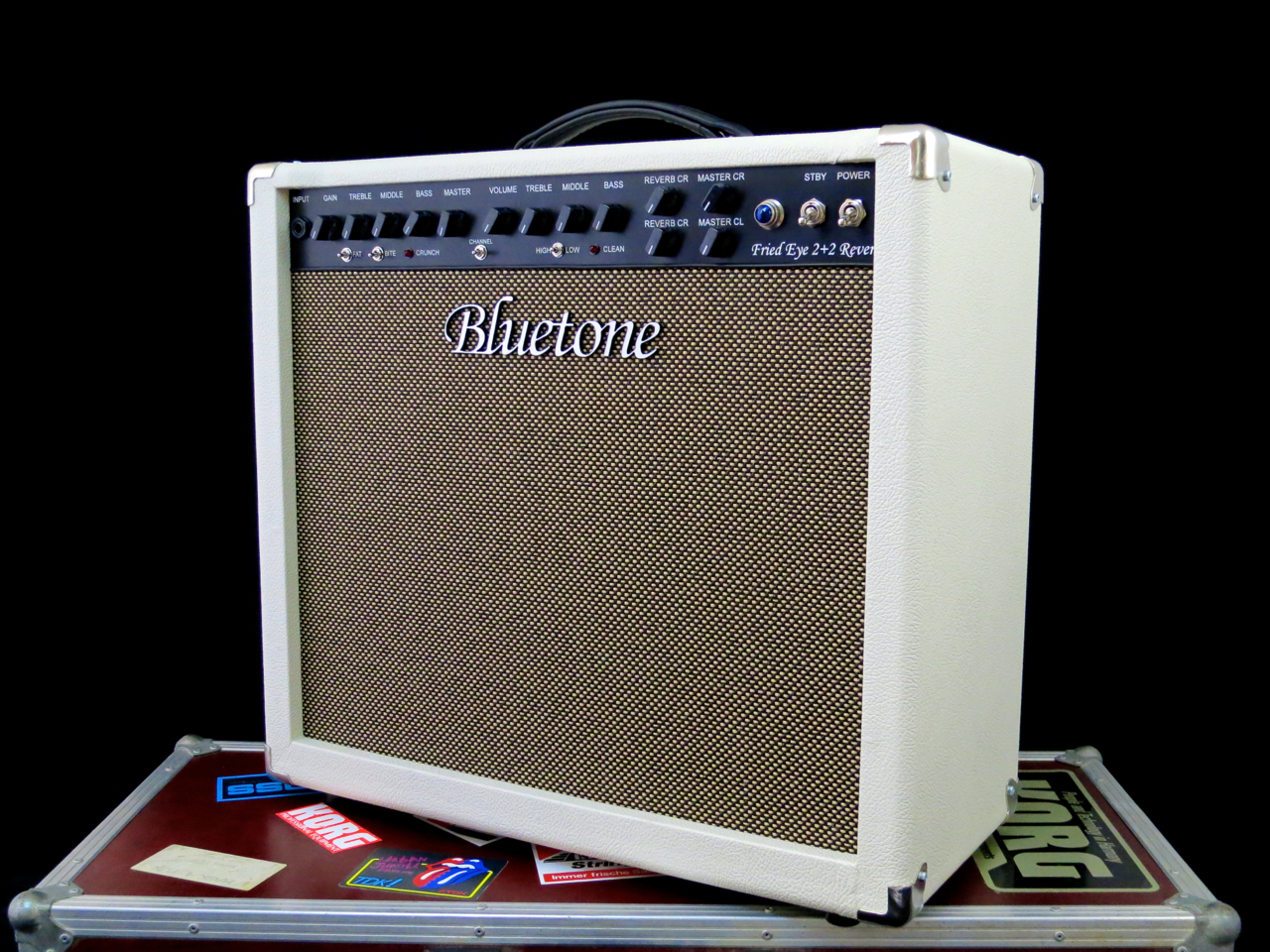
Our review combo (price of this version: 2,400 €; incl. footswitch and cover) is a two-channel all-valve affair comprising a Bluetone Clean channel partnered with a Fried Eye crunch channel, which is Bluetone’s take on the hot-rodded Marshall theme.
The 2+2-monicker in the combo’s name points to the special power amp architecture applied here. Instead of trying to emulate or approximate the different power amp sounds of, say, a Blackface-style clean channel and a Marshall-style crunch channel using heavy filtering and electronic trickery, Bluetone Amps go for maximum authenticity.
The 2+2 power amp uses two different pairs of output tubes – one pair for each channel. Selecting the clean channel switches on the power amp’s pair of 6L6GC-valves, while switching over to the Fried Eye channel will see a pair of EL34s spring into action.
(Photo courtesy of Bluetone Amps)
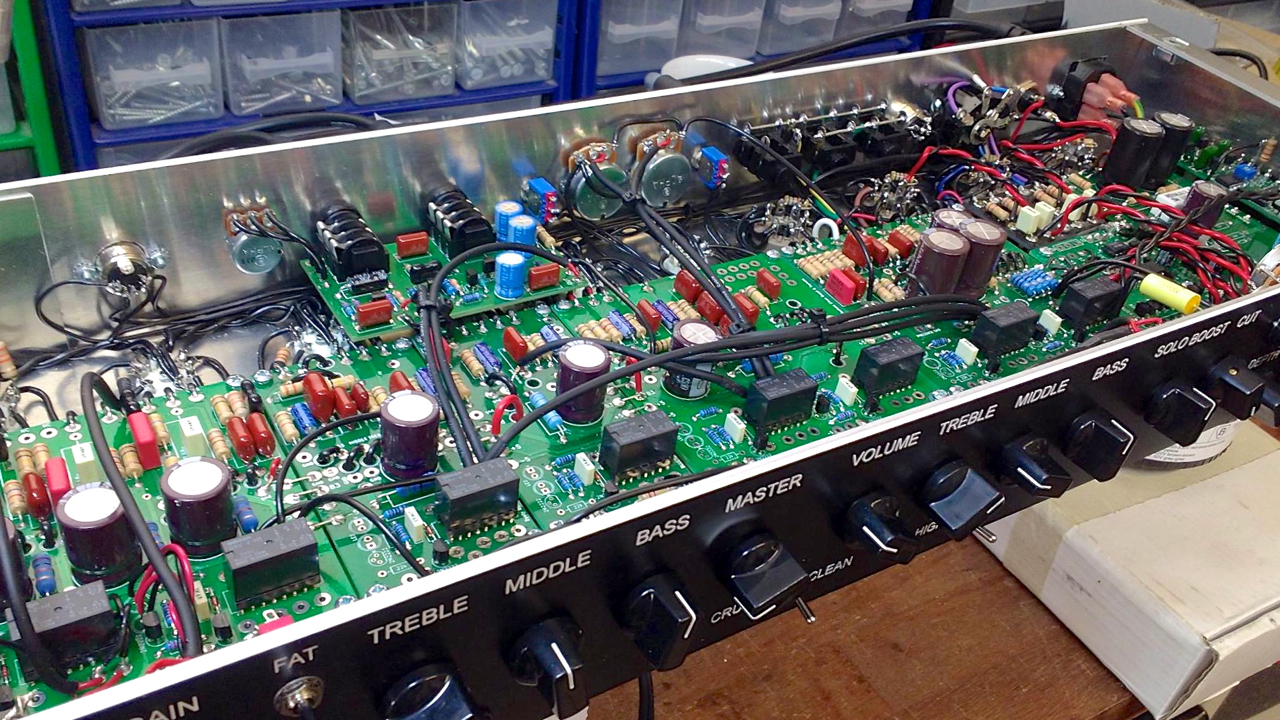
Bluetone Amps have recently been moving away from building their complete model range using only point-to-point building techniques. Certain models are now available as modular designs, which makes production less time-consuming, and thus more affordable. Still, like the point-to-point amplifiers, Bluetone hand-solders all its PCB-based modules at their workshop.
The Fried Eye 2+2 Reverb has been made in this modular fashion.
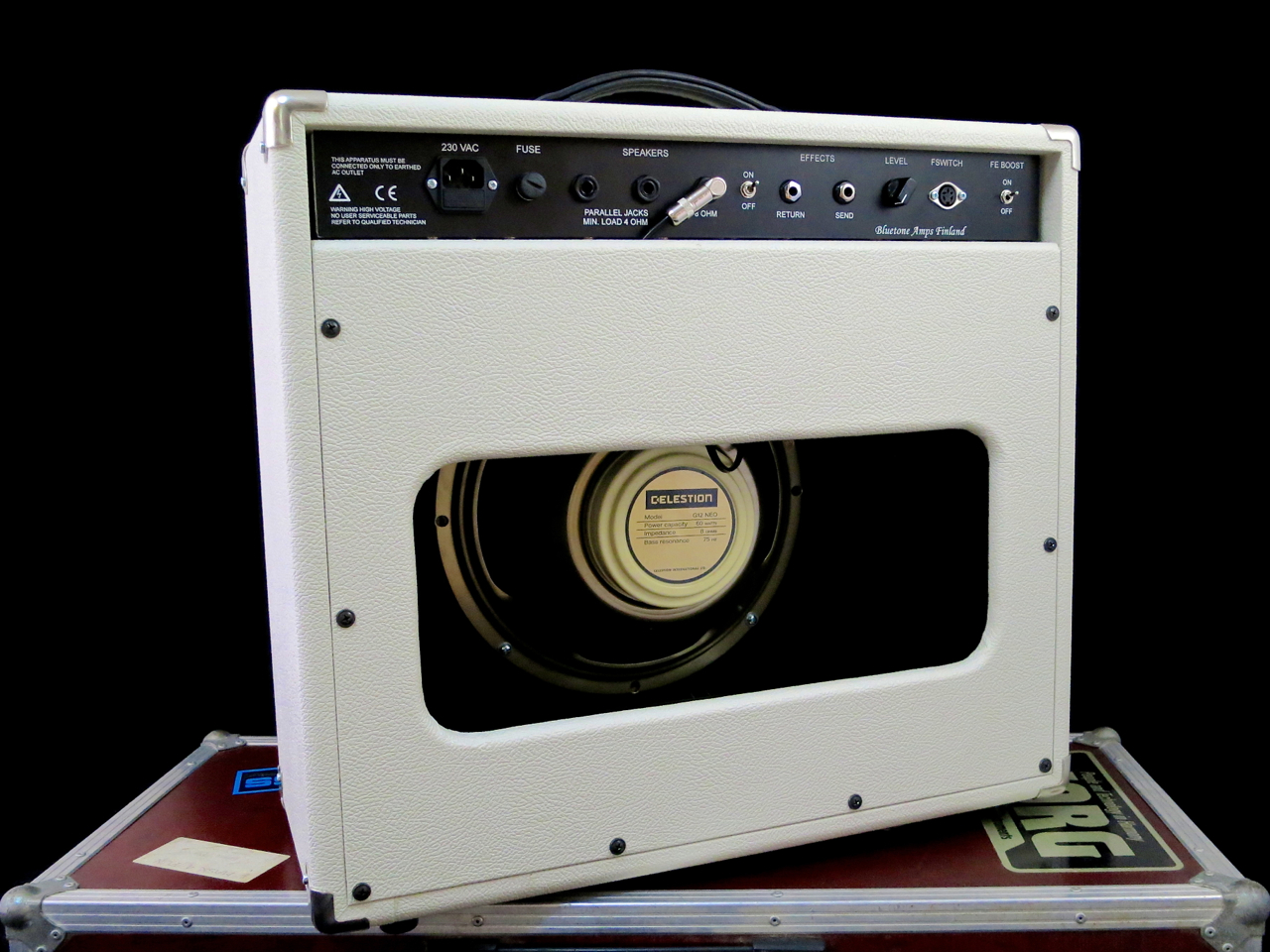
Like most Bluetone combos the Fried Eye is constructed with an open back.
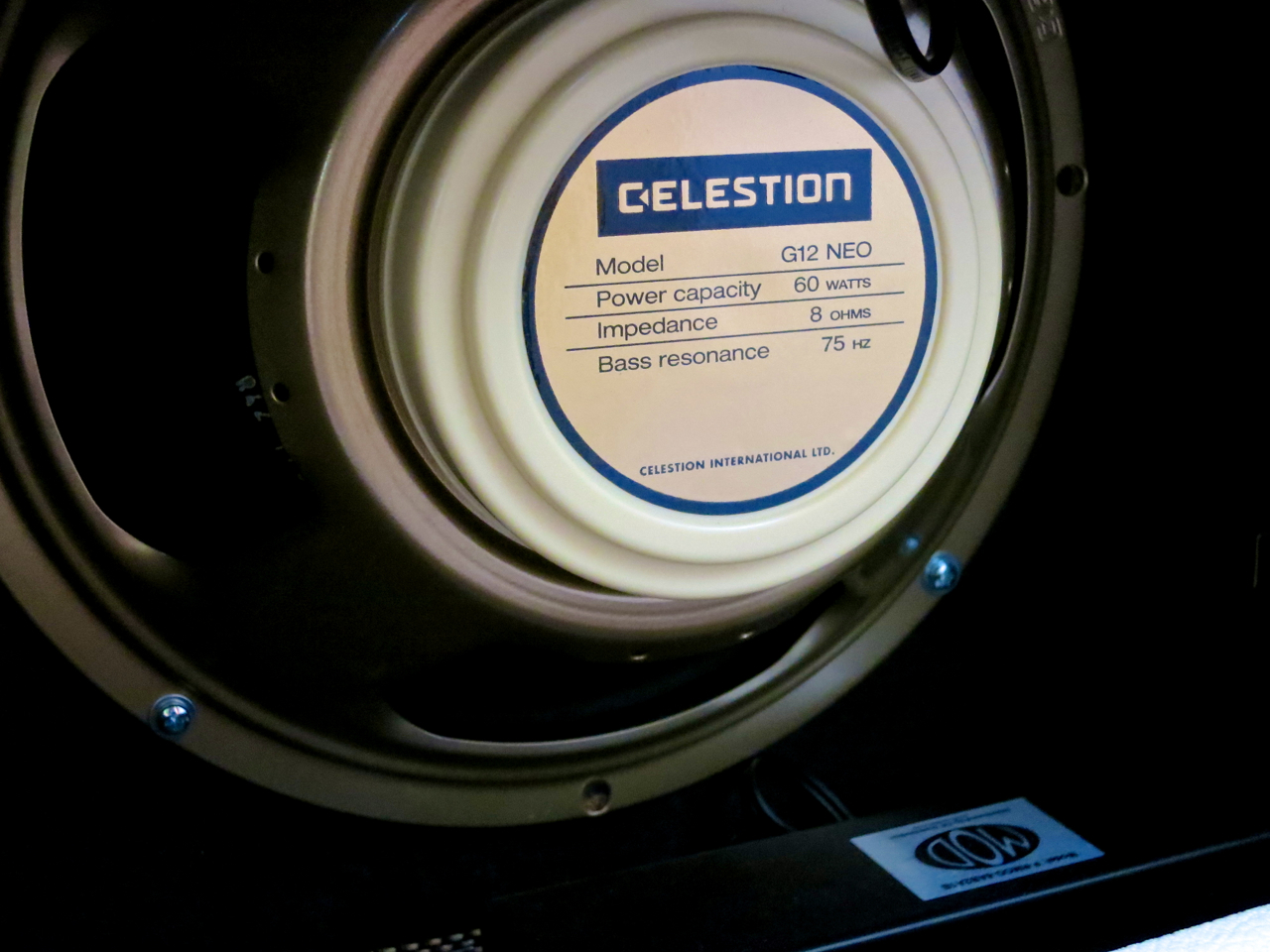
Our review sample is one of the first Bluetone amps to feature a Celestion neodymium speaker.
The 12-inch G12 NEO promises genuine Celestion Creamback tones coupled with the benefit of considerably lighter weight.
The Fried Eye 2+2 Reverb uses an MOD reverb tank and Bluetone’s own valve-driven circuitry.
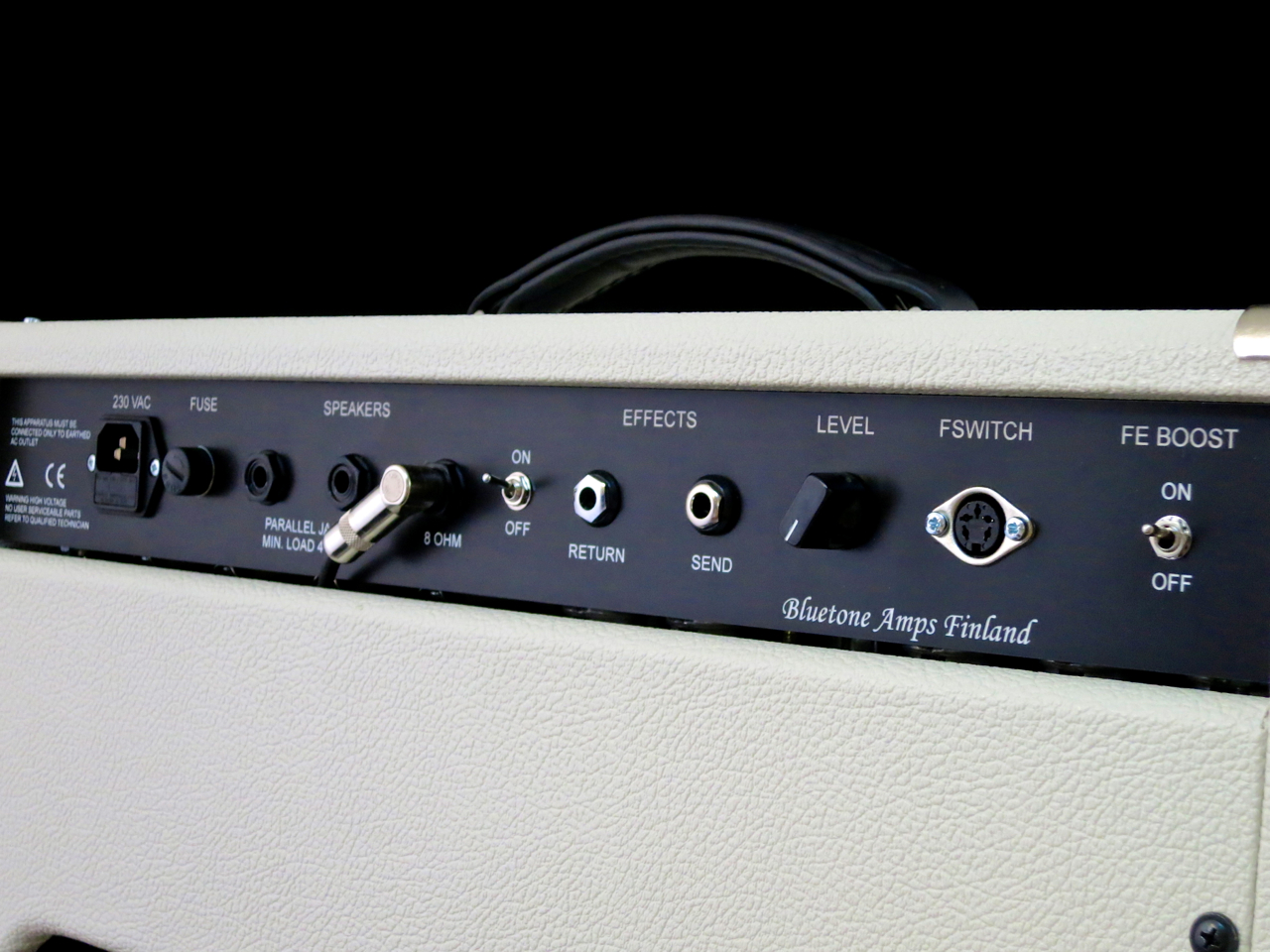
This Fried Eye combo comes with some interesting back panel features:
There’s a Front End signal booster, amplifying the signal right at the beginning of the signal path.
The Fried Eye’s switchable effects loop is an active affair, complete with a dedicated level control. If you don’t run any effects in the loop, you can use the loop’s make-up gain as an additional, foot-switchable boost in the signal path.
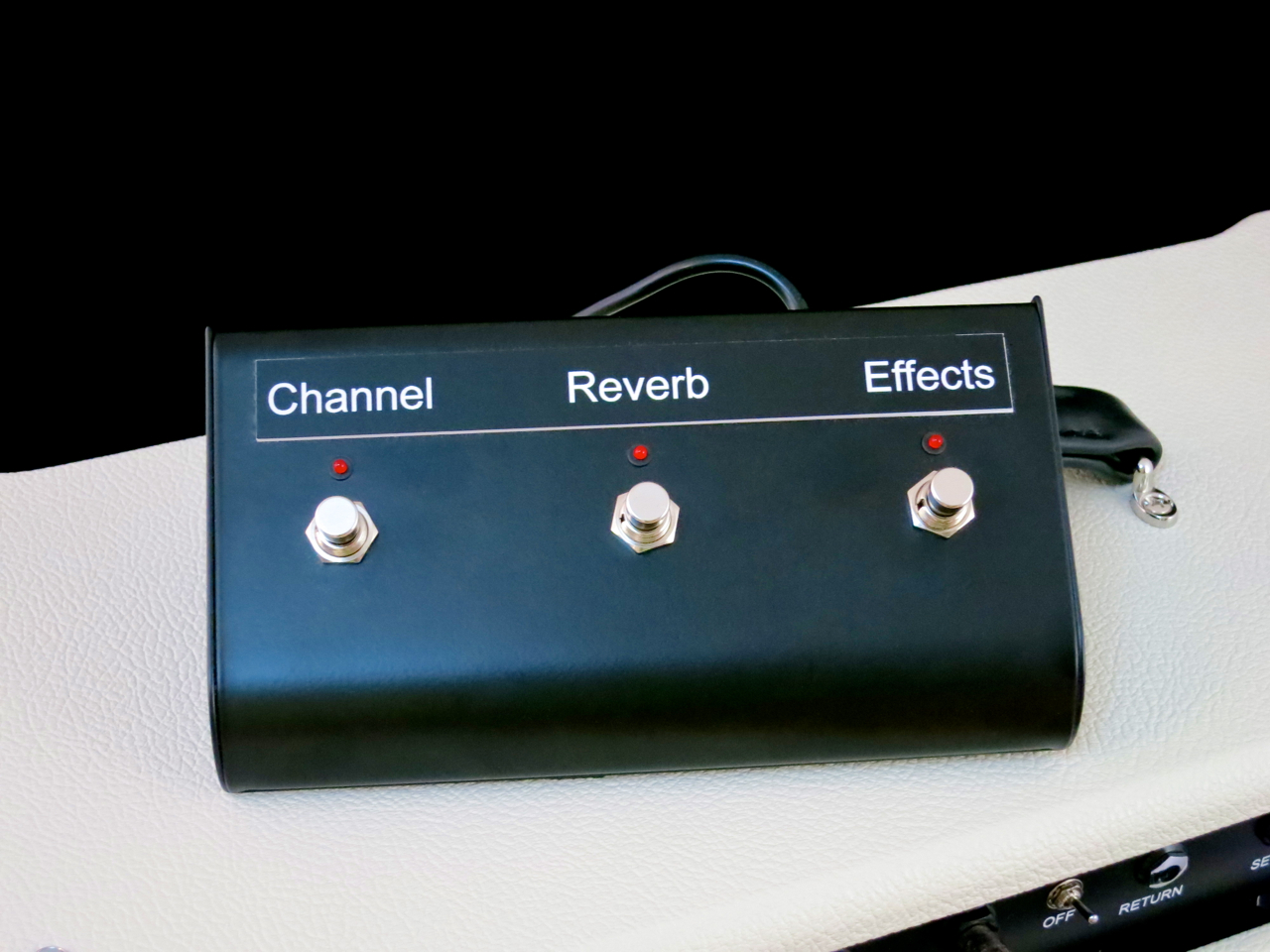
A chunky three-button footswitch unit is supplied with the Bluetone combo.
****
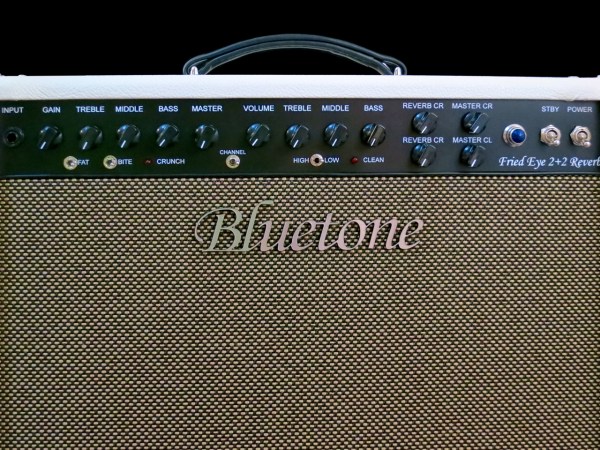
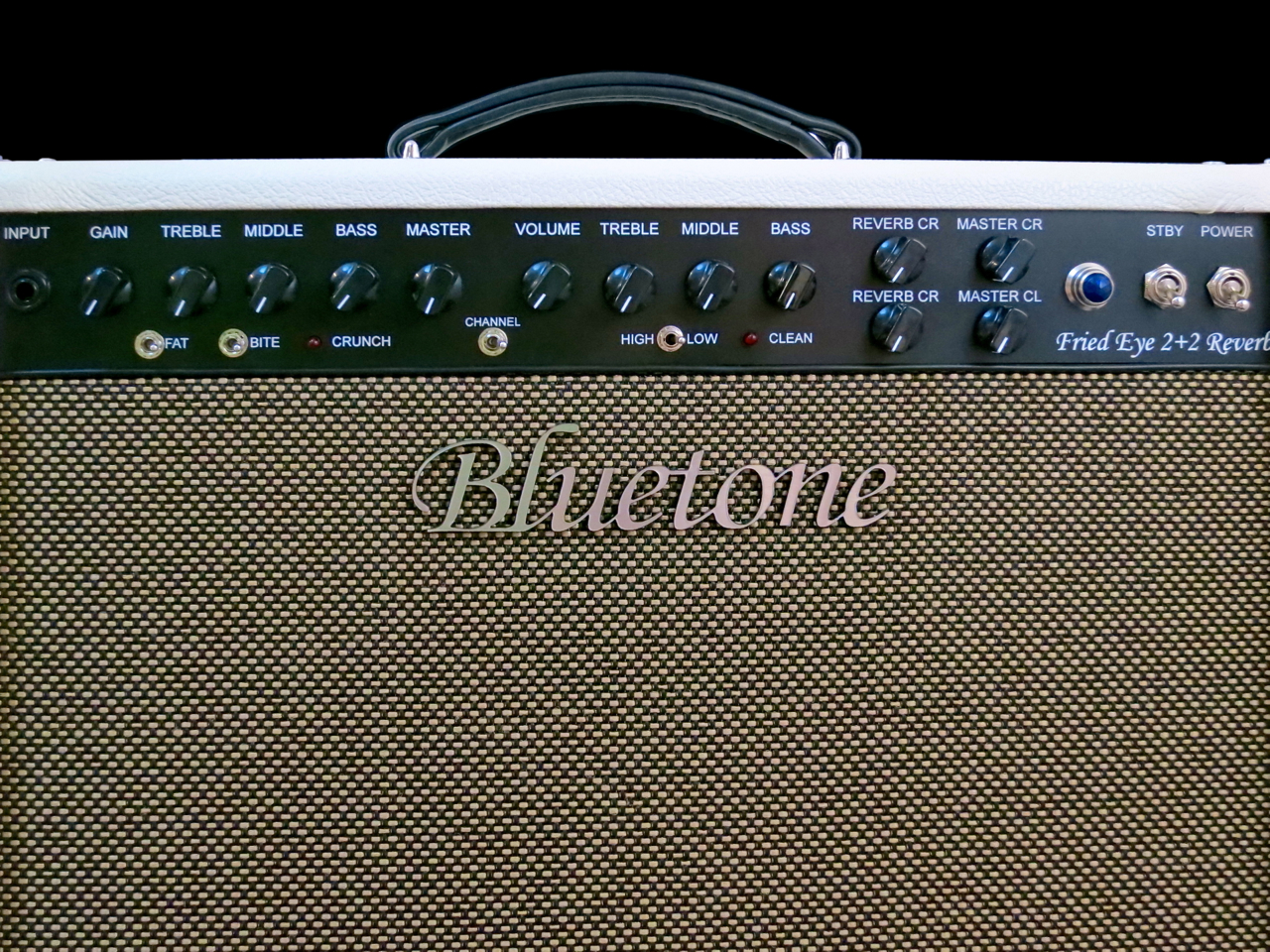
Bluetone’s Fried Eye 2+2 Reverb combo offers a wide range of options on its front panel. Thanks to the logical layout and the clear lettering, the front panel never seems complex or crowded, though.
The Fried Eye Crunch channel offers you a 3-Band EQ-section, plus Fat and Bite switches, to fine-tune your crunch tones.
The Bluetone Clean channel’s High/Low-switch offers two different pre-gain settings, which change the amount of available clean headroom.
Each channel features its own reverb level knobs – so you don’t have to compromise lush reverbs for clean tones with drier settings for crunch – as well as dedicated master volume controls.
Using all the different front panel and back panel features offers you a mind-boggling array of different tonal and drive options. With just a couple (or three) well-chosen guitars, Bluetone’s Fried Eye 2+2 Reverb will give you access to virtually any classic guitar tone you could dream up (with the exception of contemporary Metal).
Bluetone’s clean channel will take you from pristinely shimmering cleans well into Blues break-up territory.
This clip steps through the different boost options offered by the Fried Eye’s clean channel (using a Hamer USA Studio Custom). The sequence is Low dry –> Low plus reverb –> High –> High + FE Boost –> High + FE Boost + FX Boost:
Being able to use the FX loop as an additional booster turns the Fried Eye 2+2 into a two-channel-plus-solo-boost machine.
This clip steps through the different boost options offered by the Fried Eye’s crunch channel (using a Hamer USA Studio Custom). The sequence is Crunch –> Crunch + FE Boost –> Crunch + FE Boost + FX Boost:
Cleaning up the crunch channel using your guitar’s volume control works like a dream here. The Bluetone’s Fried Eye Crunch sounds juicy and lively, even with the guitar turned down to almost zero:
The demo track’s rhythm guitar parts were played on a Gibson Melody Maker SG (stereo left) and a maple-necked Fender Stratocaster (stereo right). The lead part was recorded with a modern Tele-type guitar, using the instrument’s volume control to adjust the amount of overdrive:
****
In my view the good people at Bluetone Amps have outdone themselves with their Fried Eye 2+2 Reverb Combo.
I will stick my neck out really far by claiming that the Fried Eye 2+2 is the best-sounding and most-versatile compact two-channel boutique valve combo I’ve ever come across. This guitar combo is all tone and no hype!
Messrs. Kneckt and Vauhkonen don’t run around wearing strange clothes or wild hairdos, pretending to be exalted tone gurus. You also won’t be required to send in mp3s of your guitar playing to prove you’re worthy to join the ”Bluetone Cult”.
Bluetone’s dynamic duo are down-to-earth guys, out on an ongoing quest to bring you maximum tone and usability, and no bullsh*t.
For a genuine boutique-grade amp of its calibre, I can only call the Bluetone Fried Eye 2+2 Reverb’s price tag extremely fair.
****
Bluetone Fried Eye 2+2 Reverb Combo
This version: 2,400 € (including footswitch unit and dust cover)
Italiasta on kovaa vauhtia muodostumassa eräänlainen Mekka meille kitaristeille, tai ainakin siltä vaikuttaa, kun tarkastelee saapasmaan alati kasvavaa ryhmää innovatiivisia vahvistin- ja efektipajoja.
Yksi todella kuuma nimi on Gurus Amps Faenzasta (noin puolessa välissä matkaa Bolognasta Riminiin). Gurus valmistaa sekä vahvistimia että efektipedaaleita – heidän analoginen, putkivahvistettu Echosex-viivepedaali on saavuttanut jo miltei legendastatuksen.
Gurus Ampsin Sinusoid (479 €) kuuluu samaan efektisarjaan, ja se on todella kiehtova yhdistelmä vanhaa ja uutta. Ison pokkarin kokoinen Sinusoid tarjoaa kaksi putkisoundilla höystettyä efektiä samoissa kuorissa– optisen tremolon, sekä aidon jousikaiun.
Sinusoid myydään ilman virtalähdettä. Pedaali toimii 9-12 voltin tasavirralla, ja virtajakin polariteetti on Boss-standardin mukainen. On kuitenkin tärkeää valita sen kanssa käytettäväksi astetta järeämpi virtalähde, sillä kyseinen Gurus-efekti on melko janoinen kaveri, joka tarvitsee toimiakseen 230-400 milliampeeria. Sinusoid toimi testin ajan ongelmattomasti Kitarablogin Cioks-pedaalilautavirtalähteen kanssa käytettynä.
Gurusin Sinusoid-pedaali on monofoninen tuplaefekti. Kitaran (tai kosketinsoittimen) voi liittää joko suoraan Sinusoidin tuloon, tai vaihtoehtoisesti pedaalin voi sijoittaa vahvistimen efektilenkkiin.
Remote control –jakin ansiosta Sinusoidin efektit voi kytkeä päälle ja pois ulkoisella kytkimellä, mikä mahdollistaa Sinusoidin sijoittamisen kauas muista efekteistä, mikä puolestaan voi auttaa häiriöäänten hillitsemisessä.
****
Guru Ampsin Sinusoid on todella helppokäyttöinen:
Kummallekin efektille on varattu oma jalkakytkin, kaksi säädintä sekä (vanhoista putkiradioista tuttu) vihreä Magic Eye -merkkivalo.
Tremolopuolella merkkivalo ilmaisee vatkauksen nopeuden. Jousikaiun Magic Eye -valo taas ilmaisee Accutronics-jousitankille ohjattavan signaalin volyymitason, jota säädetään Volume-säätimellä. Volumen ”väärinkäyttö” on mahdollista, ja sen myötä Sinusoidilla voi tuottaa hyvinkin rapeita ja säröisiä Surf- ja Rockabilly-kaikuja.
Sinusoid on saanut nimensä laitteen muhkeasta, siniaaltoon pohjautuvasta tremoloefektistä. Intensityllä säädetään efektin voimakkuutta, ja siinä riittää säätövaraa lähes huomaamattomasta aina rajuun vatkaukseen. Myös Speed-säädin tarjoaa laajan säätövaran tremolon nopeudelle.
Tämä klippi esittelee Gurus Sinusoidin tremoloefektiä eri säädöillä. Testikitarana toiminut Fender Stratocaster oli kytketty suoraan pedaaliin:
Ensimmäinen ajatukseni oli ”Hullut italialaiset!”, kun kuulin että Sinusoidin uumenin on asennettu aito jousikaiku. Kaikua testattuani täytyy kuitenkin myöntää, että pedaalin herkulliset kaikusoundit voittivat minut nopeasti puolelleen. Sinusoidin kaikusoundi ei ehkä ole ihan niin vivahteikas ja tiheä, kuin esimerkiksi Fender Blackface Deluxe Reverb -kombossa. Mutta täytyy muistaa, että tässä on kyse huomattavasti pienemmästä jousitankista, ja siihen nähden Gurus Sinusoidin tarjoama jousikaiku kuulostaa jopa hämmästyttävän hienolta:
Tässä on vielä yksi esimerkki, jossa hyödynnetään molempia efektejä yhtä aikaa:
Mainitsin aiemmin, että Sinusoid-pedaali toimii, kitaran lisäksi, myös todella hyvin koskettimien/synan kanssa. Äänitin siksi demobiisissä kitararaitojen lisäksi myös kosketinosuudet Gurus-pedaalin kautta:
****
Gurus Sinusoid on vallan mainio laite, jos kaipaa omaan soundiinsa putkivahvistettuja, aitoja tremolo- ja jousikaiku-efektejä. Laite on helppokäyttöinen ja samalla myös suhteellisen kompakti.
Keikkaympäristössä täytyy kuitenkin tarkkaan miettiä Sinusoidin sijaintia pedaalilaudassa sähköisten tai mekaanisten häiriöäänten ehkäisemiseksi. Nimensä mukaisesti jousikaiku tuottaa efektinsä sähkömekaanisesti resonoivilla metallijousilla, minkä vuoksi kaikki kaikutankit ovat herkkiä tärinälle ja iskuille. Tavallisesti jousikaiku on sijoitettu turvallisesti kombovahvistimen pohjaan tai sille on jopa rakennettu oma kotelo. Gurusin Sinusoidin tapauksessa jousitankki on lattiaefektin uumenissa, ja laite kytketään päälle ja pois jalkakytkimellä. Jalkakytkimen ytimekäs käyttö ja/tai vahinkopotku laitteen kylkeen voi saada jouset rämisemään, mikä kuulostaa eriasteiselta ukkosen jyrinältä. Suosittelen siis solumuovikerroksen tms. asentamista pedaalin pohjan ja pedaalilaudan rungon väliin iskujen vaimentamiseksi.
Minun mielestäni Gurus Sinusoid -tuplapedaali on mainio valinta vintageen kallistuvalle soundiesteetikolle. Tiedän, että nykyään on tarjolla loistavia vintage-tremolon ja -kaiun mallinnuksiakin, mutta aitoja analogiefektejä arvostaville Sinusoid on juuri oikea valinta.
Italy is fast becoming one of the top countries for tone hounds, thanks to the ever-growing number of cool Italian guitar amp and effects companies.
One such company is Gurus Amps from the town of Faenza, about halfway between Bologna and Rimini. Gurus makes both amplifiers and effect pedals, with their valve-driven Echosex analogue echo pedal probably being their best-known product.
Gurus Amps’ Sinusoid (price in Finland: 479 €) is another cool design, which seems both anachronistic and up-to-date at the same time. The Sinusoid is a paperback-sized effect pedal, offering you two valve-driven analogue effects in a very compact format — optical tremolo and genuine spring reverb.
The Sinusoid is sold without a power supply unit. This double pedal’s power input can handle DC between nine and twelve volts, and its polarity follows the well-established Boss-standard. Be aware, though, that this Gurus effect is relatively power hungry, requiring anything from 230 mA to 400 mA, which means running the Sinusoid off a professional pedalboard PSU is strongly advised. The effects unit worked fine with Kitarablogi’s Cioks PSU.
The Gurus Sinusoid is equipped with mono in- and outputs – you can plug your guitar (or keyboard) directly into it, or run the effects pedal in an effects loop.
The Sinusoid is loop-switcher-ready, sporting a remote control input jack in the upper left corner.
****
Guru Amps’ Sinusoid is extremely easy to use:
Each of the two effects comes with its own footswitch, two control knobs, as well as a green ”Magic Eye” indicator.
On the optical tremolo side the indicator light gives you the speed of the tremolo effect. The spring reverb’s ”Magic Eye” tells you how hot you’re currently driving the reverb tank’s (manufactured by Accutronics, by the way) input stage (using the Volume control). It is possible to overdrive the reverb circuit, should you wish to achieve extreme Surf or Rockabilly effects.
The Sinusoid’s name has been taken from its very musical tremolo circuit, whose modulation uses a sinusoidal wave generator. The Intensity takes you from completely off to quite choppy, with an ample range provided by the Speed control, too.
This clip gives you an idea of the range of tremolo effects offered by the Gurus pedal, when plugging a Fender Stratocaster into its input:
My first thought at realising that the Sinusoid incorporates a genuine spring reverb was ”These Italians must be nuts!”, but I must confess that the pedal has quickly won me over with its classic tones. To my ears, the pedal’s spring reverb sounds a tad less dense, rich, and wet, when compared to something like a Fender Blackface Deluxe Reverb. But when you remember that the Gurus Sinusoid is far smaller than a full-sized reverb tank, you will have to admit that the sound quality offered here is truly astounding:
Here’s a short clip of both effects running at the same time:
I already mentioned this before, but Gurus Amps’ Sinusoid also works very well, when used with a keyboard. This is why I’ve recorded the demo track’s keyboard and guitar parts using the effects pedal:
****
In and of itself the Gurus Sinusoid works wonders in delivering genuine vintage-sounding tremolo and reverb effects in a compact and easy-to-use format.
There is one thing worth considering, though, and that is the effect’s working environment. Due to the way a spring reverb creates its magic – namely by means of vibrating metal springs – all reverb tanks are susceptible to mechanical shocks, at least to some degree. Normally, a spring reverb tends to be safely tucked away at the bottom of an amplifier cabinet, but the Sinusoid is meant to be mounted on your pedalboard and switched on (and off) by foot. Depending on your stage volume and/or the vivacity of your showmanship, accidentally kicking the Sinusoid (or switching the reverb on very forcefully) will inevitably lead to audible spring reverb rattling (sounds like distant thunder). I’d recommend using some type of shock absorption when mounting the Sinusoid to your pedalboard, if you want to minimise reverb rattling.
In my view, Gurus’ Sinusoid is a great two-in-one pedal that scores high in the vintage tone and coolness stakes. Sure, you can get nice-sounding digital models of tremolo and spring reverb effects for less money, but the Sinusoid is the real McCoy!
The classical (aka nylon-string or Spanish guitar) is still a very popular instrument. Many guitarists start their musical journey on an affordable classical guitar.
This is why Kitarablogi.com decided to do a little round-up of a cross section of nylon-string acoustic in the all-important price segment of 250-400 euros. These days you can get a decent instrument with a solid wood top for a moderate outlay.
A solid top is an important ingredient in an acoustic guitar, played regularly the top will ”come to life” and mature to its full tonal potential. It’s true, you can make music on a plywood-topped acoustic, too, but such a guitar’s tone and volume will always stay somewhat restricted.
The father of the classical guitar was Spanish cabinet maker and luthier Antonio de Torres Jurado (1817-1892). Torres came up with the final shape of the Spanish guitar, the basic construction principles (like the top bracing pattern or the separate bridge saddle), and his choices of materials still inform and influence builders to this day.
Torres mostly used cedar for his necks and rosewood for his fretboards. Most of his tops were made from solid spruce. His choice of sound box woods was more varied, though. His back and sides were made from rosewood, mahogany, (flame) maple, and cypress.
Because cypress was a much cheaper wood in Torres’ time than, say, rosewood, cypress body instruments were usually the least expensive. Most flamenco guitarists of that time were cash-strapped, which is why they tended to play Torres’ cypress guitars. This, in turn, is the reason why many flamenco guitars are still made with cypress backs and sides today.
Most modern classicals are built with dovetailed glue joints – the neck and sound box are made separately, and only glued together relatively late in the building process.
Torres used a different technique, which is nowadays called a Spanish Heel:
The neck blank and the neck block are made from one piece of wood, with the neck block looking like an angular ”U” or ”L” (viewed from the side). Either side of the neck blank has a deep groove for the rims to be glued into. The neck blank and sides together then constitute a frame for the top and back.
Fans of the Spanish heel claim that this type of construction will give you maximum vibrational transfer and better tone. Distractors, on the other hand, point to the difficulties the Spanish heel will give you, should a neck angle reset ever become necessary. I think I’ll keep on sitting on the fence on this one…
I feel like a sleazy gameshow host writing this, but there aren’t really any losers in this round-up. All ten guitars are real instruments that are well up to the job of making beautiful music.
Still, it is very interesting to take a look at the different ways modern manufacturers use to re-interpret Torres’ time-honoured concept for the modern player.
We will proceed in alphabetical order…
****
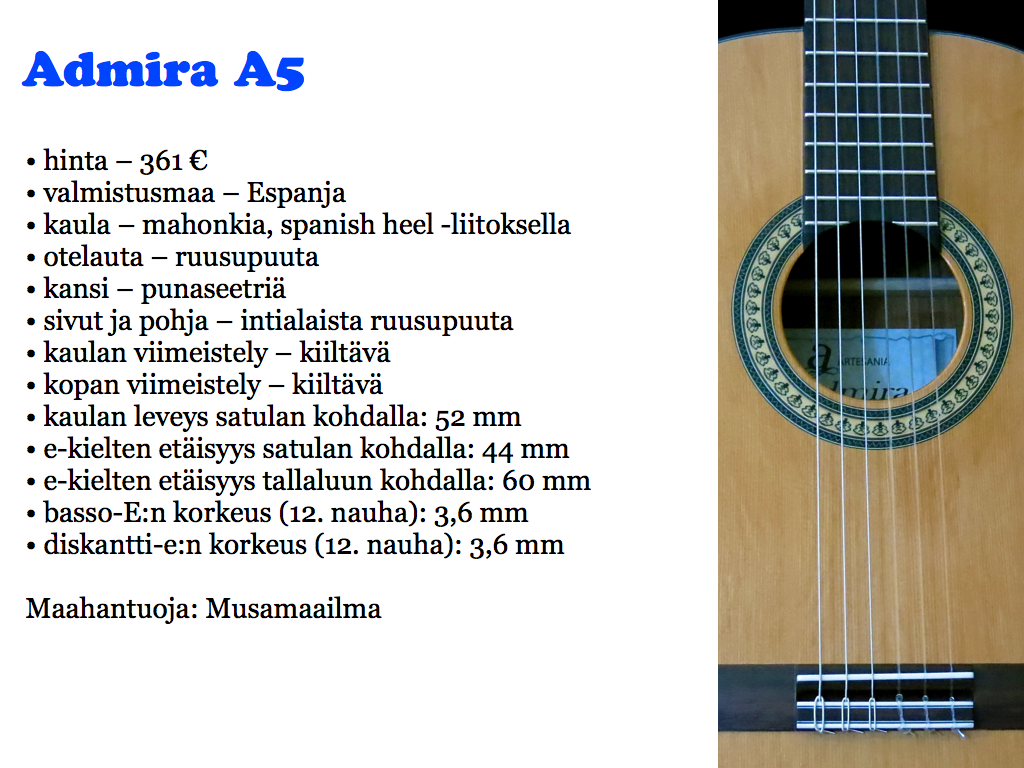
Admira is one of the largest makers of classical guitars in the world.
German-born Enrique (orig. Heinrich) Keller founded an instrument workshop in northern Spain in 1944. Over time Admira has grown from a small maker into a well-known brand.
Admira guitars are distributed by Musamaailma in Finland.
The Admira A5 is an affordable instrument from the Spanish maker’s Handcrafted-series.
The workmanship is crisp and clean. The thin finish brings out the beauty in the A5’s woods. The golden tuning machines with their pearloid knobs add a nice touch of bling. The rosette is unusual, displaying a chain of little guitars in a row.
Admira’s A5 is one of three instruments in this round-up built with a Spanish heel.
The neck profile is genuinely classical, meaning the neck is wide and flat with slightly angular shoulders.
The moderate action results in a very comfortable playing feel.
The Admira A5 has a big voice with an even balance between its chunky bottom end and clear treble attack.
The Malaga is one of the lightest instruments in this review. The workmanship on this cedar-topped beauty is excellent. The affordable nature of this guitar is only reflected in the very clean, but thinner-than-usual (non-kerfed) wooden linings joining the top and back to the sides.
The neck profile on the Admira Malaga is traditional.
The review sample came with a surprisingly low action (for a nylon-string). This makes the Malaga an excellent choice for a beginner, but also a very viable candidate for flamenco players, who prefer a very fast action and a clicking attack.
Despite its very low action the Malaga plays with a clear and strong voice, completely devoid of string buzz or rattles.
****
Esteve is a very traditionally-minded Spanish maker of classical guitars.
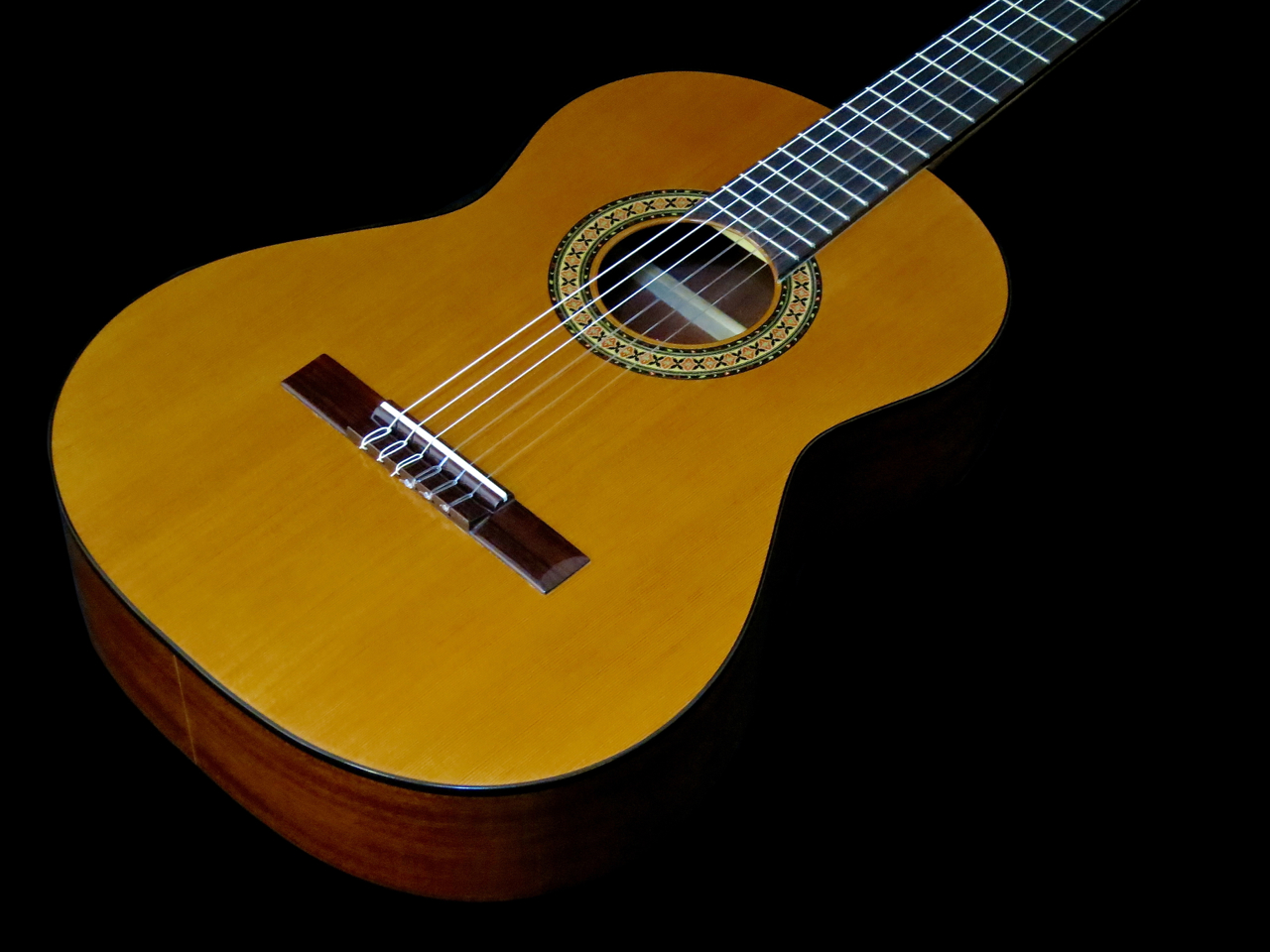
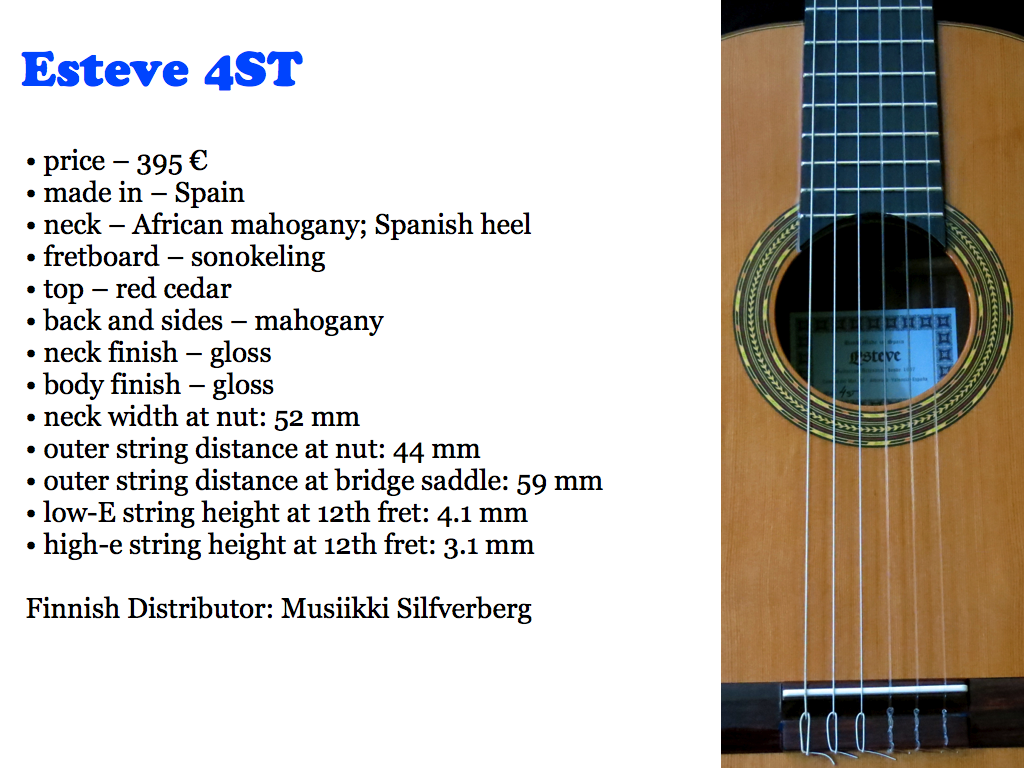
The Esteve 4ST is an instrument from the maker’s Student-range.
This guitar is a real beauty with its tinted cedar top and its intricate soundhole rosette. Spanish style at its best.
The 4ST is the second guitar (of three) in this round-up that sports a Spanish heel. The workmanship is very crisp throughout.
Esteve’s neck profile is genuinely classical – wide and flat. The action is at traditional settings. The guitar plays like a breeze.
Esteve’s 4ST has a huge and deep tone, which is warm and well-balanced. The instrument’s attack is clear and precise.
****
Kantare Guitars are a celebration of Finnish knowhow and ingenuity.
Kantare guitars are designed in Helsinki by the grand old man of Finnish luthiery, Kauko Liikanen.
The special top bracing system sets these guitar apart from any other nylon-string. Instead of the traditional fan bracing (or a variation thereof), Kantares employ the patented LRS-bracing. Kauko Liikanen’s and Uwe Florath’s Lens Resonance System concentrates an oval pattern of braces around the top’s bridge area. The sound is concentrated in a way not dissimilar to an optical lens. LRS adds strength to the bridge area, while letting the rest of the top vibrate more freely than traditional bracing patterns.
Most Kantares are built in Romania. Hora is one of Europe’s largest makers of string- and bowed instruments.
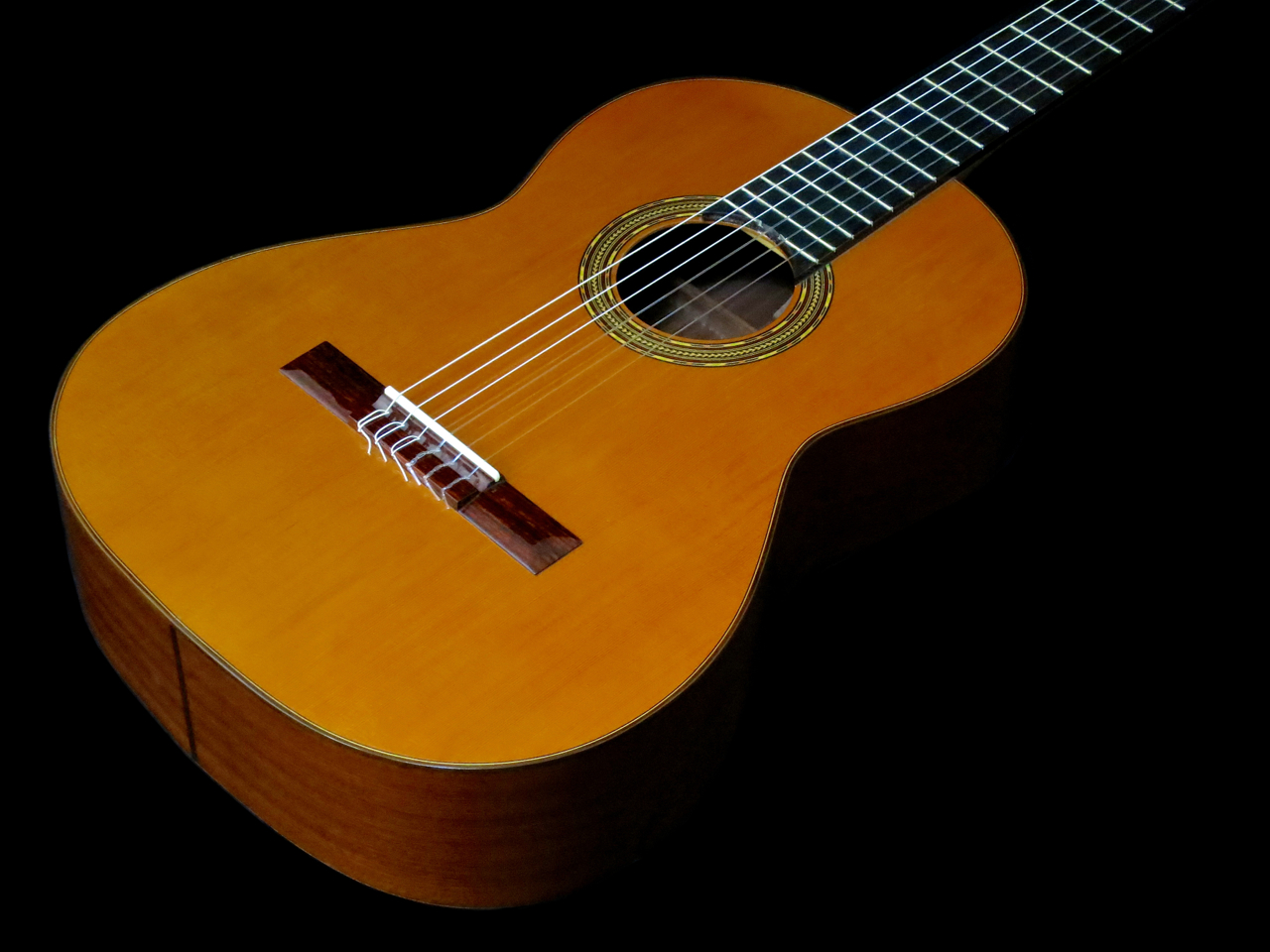
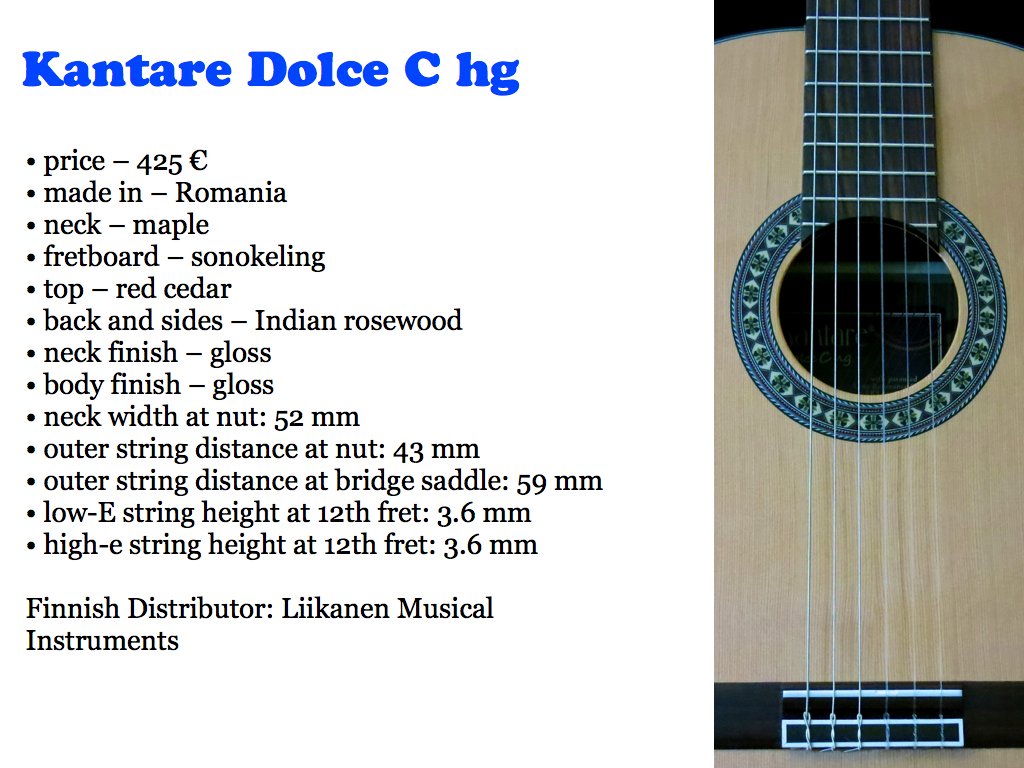
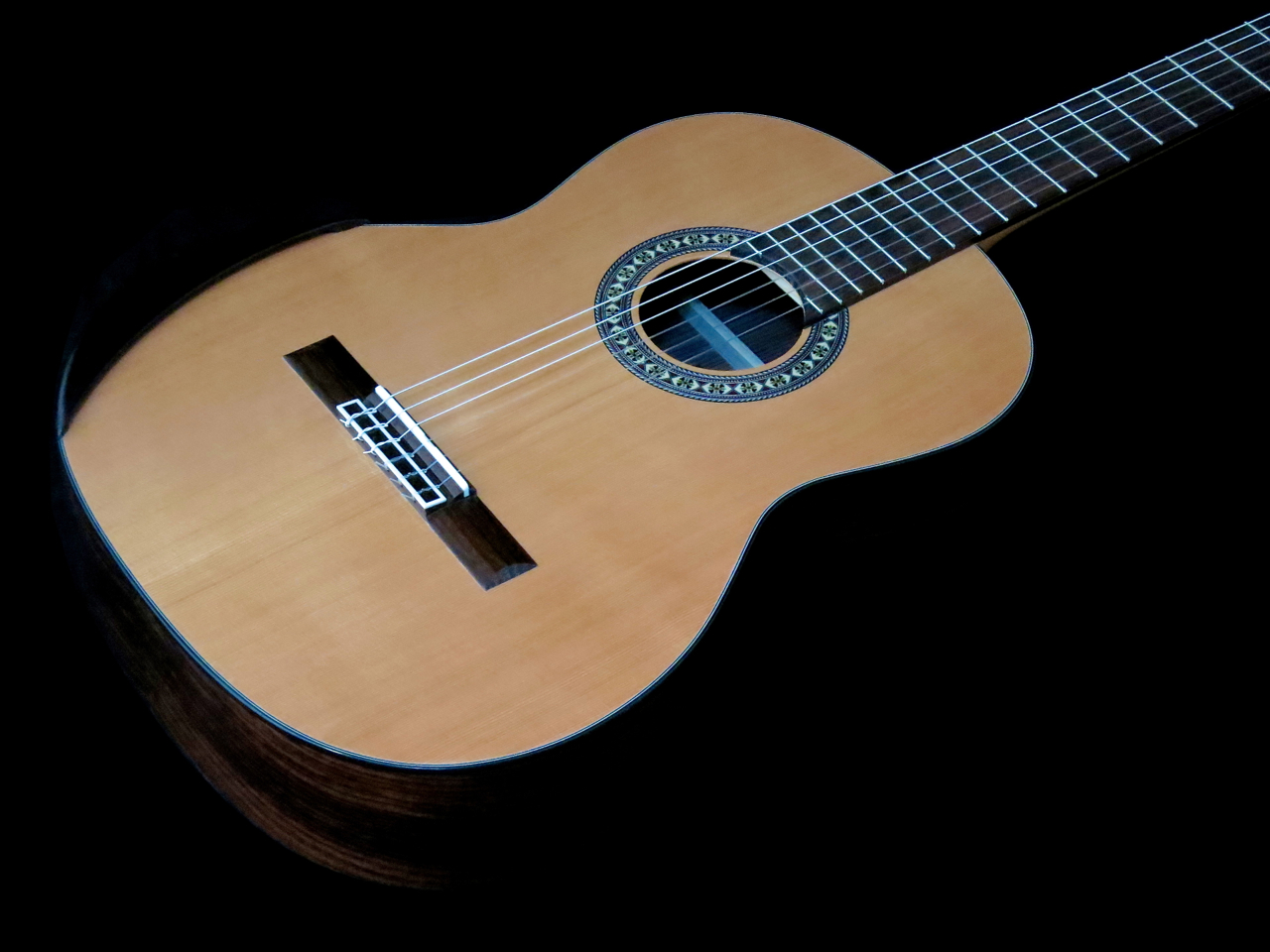
The Kantare Dolce C hg is a gloss-finished guitar with an LRS-braced cedar top.
Our review sample sports Kantare’s brand-new arm rest, which is sold separately. The arm rest has been developed to put your plucking arm into a comfortable playing position, as well as to minimise top damping.
The Dolce C hg is a very beautiful, cleanly built instrument.
Apart from the LRS bracing, a common denominator among most Kantare models is a maple neck.
Classical guitars traditionally feature mahogany or cedar necks; on the other hand, most bowed instruments use flame maple necks. The strength and density of maple makes it an enticing choice for use in a classical guitar neck, too, and the Hora factory has a large stock of flame maple.
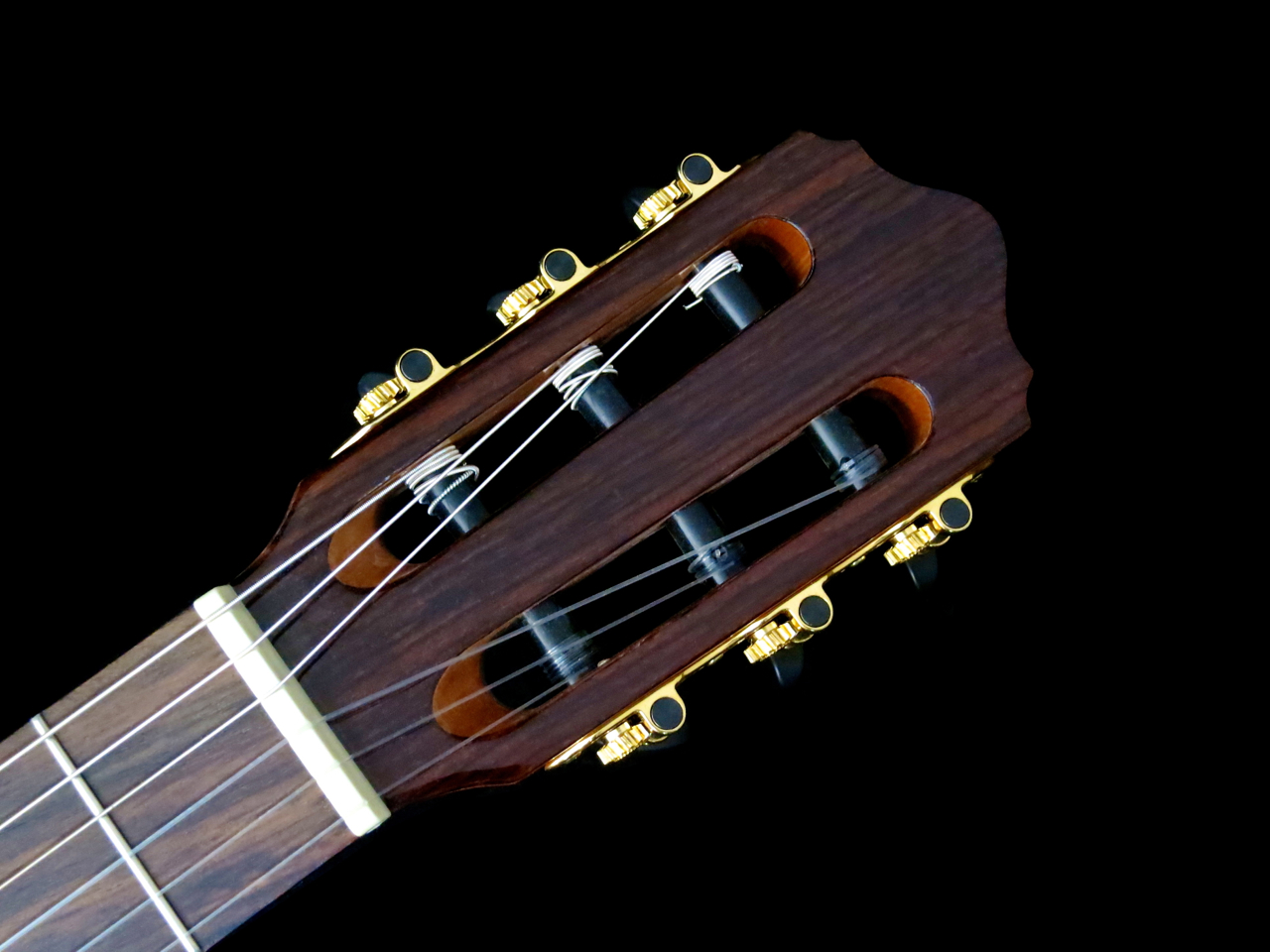
Kantare’s Hauser-style machine heads are of very decent quality, and work precisely.
The Dolce C hg’s neck profile is noticeably more rounded than a traditional Spanish neck, probably making this neck feel more comfortable for many. To help the beginner with finding the right fret positions, Kantare have included side dots at the fifth and seventh frets.
The Kantare Dolce hg has quite a loud voice and projects nicely. The sound is clear and precise.
Kantare’s Vivace C features a brand-new, ecologically sound satin finish.
The Vivace C is finished using a new German-made (by Hesse Lignal) non-poisonous product, called Proterra Resit. Proterra Resit uses a novel mixture of shellac, oil and carnauba wax.
Shellac (also called French polish) is an organic polymer that has been in use by instrument makers for centuries. Traditional French polish is very time-consuming and work-intensive in use, which is why you’ll find it on only a limited number of handmade instruments. The huge advantage of Proterra Resit lies in the fact that it is quick and easy to apply.
The Kantare Vivace C looks and feels very ”eco” and ”organic”, in the best sense of these terms.
The new finish nicely accentuates the beautiful wood grain of the guitar’s maple neck.
The neck profile is rounder than a traditional classical guitar neck, and there are two side dots (at the fifth and seventh frets) on this Kantare, too.
The Vivace C’s voice is very woody and a little bit dry. You can clearly hear the wood amplifying the string vibrations. The bottom end isn’t overpowering, the mid-range is warm, and the trebles sound open, but never too bright.
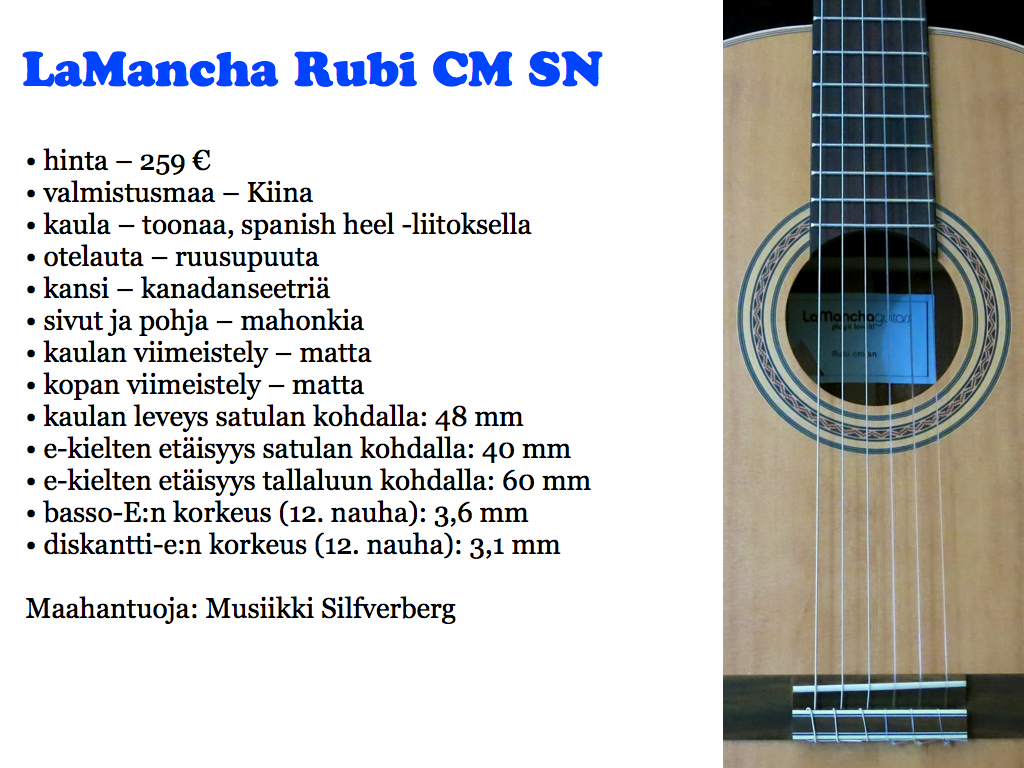
LaMancha-instruments are design in Germany and made in China (under German supervision), in the company’s own factory.
LaMancha has managed to become Germany’s best-selling brand of classical guitars over the course of just a few years. Many of their models have already won awards by the European Guitar Teachers Association.
LaMancha’s Rubi CM SN is a satin-finished guitar with a narrower-than-usual neck (LaManch call it ”Small Neck”), making it a good choice for young students and players with small hands.
The Rubi CM SN is the third guitar in this round-up constructed around a Spanish heel.
The neck is made from toona, a south Asian relative of cedar, that also grows in Australia.
The neck is stiffened by two graphite rods, which have been inserted into the neck from the front, prior to the fretboard being glued on.
The workmanship on this LaMancha is very clean. The Rubi CM SN is a very stylish and lightweight guitar.
The Rubi’s neck profile is narrower and rounder than that of a traditional classical guitar. There are two small side dots in the fingerboard for orientation.
The LaMancha plays like a dream.
The Rubi CM SN displays a well-balanced voice with a slender bass register and a woody top end.
****
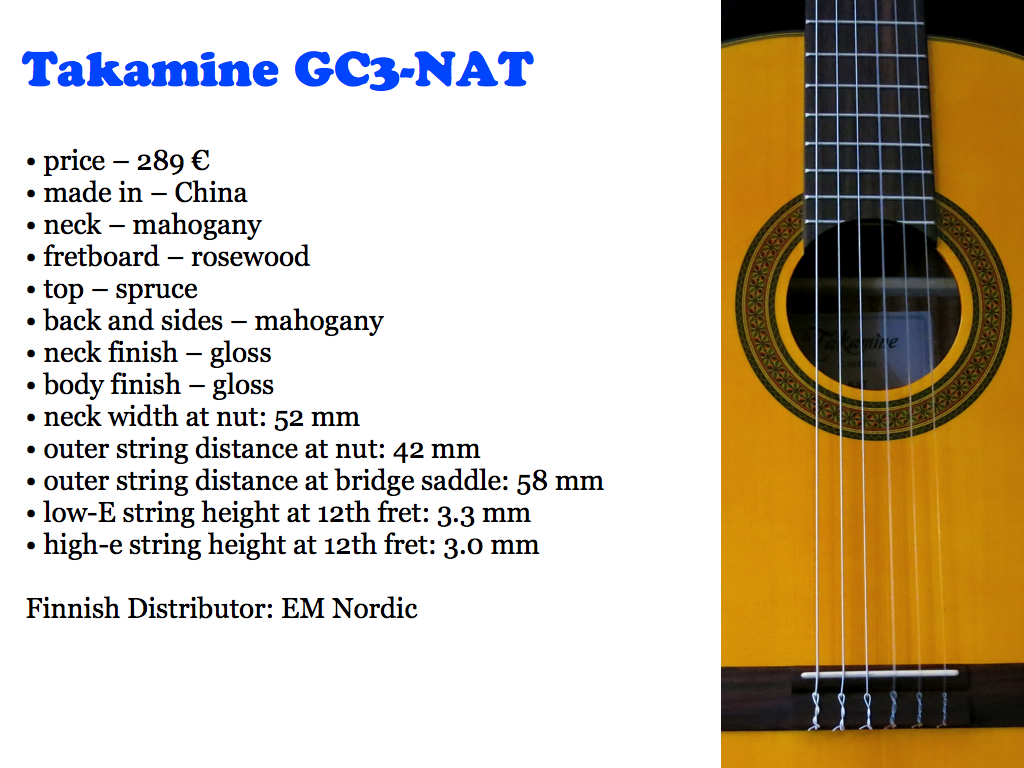
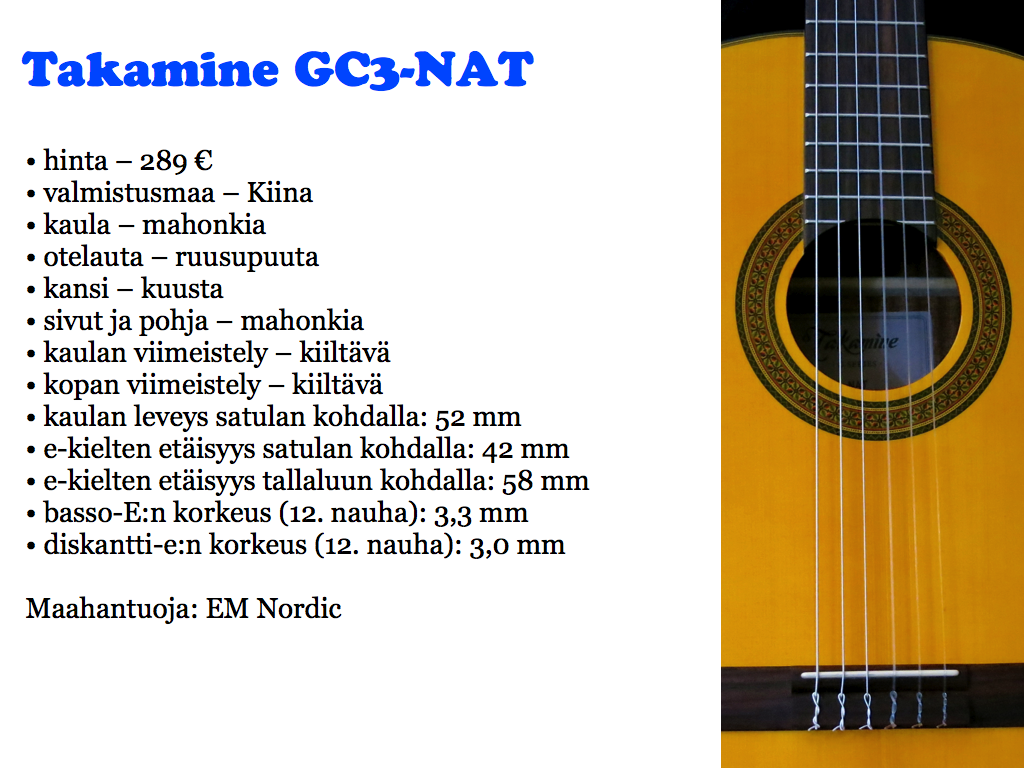
Japanese company Takamine is best known for its acoustic-electric steel-string guitars, but the company has always made classical guitars, too.
Takamine’s Finnish distributor is EM Nordic. The test instrument was kindly provided by DLX Musiikki.
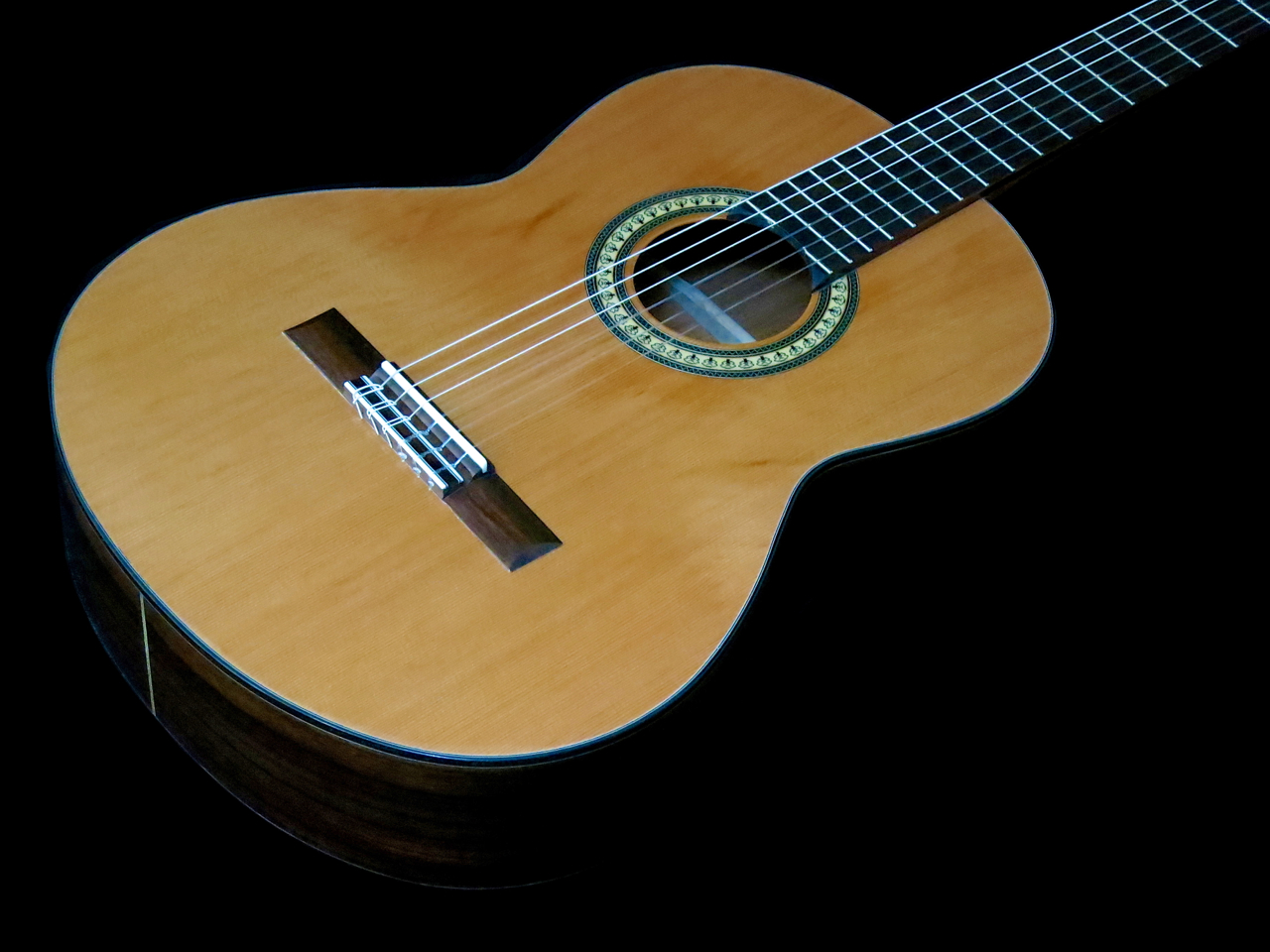
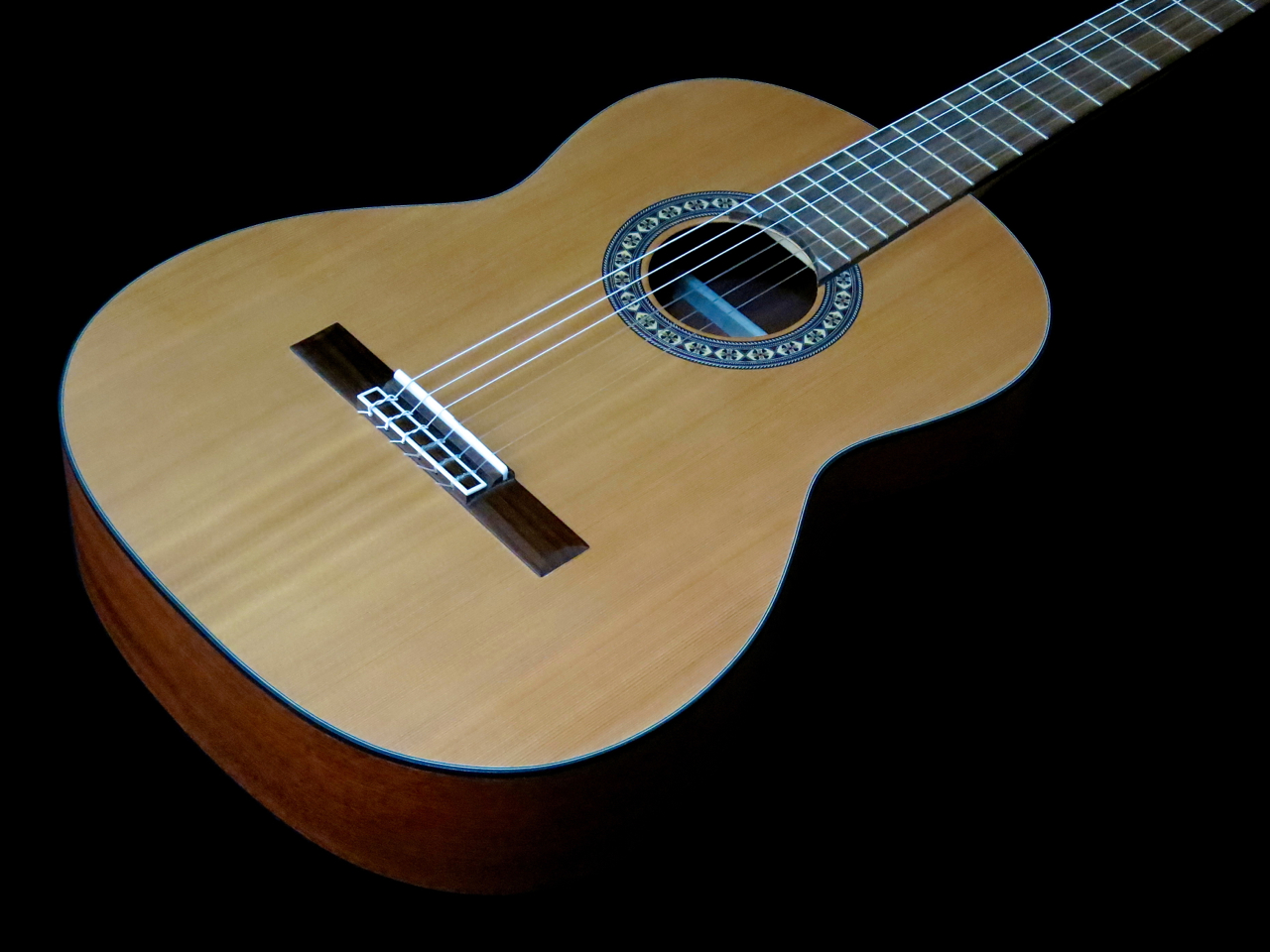
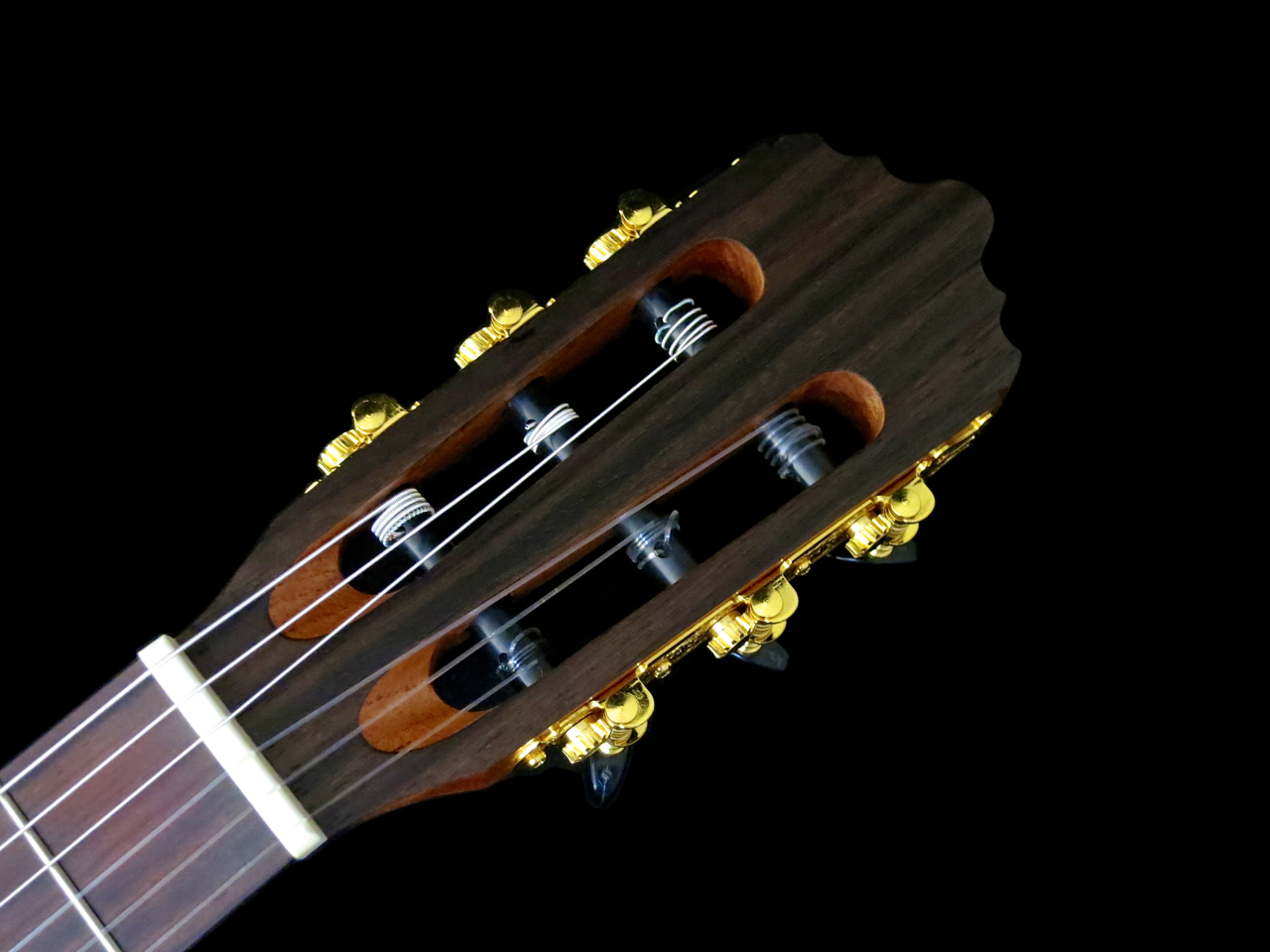
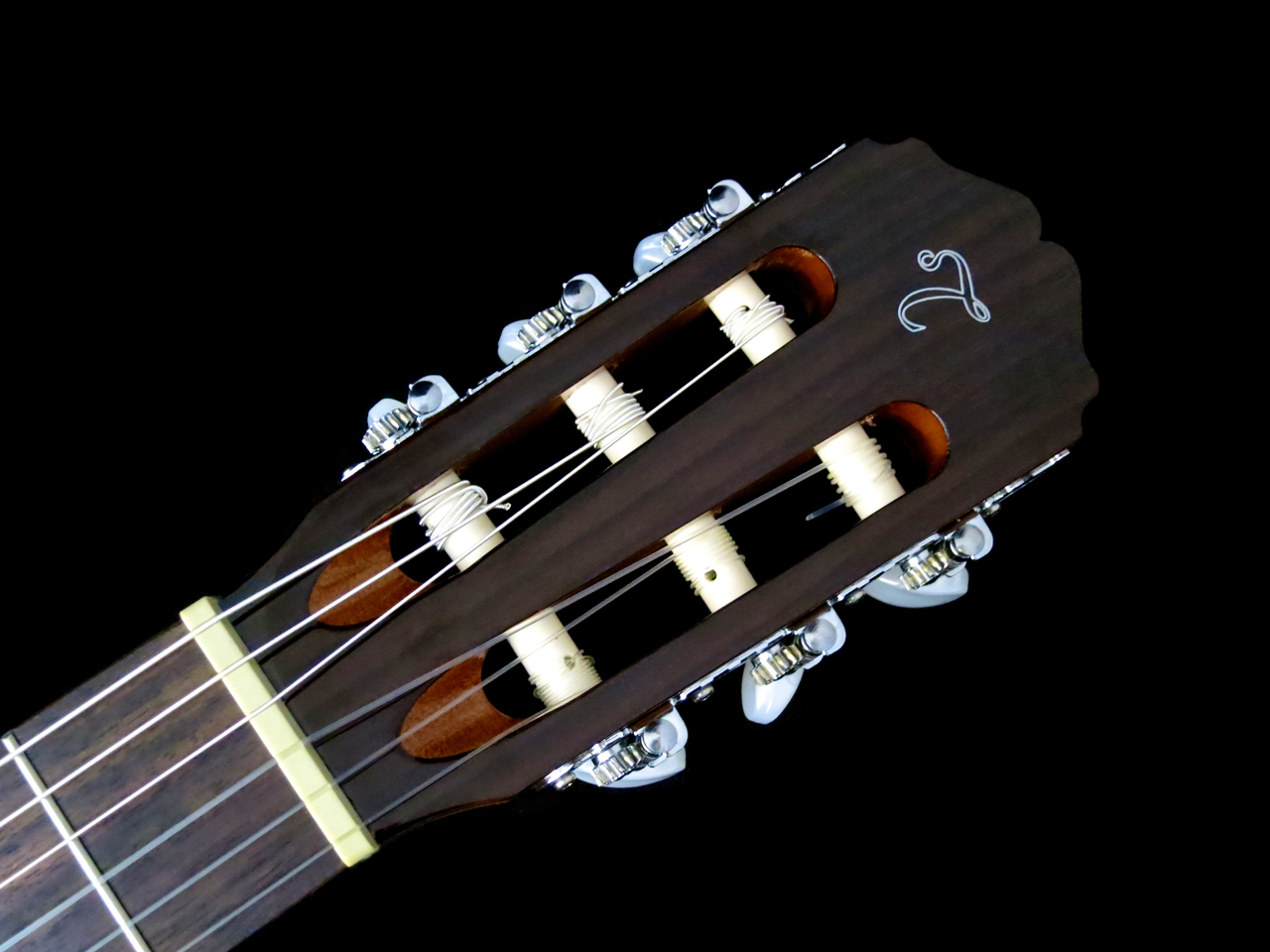
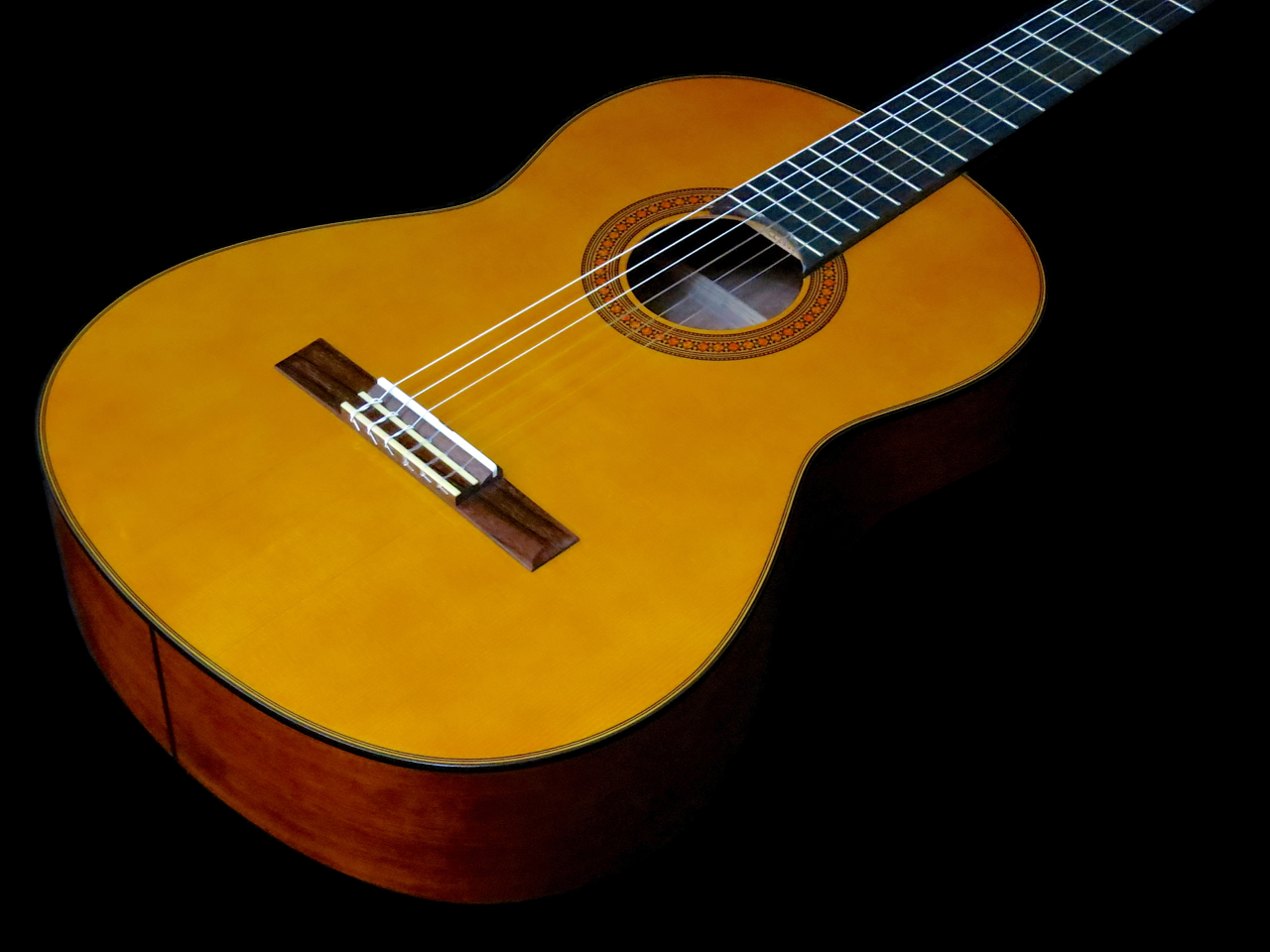
The Takamine GC3-NAT is a spruce-topped classical guitar made in China.
The top’s yellow tint is reminiscent of the look of French polish.
The stark and unadorned rosewood bridge of the GC3-NAT is a stylish contrast to the instrument’s beautifully intricate soundhole rosette.
Takamine is one of the very few makers of Spanish guitars who uses a truss rod inside their nylon-string guitars’ necks.
The GC3-NAT’s neck profile conforms to tradition – it’s wide, flat, and a touch angular. The action is low-ish (for a classical), making for a very comfortable playing feel.
This Takamine needed a bit of breaking in to realise its potential fully, but it was well worth the effort. The GC3-NAT has a beautiful and fluid voice, a clean and open mid-range, as well as a precise attack.
****
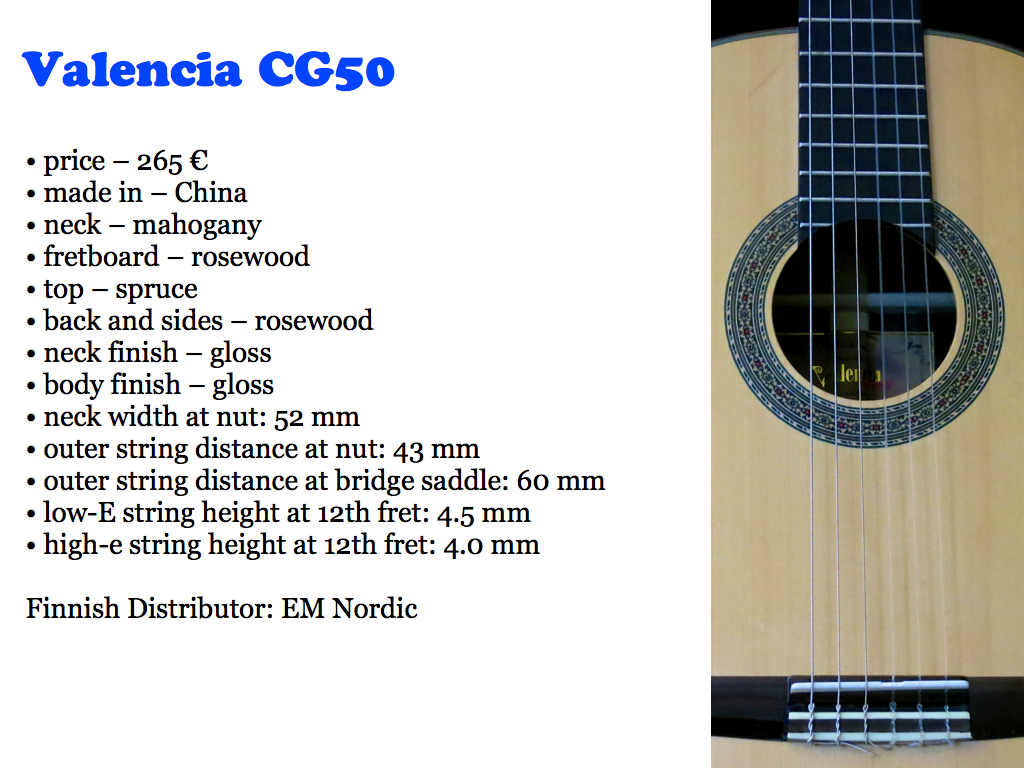
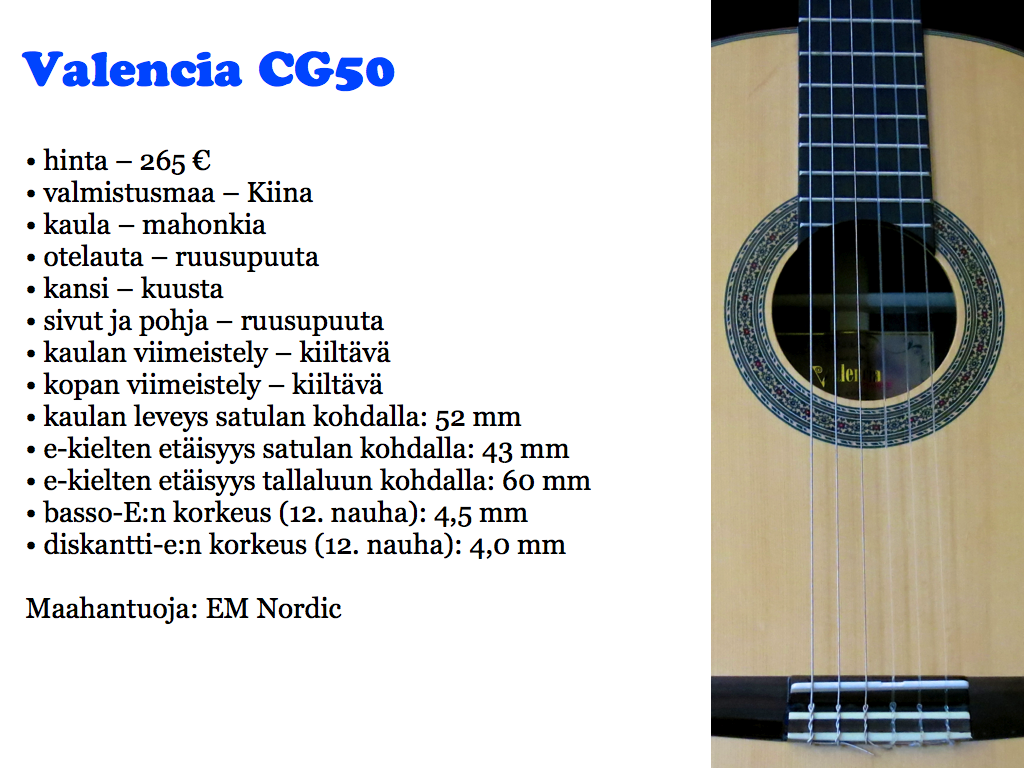
Valencia was a new name to me, even though the company has been in existence since 1972.
Valencia-guitars are designed in Australia, and built in several factories in China and Indonesia.
Valencia’s Finnish distributor is EM Nordic. The review sample was kindly provided by DLX Musiikki.
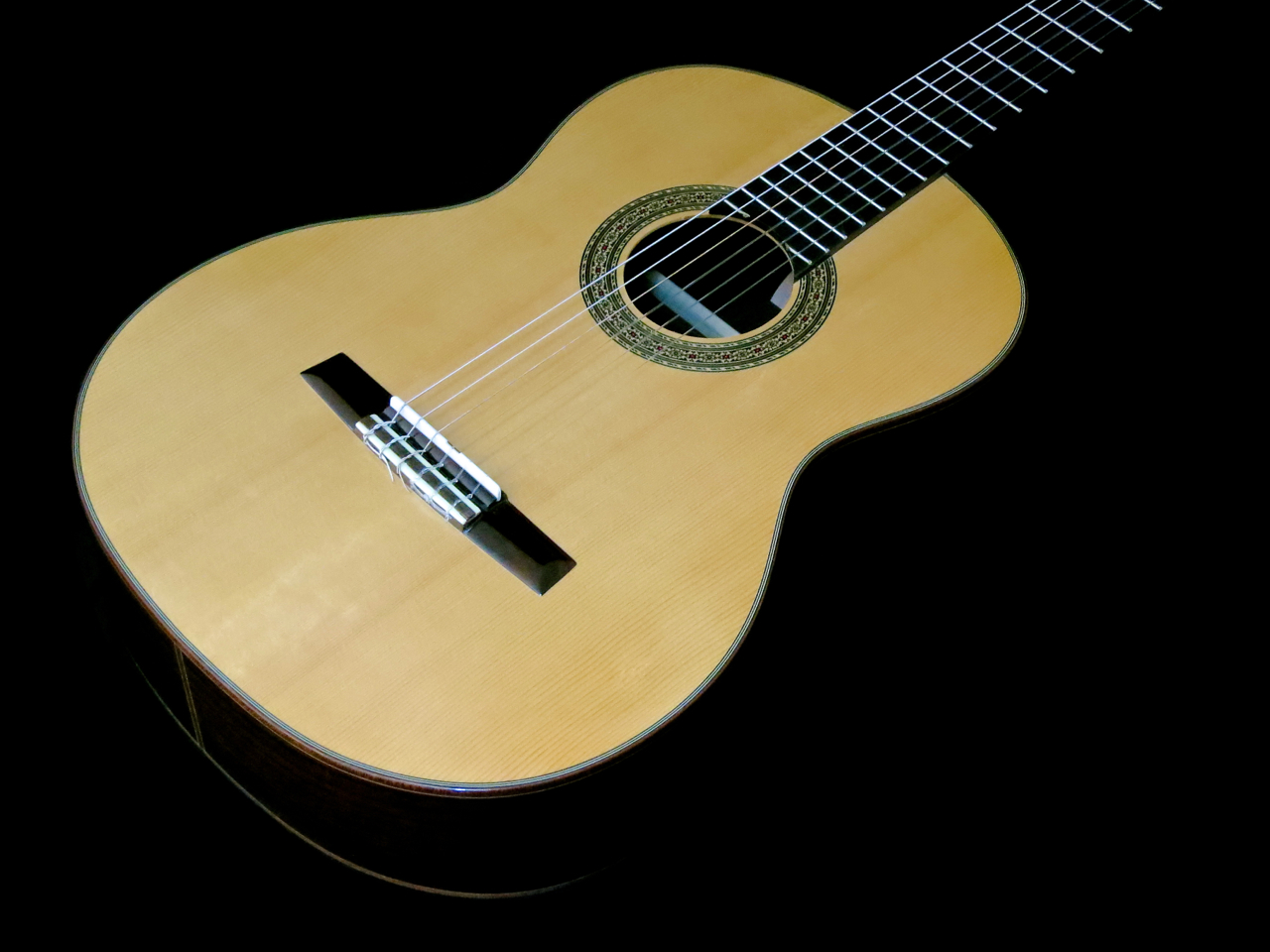
The spruce-topped Valencia GC50 is probably the most richly ornamented instrument in this review.
There is multi-ply binding on both top and back, with the outermost ply being mahogany.
The back’s centre seam has also been adorned with a mahogany inlay.
The neck of the GC50 is glued together from three side-by-side strips. The middle piece’s grain orientation is reversed to make neck warping less likely.
Valencia’s neck profile is fairly traditional, with just a touch of added roundness.
The action on our review instrument felt a bit high and stiff for my taste (I’m not Andrés Segovia). A guitar repairer (or a reasonably skilled guitarist) shouldn’t have a problem lowering the bridge saddle, though. Shaving off a millimetre, or so, should result in a much better playing feel.
The Valencia GC50’s voice is beautifully lyrical and open. Even in the highest registers the notes still have an astonishing richness and depth.
****
Classical guitars have always been a very important part of Yamaha Guitars’ wide range of models. The C40 is still the best-selling classical guitar on the planet.
The more recent Concert Series bears testament to Yamaha’s ongoing commitment to research and development.
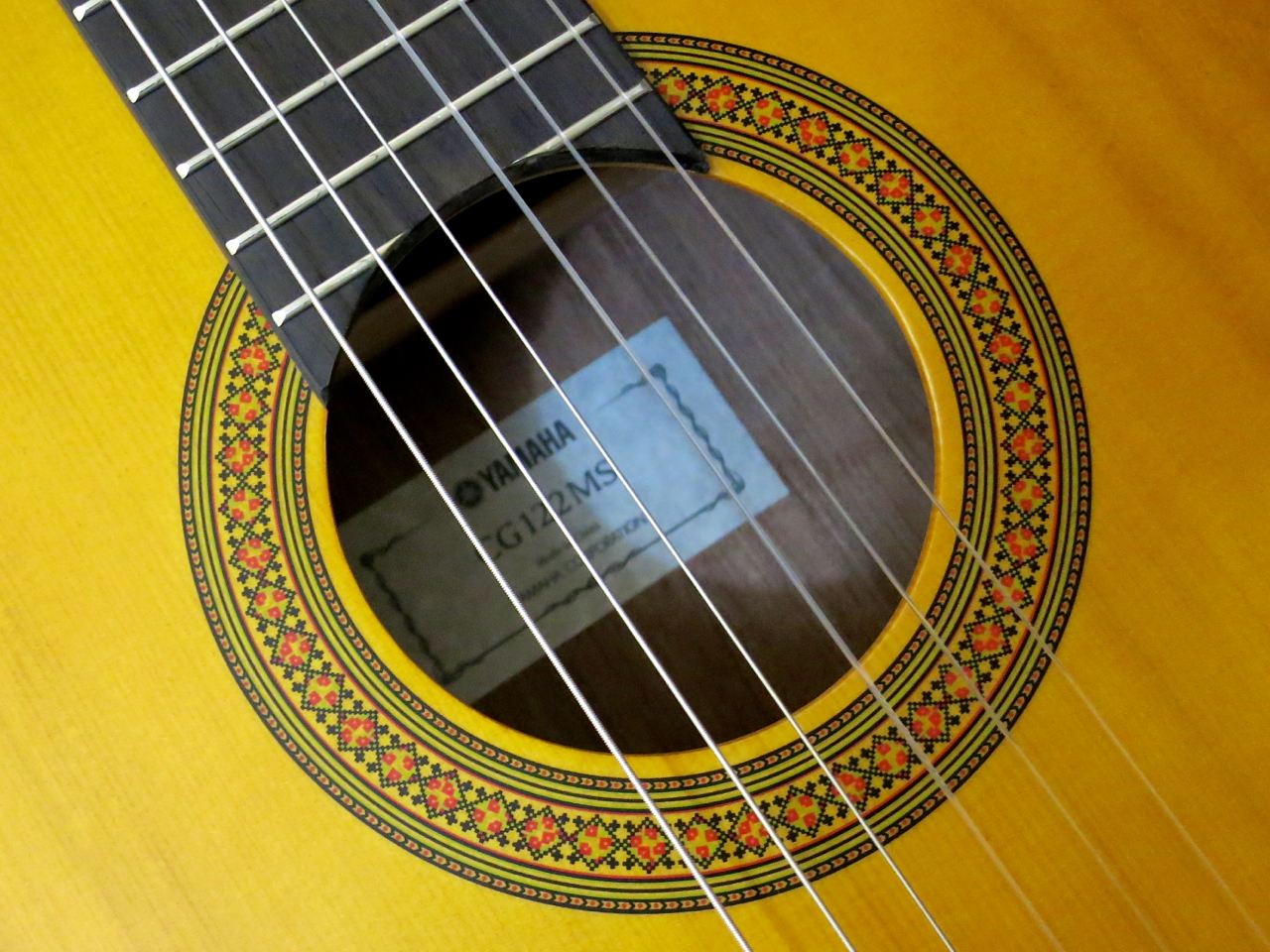
The Yamaha CG122MS is one of the most affordable Concert Series instruments.
TheCG122MS’s matte finish is applied very thinly, which is great for tone and feels nice, too.
The CG122MS is a lightweight instrument with a slightly more rounded neck profile.
Side dots at the fifth and seventh frets make finding your way around the fingerboard a little bit easier.
The CG122MS plays very well with a nice, traditional action.
The tone is warm and woody. The Yamaha sounds well-balanced, and displays a crisp and clear attack.
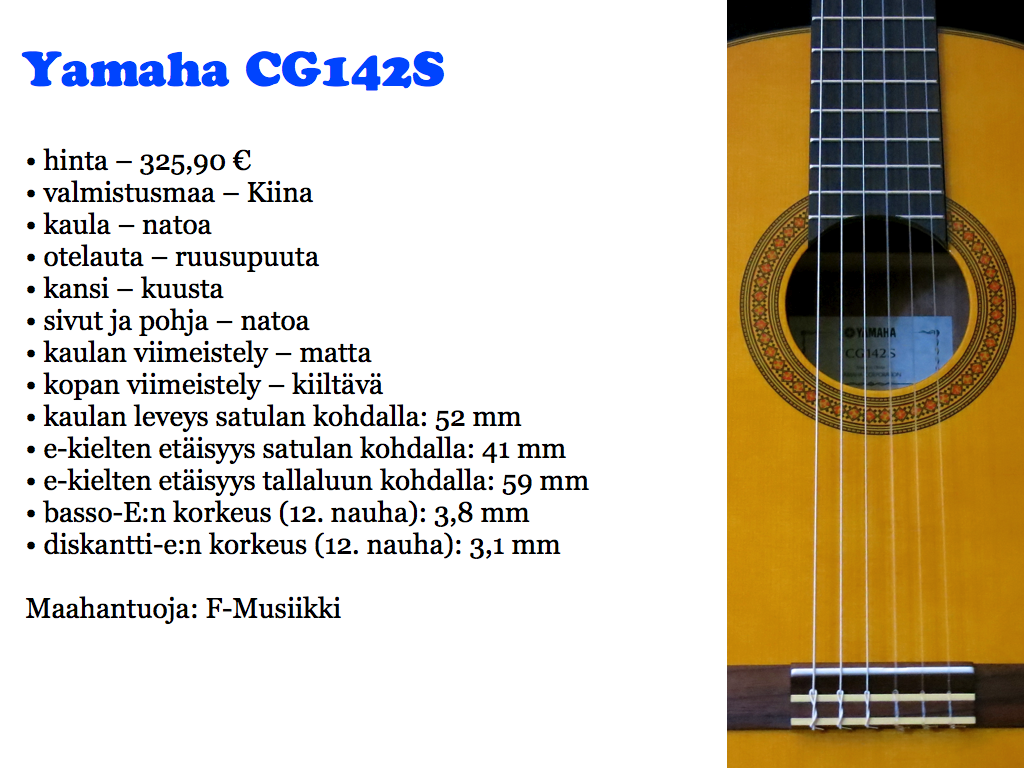
The Yamaha CG142S is the only guitar in this round-up that combines a gloss-finished body with a satin-finished neck.
Understated beauty is the thing with the CG142S. This is a very cleanly built guitar.
On this Yamaha, too, the neck profile is a tad more rounded compared to a traditional neck profile. The playability is very comfortable.
The CG142S’s fretboard also has a couple of side dots for easier orientation.
Yamaha’s CG142S sings with a well-rounded, beautiful voice. There’s a healthy amount of clarity in the mid-range.
****
To summarise I could state the obvious – there are many well-built, well-playing instruments in the 250-400 euro price segment. There should be the right guitar for everyone, depending on finish, neck profile and sound preferences.
Klassinen (nailonkielinen) kitara on yhä erittäin suosittu soitin. Monille klassinen kitara on se ensimmäinen soitin, jolla aloittelijan matka musiikin maailmaan alkaa.
Tästä syystä Kitarablogissa päätettiin tehdä pieni katsaus tärkeän 250-400 euron hintasegmentin soittimista. Kohtuullisella satsauksella saa nykyään jo kunnon kitaran kokopuisella kannella.
Kokopuisella kannella on iso merkitys soittimen sointiin, ja säännöllisesti soitettuna kansi herää henkeen ja kitaran luonne nousee esiin. Totta, vanerikannestakin lähtee ääni, mutta soitin soi aina vaisummin, eikä sen sointi kypsy ajan kanssa.
Klassisen kitaran isä oli espanjalainen puuseppä ja soitinrakentaja Antonio de Torres Jurado (1817-1892). Torres antoi kitaralle sen lopullisen ulkomuodon, soittimen rakennustavan (esim. kannen rimoitus tai erillinen tallaluu) ja sen rakentamiseen sopivat materiaalit.
Torres käytti suurimmilta osin kitaroissaan seetriä kaulamateriaaliksi ja ruusupuuta otelaudaksi. Kansi oli veistetty lähes poikkeuksetta kuusesta, mutta pohjan ja sivujen materialien suhteen Torresin soittimissa oli isompi vaihtelevuus. Kopat tehtiin ruusupuusta, mahongista, vaahterasta ja sypressistä.
Koska sypressi oli jo Torresin aikaan huomattavasti halvempi puu kuin esimerkiksi ruusupuu, olivat sypressikoppaiset soittimet myös halvempia kuin muut mallit. Monilla flamenco-kitaristeilla oli tiukka rahatilanne, miksi he valitsivat usein juuri sypressi-kitaran. Tästä syystä myös tänä päivänä monien valmistajien flamenco-kitaroissa sivut ja pohja ovat sypressistä.
Monissa nykypäivän klassississa kitaroissa on kaulaliitos toteutettu liimaamalla kaula kopassa olevaan kaulablokkiin.
Torresin tapa oli toisenlainen, ja hänen liitostaan kutsutaan nykyään espanjalaiseksi koroksi tai jalaksi (engl. Spanish Heel):
Kaula-aihio ja kaulablokki tehdään silloin yhdestä palasta. Aihion kummassakin sivussa on ura jonne liimataan kopan sivut kiinni. Tästä syntyy kehikko, johon lisätään kitaran pohja ja kansi.
Espanjalaisen jalan ystävät väittävät, että tämä rakennustapa parantaa kitaran sointia. Toiset taas ovat sitä mieltä, että Torresin tapa on liian monimutkainen, ja että se tekee mahdollisesta kaulakulman korjauksesta hyvin hankalan. Mene ja tiedä…
Tunnen itseni suomalaisen lastenohjelman juontajaksi, kun totean, että tässä kitarakatsauksessa ei ole häviäjiä. Jokainen esitelty kitara on oikea soitin, jolla voi tehdä kaunista musiikkia.
On kuitenkin hyvin mielenkiintoista huomata eri valmistajien näkemykset toteuttaa Torresin klassikkoreseptiä tässä hintaluokassa meille nykymuusikoille.
Edetään aakkosjärjestyksessä…
****
Admira on yksi isoimmista klassisten kitaroiden valmistajista maailmassa.
Saksalainen maahanmuuttaja Enrique (saks. Heinrich) Keller perusti vuonna 1944 soitintehtaan Pohjois-Espanjaan. Ajan mittaan pienestä työpajasta kasvoi varteenotettava yritys.
Admira A5 on edullinen malli espanjalaisvalmistajan Handcrafted-sarjasta.
Kevyen soittimen työnjälki vaikuttaa erittäin siistiltä. Kitaran ohut lakkaus tuo A5:n puiden sävyt ja syykuviot sopivasti esiin. Pikantteina yksityiskohtina voi mainita mallin kultaiset virityskoneistot helmiäismuovisilla nupeilla, sekä A5:n hauska rosetti, jossa näkyvät pienet kitarat rivissä.
Admira A5 on yksi tämän katsauksen kolmesta kitarasta, joilla on Spanish Heel -kaula.
Kaulaprofiili on aidosti klassinen, mikä tarkoittaa leveää, laakeaa ja hartioissa aavistuksen verran kulmikasta.
Maltillinen kieltenkorkeus tekee soittotuntumasta erittäin mukavan ja vaivattoman.
Admira A5 -kitaralla on iso ja hyvin tasapainoinen ääni muhkealla bassolla ja selkeällä atakilla.
Malaga on yksi tämän katsauksen kevyimmistä soittimista. Seetrikannella varustetun kitaran työnjälki on erinomaisen siisti, ja lopputulos on hyvin kaunis soitin. Malagan alhainen hinta näkyy ainoastaan kopan sisäisistä – sivuja pohjaan ja kanteen liittävistä – tukirimoista, jotka ovat nekin hyvin siistejä, mutta yksinkertaisemmat ja ohuemmat.
Admira Malagan kaulaprofiili on perinteisen klassinen.
Yllättävän matala kieltenkorkeus helpottaa kitaran soittotuntumaa aloittelijoille sopivaksi, mutta se tekee tästä mallista myös erinomaisen flamenco-soittimen, sen tuoman napsakan atakin ansiosta.
Matalasta ja nopeasta tatsista huolimatta Malaga soi siististi ilman kielten sirinää, ja kitaralla on iso ja täyteläinen ääni.
****
Esteve on hyvin perinnetietoinen klassisten kitaroiden valmistaja Espanjasta.
Esteven 4ST on valmistajan Student-malliston soitin.
Seetrikannen tumma viimeistely ja erittäin kaunis rosetti antavat tälle kitaralle hyvin tyylikkään ilmeen.
4ST on toinen kitara tässä katsauksessa, joka on rakennettu espanjalaisella jallalla. Työnjälki on kauttaltaan hyvin siisti.
Esteven kaulaprofiili on aidosti klassinen – leveä ja laakea. Kieltenkorkeuskin on perinteisissä lukemissa. Soittotuntuma on hyvin mukava.
Esteve 4ST soi voimakkaalla äänellä, joka on lämmin ja tasapainoinen. Kitaran atakki on mukavan selkeä.
****
Kantare-kitarat ovat suomalaisen tietotaidon ja kekseliäisyyden tuotoksia.
Kantare-soittimet ovat suomalaisen kitararakennuksen grand old manin, Kauko Liikasen, suunnittelemia.
Kansirimoitus on näissä kitaroissa hyvin erilainen perinteisen viuhkaa muistuttavan rimoitukseen (fan bracing) verrattuna. Kauko Liikasen ja Uwe Florathin keksimä LRS-rimoitus (Lens Resonance System) keskittää rimoituksen optisen linssin tavoin tallan ympärille. LRS:n suurin etu on, että kitaran kansi voi värähdellä vapaamin kuin perinteisen rimoituksen kanssa, samalla kun tuetaan tallan ympäröivä aluetta paremmin.
Soittimet valmistetaan Romaniassa. Valmistaja Hora on yksi Euroopan suurimmista akustisia kieli- ja jousisoittimia valmistavista yrityksistä.
Kantare Dolce C hg on kiiltäväksi lakattu kitara LRS-rimoitetulla seetrikannella.
Testikitaraan on asennettu Kantaren uusi käsivarsituki, joka on saatavilla pieneen lisähintaan. Tuella saadaan soittajan käsivarsi mukavaan soittoasentoon, ja se estää samalla myös käsivarrren aiheuttamaa kannen demppausta.
Dolce C hg on erittäin siististi rakennettu ja hyvin tyylikäs soitin.
LRS-rimoituksen lisäksi toinen mielenkiintoinen ominaisuus monissa Kantare-soittimissa on niiden loimuvaahterasta veistetyt kaulat.
Klassisissa kitaroissa käytetään yleisesti mahonkia tai seetriä kaulan materiaaleina, kun taas jousisoittimissa vaahtera on yleisin puulaji. Vaahteran lujuus on mainio peruste sen valinnalle myös klassisen kitaran kaulapuuksi, ja Hora-tehtaalla on isot loimuvaahteravarastot.
Kantaren uudet virityskoneistot ovat hyvin laadukkaita ja toimivat pehmeän sulavasti.
Dolce C hg:n kaulaprofiili on selvästi pyöreämpi kuin perinnekauloissa, mikä voi olla monien mielestä mukavampi vaihtoehto. Aloittelijoille oikean nauhan löytämistä helpotetaan pienillä dot-merkeillä viidennen ja seitsemännen nauhan kohdilla.
Kantare Dolce hg on varsin äänekäs kitara. Sen soundi on hyvin erotteleva selkeällä atakilla.
Kantare Vivace C on mattaviimeistelty uudella, ekologisilla tavalla.
Vivace C:n mattaviimeistelyssä käytetään saksalaisen Hesse Lignal -firman uutta, myrkytöntä Proterra Resit -pintamaalia. Proterra Resit perustuu uudenlaiseen sekoitukseen šellakasta, öljystä ja carnauba-vahasta.
Šellakka on orgaaninen polymeeri, jota on käytetty jo hyvin pitkään esimerkiksi jousisoittimien viimeistelyssä. Perinteisesti šellakkaa on hyvin työlästä levittää ja käyttää, minkä vuoksi sitä käytetään nykyään vain kalliissa soittimissa. Uusi Proterra Resit -pintakäsittely taas on nopea ja helppo käyttää.
Kantare Vivace C näyttää ja tuntuu ”luomukitaralta” sanan parhaassa merkityksessä.
Uusi viimeistely tuo myös loimuvaahterakaulan kauneuden esiin.
Kaulaprofiili on hieman perinteistä pyöreämpi, ja myös tässä Kantaressa on otelaudan reunassa kaksi otemerkkiä.
Vivace C:n ääni on luomuteemaan sopivasti kuiva ja orgaaninen. Tässä kuuluu selvästi puun sointi. Bassot eivät kumise, keskialue on lämmin ja diskantti avoin, muttei terävä.
LaManchan soittimet suunnittellaan Saksassa, ja ne valmistetaan firman omassa tehtaassa Kiinassa.
LaMancha on nykyään Saksassa eniten myyvä klassisten kitaroiden merkki, ja monet mallit ovat myös voittaneet European Guitar Teachers Association -järjestön palkintoja.
LaMancha Rubi CM SN on mattaviimeistelty kitara kapealla kaulalla, mikä tekee soittamisesta helpomman esimerkiksi lapsille.
Rubi CM SN on kolmas kitara tässä katsauksessa, jolla on spanish heel -kaulaliitos.
Kaulapuuksi on valittu toona-niminen puulaji, joka on seetrin sukulainen. Toonaa kasvaa esimerkiksi Aasiassa ja Australiassa.
Kaulan lujuutta lisäävät kaksi grafiittitankoa, joita on upotettu kaulaan ruusupuisen otelaudan alle.
LaManchan työnjälki on hyvin siisti. Rubi CM SN on hyvin tyylikäs ja erittäin kevyt kitara.
Rubin kaulaprofiili on paitsi kapeampi myös hieman pyöreämpi kuin perinteisessä klassisessa kitarassa. Otelaudan reunaan on upotettu pienet otemerkit viidennen ja seitsemännen nauhan kohdalla.
LaManchan soitettavuus on erinomainen.
Rubi CM SN -mallin ääni on mukavan tasapainoinen ja hieman kuiva. Bassorekisteri on jäntevä. Tässä kitarassa soi puu.
****
Japanilainen Takamine on tunnettu etenkin mikitetyistä teräskielisistä kitaroista, mutta firmalla on myös klassisia kitaroita valikoimassaan.
Takamine GC3-NAT on Kiinassa valmistettu klassinen kitara kuusikannella.
Kannen kellertävä värisävy muistuttaa šellakalla viimeistellyn kitaran ulkonäköä.
GC3-NAT:n pelkistetty ruusupuinen talla on raikas kontrasti soittimen runsaasti koristeltuun rosettiin.
Takamine varmistaa myös klassisten kaulojensa lujuutta asentamalla niihin kaularaudan.
GC3-NAT-mallin kaulaprofiili on hyvin perinteinen – leveä, laakea ja aavistuksen verran kulmikas. Kielten korkeus oli säädetty mukavan matalaksi, mikä teki soittotuntumasta vaivattoman.
Tämä Takamine tarvitsi hieman sisäänsoittoa, ennen kun ääni aukesi kunnolla. Toimenpide kuitenkin kannatti ehdottomasti, koska GC3-NAT:n ääni on kauniisti laulava ja avoin, sekä napakalla atakilla höystetty.
****
Valencia oli ainakin minulle uusi tuttavuus, vaikka firma on perustettu jo vuonna 1972.
Valencia-kitarat sunnittellaan Australiassa, ja ne valmistetaan useissa eri tehtaissa Kiinassa ja Indonesiassa.
Kuusikannella varustettu Valencia GC50 on tämän katsauksen runsaimmin koristeltu soitin.
Sekä kannen että pohjan reunat on koristeltu monikerroksisella reunalistoituksella, jossa uloin kerros on mahonkia.
Pohjan keskisaumassakin on kaunis mahonkikoristus.
GC50:n kaula on tehty kolmesta pitkästä vierekkäisestä palasta. Keskimmäinen pala on käännetty pituussuunnassa 180 astetta, mikä minimoi kaulan vääntymisen riskin.
Valencian kaulaprofiili perustuu perinnekaulaan, mutta siihen on lisätty aavistuksen verran pyöreyttä.
Testisoittimen kielten korkeus on jo hieman korkea omaan makuuni (en ole Andrés Segovia). Soitinrakentaja (tai kokenut soittaja itse) voisi madaltaa GC50:n tallaa varmasti ongelmitta vielä noin millimetrin verran, mikä tekisi tatsista selvästi pehmeämmän.
Valencia GC50:n soundi on hyvin avoin ja lyyrinen. Ylänauhoillakin soitetuissa äänissä on kaunis, laulava klangi.
****
Klassiset kitarat ovat aina olleet hyvin tärkeä osa Yamaha Guitarsin mallistossa, ja firman C40-malli on yhä eniten myyty klassinen kitara maailmassa.
Uusi Concert-sarja on luonnollinen jatkumo Yamahan tuotekehitykselle.
CG122MS:n soitettavuus on hyvin mukava perinteisellä tatsilla.
Tämän Yamahan äänessä on mukana aimo annos puun klangia. Sointi on kaunis ja tasapainoinen, selkeällä atakilla höystettynä.
Tämän katsauksen ainoana kitarana Yamaha CG142S tarjoaa mattaviimeistellyn kaulan yhdistettynä kiiltäväksi lakattuun koppaan.
CG142S edustaa hillittyä tyylikkyyttä. Työnjälki on erittäin siisti.
Tämän Yamahan kaulaprofiili tuntuu aavistuksen verran ohuemmalta kuin yleisesti klassisissa kitaroissa. Mallin soitettavuus on hyvin mukava.
Myös CG142S-kitarassa on otelaudan reunassa kaksi otemerkkiä.
Yamaha CG142S soi pyöreästi, mutta silti selkeästi. Soundin keskialue on kauniin siisti ja kitara artikuloi tarkasti.
****
Yhteenvetona voisin todeta, että hintahaarukassa 250-400 euroa on tarjolla runsaasti hyvin rakennettuja ja hyvin soivia klassisia kitaroita. Soittaja voi niistä valita itselleen sopivimman vaihtoehdon käyttötarkoituksen, ulkonäön ja soundin perusteella.
Kuvitellaan, että olemme läsnä Fender vahvistinosaston aivoriihessä lämpimässä Kaliforniassa, syksyllä 1966. Sessiossa on tarkoitus ideoida uutta vahvistinsarjaa.
Yksi osallistujista sanoo: ”Hei, tyypit. Jotenkin alkaa tympiä se, että teemme koko ajan vain vahvistimia country-kitaristeille ja tylsille viihdyttäjille. Miten olisi, jos tekisimme sarjan kitaravahvistimia, joissa olisi vähän enemmän ’munaa’ Blues- ja Rock-väelle? Kuulin pienestä englantilaisesta firmasta, joka rakentaa tuunattuja Bassman-kopioita, ja jengi tykkää. Meilläkin pitäisi olla tällaisia hot-rod-vahvistimia!”
Fenderin Bassbreaker 18/30 on kuin se olisi ilmestynyt jostain rinnakkaistodellisuudesta, jossa firma olisi 60-luvun lopulla päättänyt valmistaa amerikkalaisia putkivahvistimia selvällä ”brittikorostuksella”.
Uutuus on kahdella 12-tuumaisella elementillä varustettu Fender-kombo uudella, tyylikkäällä Gray Tweed -päällysteellä. Kaiutinkotelo on rakennettu laadukkaasta koivuvanerista, minkä ansiosta isokokoisen kombon paino jää alle 23 kilon.
Bassbreakerin mallitunnus ”18/30” viittaa siihen, että kombon kaksi kanavaa ovat käytännössä kaksi erillistä vahvistinta:
Ykköskanava (Channel One) perustuu Fender Blackface Deluxe -vahvistimeen, ja sen pääteteho on 30 wattia. Kakkoskanava (Channel Two) sen sijaan on kevyesti modattu versio hieman aikaisemmasta, ruskeasta Deluxesta. Kakkoskanavan pääteteho on 18 wattia.
Uusi Bassbreaker on A/B-luokan täysputkivahvistin puolijohdetasasuuntajalla.
Etuaste on rakennettu kahden 12AX7-putken ympärille, kun taas pääte saa tehonsa neljästä EL84-putkesta. EL84 mielletään yleisesti brittivahvistimiin – perinteisesti Fenkuissa, kuten muissakin jenkkivahvistimissa, käytetään 6V6- tai 6L6-pääteputkia.
Takapaneelista löytyy lisäkaappilähdön ja linjalähdön (päätevahvistimen jälkeen) lisäksi myös jakki pakettiin kuuluvalle jalkakytkimelle.
”Brittipäätteen” lisäksi Bassbreaker 18/30 -kombossa myös kaiutinvalinta on ei-perinteinen. 60-luvun Fendereistä tuttujen Jensen- tai JBL-kaiuttimien sijaan uutuusvahvistimeen on asennettu pari 12-tuumaista Celestion V-Type -kaiutinta.
****
Ykköskanavan (”Blackface”) enimmäkseen puhtaita soundeja varten on varattu kolmialueinen taajuuskorjainosasto, kun taas kakkoskanavasta (”Brownface”) löytyy ainoastaan yksi Tone-säädin.
Tärkein asia ensin – Fender Bassbreaker 18/30 on uskomattoman kovaääninen! Kyseessä on aito non-master-volume-putkikone, joka liikkuu samassa teholuokassa esimerkiksi Marshall 1962 Bluesbreakerin tai Vox AC30:n kanssa.
Kerrostaloasuntoon 18/30 ei todellakaan sovi, koska kakkoskanavan herkulliset särösoundit heräävät henkiin vain kovalla volyymillä. Ja tämä vaikka kombo toimiikin silloin ainoastaan kahdella pääteputkella, minkä vuoksi teho laskee 18 wattiin ja päätevahvistimen puhdas headroom on hyvinkin rajallinen.
Jos Bassbreaker-mallisto kiinnostaa, mutta tämän kombon äänekkyys ei tunnu sopivan käyttötarkoitukseen, kannattaa kokeilla saman sarjan Bassbreaker 15 -komboa, jossa on mm. master volume -säädin.
Pienillä Volume-asetuksilla molemmista Bassbreaker 18/30 –kanavista saa puhtaita soundeja. Channel One on kaksikosta se helisevämpi ja kirkkaampi, kun taas Channel Two on hieman pyöreämpi ja rouheampi. EL84-pääteputkien ja Celestion-kaiuttimien ansiosta uutuuskombon perussoundi ei ole pikkutarkka kopio firman vanhoista klassikkomalleista, vaan todella herkullinen sekoitus 1960-luvun Fender-soundeista ja perinteisten brittikombojen keskialueen murinasta ja potkusta.
Tässä lyhyt pätkä puhtailla asetuksilla (molemmat volume-säätimet kello yhdeksän ja kymmenen välillä), vaahterakaulaisella Fender Stratocasterilla soitettuna:
Demobiisissä soi kaksi komppikitaraa – Gibson Les Paul Junior (Channel One, oikea stereokanava) ja Fender Telecaster (Channel Two, vasemmalta) – sekä Epiphone Les Paul Standard -kitaralla (vintage-tyylisillä EMG HZ -mikrofoneilla) soitettu soolokitara (Channel Two, volume-säädin kello kolme):
****
Fenderin Bassbreaker 18/30 on oikein mainio ja kovaääninen putkivahvistin sellaisille Blues- ja Rock-kitaristeille, jotka tietävät miten non-master-volume-vahvistimien kanssa tullaan toimeen. Uudessa 18/30:ssa yhdistyvät 60-luvun Fender-kombojen parhaat ominaisuudet ja saman aikakauden brittiklassikkojen lihaksikkaan rouhea asenne.
Bassbreaker 18/30 -kombo ei sovi olohuoneen harjoittelukumppaniksi, ja myös kotistudioon se voi osoitauttua liian kovaääniseksi. Tämä on pro-luokan putkivahvistin, joka on tarkoitettu livekäyttöön sellaisissa paikoissa (ja bändeissä), joissa kitaristia ei alituiseen kehoteta soittamaan hiljempaa.
Imagine a brainstorming session at Fender R&D in sunny California, sometime in late 1966. The brief of the day is to come up with a new guitar amplifier.
One of the guys speaks up: ”I’m kinda bored of sparkling TV cowboys and clean-cut entertainers. How about we design an amp for the Blues and Rock players? I’ve heard some little company in England has been doing a sort of Bassman-on-steroids thing, and it seems to catch on. We should try to come up with something that really rocks, too!”
In reality that meeting never took place, but what if it had?
****
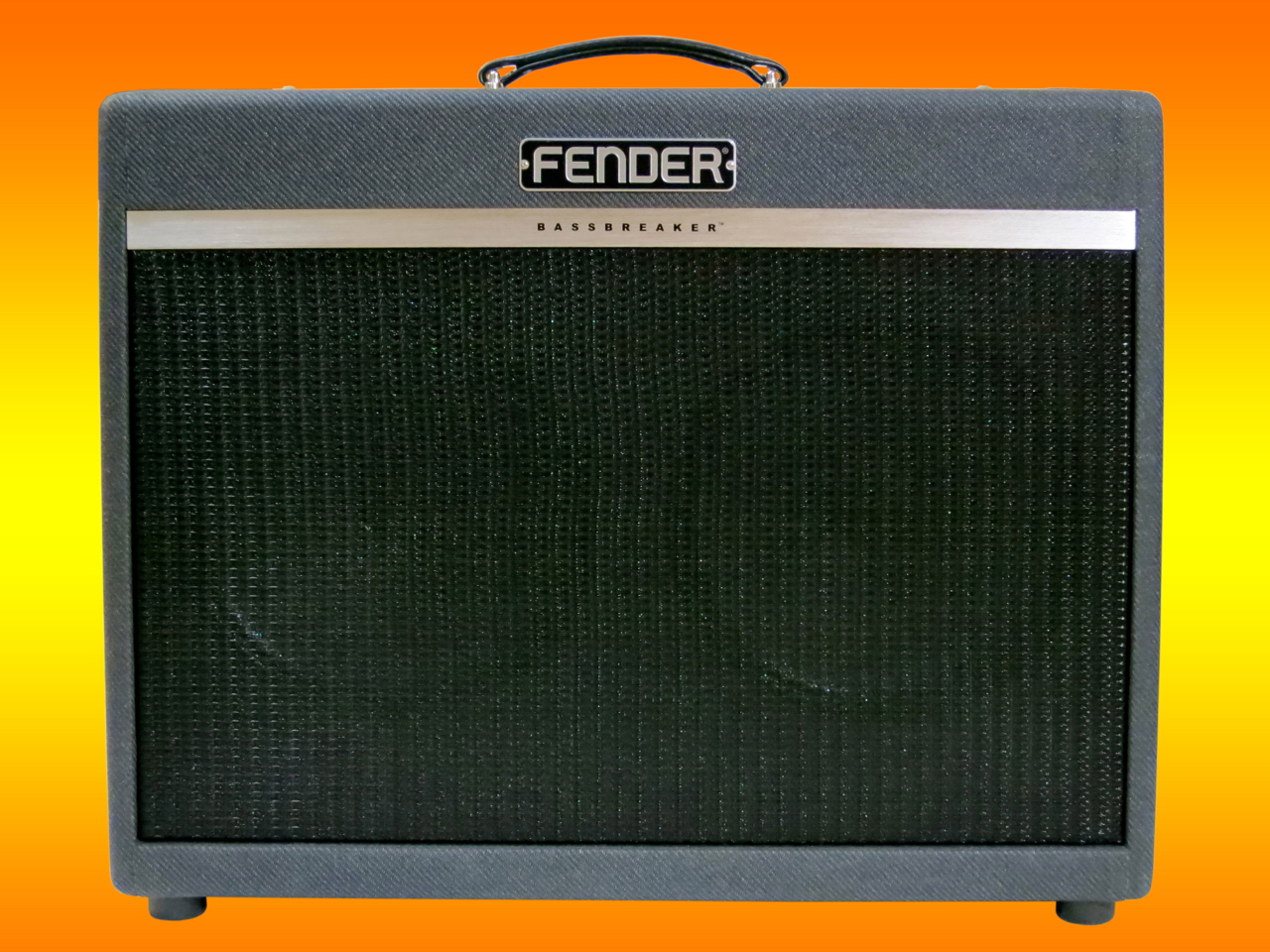
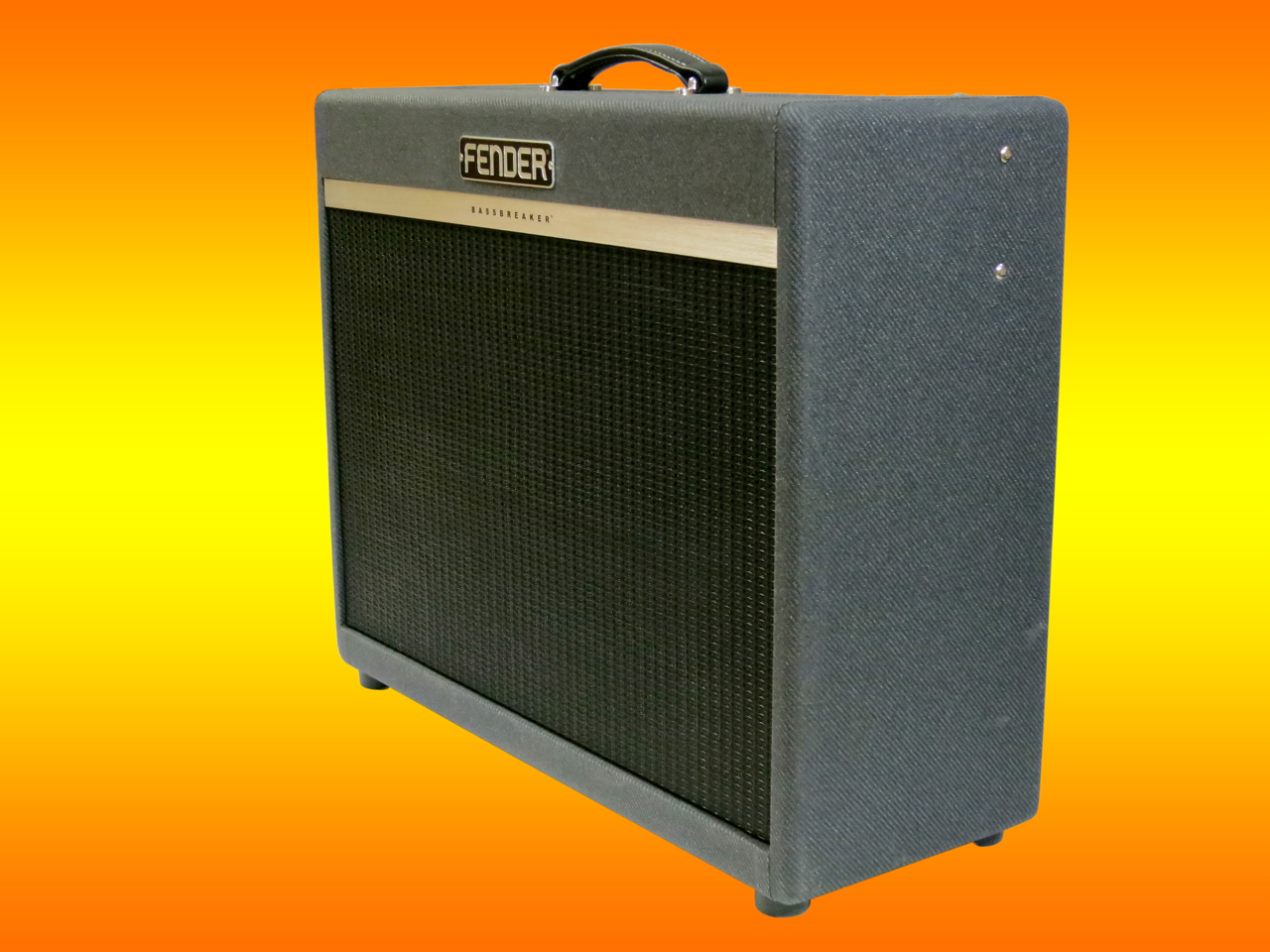
The new Fender Bassbreaker 18/30 Combo (list price in Finland: 799 €) could well have been the result of our imaginary R&D session.
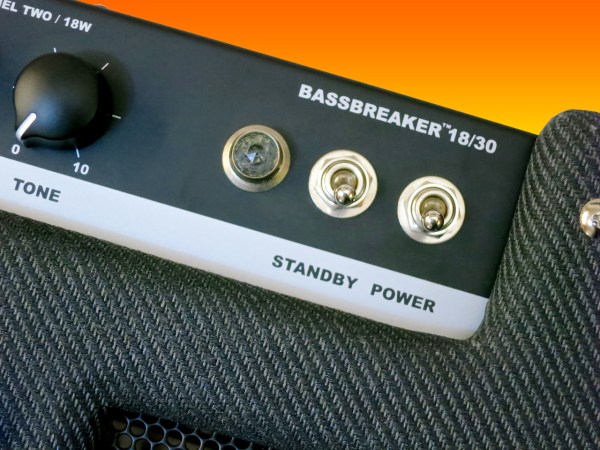
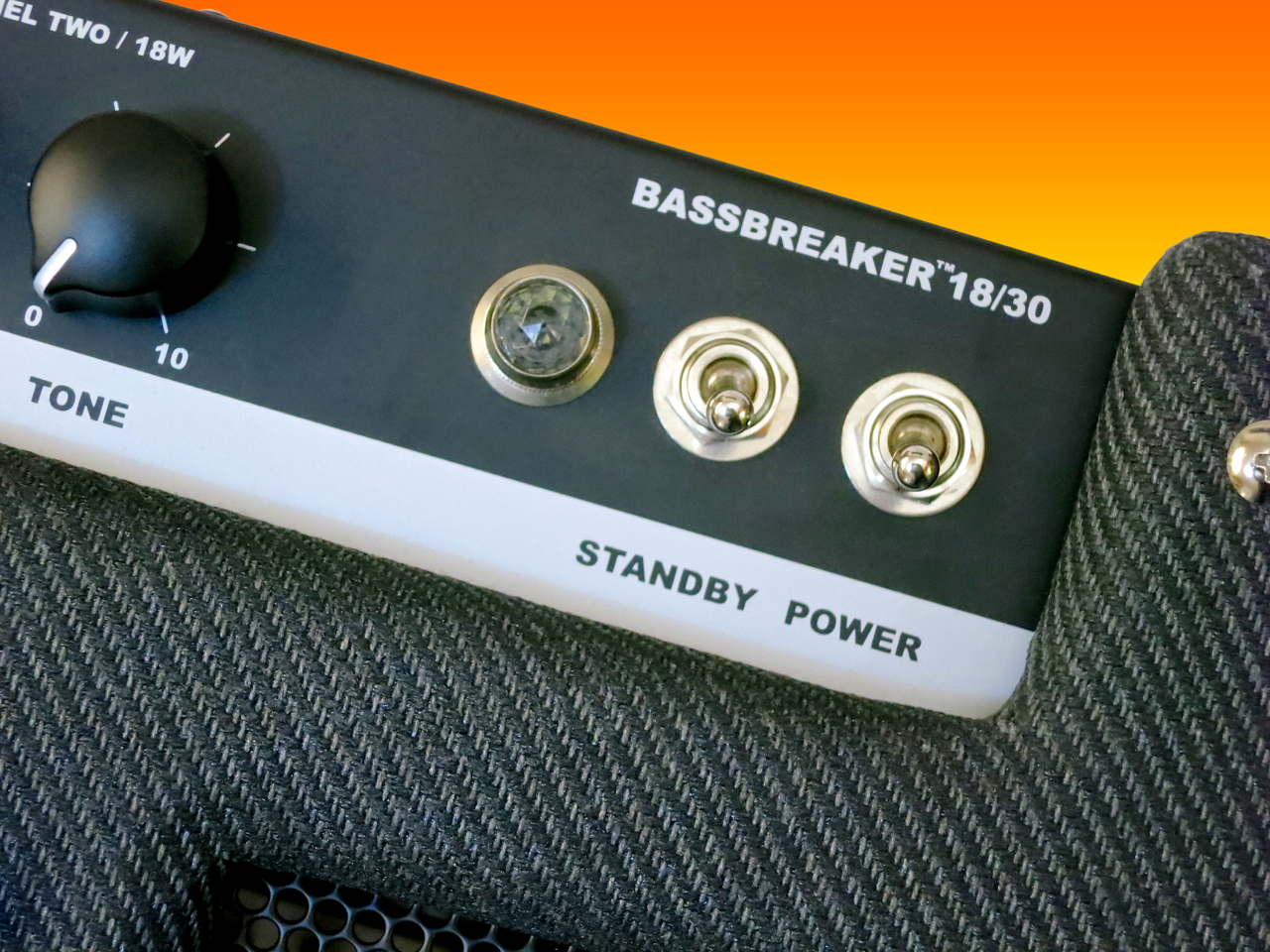
The Bassbreaker 18/30 is like a visitor from a parallel universe, in which Fender has taken a turn in the mid-Sixties to design guitar amplifiers with a distinctly British accent.
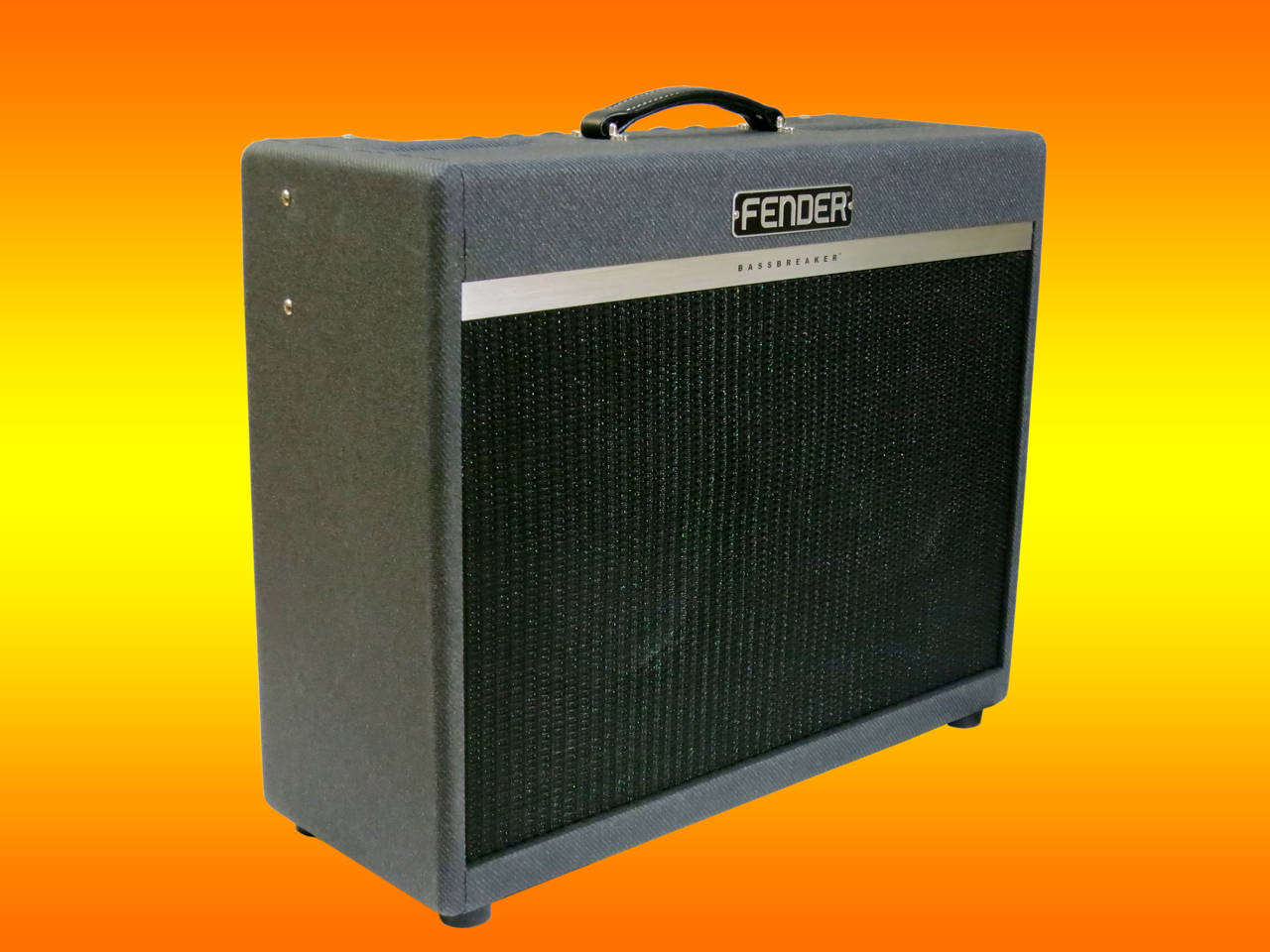
This is a 2 x 12 Fender combo with a cool new trim, called Gray Tweed. The cabinet is built from birch ply, resulting in a combo with a still-manageable weight of just below 23 kg.
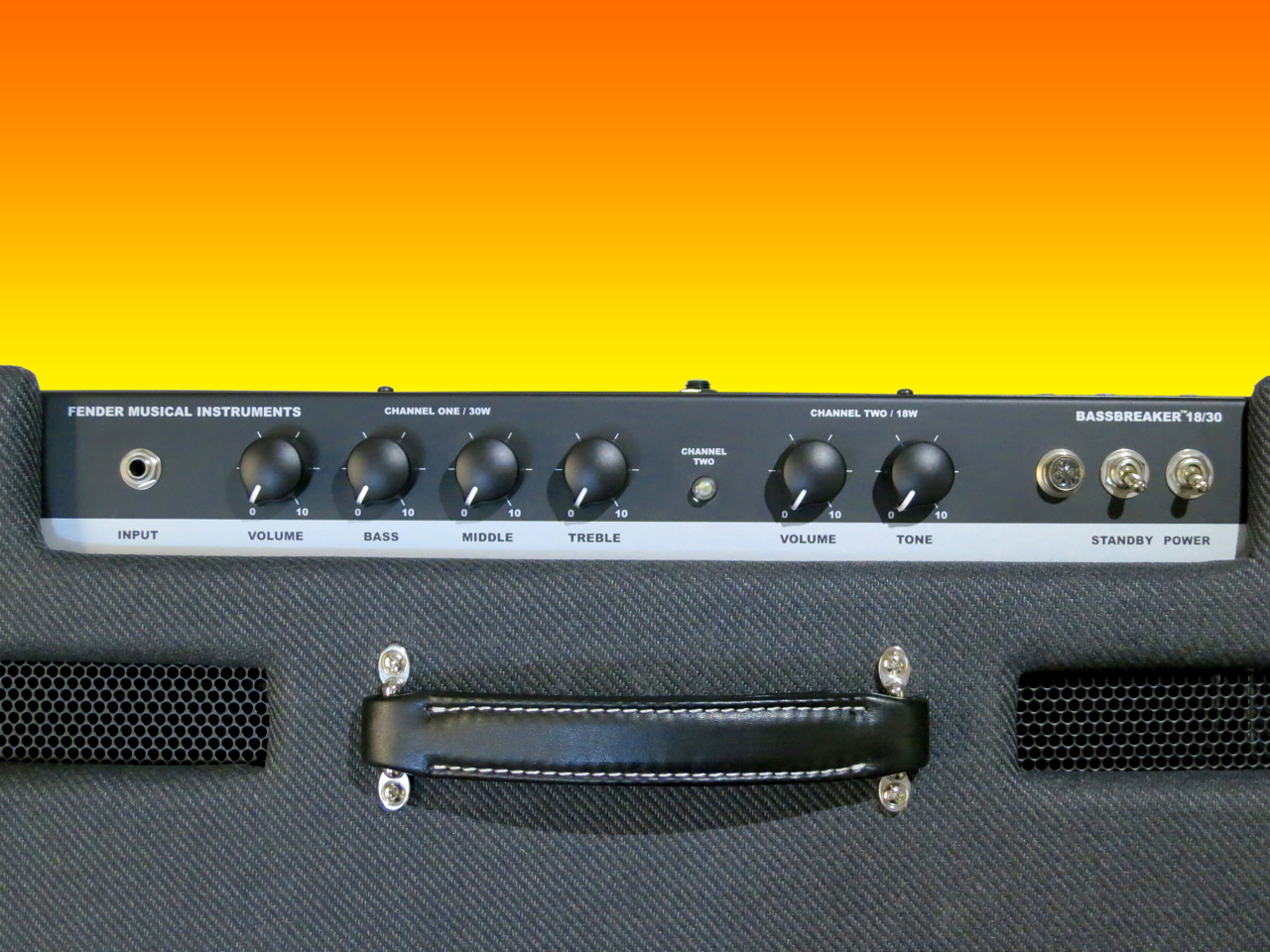
The Bassbreaker 18/30’s model name hints at the fact that this amp features two different Fender designs in one package:
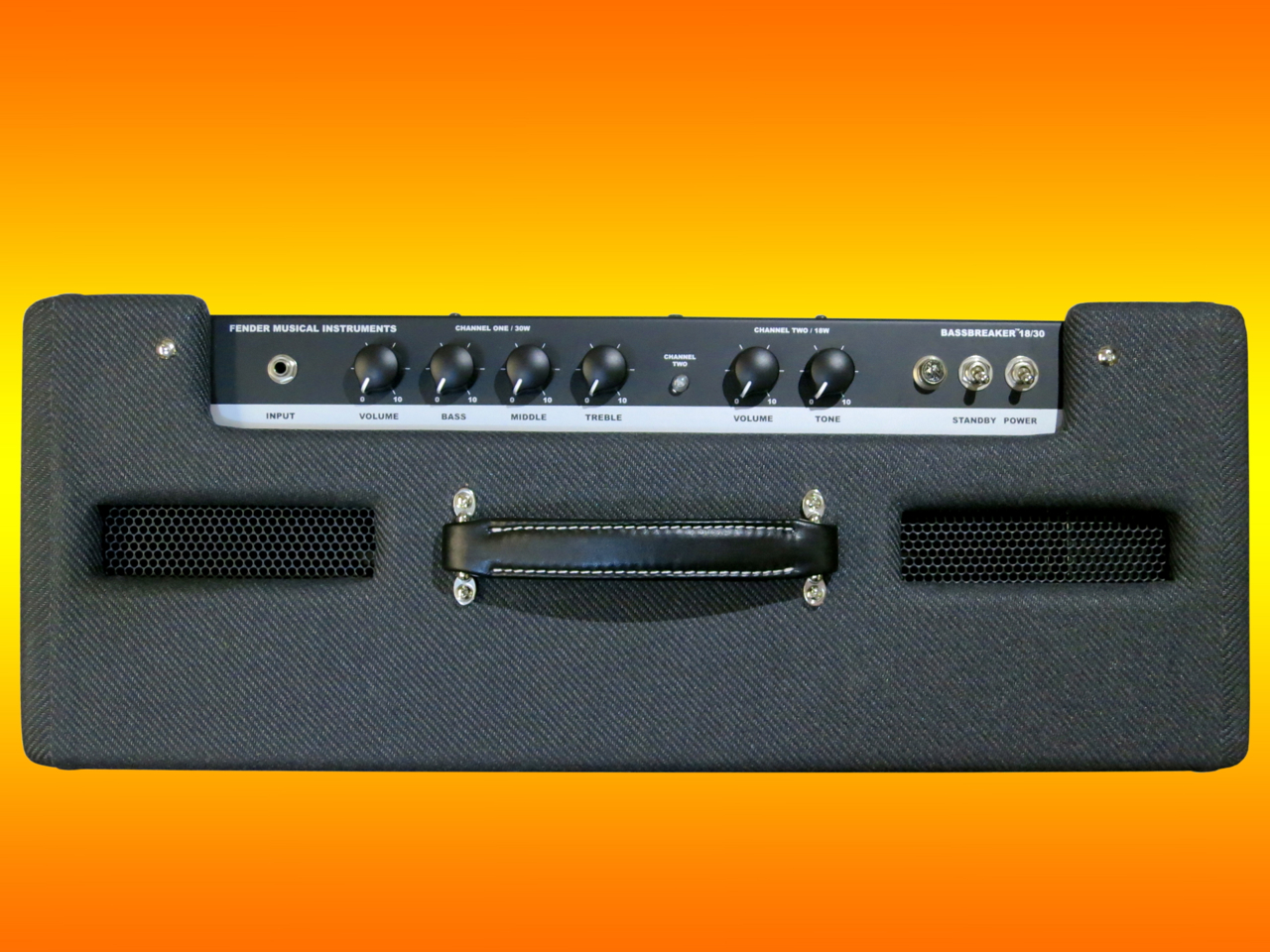
Channel One of this two-channel amplifier is based on a Blackface Fender Deluxe and gives you 30 watts of output power. Channel Two on the other hand has been lifted from the earlier brown version of the Deluxe combo, and puts out 18 watts.
The Bassbreaker is an all-valve guitar amp with solid-state rectification, and it runs in Class A/B.
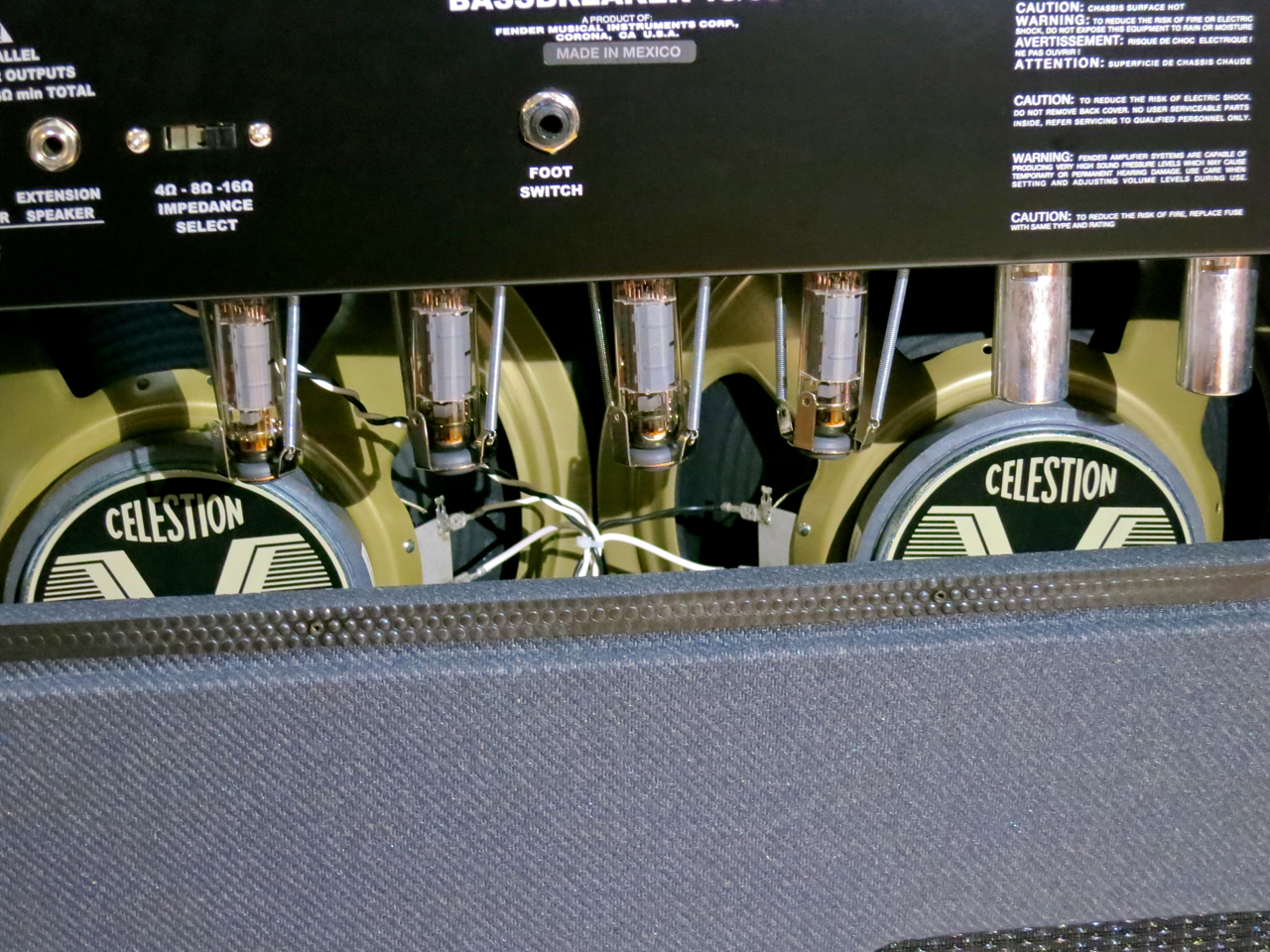
The preamp section is designed around a pair of 12AX7s, while the power amp uses a quartet of EL84s, instead of Fender’s more traditional 6V6 or 6L6 power tubes.
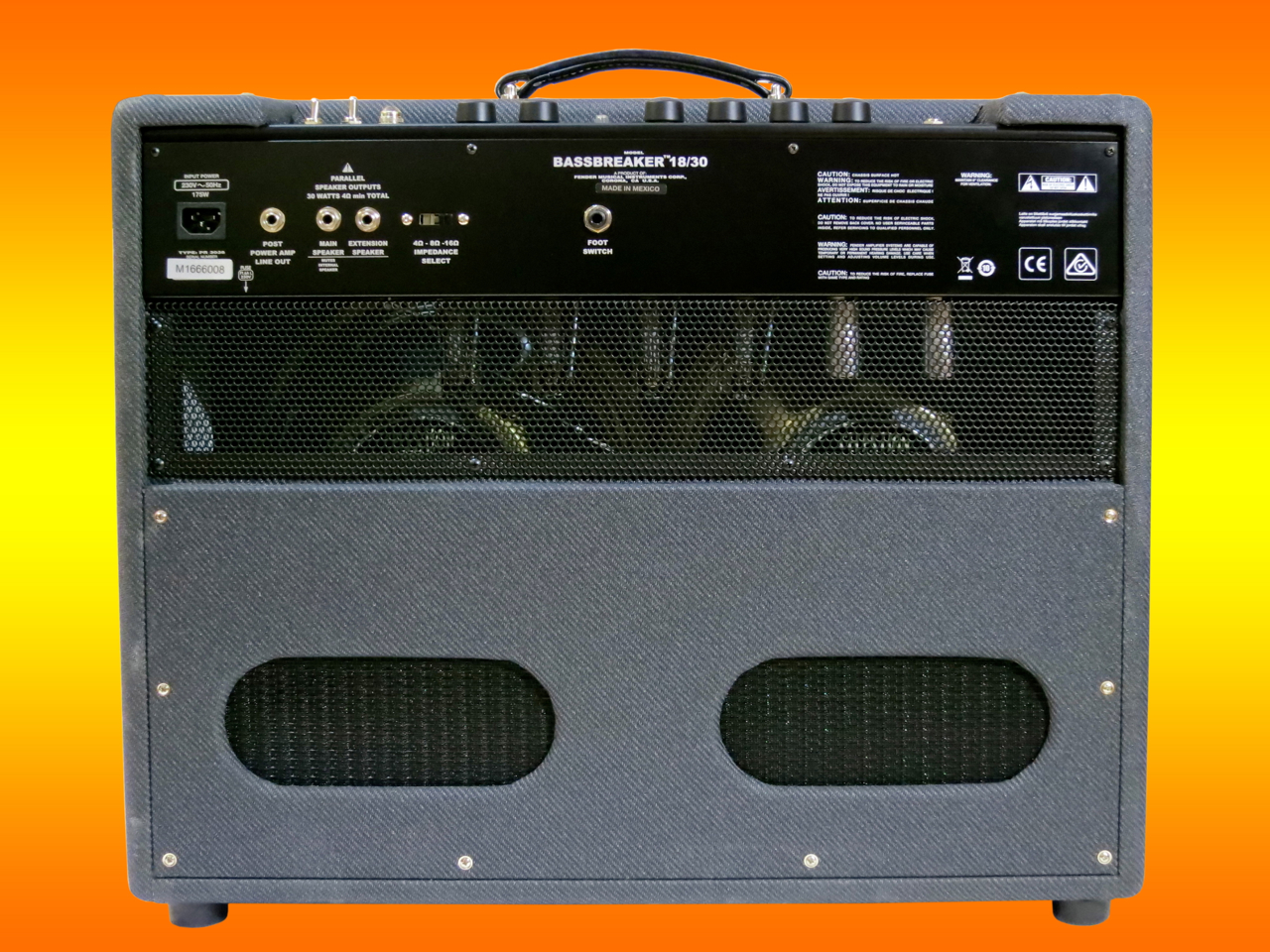
The back panel sports jack sockets for the channel-switching footswitch (included, as is an amp cover), external speaker cabinets, and a post power amp line level output.
In addition to the more ”British accent” of the Bassbreaker 18/30’s power amp valves, Fender has also opted for a pair of chunky 12-inch Celestion V-Type speakers, instead of the Jensen and JBL models the company favoured in the 1960s.
****
The 18/30’s Channel One – the Blackface channel – offers you a full three-band EQ-section for your clean tones, while Channel Two (”Brownface”) is more spartan with its single tone control.
First, let me stress that the Fender Bassbreaker 18/30 is really very loud! This is a non-master volume tube combo, which lies in the same ballpark as similar amps, such as the Marshall 1962 Bluesbreaker or Vox AC30 combos, when it comes to sheer sound pressure levels.
The 18/30 really isn’t meant for living room use, because you need to raise Channel Two’s volume substantially, if you want to enjoy the combo’s tasty dirt. And this is despite the fact that this Bassbreaker combo shuts off two of its power tubes, whenever you engage Channel Two, in order to drop the amp’s headroom so it will distort earlier.
If high volume is an issue, but you still want a piece of that Bassbreaker action, I’d suggest you check out the Bassbreaker 15 combo, which comes with a master volume control.
At low volume settings both Bassbreaker 18/30 channels will give you clean tones, with Channel One having a brighter and more chimey voice, and Channel Two sounding a bit earthier. Thanks to the EL84 power amp, this isn’t your traditional Fender combo, but rather a mix of Fender character and UK-style mid-range growl and attitude.
Here’s a short clip of both channels set to clean (volumes between 9 and 10 o’clock) and played with a maple neck Stratocaster:
The demo song features two rhythm guitars – a Gibson Les Paul Junior (Channel One, stereo right) and a Fender Telecaster (Channel Two, stereo left) – and a lead guitar part, that has been played on an Epiphone Les Paul Standard with vintage-type EMG HZ-pickups through Channel Two (volume at 3 o’clock):
****
Fender’s Bassbreaker 18/30 is a great-sounding guitar combo for the Blues and Rock guitarist, who knows how to coax great tones from an in-your-face non-master valve amp. The 18/30 manages to combine the best aspects of 1960s Fender amps with the chunk and grit usually associated with British designs.
The Bassbreaker 18/30 is too loud to be used as a bedroom or home studio amp. This combo has been designed as a professional tool for the gigging guitarist, who doesn’t have to ”turn it down” all the time.


























 Kitarablogi.com – Finland's premier Guitar and Bass blog