Lisätiedot: DLX Musiikki
Juttuja kitaroista ja bassoista
Lisätiedot: DLX Musiikki
Watch Bluetone’s Harry and Matti build a special tube amp head for this year’s Fuzz Guitar Show in Gothenburg (Sweden).


Bluetone’s brand-new Load Box is a 8 ohm/100 watts multi-purpose reactive and passive attenuator for live use and recording.
It comes with the following features:
The Load Box is completely passive, which means it doesn’t require a power supply to function.
Find out more on Bluetone’s website.


We at Kitarablogi HQ received a very special instrument for review this time – the new Tokai TJM-140, which is based on Fender’s Jazzmaster.

When the original Jazzmaster was released in 1958 Fender aimed it squarely at Jazz and Lounge musicians, who had found the company’s earlier offerings much too bright and Country-sounding. The Jazzmaster also was Fender’s first model with a rosewood fingerboard, something their sales force had been requesting for years (for cosmetic reasons).
Sadly, the new model wasn’t received very enthusiastically. Most Jazz guitarists still felt that Fender guitars were nothing more than mere breadboards with strings, while others complained that the new control setup was too complicated. A shame, really…
Over the last years Jazzmaster-type offset guitars have definitely become en vogue again. Thanks to this trend Tokai, too, has decided to come up with its own version of this guitar classic.
****

The Tokai TJM-140 Silver Star (reviewed version: 1.495 €; basic model: 1.445 €) is a top-quality Japanese rendition of the Jazzmaster model, which stays faithful to the original classic in most respects, with a few modern improvements. The review sample has been customised further with a set of Seymour Duncan Antiquity pickups.
Tokai’s TJM-140 strongly channels an early-Sixties spirit – this guitar comes with the original, small Fender-style headstock, as well as an unbound rosewood fretboard with small dot markers.
Beneath its classy Olympic White finish the curvaceous body is crafted from alder, while the satin-finished neck is maple.

Putting the truss rod adjustment at the headstock end is one of the welcome improvements on the TJM-140.
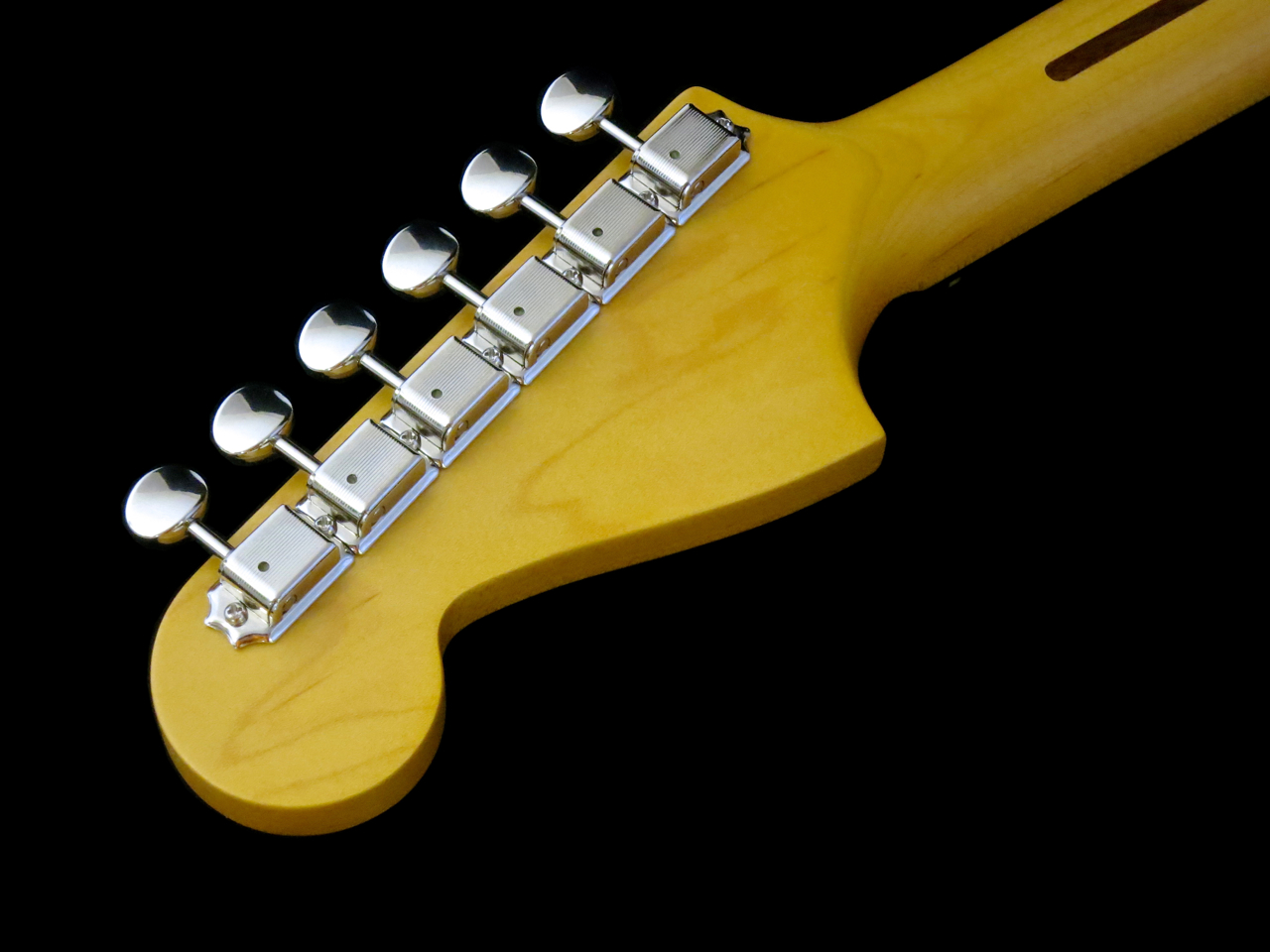
The Tokai sports a set of fine Kluson copies made by Gotoh.

This model comes with 22 medium-sized frets. The fretwork is very clean.
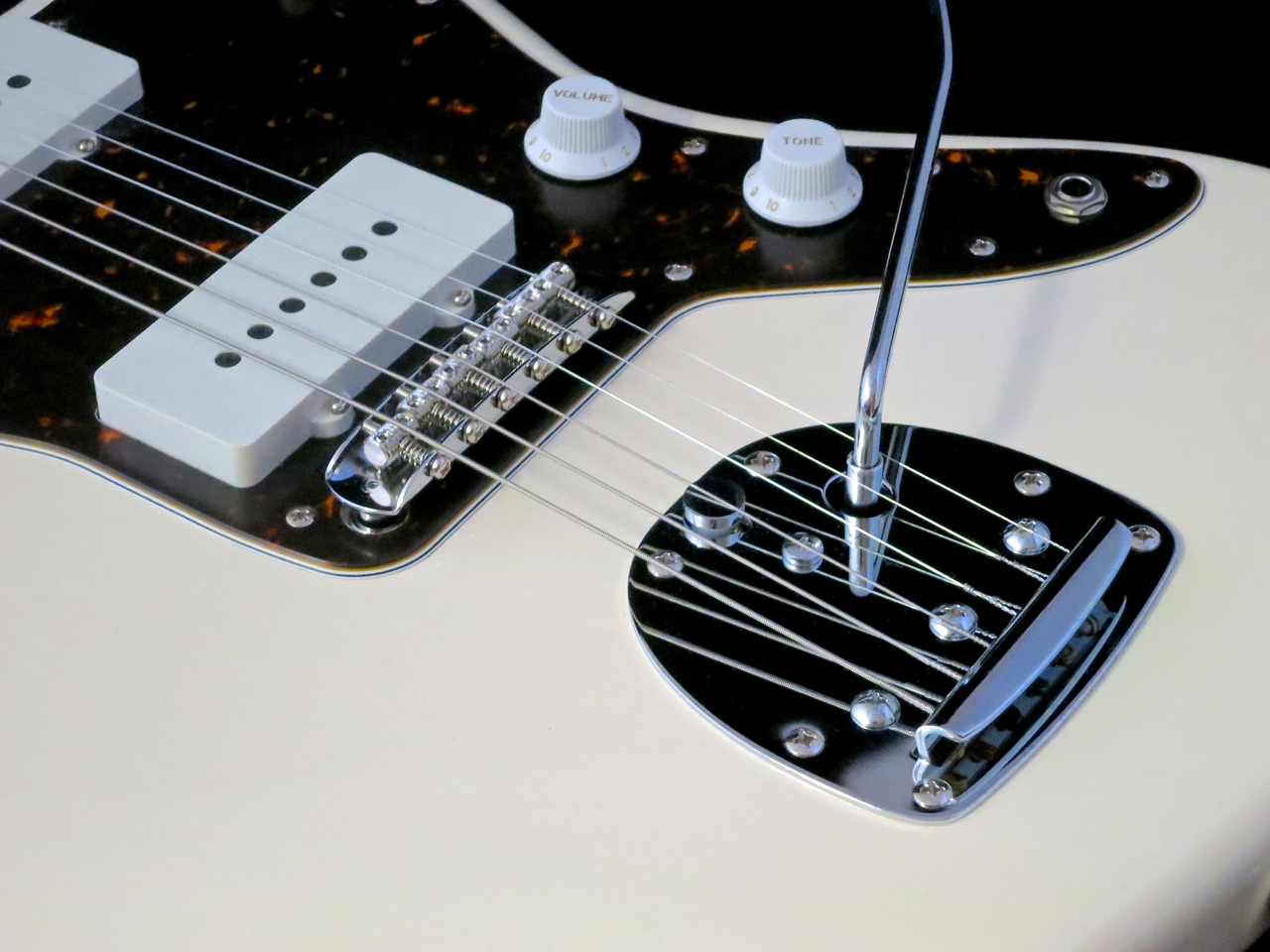
Leo Fender had a thing for vibratos, which he called tremolos. For the Jazzmaster he came up with a special new system. The Jazzmaster-vibrato (which was later used on the Jaguar, too) comprises a front-installed vibrato/tailpiece-combination, paired with a separate bridge. The bridge stands on height-adjustable poles inside long ferrules, and it rocks slightly back and forth during vibrato use. The Tokai Silver Star uses a well-made Japanese copy of the original system.

You don’t need to be a guitar expert to see that Leo Fender was aiming for a Gibson P-90-vibe with his flat and wide Jazzmaster pickups. Both the P-90 and Jazzmaster pickup have similar coils, but their magnetic structure puts them apart. Gibson’s P-90 uses two long bar magnets placed underneath the coil, either side of a metal spacer, to magnetise its pickup. Fender, on the other hand, uses six slug magnets, which also serve as the pickup’s pole pieces.
The pickups in Seymour Duncan’s Antiquity-set are reverse wound/reverse polarity, resulting in a hum-cancelling middle position on the toggle switch.

The special feature of Jazzmasters is the so-called rhythm circuit. The slide switch above the neck pickup switches between the lead and rhythm circuits. In rhythm, only the neck pickup is selected, with a slight treble roll-off and its own set of volume and tone control wheels.

The solo circuit uses the regular set of controls – a three-position toggle, plus master volume and tone. Each circuit works independently of the other’s settings.
****
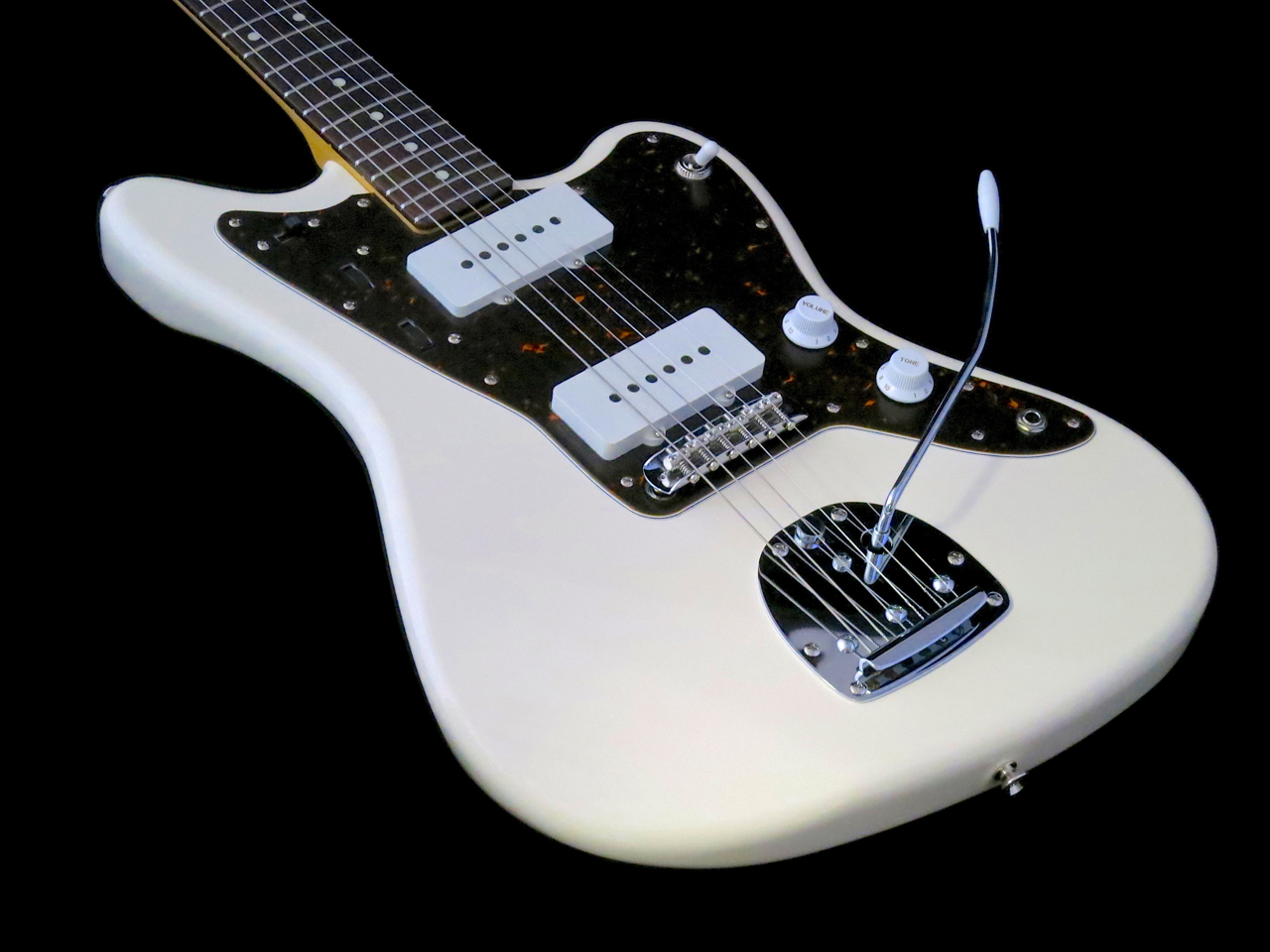
In my view, every guitarist should try a Jazzmaster- or Jaguar-style guitar once in his/her life, just to experience that comfortable offset body. Some players feel that the offset waist of a Jazzmaster is even more ergonomic that a Strat.
The Tokai TJM-140 is a fine example of a Jazzmaster-style guitar. Our test sample is light in weight, the neck’s oval C-profile feels great in your hand, and the guitar arrived with an expert setup.
Still, the Jazzmaster-vibrato will continue to divide opinions for the foreseeable future. The push-fit vibrato arm isn’t as foolproof as the screw-in Stratocaster arm, and it tends to swing rather loosely, when not in use. With a contemporary string set of 009- or 010-gauge you will probably run into some problems sooner or later, due to the shallow string angle over the bridge. Forceful strumming and/or large bends tend to cause light string gauges to jump out of the bridge saddles’ grooves, spoiling your setup and tuning in the process.
You cannot blame the Tokai TJM-140 Silver Star for using a faithful copy of the original vibrato, because this guitar is meant to be a vintage-inspired instrument. Nevertheless, it’s important to know about any possible pitfalls and solutions.
The easiest way to get a Jazzmaster-vibrato to play nicely is to use the correct string gauges of the late 1950s – read: flatwound 011s or 012s with a wound g-string. If this seems unbearable there’s always the screw-on Whizzo Buzz Stop, a Bigsby-style roller that adds much-needed downward pressure at the tailpiece. Others like to take the far more drastic step of replacing the whole Jazzmaster-system with a Mastery-vibrato, a replacement made specifically for use with modern strings.

Tokai’s TJM-140 Silver Star nails the Jazzmaster tone like a champion. The Antiquity pickups give you lots of chime and sparkle, but the top end is much warmer than on a Strat, and there’s a nice dose of mid-range chunk. The rhythm circuit rolls off a little bit of the neck pickup’s treble, but still keeps things from going all dark and muddy.
Here are a few clips of the Tokai TJM-140, recorded with a Bluetone Shadows Jr. combo, a Boss SD-1 overdrive and a Shure SM57:
****

Tokai’s TJM-140 is a pro quality Japanese version of the Fender Jazzmaster. The Tokai plays and feels great, and its sound really leaves nothing to be desired. The original Jazzmaster-/Jaguar-vibrato might become a deal-breaker for some, but I feel the original system adds a lot to this guitar’s sound and mystique. Tokai uses a high-quality copy of the original vibrato, which works as smoothly as it should. Taking this instrument for a spin is highly recommended!
****
Tokai Guitars TJM-140
Price with Antiquity pickups: 1.495 €
Distribution: Tokai Guitars Nordic
Pros:
+ workmanship
+ playability
+ sound
+ idiosyncratic vibrato system
Cons:
– idiosyncratic vibrato system


Helsinki Tonefest 2018 -messujen aikataulut on julkistettu:
Demolava
11:00 Kaakkoon
11:30 Hehku & Ile Kallio
12:00 DLX Music & Timo Kämäräinen
12:30 Custom Boards
13:00 Bluetone
13:30 Taisto Guitars
14:00 TOOB
14:30 AJL Guitars
15:00 Ruokangas
Klinikat
10:30 Pauli Halme
11:45 Tomas Niemistö
13:00 Erkka Korhonen
14:15 Tuomas Wäinölä
18:00 Ovet auki
18:30-19:00 Samuli Federley
19:15-20:15 Mikko Kosonen Kosmik 5
20:35-21:35 Jackie Venson
22:00-23:15 Matt Schofield
****
Lisätietoja saa TÄÄLTÄ.

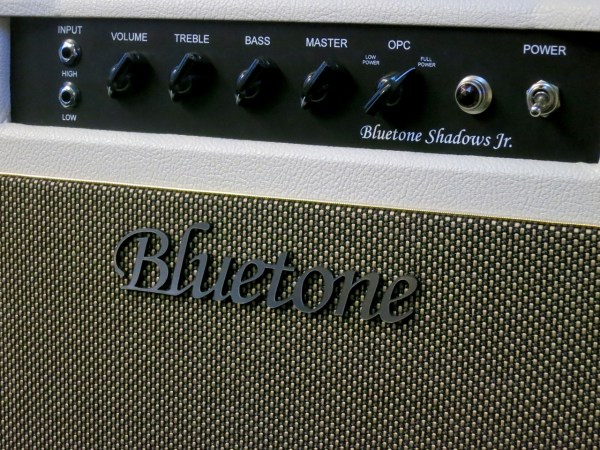
Following in the wake of their very popular Shadows Reverb combo, Finnish boutique makers Bluetone Amps have recently introduced a smaller sibling, called the Shadows Jr.
The Bluetone Shadows Jr. (combo starting at around 1,300 €) is a hand-built, all-valve guitar combo, whose sound is based on the classic Vox AC15. Instead of being a straight, slavish copy, though, the Shadows Jr. incorporates many of the up-to-date features that have made Bluetone such a well-regarded boutique maker.
****
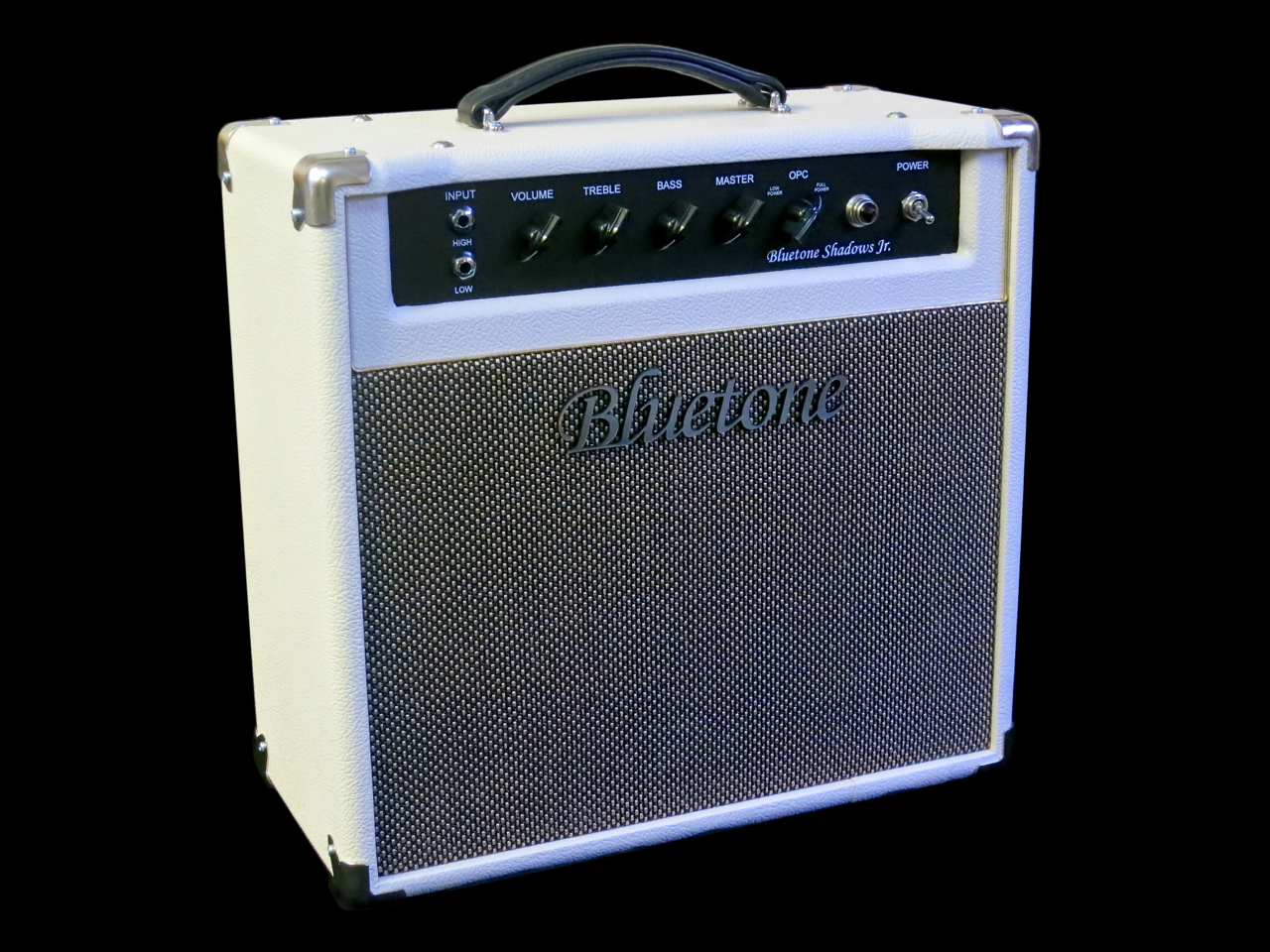
The Shadows Jr. has the clean and business-like looks that active players truly appreciate. You don’t want to be slowed down on stage by a control panel that’s hard to decipher. The Bluetone is clarity itself.

This is a single-channel all-valve combo running in Class AB mode giving you maximum output power at just over 10 watts.
The Shadows Jr. is designed around a trio of 12AX7 preamp tubes and a pair of EL84s powering the speaker. The combo’s power valves are cathode-biased, which means that swapping tubes won’t necessitate a trip to your friendly amp technician.
Bluetone is one of the very few amp makers who use torroidal power transformers. These doughnut-shaped devices (the black thing in the upper left corner) are lighter and more dependable than traditional transformer designs, and they offer more exact tolerances. As a valve amp is highly dependable on a stable and electronically quiet power supply for superior tone, Bluetone decided on using torroidal transformers early on, and they’ve never looked back.

The Warehouse Guitar Speakers Green Beret is an excellent choice for a strongly Brit-flavoured combo. Bluetone break in all of the speakers they use with low-frequency sine waves.

Despite being a compact single-channel combo amp (weighing only around 10 kg), the Bluetone Shadows Jr. offers an amazing amount of different clean and gain tones, thanks in no small part to the amp’s PPIMV master volume and the three-step OPC-switch.
PPIMV stands for ”post-power inverter master volume”, which is the preferred way of master volume design at Bluetone Amps, because it eats up the least amount of an amplifier’s tone, when in use. And if you turn the master volume knob all the way up, a PPIMV design makes the master volume ”disappear” electronically, making it completely transparent.
OPC, on the other hand, stands for ”output power control”. On the Shadows Jr. you have a choice of three settings, giving you 0.2, two or the full 10 watts of power, respectively. The magic of the OPC circuit is that it will turn volume levels down very noticeably without changing the tonal character of your settings, while also leaving almost all of the dynamics intact. Many lesser output power designs will turn a clean setting into an overdriven sound when you select a lower output level. The Shadows Jr. will sound almost the same on ten, two or 0.2 watts – the small tonal differences are the result of the speaker being driven differently. With the OPC at the lowest setting you will get approximately 95 percent of the full ”Shadows Jr. experience” at bedroom/apartment block volume levels. That’s fantastic!

The back panel gives you a choice of using the internal speaker or an external 4- or 8-ohm cabinet.
Bluetone have also included their tasty buffered, switchable effects loop with a dedicated volume control. When the loop is not in use, the circuit can also serve as a handy lead boost.
****
Are you looking for a cool little tone machine with a strong Vox-y flavour, and no-compromise build quality? You should do yourself a favour and try the Bluetone Shadows Jr.
The Shadows Jr. ticks all the right boxes:
You get that classic clean tone with that sweet mid-range ”attitude”. A clean tone that is lively, but never glassy or brittle.
With the front-end volume near the other extreme you’ll get overdrive and distortion that is more gritty and dynamic – think later era Beatles, windmilling Townshend, or multilayered May – than creamy and compressed.
But don’t forget to check out the wide scope of break-up Blues and Rock ’n’ Roll sounds to be had between 11 and 2 o’clock on the volume (gain) control (depending on the guitar used). You’re in for hours of wailing soloing and chunky rhythms without ever needing an overdrive stompbox.
Here’s a Gibson Les Paul Junior on its own:
Demo track number one features two rhythm guitar tracks – a Fender Stratocaster (stereo left) and a Gibson Les Paul Junior (right) – as well as a Hamer USA Studio Custom on lead duty:
The second demo track features a Gibson Les Paul Junior (rhythm left), an Epiphone Casino (rhythm right), and a Fender Telecaster (lead guitar):
****
The Bluetone Shadows Jr. is a fantastic little tone machine for the Vox-inclined player, who likes warm clean tones, dynamic break-up sounds, and gritty late-Sixties/early-Seventies dirt.
The build quality is miles ahead of any mass-produced guitar amplifier – this is a handcrafted boutique-grade valve amp. Modern additions like the PPIMV master volume, the OPC circuit, and the switchable effects loop, also raise this amp above any vintage-style copies.
For many the crucial question with low-wattage amps is volume. How loud is the Bluetone Shadows Jr?
Let’s just say that if you’ve only ever tried 10-watt tranny combos before you’re in for quite a surprise! These are ten (-plus) watts of British-style valve amp majesty, with every last ounce of loudness wrung out of the power amp and speaker.
With the OPC and the master on full, this little chap will easily get you into trouble with your neighbours in your block of flats on clean tones alone. If you don’t need 100 percent clean tones, the Shadows Jr. will easily get you through many rehearsals and gigs in small venues. And there’s always the option to stick a mic in front of the speaker.
So, don’t expect a Heavy Metal-type volume onslaught, but be prepared for some serious business.
****
Bluetone Amps Shadows Jr.
Prices starting from 1,300 €
Contact: Bluetone Amps
Pros:
+ Handmade in Finland
+ Master volume
+ OPC
+ Effects loop
+ Sound
+ Value-for-money






 Kitarablogi.com – Finland's premier Guitar and Bass blog