



Lisätiedot: Musamaailma
Kitarablogi.com – Finland's premier Guitar and Bass blog
Juttuja kitaroista ja bassoista


At this year’s Holy Grail Guitar Show in Berlin (Germany), Amfisound Guitars presented their newest addition to the Halti line-up:
The Halti Siren is a modern, handcrafted take on Gibson’s venerable Les Paul Junior, TV and Special models. It is a 22-fret, 24.75″ scale, set-neck solidbody guitar, crafted from mahogany (plus rosewood for the fingerboard).
The Halti Siren is available with a single P-90 – or with two pickups – from renowned Finnish pickup specialist Jarno Salo. A compensated wraparound bridge by ABM further helps make this guitar a very toneful beast. The guitar comes in a vintage-authentic nitrocellulose finish.

The pièce de résistance, though, is Amfisound’s brand-new Set-Lock neck joint, which enables you to reach the top frets without breaking a sweat.
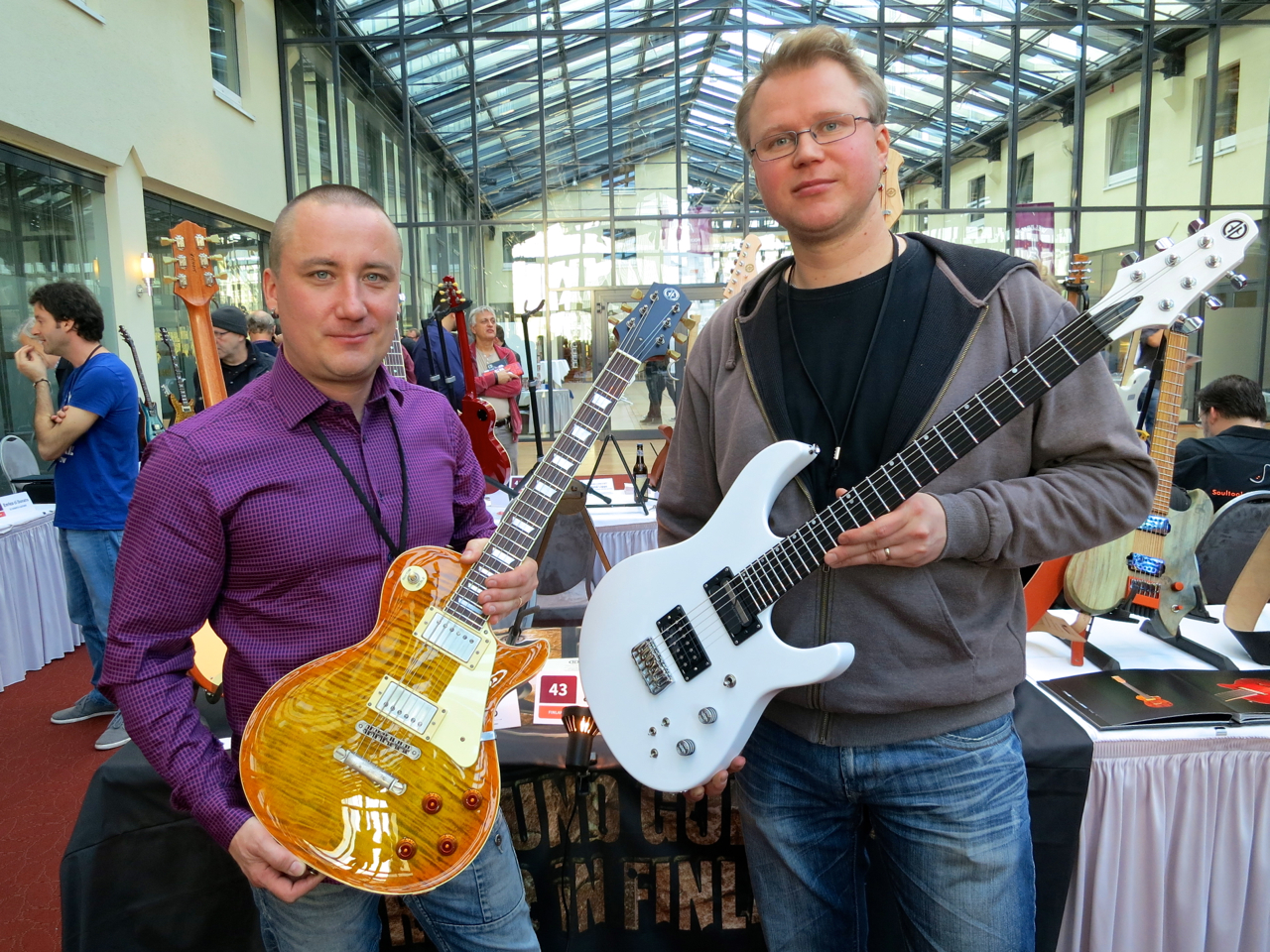
For more information contact master luthiers Sampo Leppävuori and Tomi Korkalainen HERE.


Yamaha has recently upgraded its very successful L-Series of steel-string guitars.
The most important update, at least in terms of sound quality, is the use of A.R.E.-treated spruce tops across the whole range of models. Yamaha’s proprietary Acoustic Resonance Enhancement is a wood treatment that uses heat, changes in humidity and pressure, to artificially age tonewoods. The aim is to produce brand-new acoustic instruments, which sound played-in from the get-go.
L-Series guitars come in three body sizes – LJ (Medium Jumbo), LS (Small Body = Folk-sized) and LL (Original Jumbo = Dreadnought-sized).
Kitarablogi had the pleasure to take a Yamaha LL6 ARE (current price in Finland: 534,90 €) for a spin.
****

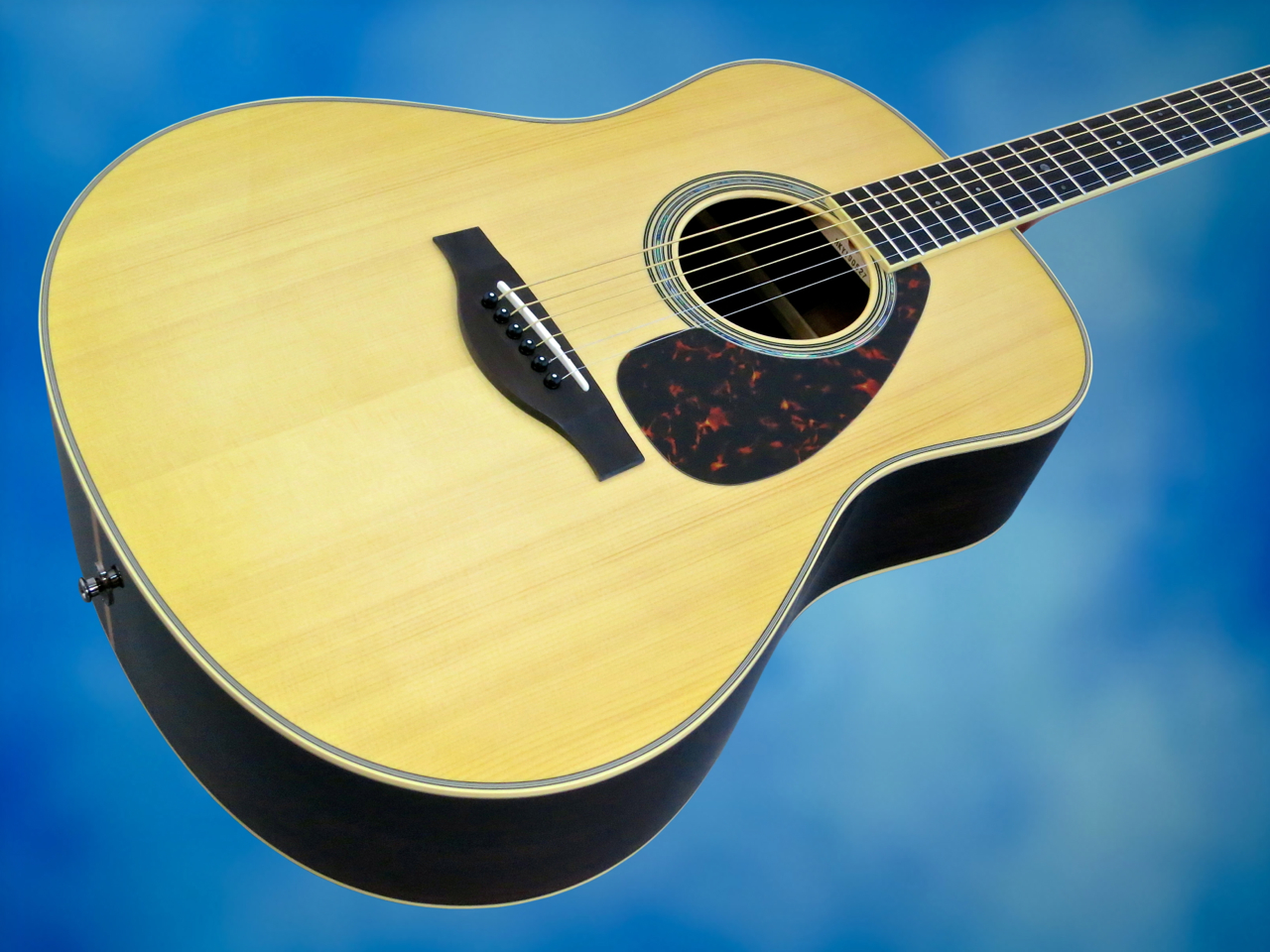
Yamaha’s Original Jumbo body style is the company’s own design, set apart from a traditional Dreadnought by its slimmer shoulders and its more rounded lower bout. The result looks nicely balanced.
Yamaha uses solid Engelmann spruce for all of their L-Series tops. Engelmann spruce has a reputation for sounding warmer and less constricted, when compared to Sitka spruce.
The LL6 is available in four different finishes – natural, brown sunburst, black and Dark Tinted (a deep reddish-brown hue).
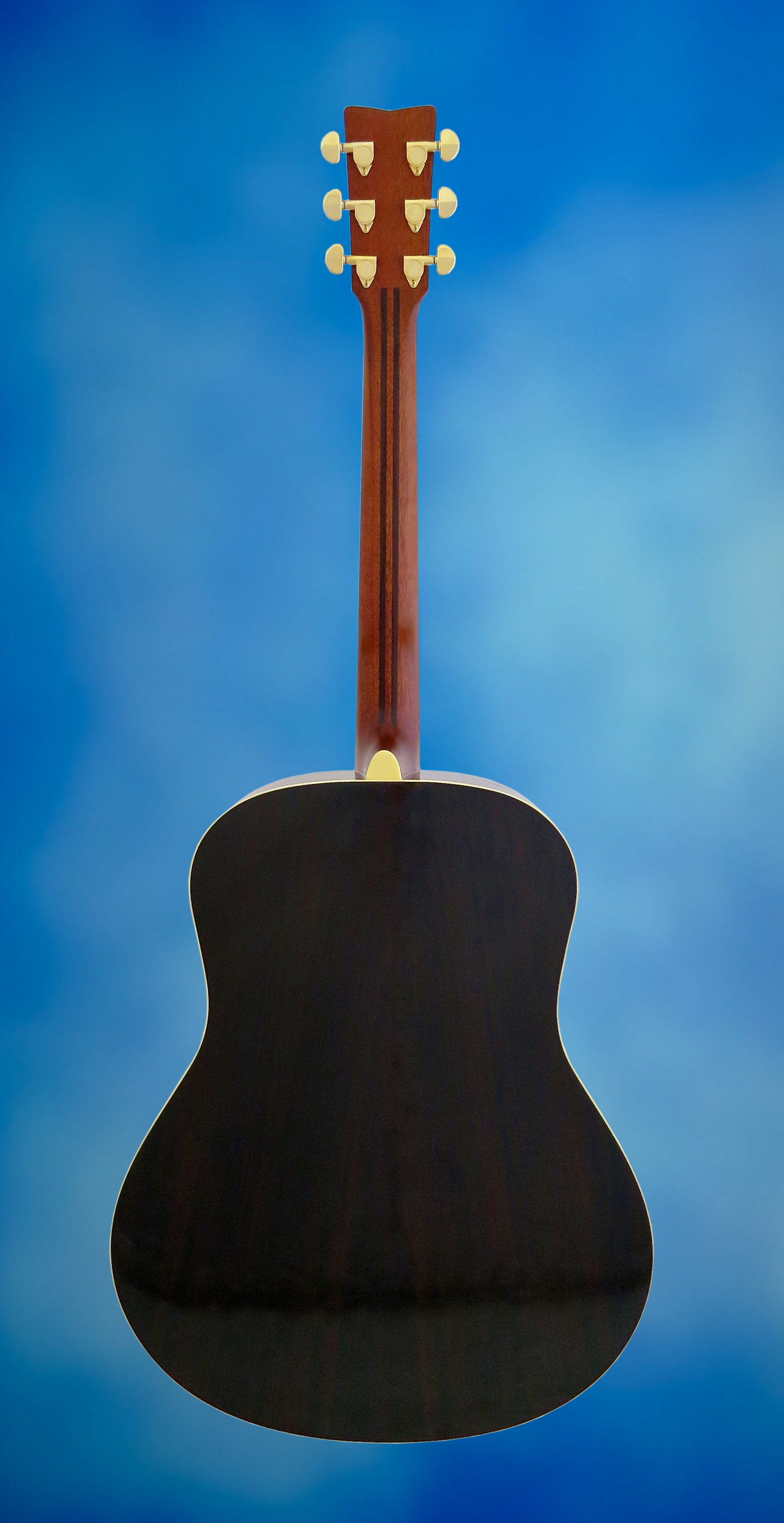
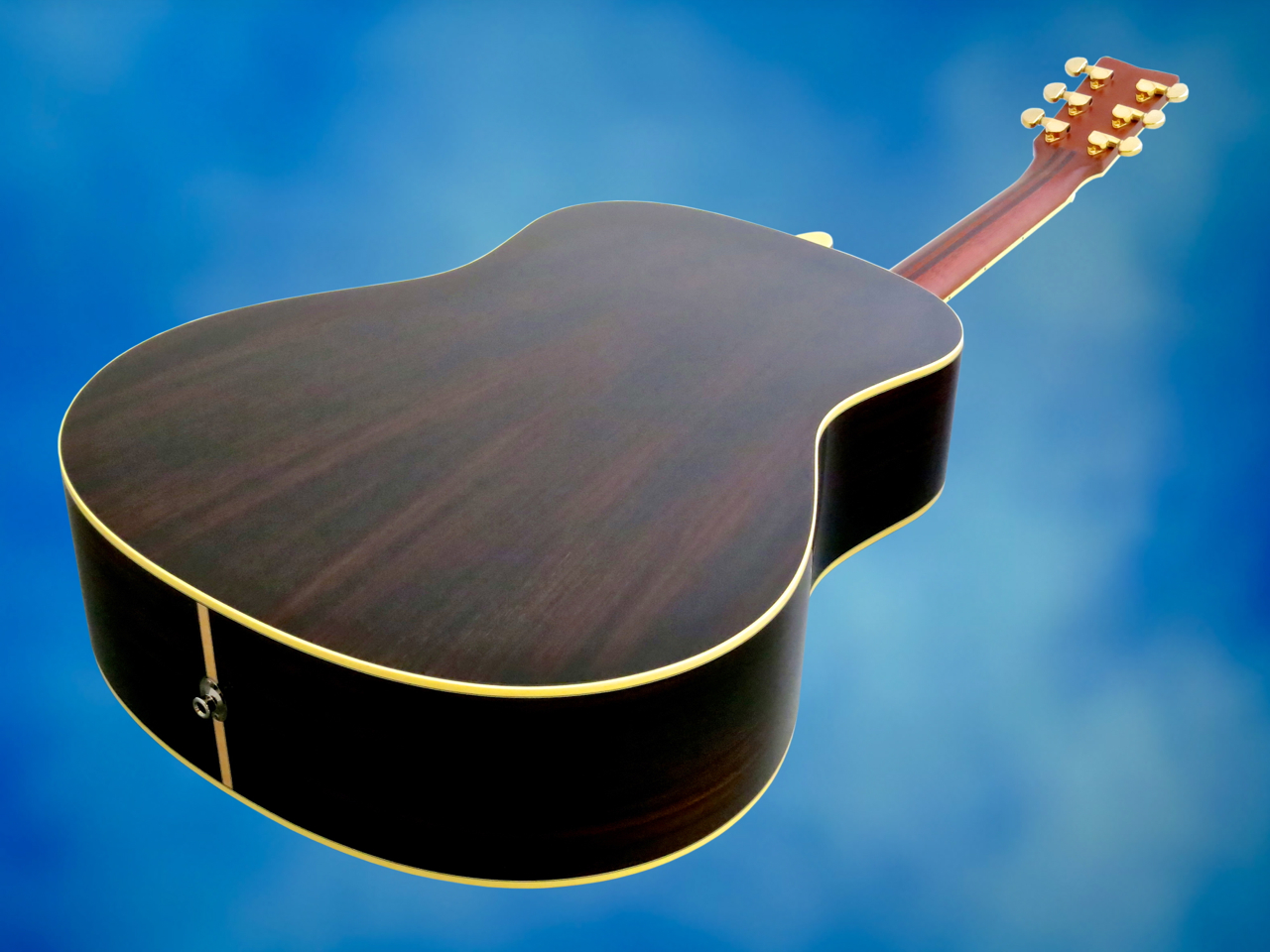
The Yamaha LL6’s sides and back are made from beautifully grained laminated rosewood. There’s a mahogany backed version available, too, the Yamaha LL6M ARE.
The guitar’s body has received a gloss finish, while the back of the neck sports a thin satin finish.

The bound headstock is home to a set of TM-29G tuning machines.

All new L-Series instruments come with five-piece necks. In the LL6’s case this means three pieces of mahogany with two strips of rosewood sandwiched between them. The idea behind this type of construction is to add stiffness to the neck, and thus sustain.
The LL6’s headstock and neck heel are crafted from separate pieces of mahogany, which are then glued to the main part.

The quality of the fretwork on this Yamaha is very good.
Another new feature across all L-Series models are rolled-in fingerboard edges for an even more comfortable playing experience.

Yamaha uses a modified type of non-scalloped X-bracing on all L-Series tops, which is meant to add a healthy dose of punch and warmth into the mix.

The centre ring of this beautiful soundhole rosette has been crafted from genuine abalone shell.

There’s multiple binding on the Yamaha’s top, as well as single ply cream binding around the back.

The LL6 comes with a Yamaha SRT Zero Impact piezo pickup hidden beneath its compensated bridge saddle.

As the main focus of the LL6 lies on its acoustic performance, Yamaha wanted an unobtrusive pickup system without the need for an on-board preamp or a battery compartment. This is why the LL6 comes equipped with a passive pickup that is wired directly to the output jack.

Yamaha’s LL6 ARE is sold in its own soft case, which is a nice hybrid of a gig bag and a hard case.
****

It speaks volumes about Yamaha’s high standards of craftsmanship, as well as the company’s stringent quality control, when the importer’s product specialist takes you to the warehouse, and simply hands you an untouched shipping carton, without even opening it. His only question was: ”Which colour would you prefer?”
And, judging from the review guitar, this trust in Yamaha’s quality control seems totally justified. When I opened the soft case I found a great instrument in fine fettle.
The neck’s new-and-improved oval C-profile feels fantastic, and the nut width of 44 mm offers enough room for complex fingerings. Yamaha have gone for a good working compromise at the bridge, too, with an E-to-e-string spacing of 55 mm, that most strummers and fingerpickers will get to grips with nicely.
The playability was first rate (remember this is a sub-600 € guitar):
The action with the factory-installed 012-gauge set was really comfortable (string height at the 12th fret: low E – 2.1 mm/high e – 1.6 mm), and the guitar played beautifully, without any rattles or buzzes whatsoever.
It’s virtually impossible to verify any claims that Yamaha’s A.R.E.-treatment makes the LL6 ARE sound like well played-in ”old ’un”, because no two vintage guitars are the same, and also because I didn’t have a ”non-A.R.E.” Yamaha to hand.
What I can say, though, is that the Yamaha LL6 ARE sounds very open, dynamic and mature, right out of the shipping carton. Many brand-new steel-string acoustics require a playing-in period to lose a certain restricted sense of dynamics and a spiky top end. The LL6 ARE sounds warm, well-balanced and open right from the start.
Fingerstyle playing comes across well-articulated. The LL6 has a clear top end and a rich bass register; it’s a warm tone, but the bottom end never gets overbearing.
The first example has been close-miked with an AKG C3000 microphone:
For a no-frills, passive piezo system the LL6’s SRT-pickup sounds rather nice:
Combining both signals works well, too:
Strumming the LL6 gives you great punch, a sparkling top end, and plenty of mid-range character (AKG C3000):
The piezo-powered version is a bit drier, but still work well in my view:
Using both signals together sounds like this:
The rhythm guitar tracks in this short Beatles-cover have been recorded with a Shure SM57, while the lead guitar parts have been recorded direct off the built-in pickup:
****
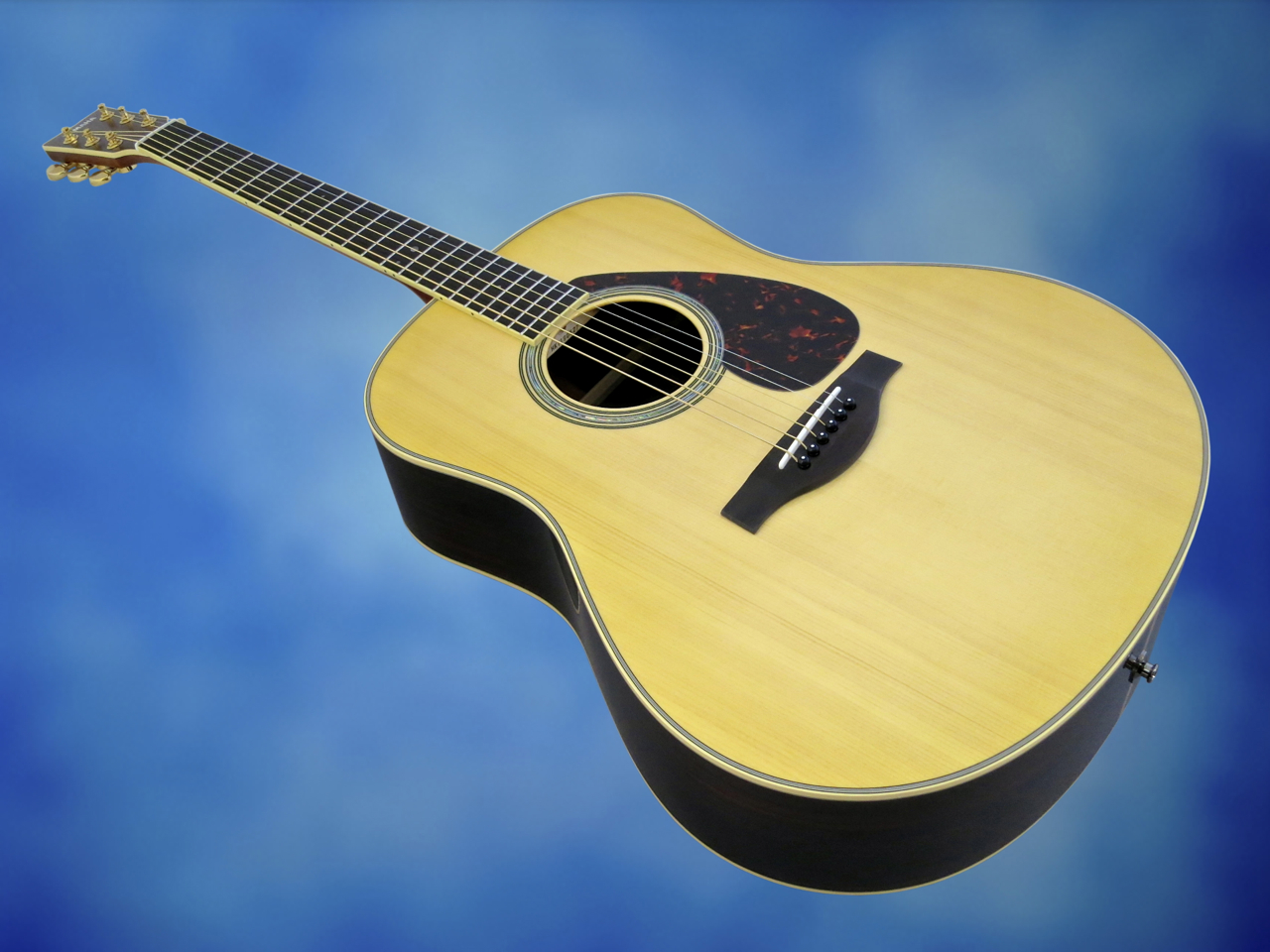
The Yamaha LL6 ARE might be the most-affordable member of the L-Series, but it most certainly is a thoroughbred example of its species. The improved neck profile is a real treat, and the A.R.E.-treatment seems to make a clear difference. This is a beautiful instrument with a voice to match. I also like the straightforward pickup system, which offers a decent sound with no fuss. I’d really recommend you try out one of these guitars, as the LL6 ARE punches well above its weight.
****
Yamaha LL6 ARE
534,90 €
Finnish distributor: F-Musiikki
****
Pros:
+ workmanship
+ A.R.E.-treated solid top
+ neck profile
+ acoustic sound
+ unobtrusive pickup system
+ soft case included
Yamaha on hiljattain päivittänyt erittäin suositun L-sarjan teräskielisiä kitaroita.
Soundin kannalta tärkein uudistus on, että koko sarjassa käytetään nyt Yamaha A.R.E. -prosessin läpi käyneitä kansia. Acoustic Resonance Enhancement on firman kehittämä puunkäsittelytapa, jossa esivanhennetaan soitinpuita lämpökäsittelyllä, sekä ilmankosteutta ja ilmanpainetta tarkoin säätämällä. Koko prosessin idea on saada uusia kitaroita soimaan heti kättelyssä sisäänsoitetun soittimen lailla.
L-sarjan kitaroita tarjotaan kolmessa eri koppakoossa – LJ (Medium Jumbo), LS (Small Body = Folk-kokoinen) ja LL (Original Jumbo = Dreadnought-kokoinen).
Kitarablogi sai tällä kertaa testattavaksi Yamaha LL6 ARE -mallin (534,90 €).
****
Yamahan Original Jumbo -koppa on firman omaa designia, jolla on selvästi kapeammat hartiat ja pyöreämpi alaosa kuin perinteisissä Martin D -malleissa. Lopputulos on sulava ja sopusuhtainen.
Yamaha käyttää LL6 ARE -mallissa (niin kuin nykyisin koko L-sarjassa) kokopuista Engelmann-kuusta kansimateriaalina. Engelmann-kuusen soundista sanotaan, että se on usein lämpimämpi ja avoimempi kuin sitkankuusikannella varustetuissa kitaroissa.
LL6-mallia saa natural-vaihtoehdon lisäksi myös sunburst-värityksellä, sekä mustana ja ruskeana.
Yamaha LL6:n sivut ja pohja on tehty kauniista ruusupuuvanerista. Mallista on saatavilla kuitenkin myös LL6M ARE -versio, jos tykkää enemmän mahongista.
Kitaran runko on lakattu kiiltäväksi, kun taas sen kaulaa on mattaviimeistelty.
Reunalistoitettuun lapaan on asennettu kuusi nykyaikaista TM-29G-viritinä.
Uudistetun LL6:n kaula tehdään kolmesta pitkästä mahonkipalasta ja kahdesta ruusupuupalasta. Rakenteen tarkoitus on lisätä kaulan lujuutta.
LL6:n viritinlapa sekä kaulakorko on veistetty kahdesta erillisestä mahonkipalasta, jotka on liimattu kaulan pitkänomaiseen osaan.
Yamahan nauhatyö on hyvin kiitettävällä tasolla.
Reunalistoitetun palisanteriotelaudan reunoja on hieman pyöristetty, mikä lisää tuntuvasti LL6:n soittomukavuutta.
L-sarjan kansissa käytetään Yamahan omaa versiota perinteisestä X-rimoituksesta (non-scalloped), jolla halutaan lisätä sopivasti potkua ja lämpöä raikkaaseen kuusikansi-perussoundiin.
Kitaran kauniissa rosetissa keskimmäinen rengas on koottu abalone-helmiäisestä.
Kannessa on monikerroksinen reunalistoitus.
LL6:n kompensoidun tallaluun alle on piilotettu Yamahan oma SRT Zero Impact -piezomikrofoni.
LL6:ssa pääpaino on kitaran akustisessa soundissa, eikä soitinta haluttu pilata monimutkaisella etuvahvistimella tai paristolokerolla. Tämän vuoksi LL6:n systeemi on täysin passiivinen ja SRT-mikrofoni on kytketty suoraan lähtöjakkiin.
Yamaha LL6 ARE:n hintaan kuuluu myös erittäin laadukas soft case -laukku, joka on oiva kovan laukun ja tavallisen gigbagin hybridi.
****
Se sanoo mielestäni aika paljon Yamahan työnjäljestä ja laadunvalvonnasta, kun maahantuojan tuotespesialisti ottaa testaajan mukaan varastoon ja antaa hänelle täysin avaamattoman kuljetuslaatikon suoraan hyllyltä. Ainoa kysymys oli: ”Minkä värin haluat?”
Ja tämä luottamus Yamahan laatuun oli täysin oikeutettua, sillä testiin saapunut kitara on todella hyvässä trimmissä oleva laatusoitin.
Kaulan uudistettu, ovaali C-profiili tuntuu erittäin mukavalta kädessä, ja 44:n millimetrin kaulaleveys satulan kohdalla antaa otekädelle riittävästi liikkumatilaa myös monimutkaisia sointuja varten. Myös Yamahan valitsema e-kielten välinen etäisyys tallan kohdalla (55 mm) on loistavasti toimiva kompromissi sekä plektra- että sormisoittoa varten.
Soittotatsi oli testiyksilössä säädetty tehtaassa hyvin mukavaksi 012-paksuisella kielisatsilla (kielten korkeus 12. nauhan kohdalla – matala-E: 2,1 mm/korkea-e: 1,6 mm), ja LL6 ARE soi kauniisti ja täysin rämisemättä.
On mielestäni miltei mahdotonta sanoa, soiko tämä Yamaha ARE-prosessin ansiosta ”kuin vanha vintage-soitin”, koska vintage-kitaroissakin on isoja eroja, eikä minulla ole ollut mahdollisuutta verratta LL6 ARE -mallia suoraan vastaavaan ”ei-ARE-Yamahaan”.
Minun on kuitenkin todettava, että Yamaha LL6 ARE soi uunituoreenakin hyvin avoimella ja dynaamisella äänellä. Tässä ei esiinny lainkaan – niin monia uusia (= ei sisäänsoitettuja) teräskielisiä vaivaava – uudenkarheus tai dynamiikan ja diskantin kireys, vaan ääni on lämmin, avoin ja erittäin hyvässä tasapainossa.
Sormisoitossa LL6 ARE artikuloi erittäin hyvin. Soitossa on aimo annos helisevää diskanttia ja lämmintä bassoa, mutta bassot eivät kumise tai dominoi tämän mallin äänimaailmaa.
Tätä pätkää on lähimikitetty AKG C3000 -mikrofonilla:
Passiiviseksi piezosysteemiksi LL6:n SRT-mikrofoni soi mielestäni hyvin kauniisti:
Myös stereoyhdistelmä molemmista signaaleista kuulostaa hyvältä:
Plektrasoitossa kuuluu LL6:n mukavasti helmeilevä atakki ja sen lämmin, mutta avoin keskialue (C3000):
Piezoversio on suorasukkaisempi, muttei missään nimessä huono:
Yhdistelmä kuuluu tältä:
Tässä Beatles-coverissa komppiraidat on äänitetty dynaamisella Shure SM57 -mikrofonilla, kun taas soolo-osuudet on poimittu mukaan linjasoittoina:
****
Vaikka Yamaha LL6 ARE on edullisin tapa tutustua L-sarjan konseptiin, on malli silti täysverinen lajinsa edustaja. Päivitetyn kaulaprofiilin ansiosta LL6 ARE on entistäkin mukavampaa soittaa, ja kannen A.R.E.-käsittely näyttää toimivan. Tämä on kaunis ja kaunisääninen soitin. Pidän myös tämän Yamaha-mallin kytke-ja-unohda-periaatteella toimivasta mikkisysteemistä. LL6 ARE on mielestäni ehdottomasti kokeilemisen arvoinen teräskielinen. Tämän Yamahan rahkeet riittävät – edullisen hintansa huolimatta – varmasti myös ammattikäyttöön.
****
Yamaha LL6 ARE
534,90 €
Maahantuoja: F-Musiikki
****
Plussat:
+ työnjälki
+ A.R.E.-käsitelty kansi
+ kaulaprofiili
+ akustinen soundi
+ huomaamaton mikkisysteemi
+ soft case kuuluu hintaan

Dream Theater’s guitar wizard John Petrucci has a long and very fruitful association with Music Man. Over the years, the company has released several signature models, both US-made and as part of their less-expensive Sterling brand.
Last year Ernie Ball/Music Man have released a new top-of-the-line John Petrucci signature instrument – the Music Man Majesty (Majesty was the original name of the Progressive Rock band that became Dream Theater).
****

The first thing that will strike you about the new package is the sensationally low weight:
When I went to pick up the Music Man Majesty for this review (from DLX Music Helsinki), I had to open the case and check, because I suspected the guitar was missing. No, it really was in there…
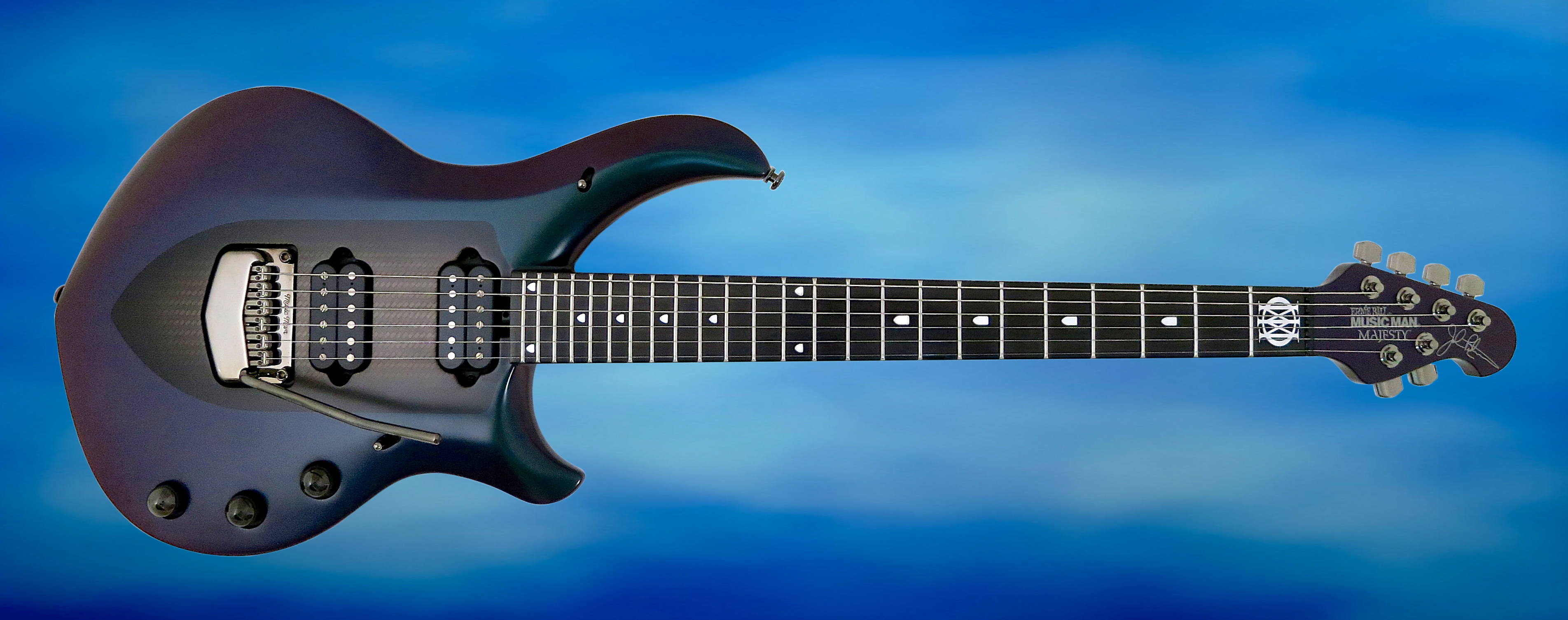
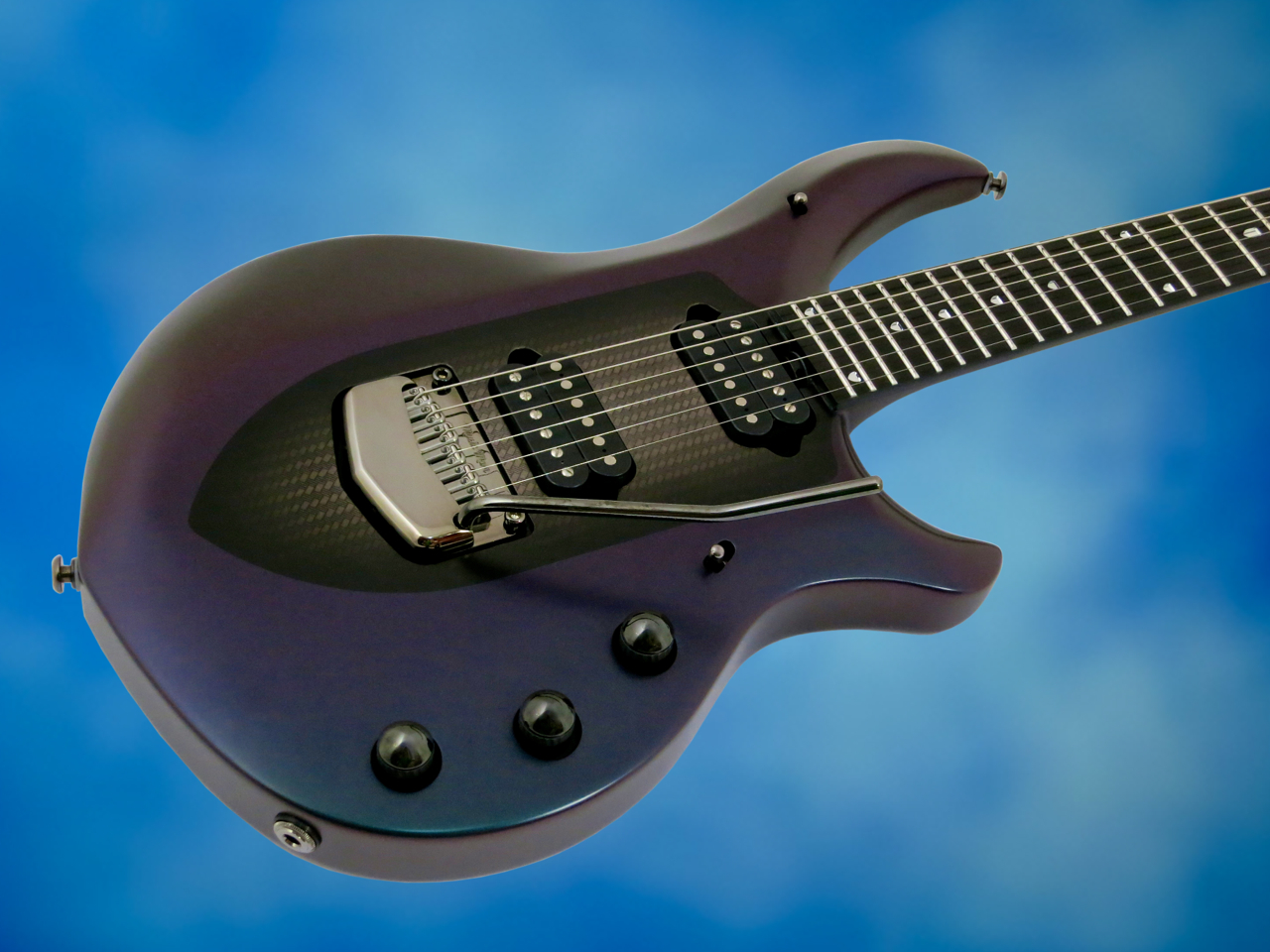
Music Man’s Majesty (current price in Finland approx. 3,900 €) is a modern top-drawer signature model, which conveys the artist’s clear vision of what his dream guitar should be like. This isn’t simply a souped-up classic model – Petrucci and Music Man started with a clean slate.
Music Man’s new signature model is a Neck-Through design with a two-octave mahogany neck, and a very smooth neck joint at the 23rd fret.

The Majesty’s body, too, is highly sculpted – you could call it streamlined – and it fits the player’s body perfectly.
The body wings, made from basswood, are capped by a maple top. The area on the top, which forms a sort of shield or crest, may look like graphite weave at first glance. In reality, this is a translucent area of the maple top, and what you see is a laser-etched graphic design resembling the look of carbon composite.
The review guitar’s finish is called Arctic Dream, which is a matte finish changing from violet to a dark green hue, depending on how the light hits the body.
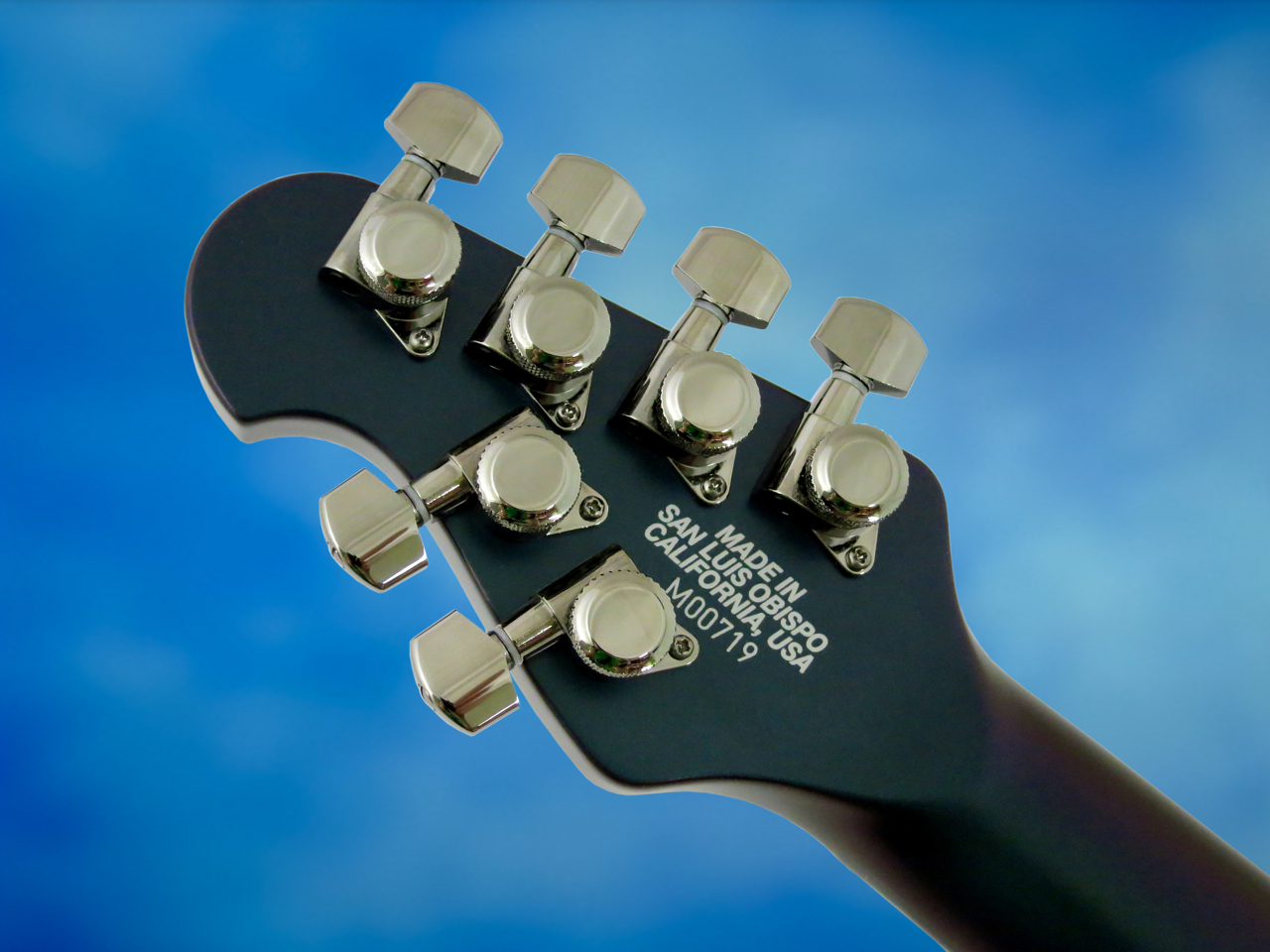
Music Man’s classic four-and-two headstock sports a set of locking Schaller M6-tuners.
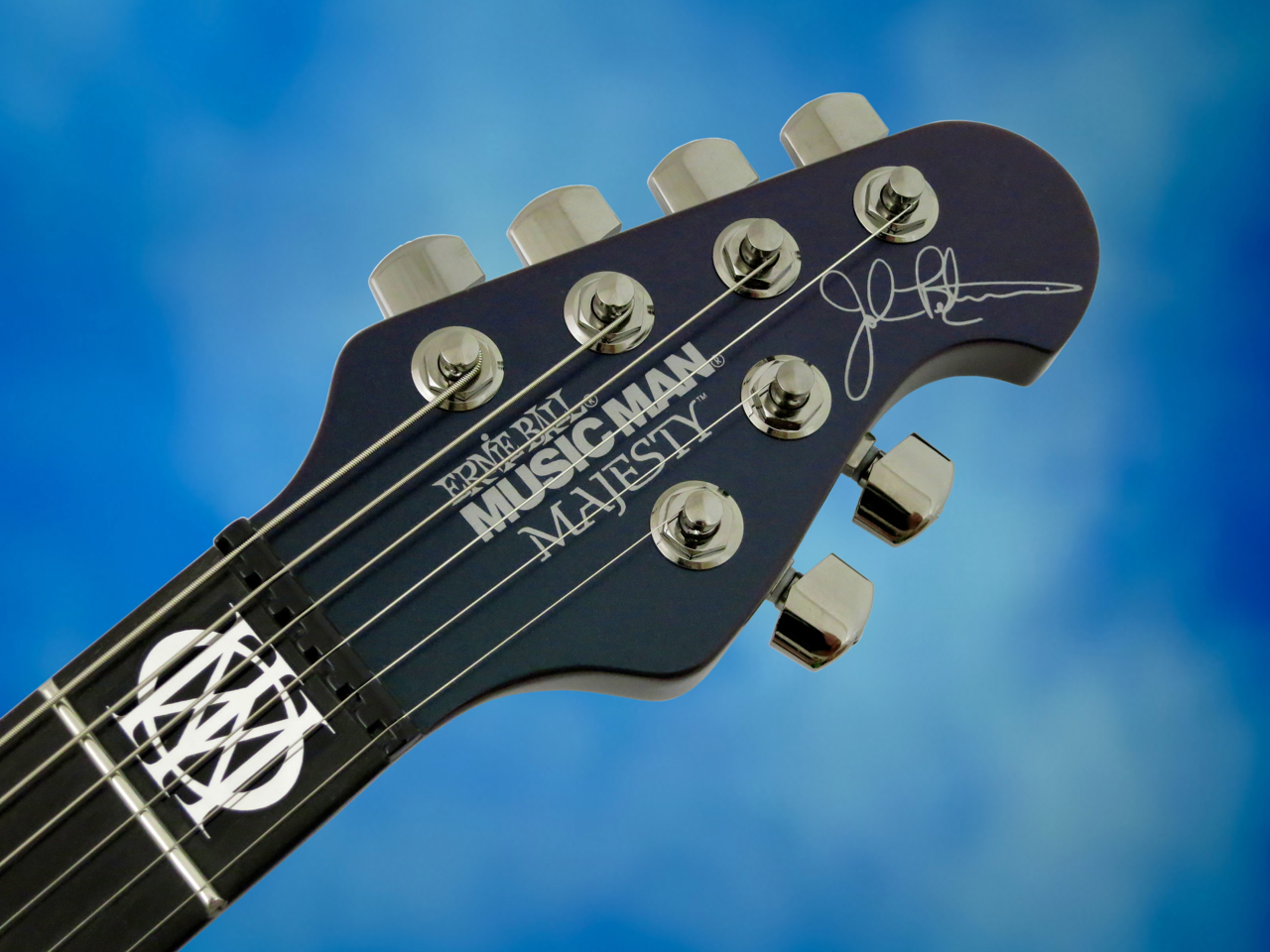
Below the compensated – and self-lubricating nut – you can see the metallic Dream Theater-logo inlay.

The quality of the fretwork on the Majesty is outstanding. We can find 24 jumbo-sized, stainless-steel frets installed into the ebony fingerboard.
The shield inlays are in fact tiny mirrors.
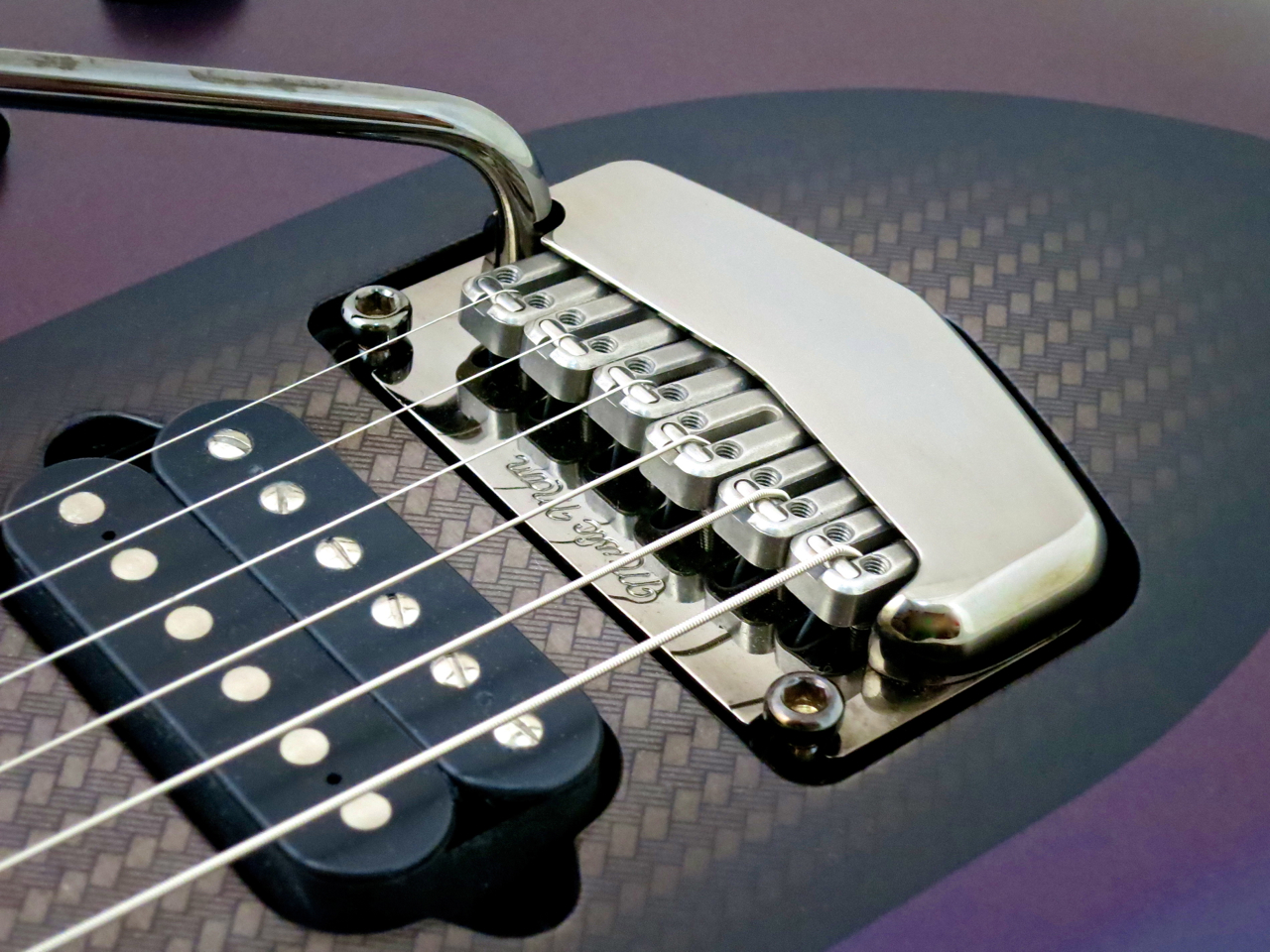
The floating vibrato bridge is Music Man’s own, cool design, which features steel saddles equipped with Fishman piezo elements for acoustic-style tones.
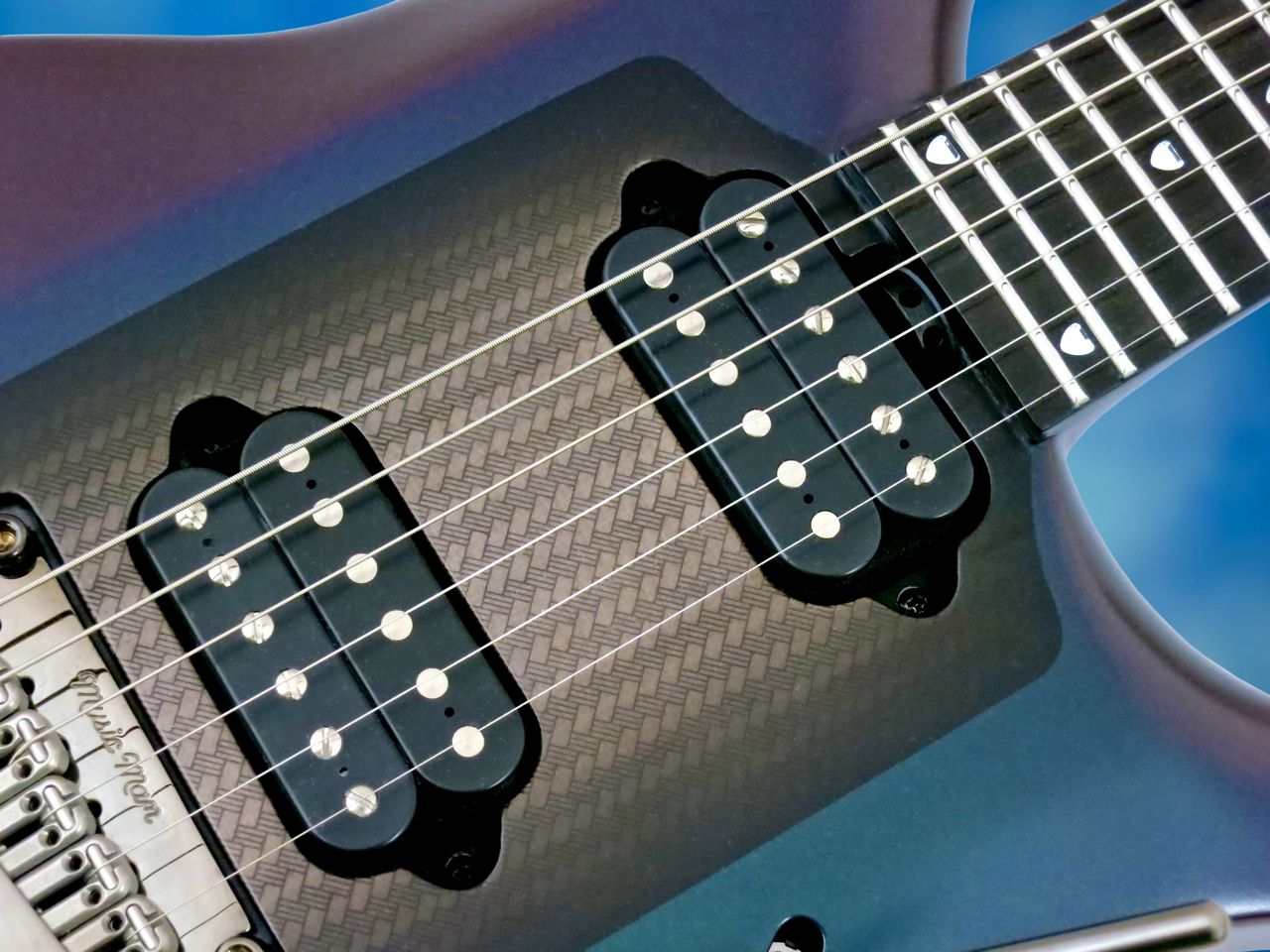
The Majesty’s magnetic side comprises a pair of DiMarzio Illuminator humbuckers (John Petrucci’s signature pickups), installed straight into the body wood.

Music Man’s Majesty comes with a very dedicated, special switching system; the technically-minded among you can take a look at the schematics:
Music Man Majesty – schematics
The three-way switch in the top horn lets the player select between piezo-only, magnetic-only, and piezo-plus-magnetic settings.
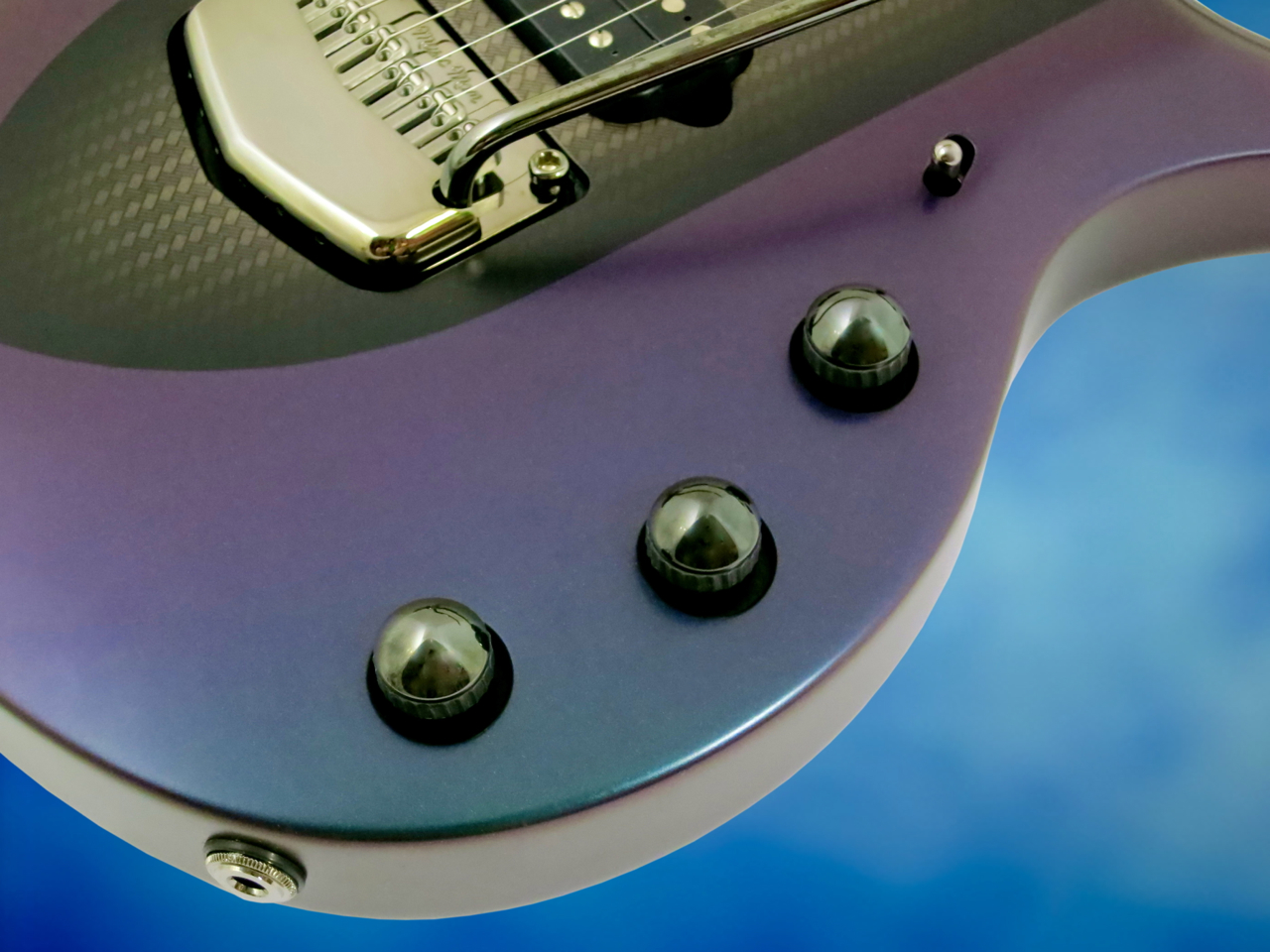
Beneath the strings you will find a second three-position toggle switch, that works as a pickup selector for the DiMarzios.
The control next to it is the volume control for the humbuckers. It also contains a push-push switch for engaging the Majesty’s active signal boost.
The second knob is a passive tone control, whose push-push switch works in the pickup selector’s middle position. ”Down” gives you the full sonic attack of two humbuckers, while the ”up” position switches off the outer coils of both pickups for thinner, more Fender-style sounds.
The third switch (near the output jack) is the volume control for the piezo signal. This knob sports a momentary switch, which allows you to reconfigure the output from standard mono – both the piezo and magnetic signals are sent to the same amplifier – to ”stereo”, enabling you to use a Y-cable to send the piezo’s output to a dedicated acoustic amp (or to a mixing console).

By using a tiny screwdriver you can adjust the active signal booster for the humbuckers, as well as set the maximum volume of the piezo signal, and the Fishman two-band EQ.
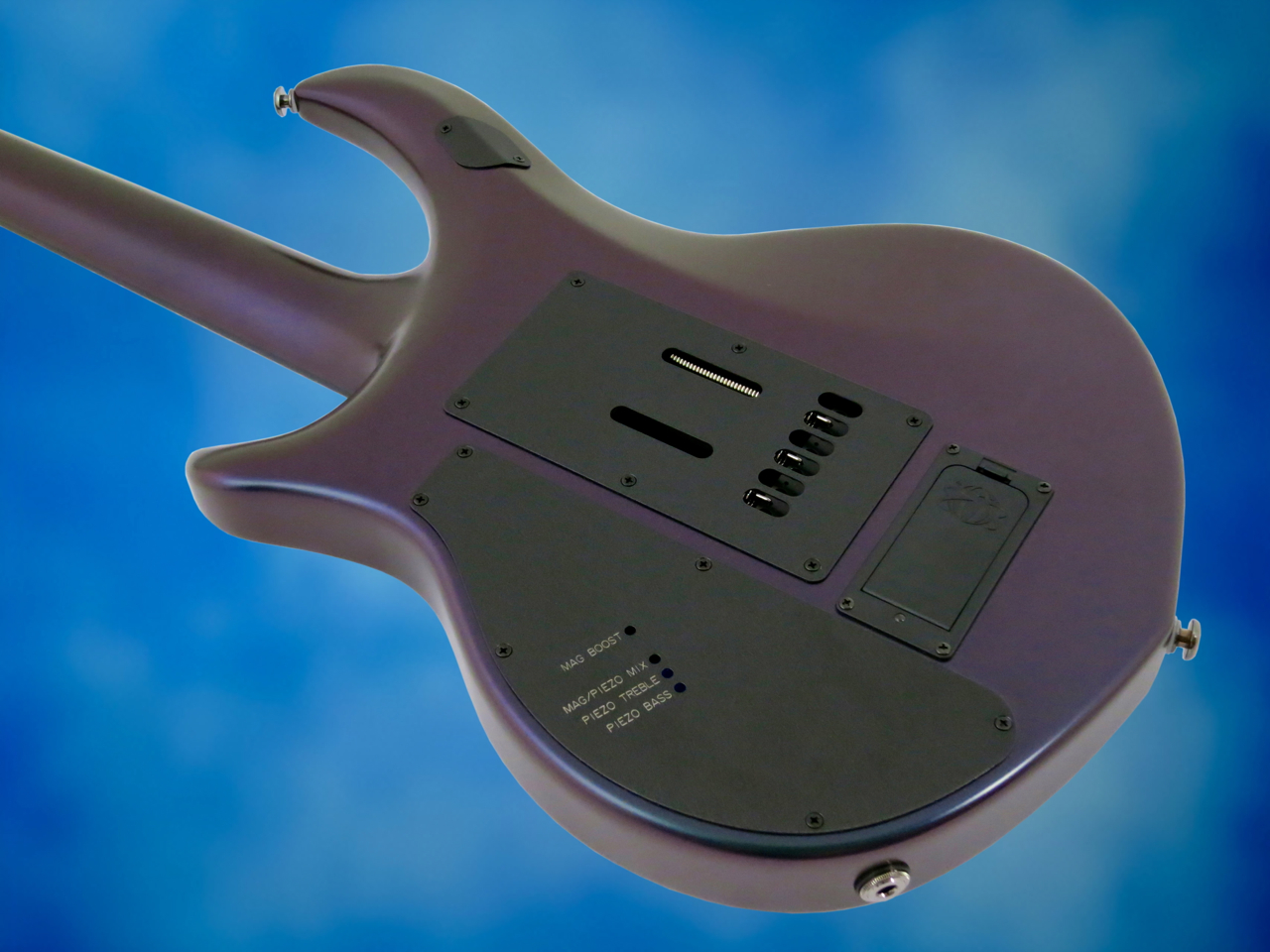
The Majesty’s active electronics are powered by a 9 V block.
****
Some ”signature models” are only for posing. Others are simply souped-up, or slightly tweaked, versions of classic guitar models.
Music Man’s Majesty is one of the few instances, when a guitar hero had very clear and strong views regarding the look, the features, and the sounds of his dream guitar. Petrucci and Music Man set to work, and no compromises were accepted.
The Majesty is a fantastic instrument, and each guitar leaves the factory set up to Mr Petrucci’s exacting specifications. You get the exact guitar the master himself plays on stage and in the studio.
As already mentioned, this guitar is extremely light and comfortable, and balances perfectly on a guitar strap.
The neck profile is a relatively thin D. The satin-finished neck feels very fast and friendly, without being insubstantial.
Thanks to the jumbo frets and the flat fingerboard radius (17″) the Majesty is very bend-friendly. The action is low, but completely free of fret buzz (low-E: 1.7 mm/high-e: 1.6 mm).
The Majesty’s floating vibrato works very smoothly, and has excellent return-to-pitch.
The piezo system works great! It gives you a credible ”acoustic” tone in the context of a Rock or Metal band, and also comes in handy to ”freshen up” the Majesty’s magnetic signal (the clip has the following order: piezo –> piezo + coil split –> coil split):
Here’s an example of the clean magnetic tones you can get from this Music Man. The powerful DiMarzio Illuminators are loaded with ceramic magnets (neck PU –> both (full) –> both (coil split) –> bridge PU):
The Majesty’s coil split and active boost give you three different degrees of distortion without even stepping on a single pedal. This clip has the coil split first, followed by the full middle position:
The active boost on this Petrucci-guitar is a great addition to any guitarist’s tool-pack, used here on the bridge pickup:
And, lastly, the audio track off the Youtube-video:

****

The Music Man John Petrucci Majesty is a top-grade signature guitar with an extremely wide array of sounds. In addition to the high quality and exemplary workmanship on display, the best thing about this guitar is that the Majesty’s features, its playability and its versatile sound also make it a great choice for many other guitarists, too.
****
Music Man John Petrucci Majesty
approx. 3,900 € (hard case included)
Finnish distributor: EM Nordic
A big thank you to DLX Music Helsinki for providing the review guitar!
****
Pros:
+ workmanship
+ finish
+ non-locking vibrato bridge
+ playability
+ versatile electronics and switching
+ sound

Progressiivisen Rockin mestarilla ja Dream Theater -bändin keulakuvana tunnetulla John Petruccilla on jo pitkään ollut hedelmällinen suhde Music Manin kanssa. Firmalla on ollut jo pitkään useampi nimikkomalli valikoimassaan, ja myös Sterling-alabrändiltä löytyy Petrucci-malleja.
Viime vuonna ilmestyi uusin, kaikilla herkuilla varustettu nimikkomalli – Music Man Majesty.
****
Ensimmäinen asia jonka huomaa, on varmaan koko paketin yllättävän alhainen paino:
Kun hain Music Man Majestyn testiin (Helsingin DLX Musiikilta) piti ensin tarkistaa, onko laukussa edes kitara, koska laukku tuntui tyhjältä. Kyllä, siinä se kaunotar oli…
Music Man Majestyn (hintaluokka noin 3.900 €) tapauksessa kyseessä on todellakin huippumoderni nimikkomalli, jolla on selvästi ihan omat näkemyksensä siitä, millainen nykyaikaisen sähkökitaran pitäisi olla. Majestyn suunnittelu lähti liikkeelle lähes tyhjältä pöydältä.
Music Manin uutuusmallissa mahonkikaula jatkuu yhtenäisenä läpi koko rungon (ns. Through-Neck), mikä mahdollistaa erittäin sulavan kaulan ja rungon liitoksen 23. nauhan kohdalla.
Myös Majestyn runko on veistetty erittäin sulavaksi, minkä ansiosta se myötäilee täydellisesti soittajan kehoa.
Runko on tehty kahdesta lehmussiivestä, joiden päälle on liimattu suhteellisen ohut vaahterakansi. Kilpeä (tai vaakunaa) muistuttava, tumma keskiosa näyttää ensisilmäykseltä hiilikuidulta, mutta todellisuudessa vaahteran pintaan on poltettu laserilla grafiittia muistuttava kuvio.
Testikitaran viimeistelyn nimi on Arctic Dream, ja sen väri vaihtelee katselukulmasta riippuen syvästä violetista tumman vihreään.
Music Man -viritinlapaan on asennettu Schallerin laadukkaita lukkovirittimiä.
Kompensoidun satulan ja ensimmäisen nauhan välillä näkyy Dream Theaterin logo.
Majestyn nauhatyö on ensiluokkaista. Eebenpuiseen otelautaan on asennettu 24 jumbonauhaa ruostumattomasta teräksestä.
Kaikki otemerkit uudessa Petrucci-mallissa ovat pieniä peilejä.
Music Manin omassa kelluvassa vibratallassa on teräksisiä tallapaloja, joihin on upotettu Fishmanin piezoelementtejä.
Majestyn magneettiset mikrofonit taas ovat kaksi DiMarzio Illuminator -humbuckeria – John Petruccin nimikkomalleja, siis – jotka on asennettu suoraan runkoon ilman kehyksiä.
Music Man Majesty -mallin kytkentä on hyvin erikoinen, mikä näkyy myös firman kytkentäkaaviosta:
Music Man Majesty – schematics
Yläsarvessa on kolmiasentoinen kytkin, jolla valitaan käytetäänkö ainoastaan piezopuolta, magneettimikrofoneja vai molempia yhdessä.
Kielten alapuolelta löytyy perinteinen kolmiasentoinen mikkikytkin DiMarzio-humbuckereille.
Ensimmäinen säädin on humbuckerien volume. Tähän potikkaan on piilotettu myös push-push-nostokytkin, jolla voi ottaa käyttöön Majestyn aktiivisen signaaliboosterin.
Toinen säädin on passiivinen tone-nuppi. Tässäkin säätimessä on push-push-kytkin, jolla kytketään mikkien uloimmat kelat pois päältä, silloin kun mikkivalitsin on keskiasennossa. Näin saadaan Music Manilta myös ohuempia, Fender-tyylisiä soundeja.
Jakkilähdön lähellä oleva, kolmas säädin on piezo-puolen volume. Tässä säätimessä on painokytkin, jolla voi valita, käytetäänkö kitaran lähtöä monona – jolloin sekä piezo- että magneettiset mikrofonit menevät samaan vahvistimeen – tai stereona (Y-johdolla), jolloin piezosignaalin voi kytkeä akustiseen vahvistimeen tai suoraan mikseriin.
Elektroniikkalokeron kannen läpi voi säätää pikkuruuvarilla booster-toiminnon ja piezosignaalin tasoja, sekä Fishmanin kaksikaistaista EQ:ta piezopuolelle.
Majesty-malli saa tarvitseman virtansa yhdestä 9 voltin paristosta.
****
Joidenkin artistien ”nimikkomallit” ovat pelkästään mainoskuvia varten. Toiset nimikkomallit taas ovat kevyesti muunneltuja versioita jostain tietystä klassikkokitarasta.
Music Man Majesty sen sijaan on yksi niistä harvinaisista tapauksista, jossa kitarasankarilla oli erittäin selkeät näkemykset soittimen ulkonäön, ominaisuuksien, sekä soundien kannoilta, joita on sitten lähetty toteuttamaan ilman turhia kompromisseja.
Majesty on huippusoitin, ja jokainen yksilö lähtee Music Manin tehtaalta prikulleen samoilla säädöillä, joita John Petrucci itse käyttää.
Kuten jo mainittu, tämä kitara on ultrakevyt, ja se roikkuu hihnassa täydellisessä tasapainossa.
Satiinipintaisen kaulan profiili on suhteellisen ohut D. Se on siis melko nopealta ja mukavalta tuntuva tapaus, joka ei kuitenkaan ole vielä epämiellyttävän ohut.
Jumbo-kokoisten nauhojen ja loivan otelautaradiuksen (17 tuumaa) ansiosta kielten venytykset onnistuvat vaivattomasti.
Kieltenkorkeudetkin on säädetty melko matalaksi (matala E: 1,7 mm/korkea e: 1,6 mm), mutta kitara soi silti puhtaasti ja rämisemättä.
Majestyn kelluva vibra toimii mukavan sulavasti ja ilman vireongelmia.
Majestyn piezosignaali kuulostaa todella hyvältä. Se toimii hyvin akustisen kitaran sijaisena Rock-bändin kontekstissa, tai sitten magneettisen soinnin raikastajana (järjestys: piezo –> piezo + coil split –> coil split):
Tältä kuulostavat Music Manin puhtaat magneettiset soundit. Tehokkaissa DiMarzion Illuminator-humbuckereissa on keraamiset magneetit (järjestys: kaulamikki –> molemmat (täysillä) –> molemmat (coil split) –> tallamikrofoni):
Majesty-mallin humbucker-puolitus ja kitaran kytkettävä boosteri luovat pohjan kolmelle eri särösoundille, ja täysin ilman efektipedaaleja. Tässä soivat ensin puolitettu keskiasento ja sitten sama täysillä mikrofoneilla:
Petrucci-kitaran tehokas boosteri on oiva lisäys työkalupakkiin (käytössä tässä tallamikrofoni):
Ja viimeisenä vielä videon demobiisi:
****
Music Man Majesty on erittäin laadukas ja todella monipuolinen nimikkosoitin. Laadukkaan toteutuksen lisäksi parasta tässä soittimessa kuitenkin on, että Majestyn kattavat ominaisuudet ja laaja sounditarjonta sopivat – John Petruccin ohella – varmasti myös monelle muulle kitaristille.
****
Music Man John Petrucci Majesty
Hintaluokka: noin 3.900 € (kova laukku kuuluu hintaan)
Maahantuoja: EM Nordic
Kiitos DLX Musiikille testisoittimen lainaamisesta!
****
Plussat:
+ työnjälki
+ viimeistely
+ vibratalla
+ soitettavuus
+ erittäin monipuolinen elektroniikka
+ soundi


This time we have something very special to feast your eyes on!
Many people may not know this, but ESP Guitars also runs its own, small West Coast workshop in California. The ESP USA factory produces limited numbers of its most popular shapes (currently three models), and its primary goal is to produce the best quality instruments for its customers.
Kitarablogi.com has been lucky to get to take one of these guitars for a spin – the ESP USA Eclipse.
****
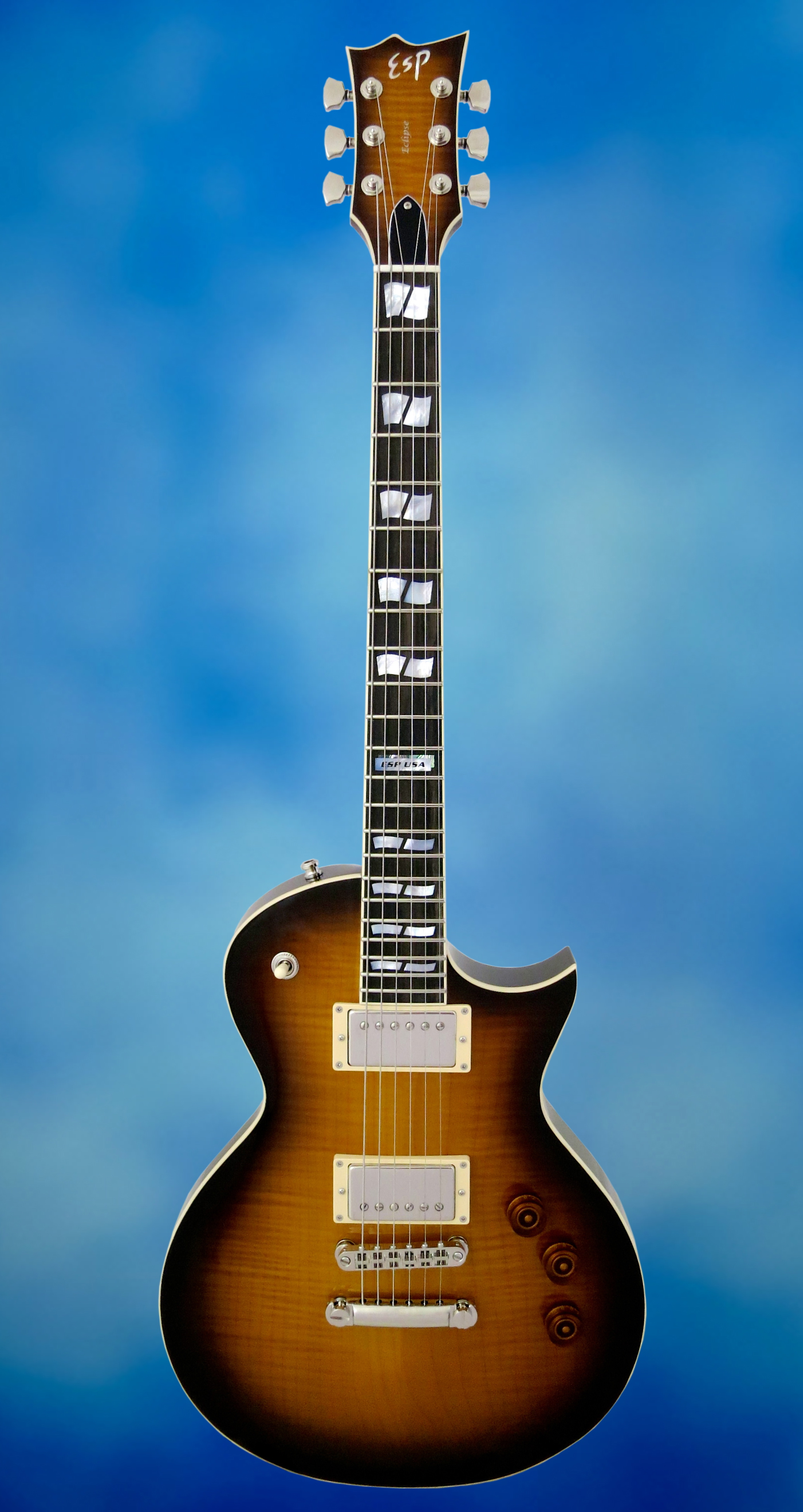
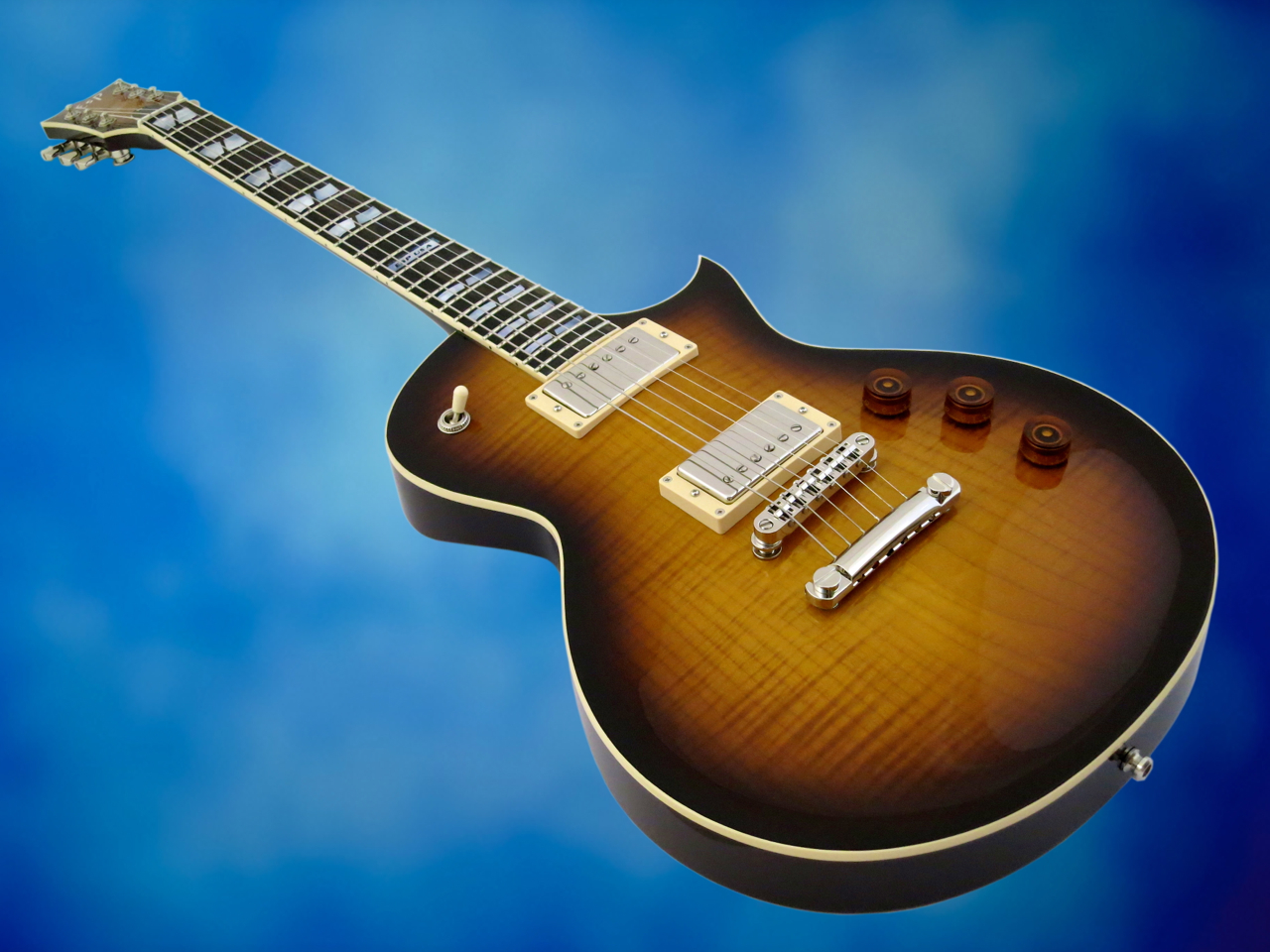
The ESP USA Eclipse (current price in Finland: 3.939 €) is the company’s ultimate version of their popular Eclipse model, using only the best materials and production methods.

One of the USA Eclipse’s special features is the ESP Set-Thru-Neck, which aims to combine the best attributes of a traditional set neck with the playability advantages of a through-neck.
ESP’s Set-Through-Neck is basically a set neck with a significantly larger tenon (both wider & deeper), which greatly improves the strength of the neck joint. Most set-neck guitars have a tenon which is somewhat narrow and shallow. In the ESP USA’s case, the width of the tenon is as large as the end of fingerboard and is almost as tall as the body. This allows the neck joint to be sculpted like a through-neck with no loss of structural integrity.
The result is a stronger neck joint, which is good for sustain, and it also makes it possible to do away with the traditional neck heel of a standard set-neck, resulting in a very comfortable playing experience.

The Eclipse’s mahogany body sports a rib cage chamfer for comfort.

The guitar’s tuning is kept rock steady by a set of Sperzel USA locking machine heads.

The bound headstock of the USA Eclipse features a flamed mahogany overlay, finished in the same Tobacco Sunburst finish as the body’s carved maple top.
The top nut has been made from genuine bone.
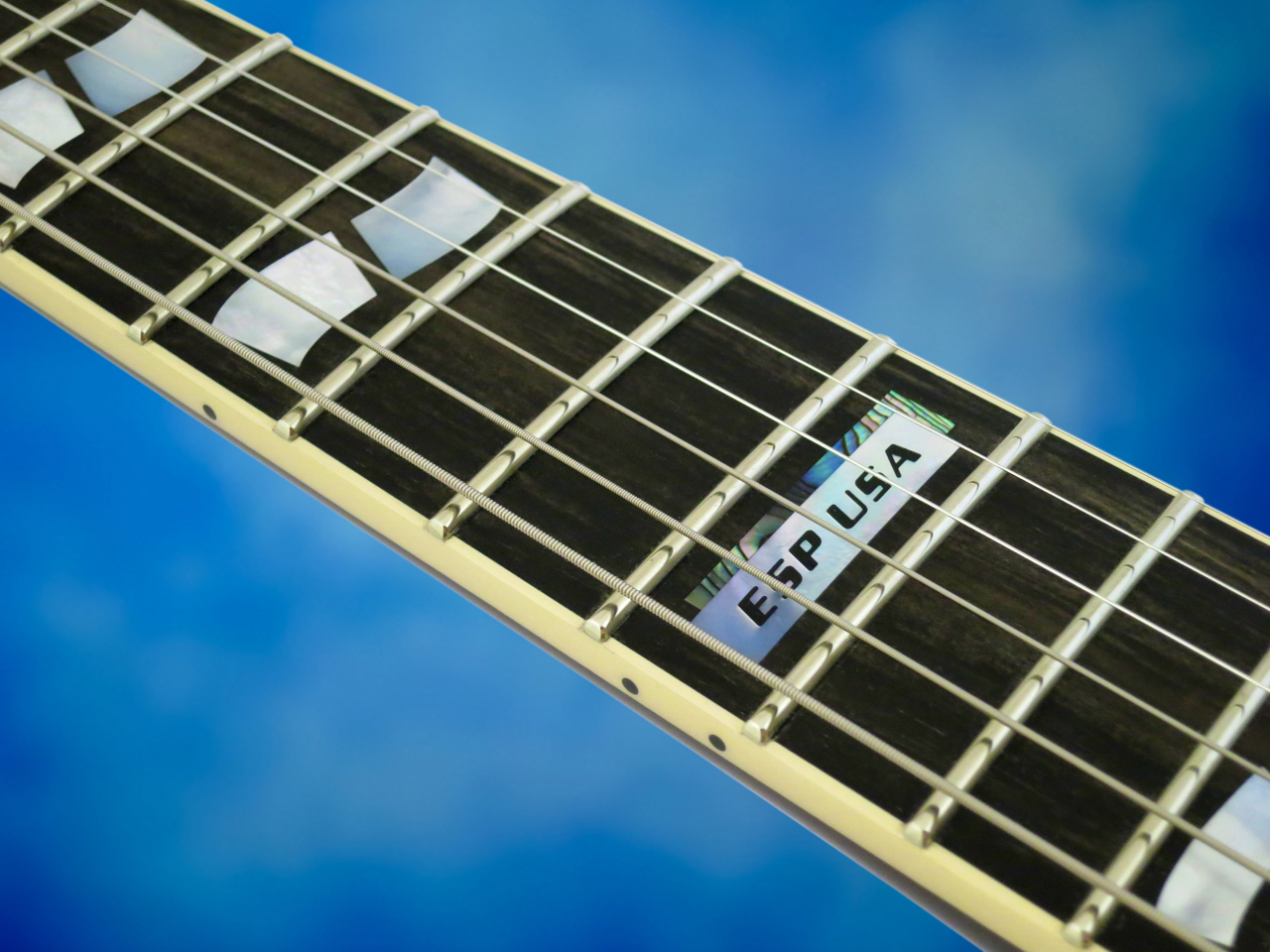
We find a bound ebony fretboard with 22 jumbo frets, adorned with beautiful pearl and abalone inlays.
The fingerboard radius is a flattish 12 inches (305 mm).

The locking Sperzels are paired at the body end with a rock solid TonePros TOM-bridge and stopbar combo.
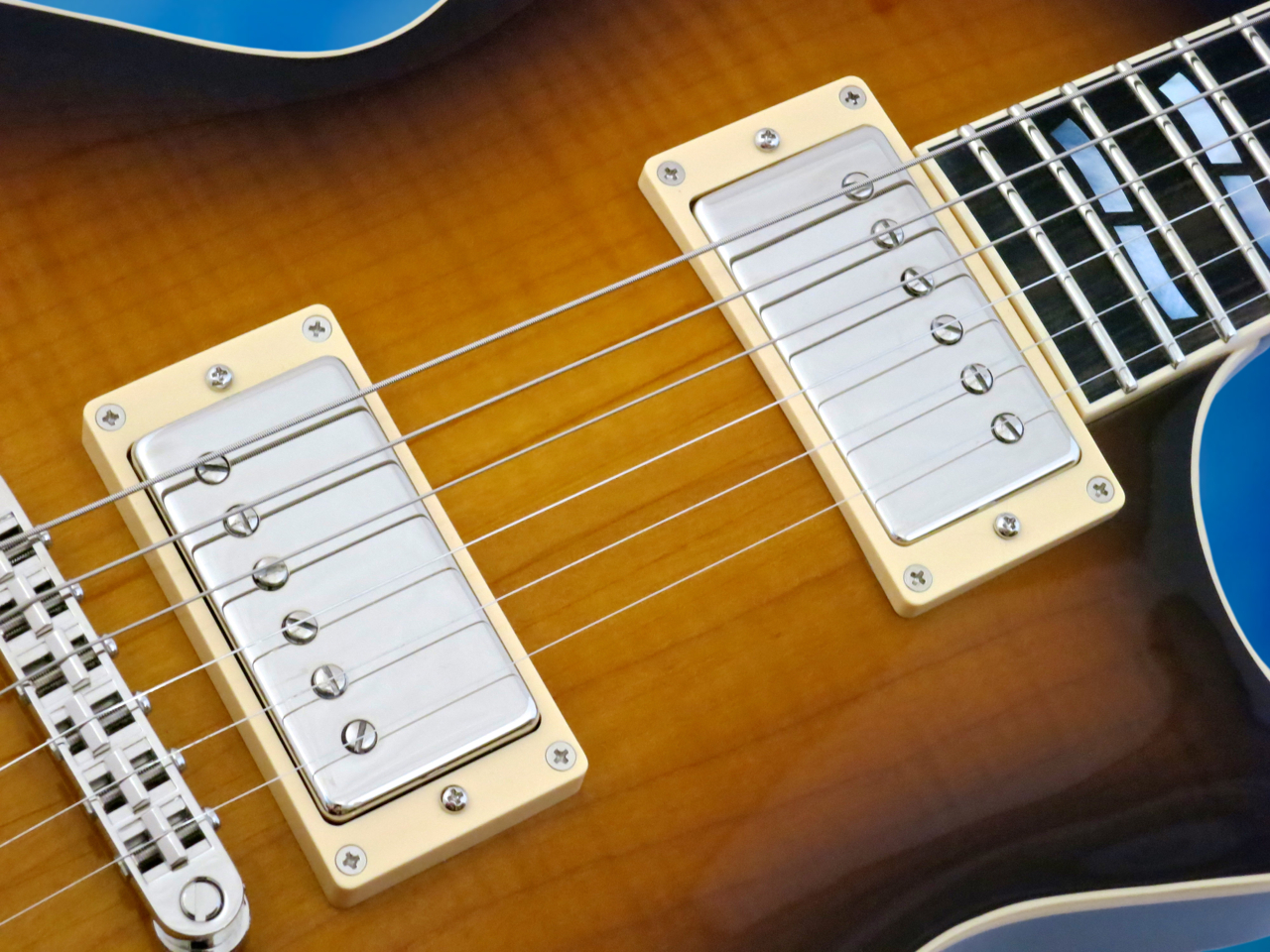
It’s quality all the way in the electronics department, too:
ESP’s USA Eclipse comes equipped with a pair of Seymour Duncan Alnico II Pro humbuckers (APH-1), which are vintage-voiced, warm-sounding pickups with moderate output levels (Slash’s favourites).

The control layout on this model has the bridge volume closest to the bridge pickup (for easy volume swells), while the middle knob is the neck volume.
The master tone control features a push/pull-switch splitting the humbuckers in the ”up” position.

The control cavity has received a layer of shielding paint, as well as a cover lined with aluminium foil.

****

This guitar really is a fantastic instrument! The ESP USA Eclipse is top quality incarnate, leaving nothing to be desired.
For a full-depth, Les Paul-inspired guitar the USA Eclipse is refreshingly light.
I don’t quite understand, why ESP insist on calling this neck profile a ”Thin U”. I agree, this neck doesn’t feel like a fat, clumsy baseball bat, but neither is it one of the notorious ”speed necks” of the Eighties. I would call the Eclipse’s rounded D-profile ”extremely comfortable”, and be done with it…
The USA Eclipse offers first-rate playability – light to the touch, offering just the right amount of resistance – across the whole fingerboard.
The vintage-voiced Seymour Duncan Alnico II Pro humbuckers are a perfect fit for this guitar, not least because of their versatility. You can have great-sounding, authentic Jazz tones, if you want, and then rock out without having to change guitars. The split humbucker sounds are very good, too, offering a brighter tonality and lower output levels. The ESP USA Eclipse covers a very wide range of different sounds and musical genres.
Here’s a short clip showing you the split humbucker sounds (starting with the neck pickup):
Next up, a similar clip with the full humbuckers:
In the demo track I have used split settings for the rhythm parts (left channel: both pickups; right channel: neck pickup), as well as the full bridge humbucker for the lead guitar:
****
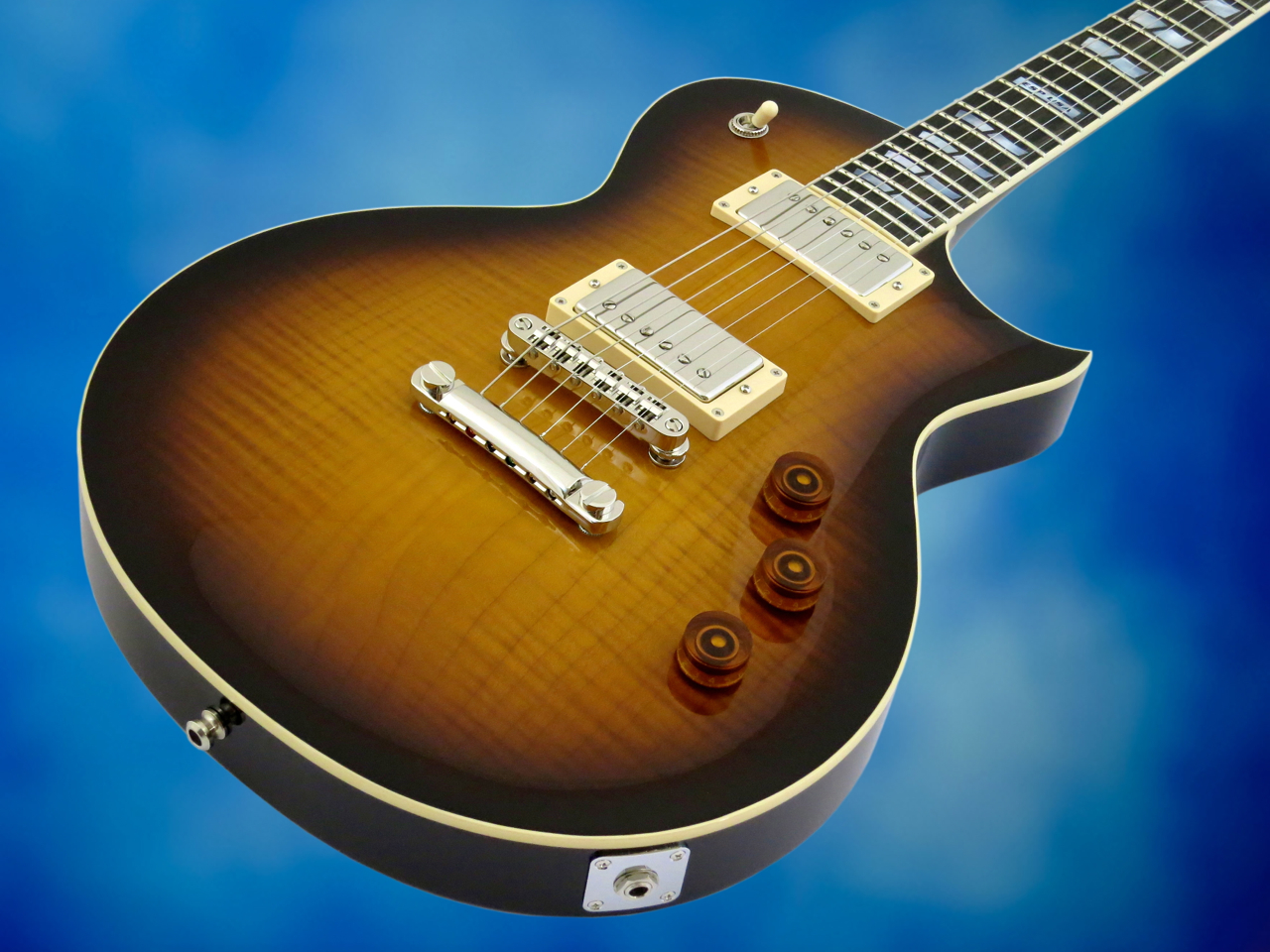
ESP’s USA Eclipse is a boutique grade guitar, backed by a large brand. Some manufacturers may ride on glories past, cashing in on their legendary brands. In contrast, ESP’s USA Eclipse really has the build quality, workmanship, and tone to justify its price tag.
In my view the ESP USA Eclipse is a gorgeous solidbody electric at a fair price.
****
ESP USA Eclipse
3.939 € (hard case included)
Finnish distributor: Musamaailma
****
Pros:
+ value for money
+ workmanship
+ Set-Thru-Neck construction
+ finish
+ splittable humbuckers
+ sound

Tällä kertaa on tarjolla todella harvinaista herkkua!
Vaikka moni kitaristi sitä ei tiedä, on ESP Guitarsilla myös pieni custom-paja USA:n länsirannikolla. ESP USA rakentaa ESP-artisteille tarkoitettujen custom-soittimien lisäksi myös muutamia kitaramalleja piensarjatuotannossa. Tällä hetkellä maailmalle lähtee alle 20 kitaraa kuukaudessa, ja testaajan suureksi iloksi yksi niistä saapui hiljattain Suomeen – ESP USA Eclipse.
****
ESP USA Eclipse (3.939 €) on firman ultimatiivinen versio Eclipse-mallista, jossa käytetään vain parhaita raaka-aineita, osia ja rakennusmenetelmiä.
Yksi USA Eclipsen erikoisuuksista on ESP:n Set-Thru-Neck-kaulaliitos, jossa yhdistetään liimaliitoksen ja kokonaan rungon läpi menevän kaulan parhaita ominaisuuksia.
Firman Set-Thru-liitoksessa on kyse erittäin syvästi ulottuvasta liimaliitoksesta. Kun perinteisissä liimaliitoksissa kaulan kieleke ulottuu kaulahumbuckerin alle, jatkuu USA Eclipsen tapauksessa kaulan mahonki vaahterakannen alla ihan tallaan saakka.
Tästä syntyy – ainakin teoriassa – lujempi kaulaliitos ja sen seurauksena pidempi sustain-vaihe. Samalla Set-Thru-liitos mahdollistaa myös erittäin sulavan liitoskohdan ilman kaulankorkoa.
Eclipsen mahonkirunkoon on lisätty oiva mukavuusviiste.
Vireen suhteen ei jätetä mitään sattumaan varaan, kun lapaan on asennettu Sperzel-lukkovirittimiä.
USA Eclipsen reunalistoitetun lavan etupuolen loimuvaahteravaneri on viimeistelty samaan Tobacco Sunburst -väritykseen kuin rungon vahvasti kaareva vaahterakansi.
Tämän kitaran satula on veistetty aidosta naudanluusta.
Reunalistoitettuun eebenpuuotelautaan on asennettu 22 jumbo-kokoista nauhaa, sekä upeat upotukset aidosta helmiäisestä.
Otelautaradius on suhteellisen loivat 12 tuumaa (305 mm).
Rungon puolella on Sperzel-virittimien aisapariksi valittu Tone Prosin lukittava Tune-o-matic-talla ja palkkimainen kieltenpidin.
Erittäin laadukas linja jatkuu myös mikrofonien suhteen:
ESP USA Eclipse on varustettu kahdella Seymour Duncan Alnico II Pro -humbuckereilla (APH-1), jotka ovat vintage-tyyliset, lämpimät mikrofonit (ja esimerkiksi Slashin lempimikit).
Tämän mallin volume-potikat toimivat niin, että tallan lähellä oleva potikka vaikuttaa tallamikrofoniin, ja keskimmäinen säädin on varattu kaulamikille.
Master tone -säätimeen on piilotettu nostokytkin, jolla voi puolittaa molemmat mikrofonit.
Kitaran laadukas, passiivinen elektroniikka on suojeltu ulkoisilta häiriöiltä grafiittipitoisella maalilla, sekä alumiinifoliolla vuoratulla kannella.
****
Tämä kitara on kerrassaan mahtava soitin! ESP USA Eclipse suorastaan huokuu aitoa laatua, eikä todellakaan jätä minkäänlaista toivomiseen varaa.
Täyspaksuiseksi LP-tyyliseksi kitaraksi USA Eclipse on mukavan kevyt.
En ymmärrä miksi ESP kutsuu tämän soittimen erittäin mukavaa kaulaprofiilia ”Thin U:ksi”. On totta, että Eclipsen mukavan pyöreä D-profiili ei tunnu lainkaan paksulta pesäpallomailalta, mutta – onneksi – tämä kaula ei myöskään ole 1980-luvun ohuen ohut ”vauhtikaula”. Erittäin mukavaksi minä kutsuisin tätä kaulaa…
Jenkki-Eclipsen soitettavuus on mielestäni ensiluokkaista – kevyt, muttei löysä – ja kitara soi puhtaasti ja kauniisti koko otelaudassa.
Seymour Duncanin vintage-tyyliset Alnico II Pro -humbuckerit sopivat tähän soittimeen täydellisesti, juuri niiden monipuolisuuden ansiosta. Hyvin maltillista lähtötehoa omaavat humbuckerit toimivat yhtä loistavasti puhtaaseen perinne-Jazziin kuin rankkaan särökäyttöönkin. Myös puolitettujen mikrofonien sointi on erittäin käyttökelpoinen, minkä ansiosta USA Eclipse kattaa hyvin laajan alueen soundeja ja musiikkityylejä.
Ensimmäisessä klipissä kuullaan puolitettujen humbuckerien puhtaita soundeja (alkaen kaulamikistä):
Toisessa audioklipissä taas soivat täydet humbuckerit:
Demobiisissä vasemmalta tuleva komppikitara käyttää molempia puolitettua mikrofonia yhdessä, kun taas oikealta tulevissa wah-osuuksissa soi puolitettu kaulamikki yksin. Särökitara käyttää täyttä tallamikrofonia:
****
ESP USA Eclipse on suuren valmistajan oma boutique-luokan huippusoitin. Toisin kuin joissakin perinnemerkeissä, USA Eclipsen tapauksessa hintalappu on suorassa yhteydessä tämän soittimen laatuun, eikä pelkästään brändi-imagoon.
ESP USA Eclipse on mielestäni loistosoitin, jossa hinta ja laatu ovat selvästi sopusuhteessa.
****
ESP USA Eclipse
3.939 € (kova laukku sisältyy hintaan)
Maahantuoja: Musamaailma
****
Plussat:
+ hinta-laatu-suhde
+ työnjälki
+ Set-Thru-Neck-kaula
+ viimeistely
+ mikrofonien puolitus
+ soundi


 Kitarablogi.com – Finland's premier Guitar and Bass blog