The mandolin – a fantastic opportunity to broaden your vocabulary

Once you’ve learnt how to get to grips with a guitar, learning to play a different stringed instrument is relatively straightforward, broadening your outlook in the process.

Take the mandolin, for example – a great second instrument for any guitarist. Its courses (pairs of strings) are tuned to the same pitch as the strings of a violin – g-d-a-e – which throws all your scale and chord shapes right overboard.

There are three different basic types of mandolin: the bowlback Italian mandolin is the senior member of the family, and closely related to Middle Eastern instruments, such as the saz.

The Portugese/Irish  mandolin is build with a straight back, much like a guitar, making it easier to hold and play.

The carved-top Bluegrass-mandolin is an American invention from the very last years of the 19th Century, taking its cue from the building principles behind a violin. Orville Gibson’s (1856–1918) quality mandolins laid the groundwork for what was to become the famous Gibson-brand. Renowned musician and luthier Lloyd Loar finalised the Gibson-mandolin around 1920.

My own mandolin is a Chinese-made, all solid wood Kentucky KM-630, pattered after a typical F-Style Gibson-mandolin.

It features a spruce top as well as a back and sides made from maple.

The headstock is replete with fine inlay work.
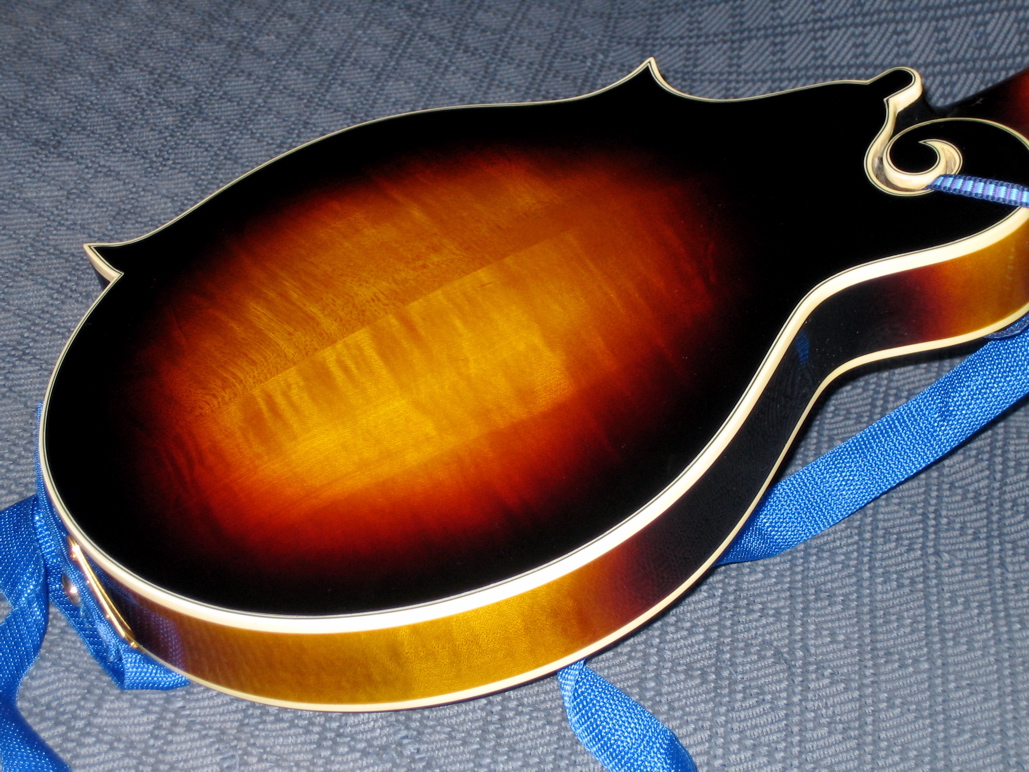
The well-applied finish really shows off the back’s figuring (flame).

The maple neck too is finished in a rich sunburst.

Gold-coloured tuners round off the picture.
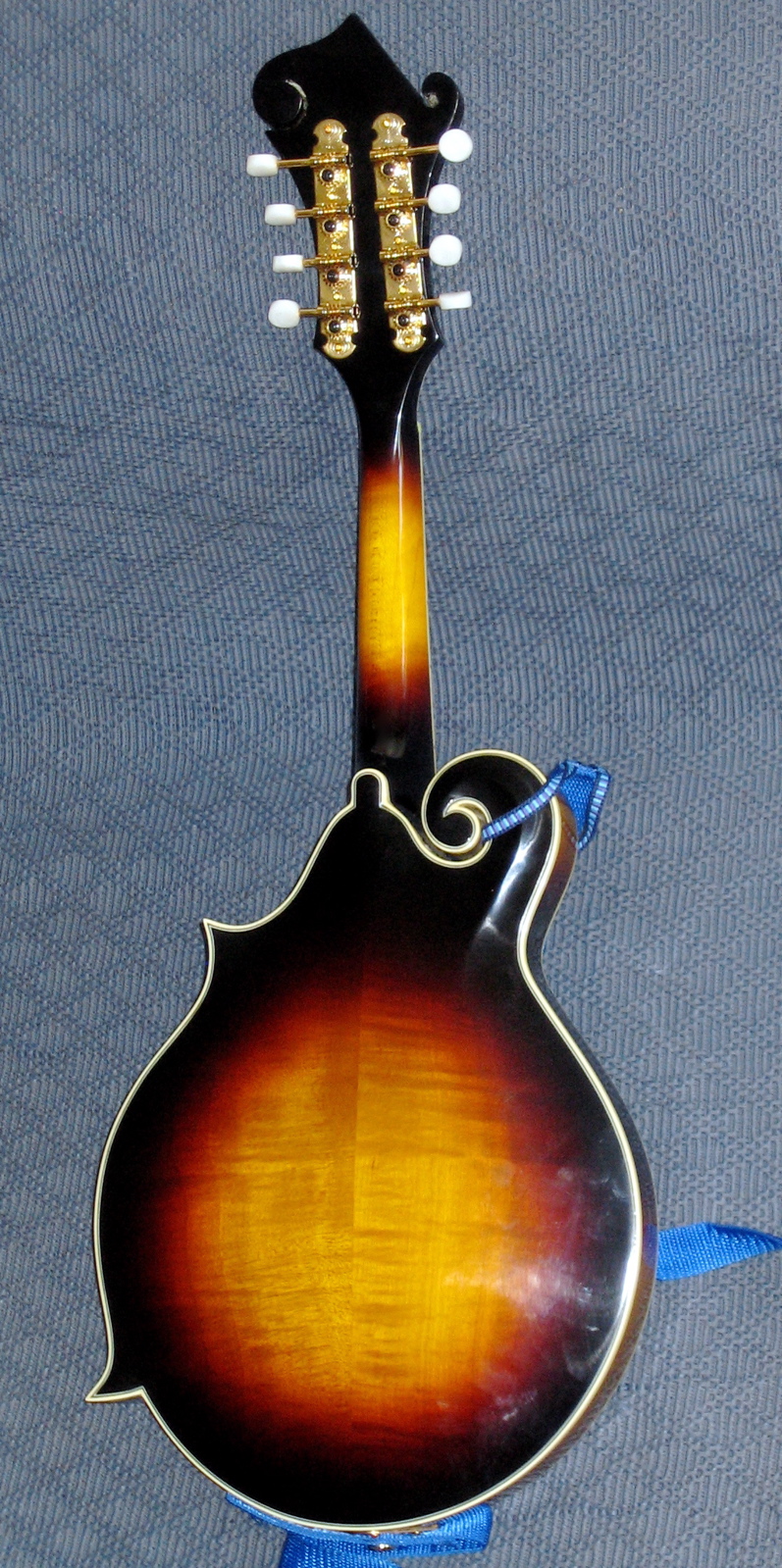
When shopping for a mid-price Bluegrass-mandolin check the neck for straightness, as well as the quality of the fretting. Make sure the free-standing bridge is OK and works as it should. The relatively hard string pull, along with transport/storage in too dry a place can sometimes lead to a cracked or collapsing bridge.

****

Here’s a recording featuring my KM-630:

Lucy (Frank Badenius/Martin Berka)

****

Check out these links for further info:

Mandolin tuner

Mandolin chords

A genuine Gibson/Lloyd Loar -mandolin from 1923

Build your own mandolin!

Mandoliini on oiva lisäys kitaristin soitinvalikoimaan

Kun kerran kitaristina musiikin tuottaminen kielisoittimella on tullut tutuksi, on toisen kielensoittimen soittamisen oppiminen suhteellisen helppo, mutta samalla horisonttia laajentava kokemus.

Esimerkiksi mandoliini on oiva kakkossoitin kitaristille. Sen kieliparit viritetään samoille sävelkorkeuksille kuin viulussa – g-d-a-e – minkä vuoksi soinnut ja skaalojen soormitukset menevät heti uusiksi.

On olemassa kolme päätyypejä: kulhomaisella, kaarevalla kopalla varustettu italialainen mandoliini on soittimen vanhempi alkuperäinen muoto, joka on sukua Lähi-Idän kielisoittimille (esimerkiksi saz).

Portugalilainen/irlantilainen mandoliini on tasakanttinen, kitaratyylinen ratkaisu, joka on helpompi pitää sylissä.

Kaarevalla kannella ja pohjalla varustettu Bluegrass– tai Archtop-mandoliini kehiteltiin 1800-luvun loppumetreillä Yhdysvalloissa, ja sen lähtökohta oli viulussa. Orville Gibsonin (1856–1918) laadukkaat mandoliinit ovat nykyisen Gibson-firman alkupiste. Soittaja ja soitinrakentaja Lloyd Loar sitten kehitti Gibson-mandoliineja loppullisen muotoon 1910-luvun loppussa.

Oma mandoliinini on Kiinassa rakennettu, kokopuinen Kentucky KM-630, jonka esikuva on ollut Gibsonin koristettu F-malli.

Kansi on kuusesta ja sivut sekä pohja vaahterasta.

Lavassa on runsaasti kauniita helmiäisupotuksia.

Pohjan hieno viimeistely tuo esiin loimuvaahteran näyttävät syykuviot.

Myös vaahterakaula on saanut ylleen sunburst-värityksen.

Kullanväriset virittimet antavat soittimelle viimeisen silauksen.

Kun ostaa edullisen Bluegrass-mandoliinin kannattaa tarkistaa, että kaula on suora, nauhat kunnossa, eikä vapaasti kannella seisova talla vioittunut. Kielten voimakas veto sekä liian kuiva ilma kuljetuksen tai varastoinnin aikana voivat nimittäin johtua siihen, että talla repii tai korkeussäädön kierretangot löystyvät tallapuussa.

Suomessa suurin mandoliinivalikoima löytyy Millbrook Musiikista, joka tuo myös maahan esimerkiksi Kentucky– ja Eastman-soittimet.

****

Tässä hauskassa biisissä soitan mandoliinia:

Lucy (san. Frank Badenius/säv. Martin Berka)

****

Tässä vielä muutama mielenkiintoinen linkki aiheesta kiinnostuneille:

Mandoliinin virittäminen

Mandoliinisoinnut

Aito Gibson/Lloyd Loar -mandoliini vuodelta 1923

Rakenna oma mandoliinisi!

Carlos Santana is my Tone God!

Last Monday Carlos Santana and his excellent band played in Helsinki’s football stadium (that’s soccer to you Americans).

Fantastic sound, great musicianship – it really was one of the best concerts I’ve ever been to!

If you have a chance to see Santana on the current European tour, you should really do so  😉

____________________________

I simply adore Carlos’ lead sound.

Here’s a short bit paying homage to the man: Hairloss Manana

I recorded it using two review guitars:

• a PRS SE Custom for the rhythm parts

• a PRS McCarty for the lead

I’m not ashamed to admit I used a Behringer V-Amp2 in front of my Pro Tools -system.

________________________________

Last month I recorded this song to test a Tascam Portastudio for Riffi: Guitar (G-A-S)

I didn’t plan on recording something Santana-ish – it simply happened.

By the way, the whole thing was recorded using only real instruments (and without a click-track).

The guitar is an Epiphone Slash Goldtop through a Mad Professor Little Green Wonder into a Fender ’57 Twin-Amp reissue.

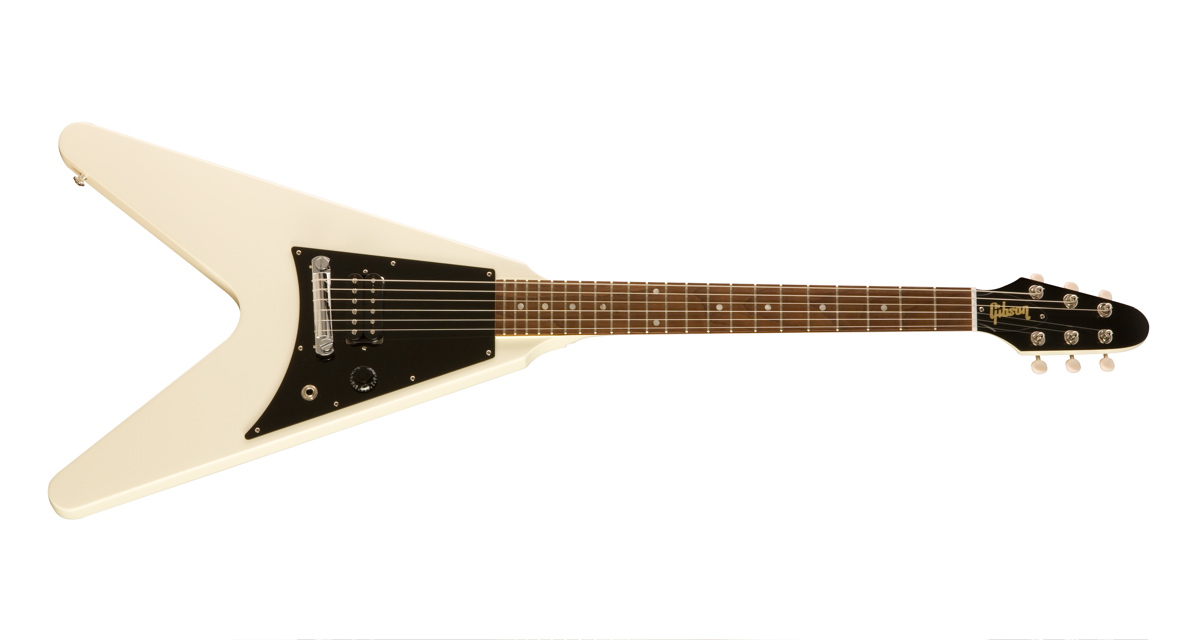
Gibson Flying V – tai: kaksi vuosikymmentä etuajassa

Vuonna 1957 Ted McCartyn mitta oli täynnä. Gibsonin toimitusjohtajaa ärsyttivät ainaiset puheet firman vanhanaikaisuudesta ja tylsyydestä muiden valmistajien ja joidenkin kitaristien keskuudessa. Etenkin Fenderin tuomat uudet tuulet kitaroiden valmistuksessa ja markkinoinnissa saivat McCartya uskomaan, että Gibson tarvitsi jotain mullistavan uutta mallistossansa.

Pidettiin kokonainen sarja aivoriihi-istuntoja, jossa yritettiin löytää mahdollisimman omanlaatuisia kitaroita. Pomo itse keksi tällaiset muodot:

Kun ensimmäinen prototyyppi oli valmis, joku nauroi ”Hehee, tämä näyttää lentävältä V-kirjaimelta!”, ja siinä olikin uutukaiselle sopiva nimi.

Kun Flying V näytettiin ensimmäistä kerta NAMMissa (1958, samalla esiteltiin myös Explorer-mallin), varsin erikoinen kitara oli yksi messujen kohokohtista. Kaula ja runko veistettiin korina-puusta ja metalliosat olivat kullattuja.

Ongelma oli vain, että omintakeinen kitara oli aikansa edellä, minkä takia siitä ei tullut myyntimenestys. Alkuperäinen painos (1958–’59) jäi alle 100 kappaletta, ja myös niistä jotkut käytettiin vain mainoskylttinä joidenkin musiikkiliikeiden edessä.

Kuuskytluvun keskivaiheella musiikkimaku oli jo muuttanut sen verran raskaampaan suuntaan, että Gibson päätti yrittää uudestaan. Uusi Flying V oli mahongista, ja sillä oli perinteinen Gibson-kieltenpidin. Myös säätimet oli hieman eri järjestyksessä tässä uusintapainoksessa (katso alle).

Jimi Hendrix käytti juuri sellaista 60-luvun mallia, aina kun halusi Stratoa paksumpia soundeja.

Mutta vasta 1970-luvulla, kun Hard Rock ja Metal keksittiin, tuli Veestä muodikas lavakitara, sekä lavakarismansa että Gibson-soundinsa ansiosta.

Ja se lentää yhä vain eteenpäin; juuri tällä hetkellä Gibson tarjoaa upouuden seitsenkielisen Veen aktiivimikityksellä rankkaan riffitykseen.

Myös uudesta, laajennetusta Melody Maker -sarjasta löytyy Flying V – Flying V Melody Maker – jolla on mahonkikaula, vaahterarunko, tallahumbucker omalla volume-säätimellä sekä yksinkertainen wraparound-talla – that’s it.

Flying V:n ainoa huono ominaisuus on, ettei mallia voi soittaa istuen. Toisaalta, kukahan moshaa istuen?

😉

The Gibson Flying V, or: Two Decades Ahead Of Its Time

In 1957 Gibson’s then president, Ted McCarty, grew tired of the company being slagged off as ”boring old farts” by some of its competitors. Especially the fresh touch brought to guitar-making (and marketing) by young upstarts Fender, made McCarty determined that something had to be done to put the ”stuffy” image behind them.

They held a series of brain-storming sessions with a view to coming up with the most outrageous designs imaginable. Ted McCarty himself came up with this:

When the first prototype was built somebody said (laughing, no doubt): ”Hey, this thing looks like a flying Vee!”, and the name stuck.

When the Flying V was first shown at the Winter NAMM show in 1958 – along with its sister model the Explorer – it sure was the show-stopper McCarty had hoped for, with its radical shape, korina neck and body and gold parts.

The problem was the model was way ahead of its time, and didn’t really sell well in its original form. Less than 100 Flying V’s were shipped to dealers during 1958-9, with some ending up as shop signs (!) to draw in customers.

In the mid-60s times had changed, though, and heavier music was becoming en vogue, so Gibson decided to reissue the Flying V, albeit with a standard stop-tailpiece, a different control layout and the company’s customary mahogany used for the body and neck.

It was this version that Jimi Hendrix used whenever he needed a fatter sound than his Stratocaster could provide him with.

But it was really only with the advent of Hard Rock and Metal in the 1970s that the Vee really took off as a fashionable guitar, as it offered both cool looks and fat Gibson-tone in the right proportions.

Since then the Flying V has never really left us; right now, for example, Gibson are offering an EMG-equipped, active 7-string version for ultra-brutal riffing.

And brand-new is a budget version of the Vee, called the Flying V Melody Maker, which gives you the essence of what the Vee’s about in a nutshell: a mahogany neck glued to a maple body, one powerful humbucker, a single volume control and a simple wraparound bridge topping it all off – that’s it.

The Flying V only has one single drawback – you can’t play the model sitting down. But then again, headbanging doesn’t really work sitting down…

😉

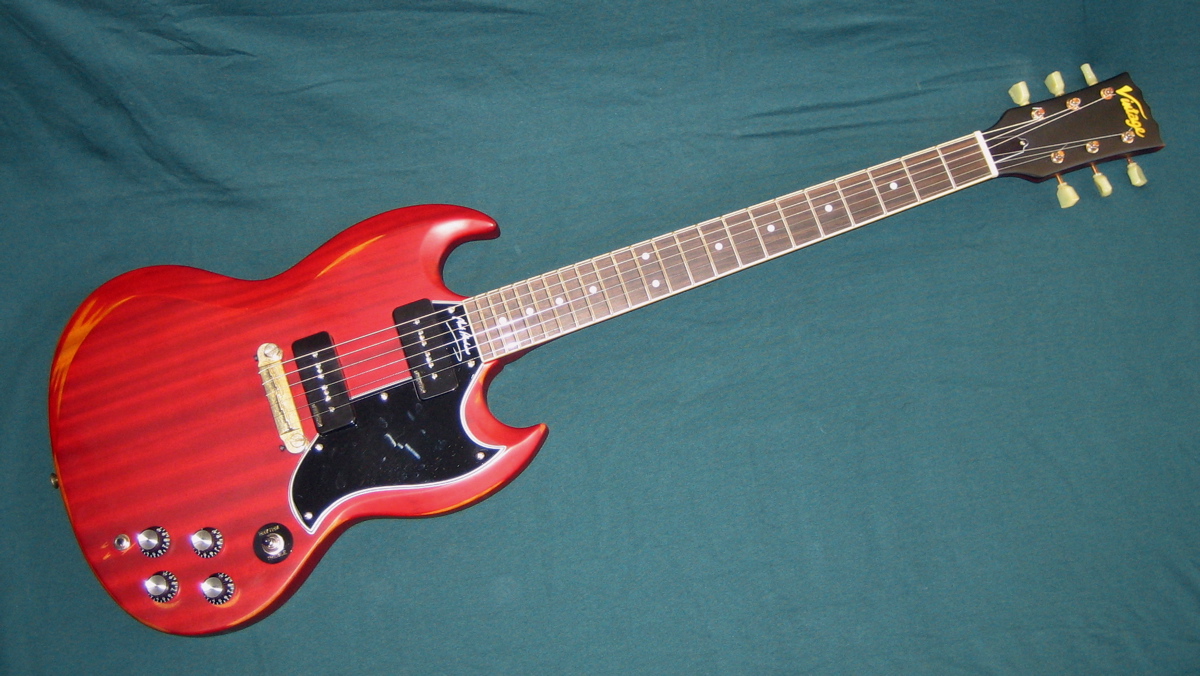
Three shades of P-90 **** Kolme kertaa P-90

Here are three soundbites I recorded for you of three different P-90 bridge pickups on three different guitars:

• the Epiphone Casino has Göldo pickups with metal covers

• the Vintage VS6 Mick Abrahams has Wilkinson soapbars with plastic covers

• the Gibson Les Paul Junior comes with a Gibson P-90 and a plastic dog-ear cover

All guitars were played through a clean Fender-type amp model with a Boss SD-1 in front.

Casino bridge P-90

VS6 Mick Abrahams bridge P-90

Junior P-90

Tässä ovat kolme soundiesimerkkiä kolmesta kitaroista ja niiden P-90 tallamikrofoneista:

• Epiphone Casinossa on Göldo-mikit, joilla on metallikansi

• Vintage VS Mick Abrahams -nimikkomallissa on Wilkinson-mikit muovikansilla (saippuapalat)

• Gibson Les Paul Juniorissa on firman oma P-90 muovikannella

Kaikki kitarat soitettiin puhtaan Fender-tyylisen mallinnuksen ja Boss SD-1 pedaalin läpi.

Classic Basses, part 3: Rickenbacker 4001/4003

Rickenbacker was one of the first manufacturers to latch onto Leo Fender’s idea of an electric bass with a proper long scale.

In 1957 they introduced their first bass model, the 4000, which was the world’s first through-neck bass.

Rickenbacker’s two-pickup model – the Rickenbacker 4001 (introduced in 1961) – turned out to become one of the company’s most successful instruments.  Paul McCartney and Chris Squire are probably the bass’ best-known users – they played the 4001’s export version 4001S.

In 1979 Rickenbacker came up with a model updated for use with roundwound strings. The new bass was named the 4003 and it  featured new truss rods (Rickenbackers always have two!) and more powerful singlecoil pickups with the neck unit moved slightly closer towards the bridge.

My own Rickenbacker 4003 was built in 1987.

Except for the rosewood fretboard, a 4003 is crafted completely from maple. The neck goes all the way from the headstock to the end of the body (a so-called Through-Neck), while the body is formed by two pieces of maple glued to the neck’s sides.

Rickenbacker typically uses a reddish type of rosewood for their fingerboards, which are usually gloss-lacquered. Another typical company trait is the narrow binding, which leaves a visible gap between the binding and the neck’s finish.

The tuning machines have been made in Germany by Schaller.

Rickenbacker’s idiosyncratic bridge design includes an adjustable string mute mechanism. Setting the correct octave compensation is a little bit more complicated than it need be – you have to detune the strings to get to the adjustment screws.

Alongside the use of maple as the instrument’s main ingredient the 4003’s singlecoil pickups play a large role in this model’s throaty tone. Most users remove the bridge pickup’s metal cover, as it tends to get in the way of your right hand.

The silver metal finish is kind of rare, even though a similar bass appeared on the cover of Rickenbacker’s bass catalogue in the mid-80s. The most popular finishes are ”Fireglo” (a red sunburst), ”Jetglo” (black) ja ”Mapleglo” (natural gloss finish).

You can check out the sound of my 4003 here or here.

Klassikkobassot, osa 3: Rickenbacker 4001/4003

Rickenbacker tajusi melko nopeasti, että Leo Fenderin keksimä sähköbasso pitkällä mensuurilla ei ollutkaan niin hullu idea kuin monet väittivät.

Vuonna 1957 firma toi markkinnoilla ensimmäisen sähköbassonsa, jolla oli mallitunnus 4000 – se oli ensimmäinen basso, jossa kaula jatkoi yhtenäisenä koko rungon läpi.

Kaksimikrofonisesta sisarmallista tuli sitten oikea klassikko – Rickenbacker 4001 (tuotanto aloitettu vuonna 1961).  Paul McCartneysta ja Chris Squireistä tuli tunnetuimpia Rickenbacker-käyttäjiä – tosin he soittivat 4001:n brittiversiota 4001S.

Vuonna 1979 sai 4001 uudella kaularaudalla ja vahvemmilla mikrofoneilla varustetun rinnakaisversion nimeltään Rickenbacker 4003.

Minun oma Rickenbacker 4003 on vuosimallia 1987.

Palisanteriotelautaa lukuunottamatta 4003 on veistetty kokonaan vaahterasta. Kaula jatkuu rungon läpi (ns. Through-Neck), ja basson runko koostuu kahdesta vaahterapalasta, joita on liitetty kaulan sivuun.

Rickenbacker on aina käyttänyt hieman punertavaa palisanterilaatua otelaudoissaan. Perinteisesti firman otelautoja viimeistellään kiiltävällä kirkaslakalla. Tyyppillinen on myös otelaudan matala reunalistoitus, joka jättää osan palisanterista näkyviin.

Virityskoneistojen valmistaja on 1970-luvun loppupuolelta ollut saksalainen Schaller.

Rickenbackereissa on läheis aina firman oma, hieman omintakeinen talla, johon on integroitu myös säädettävä solukumisordino. Oktaavikompensaation säätäminen on hieman monimutkainen, koska kielet joutuu löystää sitä varten…

Korkean ”vaahterapitoisuuden” ohella on yksikelaisille mikrofoneille tärkeä rooli 4003:n jäntevässä soundissa. Monet soittajat poistavat tallamikrofonin metallisuojan, koska se on oikean käden tiellä (näin teki myös bassoni entinen omistaja).

Hopeanvärinen metalliviimeistelly on suhteellisen harvinen, vaikka juuri tämänvärinen soitin oli 1980-luvun keskivälillä Rickenbackerin bassokatalogin kannessa. Tavallisimpia väriä ovat ”Fireglo” (punainen liukuväritys), ”Jetglo” (musta) ja ”Mapleglo” (kirkaslakkaus).

Voitte kuunnella oman 4003:n sointia esimerkiksi tässä tai tässä.

Pidä blogia WordPress.comissa.

Ylös ↑