Contact: Puuverstas Änäkäinen
Blackstar-uutuus: Blackstar Fly 3 – nyt kaupoissa!


Blackstar Amplificationin uutuustuote on minikokoinen harjoitusvahvistin nimeltään Fly 3.
Blackstar Fly 3 on kolmewattinen, kaksikanavainen kitarakombo, joka toimii virtalähteellä tai paristoilla. Fly 3 tarjoaa sekä puhtaan että särökanavan. Harjoituskombossa on Blackstarin patentoitu ISF-säädin, sekä nauhakaiku-tyylinen viive-efekti. Kaiuttimen halkaisia on kolme tuumaa.
Kaiutinmallinnuksella varustettu kuuloke-/linjalähtö mahdollistaa hiljaista harjoittelua, sekä suoria linjaäänityksiä kotistudiossa.
Blackstar Fly 3 -komboon voi hankkia myös Fly 103 -nimisen lisäkaappin, joka tekee harjoitusvahvistimesta oivan stereosysteemin – joko kitaran soittoa tai musiikin kuuntelua varten.
Blackstar Fly 3:n hinta on Suomessa vain 65 €!
****
Lisätiedot: Musamaailma


Musikmesse 2014: Fender American Deluxe Strat Plus

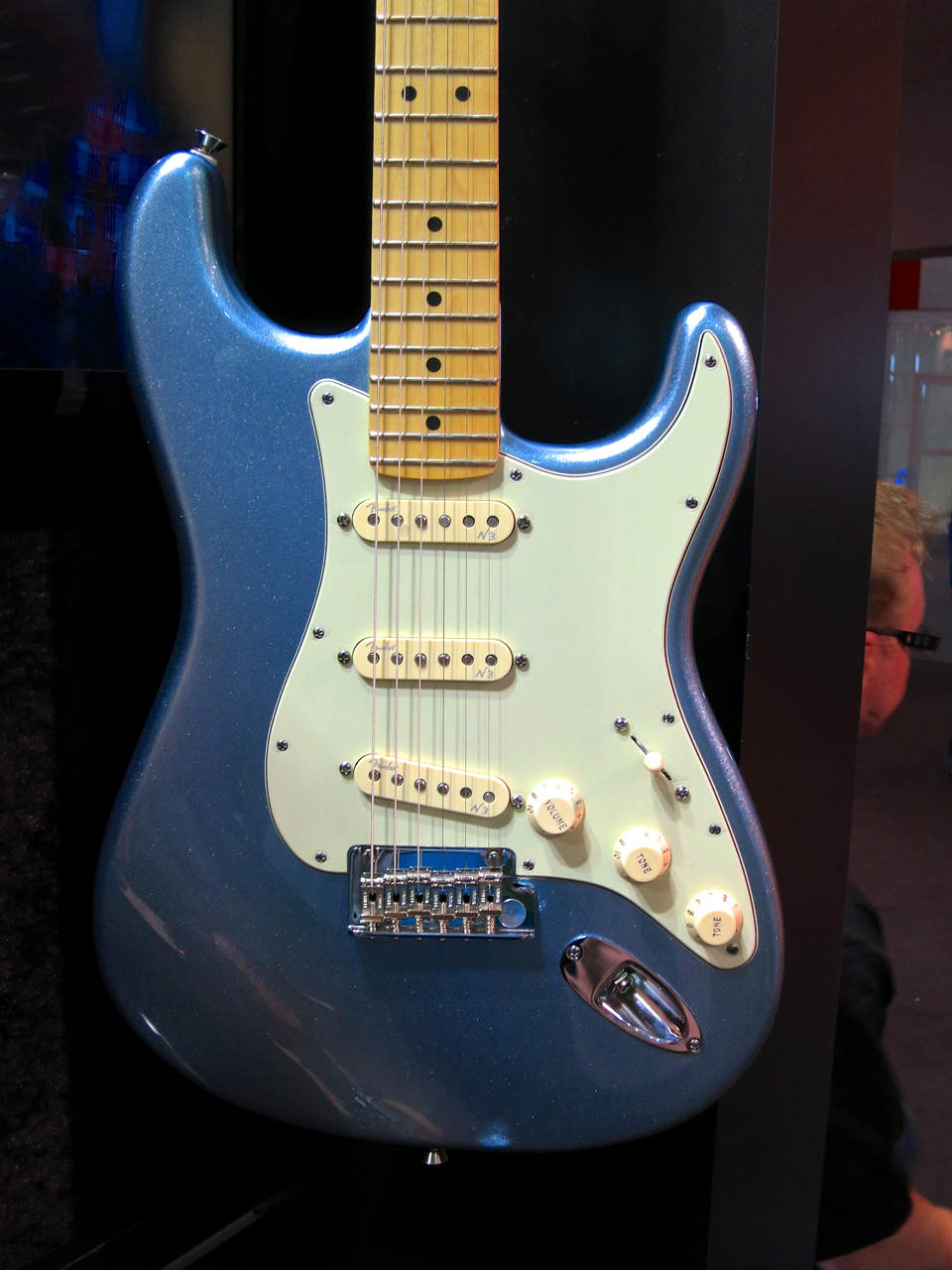
Fenderin American Deluxe Strat Plus on firman ensimmäinen sähkökitara ilman perinteisiä juotosliitoksia. Fender tulee tarjoamaan mallille erilaisia mikrofonivaihtoehtoja ja mikkien vaihtaminen on nyt huomattavasti helpompi, koska juotoskolvea ei tarvita.
Erikoisinta on Deluxe Strat Plussissa kuitenkin sen kytkentäkortti-ominaisuus. Rungon takapuolelta löytyy korttipaikka Fenderin Personality Card -kytkentäkorteille, jotka mahdollistavat kitaran modifioinnin muutamassa sekunnissa. Kitaran mukaan tulevat kolme korttia, joista Standard-kortti tarjoaa Stratocasterin perinteistä kytkentää. Cutter-kortilla kitaran tone-potikat muuttuvat, niin että toisesta tone-säätimestä tulee bassofiltteri, joka ohentaa kitaran soundia. Blender-kortilla taas saa lisättyä toisella tonella kaulamikrofonin signaalia myös sellaisissa kytkinasemissa, joissa se olisi normaalisti pois päältä. Cutter- ja Blender-kortit tarjoavat myös omia minikytkimiä, joilla saa muutettua tone-kondensaattorien arvoja.


Review: Zoom H6


Zoom have released their new handy recorder flagship:
The Zoom H6 is a six-track mobile recorder with exchangeable microphone modules.
****

Zoom’s H6 (rrp in Finland: 398 €) comes in its own carrying case.
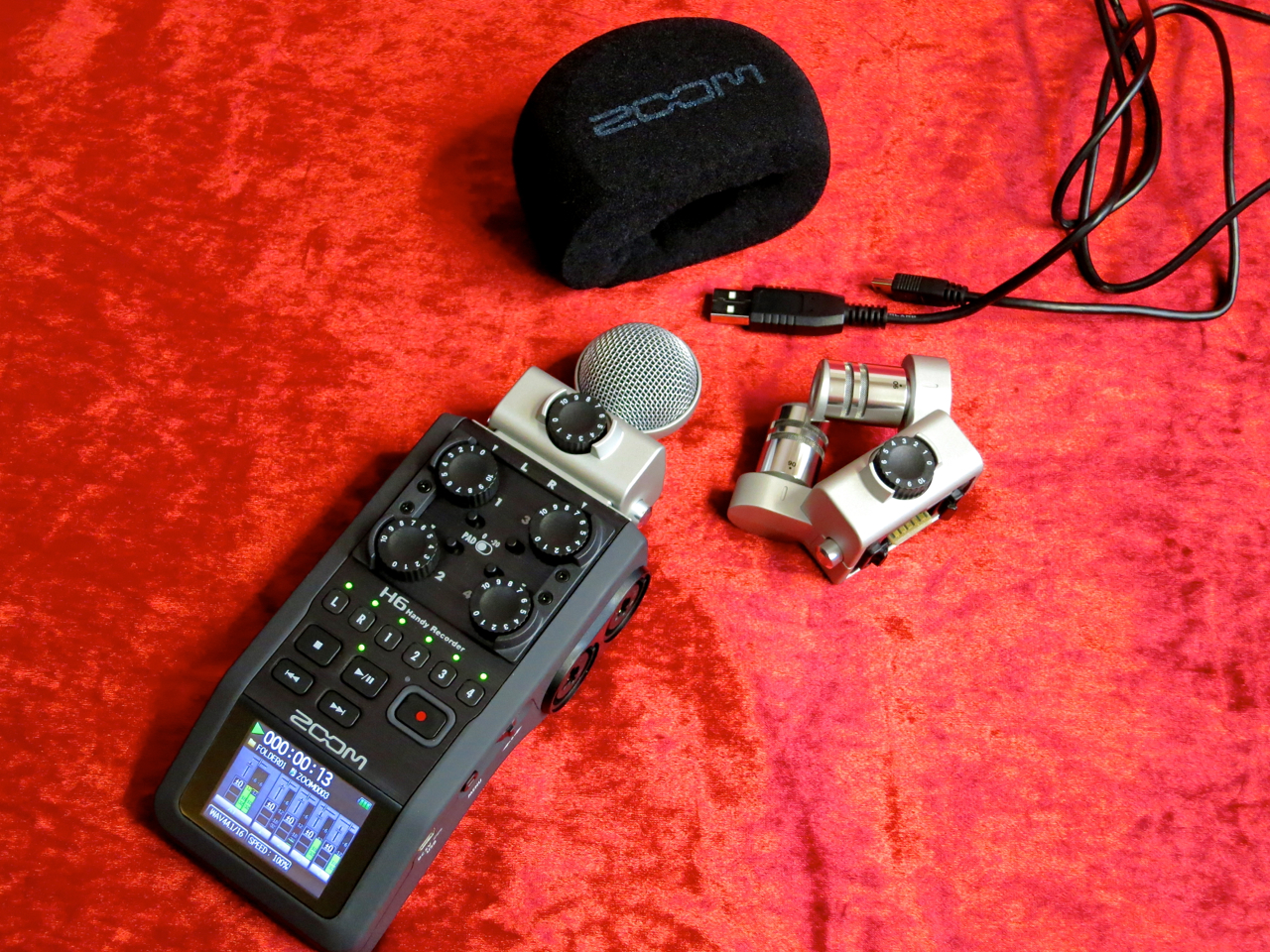
The package includes the H6 itself, two mic modules – the XYH-6 offering XY-stereo and the MSH-6 with an MS-stereo capsule – a foam windscreen, a USB-cable, four AA-size batteries and a 2 GB SD-card.
Also included is Steinberg’s Cubase LE audio-sequencer software.
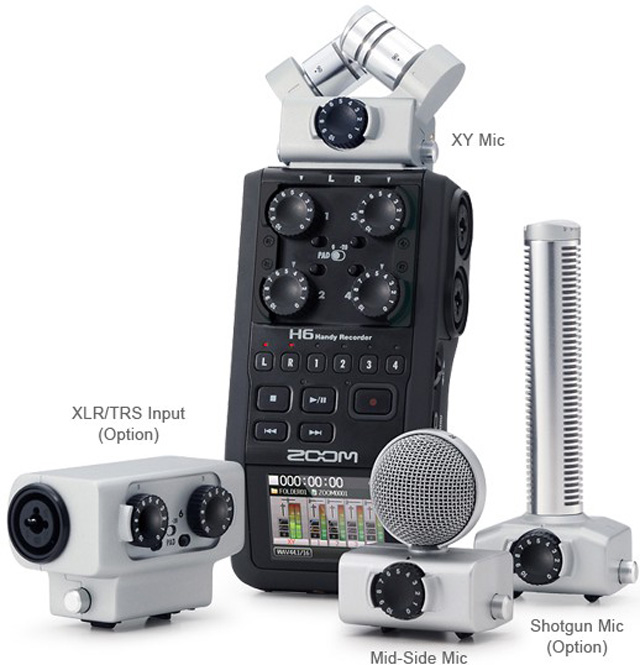
At the moment the H6 is the only field recorder offering you different exchangeable mic and preamp modules.
In addition to the supplied XY- and MS-modules you can also buy Zoom’s shotgun module (SGH-6) or a module with an additional pair of XLR-/TRS-inputs (EXH-6).

For this review we were also supplied with Zoom’s accessory pack for the H6 (APH-6), which contains a furry windshield for outdoor recording, as well a USB-power supply and a remote control.
****

Except for its control panel the Zoom H6 is entirely covered in a non-slip rubbery coating, which also cuts down on handling noise during recording.

A typical Zoom-feature has been carried over into the recorder’s XY-module:
You can switch the stereo width of the XY-setup by turning the capsules. The options are the slightly narrower 90 degrees angle…

…and the wider pickup pattern of 120 degrees.

The combined XLR/TRS-connectors have been placed on both sides of the H6. The Zoom offers switchable phantom power for condenser mics.
On the left side you’ll find the access to the SD-card, as well as the headphones output and the volume control.
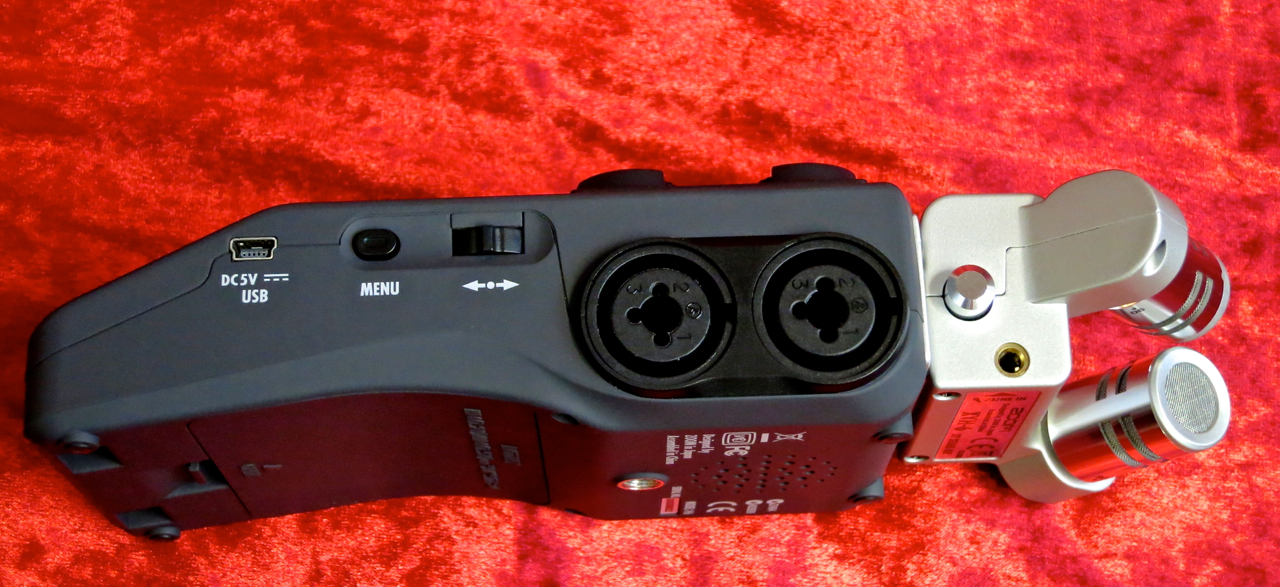
In addition to the recorder’s mini-USB-port the right side is home to the Menu-button and the device’s nifty navigation toggle.
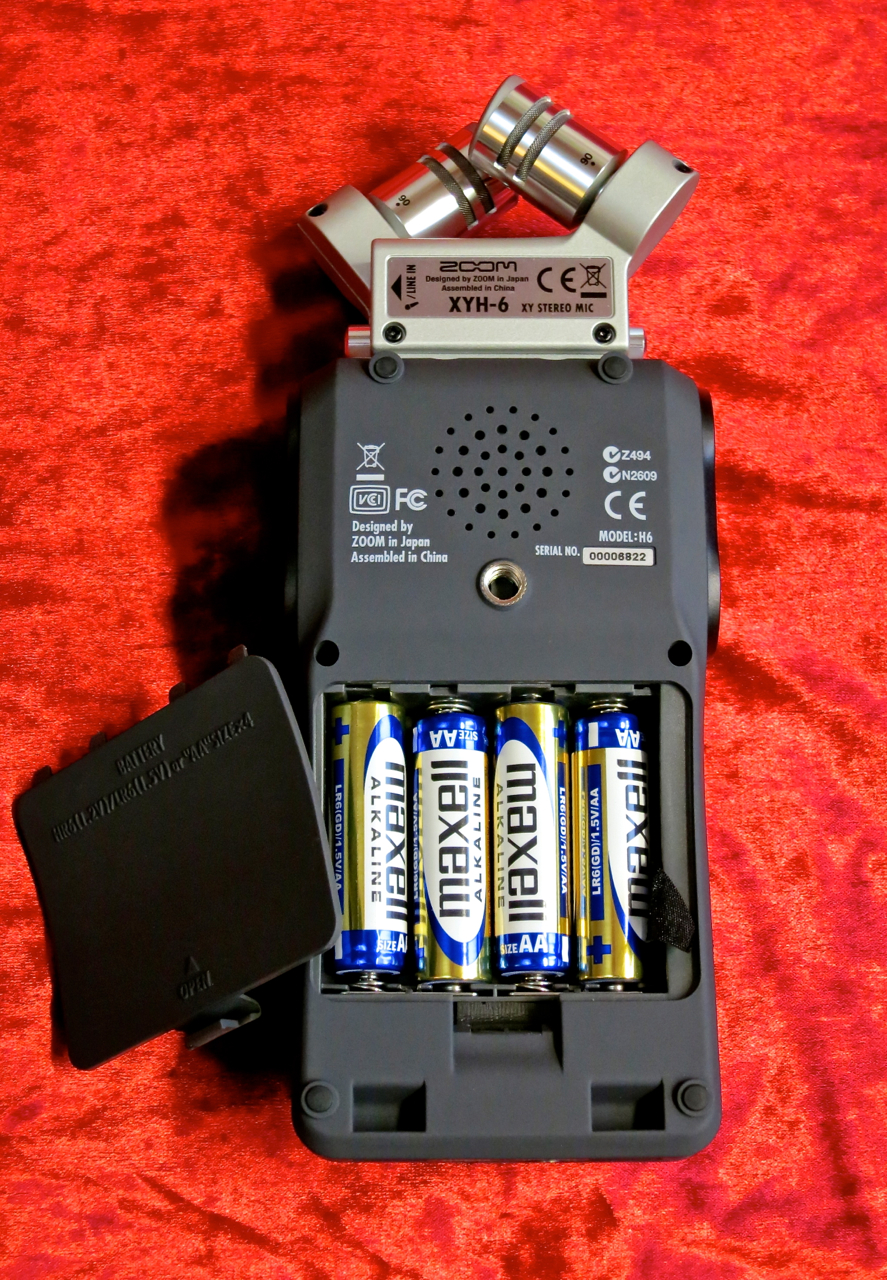
This recorder runs on four AA-size batteries, and will run for approximately 20 hours on a fresh set of alkalines.
You can place the Zoom on most camera tripods, thanks to its standardised thread. There’s also the HS-1 hot shoe adapter available, which makes it possible to mount the recorder straight onto a camera.
The small monitor speaker isn’t particularly Hi-Fi, but it’s good to have it for quick checks.

The unit’s line level output, as well as the connector for the optional remote control, has been placed on the bottom rim of the Zoom.
****
The Zoom H6 can handle two audio formats:
Linear WAV-files offer you sample rates of 44.1, 48 or 96 kHz with 16 or 24 bits of resolution. When you choose WAV as your recording format the H6 works as a multitrack recorder, which makes it possible to do overdubs, and which allows you to mix the recorded tracks afterwards. You can do your mixdown internally, using the Zoom’s own Project Mixer, or by exporting the separate tracks to an audio-sequencer.
Another function that only works when you’ve chosen WAV as your recording format is called Backup Record. This nifty function records the input signal from the exchangeable module twice – one set of tracks uses your input gain settings and is routed to the L/R-track, as usual, while the second set is recorded with 12 dB of attenuation as the so-called Backup-track. The Backup-track is your safety in case your own settings were too hot.
The big advantage of using the H6 in MP3-mode is, of course, this mode’s greatly extended recording time, made possible by data reduction. The recorder lets you choose from many different recording quality settings between 48 and 320 kbps. When in MP3-mode you use the Zoom’s Monitor Mixer to mix all of the six inputs into one stereo file, which is the recorded. This means that, when recording using the MP3-format, the end result is always a single stereo file, instead of the separate tracks you get when running in WAV-mode.
When you’re using the MS-module you can adjust the side-mic level, either before recording (WAV and MP3) or afterwards if you’ve recorded the module’s input signal using the Zoom’s MS-Raw-mode (WAV only).
More information on MS-stereo can be found HERE.
****

The Zoom H6 is very easy to use, because the signal routing is fixed:
The module’s output always goes to the L/R-track (stereo), while inputs one to four are routed to their corresponding mono tracks (1-4).

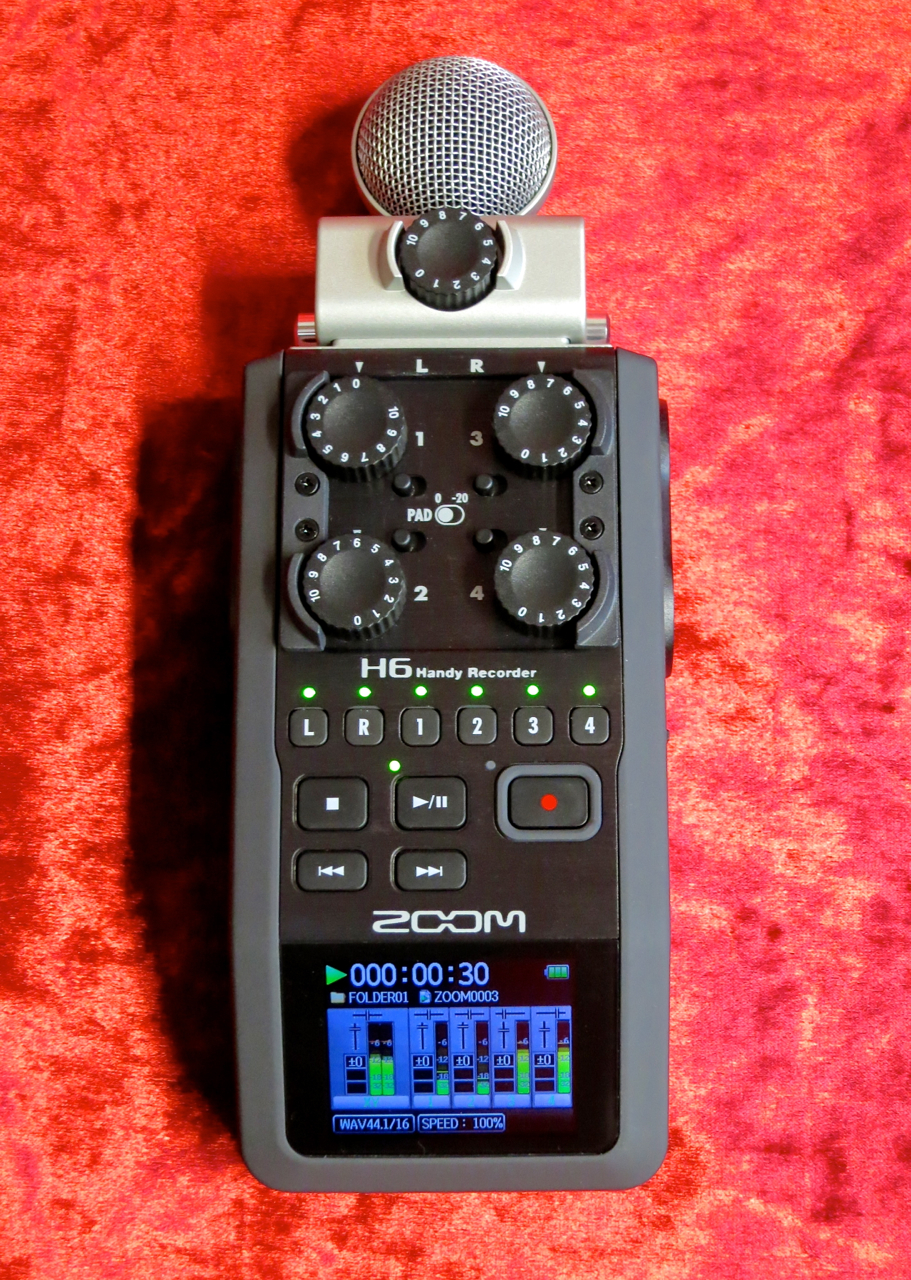
Beneath the Gain-controls there’s a row of track status buttons, as well as the recorder’s ”transport” buttons.

The Zoom’s Monitor Mixer is where you adjust the signal levels and pan positions of all the signals for monitoring.
The Monitor Mixer window also shows you the status of each channel’s bass cut, compressor/limiter and phantom power.

This is what the Menu-view looks like.

To mix down recorded tracks you use a different internal mixer, called the Project Mixer.
The Project Mixer allows you to adjust each track’s volume and pan position, as well as the playback pitch for each track (without changing the playback speed).
****

In my opinion Zoom’s H6 hits the bull’s eye:
The exchangeable mic modules give you an enormous amount of flexibility to tailor the recorder quickly to the recording situation you find yourself in. The H6 is easy to use, and the recorder’s sound quality is very, very good. Thanks to the built-in metronome and chromatic tuner it’s easy to make sure you play in time and in tune. I’ve also enjoyed the Zoom’s nice compressors and limiters, which work very musically.
To demonstrate the H6’s performance and sound I recorded a short song using the recorder’s overdub function. I used the X/Y-module (at 90 deg) to record the steel-string acoustic, and recorded two mandolin tracks and two vocals with my trusty Shure SM57.
First, I mixed the song using the Zoom’s internal mixer, after which I exported the stereo file to Garageband, where I cut off the count-in and added a little bit of reverb:
I also tried taking the other route by exporting all the separate files from the H6 into Garageband, where I remixed the song using the original tracks:
****
I used a series of sine-wave sweeps to give you an idea of the effect the side-mic level has on the stereo-width of the recorded material. The lower the side-mic level is, the narrower your stereo image gets.
Side-mic +6dB:
Side-mic -2 dB:
Side-mic -9 dB:
Side-mic -22 dB:
Side-mic off:
****

I think Zoom’s H6 is a great field recorder and portable multi-track studio. The H6 works great to capture your song ideas or to for quality recordings of your band rehearsals or live gigs. The Zoom makes pro-quality recording on the road possible.
****
Zoom H6
Finnish distributor: Studiotec
Zoom H6 – 398 €
APH-6 – 48 €
EXH-6 – 58 €
SGH-6 – 118 €
****
Pros:
+ exchangeable L/R-modules
+ rugged build
+ colour display
+ Overdub-, Pre Record- ja Backup Record -functions
+ quality compressor/limiter-section
****
Review: Tokai ATE-33N Thinline
****

Tokai Guitars are known for their well-made copies of classic guitar and bass models.
The brand-new Tokai ATE-33N Thinline is part of Tokai’s more affordable Chinese-made range, and represents their version of a Thinline Tele-type guitar.
****
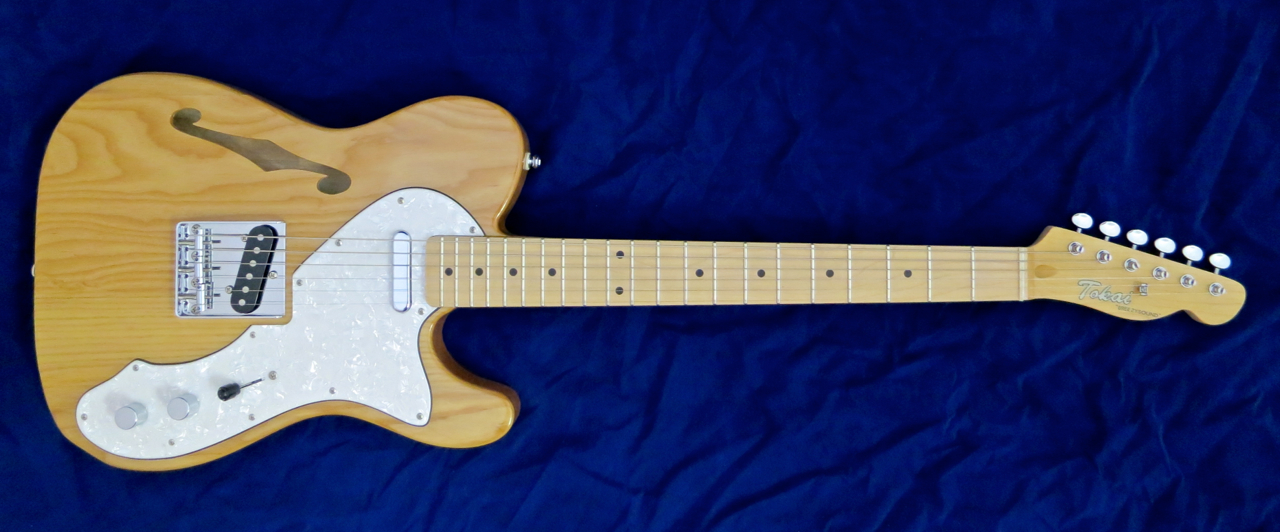
The Tokai ATE-33N Thinline (current price in Finland 437 €) is a real looker and will delight fans of the natural look, despite its moderate price tag.
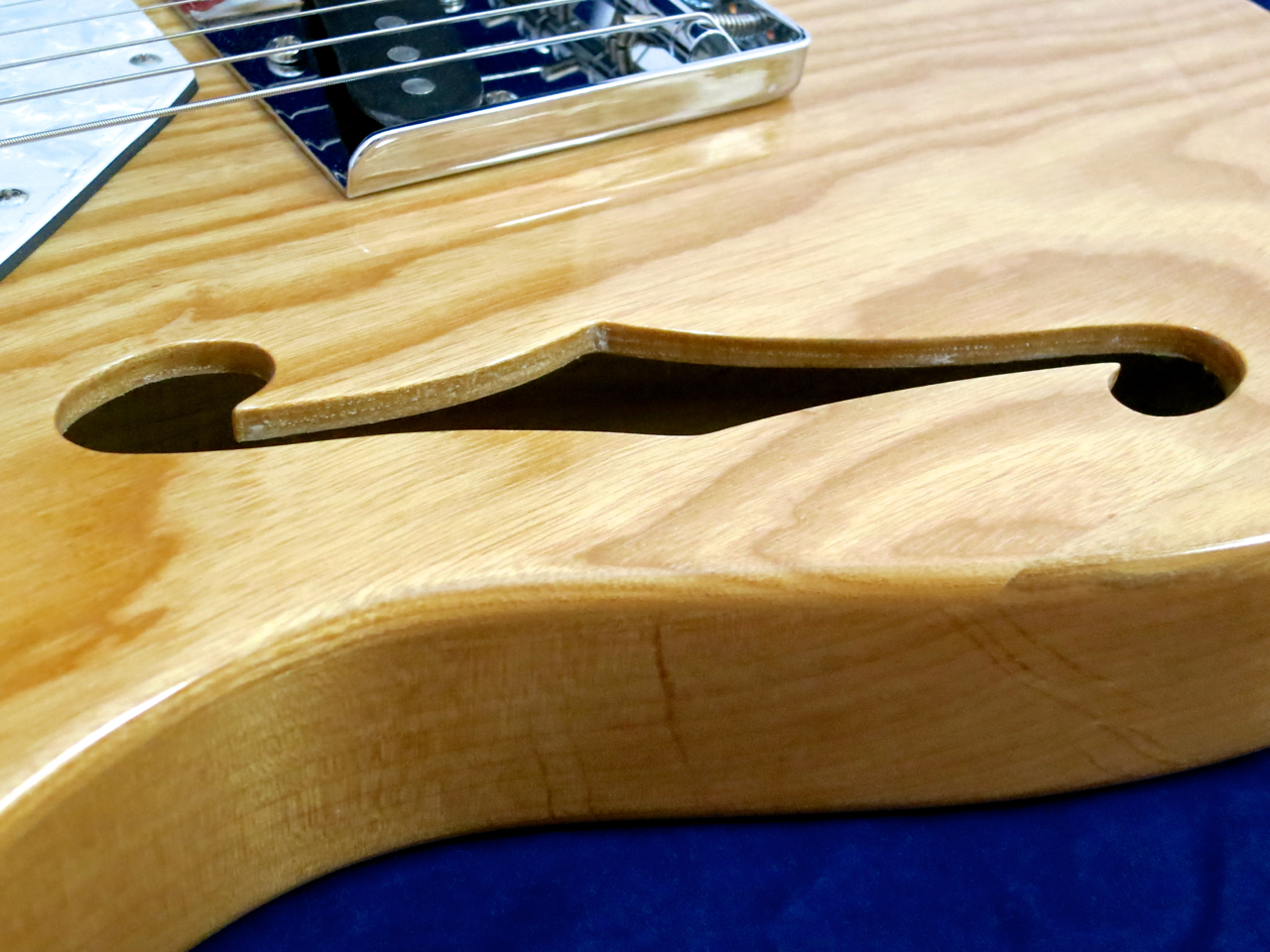
Roger Rossmeisl – known for his classic Rickenbacker designs – hit upon the concept of the Thinline Telecaster in the late 1960s when working for Fender. The original version was made with a body which featured three large pockets routed out from the back. A separate, glued-on solid piece of wood served as the body’s back.
Tokai approaches the construction of the ATE-33N Thinline the other way around: the pockets are routed into the front of the alder body, which then receives a beautiful, five millimetre thick swamp ash top. This solid ash top was made from three side-by-side pieces on our test sample, with the nicely matched grain efficiently disguising the glue lines.

The body of Tokai’s ATE-33N Thinline sports a gloss finish, while the neck has received a thin satin finish.
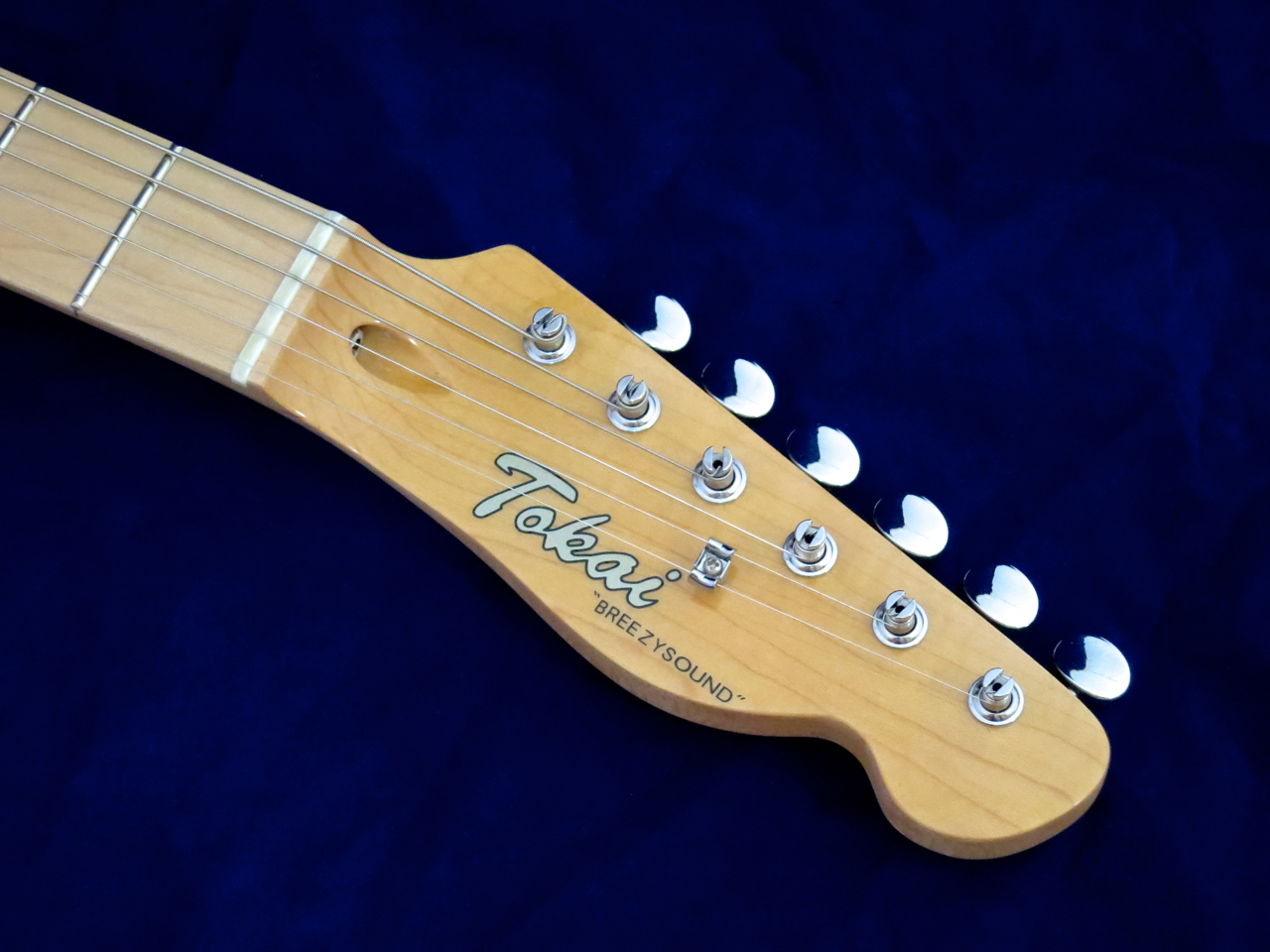
This Tokai is no slave to vintage fashion – truss rod adjustment is at the headstock end of the neck, which is a far more practical solution.

These nice Kluson-copies work fine.

The maple fingerboard has a larger radius (meaning it’s flatter) and fatter frets than its Sixties counterpart, making the ATE-33N easier to play. Especially string bending is far more comfortable with this type of neck.

The neck joint is a traditional four screw affair.

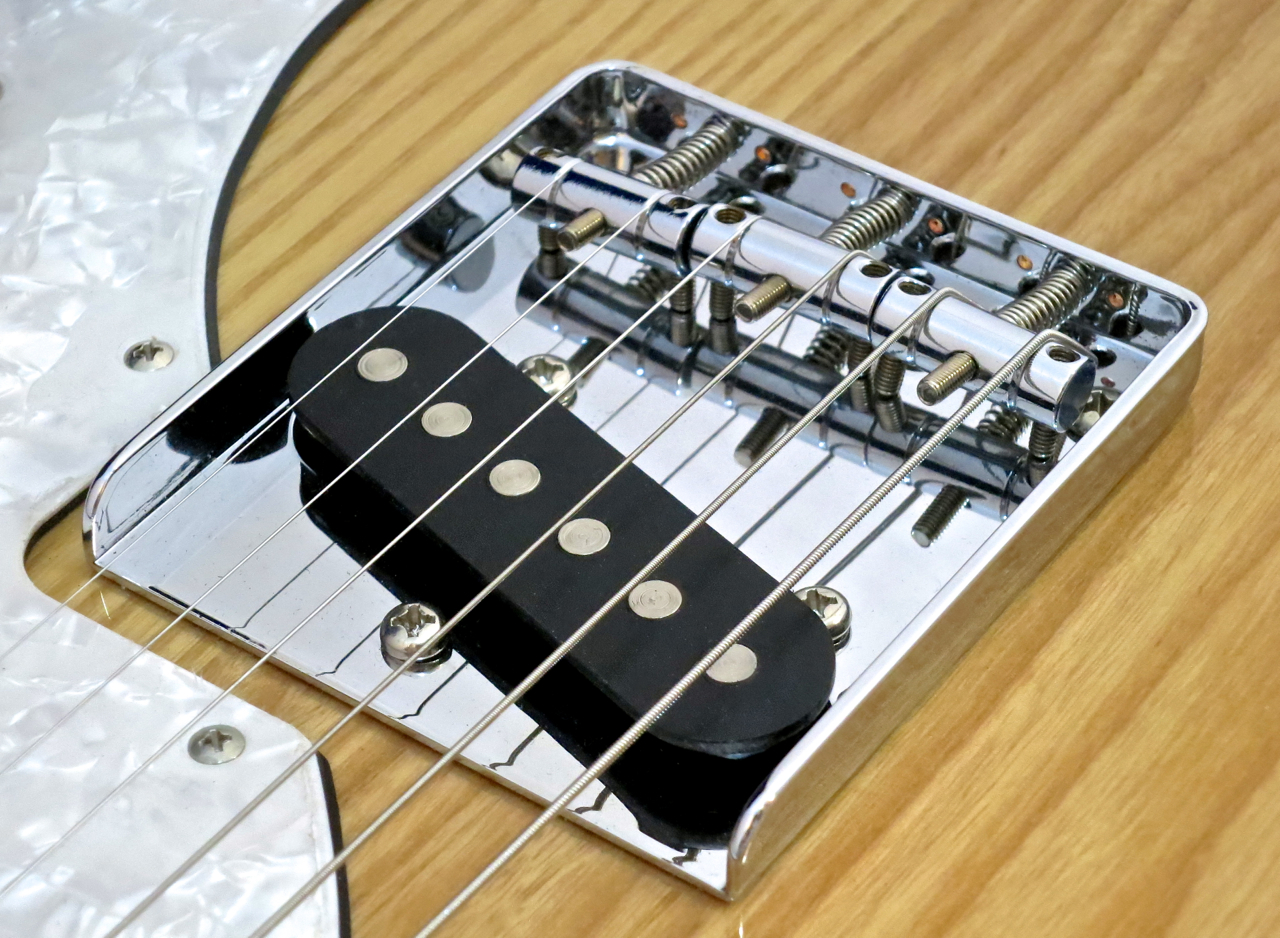
From a sonic standpoint, the traditional three-saddle, bent sheet-metal bridge that doubles as a pickup frame is probably a Tele-style guitar’s most important ingredient.
With these bridges octave compensation is always a matter of compromise, but most guitarists learn to live with the design’s limitations.

The ATE-33N Thinline is equipped with two singlecoil pickups that use soft steel slugs as polepieces and bar magnets stuck to the bottom of the bobbin.

Here’s a look at Tokai’s three-position switch and the guitar’s master volume and tone controls.
****

Now seems to be the perfect time to buy an electric guitar, judging by the sheer quality displayed by the very favourably priced Tokai ATE-33N Thinline.
The ATE-33N Thinline seems to tick all the right boxes with ease:
The satin-finished maple neck feels great. It’s rounded D-profile provides a sturdy fundament for tone and sustain, and it is comfortable to play, too. This model’s well-dressed frets and the fretboard’s flatter radius make a slinky set-up possible. Our test sample measured 1.4 mm for the low E and 1.2 mm for the high e (at the 12th fret), and it played well and without string rattles all across the neck.
Played acoustically you can clearly hear the open character of the hollowed out thinline body. Naturally, a T-style thinline won’t win a shouting match over a ES-335, but the hollowed out pockets do still make a discernible difference in this Tokai.
There’s lots of talk on guitar forums about the nastiness of many budget Tele-pickups, but I can only state that Tokai’s set of Mk3-pickups perform rather well. The neck pickup is war and round, but never muddy or one-dimensional. The bridge unit dishes out the Country twang with the right amount of bite and conviction. And the Tokai also nails my favourite Tele tone – the chimey middle setting with both pickups on. This means that changing the Tokai pickups for some aftermarket brand wouldn’t be my first priority, at least…
Here’s a taste of the ATE-33N Thinline’s clean tones, starting with the neck pickup and moving on from there:
And here’s a bit of Rock riffing:
****

In my opinion the Tokai ATE-33N Thinline scores high in the value-for-money stakes. It is a beautiful-looking instrument that plays very well indeed.
I have to admit having some reservations about the pickups before plugging in, but the sound of the Mk3-units has really won me over. This Tokai dishes out all the T-style tones we’ve come to expect from a traditionally styled and built example.
And should you decide to upgrade the pickups, regardless, the ATE-33N Thinline will prove to be a great starting point for any such ventures.
****
Tokai ATE-33N Thinline
437 €
Finnish distributor: Musamaailma
****
Pros:
+ outstanding value for money
+ workmanship and finishing
+ playability
+ sound
****

 Kitarablogi.com – Finland's premier Guitar and Bass blog