The Fuzz Guitar Show 2015 in Gothenburg (Sweden) runs May 9th and 10th, 2015.
Four Finnish brands garnered considerable interest at the show:
Juha Lottonen and Juha Rinne (Lottonen Guitars) are fast becoming the go-to guys for small-bodied Folk and Blues guitars off the beaten path.
Lottonen Guitars mostly use alder (!) for their necks, as well as birch for many of their backs and sides.
Lottonen employ different bracing patterns and bridge designs to achieve a multitude of different guitar timbres.
Fingerstylists and Blues-pickers simply can’t get enough of the Lottonen tone.
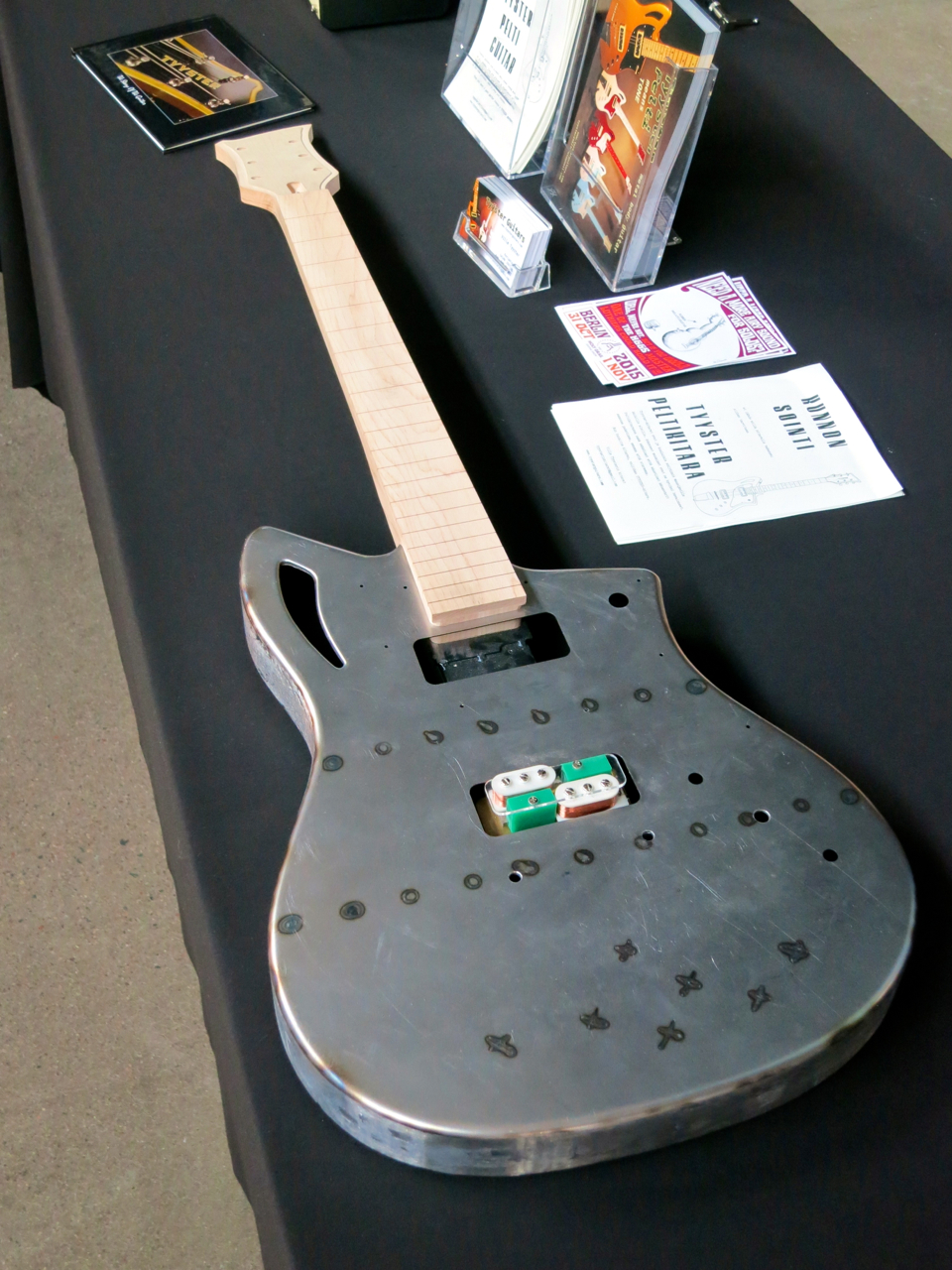
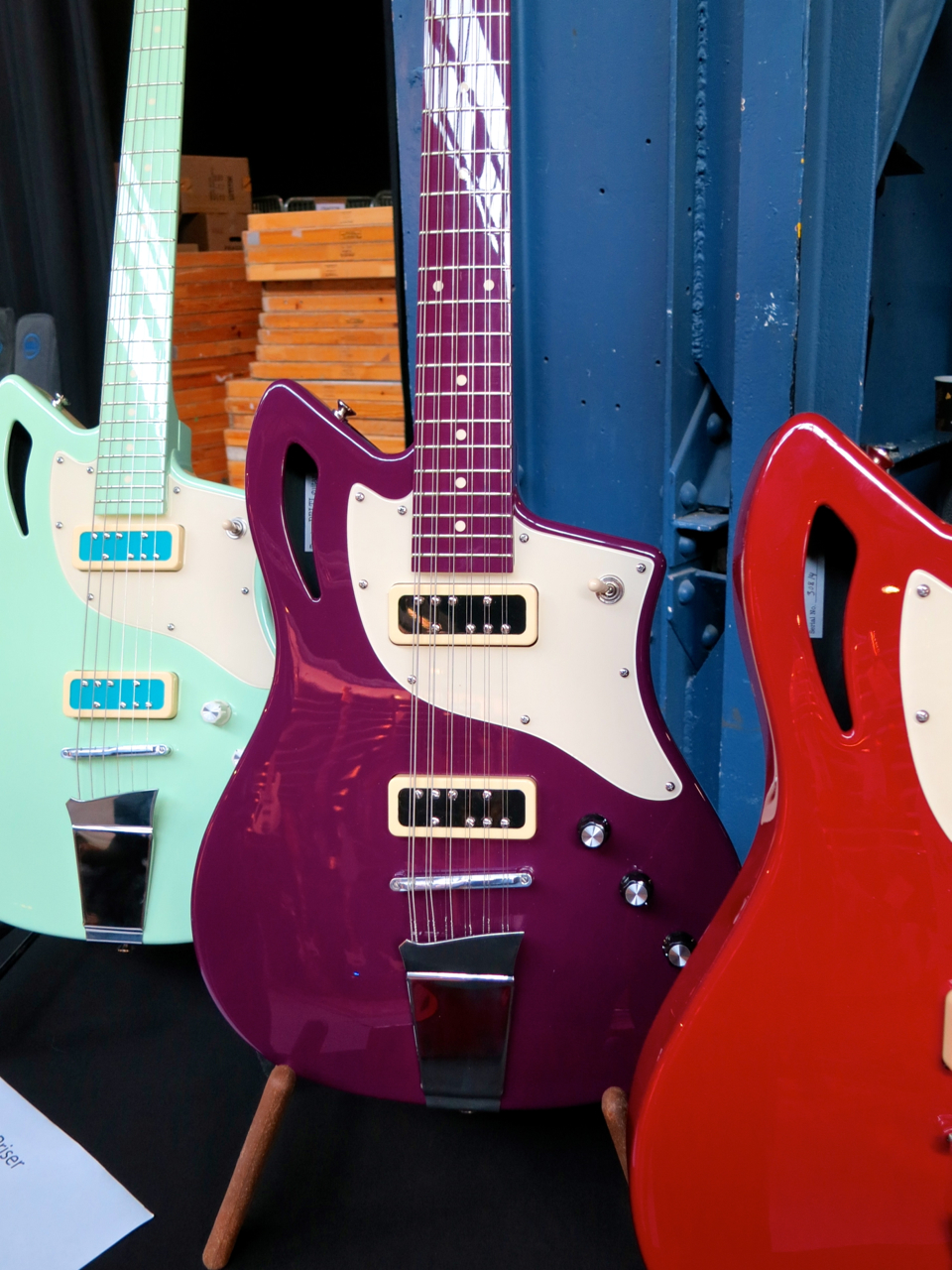
Tyyster Guitars’ dynamic duo and their mouth-watering metal-bodied guitars.
Ville Tyyster brought along an unfinished guitar to give you an idea of what goes into the making of a Tyyster Pelti.
Tyyster’s clear lines and cool colours whet your appetite. Their playability and sound will make you want one!
Kari Nieminen’s tasteful Versoul Instruments have found their way into the hands of many serious guitar collectors and guitar heroes alike (Ron Wood, Billy Gibbons, just to name two in a long list).
This salmon skin-covered 4-watter was definitely one of the show stoppers at this year’s Fuzz.
The all-valve combo can be modified to the user’s requirements by changing the tube types.
…and if you have a salmon-skinned amp, you will need the matching, breathtakingly beautiful Versoul Guitar, too!
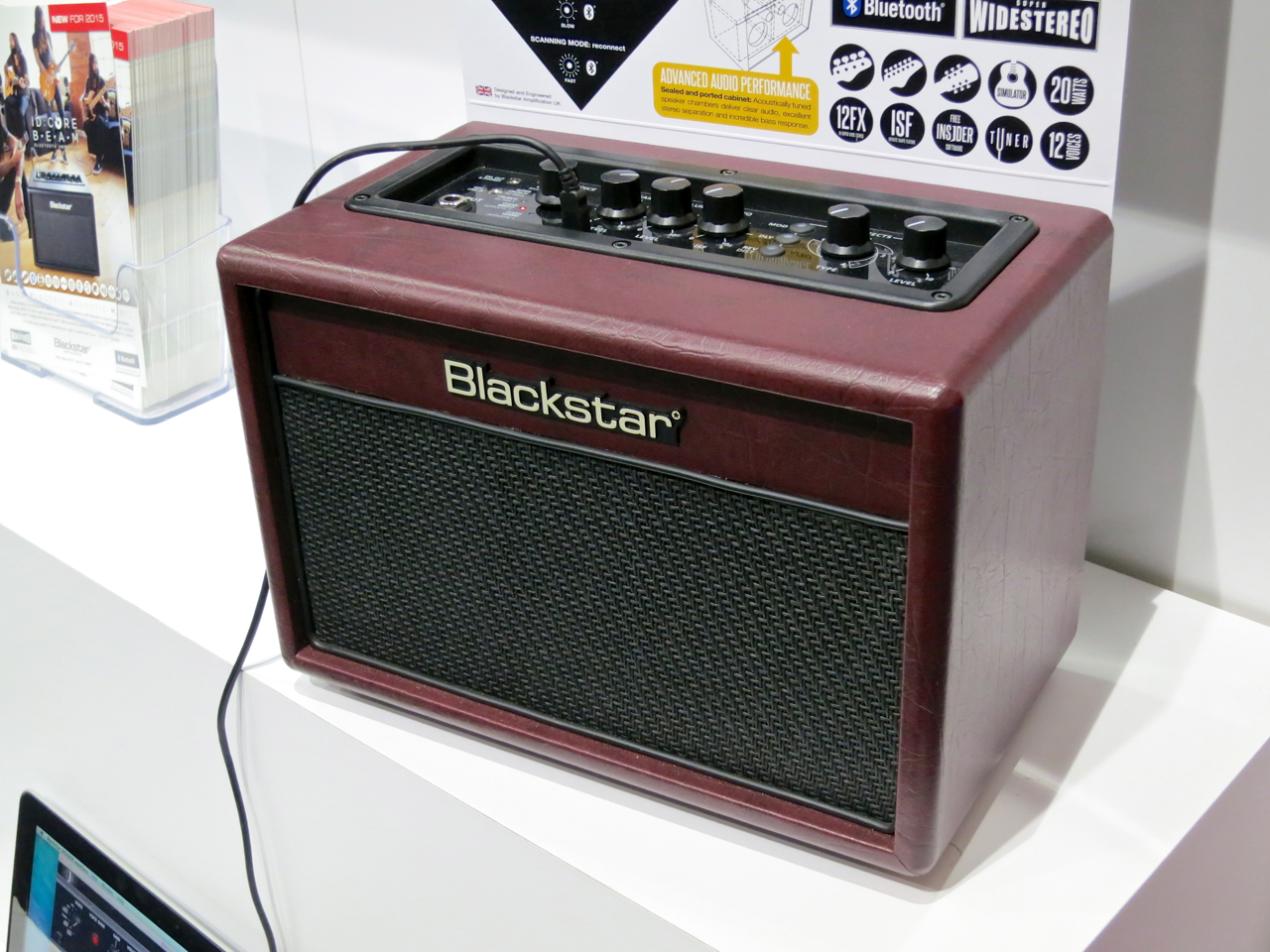
Amp and effect specialists Mad Professor were represented at Fuzz by their Swedish distributors.
Dream Theater’s guitar wizard John Petrucci has a long and very fruitful association with Music Man. Over the years, the company has released several signature models, both US-made and as part of their less-expensive Sterling brand.
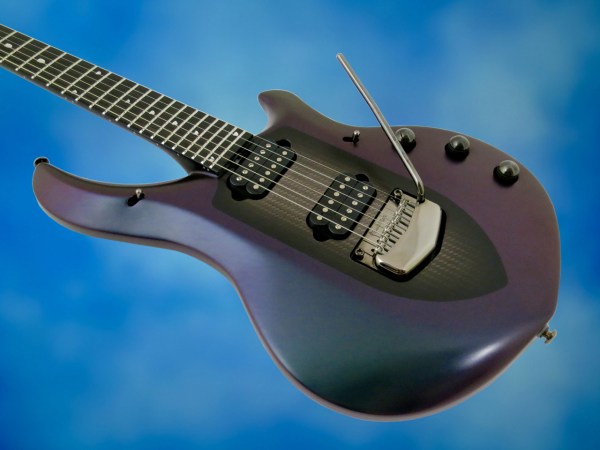
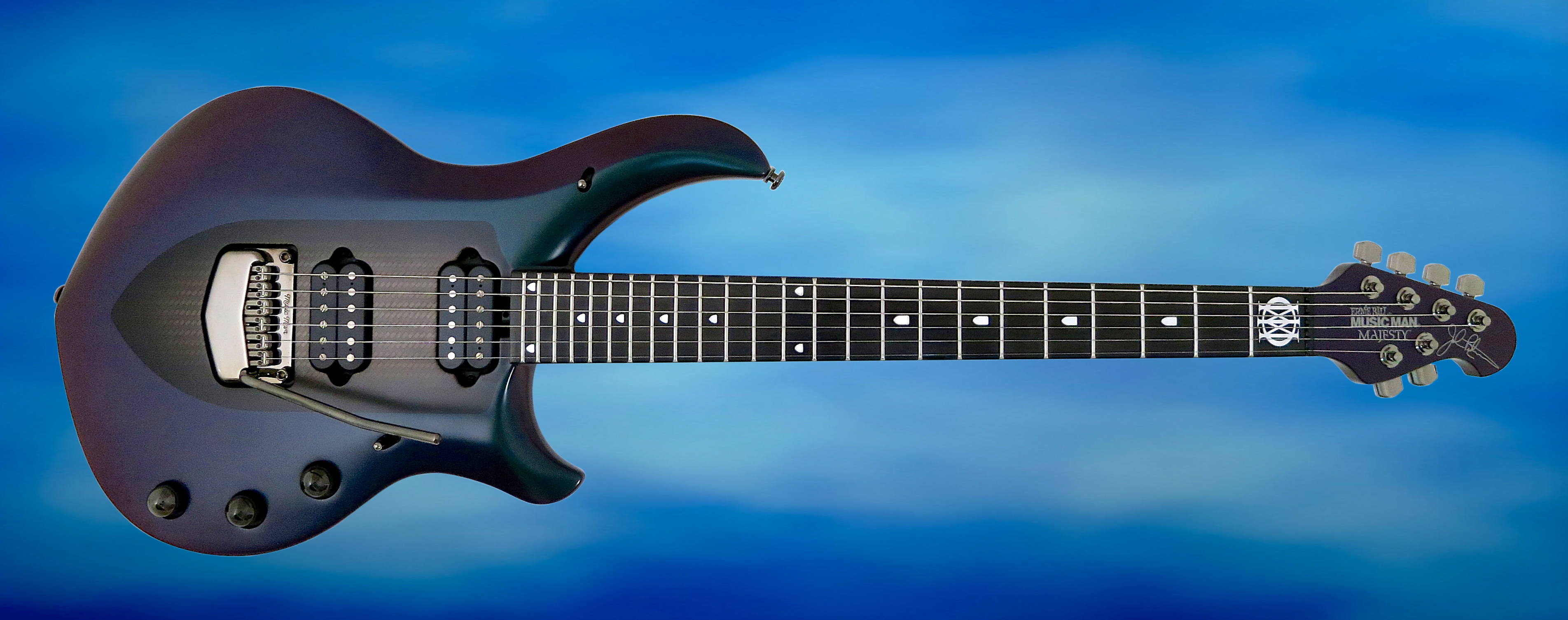
Last year Ernie Ball/Music Man have released a new top-of-the-line John Petrucci signature instrument – the Music Man Majesty (Majesty was the original name of the Progressive Rock band that became Dream Theater).
****
The first thing that will strike you about the new package is the sensationally low weight:
When I went to pick up the Music Man Majesty for this review (from DLX Music Helsinki), I had to open the case and check, because I suspected the guitar was missing. No, it really was in there…
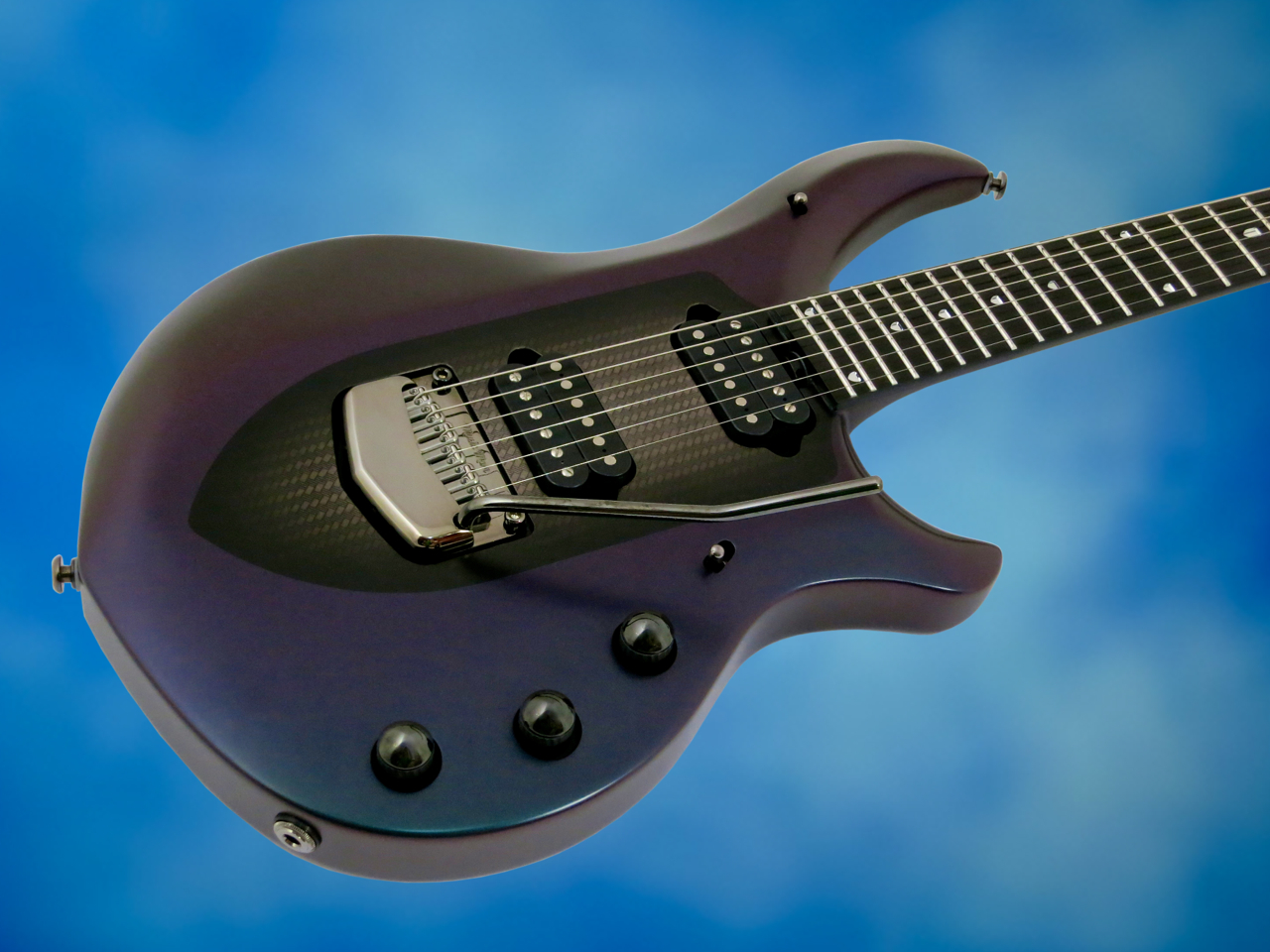
Music Man’s Majesty (current price in Finland approx. 3,900 €) is a modern top-drawer signature model, which conveys the artist’s clear vision of what his dream guitar should be like. This isn’t simply a souped-up classic model – Petrucci and Music Man started with a clean slate.
Music Man’s new signature model is a Neck-Through design with a two-octave mahogany neck, and a very smooth neck joint at the 23rd fret.
The Majesty’s body, too, is highly sculpted – you could call it streamlined – and it fits the player’s body perfectly.
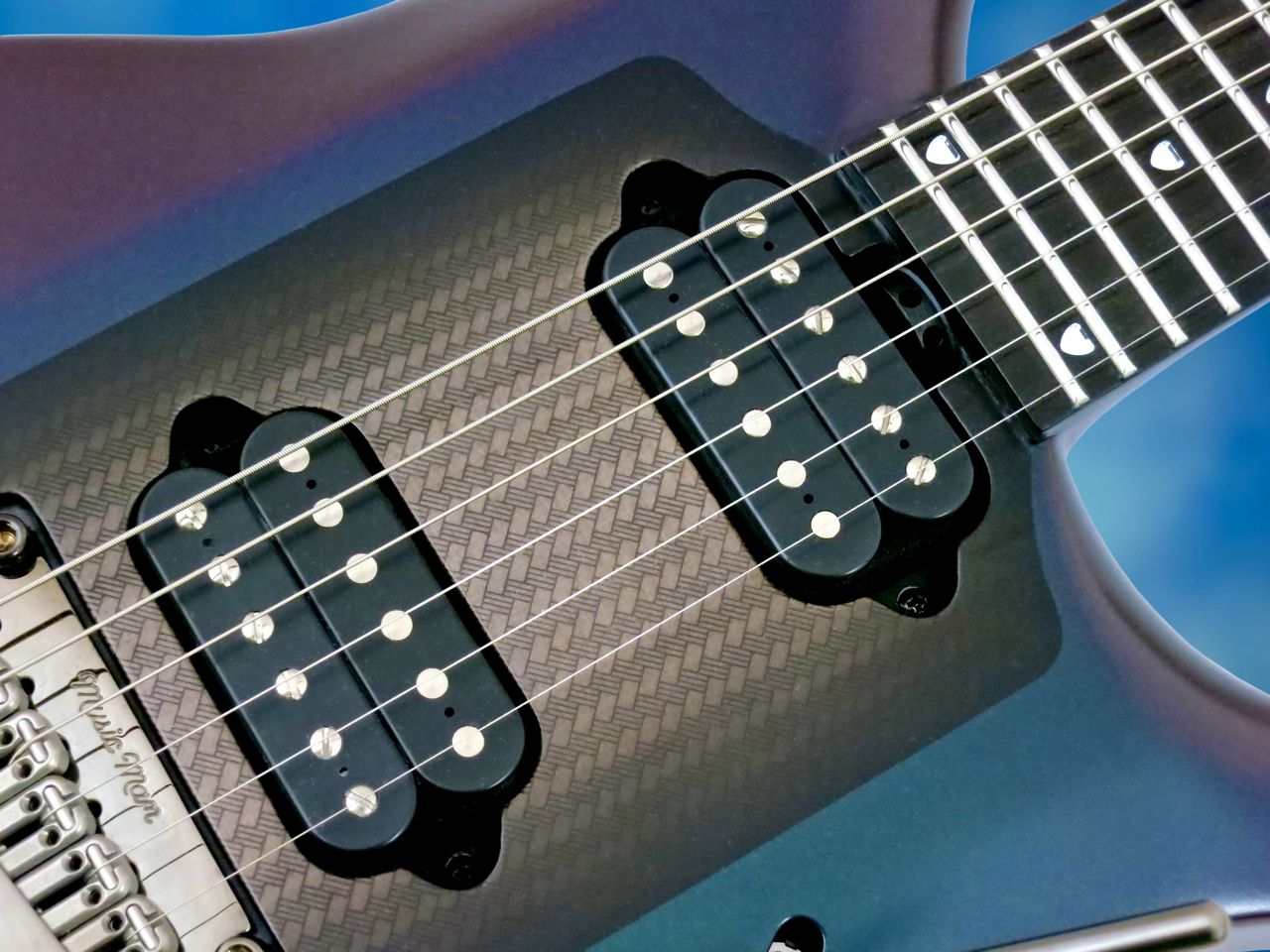
The body wings, made from basswood, are capped by a maple top. The area on the top, which forms a sort of shield or crest, may look like graphite weave at first glance. In reality, this is a translucent area of the maple top, and what you see is a laser-etched graphic design resembling the look of carbon composite.
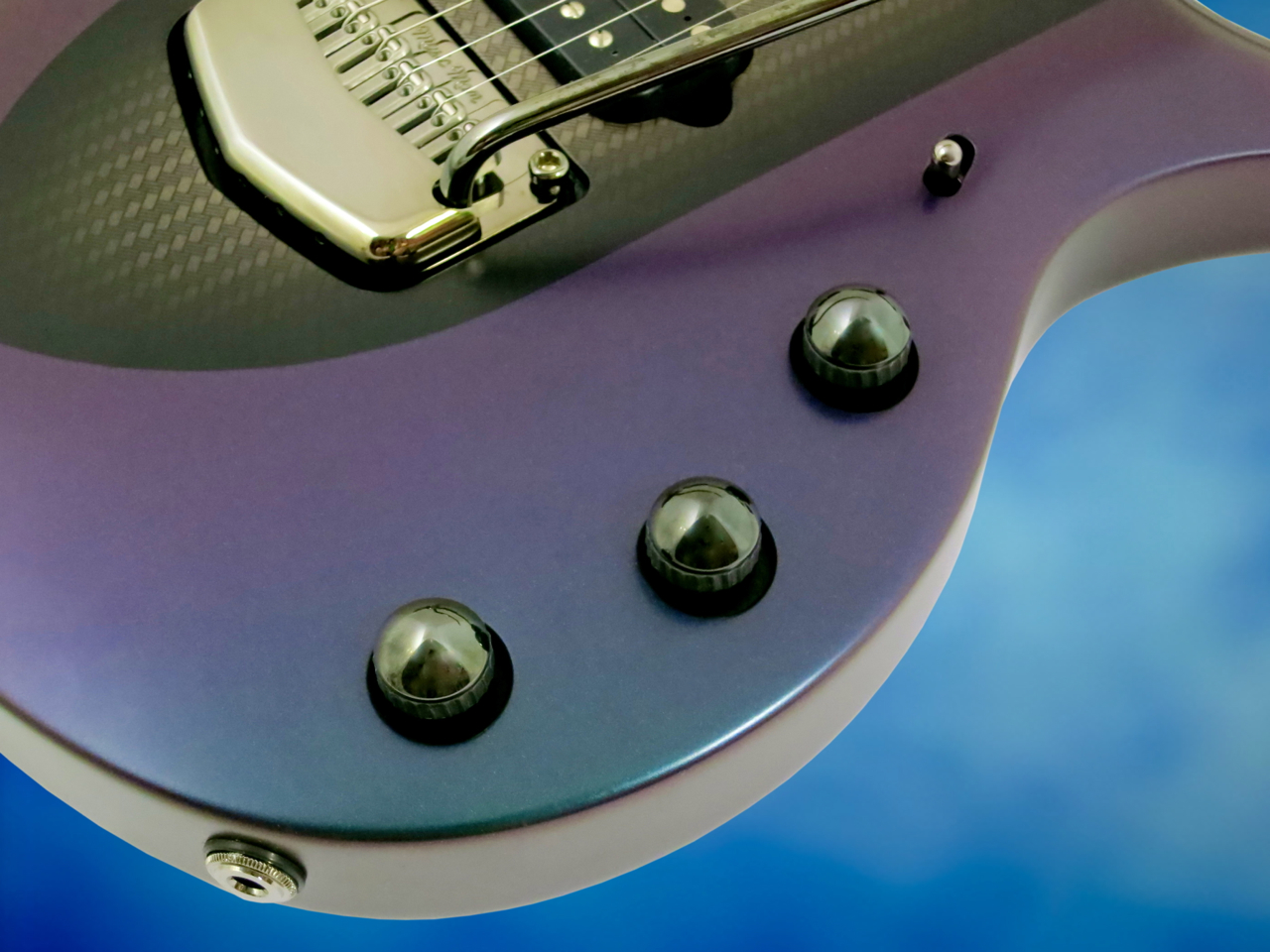
The review guitar’s finish is called Arctic Dream, which is a matte finish changing from violet to a dark green hue, depending on how the light hits the body.
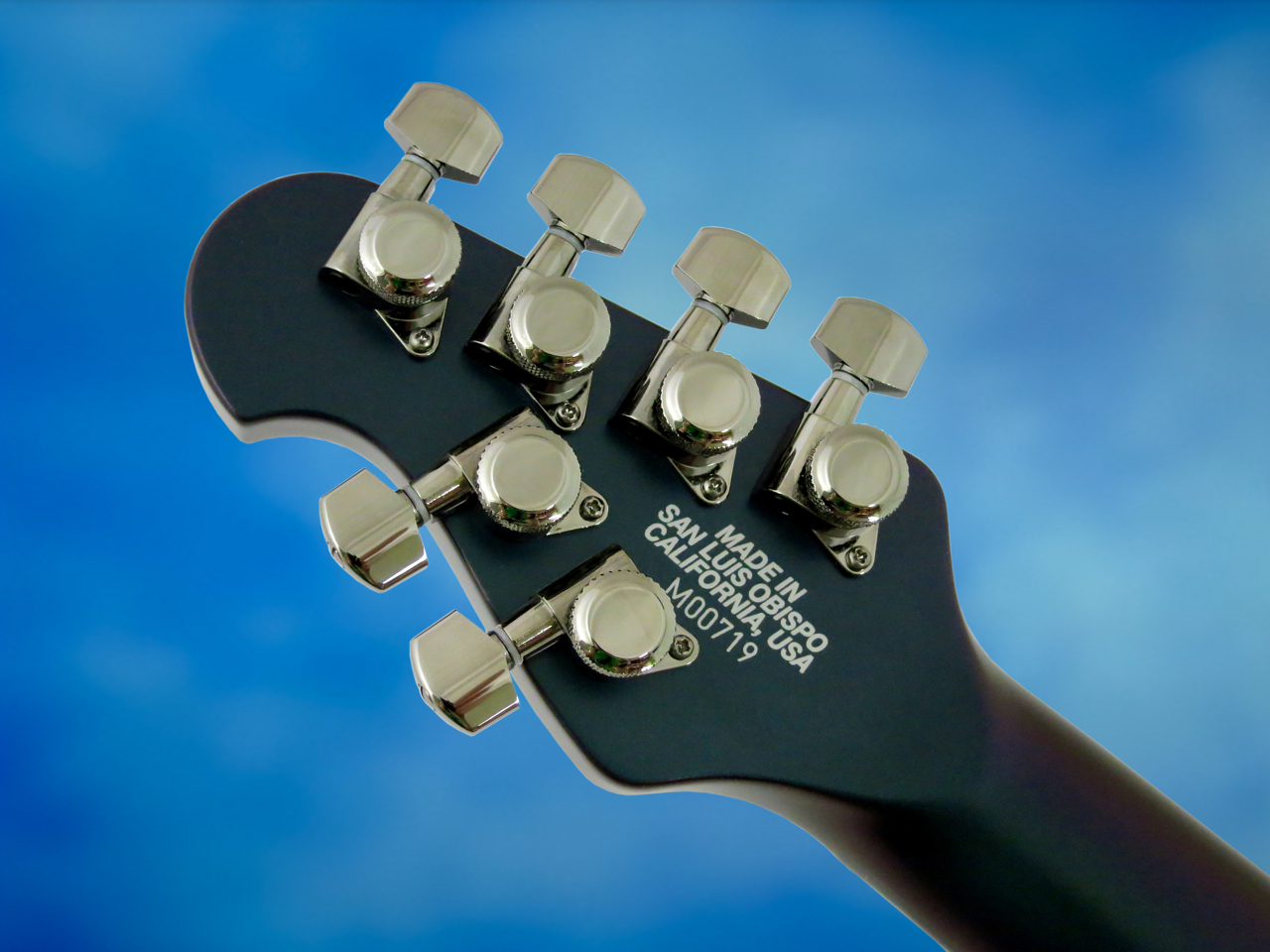
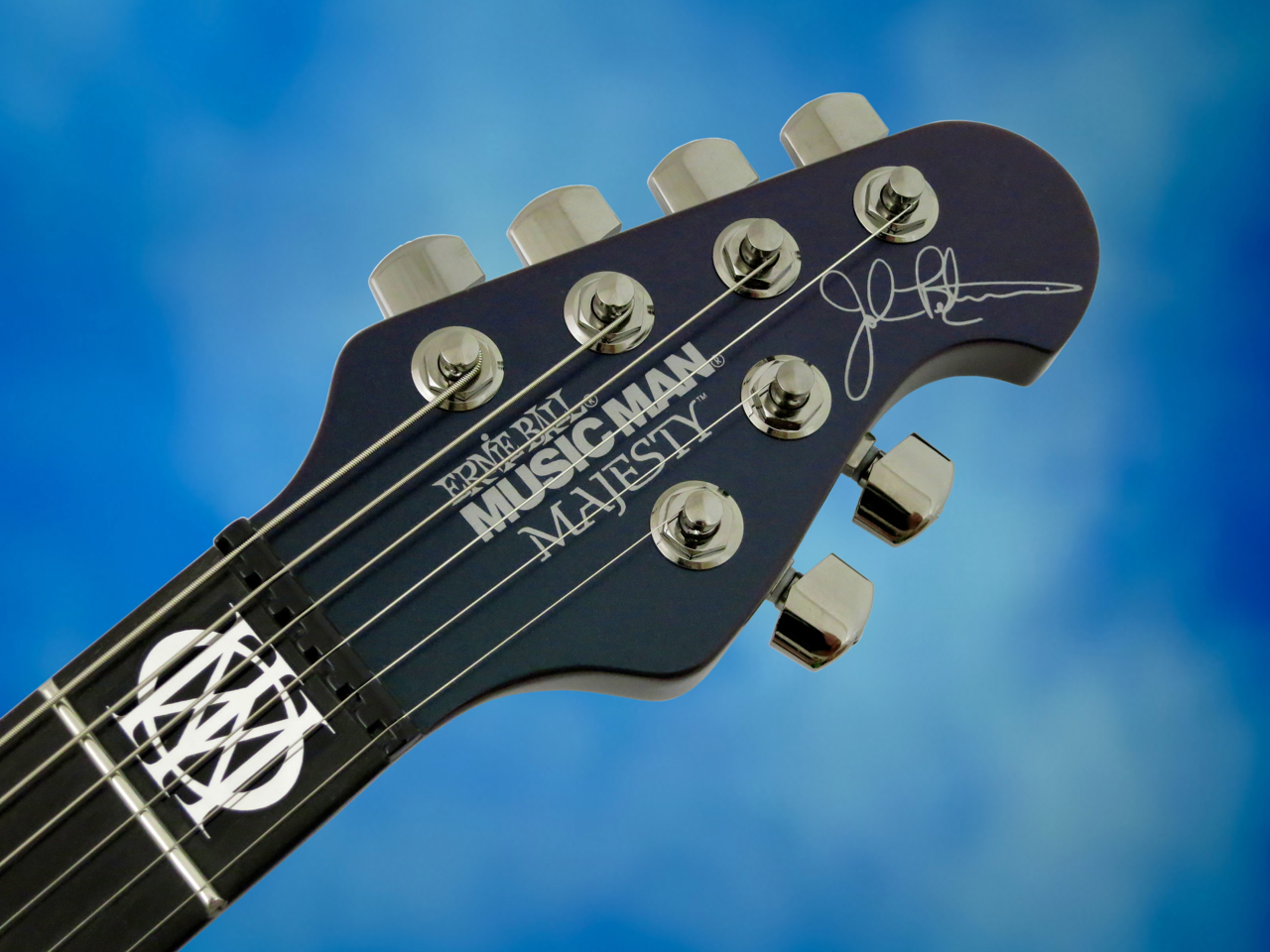
Music Man’s classic four-and-two headstock sports a set of locking Schaller M6-tuners.
Below the compensated – and self-lubricating nut – you can see the metallic Dream Theater-logo inlay.
The quality of the fretwork on the Majesty is outstanding. We can find 24 jumbo-sized, stainless-steel frets installed into the ebony fingerboard.
The shield inlays are in fact tiny mirrors.
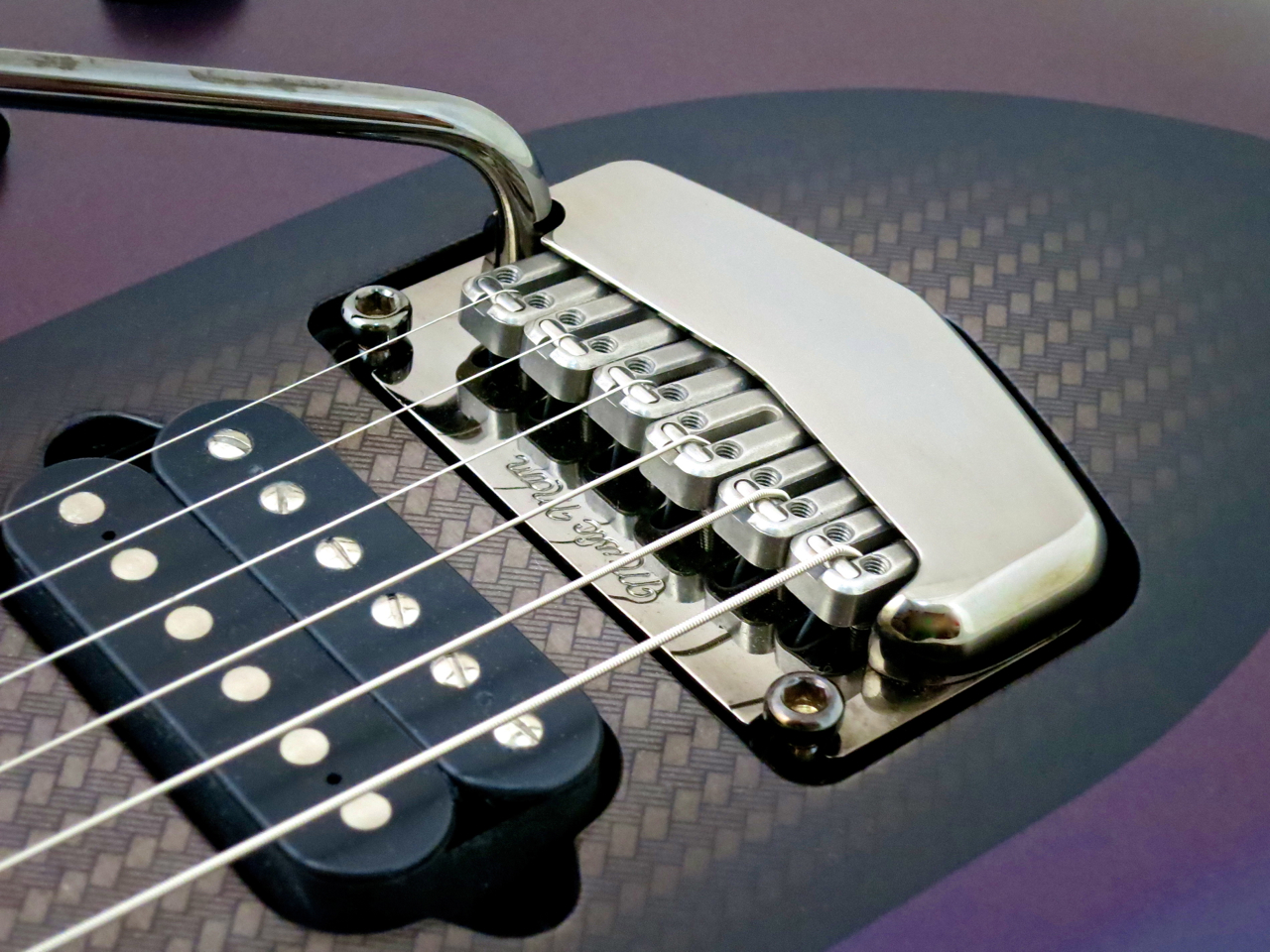
The floating vibrato bridge is Music Man’s own, cool design, which features steel saddles equipped with Fishman piezo elements for acoustic-style tones.
The Majesty’s magnetic side comprises a pair of DiMarzio Illuminator humbuckers (John Petrucci’s signature pickups), installed straight into the body wood.
Music Man’s Majesty comes with a very dedicated, special switching system; the technically-minded among you can take a look at the schematics:
The three-way switch in the top horn lets the player select between piezo-only, magnetic-only, and piezo-plus-magnetic settings.
Beneath the strings you will find a second three-position toggle switch, that works as a pickup selector for the DiMarzios.
The control next to it is the volume control for the humbuckers. It also contains a push-push switch for engaging the Majesty’s active signal boost.
The second knob is a passive tone control, whose push-push switch works in the pickup selector’s middle position. ”Down” gives you the full sonic attack of two humbuckers, while the ”up” position switches off the outer coils of both pickups for thinner, more Fender-style sounds.
The third switch (near the output jack) is the volume control for the piezo signal. This knob sports a momentary switch, which allows you to reconfigure the output from standard mono – both the piezo and magnetic signals are sent to the same amplifier – to ”stereo”, enabling you to use a Y-cable to send the piezo’s output to a dedicated acoustic amp (or to a mixing console).
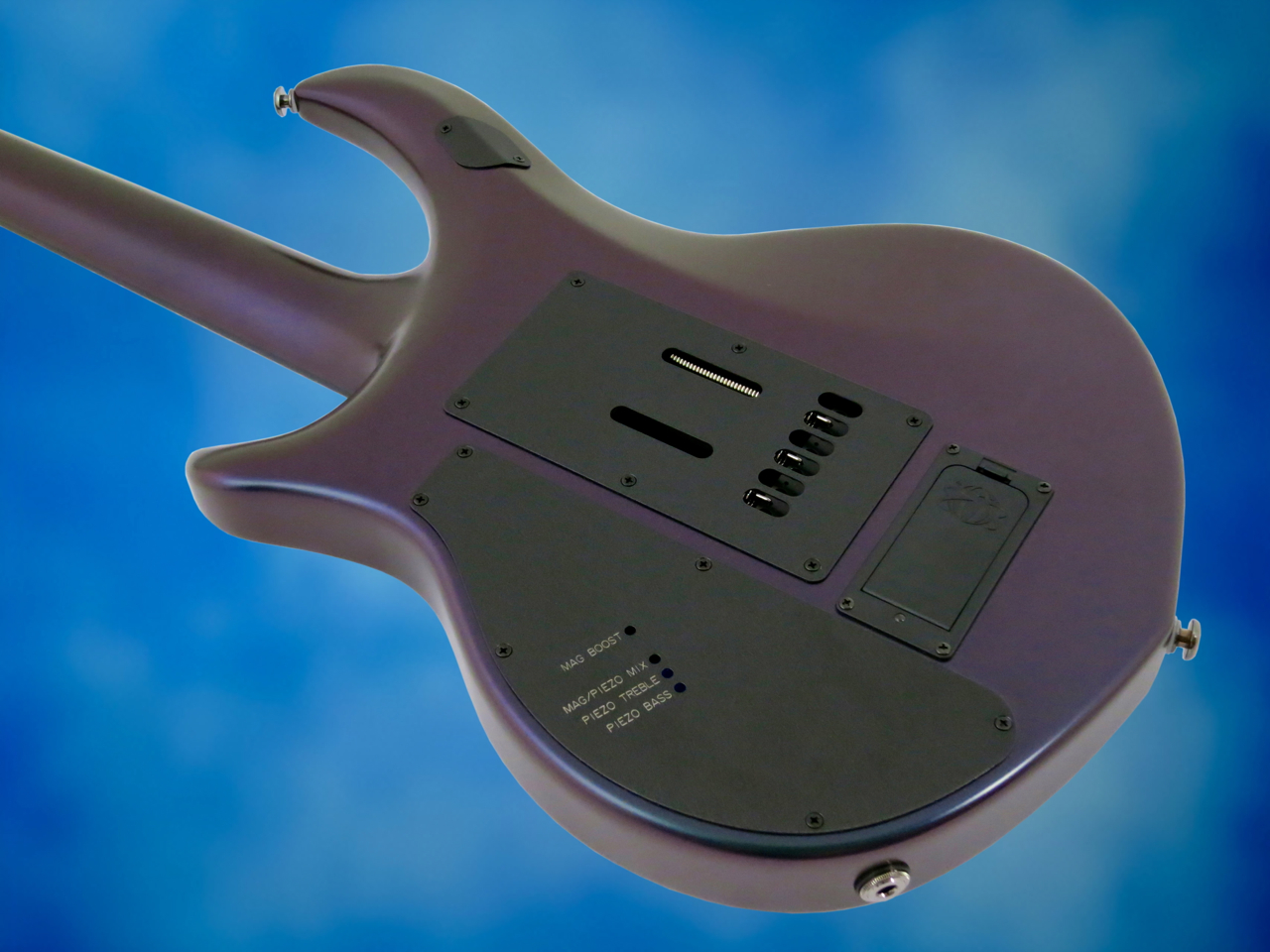
By using a tiny screwdriver you can adjust the active signal booster for the humbuckers, as well as set the maximum volume of the piezo signal, and the Fishman two-band EQ.
The Majesty’s active electronics are powered by a 9 V block.
****
Some ”signature models” are only for posing. Others are simply souped-up, or slightly tweaked, versions of classic guitar models.
Music Man’s Majesty is one of the few instances, when a guitar hero had very clear and strong views regarding the look, the features, and the sounds of his dream guitar. Petrucci and Music Man set to work, and no compromises were accepted.
The Majesty is a fantastic instrument, and each guitar leaves the factory set up to Mr Petrucci’s exacting specifications. You get the exact guitar the master himself plays on stage and in the studio.
As already mentioned, this guitar is extremely light and comfortable, and balances perfectly on a guitar strap.
The neck profile is a relatively thin D. The satin-finished neck feels very fast and friendly, without being insubstantial.
Thanks to the jumbo frets and the flat fingerboard radius (17″) the Majesty is very bend-friendly. The action is low, but completely free of fret buzz (low-E: 1.7 mm/high-e: 1.6 mm).
The Majesty’s floating vibrato works very smoothly, and has excellent return-to-pitch.
The piezo system works great! It gives you a credible ”acoustic” tone in the context of a Rock or Metal band, and also comes in handy to ”freshen up” the Majesty’s magnetic signal (the clip has the following order: piezo –> piezo + coil split –> coil split):
Here’s an example of the clean magnetic tones you can get from this Music Man. The powerful DiMarzio Illuminators are loaded with ceramic magnets (neck PU –> both (full) –> both (coil split) –> bridge PU):
The Majesty’s coil split and active boost give you three different degrees of distortion without even stepping on a single pedal. This clip has the coil split first, followed by the full middle position:
The active boost on this Petrucci-guitar is a great addition to any guitarist’s tool-pack, used here on the bridge pickup:
And, lastly, the audio track off the Youtube-video:
****
The Music Man John Petrucci Majesty is a top-grade signature guitar with an extremely wide array of sounds. In addition to the high quality and exemplary workmanship on display, the best thing about this guitar is that the Majesty’s features, its playability and its versatile sound also make it a great choice for many other guitarists, too.
Progressiivisen Rockin mestarilla ja Dream Theater -bändin keulakuvana tunnetulla John Petruccilla on jo pitkään ollut hedelmällinen suhde Music Manin kanssa. Firmalla on ollut jo pitkään useampi nimikkomalli valikoimassaan, ja myös Sterling-alabrändiltä löytyy Petrucci-malleja.
Viime vuonna ilmestyi uusin, kaikilla herkuilla varustettu nimikkomalli – Music Man Majesty.
****
Ensimmäinen asia jonka huomaa, on varmaan koko paketin yllättävän alhainen paino:
Kun hain Music Man Majestyn testiin (Helsingin DLX Musiikilta) piti ensin tarkistaa, onko laukussa edes kitara, koska laukku tuntui tyhjältä. Kyllä, siinä se kaunotar oli…
Music Man Majestyn (hintaluokka noin 3.900 €) tapauksessa kyseessä on todellakin huippumoderni nimikkomalli, jolla on selvästi ihan omat näkemyksensä siitä, millainen nykyaikaisen sähkökitaran pitäisi olla. Majestyn suunnittelu lähti liikkeelle lähes tyhjältä pöydältä.
Music Manin uutuusmallissa mahonkikaula jatkuu yhtenäisenä läpi koko rungon (ns. Through-Neck), mikä mahdollistaa erittäin sulavan kaulan ja rungon liitoksen 23. nauhan kohdalla.
Myös Majestyn runko on veistetty erittäin sulavaksi, minkä ansiosta se myötäilee täydellisesti soittajan kehoa.
Runko on tehty kahdesta lehmussiivestä, joiden päälle on liimattu suhteellisen ohut vaahterakansi. Kilpeä (tai vaakunaa) muistuttava, tumma keskiosa näyttää ensisilmäykseltä hiilikuidulta, mutta todellisuudessa vaahteran pintaan on poltettu laserilla grafiittia muistuttava kuvio.
Testikitaran viimeistelyn nimi on Arctic Dream, ja sen väri vaihtelee katselukulmasta riippuen syvästä violetista tumman vihreään.
Music Man -viritinlapaan on asennettu Schallerin laadukkaita lukkovirittimiä.
Kompensoidun satulan ja ensimmäisen nauhan välillä näkyy Dream Theaterin logo.
Majestyn nauhatyö on ensiluokkaista. Eebenpuiseen otelautaan on asennettu 24 jumbonauhaa ruostumattomasta teräksestä.
Kaikki otemerkit uudessa Petrucci-mallissa ovat pieniä peilejä.
Music Manin omassa kelluvassa vibratallassa on teräksisiä tallapaloja, joihin on upotettu Fishmanin piezoelementtejä.
Majestyn magneettiset mikrofonit taas ovat kaksi DiMarzio Illuminator -humbuckeria – John Petruccin nimikkomalleja, siis – jotka on asennettu suoraan runkoon ilman kehyksiä.
Music Man Majesty -mallin kytkentä on hyvin erikoinen, mikä näkyy myös firman kytkentäkaaviosta:
Yläsarvessa on kolmiasentoinen kytkin, jolla valitaan käytetäänkö ainoastaan piezopuolta, magneettimikrofoneja vai molempia yhdessä.
Kielten alapuolelta löytyy perinteinen kolmiasentoinen mikkikytkin DiMarzio-humbuckereille.
Ensimmäinen säädin on humbuckerien volume. Tähän potikkaan on piilotettu myös push-push-nostokytkin, jolla voi ottaa käyttöön Majestyn aktiivisen signaaliboosterin.
Toinen säädin on passiivinen tone-nuppi. Tässäkin säätimessä on push-push-kytkin, jolla kytketään mikkien uloimmat kelat pois päältä, silloin kun mikkivalitsin on keskiasennossa. Näin saadaan Music Manilta myös ohuempia, Fender-tyylisiä soundeja.
Jakkilähdön lähellä oleva, kolmas säädin on piezo-puolen volume. Tässä säätimessä on painokytkin, jolla voi valita, käytetäänkö kitaran lähtöä monona – jolloin sekä piezo- että magneettiset mikrofonit menevät samaan vahvistimeen – tai stereona (Y-johdolla), jolloin piezosignaalin voi kytkeä akustiseen vahvistimeen tai suoraan mikseriin.
Elektroniikkalokeron kannen läpi voi säätää pikkuruuvarilla booster-toiminnon ja piezosignaalin tasoja, sekä Fishmanin kaksikaistaista EQ:ta piezopuolelle.
Majesty-malli saa tarvitseman virtansa yhdestä 9 voltin paristosta.
****
Joidenkin artistien ”nimikkomallit” ovat pelkästään mainoskuvia varten. Toiset nimikkomallit taas ovat kevyesti muunneltuja versioita jostain tietystä klassikkokitarasta.
Music Man Majesty sen sijaan on yksi niistä harvinaisista tapauksista, jossa kitarasankarilla oli erittäin selkeät näkemykset soittimen ulkonäön, ominaisuuksien, sekä soundien kannoilta, joita on sitten lähetty toteuttamaan ilman turhia kompromisseja.
Majesty on huippusoitin, ja jokainen yksilö lähtee Music Manin tehtaalta prikulleen samoilla säädöillä, joita John Petrucci itse käyttää.
Kuten jo mainittu, tämä kitara on ultrakevyt, ja se roikkuu hihnassa täydellisessä tasapainossa.
Satiinipintaisen kaulan profiili on suhteellisen ohut D. Se on siis melko nopealta ja mukavalta tuntuva tapaus, joka ei kuitenkaan ole vielä epämiellyttävän ohut.
Jumbo-kokoisten nauhojen ja loivan otelautaradiuksen (17 tuumaa) ansiosta kielten venytykset onnistuvat vaivattomasti.
Kieltenkorkeudetkin on säädetty melko matalaksi (matala E: 1,7 mm/korkea e: 1,6 mm), mutta kitara soi silti puhtaasti ja rämisemättä.
Majestyn kelluva vibra toimii mukavan sulavasti ja ilman vireongelmia.
Majestyn piezosignaali kuulostaa todella hyvältä. Se toimii hyvin akustisen kitaran sijaisena Rock-bändin kontekstissa, tai sitten magneettisen soinnin raikastajana (järjestys: piezo –> piezo + coil split –> coil split):
Tältä kuulostavat Music Manin puhtaat magneettiset soundit. Tehokkaissa DiMarzion Illuminator-humbuckereissa on keraamiset magneetit (järjestys: kaulamikki –> molemmat (täysillä) –> molemmat (coil split) –> tallamikrofoni):
Majesty-mallin humbucker-puolitus ja kitaran kytkettävä boosteri luovat pohjan kolmelle eri särösoundille, ja täysin ilman efektipedaaleja. Tässä soivat ensin puolitettu keskiasento ja sitten sama täysillä mikrofoneilla:
Petrucci-kitaran tehokas boosteri on oiva lisäys työkalupakkiin (käytössä tässä tallamikrofoni):
Ja viimeisenä vielä videon demobiisi:
****
Music Man Majesty on erittäin laadukas ja todella monipuolinen nimikkosoitin. Laadukkaan toteutuksen lisäksi parasta tässä soittimessa kuitenkin on, että Majestyn kattavat ominaisuudet ja laaja sounditarjonta sopivat – John Petruccin ohella – varmasti myös monelle muulle kitaristille.
****
Music Man John Petrucci Majesty
Hintaluokka: noin 3.900 € (kova laukku kuuluu hintaan)
When the Fender Custom Shop introduced the La Cabronita Especial in 2009, nobody would have thought that this Telecaster and Gretsch mongrel would go on to become the huge hit it is today.
The Cabronita Tele’s success can be seen in the way new, more affordable versions of the model started creeping up – first as Fender models, and now as very affordable Squier guitars. At the moment of writing there are, in fact, two Squier-versions – one with a Bigsby vibrato, and one with a hardtail bridge.
The body of the Squier Cabronita is made from a plank of several pieces of basswood, while its classic one-piece neck has been crafted from hard rock maple.
There is no separate fretboard, instead the instrument’s 22 medium jumbo frets have been installed straight into the radiussed face of the neck.
A welcome nod to modernity is the truss rod access from the headstock side.
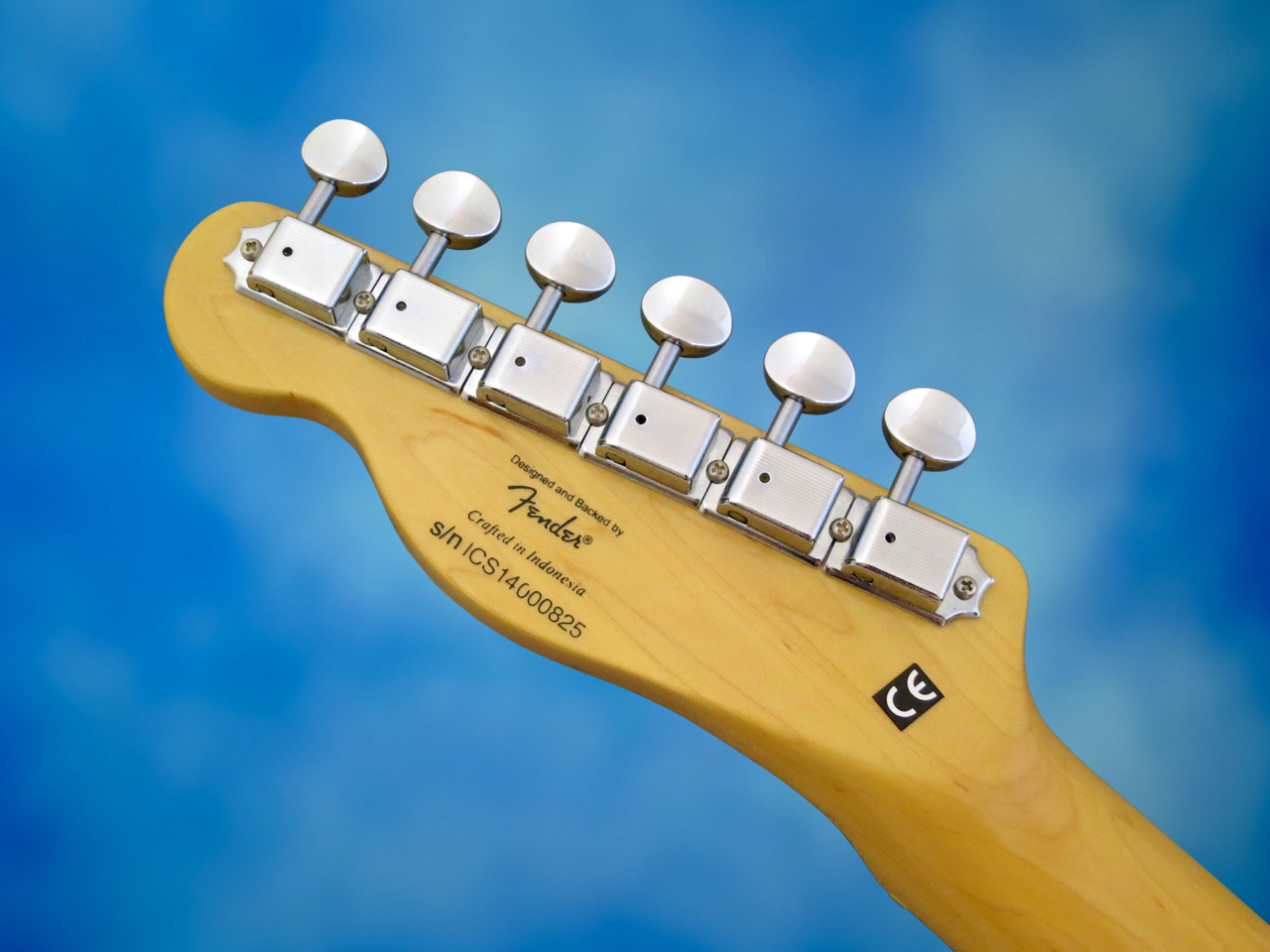
A set of very decent Kluson-copies has been selected for tuning duties on this Squier.
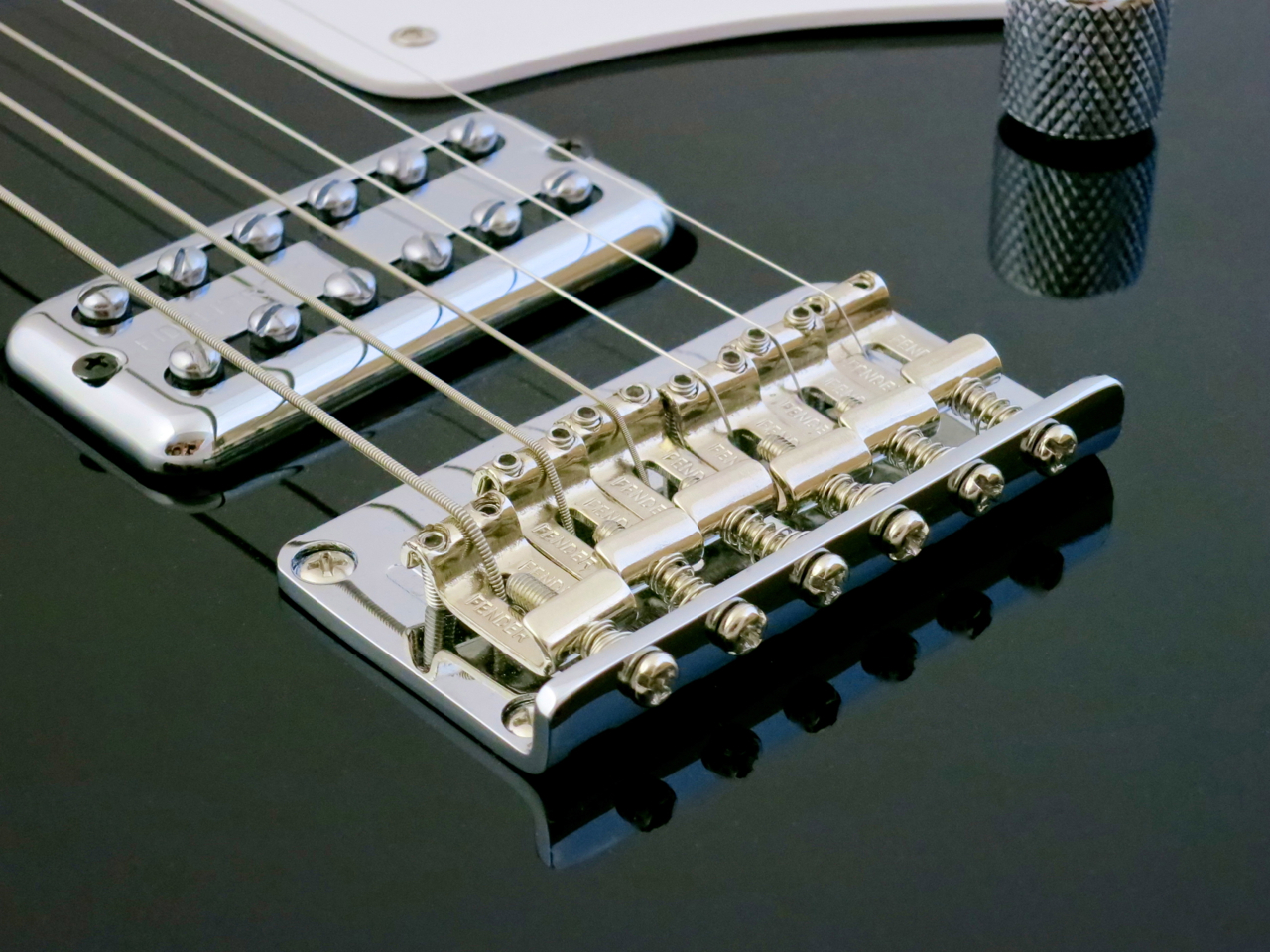
Instead of a classic Telecaster ashtray, the Cabronita employs a hardtail, six-saddle bridge with vintage-type Stratocaster saddles.
The extremely low price tag of the Squier can be seen in a couple of small things, such as the bridge being installed a tiny bit askew on the review instrument.
Central to the Cabronita-concept is the use of Gretsch Filtertron-style pickups. Squier make their own version for this guitar model, and call it the Fideli’Tron.
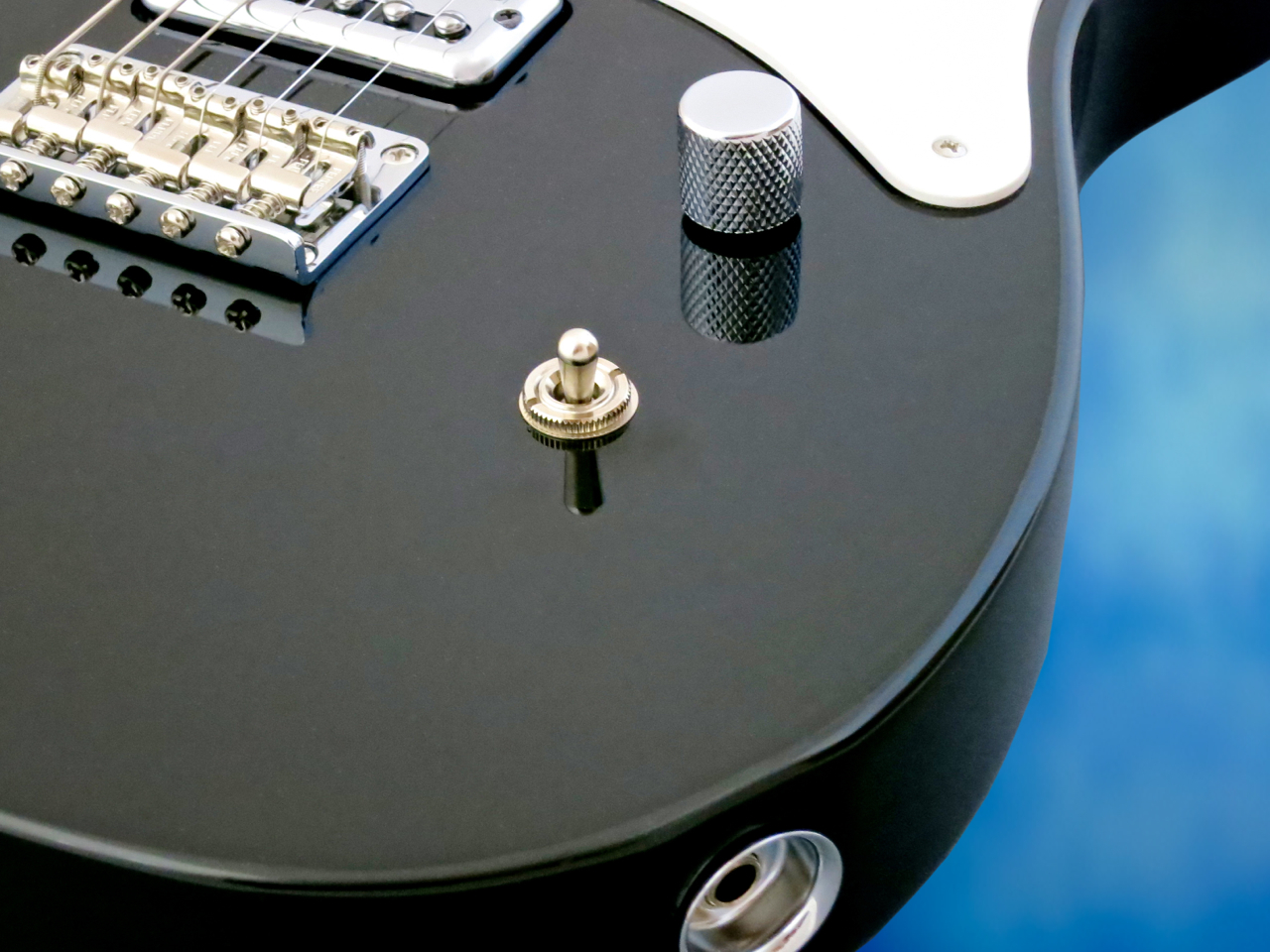
As befits such a Hot Rod guitar, the Squier Cabronita Tele is equipped with just a single volume control, and a three-way toggle pickup selector.
At prices like these you cannot seriously expect custom shop build quality:
The volume control works very smoothly, but the toggle switch of our review guitar was a bit temperamental, sometimes adding crackling, or even muting the signal, in the middle position. This could be a glitch on this specific guitar, but I’d probably upgrade to a better switch.
****
Squier’s Vintage Modified Cabronita Telecaster offers a whole lot of musical fun for the money.
In the sub-500 € price bracket, manufacturers generally tend to achieve savings in production costs, by reducing man-hours spent on each instrument’s production. Very often these savings are directed at the final set-up stage. Straight out of the box, many guitars in this price bracket suffer from top nuts left too high and/or dodgy intonation, and it is then up to the local distributor or the individual music shop to give these instruments a proper set-up prior to sale. This is one of the reasons why I think you should prefer an actual guitar dealer to ordering your affordable guitar over the internet, as the dealer will make sure the guitar plays to the best of its abilities, before it is sold.
Helsinki’s DLX Music were kind enough to supply me with the review instrument, and – naturally – they keep all their stock shipshape. No problems here, then! The reviewed Squier Cabronita is a lightweight solidbody guitar, with a very comfortable C-profile neck. Thanks to its larger-than-vintage frets, as well as the modern fingerboard radius of 9.5 inches, the Cabronita is easy to play, and the string-bending feel is rather slinky, even with a set of 010s.
Acoustically, the Squier Cabronita sounds more like a hardtail Strat than a vintage Tele, which is due to this model’s different bridge. There is a good deal of that typical Fender- attack and -cluck, but much less of the famous, nasal twang of the treble strings.
Generally speaking, Filtertron-type pickups tend to fall right in the middle of your typical singlecoil/humbucker-divide. Filtertrons are doublecoil pickups (= humbuckers), but thanks to their special construction, and their smaller size, they sound much brighter than a traditional, PAF-style humbucker. Generally, there’s a lot of clarity and attack on tap in this kind pickup.
Squier’s own Fideli’Tron-pickups sound surprisingly good, belying their affordable pedigree. On clean amp settings you will get a clear attack to each note, plenty of chime, and superb string separation (this clip starts with the neck pickup):
Driven into distortion Squier’s Fideli’Trons satisfy with a healthy dose of bite and snarl:
And here’s the audio track from the Youtube-video:
****
I simply love the way that this Squier Cabronita Telecaster manages to give you the essence of what this model is all about, at such an affordable price point. You get a great-feeling neck with a very decent fretjob, coupled with – for the money – fantastic tone. This Squier really gives you the original ”bastardised Tele” experience, and is very hard to put down, indeed.
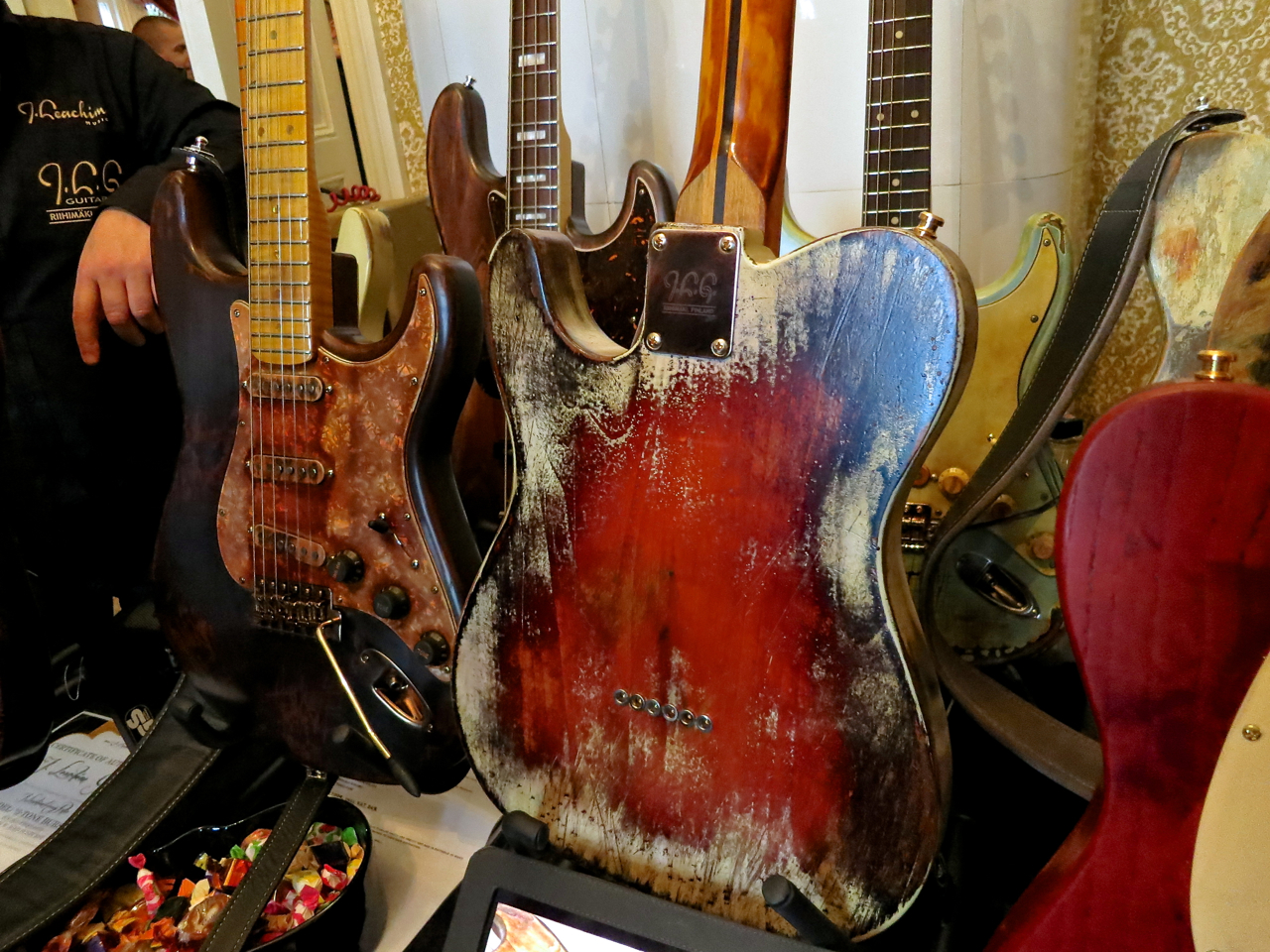
You could call J. Leachim Guitars Finland’s answer to Nash Guitars. Just like the American maker, JLG, too, don’t make their guitars from scratch, from the raw wood. Instead, J. Leachim assembles guitars from bought in unfinished necks and bodies, as well as parts and hardware sourced from a number of reputable sources. J. Leachim Guitars’ forte lies in their finish work, and the relicing of guitars.
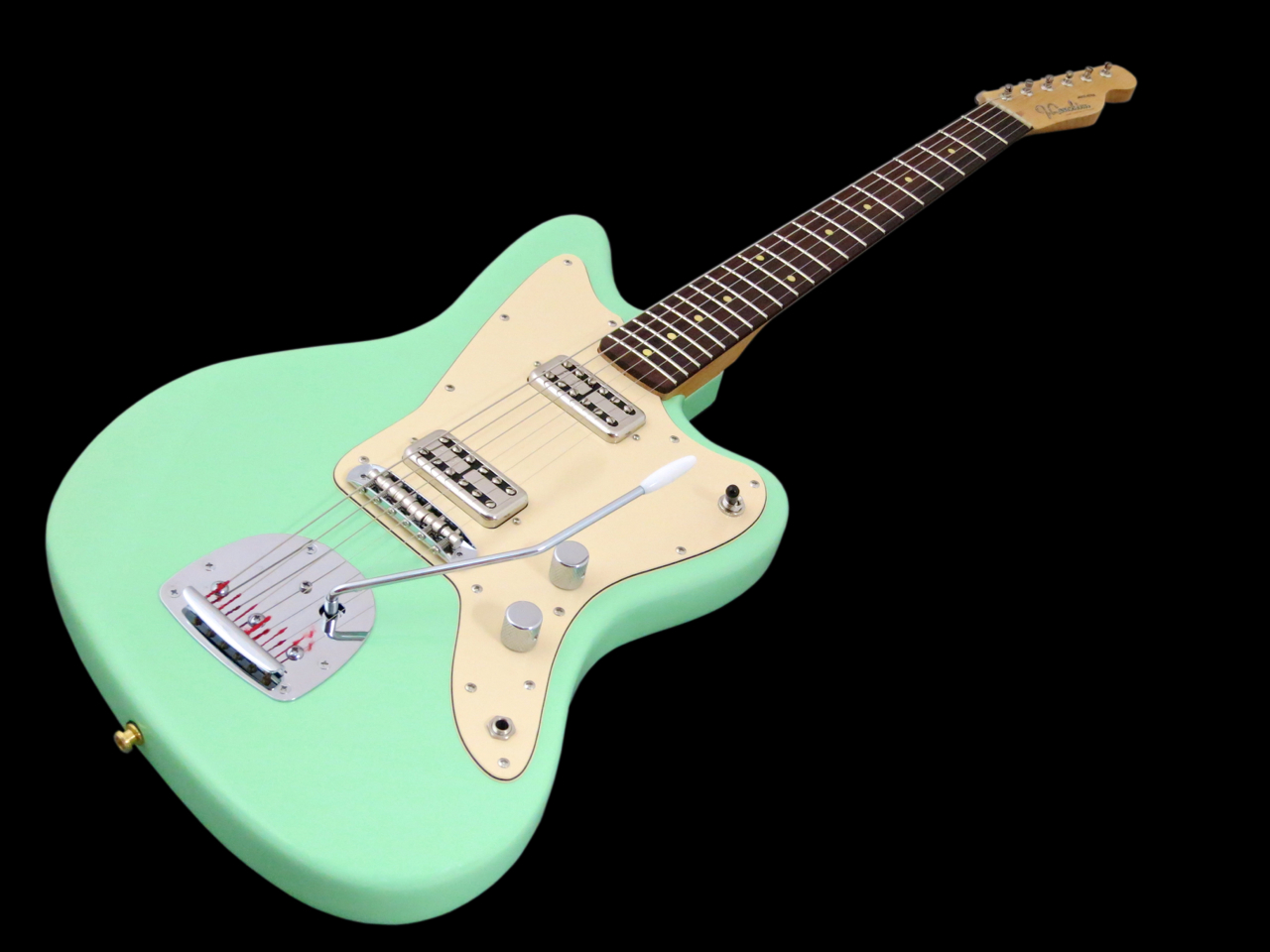
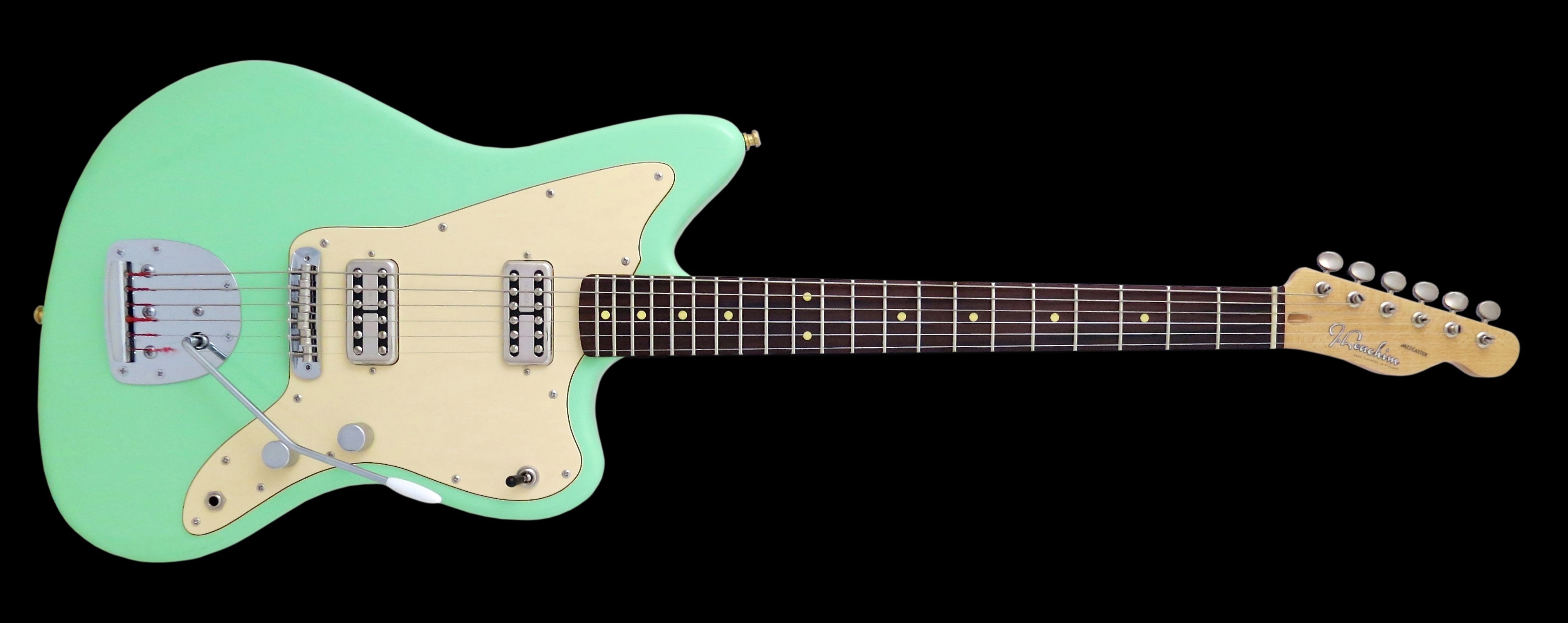
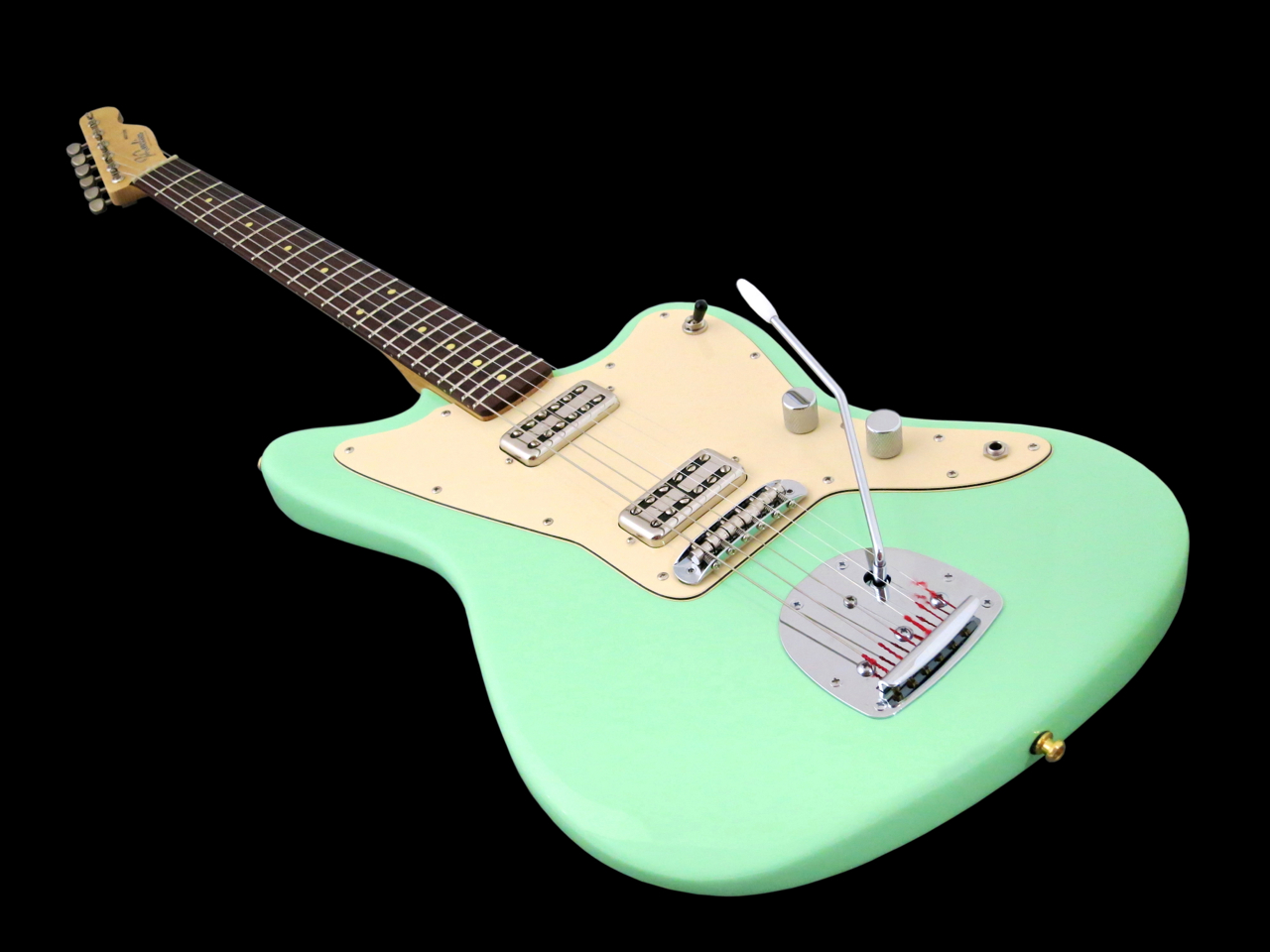
J. Leachim’s main man, Jan Merivirta, supplied Kitarablogi.com with an example of his Jazzcaster model, which sports a pristine, “NOS” nitro finish.
****
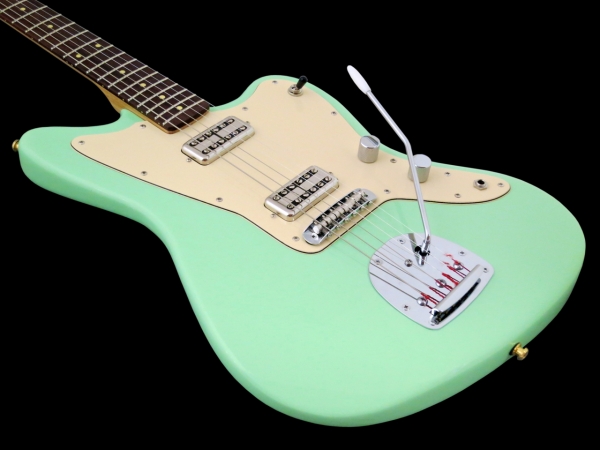
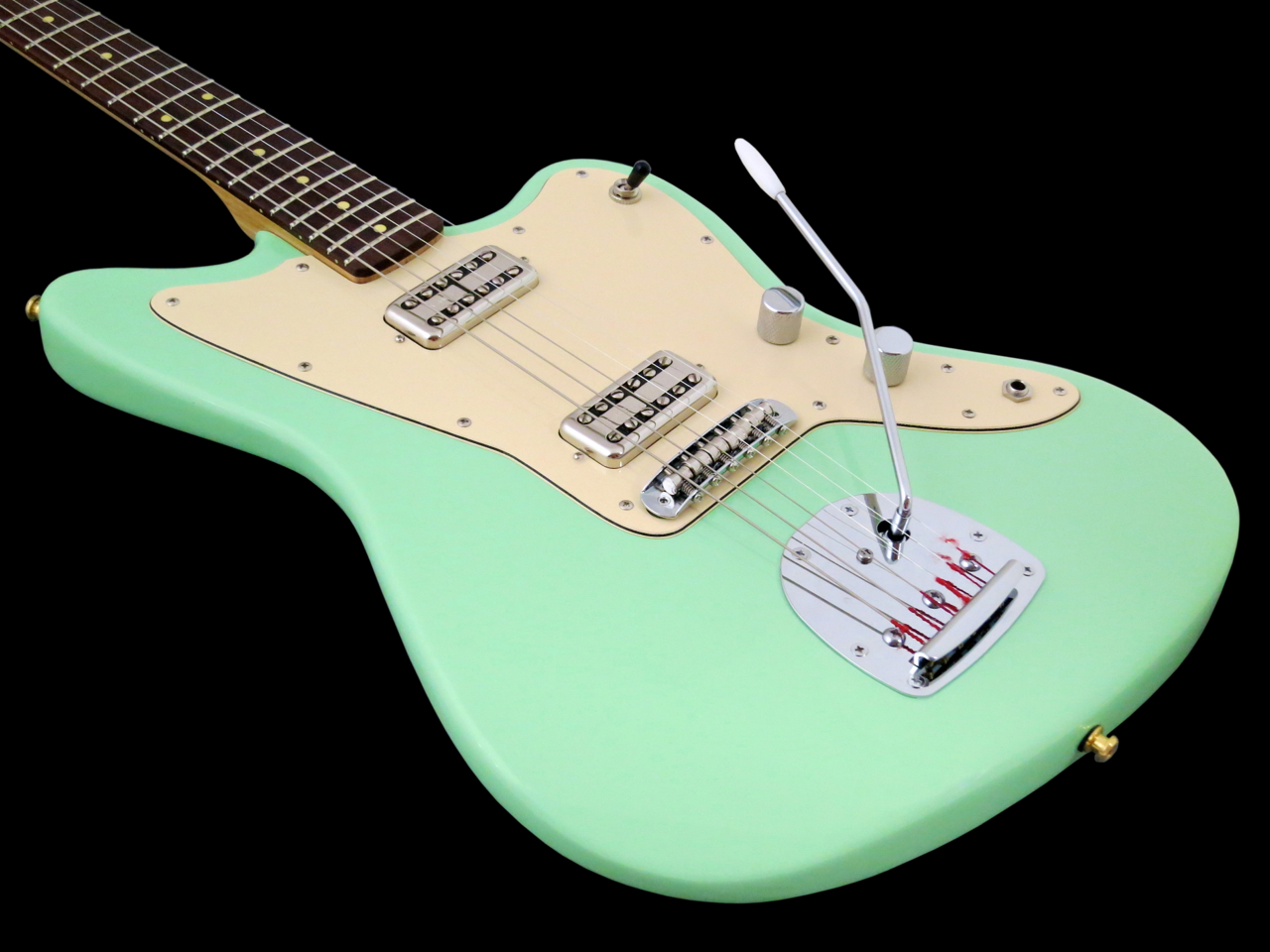
The J. Leachim Guitars Jazzcaster (prices start from approx. 1,300 €; hard case incl.) is a very enticing mix of different classic guitars:
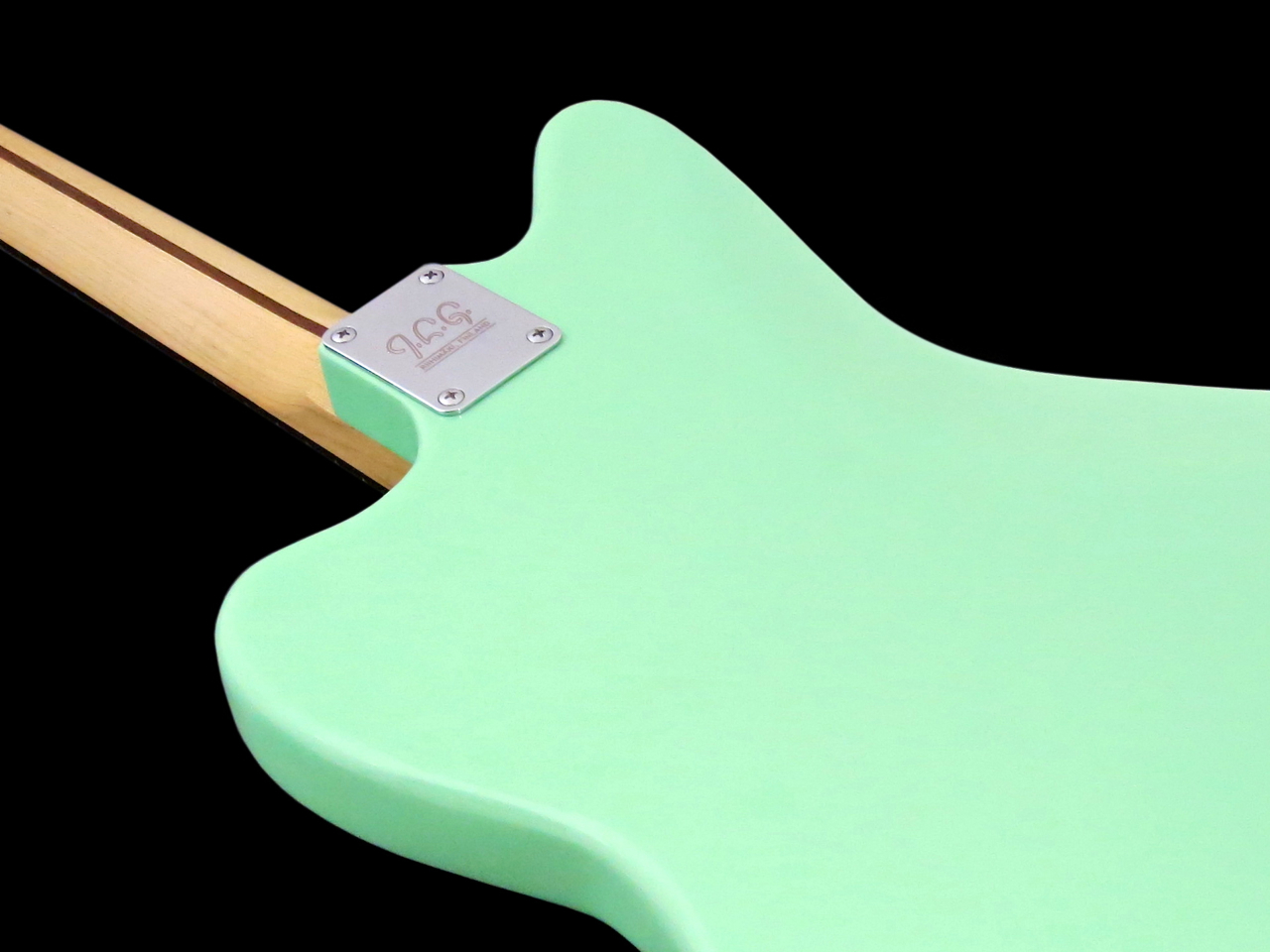
The Jazzcaster’s maple neck has been sourced from Northwest Guitars. It’s a Tele-style neck sporting jumbo frets, as well as a modern fretboard radius of 9.5 inches.
The Guitarbuild body has been crafted from very lightweight swamp ash. Filtertron-sized pickup routs have been added at the J. Leachim workshop.
J. Leachim Guitars clearly know how to use nitro lacquer properly:
The body has received an exquisite, thinly applied gloss finish in Surf Green, while the neck has been finished with a thin satin clear coat.
The fretwork on the Jazzcaster is great. The rosewood fingerboard comes with 21 jumbo-sized frets.
The top nut has been carved from a piece of genuine bovine bone. Some may find the nut’s shaping a tad angular, but I don’t mind; it’s only cosmetics, after all.
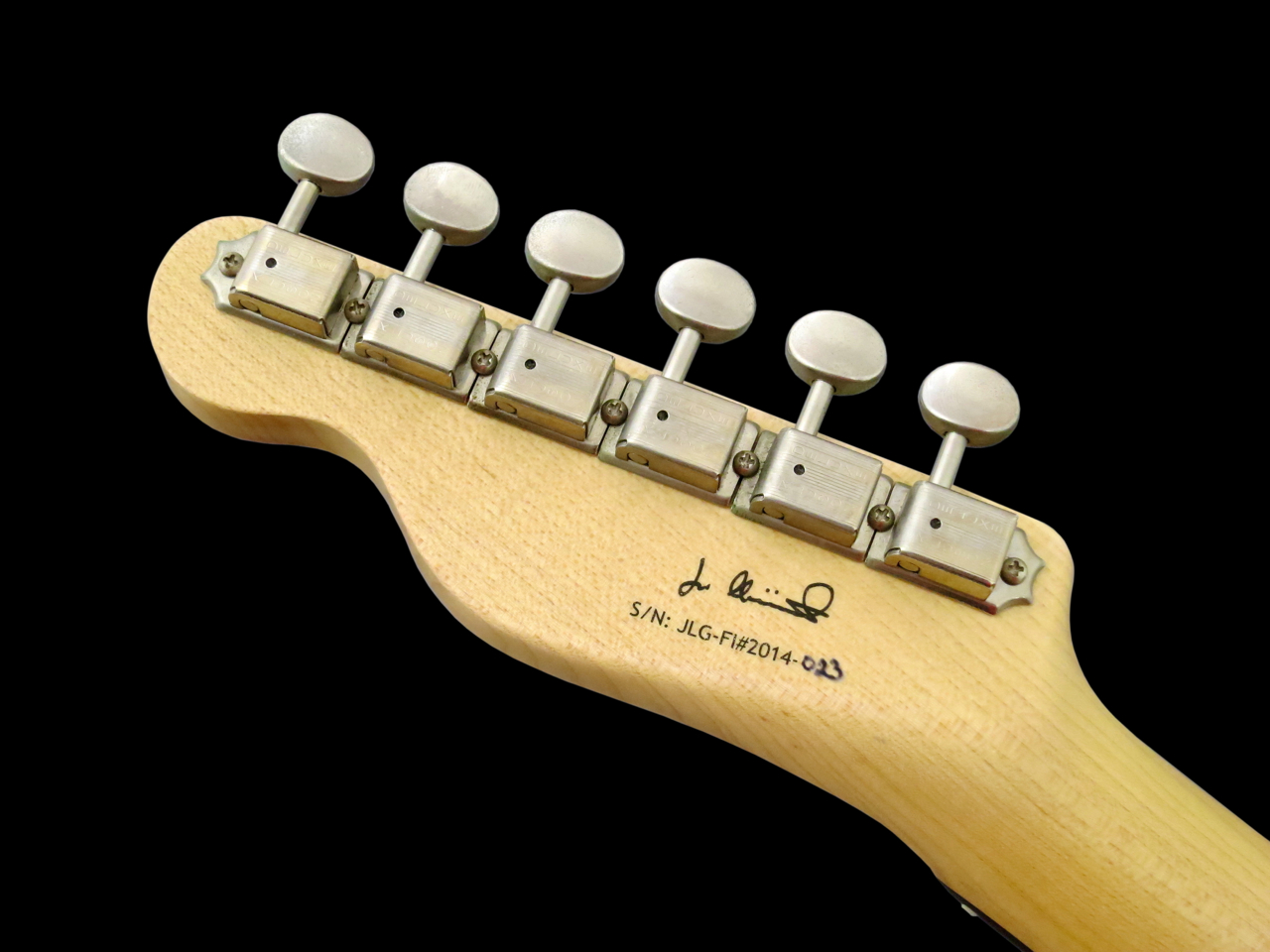
A nice set of lightly-aged Klusons takes care of tuning duties on this J. Leachim model.
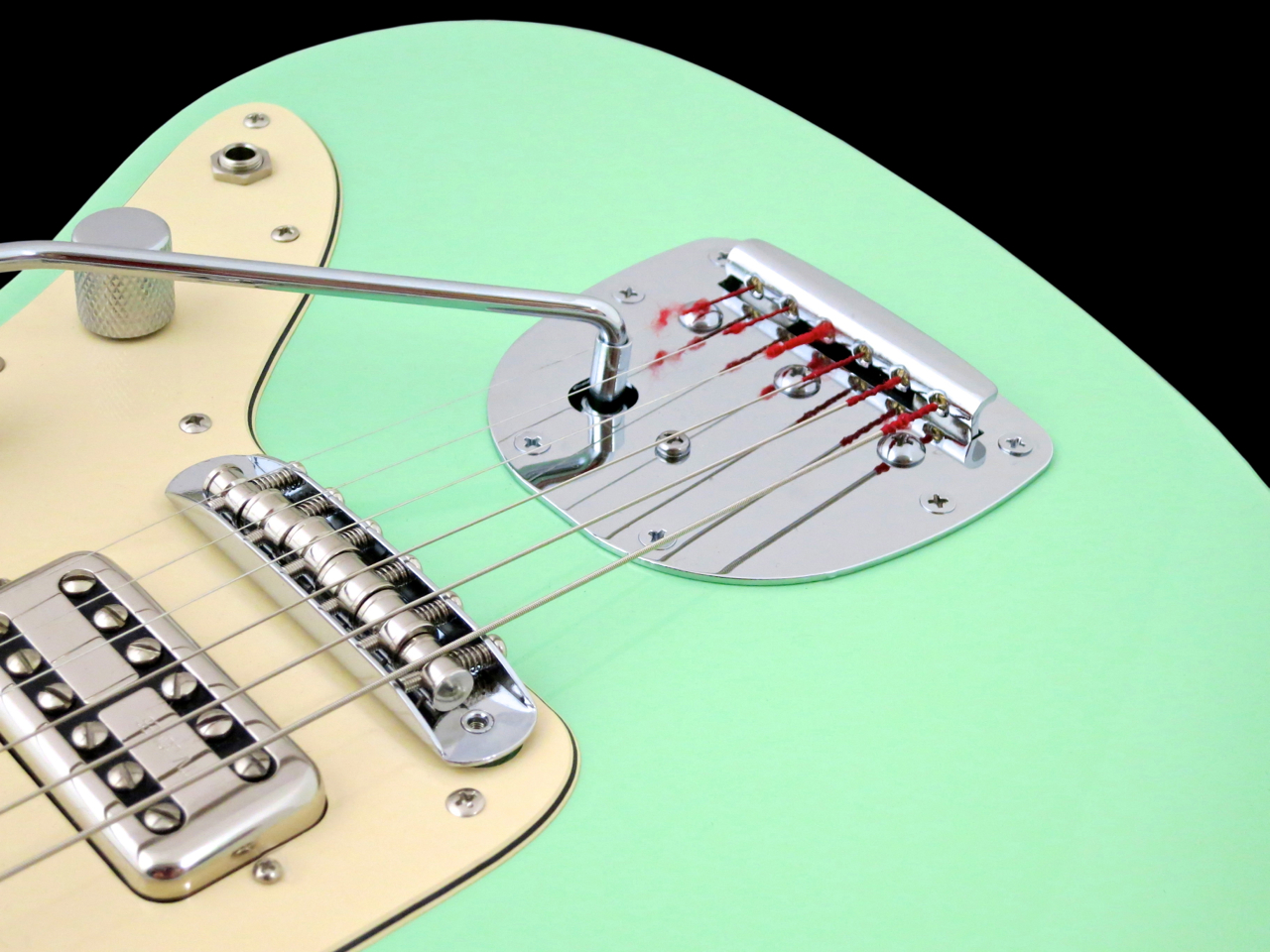
The Jazzcaster’s bridge and vibrato tailpiece have both been sourced from WD Music:
The vibrato is a version of the Fender Jazzmaster/Jaguar-vibrato, albeit without the original’s lock-off mechanism. The original locking mechanism is notoriously difficult to set up properly, so leaving it off is actually a good thing (in the view of most guitarists).
Many guitarists today dislike the original Jazzmaster-bridge, too, because the individual height-adjustment screws on the bridge saddles tend to work themselves loose with modern (light gauge) strings. Originally, this bridge – as well as the vibrato – has been designed to work with the stiffer string sets of the late 1950s (mostly 012 or 013 sets). With a set of 010s or 009s the Jazzmaster-bridge’s adjustment screws tend to rattle a lot.
Many modern makers – like J. Leachim Guitars – substitute the Jazzmaster-bridge with a Fender Mustang-bridge for this very reason. The Mustang-bridge is a direct replacement, and it uses differently sized bridge saddles to preset the fretboard radius permanently, so nothing can work itself loose and rattle.
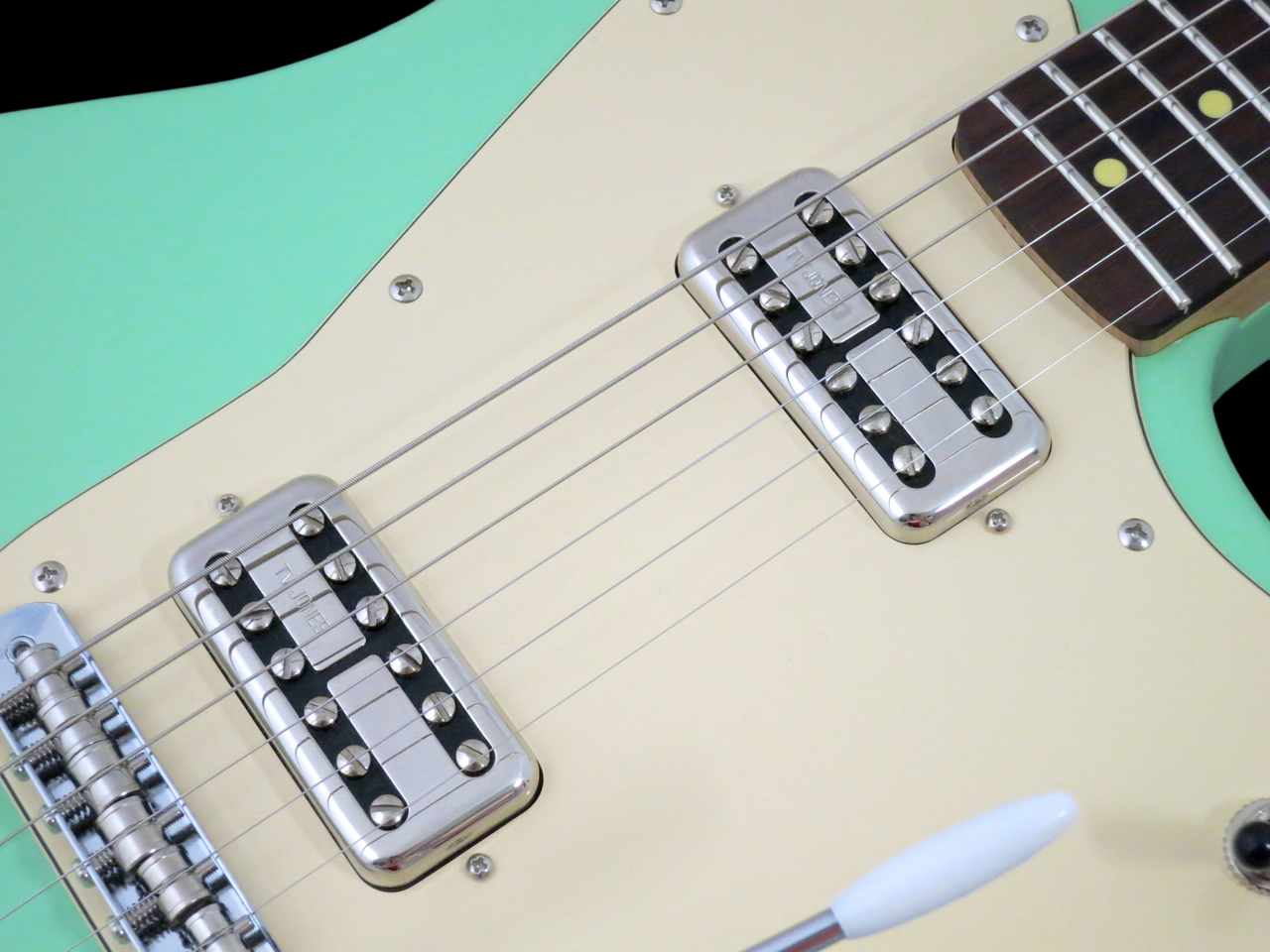
Gretsch Filtertron-style pickups are the ”in” thing at the moment.
J. Leachim’s Jazzcaster comes with a pair of TV Jones-pickups – there’s a vintage-type TV Classic in the neck position, and a more powerful Powertron model placed near the bridge.
The customer who ordered this particular Jazzcaster specified a reverse tone control (working clockwise), so this is what can be found on this instrument.
J. Leachim Guitars use a stereo phone jack, which keeps a firmer grip on the guitar lead’s plug, as well as making sure you always have a good connection to ground.
****
In my view, the J. Leachim Jazzcaster very successfully blends the ergonomics of the Jazzmaster body with a Gretschy tone. Thanks to its very smooth Jazzmaster-vibrato, the JLG Jazzcaster has a more open sound than, for example, a Cabronita Telecaster.
The Jazzcaster plays like a dream, as long as you’re willing to live with the typical, well-known compromises of the Jazzmaster/Jaguar-vibrato.
With modern, slinky strings, big bends – especially, when played higher up the neck – can quite easily make the high e-string jump out of its bridge groove. In a way this isn’t so much a fault, but more of a feature of this vibrato system, because the strings cross the bridge at a relatively shallow angle. With the stiff string sets of the late Fifties the system works fine, but for huge Blues bends with a contemporary 010-gauge set you should maybe invest in an additional bridge roller.
I would like to see a smoother taper on the tone control, though. On the review instrument the treble roll-off was more a matter of on or off, with everything happening right at the end of of the knob’s travel.
The Jazzcaster has a beautiful acoustic tone, with a bell-like ring and an open, yet firm body.
TV Jones’ acclaimed Filtertron-style pickups seem like a perfect fit for this model, adding a good deal of chime and twang, without sounding too bright or biting. Being humbuckers, the TV Jones pickups are also immune against hum and buzz, unlike a traditional Jazzmaster’s singlecoil units, which are not a million miles removed from a Gibson P-90.
This clip gives you an idea of the J. Leachim Jazzcaster’s clean sounds (starting with the neck pickup):
When plugged into an overdriven channel, the Jazzcaster wins you over with a chunky, aggressive and compact voice, which is just the ticket for Seventies-style Rock or Punk. Famous Filtertron-users in the Rock genre include AC/DC’s original rhythm guitarist Malcom Young, and the Who’s Pete Townshend, who frequently used Gretsch guitars as his ”secret weapon” in the studio.
Here’s the track from the Youtube-video – ”Seabird Flavour (Homage to Peter Green)”:
There are three rhythm parts – left channel (neck pickup), centre (neck pickup), and right channel (both pickups) – as well as the lead part, which uses both pickups (and the vibrato tailpiece).
****
In my view, J. Leachim’s Jazzcaster is a beautiful, and very well-made, Fender-inspired guitar, with a sound that’s all its own. You could think the Jazzcaster was only for Jazz or Country, but in reality this fine guitar covers a much wider area of musical styles.
In any case, J. Leachim Guitars is yet another Finnish guitar brand worth keeping on your radar.
This time we have something very special to feast your eyes on!
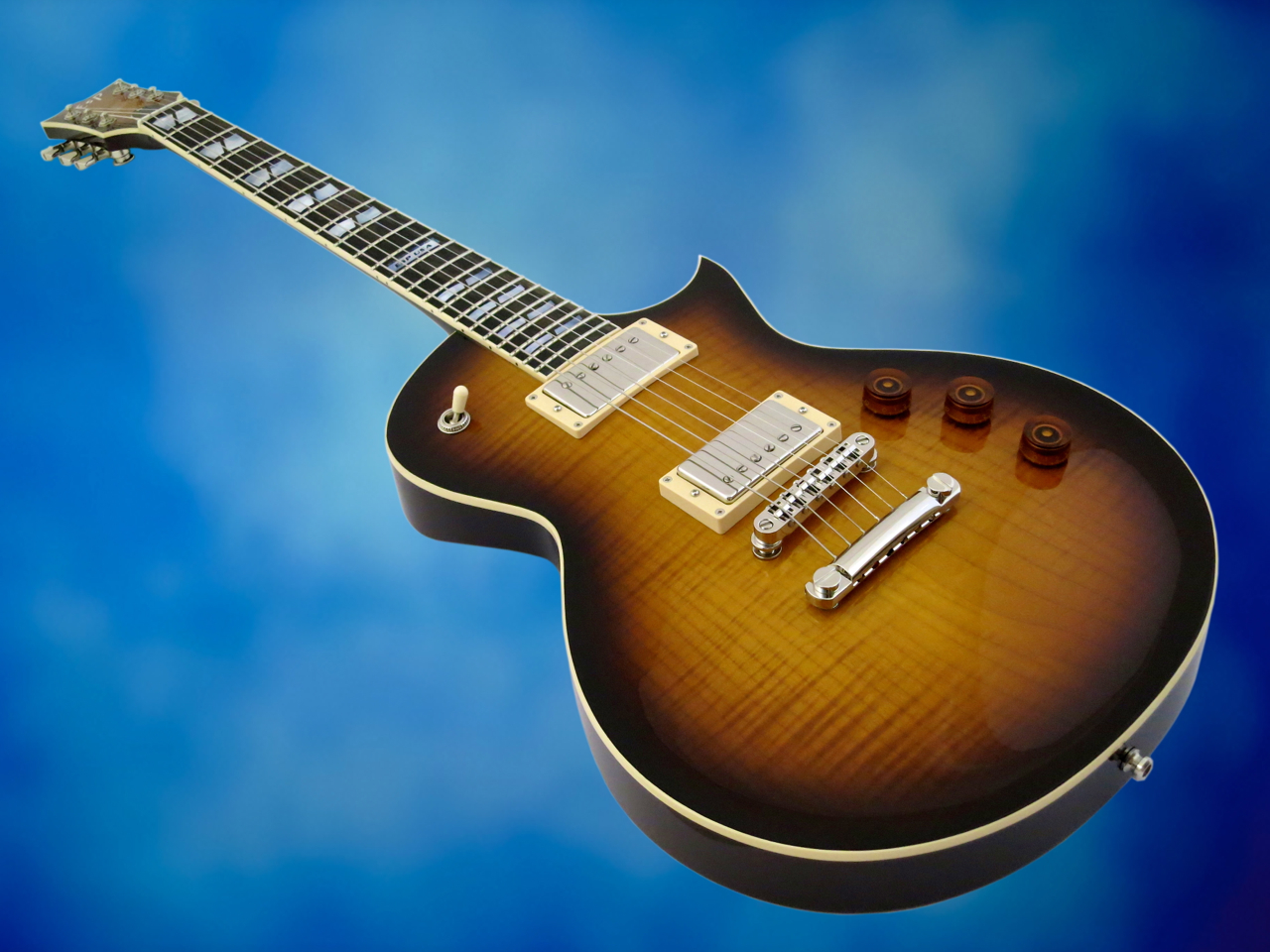
Many people may not know this, but ESP Guitars also runs its own, small West Coast workshop in California. The ESP USA factory produces limited numbers of its most popular shapes (currently three models), and its primary goal is to produce the best quality instruments for its customers.
Kitarablogi.com has been lucky to get to take one of these guitars for a spin – the ESP USA Eclipse.
****
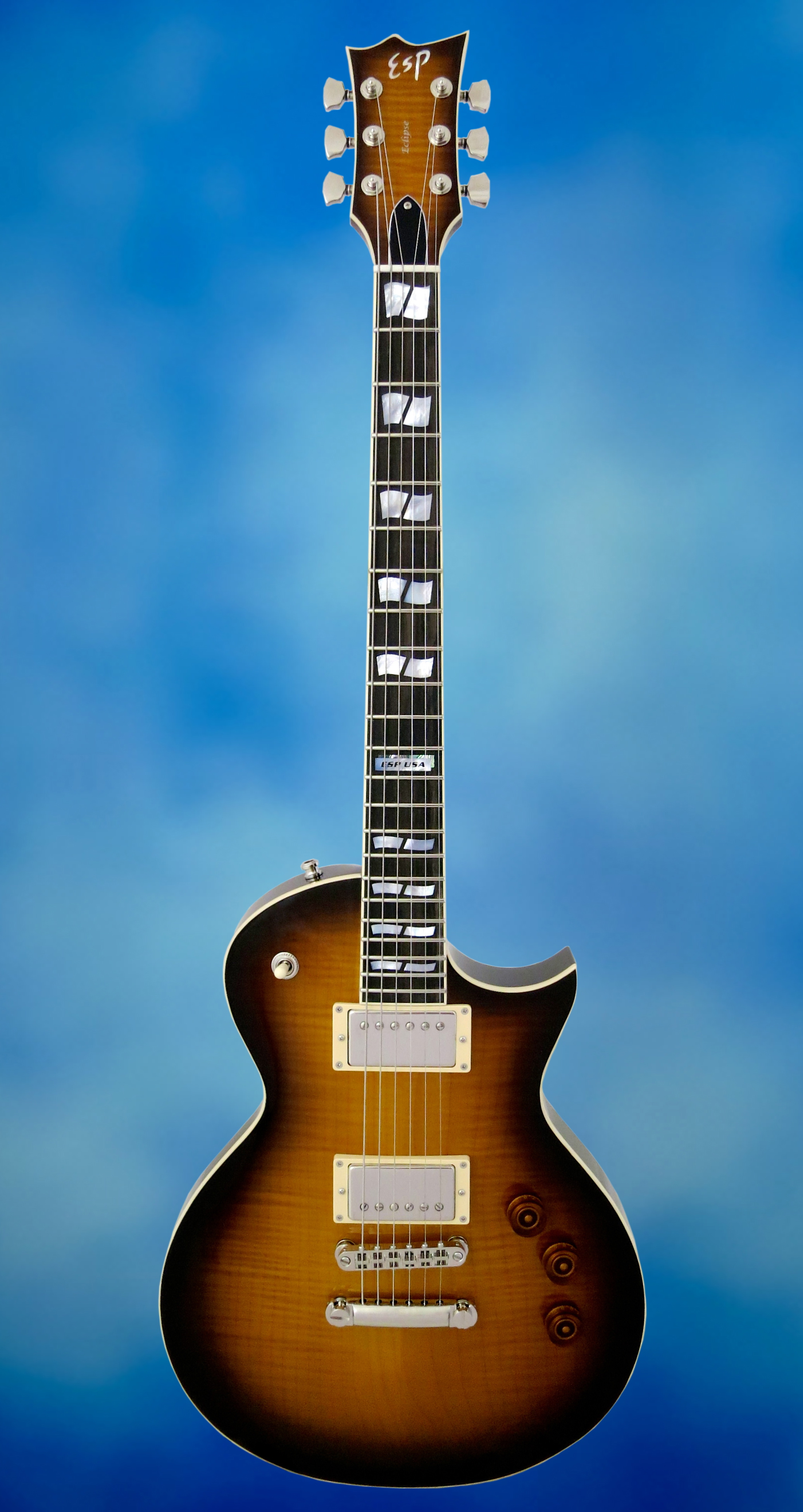
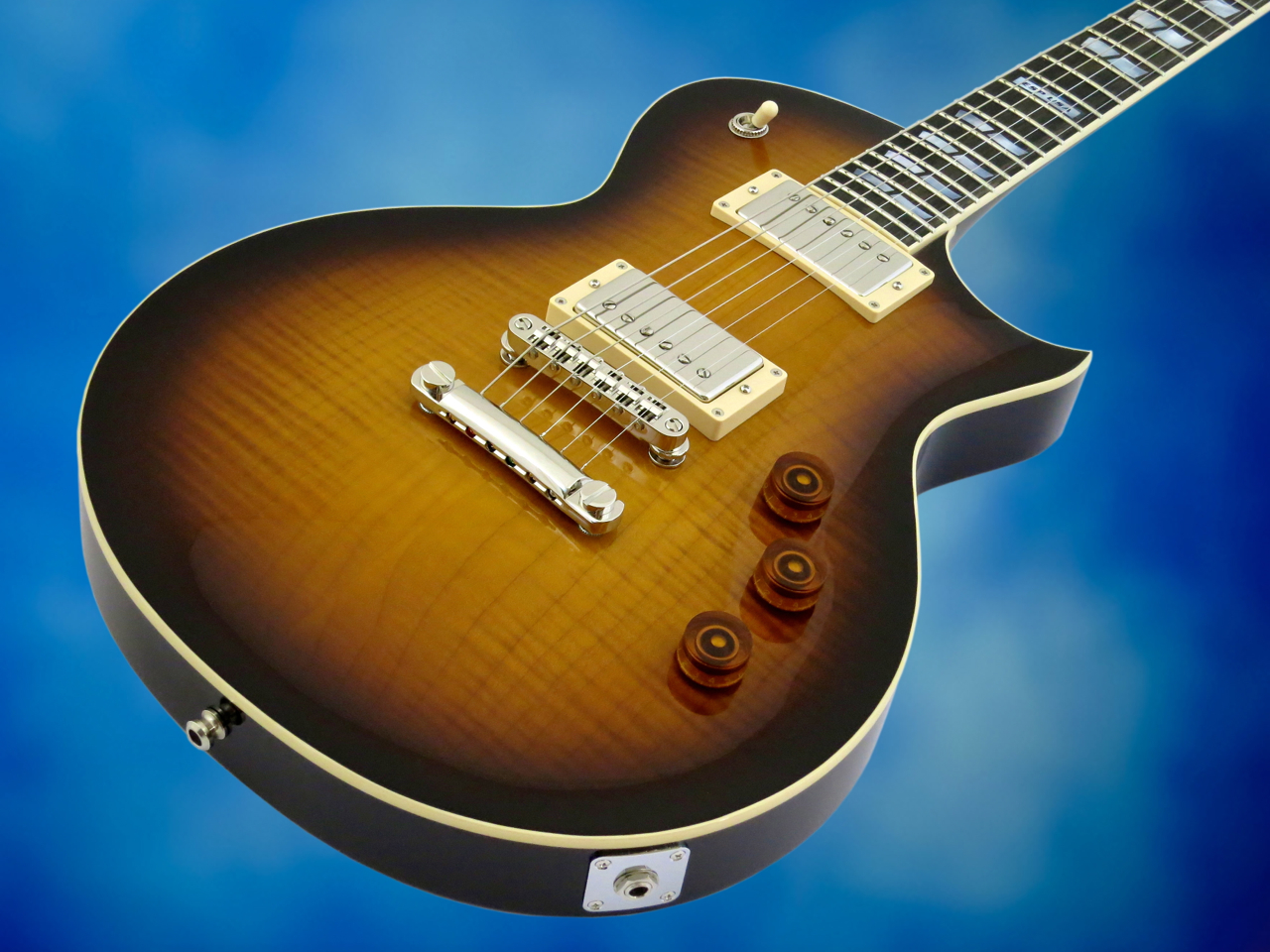
The ESP USA Eclipse (current price in Finland: 3.939 €) is the company’s ultimate version of their popular Eclipse model, using only the best materials and production methods.
One of the USA Eclipse’s special features is the ESP Set-Thru-Neck, which aims to combine the best attributes of a traditional set neck with the playability advantages of a through-neck.
ESP’s Set-Through-Neck is basically a set neck with a significantly larger tenon (both wider & deeper), which greatly improves the strength of the neck joint. Most set-neck guitars have a tenon which is somewhat narrow and shallow. In the ESP USA’s case, the width of the tenon is as large as the end of fingerboard and is almost as tall as the body. This allows the neck joint to be sculpted like a through-neck with no loss of structural integrity.
The result is a stronger neck joint, which is good for sustain, and it also makes it possible to do away with the traditional neck heel of a standard set-neck, resulting in a very comfortable playing experience.
The Eclipse’s mahogany body sports a rib cage chamfer for comfort.
The guitar’s tuning is kept rock steady by a set of Sperzel USA locking machine heads.
The bound headstock of the USA Eclipse features a flamed mahogany overlay, finished in the same Tobacco Sunburst finish as the body’s carved maple top.
The top nut has been made from genuine bone.
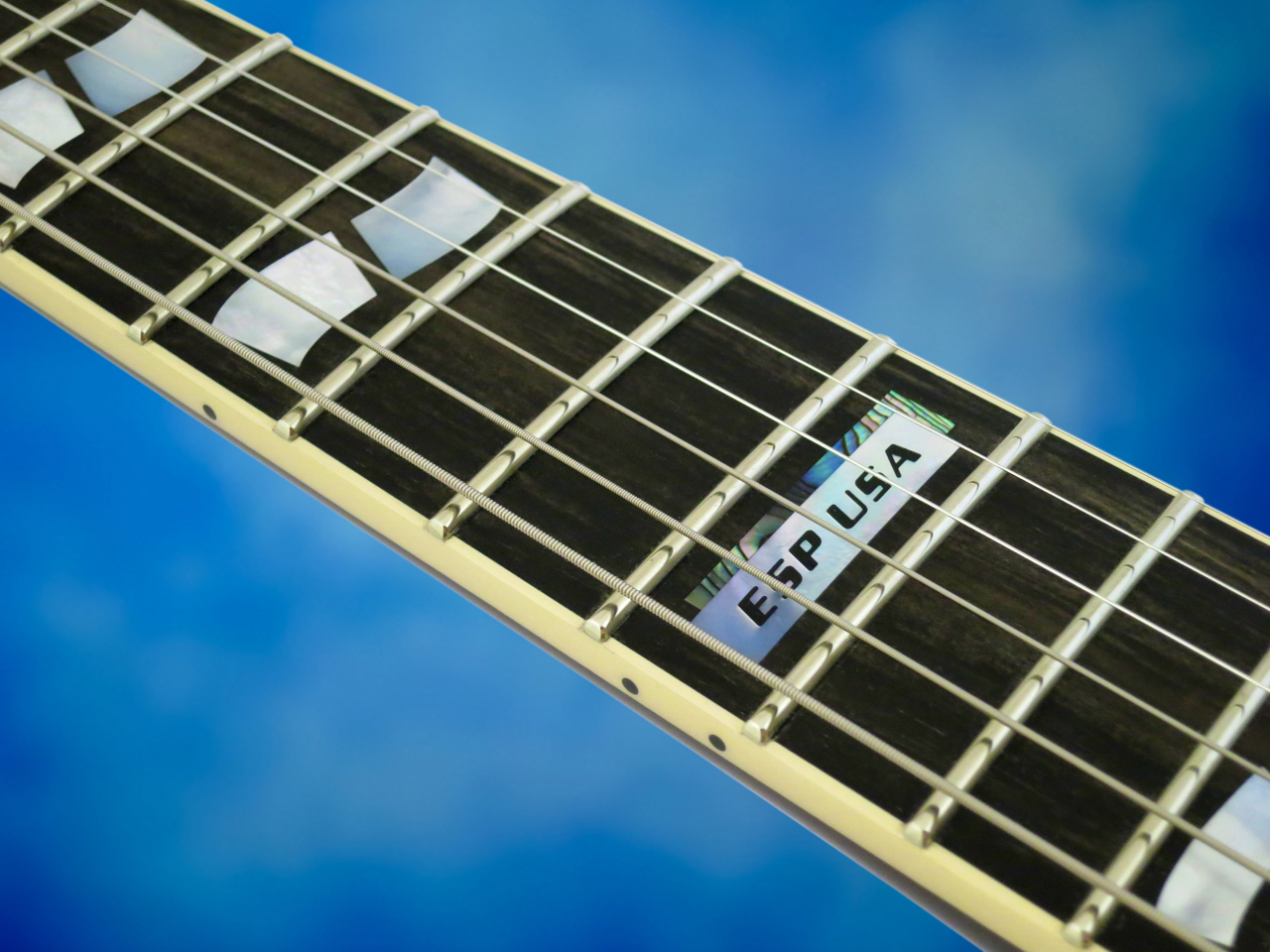
We find a bound ebony fretboard with 22 jumbo frets, adorned with beautiful pearl and abalone inlays.
The fingerboard radius is a flattish 12 inches (305 mm).
The locking Sperzels are paired at the body end with a rock solid TonePros TOM-bridge and stopbar combo.
It’s quality all the way in the electronics department, too:
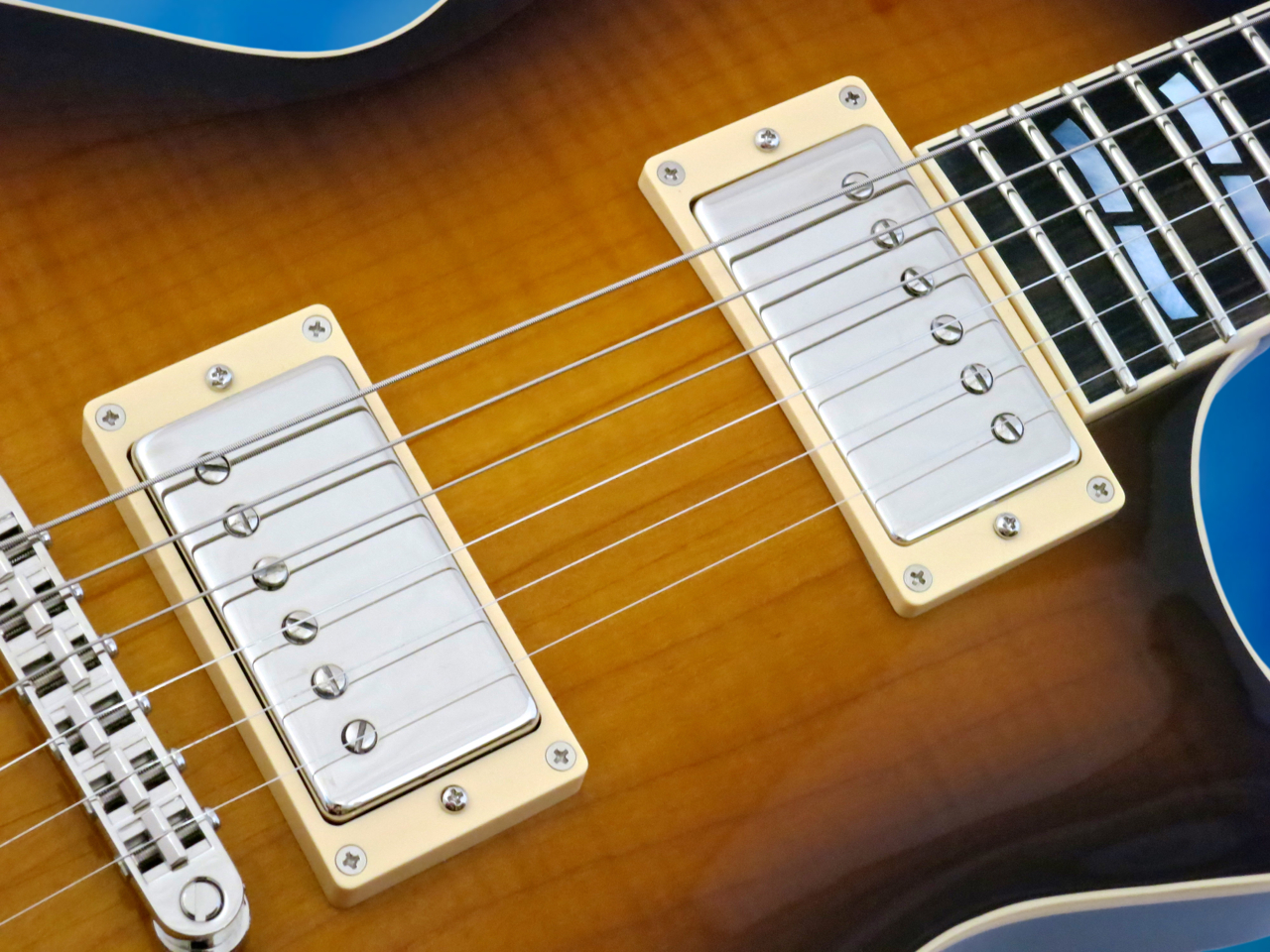
ESP’s USA Eclipse comes equipped with a pair of Seymour Duncan Alnico II Pro humbuckers (APH-1), which are vintage-voiced, warm-sounding pickups with moderate output levels (Slash’s favourites).
The control layout on this model has the bridge volume closest to the bridge pickup (for easy volume swells), while the middle knob is the neck volume.
The master tone control features a push/pull-switch splitting the humbuckers in the ”up” position.
The control cavity has received a layer of shielding paint, as well as a cover lined with aluminium foil.
****
This guitar really is a fantastic instrument! The ESP USA Eclipse is top quality incarnate, leaving nothing to be desired.
For a full-depth, Les Paul-inspired guitar the USA Eclipse is refreshingly light.
I don’t quite understand, why ESP insist on calling this neck profile a ”Thin U”. I agree, this neck doesn’t feel like a fat, clumsy baseball bat, but neither is it one of the notorious ”speed necks” of the Eighties. I would call the Eclipse’s rounded D-profile ”extremely comfortable”, and be done with it…
The USA Eclipse offers first-rate playability – light to the touch, offering just the right amount of resistance – across the whole fingerboard.
The vintage-voiced Seymour Duncan Alnico II Pro humbuckers are a perfect fit for this guitar, not least because of their versatility. You can have great-sounding, authentic Jazz tones, if you want, and then rock out without having to change guitars. The split humbucker sounds are very good, too, offering a brighter tonality and lower output levels. The ESP USA Eclipse covers a very wide range of different sounds and musical genres.
Here’s a short clip showing you the split humbucker sounds (starting with the neck pickup):
Next up, a similar clip with the full humbuckers:
In the demo track I have used split settings for the rhythm parts (left channel: both pickups; right channel: neck pickup), as well as the full bridge humbucker for the lead guitar:
****
ESP’s USA Eclipse is a boutique grade guitar, backed by a large brand. Some manufacturers may ride on glories past, cashing in on their legendary brands. In contrast, ESP’s USA Eclipse really has the build quality, workmanship, and tone to justify its price tag.
In my view the ESP USA Eclipse is a gorgeous solidbody electric at a fair price.



























 Kitarablogi.com – Finland's premier Guitar and Bass blog