

****
Lisätiedot: Custom Sounds
Kitarablogi.com – Finland's premier Guitar and Bass blog
Juttuja kitaroista ja bassoista

****
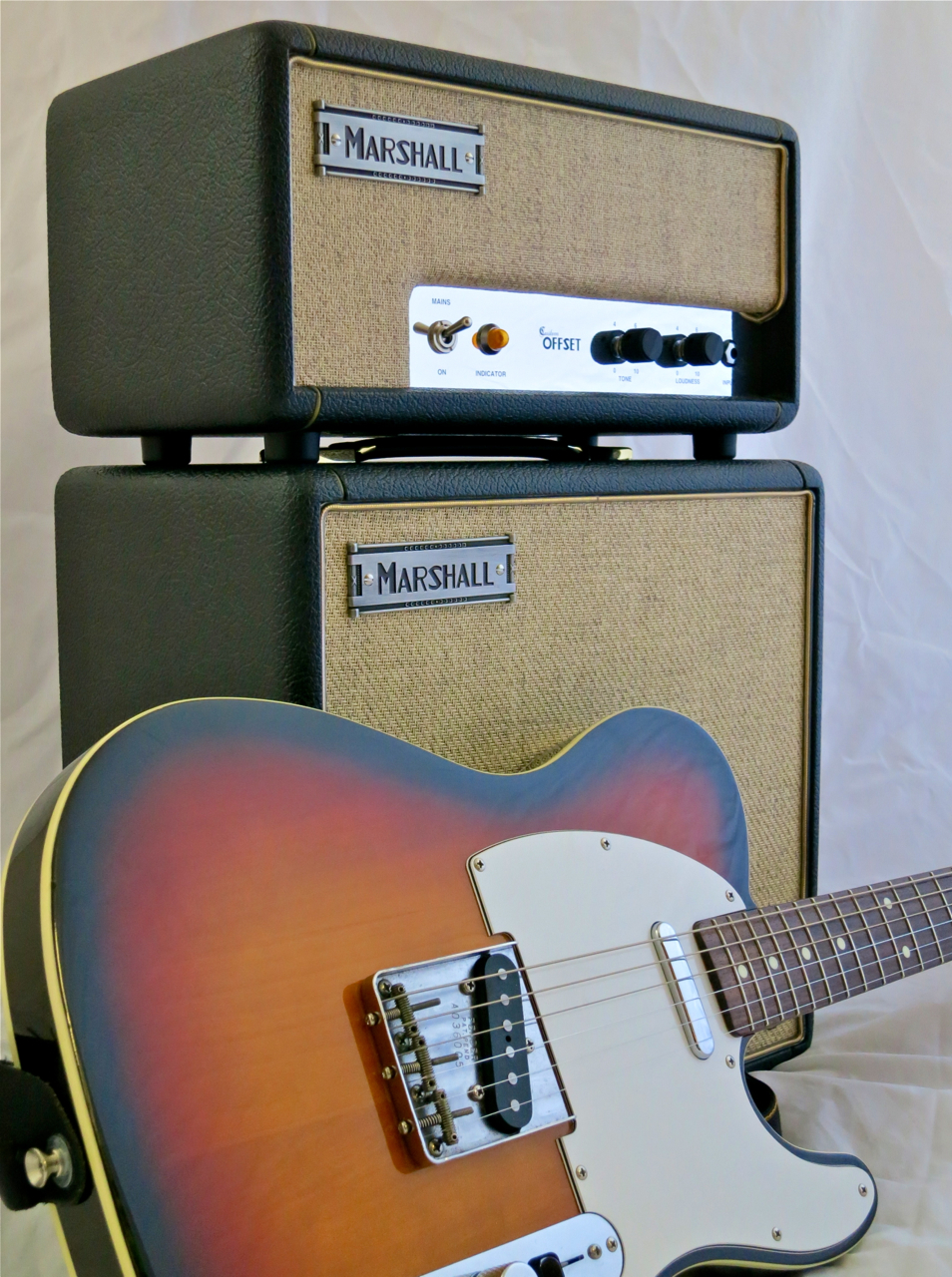
Last year Marshall celebrated their 50th anniversary by releasing a whole range of limited-edition one-watt combos and half-stacks.
Now we’re in for a cool reprise, as Marshall announced a limited edition of 1,111 of a Custom Offset half-stack in Frankfurt earlier this year. The Custom Offset is based on their JTM1 50th Anniversary amp.
A couple of these rare amps even made it to Finland. Kitarablogi.com managed to get hold of one half-stack for a quick review.
****
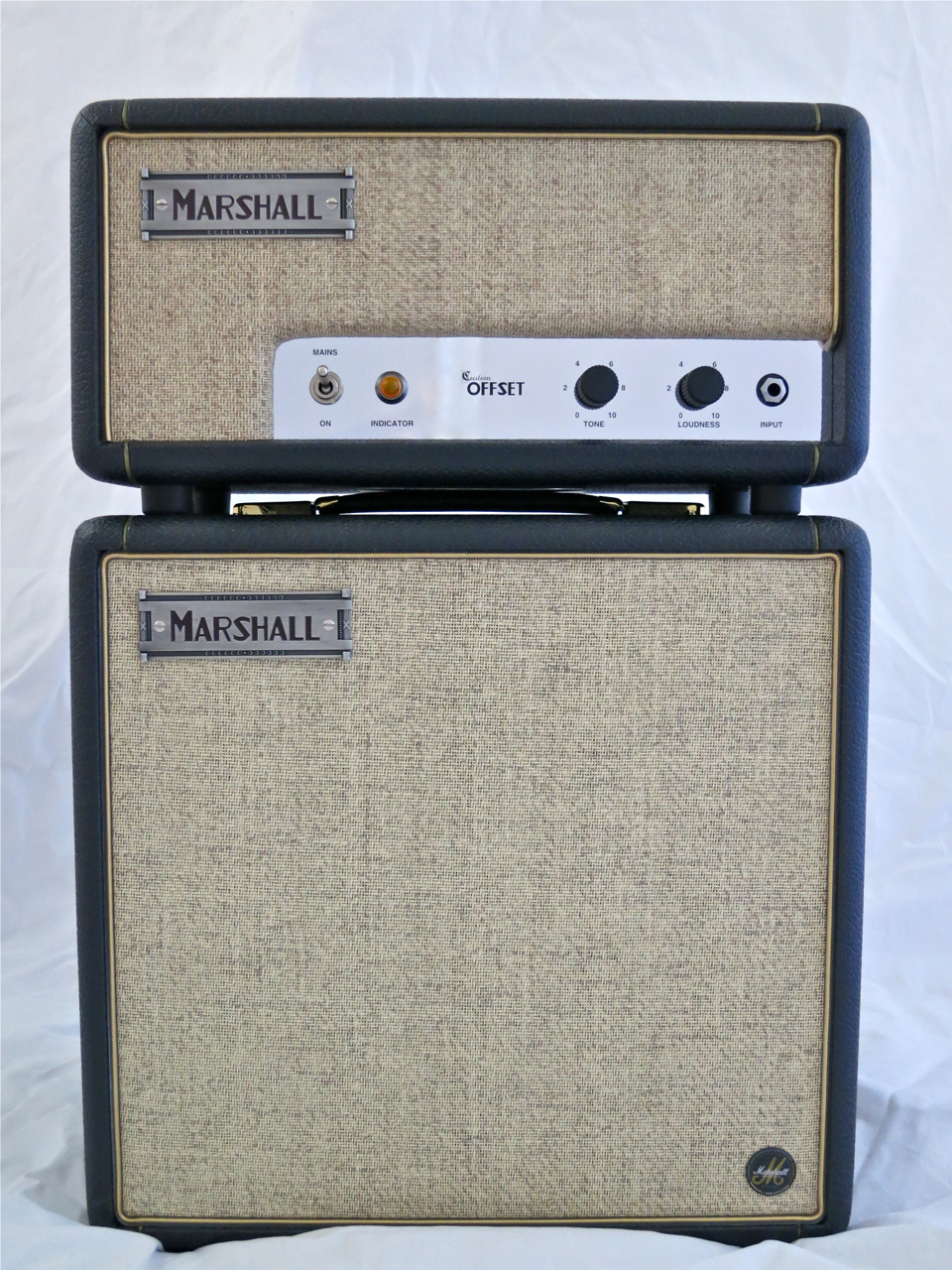
The Marshall Custom JTM1 Offset (price in Finland approx 1,000 €) takes the JTM1 as its starting point, but takes the concept even further down the vintage road to give the Custom Offset the look the company’s first batch of JTM45 models. There’s the famous light grey/beige grille cloth, and the offset control panel, which has given this amp its name.

As can be expected at this price point, the overall workmanship is of a very high standard, indeed.

The head’s gleaming, chrome-plated front panel, as well as the two black metal control knobs, are clear hints at this amp’s exalted limited edition status.
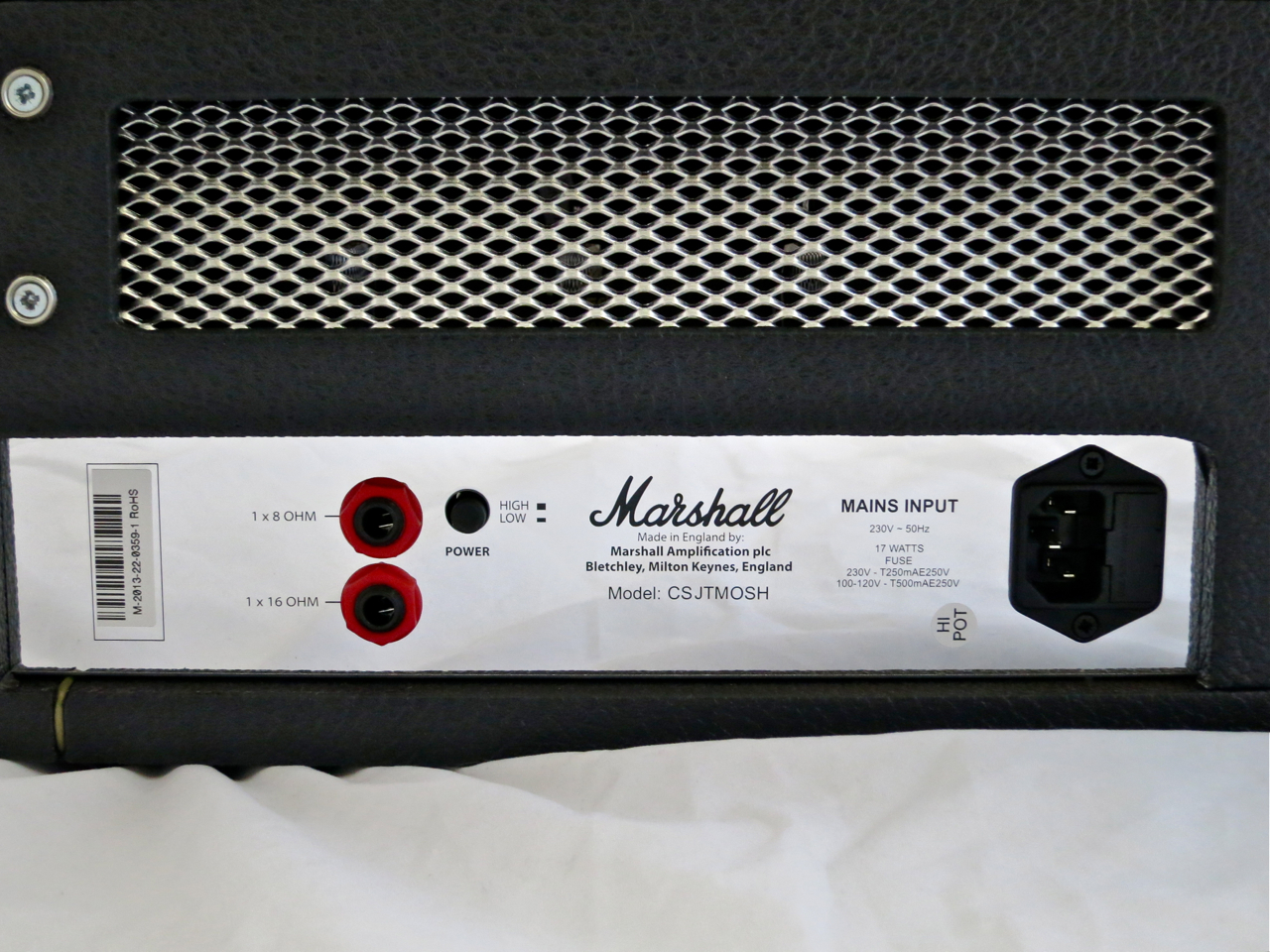
On the chromed back panel you will find the same Power-switch as on last year’s anniversary models. It drops the amp’s output from one Watt down to one-tenth of a Watt.
The Custom JTM1 Offset’s matching cabinet has an impedance of 16 Ohms, but you can also connect 8 Ohm speaker loads via the second output jack.

The Custom head is build around the same valve types as the JTM1 head – we find two ECC83/12AX7-valves, as well as a model ECC82/12AU7.
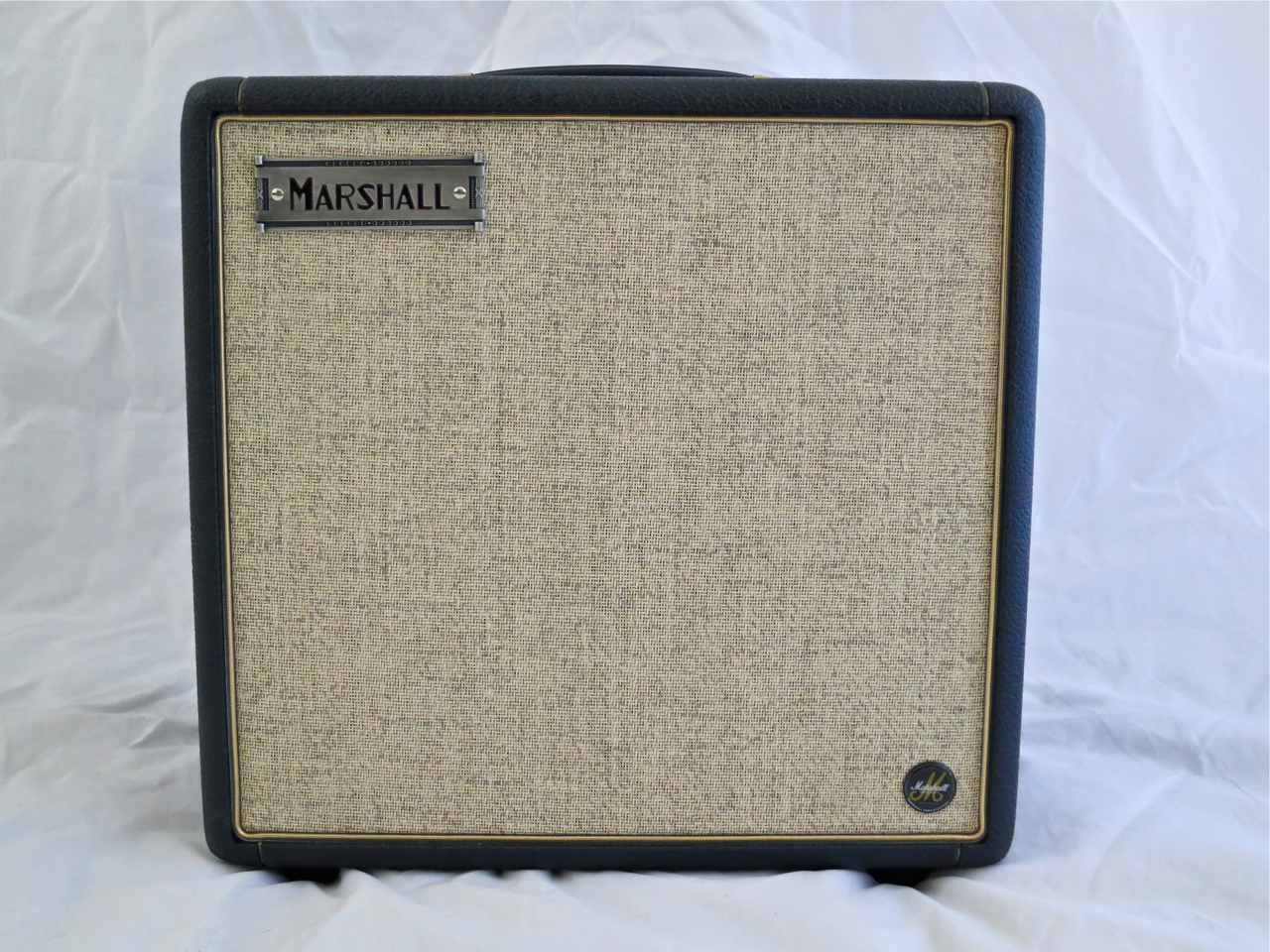
The closed-type Marshall cab holds a single Celestion G10F-15 10-inch speaker.
****

What kinds of sounds do we usually associate with a vintage-style Marshall? Probably clean tones with a dry character and not very much headroom. On the overdriven and distorted side of things we’d definitely look for creamy compression with a good sprinkling of mid-range grunt and presence bite .
…and these are exactly the types of tones the Marshallin Offset dishes out in a very tasty manner!
A vintage-reissue Fender Telecaster stays fairly clean at the beginning of the Custom Offset’s gain range, but the British type of dryness is clearly present:
The higher output of my Gibson Les Paul Junior’s P-90 clearly drives the preamp more, which results in a nice bit of added graininess at the same settings, especially in the attack phase of each note:
A double-humbucker’d Hamer USA Studio Custom finally pushes this Marshall into real break-up territory – fantastic for old-school Blues. For completely clean tones with humbuckers you will have to turn down your guitar’s volume control:
****
Turning up the Marshall’s Loudness-control adds more gain to preceedings, but also raises volume levels considerably. The Custom JTM1 Offset is quite a belter for a one-watter, meaning it’s too loud to be played at full-tilt in most apartment buildings.
Luckily for us, there’s the nifty Power-switch on the back panel, which drops the volume down to neighbour-friendly levels. A nice side effect of going oh-point-one Watts is that it also adds another wallop of overdrive into the mix, which is why you can even get some decent Hard ’n’ Heavy-tones out of this tiny rig.
Here’s a taste of what I got at 0.1 Watts and Loudness turned all the way up.
First the Tele…
…next up the Junior…
…and last, but not least, the Hamer:
****

In my view the Marshall Custom JTM1 Offset is a great-sounding little bugger of a half-stack, giving you most of the classic Marshall tones.
Yes, I know that 1,000 euros is a lot of money for such a tiny amp. If you’re purely on the look-out for a very small valve amp for your living-room or project studio, you will probably get more features (and Watts) for your money from other makes or models.
But the Custom Offset clearly isn’t only about being a small amp; instead there’s a great deal of added prestige in such a well-made, limited edition amp build in England by a company of such standing. The Marshall Custom JTM1 Offset is a boutique-class amp for collectors and purists, and seen in this light the price seems rather fair.
If you’re interested I’d recommend speedy action, though, because the availability is, indeed, very limited!
****
Marshall Custom JTM1 Offset
Finnish distributor: EM Nordic
Thanks to DLX Music Helsinki for the loan of the review sample!
****
Pros:
+ quality of workmanship
+ sound
+ Power-switch
+ small size
+ collectability
****
****
Viime vuonna Marshall juhli 50-vuotista taivaltaan kokonaisella sarjalla pienissä erissä valmistettuja yksiwattisia puolistäkkejä ja komboja.
Ilmeisesti hyvä vire on jäänyt päälle, sillä tänä keväänä Marshall ilmoitti 1111 kappaleeseen rajoitetusta Custom Offset -puolistäkistä, joka on modifioitu versio JTM1-juhlavahvistimesta.
Muutaman kappaleen erä on hiljattain saapunut Suomeen, josta onnistuimme lainata yhden puolistäkin Kitarablogi-testiin.
****
Marshall Custom JTM1 Offset -vahvistimen (hinta noin 1.000 €) lähtökohtana on siis ollut viime vuoden JTM1-juhlamalli. Tämä keräilyvahvistin on kuitenkin viety lähemmäksi firman ensimmäisiä JTM45-malleja käyttämällä alkuperäistä logoa, vaaleata etukangasta sekä keskittämisen sijaan reunaan asennettua etupaneelia, josta vahvari on myös saanut nimensä.
Kuten setin korkean hintatason perusteella sopiikin odottaa, on englantilainen työnjälki Offsetin kohdalla erittäin korkealaatuista.
Vahvistimen kromattu etupaneeli sekä sen mustat, metalliset nupit kielivät vahvistinnupin ylevästä boutique-luokan asemasta.
Kromatusta takapaneelista löytyy viimevuotisesta juhlasarjastakin tuttu teho-nappi, jolla Marshallin päätetehon saa pudotettua yhdestä watista 0,1:een wattiin.
Custom JTM1 Offsetin oma kaiutinkaappi toimii 16 ohmin impedanssilla, mutta nuppiin voi liittää myös kahdeksan ohmia vastusta tarjoavia ämyreitä.
Custom-nupin putkivarustus on sama kuin viime vuoden juhla-JTM1:ssä – etuasteputkina toimii kaksi ECC83/12AX7-putkea ja pääteputki on malliltaan ECC82/12AU7.
Tyyppillisen suljetun Marshall-kaapin uumeniin on asennettu yksi 10-tuumainen Celestion G10F-15 -kaiutin.
****
Millaista soundia yleensä odotetaan vintage-tyyliseltä Marshallilta? Ehkä puhdasta soundia, joka on kirkas, mutta melko kuiva, ja joka ei tarjoa suuria määriä putipuhdasta headroomia. Särösoundilta haetaan varmasti kermaista kompressiota, mutta samalla myös tietynlaista keskialueen rouheutta ja purevuutta.
…ja juuri sellaisia soundeja Marshallin Offset tarjoaa hyvin maukkaalla tavalla.
Fender Telecasterilla sointi pysyy kutakuinkin täysin puhtaana, mutta tyyppillinen brittiläinen kulmikkuus on jo tässä hyvin havaittavissa:
Gibson Les Paul Juniorin P-90 mikrofonin korkeampi lähtötaso aiheuttaa jo pientä, kaunista rakeisuutta etenkin nuottien alkuvaiheissa:
Samoilla säädöilla humbuckereilla varustettu Hamer USA Studio Custom työntää Marshallin selvästi pikkusärön herkkulliseen maailmaan. Täysin puhtaita clean-soundeja täytyy tässä hakea kitaran volume-nuppeja käyttäen:
****
Vääntämällä Marshallin Loudness-potikkaa kaakkoon, soundiin saa yhä enemmän säröä, mutta samalla kasvaa myös volyymitaso. Custom Offset on hyvin kovaääninen puolistäkki yksiwattiseksi vahvistimeksi, eikä täysillä soitettuna vahvistin enää sovi kerrostaloon.
Onneksi on olemassa takapaneelin tehonpudotus-nappi, jolla JTM1 Offset -stäkistä saa ”sisäsiistin”. Toivottuna lieveilmiönä pudottamalla nupin 0,1-wattiseksi myös vahvistimen saturaatio kasvaa, minkä ansiosta Marsusta saa pienellä volyymillä irti hyvin uskottavia heavysoundeja.
Tältä kuulostivat testissä käytetyt kitarat 0,1 W -tilassa ja Loudness täysillä.
Ensin Tele…
…seuraavaksi Junior…
…ja lopulta Hamer:
****
Marshallin Custom JTM1 Offset on mielestäni erittäin hieno pikkustäkki, jolla on juuri sellainen soundi kuin mitä itse hakisin tämänkaltaiselta vahvistimelta.
On kyllä sekin totta, että tuhat euroa on aivan liikaa, jos haetaan ”vain” olohuoneeseen tai pikkustudioon mahtuvaa kitaravahvistinta – pienemälläkin rahalla saa usein jopa enemmän watteja ja ominaisuuksia.
Custom Offsetissa on kuitenkin kyse pitkälti myös rajoitetun painoksen tuomasta prestigestä ja keräilyarvosta sekä Englannissa tehdyn pikkuvahvistimen hienoudesta. Marshall JTM1 Offset on boutique-luokan peli kitarasoiton puristille – ja siinä luokassa se pärjää vallan mainiosti!
On kuitenkin syytä pitää kiirettä, koska Suomeen on saapunut vain muutama kappale tätä mallia, eikä lisää enää tule!
****
Marshall Custom JTM1 Offset
Maahantuoja: EM Nordic
Kiitos DLX Musiikille testiyksilöiden lainasta!
****
Plussat:
+ työnjälki
+ soundi
+ kaksi päätetehoa
+ pieni koko
+ keräilyarvo
****

****

One of the hottest new products at this year’s Musikmesse was the Multiamp from Italian makers DV Mark.
The DV Mark Multiamp head niftily combines pro-quality amp and cab models with top-drawer effects and a very powerful – yet unbelievably lightweight – 500 Watt Class-D power amplifier.
****

The DV Mark Multiamp (current price in Finland: 1.380 €) is build to withstand serious use, yet is still manages to look elegant. The whole chassis is made from sturdy folded metal, with the front panel finished in a fetching cream white.
You can put the Multiamp on your speaker cabinet (or on your table), or install it in a 19-inch rack. DV Mark have supplied the necessary mounting brackets and screws with the amp.

A very quiet, brushless fan keeps the unit cool.
****
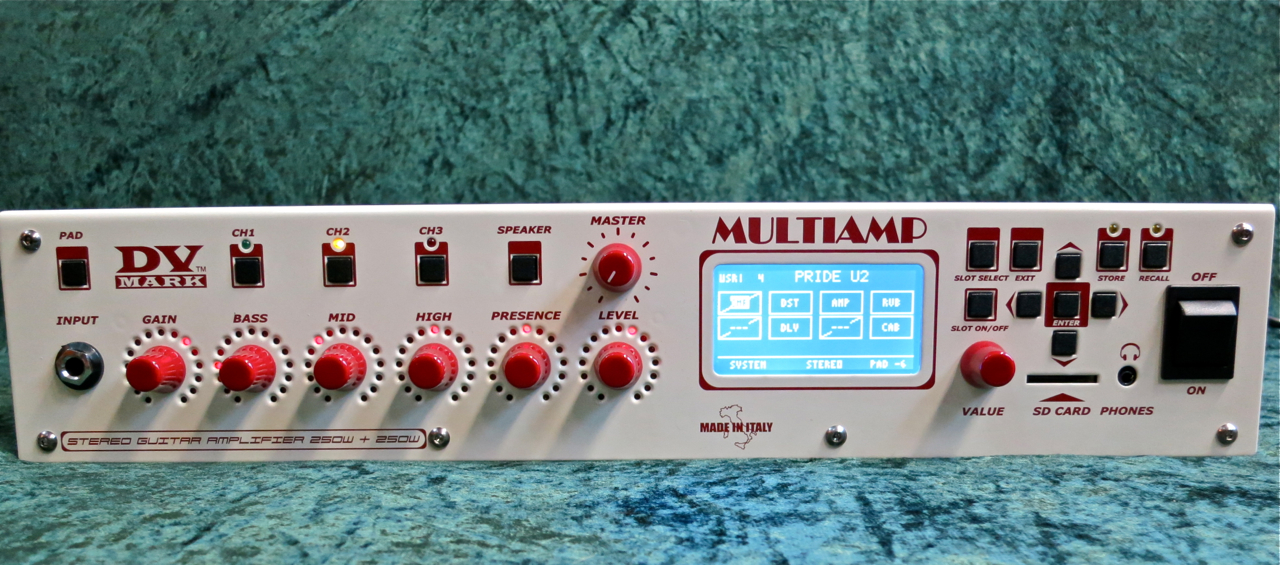
DV Mark’s Multiamp has been designed with user-friendliness as one of the main focus points.
Thanks to the front panel’s very logical layout, as well as the easy-to-use user interface, the Multiamp presents you with a surprisingly shallow learning curve. It’s a digital amp head, but you won’t need a degree in physics to get to grips with it!

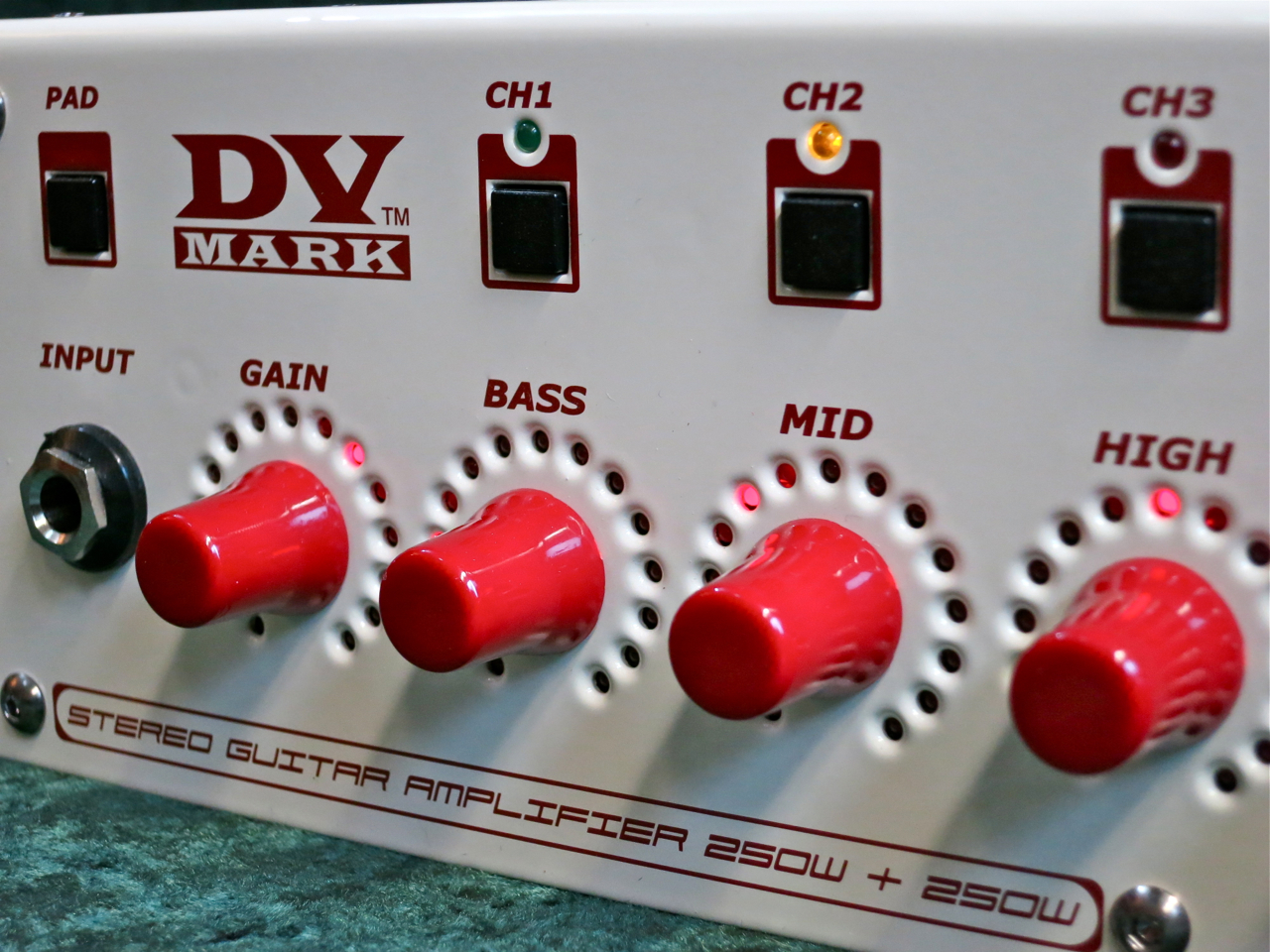
The left half of the front panel is reserved for the traditional set of amp controls.
The LEDs around the digital control knobs will keep you in the picture about your current settings, even on a darkened stage. The only ”traditional” knob is the Master-knob, which adjusts both the power amp’s volume, as well as the headphones level.
The three Channel-buttons on the Multiamp might lead you to the wrong conclusion that patches consist of a set of three different preamp channels. In reality each preset only consists of a single amp-plus-effects chain.
The basic idea behind the Channel-buttons is to give the guitarist a good idea of what type of sound he is currently running by a simple look at the status LEDs.
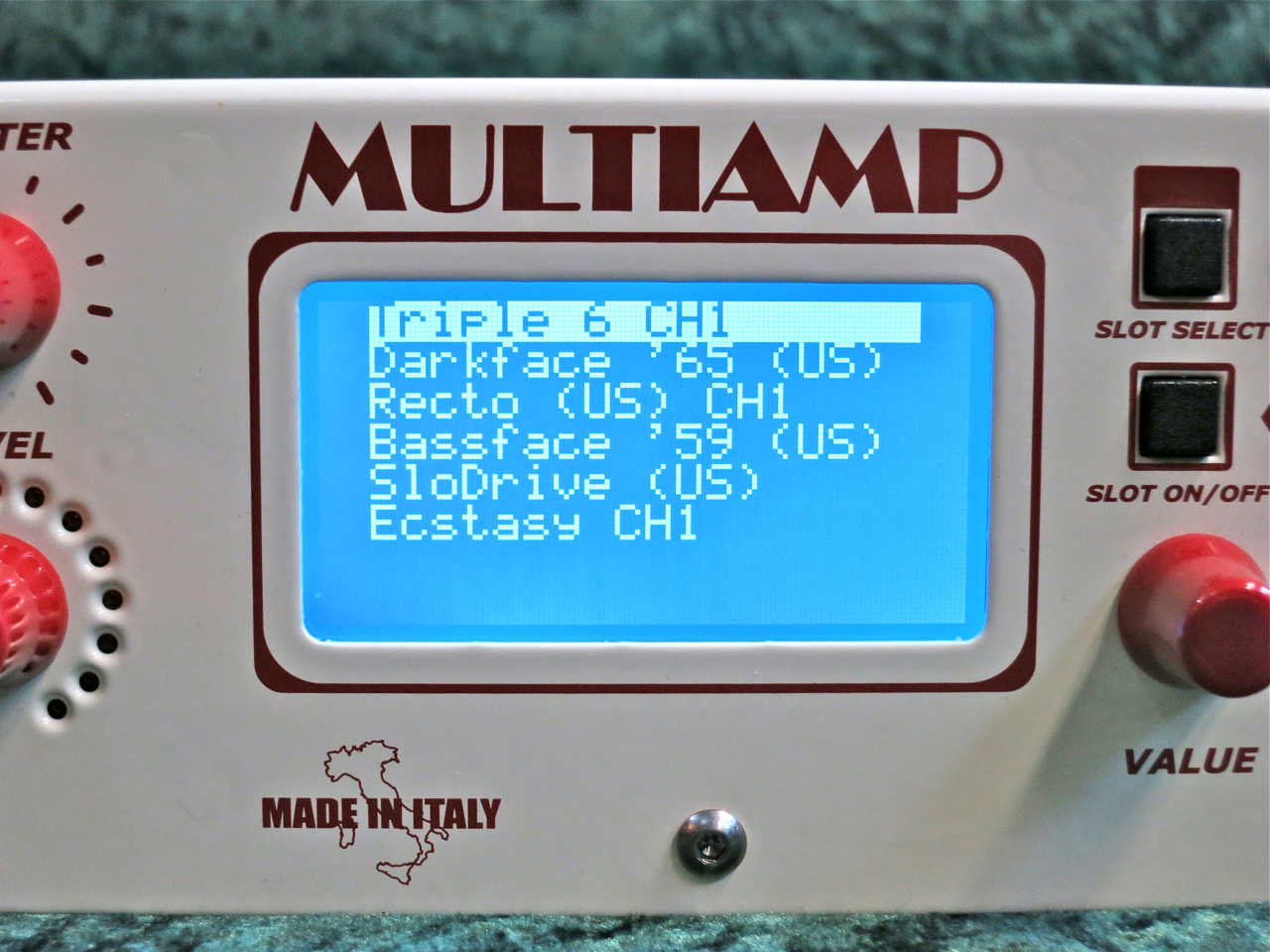
Channel 1 gathers together all of the Multiamp’s clean virtual amp models.
In addition to a virtualised version of DV Mark’s own Triple 6, the head offers five clean models, based on famous amps.

Slight breakup to full-on crunch is the name of the game in Channel two…
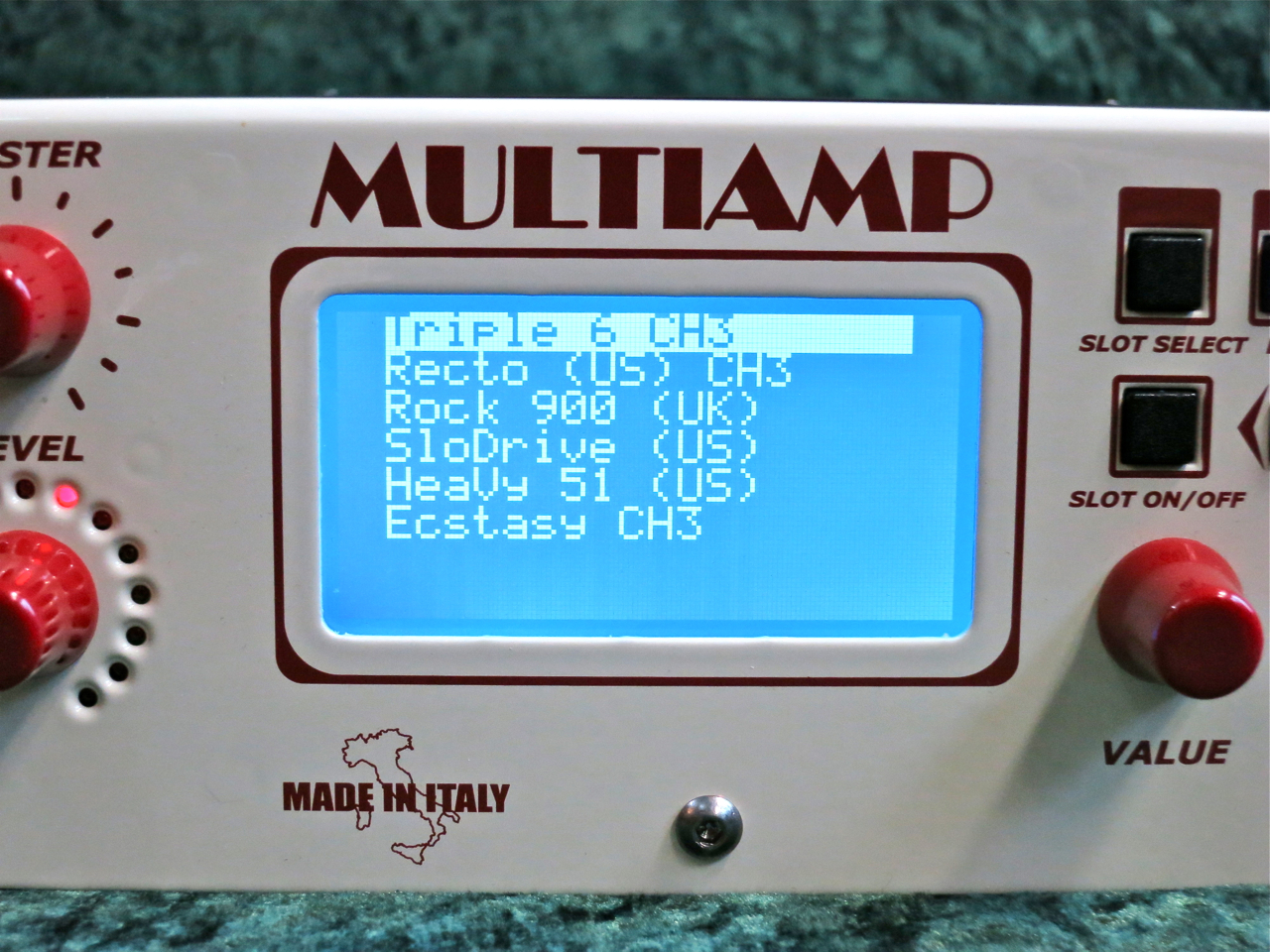
…while Channel 3 is home to all things high-gain.
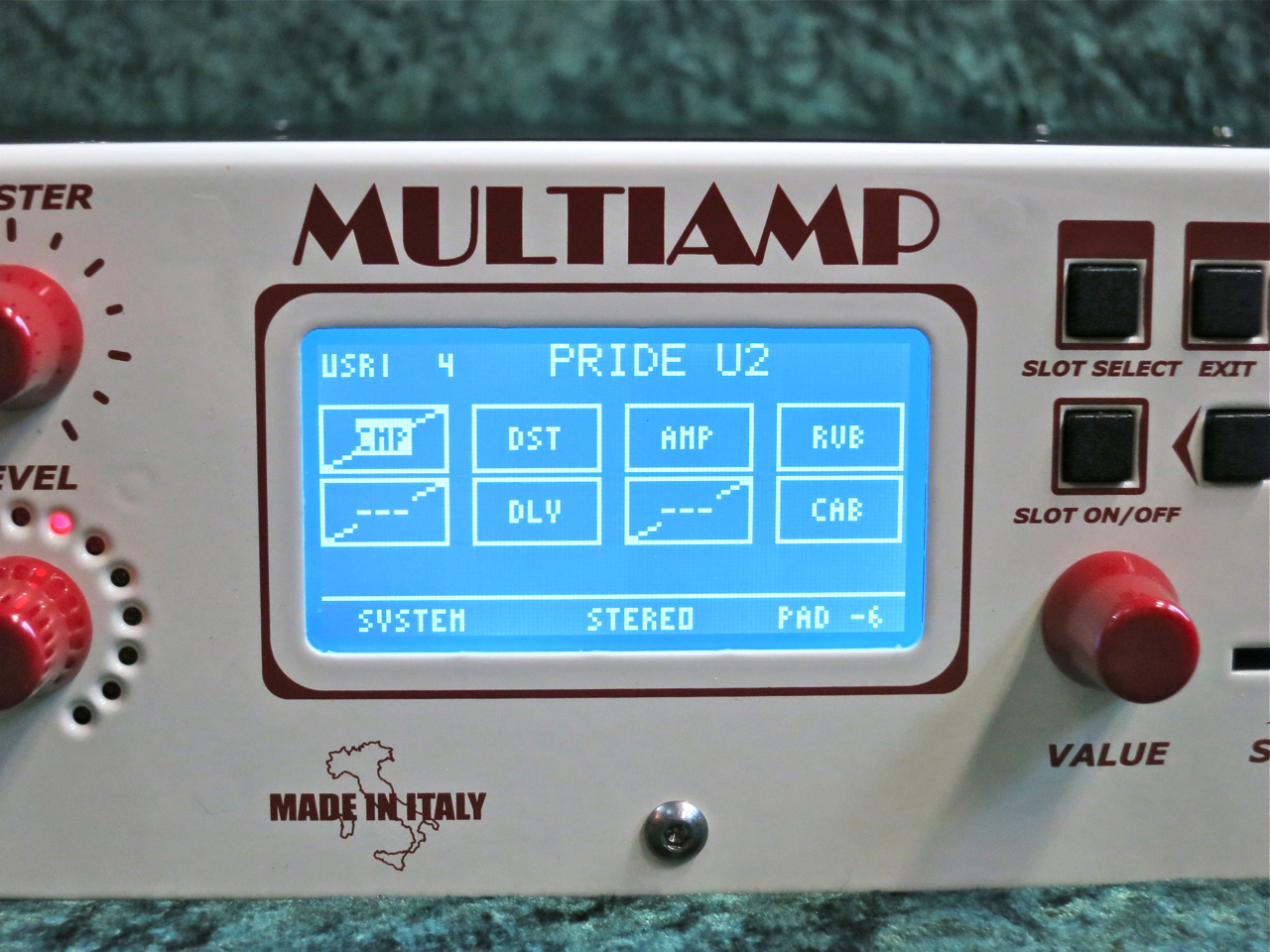
Next to the amp section sits the Multiamp’s clear, backlit display.
The home screen displays the currently selected preset, with the whole signal chain displayed as blocks, or: Slots in Multiamp-speak.
The signal flow is in reading direction, starting from the top left and ending at the bottom right slot. A crossed out effect slot means that the respective effect is currently bypassed.
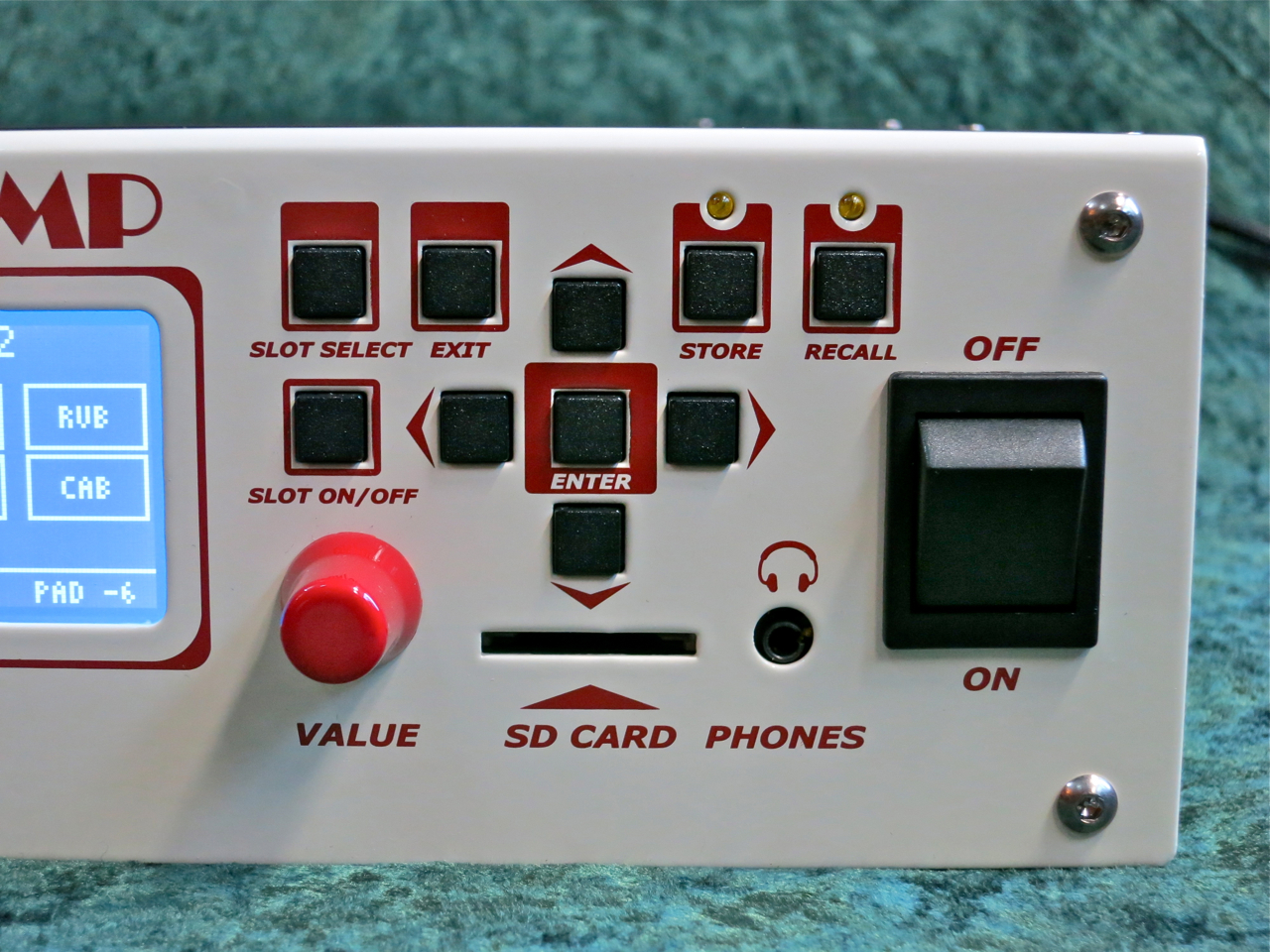
Everything that has to do with parameter changes and patch editing, storing and recalling is controlled by these buttons and the red Value-control.
You can also import and export DV Mark Multiamp-patches using an SD-card. DV Mark are already offering free artist patches for download on their Multiamp Ambassador page, as well as their main website.

You can use the DV Mark Multiamp in stereo or mono: In bridged mono the power amp puts out a whopping 500 Watts (8 Ω), while stereo use will give you a maximum of 250 Watts per side (4 Ω).
In addition to DI- and line outputs, the back panel also offers you an external effects loop, MIDI-connectors, and a USB-port.
The Multiamp can’t be used to stream USB-audio, but I have heard rumours of an upcoming editor software, which would utilise the USB-port.
MIDI is very important, because you have to use a MIDI-controller for on-the-fly preset switching.
****
In addition to its virtual amps and cabs DV Mark’s Multiamp offers you 19 different effects at the moment. They include all sorts of guitar effects from a compressor and a noise gate all the way to several different distortion pedals, vibrato or auto wah.
Some digital amp modellers may offer an even wider variety of effects, but the Multiamp clearly puts quality above quantity. Besides: Future firmware updates are likely to add to the current effects line-up – the latest update came with a parametric EQ, for example.

Programming he Multiamp is made easy by the fact that DV Mark have managed to fit each effect’s parameters onto a single page, so there’s no jumping around different menus.
What I would like to see, though, is a better, more detailed owner’s manual. At the moment, the manual contains a simple listing of the available effects, but tells you nothing about the function of each effect’s parameters. This means you have to try out all parameters in order to get an idea of what each one does.

I really like the virtual speaker (and microphone) section a lot! It is a fantastic tool, if you’re running a direct line into a mixer or sound-card.
In addition to a whole range of different cabinets, the Cab-slot also offers a number of virtual mics, as well as three different choices for virtual microphone placement (On Axis/Off Axis/Far).
****
In light of this test I can only recommend the DV Mark Multiamp as an outstanding tool for the creative guitarist. This amp head offers you a wide variety of excellent amp and cabinet models, as well as pro-quality effects.
In my view it is rather futile to dissect the authenticity of the virtual amps, if you don’t have all of the original (physical) amps for comparison. Suffice it to say that the Multiamp’s amp models tick all the right boxes in terms of their tones and their dynamic behaviour.
This head reacts like the real deal, when it comes to guitar volume changes and a player’s dynamics, and it sounds great, regardless of whether it’s run straight into a mixing console or used to fire up a guitar speaker.
Here are two clean examples taken from the Multiamp’s CH1-models, and using a Fender Stratocaster:
I’ve chosen an Epiphone Casino for these two soundbites, using amp models from CH2:
…and here are two examples of what the CH3-models can do for you; played on a Hamer Studio Custom:
****
For on-stage use, you will first have to find out how the Multiamp’s MIDI-section works, as the owner’s manual comes over as extremely tight-lipped on this front.
Luckily, the Multiamp has been designed to work with virtually all types of MIDI-equipment. Just plug in a floor controller of your choice, select the patch bank you want to access by pressing the Recall-button on the Multiamp – and off you go! Step on your controller, and the desired preset will be called up.
MIDI-switching is very fast and smooth, and doesn’t result in any audio clicks or other irritating artifacts.
****
In my view the DV Mark Multiamp is a fabulous piece of equipment, which will win you over with its great sounds, its power, its lightness and its user-friendliness. Its a fantastic tool for both studio- and live-use.
The user’s manual certainly needs an overhaul – and some folks might miss an on-board tuner – but this isn’t enough to spoil the fun. And the Multiamp is a lot of fun!

****
DV Mark Multiamp
Current price in Finland: 1.380 €
Finnish distributor: Nordsound
****
Pros:
+ sturdy build
+ lightweight
+ can be updated
+ versatile
+ pro-quality sound
+ powerful
Cons:
– tight-lipped manual

****
Yksi tämänvuotisen Frankfurt Musikmessen kuumimmista uutuuksista oli italialaisen valmistajan DV Markin digitaalinen kitaranuppi, Multiamp.
DV Mark Multiamp -nupissa ydistyvät pro-luokan vahvistin- ja kaappimallinnukset, laadukkaat efektit, sekä erittäin tehokas – mutta samalla myös uskomattomman kevyt – viidensadan watin päätevahvistin.
****
Multiampin (1.380 €) ulkoinen olemus on luottamusta herättävä ja erittäin siisti. Nupin koko kotelo on valmistettu taitetusta metallista, ja etupaneeli on viimeistelty kermanvaaleaksi.
Multiamp sopii sekä suoraan kitarakaapin (tai vaikkapa pöydän) päälle laitettavaksi että laiteräkkiin. Hyvin asialliset räkkiraudat kuuluvat pakettiin.
Ilahduttavan hiljainen tuuletin pitää huolen tehokkaan päätevahvistimen jäähdytyksestä.
****
DV Mark Multiampin etupaneeli on suunniteltu käyttäjälle ystävälliseksi.
Selkeän etupaneelin ja erittäin loogisesti toimivan käyttöliittymän ansiosta, tavallinenkin pulliainen tulee tämän digitaalisen nupin kanssa yllättävän nopeasti toimeen.
Etupaneelin vasen puoli on varattu täysin nupin vahvistinosiolle.
Digitaalisten säätimien mainioiden lediketjujen ansiosta, nuppien asetukset näkyvät selkeästi myös pimeällä lavalla. Ainoastaan päätevahvistimeen (ja kuulokevolyymiin) vaikuttava Master-säädin on perinteinen, analoginen potikka.
Multiampin kolmesta ”kanavanupista” voisi syntyä sellainen väärä vaikutelma, että jokaisessa patchissa olisi valmiiksi ohjelmoitu kolme vahvistinkanavaa. Todellisuudessa nupin patcheissa on aina kerrallaan pelkästään yksi vahvistin-plus-efektit-ketju.
Channel-nappien idea on jäsennellä Multiampin vahvistinmallinnuksia niin, että kitaristi tietää heti jo kanavan statusledistä, minkätyypisestä soundista on kyse.
Ykköskanavaan on koottu kaikki puhtaat vahvistinvalinnat.
DV Markin oman Triple 6 -vahvistimen lisäksi on mallinnettu viisi kuuluisaa vahvistinta, joita tunnistaa helposti Multiamp-vastineiden nimistä.
Kakkoskanavasta löytyy viisi mallinnusta sellaisista vahvistimista (tai niiden kanavista), joiden sointi ulottuu melko puhtaasta jo selkeästi säröpuoleen.
Kolmannen kanavan tarjonta keskittyy sitten vain ja ainoastaan rankkojen genrejen soundeihin.
Vahvistinosion viereen on sijoitettu Multiampin selkeä, taustavalaistettu näyttö.
Perusnäkymässä näytetään valitun patchin koko efektiketju, joka koostuu maksimissaan kahdeksasta eri efektistä.
Signaalikulku vastaa lukemisjärjestystä – siis: vasemmassa yläkulmassa oleva efekti on ketjun ensimmäinen ja oikeassa alakulmassa sijaitse ketjun viimeinen palikka (Multiamp-sanastossa: Slot). Yliviivattu efektipalikka on tällä hetkellä pois päältä.
Patchien ohjelmointi, efektien valinta ja niiden hienosäätäminen, sekä patchien tallennus ja manuaalinen valinta hoidetaan näillä painonapeilla ja punaisella Value-säätimellä.
DV Mark Multiamp -patcheja voi siirtää eri laitteiden välillä myös SD-kortilla. DV Mark tarjoaa jo nyt Multiamp Ambassador -sivullaan (sekä myös pääsivullaan) eri artistien ohjelmoimia presettejä ladattavaksi ilmaiseksi.
DV Mark Multiamp -nuppia voi käyttää joko monofonisena tai stereona. Monokäytössä vahvistimen pääteteho voi maksimissaan olla 500 wattia (8 Ω), kun taas stereona nupista irtoaa vastaavasti 250 wattia per sivu (4 Ω).
DI- ja linjalähtöjen lisäksi takapaneelista löytyy myös liittimet ulkoiselle efektilaitteelle, sekä MIDI-liittimet ja USB-portti.
Multiamp ei valitettavasti pysty striimaamaan audiota USB:n kautta, mutta olen kuulut huhuja tulevasta softaeditorista, joka hyödyntäisi luonnollisesti laitteen USB-porttia.
MIDIä taas tarvitaan livekäytössä midi-kontrolleria varten, jotta pystyy vaihtamaan Multiampin patcheja lennossa.
****
Vahvistin- ja kaappimallinnuksien lisäksi DV Mark Multiamp tarjoaa tällä hetkellä 19 eri efektityyppiä Slot-palikoiden täytteeksi, ja valikoima ulottuu kompressorista ja kohinaportista kaiun ja eri viive-efektien kautta eri säröpedaaleille tai vaikkapa auto-wahille.
Joissakin mallintavissa vahvistimissa on ehkä tätäkin enemmän efektytyyppejä tarjolla, mutta Multiampissä on selkeästi satsattu efektien kohdalla laatuun, eikä määrään. Sitä paitsi on DV Markilta luvattu firmware-päivityksien mukaan myös uusia efektejä – viime päivityksessä lisättiin esimerkiksi parametrinen EQ!
Parametrien ruuvailua helpottaa suuresti, että DV:ltä on onnistettu mahtumaan valitun efektityypin kaikkia parametrejä yhteen ikkunaan.
Toisaalta olisin etenkin efektien ja kaappiostaston yhteydessä toivonut parempaa käyttöohjetta. Nykyinen käyttöopas (englannin- ja italiankielinen) on hyvin lyhyt, eikä se esimerkiksi kerro lainkaan mitään efektien parametrien toiminnasta tai säätövarasta. Nyt jää vain jokaisen parametrin kokeileminen, ennen kun saa selvää valitun efektityypin kaikista mahdollisuuksista ja toiminnoista.
DI-käytössä studiossa (tai lavalla) ilman fyysistä kaappia Multiampin kaappimallinnus osoittautuu oivaksi työkaluksi, joka tarjoaa monipuolista säätövaraa, jolla voi antaa signaalille sen kuuluisan loppusilauksen.
Pelkään kaappisimulaation lisäksi saadaan Cab-palikasta myös monta eri mallinnettua mikrofonimallia, sekä mahdollisuuden vaikuttaa virtuaalimikin sijaintiin kaiuttimen edessä (On Axis/Off Axis/Far).
****
Tämän testin perusteella voin todeta, että DV Markin Multiamp on erinomainen työkalu laajan soundikirjoa tarvitsevalle kitaristille. Nuppi tarjoaa erittäin laadukkaita vahvistin- ja kaappimallinnuksia, sekä pro-luokan efektejä, omien patchien raaka-aineeksi.
Vahvistinvaihtoehtojen autenttisuudesta on mielestäni turha väitellä, jos ei ole mahdollisuus vertailla suoraan Multiampin ja mallinnettujen vahvistimien välillä. Multiampin vahvistimissa on kuitenkin kieltämättä kaikkia näitä ominaisuuksia, joita kummastakin fyysisestä mallista odottaisi kuulevan.
Nuppi reagoi uskollisesti soittodynamiikkaan, ja se kuulostaa hyvin luonnolliselta riippumatta sitä, mennäänkö linjalähtöjen kautta studiomonitoreille vai fyysisen kitarakaapin läpi.
Tässä kaksi puhdasta esimerkkiä Multiampin CH1-soundeista Fender Stratocasterilla soitettuna:
Äänitin kaksi klippiä CH2-vaihtoehtojen kautta Epiphone Casinolla:
…ja lopuksi kaksi särösoundin esimerkkiä CH3-vaihtoehdoista Hamer Studio Custom -kitaralla soitettuna:
****
Live-käyttöä varten joutuu ensin hieman funtsimaan Multiampin Midi-toimintoja, koska käyttöohjeessa ei lue mitään tähän teemaan liittyvää.
Onneksi Multiamp toimii sulavassa yhteistyössä käytännössä kaikkien Midi-laitteiden kanssa. Lattiakontrolleri liitetään nupin Midi In -porttiin, minkä jälkeen valitaan vain Recall-napilla minkä muistipankin patcheja halutaan käyttää – enempää ei tarvita. Polkaisu kontrolleriin, ja oikea patchi on valittu.
Patchien vaihtaminen Midi-kommennoilla käy ilman minkäänlaista viivettä, ja myös täysin ilman naksahduksia audiosignaalissa.
****
Mielestäni DV Mark Multiamp on loistava laite, joka saa soittajan puolelleen sen erinomaisilla soundeilla, suurella teholla, kevyellä painolla ja suurella käyttäjäystävällisyydellään. Vahvistin sopii hyvin sekä studioon että keikalle.
Käyttöohje tarvitsee mielestäni päivittämistä – ja joidenkin mielestä sisäinen viritysmittari olisi tervetullut lisä tähän pakettiin – mutta tämä ei himmennä DV Mark Multiampin loistavuutta minun silmissäni.
****
DV Mark Multiamp
1.380 €
Maahantuoja: Nordsound
****
Plussat:
+ kestävänoloinen
+ kevyt
+ voi päivittää
+ monipuolinen
+ pro-luokan soundi
+ tehokas päätevahvistin
Miinukset:
– lyhytsanainen käyttöohje

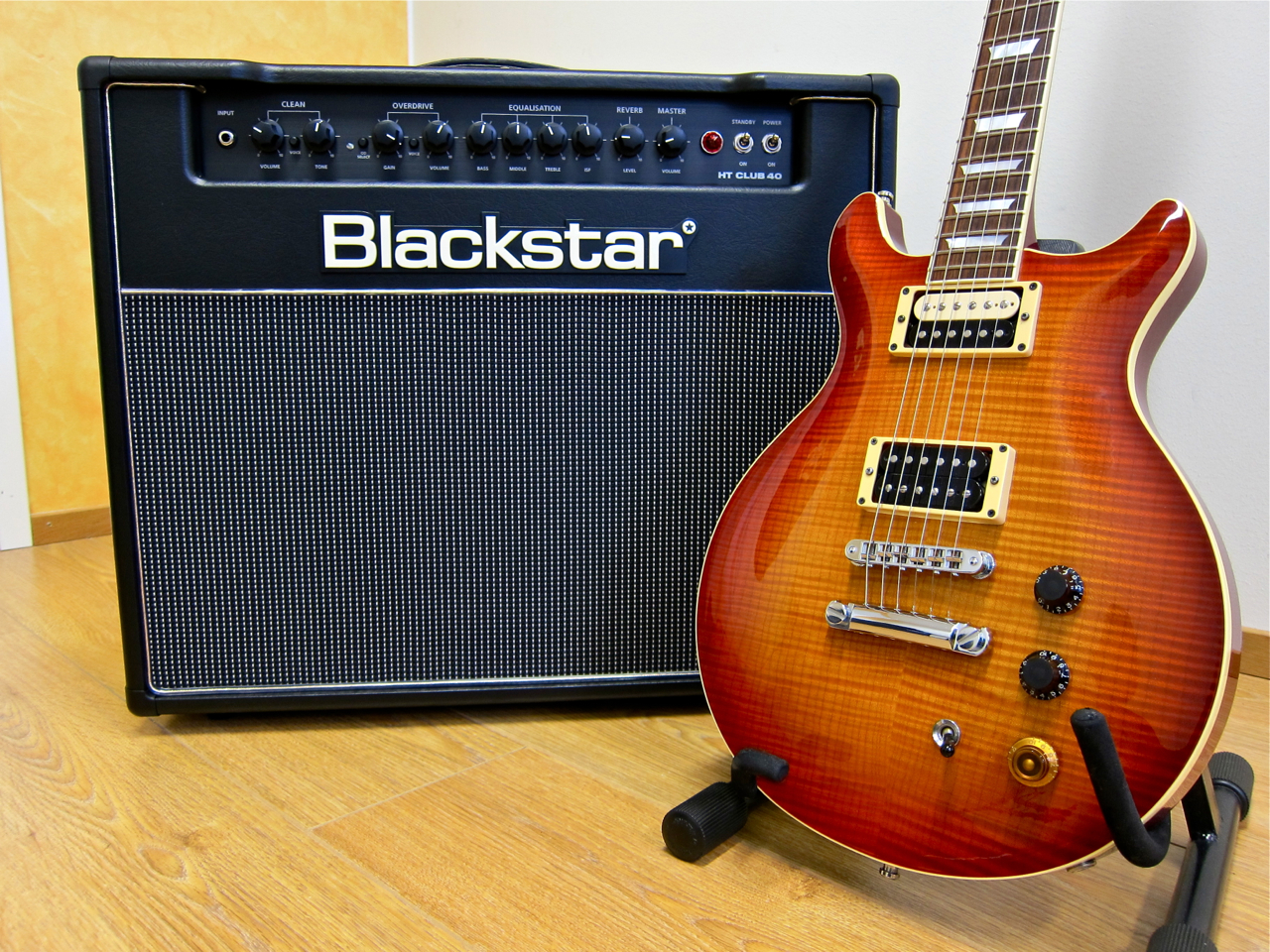
British company Blackstar Amplification have earned a reputation for producing versatile, reliable, no-nonsense valve amplifiers for the modern player. Their ever-growing roster of endorsers from a wide variety of different musical styles is an irrefutable testament to this.
This time Kitarablogi will take a closer look at the Blackstar HT Club 40 combo (current price in Finland 694 €), which looks like the perfect workhorse for the gigging guitarist.
****

As indicated by its name, the Blackstar HT Club 40 is a 40-Watt valve combo. The preamp is designed around two ECC83-valves, while the power amp uses a pair of EL34s.
This made-in-China combo is a two-channel affair and comes equipped with a single 12-inch speaker.

One of Blackstar’s trademarks is the clean and crisp, unfussy look – the HT Club 40 means business, and it’s ready to go.

This mid-sized combo weighs in at about 24 kilos, which makes it relatively easy to move around.

The combo’s back is almost fully closed, which makes achieving stack-like tonalities from a combo amplifier easier.
Because of the very small opening – and the compulsory metal safety grille – changing valves is rather tedious, as you will have to remove the whole back panel for the procedure.
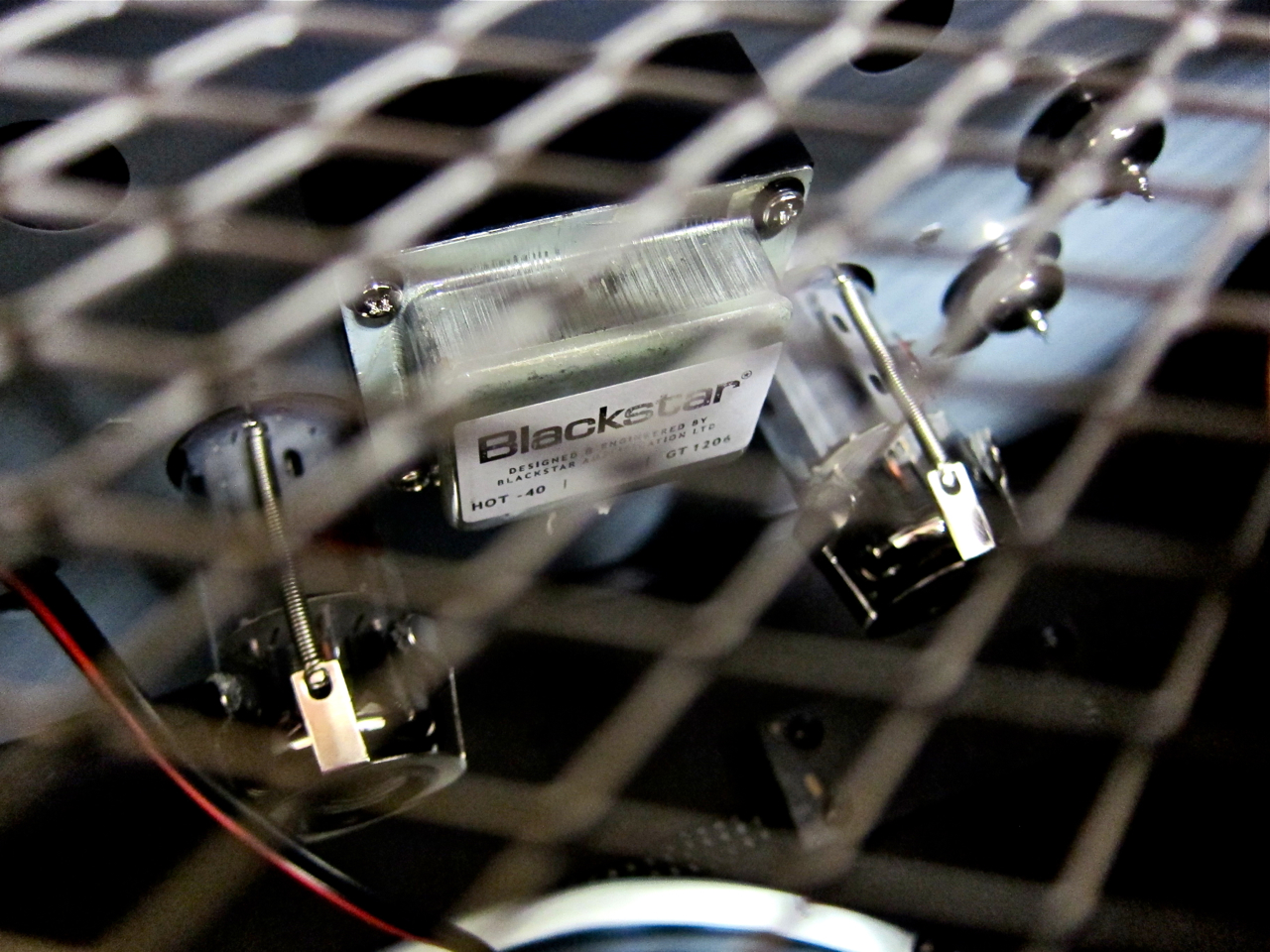
Looking in through the grille you can spot the valves…

…as well as the combo’s quality transformers.
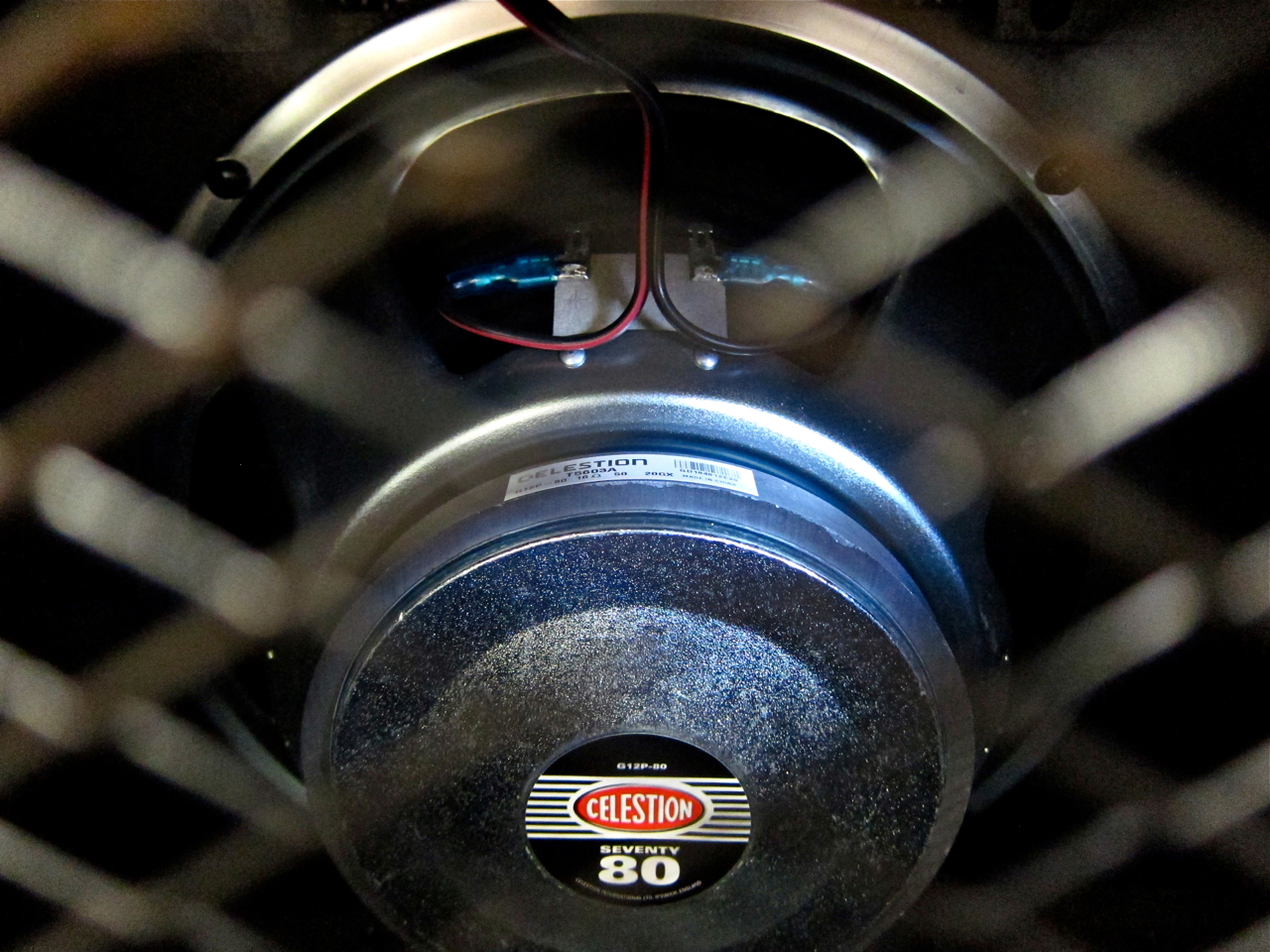
Blackstar have chosen a Celestion Seventy 80 -speaker for the HT Club 40 – a speaker highly regarded for its dynamic and open sound.
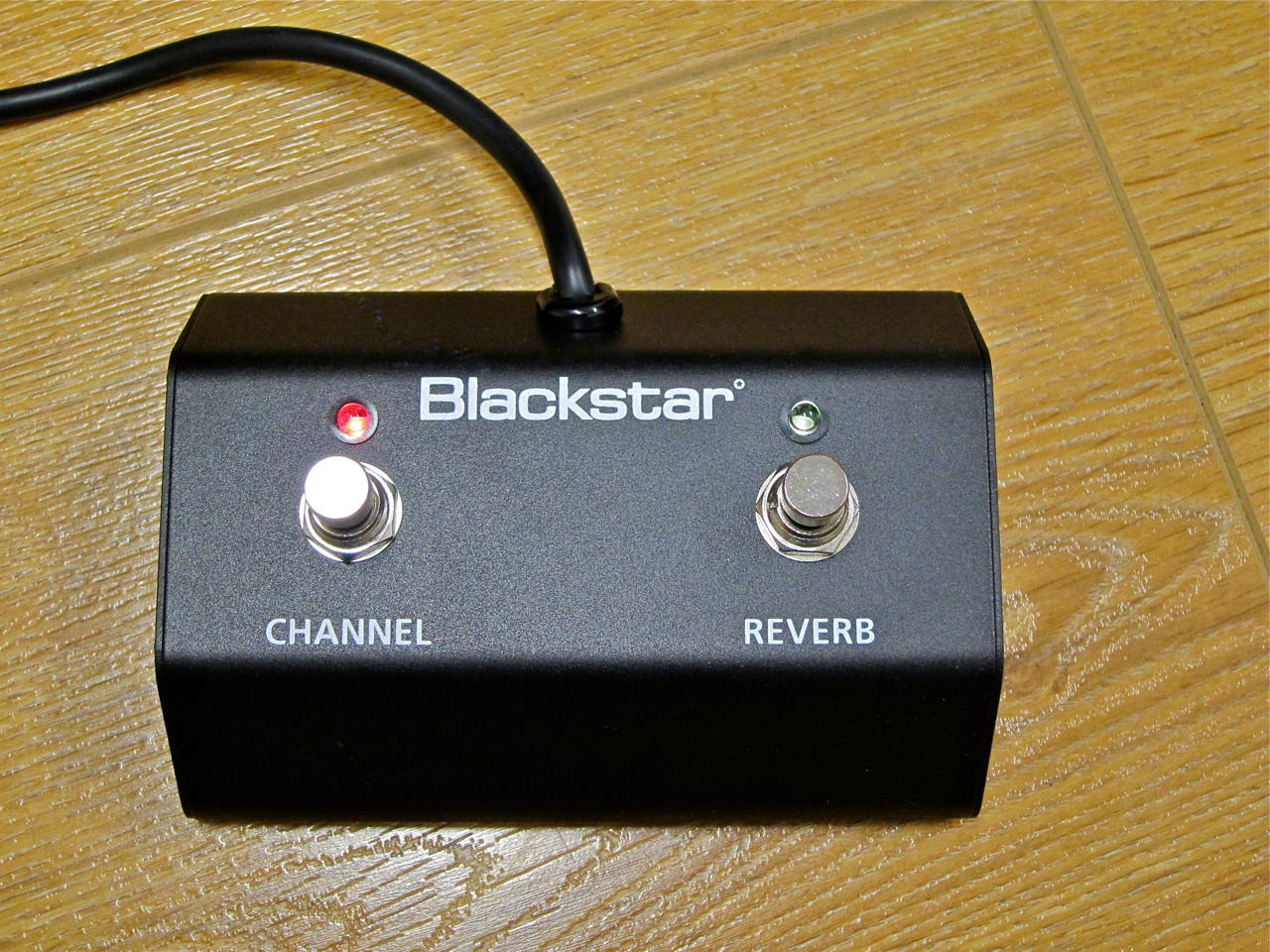
A sturdy FS-5 footswitch unit is included in the price.
****
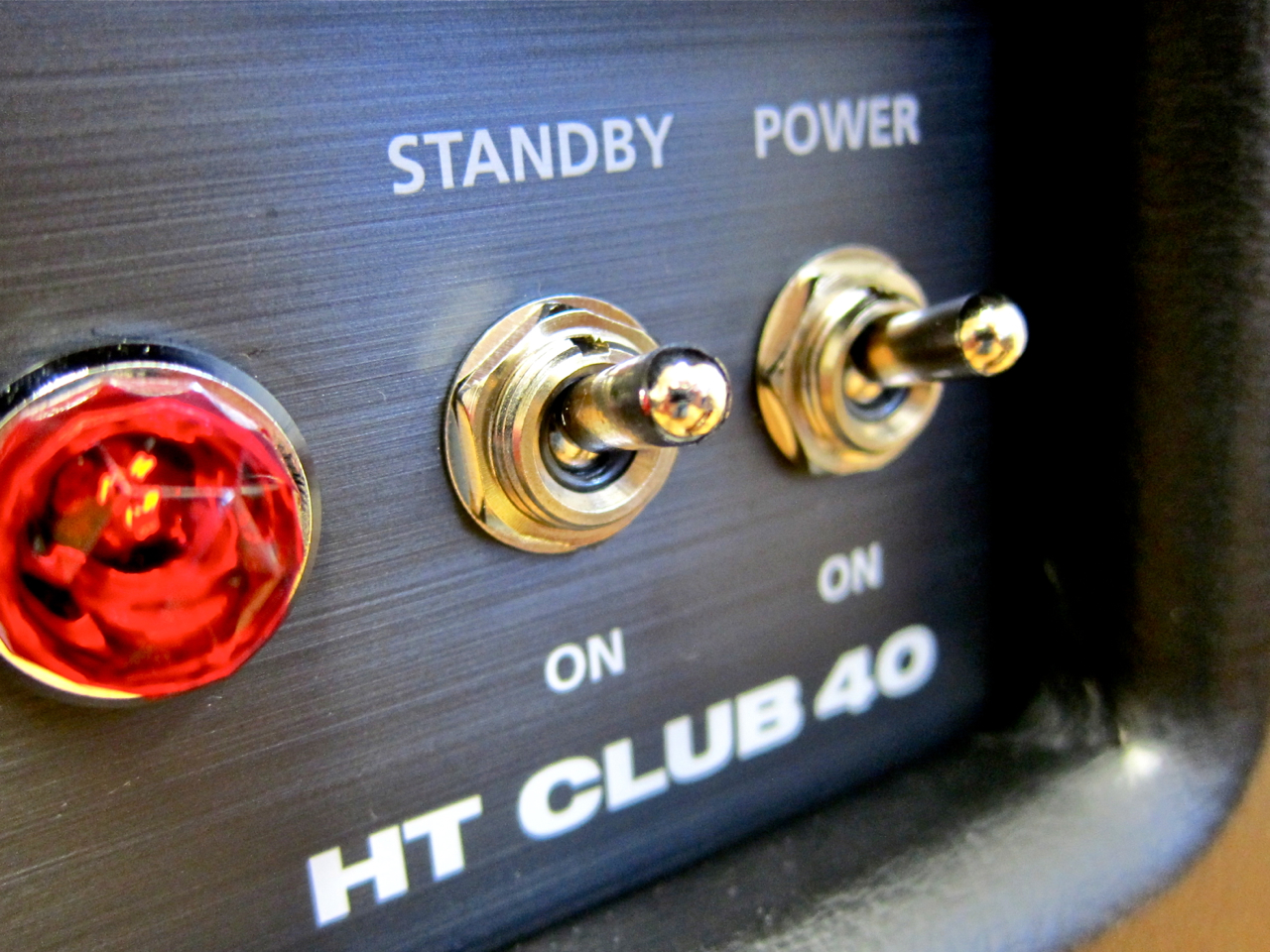
Even though the Blackstar HT Club 40 is called a two-channel combo, the amp’s many features offer the player a wider palette of sounds than he (or she) might expect from such a compact design.

The clean channel offers you two controls – Volume (gain) and a simple Tone knob. The channel’s Voice switch gives you two different versions of the clean channel.
Boutique Clean has the HT Club 40 working in Class A -mode, which even lets you dial in a good dose of grainy dirt using the Volume knob.
In Modern Clean the amp runs in Class AB, and offers a fatter bass, and a far cleaner overall tone, even at high Volume settings.
****
The overdrive side offers you separate gain and volume controls, enabling you to get even the most distorted tones at moderate volume levels. This channel is also equipped with its own Voice switch.
Classic Overdrive takes the Blackstar into classic Seventies and Eighties Marshall-territory – the sounds are chunky and tight.
Modern Overdrive gives you more gain, a bigger bass register, as well as a creamy and vocal mid-range.

The overdrive channel also offers a far more versatile EQ-section than the clean channel.
In addition to the fine three-band EQ, Blackstar have included their patented ISF-feature. The settings of the ISF-knob (ISF = Infinite Shape Feature) directly influence the EQ-section’s tonality, as well as the overall tonal response. ISF set to zero (Blackstar call this the USA-setting) results in a very tight bass response with a sharper treble zing, compared to ISF at ten (UK), which sounds fuller and fatter.
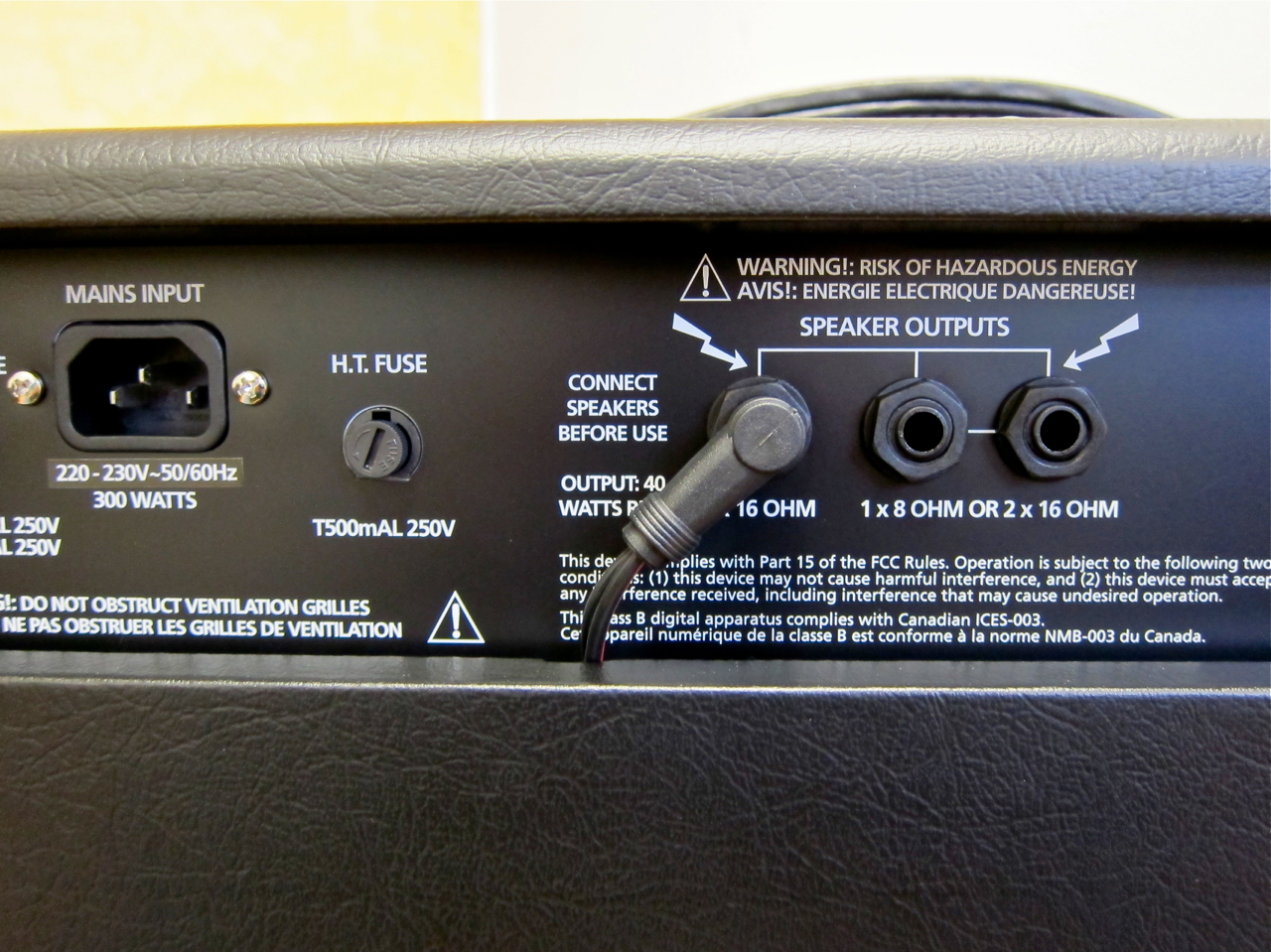
The back panel offers you three different speaker outputs…

…a speaker-simulated line out, an effects loop, and the Reverb switch that lets you choose from two different reverb characteristics. The HT Club 40’s fine reverb is digital.
****

Here are some Blackstar HT Club 40 sounds I recorded using a Hamer USA Studio Custom and a Gibson Les Paul Junior:
Gibson Les Paul Junior – Modern Clean
Hamer Studio Custom – Modern Clean
Gibson Les Paul Junior – Boutique Clean (Volume at full)
Hamer Studio Custom – Boutique Clean (Volume at full)
Gibson Les Paul Junior – Classic Overdrive
Hamer Studio Custom – Classic Overdrive
Hamer Studio Custom – Modern Overdrive
****
The Blackstar HT Club 40 is a joy to work with! The combo dishes out a plethora of quality tones, and it proved very intuitive and easy to use.
In effect, the HT Club 40 really offers you four quality amps in one package:
Modern Clean is a Fender-like (or Mesa/Boogie-type) clean channel with oodles of headroom. Boutique Clean embodies Class A interactivity – there’s less clean headroom, but the amp reacts organically to your playing dynamics, as well as the volume knob setting on your guitar. Classic Overdrive is the place to go to for all your classic Blues Rock, Hard Rock and Metal needs, with Modern Overdrive catering for the current gain-saturated mosh-pit crowd.
In my opinion the Blackstar HT Club 40 is a fantastic choice for the guitarist on the move. It will give you great tones on stage, as well as in the studio, where using a moderately-sized amp may prove to be a more workable solution than going for a full blown stack.
****
Blackstar HT Club 40
Current price in Finland: 694 €
Finnish distributor: Musamaailma
****
Pros:
+ bang-for-the-Euro
+ sound
+ versatility
+ speaker-simulated line out
+ workmanship
Brittiläinen Blackstar Amplification on saavuttanut verrattaen nopeasti maineen monipuolisten, nykyaikaisten ja luotettavien putkivahvistimien valmistajana. Yhä laajentuva endorserikatras – josta löytyy niin erityylisiä nimiä kuin Manic Street Preachers ja Dimmu Borgir – kertoo sekin jotain merkin arvostuksesta.
Tällä kertaa katsomme hieman tarkemmin Blackstarin HT Club 40 -komboa (694 €), joka on tarkoitettu keikkailevan kitaristin uskolliseksi työjuhdaksi.
****
Nimensä mukaisesti Blackstar HT Club 40 on 40-wattinen kitarakombo, joka on toteutettu täysputkikytkennällä. Etuvahvistimessa toimivat kaksi ECC83-putkia, kun taas päätevahvistin saa voimansa kahdelta EL34-tyypiltä.
Kiinassa valmistettu kombo on kaksikanavainen, ja se on varustettu yhdellä 12-tuumaisella kaiuttimella.
Blackstar-kombojen selkeä, siisti ja kaunis olemus on sekin noussut jo yhdeksi firman tavaramerkiksi, ja HT Club 40 jatkaa tätä linjaa.
Blackstarin keskikokoinen kombo painaa hieman yli 24 kiloa, mikä on vielä hyvin roudausystävällinen putkikomboksi.
Lähes kokonaan suljetun kotelon ansiosta, kombosta saa tyypillisten kombosoundien lisäksi myös hyvin uskottavia stäkkisoundeja.
Pienen aukon – ja nykyaikaisten turvallisuusmääräyksien – takia putkien vaihtaminen on hieman työlästä, koska koko takapaneeli on ensin irrotettava, ennen kuin putkiin pääsee käsiksi.
Metalliritilän läpi näkyy kombon putket…
…sekä sen laadukkaat muuntimet.
Kombon kaiuttimeksi on valittu Celestionin Seventy 80 -malli, joka on tunnettu sen dynaamisesta ja avoimesta perusluonteestaan.
Suoraviivainen ja kestävänoloinen Blackstar FS-5 -jalkakytkin kuuluu hintaan.
****
Vaikka Blackstar HT Club 40 kutsutaankin kaksikanavaiseksi komboksi, on vahvistin – runsaiden ominaisuuksiensa ansiosta – huomattavasti monipuolisempi kuin luulisi.
Puhdas kanava tarjoaa vain kaksi säädintä – Volume (gain) ja helppokäyttöinen Tone. Voice-kytkimellä saa kuitenkin muutettua puhtaan kanavan luonetta perusteellisesti.
Boutique Clean -nimisessä tilassa HT Club 40 toimii tyypillisen A-luokan kitaravahvistimen tavoin, jossa Volume-säätimen avaaminen lisää ensin vain hieman kompressiota ja rosoisuutta, mutta säätimen loppumetreillä soundi muuttuu selvästi säröiseksi.
Modern Cleanissä kombo toimii AB-luokan periaatteella, jolloin bassorekisteri on muhkeampi, ja signaali pysyy siistinä miltein koko Volume-säätimen skaalalla.
****
Särökanava tarjoaa erilliset Gain- ja Volume-säätimet, minkä ansiosta rankkoihin särösoundeihin pääsee käsiksi myös hyvin maltillisellä volyymitasolla. Myös tässä kanavassa on oma Voice-kytkin.
Classic Overdrive vie Blackstarin soundia klassiseen 1970- ja 80-luvun Marshall-alueeseen – soundi on rouhea ja kiinteä.
Modern Overdrive lisää menoon sekä hieman gainia että aimon annoksen potkua ja laulavaa keskirekisteriä.
Särökanavan EQ-osasto on huomattavasti runsaammin varusteltu kuin Clean-kanavan yksittäinen Tone-säädin.
Säröpuolelta löytyy kunnon kolmialueinen taajuuskorjain, sekä Blackstarin patentoitu ISF-kytkentä. ISF-säätimellä (ISF = Infinite Shape Feature) pystyy vaikuttamaan portaattomasti EQ-osaston luonteeseen ja soundiin. Nolla-asento (Blackstar kutsuu sitä USA:ksi) tarjoaa tiukempaa bassorekisteriä ja purevampaa diskanttia kuin täyteläisempi UK-vaihtoehto ISF-säätimen toisessa ääripäässä.
Takapaneelista löytyy kaiutinlähtöjen lisäksi vielä…
…linjalähtö kaiutinsimulaatiolla, efektilenkki, sekä Reverb-kytkin, jolla voi valita yhden kahdesta laadukkaasta digikaiun luonteesta.
****
Tällaisia soundeja irtosi Blackstar HT Club 40 -kombosta, kun soitin sen läpi Hamer USA Studio Custom ja Gibson Les Paul Junior kitarani:
Gibson Les Paul Junior – Modern Clean
Hamer Studio Custom – Modern Clean
Gibson Les Paul Junior – Boutique Clean (Volume täysillä)
Hamer Studio Custom – Boutique Clean (Volume täysillä)
Gibson Les Paul Junior – Classic Overdrive
Hamer Studio Custom – Classic Overdrive
Hamer Studio Custom – Modern Overdrive
****
Blackstar HT Club 40 -komboa on ilo soittaa! Vahvistin tarjoaa yllin kyllin erilaisia laatusoundeja, ja käyttökokemus on hyvin intuitiivinen ja helppo.
HT Club 40:ssä on ikäänkuin neljä erilaista vahvistinta samassa kuoressa:
Modern Clean on Fender- (tai Mesa/Boogie-tyylinen) putipuhdas valinta isolla headroomilla. Boutique Clean taas tarjoaa kaikki interaktiivisen A-luokan vahvistimen ilot – puhdas headroom ei ole tarjolla niin paljon, mutta vahvistin reagoi hyvin mukavasti soittodymaniikkalle ja kitaran volume-säätimelle. Classic Overdrivesta saa irti kaikki klassisen Bluesrockin, Hard Rockin ja Metallin soundeja, kun taas Modern Overdrive tyydyttää varmasti nykyaikaiset kitarasankarit.
Mielestäni Blackstar HT Club 40 on loistava valinta ravintola- ja klubikeikoille, sekä studiossa, jossa vuotoäänien minimoimiseksi keskikokoinen kombo voikin olla parempi valinta kuin iso stäkki.
****
Blackstar HT Club 40
694 €
Maahantuoja: Musamaailma
****
Plussat:
+ hinta-laatu-suhde
+ soundi
+ monipuolisuus
+ linjalähtö kaiutinmallinnuksella
+ työnjälki

Over the last decade Bogner Amplification have achieved a legendary status among fans of boutique amps.
Bogner’s best-known design is probably the Uberschall-model, which is aimed squarely at the connoisseur of high-gain amps. But the company also build several vintage-inspired amps, one of which is the Bogner Goldfinger combo.
****

Bogner’s Goldfinger 45 1×12 (current price in Finland: 2.946 €) is quite large for a 1×12”-combo. Its dimensions are in a similar league as the 2 x 12 Vox AC30. The reason behind the large and deep cabinet lies in the fatter tone it produces.
The Goldfinger’s preamp section has been designed around four 12X7- and one 12AT7-valve, with the main amplifier running a quartet of 6V6-types. The combo is rated at 45 Watts, but its power can be reigned in using the front panel’s Standby/Hi/Low-toggle, as well as the Full/Half-switch around the back.
The top-drawer valve amplification circuit and the combo’s high-class plywood cabinet naturally make themselves felt on the scales. Handling 30 kilos worth of weight using the Goldfinger’s sole top handle isn’t quite a walk in the park.

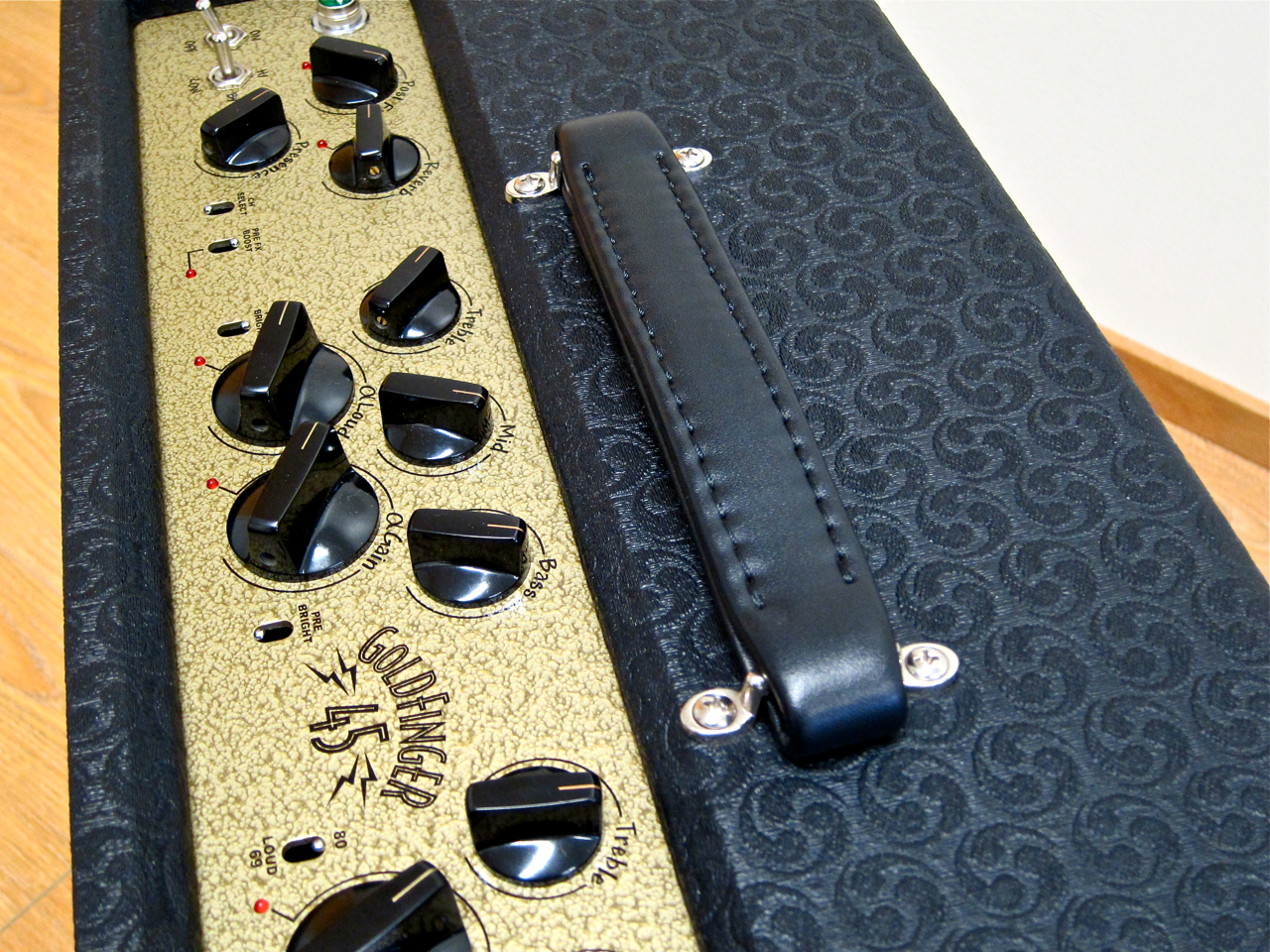
The Bogner Goldfinger 45 is a two-channel amplifier, with the clean channel called α – or Alpha.
On the right side of the picture you can spot the Alpha-channel’s controls – gain, master volume (”Loudness”), as well as a three-band EQ-section – with the added attraction of not one, but two bright-switches. Pre Bright spices up the signal in front of the gain control, with Post Bright being inserted into the Loudness-circuit. Pre Bright has a sharper and more dynamic character, in contrast to Post Bright’s somewhat more open tone. Both the gain- as well as the Loudness-settings affect the amount of brightness added via the switches – the louder you go, the less top end bite is added.
On the picture’s right hand side you’ll find the Goldfinger’s master section, with controls for reverb, master presence and the Post FX -loop. One of the Bogner-combo’s coolest features is hinted at by the miniswitch labelled Pre FX/Boost – the input has its own effects loop.
You could use the Pre FX -loop for adding a booster, compressor or outboard EQ-pedal to your signal chain, which then can be switched on or off using the combo’s own footswitch board. If you don’t have anything plugged into the Pre FX -loop, you can use the loop’s own buffer amp as a signal booster, with the amplification level adjustable on the back panel.

The name of the Goldfinger’s overdrive channel is Ω, or Omega, and it’s got a slightly different architecture compared to the Alpha-channel.
The Omega-channel offers you two basic charatcers to choose from, called 80 ja Loud 69. Loud 69 is the more vintage-type setting of the pair, giving you a moderate amount of gain with plenty of dynamics, reminding me of early Marshall-amps or the rudeness of a hollering Hiwatt. ”Loud” is a very good term here, as with identical settings Loud 69 is much louder and punchier than the far creamier 80-selection.
Setting the Omega to 80 morphs the Goldfinger into a Classic Rock -aficionado’s dream machine. There’s lot of gain on tap with a good helping of fat and creamy compression, which calls to mind Mesa/Boogie-style Westcoast-sounds or Gary Moore’s singing Marshall-tones.
In addition to its three-band EQ, Omega also offers a control named Gain EQ, which allows you to change the channel’s tonal focus from warm and fat all the way to biting and bright. Because the Gain EQ -control sits at the channel’s front end, its setting also influences the amount of overdrive.

A full-length spring reverb tank is situated in its own bag at the bottom of the cabinet.
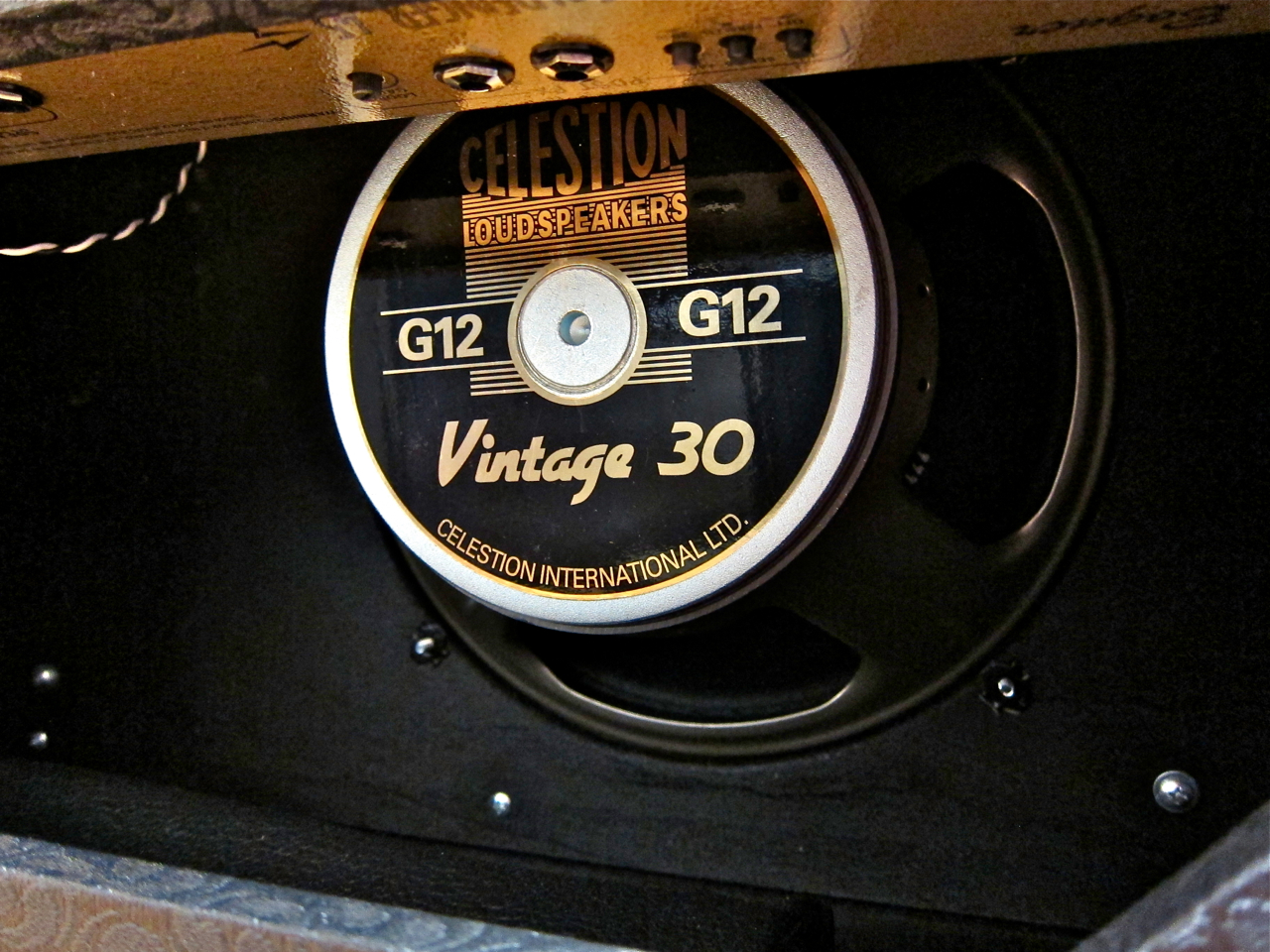
Bogner’s Goldfinger 45 speaks via one of the world’s most-loved speakers – a Celestion G12 Vintage 30.

Because the Goldfinger-combo basically utilises the head of the same name, only flipped on its side, a more fitting name for the back panel might be ”bottom panel” in this case. All connectors, switches and controls face downward, which isn’t so great for accessibility and visibility.

On the right hand side you can find the connectors and the level control for the Pre FX -loop, as well as the socket for the footboard’s screw-in connector.

Bogner’s Post FX -loop offers a plethora of options.
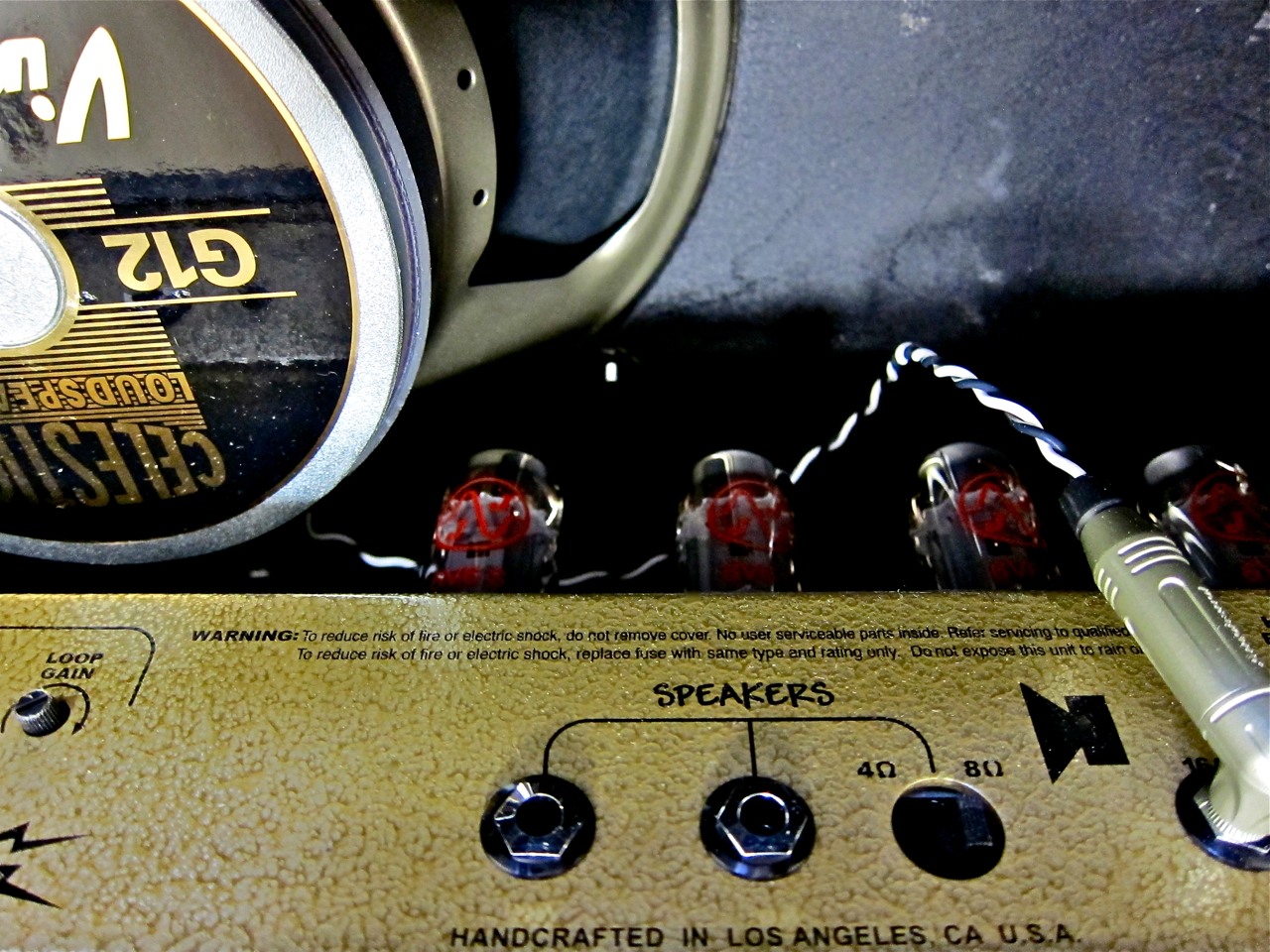
There are two additional speaker outputs on offer, with the impedance switch sitting right next to them.
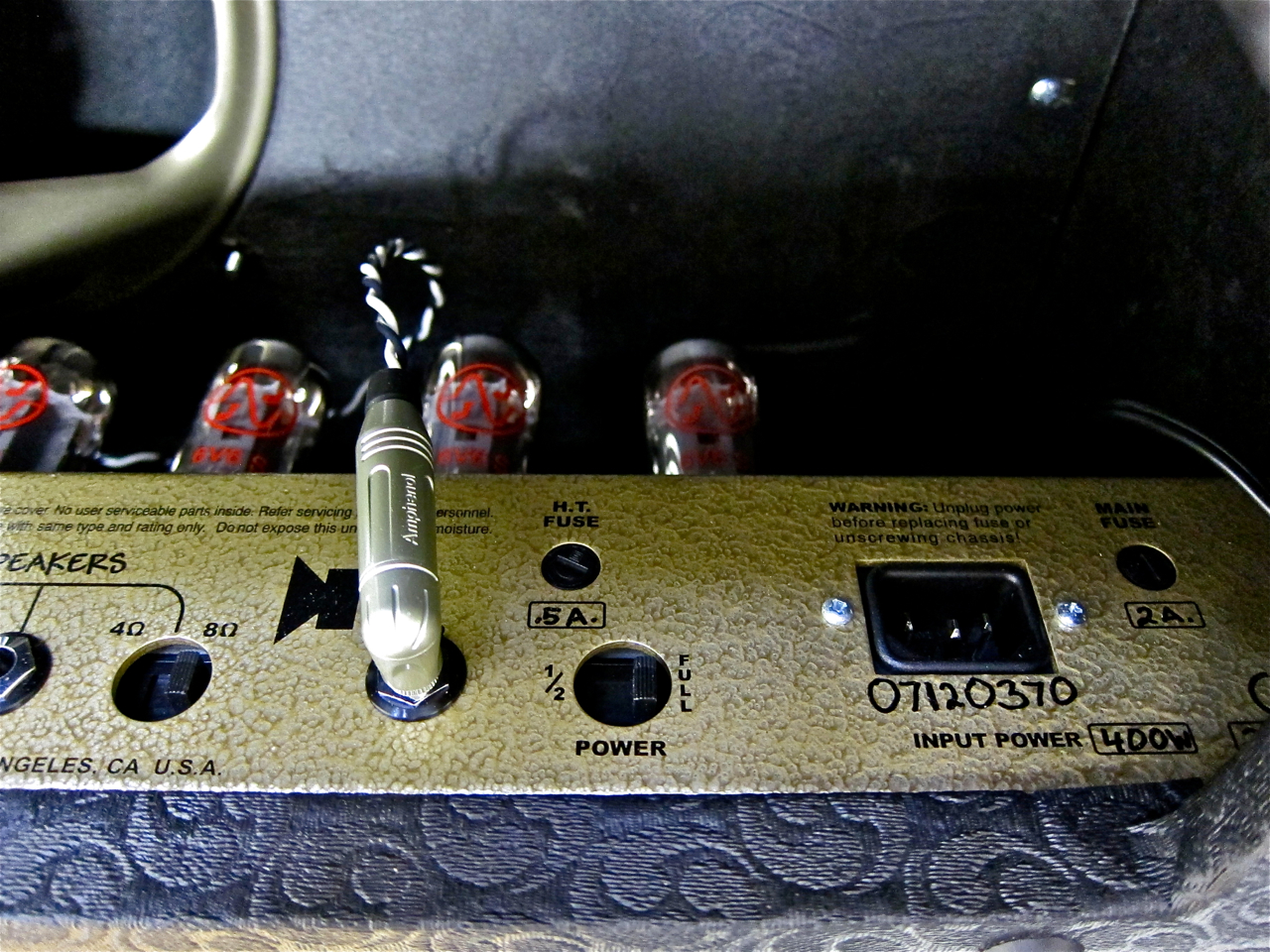
…and last, but not least, the amp’s fuses, as well as the half-power switch for the main amp section.

Just as the combo itself, the accompanying footswitch board is built to last, and sports the same structured, golden finish as the combo’s control panel.
****
The Bogner Goldfinger 45 is an extremely versatile valve-amplifier. Per se this doesn’t really tell you anything, because in many designs versatility comes at the price of a mediocre basic tone.
The Bogner Goldfinger’s outstanding quality really shows in this respect, as each and every link in the signal chain only serves to enhance this combo’s fantastic basic tone.
True, if you don’t know what you’re doing, you can get bad sounds out of the Bogner, regardless – for example by heaping both Alpha-channel brights on top of a Fender Strat or Tele – but in those cases it’s the user who’s to blame, not the amp.
Used with good taste, though, the Bogner Goldfinger will enhance the basic character of your guitar’s tone to bring out the best in your playing.
The combo’s spring reverb sounds fantastically lush, with the reverb-knob giving you anything from a nice little sprinkle to full-out Surf Mania.
The only two things I am not totally in love with are the downward-facing back panel, as well as the loud thud emanating from the Omega’s Mode-switch, when used with the amp running. According to the owner’s manual this loud noise is perfectly normal, but it still bothers me a bit, not being able to switch between Loud 69 and 80 on-the-fly.
All in all, I feel that the Bogner Goldfinger 45 is a very strong contender for the title of ”Best Combo ever”. The price tag is steepish, but well in line with the amp’s quality and this particular market segment as a whole.
Here are some sounds I recorded with the Bogner Goldfinger combo:
Alpha (Post Bright on) – Hamer Studio Custom
Omega (Loud 69) – Fender Stratocaster
Omega (Loud 69) – Hamer Studio Custom
Omega (80) – Fender Stratocaster
Omega (80) – Hamer Studio Custom
****
Bogner Goldfinger 45 1×12 -kombo
Current price in Finland: 2.946 €
Finnish distribution: Musamaailma
Pros:
+ workmanship
+ sound
+ versatility
+ pedalboard included in price
+ half-power switch
+ reverb sound
Cons:
– back panel placement not very practical
– Loud 69/80-switch’s thud


 Kitarablogi.com – Finland's premier Guitar and Bass blog