Review: Ten Affordable Solid Top Classical Guitars

classical-guitars-intro

The classical (aka nylon-string or Spanish guitar) is still a very popular instrument. Many guitarists start their musical journey on an affordable classical guitar.

This is why Kitarablogi.com decided to do a little round-up of a cross section of nylon-string acoustic in the all-important price segment of 250-400 euros. These days you can get a decent instrument with a solid wood top for a moderate outlay.

A solid top is an important ingredient in an acoustic guitar, played regularly the top will ”come to life” and mature to its full tonal potential. It’s true, you can make music on a plywood-topped acoustic, too, but such a guitar’s tone and volume will always stay somewhat restricted.

****
Torres laid down the rules

guitarra_dantonio_de_torres_mdmb_626_al_museu_de_la_musica_de_barcelona

(photo: Wikipedia)

The father of the classical guitar was Spanish cabinet maker and luthier Antonio de Torres Jurado (1817-1892). Torres came up with the final shape of the Spanish guitar, the basic construction principles (like the top bracing pattern or the separate bridge saddle), and his choices of materials still inform and influence builders to this day.

Torres mostly used cedar for his necks and rosewood for his fretboards. Most of his tops were made from solid spruce. His choice of sound box woods was more varied, though. His back and sides were made from rosewood, mahogany, (flame) maple, and cypress.

Because cypress was a much cheaper wood in Torres’ time than, say, rosewood, cypress body instruments were usually the least expensive. Most flamenco guitarists of that time were cash-strapped, which is why they tended to play Torres’ cypress guitars. This, in turn, is the reason why many flamenco guitars are still made with cypress backs and sides today.

classical-guitars-spanish-heel

Most modern classicals are built with dovetailed glue joints – the neck and sound box are made separately, and only glued together relatively late in the building process.

Torres used a different technique, which is nowadays called a Spanish Heel:

The neck blank and the neck block are made from one piece of wood, with the neck block looking like an angular ”U” or ”L” (viewed from the side). Either side of the neck blank has a deep groove for the rims to be glued into. The neck blank and sides together then constitute a frame for the top and back.

Fans of the Spanish heel claim that this type of construction will give you maximum vibrational transfer and better tone. Distractors, on the other hand, point to the difficulties the Spanish heel will give you, should a neck angle reset ever become necessary. I think I’ll keep on sitting on the fence on this one…

10-slipper-heel

(photo: Andy Manson, luthier)

****

Nothing but winners

I feel like a sleazy gameshow host writing this, but there aren’t really any losers in this round-up. All ten guitars are real instruments that are well up to the job of making beautiful music.

Still, it is very interesting to take a look at the different ways modern manufacturers use to re-interpret Torres’ time-honoured concept for the modern player.

We will proceed in alphabetical order…

****

Admira is one of the largest makers of classical guitars in the world.

German-born Enrique (orig. Heinrich) Keller founded an instrument workshop in northern Spain in 1944. Over time Admira has grown from a small maker into a well-known brand.

Admira guitars are distributed by Musamaailma in Finland.

classical-guitars-info-cards-eng-admira-a5

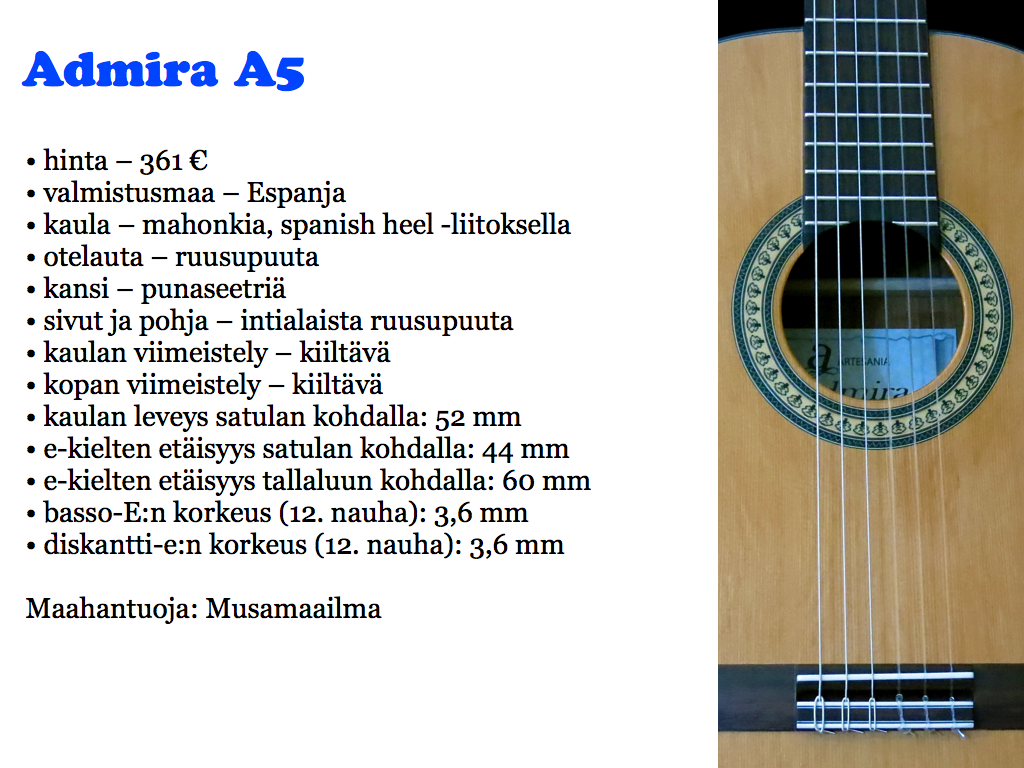
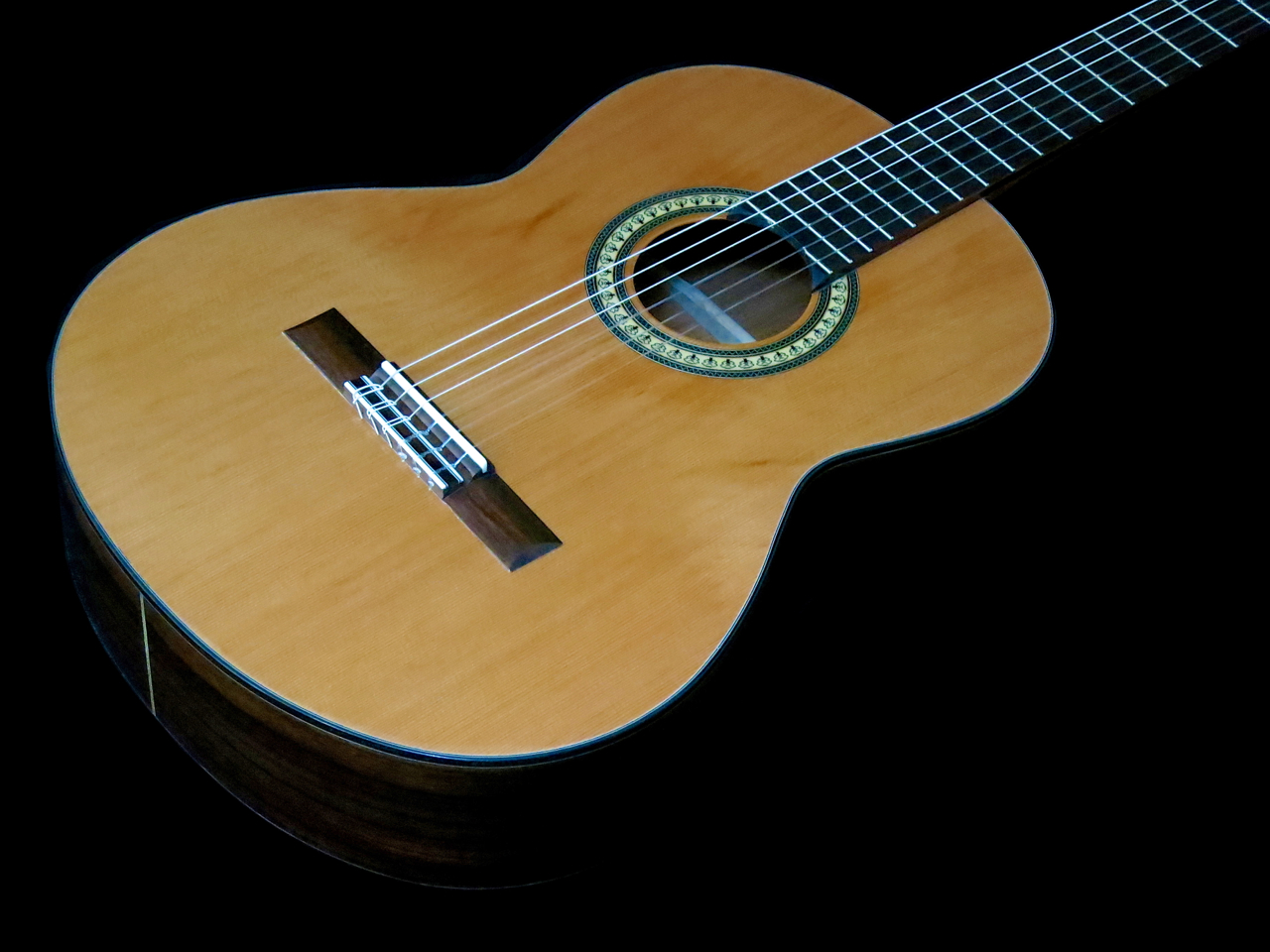
The Admira A5 is an affordable instrument from the Spanish maker’s Handcrafted-series.

admira-a5-beauty-shot

The workmanship is crisp and clean. The thin finish brings out the beauty in the A5’s woods. The golden tuning machines with their pearloid knobs add a nice touch of bling. The rosette is unusual, displaying a chain of little guitars in a row.
admira-a5-body-beauty

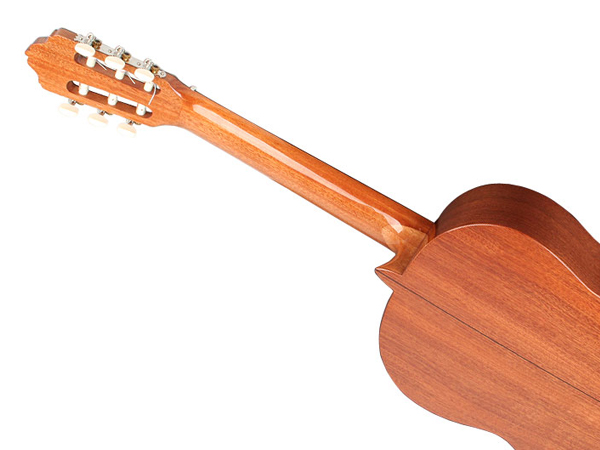
Admira’s A5 is one of three instruments in this round-up built with a Spanish heel.

The neck profile is genuinely classical, meaning the neck is wide and flat with slightly angular shoulders.

The moderate action results in a very comfortable playing feel.

admira-a5-headstock

The Admira A5 has a big voice with an even balance between its chunky bottom end and clear treble attack.

classical-guitars-info-cards-eng-admira-malaga

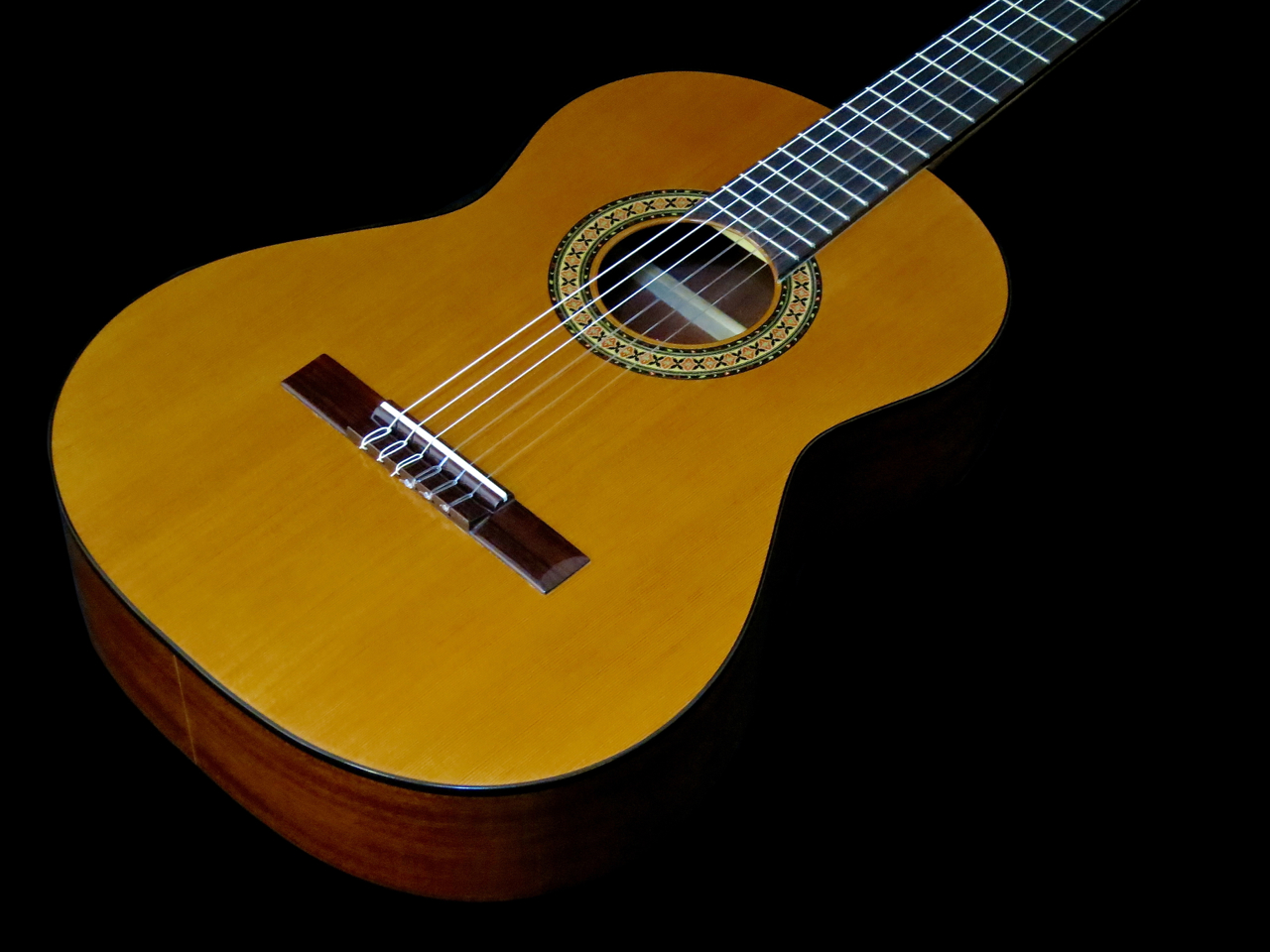
Admira’s Malaga is part of their Student-range.

admira-malaga-beauty-shot

The Malaga is one of the lightest instruments in this review. The workmanship on this cedar-topped beauty is excellent. The affordable nature of this guitar is only reflected in the very clean, but thinner-than-usual (non-kerfed) wooden linings joining the top and back to the sides.
admira-malaga-body-beauty

The neck profile on the Admira Malaga is traditional.

The review sample came with a surprisingly low action (for a nylon-string). This makes the Malaga an excellent choice for a beginner, but also a very viable candidate for flamenco players, who prefer a very fast action and a clicking attack.

Despite its very low action the Malaga plays with a clear and strong voice, completely devoid of string buzz or rattles.

admira-malaga-headstock

****

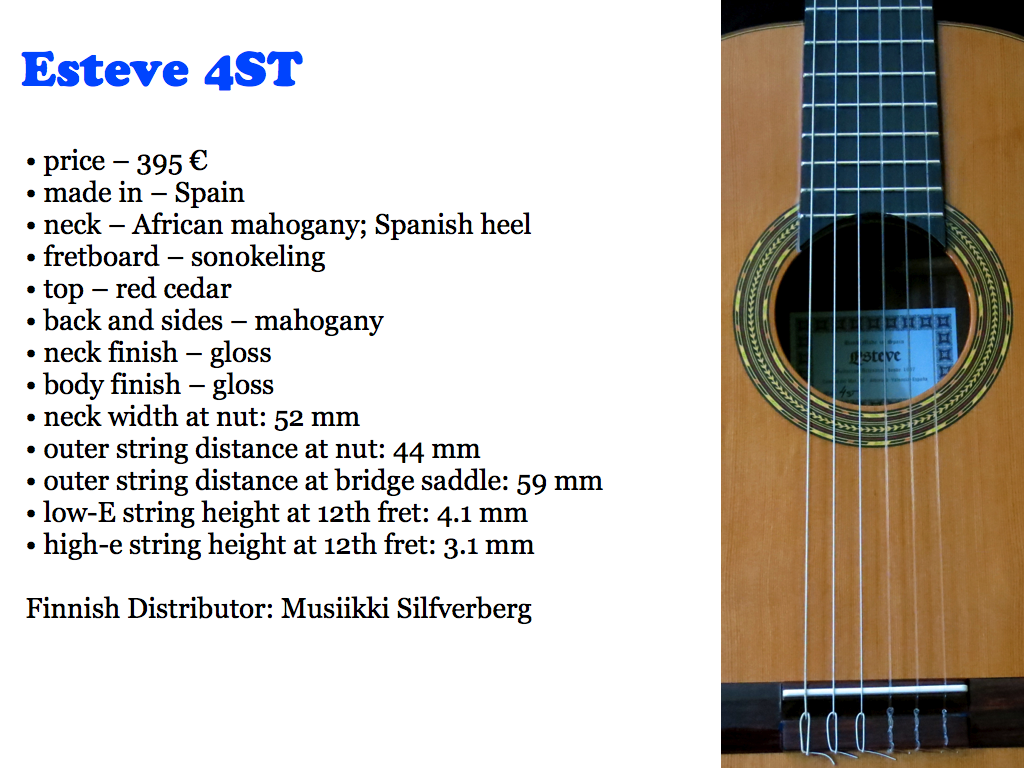
Esteve is a very traditionally-minded Spanish maker of classical guitars.

Esteve guitars are imported by Musiikki Silfverberg. Our review sample was kindly provided by Vantaan Musiikki.
classical-guitars-info-cards-eng-esteve-4st

The Esteve 4ST is an instrument from the maker’s Student-range.

esteve-4st-beauty-shot

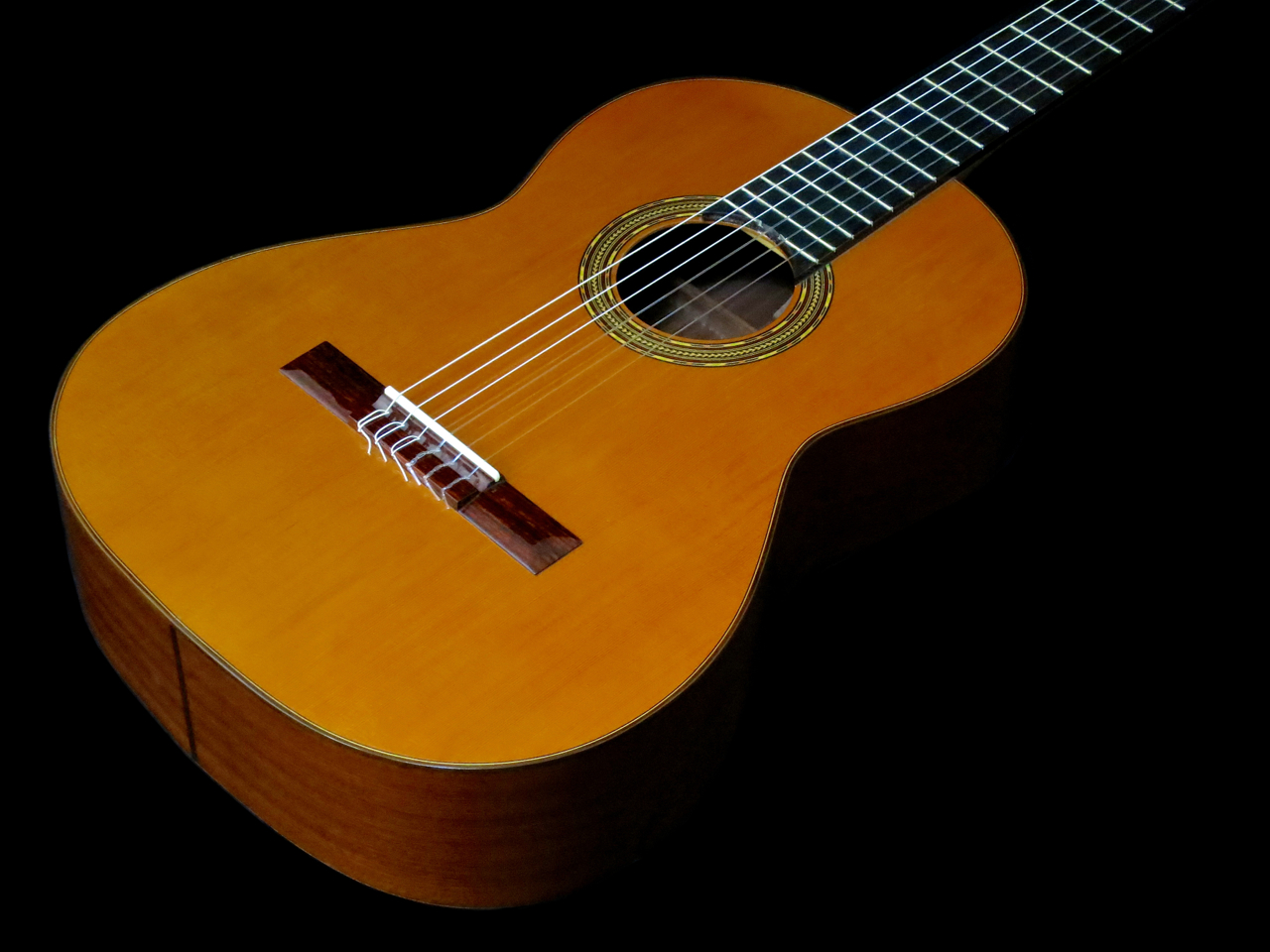
This guitar is a real beauty with its tinted cedar top and its intricate soundhole rosette. Spanish style at its best.

The 4ST is the second guitar (of three) in this round-up that sports a Spanish heel. The workmanship is very crisp throughout.
esteve-4st-body-beauty

Esteve’s neck profile is genuinely classical – wide and flat. The action is at traditional settings. The guitar plays like a breeze.

Esteve’s 4ST has a huge and deep tone, which is warm and well-balanced. The instrument’s attack is clear and precise.

esteve-4st-headstock

****

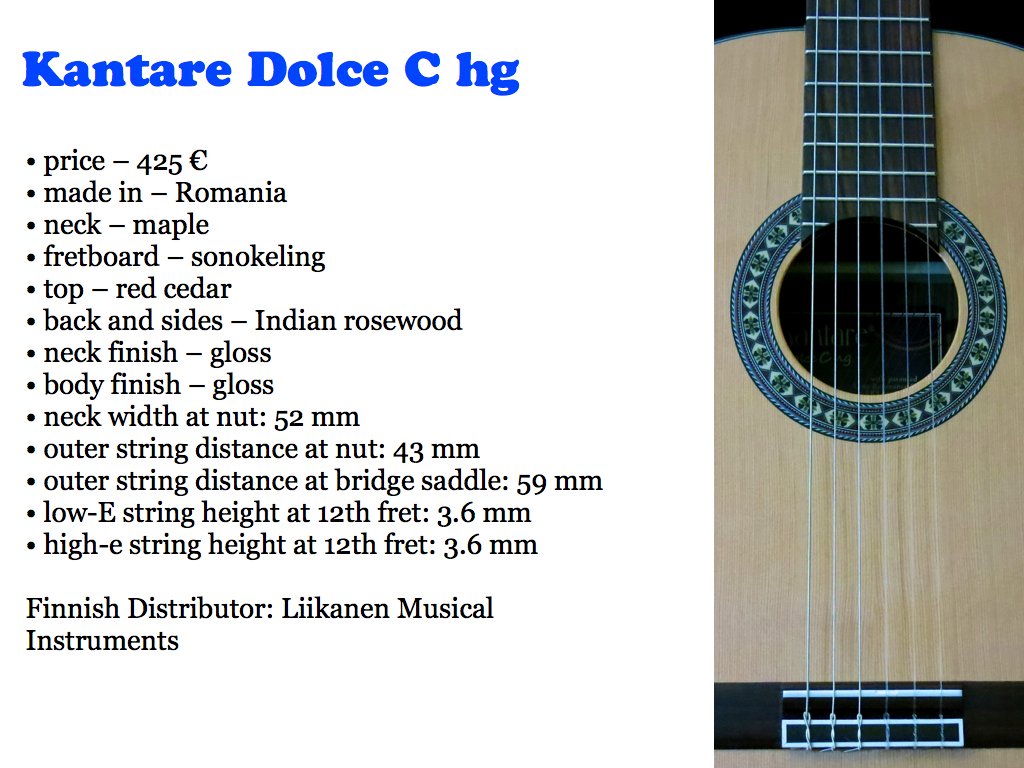
Kantare Guitars are a celebration of Finnish knowhow and ingenuity.

Kantare guitars are designed in Helsinki by the grand old man of Finnish luthiery, Kauko Liikanen.

The special top bracing system sets these guitar apart from any other nylon-string. Instead of the traditional fan bracing (or a variation thereof), Kantares employ the patented LRS-bracing. Kauko Liikanen’s and Uwe Florath’s Lens Resonance System concentrates an oval pattern of braces around the top’s bridge area. The sound is concentrated in a way not dissimilar to an optical lens. LRS adds strength to the bridge area, while letting the rest of the top vibrate more freely than traditional bracing patterns.

Most Kantares are built in Romania. Hora is one of Europe’s largest makers of string- and bowed instruments.

Kantare’s Finnish distributor is Liikanen Musical Instruments.
classical-guitars-info-cards-eng-kantare-dolce-c-hg

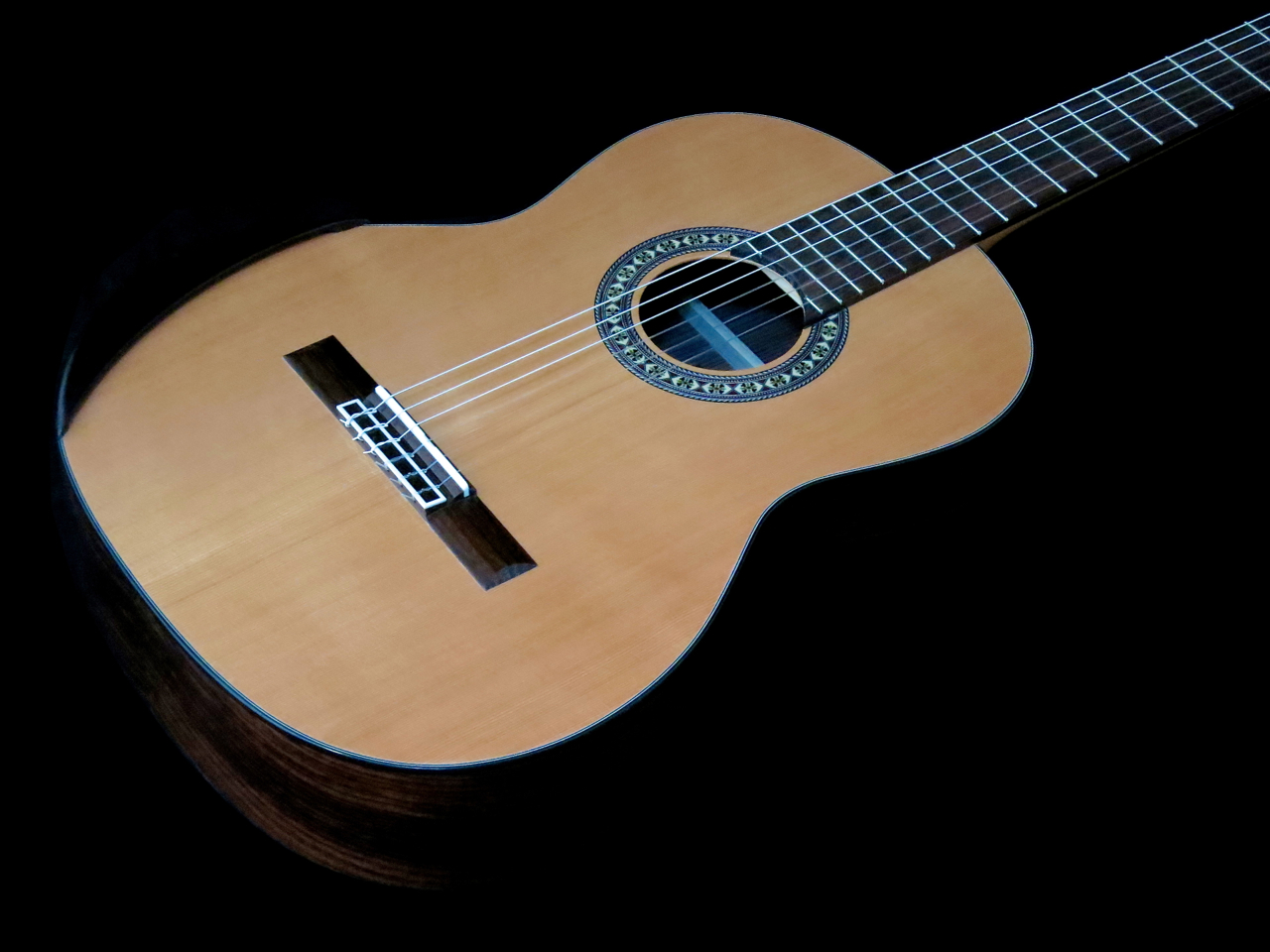
The Kantare Dolce C hg is a gloss-finished guitar with an LRS-braced cedar top.

kantare-dolce-c-hg-beauty-shot

Our review sample sports Kantare’s brand-new arm rest, which is sold separately. The arm rest has been developed to put your plucking arm into a comfortable playing position, as well as to minimise top damping.

The Dolce C hg is a very beautiful, cleanly built instrument.
kantare-dolce-c-hg-body-beauty

Apart from the LRS bracing, a common denominator among most Kantare models is a maple neck.

Classical guitars traditionally feature mahogany or cedar necks; on the other hand, most bowed instruments use flame maple necks. The strength and density of maple makes it an enticing choice for use in a classical guitar neck, too, and the Hora factory has a large stock of flame maple.
kantare-dolce-c-hg-headstock

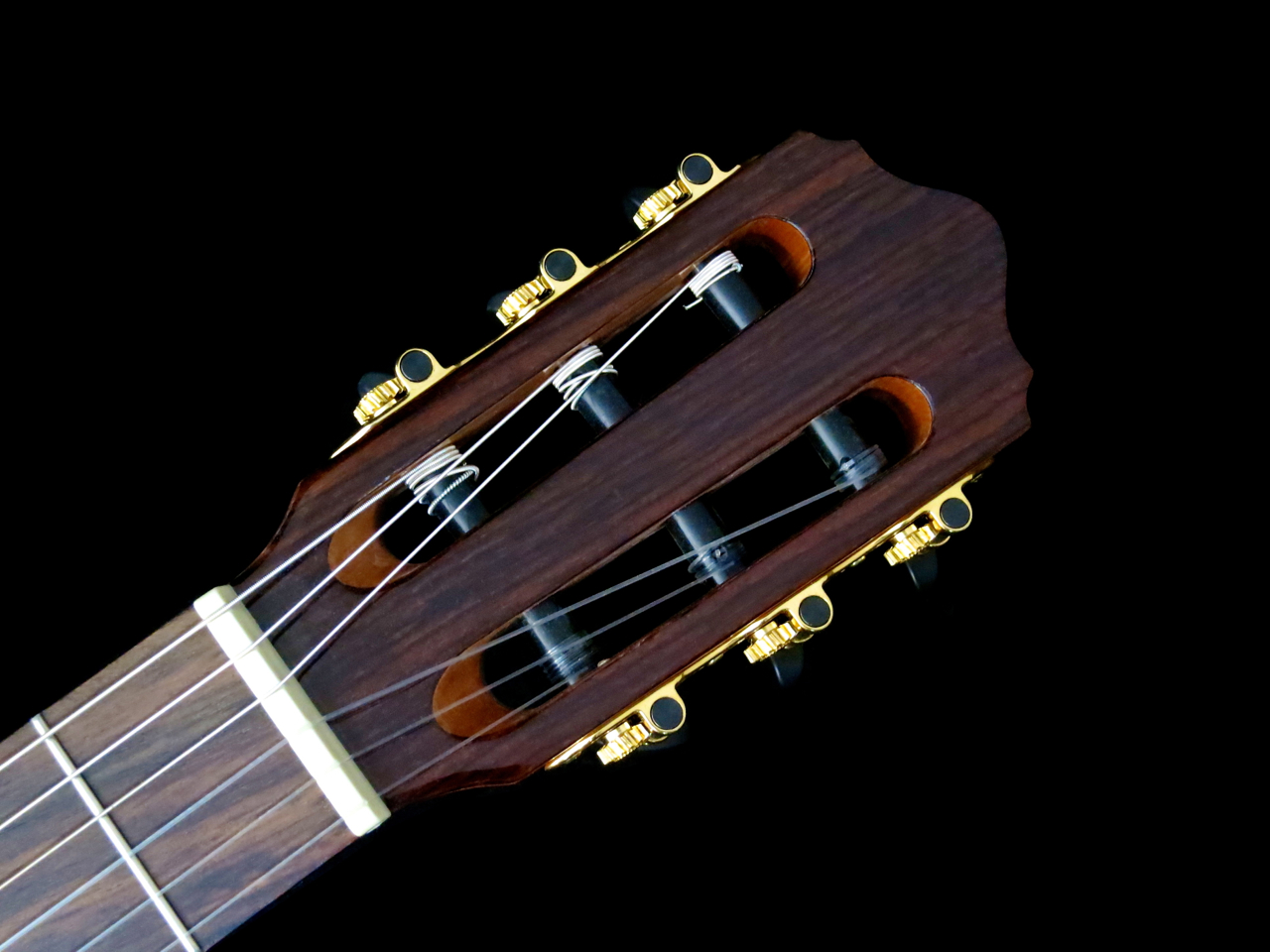
Kantare’s Hauser-style machine heads are of very decent quality, and work precisely.

The Dolce C hg’s neck profile is noticeably more rounded than a traditional Spanish neck, probably making this neck feel more comfortable for many. To help the beginner with finding the right fret positions, Kantare have included side dots at the fifth and seventh frets.

The Kantare Dolce hg has quite a loud voice and projects nicely. The sound is clear and precise.

Kantare’s Vivace C features a brand-new, ecologically sound satin finish.

kantare-vivace-c-beauty-shot

The Vivace C is finished using a new German-made (by Hesse Lignal) non-poisonous product, called Proterra Resit. Proterra Resit uses a novel mixture of shellac, oil and carnauba wax.

Shellac (also called French polish) is an organic polymer that has been in use by instrument makers for centuries. Traditional French polish is very time-consuming and work-intensive in use, which is why you’ll find it on only a limited number of handmade instruments. The huge advantage of Proterra Resit lies in the fact that it is quick and easy to apply.
kantare-vivace-c-body-beauty

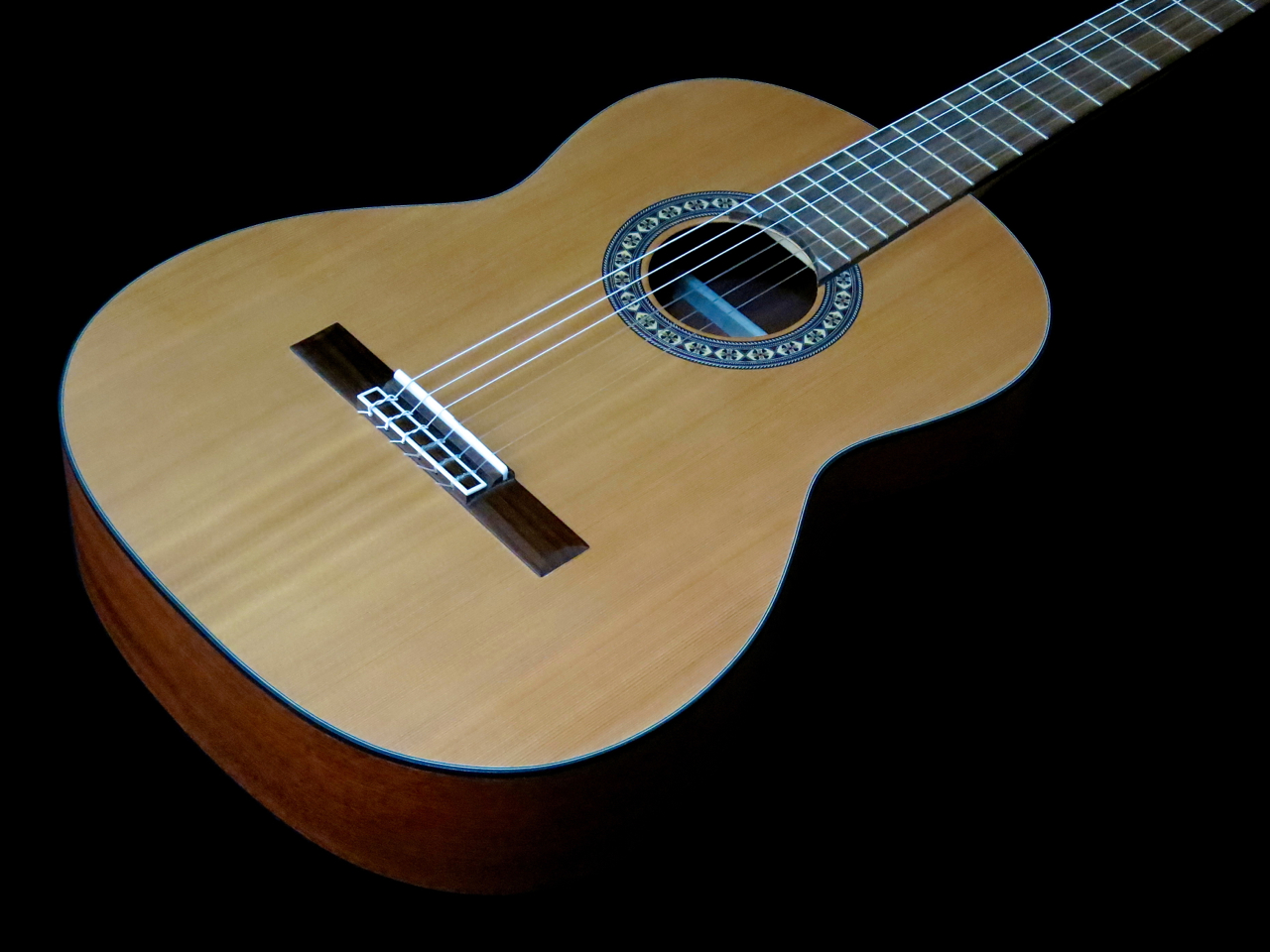
The Kantare Vivace C looks and feels very ”eco” and ”organic”, in the best sense of these terms.

kantare-vivace-c-flame-maple-neck

The new finish nicely accentuates the beautiful wood grain of the guitar’s maple neck.

The neck profile is rounder than a traditional classical guitar neck, and there are two side dots (at the fifth and seventh frets) on this Kantare, too.

The Vivace C’s voice is very woody and a little bit dry. You can clearly hear the wood amplifying the string vibrations. The bottom end isn’t overpowering, the mid-range is warm, and the trebles sound open, but never too bright.

kantare-vivace-c-headstock

****

LaMancha is a young brand from Germany.

LaMancha-instruments are design in Germany and made in China (under German supervision), in the company’s own factory.

LaMancha has managed to become Germany’s best-selling brand of classical guitars over the course of just a few years. Many of their models have already won awards by the European Guitar Teachers Association.

LaMancha’s distributor in Finland is Musiikki Silfverberg. Our review instrument was kindly provided by Vantaan Musiikki.

lamancha-rubi-cm-sn-beauty-shot

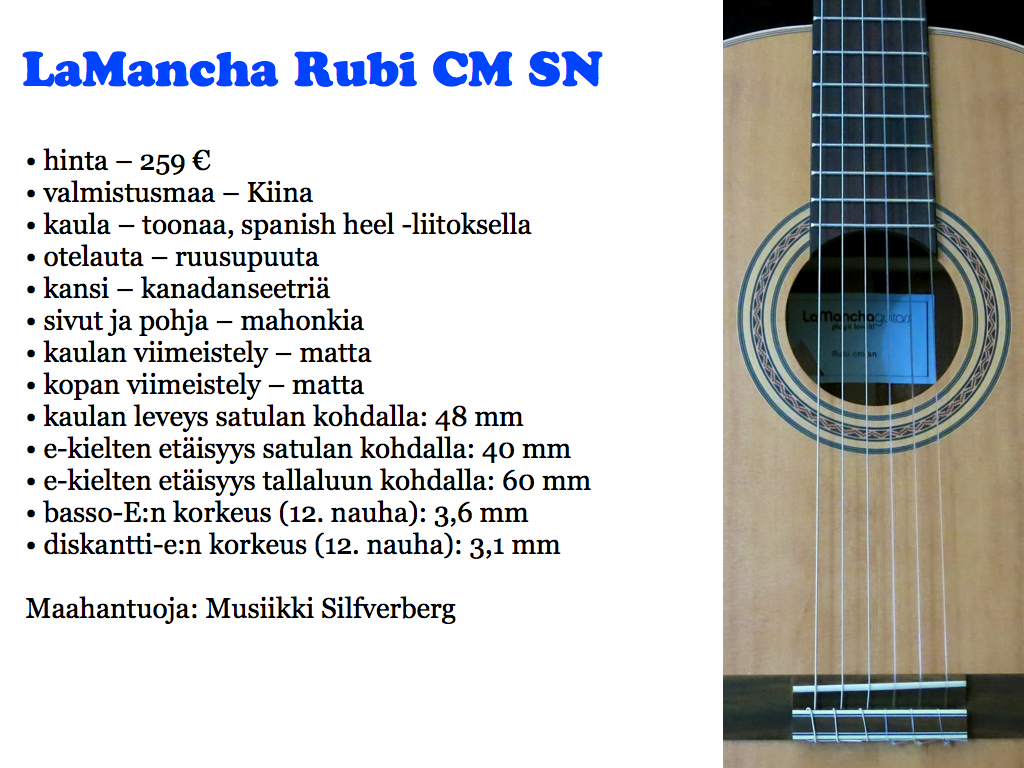
LaMancha’s Rubi CM SN is a satin-finished guitar with a narrower-than-usual neck (LaManch call it ”Small Neck”), making it a good choice for young students and players with small hands.

lamancha-rubi-cm-sn-back-beauty

The Rubi CM SN is the third guitar in this round-up constructed around a Spanish heel.

The neck is made from toona, a south Asian relative of cedar, that also grows in Australia.

The neck is stiffened by two graphite rods, which have been inserted into the neck from the front, prior to the fretboard being glued on.

lamancha-rubi-cm-sn-body-beauty

The workmanship on this LaMancha is very clean. The Rubi CM SN is a very stylish and lightweight guitar.

The Rubi’s neck profile is narrower and rounder than that of a traditional classical guitar. There are two small side dots in the fingerboard for orientation.

The LaMancha plays like a dream.

The Rubi CM SN displays a well-balanced voice with a slender bass register and a woody top end.
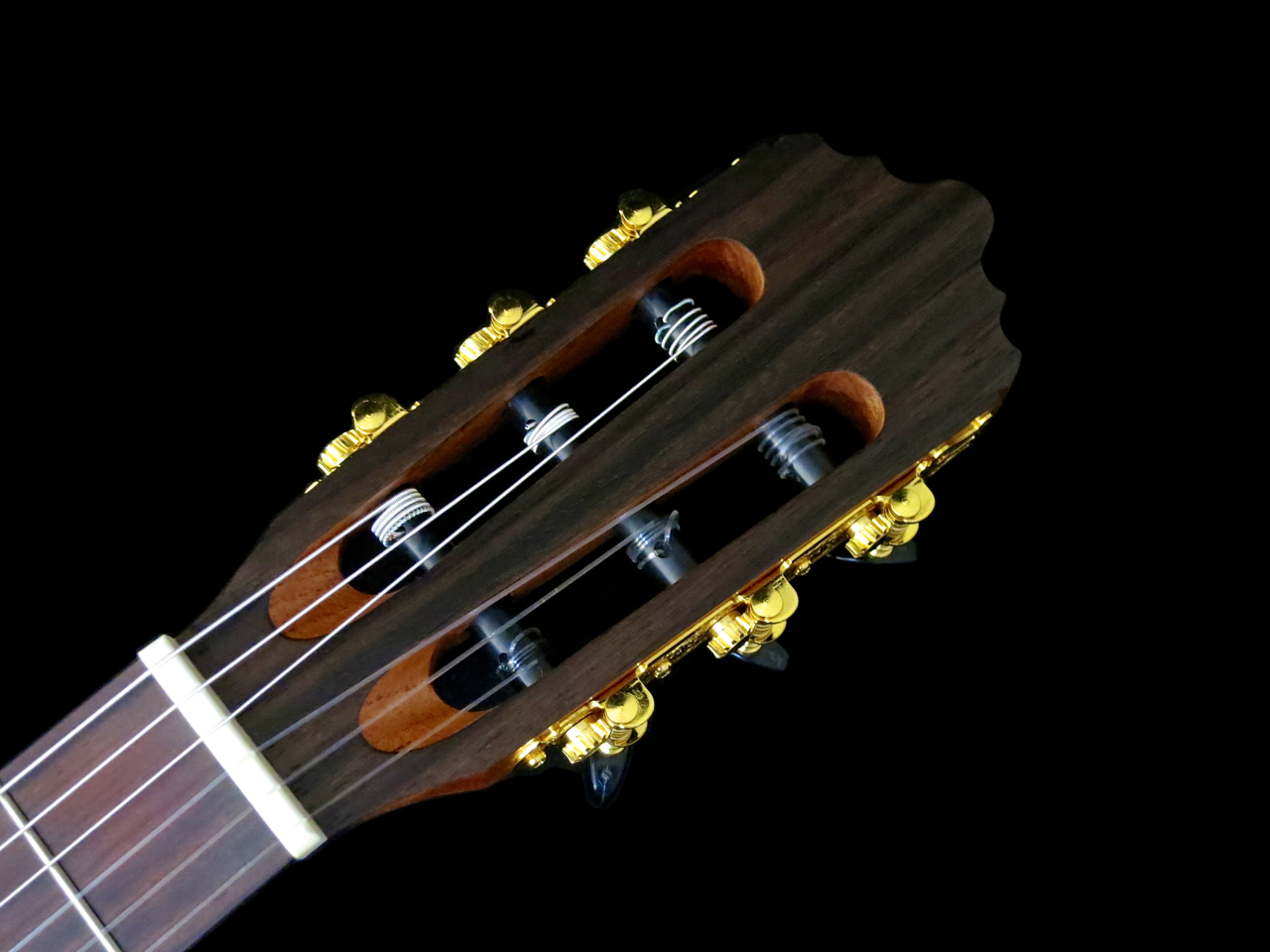
lamancha-rubi-cm-sn-headstock

****

Japanese company Takamine is best known for its acoustic-electric steel-string guitars, but the company has always made classical guitars, too.

Takamine’s Finnish distributor is EM Nordic. The test instrument was kindly provided by DLX Musiikki.
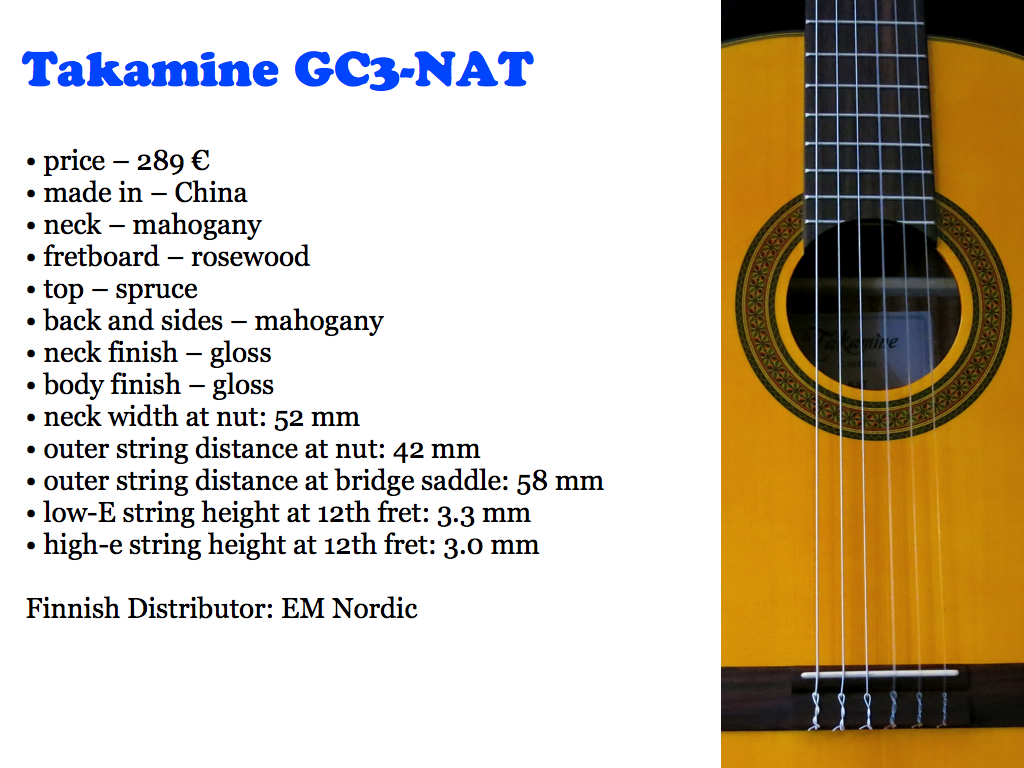
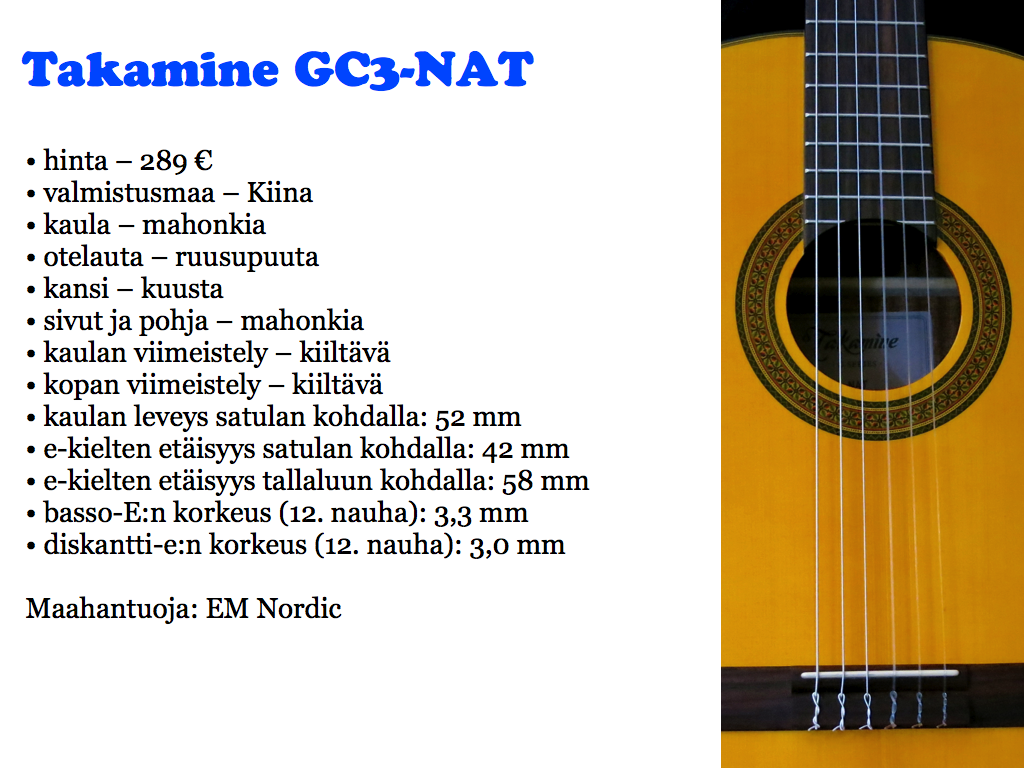
The Takamine GC3-NAT is a spruce-topped classical guitar made in China.

takamine-gc3-nat-beauty-shot

The top’s yellow tint is reminiscent of the look of French polish.

takamine-gc3-nat-body-beauty

The stark and unadorned rosewood bridge of the GC3-NAT is a stylish contrast to the instrument’s beautifully intricate soundhole rosette.

takamine-gc3-nat-truss-rod-access

Takamine is one of the very few makers of Spanish guitars who uses a truss rod inside their nylon-string guitars’ necks.

The GC3-NAT’s neck profile conforms to tradition – it’s wide, flat, and a touch angular. The action is low-ish (for a classical), making for a very comfortable playing feel.

This Takamine needed a bit of breaking in to realise its potential fully, but it was well worth the effort. The GC3-NAT has a beautiful and fluid voice, a clean and open mid-range, as well as a precise attack.
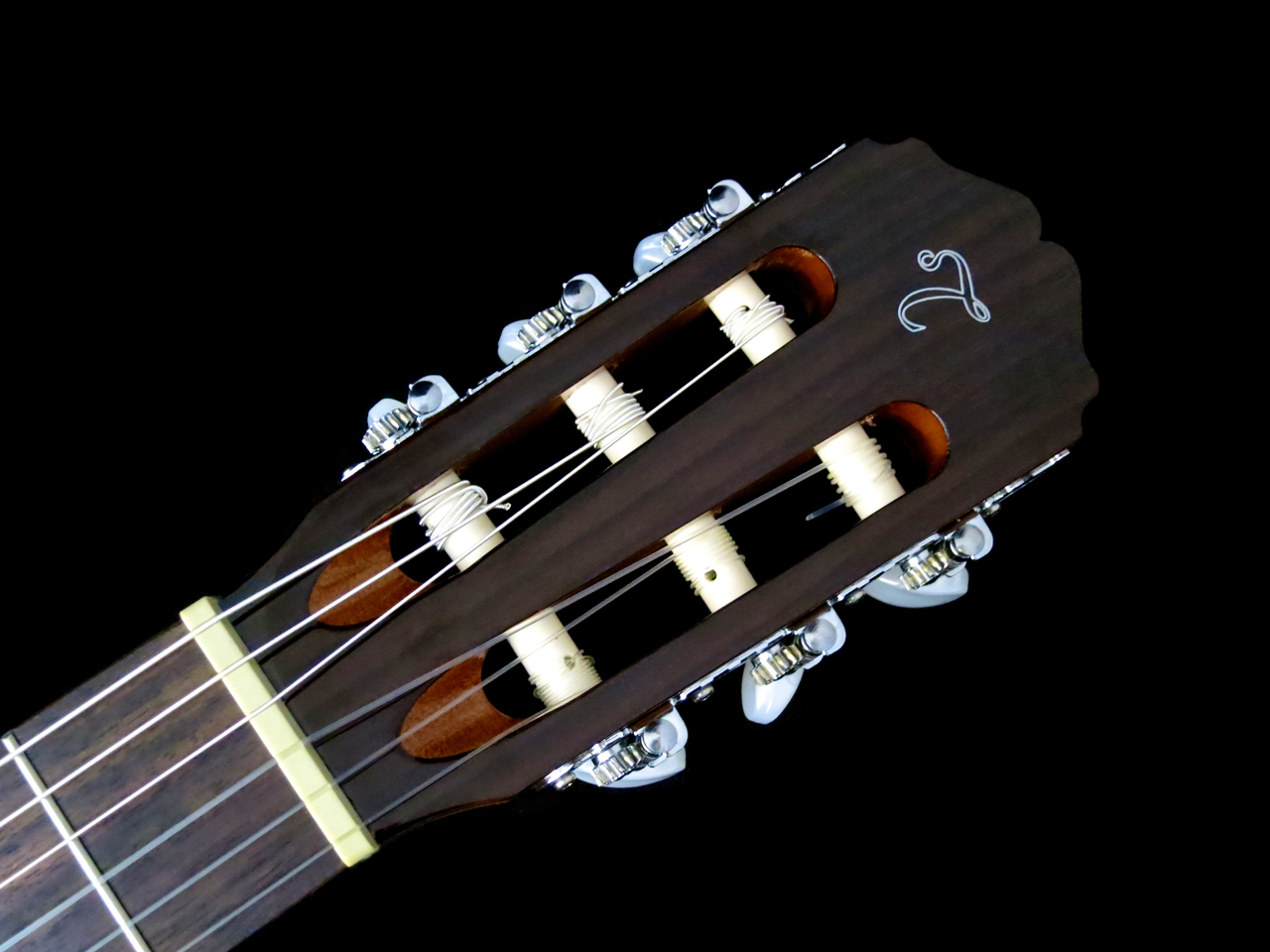
takamine-gc3-nat-headstock

****

Valencia was a new name to me, even though the company has been in existence since 1972.

Valencia-guitars are designed in Australia, and built in  several factories in China and Indonesia.

Valencia’s Finnish distributor is EM Nordic. The review sample was kindly provided by DLX Musiikki.
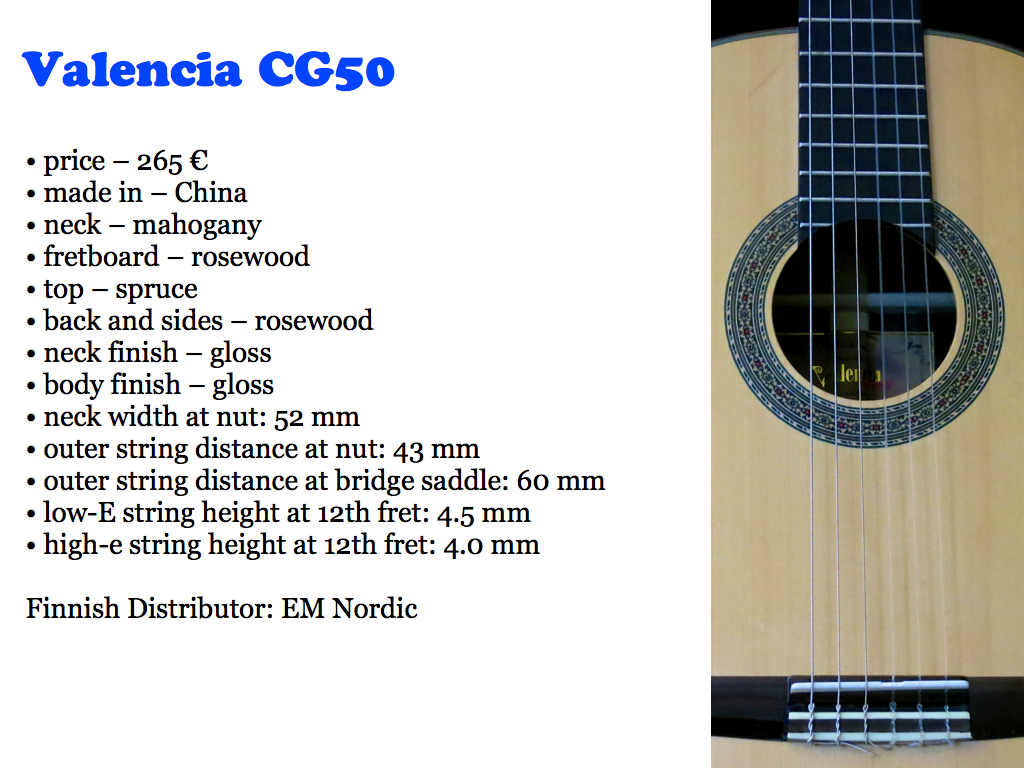
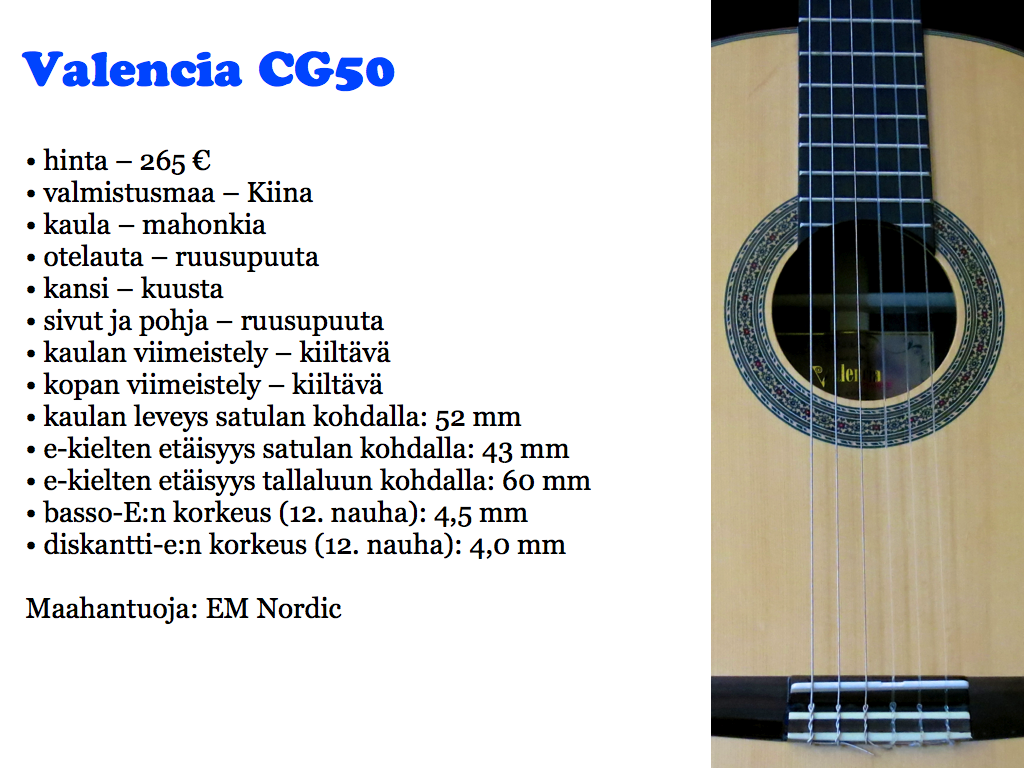
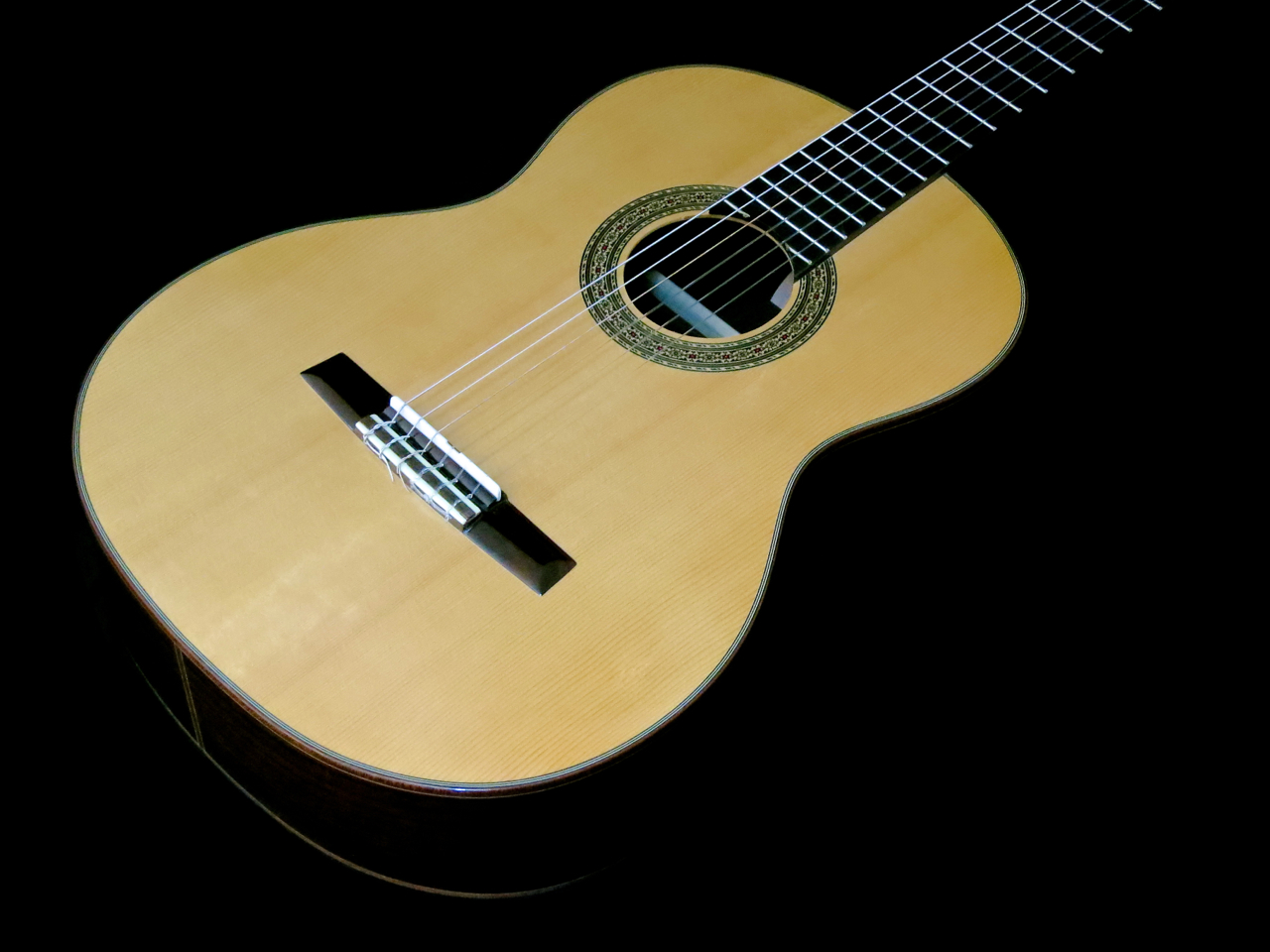
The spruce-topped Valencia GC50 is probably the most richly ornamented instrument in this review.

valencia-cg50-beauty-shot

There is multi-ply binding on both top and back, with the outermost ply being mahogany.

The back’s centre seam has also been adorned with a mahogany inlay.
valencia-cg50-body-beauty

The neck of the GC50 is glued together from three side-by-side strips. The middle piece’s grain orientation is reversed to make neck warping less likely.

Valencia’s neck profile is fairly traditional, with just a touch of added roundness.

The action on our review instrument felt a bit high and stiff for my taste (I’m not Andrés Segovia). A guitar repairer (or a reasonably skilled guitarist) shouldn’t have a problem lowering the bridge saddle, though. Shaving off a millimetre, or so, should result in a much better playing feel.

The Valencia GC50’s voice is beautifully lyrical and open. Even in the highest registers the notes still have an astonishing richness and depth.

valencia-cg50-headstock

****

Classical guitars have always been a very important part of Yamaha Guitars’ wide range of models. The C40 is still the best-selling classical guitar on the planet.

The more recent Concert Series bears testament to Yamaha’s ongoing commitment to research and development.

Yamaha’s Finnish distributor is F-Musiikki.

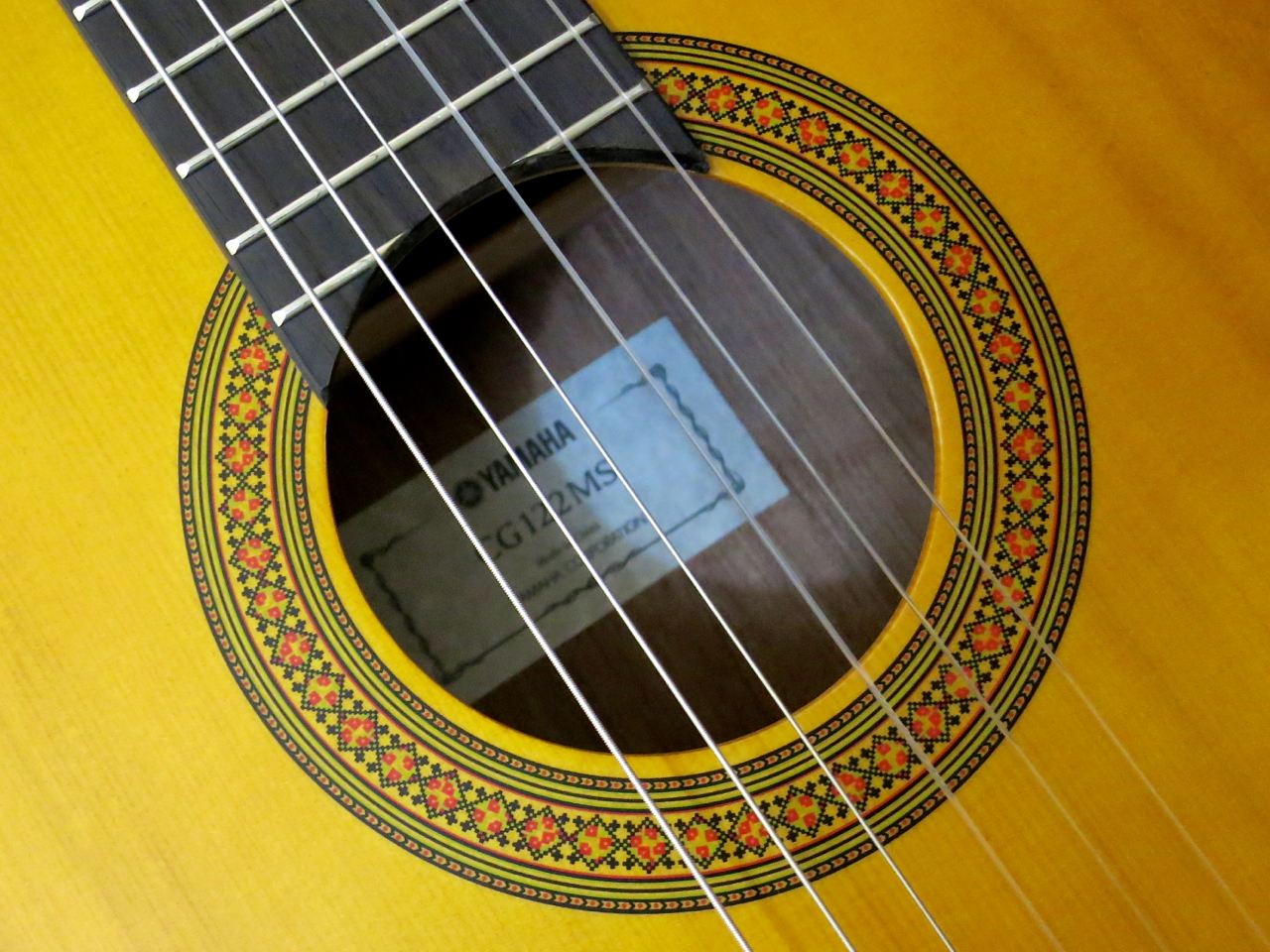
The Yamaha CG122MS is one of the most affordable Concert Series instruments.

yamaha-cg122ms-beauty-shot

TheCG122MS’s matte finish is applied very thinly, which is great for tone and feels nice, too.

yamaha-cg122ms-body-beauty

The CG122MS is a lightweight instrument with a slightly more rounded neck profile.

Side dots at the fifth and seventh frets make finding your way around the fingerboard a little bit easier.

yamaha-cg122ms-headstock

The CG122MS plays very well with a nice, traditional action.

The tone is warm and woody. The Yamaha sounds well-balanced, and displays a crisp and clear attack.

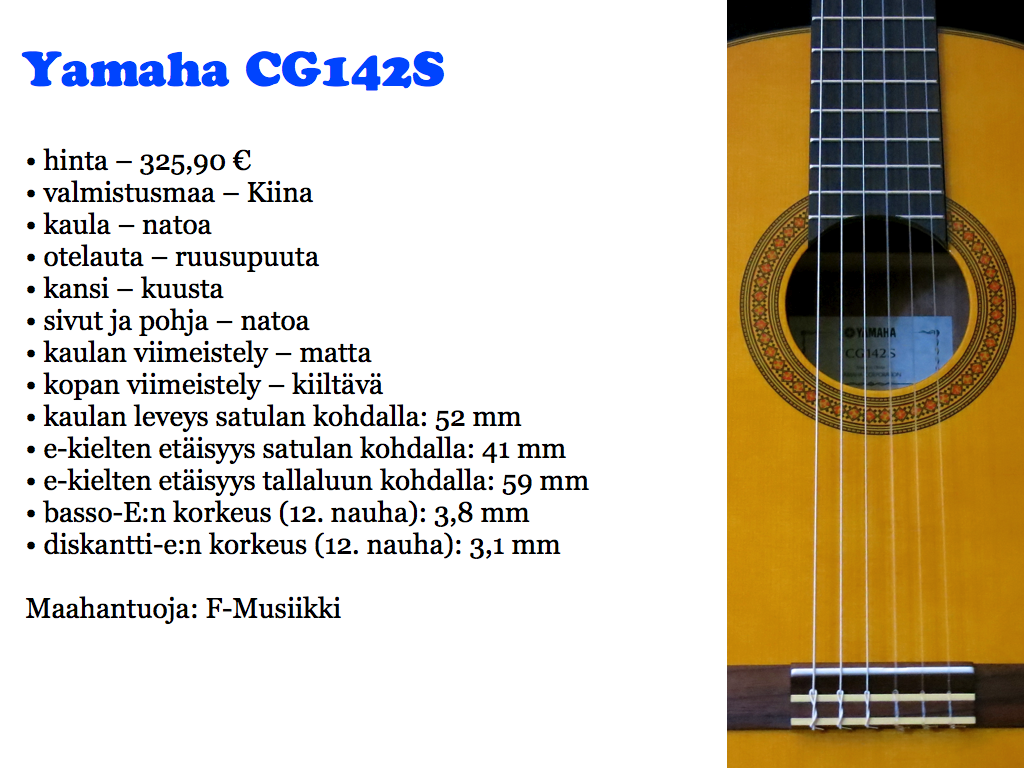
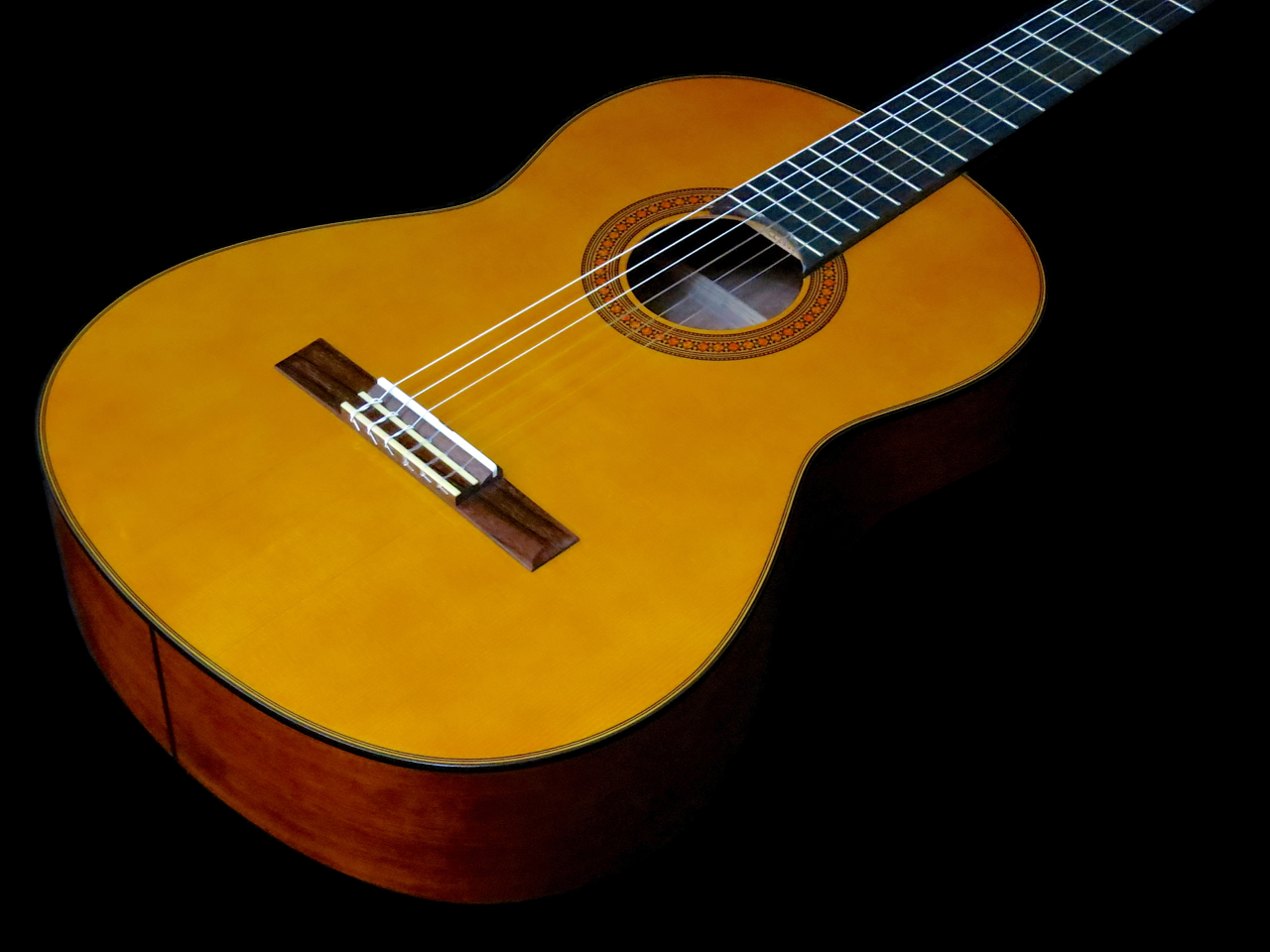
The Yamaha CG142S is the only guitar in this round-up that combines a gloss-finished body with a satin-finished neck.

yamaha-cg142s-beauty-shot-new

Understated beauty is the thing with the CG142S. This is a very cleanly built guitar.
yamaha-cg142s-body-beauty

On this Yamaha, too, the neck profile is a tad more rounded compared to a traditional neck profile. The playability is very comfortable.

The CG142S’s fretboard also has a couple of side dots for easier orientation.

Yamaha’s CG142S sings with a well-rounded, beautiful voice. There’s a healthy amount of clarity in the mid-range.

yamaha-cg142s-headstock

****

To summarise I could state the obvious – there are many well-built, well-playing instruments in the 250-400 euro price segment. There should be the right guitar for everyone, depending on finish, neck profile and sound preferences.

Save

Save

Save

Save

Save

Save

Save

Save

Save

Save

Save

Save

Save

Save

Save

Save

Save

Save

Save

Save

Save

Save

Save

Save

Save

Save

Save

Save

Save

Save

Save

Save

Save

Save

Save

Save

Save

Save

Save

Save

Save

Save

Save

Save

Save

Testipenkissä: Kymmenen edullista klassista kitaraa

classical-guitars-intro

Klassinen (nailonkielinen) kitara on yhä erittäin suosittu soitin. Monille klassinen kitara on se ensimmäinen soitin, jolla aloittelijan matka musiikin maailmaan alkaa.

Tästä syystä Kitarablogissa päätettiin tehdä pieni katsaus tärkeän 250-400 euron hintasegmentin soittimista. Kohtuullisella satsauksella saa nykyään jo kunnon kitaran kokopuisella kannella.

Kokopuisella kannella on iso merkitys soittimen sointiin, ja säännöllisesti soitettuna kansi herää henkeen ja kitaran luonne nousee esiin. Totta, vanerikannestakin lähtee ääni, mutta soitin soi aina vaisummin, eikä sen sointi kypsy ajan kanssa.

****
Torres sen keksi

guitarra_dantonio_de_torres_mdmb_626_al_museu_de_la_musica_de_barcelona

(kuva: Wikipedia)

Klassisen kitaran isä oli espanjalainen puuseppä ja soitinrakentaja Antonio de Torres Jurado (1817-1892). Torres antoi kitaralle sen lopullisen ulkomuodon, soittimen rakennustavan (esim. kannen rimoitus tai erillinen tallaluu) ja sen rakentamiseen sopivat materiaalit.

Torres käytti suurimmilta osin kitaroissaan seetriä kaulamateriaaliksi ja ruusupuuta otelaudaksi. Kansi oli veistetty lähes poikkeuksetta kuusesta, mutta pohjan ja sivujen materialien suhteen Torresin soittimissa oli isompi vaihtelevuus. Kopat tehtiin ruusupuusta, mahongista, vaahterasta ja sypressistä.

Koska sypressi oli jo Torresin aikaan huomattavasti halvempi puu kuin esimerkiksi ruusupuu, olivat sypressikoppaiset soittimet myös halvempia kuin muut mallit. Monilla flamenco-kitaristeilla oli tiukka rahatilanne, miksi he valitsivat usein juuri sypressi-kitaran. Tästä syystä myös tänä päivänä monien valmistajien flamenco-kitaroissa sivut ja pohja ovat sypressistä.

classical-guitars-spanish-heel

Monissa nykypäivän klassississa kitaroissa on kaulaliitos toteutettu liimaamalla kaula kopassa olevaan kaulablokkiin.

Torresin tapa oli toisenlainen, ja hänen liitostaan kutsutaan nykyään espanjalaiseksi koroksi tai jalaksi (engl. Spanish Heel):

Kaula-aihio ja kaulablokki tehdään silloin yhdestä palasta. Aihion kummassakin sivussa on ura jonne liimataan kopan sivut kiinni. Tästä syntyy kehikko, johon lisätään kitaran pohja ja kansi.

Espanjalaisen jalan ystävät väittävät, että tämä rakennustapa parantaa kitaran sointia. Toiset taas ovat sitä mieltä, että Torresin tapa on liian monimutkainen, ja että se tekee mahdollisesta kaulakulman korjauksesta hyvin hankalan. Mene ja tiedä…

10-slipper-heel

(kuva: Andy Manson, luthier)

****

Vain voitajia

Tunnen itseni suomalaisen lastenohjelman juontajaksi, kun totean, että tässä kitarakatsauksessa ei ole häviäjiä. Jokainen esitelty kitara on oikea soitin, jolla voi tehdä kaunista musiikkia.

On kuitenkin hyvin mielenkiintoista huomata eri valmistajien näkemykset toteuttaa Torresin klassikkoreseptiä tässä hintaluokassa meille nykymuusikoille.

Edetään aakkosjärjestyksessä…

****

Admira on yksi isoimmista klassisten kitaroiden valmistajista maailmassa.

Saksalainen maahanmuuttaja Enrique (saks. Heinrich) Keller perusti vuonna 1944 soitintehtaan Pohjois-Espanjaan. Ajan mittaan pienestä työpajasta kasvoi varteenotettava yritys.

Admiran kitaroita tuo maahan Musamaailma.

classical-guitars-info-card-admira-a5

Admira A5 on edullinen malli espanjalaisvalmistajan Handcrafted-sarjasta.

admira-a5-beauty-shot

Kevyen soittimen työnjälki vaikuttaa erittäin siistiltä. Kitaran ohut lakkaus tuo A5:n puiden sävyt ja syykuviot sopivasti esiin. Pikantteina yksityiskohtina voi mainita mallin kultaiset virityskoneistot helmiäismuovisilla nupeilla, sekä A5:n hauska rosetti, jossa näkyvät pienet kitarat rivissä.

admira-a5-body-beauty

Admira A5 on yksi tämän katsauksen kolmesta kitarasta, joilla on Spanish Heel -kaula.

Kaulaprofiili on aidosti klassinen, mikä tarkoittaa leveää, laakeaa ja hartioissa aavistuksen verran kulmikasta.

Maltillinen kieltenkorkeus tekee soittotuntumasta erittäin mukavan ja vaivattoman.

admira-a5-headstock

Admira A5 -kitaralla on iso ja hyvin tasapainoinen ääni muhkealla bassolla ja selkeällä atakilla.

classical-guitars-info-cards-admira-malaga

Admira Malaga on Student-sarjan kitara.

admira-malaga-beauty-shot

Malaga on yksi tämän katsauksen kevyimmistä soittimista. Seetrikannella varustetun kitaran työnjälki on erinomaisen siisti, ja lopputulos on hyvin kaunis soitin. Malagan alhainen hinta näkyy ainoastaan kopan sisäisistä – sivuja pohjaan ja kanteen liittävistä – tukirimoista, jotka ovat nekin hyvin siistejä, mutta yksinkertaisemmat ja ohuemmat.

admira-malaga-body-beauty

Admira Malagan kaulaprofiili on perinteisen klassinen.

Yllättävän matala kieltenkorkeus helpottaa kitaran soittotuntumaa aloittelijoille sopivaksi, mutta se tekee tästä mallista myös erinomaisen flamenco-soittimen, sen tuoman napsakan atakin ansiosta.

Matalasta ja nopeasta tatsista huolimatta Malaga soi siististi ilman kielten sirinää, ja kitaralla on iso ja täyteläinen ääni.

admira-malaga-headstock

****

Esteve on hyvin perinnetietoinen klassisten kitaroiden valmistaja Espanjasta.

Esteven soittimia tuo maahan Musiikki Silfverberg. Saimme testisoittimen lainaksi Vantaan Musiikilta.

classical-guitars-info-cards-esteve-4st

Esteven 4ST on valmistajan Student-malliston soitin.

esteve-4st-beauty-shot

Seetrikannen tumma viimeistely ja erittäin kaunis rosetti antavat tälle kitaralle hyvin tyylikkään ilmeen.

4ST on toinen kitara tässä katsauksessa, joka on rakennettu espanjalaisella jallalla. Työnjälki on kauttaltaan hyvin siisti.

esteve-4st-body-beauty

Esteven kaulaprofiili on aidosti klassinen – leveä ja laakea. Kieltenkorkeuskin on perinteisissä lukemissa. Soittotuntuma on hyvin mukava.

Esteve 4ST soi voimakkaalla äänellä, joka on lämmin ja tasapainoinen. Kitaran atakki on mukavan selkeä.

esteve-4st-headstock

****

Kantare-kitarat ovat suomalaisen tietotaidon ja kekseliäisyyden tuotoksia.

Kantare-soittimet ovat suomalaisen kitararakennuksen grand old manin, Kauko Liikasen, suunnittelemia.

Kansirimoitus on näissä kitaroissa hyvin erilainen perinteisen viuhkaa muistuttavan rimoitukseen (fan bracing) verrattuna. Kauko Liikasen ja Uwe Florathin keksimä LRS-rimoitus (Lens Resonance System) keskittää rimoituksen optisen linssin tavoin tallan ympärille. LRS:n suurin etu on, että kitaran kansi voi värähdellä vapaamin kuin perinteisen rimoituksen kanssa, samalla kun tuetaan tallan ympäröivä aluetta paremmin.

Soittimet valmistetaan Romaniassa. Valmistaja Hora on yksi Euroopan suurimmista akustisia kieli- ja jousisoittimia valmistavista yrityksistä.

Kantaren maahantuoja on Liikanen Musical Instruments.

classical-guitars-info-card-kantare-dolce-c-hg

Kantare Dolce C hg on kiiltäväksi lakattu kitara LRS-rimoitetulla seetrikannella.

kantare-dolce-c-hg-beauty-shot

Testikitaraan on asennettu Kantaren uusi käsivarsituki, joka on saatavilla pieneen lisähintaan. Tuella saadaan soittajan käsivarsi mukavaan soittoasentoon, ja se estää samalla myös käsivarrren aiheuttamaa kannen demppausta.

Dolce C hg on erittäin siististi rakennettu ja hyvin tyylikäs soitin.

kantare-dolce-c-hg-body-beauty

LRS-rimoituksen lisäksi toinen mielenkiintoinen ominaisuus monissa Kantare-soittimissa on niiden loimuvaahterasta veistetyt kaulat.

Klassisissa kitaroissa käytetään yleisesti mahonkia tai seetriä kaulan materiaaleina, kun taas jousisoittimissa vaahtera on yleisin puulaji. Vaahteran lujuus on mainio peruste sen valinnalle myös klassisen kitaran kaulapuuksi, ja Hora-tehtaalla on isot loimuvaahteravarastot.

kantare-dolce-c-hg-headstock

Kantaren uudet virityskoneistot ovat hyvin laadukkaita ja toimivat pehmeän sulavasti.

Dolce C hg:n kaulaprofiili on selvästi pyöreämpi kuin perinnekauloissa, mikä voi olla monien mielestä mukavampi vaihtoehto. Aloittelijoille oikean nauhan löytämistä helpotetaan pienillä dot-merkeillä viidennen ja seitsemännen nauhan kohdilla.

Kantare Dolce hg on varsin äänekäs kitara. Sen soundi on hyvin erotteleva selkeällä atakilla.

classical-guitars-info-card-kantare-vivace-c

Kantare Vivace C on mattaviimeistelty uudella, ekologisilla tavalla.

kantare-vivace-c-beauty-shot

Vivace C:n mattaviimeistelyssä käytetään saksalaisen Hesse Lignal -firman uutta, myrkytöntä Proterra Resit -pintamaalia. Proterra Resit perustuu uudenlaiseen sekoitukseen šellakasta, öljystä ja carnauba-vahasta.

Šellakka on orgaaninen polymeeri, jota on käytetty jo hyvin pitkään esimerkiksi jousisoittimien viimeistelyssä. Perinteisesti šellakkaa on hyvin työlästä levittää ja käyttää, minkä vuoksi sitä käytetään nykyään vain kalliissa soittimissa. Uusi Proterra Resit -pintakäsittely taas on nopea ja helppo käyttää.

kantare-vivace-c-body-beauty

Kantare Vivace C näyttää ja tuntuu ”luomukitaralta” sanan parhaassa merkityksessä.

kantare-vivace-c-flame-maple-neck

Uusi viimeistely tuo myös loimuvaahterakaulan kauneuden esiin.

Kaulaprofiili on hieman perinteistä pyöreämpi, ja myös tässä Kantaressa on otelaudan reunassa kaksi otemerkkiä.

Vivace C:n ääni on luomuteemaan sopivasti kuiva ja orgaaninen. Tässä kuuluu selvästi puun sointi. Bassot eivät kumise, keskialue on lämmin ja diskantti avoin, muttei terävä.

kantare-vivace-c-headstock

****

LaMancha on suhteellisen tuore brändi Saksasta.

LaManchan soittimet suunnittellaan Saksassa, ja ne valmistetaan firman omassa tehtaassa Kiinassa.

LaMancha on nykyään Saksassa eniten myyvä klassisten kitaroiden merkki, ja monet mallit ovat myös voittaneet European Guitar Teachers Association -järjestön palkintoja.

LaManchan soittimia tuo maahan Musiikki Silfverberg. Saimme testisoittimen lainaksi Vantaan Musiikilta.

classical-guitars-info-card-lamancha-rubi-cm-sn

lamancha-rubi-cm-sn-beauty-shot

LaMancha Rubi CM SN on mattaviimeistelty kitara kapealla kaulalla, mikä tekee soittamisesta helpomman esimerkiksi lapsille.

lamancha-rubi-cm-sn-back-beauty

Rubi CM SN on kolmas kitara tässä katsauksessa, jolla on spanish heel -kaulaliitos.

Kaulapuuksi on valittu toona-niminen puulaji, joka on seetrin sukulainen. Toonaa kasvaa esimerkiksi Aasiassa ja Australiassa.

Kaulan lujuutta lisäävät kaksi grafiittitankoa, joita on upotettu kaulaan ruusupuisen otelaudan alle.

lamancha-rubi-cm-sn-body-beauty

LaManchan työnjälki on hyvin siisti. Rubi CM SN on hyvin tyylikäs ja erittäin kevyt kitara.

Rubin kaulaprofiili on paitsi kapeampi myös hieman pyöreämpi kuin perinteisessä klassisessa kitarassa. Otelaudan reunaan on upotettu pienet otemerkit viidennen ja seitsemännen nauhan kohdalla.

LaManchan soitettavuus on erinomainen.

Rubi CM SN -mallin ääni on mukavan tasapainoinen ja hieman kuiva. Bassorekisteri on jäntevä. Tässä kitarassa soi puu.

lamancha-rubi-cm-sn-headstock

****

Japanilainen Takamine on tunnettu etenkin mikitetyistä teräskielisistä kitaroista, mutta firmalla on myös klassisia kitaroita valikoimassaan.

Takaminen soittimia tuo maahan EM Nordic. Saimme testisoittimen lainaksi DLX Musiikilta.

classical-guitars-info-card-takamine-gc3-nat

Takamine GC3-NAT on Kiinassa valmistettu klassinen kitara kuusikannella.

takamine-gc3-nat-beauty-shot

Kannen kellertävä värisävy muistuttaa šellakalla viimeistellyn kitaran ulkonäköä.

takamine-gc3-nat-body-beauty

GC3-NAT:n pelkistetty ruusupuinen talla on raikas kontrasti soittimen runsaasti koristeltuun rosettiin.

takamine-gc3-nat-truss-rod-access

Takamine varmistaa myös klassisten kaulojensa lujuutta asentamalla niihin kaularaudan.

GC3-NAT-mallin kaulaprofiili on hyvin perinteinen – leveä, laakea ja aavistuksen verran kulmikas. Kielten korkeus oli säädetty mukavan matalaksi, mikä teki soittotuntumasta vaivattoman.

Tämä Takamine tarvitsi hieman sisäänsoittoa, ennen kun ääni aukesi kunnolla. Toimenpide kuitenkin kannatti ehdottomasti, koska GC3-NAT:n ääni on kauniisti laulava ja avoin, sekä napakalla atakilla höystetty.

takamine-gc3-nat-headstock

****

Valencia oli ainakin minulle uusi tuttavuus, vaikka firma on perustettu jo vuonna 1972.

Valencia-kitarat sunnittellaan Australiassa, ja ne valmistetaan useissa eri tehtaissa Kiinassa ja Indonesiassa.

Valencian soittimia tuo maahan EM Nordic. Saimme testisoittimen lainaksi DLX Musiikilta.

classical-guitars-info-card-valencia-cg50

Kuusikannella varustettu Valencia GC50 on tämän katsauksen runsaimmin koristeltu soitin.

valencia-cg50-beauty-shot

Sekä kannen että pohjan reunat on koristeltu monikerroksisella reunalistoituksella, jossa uloin kerros on mahonkia.

Pohjan keskisaumassakin on kaunis mahonkikoristus.

valencia-cg50-body-beauty

GC50:n kaula on tehty kolmesta pitkästä vierekkäisestä palasta. Keskimmäinen pala on käännetty pituussuunnassa 180 astetta, mikä minimoi kaulan vääntymisen riskin.

Valencian kaulaprofiili perustuu perinnekaulaan, mutta siihen on lisätty aavistuksen verran pyöreyttä.

Testisoittimen kielten korkeus on jo hieman korkea omaan makuuni (en ole Andrés Segovia). Soitinrakentaja (tai kokenut soittaja itse) voisi madaltaa GC50:n tallaa varmasti ongelmitta vielä noin millimetrin verran, mikä tekisi tatsista selvästi pehmeämmän.

Valencia GC50:n soundi on hyvin avoin ja lyyrinen. Ylänauhoillakin soitetuissa äänissä on kaunis, laulava klangi.

valencia-cg50-headstock

****

Klassiset kitarat ovat aina olleet hyvin tärkeä osa Yamaha Guitarsin mallistossa, ja firman C40-malli on yhä eniten myyty klassinen kitara maailmassa.

Uusi Concert-sarja on luonnollinen jatkumo Yamahan tuotekehitykselle.

Yamaha-kitarat tuo maahan F-Musiikki.

classical-guitars-info-card-yamaha-cg122ms

Yamaha CG122MS on Concert-sarjan mattaviimeistelty edullinen jäsen.

yamaha-cg122ms-beauty-shot

CG122MS:n viimeistely on hyvin ohut, minkä ansiosta kosketuksessa tuntuu selvästi puun pintarakenne.

yamaha-cg122ms-body-beauty

CG122MS on kevyt soitin hieman perinnekaulaa pyöreämmällä kaulaprofiililla.

Nauhojen etsinnässä auttavat otemerkit otelaudan reunassa (5. ja 7. nauhan kohdalla).

yamaha-cg122ms-headstock

CG122MS:n soitettavuus on hyvin mukava perinteisellä tatsilla.

Tämän Yamahan äänessä on mukana aimo annos puun klangia. Sointi on kaunis ja tasapainoinen, selkeällä atakilla höystettynä.

classical-guitars-info-card-yamaha-cg142s

Tämän katsauksen ainoana kitarana Yamaha CG142S tarjoaa mattaviimeistellyn kaulan yhdistettynä kiiltäväksi lakattuun koppaan.

yamaha-cg142s-beauty-shot-new

CG142S edustaa hillittyä tyylikkyyttä. Työnjälki on erittäin siisti.

yamaha-cg142s-body-beauty

Tämän Yamahan kaulaprofiili tuntuu aavistuksen verran ohuemmalta kuin yleisesti klassisissa kitaroissa. Mallin soitettavuus on hyvin mukava.

Myös CG142S-kitarassa on otelaudan reunassa kaksi otemerkkiä.

Yamaha CG142S soi pyöreästi, mutta silti selkeästi. Soundin keskialue on kauniin siisti ja kitara artikuloi tarkasti.

yamaha-cg142s-headstock

****

Yhteenvetona voisin todeta, että hintahaarukassa 250-400 euroa on tarjolla runsaasti hyvin rakennettuja ja hyvin soivia klassisia kitaroita. Soittaja voi niistä valita itselleen sopivimman vaihtoehdon käyttötarkoituksen, ulkonäön ja soundin perusteella.

Save

Save

Save

Save

Save

Save

Save

Save

Save

Save

Save

Save

Save

Save

Save

Save

Save

Save

Save

Save

Save

Save

Save

Save

Save

Save

Save

Save

Save

Kielten vaihtaminen teräskielisessä kitarassa

String change steel string – start

Kielten vaihtamiseen tarvitaan teräskielisessä kitarassa kielisatsin lisäksi terävän leikkurin, sekä viritysmittarin. Halpa muovikampi nopeuttaa virittimien kääntämistä.

Metalliviivoittimella taas mitataan ennen kuin aloitetaan kielten korkeus 12:n nauhan kohdalla. Mittaamisen ansiosta kaularaudan säätäminen helpottuu huomattavasti, jos uusi kielisatsi on ohuempi tai paksumpi kuin vanha. Parasta olisi kuitenkin aina vaihtaa samanpaksuiset kielet päälle – näin soittotuntuma pysyy muuttamattomana, eikä kaularautaa tarvitse silloin tavallisesti säätää.

String change steel string – loosening string

Mielestäni on helpointa ottaa ensin kaikki kielet pois.

Jotkut väittävät, että akustisissa kitaroissa kaikkien kielten yhtäaikainen poistaminen olisi jotenkin soittimelle vahingollista, mutta itse olen aina (vuodesta 1977 lähtien) vaihtanut kielet näin, enkä ole tähän mennessä vielä rikkonut yhtäkään kitaraa. Myös Martin Guitarsin omassa videossa poistetaan heti koko kielisatsi.

String change steel string – cutting old string

Kun kielet ovat täysin löysiä, leikkaan ne keskeltä poikki.

Tämä ei ole välttämättömyys, mutta minusta lyhyet pätkät ovat helpompia käsitellä kuin täyspitkät kitaran kielet.

String change steel string – winder pin puller

Teräskielisissä kitaroissa kielet on kiinnitetty tallaan ns. tallanastoilla (engl. bridge pin), jotka voivat olla muovista, luusta, puusta tai metallista.

Tallanastojen nostamiseen on lähes kaikissa viritinvivuissa pieni syvennys. Tavallisesti tallanasta ja kielen ball-end-rengas ovat näin jumissa, että vipua ei kannata käyttää nastan nostamiseksi, ainakaan heti.

String change steel string – push end in

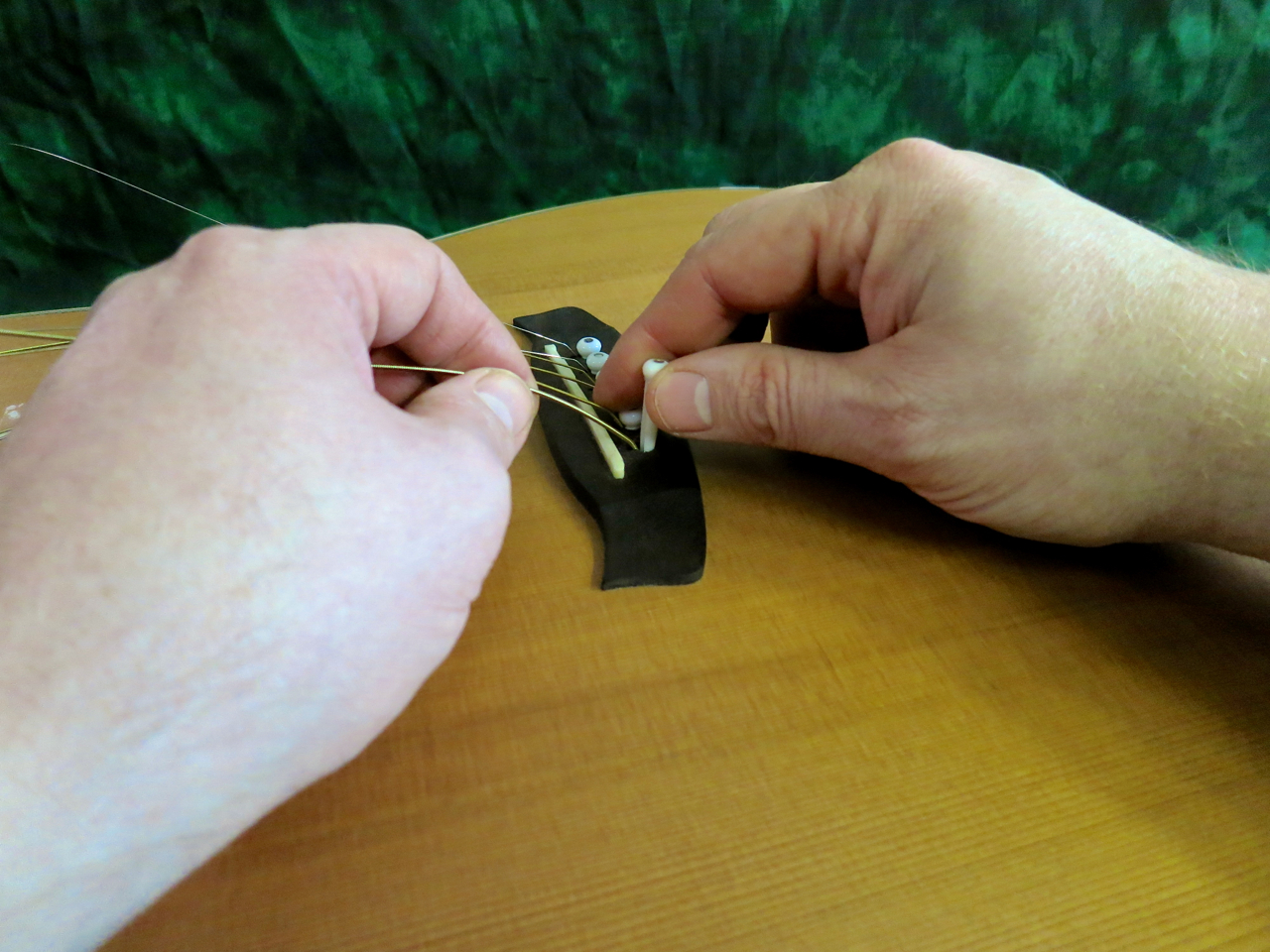
Useimmissa tapauksissa kielen saa pois käsipelillä:

Työnnä ensin kielen hieman tallan läpi runkoon.

String change steel string – pull pin out 1

Tämä vapauttaa yleensä tallanastan ball-end-renkaan lukituksesta, ja nastan voi nostaa helposti ulos.

String change steel string – pull pin out 2

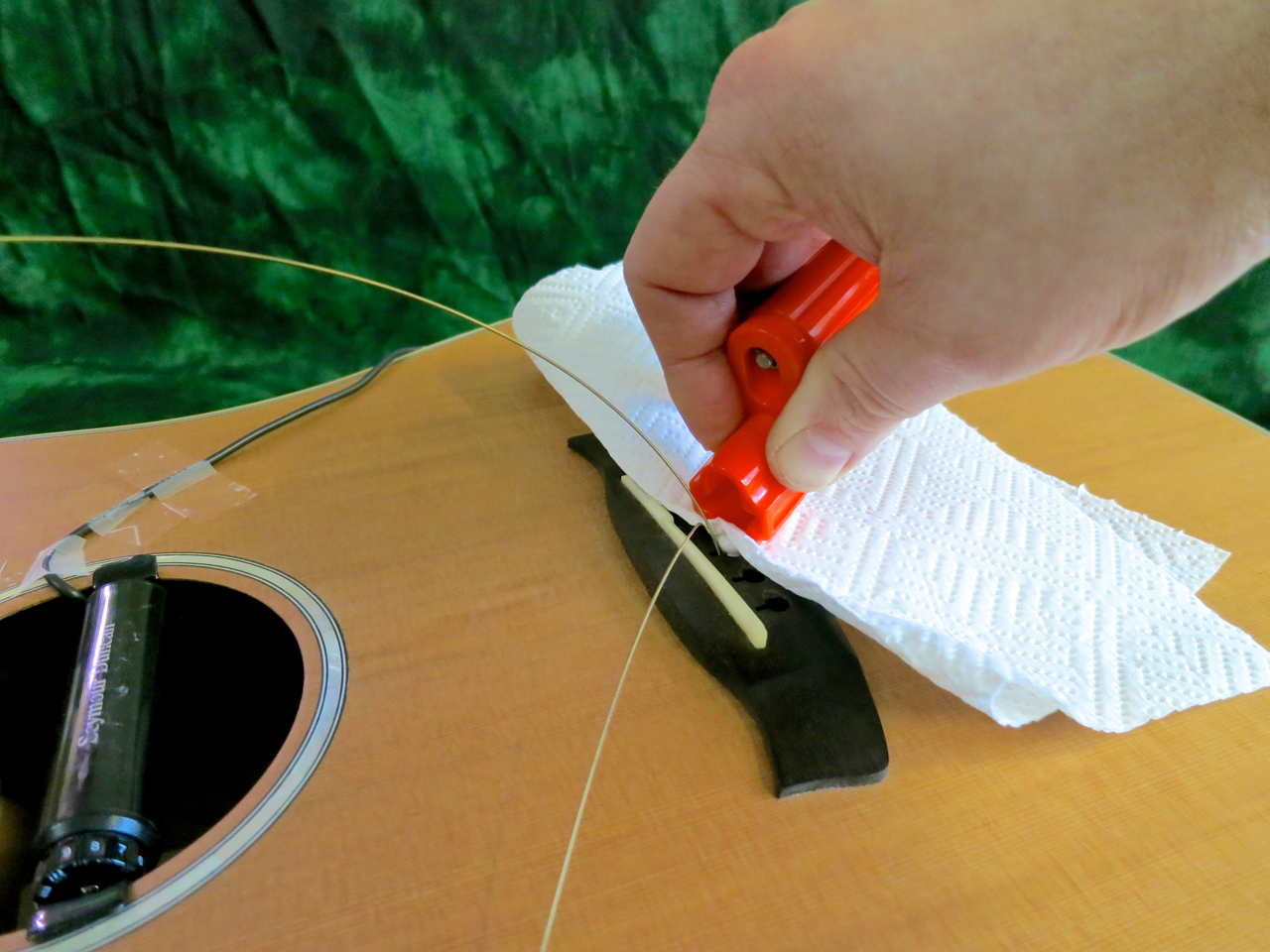
Jos tallanastaa ei saa – yrityksistä huolimatta – pois käsipelillä, suosittelisin talouspaperin (tai ohuen kangaspalan) käyttämistä tallan ja tallanastan suojaksi.

tak-n20-bridge

Joissakin kitaroissa – etenkin tietyissä Ovation- ja Takamine-malleissa – löytyy myös nastattomia tallaratkaisuja. Näissä talloissa kielet pujotetaan yksinkertaisesti tallan takaosan läpi.

String change steel string – take string off machine head

Tämän jälkeen poistetaan vanhat kielet myös virittimien tapeista.

Kun kaikki vanhat kielet on poistettu, voi tarvittaessa öljytä otelaudan ja tallan sopivalla otelautaöljyllä.

String change steel string – put pin in

Uudet kielet kiinnitetään aina ensin soittimen tallaan, laittamalla ball-endin ja tallanastan paikoilleen.

String change steel string – pull on string

Seuraavaksi kieli vedetään kevyesti ulospäin, samalla kun pidetään tallanastaa paikalla. Näin kiilataan se tallanasta ball-endin avulla kiinni tallaan.

String change steel string – stringing 1

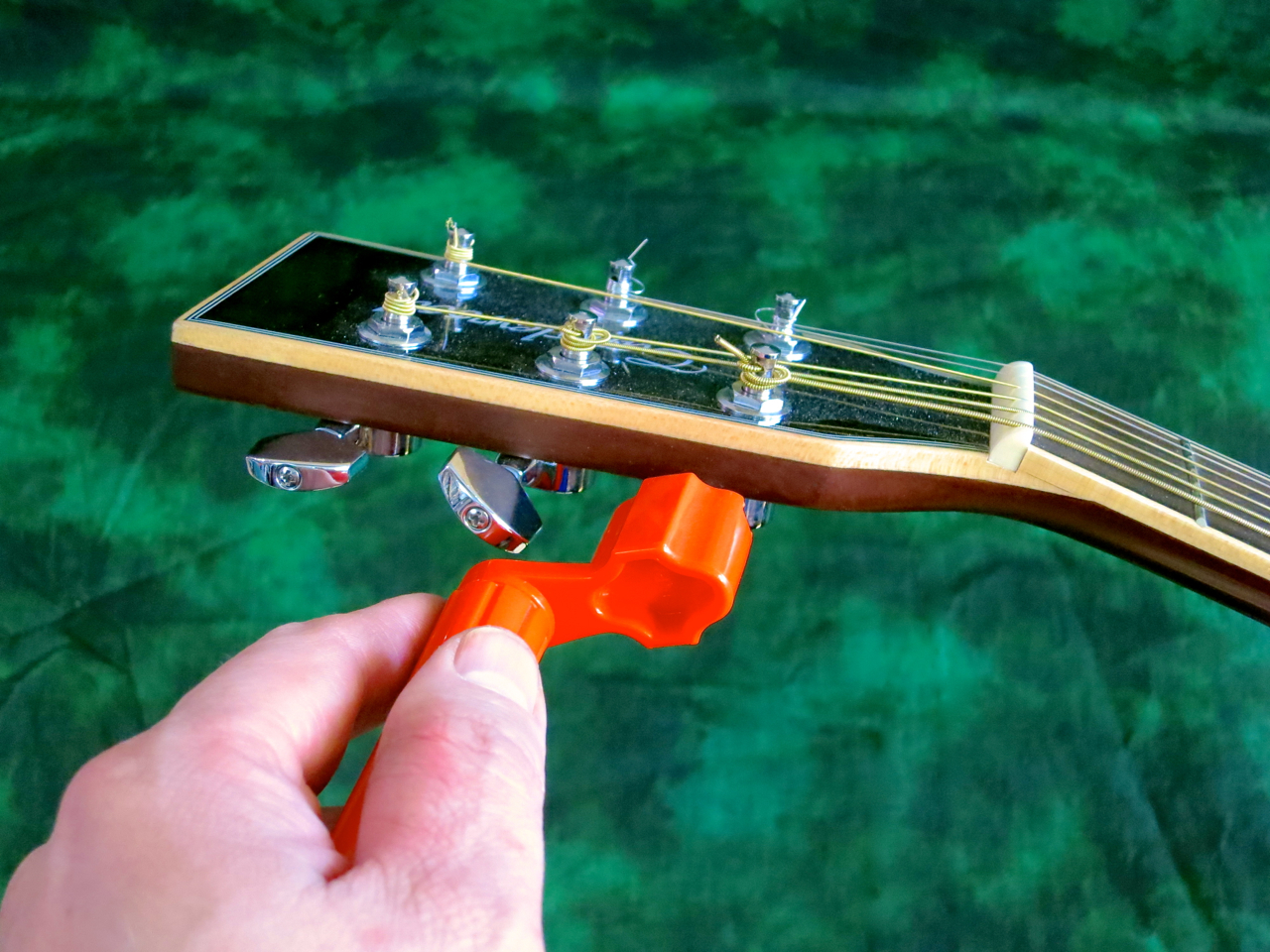
Lavalla kieli työnnetään virittimen läpi…

String change steel string – stringing 2

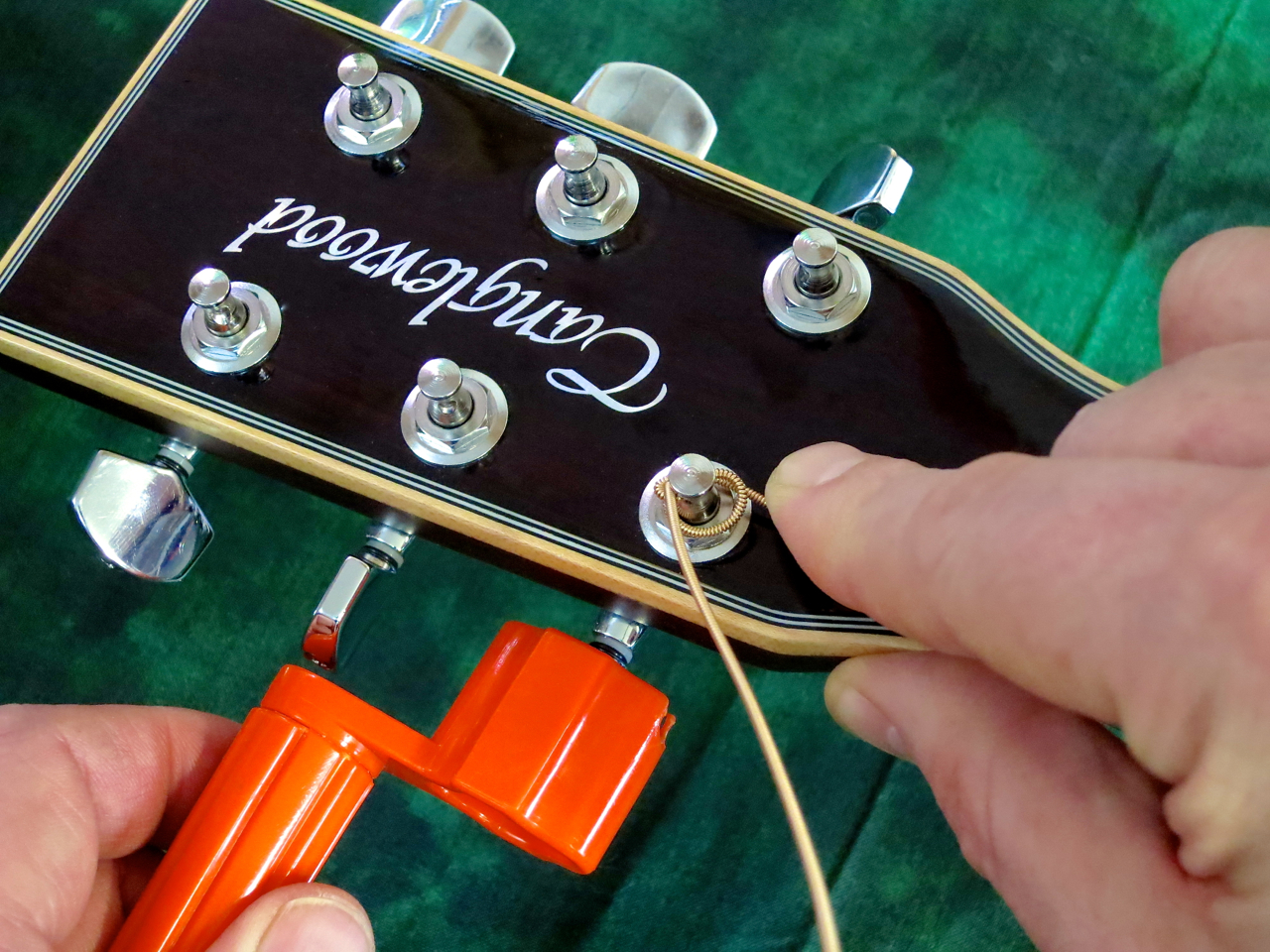
…vedetään viritintapin ympäri…

String change steel string – stringing 3

…ja lukitaan paikoilleen vetämällä sitä rungosta poispäin.

String change steel string – stringing 4

Yksi käsi painaa kielen alas, kun toinen kiertää sen kireäksi. Kielen pitää kiertää tapin ympäri ylhäältä yhä alemmas.

String change steel string – keep pin in place

Kun viritin alkaa kiristää kieltä yhä enemmän, otan toisen käteni pois lavalta, jotta voin tarvittaessa estää tallanastan nousemista ulos tallasta.

String change steel string – cut off end

Suosittelen ylijäävän palan poistamista – kun kieli on viritetty – katkaisemalla sen läheltä viritintappia. Sen jälkeen taivutan varovaisesti kielityngän hieman kohti lapaa. Ole varovainen, katkaistu kieli on hyvin terävä!

Laitan uudet kielet kitaralle tavallisesti pareittain – ensin E-e, sitten A-h ja viimeiseksi D-g.

String change steel string – strings on machine heads

Onnistunut lopputulos näyttää tällaiselta.

String change steel string – pin height

Tallanastat istuvat tasaisesti tallassa.

String change steel string – string stretching

Kielet pitävät vireen nopeammin, jos niitä venytetään ensimmäisten viritysten yhteydessä: ensin viritetään, sitten venytetään… neljän-viiden kerran jälkeen virityksen pitäisi alkaa asettua.

Otekäsi pitää kielen alhaalla venymisen yhteydessä, jottei satulaan kohdistuisi liikkaa rasitusta.

****

Kun kitara on viritetty, voidaan tarkistaa vielä uusien kielten korkeus 12:n nauhan yllä.

Jos kielten korkeus on selvästi suurempi kuin ennen kielten vaihtamista, uusi kielisatsi oli luultavasti paksumpi kuin vanha. Silloin kannattaa kiristää kaularautaa (sopivalla avaimella) noin neljänneskierrosta (korkeintaan puolen kierroksen).

Jos kielten korkeus on selvästi pienempi kuin ennen kielten vaihtamista, uusi kielisatsi oli luultavasti ohuempi kuin vanha. Silloin kannattaa löysätä kaularautaa (sopivalla avaimella) noin neljänneskierrosta (korkeintaan puolen kierroksen).

Kaularaudan tarkoitus on säätää kaulan loivaa kaarevuutta (ns. neck relief). Vaikka kaulan reliefilla on suora vaikutus kielten korkeuteen, kaularauta ei ole varsinaisesti tarkoitettu säätämään kielten korkeutta. Kielten korkeuden oikeaoppinen muuttaminen on soitinrakentajan homma, ja sitä hoidetaan hiomalla (tai vaihtamalla) soittimen tallaluu.

Changing strings on a steel-string guitar

String change steel string – start

Here’s what you need:

In addition to a fresh set of strings, you should have a wire cutter and a tuner at the ready. An inexpensive string winder makes the process much faster.

A steel rule will come in handy, should you want to double-check your ”before” and ”after” setups. Measure your string height at the 12th fret (top of fret to bottom of string) before taking the old strings off. That way you will be able to use the steel rule to ascertain that your setup has stayed unchanged. Alternatively, you could also measure the neck relief at the seventh fret directly, by using a capo at the first fret, while pressing down the low E-string at the 14th fret.

Ideally, though, you should stick to the exact same string gauge (and even string brand) to avoid inadvertently changing the playability of your acoustic guitar.

String change steel string – loosening string

I find it most convenient to take off all strings at once.

There are some people who claim that taking all six strings off at the same time may cause damage to your instrument. Let me tell you, I have been changing strings on steel-string guitars since 1977, always removing the whole set at once, and have never had any problems at all. Even Martin Guitars suggest you do it this way in their own video, and they should know!

String change steel string – cutting old string

Once the strings are completely loose and flabby, I cut them in half.

This isn’t something you must do, but I find the shorter lengths easier to handle, than having to deal with the whole string.

String change steel string – winder pin puller

For the largest part, steel-string acoustics come with pin bridges. The bridge pins – made out of plastic, bone, wood or even metal – keep the ball-ends locked into place.
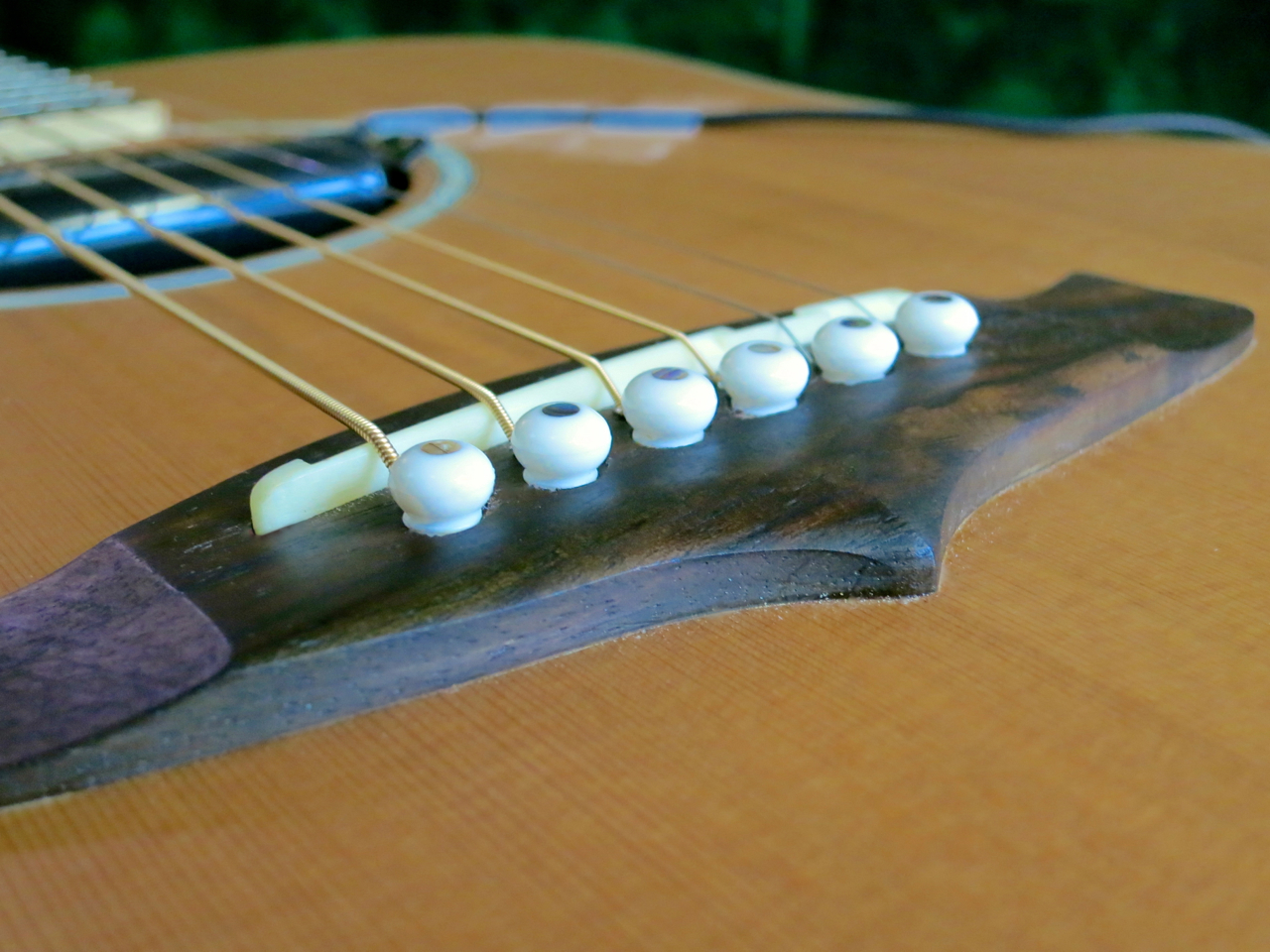
Most string winders sport a small cut-out for lifting the bridge pins. I’d suggest, though, that you first try extracting the pins by hand, because, very often, the ball-ends have jammed the pins in place fairly tightly. Trying to pull them out directly might damage your string winder or the bridge pins, or, even worse, the bridge itself.
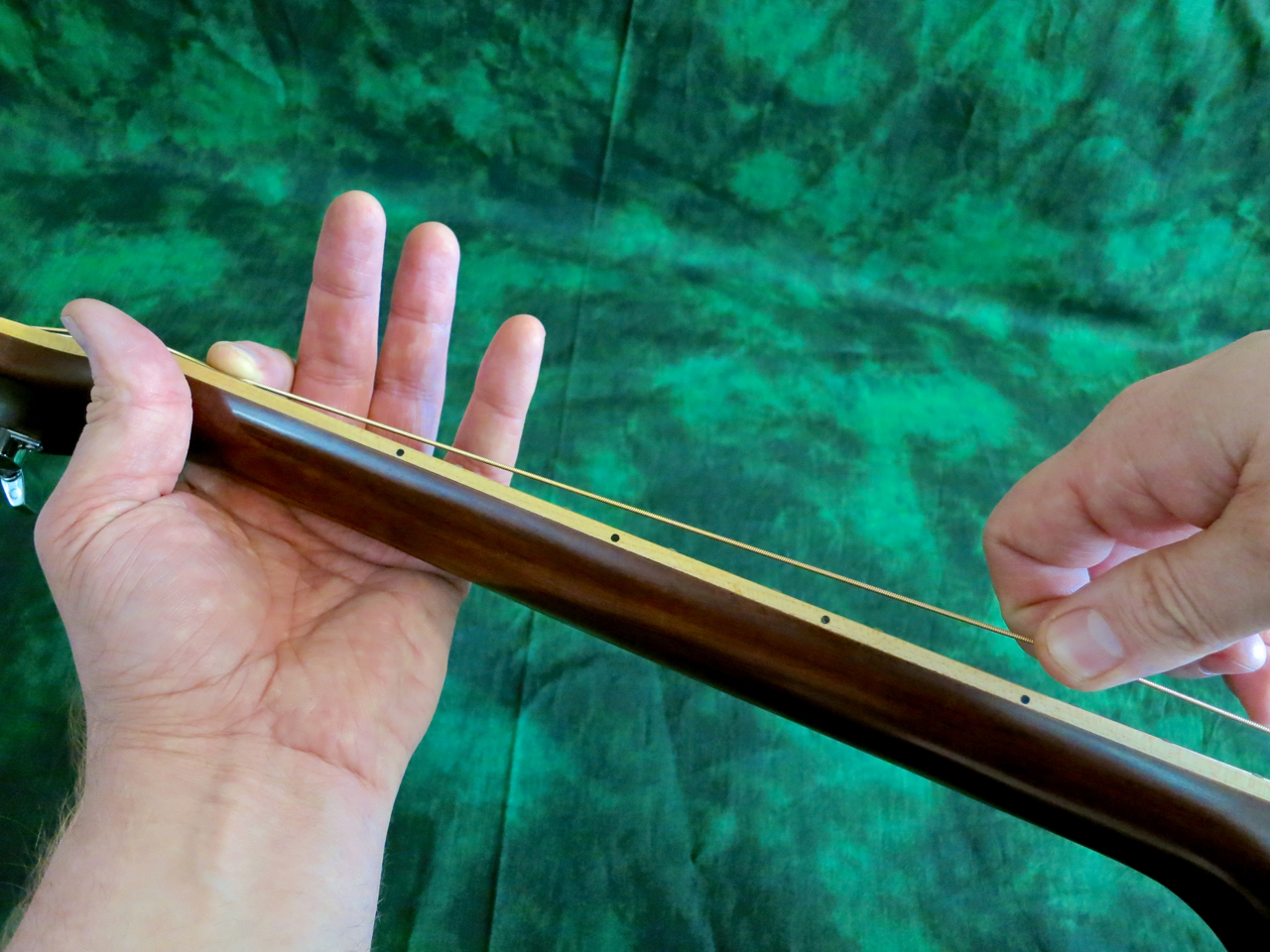
String change steel string – push end in

Most of the time you will be able to extract the bridge pins by hand:

Start by pushing the ball-end down (into the body) by a centimetre, or so.

String change steel string – pull pin out 1

Usually, this is all that’s needed to unjam the bridge pin.

String change steel string – pull pin out 2

If a pin really is stuck, and can’t be lifted out with your fingers, I’d strongly suggest using a piece of tissue paper (or a piece of cloth) as a cushion to protect the pin and the bridge’s surface.

tak-n20-bridge

Some acoustic guitars come equipped with a pinless bridge – most notable Ovation and some Takamines. With these bridges, all you have to do is pull the ball-ends out of the back of the bridge.

String change steel string – take string off machine head

At the headstock end you have to untie the strings and take them off the tuner posts.

If your guitar’s fretboard and/or bridge feel (or look) a little dry, now would be the perfect time for applying a little fretboard oil.

String change steel string – put pin in

You start putting on a new string by feeding the ball-end into the appropriate bridge hole, while inserting the bridge pin.

String change steel string – pull on string

By pulling the string up a little, while holding the pin down, you will conveniently get the ball-end to jam the bridge pin in place.

String change steel string – stringing 1

Next you feed the string through the tuner’s post…

String change steel string – stringing 2

…pull the string away from the body, and around the post…

String change steel string – stringing 3

…and, finally, lock the string end in place.

String change steel string – stringing 4

Keep the string pressed downwards, while you’re turning the crank. Each new winding should pass under the one before it.

String change steel string – keep pin in place

When the string starts getting taut, I move my hand from the headstock to the bridge, to make sure the bridge pin stays firmly in place.

String change steel string – cut off end

I’d recommend cutting off the surplus string in close proximity to the tuning post. Then I bend the stub down towards the headstock face. Be careful, a cut-off string is very sharp!

I put on the fresh strings in pairs, working my way away from the nut – first the two e-strings, then the pair of A and b, and lastly the D- and g-strings.

String change steel string – strings on machine heads

This is what the result should look like at the headstock end.

String change steel string – pin height

The bridge pins should sit at a uniform height above the surface of the bridge.

String change steel string – string stretching

Getting new strings to stay in tune is a much faster process, if you stretch each string carefully. It works like this: First you tune to pitch, then you stretch each string, and retune again. Once you’ve repeated this process four to five times, you should be ready to go.

Your fretting hand should hold down the string you’re stretching at the first or second fret to avoid damage to the top nut.

****

Once the guitar is in tune you could check the string action at the 12th fret and compare it with the values measured with the old string set.

If the action is noticeably higher, chances are you’ve put on a heavier gauge set of strings. You need to compensate for the stronger string pull by tightening the truss rod (with the correct tool) by a quarter of a turn (or half a turn, at the most).

If the action is noticeably lower, chances are you’ve put on a lighter gauge set of strings. You need to compensate for the weaker string pull by loosening the truss rod (with the correct tool) by a quarter of a turn (or half a turn, at the most).

The truss rod is meant solely for neck relief adjustment. Even though adjusting the neck relief does have an impact on the action, string height adjustment isn’t really what the truss rod is meant for. Adjusting the action on a steel-string acoustic is usually a job for a luthier, and is achieved by changing the height of the bridge saddle.

Review: Zoom A3

****

Zoom A3 + Godin Acousticaster A6

Zoom’s A3 is the company’s brand-new, next-generation modelling effects unit for acoustic guitar.

The Zoom A3’s user interface is very similar to the one used in their MS-50G-pedal for electric guitar, but in terms of its features the A3 offers a whole plethora of stuff developed specially for use with acoustic guitars.

****

zooma3

Zoom have managed to pack an unbelievable amount of processing prowess into its new compact contender (current street price in Finland approx. 170 €), yet the A3 is still easy to use. The most vital functions have been given their own knobs and pushbuttons, which makes the A3 easy to use and cuts back on unnecessary menu-jumping at the same time.

The Zoom’s main sections are the quality dual preamp with its three-band EQ, the pedal’s versatile guitar-modelling department, as well as the A3’s large assortment of effects.

Additionally, the pedal offers a switchable solo boost (up to 12 dB) with its own tone control, an automatic feedback remover (that can defeat up to three different frequencies simultaneously) and a digital tuner.

a3_memory

The Zoom A3 is a programmable unit, which can store up to 20 patches. The patches can also be lined up in an A/B-list, which enables you to select patches for on-the-fly switching.

a3_battery

The effect pedal comes with its own power supply unit, but it can also be run on four AA-size batteries.

Zoom A3 – mic input

The A3’s microphone input – which can run phantom power (+24V or +48V) for condenser mics – and the unit’s balanced XLR-output (with a dedicated ground lift switch) have been placed on the front panel.

Zoom_A3_right_side

Your guitar’s output goes into the Zoom’s pickup input on the unit’s right hand side. A three-way slider lets you select two pre-EQ curves – magnetic or piezo – as well as a linear option (flat).

Zoom_A3_left_side

The stereo outputs have been placed on the opposite side, next to the USB-port for (firmware updates).

****

Zoom A3

Each of the A3’s patches can run up to three different effects simultaneously, so you could use the first slot for one of the Zoom’s 28 virtual guitars, the second slot for one of three virtual microphones (SM57, C414, U87) and the third for something like a reverb.

On the other hand, you can also use the A3 as a ”pure” multieffect, by not using any digital guitar-modelling and creating patches with three effects in them. You can choose from 40 different effect types – from compression and chorus all the way to pitch-shifting and reverb. The sound quality is very good, and each effect offers plenty of leeway for precise adjustment.

16_body_types

Still, I think the A3’s biggest selling point is its excellent modelling section, which makes it possible to achieve astonishingly realistic results with only a few clicks of a button.

To work properly the modelling section needs a clean guitar signal, so the first thing is to make sure you’ve got the input gain settings for your straight guitar output and/or the mic put in front of your guitar just right.

Once the levels are OK, miraculously changing the character of your guitar is quick and easy: First, use the rotary switch above the Zoom’s display to select the body type corresponding best to the guitar you’re using – for example, choose ”Mold Body” if you’re playing an Ovation or ”YMH” if your guitar is a Yamaha LL-series instrument.

acoustic_preamp

Next, you select a virtual guitar of your liking for the first effect slot in the chosen patch. You can access all of the A3’s 28 virtual guitars by using the Type-buttons. The guitars are displayed using their model names – like J-45, LG-2 or F-55 – as well as by an icon in the display.

If you’re using only a direct piezo signal as a starting point, you can add a good dose of authenticity by selecting a virtual microphone for the second effect slot of the patch. Each of the three virtual mics lets you choose between close- and ambient-miking, and whether the mic has been placed in front of the virtual sound-hole or near the virtual guitar’s bridge.

I have recorded three audio examples to give you an idea of the modelling technology’s sound:

The first clip features a Godin Acousticaster with an LR Baggs piezo system. First you’ll hear the straight piezo signal, followed by the these virtual guitars: A D-28, an OM-28, a 00-18 and an SJ-200. I’ve used Zoom’s virtual version of an AKG C414, and a touch of reverb:

The second clip has been recorded with me playing my Takamine N-20 -jumbo into a real condenser mic (an AKG C3000). The sequence of virtual guitar models is the same as above:

In the third clip I play my Tanglewood TW28-CSN -dreadnought, with the physical microphone and the sequence of virtual guitars staying the same:

****

In my opinion the Zoom A3 is a very serious contender for the title of ”Best compact multieffect for acoustic guitar”. It is a fantastic little tool for both live use and in the studio, where it can act as your own production centre for acoustic guitars. The Zoom is very easy to use and it sounds great. The on-board anti-feedback circuitry works very nicely and the solo boost is a handy tool to have in a unit such as this.

The best bit is, nonetheless, the A3’s surprisingly organic-sounding modelling section. The Zoom’s biggest advantage, when compared to other similar effect units, lies in its versatility and the wide range of different virtual guitars on offer. It is very easy to find a good body-style match for your physical guitar’s input signal, and the amount of different virtual guitar models makes it almost hard to choose. The option to creatively misuse the Zoom A3 – by selecting the ”wrong” body-type for your input signal – is also fun, and yields some nice new flavours.

But, don’t listen to me, go out and give it a try yourselves.

****

Zoom A3

Current street price in Finland approx. 170 €

Finnish distributor: Studiotec

****

Pros:

+ value-for-money

+ quality preamp

+ mic input with phantom power

+ great-sounding virtual guitar models

+ effect quality

+ EQ-section has physical control knobs

+ Boost & Anti-Feedback functions

****

Pidä blogia WordPress.comissa.

Ylös ↑