

Kitarablogi.com – Finland's premier Guitar and Bass blog
Juttuja kitaroista ja bassoista

****

Yamaha’s popular series of THR practice amps has recently got three new members:
The brass-metallic coloured THR5A is a 5 Watts combo aimed specifically at electroacoustic guitars, and features digital microphone modelling, amongst other things.
The regular Yamaha THR10 has now gotten two sister models. The black THR10C concentrates on ”classic” and ”boutique” tones to satisfy the friends of classic Sixties and Seventies Rock and Blues. The army-green THR10X is aimed squarely at the connoisseurs of all things hard and heavy, concentrating on Hard Rock-, Metal- and Thrash-tones.
****
The main design concept is uniform across the THR-range:

All combos have a sturdy metal chassis with plastic sides. The overall design clearly takes a lot of cues from today’s high-end tube Hi-Fi gear.
All THRs come equipped with a digital tuner.

All of the small amps feature a built-in USB-soundcard, which can be utilised for recording purposes (Steinberg’s Cubase AI comes with each amp), as well as for using the amp as your personal stereo system.
With the help of Yamaha’s THR Editor software you can also programme your own amp settings via the USB-port. As an added bonus, the THR Editor gives you access to some hidden functions (like the noise gate, or in the THR5A’s case also additional effects) that cannot be accessed from the front panel.

The Yamahas can be run on AA-batteries, if necessary. The THR5A’s battery compartment has been placed on the combo’s back…

…while on all THR10-models it has been sunk into the amp’s base plate.
Naturally, a quality, laptop-type PSU is supplied with all models.
****

Regardless of the fact that the Yamaha THR5A (current price in Finland: 199,99 €) is one of the world’s smallest acoustic amps, it is still packed chock-full with tasty features.

The THR5A offers you four different virtual microphones to turn your piezo’s tone into the sound of a mic’ed up acoustic. Three settings are meant for steel-string acoustics, with the fourth being reserved for nylon-string electroacoustic guitars.
The last Mic Type selection reads ”EG Clean”, being a clean electric guitar amp model for your occasional Jazz Box meanderings.
The Blend-control lets you change the balance between the dry piezo signal and the modelled virtual mic.
Offering only a single master tone the THR5A’s EQ-section is rather spartan, but the effect section is far better endowed: The Effect knob gives you compression, chorus or a combination of both. Delay/Reverb delivers delay, reverb and a combination effect.
You can adjust delay times using the Tap Tempo button on the far left.
****

The vintage-inclined Yamaha THR10C (current price in Finland: 299,99 €) is larger than the THR5A, and it also offers more features.

The THR10C comes loaded with five guitar amp models, whose names already give you a very good idea of their soundscape:.
In addition, there’s one bass amp model, as well as a setting for acoustic guitar. The neutral sounding Flat-selection is a good choice if you want to amplify a synth or digital piano.
The THR10C’s EQ-section is a three-band affair, while the effect department offers eight different effects. Turning the Effect-knob gives you access to a chorus, a flanger, a phaser and a tremolo effect. Delay/Reverb offers you tape echo, spring reverb, hall reverb, as well as a echo/reverb-combination setting.
All THR10-models sport five memory slots to store your favourite amp settings.
The Output-section offers you two volume controls, with one being the guitar section’s master volume and the other dealing with the signal coming in via USB (or the auxiliary input).
****

It may be small, but it still is fierce – the Yamaha THR10X (current price in Finland: 299,99 €) is tailoured to all Rock and Metal.

The THR10X’s Amp-department holds in store five high gain amp models, each with its own tonal footprint, with differences in areas such as bass punch and overall compression.
A Clean model is also supplied for the occasional ballad or two, along with a Bass amp and the Flat setting.
The THR10X features the same type of three-band EQ as it’s sister model.
The effect department is also nearly identical, save for the THR10X’s brighter Delay-effect.
****

I think it’s great that Yamaha have designed their entire THR-range as stereophonic combos, because this way the amps also have a clear appeal as ”lifestyle accessories”. As pure guitar amps, stereo brings out the depth in some effects, especially reverbs, but when used as a personal micro-Hi-Fi stereo is the only way to go.
Yamaha’s decades-long experience in the Hi-Fi-field really shows in the sound of these small combos. The sound is full, clear, punchy and dynamic. The tiny THR5A already sounds better than most built-in computer sound systems, even if the breadth of the stereo picture isn’t as wide, and the bass response as deep as in the larger combos. The THR10s really hit the sonic jackpot, and will blow many micro-Hi-Fis off the table, hands down. For a guitarist the THR-series is a stylish way to combine an mp3-boombox with a practice amp.
****
THR5A
I must admit that the THR5A’s raison d’être is not quite clear to me. At home you normally wouldn’t need to use and amp with an acoustic guitar, but on the other hand this tiny combo really doesn’t cut it at, say, a pub gig. Maybe the THR5A is meant mainly for busking.
On the other hand I can’t deny that this dwarf’s virtual microphones sound surprisingly realistic, so maybe this combo’s main function is to serve as a specialised soundcard in your home or project studio. The amp’s cool mic modelling really manages to turn those dry and upfront piezo tones into something organic and beautiful.
The effects also sound very good.
I have recorded these examples with a Zoom H1 recorder. I played a Taylor 110CE:
Yamaha THR5A – Condenser + Compressor + Hall
Yamaha THR5A – Dynamic + Compressor + Hall
Yamaha THR5A – Tube + Compressor + Hall
****
THR10C
Ooh, man, I really dig this combo! I wouldn’t change a single amp model on the Yamaha THR10C – each sounds great and has plenty of depth and character.
The effects also sound great, with the spring reverb coming over especially realistically.
These three examples have been recorded using a Les Paul -style guitar:
Yamaha THR10C – British Blues + Hall
Yamaha THR10C – Class A + Chorus + Tape Echo
Yamaha THR10C – Deluxe + Tremolo + Spring Reverb
****
THR10X
Some jokers occasionally quip that all Heavy and Metal guitar tones sound alike.
The truth is nevertheless that there are all sorts of different types of overdriven and distorted guitar tones to be found in Hard Rock, Metal and Thrash. The most distinct differences are usually found in the mid-range character and the bass response of saturated distortion tones.
To my knowledge, Yamaha’s THR10X is the world’s first and only practice amp devoted specifically to full-on Hard Rock and Metal. And what a great job it does!
These three examples have been recorded using a Les Paul -style guitar:
Yamaha THR10X – Brown II + Hall
Yamaha THR10X – Power II + Flanger + Delay
Yamaha THR10X – Southern Hi + Phaser + Delay
****

In my opinion these new THR-models are a great move by Yamaha. These specialised combos will satisfy those guitarists who have wished for more of their own genre in the same combo, while leaving the successful basic models – the THR5 and THR10 – untouched, and the overall concept of the THR-series intact.
****
Three new Yamaha THR -models
• THR5A – 199,99 €
• THR10C and THR10X – 299,99 €
Finnish distributor: F-Musiikki
****
Pros (all models):
+ sturdy chassis
+ USB-soundcard
+ quality of amp/mic models
+ quality of effects
+ great sound as micro-Hi-Fis
+ value-for-money

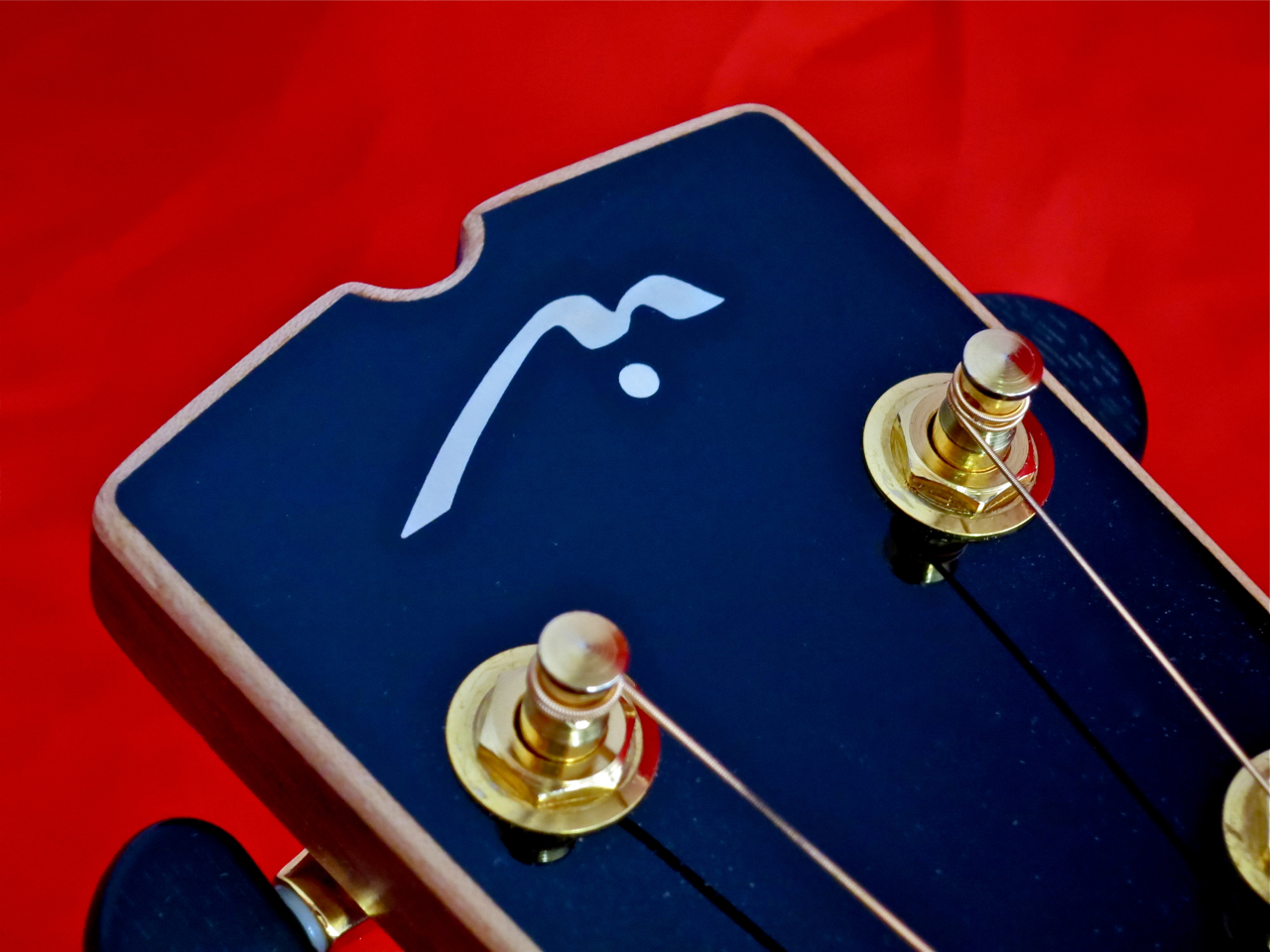
Mannedesign on italialaisen Manne Guitarsin edullisempi, Kauko-Idässä valmistettu kitaramerkki.
Mannedesignin valikoimaan kuuluu sähkösoittimien ohella myös pieni akustisten kitaroiden mallisto, josta valittiin tällä kertaa kaksi kitaraa testiin: Parlour-kokoinen Mannedesign PFM, sekä Roberto Dalla Vecchian nimikko-Dreadnought RDV.
****

Kauttaaltaan kokopuinen Mannedesign PFM (660 €) on suunniteltu Blues-, Folk- ja juurimusiikin ystäville, jotka hakevat soittimestaan juuri sitä autenttista 1930-luvun soundia.
Setrikannen mattaviimeistelty tumma sunburst-väritys antaa kitaralle hienosti lisää katu-uskottavuutta.

PFM-mallin mahonkikaula on veistetty yhdestä pitkästä palasta, johon on lisätty viritinlavan yläosa, sekä toinen pala kaulakorkoa varten. Kaulan ja rungon liitoskohta on perinteen mukaisesti 12. nauhan kohdalla.
Rungon sivut ja pohja on tehty kauniista mahongista.
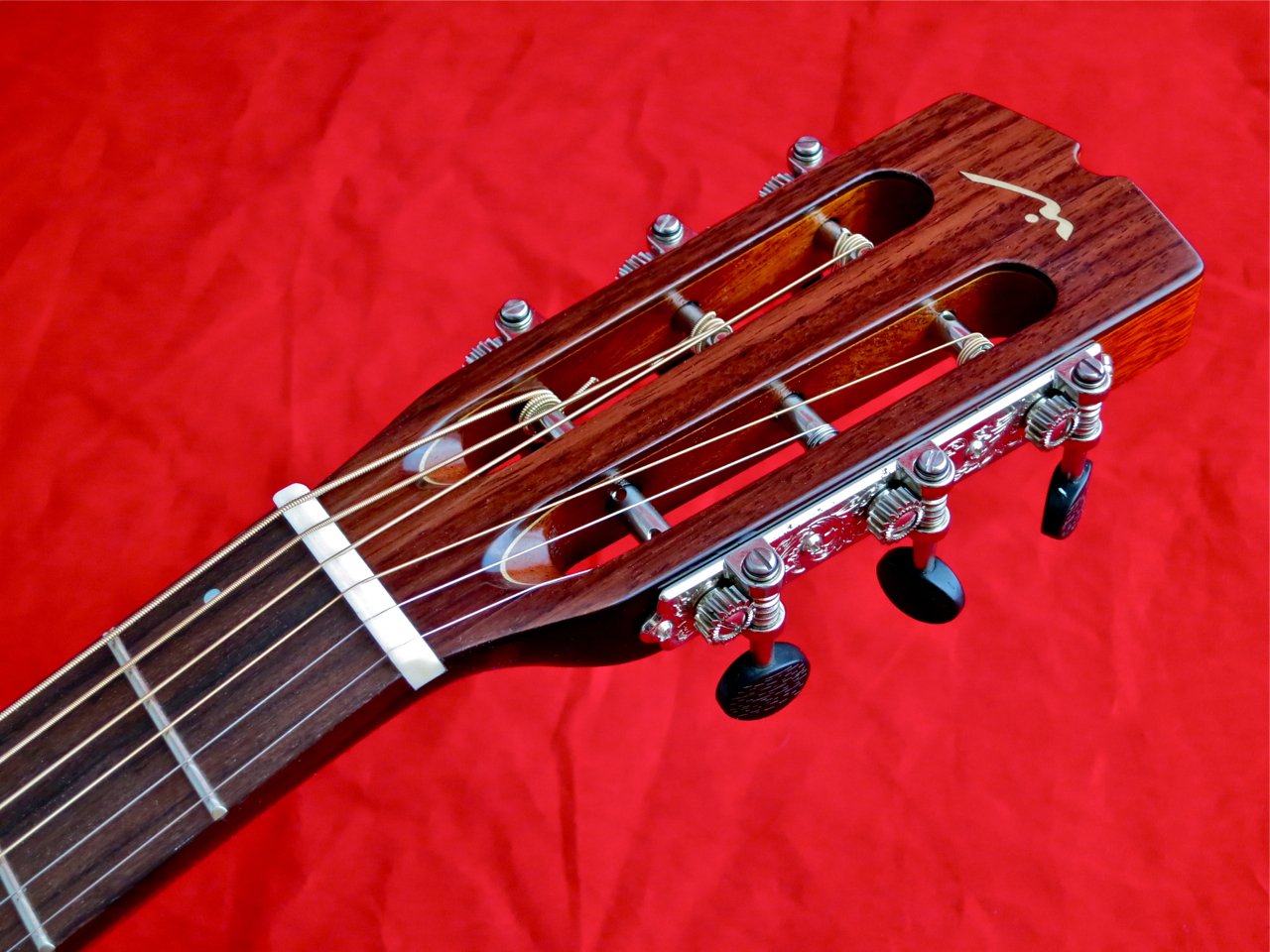
Lavan etupuoli on päällystetty palisanterilla, johon on upotettu vaahterasta veistetty Mannedesign-logo.
Satula aitoa naudanluuta.

Ladukkaat vintage-tyyliset virittimet tulevat Gotohilta. Nykyaikaisena parannuksena niissä löytyy virittimien kireyttä säätävät ruuvit.

Mannedesignin palisanteriotelautaan on siististi asennettu 19 keskikokoista nauhaa.

PFM-mallin koppa on koristeltu upealla loimuvaahtera-reunalistoituksella. Rosetti taas on taidokkaasti kasattu aidoista helmiäispaloista.
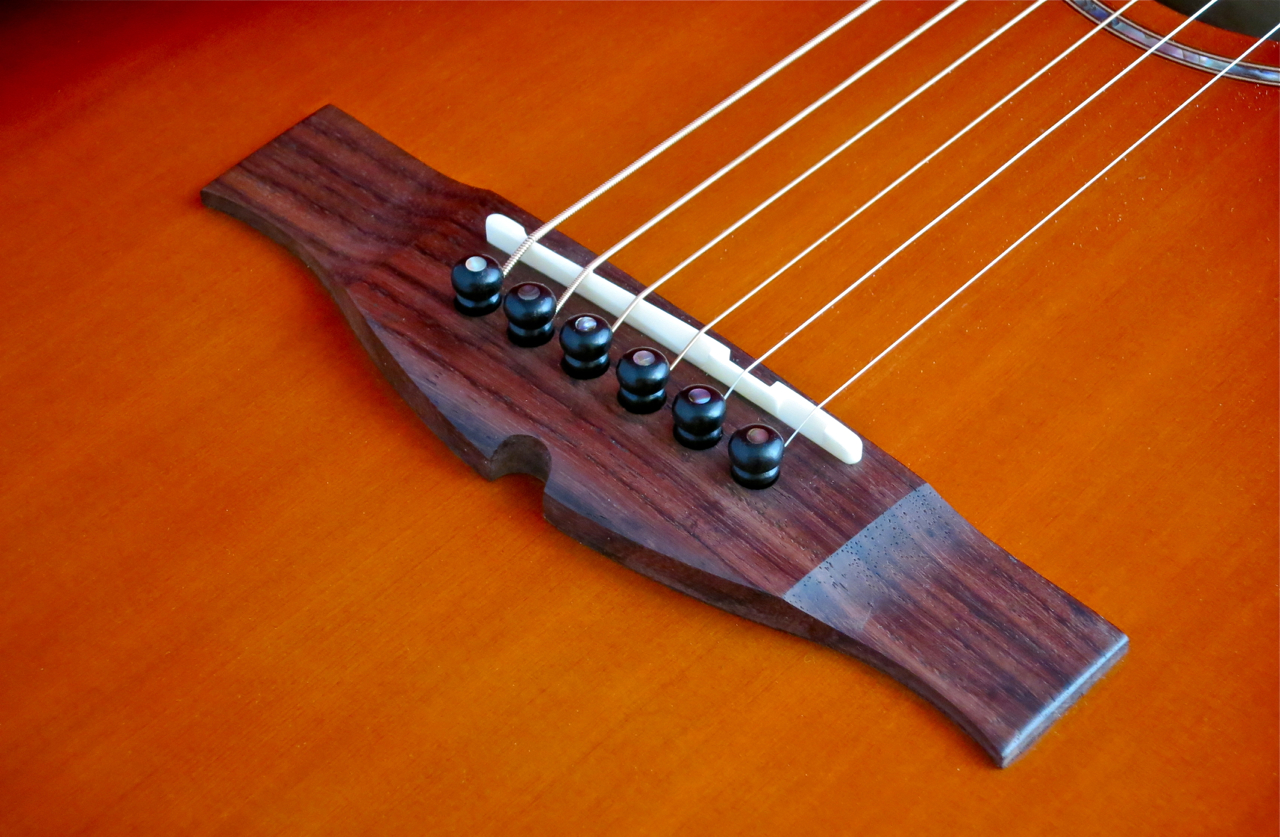
Palisanteritallan alareuna on ikäänkuin viritinlavan yläreunan peilikuva – molemmissa on pyöreä lovi.
Kompensoitu tallaluu on – satulan lailla – tehty naudanluusta, mikä on edelleenkin yksi parhaista materiaaleista tähän tarkoitukseen.

****

Roberto Della Vecchia on italialainen Fingerstyle-mestari, jonka tuotantoon kannattaa ehdottomasti tutustua!
Della Vecchian Mannedesign RDV -nimikkomalli (950 €) on erittäin tyylikäs, perinteisistä ainesosista tehty Dreadnought-teräskielinen. Kitaran kokopuiseen kanteen käytetään laadukasta AA-luokan sitkakuusta.

RDV:n mahonkikaula on veistetty yhdestä palasta, lukuunottamatta kaulakorkoa, joka on ekologisista syistä erillinen pala.
Rungon kokopuiset sivut ja pohja on veistetty kuvankauniista intialaisesta palisanterista.
Kitaran koppa on viimeistelty kiiltävällä lakalla, kun taas kaulassa on satiinipintainen viimeistely.

Reunalistoitetun lavan koristeeksi käytetään eebenpuuta, sekä helmiäisesta tehtyä upotusta.
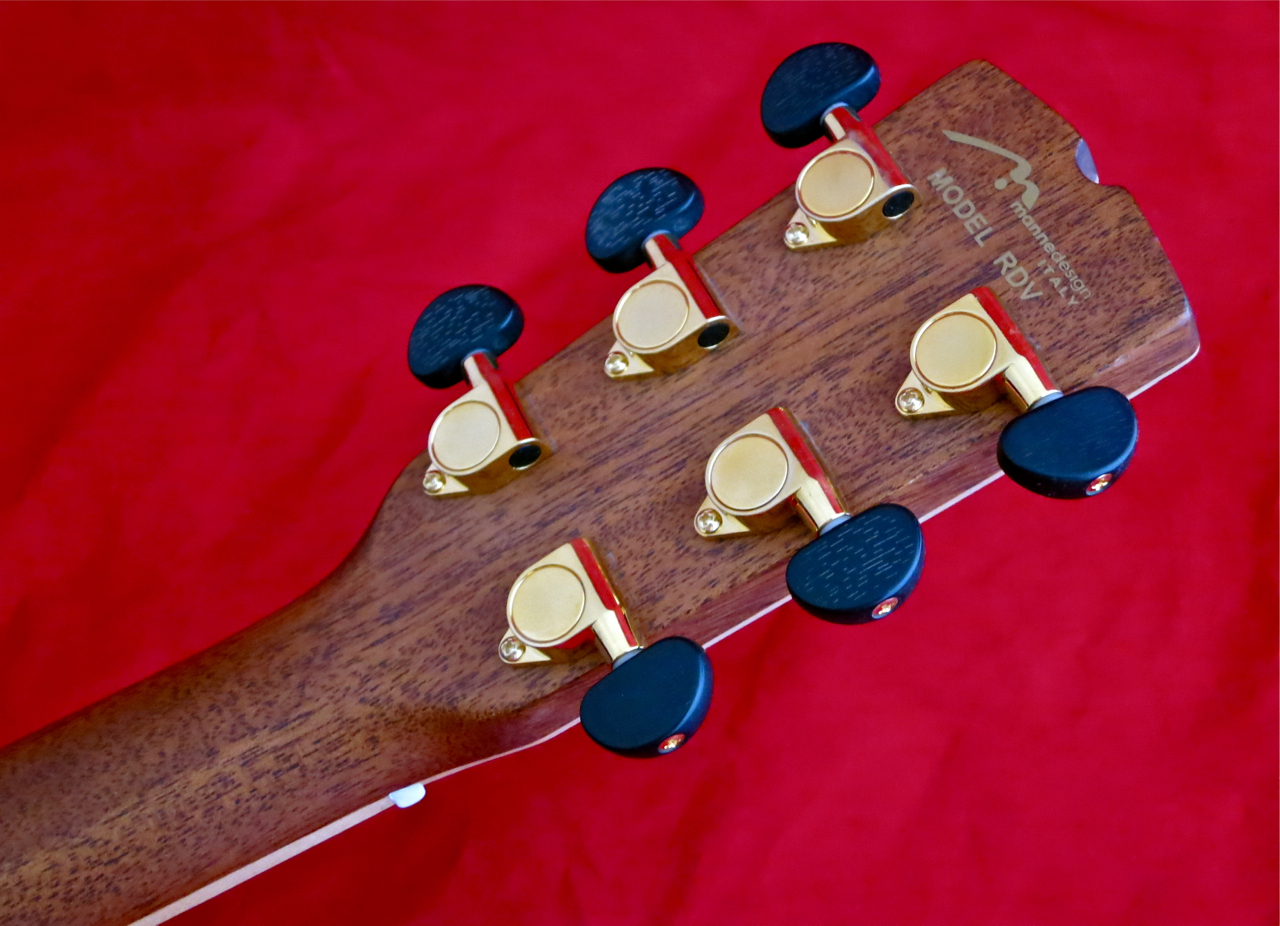
Kullanvärisillä Gotoh-virittimillä on eebenpuuta matkivia muovinuppeja.

Eebenpuisen otelaudan reunalistoitus on vaahteraa. RDV:ssä on 20 keskikokoista nauhaa.

Rungon pohjaan on upotettu hieno mustavalkoinen keskilinjan koriste. Reunalistoitus on veistetty vaahterasta.
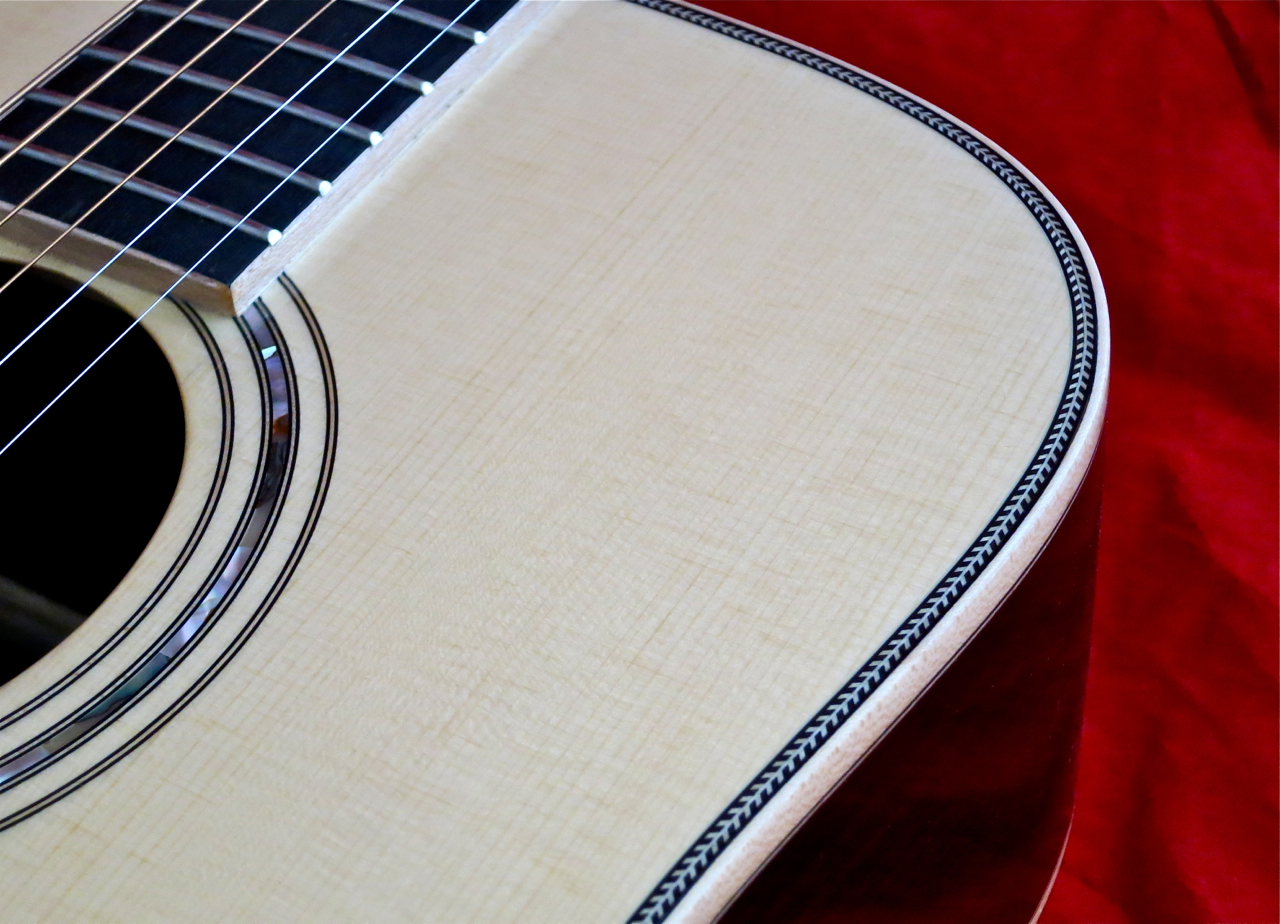
Kannessa käytetään vaahterareunalistan lisäksi vielä kaunista herringbone-koristereunaa.
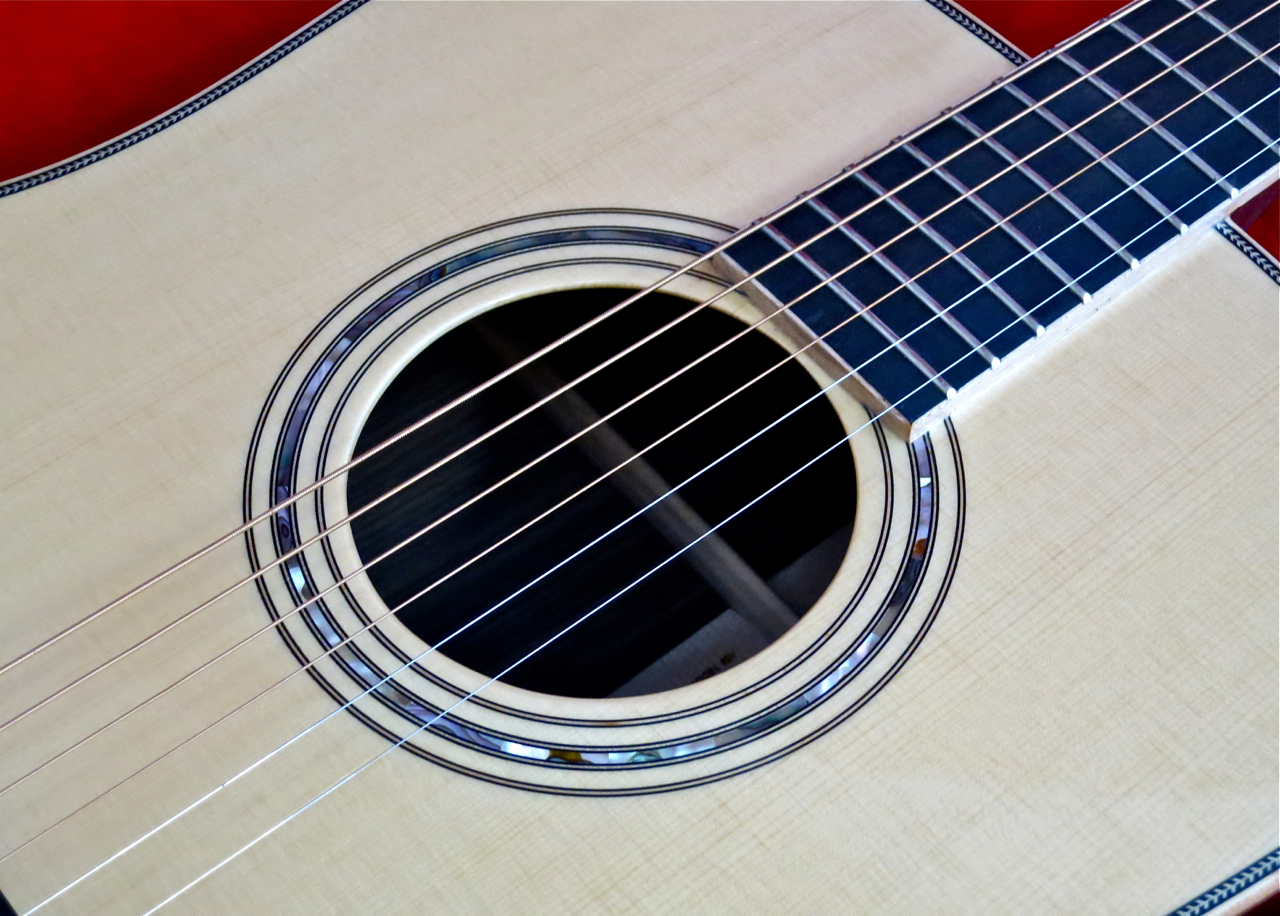
Rosetin keskimmäiseen renkaaseen on käytetty aitoja helmiäispaloja.

RDV:n talla on samanmuotoinen kuin PFM-mallissa käytetty vastine, mutta tällä kertaa se on veistetty sysimustasta eebenpuusta.

****
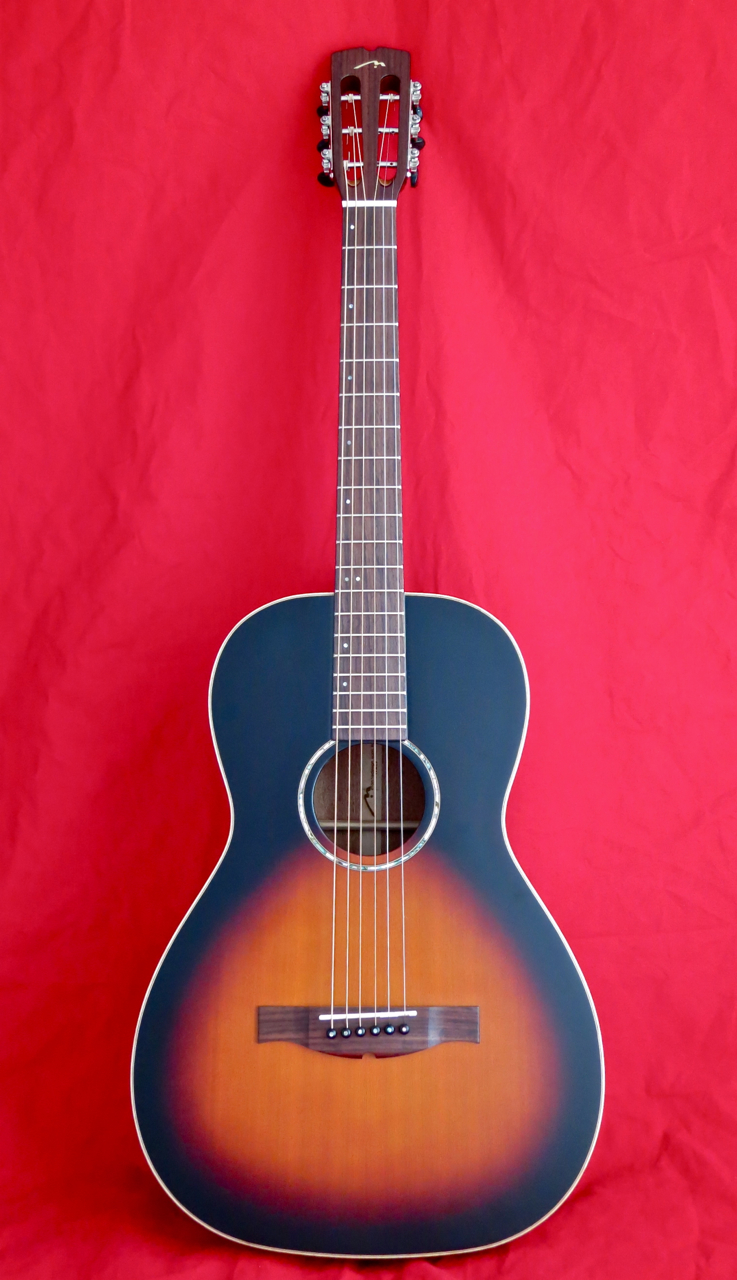
Mannedesign PFM -mallilla on Parlour-kitaroille tyypillinen keskipitkä mensuuri (63 cm), jonka ansiosta kitaran 012-satsin kieliä pystyy venyttämään vielä suhteellisen helposti. Mielipiteitä usein jakaavan, perinteisen V-tyylisen kaulaprofiilin sijaan PFM on varustettu yleispätevällä – ja hyvin mukavalla – D-profiililla. Kaulan leveys on satulan kohdalla 4,4 cm, ja E-kielten välinen etäisyys tallassa 5,4 cm – tämän kitaran kanssa tulee siis hyvin helposti toimeen. Testikitaran tatsia oli säädetty erittäin mukavaksi (E: 1,9 mm/e: 1,5 mm).
Mannedesign PFM on tyypillinen Parlour-kitara sanan parhaassa merkityksessä. Kitaran soinnissa on hyvin kuiva ja yskivä atakki, sekä keskialuevoittoinen, hieman honottava yleissoundi. Sormisoittoa harrastavat Folk-kitaristit tykkävät varmasti PFM-mallin kevyestä bassorekisteristä, koska sen ansiosta soiton erottelevuus säilyy kaikissa tilanteissa. Plektrasoitossa taas tämän Mannedesignin jäntevä sointi lyö itsensä hyvin läpi, ja sen soundi sopii erinomaisesti Ragtime-musiikkiin tai varhaiseen Blues-meininkiin. Äänityskäytössäkin PFM voi olla loistava työkalu, jolla saadaan komppikitarat istutettua ilmaavammin miksaukseen.

****

Mannedesign RDV -kitaralla on luonnollisesti Dreadnoughtin perinteinen pitkä mensuuri (65 cm). Roberto Della Vecchian erikoistoive oli sormityylille mukavampi, väljempi E-kielten välinen etäisyys (5,9 cm) kuin monissa muissa tämän lajin kitaroissa. Näin oikealle kädelle on tuntuvasti enemmän tilaa toteuttaa myös hieman hankalampia sovituksia. Kaulaprofiili on ainakin minun käteeni mukavasti sopiva ovaali C. Myös Della Vecchia -malli saapui testiin loistavassa trimmissä (E: 2,0 mm/e: 1,5).
Palisanterikoppainen Dread’ kuusikannella on yleensä melkoinen voimanpesä, niin kuin esimerkiksi Mannedesignin RDV. Täällä tarjotaan hyvin muhkeata bassorekisteriä, lämmintä keskialuetta sekä hyvin tuoretta diskantin loistoa. RDV on loistava esimerkki laadukkaasta Dreadnought-soundista, ja se tarjoaa sekä paljon volyymiä että tarkkaa ja hyvin eloisaa dynamiikan toistoa.


****
Mannedesign-soittimilla on Suomessa vielä melko matala profiili. Tämän testin perusteella voin kuitenkin vain suositella lämpimästi lähempää tutustumista brändin akustisiin kitaroihin.
****
Mannedesign PFM + RDV
PFM – 660 €
RDV – 950 €
Maahantuoja: Nordsound
****
Plussat (molemmat mallit):
+ hinta-laatu-suhde
+ työnjälki
+ soitettavuus
+ soundi
****

****
Yamahan suosittu THR-harjoitusvahvistimien perhe on hiljattain saanut kolme uutta jäsentä:
Messinginhohtoinen THR5A on viisiwattinen pikkukombo akustiselle kitaralle, joka on varustettu mm. mikrofonimallinnuksilla.
Yamaha THR10 on saanut kaksi rinnakaismallia, joista musta THR10C on tarkoitettu 1960- ja 70-luvun Rock- ja Blues-klasikkosoundien ystäville, kun taas armeijanvihreän THR10X:n erikoisalaa ovat Hard Rock-, Metal- ja Thrash-genrejä.
****
Koko THR-malliston pääpiirteet ovat yhteisiä:
Komboilla on kestävä kotelo taitetusta metallista, sekä muovista. Vahvarien tyylitelty ulkonäkö on saanut selviä vaikutteita high end -audiolaitteista.
Kaikissa THR-komboissa on sisäinen viritysmittari.
Kaikissa THR:eissä on sisäänrakennettu usb-äänikortti. Komboja voi käyttää sekä kitararaitojen tietokonepohjaiseen äänittämiseen (Steinberg Cubase AI kuuluu hintaan) että muusiikin kuunteluun.
Yamahan THR Editor -softalla pystyy usb:n kautta myös ohjelmoimaan oman THR-kombonsa. Softalla pääsee käsiksi myös muutamaan ”piilotettuun”, sisäiseen parametriin (esimerkiksi kohinaportin asetuksiin), sekä THR5A:n tapauksessa myös lisäefekteihin.
Yamaha-komboja voi käyttää myös AA-paristoilla. THR5A:ssa paristolokero sijaitsee laitteen takaseinässä…
…kun taas THR10-malleissa se on upotettu vahvistimen pohjaan.
Laadukas virtalähde kuuluu luonnollisesti kaikissa malleissa pakettiin.
****
Vaikka Yamaha THR5A (199,99 €) on yksi maailman pienimmistä vahvistimista akustisille kitaroille, on kärpässarjalaiseen kuitenkin mahdutettu pitkä lista ominaisuuksia.
THR5A tarjoaa neljä virtuaalimikrofonia pietsomikrofonilla varustetuille akustisille. Näistä kolme on tarkoitettu käytettäviksi teräskielisten kanssa, ja viimeinen on erikoistunut nailonkielisiin.
Mic Type -valitsimen viimeinen pykälä – EG Clean – on puhtaan kitarakombon vahvistinmallinnus, jonka voi valita silloin, kun haluaa soittaa THR5A:n kautta sähkökitaraa.
Blend-säätimellä voi asettaa pietsosignaalin ja mikkimallinnuksen keskenäistä suhdetta.
Pikku-Yamahan EQ-osasto on yhdellä Tone-säätimellä hyvin pelkistetty, sen sijaan kombo tarjoaa peräti kuutta efektiä. Effect-lohkosta saa joko kompressorin tai choruksen tai sitten yhdistelmän näistä kahdesta. Delay/Reverb-osasto tarjoaa nimensä mukaisesti viivettä, kaikua tai viiveen ja kaiun komboefektiä.
Viiveajan voi säätää kätevästi Tap Tempo -napilla.
****
Vintage-puoleen kallistuva Yamaha THR10C (299,99 €) on hieman THR5A:ta isompi värkki, ja isoveljellä on myös enemmän ominaisuuksia tarjottavana.
THR10C:ssä on viisi vahvistinmallinnusta, joiden nimistä saa jo hyvän vihjeen, millaisia soundeja on odotettavissa.
Niiden lisäksi löytyy basistille myös kelpo bassovahvistinmalli, sekä yksi akustiselle kitaralle tarkoitettu asetus. Neutraali Flat-pykälä taas sopii hyvin esimerkiksi synan vahvistamiseen.
THR10C:n EQ-osasto on kolmialueinen, kun taas efektejä on tarjolla kahdeksan kappaletta. Effect-puolelta löytyy chorus, flanger, phaser ja tremolo, kun taas Delay/Reverb-lohkosta irtoavat nauhakaiun, jousikaiun ja hallikaiun vaihtoehtoja, kuten myös yksi viiveen ja kaiun yhdistelmä.
Kaikissa THR10-malleissa on viisi muistipaikkaa soittajan omia luomuksia varten.
Output-osasto tarjoaa peräti kaksi volume-säädintä – yksi kitarapuolelle ja toinen usb-väylältä (tai Aux-tulolta) tulevalle ulkoiselle signaalille.
****
Pieni, mutta pippurinen Yamaha THR10X (299,99 €) on optimoitu metallimiehille (ja tietysti -naisillekin) sopivaksi.
THR10X:n Amp-lohkosta löytyy peräti viisi erilaista high gain -särökanavaa, joista jokaisella on oma soundinsa, sekä erilaisia luonteita esimerkiksi basson tiukkuudessa tai kompressoinnissa.
Satunnaista heavy-balladihetkiä varten mukaan on mahdutettu myös yksi puhdas virtuaalivahvistin, sekä Bass- ja Flat-asetukset.
Myös THR10X:ssä on kolmialueinen taajuskorjain.
Efektiosastot ovat lähes samat kuin THR10C-kombossa, THR10X:n kirkkaampaa Delay-efektiä lukuunotamatta.
****
Mielestäni on erittäin hienoa, että Yamaha on suunnittellut koko THR-mallistonsa stereofoniseksi, koska nämä kombot toimivat tällä tavoin loistavasti myös lifestyle-lisälaitteina. Stereofonia tarjoaa kitarakäytössä etenkin laajempia kaikuja, mutta erittäin tärkeää se onkin musiikin toistossa.
Yamaha-konsernin pitkä kokemus laadukkaiden hifi-laitteiden valmistajana kuuluu selvästi. Soundi on mehevä, puhdas ja dynaaminen. Pieneltä THR5A-kombolta saa jo huomattavasti paremman musiikkinautinnon kuin tavallisista tietokonekaiuttimista, vaikka stereokuva ei ole niin leveä, eikä bassotoisto niin muhkea kuin THR10-sarjalaisilla. Isojen kombojen soundi taas on todella ällystättävä ja pyyhkii monet pikkustereot pöydältä. Kitaristille Yamahan THR-sarjalaiset korvaavat tyylikkästi mp3-soittimen vahvistinjärjestelmää, samalla kun toimivat laadukkaina kotivahvistimina.
****
THR5A
Pienen, elektroakustiselle tarkoitetun vahvistimen järkevyydestä voi toki olla montaa mieltä, kun kotona soitettaessa vahvistinta yleensä ei tarvita eikä haluta. Keikoissa taas Yamaha THR5A:n kokoinen laite on yleensä tehojensa vuoksi melko alakynnessä. Kombon olemassaolon tarkoitus on kenties katusoitossa.
Toisaalta täytyy myöntää, että pikku-Yamahan mikrofonimallinnukset toimivat yllättävän hienosti ja uskottavasti, joten on ehkä luontevinta käyttää THR5A-komboa elektroakustiselle erkoistuneena äänikorttina kotiäänityksissä tai projektistudiossa. Vahvarin mikrofonimallinnukset nimittäin onnistuvat kiitettävästi pietsosysteemin kuivuuden ja suorasukkaisuuden poistamisessa.
Myös pikkukombon efektiosasto toimii hyvin, ja tarjoaa akustiselle sopivimmat efektit.
Ääniesimerkit on äänitetty Zoom H1 -tallentimilla. Käytin Taylor Guitarsin 110CE-mallia:
Yamaha THR5A – Condenser + Compressor + Hall
Yamaha THR5A – Dynamic + Compressor + Hall
Yamaha THR5A – Tube + Compressor + Hall
****
THR10C
Mahtavaa meininkiä! En vaihtaisi Yamaha THR10C:n vahvistinmallinnuksista yhtäkään pois – jokainen vahvistintyyppi kuulostaa hyvältä ja vastaa ainakin omat odotukseni siihen.
Myös efektien laatu on hieno sekä modulaatioefektien kannalta että kaikujen ja viiveiden osilta. Jousikaiun mallinnuksessa on onnistettu mielestäni erittäin hyvin.
Kaikki kolme ääniesimerkkiä on soitettu Les Paul -tyylisellä kitaralla:
Yamaha THR10C – British Blues + Hall
Yamaha THR10C – Class A + Chorus + Tape Echo
Yamaha THR10C – Deluxe + Tremolo + Spring Reverb
****
THR10X
Pintapuoliset kriitikot väittävät, että kaikki Heavy- ja Metal-soundit kuulostavat samalta moottorisahalta.
Totuus on kuitenkin, että myös Hard Rockissa, Metal-genressä ja Thrashissa käytetään monia eri särösoundeja ja vivahteita. Etenkin keskialueen soinnissa ja basson tiukkuudessa on olemassa monta eri vaihtoehtoa.
Yamahan THR10X on tietääkseni maailman ainoa harjoitusvahvistin, joka on kokonaan omistettu raskaalle musiikille, ja se lunastaa kaikki lupauksensa avokätisesti!
Myös THR10X:n tapauksessa käytin LP-tyylistä kitaraa:
Yamaha THR10X – Brown II + Hall
Yamaha THR10X – Power II + Flanger + Delay
Yamaha THR10X – Southern Hi + Phaser + Delay
****
Uudet THR-mallit ovat mielestäni todella hyvä veto Yamahalta. Erikoismalleilla tyydytetään sellaisten kitaristien toiveita, jotka toivoivat tietyille genreille enemmän vaihtoehtoisia soundeja, kuin mihin yleishyödylliset perusmallit – THR5 ja THR10 – pystyvät, mutta ilman että THR-sarjan hyvin toimiva yleiskonsepti muuttuu.
****
Uudet Yamaha THR-mallit
• THR5A – 199,99 €
• THR10C ja THR10X – 299,99 €
Maahantuoja: F-Musiikki
****
Plussat (kaikki mallit):
+ vankka kotelo
+ usb-äänikortti
+ mallinnuksien laatu
+ efektien laatu
+ äänenlaatu musiikin toistossa
+ hinta-laatu-suhde

****
The UK’s favourite brand of acoustic guitars – Tanglewood – is steadily growing a devoted following in Finland, too, thanks to their wide variety of different models, as well as the company’s knack for providing fantastic value for money.
This time Kitarablogi.com takes a closer look at two guitars from opposing ends of Tanglewood’s price range:

The Tanglewood TW28-CLN is one of the brand’s most affordable instruments, and is part of the Evolution-series.
Tanglewood’s Finnish distributor – Musamaailma – has equipped the test sample with a Seymour Duncan soundhole pickup, the humbucking Woody (SA-3 HC).

Tanglewood’s TW1000HSRE is the top model of the Heritage-series, and comes factory-equipped with a Fishman-pickup and Sonitone-preamp.

By the way, Musamaailma throws in a nifty Kyser Lifeguard humidifier for free with the purchase of any Tanglewood acoustic guitar, so you can be sure that your new instrument won’t suffer the detrimental effects of central heating during the cold season.
****

Tanglewood’s TW28-CLN (current price in Finland: 201 €) is a Dreadnought with a soundbox made from plywood, and a set mahogany neck.
The top is crafted from very nice looking cedar…

…while the rims and the back have been made of laminated mahogany.
The whole instrument – with the exception of the gloss-lacquered headstock veneer – has been finished in a very thin, clear satin finish.

The TW28-CLN’s headstock sports a rosewood veneer.

In this picture you can clearly spot the glue line, where the headstock has been added to the neck, as well as the very decent sealed machine heads.

Even though the Evolution-series is all about affordability, this Tanglewood has been spruced up with some nice cosmetic touches: The rosewood fingerboard, for example, has been bound using genuine maple!
The frets are of medium size, and the fretwork looks and feels very crisp and clean.
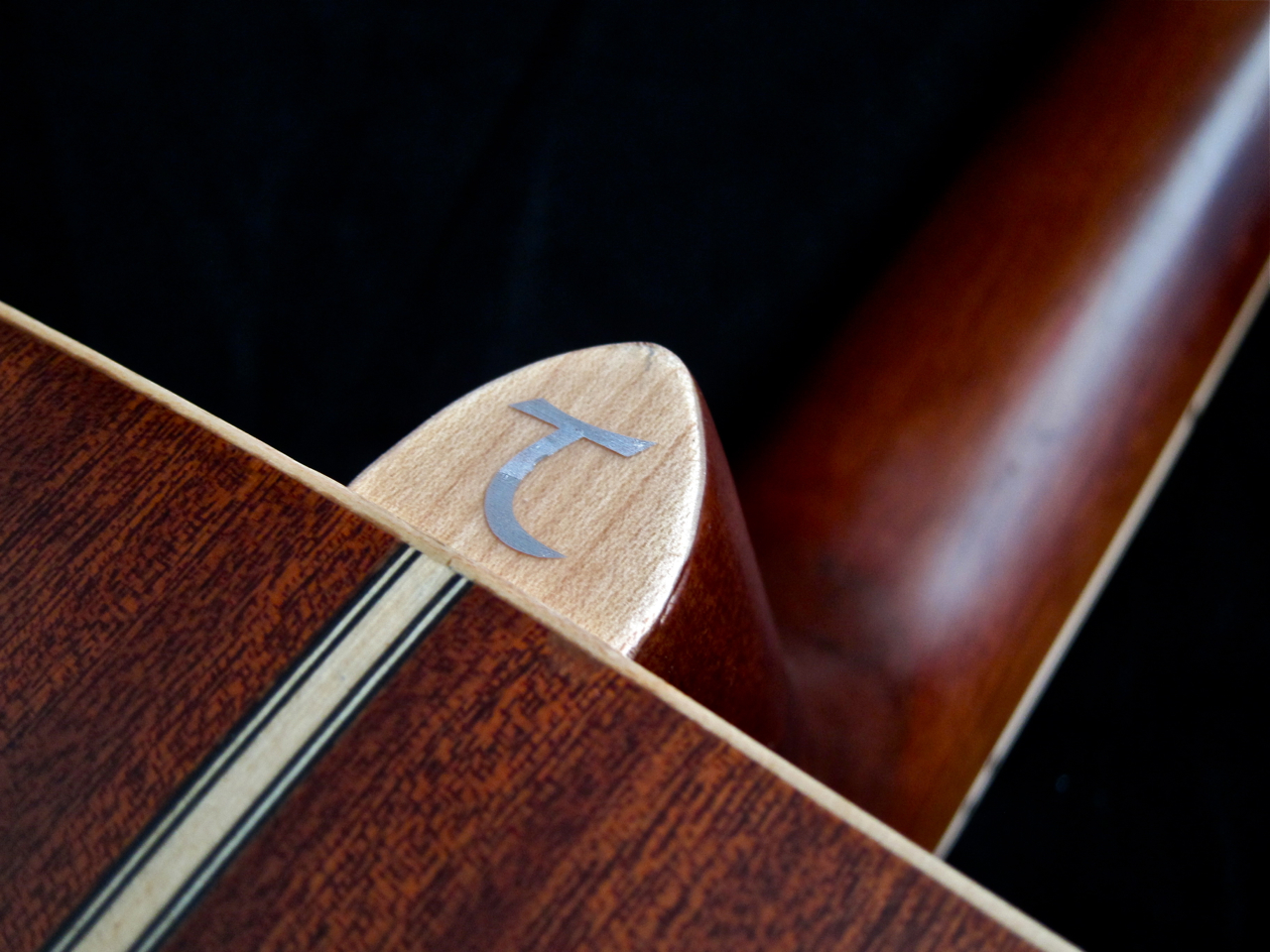
The neck’s heel-cap has been adorned with a maple overlay and a ”Tanglewood-T” made from holographic aluminium foil.

Tanglewood’s TW28-CLN exudes a certain down-to-earth, organic stylishness: There is no scratchplate, but the instrument features multiple binding, and also sports a pretty, bird-shaped bridge.
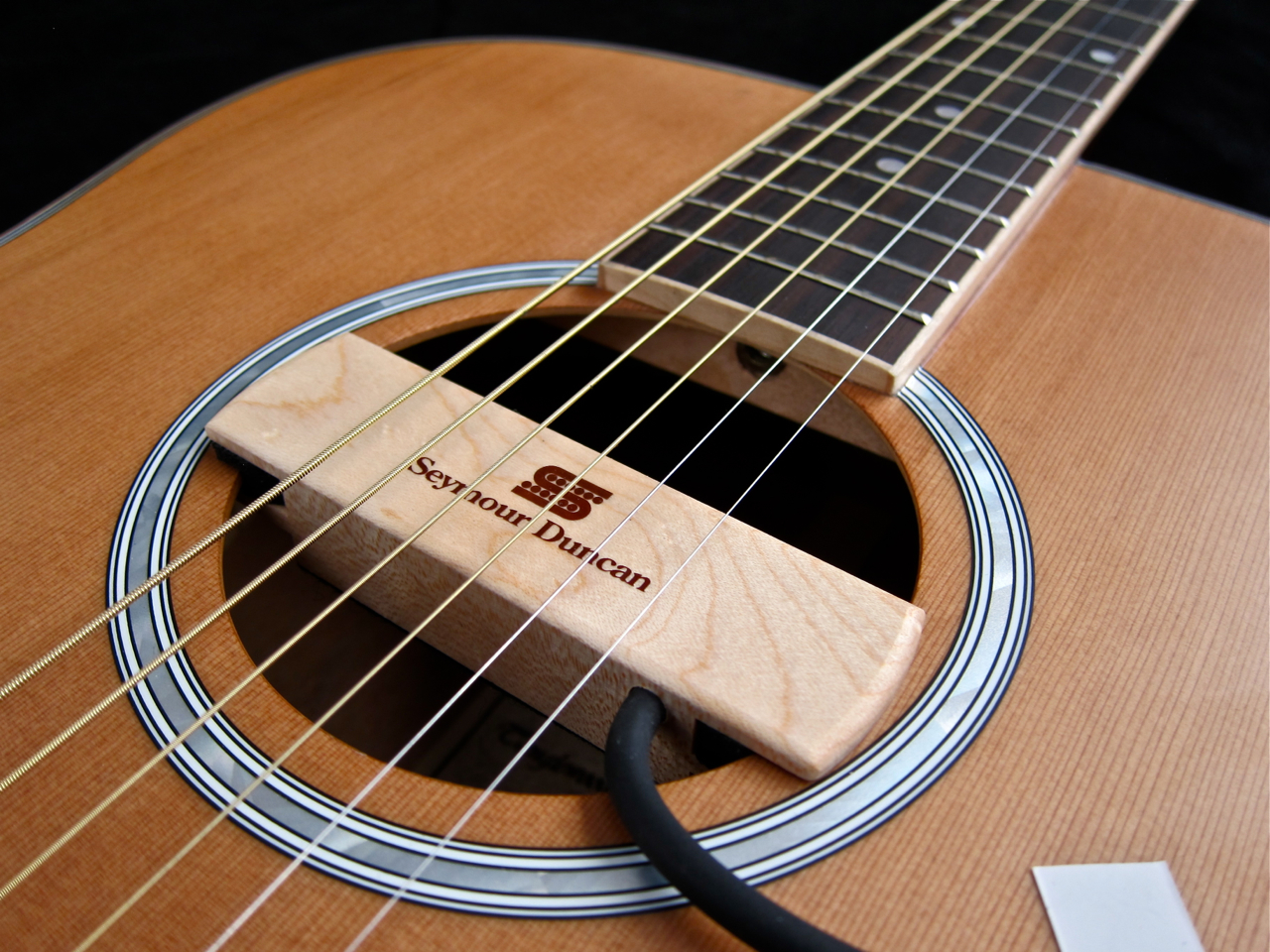
The looks of the Seymour Duncan Woody pickup (current price in Finland 61.70 €) complements the TW28’s earthy looks. This magnetic pickup is a stacked humbucker featuring double-potted (wax and resin) coils in a maple casing.
The Woody fits most regular soundholes (with a diameter between 9.8 and 10.4 cm) and is kept in place by chunky foam inserts on its sides.
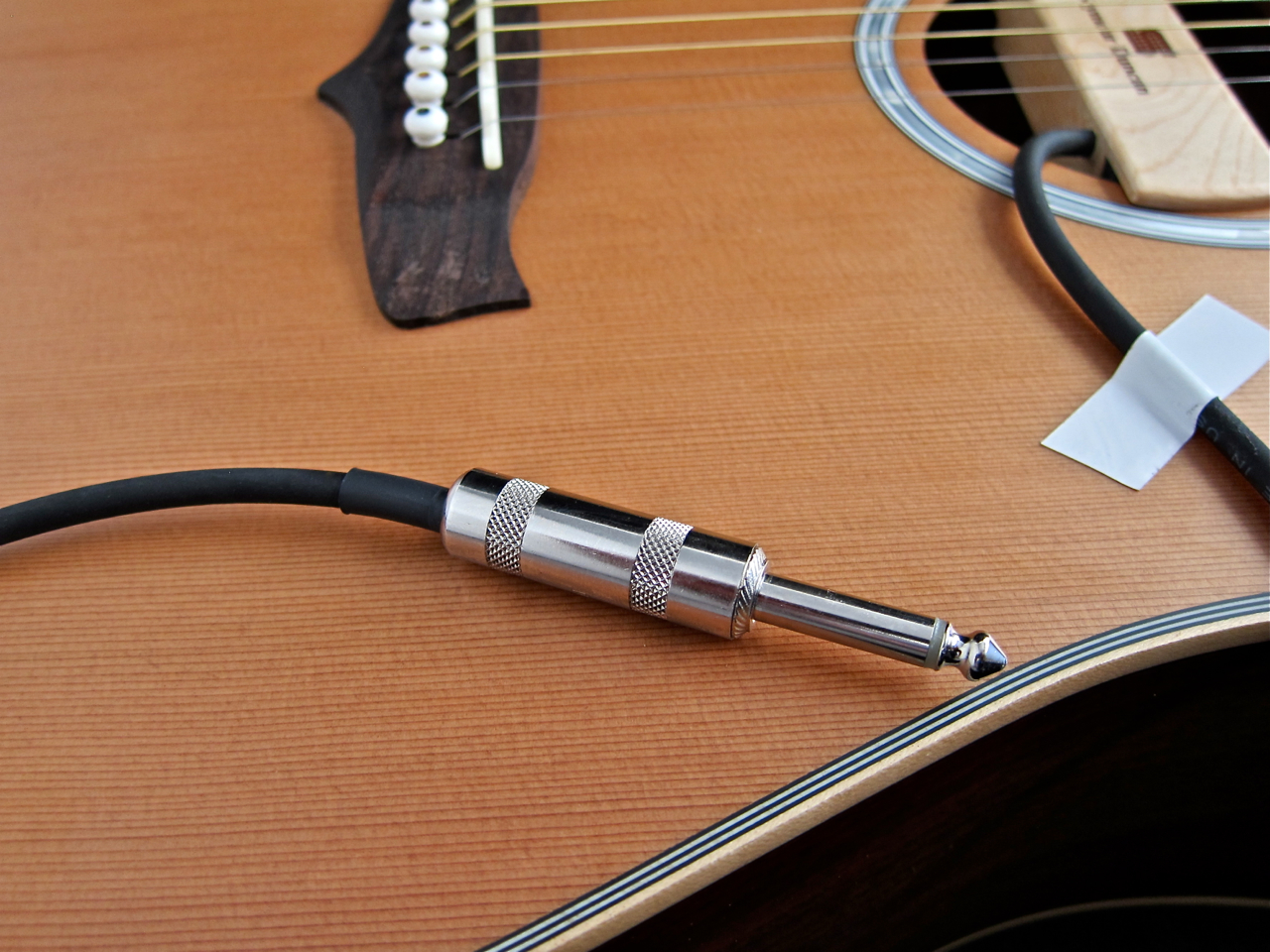
The pickup’s quality lead is approximately five metres long.
Tanglewood’s standard of workmanship is delightfully crisp, even when it comes to their most affordable models.
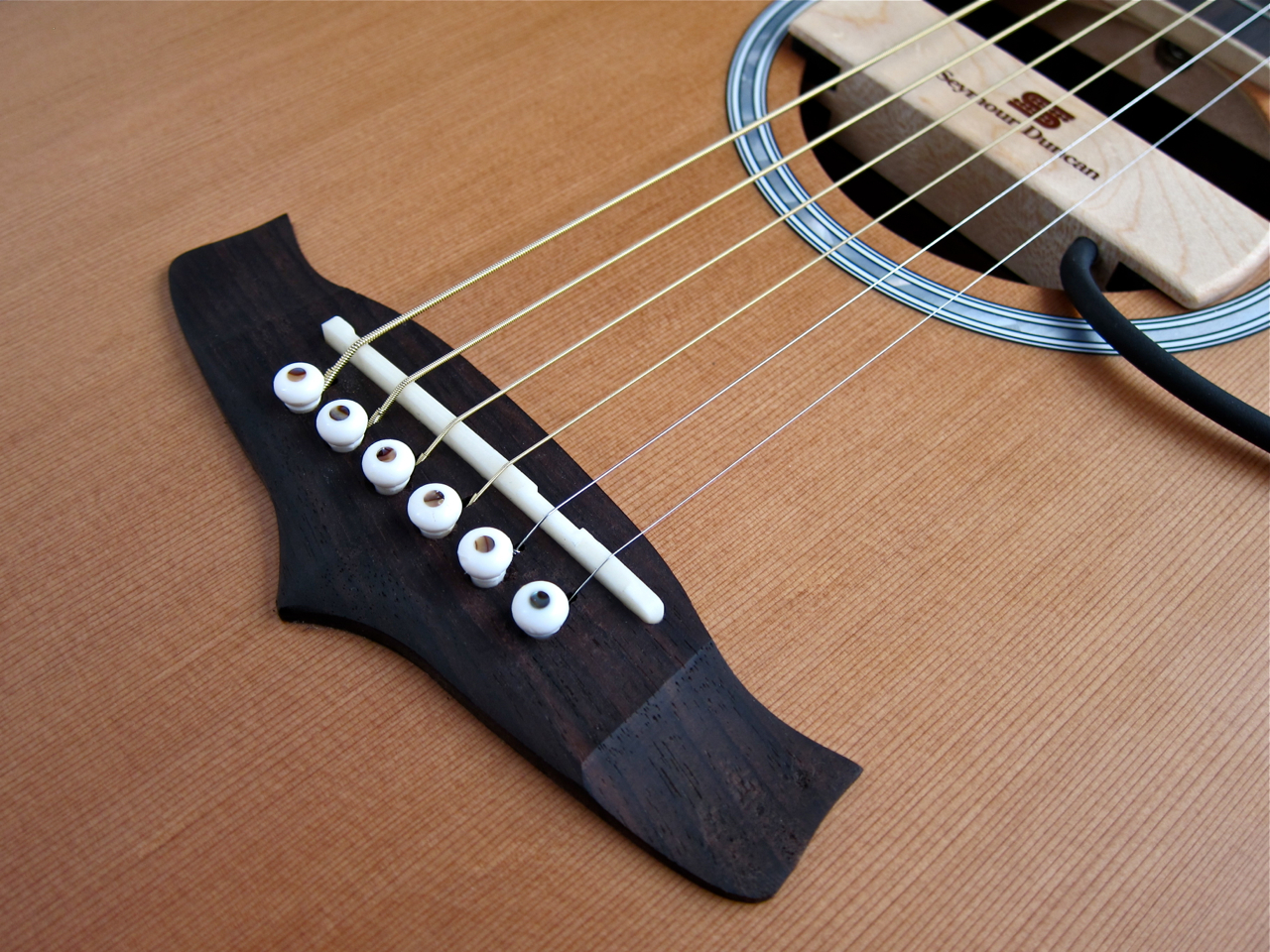
Both the top nut, as well as the compensated bridge saddle have been carved from bovine bone.
****

There is a certain logic behind the Tanglewood TW1000HSRE’s (current price in Finland: 1,137 €) hard-to-enunciate model designation: The letters in the suffix stand for the guitar’s Herringbone-trim (H), its solid rosewood back and sides (SR), and the factory-installed Fishman-electronics (E).
Engelmann spruce has been chosen for this model’s solid wood top.
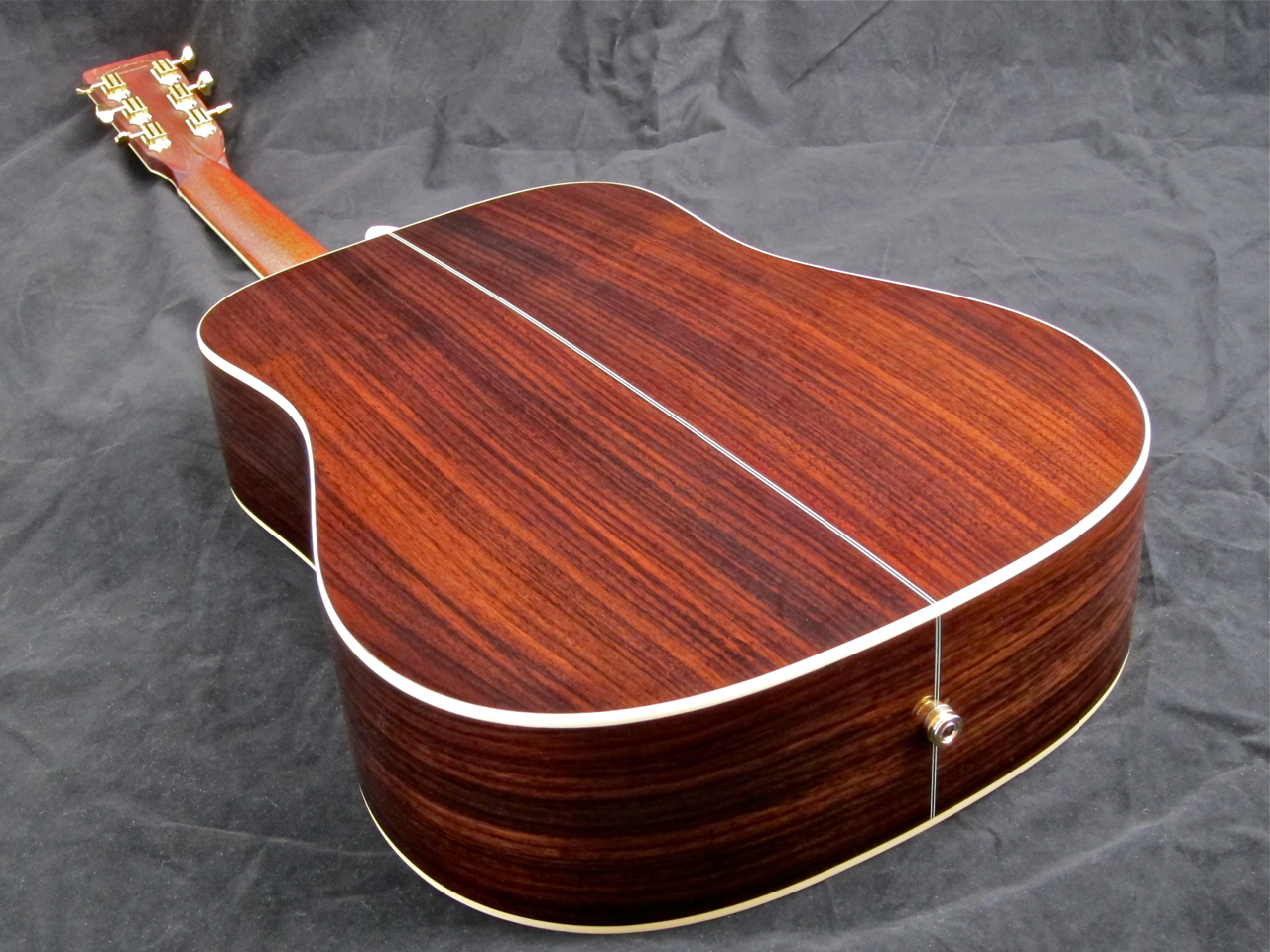
The fine Indian rosewood used for the TW1000 is breathtakingly beautiful.

The same material has also been used for the headstock veneer.
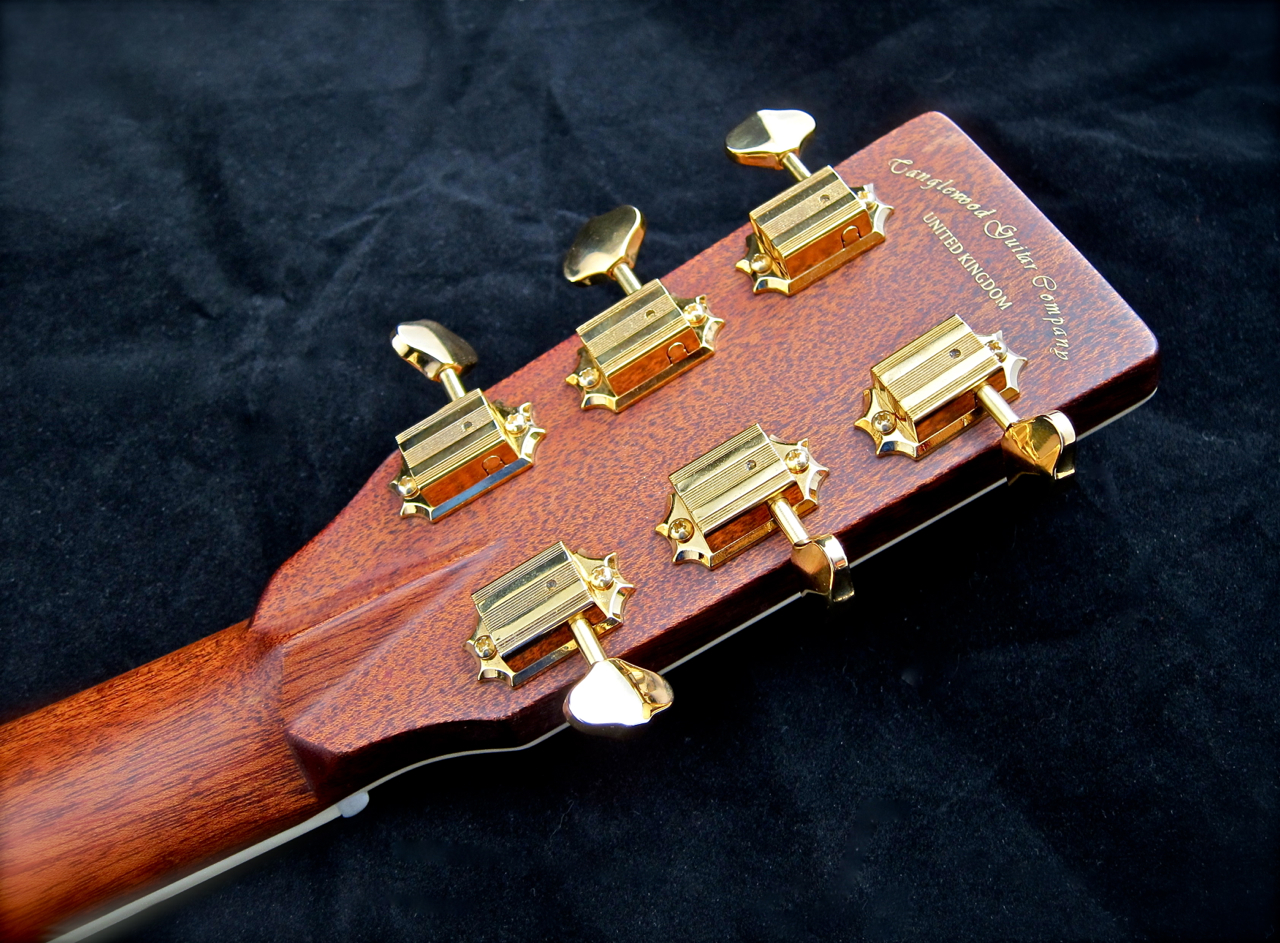
Vintage-aficionados will be delighted at the sight of the diamond-shaped headstock volute, so reminiscent of vintage Martins (and their reissues).
The gold-coloured tuners may look light straight vintage copies, but they have been designed to feature a much more practical, modern gear ratio. The result is a very smooth and precise tuning feel.

Only the best ingredients go into the making of Tanglewood’s top models – this Dread’ sports genuine mother-of-pearl inlays (in a D-45’s hexagonal style) in its ebony fretboard.
The inlay work and fretting are top-notch!

Just look at that rosewood…
All Tanglewoods come equipped with a second strap button – a small, but nevertheless very nice little detail.
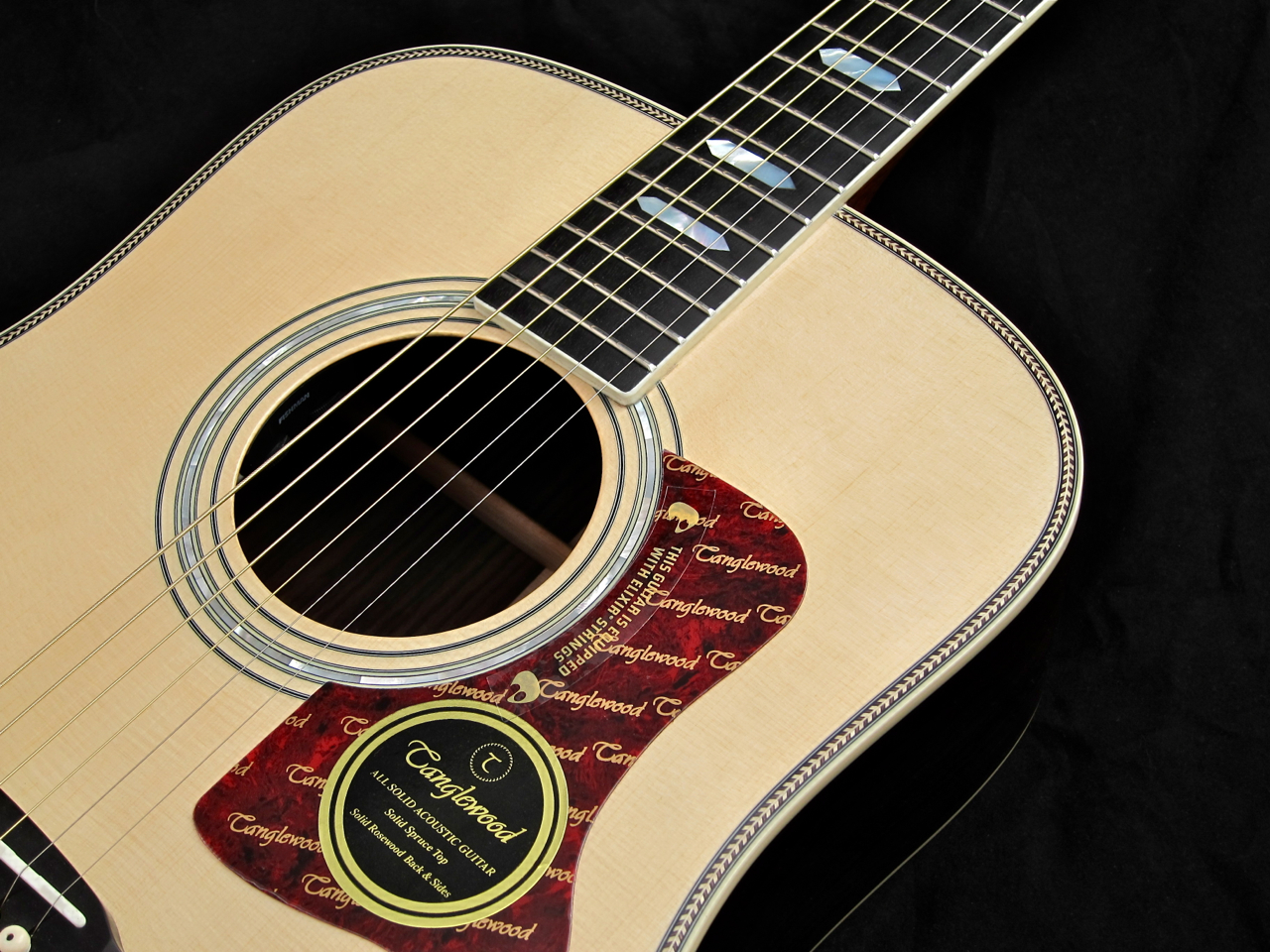
Genuine mother-of-pearl inlays in the rosette, along with Herringbone-binding – this is a guitar enthusiast’s wet dream come true!
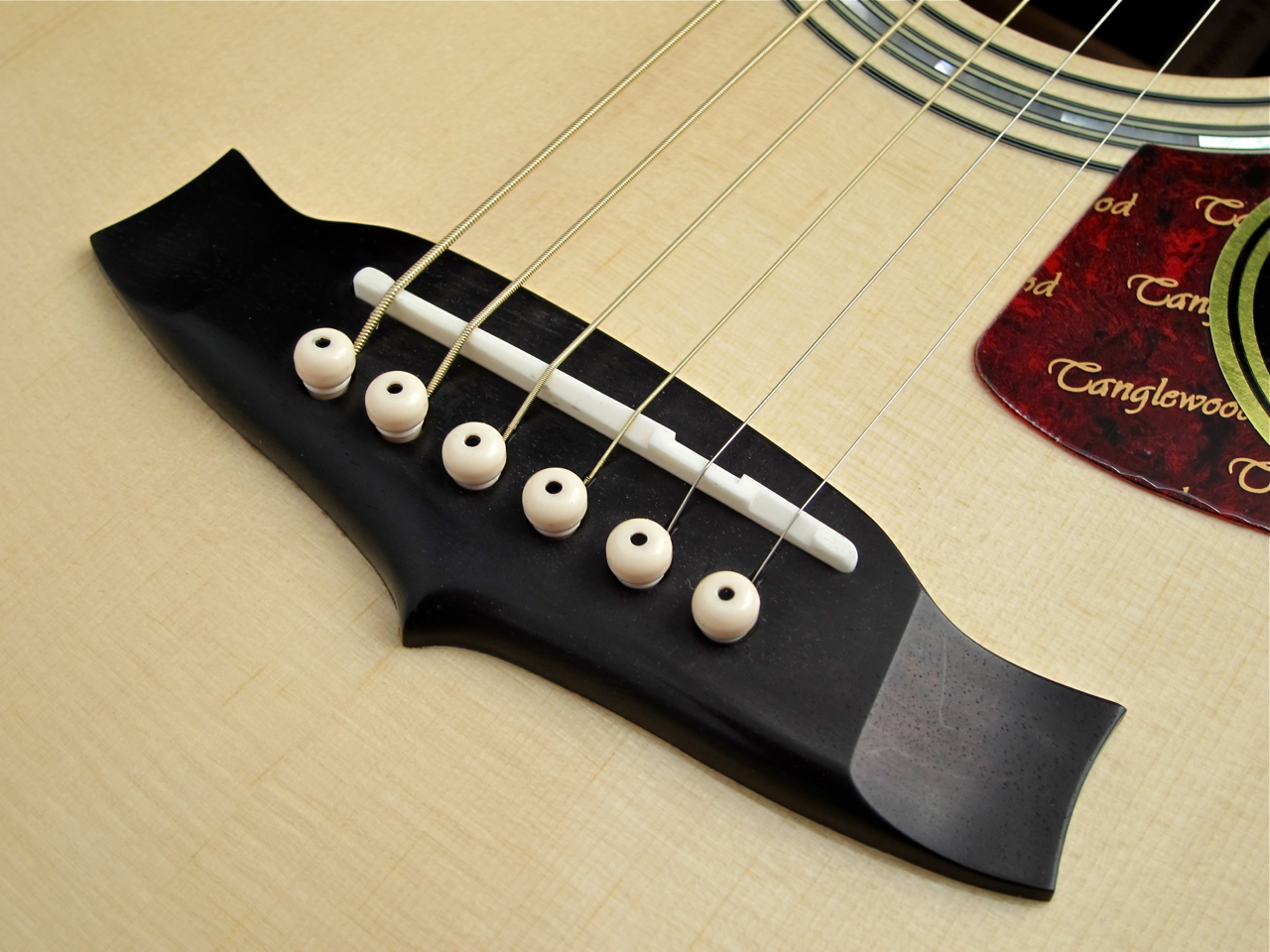
Here’s a second glimpse at Tanglewood’s stylish steel-string bridge – this time crafted from luscious ebony.
Tucked away beneath the bone saddle is a Fishman Sonicore piezo pickup, which feeds a Sonitone-preamp.

The Sonitone’s controls are mounted beneath the soundhole’s bass side edge.
The system is simplicity incarnate, offering a volume control (bridge-facing side) and an easy-to-use tone control (neck-facing side).
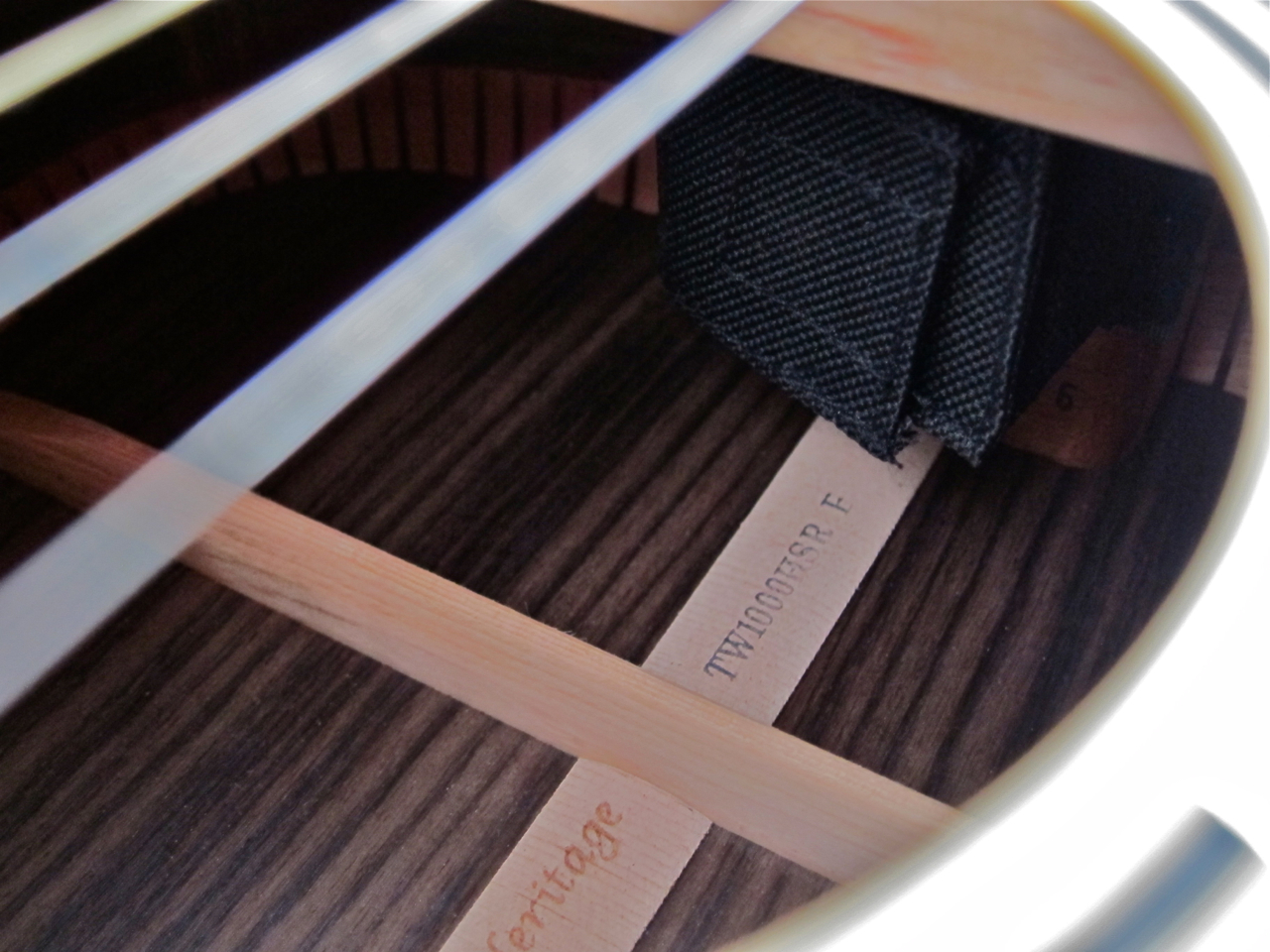
Tanglewood have chosen to keep the TW1000HSRE’s good looks intact, by using a battery pouch, velcro’d to the neck block. There is one drawback, tough: You have to loosen the strings to get to the pouch, meaning quick battery-changes mid-set are impossible.
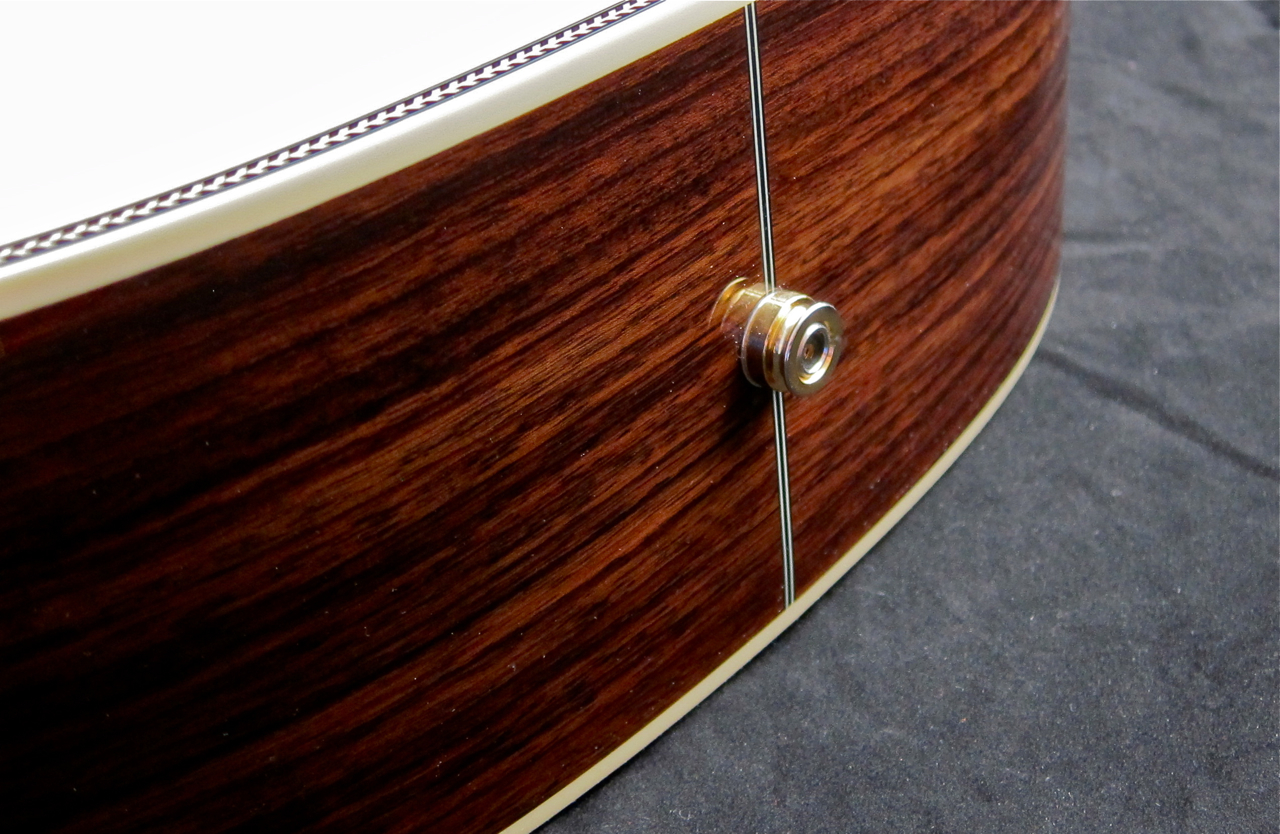
The output jack is integrated into the guitar’s end pin.
****

Our review sample of the TW28–CLN is a very lightweight and comfortable instrument, even though its broad shoulders are a few millimetres wider than those of some other Dreadnoughts. The guitar sits nicely in your lap and feels well-balanced.
For the guitar’s price the standard of its satin finish is quite good – there are a couple of tiny grainy spots on the back of the neck, but overall the feel is very nice.
The neck profile will fit into most players’ hands – it’s a D-profile of medium depth with a slight whiff of a soft V blended in.
The TW28-CLN is a very decent player, thanks to its clean fretwork and comfortable set-up (string height @ 12th fret: bottom-E = 2.6 mm, top-e = 1.7 mm). String spacing is a good middle-of-the-road choice – 3.7 cm at the nut and 5.5 cm at the bridge. It’s a workable compromise for both fingerstylists and plectrum strummers.
I was surprised by the test sample’s punch and volume! After the first few strums I really had to check the label to make sure I hadn’t been given this model’s solid top cousin (the TW28-CSN) by mistake.
The TW28-CLN wins you over with its warm and clear voice. Thanks in no small part to its tight bass response, this model is very easy to record with a condenser microphone set up in front of it.
Seymour Duncan’s Woody sounds old-fashioned in a very nice way: The bottom end is warm, the mid-range is plummy and the trebles are airy and pleasant. If you’re after an authentic Sixties Pop guitar tone, the Woody will get you there in no time. Many of the early Beatles-stuff (pre-1966), for example, was recorded with their Gibsons miked up, as well as plugged into their Vox amps. Furthermore, I’m quite sure the Woody’s vintage-tinged tones will also please the slide guitar fraternity.
Here are some sound examples of the TW28-CLN recorded with an AKG microphone, as well as using the Duncan Woody:
****

To say Tanglewood’s TW1000HSRE is a ”great guitar for its price” or a ”very decent Chinese-made instrument” would do this guitar a grave injustice. The TW1000HSRE is simply a great guitar, carefully crafted from top quality materials – period! Our review sample is that sort of guitar that puts a quick stop to any kind of brand snobbery.
The guitar’s finish is flawless, and the instrument plays like a dream.
We have a mid-sized, oval C-Profile, coupled with a generous string spacing – 3.95 cm at the nut and 5.75 cm at the bridge – which makes a lot of difference to fingerstyle players.
The set-up is superb, with the guitar playing cleanly across the whole neck, despite the comfortably low action (bottom-E: 2.0 mm, top-e: 1.6 mm).
The TW1000HSRE’s acoustic tone and punch will bowl you over! The bottom end is fat and rich, the mid-range has character in spades, and the top end sparkles like a diamond. This is a very hard guitar to put down.
The Fishman Sonicore-piezo and Sonitone-preamp seem like the perfect match for this Tanglewood – a really inspired choice. The Fishman system sounds surprisingly ”acoustic” with not so much as a whiff of piezo quack or dryness. The amplified tone is a couple of degrees more upfront, and a tiny bit fuller, than the TW1000HSRE’s acoustic voice, but it’s very close. Coming to grips with the Sonitone only requires seconds. I left the tone control on full – if you need more scope for adjustment you’ll most probably find it in your acoustic amp or at the mixing console.
****
If there’s a conclusion to be drawn from this review, then maybe it is that Tanglewood seem to consistently offer fantastic value at any price-point. And this is regardless of whether you chose one of their affordable models (like the TW28-CLN) or something from the very top of their catalogue (like the TW1000HSRE).
****
Tanglewood TW28-CLN
Tanglewood TW1000HSRE
Seymour Duncan Woody soundhole pickup
Finnish distributor: Musamaailma
****
Tanglewood TW28-CLN
Current price in Finland: 201 €
Pros:
+ value-for-money
+ workmanship
+ playability
+ sound
****
Tanglewood TW1000HSRE
Current price in Finland: 1,137 €
Pros:
+ top grade instrument
+ value-for-money
+ workmanship
+ playability
+ acoustic sound
+ preamp sound
****
Seymour Duncan Woody (SA-3 HC)
Current price in Finland: 61.70 €
Pros:
+ very affordable
+ easy to install
+ stylish
+ vintage-type tone
Cons:
– vintage-type tone

Akustisen kitaran (tai puusta rakennetun soittimen ylipäänsä) säilyttämisessä pätee yleensä vanha sääntö: ”Älä jätä kitarasi pitkään sellaisissa olosuhteissa, joissa itse et viihtyisi”. Kukaan meistä ei haluaisi esimerkiksi istua pitkiä jaksoja kesähelteisessä (tai talvipakkaisessa) autossa, ja myös kitaraa kannattaa säilyttää jossain muualla.
Tavallinen huonelämpötila (18 – 22 celsiusastetta) luo myös kitaralle hyvät olosuhteet.
Yhdessä asiassa akustinen kitara on kuitenkin selvästi herkempi muutoksiin kuin ihminen, ja se on ilmankosteus.
****
Tämä herkkyys johtuu siitä, että akustisen kitaran runko on tehty melko ohuista puun ”viipaleista”, joihin kohdistuu kuitenkin huomattavasti kielten aiheuttamaa vääntöä ja vetoa.
Akustinen kitara on koko elämänsä aikana herkässä balansissa: sen runkopuut (etenkin kansi ja rungon rimoitus) täyttyy olla mahdollisimman ohuita ja kevyitä, että kitara soi hyvin, mutta toisaalta rakennelman täytyy myös kestää kielten ankaraa vetoa.
Puu elää materiaalina ilmankosteusvaihtojen mukaan – kuivuudessa se kutistuu, suuri ilmankosteus taas aiheuttaa puun turpoamista. Akustisen kitaran tapauksessa tämä tarkoittaa, että kuivissa olosuhteissa soittimen runko yrittää kutistua pienemmäksi, ja kosteassa ilmassa runko alkaa paisua alkuperäisiä mittojaan isommaksi.
Tästä seuraa, että miedoissa tapauksissa ainakin kielten korkeus muuttuu kannen kutistumisen (tai turpoamisen) mukaan. Ääritapauksissa liikkaa kosteus tai kuivuus voi aiheuttaa jopa rungon repeämistä. Sellaista kitaraa nähdään esimerkiksi tässä videossa:
****

Meillä Suomessa ei tavallisesti ole ongelmia liian suuren ilmankosteuden kanssa, koska maa ei sijaitse subtrooppisessa tai trooppisessa säävyohykkeessä. Sen sijaan pitkä lämmityskausi voi aiheuttaa useimmissa sisätiloissa akustiselle kitaralle liian kuivaa ilmaa.
Akustiselle kitaralle ihanteellinen suhteellinen ilmankosteus on tavallisessa huonelämpötilassa 45:n ja 60:n prosentin välillä.
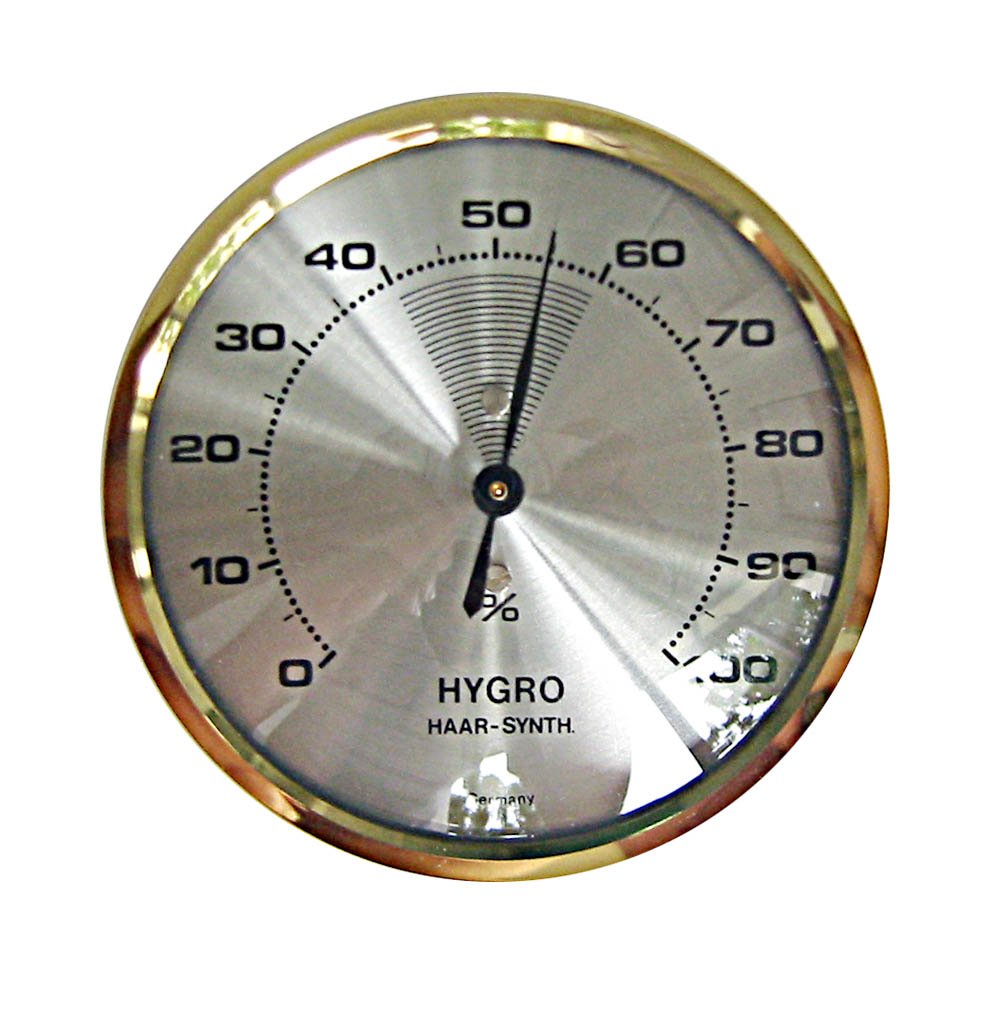
Kannattaa siis tarkistaa ilmankosteutta mittarilla, joka voi olla joko perinteinen analoginen seinähygrometri…
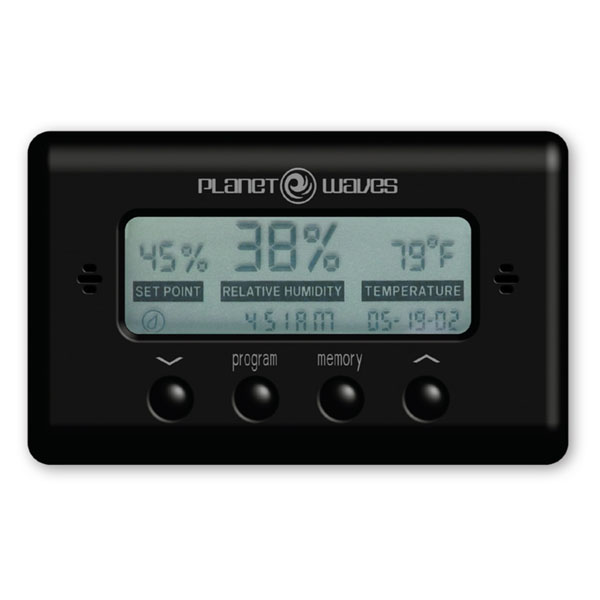
…tai sitten esimerkiksi kitaralaukkuun menevä pieni digitaalimittari.
****
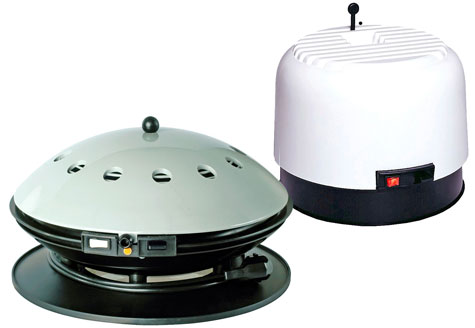
Kokonaisen huoneen ilmankosteutta voi nostaa tavallisella ilmankostuttimella, kun se ei seiso suoraan soittimen vieressä tai sen alla.
****
Hyvin huoleton tapa pitää yllä akustiselle kitaralle sopivaa ilmankosteutta säilytyksen tai kuljetuksen aikana on soittimen runkoon menevä kostutin.
Tällaisia kostuttimia saa monissa eri muodoissa:

• Dampitin ja Martin Guitarsin kostuttimet ovat putkilomaisia.
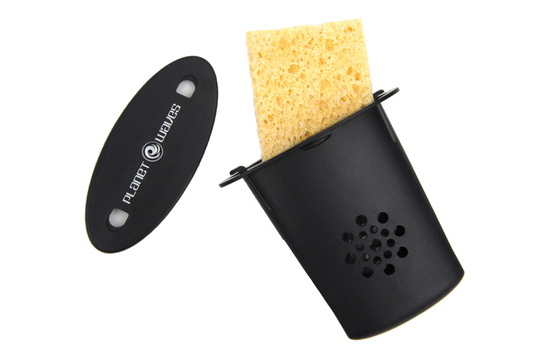
• Planet Wavesin mallia roikutetaan kitaran kieliltä.
• Kyserin ääniaukkoon menevää kostutinta taas voidaan käyttää myös lavalla feedback-suojana.
Kaikilla kitarakostuttimilla on yhteistä kuitenkin se, että niiden sisällä on pieni muovisieni, jonka kastutettaan tavallisilla kraanavedellä. Tämän jälkeen ylimääräistä vettä puristetaan pois ja kostutinta pyyhitään ulkopuolelta kuivaksi, ennen kuin sitä asetetaan kitaran runkoon. Runkopuu sitten imee hyvin hitaasti itselleen kostean sienen tarjoamaa kosteutta. Usein riittä, kun kostuttimeen lisätään vettä kerran (tai kaksi kertaa) viikossa.
****
Kannata siis pitää oma kitara oikeassa ilmankosteudessa, jos haluaa välttää ongelmista.
Paniikkinomaiseen hysteriaan ei kuitenkin tarvitse sortua, koska ilmankosteuden vaihtelu – toisin kuin äkillinen lämpötilan muutos – vaikuttaa kitaraan vain suhteellisen hitaasti. Kyllä, kitaraa voi soittaa huoletta tunnin tai pari sellaisessakin huoneessa, jossa suhteellinen ilmankosteus on vain 40 prosenttia, kun vain laittaa soittimen sen jälkeen takaisin sopivaksi kosteutettuun huoneeseen tai kitarakostuttimen kera koteloon.


****

Schecter probably aren’t known so much as manufacturers of acoustic guitars, but they do carry a few acoustic-electric models in their current line-up. We picked up a new model from Schecter’s Hellraiser range for a review – the Hellraiser Studio Acoustic.
****
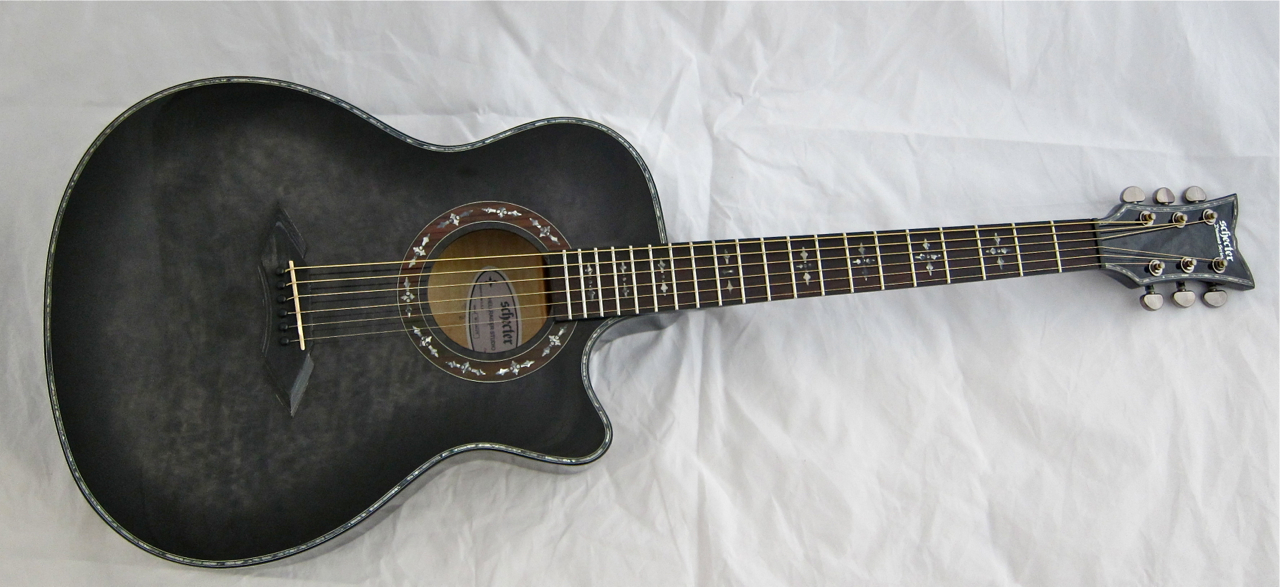
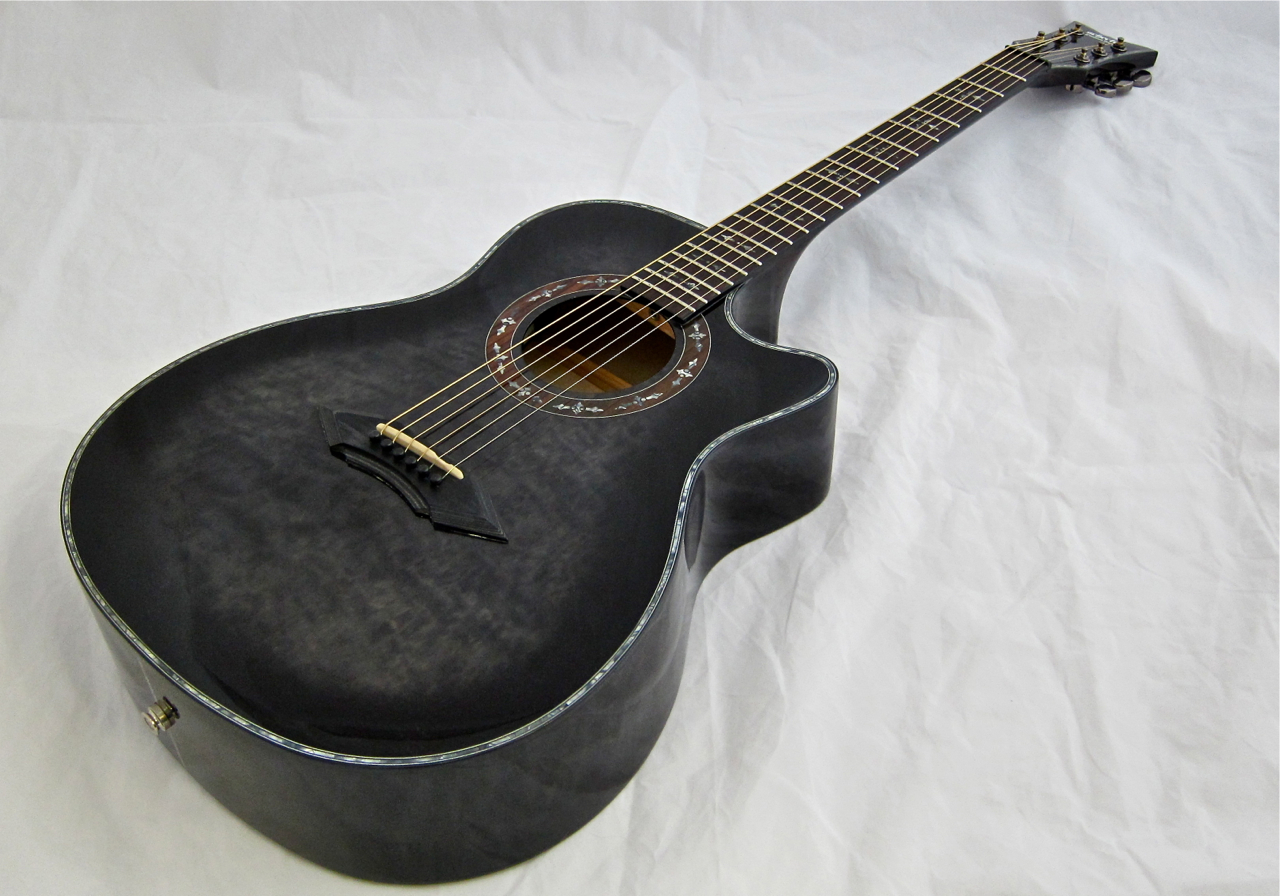
The Schecter Hellraiser Studio Acoustic (current street price in Finland approx. 600 €) is a stunning looker with a Grand Auditorium -sized, full-depth body.
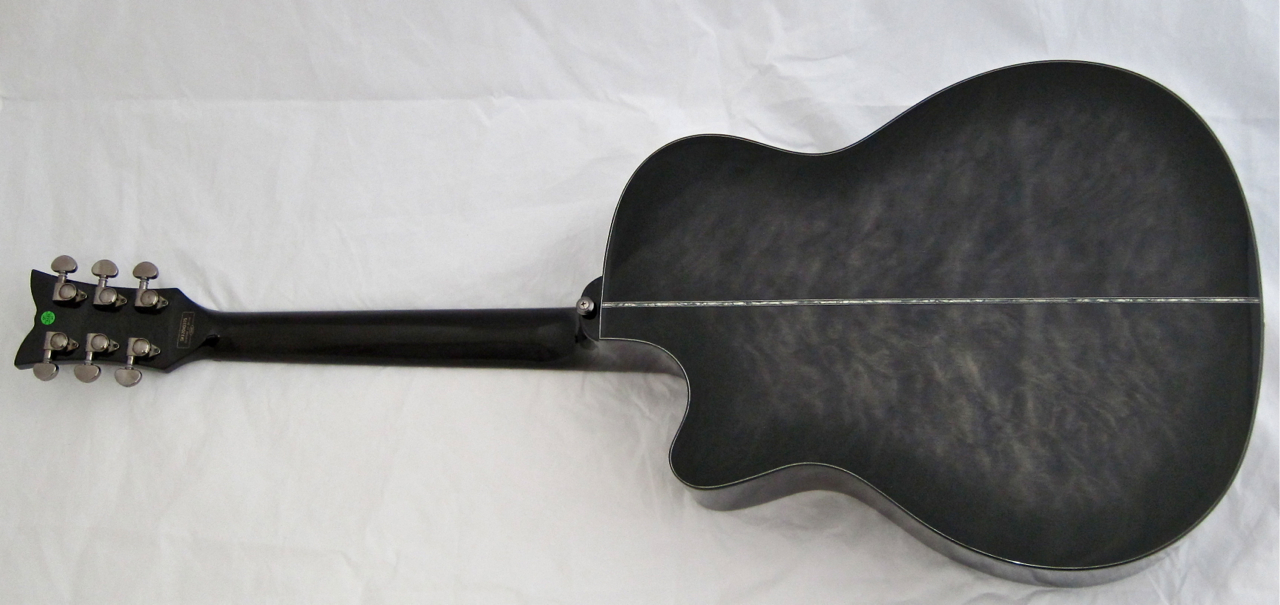
The whole body – top, rims and back – is crafted from beautiful, laminated quilted maple. Our review sample sports a fetching see-through-black gloss finish.
The glued-in neck, which is finished in solid gloss black, is made from mahogany.

Judging by its headstock shape, Schecter seems to be aiming the Hellraiser Studio squarely at the Rock and Metal crowd. The headstock features intricate binding in luscious grey pearloid framed by black and white strips of plastic.

The sealed Grover-tuners sport a cool and moody black chrome finish.

The bound rosewood fretboard comes equipped with 20 jumbo-sized frets, giving the guitar an effortless modern playing feel.
The Hellraiser Studio’s ’board is adorned with cleanly executed gothic-style cross inlays, made from grey pearloid.
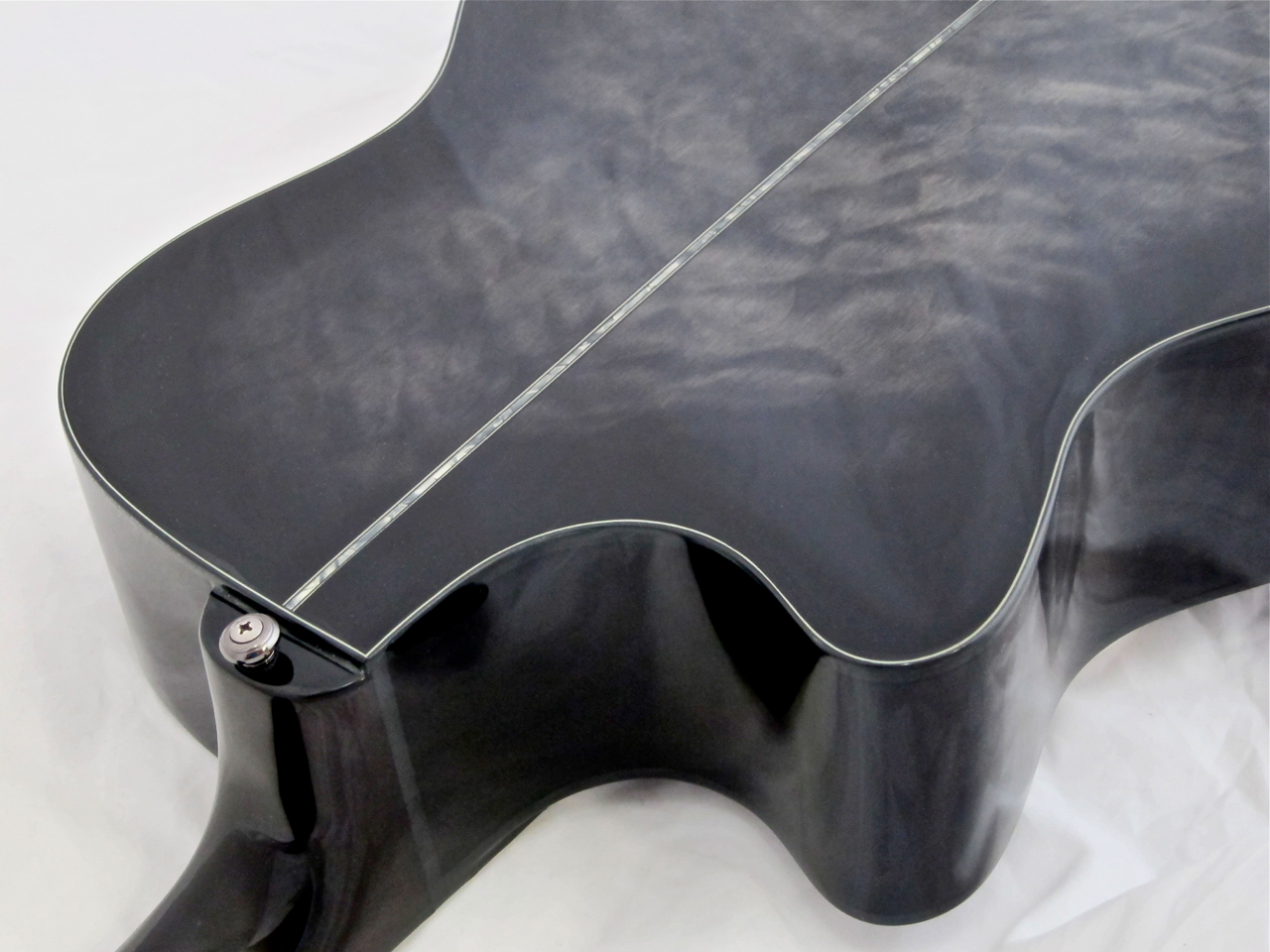
The stylish dark pearloid theme is carried over onto the soundbox – seen here in the back’s centre line.
Schecter’s Hellraiser Studio comes factory-equipped with a second strap button.

The guitar’s flowing lines are a thing of beauty.

The test sample’s bracings and kerfed linings look well made, even if there are a couple of glue specks in places.
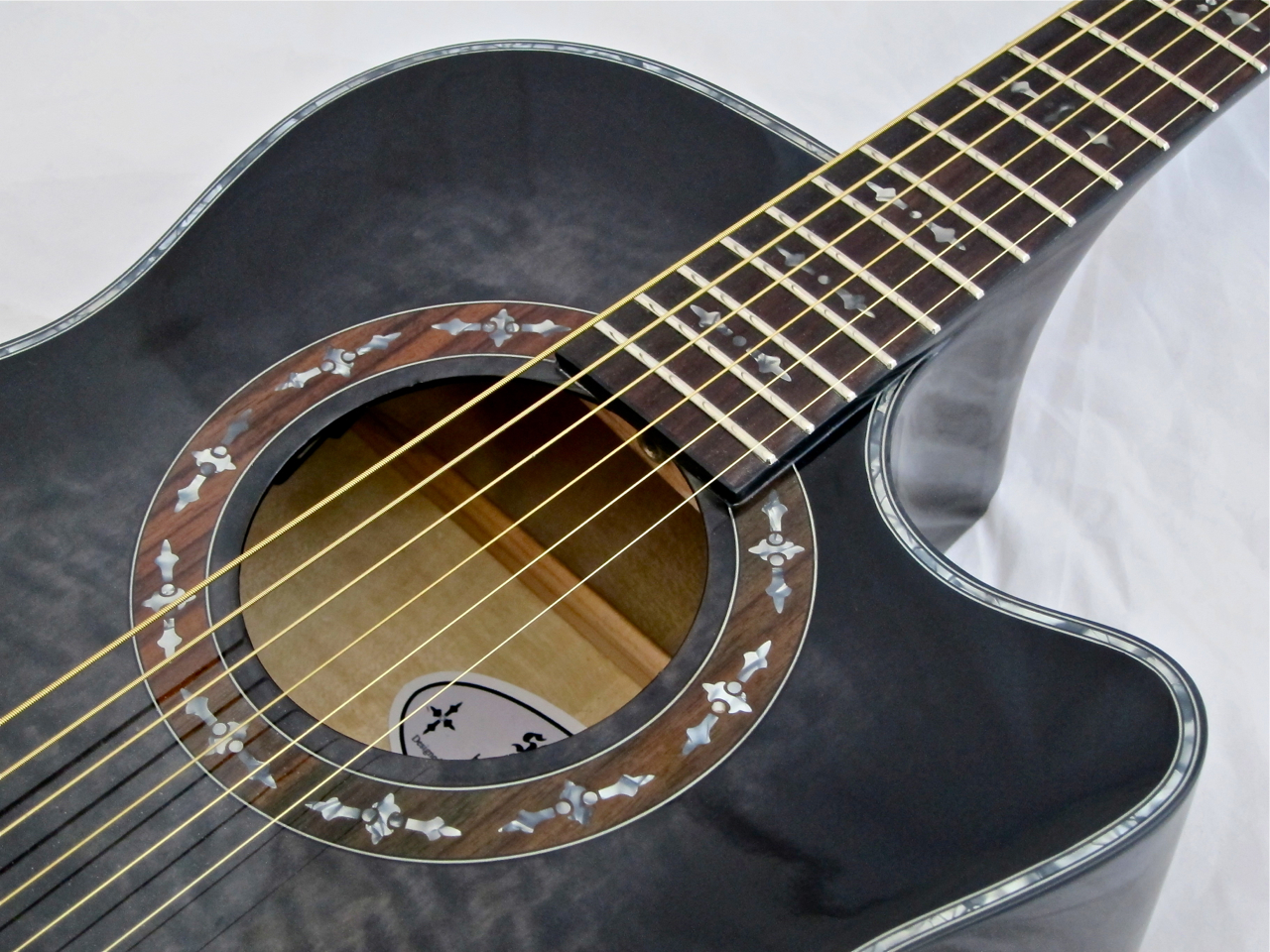
The gothic theme continues in the rosewood rosette’s inlays.

A very dark finish is a double-edged sword for any manufacturer, because any tiny imperfection shows up more clearly. On the review instrument a tiny amount of white glue can be seen seeping out from under the bridge – the only small slip-up on this nicely-finished guitar.
The bridge is an interesting design, made from a composite material based on wood and black resin. The octave-compensated bridge saddle is Graph Tech’s man-made alternative to ivory, called Tusq.
The under-saddle-transducer is a Fishmanin Sonicore piezo pickup.
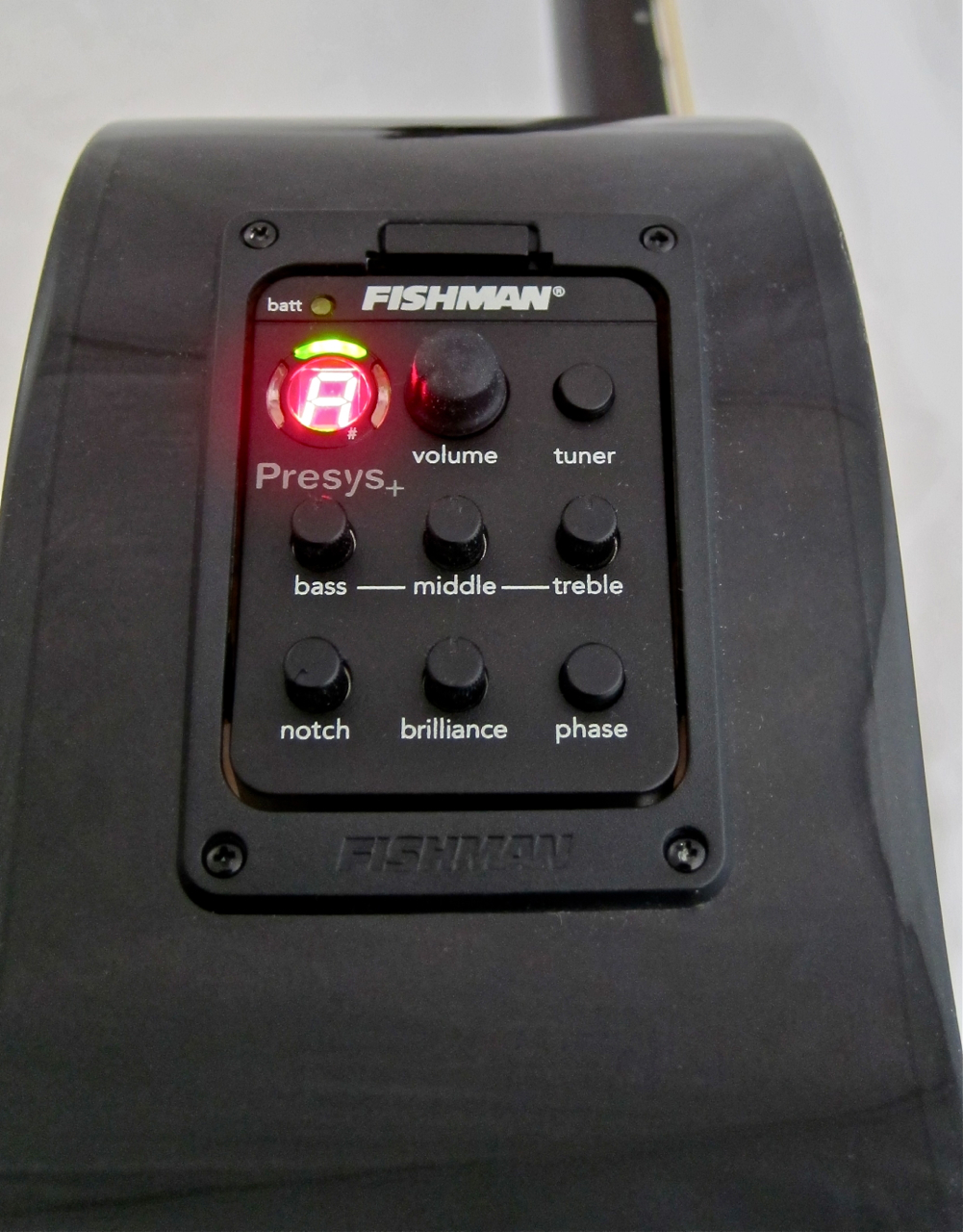
The UST’s signal is sent to a Fishman PreSys+ preamp featuring four-band EQ – bass, middle, treble and brilliance – a notch filter (to combat feedback or annoying stage resonances), a phase reverse switch (also for feedback removal), as well as a chromatic tuner, which also works without the guitar lead plugged in.

The PreSys+ makes battery changes a doddle.
****

Even though the Schecter Hellraiser Studio Acoustic is aimed at Rock musicians, Schecter haven’t chosen an overtly ”electric” neck profile for this steel-string – which is good in my opinion. The guitar’s well-rounded, medium D-profile feels great, giving you ample flesh to hold on to.
Sadly, our review sample suffers from some minor fretting issues, which lead to the high-e string buzzing at the first and 14. frets. Otherwise the set-up is good and the guitar plays well.
Nowadays it seems that many manufacturers have found out how to put together a good-sounding acoustic guitar using a laminated body. The Schecter Hellriser Studio is a good example of this. Even though you cannot find the out-and-out volume and punch of an all-solid shouter in a laminated steel-string, this Schecter really manages to hold its own, and do so with panache.
The all-maple body gives you a lively tone with a tight, sinewy bottom end, a clear mid-range (typical of maple-bodied steel-strings), as well as a nicely rounded top end. I see the Hellraiser Studio as a great choice for accompanying vocals, as the guitar’s clarity leaves ample space in the frequency spectrum for the singer.
The Fishman Sonicore/PreSys+ is a high-quality combination that sounds great right off the bat, without even touching the EQ. Fishman have managed to filter out most of the infamous nasal quack and attack click, so often found on lesser piezo systems. Thanks to this the Hellraiser’s EQ is freed up to fine-tune your (already great) basic tone, instead of having to combat any annoying tonal problems inherent in the original signal.
I recorded the following examples both acoustically (using an AKG C3000) and direct (with the Fishman’s EQ flat):
Fingerstyle – miked up (AKG C3000)
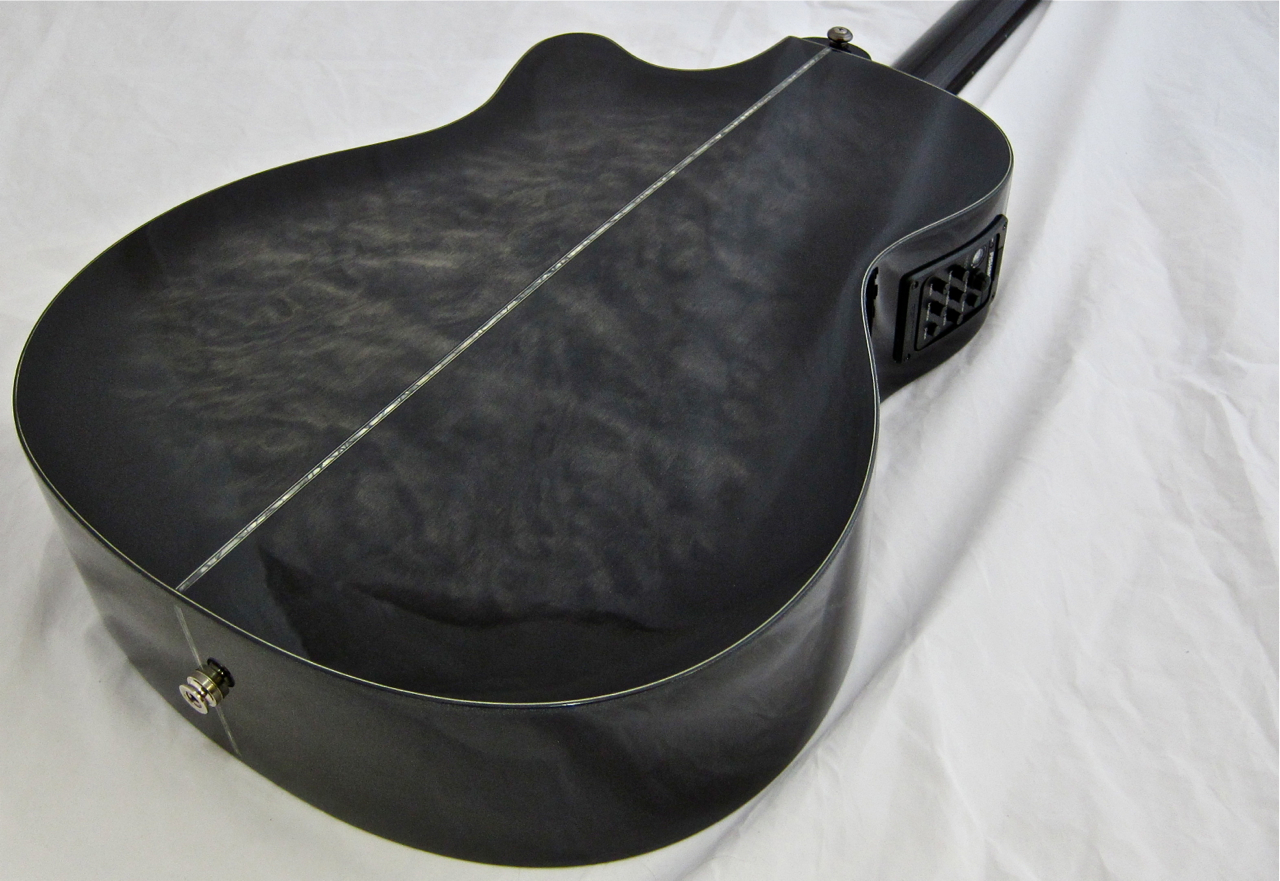
The review guitar’s fretting (or neck?) problem really is a shame, because overall this Schecter is an extremely nice acoustic-electric. Schecter are known for their stringent quality control, so maybe this here was the one guitar that slipped through.
Schecter’s Hellraiser Studio Acoustic is a beautiful instrument, offering easy playability and a great sound. The guitar’s clear voice records very well – regardless of whether you’re using a microphone or the fantastic on-board Fishman-system. I can only recommend a test run!
****
Schecter Hellraiser Studio Acoustic
Current street price in Finland approx. 600 €
Finnish distributor: Soundtools
****
Pros:
+ beautiful design
+ overall workmanship
+ playability
+ acoustic tone
+ pro-quality Fishman-electronics
Cons:
– some fretting issues on review sample
– some glue visible at bridge



 Kitarablogi.com – Finland's premier Guitar and Bass blog