


****
Lisätiedot: EM Nordic
Kitarablogi.com – Finland's premier Guitar and Bass blog
Juttuja kitaroista ja bassoista


Ukulele on tällä hetkellä kovasti ”in”. Kompaktia soitinta on hauska soittaa ja se kulkee helposti mukana.
Tämän asian on huomannut myös englantilainen brändi Tanglewood, joka on hiljattain laajentanut ukulele-valikoimaansa.
****

Testissä käynyt kvartetti – TU-1CE, TU-3, TU-3E ja TU-5 – tulee Tanglewoodin mahonkikoppaisesta Union-sarjasta.
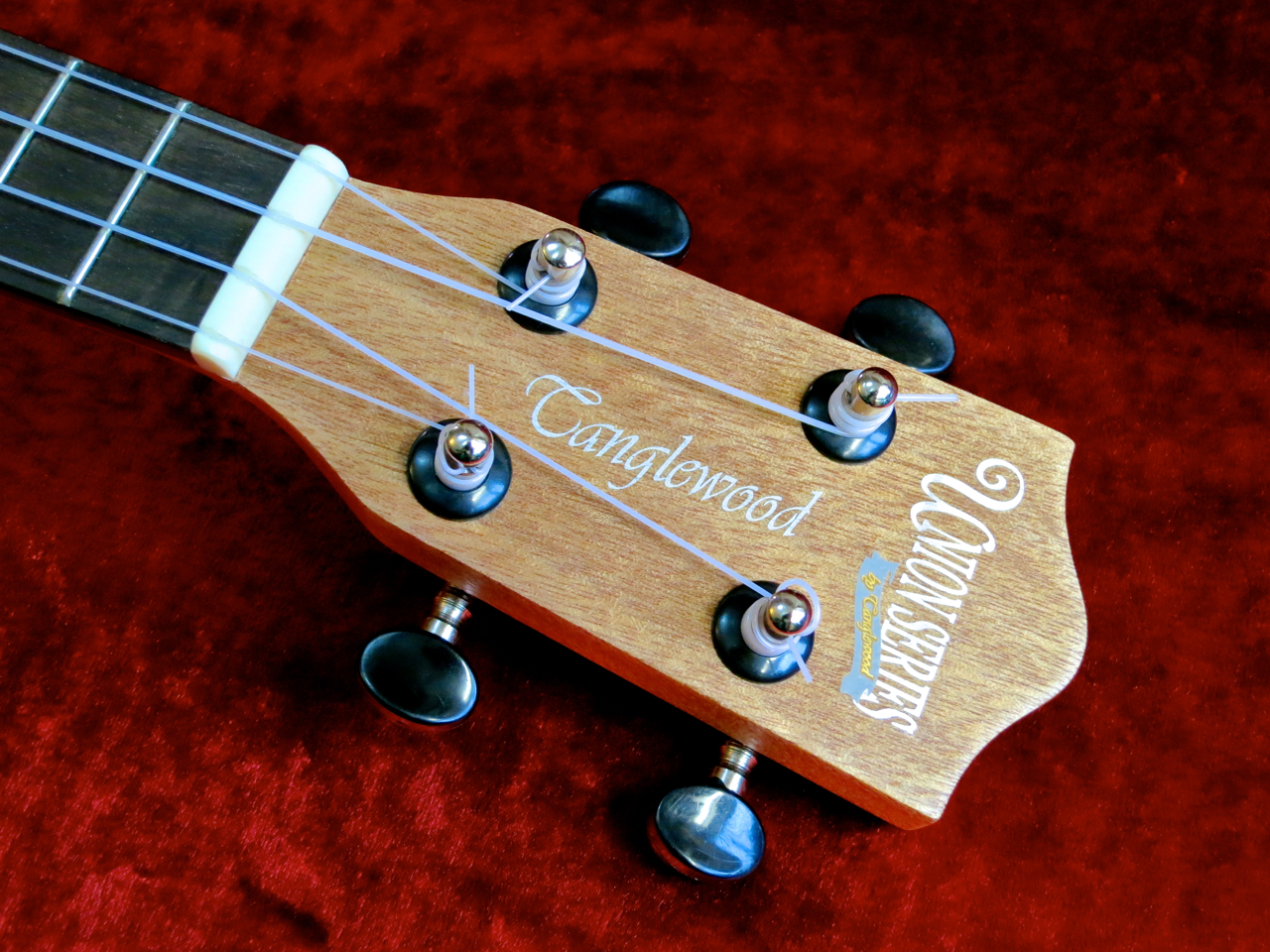
Kaikissa Union-sarjan ukuleleissa on mahonkikaula, jossa kaulakorko ja lapa ovat liimattuna pitkään pääosaan.
Otelauta on palisanterista.

Tanglewoodin avoimet virittimet toimivat moitteettomasti.
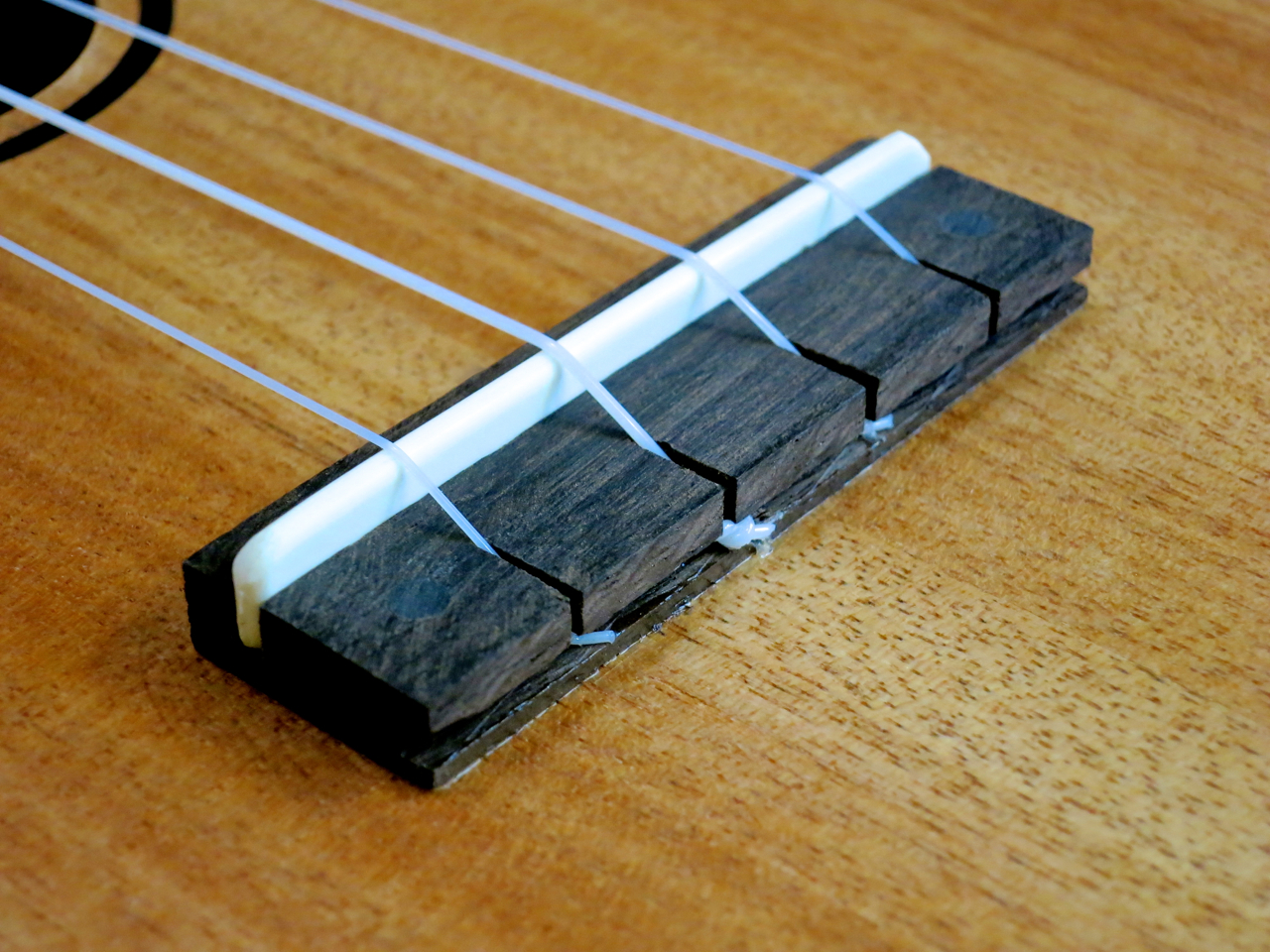
Ukuleleissa käytetään valmistajasta riippuen useita eri tallaratkaisuja.
Tanglewood on päättänyt käyttää niistä helppokäyttöisintä mallia, jossa kielet kiinnitetään solmulla tallan edestä.

Union-sarja ukuleleissa on kaikukoppa mahonkivanerista.
Soittimet on viimeistelty ohuella mattalakkauksella.
****

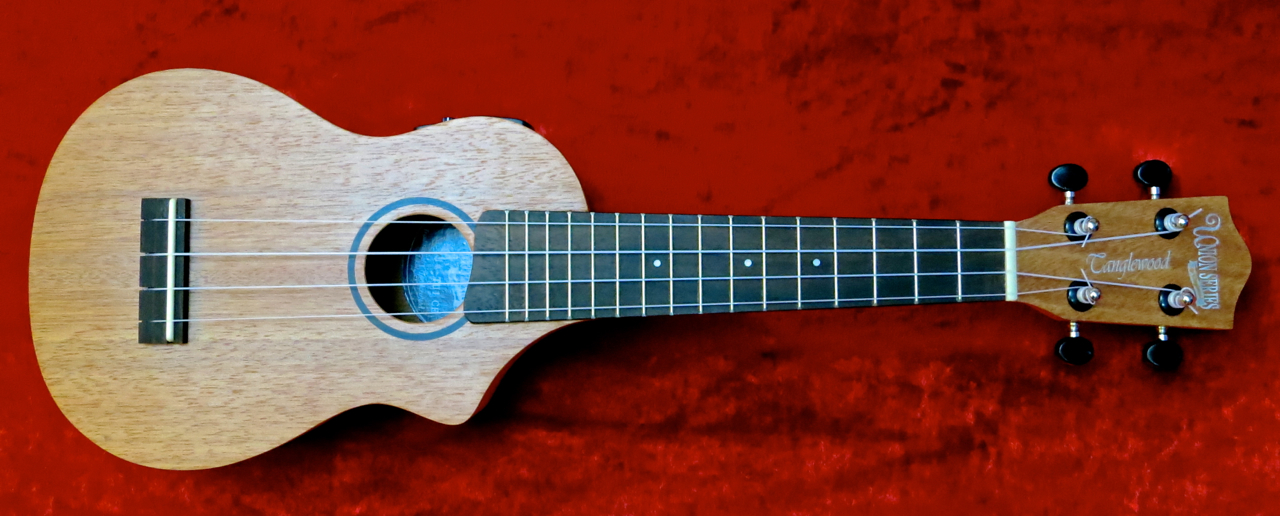
Tanglewood TU-1CE (116 €) on soololovella ja mikrofonijärjestelmällä varustettu sopraano-kokoinen ukulele.
Sopraano on tavallisista ukulele-kokoluokista pienin, ja näin ollen TU-1CE:n mensuuri on vain 34,5 cm.
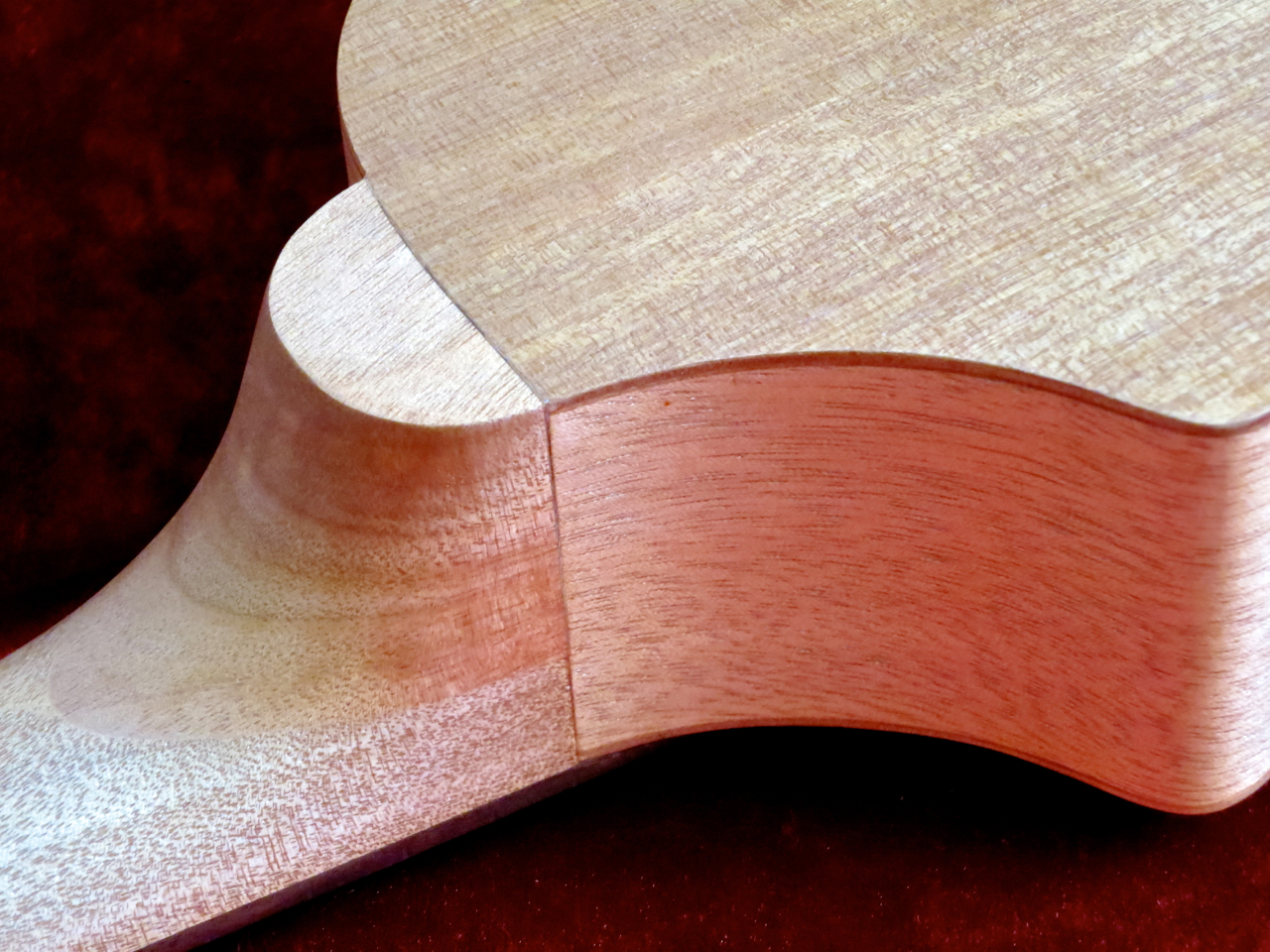
Kauko-Idässä valmistetun Tanglewoodin työnjälki on hintaansa nähden erinomainen, mikä näkyy esimerkiksi erittäin siististä kaulaliitoksesta.

TU-1CE:n otelaudassa on 16 pienikokoista nauhaa.
TU-1CE on varustettu laadukkailla Aquila Nylgut -kielillä.
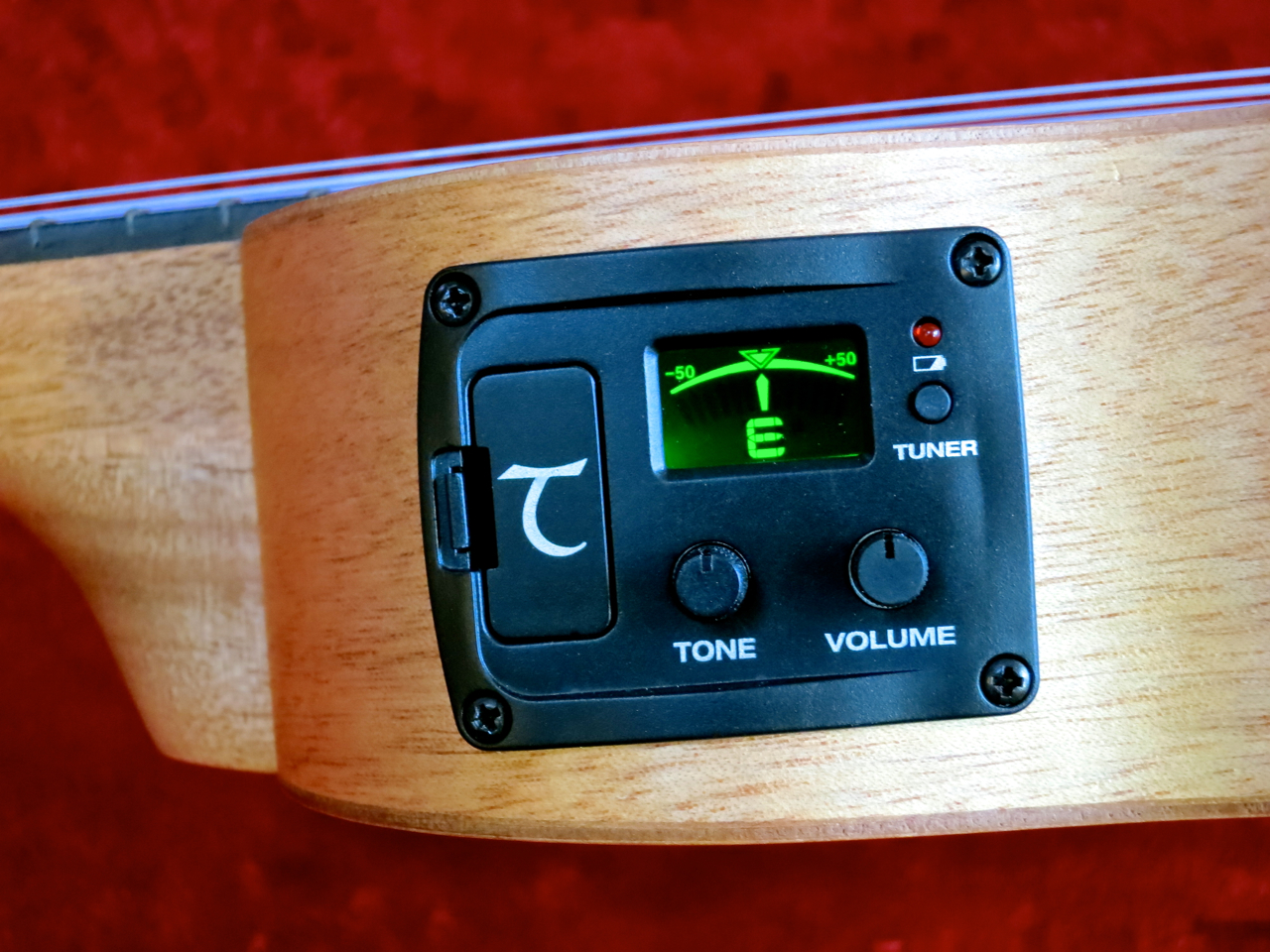
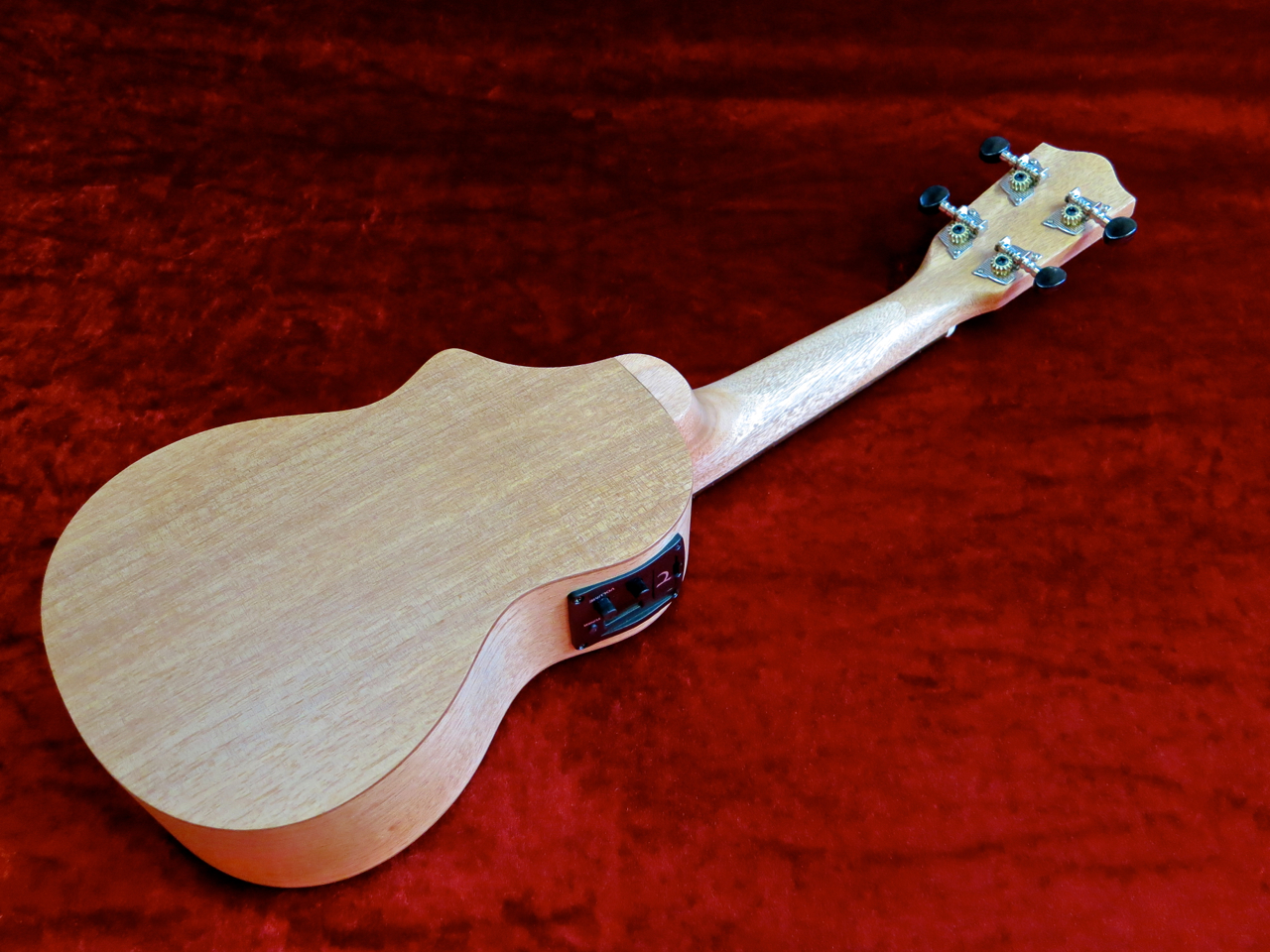
Tanglewoodin kylkeen on asennettu nappiparistolla toimiva esivahvistin TU-1CE:n pietsomikrofonille. Volume- ja tone-säätimien lisäksi esivahvistin tarjoaa myös oivan viritysmittarin.
****

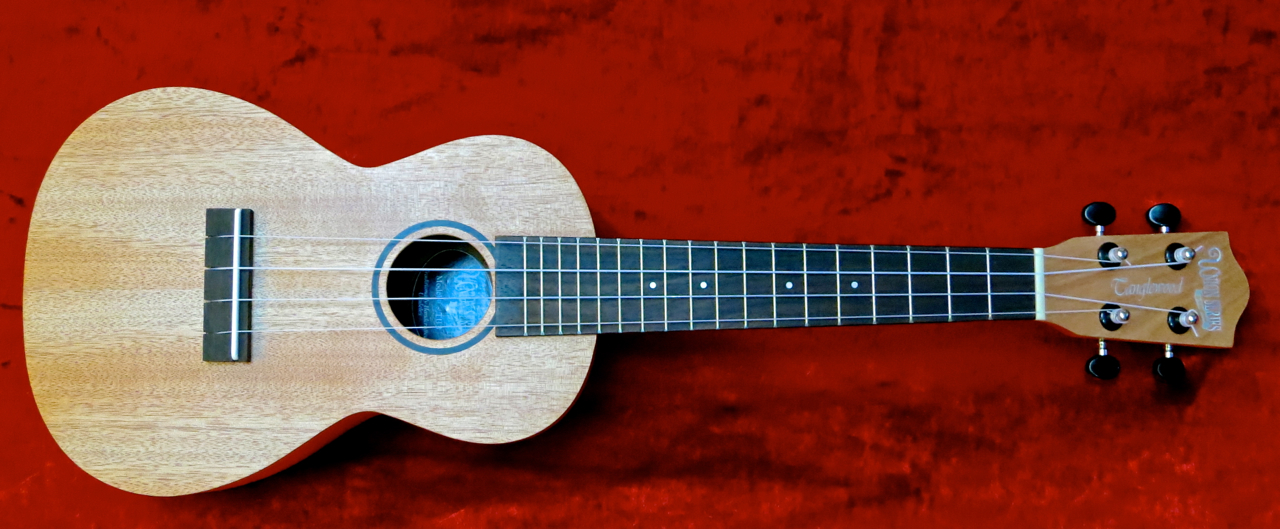
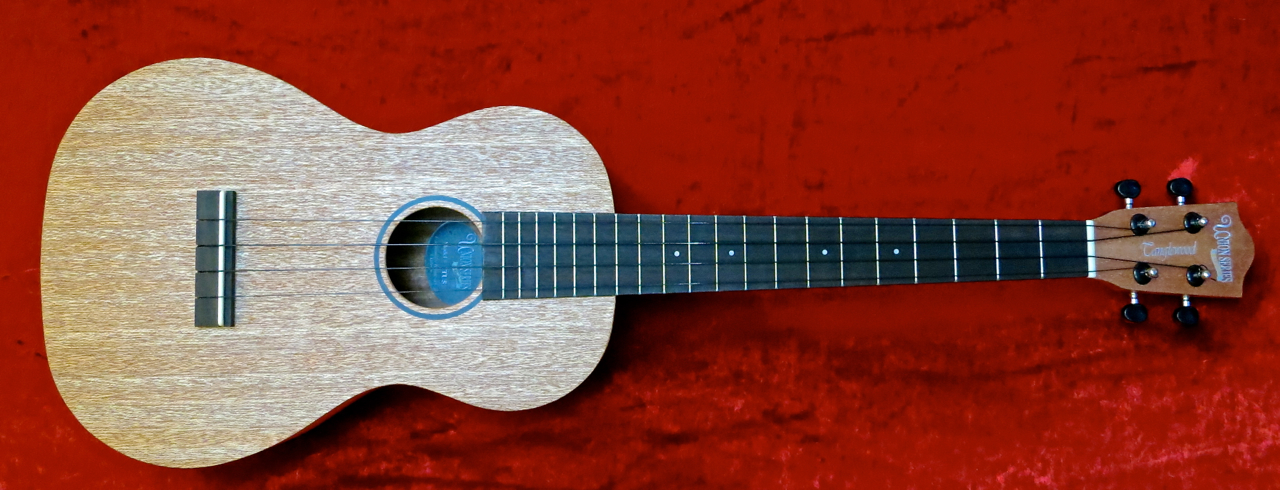
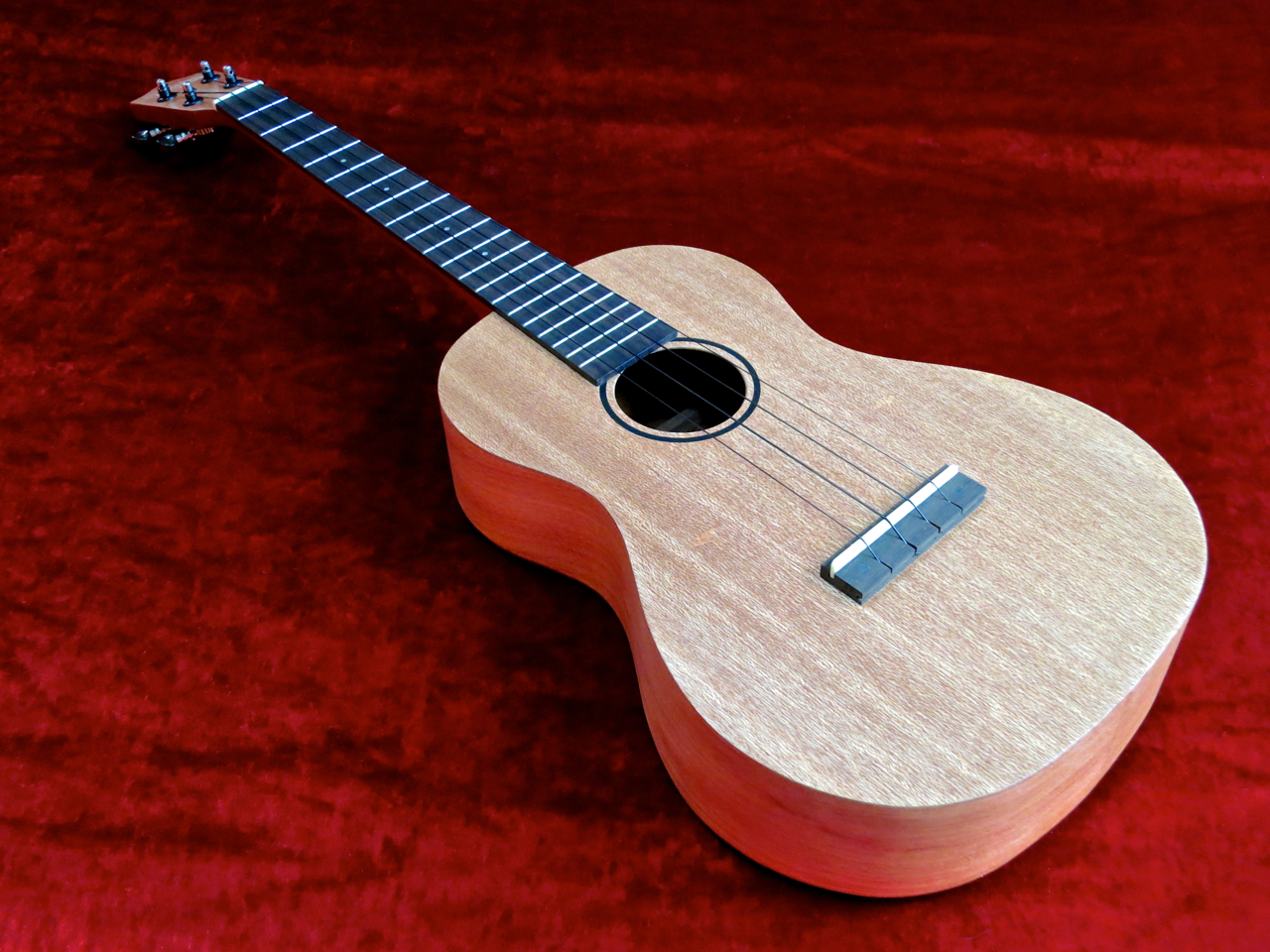
Tanglewood TU-3 (119 €) on konsertti-kokoinen ukulele, ja se toimitetaan omassa laukussaan.
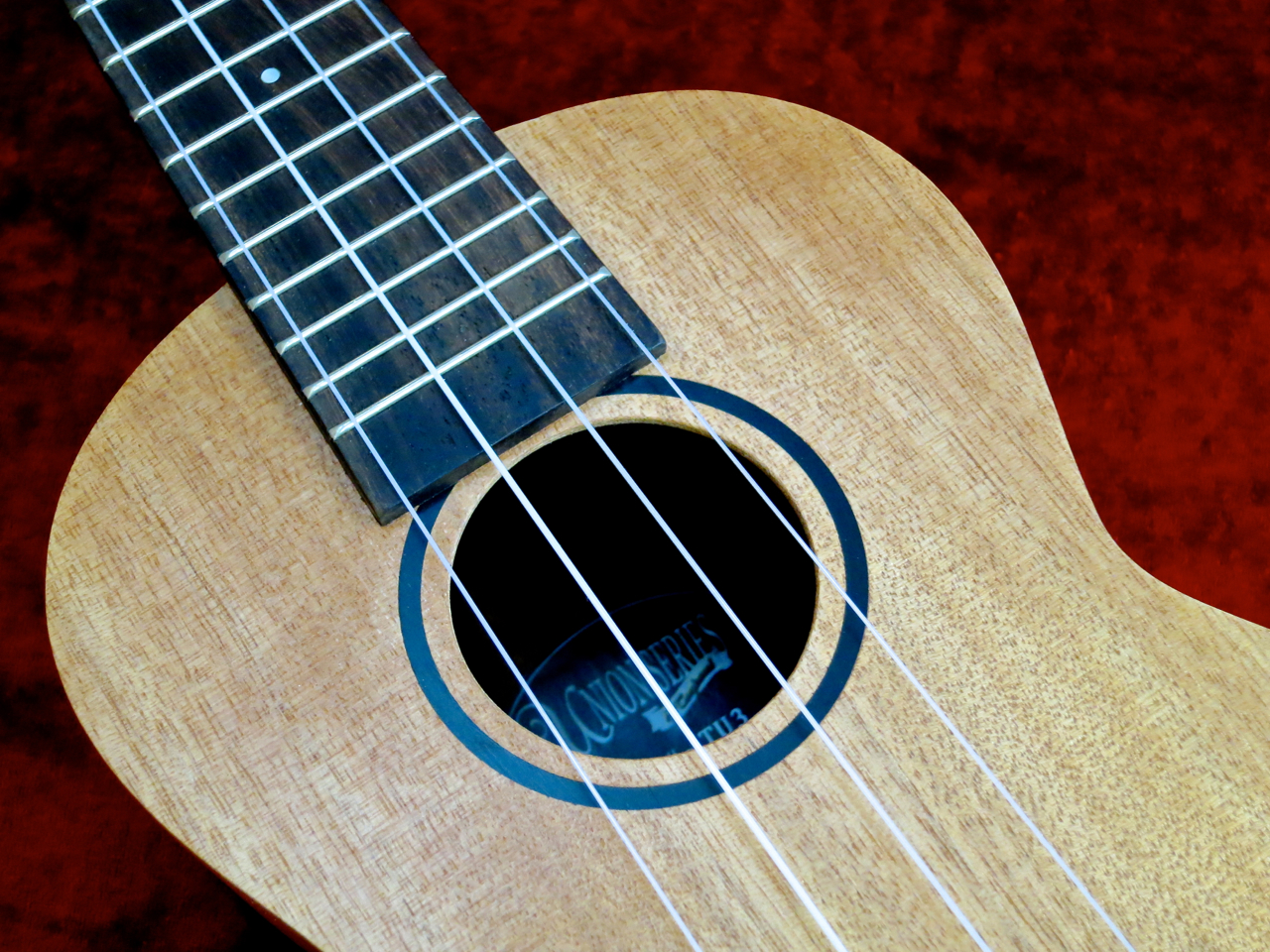
Concert-ukulele on yksi kokoluokka sopraanosta ylöspäin.
Tämän mallin mensuuri on 37,5 cm.

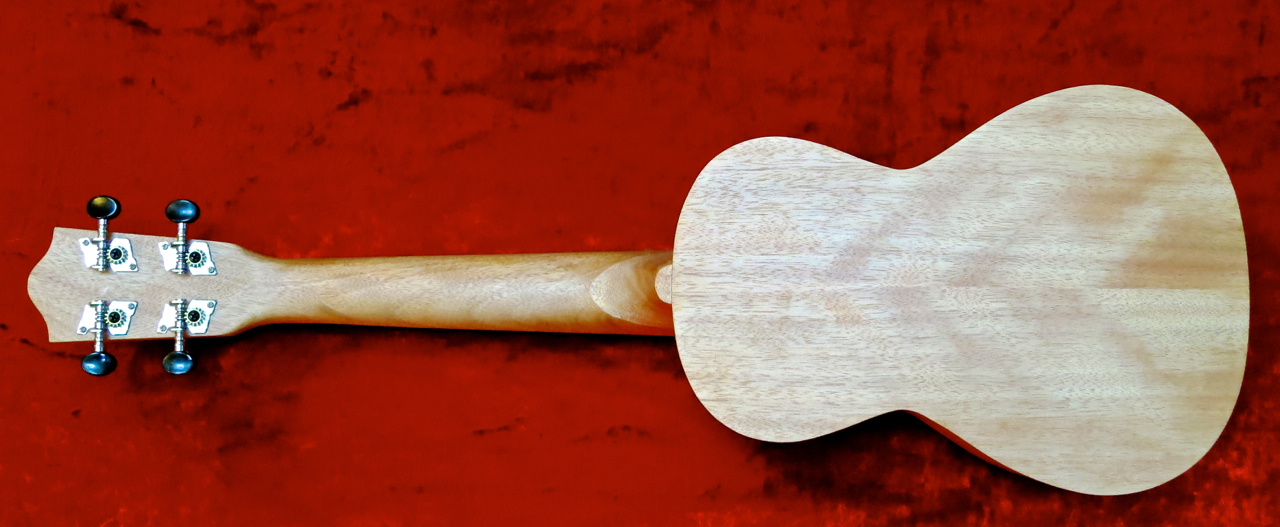
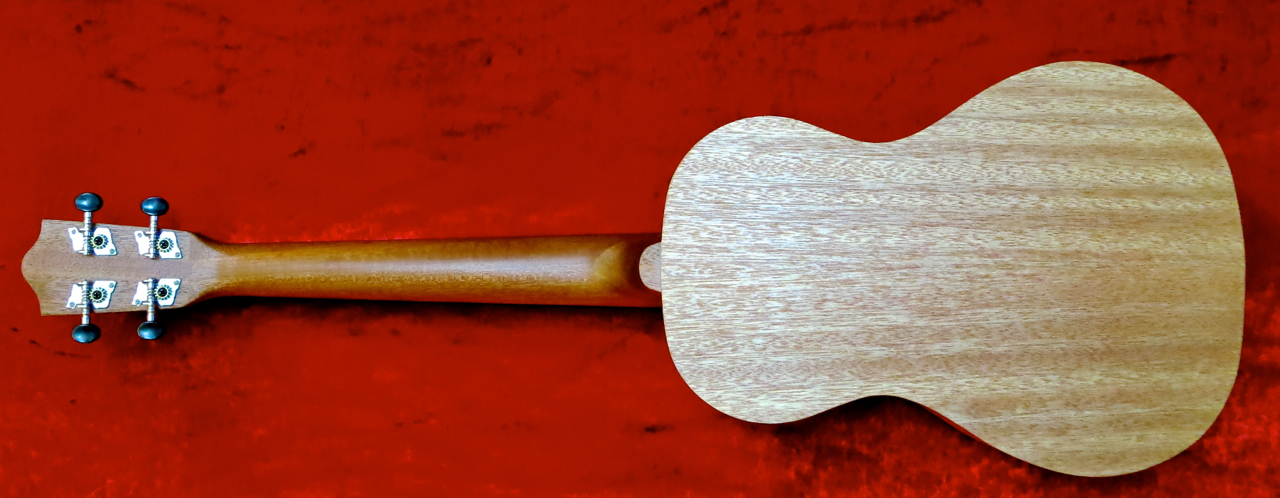
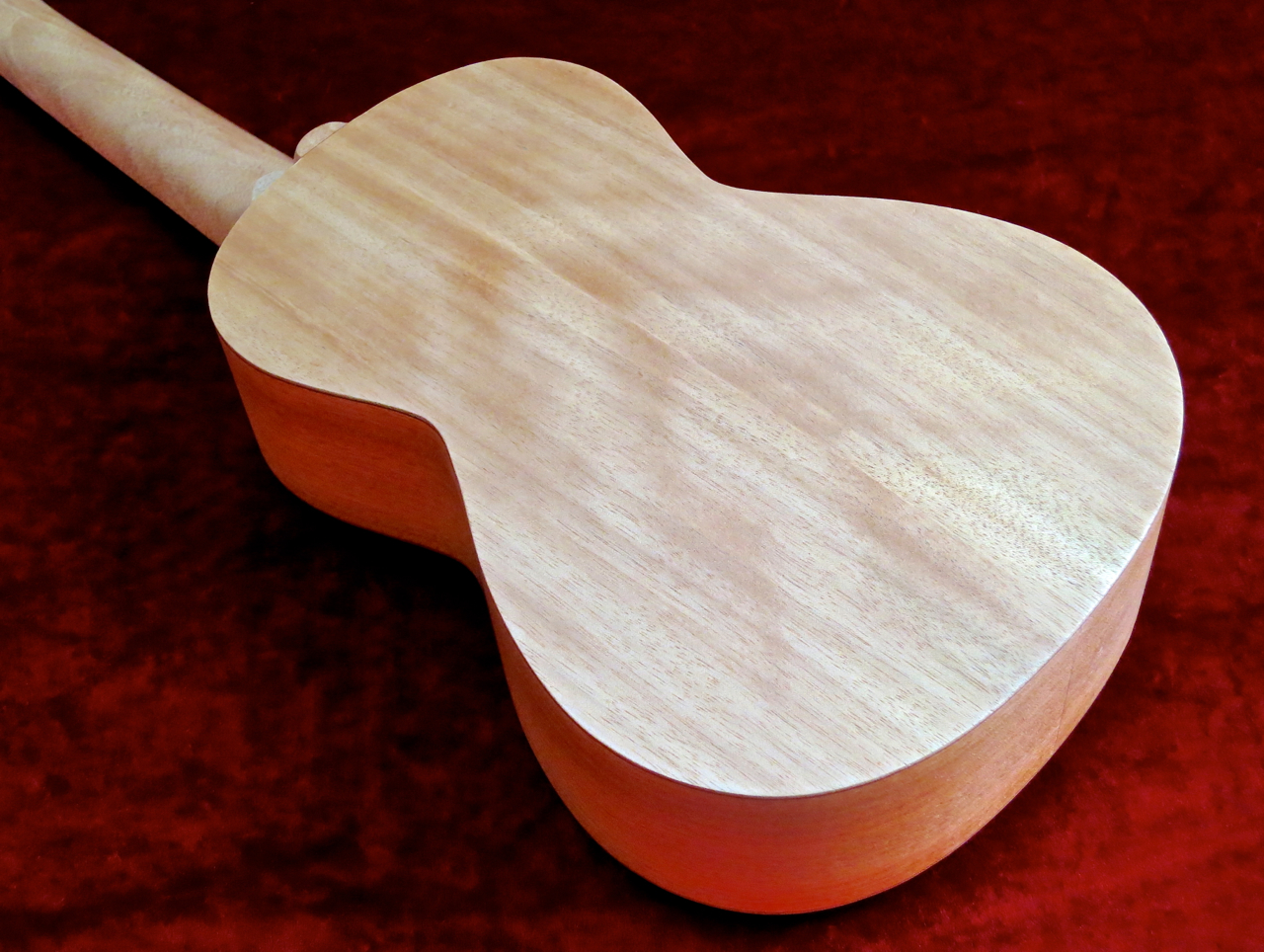
Testissä käynyt TU-3 on kaunis yksilö niin etu-…
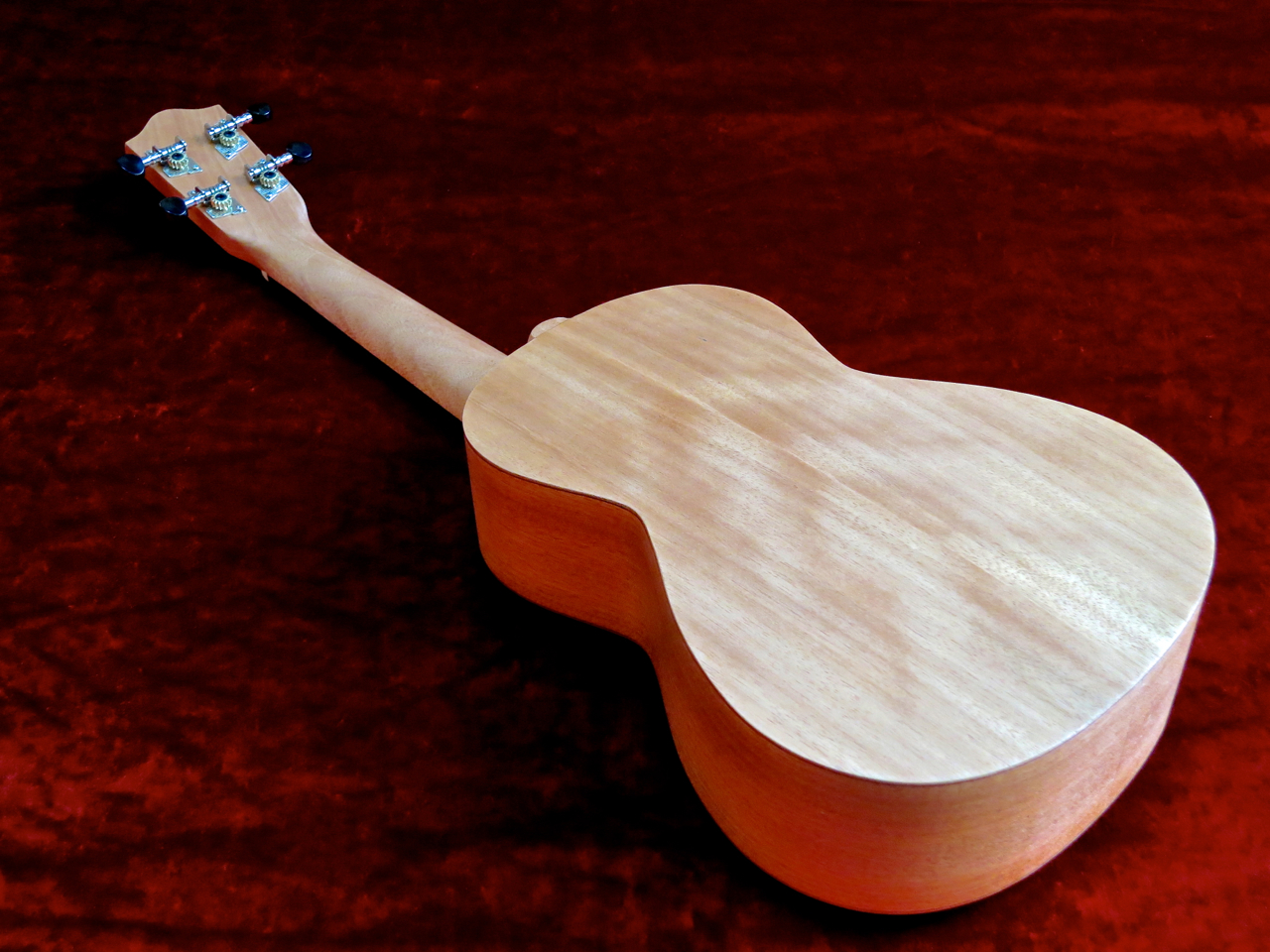
…kuin takapuoleltakin.
****

TU-3:n sähköistetyssä versiossa – Tanglewood TU-3E (129 €) – on sama etuvahvistin kuin TU-1CE-mallissa.
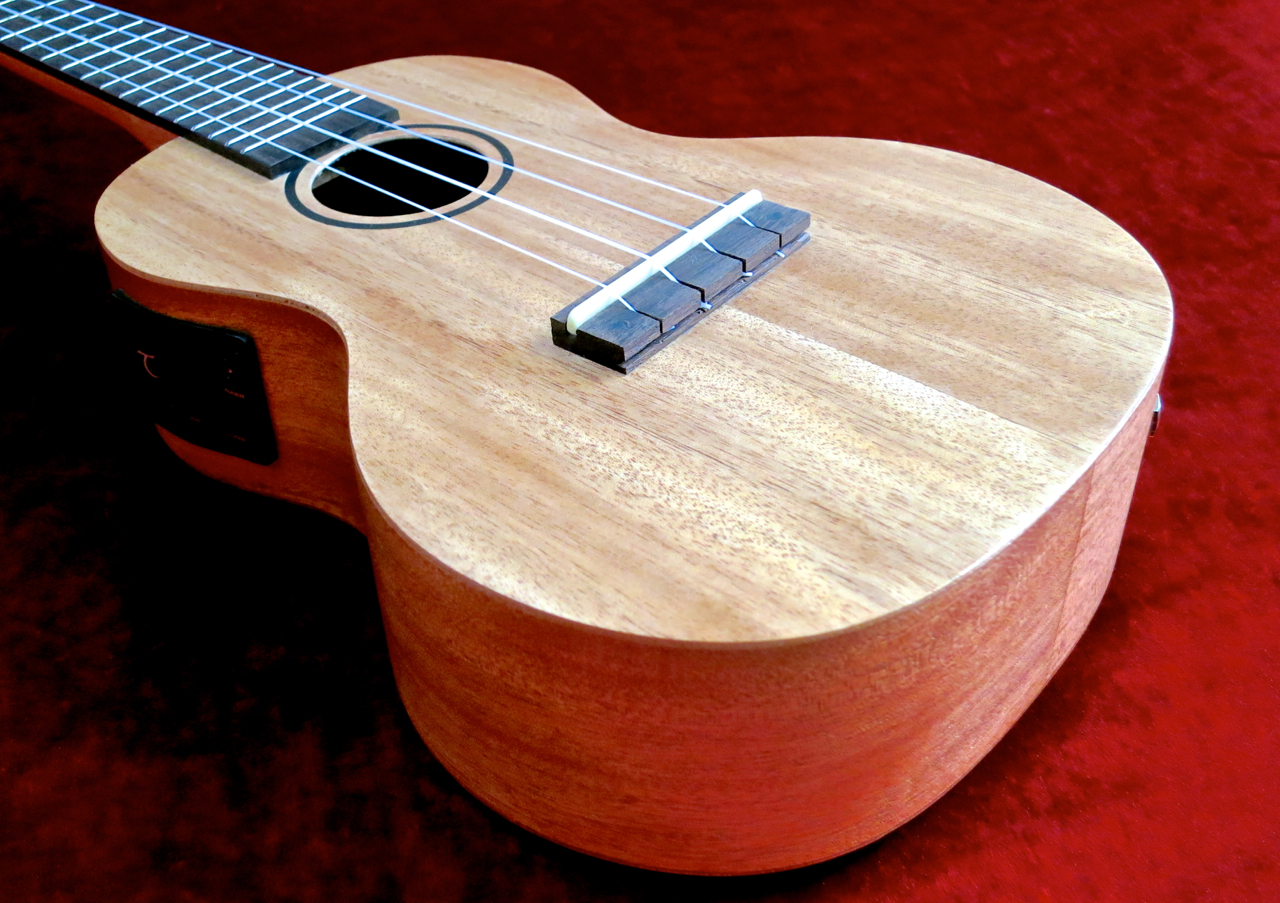
TU-3E:n otelauta tarjoaa 18 pientä nauhaa.

Union-sarjan ukuleleiden yksinkertainen musta rosetti istuu tyylikkäästi soittimien luonnonläheiseen imagoon.

Mikkijärjestelmän lähtöjakki on asennettu kopan sivuun.
****
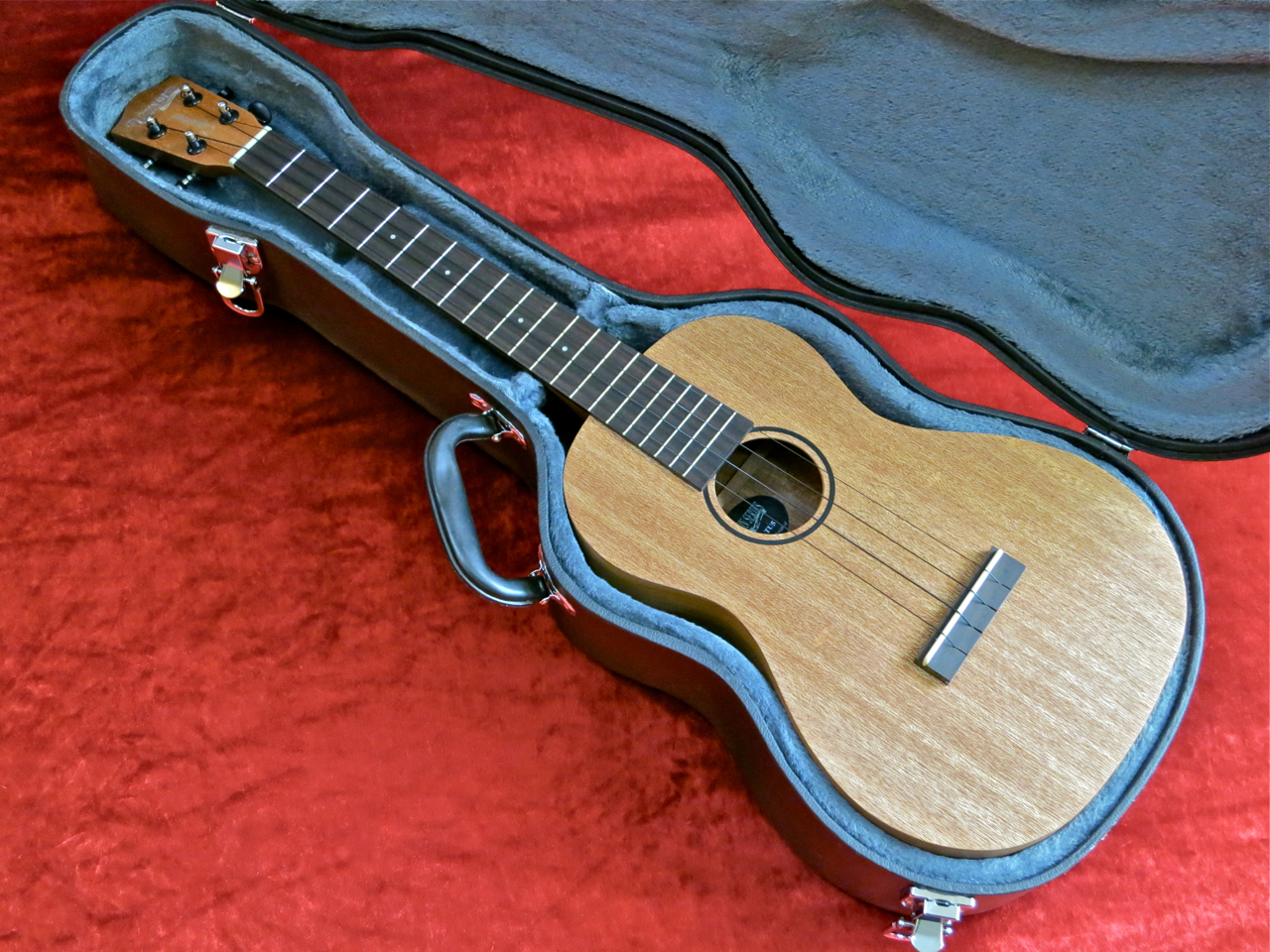
Myös Tanglewoodin baritoni-kokoisessa TU-5-ukulelessa (149 €) laadukas laukku kuuluu hintaan.

Baritoni on isoin perinteinen ukulelekoko. TU-5:n mensuurin pituus on 51,2 cm.

TU-5:llä on 20 pientä nauhaa. Tämä malli toimitetaan tehtaalta mustilla nylonkielillä korkeassa g-virityksessä (d4-g3-h3-e4), jossa D-kieli on viritetty oktaavin verran ylemmäs kuin akustisessa kitarassa.

****
Tältä TU-1CE-sopraano kuulostaa studiomikrofonilla mikitettynä:
Linjasoitostakin lähtee laadukas versio pienokaisen akustisesta äänestä:
Ja molemmista äänilähteistä yhdistetty signaali on tällainen:

****
Äänitin Tanglewoodin TU-3 konserttiukulelea samanaikaisesti sekä kondensaattorimikrofonilla (AKG C3000) että dynaamisella Shure SM57:llä:
****

Mikitettynä pietsolla varustettu TU-3E kuulostaa käytännössä samalta kuin täysin akustinen TU-3:
Valitettavasti testiyksilön tallamikrofonin asennuksessa (tai sen toiminnassa) oli jotain häikkää, minkä takia ukulelen kaksi reunimmaiset kielet eivät kuulu käytännössä lainkaan:
Tältä kuulostavat TU-3E:n akustinen ja linjasignaali summattuina:

****
Äänitin Tanglewood TU-5 -baritoniukulelea samanaikaisesti sekä AKG C3000 -kondensaattorimikrofonilla että Shuren dynaamisella SM57:llä:
****

Tanglewoodin Union-sarjan ukulelet ovat laadukkaasti tehtyjä, kevyitä soittimia, joilla on mattaviimeistelyn tuoma hillitty charmi.
Nämä ukulelet ovat jo ihan oikeita soittimia, edullisista hinnoista huolimatta!
Pidän todella paljon Tanglewoodien tuhdista kaulaprofiilista, joka tarjoaa myös aikuisen kädelle reilusti mistä pitää kiinni.
Testissä käyneen TU-3E:n sähkösoundissa ilmentynyt ongelma on toki harmittava yksilövika, etenkin kun sitä vertaa TU-1CE:n mallikkaasti toimivaan pietsojärjestelmään.
Kokonaiskuva on kuitenkin hyvin positiivinen, niin työnjäljen kuin soundin osilta. Kolmen ”isompien” mallien kovat laukut tekevät näistä Tanglewood-soittimista entistäkin houkuttelevampia. Mielestäni Tanglewoodin Union-sarjan ukulelet ovat erittäin hyvä (ja edullinen) tapa tutustua ukulelen soittamiseen hieman vakavammin.
****
Tanglewood Union-sarja ukulelet
Maahantuoja: Musamaailma
TU-1CE – 116 €
TU-3 – 119 €
TU-3E – 129 €
TU-5 – 149 €
****
Plussat (kaikki mallit):
+ työnjälki
+ mattaviimeistely
+ nauhatyö
+ Aquila-kielet (ei TU-5)
+ kova laukku kuuluu hintaan (ei TU-1CE)
+ TU-1CE: laadukas pietsosoundi
Miinukset:
– TU-3E: pietsosignaalin epätasaisuus testiyksilössä
– TU-5: ensiasennuskielten löysähkö soittotuntuma
****

This time we take two new LTD-models for a spin:

The LTD AJ-1 is the brand-new signature model for British guitarist Andy James. Mr James is best known for his stellar work with the Prog Metal outfit Sacred Mother Tongue.

The LTD EC-1000ET Evertune isn’t some rocking rapper’s axe of choice, instead it is one of currently two LTD-guitars factory-equipped with an Evertune-bridge. The Evertune-system promises to do away with the chore of having to tune your guitar for virtually the whole lifespan of a set of strings.
****

The Andy James LTD AJ-1 (current price in Finland: 986 €) is clearly based on the Horizon/MH-series of instruments, but fine-tuned in many details to Andy’s requirements.

The most obvious difference to your regular Horizon is the AJ-1’s satin black finish, which feels very smooth to the touch and doesn’t get all slippery when you’re starting to sweat (in contrast to some gloss finishes).
The guitar is build around a maple through-neck, with mahogany used for the body. The AJ-1’s slightly curved body top and the deep rib-cage chamfer make for a very comfortable fit.

Andy James also requested a non-standard headstock shape for the LTD AJ-1, instead of the usual pointed hockey stick type shape found on regular MH-series guitars.
I’m probably just being a boring old fart here, but I must say I’m not the greatest fan of this style of über-Metal headstock. Objectively, though, there’s nothing wrong with this functional three-a-side design.
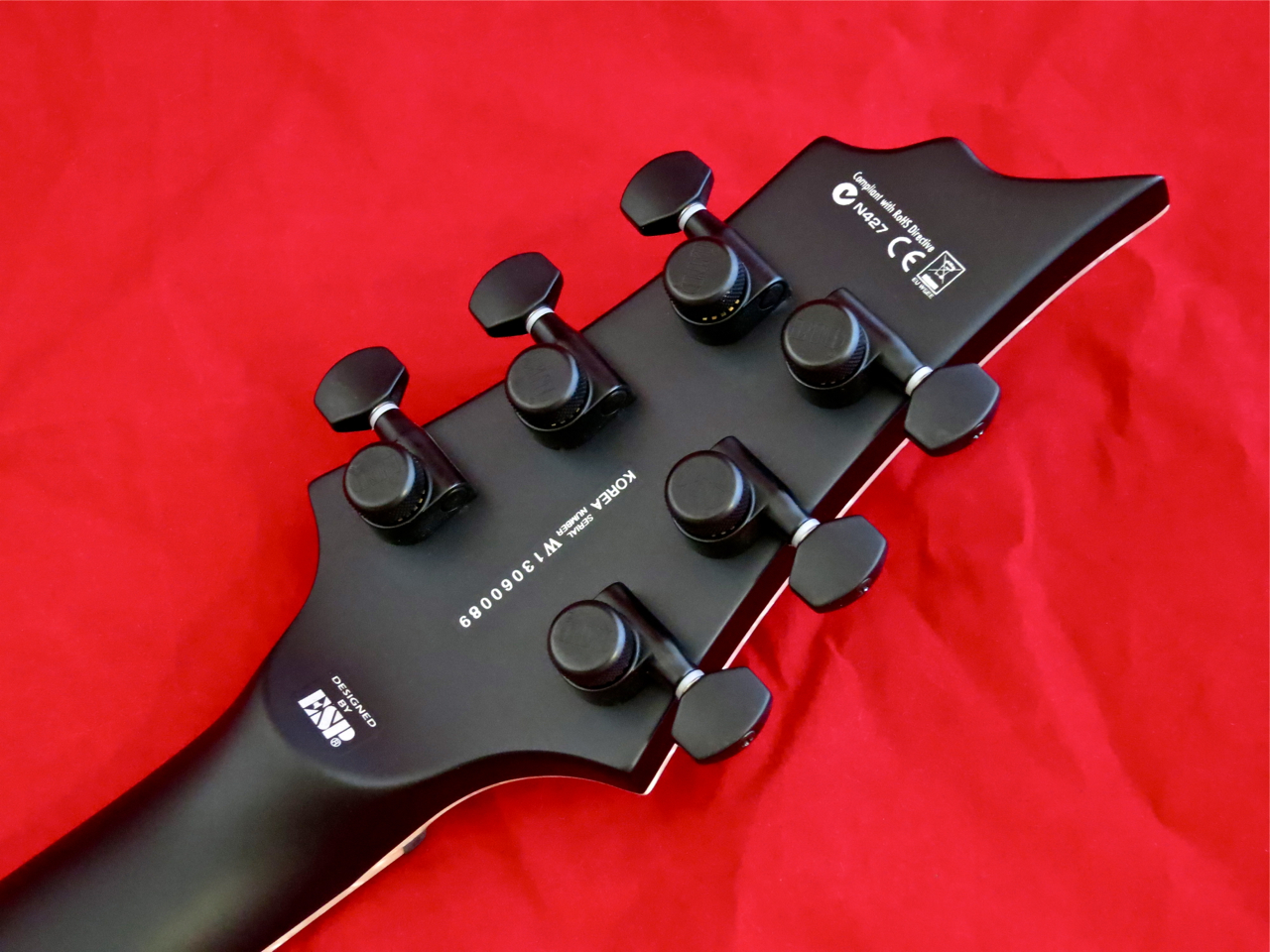
The AJ-1 sports a graphite top nut, as well as black locking tuners, to keep the guitar’s tuning rock solid.
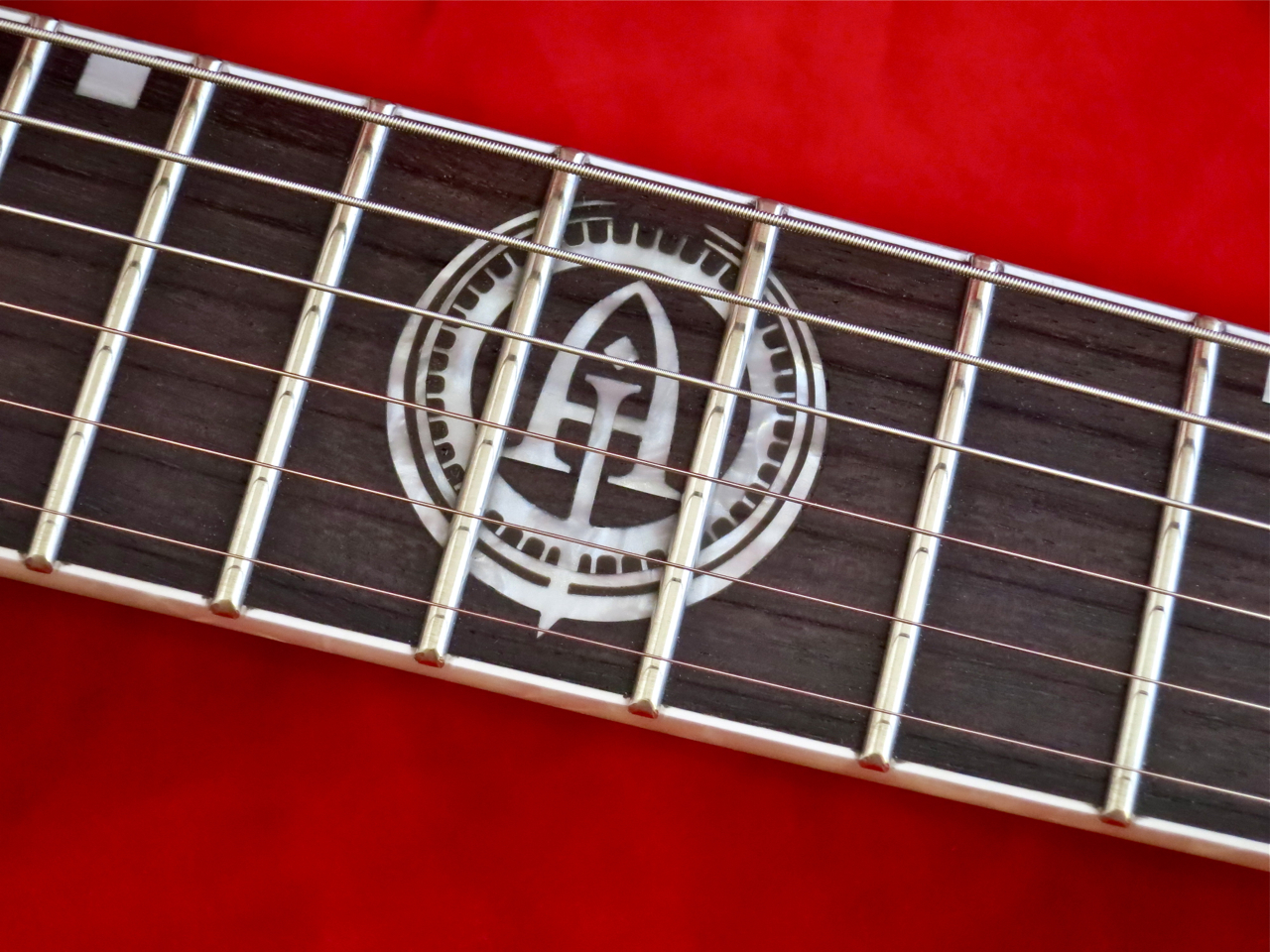
The inlaid Andy James-crest at the 12th fret is a very beautiful touch.

The quality of workmanship in the fretting and binding departments leaves nothing to be desired in our test sample.

Smooth is the right word to describe this type of neck-to-body-junction, which makes excursions to the dusty end of the fretboard a doddle.
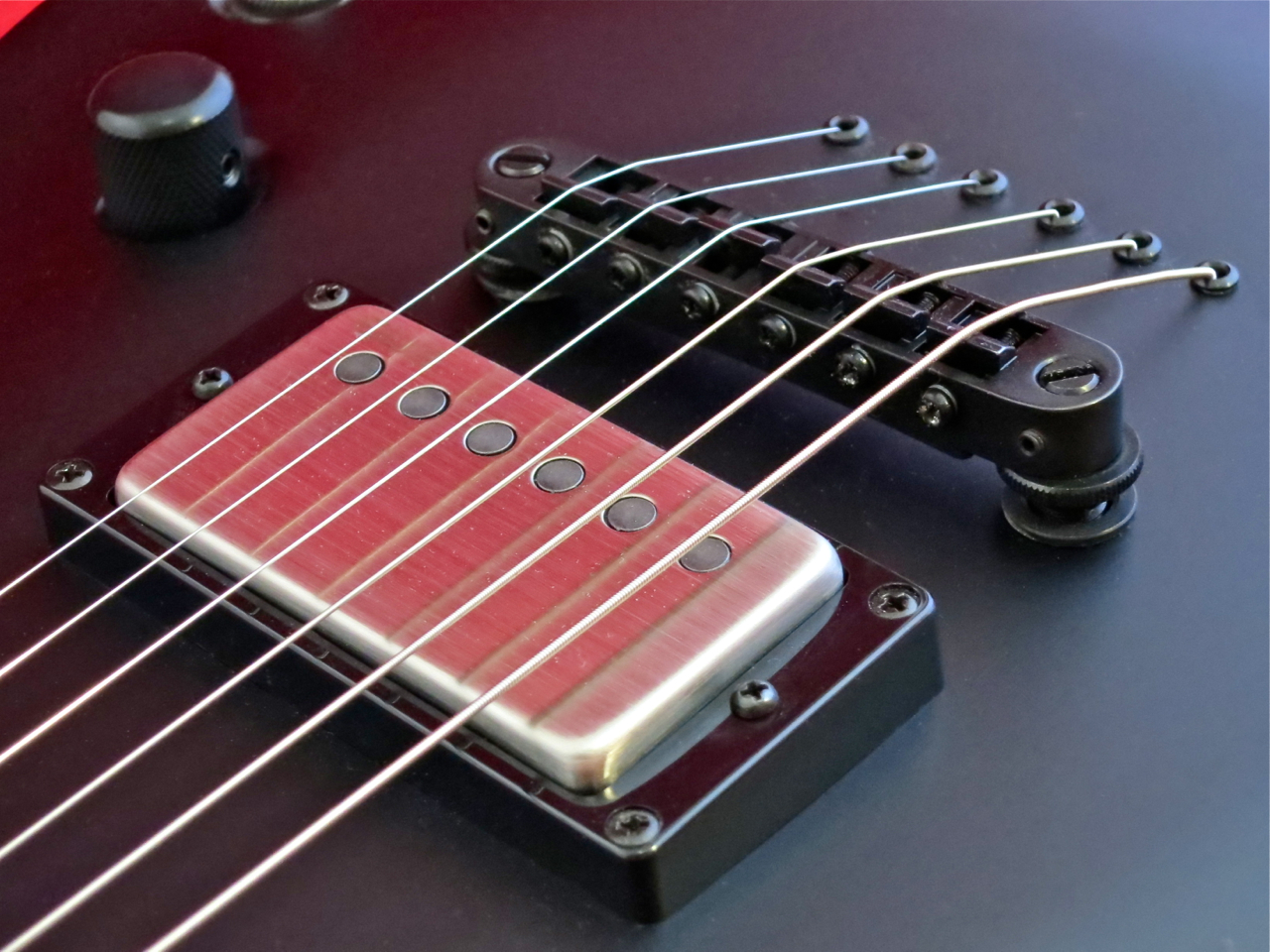
Mr James has specified a TonePros-bridge for his main squeeze. Two grub screws lock the Tune-o-matic to the bridge posts for better vibrational transfer from the strings to the body, and thus a better tone and more sustain.

The LTD AJ-1 comes equipped with a set of active EMGs from their recent Metal Works-series.
An EMG 66-humbucker is used in the neck position. This pickup is build around an Alnico V-magnet and ceramic pole-pieces for a rich tone with good string separation and clarity.
The bridge ’bucker is an EMG 57, which pairs the Alnico V with steel pole-pieces for a slightly warmer, vintage inspired sound.

Andy James doesn’t use a tone control on his guitars, which is why the signature model only comes with a three-way switch and a master volume control.
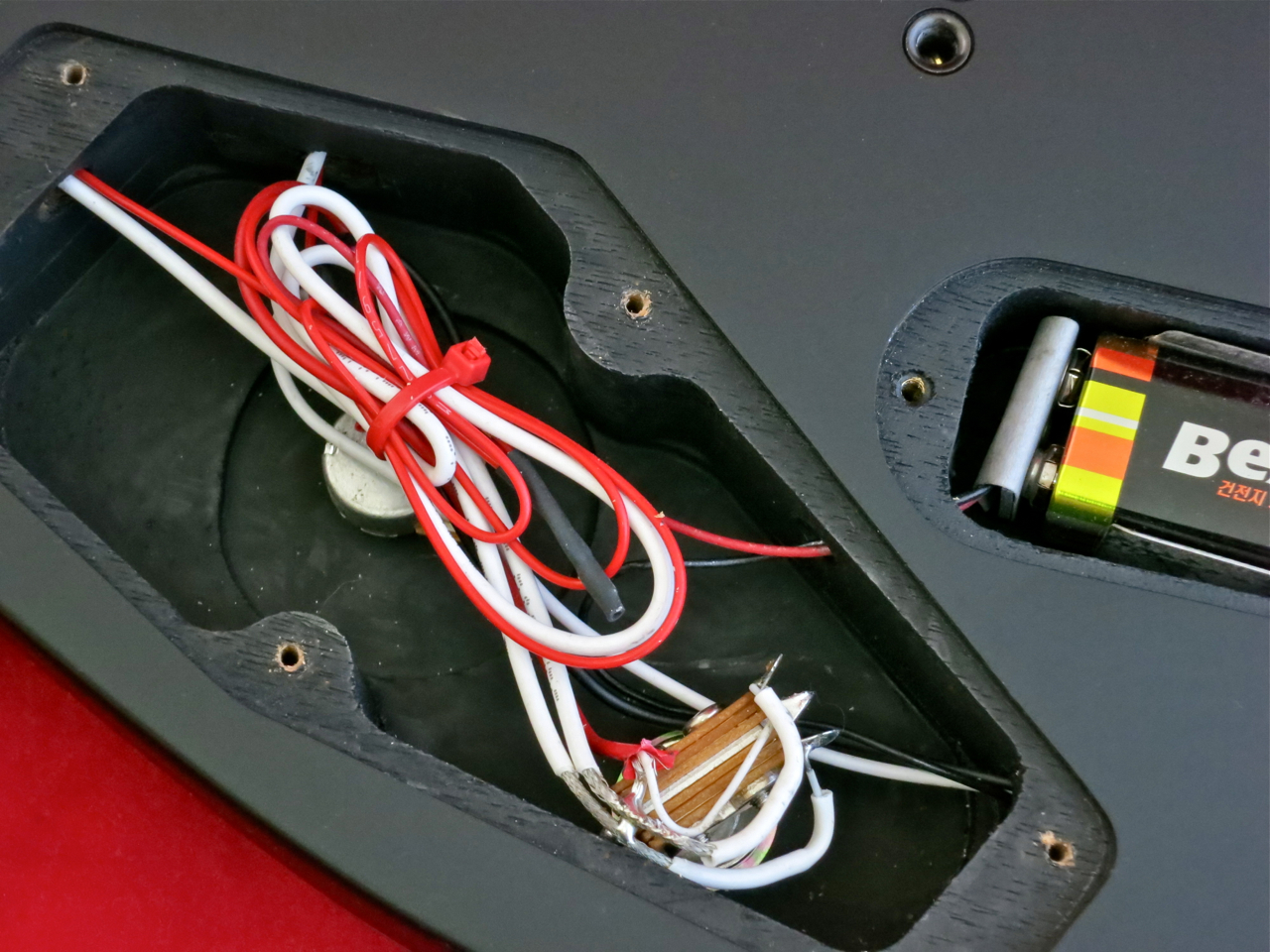
The control cavity displays clean workmanship. The battery compartment’s lid is screwed on with machine screws that grip into threaded inlets sunk into the body wood, which is a roadworthy solution.
****
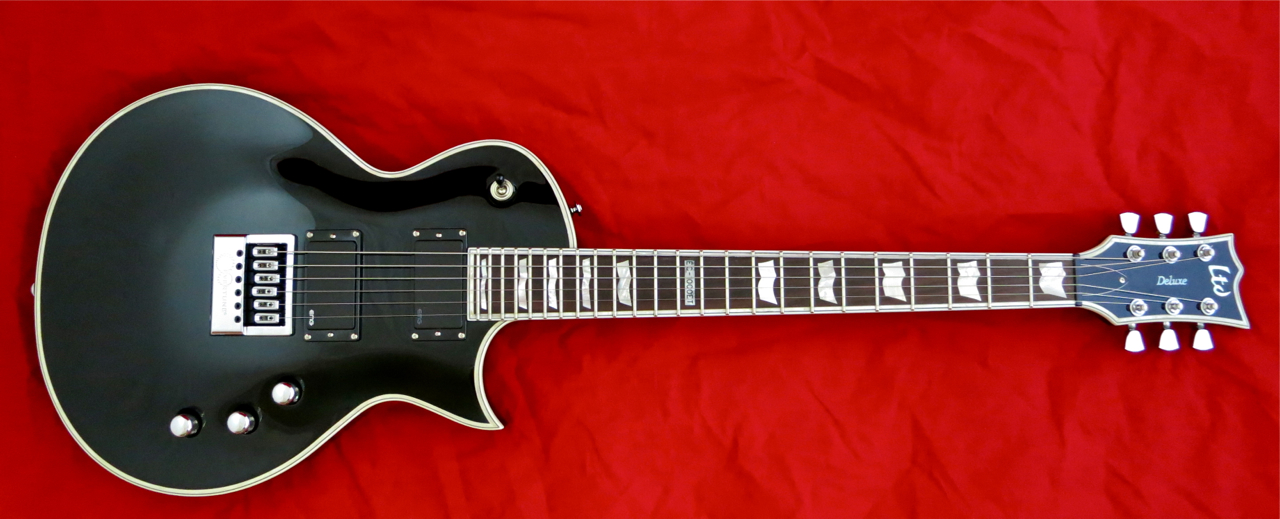
The LTD EC-1000ET (current price in Finland: 986 €) is the Evertune-equipped sister model of the regular EC-1000.
It is a set-neck guitar featuring a mahogany neck, as well as a mahogany body with a maple top.

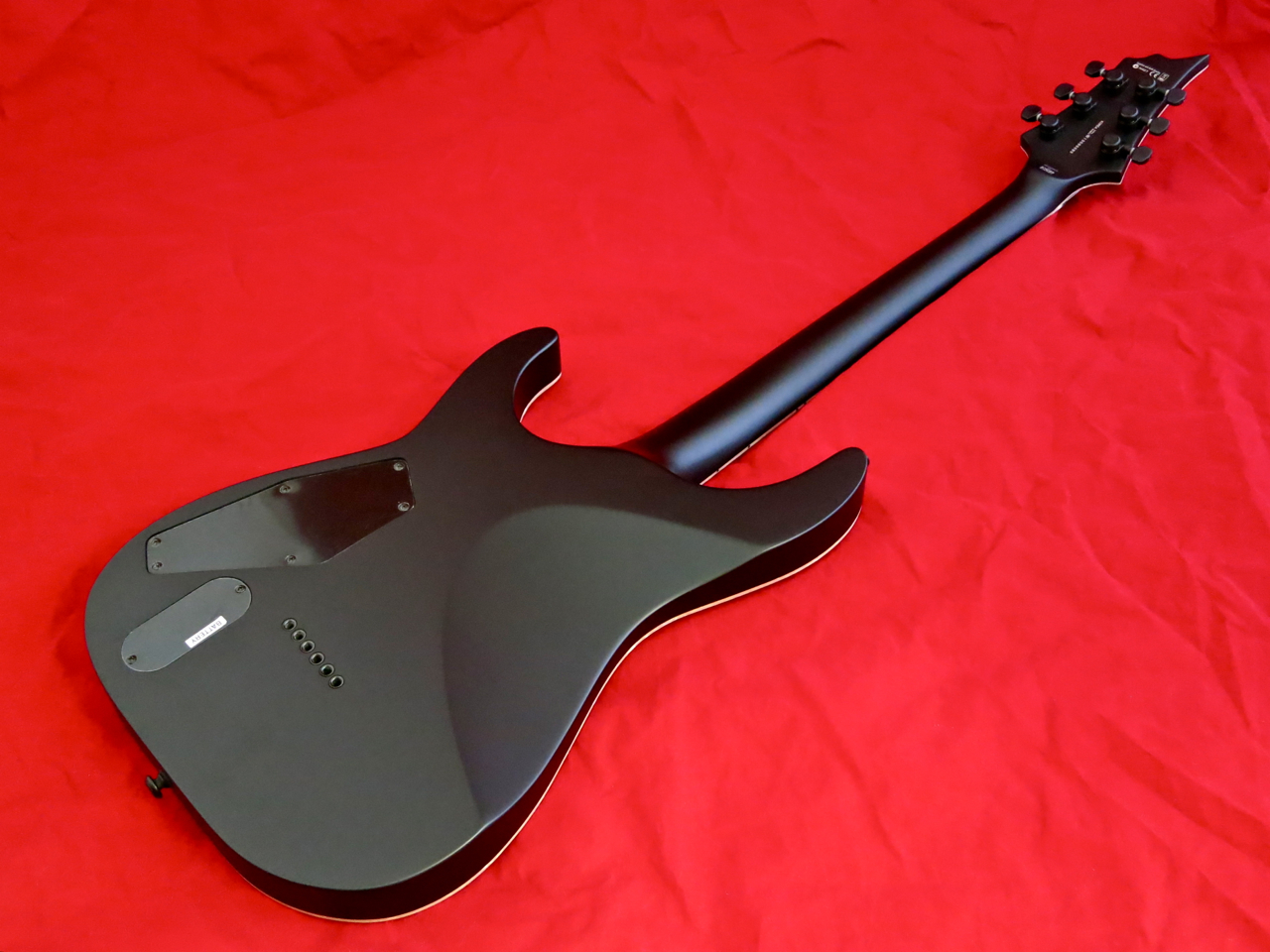
The EC-1000ET’s strings are loaded into the bridge from the guitar’s back.

As a card-carrying member of the LTD Deluxe-range the instrument is adorned with multiply binding and pearl inlays.

These classy Grover-tuners manage to combine contemporary functionality with vintage looks.

Look at the crisp inlay work in the rosewood fingerboard and the great fret job!

The LTD EC-1000ET comes equipped with EMG’s classic EMG 60/EMG 81-combination, which means we’re in for a strong output signal with a well-focused mid-range, clean highs and a very precise bottom end.
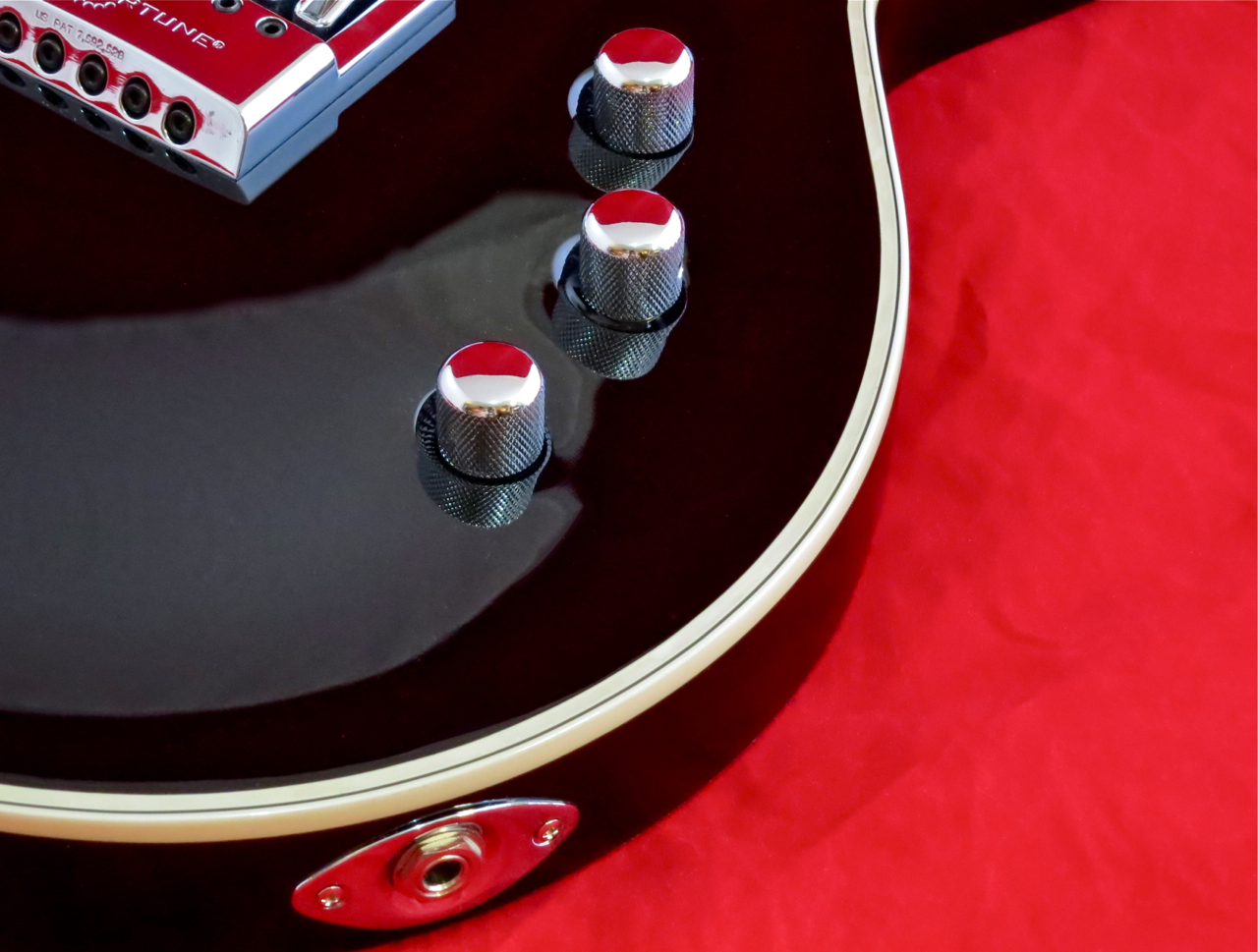
The control nearest to the bridge is the EC-1000ET’s bridge pickup volume [sic!], with the middle control being the neck volume and the third knob adjusting master tone.

This guitar is almost as clean on the inside as it is on the outside.

The Evertune-bridge is based on very similar physical principles as modern knife-edge vibrato bridges. In the Evertune’s case there is a separate spring-loaded mechanism with a knife-edge bearing for each of the guitar’s strings, trying to keep the string’s tension (read: tuning) unchanged for practically the whole of its lifespan.
The allen screws visible at the back of the Evertune-bridge are the intonation screws, while the ones on top of the bridge are for string-height adjustment.

This is what the Evertune looks like underneath the back cover plate.
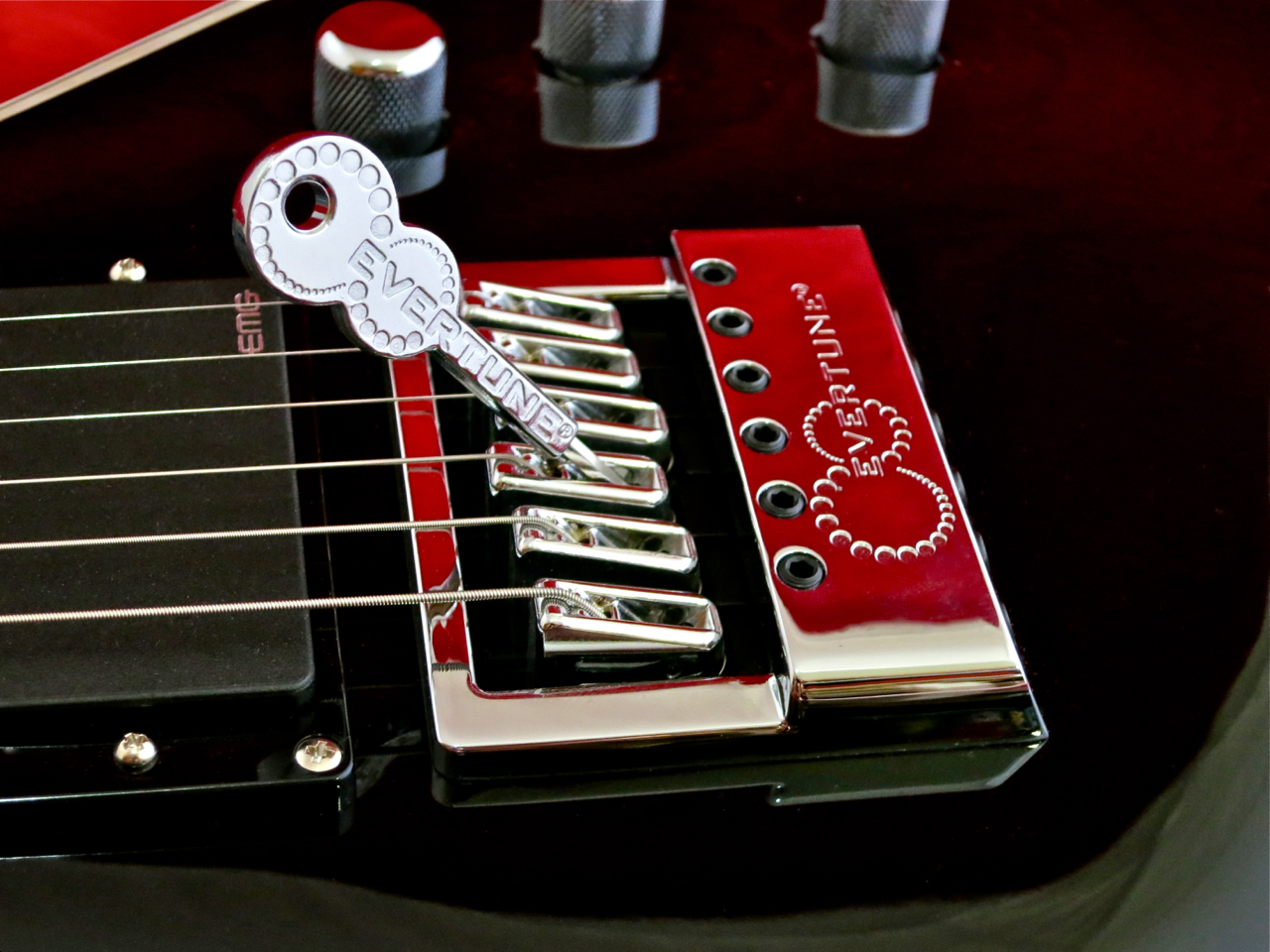
An Evertune-equipped guitar is not tuned at the headstock. The traditional tuners are instead used to correctly tension each string, as well as to adjust how much (if at all) each string reacts to finger vibrato and string bending.
You tune the guitar at the bridge by turning a hex screw inside the bridge saddle. The picture shows the handy key included with the guitar, but a regular allen key will also work fine.
According to Evertune its factory-speced bridge should work correctly at standard tuning (E-e, a = 440 Hz) using regular 009-012 string sets. Many other tunings, like drop-D or DADGad, should also be possible with the regular Evertune-bridge, but you will need to make changes to the tuner- and bridge-settings, meaning a change in tuning mid-gig is practically out of the question.
If you’re using very heavy (or very light) string gauges and/or very unusual tunings, you will in all likelihood have to swap a few of the bridge’s spring-loaded saddle-units for differently tensioned ones, which are available as options from Evertune.
You can read the Evertune-manual here: Evertune User Manual
****

Judging by the review sample, the LTD AJ-1 is a very lightweight guitar with a nice balance.
The neck profile is is comparatively shallow, yet round-backed ”D” that gives you the typical feel and playability of a widdle-meister guitar. The Andy James-signature very clearly isn’t for the campfire guitarist, but for the fleet-fingered Metal-shredder.
EMG seem to use the expression ”vintage” more interms of a tonal reference that with regard to a pickup’s output level, judging by this very punchy set of Metal Works-humbuckers.
Depending on the rest of your signal chain, you may be forced to turn the guitar’s volume control down to keep your signal clean:
But for overdriven and distorted use these powerful pickups have just what it takes:
****

The LTD EC-1000ET is a dyed-in-the-wool Rock-machine – it’s chunky, but not too too heavy.
The neck profile is fuller and more rounded compared to the AJ-1. The all-gloss finish of the EC-1000ET and its smalle fingerboard radius give this guitar a more vintage-type, classic feel.
It is possible that the Evertune-bridge adds a little to this model’s weight, but what is very clear to me is the added ring and sustain of the Evertune-equipped LTD.
I set the strings to high-sensitivity for easy bending and vibrato. Regardless of this the Evertune-system managed to win me over by absorbing efficiently any tuning issues caused by too much left-hand pressure or a very heavy-handed approach to right -hand strumming. The guitar stays in tune and rings freely nonetheless.

This EMG-set sounds a little bit more neutral to my ears. It’s maybe a tad dryer than the Andy James-model’s tone – it’s different, but still very good:
****

Brother, what an axe! In my opinion the LTD AJ-1 is a fine example of a streamlined instrument for the hard and heavy-crowd. The Andy James-model plays like a dream, and it gives you a chunky, buzz- and squeal-free signal with plenty of tonal character as a solid basis for you string excursions.

Is there a classier chassis for the novel Evertune-bridge than the LTD EC-1000ET? Probably not!
This is a very cool guitar if you want to cut down drastically on the amount of time spent tuning. The Evertune-bridge probably isn’t the best choice if you need one guitar to cover all sorts of different tunings. But if you stay in one tuning, you’ll quickly appreciate the (tonal and practical) benefits of this new bridge system, and tuning a guitar becomes something that you do only very occasionally.
****
LTD AJ-1 Andy James Signature
• 986 €
LTD EC-1000ET Evertune
• 986 €
Finnish distributor: Musamaailma
****
LTD AJ-1 Andy James Signature
Pros:
+ lightweight
+ matte finish
+ playability
+ workmanship
+ sound
Cons:
– some players might crave a tone control
****
LTD EC-1000ET Evertune
Pros:
+ Evertune-bridge
+ classic design
+ playability
+ workmanship
+ sound
Cons:
– no tuning changes mid-set
****



Roland’s popular Cube-series of COSM-combos has recently been updated.
The new Cube GX-amps boast some new features, like the iCube Link (first seen in the Cube Lite), which allows you to use the guitar combo as a soundcard with Apple iOS devices.
****

The Roland Micro Cube GX (current price in Finland 134 €) is the newest version of one of the most successful battery-powered practice amps ever.
At first glance the GX-version looks very similar to the Micro Cube’s previous incarnation, with only the large Cube logo on the metal grille hinting at the combo’s updated status.
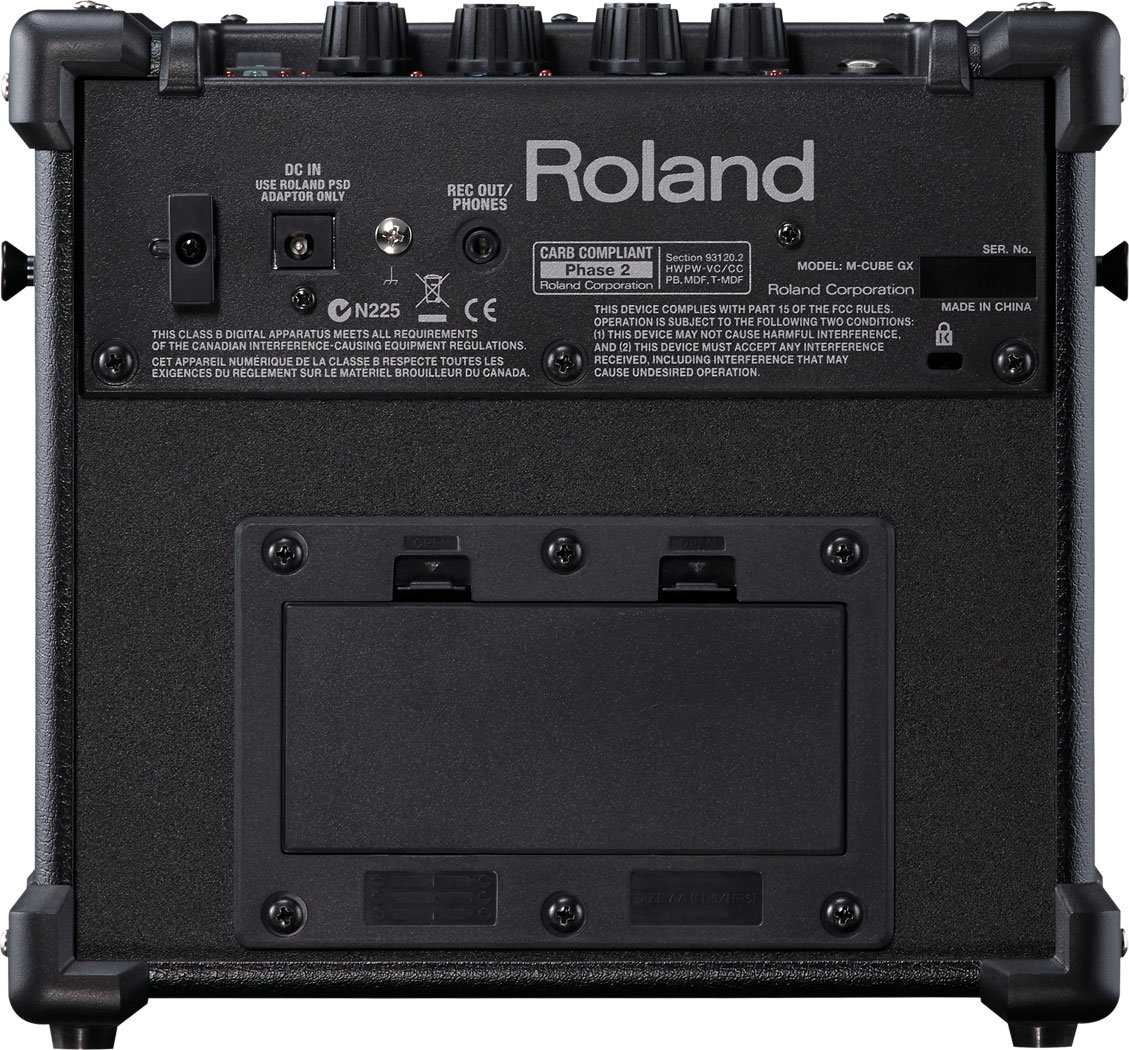
The Micro Cube GX’ back panel is a good deal smaller than on the last version.
The new combo sports mini-sized headphone and line-level outputs.

The GX still runs on six AA-batteries, but the new battery compartment is much easier to use.
A power supply can be found in the box.

The front panel has gotten a serious overhaul:
Above the guitar input you can find the i-Cube Link connector, which allows you to hook up you iPad or iPhone to the combo using the supplied cable. Thanks to the i-Cube Link you can use the GX-amp as the iDevice’s sound-card, as well as record and practice using Roland’s free Cube Jam-app. You can get more info on the Cube Jam-app in Kitarablogi’s Cube Lite review.
Another important new feature of the Micro Cube GX is the Memory-function, which offers you one memory slot per COSM Amp Type. Memory stores all settings of the chosen Amp Type, namely the settings of the Gain-, Volume-, EFX- and Delay-controls.
The tuner section has also received an overhaul. The old Micro Cube came with an electronic tuning fork on-board, giving you an ”a” (or Ab or Abb) to tune to. The brand-new Micro Cube GX comes equipped with a genuine digital tuner. The default setting for the tuner is chromatic, but it can also be set to A-only, which comes in handy when changing strings.
****
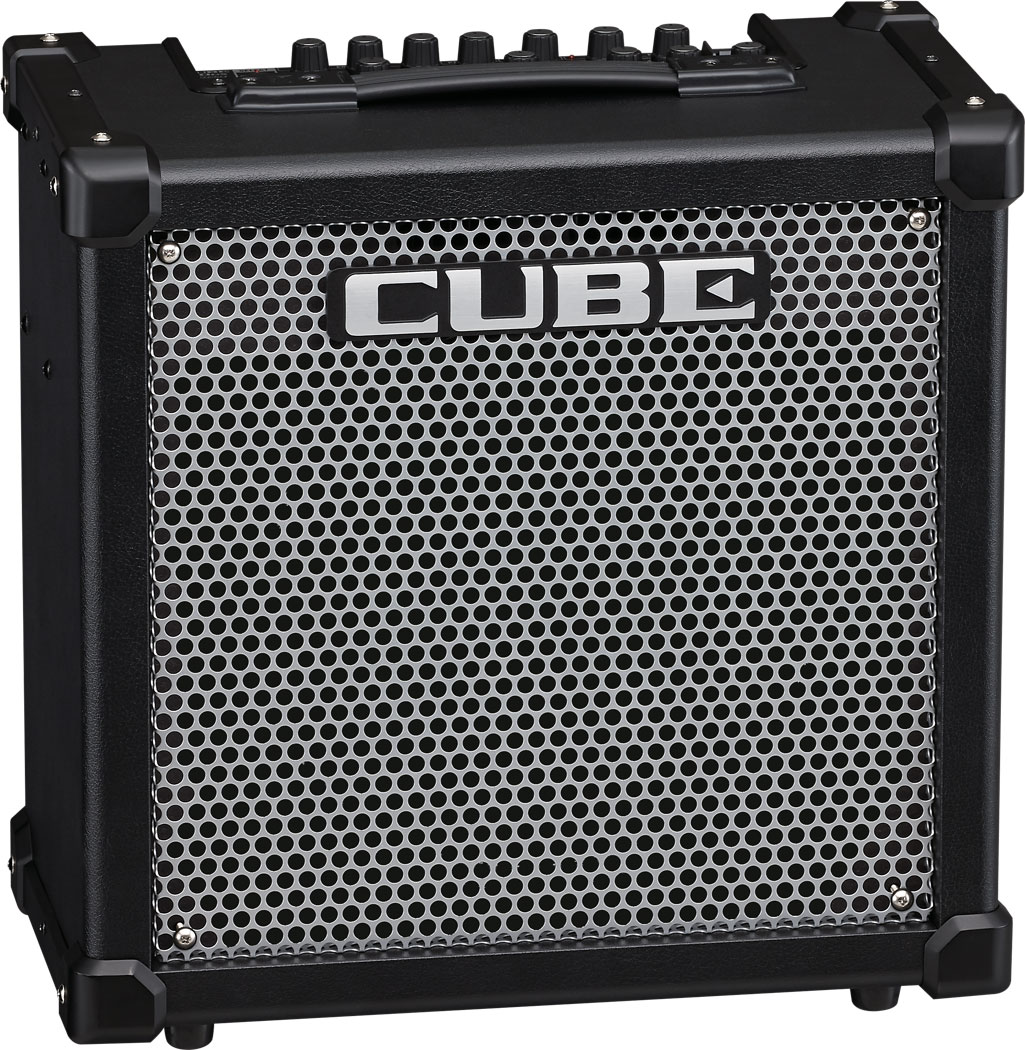
The Roland Cube-80 GX (current price in Finland 384 €) is the current top model in the GX-series, offering you 80 Watts of output power through a single 12-inch speaker.
The clearest difference between the predecessor – the Cube-80 XL – and the GX-version is the addition of the i-Cube Link in favour of the old model’s built-in looper.

Also new is the GA-FC-connector on the amp’s back panel, which allows you to use Roland’s guitar amp foot-controller the GA-FC (optional) with the Cube-80 GX.

This is what the foot-controller looks like. When used with the GX, you can switch amp channels and turn the combo’s EFX-, Delay- and Reverb-sections on/off separately. You can also connect two expression pedals to the GA-FC, if you want to adjust input and output levels on the fly. The Cube-80 GX comes supplied with a special overlay for the foot-controller, so you can change the GA-FC’s labelling to match the correct functions.
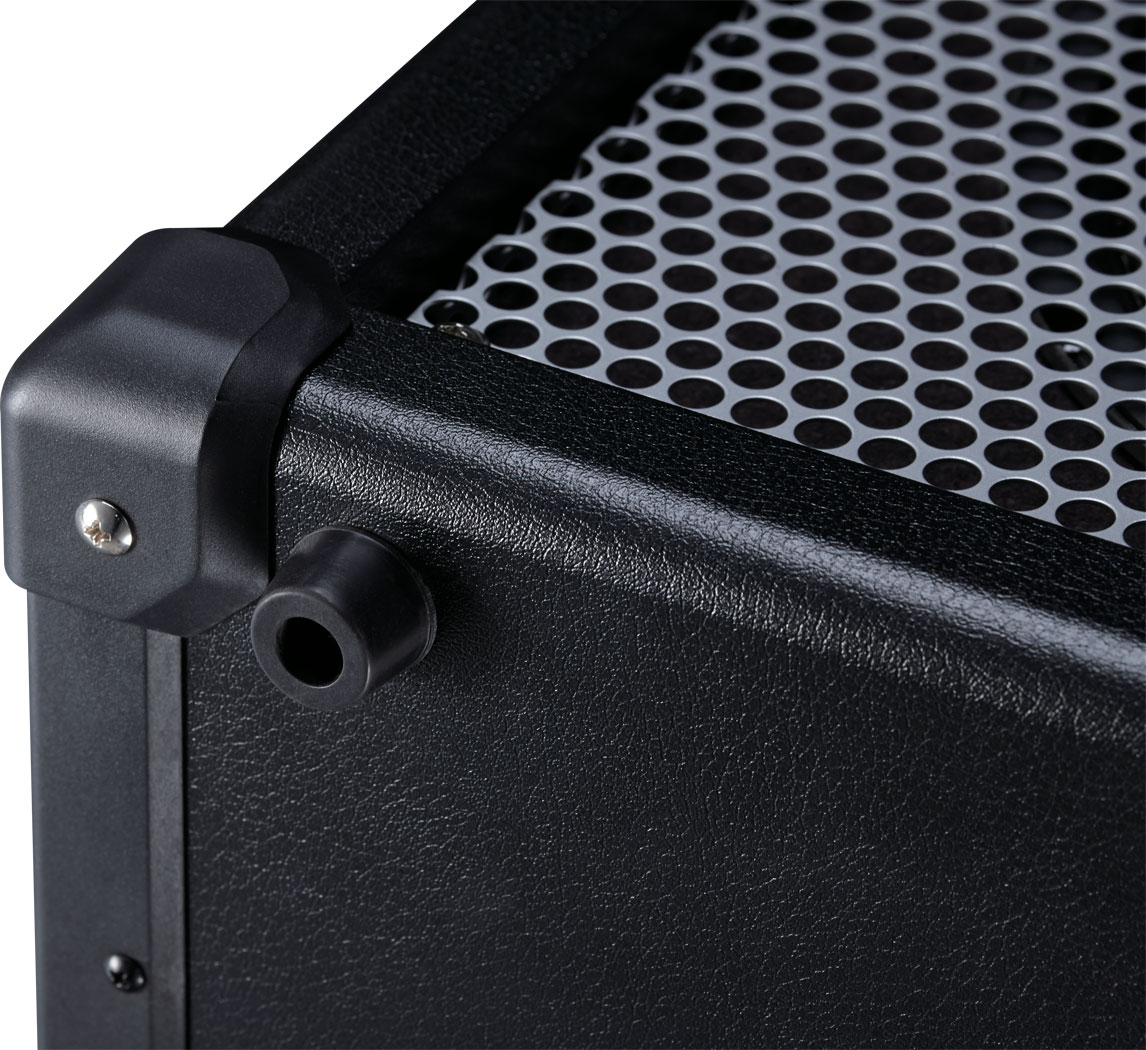
Some things have stayed the same, though, like the rugged design of the Cube-series.

The Cube-80 GX is a three-channel guitar amplifier:
The JC Clean-channel is reserved for ultra-clean tones in the style of Roland’s legendary Jazz Chorus-combo. The Lead-channel, on the other hand, offers you nine different COSM-models, as well as an acoustic simulator for your occasional steel-string needs.
The third channel is the so-called Solo-channel. I say ”so-called”, because actually the Solo-channel is the Cube-80 GX’ memory slot, which you can fill with any amp setting you wish, regardless of whether it is a setting for soloing or not. The crucial difference between the Solo-channel and the other two channels is the fact that the Solo-channel uses its own (stored) settings for the EQ-, EFX-, Delay- and Reverb-sections, while JC Clean- and Lead-channels have to share the current control settings.
Apart from the i-Cube Link, the Cube-80 GX’ features list is very similar to the Cube-80 XL-version. You can get more info on the i-Cube Link and Roland’s free Cube Jam-app in Kitarablogi’s Cube Lite review.
****

Roland’s brand-new Micro Cube GX offers you even more than its already legendary predecessor. The built-in tuner makes life much easier, and the new i-Cube Link/Cube Jam functionality genuinely adds value to this diminutive powerhouse. If you own an iDevice you will have your own practice set-up up and running in no time.
The little GX-combo also gives you three new sounds – the fantastically über-Metal amp type called Extreme, a fine polyphonic octaver effect, as well as a spring reverb model. The Micro Cube GX’ spring reverb simulation sounds good, but very small area designated for it on the Reverb-control doesn’t allow for much in terms of tailoring the spring reverb. It’s more of an on/off affair.
Overall the GX sounds better than the original Micro Cube, with more realistic amp simulations and clearly less hiss in the effect section.
These four clips have been recorded using a dynamic mic in front of the combo, and playing a Fender Stratocaster:
****

Roland’s new Cube-80 GX is a compact, yet powerful guitar combo for the gigging guitarist.
The sounds on offer cover all bases, and the amp types and effects all sound great. Depending on your guitar of choice there can be a very slight tendency toward a crowded lower-midrange – especially with clean sounds – but this can be easily kept in check with the amp’s nice EQ-section.
I feel that if you want to use the Cube-80 GX live, buying the GA-FC-controller is almost compulsory, as it is the only way you can fully control all the combo’s functions on the fly. 100 euros seems a bit steep in relation to the Cube’s own price tag, but from a practical standpoint the additional outlay makes a whole lot of sense.
Be that as it may, Roland’s Cube-80 GX is a cool amp for both gigging and studio use.
These four examples have been recorded with the same set-up are the Micro Cube GX-clips:
****

Roland’s Cube GX-series is a good choice if you want a wide variety of different amp tones and effect sounds to choose from. For teaching and/or practising purposes the iOS-compatibility and Roland’s own Cube Jam-app add a lot of value to an already very enticing package.
****
Roland Cube GX-series
Micro Cube GX – 134 €
Cube-80 GX – 384 €
Finnish distributor: Roland Scandinavia
****
Pros:
+ value for money
+ i-Cube Link
+ Micro Cube GX: new Memory-feature
+ Cube-80 GX: GA-FC-compatibility
+ sound
+ rugged build
Cons:
– Micro Cube GX: spring reverb effect hard to adjust
– Cube-80 GX: price of GA-FC-controller

****
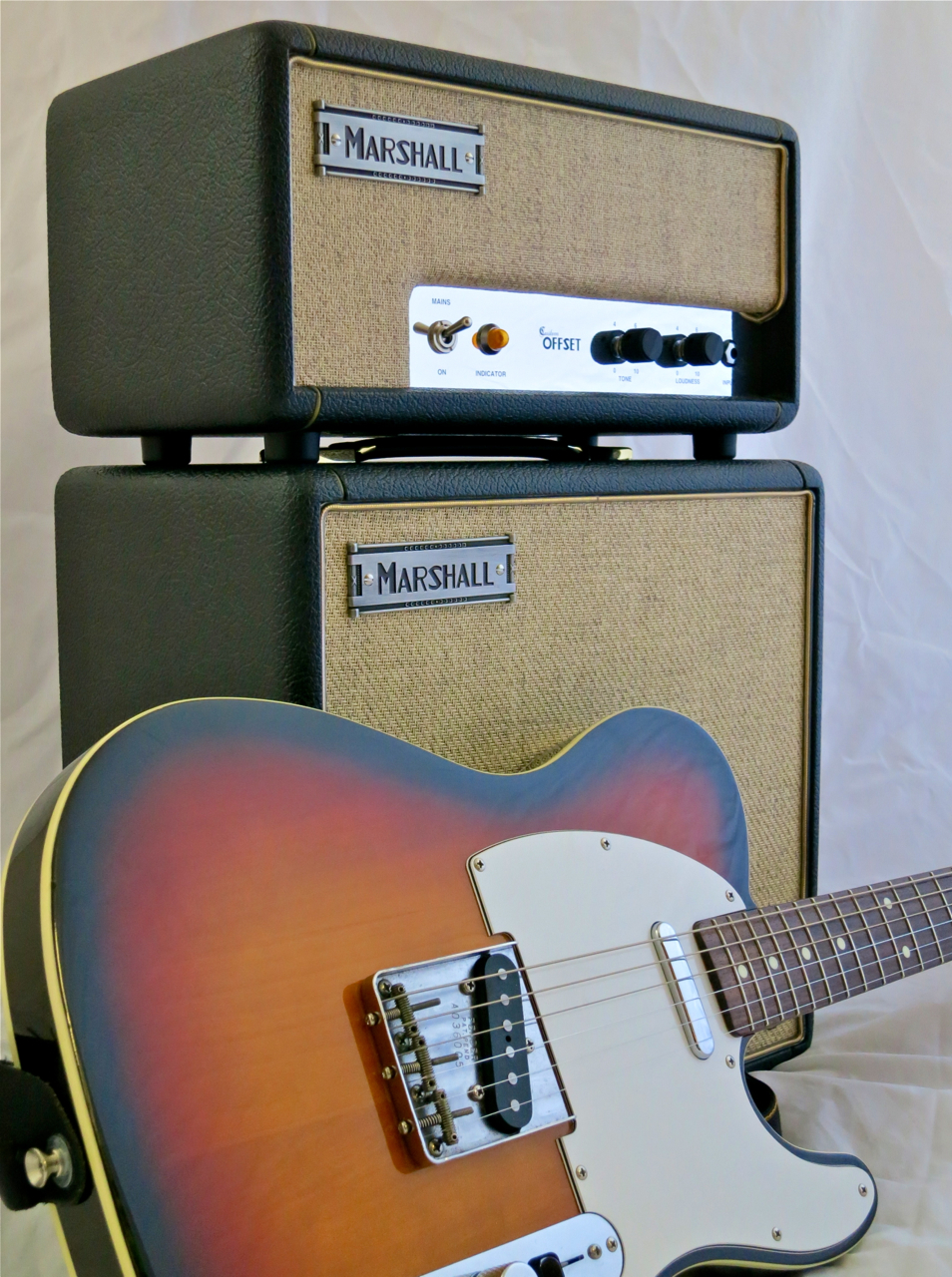
Last year Marshall celebrated their 50th anniversary by releasing a whole range of limited-edition one-watt combos and half-stacks.
Now we’re in for a cool reprise, as Marshall announced a limited edition of 1,111 of a Custom Offset half-stack in Frankfurt earlier this year. The Custom Offset is based on their JTM1 50th Anniversary amp.
A couple of these rare amps even made it to Finland. Kitarablogi.com managed to get hold of one half-stack for a quick review.
****
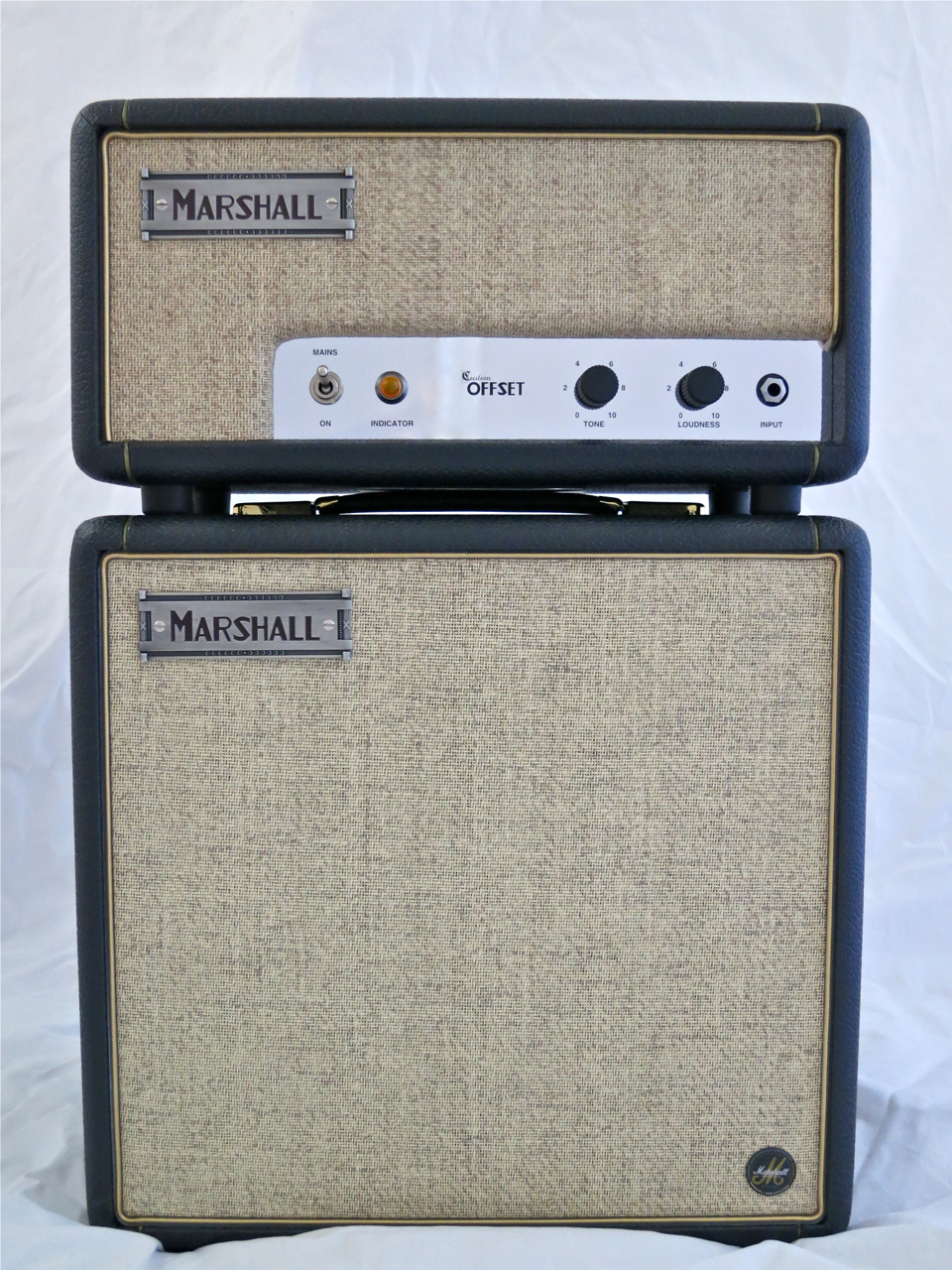
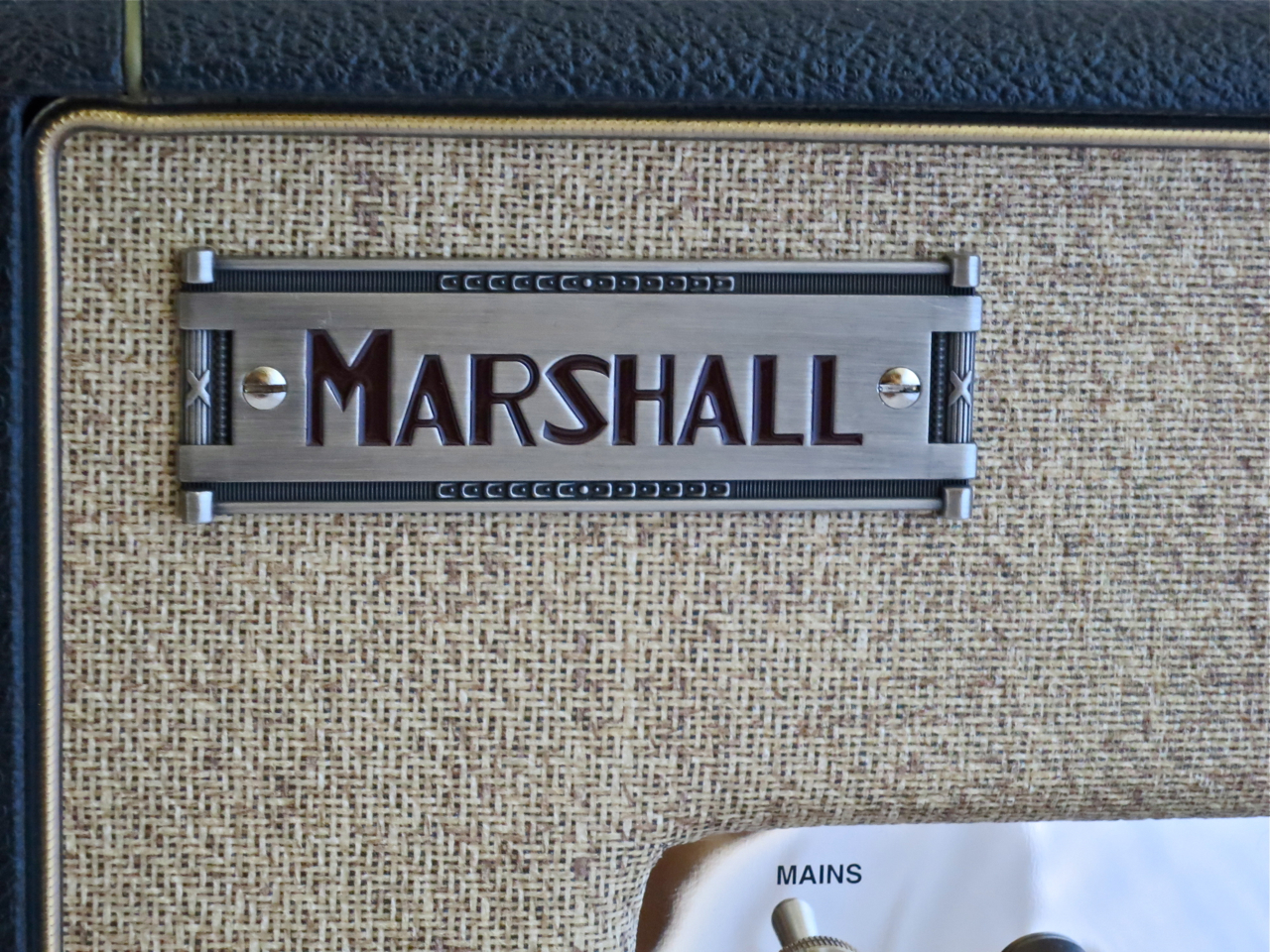
The Marshall Custom JTM1 Offset (price in Finland approx 1,000 €) takes the JTM1 as its starting point, but takes the concept even further down the vintage road to give the Custom Offset the look the company’s first batch of JTM45 models. There’s the famous light grey/beige grille cloth, and the offset control panel, which has given this amp its name.

As can be expected at this price point, the overall workmanship is of a very high standard, indeed.

The head’s gleaming, chrome-plated front panel, as well as the two black metal control knobs, are clear hints at this amp’s exalted limited edition status.
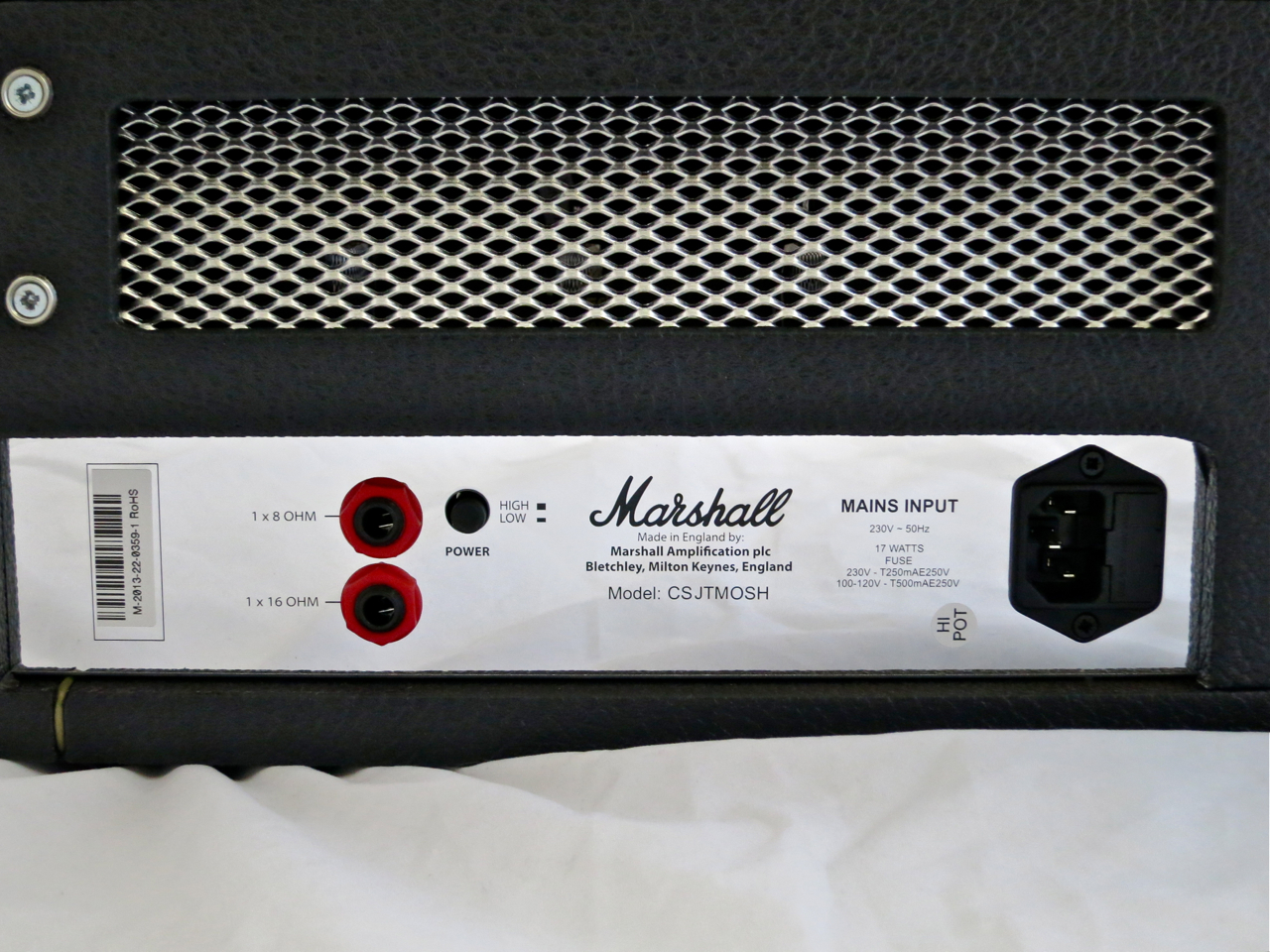
On the chromed back panel you will find the same Power-switch as on last year’s anniversary models. It drops the amp’s output from one Watt down to one-tenth of a Watt.
The Custom JTM1 Offset’s matching cabinet has an impedance of 16 Ohms, but you can also connect 8 Ohm speaker loads via the second output jack.

The Custom head is build around the same valve types as the JTM1 head – we find two ECC83/12AX7-valves, as well as a model ECC82/12AU7.
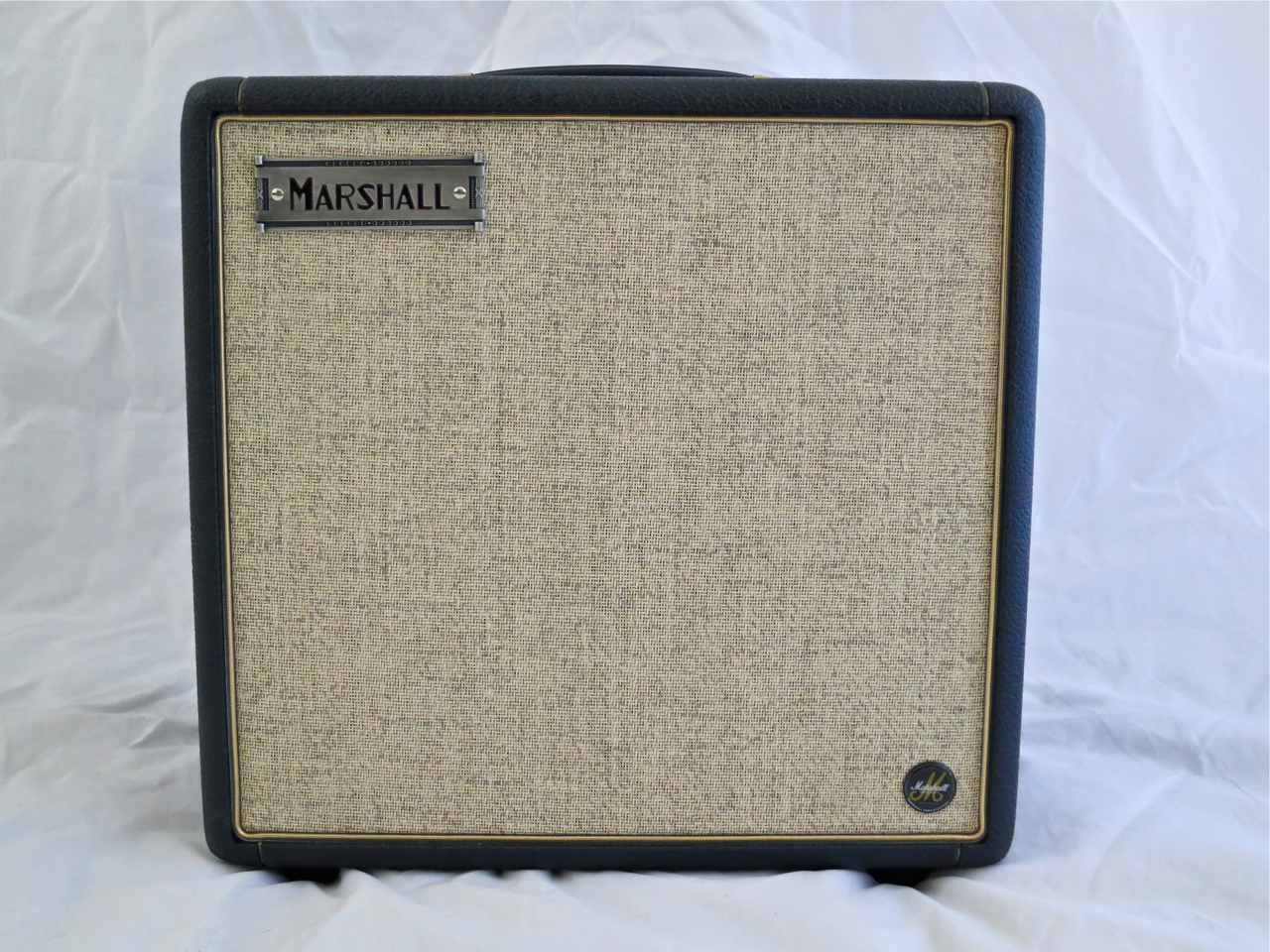
The closed-type Marshall cab holds a single Celestion G10F-15 10-inch speaker.
****

What kinds of sounds do we usually associate with a vintage-style Marshall? Probably clean tones with a dry character and not very much headroom. On the overdriven and distorted side of things we’d definitely look for creamy compression with a good sprinkling of mid-range grunt and presence bite .
…and these are exactly the types of tones the Marshallin Offset dishes out in a very tasty manner!
A vintage-reissue Fender Telecaster stays fairly clean at the beginning of the Custom Offset’s gain range, but the British type of dryness is clearly present:
The higher output of my Gibson Les Paul Junior’s P-90 clearly drives the preamp more, which results in a nice bit of added graininess at the same settings, especially in the attack phase of each note:
A double-humbucker’d Hamer USA Studio Custom finally pushes this Marshall into real break-up territory – fantastic for old-school Blues. For completely clean tones with humbuckers you will have to turn down your guitar’s volume control:
****
Turning up the Marshall’s Loudness-control adds more gain to preceedings, but also raises volume levels considerably. The Custom JTM1 Offset is quite a belter for a one-watter, meaning it’s too loud to be played at full-tilt in most apartment buildings.
Luckily for us, there’s the nifty Power-switch on the back panel, which drops the volume down to neighbour-friendly levels. A nice side effect of going oh-point-one Watts is that it also adds another wallop of overdrive into the mix, which is why you can even get some decent Hard ’n’ Heavy-tones out of this tiny rig.
Here’s a taste of what I got at 0.1 Watts and Loudness turned all the way up.
First the Tele…
…next up the Junior…
…and last, but not least, the Hamer:
****

In my view the Marshall Custom JTM1 Offset is a great-sounding little bugger of a half-stack, giving you most of the classic Marshall tones.
Yes, I know that 1,000 euros is a lot of money for such a tiny amp. If you’re purely on the look-out for a very small valve amp for your living-room or project studio, you will probably get more features (and Watts) for your money from other makes or models.
But the Custom Offset clearly isn’t only about being a small amp; instead there’s a great deal of added prestige in such a well-made, limited edition amp build in England by a company of such standing. The Marshall Custom JTM1 Offset is a boutique-class amp for collectors and purists, and seen in this light the price seems rather fair.
If you’re interested I’d recommend speedy action, though, because the availability is, indeed, very limited!
****
Marshall Custom JTM1 Offset
Finnish distributor: EM Nordic
Thanks to DLX Music Helsinki for the loan of the review sample!
****
Pros:
+ quality of workmanship
+ sound
+ Power-switch
+ small size
+ collectability
****
Tällä kertaa testin aiheina ovat kaksi uutta LTD-mallia:
LTD AJ-1 on brittiläisen kitaristin, Andy Jamesin nimikkomalli. Andy James on tunnettu progressiivista metallia soittavan Sacred Mother Tongue -bändin kitaristina.
LTD EC-1000ET Evertune ei ole jonkun räppärin uusi nimikkomalli, vaan uudenlaisella Evertune-tallalla varustettu sähkökitara. Evertunen juju piilee siinä, että se käytännössä poistaa virittämisen tarpeen sen jälkeen, kun kitara on viritetty kerran.
****
Vaikka Andy Jamesin LTD AJ-1 (986 €) pohjautuukin selvästi firman Horizon/MH-sarjalaisiin, nimikkomallissa on huomioitu monta Jamesin toivomia detajiratkaisuja.
Silmiinpistävin ero rivi-Horizoniin on AJ-1:n satiinipintainen musta viimeistely, joka tuntuu erittäin mukavalta, eikä myöskään muutu hikisillä käsillä niin liukkaaksi kuin useat kiiltävät viimeistelyt.
LTD:n vaahterakaula jatkuu yhtenäisenä koko mahonkirungon läpi. Rungon kaareva etupuoli, sekä takapuoleen lisätty syvä viiste tekevät kitarasta hyvin mukavan.
Andy Jamesin toiveesta LTD AJ-1:n viritinlavan muoto poikkeaa MH-kitaroiden tavallisesti käytetystä jääkiekkomaila-tyypistä.
Minä en ole henkilökohtaisesti tämän LTD-lavan suurin fani – sen kärjekäs ulkonäkö on minulle yksinkertaisesti jo liian ”Metal”, mutta objektiivisesti katsottuna ei tässä lavassa ole kuitenkin mitään vikaa.
AJ-1:n grafiittipitoinen satula tukee laadukkaiden lukkovirittimien toimintaa hienosti.
Andy Jamesin oma logo toimii 12:n nauhan kauniina otemerkkinä.
Testiyksilön reunalistoitukset, upotukset sekä nauhatyö ovat erittäin korkeaa tasoa.
LTD:n sulavasti toteutettu ylimeno kaulalta runkoon helpottaa tuntuvasti otekäden pääsemistä 24:lle nauhalle.
Herra James on valinnut omaan nimikkosoittimeensa lukittavan TonePros-tallan. Ylimääräisen, ei-toivotun lisävärähtelyn tehokas poistaminen parantaa yleensä kitaran sointia ja sustainea.
LTD AJ-1 -mallin mikrofonit ovat aktiivit ja tulevat EMG:n melko tuoreelta Metal Works -sarjalta.
Kaulan viereen on asennettu EMG 66 -humbucker, joka on varustettu Alnico V -magneetilla ja keraamisilla napapaloilla. EMG 66:lle luvataan vintage-tyylistä soundia aktiivipotkulla, mutta ilman bassokaistan puuroutumista.
Tallamikrofoniksi taas on valittu EMG 57, jossa Alnico V:n kumppaneiksi on lisätty teräsnapapaloja hieman pehmeämpää, PAF-maista sointia varten.
Andy James ei tarvitse tone-säädintä lainkaan, minkä takia se on jätetty hänen nimikkomallistaan kokonaan pois.
Takalokeroiden työnjälki on hyvin siisti. Paristolokeron kansi on kiinnitetty koneruuveilla, mikä on selvästi puuruuveja kestävämpi ratkaisu.
****
LTD EC-1000ET (986 €) on tavallisen EC-1000:n Evertune-tallalla varustettu sisarmalli.
Kyseessä on siis liimakaulainen kitara, jolla on mahonkikaulan lisäksi samasta puusta veistetty runko vaahterakannella.
Kielitys hoituu EC-1000ET:ssä rungon takapuolelta tallan läpi.
Aitona LTD Deluxe -malliston jäsenenä soittimella on upeat helmiäisupotukset, sekä monikerroksinen reunalistoitus sekä kaulassa että kannessa.
Tyylikkäissä Grover-virittimissä yhdistyy nykyaikainen tarkkuus ja vintage-tyylinen ulkonäkö.
Palisanteriotelaudassa kohtaavat upeat helmiäisupotukset ja erittäin korkeatasoinen nauhatyö.
LTD EC-1000ET:n mikrofonivarustus koostuu – jo klassikoksi varttuneesta – EMG 60/EMG 81 -parivaljakosta. Tarjolla on siis hyvin fokusoitu keskialue, heleä diskantti, sekä muhkea basso tehokkaassa, aktiivisessa paketissa.
Lähimpänä tallaa oleva säädin on tallamikrofonin (!) volume, keskeltä löytyy kaulamikin volume-säädin, ja viimeiseksi tulee EC-1000ET:n master tone.
Myös tässäkin kitarassa elektroniikkalokero näyttää hyvin asialliselta.
Evertune-tallan toiminta perustuu käytännössä samoihin fysikaalisiin periaatteisiin kuin esimerkiksi nykyaikainen vibratalla: Evertunen tapauksessa jokaisella kielellä on oma laakeroitu jousijärjestelmä, joka pyrkii pitämään kielen vetoa aina samansuuruisena.
Tallan takareunalla näkyy intonaatiosäätöruuvit, kun taas Evertune-logon yllä olevilla kuusiokoloruuveilla säädetään kielten korkeutta.
Tällaiselta Evertune-systeemi näyttää silloin kun takalevy on poistettu.
Evertune-kitaroilla lavalla olevilla virittimillä ei viritetä soitinta perinteisellä tavalla, vaan niillä säädetään kuinka herkästi kielet reagoivat venytyksiin ja sormivibratoon.
Virittäminen sinänsä hoidetaan kuusiokoloavaimella tallapaloissa. Kuvassa näkyvä avain tulee paketissa mukana, mutta tavallinenkin kuusiokoloavain käy.
Evertunen mukaan talla toimii tehdasvarustuksella normaalivirityksessä (E-e, a = 440 Hz) tavallisilla 009-012 kielisatseilla. Myös toisenlaisten virityksien käyttö pitäisi onnistua, mutta se vaatii aina hieman säätöä (sekä virittimillä että tallassa), minkä takia nopea vaihtaminen esimerkiksi standardivirityksestä drop-D:hen ei onnistu kesken livekeikan.
Hyvin paljon tavallisesta poikkeavia virityksiä – tai kielityksiä – varten täytyy tilata Evertunelta sopivia vaihtoyksiköitä, joita asennetaan perus tallapalojen sijasta. Lisätietoa saa Evertunen käyttöoppaasta: Evertune User Manual
****
Testissä käynyt LTD AJ-1 on hyvin kevyt kitara, joka tuntuu erittäin mielyttävältä.
Kaulaprofiiliksi on valittu melko matala, mutta kuitenkin pyöreä D, joka antaa soittimelle – yhdessä suuren otelaudan radiuksen kanssa – vauhtikepille tyypillisen tatsin ja soitettavuuden. Andy James -nimikkomalli ei selvästikään ole nuotiokitaraksi tarkoitettu, vaan täysverinen nopeasormisen metallivelhon luottokitara.
Kun EMG käyttää sanaa ”vintage”, se viittaa ilmiselvästi uusien mikrofoniensa mehevään soundiin, eikä lähtötasoon. Tällä Metal Works -humbuckerilla nimittäin puhtia riittää rutkasti.
Joissakin tapauksissa joutuu varmaan säätämään kitaran volumea hieman pienemmälle, jotta vahvistin pysyisi täysin puhtaana:
Särösoundit taas vain hyötyvät tehokkaista ja täysin hiljaisista EMG-mikrofoneista:
****
LTD EC-1000ET on jämäkän tuntuinen Rock-keppi mukavalla keskivertopainolla.
Kaulassa on hivenen verran enemmän lihaa ja pyöreyttä kuin AJ-1-mallissa. Kiiltävän lakkauksen ja EC-1000ET:n hieman kaarevamman otelaudan ansiosta, nojaa tämä kitara enemmän vintagen suuntaan. Klassikkoainesta siis…
On mahdollista, että Evertune-talla lisää soittimelle vähän painoa, mutta selkeästi havaittavissa on, että erikoistallan ansiosta kitara soi erittäin puhtaasti ja pitkällä, tasaisella sustainella.
Vaikka olin säätänyt LTD:n pääsääntöisesti sellaiseksi, että kielten venytykset ja sormivibratot onnistuvat mahdollisimman helposti, oli mukava havaita, että vire pysyy myös rankalla kädellä soitettaessa horjumatta.
Soundiltaan tämän kitaran EMG-setti on ehkä neutraalimpi kuin Andy James -mallin varustus, muttei missään nimessä huonompi:
****
Vau, mikä soitin! LTD AJ-1 on mielestäni erinomainen esimerkki virtaviivaistetusta heavykitarasta. Andy James -malli tarjoaa loistavaa soitettavuutta ja soundia, asianmukaisen tuhdilla lähtötasolla.
LTD EC-1000ET on erittäin tyylikäs ja laadukas alusta erikoiselle tallaratkaisulle. Evertune ei ole ehkä paras valinta, jos haluaa vaihtaa nopeasti yhdestä virityksestä toiseen, mutta tavallisessa yleiskäytössä se on suorastaan lyömätön. Tällä kitaralla virittäminen ei enää kuulu kitaristin jokapäiväisiin toimenpiteisiin!
****
LTD AJ-1 Andy James Signature
• 986 €
LTD EC-1000ET Evertune
• 986 €
Maahantuoja: Musamaailma
****
LTD AJ-1 Andy James Signature
Plussat:
+ kevyt paino
+ mattaviimeistely
+ soitettavuus
+ työnjälki
+ soundi
Miinukset:
– jotkut ehkä kaipaa tone-säätimen
****
LTD EC-1000ET Evertune
Plussat:
+ Evertune-tallan toimivuus
+ klassinen ulkonäkö
+ soitettavuus
+ työnjälki
+ soundi
Miinukset:
– ei voi nopeasti vaihtaa virityksien välillä
****

****

American guitar guru Grover Jackson is a genuine living legend. When Jackson bought Wayne Charvel’s small shop (in 1978) nobody would have guessed that this man would single-handedly define two new types of electric guitars.
The – mostly bolt-on necked – Charvel guitars from the Eighties kicked off the Superstrat-phenomenon in earnest.
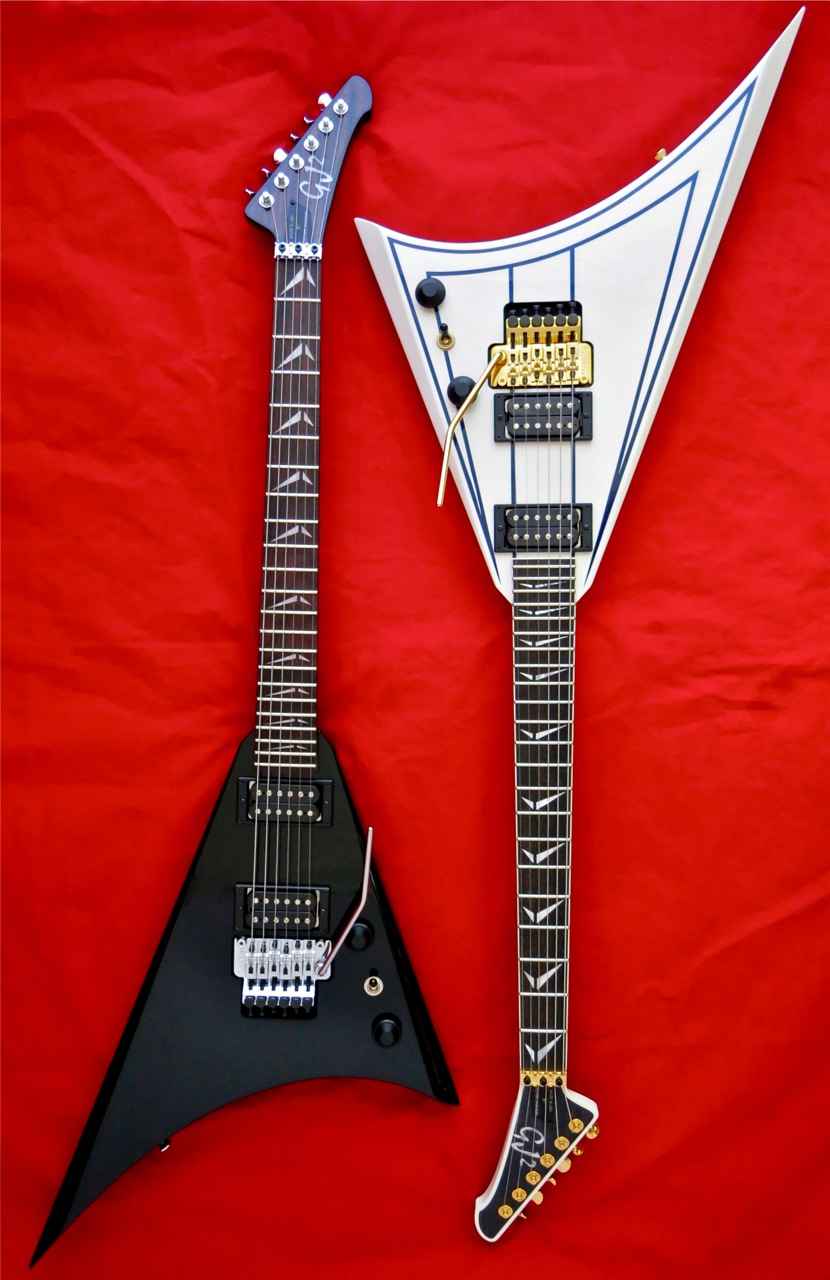
The original Jackson-branded instruments became famous as hiogh-octane Metal-guitars, which combined first class playability with bold graphic finishes. The most legendary Jacks model is surely the Concorde/RR, which Grover Jackson developed for Randy Rhoads.
Grover Jackson left Charvel/Jackson at the end of the 80s, and he went on to design instruments for a number of different brands, like Washburn for example. The Charvel and Jackson brands are nowadays part of the huge Fender conglomerate.
Grover Jackson has recently launched a new guitar-making outfit, together with (ex-Fender man) Jon Gold. GJ2 Guitars is a small Californian outfit which concentrates on small-run high-end guitar making.
Kitarablogi.com takes the first five instruments to arrive in Finland for a spin.
****
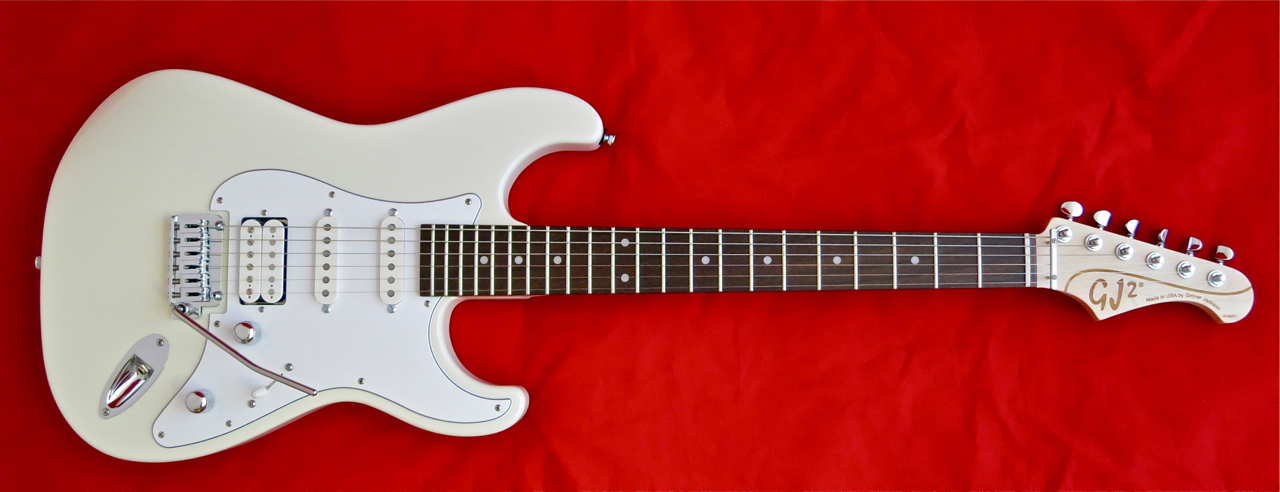
The GJ2 Glendora NLT (this version 1,717 €, incl. gigbag) is the most traditional guitar of our group of five.
The review sample’s body has been crafted from light ash (custom option) and finished in gloss Antique White. The basic version of the Glendora comes with a body made from either basswood, alder or poplar.
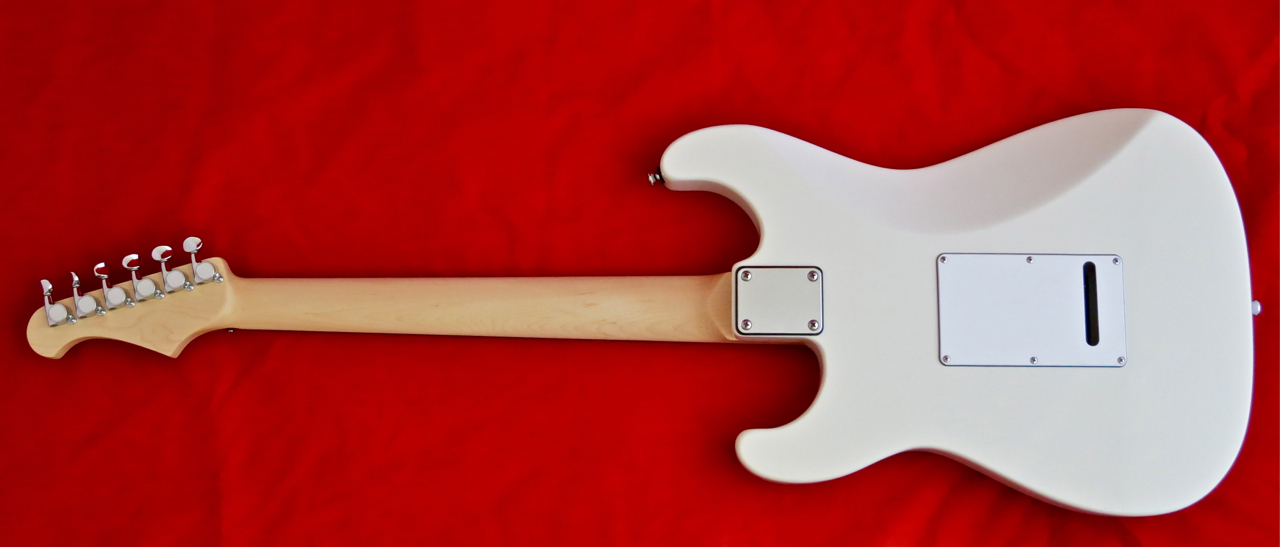
The satin-finished maple neck joins the body in traditional fashion.
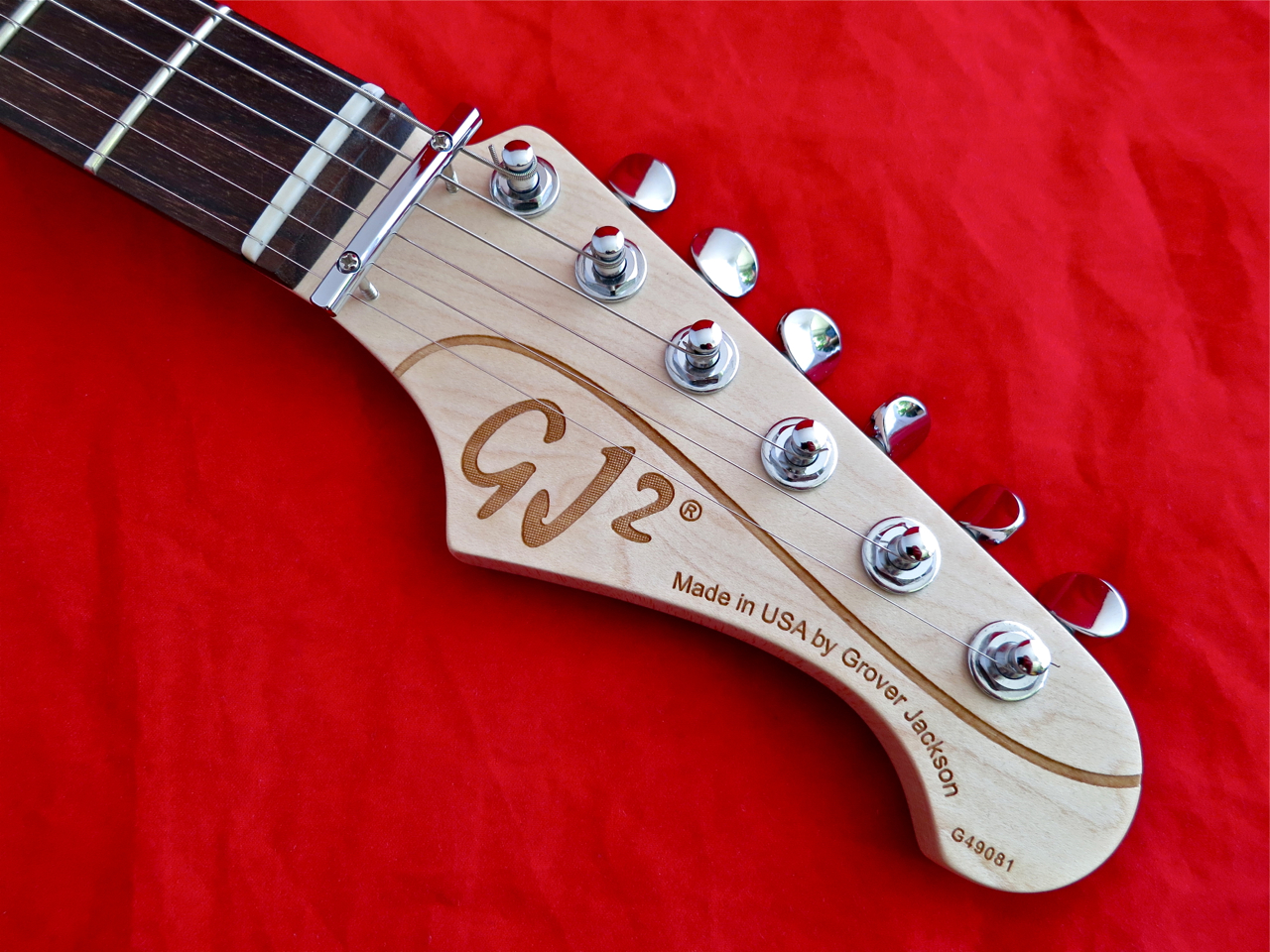
The Glendora’s headstock is a stylish variation on the classic six-in-a-row design.
The tuning machines are quality units from Gotoh.
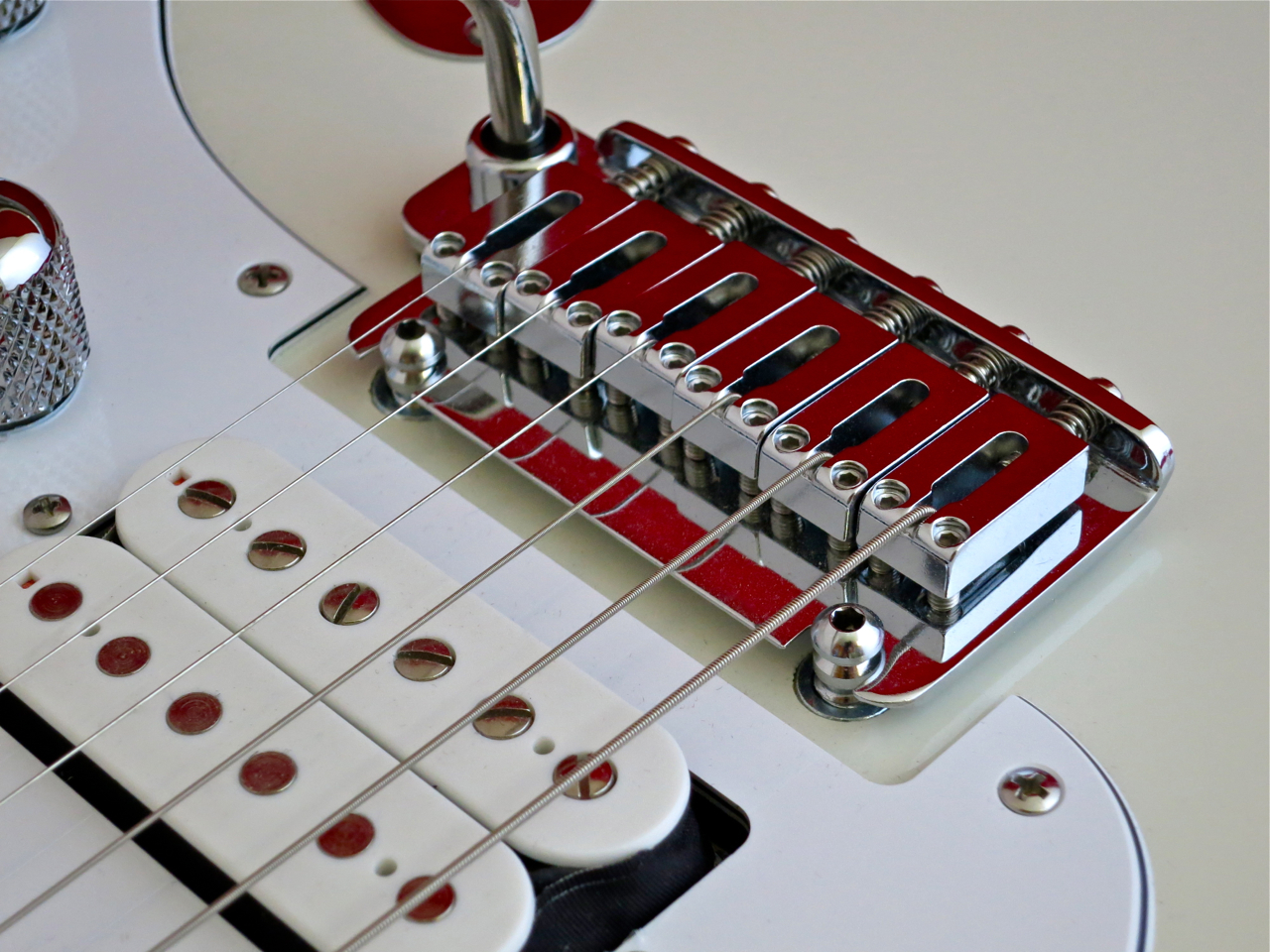
The contemporary two-post vibrato bridge is also a Gotoh design. The bar is simply pushed into the block and kept in place by an adjustable nylon collar.
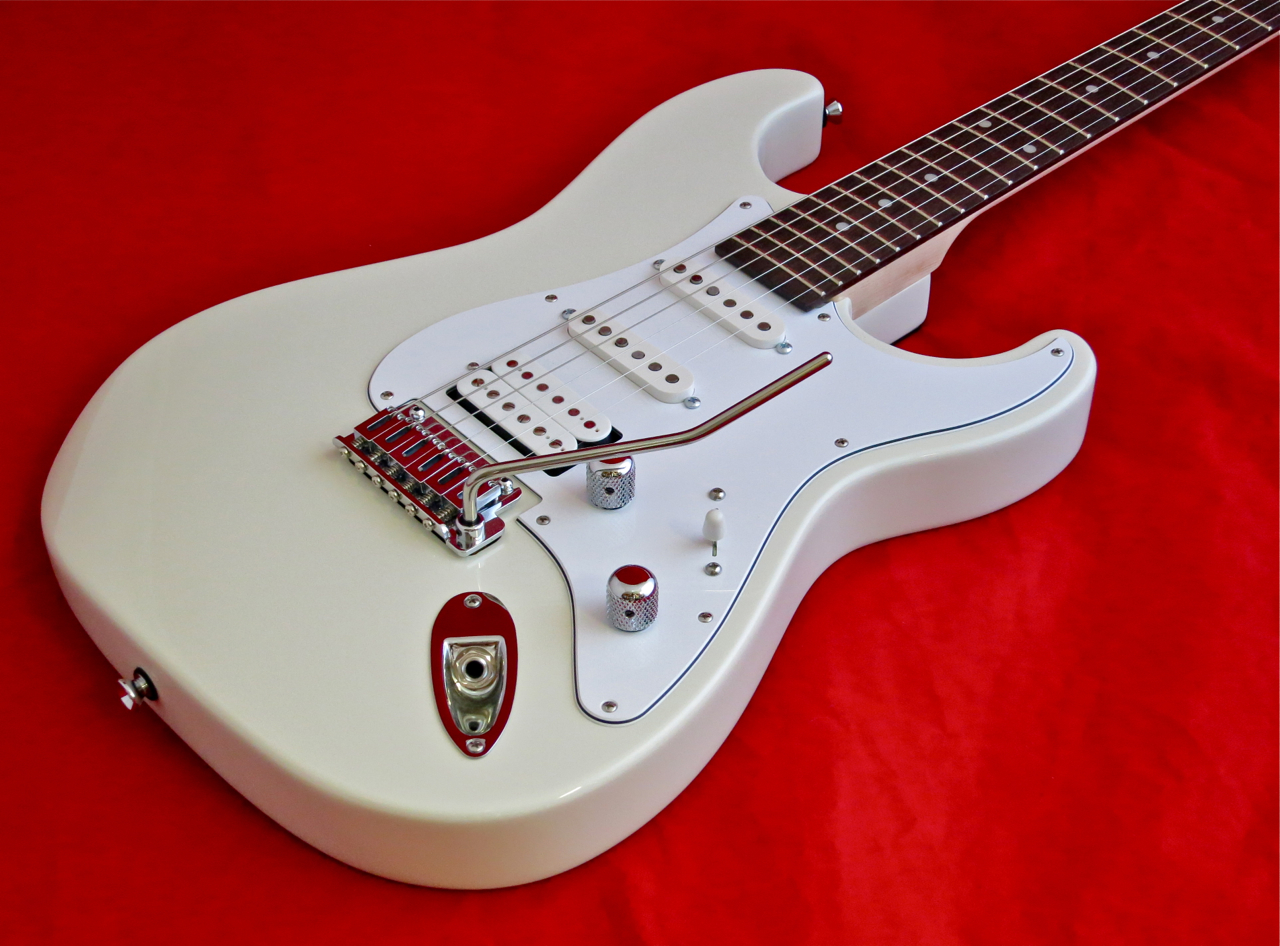
The rosewood fingerboad sports 22 gleaming jumbo-sized frets.
For his new GJ2 guitars Grover Jackson has perfected a new method of applying a compound radius to the fretboard. A compund radius means that the frets have a steeper curve near the nut and get shallower further up towards the body. This gives you the best of both worlds with easy open position chording and effortless string bending higher up the neck without string choking.
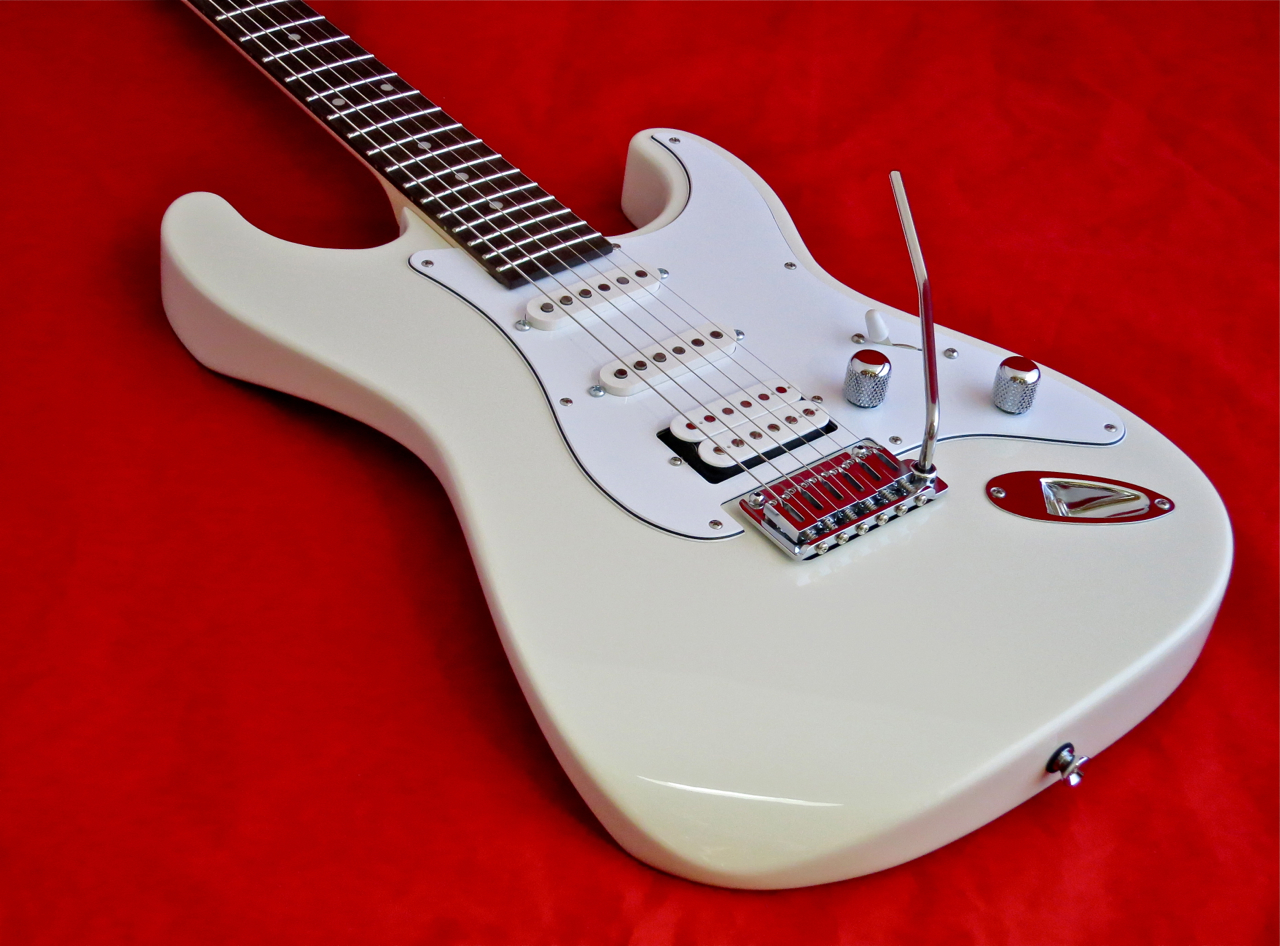
GJ2 Guitars use their own Habanero pickups as standard. Our review sample comes equipped with an HSS-setup, but you can order your Glendora with several different pickup combinations, like the vintage-style SSS or two humbuckers.
The controls comprise a five-way switch, as well as master volume and tone controls.
****
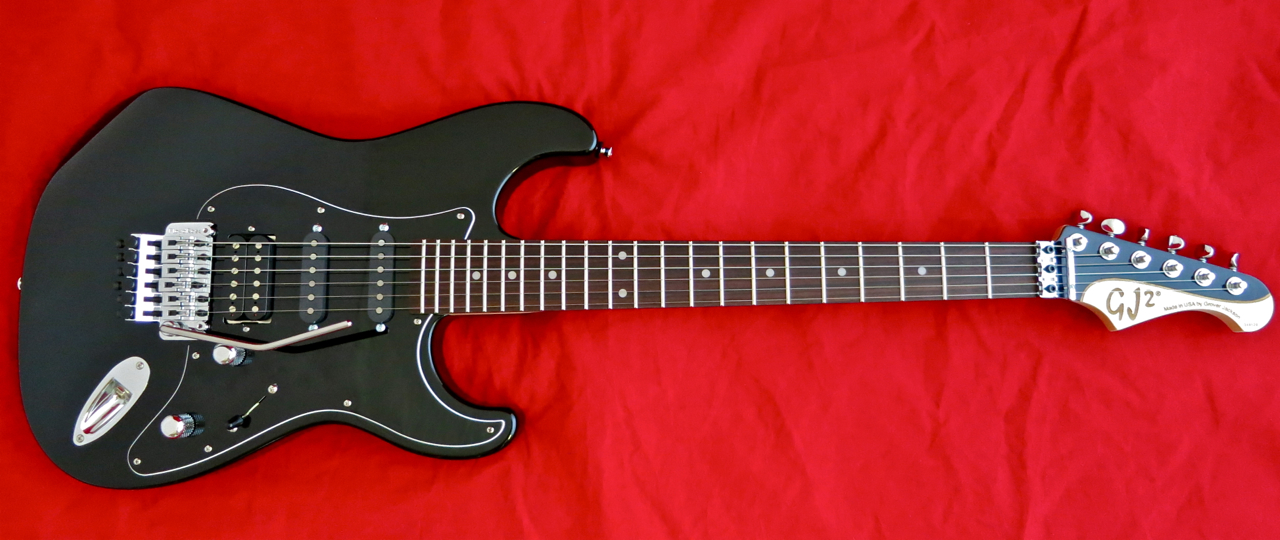
The Glendora FR (this version 1,930 €, incl. lightweight case) is the Floyd Rose-equipped version of the Glendora.
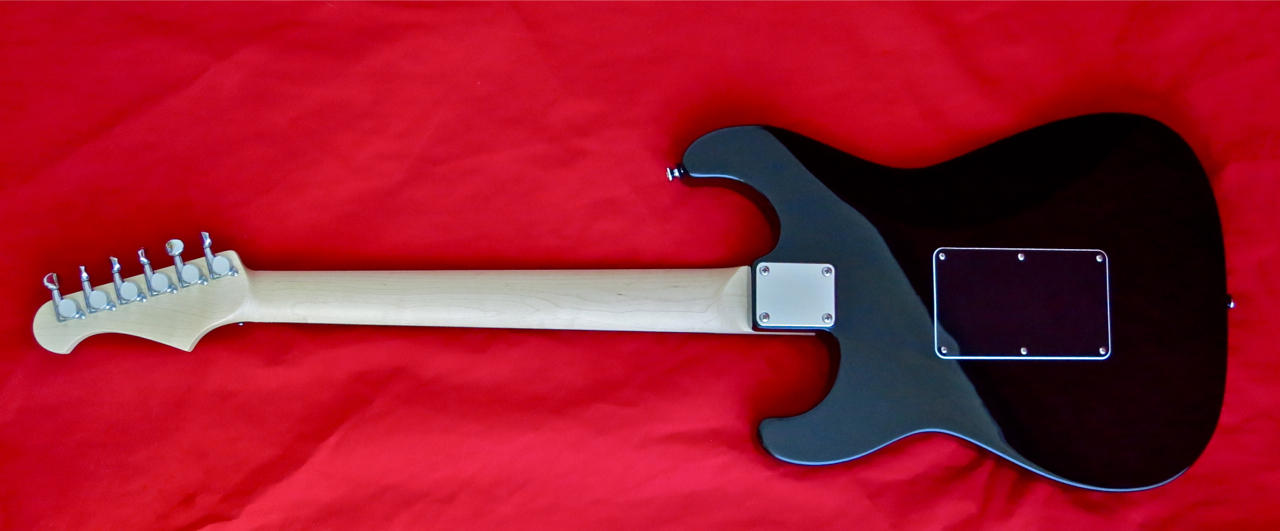
Our review instrument comes with a standard body (basswood, alder or poplar), but apart from that the basic build is the same as on the Glendora NLT.
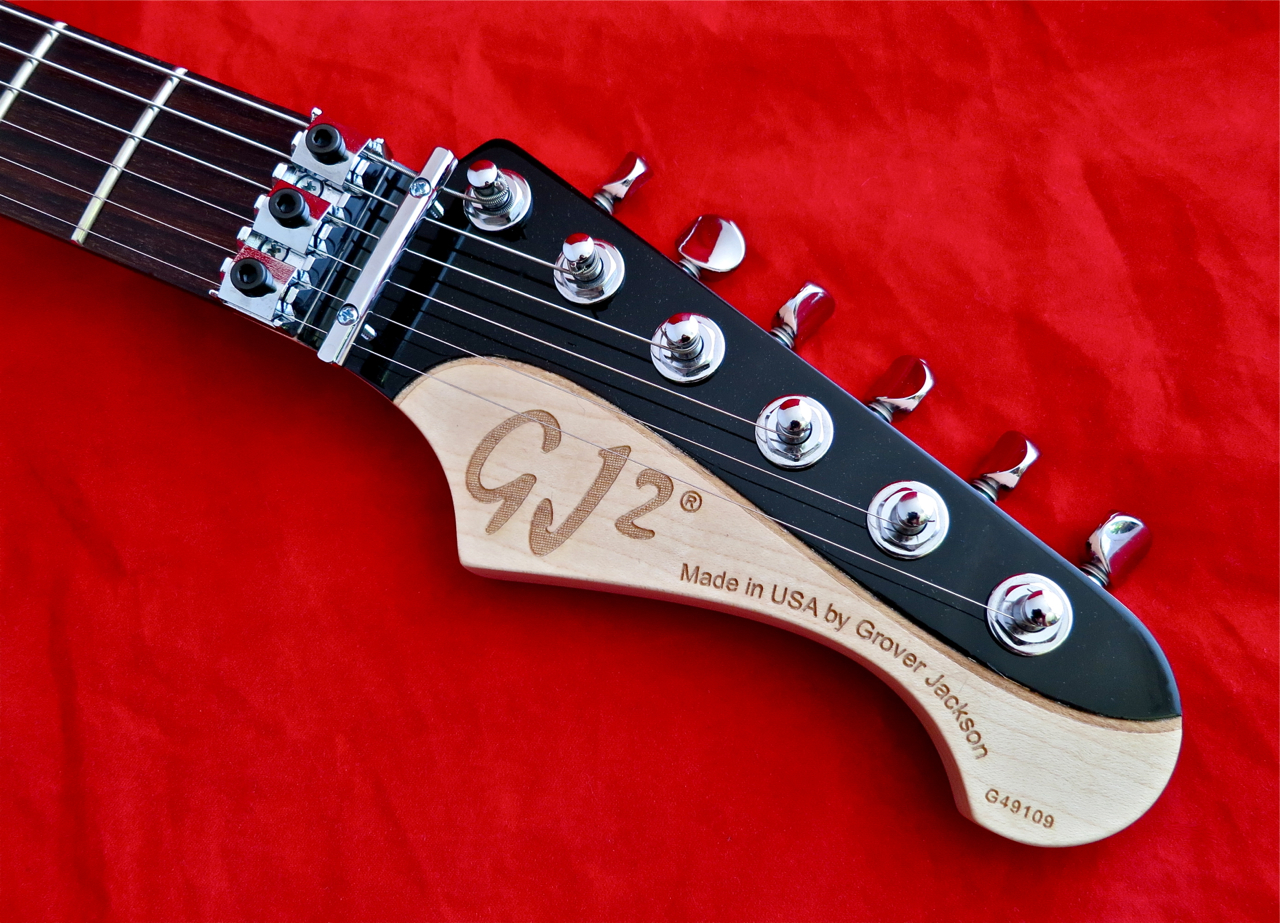
One of the custom options available for a surcharge in the Glendora-range is a matching headcap, just like on this guitar.
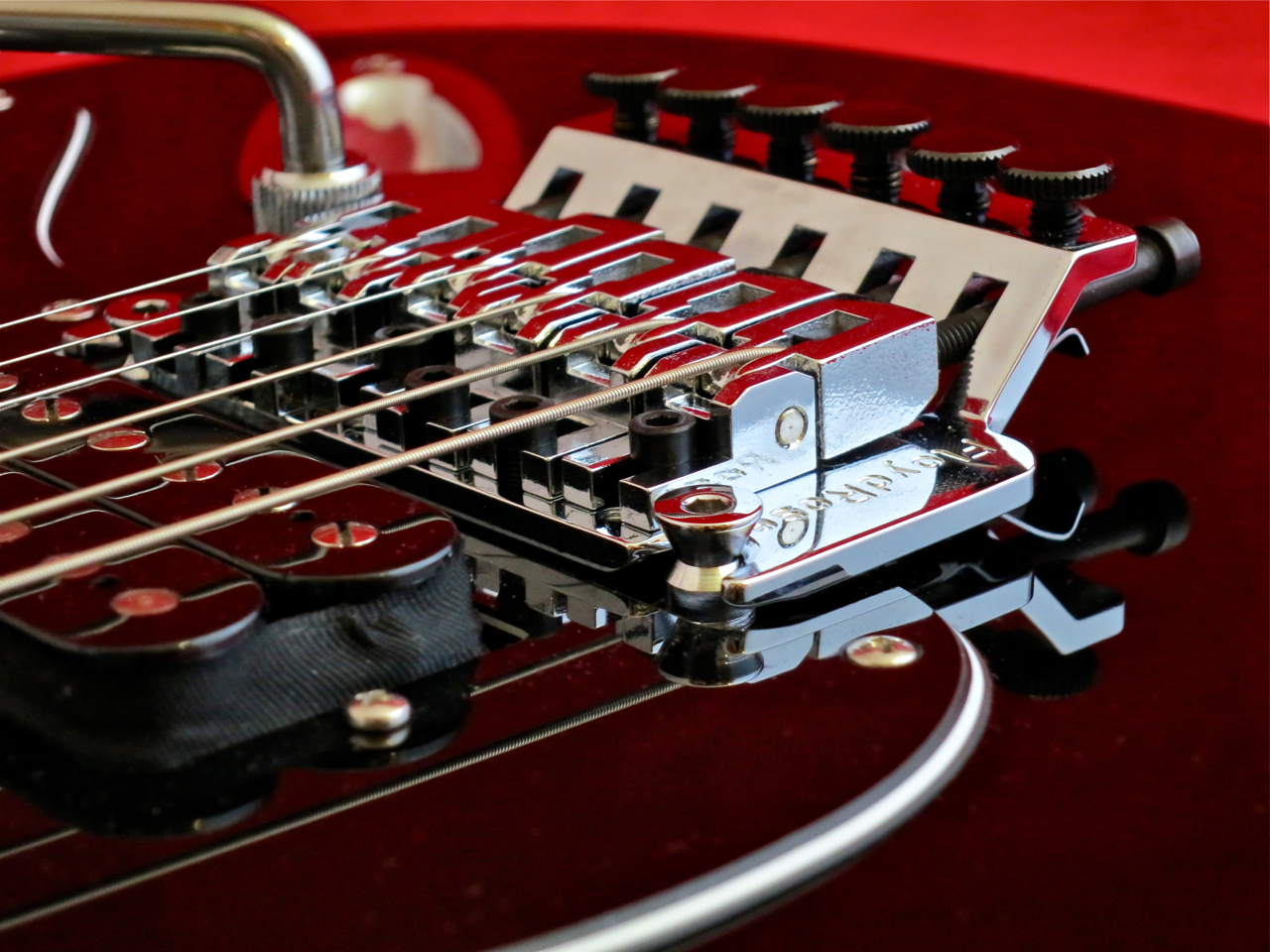
GJ2 Guitars use only top-drawer quality parts, like the Schaller-made steel Floyd Rose bridge on the Glendora FR.
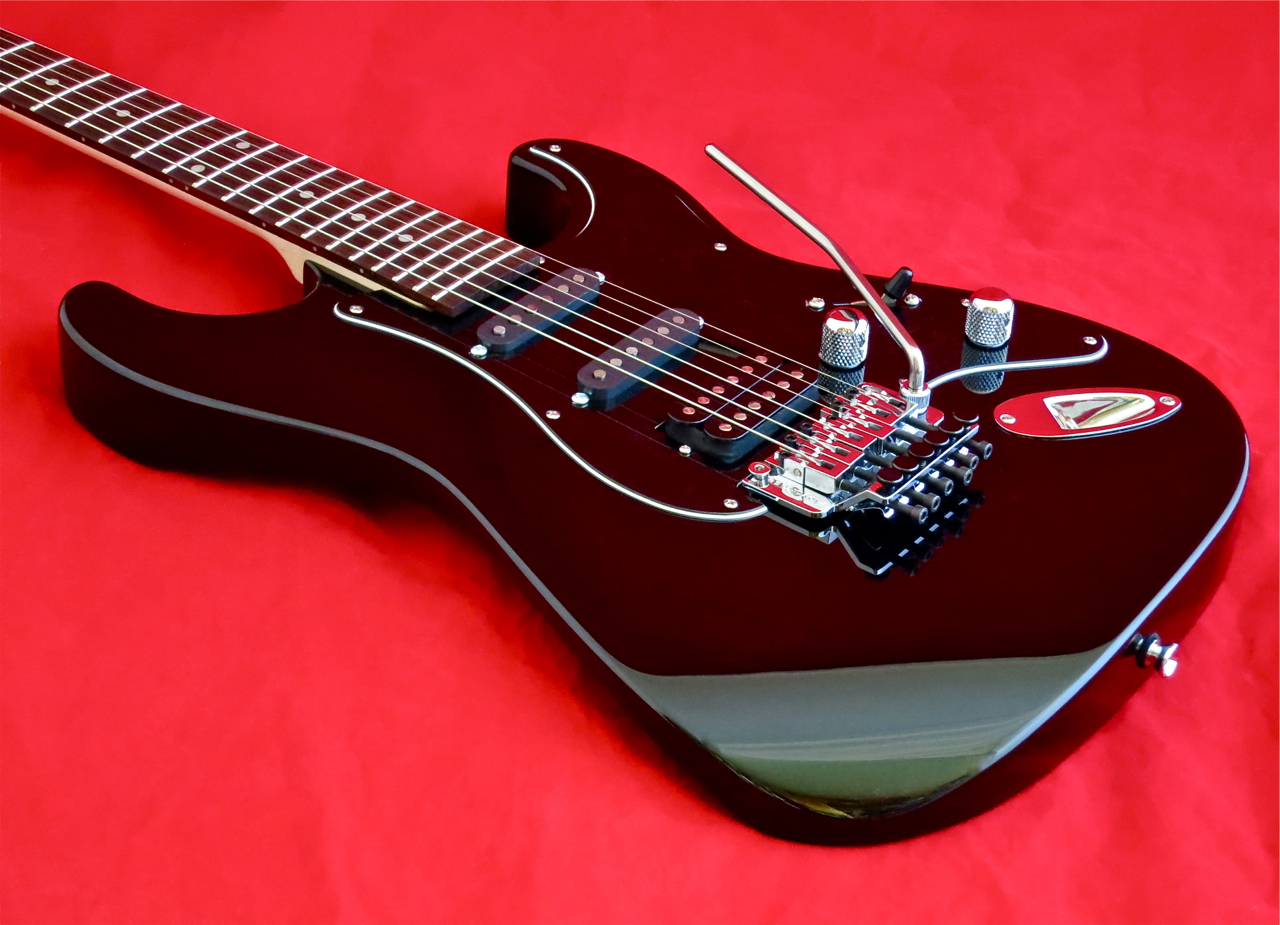
It’s a Habanero-set of two single-coils and one humbucker for this guitar.
****
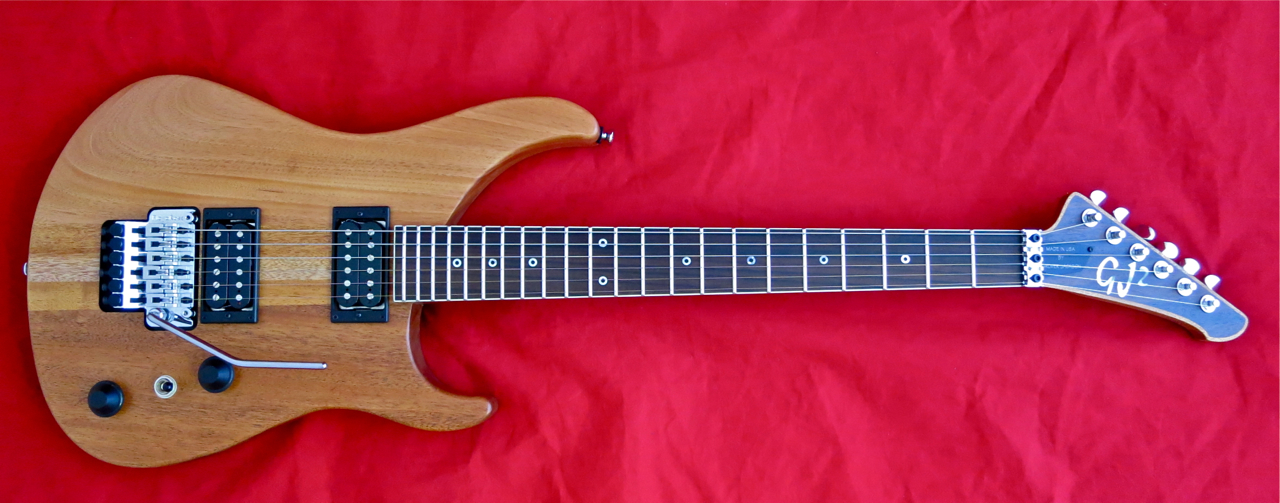
The GJ2 Arete is one of Grover Jackson’s new designs based on a through-neck. There are three different basic versions of the Arete available, called 3-Star, 4-Star and 5-Star.
The Arete 4-Star (this version 2,231 €, incl. lightweight case) is the middle model, which is crafted almost completely from South-American mahogany. The neck uses three long strips side-by-side for added stiffness.
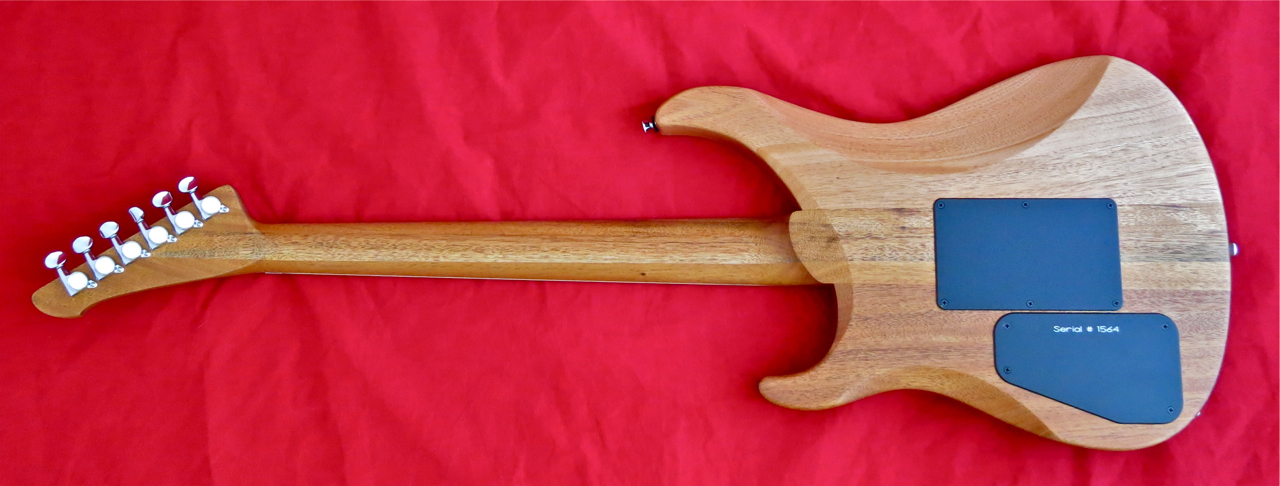
Two mahogany wings make up the streamlined body. The more affordable Arete 3-Star is made from sapele, while the more expensive 5-Star counterpart gives you several different body woods to choose from.
The Arete 4-Star comes in a hand-rubbed oil finish. The cover plates are made from aluminium.
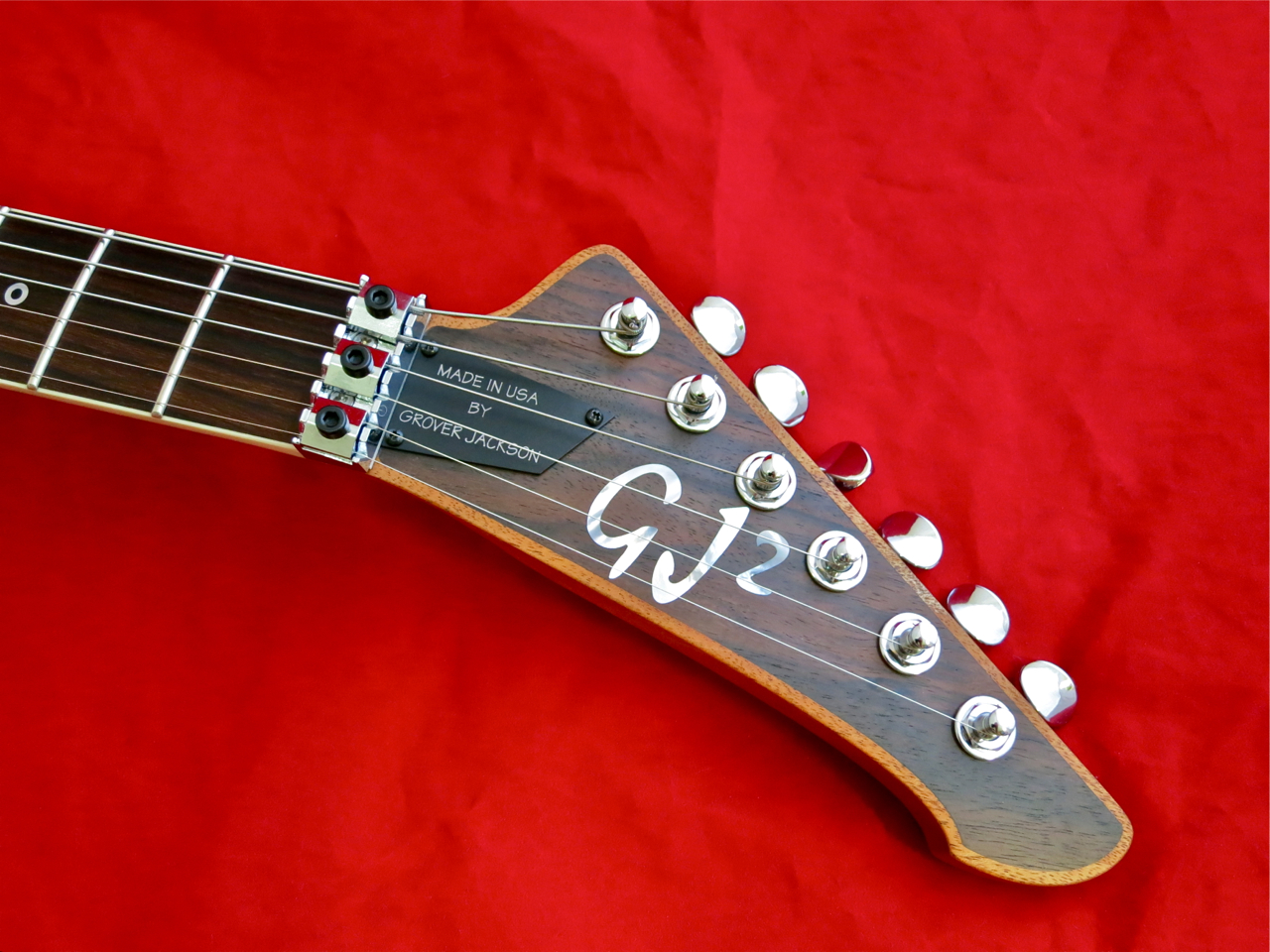
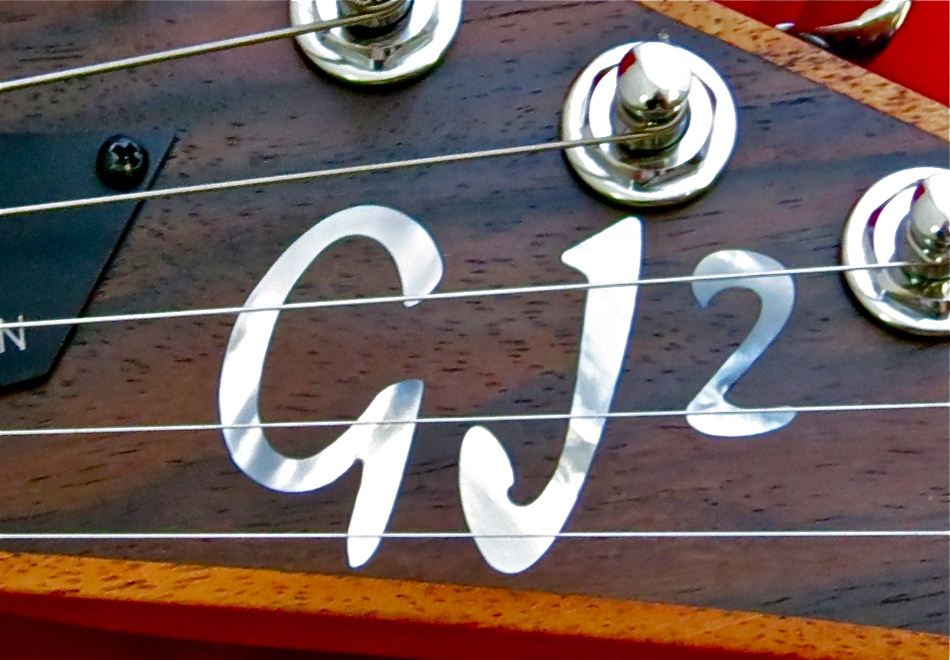
The headstock sports one of GJ2 Guitars’ special features – the Invisible Binding. This is achieved by routing out a shallow ”pool” on the headstock’s face, into which a large rosewood plate is then inlaid.
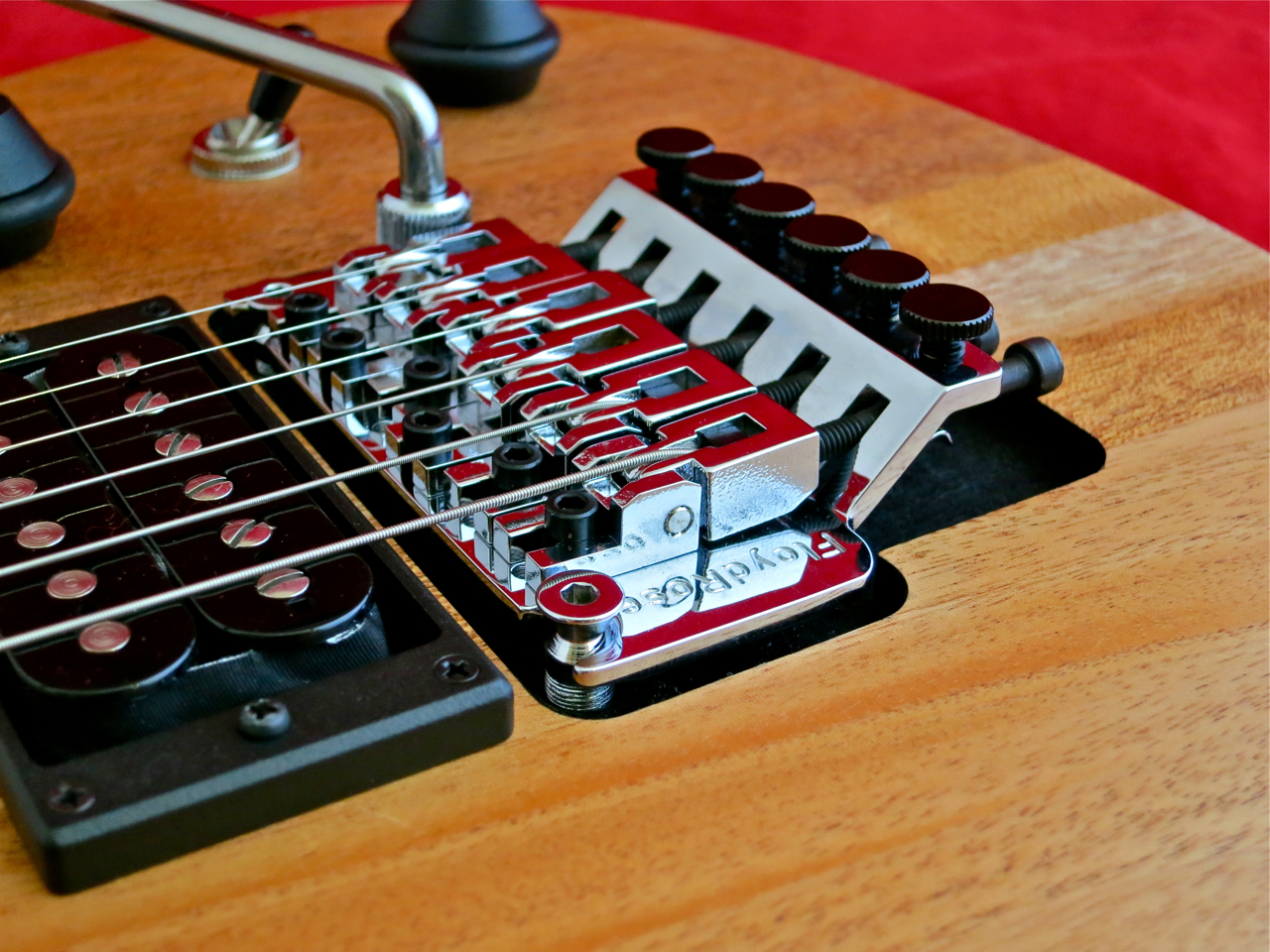
All Arete 4-Star guitars are vibrato-equipped – they come either with the same knife-edge bridge as on the Glendora NTL, or with a steel Floyd Rose as on our review instrument.
The black pickup bezels feature a structured surface.

The bound rosewood fingerboard sports Mini Bull’s Eye inlays, as well as 22 jumbo frets.
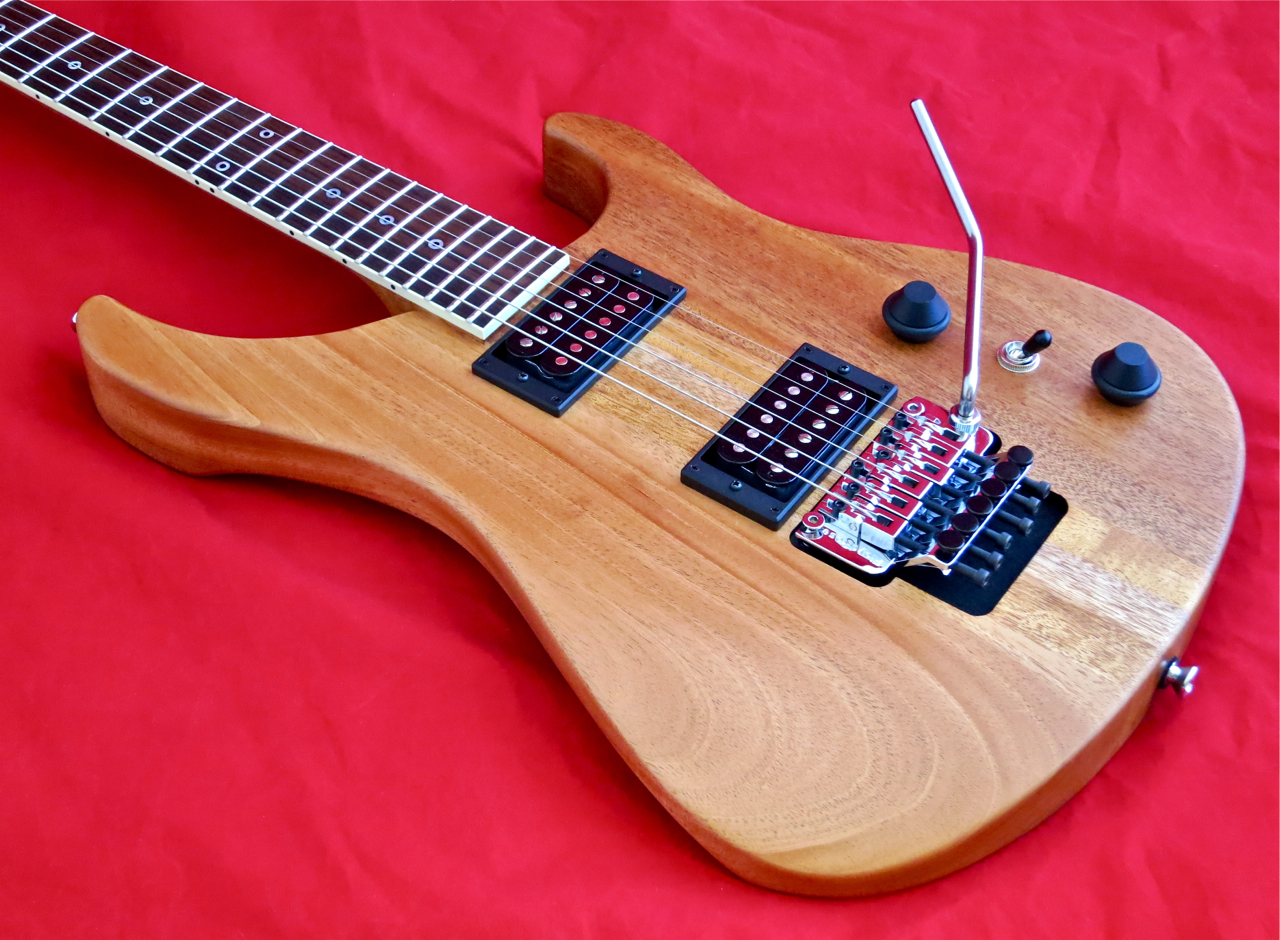
The basic version of the Arete 4-Star is equipped with two Habanero humbuckers, but you can also order HSS- or HSH-configurations, should you so desire.
The three-way toggle is mounted between the master volume and tone controls. GJ2 Guitars’ cool Flying Saucer-knobs not only look great, but are also easy to adjust.
****
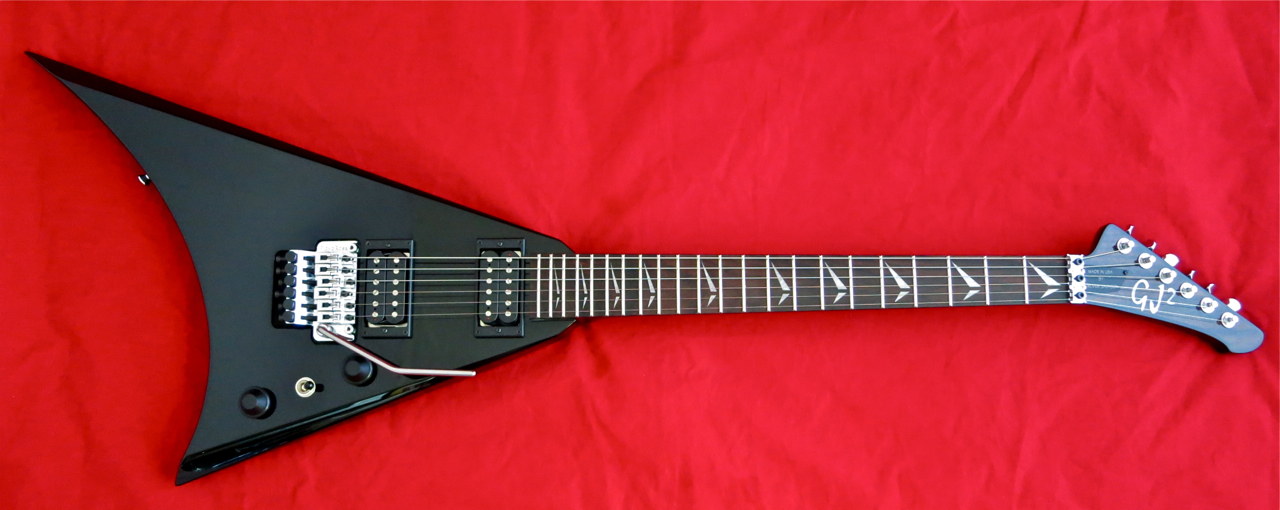
A through-neck crafted from three side-by-side strips of maple flanked by basswood wings – this is the basic recipe behind the GJ2 Concorde 4-Star (this version 2,768 €, including hard case).
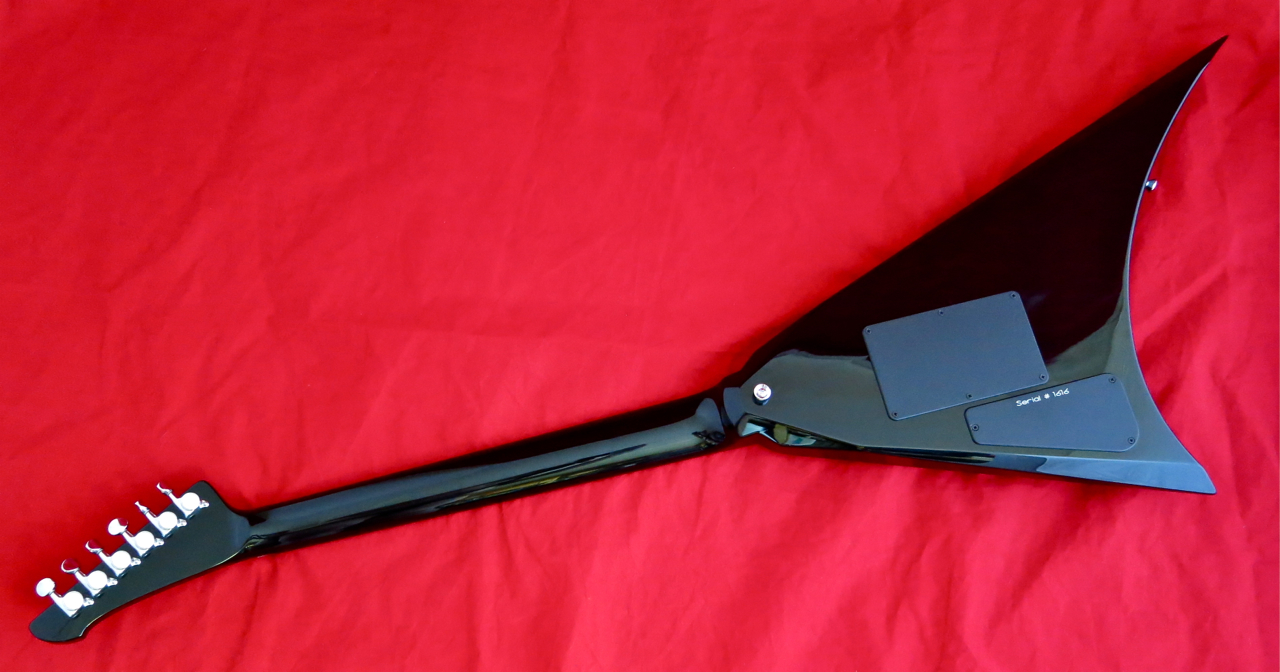
All Concorde-models feature a full-length, 64.8 cm (25.5-inch) scale.
The Concorde 4-Star is available in five gloss finishes – Jet Black, Stark White, Antique White, Sports Car Red and GJ Blue – and either a Floyd Rose vibrato (as on the review sample) or a Gotoh hardtail bridge.
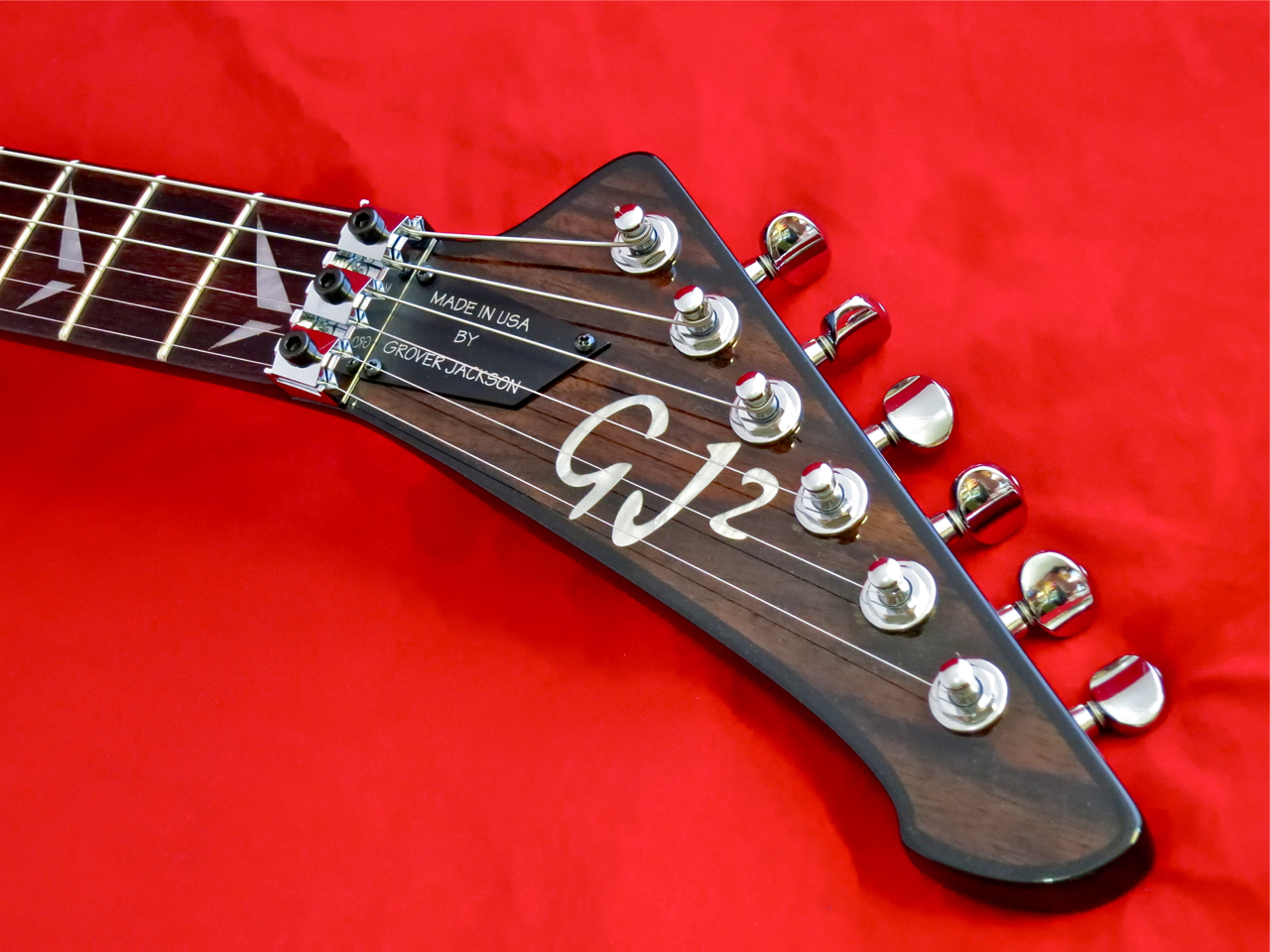
The hardware on a Concorde 4-Star is chrome-plated.
The fretboard is equipped with 22 jumbo frets and pearloid inlays.
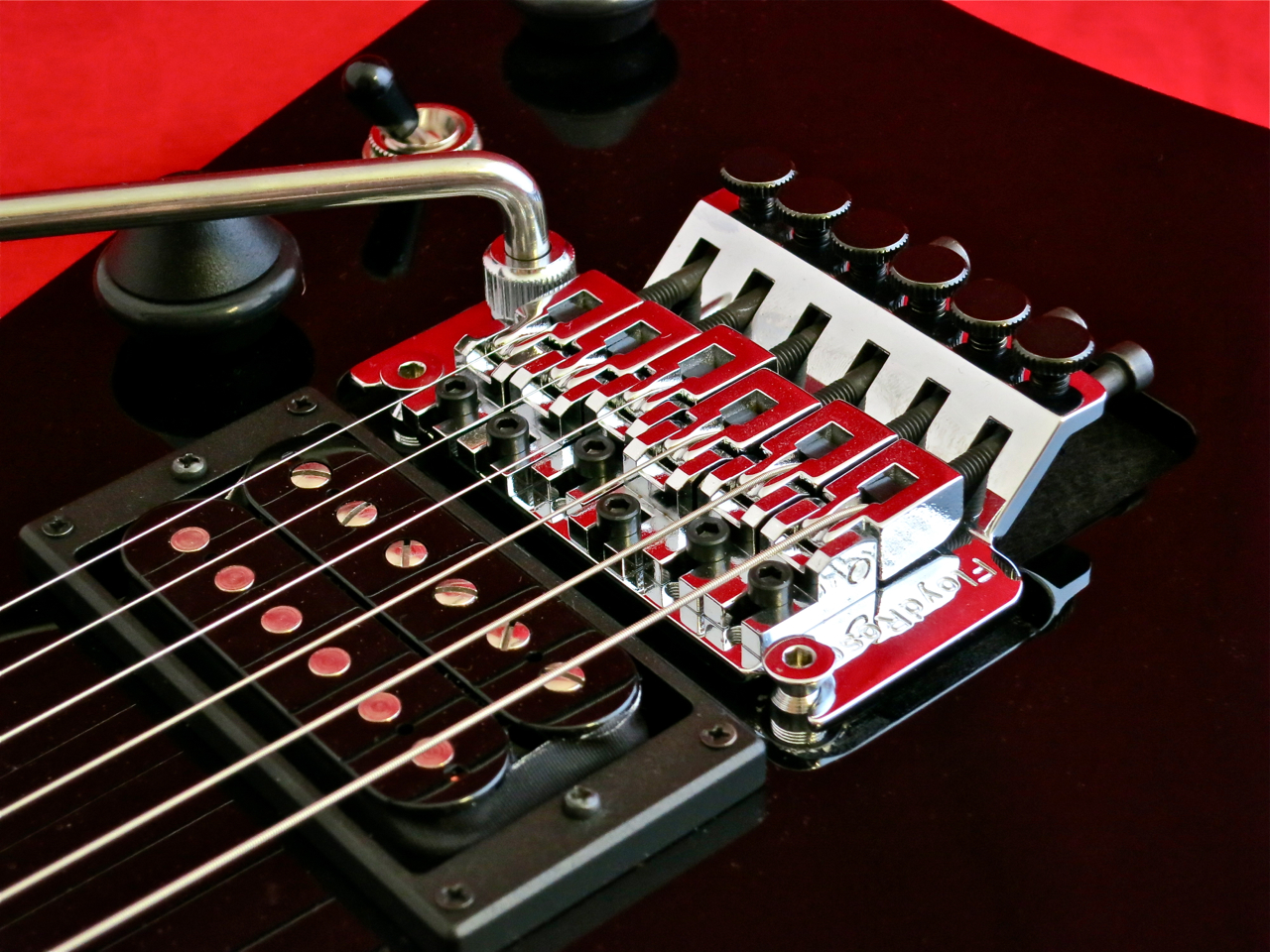
The volume knob is easy to reach with your pinkie.
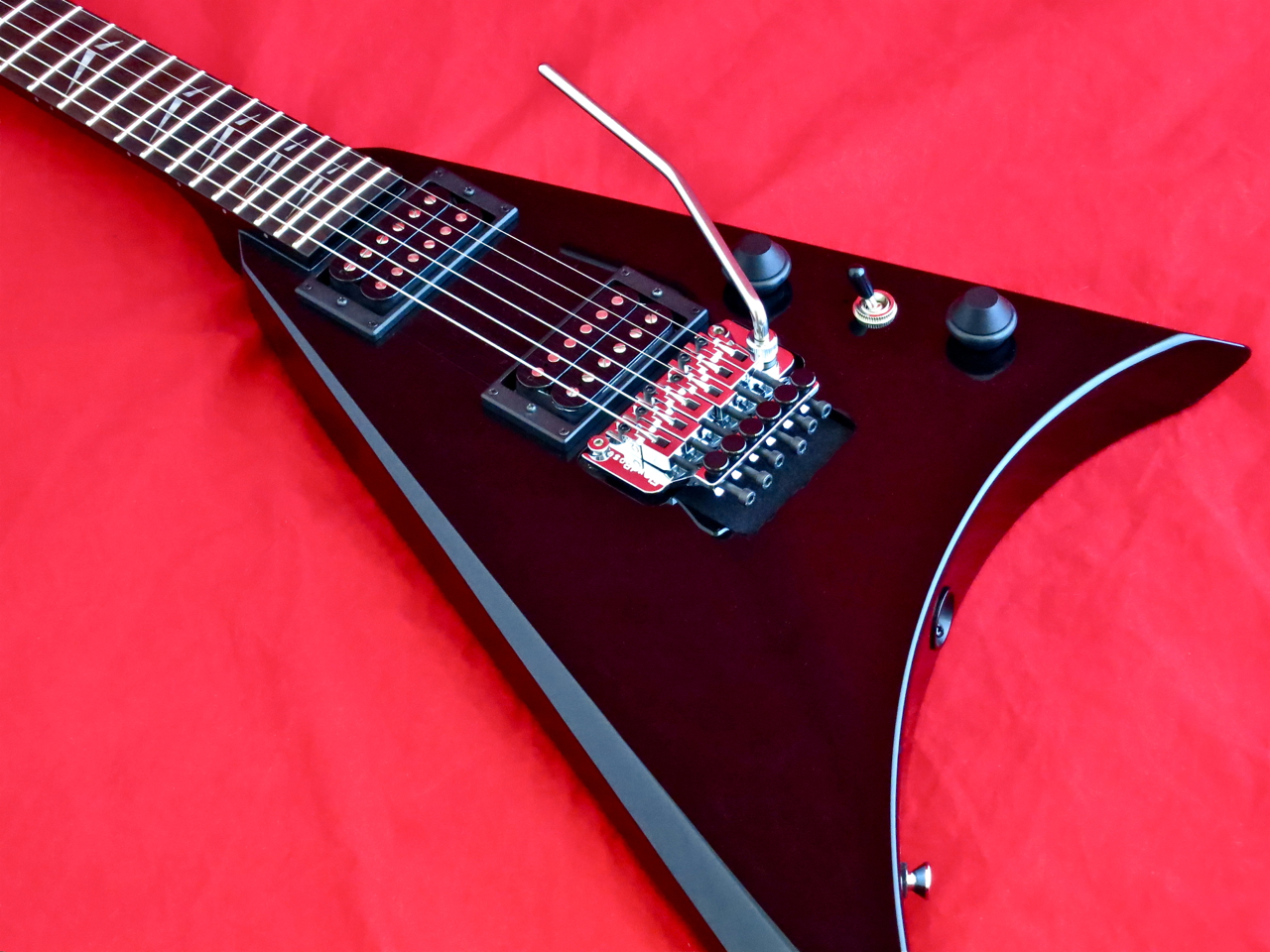
Two Hanbanero humbuckers, one master volume, one master tone control and a three-way toggle – what more does a Rock God need?
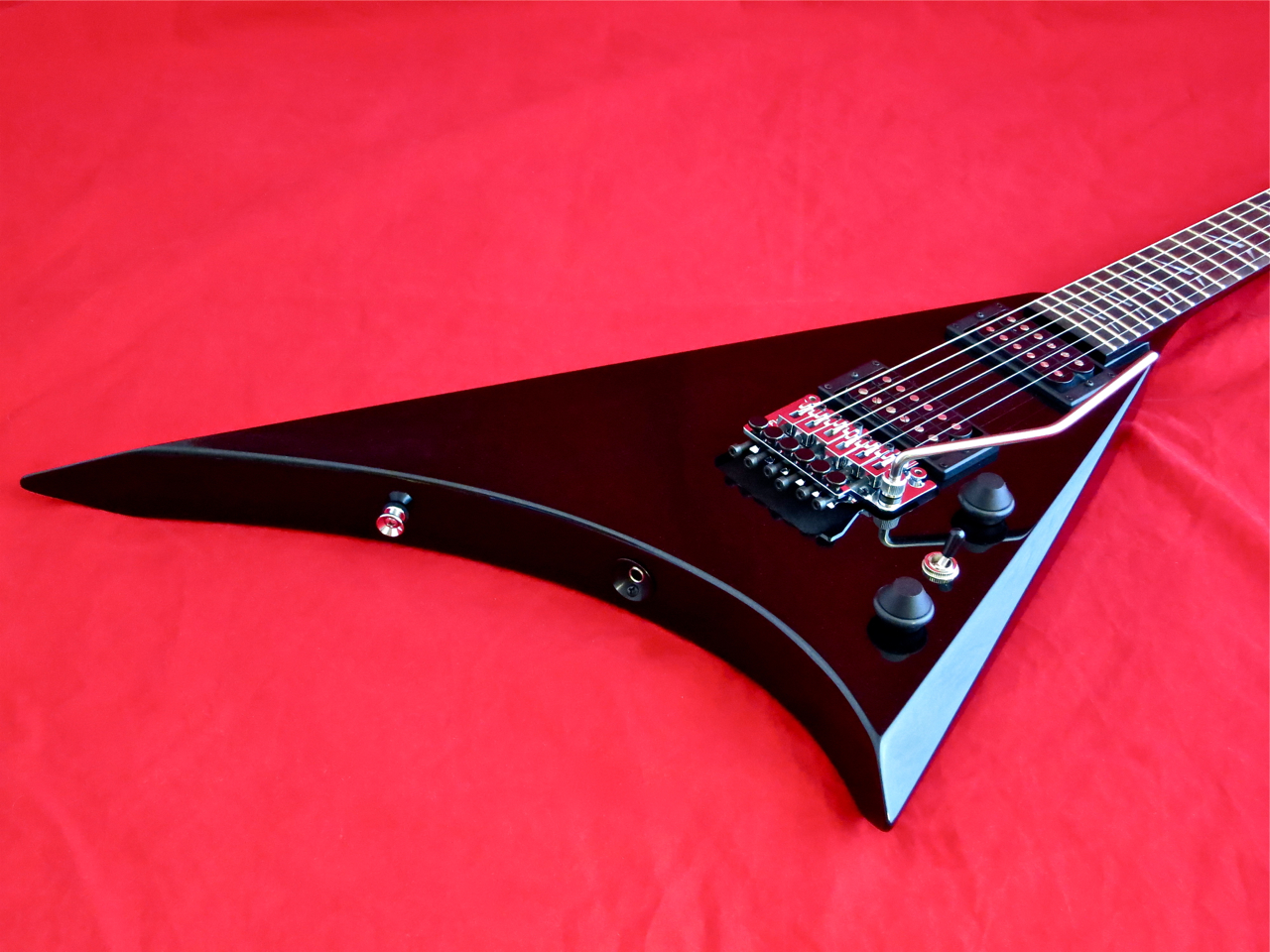
The placement of the output jack is a nifty little feature.
****
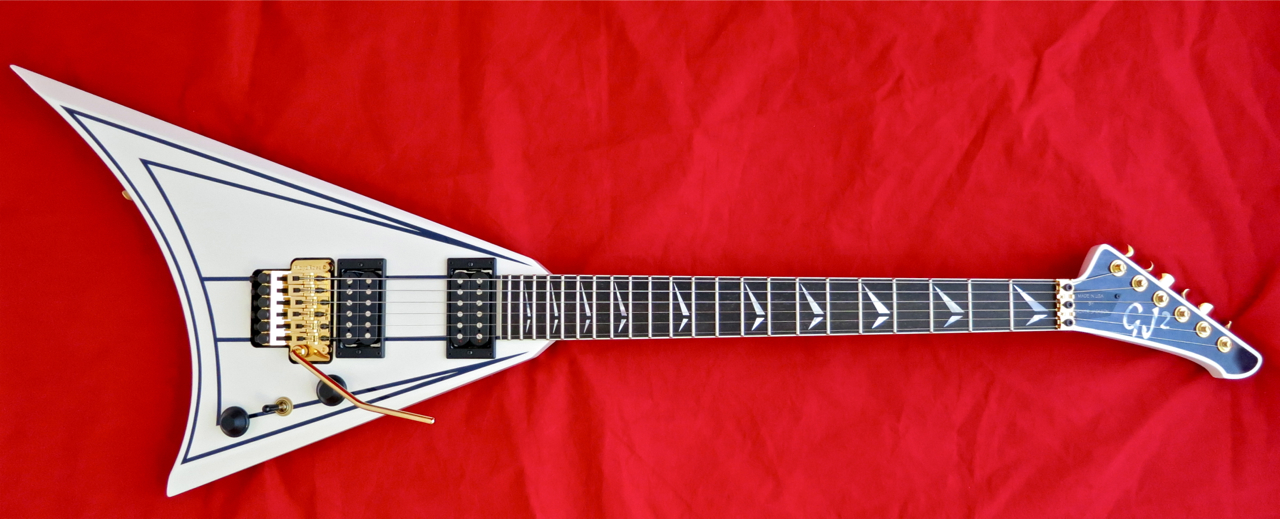
This is GJ2 Guitars’ ultimate Heavy Dream Machine:
The Concorde 5-Star (this version 4,103 €, incl. hard case) can be had – for an additional charge – finished in a custom finish, such as the Randy Rhoads-style pinstripe graphics on this guitar.
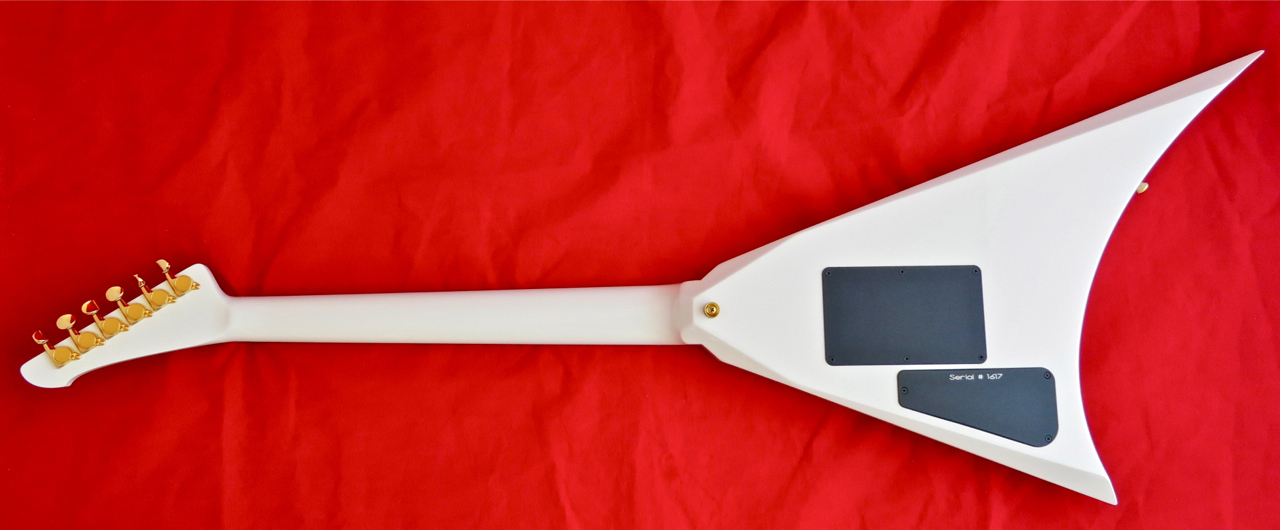
The back plates of the Concorde-models are made of aluminium.
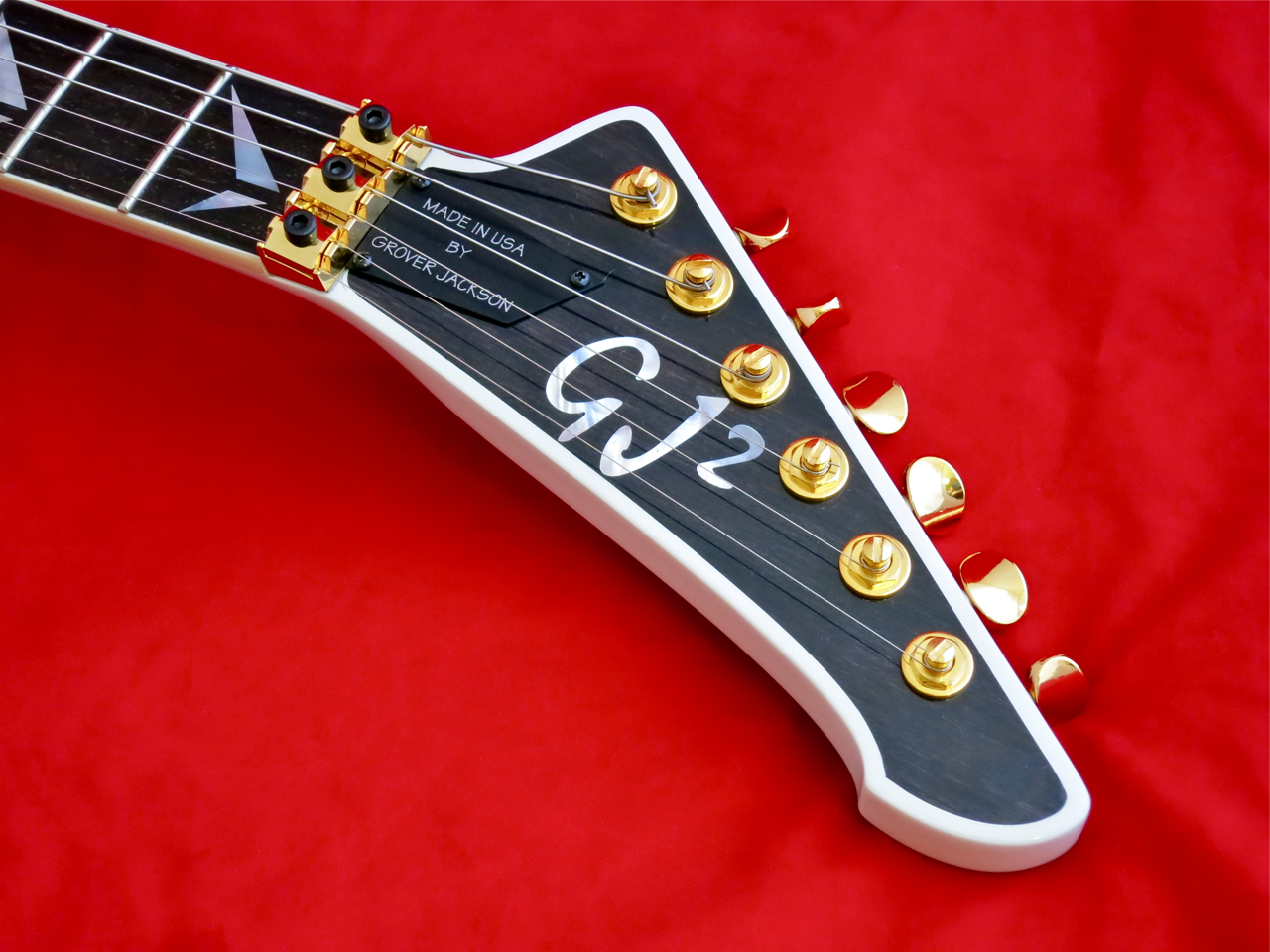
The Concorde 5-Star sports gold-coloured hardware. Our review sample had optional, locking Gotoh-tuners installed.
Ebony is the material of choice for the bound fretboard, as well as the headstock inlay.
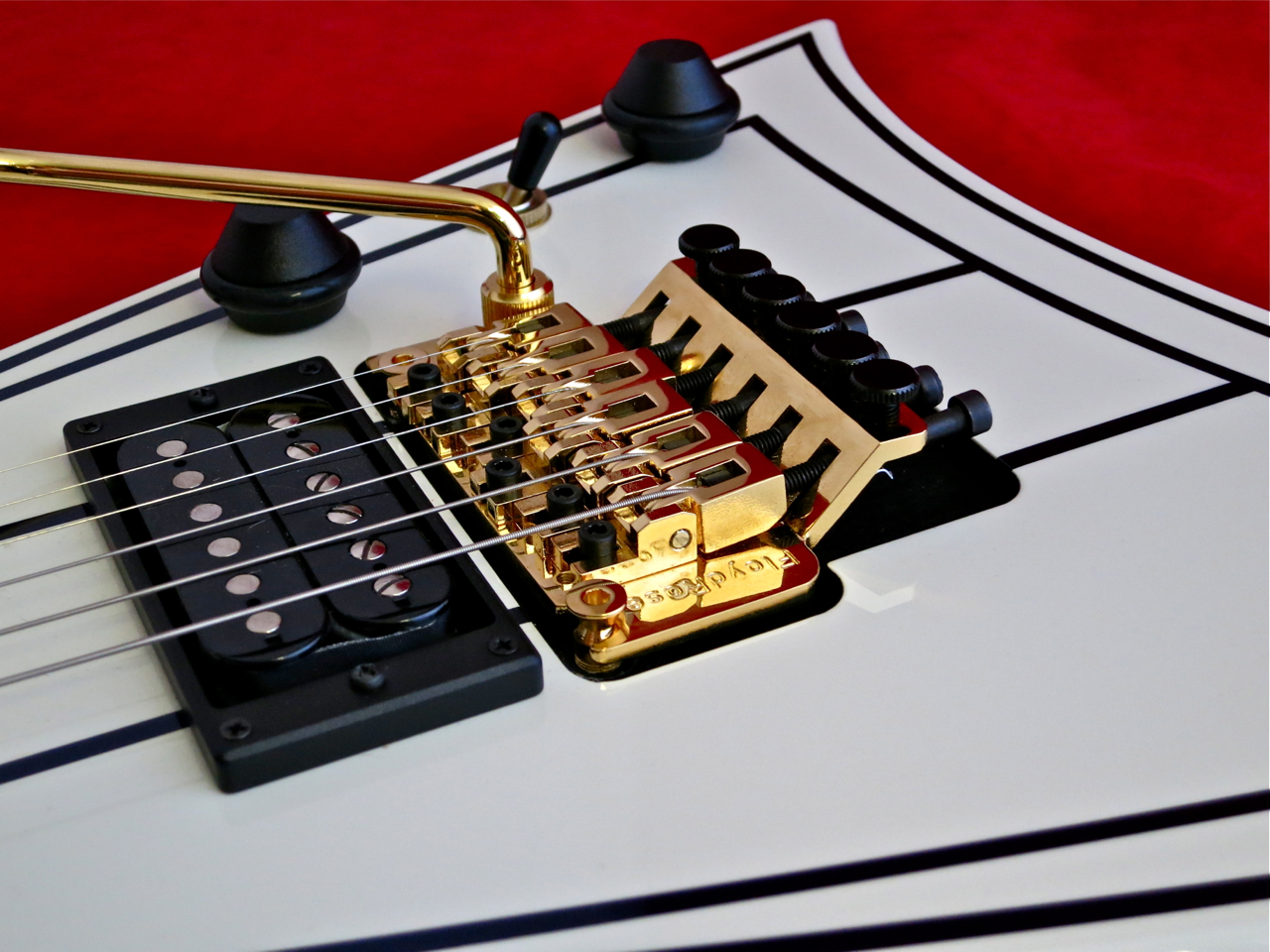
Here’s a closer look at the golden Floyd Rose bridge.
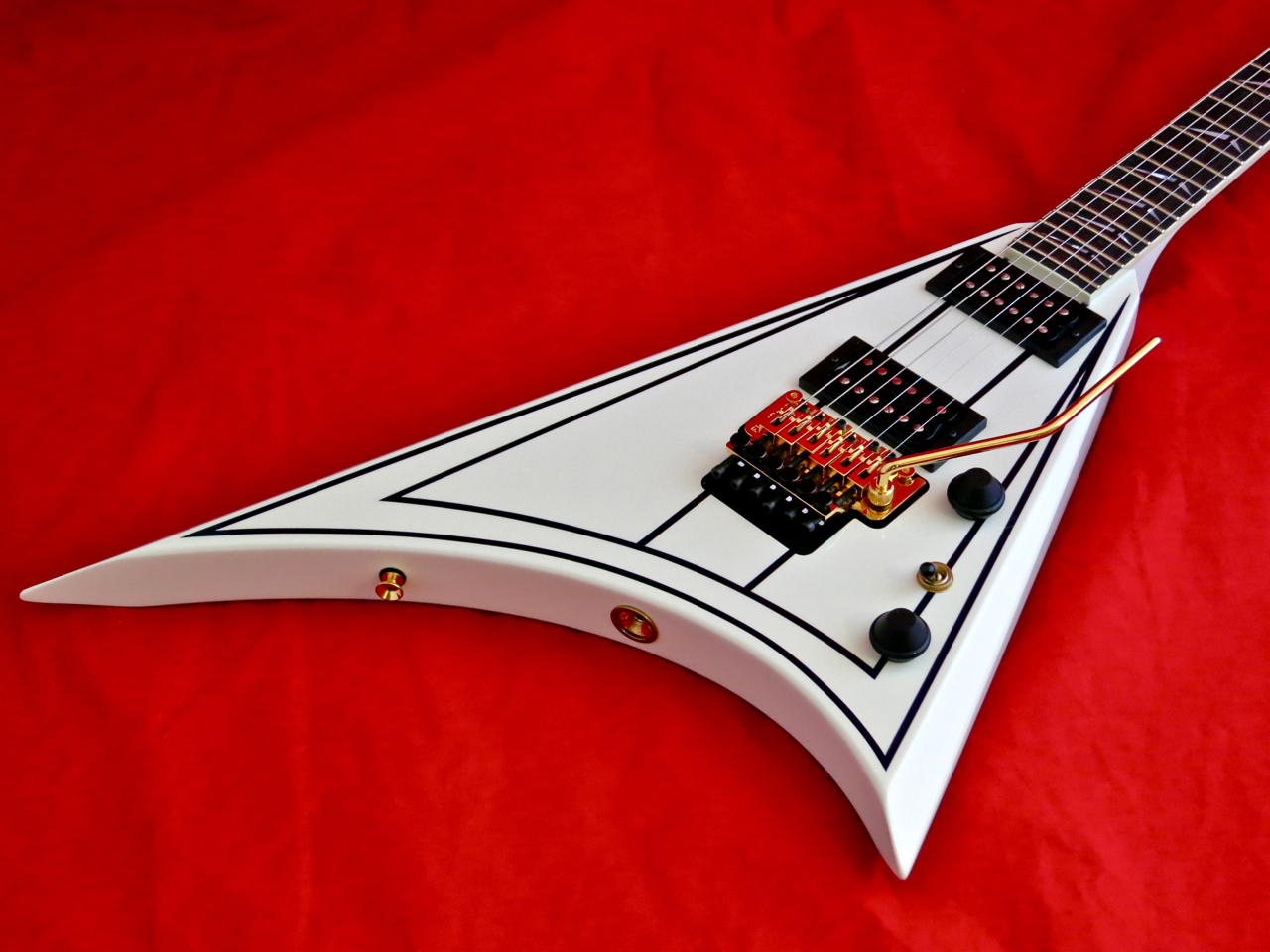
The inlays on the Concorde 5-Star are genuine pearl.
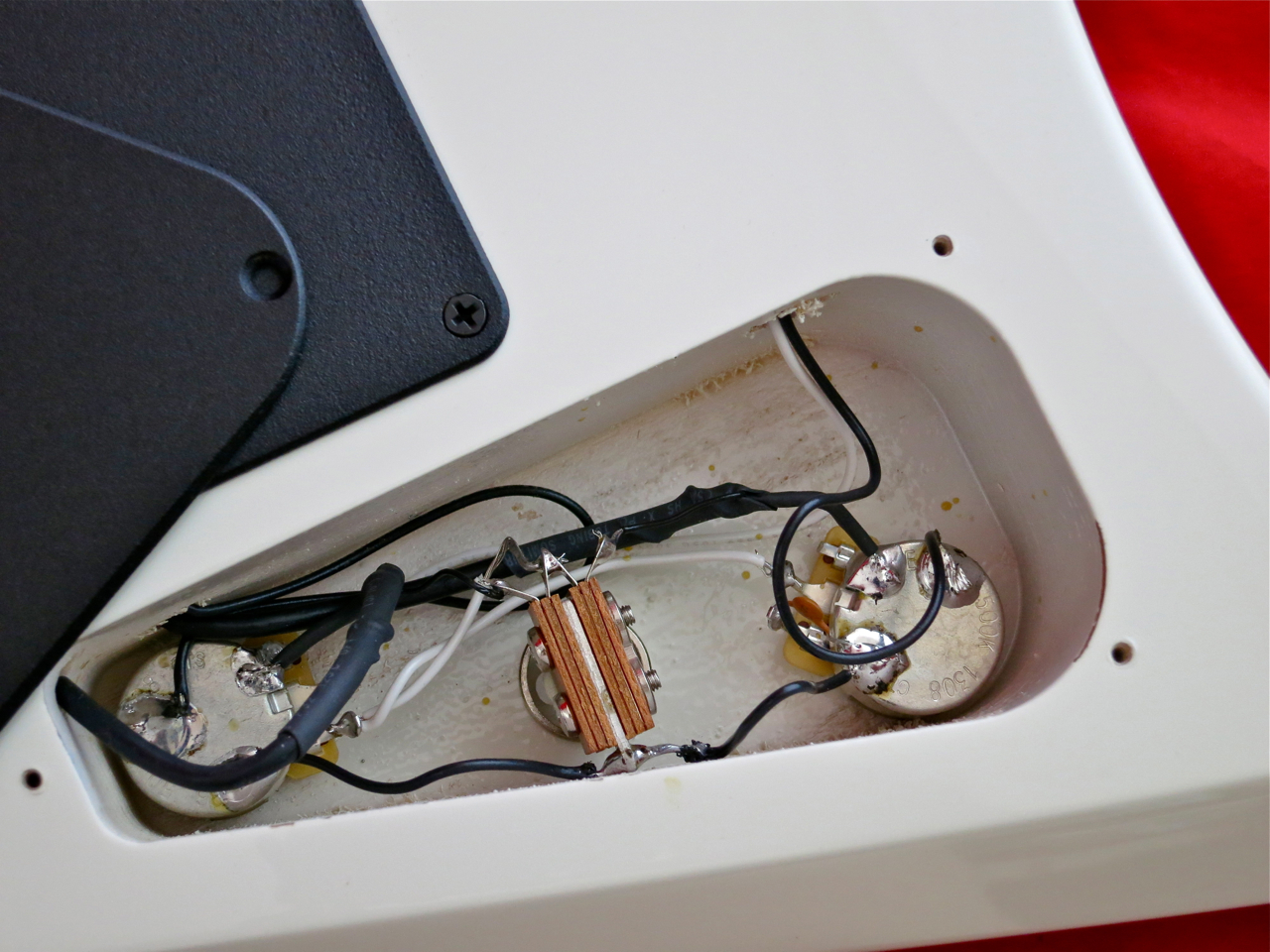
…and here’s a little peek into the very clean control cavity.
****
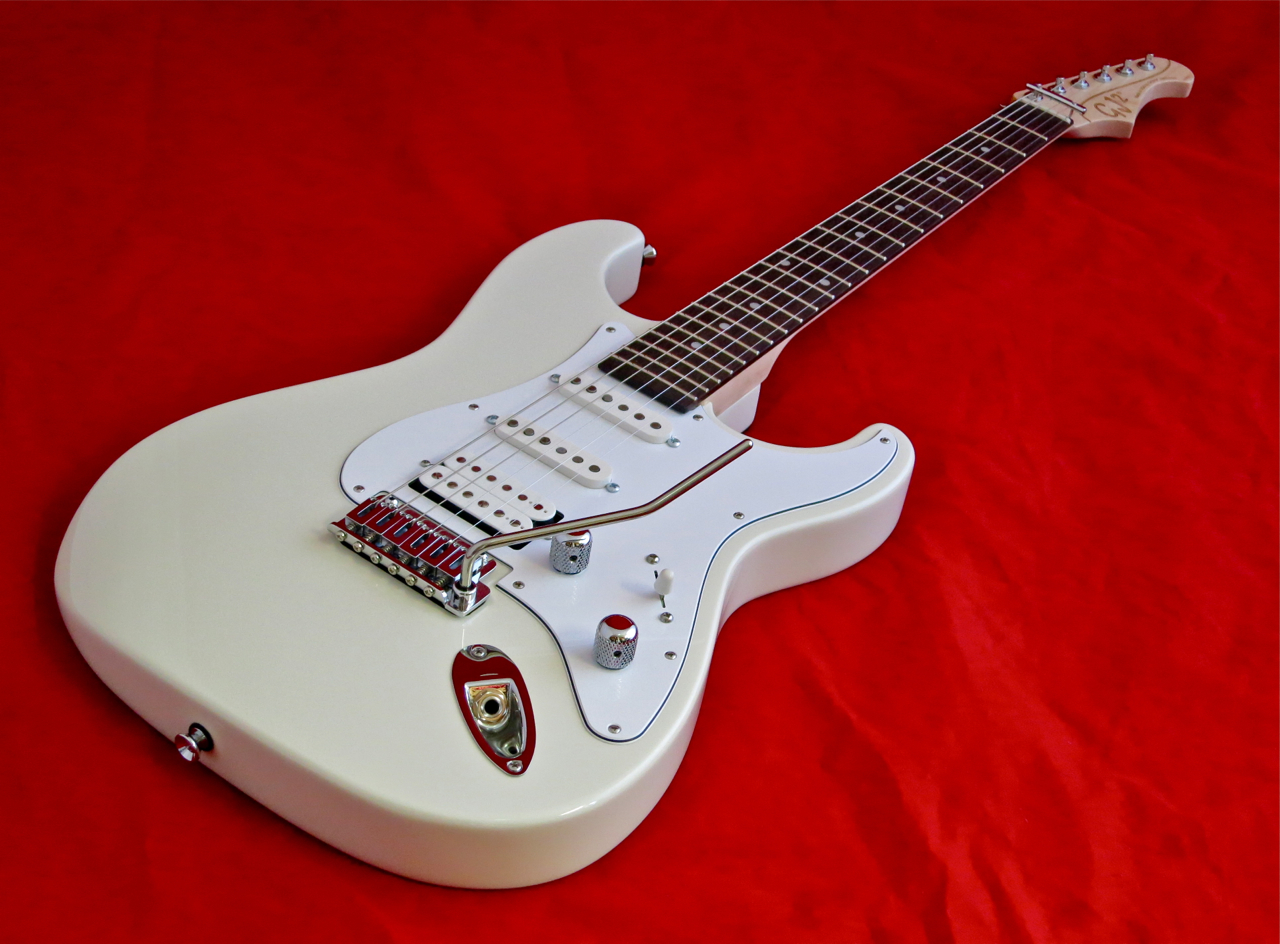
The feather-light ash-bodied GJ2 Glendora NLT is a fantastic S-style guitar for the connoisseur!
The Glendora’s playability is first-rate, and the guitar’s satin-finished neck, with its oval C-profile feels like an old friend.
Played acoustically there’s a hefty dose of woody dryness and sparkling top end, no doubt thanks to the ash body. The Glendora NLT’s displays an open voice with a nicely clucking attack.
I have only good things to say about GJ2’s Habanero pickups – they sound great, they are dynamically rich and the whole set is well balanced in terms of tone and output level.
Here’s a short clip played using the neck pickup:
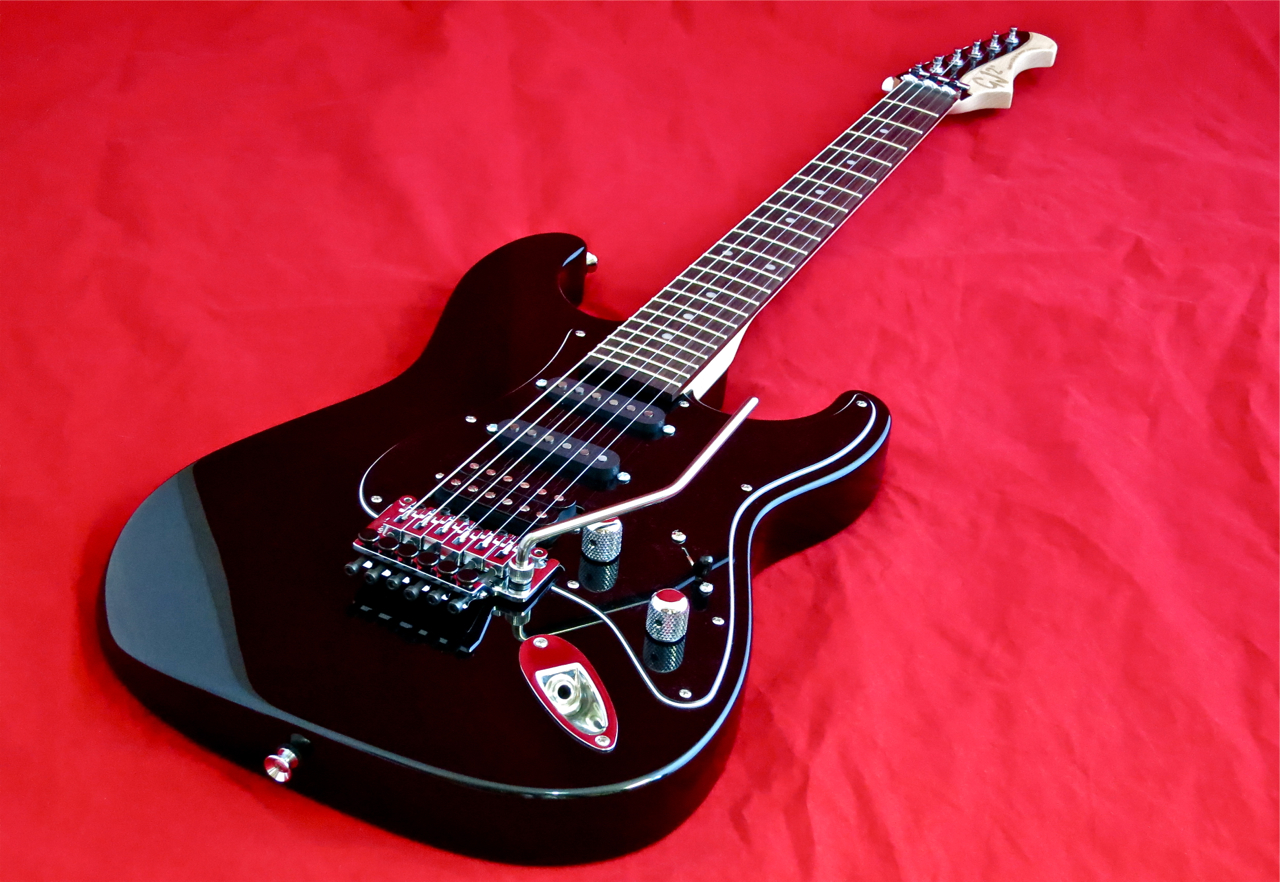
The workmanship, feel and playability of the Glendora FR is the same as in the NLT-version – simply fantastic!
Acoustically there’s maybe a tad more roundness in the mid-range and a slightly fatter bass on display in the Glendora FR, which is probably a result of its standard body. On the other hand, the steel Floyd Rose adds its own sprinkling of presence bite into the mix.
Because the bridge humbucker isn’t overpowering the guitar’s single-coils, there’s plenty of fun to be had using the second switch position (bridge and middle):
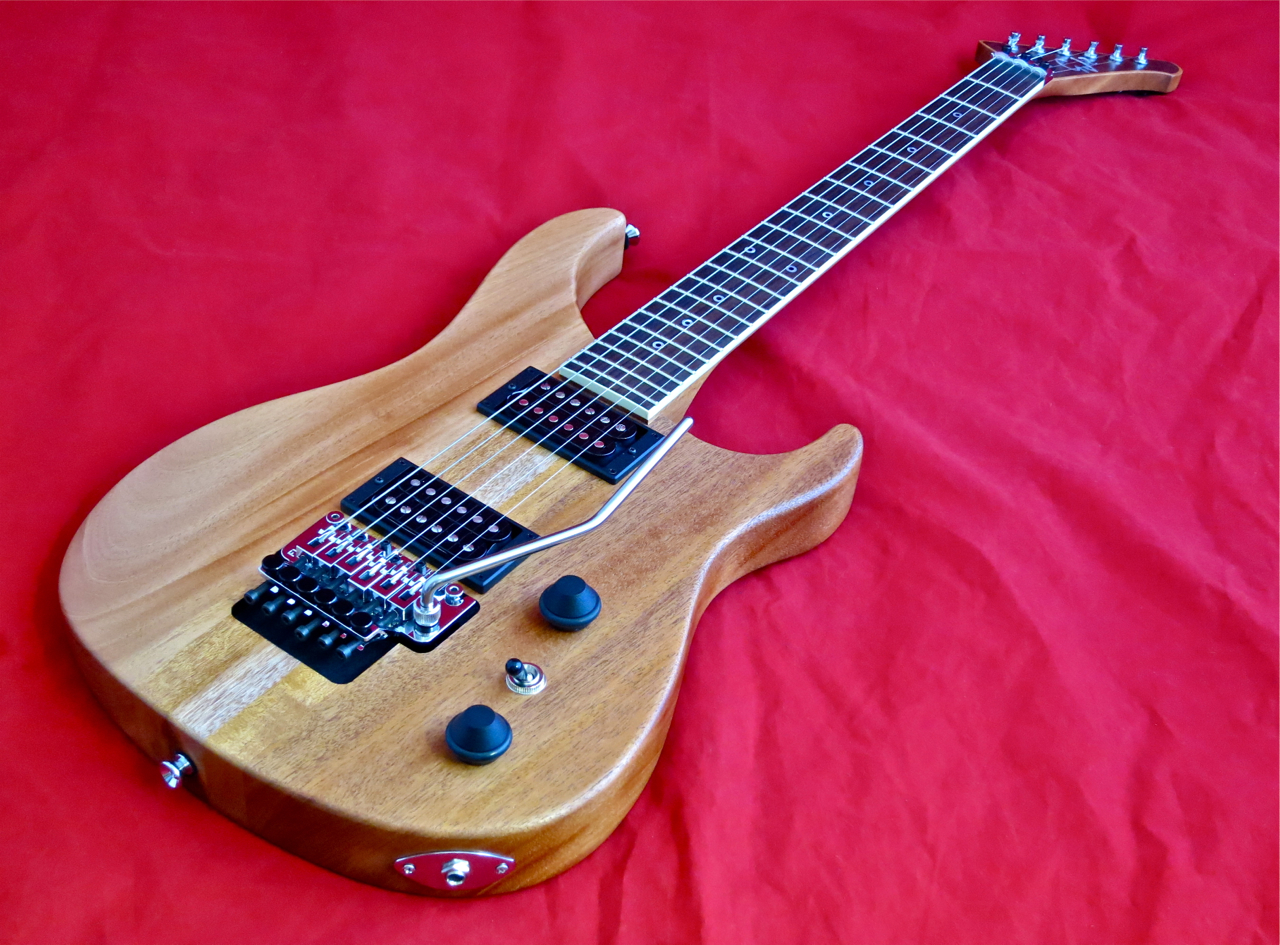
The lightweight GJ2 Arete 4-Star is a very comfortable guitar to hold and play.
Thanks to its hand-rubbed oil finish the Arete feels very organic. If you’re a fan of nice wood, then this is the guitar for you.
The neck profile has a nice bit of shoulders to its slightly flattened D-section, and fills out your hand rather nicely.
The Arete’s acoustic voice is warm and open.
GJ2’s Habanera humbuckers clearly follow the boutique-vintage route, which puts tone and dynamics front and centre, instead of sheer brute force. Thanks to this it is very easy to coax a whole trainload of different tasty humbucker-tones from the Arete 4-Star, which will satisfy both the traditionalist, as well as modern Rock- and Fusion-guitarists.
The Flying Saucer knobs have a very positive grip, allowing you to adjust the guitar’s controls precisely.
Here’s a clip I recorded using the bridge humbucker:
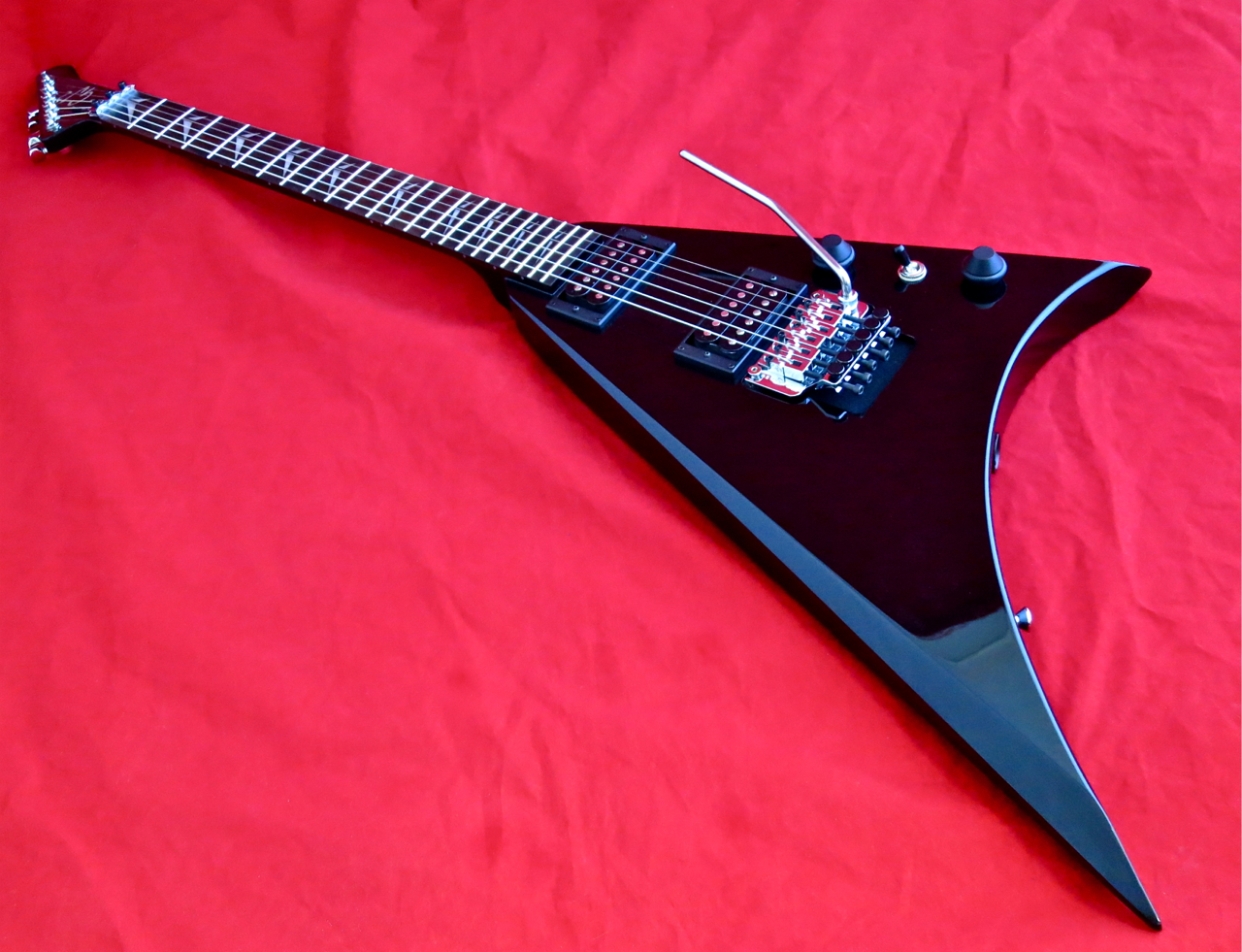
It may come as a surprise to a newbie, but the Concorde 4-Star actually feels extremely comfortable hanging suspended from a guitar strap. Sure, the visuals are very angular, but the feel isn’t.
On the other hand I should stress that the Concorde most probably isn’t the right choice as a couch guitar, because it won’t really stay in your lap. And one more thing – beware of the sharp top horn! But as long as you know this guitar’s boundaries, your in for a fun ride with a light and well-balanced studio- and stage-guitar.
The neck has a chunky D-profile, which is good news for tone and sustain.
The Concorde’s long scale, its maple through-neck, as well as the Floyd Rose system give this guitar a clearer, more precise – and in a positive way – more neutral acoustic tone, when compared, say, to a Gibson Flying V.
The guitar’s Habanero humbuckers do a fantastic job in getting the Concorde 4-Star’s precise attack and growling mid-range across.
The neck ’bucker displays a fluid, flute-like timbre, without any sign of muddiness:
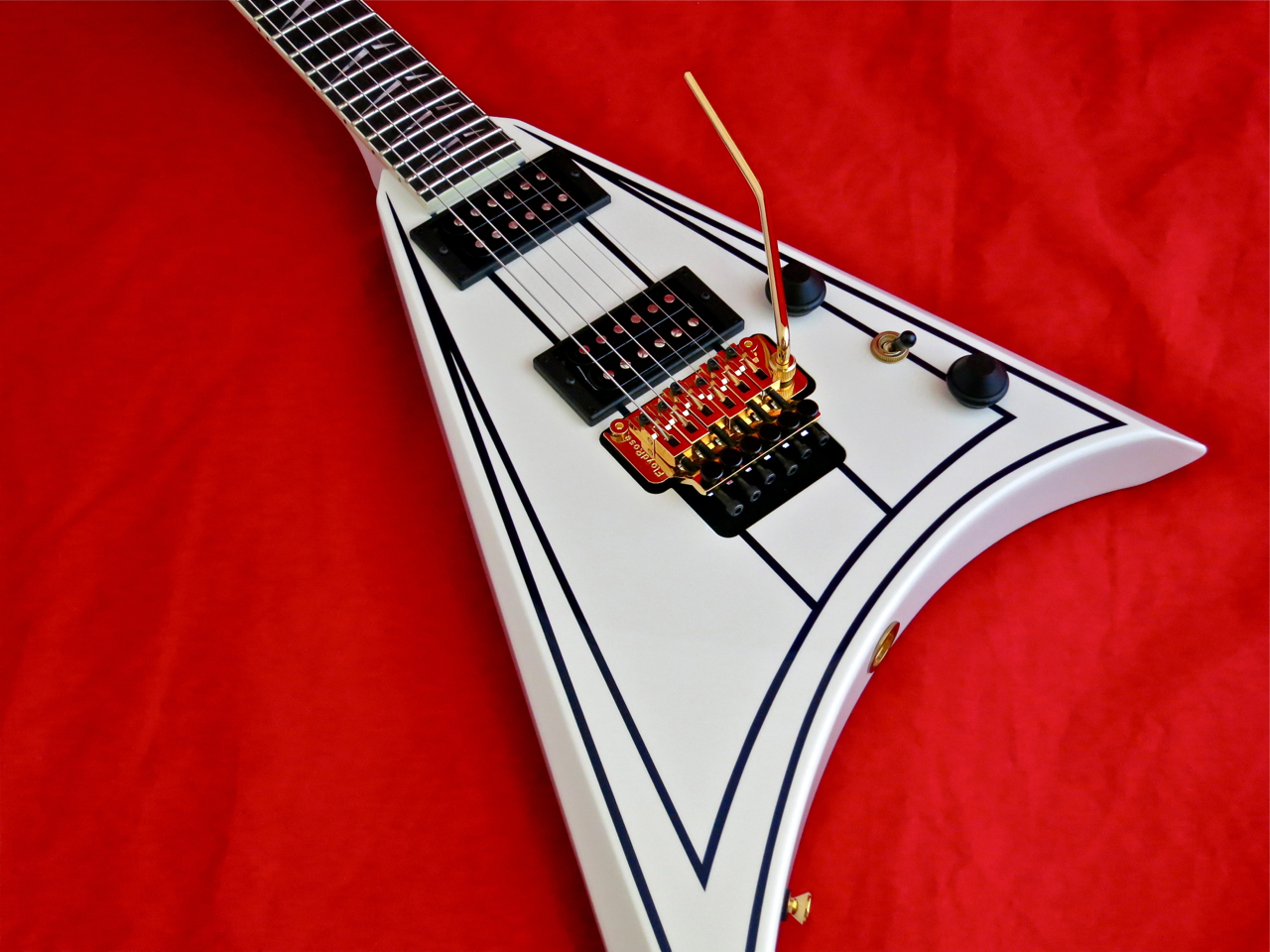
In terms of playablity and ergonomics there’s not much to divide the Concorden 5-Star from its 4-Star sibling.
But there are some clear differences in tone, most probably due to the posher 5-Star-version’s ebony ’board. The Concorde 5-Star has some added presence bite and a tad more twang in its attack, resulting in an even livelier tone.
Here’s a clip played using the bridge humbucker:
****
What a great thing that Grover Jackson isn’t content with resting on his (considerable) laurels. These new instruments build upon Mr Jackson’s rich past and vast knowledge, while managing to stay foward-facing and fresh.
The sum of this knowledge and experience, coupled with new building techniques and GJ2 Guitars’ obvious attention to detail, result in a range of instruments I would call the best guitars Grover Jackson has ever made.
This type of quality naturally comes at a price. But in light of GJ2’s comparatively small production runs and the sheer quality on offer here, you truly get what you paid for – boutique quality, made in the USA.
****
GJ2 Guitars
Glendora NLT – starting from 1,368 €
Glendora FR – starting from 1,541 €
Arete 4-Star – starting from 2,594 €
Concorde 4-Star – starting from 2,779 €
Concorde 5-Star – starting from 3,335 €
Finnish distributor: Musamaailma
****
Pros:
+ genuine boutique quality
+ playability
+ sound
+ many custom options
+ GJ2 Habanero-pickups
Cons:
– Concorde-models’ G&G-cases weigh a ton
****
Viime vuonna Marshall juhli 50-vuotista taivaltaan kokonaisella sarjalla pienissä erissä valmistettuja yksiwattisia puolistäkkejä ja komboja.
Ilmeisesti hyvä vire on jäänyt päälle, sillä tänä keväänä Marshall ilmoitti 1111 kappaleeseen rajoitetusta Custom Offset -puolistäkistä, joka on modifioitu versio JTM1-juhlavahvistimesta.
Muutaman kappaleen erä on hiljattain saapunut Suomeen, josta onnistuimme lainata yhden puolistäkin Kitarablogi-testiin.
****
Marshall Custom JTM1 Offset -vahvistimen (hinta noin 1.000 €) lähtökohtana on siis ollut viime vuoden JTM1-juhlamalli. Tämä keräilyvahvistin on kuitenkin viety lähemmäksi firman ensimmäisiä JTM45-malleja käyttämällä alkuperäistä logoa, vaaleata etukangasta sekä keskittämisen sijaan reunaan asennettua etupaneelia, josta vahvari on myös saanut nimensä.
Kuten setin korkean hintatason perusteella sopiikin odottaa, on englantilainen työnjälki Offsetin kohdalla erittäin korkealaatuista.
Vahvistimen kromattu etupaneeli sekä sen mustat, metalliset nupit kielivät vahvistinnupin ylevästä boutique-luokan asemasta.
Kromatusta takapaneelista löytyy viimevuotisesta juhlasarjastakin tuttu teho-nappi, jolla Marshallin päätetehon saa pudotettua yhdestä watista 0,1:een wattiin.
Custom JTM1 Offsetin oma kaiutinkaappi toimii 16 ohmin impedanssilla, mutta nuppiin voi liittää myös kahdeksan ohmia vastusta tarjoavia ämyreitä.
Custom-nupin putkivarustus on sama kuin viime vuoden juhla-JTM1:ssä – etuasteputkina toimii kaksi ECC83/12AX7-putkea ja pääteputki on malliltaan ECC82/12AU7.
Tyyppillisen suljetun Marshall-kaapin uumeniin on asennettu yksi 10-tuumainen Celestion G10F-15 -kaiutin.
****
Millaista soundia yleensä odotetaan vintage-tyyliseltä Marshallilta? Ehkä puhdasta soundia, joka on kirkas, mutta melko kuiva, ja joka ei tarjoa suuria määriä putipuhdasta headroomia. Särösoundilta haetaan varmasti kermaista kompressiota, mutta samalla myös tietynlaista keskialueen rouheutta ja purevuutta.
…ja juuri sellaisia soundeja Marshallin Offset tarjoaa hyvin maukkaalla tavalla.
Fender Telecasterilla sointi pysyy kutakuinkin täysin puhtaana, mutta tyyppillinen brittiläinen kulmikkuus on jo tässä hyvin havaittavissa:
Gibson Les Paul Juniorin P-90 mikrofonin korkeampi lähtötaso aiheuttaa jo pientä, kaunista rakeisuutta etenkin nuottien alkuvaiheissa:
Samoilla säädöilla humbuckereilla varustettu Hamer USA Studio Custom työntää Marshallin selvästi pikkusärön herkkulliseen maailmaan. Täysin puhtaita clean-soundeja täytyy tässä hakea kitaran volume-nuppeja käyttäen:
****
Vääntämällä Marshallin Loudness-potikkaa kaakkoon, soundiin saa yhä enemmän säröä, mutta samalla kasvaa myös volyymitaso. Custom Offset on hyvin kovaääninen puolistäkki yksiwattiseksi vahvistimeksi, eikä täysillä soitettuna vahvistin enää sovi kerrostaloon.
Onneksi on olemassa takapaneelin tehonpudotus-nappi, jolla JTM1 Offset -stäkistä saa ”sisäsiistin”. Toivottuna lieveilmiönä pudottamalla nupin 0,1-wattiseksi myös vahvistimen saturaatio kasvaa, minkä ansiosta Marsusta saa pienellä volyymillä irti hyvin uskottavia heavysoundeja.
Tältä kuulostivat testissä käytetyt kitarat 0,1 W -tilassa ja Loudness täysillä.
Ensin Tele…
…seuraavaksi Junior…
…ja lopulta Hamer:
****
Marshallin Custom JTM1 Offset on mielestäni erittäin hieno pikkustäkki, jolla on juuri sellainen soundi kuin mitä itse hakisin tämänkaltaiselta vahvistimelta.
On kyllä sekin totta, että tuhat euroa on aivan liikaa, jos haetaan ”vain” olohuoneeseen tai pikkustudioon mahtuvaa kitaravahvistinta – pienemälläkin rahalla saa usein jopa enemmän watteja ja ominaisuuksia.
Custom Offsetissa on kuitenkin kyse pitkälti myös rajoitetun painoksen tuomasta prestigestä ja keräilyarvosta sekä Englannissa tehdyn pikkuvahvistimen hienoudesta. Marshall JTM1 Offset on boutique-luokan peli kitarasoiton puristille – ja siinä luokassa se pärjää vallan mainiosti!
On kuitenkin syytä pitää kiirettä, koska Suomeen on saapunut vain muutama kappale tätä mallia, eikä lisää enää tule!
****
Marshall Custom JTM1 Offset
Maahantuoja: EM Nordic
Kiitos DLX Musiikille testiyksilöiden lainasta!
****
Plussat:
+ työnjälki
+ soundi
+ kaksi päätetehoa
+ pieni koko
+ keräilyarvo
****
Rolandin suosittu Cube -kitaravahvistinsarja on päivitetty.
Uusiin Cube GX -komboihin on lisätty useita uusia ominaisuuksia, kuten esimerkiksi Cube Lite -mallissa ensiesittelynsä saanut i-Cube Link, jonka ansiosta uusia Roland-vahvareita voi käyttää saumattomasti yhdessä Applen iOS-laitteiden kanssa.
****
Rolandin Micro Cube GX (134 €) on maailman suosituimman paristokäyttöisen harjoitusvahvistimen uusin versio.
Edestä katsottuna GX-versio on pysynyt lähes muuttumattomana – eturitilään kiinnitetty uusi Cube-logo on käytännössä ainoa visuaalinen vihje uudistuksesta.
Micro Cube GX:n metallinen takapaneeli on edeltäjään verrattuna pienempi.
Uudessa mallissa yhdistetty kuuloke-/linjalähtö on minikokoinen jakkiliitin.
Pikku-GX käyttää edelleen kuutta AA-paristoa, mutta uutukaisen paristolokero on isompi ja kätevämpi.
Verkkovirralla toimiva virtalähde kuuluu pakettiin.
Etupaneeli on uudistettu perusteellisesti:
Kitaratulon yltä löytyy Rolandin uusi i-Cube Link -liitin, johon liitetään iPhone tai iPad vahvistimen mukana tulevalla johdolla. i-Cube Linkin ansiosta kaikkia Cube GX -perheen vahvistimia voi käyttää iOS-laitteen äänikorttina sekä tehokkaina treenivälineinä Rolandin ilmaista Cube Jam -ohjelmaa hyödyntäen. Lisätietoa Cube Jam -ohjelmasta saat Kitarablogin Cube Lite -testistä.
Toinen tärkeä uudistus on Micro Cube GX:n Memory-muisti. Muistiin voi tallentaa jokaiselle Amp Type -vahvistimelle omat säädöt – siis Gain-, Volume-, Tone-, EFX- ja Delay/Reverb-säätimien asetukset.
Myös viritysosasto on uudistettu. Vanhassa Micro Cubessa oli elektroninen äänirauta, josta sai A:n sävelkorkeuden (vaihtoehtoisesti tarjolla oli myös Ab ja Abb=G). Uudessa Micro Cube GX:ssä on kunnon viritysmittari, joka toimii oletuksena kromaattisesti. Viritysmittaria voi kuitenkin myös käyttää pelkästään A-viritysmittarina, mikä on kätevä ominaisuus esimerkiksi kieltenvaihdon yhteydessä.
****
Rolandin Cube-80 GX (384 €) on Cube GX -perheen suuritehoisin malli, joka tarjoaa peräti 80 wattia tehoa 12-tuumaisen kaiuttimen kautta.
Tärkein ero sen edeltäjään – Cube-80 XL – nähden on, että GX-versiosta on jäänyt loopperi pois, joka on nyt puolestaan korvattu i-Cube Link -ominaisuudella.
Uusi on myös takapaneelin GA-FC-liitin, johon voi kytkeä Rolandin, varta vasten firman kitaravahvistimia kehitetyn GA-FC-kytkinlaudan (ostettava erikseen).
Tältä kytkinlauta näyttää. Cube-80 GX:n tapauksessa laudalla voi vaihtaa kombon kanavia, sekä kytkeä EFX-, Delay- ja Reverb-osastojen efektit yksitellen päälle tai pois. GA-FC:hen voi myös liittää tarvittaessa kaksi ekspressiopedaalia (lisävaruste), joilla voi säätää tulon äänenvoimakkuutta ja vahvistimen masterin tasoa. Cube-80 GF:n paketista löytyy suurikokoinen tarra, jolla kytkinlaudan merkinnät muutetaan kombolle sopiviksi.
Cube-kombojen tuttu, vankka perusluonne on säilynyt myös GX-sarjassa entisellään.
Cube-80 GX on kolmikanavainen vahvistin:
JC Clean -kanava tarjoaa vanhasta Roland Jazz Chorus -kombosta tuttuja putipuhtaita soundeja. Lead-kanavan vahvistinmallinustarjonta taas on huomattavasti isompi – se tarjoaa yhdeksän eri COSM-vahvistinta sekä teräskielisen akustisen kitaran mallinuksen.
Kolmas kanava on niin sanottu Solo-kanava. Käytän sanoja ”niin sanottu”, koska todellisuudessa Solo-kanava on Cube-80 GX:n muistipaikka, johon voi tallentaa yhden omavalintaisen soundin (JC Clean- tai Lead-kanavan) vahvistin- ja efektiasetukset, eikä sen tarvitse välttämättä olla soolokitaralle sopiva soundi. Ero Solo-kanavan ja kombon kahden muun kanavan välillä piilee siinä, että Solo-kanavalla on (tallennuksen ansiosta) täysin omat EQ-, EFX-, Delay- ja Reverb-asetukset, kun taas JC Clean- ja Lead-kanavat käyttävät EQ:ta ja efektejä niillä asetuksilla, joihin ne on käyttöhetkellä säädetty.
Uuden kombon vahvistin- ja efektivalikoima on pysynyt käytännössä samana kuin XL-versiossa, mutta lisänä löytyy jo alussa mainittu i-Cube Link -liitin, jolla Cube-80 GX:n saa kytkettyä esimerkiksi iPadiin. Lisätietoa uudesta i-Cube Link -liittimestä ja Rolandin Cube Jam -ohjelmasta saat TÄSTÄ.
****
Uusi Micro Cube GX tarjoaa selvästi enemmän kuin sen kuuluisa edeltäjä. Oikean viritysmittarin lisäys helpottaa kitaristin elämää entisestään, ja uusi i-Cube Link/Cube Jam -ominaisuus istuu tällaiseen kannettavaan harjoituskomboon kuin nakutettu. Tämän ansiosta Micro Cube GX:stä kuoriutuu iOS-laitteiden omistajalle oikea liikkuva harjoituspartneri ja sutjakka ideoiden tallennin.
Uuden pikku-GX:n valikoimaan kuuluu myös kolme uutta soundia – vallan mainio über-metal-vahvistin Extreme, loistava polyfoninen oktaaveri, sekä jousikaiun mallinnus. Micro Cube GX:n jousikaiku kuulostaa toki hyvältä, mutta minua häiritsee efektin varsin rajallinen säätövara, joka johtuu tälle efektille säätimessä varatusta lyhyestä liikeradasta. Jousikaiku on käytännössä täysillä tai pois päältä.
Käytössä uutukainen kuulostaa jopa paremmalta kuin vanha versio, ja GX:n kohinatasoa on parannettu entisestään – etenkin efektien kohdalla.
Tässä on neljä esimerkkiä, jotka on äänitetty dynaamisella mikrofonilla Fender Stratocasteria käyttäen:
****
Rolandin uusi Cube-80 GX on erittäin kompakti voimanpesä, jonka teho riittää ongelmitta myös useimmalle klubikeikalle.
Kombon soundivalikoima on hyvin laaja, ja sen vahvistinmallinnukset ja efektit kuulostavat erittäin terveeltä. Kitarasta riippuen tällä Rolandilla voi olla lievä taipumus kumiseville ala-keskitaajuuksille – etenkin puhtaissa soundeissa – mutta ei niin vahvasti, ettei sitä saisi kombon EQ:lla helposti aisoihin.
Mielestäni GA-FC-kytkinlauta on Cube-80 GX:n live-käyttöä varten käytännössä pakollinen hankita, koska se on ainoa järkevä tapa vaihtaa kanavia lennossa, samalla kun kytkee efektit päälle tai pois. Noin satasen maksava lauta on vahvistimen hintaan suhtautettuna melko kallis, mutta käytettävyyden kannalta mielestäni kuitenkin järkevä lisähankinta.
Niin tai näin – Roland Cube-80 GX on varsin mehukkaalta kuulostava tapaus, joka sopii sekä keikalle että studioon.
Myös nämä esimerkit on soitettu Fender Stratocasterilla ja äänitetty dynaamisella mikrofonilla:
****
Rolandin Cube-sarjan GX-kombot sopivat mainosti tilanteisiin, joissa tarvitaan hyvin monipuolista soundi- ja efektivalikoimaa sähkökitaralle. Opetus- tai harjoituskäytössä uuden sarjan i-Cube Link -tulo ja Rolandin Cube Jam -ohjelma antavat Cube-vahvistimelle mielestäni rutkasti lisäarvoa.
****
Roland Cube GX -sarja
Micro Cube GX – 134 €
Cube-80 GX – 384 €
Maahantuoja: Roland Scandinavia
****
Plussat:
+ hinta-laatu-suhde
+ i-Cube Link
+ Micro Cube GX: omia soundeja voi nyt tallentaa
+ Cube-80 GX: yhteensopiva GA-FC-kytkinlautaan
+ soundi
+ tukeva rakenne
Miinukset:
– Micro Cube GX: jousikaiun vähäinen säätövara
– Cube-80 GX: GA-FC-kytkinlaudan hinta

PRS on vastannut kitaristien pyyntöihin ja esittelee nyt uuden, edullisemman S2-sarjan.
S2-sarja koostuu tällä hetkellä kolmesta mallista: S2 Custom, S2 Mira ja S2 Starla. Kitarat valmistetaan PRS:n tehtaassa Marylandissa, mutta uusilla menetelmillä ja korealaisilla mikrofoneilla ja talloilla. Lopputulos ovat selvästi edullisempia soittimia, PRS Guitarsin perustuotantoon verrattuna.

****
Lisätiedot: EM Nordic
****
Anderton’s on jo ehtinyt kuvata videotestin uusista PRS S2 -malleista…
 Kitarablogi.com – Finland's premier Guitar and Bass blog