Here are a few sound clips that I’ve recorded with my trusty Jazz Bass, going via my Sans Amp Bass Driver DI into Pro Tools.
My own Jazz Bass is a Japanese Standard-model from 1985, strung with a Rotosoundin Swing Bass -set.
Kitarablogi.com – Finland's premier Guitar and Bass blog
Juttuja kitaroista ja bassoista

Here are a few sound clips that I’ve recorded with my trusty Jazz Bass, going via my Sans Amp Bass Driver DI into Pro Tools.
My own Jazz Bass is a Japanese Standard-model from 1985, strung with a Rotosoundin Swing Bass -set.
Tässä muutama soundiesimerkki Jazz-bassosta, joita on äänitetty Sans Amp Bass Driver DI -boksin kautta Pro Toolsiin.
Minun Jazz-basso on japanilainen Standard-malli vuodelta 1985. Kielet ovat Rotosoundin Swing Bass:et.

Everybody has heard of Tokai, and there’s plenty of knowledge about Greco’s and Ibanez’ copycat instruments around.
The Kasuga-brand is a much rarer beast, even though the company produced many decent instruments (many of those were copies) between the mid-Sixties and the Eighties.
I own a Kasuga-version of Gibson’s classic ES-335, which was most likely produced in the late 1970s, judging by its main specs.


I found my Kasuga by chance in a flea-market in the early Nineties. The price asked was so low and the guitar so red, it was a no-brainer. 😉
The classic curves of a Gibson ES-335/345/355 are one of the prettiest guitar shapes, in my opinion.
In some respects this copy is a funny hodgepodge of different attributes lifted from different periods of the original’s lifespan. Additionally there are also some of Kasuga’s own details added.

Take the headstock, for example, which is the larger version, generally used for the bound headstock of the Gibson ES-355 model.
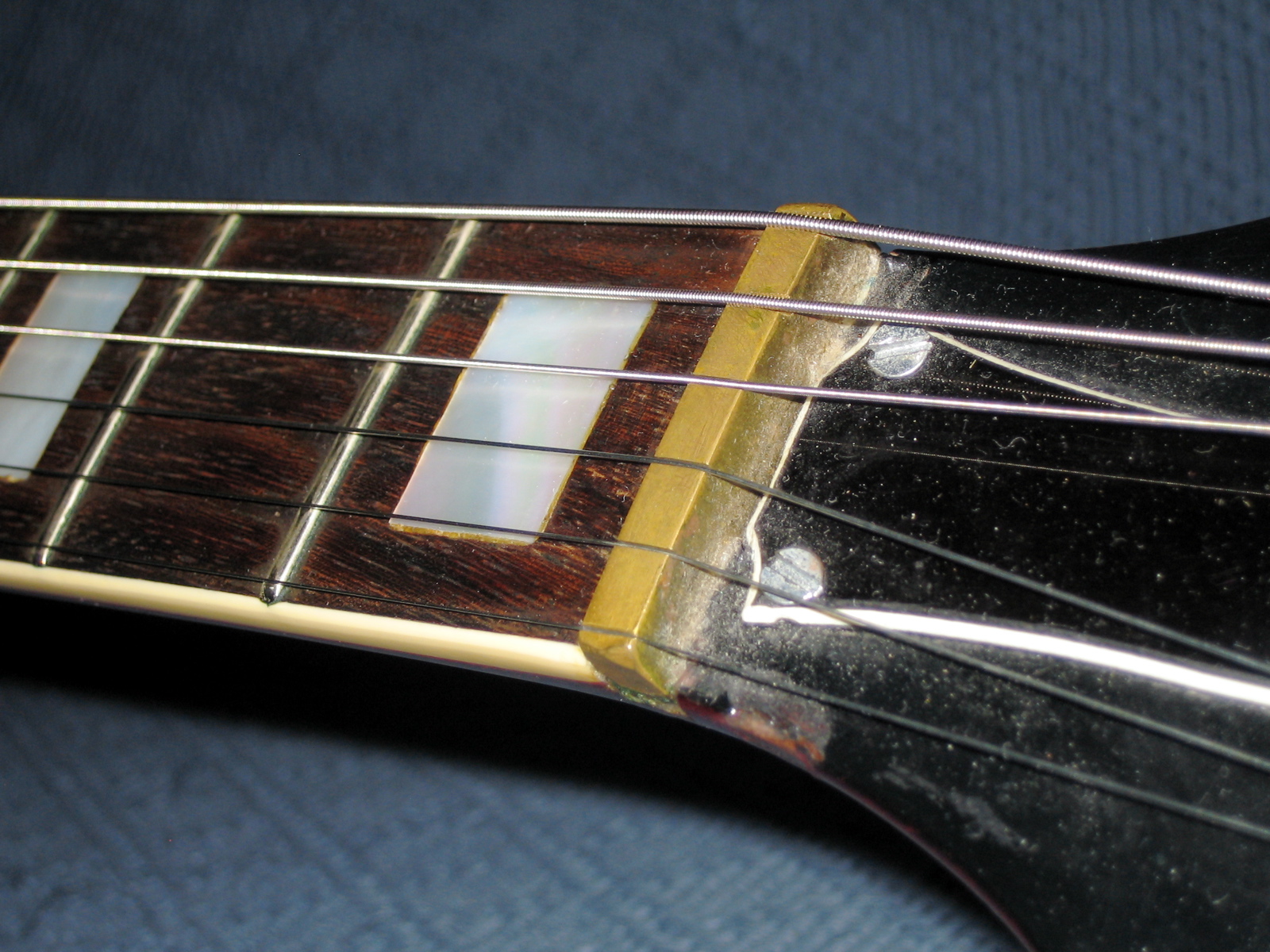
A previous owner had installed a brass nut – very much in fashion in the early Eighties. The extremely low frets are original, as are the large pearl inlays. The neck profile is a copy of Gibson’s 1970’s slim type.

The sealed tuners are of a make that I’ve never seen before or since. There’s the typical 1970s volute, meant to strengthen the neck’s wrist and the headstock.
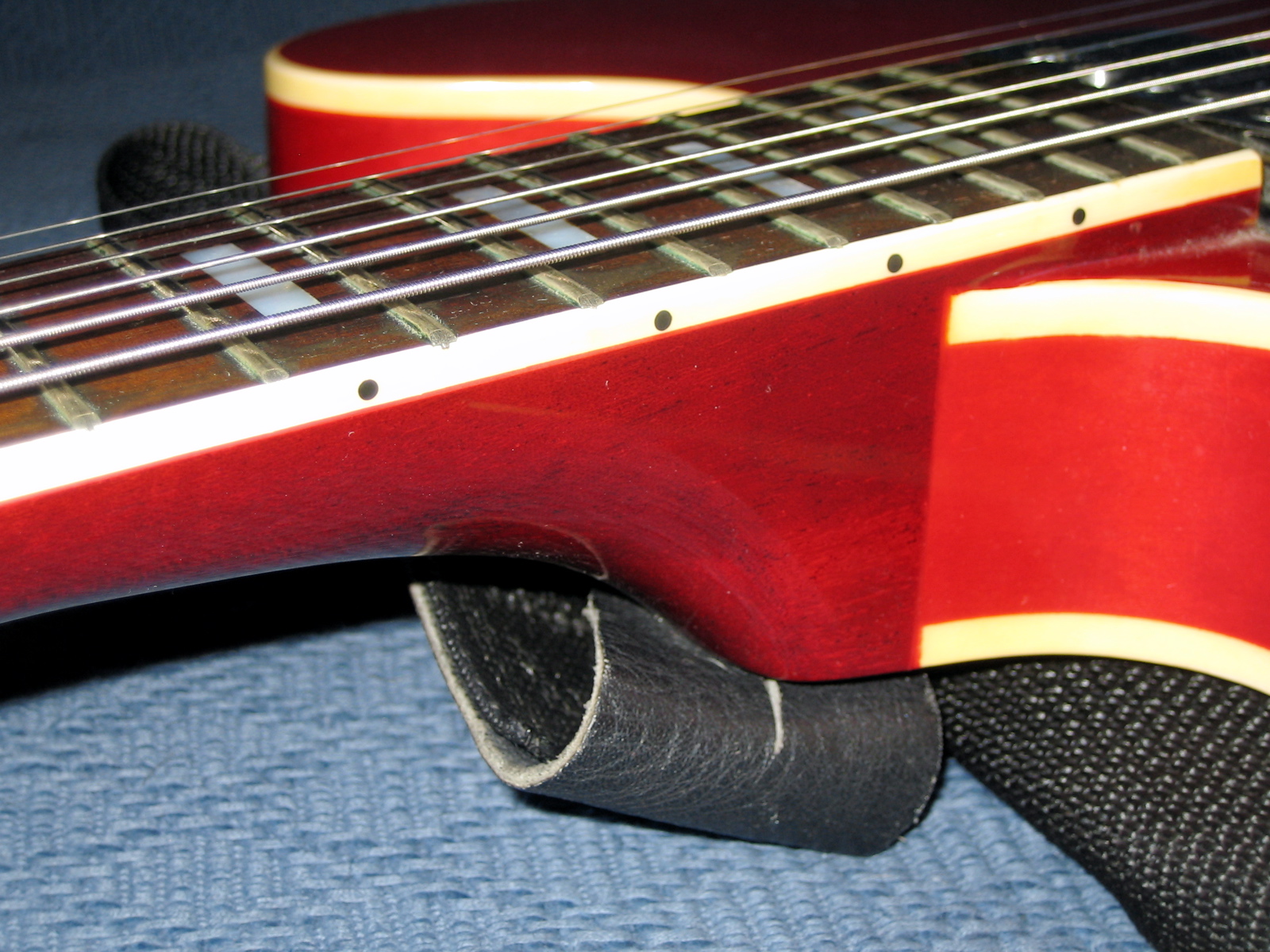
Genuine mahogany has been used for the set neck.

One of the f-holes reveals the body’s five-ply laminate, which seems to be maple/mahogany/maple/mahogany/maple.

The Kasuga even mimics Gibson’s Seventies short centre block, that only starts at the bridge. The neck has its own little block. In this case the centre block has been fashioned from mahogany.

The electronics are high quality – the original pots all still work fine, as does the switch. I only had to replace the output jack some ten years ago.

Strangely enough the arch of the body is not as pronounced and graceful, as on the originals. The humbuckers are standard sized, but the bezels are wider than normal.

The body ears have been left completely flat on the Kasuga, while the original sports very attractive arching both on the top as well as the back. The ears are slightly pointed, as was usual in post-1964 Gibsons as well.
Here are some Kasuga soundbites:
Kaikki tuntevat Tokain, ja myös Ibanezin ja Grecon kopiosoittimista löytyy tietoa laajasti.
Harvinaisempi tapaus on japanilainen merkki Kasuga, joka oli rakentanut soittimia – monet niistä kopiosoittimia – 1960-luvulta lähtien.
Minulla on (luultavasti 1970-luvun loppupuolelta peräisin oleva) Kasugan kopio Gibson ES-335 -puoliakustisesta.
Löysin Kasugani sattumoisin yhdeltä kirpputorilta 1990-luvun alussa. Kitaran hinta oli niin alhainen, että ostos kannatti jo kaunottaren punaisen värin takia 😉
Gibsonin klassinen ES-335/345/355-muoto on mielestäni yksi kauniimmista kitaratyypeistä.
Tämän kopion yksityiskohdat sekoittavat hauskasti (eikä mitenkään vintage-tietoisesti) eri aikakausien ominaisuudet, ja valmistajakin on lisännyt soppaan muutaman oman ratkaisun.
Viritinlapa on kopio Gibson ES-355:n isommasta mallista, vaikka tässä tapauksessa koristus on selvästi ES-335:n mukainen (ei reunalistoitus, pieni kukka-upotus).
Edellinen omistaja oli asentanut 1980-luvun alussa niin suosittua messinkisatulaa. Alkuperäiset nauhat ovat erittäin matalat ja helmiäisupotukset isot – niin kuin tavallisesti ES-355-kitarassa. Kaula on siro kuin 1970-luvun Gibsoneissa.
Suljetut virittimet ovat minulle tuntemattomasta brändistä. Satulan vastapuolella on kaulassa 1970-luvulle tyyppillinen paksunnos (engl. volute), joka on tarkoitettu suojaamaan lapaa murtumisestä.
Kaula on veistetty oikeasta mahongista, ja se on liimattu vanerirunkoon perinteisellä tavalla.
F-aukon reunalla näkyy, että vaneri on viisikerroksinen – ilmeisesti vaahtera/mahonki/vaahtera/mahonki/vaahtera.
Kasugalla on 1970-luvulle tavanomaista lyhyttä keskipalkkia, joka menee tallasta runkoon loppuun. Kaula istuu omassa pienessä blokissa. Kitarani tapauksessa blokki on tehty mahongista.
Elektroniikka on toteutettu laadukkaasti – Kasugassa on yhä alkuperäinen kytkin ja potikat, ainoastaan jakin joutuin vaihtamaan jonkin aikaa sitten.
Rungon muotoilussa valmistaja on ollut yllättävän suurpiirteinen, eikä kansi kaareutuu ihan niin kauniisti kuin alkuperäisessä Gibsonissa. Humbuckerit ovat standardikokoa, mutta niiden kehykset ovat hieman perinteisiä isompia.
Rungon korvat ovat sitä hieman terävämpi sorttia, joka on tavallinen 1964-1981 välillä rakennetuissa oikeissa Gibsoneissa. Mutta myös tässä sekä kansi että pohja ovat tasaisia, eivät ne kaartu holvimaisesti niin kuin oikeassa Gibsonissa.
Tältä Kasugan ES-335-kopio kuulostaa:

The baglama saz is a turkish folk instrument, which is also popular in Iran, Iraq, Kurdistan and Azerbaijan. The Persian word ”saz” means ”instrument”. The baglama is the forefather of the Greek bouzouki and the Italian mandolin
I got my saz a few years ago as a gift from my dear wife, who brought one home from Istanbul, where these instruments are relatively inexpensive.


I’m not 100 percent sure what different kinds of wood went into my baglama, but the long neck seems to be made from juniper, richly inlaid with pieces of walnut.


The ”frets” on the beech fingerboard are made of tied fishing-line.

My baglama saz is a seven-string instrument with two ”low” strings (one is wound), two middle strings and three ”high” strings (one is wound). ”Low” means the place where the low-E-string would be in a guitar.
The tuners are simple wooden pegs.
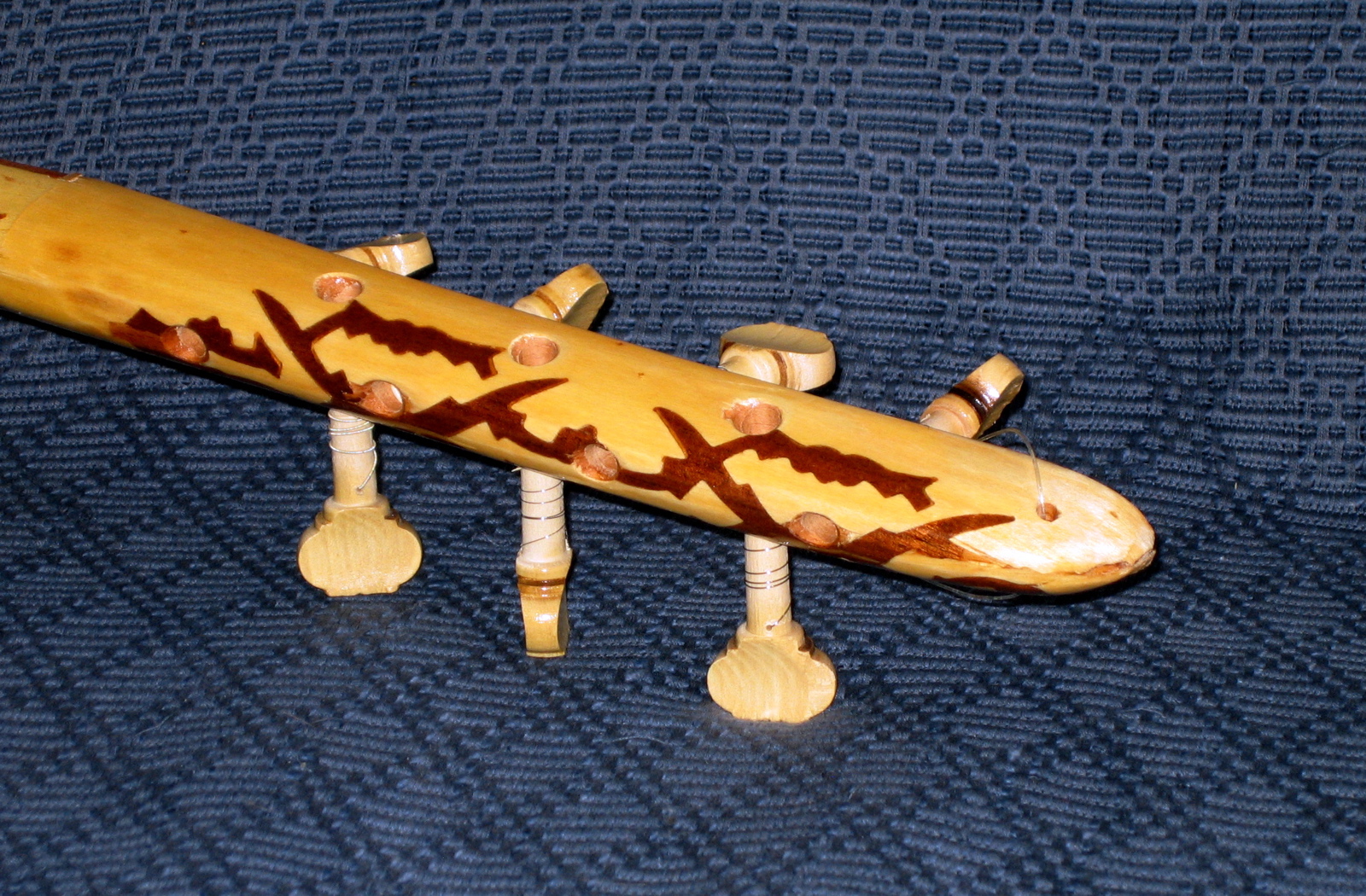
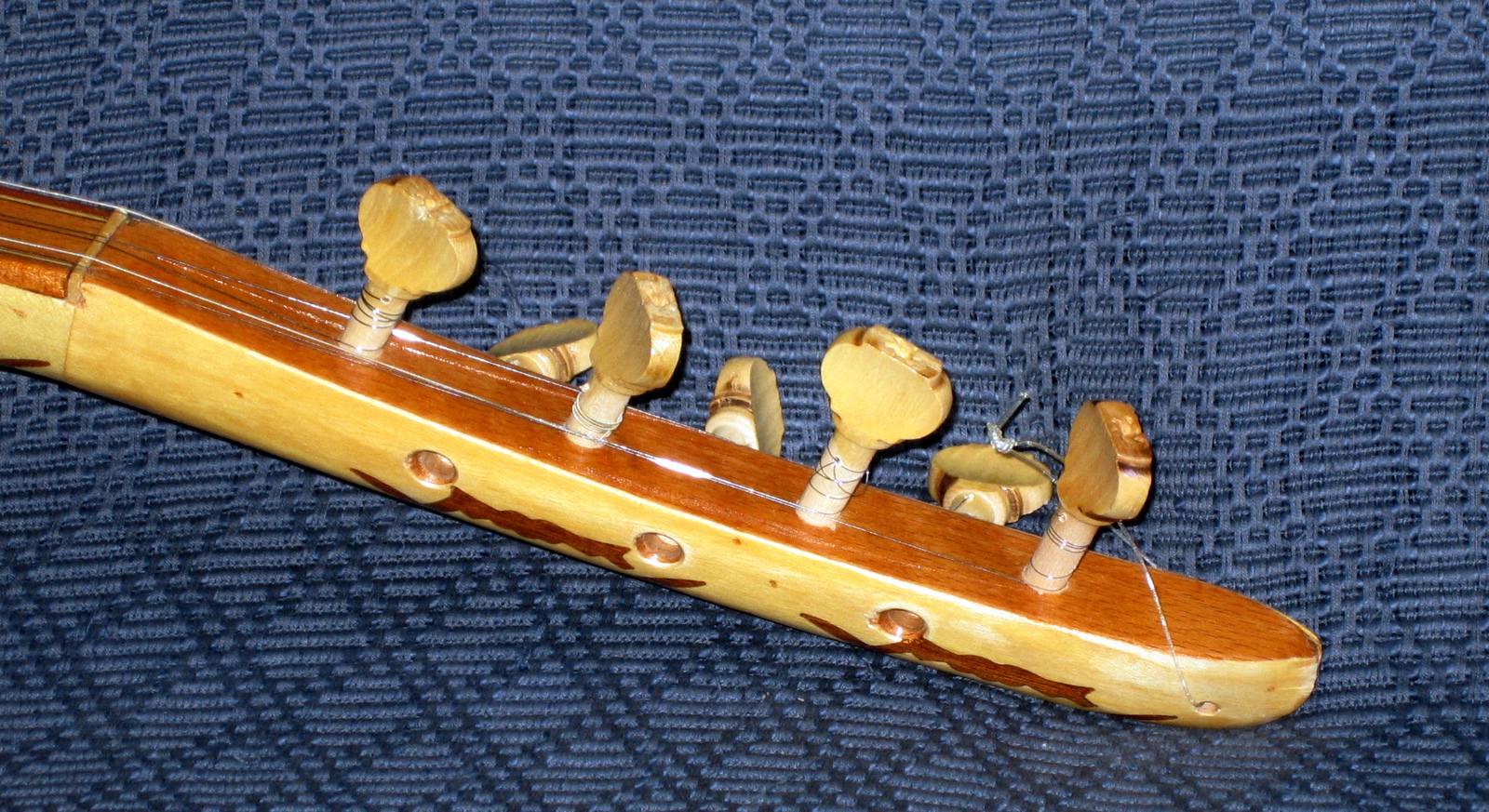
The top nut is a piece of maple.

The bowl-back body has been crafted from multiple stripes of what looks like walnut.
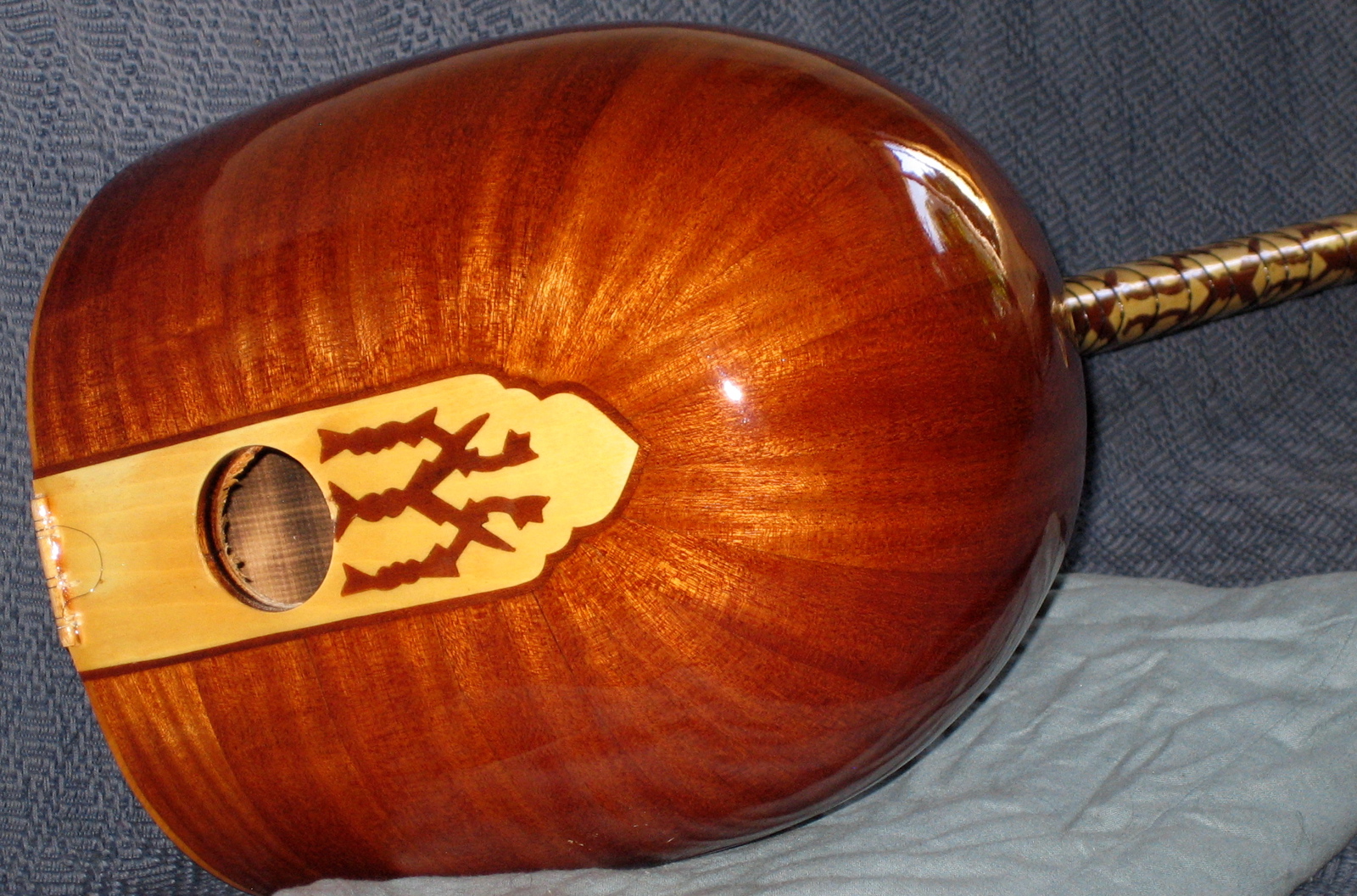
The neck joint is also beautifully inlaid.


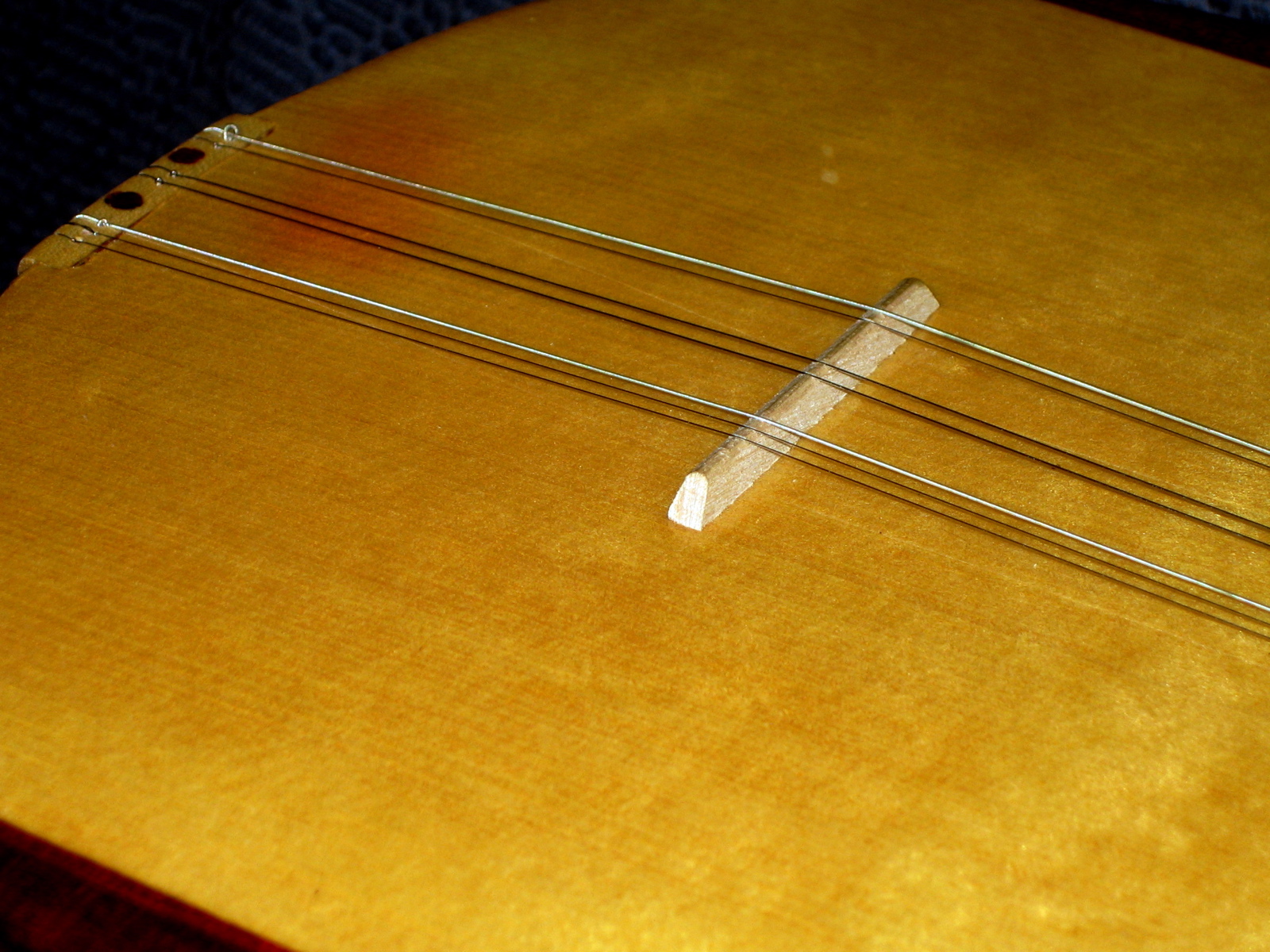
The maple bridge stands atop the solid spruce top.
You pluck the saz with either your fingers or using colourful, soft plecks.

****
There are many known tunings for the baglama saz, depending upon the region where the players come from, the type of tune which is played, as well as the singer’s vocal range. The use of personal tunings is standard practice.
At first I used higher tunings, but recently I have settled on a relatively low, warm-sounding tuning of c-g-d.
My tuning sounds like this: Baglama Saz c-g-d-tuning
Using this tuning I can easily play scales atop tonic (C-major/-minor) ja dominant (G-major/-minor) drones.
****
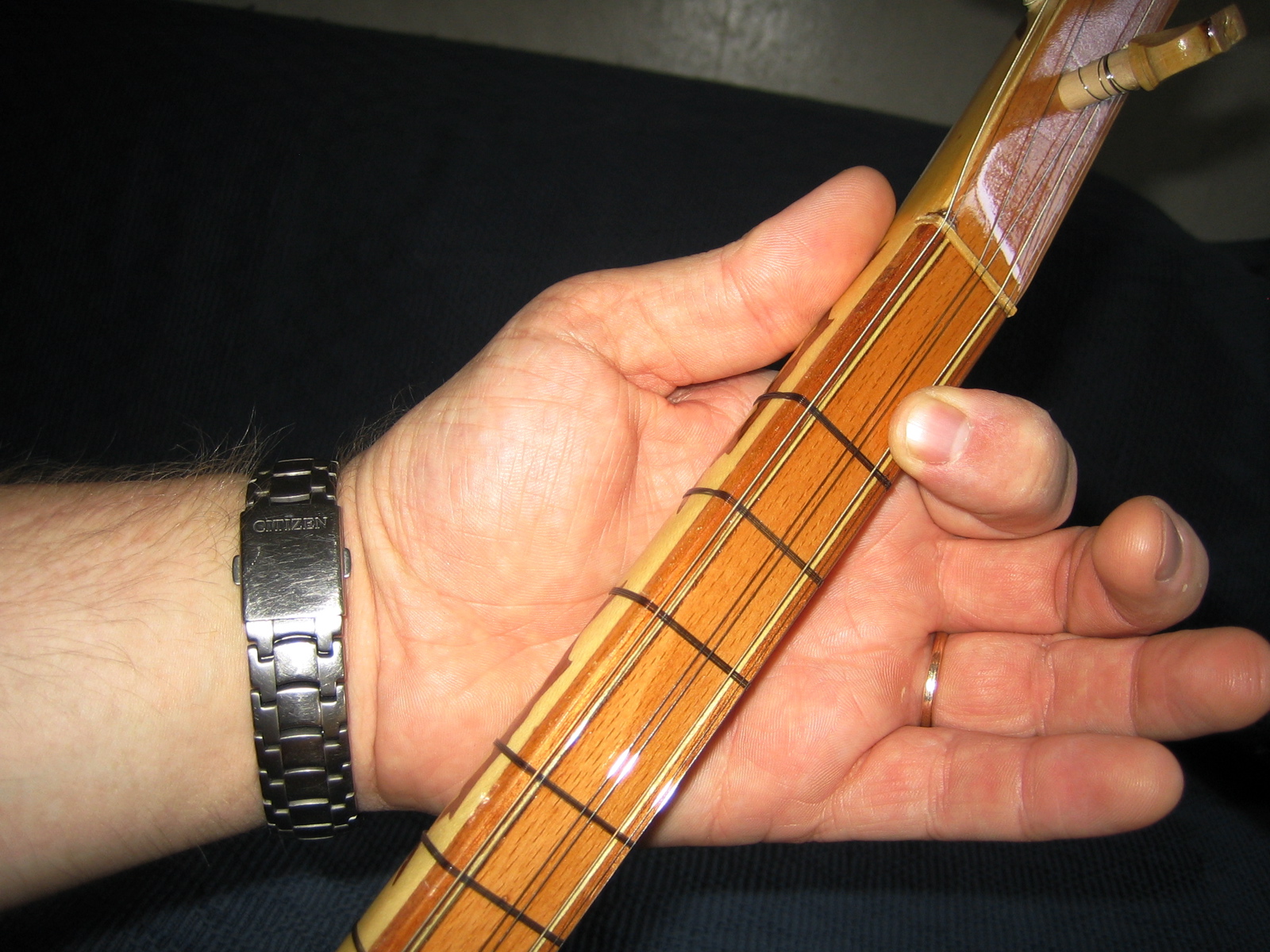
This is what a C-minor chord looks like in my tuning:
****
And this here would be a G5 (no 3rd) -chord:

****
Here’s a track I used the saz on (tuned in a higher tuning):
****
Baglama saz on turkkilainen kansansoitin, joka on myös suosittu Irakissa, Iranissa ja Kurdialueilla. Persialainen sana ”saz” tarkoittaa ”musiikkia” (tai ”soitin”) ja baglama on kreikkalaisen busukin ja italialaisen mandoliinin esi-isä.
Rakas vaimoni toi minulle – muutama vuosi sitten – sazin yllätyksenä mukaan Istanbulista, missä nämä soittimet ovat verraten edullisia.
En ole sataprosenttisesti varma kaikista minun baglama sazissa käytetyistä puulajeista, mutta kaula näyttää olevan katajasta kauniilla pähkinäpuu upotuksilla.
Nauhat ovat nylonlangasta ja otelauta pyökkiä.
Minun sazissa on seitsemän kieltä kolmessa ryhmissä – kaksi ”alhaalla” (yksi punottu), kaksi keskellä ja kolme ”ylhäällä” (yksi punottu). Alhaalla tarkoittaa siellä missä kitarassa olisi paksu ala-E-kieli.
Virittimet ovat yksinkertaisia puutappeja.
Satula on veistetty vaahterasta.
Kupera, pisaramainen koppa on kasattu useasta pähkinäpuupalasta.
Kaulaliitos on koristeltu näyttävästi.
Kuusikannen päällä seisoo baglama sazin pieni vaahteratalla.
Sazia soitetaan pehmeillä värillisillä plektroilla.
****
Baglama sazille löytyy monta eri viritysvaihtoehtoa biisimateriaalin ja soittajan kotipaikasta riippuen. Myös omien virityksien käyttäminen on sallittu.
Alussa käytin korkeampia virityksiä, mutta nykyään pidän eniten melko matalasta ja lämminsoundisesta c-g-d-virityksestä.
Se kuulostaa tällaiselta: Baglama Saz c-g-d-viritys
Tällä virityksellä saa helposti soitettu melodioita toonikan (C-duuri/-molli) ja dominantin (G-duuri/-molli) päälle.
****
Tältä näyttää C-molli-sointu:
****
Ja tämä on G-sointu:
****
Tässä rock-tyylinen soundiesimerkki (toisella virityksellä soitettuna):
****


Last Monday Carlos Santana and his excellent band played in Helsinki’s football stadium (that’s soccer to you Americans).
Fantastic sound, great musicianship – it really was one of the best concerts I’ve ever been to!
If you have a chance to see Santana on the current European tour, you should really do so 😉
____________________________
I simply adore Carlos’ lead sound.
Here’s a short bit paying homage to the man: Hairloss Manana
I recorded it using two review guitars:
• a PRS SE Custom for the rhythm parts
• a PRS McCarty for the lead
I’m not ashamed to admit I used a Behringer V-Amp2 in front of my Pro Tools -system.
________________________________
Last month I recorded this song to test a Tascam Portastudio for Riffi: Guitar (G-A-S)
I didn’t plan on recording something Santana-ish – it simply happened.
By the way, the whole thing was recorded using only real instruments (and without a click-track).
The guitar is an Epiphone Slash Goldtop through a Mad Professor Little Green Wonder into a Fender ’57 Twin-Amp reissue.

Here are three soundbites I recorded for you of three different P-90 bridge pickups on three different guitars:
• the Epiphone Casino has Göldo pickups with metal covers
• the Vintage VS6 Mick Abrahams has Wilkinson soapbars with plastic covers
• the Gibson Les Paul Junior comes with a Gibson P-90 and a plastic dog-ear cover
All guitars were played through a clean Fender-type amp model with a Boss SD-1 in front.
Tässä ovat kolme soundiesimerkkiä kolmesta kitaroista ja niiden P-90 tallamikrofoneista:
• Epiphone Casinossa on Göldo-mikit, joilla on metallikansi
• Vintage VS Mick Abrahams -nimikkomallissa on Wilkinson-mikit muovikansilla (saippuapalat)
• Gibson Les Paul Juniorissa on firman oma P-90 muovikannella
Kaikki kitarat soitettiin puhtaan Fender-tyylisen mallinnuksen ja Boss SD-1 pedaalin läpi.


Rickenbacker was one of the first manufacturers to latch onto Leo Fender’s idea of an electric bass with a proper long scale.
In 1957 they introduced their first bass model, the 4000, which was the world’s first through-neck bass.
Rickenbacker’s two-pickup model – the Rickenbacker 4001 (introduced in 1961) – turned out to become one of the company’s most successful instruments. Paul McCartney and Chris Squire are probably the bass’ best-known users – they played the 4001’s export version 4001S.
In 1979 Rickenbacker came up with a model updated for use with roundwound strings. The new bass was named the 4003 and it featured new truss rods (Rickenbackers always have two!) and more powerful singlecoil pickups with the neck unit moved slightly closer towards the bridge.
My own Rickenbacker 4003 was built in 1987.

Except for the rosewood fretboard, a 4003 is crafted completely from maple. The neck goes all the way from the headstock to the end of the body (a so-called Through-Neck), while the body is formed by two pieces of maple glued to the neck’s sides.

Rickenbacker typically uses a reddish type of rosewood for their fingerboards, which are usually gloss-lacquered. Another typical company trait is the narrow binding, which leaves a visible gap between the binding and the neck’s finish.

The tuning machines have been made in Germany by Schaller.


Rickenbacker’s idiosyncratic bridge design includes an adjustable string mute mechanism. Setting the correct octave compensation is a little bit more complicated than it need be – you have to detune the strings to get to the adjustment screws.

Alongside the use of maple as the instrument’s main ingredient the 4003’s singlecoil pickups play a large role in this model’s throaty tone. Most users remove the bridge pickup’s metal cover, as it tends to get in the way of your right hand.

The silver metal finish is kind of rare, even though a similar bass appeared on the cover of Rickenbacker’s bass catalogue in the mid-80s. The most popular finishes are ”Fireglo” (a red sunburst), ”Jetglo” (black) ja ”Mapleglo” (natural gloss finish).

 Kitarablogi.com – Finland's premier Guitar and Bass blog