F-Musiikki ja Rockway.fi järjestävät jo perinteeksi muodostuneet Musiikin Avoimet Ovet -opetusmaratonin F-Musiikin suurmyymälässä Vantaalla. Ilmaiset livelähetykset klinikoista alkavat klo 17.00. Tämänkertainen teema on ”Yhden Biisin Tarina”. Suomen eturivin biisintekijöistä mm. Jussu Pöyhönen (Suurlähettiläät), Janne Huttunen (Anna Abreu, Pete Parkkonen, Robin) ja Esa Eloranta (Katri-Helena, Kari Tapio, Pate Mustajärvi) avaavat teemaa kertoen omia kokemuksiaan jonkun tunnetun biisin tekovaiheista. Mistä idea lähti, millaisia tekniikoita käytettiin, mitä haasteita kyseisen biisin kirjoittamisessa oli ja paljon muuta.
Opetussuunnitelmaan kuuluu myös arvokasta tietoa kitaran säätämisestä (soitinrakentaja Heidi Meri), sopivan soittimen valinnasta (Paavo Kuukasjärvi ja Juha Pöysä), demon äänittämisestä ja miksauksesta (Jaakko Roiha) sekä Teoston puheenvuoro (Antti Rask) teoksen käytöstä ja siihen liittyvistä juridisista seikoista.Tarkemmat tiedot aikataulusta ja klinikoitsijoista löytyvät osoitteesta www.rockway.fi/klinikat
Tapahtuman aikana jaetaan yli 5000 € edestä palkintoja. Arvomme tasatunnein 24 kappaletta Yamahan F310 -teräskielistä kitaraa kaikkien Rockway.fi sivustolle kirjautuneiden katsojien kesken. Kirjautuminen ja tapahtuman seuraaminen livenä on täysin ilmaista!
F-Musiikin verkkokauppa on aktiivinen koko tapahtuman ajan. Verkkokaupan erikoistarjoukset vaihtuvat noin tunnin välein alkaen 23.01.2015 klo 17.00.
F-Musiikki Vantaan myymälän aukioloajat:
Perjantai 23.01.2015 klo 10 – 19
Lauantai 24.01.2015 klo 10 – 17
Hughes & Kettner’s Red Box has been a runaway success, ever since the first version was introduced in the late Eighties.
The Red Box is a specialised DI-box for your guitar amp. Traditionally, DI-boxes are meant to transform the high impedance signal of an electric guitar (or bass) into a low impedance signal fit for direct connection to a recording (or PA) console.
The Red Box, on the other hand, is inserted between the amp’s speaker output and the speaker (cabinet). Hughes & Kettner’s analogue cabinet modelling then makes it possible to send the sound of a miked up guitar speaker to the mixing desk (or sound card) without having to actually put a microphone in front of the amp’s speaker.
Hughes & Kettner haven’t been resting on their laurels, though. They have updated and improved the Red Box every once in a while, with the most recent version being the Red Box 5 tested here.
****
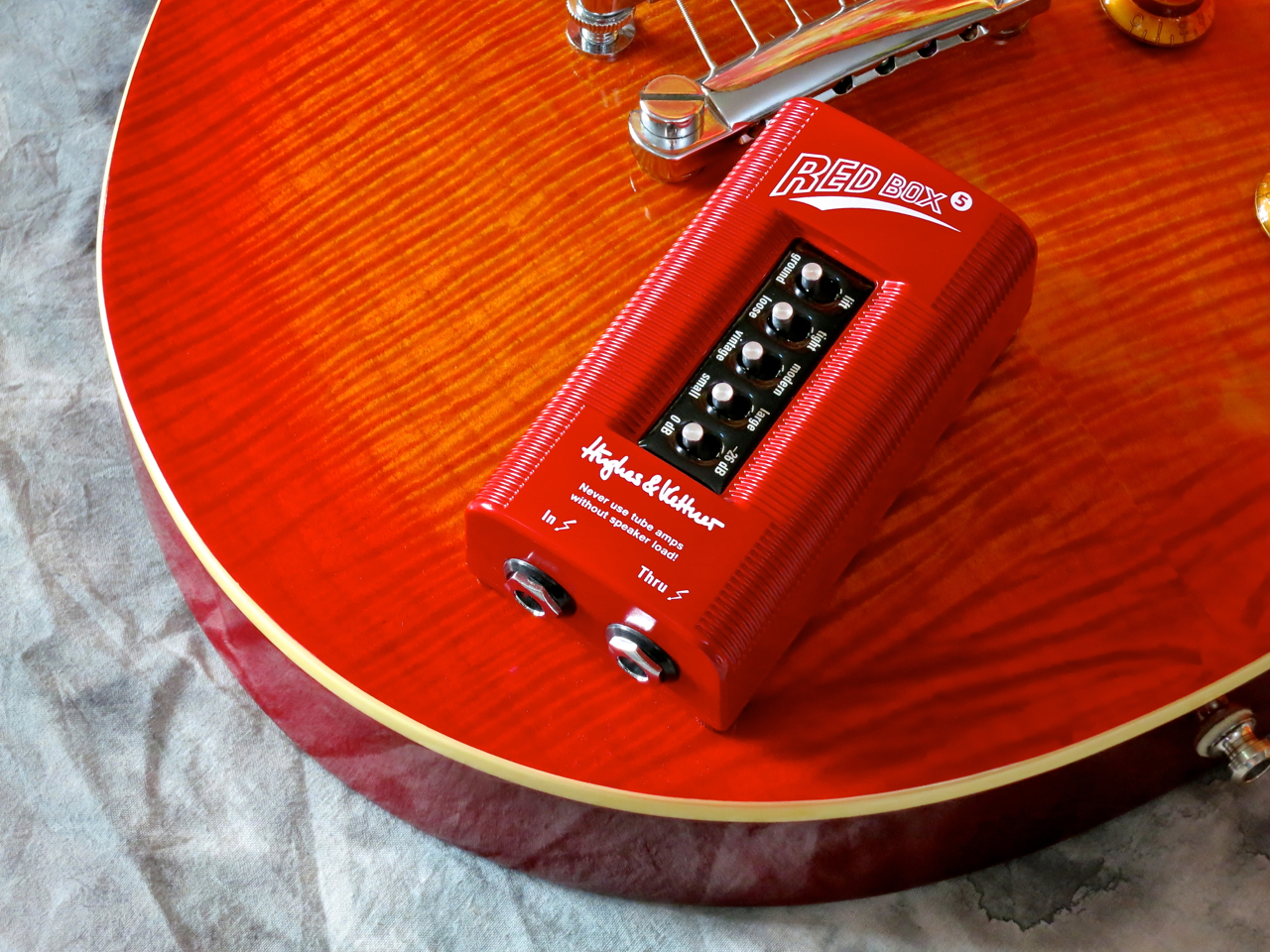
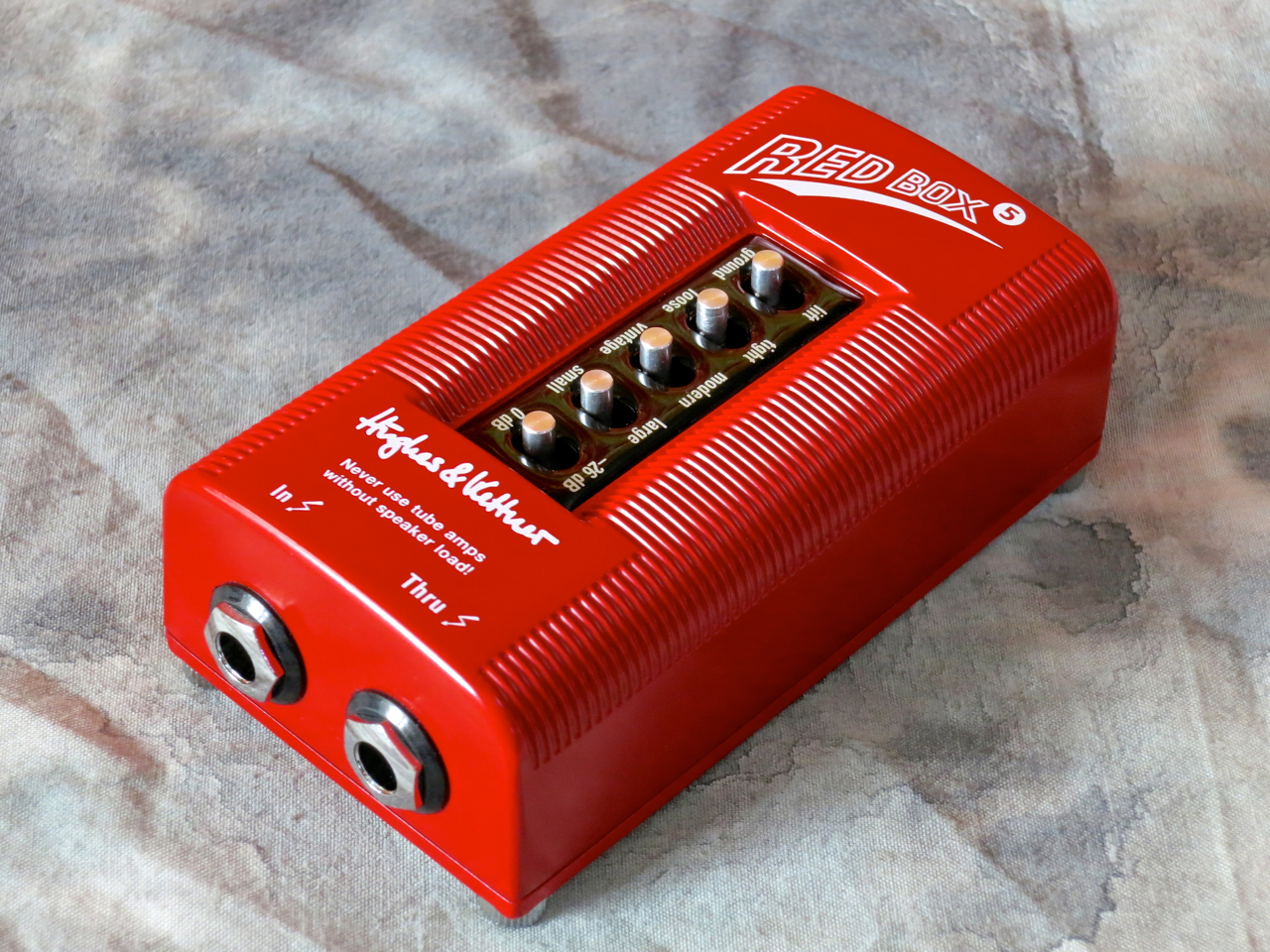
The Hughes & Kettner Red Box 5 (current price in Finland:89,90 €) feels like a sturdy little blighter in its very compact cast-metal casing.
The Red Box’ switch panel has been sunk into the unit’s face, keeping the switches secure from mechanical damage or accidental changes to the settings.
Guitarists and guitar techs will rejoice in the fact that this little helper isn’t finicky when it comes to its power supply:
The Hughes & Kettner works just as well running on an internal 9 volts block, as it does powered by phantom power off the mixer, an external PSU. The Red Box will work with voltages from 9 to 12 V DC (centre negative) or even AC. So, finding a wall wart for this device should be a piece of cake!
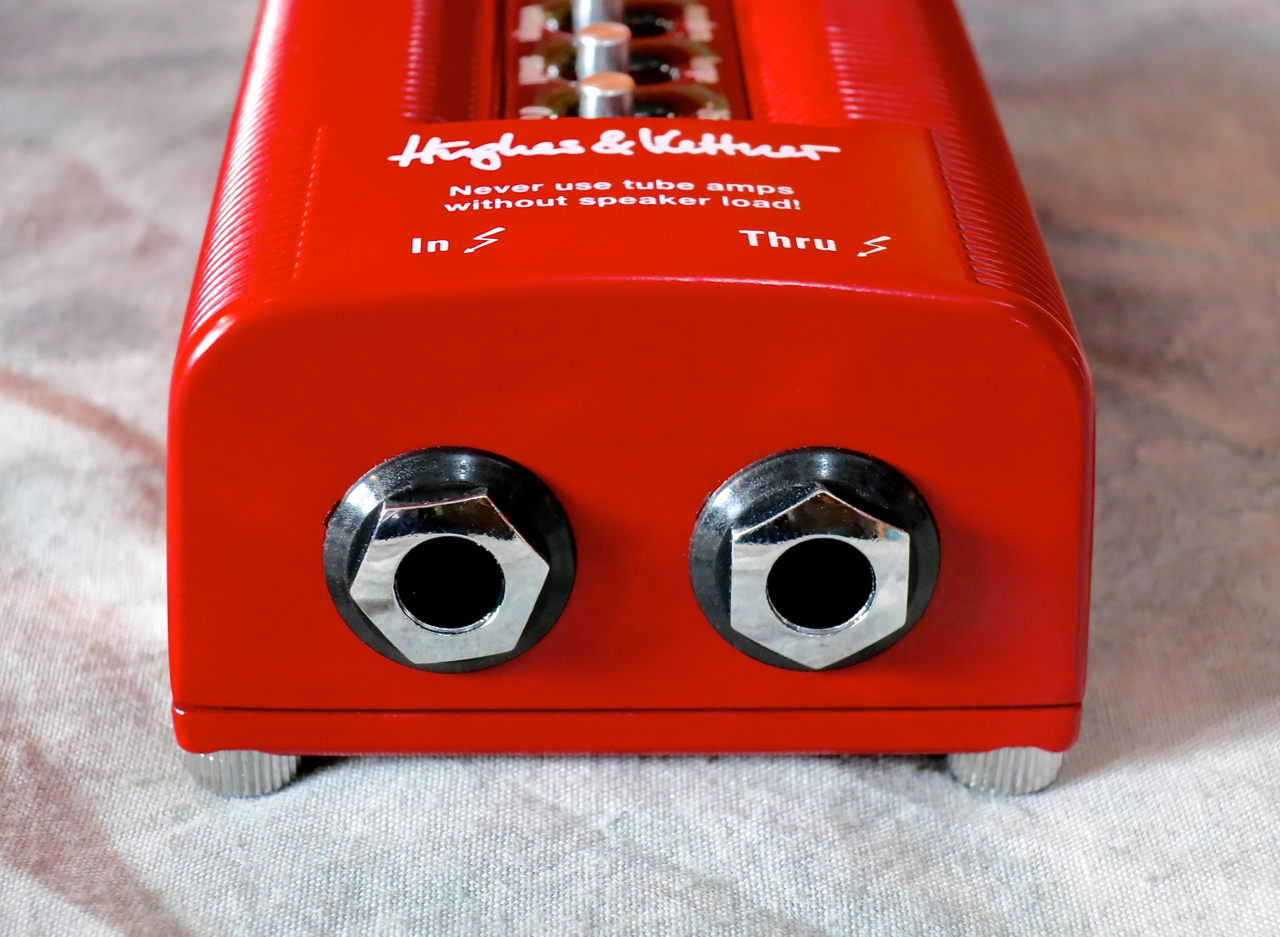
The speaker connectors have been placed at the Hughes & Kettner’s bottom end:
The amp’s speaker output is connected to the Red Box’ In-jack, while the Thru-jack will send an unadulterated signal to your speaker (cabinet).
It is very important that you don not confuse the Red Box – which is a DI-box – with a dummy load! If you’re using a valve amplifier (or a hybrid with a tube power amp) you really have to make sure to have the correct speaker load (in ohms) connected, whenever you use the amp. Using the Red Box without a speaker or dummy load will fry your amp’s power section or audio transformer!
The Red Box’ top end holds the balanced XLR DI-output, as well as the power supply (not included) connector.
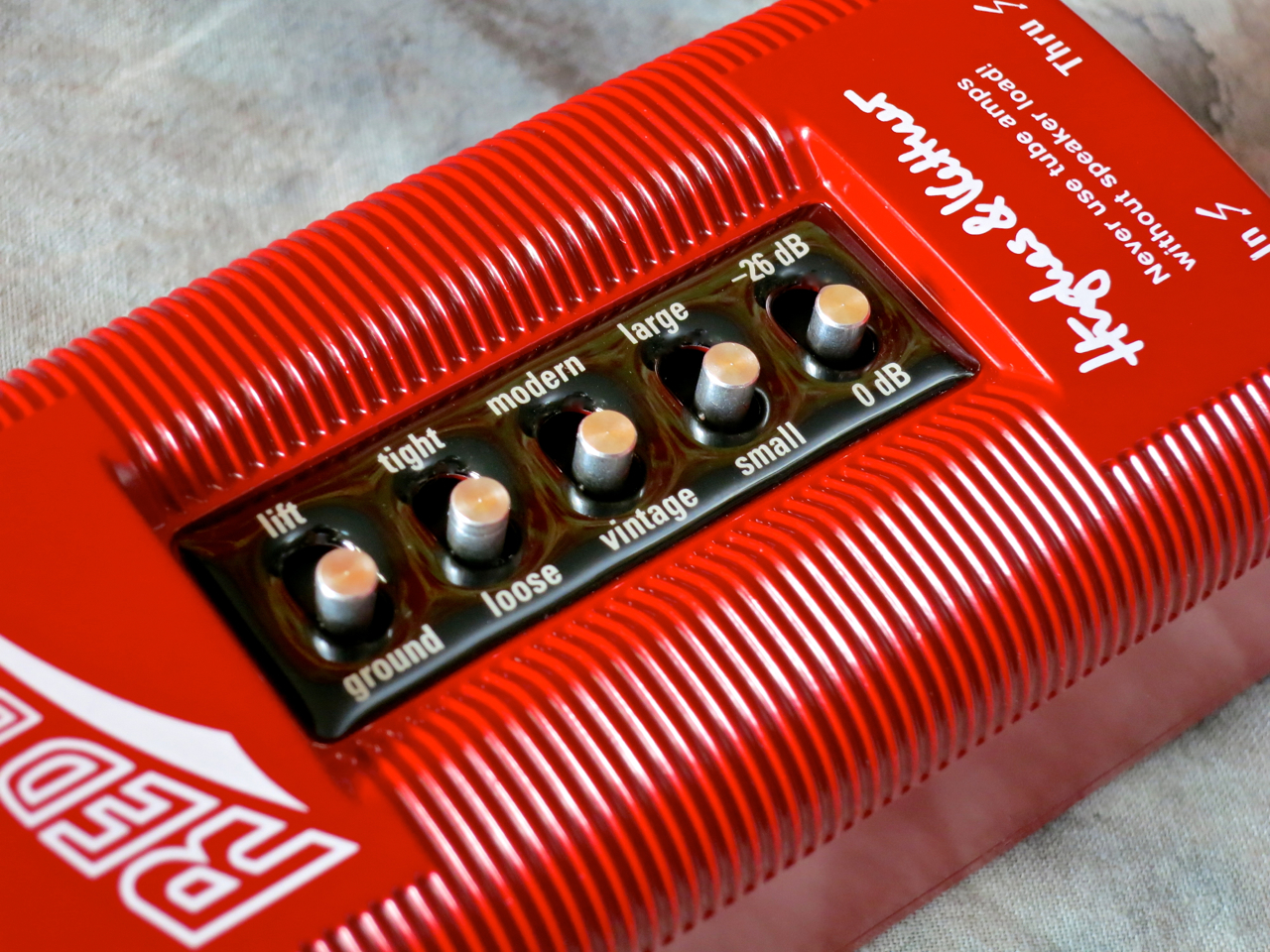
The Hughes & Kettner unit offers you five switches to tailor the DI-box’ output to your specific requirements:
There’s a ground lift switch (to cut any humming ground loops), a bass response switch, modern or vintage pre-EQ, a switch for the size of the virtual cabinet, as well as a 26 dB pad to prevent the DI-signal from overloading the console’s input.
A black velvet bag is also thrown in with the Red Box.
****
A ”great guitar sound” is probably one of our universe’s most subjective matters. Any guitar signal chain offers plenty of different variables. When you throw in the chosen cabinet, as well as the microphone and its placement relative to the speaker, the options available are virtually infinite. Nobody in their right mind can demand that a small DI-box, such as the Red Box 5, can actually offer any and all of the tonal options theoretically possible.
The Hughes & Kettner Red Box 5 raison d’être is to offer a handful of ”Best of” miked cabinet sounds, straight off of the amp’s speaker output to the mixing console (or sound card), without the hassle of having to set up a physical microphone, or having to account for the different sound characteristics of different rooms (for example on a tour). And in this the Red Box 5 truly excels.
To give you an idea of how well the Red Box 5’s sound stands up to a physical microphone, I have recorded a few clips simultaneously using a Shure SM57 and the Red Box. I used a Blackstar HT-1R running into an Änäkäinen Rumble speaker. The Red Box 5 was set to ”loose”, ”vintage” and ”large”.
Here’s a clean example, close-miked with the Shure:
And here’s the same example recorded direct with the Red Box:
Next I went for a crunchy amp sound; here’s the close-miked version:
And this is the same example DI’d through the Hughes & Kettner:
****
Hughes & Kettner’s Red Box 5 is a fabulous tool, especially for onstage use. No need to put up a mic anymore, which means no more feedback and bleed problems. The Red Box 5 will give you consistently excellent DI’d guitar amp tones with the least amount of hassle.
Ensimmäinen versio Hughes & Kettnerin Red Boxista ilmestyi jo 1980-luvun loppupuolella, ja nerokkaasta laitteesta tuli nopeasti menestystuote.
Red Box on kitaravahvistimelle tarkoitettu erikois-DI-boksi. Perinteisen DI-boksin leipätyö on muunnella soittimesta lähtöistä korkeaimpendanssista signaalia mikserille sopivaksi matalaimpendanssi-signaaliksi.
Red Box taas kytketään kitaravahvistimen kaiutinlähdön ja kaiuttimen väliin, ja sen ansiosta saadaan kaiutinmallinnuksella höystettyä signaalia suoraan mikseriin, täysin ilman kaiuttimen eteen laitettavia mikrofoneja.
Hughes & Kettnerin tuotekehitys on edennyt vuosikymmenien mittaan jo Red Box -vitosversioon – oli siis korkea aikaa tutkiskella päivitetyn laitteen toimintaa ja soundia.
****
Hughes & Kettner Red Box 5 (89,90 €) tuntuu hyvin kestävänoloiselta, sen kompaktin, valumetallisen kotelonsa ansiosta.
Red Boxin koteloon upotettu kytkinpaneeli suojaa kytkimiä tehokkaasti mekaaniselta rasitukselta, sekä tahattomilta asetusmuutoksilta.
Kitaristin ja teknikon iloksi uusille Red Boxeille voi syöttää monenlaista sähköä:
Tämä Hughes & Kettner toimii sekä 9 voltin paristolla, mikserin phantomsyötöllä tai ulkoisen virtalähteen sähköllä, jolloin Red Boxiin voi syöttää 9-12 volttia joko tasavirtana (miinus keskellä) tai vaihtovirtana. Sopivan verkkolaitteen löytäminen ei siis pitäisi olla tässä tapauksessa ongelma!
Hughes & Kettnerin alareunasta löytyy boksin kaiutinliittimet:
Vahvistimesta tuleva kaiutinjohto kytketään In-tuloon, kun taas Thru-lähdön signaali menee eteenpäin kaiuttimelle.
On erittäin tärkeä korostaa, että Red Box 5 ei ole keinokuorma, vaan ainoastaan DI-boksi! Jos käytössä on putkivahvistin (tai putkipäätteellä varustettu hybridi), vahvistinta saa ainoastaan käyttää sopivalla (= oikea ohmiarvo) kaiuttimella/kaiutinkaapilla tai keinokuormalla, riippumatta siitä käytetäänkö Red Boxia vai ei. Putkivahvistimen käyttäminen ilman asianmukaista kuormaa rikkoo (käytännössä väistämättä) laitteen audiomuuntajan!
Red Boxin yläreunaan on asennettu laitteen balansoitu XLR-lähtö mikserille, sekä liitin virtalähteelle.
Hughes & Kettnerin viidellä kytkimellä voi hienosäätää DI-boksin toimintaa ja soundia:
Tarjolla on maalenkin katkaisin, bassokarakteerikytkin, modern/vintage-valitsin, kaappikokokytkin (small: kombo; large: 4 x 12 -kaappi), sekä 26:n desibelin padi DI-signaalille.
Pakkauksesta löytyy myös musta samettipussi kuljetusta varten.
****
”Hyvä kitarasoundi” on ehkä yksi maailmankaikkeuden subjektiivisimmista asioista. Signaaliketjussa sinänsä on tavallisesti jo suuri määrä muuttuvia tekijöitä. Kun soppaan lisätään vielä kaapin mikitykseen käytetty mikrofoni, sen asento kaiuttimeen nähden ja mikin etäisyys, soundien kirjosta tulee miltei ääretön. Olisi täysin kohtuutonta vaatia tämänkaltaisesta DI-boksista samankaltaiset laajat muokkausmahdollisuudet.
Hughes & Kettner Red Box 5:n idea onkin tarjota käyttäjälle mahdollisimman luonnollisen kuuloisia Best of -vaihtoehtoja tyypillisistä kitarakaappisoundeista, suoraan vahvistimesta mikseriin, täysin ilman mikkiasetuksesta tai huoneakustiikasta johtuvia häiriötekijöitä. Ja juuri siinä Red Box 5 onnistuu mielestäni loistavasti.
Seuraavissa klipeissä on samat pätkät vertailun vuoksi äänitetty sekä ”akustisesti” Shure SM57 -mikrofonilla että suoraan Red Boxilla. Käytin Blackstar HT-1R -vahvistinta ja Änäkäinen Rumble -kaappia. Hughes & Kettnerin kytkimillä oli valittu asetukset ”loose”, ”vintage” ja ”large”.
Tässä on lähimikitetty puhdas pätkä:
Tällaiselta sama pätkä kuulostaa Red Box 5:llä äänitettynä:
Shurella poimittu särösoundi oli tällainen:
Sama pätkä suoraan Hughes & Kettnerin kautta äänitettynä:
****
Hughes & Kettner Red Box 5 on mainio työkalu etenkin lavalla. Red Box 5:llä pääsee viimein mikrofonin kanssa häsläämisestä, ja se poistaa näin myös tehokkaasti mikrofonin feedback- ja vuoto-ongelmat. Jäljellä jää erittäin laadukas kitarasoundi päivästä toiseen.
The good people of EBS Sweden are now bringing a healthy dose of fuzz to the bassist’s toolbox.
****
The EBS FuzzMo (current price in Finland: 169,90 €) is a fuzz-type high gain distortion developed especially for bass.
This stompbox is made in China to the EBS’ exacting standards. It’s a sturdy pedal with very positive feeling controls.
The FuzzMo can be powered in three ways:
If you use an EBS amp from the Drome-, Gorm-, HD- or TD-series, you can use a TRS-cable (aka a stereo cable) to feed phantom power from the amp to the effect pedal.
The FuzzMo pedal also runs off a standard 9 V battery, but you will need a screwdriver to take off the base plate first.
The third alternative is to employ a Boss-type power supply (9 V DC, centre negative) to fire up the stompbox.
****
Even though the EBS FuzzMo looks somewhat similar to the company’s Billy Sheehan -pedal, the controls on the fuzz work in a different way.
The FuzzMo doesn’t do ”nice and sweet” – the Gain control offers fuzz from medium-crunchy to balls-to-the-wall-fuzz. Shape adjusts the tone of the fuzz effect – not in the way a traditional tone control does, but rather by changing the waveform of the fuzz signal. At seven o’clock the sound is quite warm and organic with the waveform approaching a square, while five o’clock is far brighter and more aggressive with the waveform resembling a triangle.
The mini-switch underneath the FuzzMo-logo (called Character) also plays an important part in the stompbox’ sound:
Switched to the left no EQ’ing is applied to the signal (FLAT). In the middle position there’s a slight attenuation of the mid-range. SCOOP on the right side results in a very Metal-style scooped-mid tone with plenty of bite.
Modern bass effects often split the bass signal at the input. One half is fed through the effect, while the other half is kept dry and mixed into the wet signal before it reaches the output. The advantage of doing things this way is that it enables you to keep your bottom end and dynamic attack intact.
This is just the way EBS’ FuzzMo works, too:
You use the Volume knob to adjust the fuzz signal’s volume level, and then use the Blend control to add the desired amount of dry bass. This feature is especially important in fuzz pedals for bass, because the hard clipping of a fuzz effect practically negates all your playing dynamics by design. With the FuzzMo there will be no problems with your tone becoming mushy, clogged up and indistinct, because the Blend control lets you restore your bass guitar’s punch and low end.
Here’s a bit recorded with a Jazz Bass (both pickups on) and a relatively low Gain setting:
In this clip I added some more fuzz and bite to a Rickenbacker played with a plectrum:
Thanks to the ability to blend in the dry signal, the EBS FuzzMo also works extremely well with a five-string (in this case a Yamaha BB with active EMGs):
Note that on all these audio clips the Gain control stayed below one o’clock. If you want you can take things much, much further with this EBS-pedal!
The FuzzMo is a typical EBS-pedal – it’s a sturdy, pro-quality stompbox and it sounds great. If you’re a purveyor of sleazy, dirty and aggressive bass tones, you should definitely give this baby a spin!
German maker Duesenberg is known for its high-quality guitars and basses, that combine seamlessly Art Deco-chic and ingenious improvements in many details, such as the hardware and electronics departments.
The Duesenberg D-Bass is a good example of this, promising both P- and J-style tones from a passive, one-pickup instrument.
****
The Duesenberg D-Bass (current price in Finland:1.729,90 €) proves that you can build a bass from classic tonewoods without having to resort to copying others.
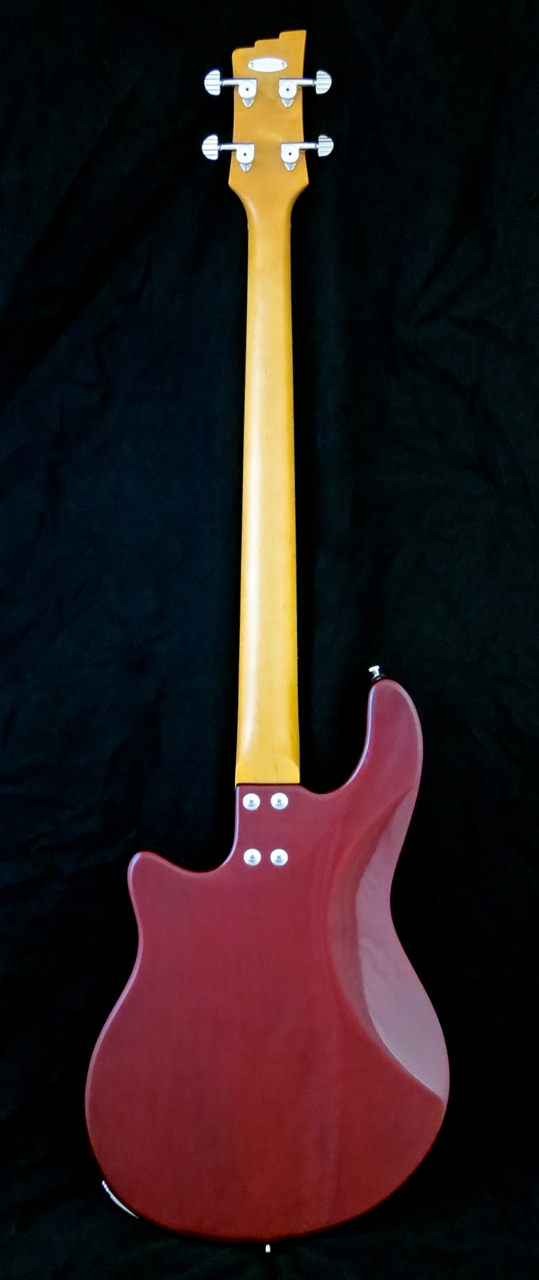
This is a four-string, passive bass, built using a bolt-on maple neck with a rosewood fretboard mated to a bound alder body. The top of the body sports elegant carving.
The generous rib cage bevel adds a great deal of comfort to the D-Bass.
The body comes in a fetching gloss finish, while the neck has received a thin, vintage-tinted satin finish.
I feel that Duesenberg’s three step headstock looks even better in its bass guise than the smaller guitar version.
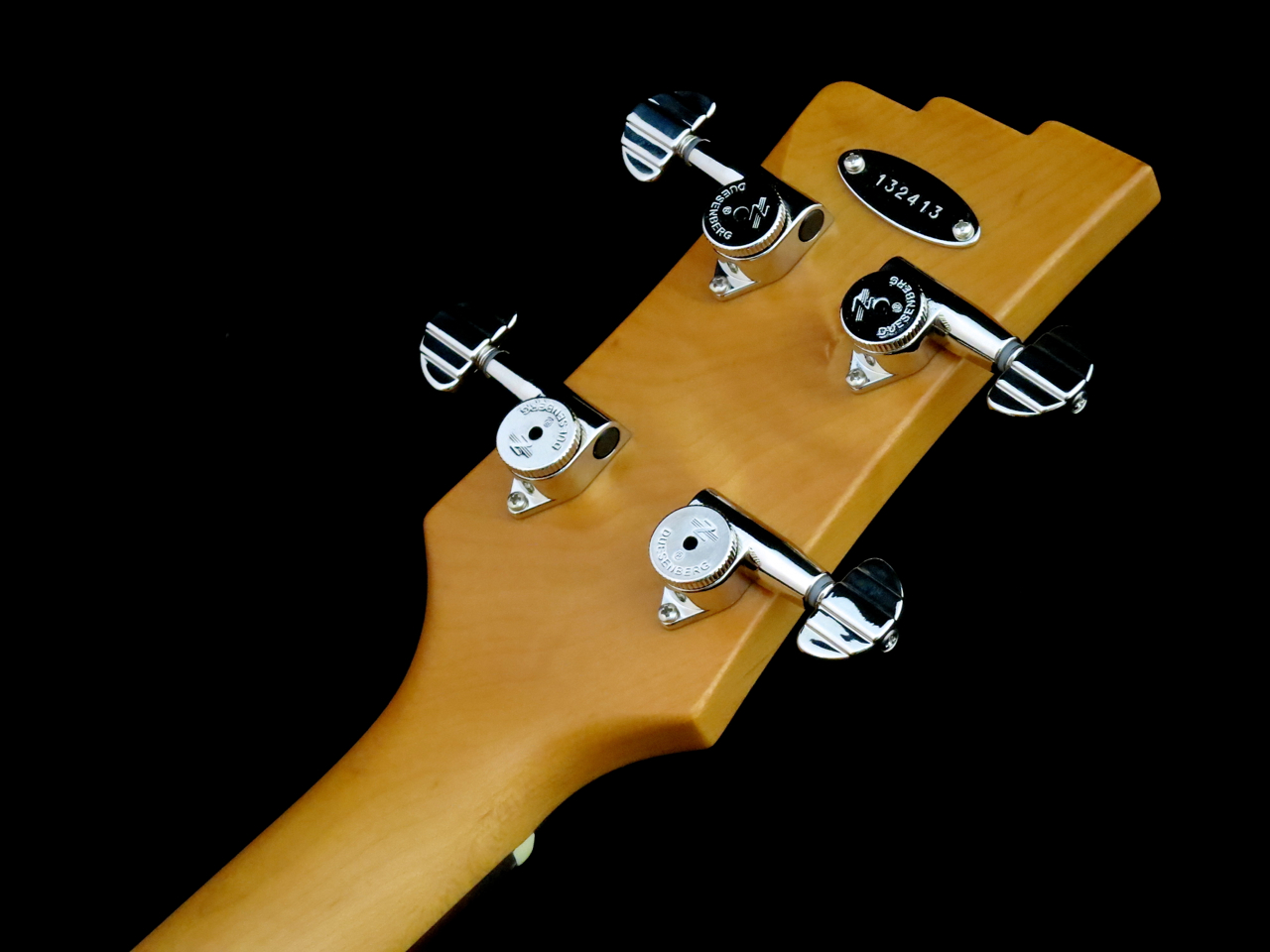
Duesenberg use their own locking Z-Tuners on the D-Bass. The string is first fed into a well in the tuning post until it comes out of a small hole in the tuning machine’s back. You cut off the surplus length of string, pull back the string by a couple of millimetres, lock it in place and tune up. Voila, a clean and uncluttered solution that leaves no sharp string ends.
Duesenberg employ a PLEK-robot to give all their instruments a perfect fret job and set-up.
Thanks to the angled neck joint an excursion to the dusty end of the fretboard is fast and easy on the D-Bass.
Duesenberg’s bridge and tailpiece combo are made of chunky bits of milled brass.
In addition to action and intonation the bridge also offers the adjustment of string-to-string distance. After adjustment you can lock everything in place with allen grub screws.
The D-Bass’ two-part pickup is situated on its own, oval pickguard.
Duesenberg’s Toaster-pickup may resemble a Fender Precision-pickup, but it really has its own thing going on in terms of construction. While the venerable P-Bass is equipped with two singlecoil pickups (one for each pair of strings), which are hooked up to form a humbucking unit, Duesenberg’s design uses two small humbuckers with open covers.
The passive controls are found on the bass’ larger pickguard and comprise a master volume, the Mid-Shift control and a master tone.
The Mid-Shift control uses a nifty bit of wiring voodoo:
When Mid-Shift is fully turned up, both coils of each pickup are used fully, but some of the top end signal is filtered by a capacitor. This is how the D-Bass achieves a P-style sound.
Turning the potentiometer counterclockwise fades out the signal of one of each humbucker’s coils, while lessening the capacitor’s effect on the signal. Fully counterclockwise, this gives you a brighter and more focussed, J-type tone.
You can find a similar wiring trick on Seymour Duncan’s web page, showing you how to wire up a humbucker in such a way that you can use a control pot for going from humbucking to singlecoil by feeding one of the pickup coils to earth.
The Duesenberg D-Bass comes in its own quality hard case.
****
Duesenberg’s bass is a beautiful instrument with a nice, medium weight and a great balance, both in you lap or hanging on a strap.
The neck profile is a Precision-style wide ”D”, but combined with the D-Bass’ larger fingerboard radius and its jumbo frets the playing feel is decidedly more modern and slinky than vintage.
My only small gripe is a strictly cosmetic one: I would like to see one or two screws added to the larger control scratchplate, as the current layout doesn’t make the plate fit snugly on top of the body’s top contour, leaving a few edges standing proud of the body surface.
This Duesenberg has a very healthy acoustic ring, completely devoid of any of the quirks often associated with vintage basses (like an over-enthusiastic low G or a dead spot around the high c).
Amped up you’re in for a real treat, as long as you’re not after that type of extreme EQ, only achievable with active preamps. Duesenberg’s Mid-Shift control is a really ingenious addition to the D-Bass, resulting in a much more organic palette of sounds than a mere coil-split could provide. The volume drop going from the P- to the J-variant is negligible, which is another positive effect of not using a straight coil-split.
I always play the same motif twice in each sound clip – first with Mid-Shift full on (P), then with Mid-Shift turned down fully (J).
****
I must say, I liked the Duesenberg D-Bass very much. It is a great instrument for connoisseurs of passive bass tones. The Mid-Shift control isn’t ”in your face”, but still manages to provide you with an ingenious way of tailoring the bass’ sound to your needs.
Rotosoundin loistava 1960s Reissue Fuzz -pedaali on nyt saanut kuusi efektiveljeä, jotka ovat kaikki efektiguru John Oramin käsialaa:
• The Wobbler on optinen tremolo pedaali, jolla on kaksi rinnakaista, silikoni- ja germanium-transistoreilla toteutettuja vahvistuspiiriä, joiden signaalia voi miksata portaattomasti.
• Phaser-pedaalin nimi on King Henry. Rotosound lupaa efektille erittäin maukasta soundia, jonka voi hienosäädellä Peak-nupilla.
• The Pusher on firman uusi kompressori, jota on varustettu omalla tone-säätimellä (Bite).
• Rotosoundin The Crusader maustaa soundisi syvällä ja lämpimällä choruksella.
• Analogiviiveen ystäville tarjotaan The Aftermath -nimistä pedaalia.
• Viimeinen efekti katrasta on kolmialueinen EQ-pedaali The Leveller.
EBS Swedenin uusin mausterasia tuo maukasta fuzzia basistin elämään.
****
EBS FuzzMo (169,90 €) on sähköbassoille suunniteltu fuzz-tyyppinen säröpedaali.
Kiinassa rakennettu efektiloota edustaa EBS:lle tyypillistä vankkaa tekoa, sen jämäkän oloisella jalkakytkimellä ja sulavasti toimivilla potikoilla.
Elektroniikan sähköntarpeen voi tyydyttää kolmella eri tavalla:
Jos on käytössä EBS:n Drome-, Gorm-, HD- tai TD-mallinen vahvistin, voi käyttää vahvistimen tarjoamaa phantom-syöttöä TRS-plugijohdon kautta. TRS-johto tulee silloin kytkeä FuzzMo:n lähdön ja vahvistimen tulon väliin.
FuzzMo-pedaali toimii toki myös perinteisesti yhdeksän voltin paristolla, mutta pariston vaihtamiseen tarvitaan ruuvimeisseliä, koska pohjalevy on ensin irrotettava.
Kolmas vaihtoehto on käyttää Boss-standardin mukaista virtalähdettä (9 V DC, miinus keskellä).
****
Vaikka EBS:n FuzzMo muistuttaa ulkoisesti firman Billy Sheehan -pedaalia, vaikuttavat fuzz-pedaalin säätimet kuitenkin hieman toisella tavalla soundiin.
”Mieto” ei ole FuzzMo:ssa homman nimi, sillä Gain-säätimen vaikutusalue menee keskivahvasta erittäin rankkaan fuzziin. Shape-nupilla säädetään säröefektin sointia, mutta kyseessä ei ole perinteinen tone-potikka, vaan yliohjauksessa syntyvän aaltomuodon säädin. Vasemmalla äärilaidalla on tarjolla orgaanisempi ja lämpimämpi kanttiaalto, kun taas toisessa ääripäässä lootasta lähtee kirkkaampi ja purevampi kolmioaalto.
Lopulliseen särösoundiin vaikuttaa vielä FuzzMo-logon alle sijoitettu minikokoinen vipukytkin:
Kun kytkin on vasemmassa asennossa, säröpedaalin EQ-osasto on pois päältä (FLAT). Keskiasennossa särösignaalissa vaimennetaan hieman keskialueen taajuuksia, kun taas oikealla laidalla (SCOOP) syntyy Trash-tyylinen, pureva särösoundi.
Nykyaikaisissa bassoefekteissä jaetaan bassosignaali usein heti tulon jälkeen kahteen. Puolet signaalista menee efektin läpi, kun taas toinen puoli miksataan ennen pedaalin lähtöä kuivana efektoituun signaaliin. Tämän menetelmän suuri etu on, että basson alkuperäinen dynamiikka ja pyöreys säilyy miltei ehjänä efektityypistä huolimatta.
Juuri tällä tavalla toimii myös EBS FuzzMo:
Volume-säätimellä asetetaan särösignaalin voimakkuutta ja Blendillä lisätään siihen sitten oman tarpeen mukaan basson puhdasta signaalia. Etenkin bassoille tarkoitetussa fuzz-pedaalissa tällainen ominaisuus on erittäin tervetullut, koska fuzz-piirit leikkaavat toimintaperiaatteensa takia etenkin soittodynamiikkaa melko rankasti. FuzzMo-pedaalilla ei synny ongelmia puuroutumisen kanssa, jollei juuri sitä halua.
Tässä on lyhyt esimerkkipätkä sormilla soitetusta Jazz-bassosta (molemmat mikrofonit täysille avattuna) ja hyvin miedolla fuzzilla:
Plektralla soitetuille Rickenbackerille lisäsin hieman enemmän, ja hieman purevampaa, säröä:
Puhtaan signaalin annostelun ansiosta EBS:n FuzzMo toimii myös mainiosti viisikielisen basson kanssa (EMG-mikrofoneilla varustettu Yamaha BB-malli):
On muuten syytä huomauttaa, että kaikissa esimerkkipätkissä Gain-säädin pysyi alle puoleksi avattuna. EBS-pedaalista lähtee tarvittaessa vielä huomattavasti rankempia soundeja!
FuzzMo on tyypillinen EBS-pedaali – se on kestävän oloinen laite laadukkaalla soundilla, joka sopii mainiosti likaisten bassosoundien ystäville.




















 Kitarablogi.com – Finland's premier Guitar and Bass blog